Metaverse

Home Metaverse Page 148

CLAPS Unveils Crypto Sportsbook With On-Chain Payments and Instant Fiat Access | NFT News Today

CLAPS Unveils Crypto Sportsbook With On-Chain Payments and Instant Fiat Access | NFT News Today


CLAPS, a Web3-native casino platform, launched its crypto sportsbook in May 2025. The addition extends its existing gambling services by introducing live and pre-match sports betting backed by on-chain deposits and fiat onboarding. Players can fund their accounts using BTC, ETH, BNB, SOL, or USDT, while fiat users access the platform through MoonPay integration. Wagers are executed off-chain for speed, while deposits and withdrawals remain verifiable on-chain. 

This hybrid infrastructure marks a growing move toward blockchain gambling, where platforms are expected to deliver both performance and provable control over funds.

CLAPS Takes Crypto Betting Mainstream

Originally focused on decentralized casino games, CLAPS now enters the sportsbook market to compete with hybrid platforms and established betting operators. Its direct-wallet structure eliminates the need for custodial accounts or third-party exchanges. Players interact using self-custodied crypto wallets, a model increasingly adopted by those prioritizing privacy and asset sovereignty.

Platforms like this one are part of a new generation of websites that allow crypto play, combining blockchain-backed accountability with real-money betting across multiple categories. CLAPS aims to extend that model into sports betting without altering its technical foundations.

Full Token Support and Transparent Transactions

The sportsbook supports a range of major digital assets. Among these, USDT stands out due to its role in enabling consistent transaction values in volatile markets.

According to Forbes, stablecoins such as USDT have unleashed a $10 billion global crypto casino boom by allowing fast, low-slippage transfers between players and platforms. CLAPS incorporates USDT not only as a practical deposit method but also to meet user expectations for speed and reliability.

Wallet-level control is central to the experience – players can track balances on-chain, verify deposit history, and withdraw without platform-mediated delays. These features align with broader Web3 design principles, where transparency and user agency are considered non-negotiable.

Why Off-Chain Execution Still Matters

Bet execution with CLAPS is handled via off-chain processing. This means that while deposits and payouts are recorded on-chain, the actual wagering process takes place through an off-chain engine designed to respond in real time.

The decision addresses performance limitations that affect platforms relying solely on blockchain confirmations. A 2025 peer-reviewed paper on security challenges and performance trade-offs in on-chain and off-chain blockchain storage confirms that hybrid blockchain designs are increasingly adopted to reconcile performance demands with verifiable fund management. In sportsbook contexts, this allows live betting markets to remain responsive under high load, while deposits and withdrawals stay auditable on-chain.

Fiat Users Included – Without Sacrificing Web3

To improve accessibility, CLAPS integrates MoonPay as a fiat-to-crypto on-ramp. This allows users to purchase digital assets using conventional payment methods directly within the platform. Once converted, those assets are used natively, no proxy tokens or off-ledger balances.

This model allows users to enter and exit the platform through crypto rails, even if they began with fiat. Offshore sportsbooks often rely on separate fiat processors and offer only partial withdrawal functionality in digital assets. CLAPS bypasses that complexity by consolidating the flow within a single interface. As a result, users who may be unfamiliar with Web3 tools can still participate without compromising the protocol’s core features.

Market Signal – Sports Betting Is Crypto’s Next Growth Front

According to the Statista worldwide gambling report, global gambling revenue is projected to reach $449.67 billion in 2025, with a compound annual growth rate of 3.21%. CLAPS is entering the market just as crypto-native betting aligns with a gambling sector projected to surpass $510 billion globally by 2029. That timing is not incidental. It reflects how blockchain-based sportsbooks are evolving from edge experiments into real infrastructure within the global gambling economy, defined not by novelty, but by performance, compliance, and market readiness.


Source link

Will the Quantum Threat Shake Web3?

Will the Quantum Threat Shake Web3?


Today, we’re delving into a topic that is both exciting and thought-provoking in the world of technology: quantum computing. This technology has the potential to shake the very foundations of Web3. We often read about how Zero-Knowledge Proofs (ZKPs) bring innovations to DeFi and NFTs. In this article, we will examine how quantum computers pose a threat to Web3’s security and which solutions might emerge victorious in this race.

First, what is quantum computing? Classical computers operate with bits, which are zeros and ones. Quantum computers, however, process with “qubits,” particles that can represent multiple states simultaneously. This elevates computational power to an incredible level. In December 2024, Google announced its new quantum model, Willow. Willow performed a standard benchmark calculation that would take one of today’s fastest supercomputers 10 septillion (i.e., 10^25) years, in less than five minutes. This development presents both an opportunity and a serious risk for Web3.

The cornerstone of Web3, blockchain technology, relies on encryption algorithms like RSA and ECC. Bitcoin, Ethereum, and DeFi platforms, for example, are protected by these systems. However, quantum computers can rapidly break these algorithms using methods like Shor’s Algorithm. This endangers the security of private keys and digital wallets. Imagine a day when all your assets could be at risk from a quantum attack, though I’d rather you didn’t. This situation forces the Web3 community to take action.

When Will This Threat Become a Reality?

Experts estimate that a dangerous level is 10-15 years away (a bit long in the age of AI). However, the “harvest now, decrypt later” strategy indicates that malicious actors could collect and store encrypted data today and decrypt it when quantum computers become widespread. This means a DeFi transaction you make today could turn into a security vulnerability in the future.

Dr. John Preskill from the California Institute of Technology states, “Quantum computing could threaten Web3’s encryption systems within a few years. If we don’t prepare, it will be a catastrophe.”

Fortunately, the Web3 world is working against this threat. NIST (National Institute of Standards and Technology) is developing quantum-resistant cryptography standards. In 2022, algorithms like CRYSTALS-Kyber, CRYSTALS-Dilithium, and SPHINCS+ were proposed. These algorithms offer encryption systems resilient to quantum attacks. Dustin Moody, NIST’s lead cryptographer, says, “These standards can rebuild Web3’s security, but communities need to move quickly.”

However, this transition is, of course, not as easy as the AI transition currently on the agenda. Because blockchains are decentralized, implementing such a change requires the consensus of millions of users. For example, Bitcoin’s SHA-256-based mining is vulnerable to quantum attacks. Ethereum’s PoS system might adapt more easily to a quantum-resistant upgrade, but this could also take time. Dr. Tanja Lange from Eindhoven University of Technology warns, “Blockchain developers should already be testing post-quantum scenarios.”

Now, a Critical Question: ZKP or Quantum-Resistant Systems Leading the Way?

ZKP (Zero-Knowledge Proofs) is a method that allows proving the validity of information without revealing the information itself. It enhances confidential transactions in DeFi, anonymity in NFTs, and scalability with solutions like StarkNet. It’s currently the star of the Web3 economy. However, if quantum computers come into play, some algorithms used by ZKP could also become vulnerable.

Here’s the good news: Experts are working on quantum-resistant ZKP algorithms. Dr. Michele Mosca from the Quantum Security Centre says, “Quantum-resistant ZKPs can make Web3 both private and secure. This could be the winner of the future.” In other words, if ZKP’s privacy advantages combine with quantum-resistant systems, a powerful solution for Web3 could emerge. In the short term, ZKP leads because it offers practical solutions. In the long term, quantum-resistant ZKPs could change the game. This isn’t a competition; it’s a collaboration – and this is how we talk about the future of Web3.

What is Our Role as Web3 Enthusiasts?

Developers should test quantum-resistant algorithms. For example, the Ethereum community could start working on an upgrade in this direction. Investors should ask the projects they support: “What is your quantum plan?” We all need to be aware of this issue. Quantum computing will be one of Web3’s biggest tests, and passing this test will shape the future of the decentralized world.

On a personal note: As a Web3 enthusiast, I find the quantum threat both concerning and inspiring. Lately, I’ve been dedicating all my effort to learning about quantum. I believe this is a challenge that pushes the boundaries of technology. Innovations like ZKP can guide us. My advice to crypto followers is not just to watch price charts but also to follow such technological developments. Researching NIST standards or quantum-resistant projects can provide an early advantage.

Quantum computing is not just a threat; it’s also an opportunity. It can break existing ciphers, but innovations that make Web3 more secure can also arise from this technology. We can imagine quantum-based blockchains or hybrid encryption systems. The important thing is to be ready for this change. The power of ZKP’s privacy, combined with quantum-resistant systems, can reshape Web3.

Do you think Web3 will pass this quantum test? Will ZKP’s privacy advantages, quantum-resistant systems, or a combination of both prevail? I await your comments!

Follow us on TWITTER (X) and be instantly informed about the latest developments…

Copy URL


Source link

How Cloud-Based Email Solutions — and Web3 — Can Change Your Business Marketing Efforts | NFT News Today

How Cloud-Based Email Solutions — and Web3 — Can Change Your Business Marketing Efforts | NFT News Today


If you’re curious about how cloud-based email solutions can improve your business marketing, the answer is clear: they can make a big difference. Email marketing is still one of the strongest tools in digital marketing because it lets you communicate with customers in a direct, personal way. But using old, manual methods or internal systems can slow you down—especially as your business grows.

This is where cloud computing—and now emerging Web3 technology—comes in. Cloud-based platforms are scalable, flexible, and cost-effective. They let businesses extend their reach, automate complicated campaigns, and get detailed data on their results.

Meanwhile, Web3 introduces decentralized identity, privacy-first data handling, and token-based engagement that open up new ways to connect with customers.

Providers like EmailLabs are leading the way, offering the tools and systems needed to use cloud technology—and increasingly, Web3 capabilities—for better email marketing.

How Cloud-Based Email Solutions Improve Business Marketing

Switching to the cloud is more than just a technology move; it’s a smart strategy that changes how companies do marketing. It gives businesses access to strong, remote servers so they can reach marketing goals that would otherwise be tough or expensive with local systems.

The numbers show that cloud technology is widely used: 94% of major companies use it, and about 60% of company data is now stored in the cloud. The International Data Corporation (IDC) predicts global spending on public cloud services will reach $1.35 trillion by 2027.

Even among small and medium businesses, around 78% are using the cloud, with many spending up to $600,000 each year on these services. Businesses are clearly seeing real benefits from switching to cloud solutions.

And now, many are looking to the next evolution in infrastructure—Web3—where email platforms can interact with decentralized identifiers (DIDs), on-chain data, and wallet-linked user profiles to create more secure and transparent engagement.

Understanding Cloud-Based Email Solutions

Cloud computing, or just “the cloud,” is a network of servers that store, handle, and deliver resources over the internet. Email services are one of the most popular uses for businesses.

While it feels like a modern idea, cloud computing dates to the 1960s, when Joseph Carl Robnett Licklider suggested the basic concepts. Today, cloud services are everywhere—about 2.3 billion people use them for personal needs, and 42.5% of European businesses rely on the cloud.

For email marketing, the cloud is a big advantage. Companies can send huge numbers of emails, protect customer data, and track campaign results live—all without paying upfront for hardware or maintaining local servers.

Cloud email providers handle the technical issues, software updates, and system improvements, lowering the workload for businesses. Reports say that spending on Cloud IT infrastructure will hit $105.6 billion in 2024, showing just how valuable cloud email marketing is becoming for companies.

Web3 expands on this foundation by introducing decentralized storage, verifiable delivery mechanisms (like blockchain timestamping), and user-controlled consent.

Why Are Companies Moving to Cloud Email for Marketing?

Companies are choosing cloud-based email solutions because traditional systems can’t keep up, especially as they try to grow. Manual processes or out-of-date setups become bottlenecks as subscriber lists and campaigns get larger.

The cloud offers a solution by being easy to expand, simple to adjust, and less expensive than maintaining your own servers and dedicated team. With cloud email, businesses don’t have to invest heavily in hardware or software.

They can easily scale up, achieve better email delivery, and link their email system to other marketing tools. This makes it easier to keep up with changing customer demands and rapid expansion, removing roadblocks and keeping your marketing running smoothly.

As Web3 adoption grows, more businesses are experimenting with email triggered by smart contracts, wallet sign-ins, and blockchain-based loyalty programs—made possible when paired with cloud infrastructure.

Main Advantages of Using Cloud-Based Email for Marketing

Scalability for Growing Customer Lists

A huge strength of cloud computing is being able to grow or shrink resources as needed. Old systems can’t manage large or fast-growing subscriber lists, leading to slowdowns and missed chances during key campaigns.

Cloud platforms fix this by giving you the resources you need, when you need them. You can send thousands or even millions of emails at once without slowdowns. If you’re running a big holiday campaign, the system can handle more traffic easily.

Web3 integrations—like on-chain user triggers—can scale in parallel, letting you run wallet-aware campaigns during NFT mints, token launches, or DAO updates.

Savings with Pay-As-You-Go Payment Plans

Cloud-based email marketing can lead to big savings because of the pay-as-you-go approach. Unlike traditional systems that require buying and setting up expensive hardware, cloud computing lets you pay only for what you use each month.

Email providers also take care of the technology, security, and updates, so you don’t need a large IT team. Most services offer different pricing levels based on things like how many emails you send or the features you need.

This model supports event-driven Web3 campaigns that only trigger email sends when a user interacts with a smart contract or blockchain app—so you’re never paying for unused capacity.

Better Email Delivery and High Reliability

The main goal is to ensure your emails actually reach your customers. Cloud providers achieve higher delivery rates and dependability by using secure and well-maintained systems. Campaigns go out smoothly and on time, without technical issues.

Web3’s transparent, cryptographic verification could soon allow verifiable message delivery, where both sender and recipient activity is timestamped and logged securely on-chain.

Improved Team Collaboration

With many teams working remotely or across different offices, cloud-based email platforms help everyone work better together. Team members can access the system wherever they are and work on projects at the same time.

Web3 tools like decentralized messaging protocols can integrate with cloud systems, enabling secure collaboration across distributed teams, especially in DAO environments.

Built-In Analytics and Live Reporting

Modern email marketing is about learning what works, not just sending messages. Cloud platforms give you detailed analytics with information like open rates, clicks, and conversions.

With Web3, future reporting could include blockchain-verified campaign performance—a powerful feature for regulated industries, high-value affiliates, and Web3-native brands.

How Cloud Email Supports Advanced Marketing Automation

Email automation is much more advanced now, thanks to the cloud. With more power and flexibility, businesses can use automation tools that were only available to large companies before. This lets you set up complex workflows, send dynamic content, and group customers more intelligently.

Web3 makes automation even smarter, using wallet activity, token ownership, and on-chain triggers as inputs for highly relevant email flows.

Personalization and Dynamic Content with AI

Cloud platforms use AI to analyze subscriber behavior, allowing you to send personalized messages based on interests or past activity.

Now, wallet-based personalization can be layered in—like sending product suggestions based on NFT collections owned or DeFi usage history.

Smart Segmentation for Targeted Campaigns

Effective marketing means sending the right message to the right person. Cloud email systems segment users by location, past actions, or profile data.

Web3 enables segmentation by wallet age, token holdings, or DAO participation, creating micro-audiences with highly specific needs.

Drip Campaigns and Automatic Workflows

Cloud automation tools help you set up sequences for welcome emails, abandoned carts, or re-engagement.

Add Web3 and those same workflows can now include wallet sign-ups, NFT redemptions, or staking milestones as triggers.

Security and Compliance for Cloud-Based Email Marketing

Security is a top concern, especially when you handle customer data. Cloud email services use strong protections to keep your information safe and help you follow laws about data privacy.

Web3 complements these protections by giving users control over their identities and consent through decentralized identifiers (DIDs) and on-chain consent mechanisms.

Data Encryption and Secure Storage

Cloud platforms encrypt data and store it in secure, audited environments. They regularly back up data and monitor for threats.

In Web3, decentralized storage (e.g., IPFS or Arweave) can be added to the stack to reduce dependency on centralized servers and improve resilience.

Following GDPR, CAN-SPAM, and Privacy Laws

Cloud email systems support built-in compliance tools—opt-ins, unsubscribes, data deletion.

Web3 adds layers of verifiable compliance—opt-ins recorded immutably on-chain and zero-knowledge proofs for authentication without exposing personal data.

Connecting Cloud Email With Other Marketing Tools

Cloud-based email works best when linked with your other systems. These integrations now increasingly include Web3-native tools.

CRM and Customer Data Sync

Connecting your CRM gives you a full customer view. That now includes wallet-linked behavior—such as NFT purchases or DAO votes—adding new data points for targeting.

eCommerce and Transactional Email Integration

Cloud platforms sync with eCommerce tools to send automated emails about orders, carts, or purchases.

In Web3 commerce, email can be triggered by token mints, sales on marketplaces, or rewards claimed from staking programs.

Integration With Analytics and Automation Tools

Email systems pull in web activity, ad data, and social signals. With Web3, you can add smart contract activity, token usage, and even chain-specific behavior, bringing decentralized and traditional marketing into one view.

Challenges and Solutions for Switching to Cloud-Based Email

Biggest Migration Issues and How to Solve Them

Migration can feel overwhelming—especially when combining cloud and decentralized tools. Stick to a phased approach:

Audit and clean your data

Use your provider’s support tools

Test integrations in a sandbox

Gradually add Web3 components like wallet login or smart triggers

Avoiding Email Delivery Problems During Migration

Switching systems can disrupt inbox placement. Start with warm-up campaigns, and monitor deliverability closely. Make sure any Web3-enabled flows are fully tested, especially if connected to smart contract activity.

Making Sure Your Team Learns and Uses the Platform

Success depends on user adoption. Offer tutorials, highlight time-saving features, and gradually introduce Web3 terminology and functions in context.

How to Choose the Best Cloud-Based Email Platform for Your Business

Look for a platform that balances:

Segmentation

Automation

Personalization

Analytics

CRM/eCommerce integration

Web3 compatibility (wallet connect, smart contract triggers, DID support)

Compare tools like Mailchimp, HubSpot, ActiveCampaign, and newer options that support blockchain-native marketing workflows.

New Trends in Cloud Email Marketing

Using Predictive Analytics

Cloud AI now predicts opens, purchases, and churn. Web3 adds tamper-proof data inputs, ensuring more trustworthy analytics—ideal for high-value or regulated campaigns.

Serverless Email Operations

Serverless cloud tools allow for lightweight, event-driven messaging. Smart contracts in Web3 apps can trigger emails without dedicated servers, lowering costs and complexity.

Conclusion

Cloud-based email solutions are more than a technical upgrade; they represent a new way to plan and run marketing. The clear move towards cloud tools among companies—large and small—shows their value.

Web3 extends that value, introducing ethical, decentralized, and more secure ways to interact with customers. From wallet-based personalization to token-triggered automation, combining cloud email with Web3 capabilities creates powerful, future-ready marketing infrastructure.

For businesses looking to stay ahead, this isn’t optional anymore—it’s the next chapter of customer communication.

Image Source: Freepik



Source link
BAAI Unveils RoboBrain 2.0: Open-Source AI Model For Humanoids And General-Purpose Robots

BAAI Unveils RoboBrain 2.0: Open-Source AI Model For Humanoids And General-Purpose Robots


In Brief

BAAI has unveiled RoboBrain 2.0, an advanced open-source AI model for humanoid robotics, as part of a broader strategy to boost innovation.

BAAI Unveils RoboBrain 2.0: Open-Source AI Model For Humanoids And General-Purpose Robots

Non-profit research institution Beijing Academy of Artificial Intelligence (BAAI), has introduced RoboBrain 2.0, an open-source, general-purpose AI model intended for use in humanoid robots and other versatile robotic systems. 

According to BAAI director Wang Zhongyuan, the updated model demonstrates a 17% increase in execution speed and a 74% improvement in accuracy compared to the previous version, which was released three months earlier. 

The latest iteration features enhanced spatial reasoning, enabling robots to more precisely gauge the distance between themselves and surrounding objects. In addition, its upgraded task planning functionality allows for the autonomous decomposition of complex tasks into smaller, actionable steps, thereby improving operational accuracy. 

RoboBrain 2.0 is part of the broader Wujie model portfolio, which also includes RoboOS 2.0—a cloud-based distribution platform for robotics AI models—and Emu3, a multimodal AI model capable of interpreting and generating text, images, and video content.

BAAI Expands AI-Robotics Partnerships Amid Strategic Push For Innovation In China

The integration of advanced AI models within China’s fast expanding robotics sector is expected to support the broader deployment of humanoid robots, particularly as the industry works to overcome limitations related to model performance and insufficient training data, according to Wang Zhongyuan, head of the BAAI, during the institute’s annual conference in Beijing. 

“We sincerely hope that various stakeholders in the embodied intelligence industry will collaborate with the Zhiyuan Institute,” Wang Zhongyuan said, using BAAI’s local designation. 

BAAI is currently engaged in partnerships with more than 20 companies operating in the robotics space and is actively seeking additional collaborators to aid ongoing development efforts. 

As a key player in China’s research and development of open-source large language models (LLMs)—the foundational technology for generative AI systems—BAAI has also seen several of its former researchers go on to establish AI startups of their own. 

In March, the United States placed BAAI on the Entity List, effectively restricting the institute’s access to American technologies. Wang Zhongyuan described the decision as “a mistake,” and the organization has since made efforts to petition the US government to reverse the listing. 

Recently, BAAI entered a strategic agreement with the Hong Kong Investment Corporation aimed at fostering collaboration in the areas of talent development, technological advancement, and capital investment to promote innovation and entrepreneurship within the AI industry.

Disclaimer

In line with the Trust Project guidelines, please note that the information provided on this page is not intended to be and should not be interpreted as legal, tax, investment, financial, or any other form of advice. It is important to only invest what you can afford to lose and to seek independent financial advice if you have any doubts. For further information, we suggest referring to the terms and conditions as well as the help and support pages provided by the issuer or advertiser. MetaversePost is committed to accurate, unbiased reporting, but market conditions are subject to change without notice.

About The Author


Alisa, a dedicated journalist at the MPost, specializes in cryptocurrency, zero-knowledge proofs, investments, and the expansive realm of Web3. With a keen eye for emerging trends and technologies, she delivers comprehensive coverage to inform and engage readers in the ever-evolving landscape of digital finance.

More articles


Alisa Davidson


Alisa, a dedicated journalist at the MPost, specializes in cryptocurrency, zero-knowledge proofs, investments, and the expansive realm of Web3. With a keen eye for emerging trends and technologies, she delivers comprehensive coverage to inform and engage readers in the ever-evolving landscape of digital finance.


More articles


Source link

VERSE Token and the Rise of Real-World Utility in the Metaverse Economy | NFT News Today

VERSE Token and the Rise of Real-World Utility in the Metaverse Economy | NFT News Today


Verse World’s native asset exploded onto Pump.fun in June 2025, rocketing to a $1 billion market cap within minutes of launch. Let’s examine how that lightning-fast debut translates into lasting utility across the wider metaverse economy and Solana Web3 gaming landscape.

Key Takeaways

VERSE token hit a $1 billion market cap moments after listing, later stabilizing near $17.9 million.

A 45 % allocation rewards players, creators, and stakers, tying participation directly to economic upside.

Utility spans purchases, staking yields, governance, event access, and marketplace fee cuts, giving the coin five clear revenue loops.

NFT real estate converts blockchain deeds into in‑game villas and apartments, anchoring digital ownership to tangible experiences.

Solana’s speed and low fees keep micro‑transactions friction‑free, which is crucial for blockchain gaming adoption.

What made the VERSE token launch stand out?

VERSE token made headlines by hitting a $1 billion market cap just minutes after launch on Pump.fun. That kind of spike usually signals intense interest from SmartMoney wallets and early adopters.

It didn’t stop there:

Total supply: 1 billion tokens

24-hour trading volume: $2.2 million

Current market cap: Roughly $17.9 million

Liquidity and visibility are key. This wasn’t just a temporary pump—it’s active, traded, and gaining traction across the Solana blockchain.

What can you actually do with VERSE token?

VERSE token fuels the core of Verse World’s economy. Unlike passive tokens, it’s built with five utility layers that support long-term platform engagement.

Here’s what it powers:

In-game transactions and item purchases

Staking with yield drawn from a 45% ecosystem allocation

Governance votes on new features and content

VIP access to events like brand activations and virtual shows

Discounted fees on the NFT marketplace

Each use case adds another reason to hold rather than sell; this is a critical factor for sustaining value.

How does NFT real estate work in Verse World?

Inside Verse World, NFTs aren’t just collectibles—they’re livable assets. Players can turn Solana-based NFTs into functional real estate.

Here’s what that unlocks:

Ownership: Full control sits in your wallet, not the platform

Rental potential: Lease out villas and commercial spaces

Market value: Properties can appreciate based on popularity and foot traffic

According to Verse Estate, everything from digital villas to branded showrooms is tokenized. This ties in-game experiences to real blockchain value.

Where does VERSE token fit in the metaverse economy?

While most metaverse tokens compete on gimmicks or graphics, VERSE token benefits from Verse World’s enterprise-grade design. Unreal Engine 5 delivers high-fidelity visuals, and that realism pulls in real-world brands.

That matters because:

Toyota, Lexus, and BYD already run showrooms

Retail-style user flows lead to real spending

Web3 gaming benefits from Solana’s low fees and fast speeds

Compared to sandbox-style worlds like Decentraland, Verse World is aiming for a hybrid of entertainment and enterprise—with VERSE token as the payment backbone.

Why VERSE token matters going forward

VERSE token isn’t a short-lived hype coin. Its built-in utility, NFT real estate tie-ins, and Solana-native structure make it one of the few tokens linking real economic functions to blockchain gaming.

Expect more attention as staking expands and additional corporate activations go live inside Verse World. If utility drives value, VERSE token is positioned for serious longevity in the metaverse economy.


Source link

QCP Capital: Crypto Market Sees Over $1B Sell-Offs As Traders Seek Downside Protection, Attention Turns To Tehran’s Response To Israel’s Strike

QCP Capital: Crypto Market Sees Over B Sell-Offs As Traders Seek Downside Protection, Attention Turns To Tehran’s Response To Israel’s Strike


In Brief

QCP reports that Israel’s strike on Iran triggered global market turmoil, with oil prices surging, crypto falling sharply, and over $1B in liquidations.

QCP Capital: Crypto Market Sees Over $1B In Liquidations As Traders Seek Downside Protection, Attention Turns To Tehran’s Response To Israel’s Strike

Singapore-based digital asset firm QCP Capital has published its recent market analysis, highlighting Israel’s preemptive airstrike on Iran’s nuclear facilities, which reportedly caused the death of IRGC commander Hossein Salami, as a key event that sent shockwaves through risk assets and increased volatility in global markets. In the wake of Tehran’s vow of retaliation and Washington’s efforts to distance itself from the situation, investors sought safe-haven assets, leading to sharp rises in oil and gold prices.

Futures on the S&P 500 dropped below the 6,000 level, while cryptocurrencies also experienced declines amid the turmoil. BTC fell by approximately 3%, and ETH suffered a steeper drop of around 9%. Market volatility increased notably, especially in the short term, as traders moved quickly to acquire gamma exposure ahead of the upcoming Federal Open Market Committee (FOMC) meeting.

QCP Capital observed a clear shift in risk sentiment, with risk reversals for Bitcoin indicating a marked increase in demand for downside protection. Front-end put options for BTC were trading at premiums up to 5 volatility points higher than equivalent calls. Meanwhile, West Texas Intermediate (WTI) crude oil prices surged by as much as 11% during intraday trading, driven by concerns over a prolonged conflict between Israel and Iran. Given Iran’s crucial role in global oil supply, the firm notes, any escalation threatens to disrupt key supply routes, intensifying inflation worries and challenging the Federal Reserve’s approach to interest rates.

Current tensions have reached levels comparable to those seen in April, leaving markets uncertain and caught between anticipating either further escalation or a diplomatic resolution.

Adding to these macroeconomic pressures, US equities faced a setback due to a widespread internet outage that renewed concerns about the structural vulnerabilities of centralized web infrastructure. Disruptions at Cloudflare affected many users, and Google Cloud outages impacted major platforms such as Spotify, Snap, Discord, and even Google’s own services. These technological failures contributed to declines in technology stocks and deepened losses toward the end of the trading day.

Bitcoin Shows Resilience Amid Equity Declines And Liquidations, Investor Focus Shifts To Tehran’s Response

The decline in equities coincided with a notable increase in open interest across major cryptocurrency assets, resulting in over $1 billion in long liquidations. Despite these sell-offs, Bitcoin demonstrated relative resilience, indicating sustained institutional interest. Reflecting continued confidence in major cryptocurrencies amid a broader market deleveraging, DeFi Development Corp announced a $5 billion equity facility intended to acquire SOL for its corporate treasury.

QCP Capital emphasizes that attention remains focused on Tehran as the digital asset sector continues to be closely linked with geopolitical risks. Market movements are expected to be heavily influenced by headlines, with the interplay between conflict escalation and diplomatic efforts shaping near-term trends not only for cryptocurrencies but across the wider macroeconomic environment.

At the time of this report, Bitcoin is trading at $105,251, reflecting a decline of approximately 1.69% over the past 24 hours. During this period, its highest value reached $108,367, while the lowest recorded price was $103,053. 

ETH is currently valued at $2,552, marking a decrease of about 7.09% in the same timeframe, with a peak price of $2,770 and a low of $2,454. 

The total market capitalization of the global cryptocurrency market stands at $3.28 trillion, representing a 2.84% drop in the last 24 hours. Meanwhile, the overall trading volume across the crypto market has increased significantly by 33.76%, reaching $171.07 billion, based on data provided by CoinMarketCap.

Disclaimer

In line with the Trust Project guidelines, please note that the information provided on this page is not intended to be and should not be interpreted as legal, tax, investment, financial, or any other form of advice. It is important to only invest what you can afford to lose and to seek independent financial advice if you have any doubts. For further information, we suggest referring to the terms and conditions as well as the help and support pages provided by the issuer or advertiser. MetaversePost is committed to accurate, unbiased reporting, but market conditions are subject to change without notice.

About The Author


Alisa, a dedicated journalist at the MPost, specializes in cryptocurrency, zero-knowledge proofs, investments, and the expansive realm of Web3. With a keen eye for emerging trends and technologies, she delivers comprehensive coverage to inform and engage readers in the ever-evolving landscape of digital finance.

More articles


Alisa Davidson


Alisa, a dedicated journalist at the MPost, specializes in cryptocurrency, zero-knowledge proofs, investments, and the expansive realm of Web3. With a keen eye for emerging trends and technologies, she delivers comprehensive coverage to inform and engage readers in the ever-evolving landscape of digital finance.


More articles


Source link

MEXC Launches Golden Era Showdown Mid-Year Trading Event with a 10 Million USDT Prize Pool

MEXC Launches Golden Era Showdown Mid-Year Trading Event with a 10 Million USDT Prize Pool


In Brief

MEXC has launched its Golden Era Showdown, a three-week trading event with a prize pool of up to 10 million USDT, offering participants chances to win gold bars, Bitcoin, and bonuses through various reward mechanisms.

MEXC Launches Golden Era Showdown Mid-Year Trading Event with a 10 Million USDT Prize Pool

MEXC, a leading global cryptocurrency exchange, today announced the launch of its most ambitious mid-year trading event, the Golden Era Showdown. The three-week event offers participants the opportunity to win from a prize pool worth up to 10 million USDT, including real gold bars and Bitcoin rewards.

Golden Era Showdown: Multiple Ways to Win Big

The Golden Era Showdown features a dynamic prize pool structure where increased participation directly benefits all traders. The more participants who join, the bigger the prize pool grows across six exciting tiers, with early participation helping unlock maximum rewards for everyone involved. Participation is free and requires logging into MEXC, clicking the “Register Now” button on the event page, then accumulating valid futures trading volume to earn scratch-offs, spins, and lottery tickets.

Event Timeline

Early Bird Registration: June 13, 2025, 16:00 (UTC) – June 17, 2025, 15:55 (UTC)

Official Registration: June 13, 2025, 16:00 (UTC) – July 4, 2025, 08:00 (UTC)

Main Event: June 13, 2025, 16:00 (UTC) – July 4, 2025, 08:00 (UTC)

Lucky Draw: June 13, 2025, 16:00 (UTC) – July 5, 2025, 08:00 (UTC)

Early Bird Rewards

The first 2,000 users who register during Early Bird and complete at least 50,000 USDT in futures trading volume will share 40,000 USDT in trading fee vouchers on a first-come, first-served basis.

Daily Scratch-Off: Guaranteed Wins from 60% of the Grand Prize Pool

Every 50,000 USDT in daily futures trading volume earns one scratch-off card, with a maximum of five cards daily. Cards offer futures bonuses up to 2,025 USDT from 60% of the grand prize pool and can be saved until the lucky draw period ends.

Weekly Spin Wheel: Guaranteed Wins from 25% of the Grand Prize Pool 

Each 2 million USDT in weekly futures trading volume grants one spin chance, with up to five spins weekly. This system distributes 25% of the grand prize pool through random bonuses while supplies last, with spin chances saveable until the draw period concludes.

Ultimate Lottery: Gold Bar & BTC Giveaway

Accumulating 10 million USDT in valid futures trading volume generates lottery tickets with no earning limits. Prizes include luxury gold bars worth 350,000 USDT, Bitcoin, and bonuses. Winners are determined through Bitcoin blockchain hash methodology, ensuring complete transparency with independently verifiable results.

MEXC continues to demonstrate its commitment to providing innovative trading experiences that deliver genuine value to its global user base. Through transparent reward mechanisms and substantial incentives, the exchange creates opportunities for traders to maximize their potential returns. Visit the official Golden Era Showdown event page to register and discover complete participation details.

About MEXC

Founded in 2018, MEXC is committed to being “Your Easiest Way to Crypto.” Serving over 40 million users across 170+ countries, MEXC is known for its broad selection of trending tokens, daily airdrop opportunities, and low trading fees. Our user-friendly platform is designed to support both new traders and experienced investors, offering secure and efficient access to digital assets. MEXC prioritizes simplicity and innovation, making crypto trading more accessible and rewarding.

MEXC Official Website| X | Telegram |How to Sign Up on MEXC

Source

Disclaimer

In line with the Trust Project guidelines, please note that the information provided on this page is not intended to be and should not be interpreted as legal, tax, investment, financial, or any other form of advice. It is important to only invest what you can afford to lose and to seek independent financial advice if you have any doubts. For further information, we suggest referring to the terms and conditions as well as the help and support pages provided by the issuer or advertiser. MetaversePost is committed to accurate, unbiased reporting, but market conditions are subject to change without notice.

About The Author


Gregory, a digital nomad hailing from Poland, is not only a financial analyst but also a valuable contributor to various online magazines. With a wealth of experience in the financial industry, his insights and expertise have earned him recognition in numerous publications. Utilising his spare time effectively, Gregory is currently dedicated to writing a book about cryptocurrency and blockchain.

More articles


Gregory, a digital nomad hailing from Poland, is not only a financial analyst but also a valuable contributor to various online magazines. With a wealth of experience in the financial industry, his insights and expertise have earned him recognition in numerous publications. Utilising his spare time effectively, Gregory is currently dedicated to writing a book about cryptocurrency and blockchain.


Source link

Is Learning Photoshop Challenging? Here Are the Best Free AI Design Apps You Can Use

Is Learning Photoshop Challenging? Here Are the Best Free AI Design Apps You Can Use


Thanks to artificial intelligence technologies, designing has become much easier than ever before. But what are the best free AI tools you can use for design today?

AI is now involved in every aspect of our lives—from creating videos to answering questions you have in mind. Naturally, you can also use this technology for design purposes. So, which free AI-powered design tools should you be trying?

In this article, we’ll take a look at some of the best AI tools that allow you to create designs quickly and effortlessly. The best part? You can use all of them for free. Let’s dive right into the top AI-powered design applications you can use today.

What Are AI-Powered Design Tools?

a white hoodie with a dinosaur on it

These are platforms that use generative AI technologies to help you create and enhance graphic designs while automating many of the time-consuming tasks. From logos to social media posts, marketing content, and presentations, you can generate a wide range of design assets using simple text prompts.

Advantages of AI-Powered Design

Automates tedious tasks and makes your job easier

Offers creative support when you’re out of ideas

Speeds up content creation and saves you time

Allows you to complete work with minimal cost through free versions

Top Free AI Design Tools

Canva

When it comes to design, the first name that comes to mind is undoubtedly Canva. It has recently evolved into a platform fully equipped with AI features. Even with no prior design experience, you can create stunning visuals using AI-powered tools.

From logos to Instagram posts, you can design everything quickly and even make edits to existing templates. The Magic Design tool allows you to turn text into posters, social media posts, and even presentations in seconds. It’s easy to use and offers a free version, although advanced features require a subscription.

Adobe Express

You can’t talk about design without mentioning Adobe Express. With its Firefly AI integrations, you can bring almost any design idea to life. It’s suitable for both beginners and experienced content creators. Adobe Express has a free basic version, while premium features require a paid subscription.

ChatGPT

As one of the world’s most popular AI tools, ChatGPT can also help with design tasks. Using GPT-4o’s image generation capabilities, you can create visuals in various styles. Additionally, it’s excellent for creative brainstorming and design idea generation.

Designs.ai

A fast and automation-focused design tool, Designs.ai enables you to create logos, videos, and mockups for your brand in just a few clicks. It’s very easy to use and also offers a free version for basic needs.

Looka

As the name suggests, Looka is designed for logo creation. If you need a professional-looking logo fast, this tool is ideal. Just enter your industry, brand name, and design preferences, and Looka will generate multiple logo options for you to choose from.

Krea.ai

Krea.ai is a platform focused on visual content generation. It uses advanced AI models to produce high-quality images and videos through text commands. It’s especially great for generating visuals in specific styles, making it ideal for your custom design needs. A free version is available.

Visme

Lastly, Visme is a user-friendly tool that allows you to handle all your design needs in one place. Just tell the built-in AI assistant what kind of design you want, and it helps you create everything from logos to presentations. It also offers a free version.

Final Thoughts

AI-powered design has never been more accessible. With the tools listed above, you can create any design you need within minutes. If you know of other useful AI design applications, feel free to share them in the comments below!

You Might Also Like;

Follow us on TWITTER (X) and be instantly informed about the latest developments…

Copy URL


Source link

8 Best AI Business Name Generators in 2025

8 Best AI Business Name Generators in 2025


In Brief

The right business name sets the tone for everything that follows. Whether you want something sleek and corporate or fun and unique, these AI tools cover the full spectrum, from raw ideas to visual execution.

8 Best AI Business Name Generators in 2025

In 2025, you no longer have to stress over brainstorming the perfect business name. AI-powered name generators can deliver creative, relevant, and domain-ready options in seconds. Whether you’re launching a tech startup, a fashion label, or a consulting agency, these tools combine smart algorithms with user-friendly interfaces to help you find the right fit—fast.

Here are the top 8 AI business name generators worth using this year:

8 Best AI Business Name Generators in 2025

This tool is designed with e-commerce founders in mind. You simply type in a word related to your niche, and it churns out a large selection of clean, shop-friendly names that are often ready to register as domains right away. Its biggest draw is simplicity—you don’t need to set any filters or preferences to get dozens of ideas in seconds.

It’s not the most customizable option, but it’s fast and reliable. For users who want to set up a Shopify store quickly and need a name that sounds brandable and available, it delivers everything you need with no learning curve.

8 Best AI Business Name Generators in 2025

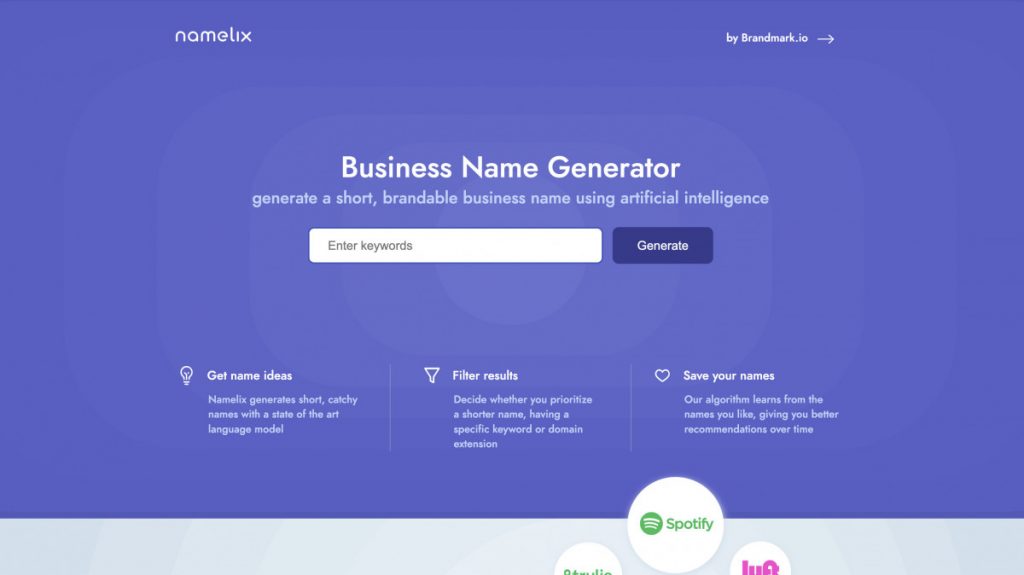
Namelix excels at delivering short, catchy names that feel brandable right off the bat. Unlike other tools, it lets you control variables like name length, randomness, and domain extension preference. The result is a curated list of sleek, startup-friendly names that feel intentional and modern.

What really sets Namelix apart is how it improves over time. It learns from your clicks and preferences, making future suggestions increasingly relevant. This makes it ideal for founders who are picky but want to see smarter results with each search.

8 Best AI Business Name Generators in 2025

This tool is perfect for anyone who wants to see their business name visualized from the start. After entering a keyword, you get a list of name suggestions accompanied by automatically generated logos. It’s a great way to gauge how the name will look in action, not just on paper.

While it doesn’t offer deep customization, the integration between name creation and visual branding makes the process feel complete. If you want a quick route from concept to brand identity, this generator offers an end-to-end solution.

8 Best AI Business Name Generators in 2025

Namify takes a more professional, structured approach to business naming. It doesn’t just throw out random names—it filters them by availability, social media handle options, and even potential trademarks. It’s especially useful if you’re starting an LLC or aiming for long-term brand protection.

Each name comes with a sleek logo preview, and the interface makes it easy to toggle between themes like tech, health, or sustainability. It’s a tool made for serious founders who want creative names without legal surprises down the road.

8 Best AI Business Name Generators in 2025

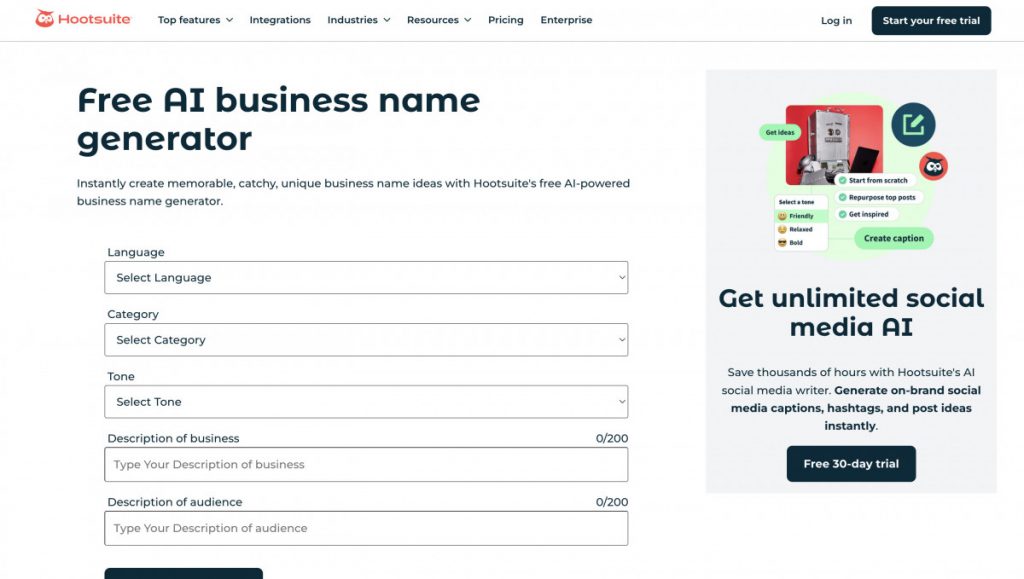
This generator shines for users operating in multilingual markets. You can generate names in several major languages, which is rare among free AI naming tools. It also adapts suggestions to different business types—whether it’s a product, blog, or full company.

While the feature set is relatively simple, the language support makes it incredibly valuable for international entrepreneurs or businesses targeting non-English-speaking markets. It’s efficient, straightforward, and globally aware.

8 Best AI Business Name Generators in 2025

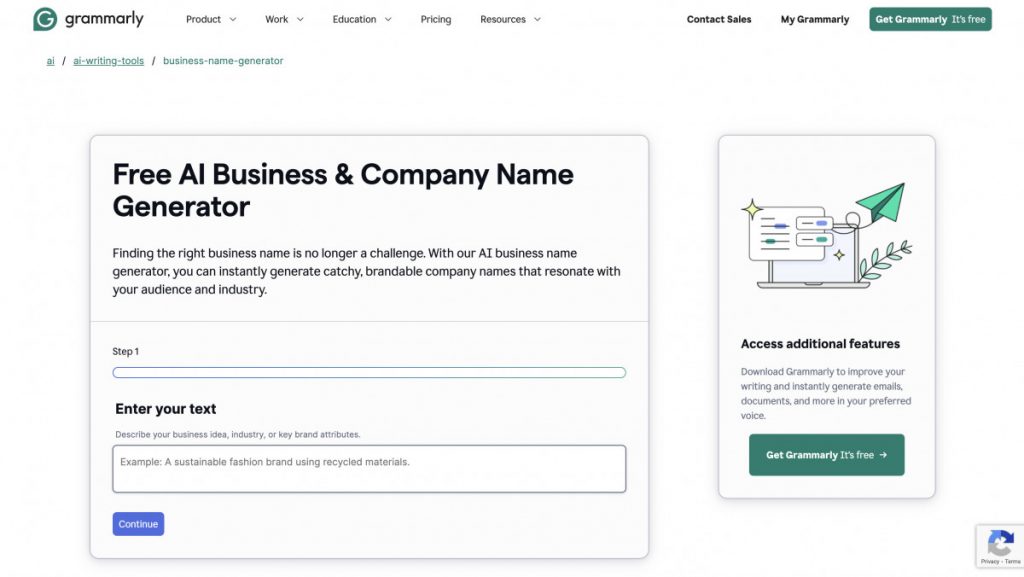
Built on Grammarly’s tone expertise, this tool lets you define how you want your business to sound—whether bold, refined, fun, or professional. It then offers a lineup of names that reflect your selected vibe, helping you match the name with your brand personality.

It’s especially helpful for creatives or agencies that want their name to evoke a certain emotional response. It won’t give you logos or domains, but what it does offer—tone-true naming—is refreshingly nuanced compared to most tools.

8 Best AI Business Name Generators in 2025

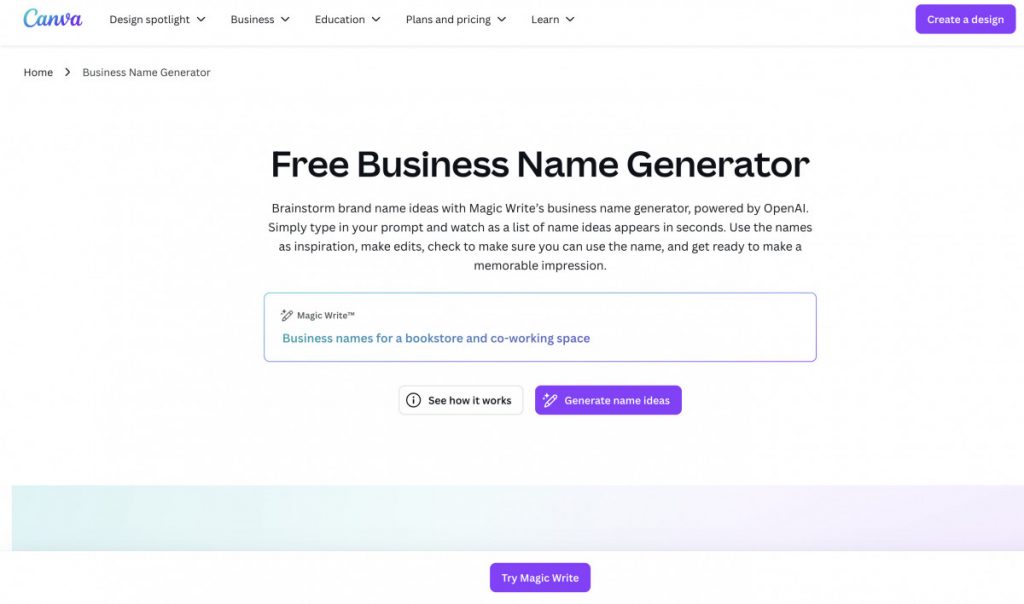
Canva’s name generator ties directly into its design suite, which means you can instantly build brand visuals based on your chosen name. Once you find a name you like, you can immediately start creating a logo, website, or business card, all on the same platform.

While it lacks complex filters, it’s ideal for creators who value visual branding from day one. If you’re the type of founder who prefers seeing the name in action right away, Canva makes that transition smooth and intuitive.

8 Best AI Business Name Generators in 2025

This platform mixes AI logic with branding best practices to suggest creative, often unexpected names. It’s especially strong at producing combinations you might not think of on your own—mixing real words, invented syllables, and trendy structures to spark inspiration.

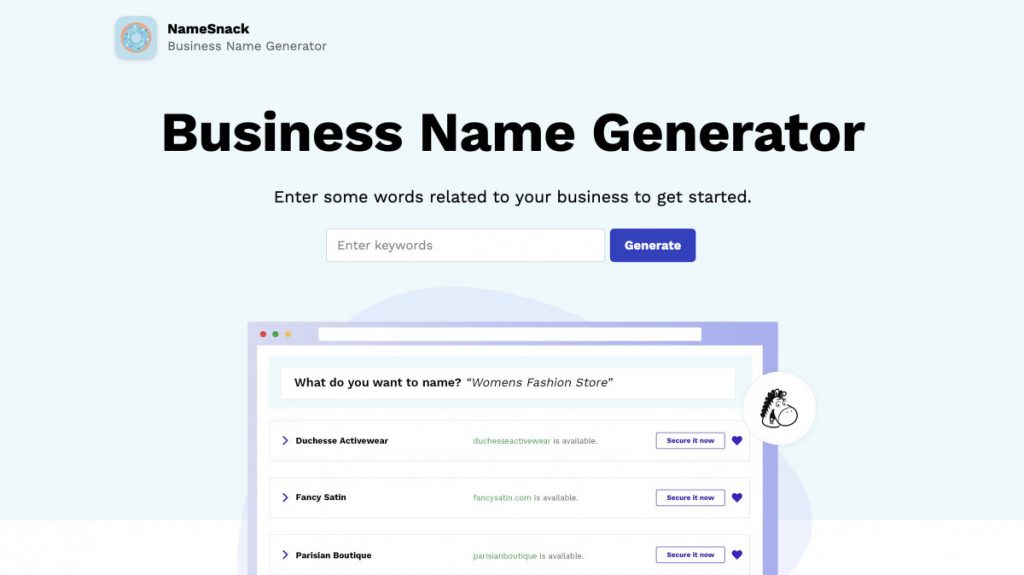
It’s also fast and user-friendly, with built-in domain checks to save you time. If you’re exploring name ideas with a more open-ended, creative mindset, NameSnack is one of the best tools to shake up your thinking and uncover hidden gems.

Disclaimer

In line with the Trust Project guidelines, please note that the information provided on this page is not intended to be and should not be interpreted as legal, tax, investment, financial, or any other form of advice. It is important to only invest what you can afford to lose and to seek independent financial advice if you have any doubts. For further information, we suggest referring to the terms and conditions as well as the help and support pages provided by the issuer or advertiser. MetaversePost is committed to accurate, unbiased reporting, but market conditions are subject to change without notice.

About The Author


Victoria is a writer on a variety of technology topics including Web3.0, AI and cryptocurrencies. Her extensive experience allows her to write insightful articles for the wider audience.

More articles


Victoria d’Este


Victoria is a writer on a variety of technology topics including Web3.0, AI and cryptocurrencies. Her extensive experience allows her to write insightful articles for the wider audience.


Source link

Deutsche Telekom And NVIDIA Partner To Build Industrial AI Cloud For European Manufacturers

Deutsche Telekom And NVIDIA Partner To Build Industrial AI Cloud For European Manufacturers


In Brief

Deutsche Telekom and Nvidia are partnering to build Germany’s largest industrial AI cloud by 2026, aiming to support advanced manufacturing across Europe and strengthen the country’s digital sovereignty.

Deutsche Telekom And NVIDIA Collaborate To Advance Germany’s Sovereign AI

Telecommunications provider Deutsche Telekom revealed a partnership with Nvidia aimed at developing an industrial AI cloud tailored for European manufacturing, with deployment scheduled no later than 2026. The planned AI infrastructure, which will be based in Germany and managed by Deutsche Telekom, is intended to support a wide range of advanced manufacturing use cases such as product design, engineering processes, simulations, digital twin technology, and robotics. 

The AI infrastructure, described as the largest of its kind in Germany to date, represents a notable step toward building a sovereign technological foundation for the country. It is intended to support broader industrial adoption and development of AI solutions. In its initial rollout, the facility will incorporate 10,000 NVIDIA Blackwell GPUs, distributed across NVIDIA DGX GB200 systems and NVIDIA RTX PRO Servers, alongside accompanying NVIDIA networking components and AI software solutions.

Advancing Germany’s Industrial Ecosystem Through Strategic Innovation

Deutsche Telekom is set to manage the AI facility and deliver cloud-based AI computing capabilities to the broader industrial sector in Europe. This infrastructure will allow users to deploy workloads powered by NVIDIA CUDA-X libraries, as well as tasks accelerated by NVIDIA RTX and Omniverse technologies, supported by software from providers including Siemens, Ansys, Cadence, and Rescale. The platform is expected to benefit a wide spectrum of stakeholders, from Germany’s well-established small and medium-sized enterprises, known as the Mittelstand, to academic institutions, research organizations, and large corporations, offering access to advanced technological capabilities for innovation and development.

Accelerating The Path To AI Gigafactories

The industrial AI cloud is expected to support the advancement and integration of AI across the European manufacturing sector by promoting simulation-led, AI-supported production methods. This initiative aligns with ongoing efforts to establish foundational infrastructure for future AI gigafactories in Germany. 

Backed by the European Union, the German government, and various collaborators, the AI gigafactory program is projected to launch in 2027. It will consist of a large-scale network powered by 100,000 GPUs, offering enhanced computing capabilities through the development and scaling of high-performance computing centers. The goal is to enable broader access to accelerated computing resources for enterprises, startups, research institutions, and academic organizations.

“Investments in strategic AI infrastructures are central to our country’s innovative strength,” said German Chancellor Friedrich Merz in a statement following his meeting with Nvidia CEO Jensen Huang. “We expressly welcome the commitment of Nvidia and its partners. This cooperation can be an important step for Germany’s digital sovereignty and economic future,” he added.

Disclaimer

In line with the Trust Project guidelines, please note that the information provided on this page is not intended to be and should not be interpreted as legal, tax, investment, financial, or any other form of advice. It is important to only invest what you can afford to lose and to seek independent financial advice if you have any doubts. For further information, we suggest referring to the terms and conditions as well as the help and support pages provided by the issuer or advertiser. MetaversePost is committed to accurate, unbiased reporting, but market conditions are subject to change without notice.

About The Author


Alisa, a dedicated journalist at the MPost, specializes in cryptocurrency, zero-knowledge proofs, investments, and the expansive realm of Web3. With a keen eye for emerging trends and technologies, she delivers comprehensive coverage to inform and engage readers in the ever-evolving landscape of digital finance.

More articles


Alisa Davidson


Alisa, a dedicated journalist at the MPost, specializes in cryptocurrency, zero-knowledge proofs, investments, and the expansive realm of Web3. With a keen eye for emerging trends and technologies, she delivers comprehensive coverage to inform and engage readers in the ever-evolving landscape of digital finance.


More articles


Source link

Popular Posts

My Favorites