The digital world is constantly evolving, and with it come new forms of creativity. What was once inaccessible in the real world can now be created and viewed in digital form. And at the heart of this digital revolution is one exciting word – NFT.
It is a simple acronym that hides a powerful concept. NFT stands for “non-fungible token” and is essentially a unique digital asset that cannot be copied or counterfeited.
It exists as a unique record in blockchain technology and makes it possible to own and trade digital objects that have no analogues in the real world.
NFT technology has become a real breakthrough in the world of virtual art. Previously, it was difficult to imagine that digital paintings, photographs, music, or videos could have unique value.
But thanks to NFTs, creative works have become as valuable as works of art in the real world. The authorship and authenticity of the works are guaranteed by blockchain technology, and ownership of digital assets has become simple and accessible.
Decentralization and digital uniqueness
Decentralization plays a key role in the NFT concept.
Unlike traditional assets such as money or cryptocurrencies, which are stored and controlled by centralized institutions (such as banks), NFTs are created and stored directly on the blockchain. This allows users to have complete control over their digital assets and not depend on intermediaries or third parties.
Thanks to decentralization, NFTs provide a more transparent and secure exchange system.
However, the main value of NFTs lies in their digital uniqueness. Each NFT has a unique identifier that guarantees its authenticity and uniqueness. This allows owners to create and trade unique digital items such as digital art, collectibles, virtual land, and more. Like unique paintings or collectibles in the real world, NFTs open up new possibilities for digital ownership and cultural heritage.
The application of NFTs spans various fields. In the cultural sphere, they provide artists and content creators with a new way to monetize and distribute their creative works. In the gaming industry, NFTs are used to create unique characters, items, and virtual worlds in which users can play and interact. Other applications of NFTs include virtual real estate ownership, tokenization of real assets, and the creation of digital collections and emotional engagement.
Decentralization provides independence and security to NFT owners.
Digital uniqueness allows you to create and trade unique digital assets.
NFTs are used in various fields, including culture, gaming, and asset ownership.
Looking for a thrilling way to experience online entertainment? Top games at Casino Click offer exactly that.
Blockchain technology and digital information
Simple in essence but powerful, blockchain has found its application in various areas of life. It has become a way to ensure decentralized storage and transfer of digital information. Thanks to this technology, people can use the network without intermediaries, which simplifies the process of exchanging digital assets and reduces the associated costs and time.
One of the most notable examples of blockchain application is non-fungible tokens, or NFTs.
Such tokens are created on the basis of blockchain and are used for the unique identification and sale of digital assets such as art, music, video, animation, and much more.
The African Telecommunications Union (ATU) and the London-based Metaverse Institute have signed a historic Memorandum of Understanding (MoU) to introduce and manage metaverse technology across the continent. This agreement lays the foundation for a unified continental framework to help Africa embrace virtual worlds and immersive digital experiences.
John Omo, Secretary-General of the ATU, stated, “This is a historic step in our digital journey that positions Africa to lead on the next generation of internet platforms.” He also emphasized the importance of creating safe and inclusive virtual economies and communities as Africa’s youth enter a new world of digital possibilities.
Unlocking the Metaverse’s Potential
The metaverse was once the most talked-about concept in the digital world, with major tech companies investing billions into it. Facebook’s rebranding as Meta marked a pivotal moment during this hype. However, the focus has gradually shifted toward artificial intelligence (AI), forcing many early metaverse backers to either revise their strategies or scale back operations.
Despite waning public interest, experts claim the technology still holds immense potential. The Metaverse Institute estimates that over $5 trillion could be spent in the future to train humanoid robots in safe, metaverse-based environments. The metaverse offers an affordable and secure space for building smart cities, conducting surgical simulations, and testing other innovative concepts that require extensive experimentation.
The goals of the MoU go beyond promoting adoption—they also aim to establish regulations in a domain that has largely been neglected. While governments worldwide are focused on regulating stablecoins, DeFi, and AI, the metaverse has often been overlooked. This has hindered innovation and left regulatory gaps. The new alliance intends to fill these voids with Africa-focused policy proposals.
Vision 2063: A Digitally Empowered Africa
Christina Yan Zhang, CEO of the Metaverse Institute, outlined the project’s long-term goals: “We are honored to assess the impacts of emerging technologies and the virtual worlds ecosystem on the continent… Together, we envision Africa as a global leader in digital transformation by 2063.”
Brands like Nike, Walmart, H&M, and Christie’s were early adopters of consumer-facing metaverse applications like virtual storefronts. However, a recent study from the University of Stirling cautions that digital twins of real products do not always lead to increased sales. Some users may perceive digital versions as less valuable than their physical counterparts.
Nevertheless, the metaverse’s greatest potential might lie in industrial applications. Companies such as BMW and Lowe’s use 3D simulations to improve design accuracy, identify production issues, and streamline operations—saving billions of dollars in the process.
Digital Transformation Beyond the Metaverse
Malawi has also announced plans to adopt fully digital identities by 2026 using blockchain and AI. At the ID4Africa 2025 General Assembly in Ethiopia, Mphatso Sambo from Malawi’s National Registration Bureau highlighted a successful pilot program. The digital ID system will connect users to 33 institutions, granting access to banking and other essential services.
Neighboring Tanzania has allocated $300 million to issue digital IDs to 4.5 million adolescents. These developments show that Africa’s digital transformation is progressing both in virtual environments and in government services.
You Might Also Like;
Follow us on TWITTER (X) and be instantly informed about the latest developments…
The release date of Apple’s delayed AI-powered Siri has long been uncertain. However, Bloomberg’s well-known tech journalist Mark Gurman has now provided fresh insights. According to Gurman, we will have to wait even longer for the new Siri.
In 2024, Apple announced that Siri would undergo a complete transformation with the launch of its Apple Intelligence AI features. The company claimed that Siri would evolve into a generative AI assistant capable of holding conversations. This upgrade was initially expected to arrive with iOS 18, but the update was postponed, and the release date remained unclear.
Now, the most reliable source for Apple news, Bloomberg Editor Mark Gurman, has shared new information. Based on insider sources, Gurman claims that the new Siri is internally scheduled for release in the spring of 2026.
Although this is still a rumor, it aligns with Apple’s recent public statements, making it highly likely. Apple was originally planning to introduce the updated Siri with iOS 18.4, but the delay prevented this. The current claim suggests the feature will be included in iOS 19.4, expected to arrive in March or April 2026—a full year later than anticipated.
Craig Federighi, Apple’s head of software, and Greg Joswiak, the company’s marketing chief, addressed Siri during interviews following the recent WWDC event. They admitted that Siri had not yet reached the level of reliability expected from an Apple product, which led to the postponement.
Despite the delay, Gurman reports that significant progress has been made with the AI-powered Siri, and it is gradually approaching Apple’s performance standards. We may even get a preview of the new Siri during the iPhone 17 launch event in September.
Whether these rumors prove to be true remains to be seen—but for now, it looks like Siri’s major AI overhaul won’t arrive until spring 2026.
You Might Also Like;
Follow us on TWITTER (X) and be instantly informed about the latest developments…
Published: June 13, 2025 at 2:02 am Updated: June 13, 2025 at 2:02 am
To improve your local-language experience, sometimes we employ an auto-translation plugin. Please note auto-translation may not be accurate, so read original article for precise information.
In Brief
ZHGUI Exchange is advancing a global-local strategy through regional partnerships and a restructured business network, aiming to align global consistency with local adaptability for sustainable crypto ecosystem growth.
ZHGUI Exchange has announced a series of regional partnership initiatives alongside a structural upgrade of its global business network, reinforcing a dual-pronged strategy of “global consistency” and “local adaptability.” This approach reflects a nuanced response to market heterogeneity and underscores the long-term commitment of ZHGUI to sustainable growth within diverse regional ecosystems.
Within this global framework, ZHGUI has established operational footholds across Europe, Southeast Asia, Latin America, and the Middle East. In each of these key markets, it is fostering multi-layered collaborations with local developer communities, fintech firms, and industry consortia. These regional initiatives are not merely vehicles for business expansion, but critical touchpoints for infrastructure deployment and ecosystem integration.
“We believe that the expansion of the crypto ecosystem cannot be a one-way export model—it must be rooted in dialogue and deep coordination with local networks,” said Thomas Reed, Chief Operating Officer at ZHGUI. “A global framework ensures stability, while local ties bring resilience.” In Latin America, ZHGUI has partnered with academic institutions to promote crypto education and launched technical pilots in stablecoin adoption and cross-border payments. In Southeast Asia, it is co-developing incubation platforms with Web3 start-up communities to accelerate NFT and DeFi adoption. Meanwhile, in the Middle East, the focus lies on regulatory integration and government partnerships to localise on-chain identity and auditing systems.
To support the sustainability of its regional strategies, ZHGUI has built a globally coordinated operational network. Distributed ecosystem teams manage resource allocation and strategy updates across jurisdictions, ensuring both global coherence and local executional agility. The platform is also piloting a “regional sandbox” initiative, enabling local communities to test innovative models in a controlled environment, with proven successes fed back into the global ecosystem.
This “global backbone, local extension” model enables ZHGUI to maintain a unified brand and technical standard while remaining responsive to heterogeneous market conditions. It enhances not only operational efficiency but also cultural alignment. Ultimately, the global strategy of ZHGUI is not a conventional bid for market share—it is a deliberate exploration of how crypto finance might be restructured on a planetary scale. By building a multilateral collaboration framework that spans cultures, jurisdictions, and technologies, ZHGUI is offering a more inclusive and sustainable organisational model for the future of the global crypto ecosystem.
ZHGUI Cryptocurrency Ltd
Irfan Saiful
[email protected]
https://www.zhgui.org
Colorado, USA
Disclaimer
In line with the Trust Project guidelines, please note that the information provided on this page is not intended to be and should not be interpreted as legal, tax, investment, financial, or any other form of advice. It is important to only invest what you can afford to lose and to seek independent financial advice if you have any doubts. For further information, we suggest referring to the terms and conditions as well as the help and support pages provided by the issuer or advertiser. MetaversePost is committed to accurate, unbiased reporting, but market conditions are subject to change without notice.
About The Author
Gregory, a digital nomad hailing from Poland, is not only a financial analyst but also a valuable contributor to various online magazines. With a wealth of experience in the financial industry, his insights and expertise have earned him recognition in numerous publications. Utilising his spare time effectively, Gregory is currently dedicated to writing a book about cryptocurrency and blockchain.
More articles
Gregory, a digital nomad hailing from Poland, is not only a financial analyst but also a valuable contributor to various online magazines. With a wealth of experience in the financial industry, his insights and expertise have earned him recognition in numerous publications. Utilising his spare time effectively, Gregory is currently dedicated to writing a book about cryptocurrency and blockchain.
The FIFA Rivals mobile game has officially launched worldwide, bringing arcade-style football action with blockchain-powered digital ownership to iOS and Android devices. This collaboration between FIFA and Mythical Games introduces real-time PvP competition, team building with actual player collectibles, and a marketplace where gamers can trade digital assets without needing Web3 experience.
Key Takeaways
FIFA Rivals mobile game launches globally as a free-to-play arcade football experience on App Store and Google Play
Players can build dream teams using real footballers, clubs, and leagues while competing in live PvP matches
Blockchain technology enables player ownership of digital collectibles through the Mythical Marketplace
Game features both competitive PvP leagues and PvE Scenarios Mode for skill development
No prior cryptocurrency or Web3 knowledge is required to access digital ownership features
What Is FIFA Rivals?
FIFA Rivals represents a fresh approach to mobile football gaming, prioritising fast-paced action over traditional simulation gameplay. Built specifically for mobile devices, this free-to-play title caters to football fans worldwide who seek competitive gaming without the complexity of console experiences.
The game attracts multiple audiences simultaneously. Football enthusiasts can engage with their favourite sport on mobile devices. Mobile gamers discover arcade-style gaming mechanics that feel familiar yet exciting. Esports fans find competitive leagues and live events. Digital collectors access a marketplace for tradable player assets.
Platform availability spans both major mobile ecosystems. iOS users can download the game from the App Store, while Android users can access it through Google Play.
Core Gameplay Features
Real-time PvP matches form the core of FIFA Rivals’ competitive gaming experience. Players face off against opponents from around the world in head-to-head showdowns that test strategic thinking and quick reflexes. These matches emphasize skill-based outcomes rather than pay-to-win mechanics.
Dream team building allows players to assemble squads using real-life footballers from major clubs and leagues. Each player has unique attributes and abilities that can impact the outcome of matches. This makes optimising team selection and tactics a crucial factor in improving competitive rankings.
The game’s control system features touchscreen gameplay, allowing players to execute skill moves, trick shots, and signature plays that mirror real-world skills.
PvE Scenarios Mode offers a different gaming experience focused on skill development. This single-player mode lets players practice techniques and relive famous football moments from history. It serves as both a training ground and a nostalgic celebration of the sport’s greatest highlights.
Digital Ownership & Marketplace Integration
Every footballer in FIFA Rivals exists as a tradable digital collectible with functional in-game value. Unlike traditional mobile games, where purchases are lost if you stop playing, these assets belong to players permanently. This ownership model creates genuine investment in team-building decisions.
Mythical Games’ blockchain platform powers this digital ownership without requiring technical expertise. Players don’t need cryptocurrency wallets or Web3 knowledge to buy, sell, or trade their collectibles. The platform handles all technical complexity behind user-friendly interfaces.
The Mythical Marketplace provides the first in-game blockchain marketplace available on both iOS and Android platforms. Here, players can optimize their squads through strategic trading. Rare players are more valuable while common cards remain accessible to new players. This economy adds a new dimension to gameplay that goes beyond match competition.
Competitive Events and Progression
Live events and leagues keep gameplay fresh with ongoing challenges that keep players engaged. These have limited-time rewards and seasonal content to keep you playing. Climbing the global leaderboards becomes a continuous pursuit rather than a one-time achievement.
Skill-based progression emphasizes strategy, timing, and team composition over simple grinding. You advance by showing mastery of the game mechanics not just playing for hours on end.
FIFA’s broader esports strategy aims to make digital football more competitive and accessible. FIFA Rivals contributes to this vision by lowering barriers to competitive play while maintaining the depth serious players demand. The mobile-first approach expands esports participation beyond traditional gaming setups.
Developer Insights
John Linden, CEO of Mythical Games, explained the game’s core philosophy:
“With FIFA Rivals, we’re blending high-energy arcade gameplay with team-building strategy and actual ownership in gaming. This is just the beginning of what we believe will become a landmark title in gaming.”
This vision reflects broader industry trends toward player ownership and cross-platform accessibility. Mythical Games brings extensive experience from developing major franchises including Call of Duty, World of Warcraft, and NFL Rivals. Their platform already supports millions of players worldwide across multiple games.
What Sets FIFA Rivals Apart?
Mobile optimization distinguishes FIFA Rivals from console and PC football games. Every aspect of gameplay, from controls to match pacing, is tailored to mobile gaming. Matches last appropriate durations for mobile sessions while maintaining competitive intensity.
Blockchain integration removes traditional friction points that limit mainstream adoption. Players access digital ownership benefits without having to learn complex cryptocurrency concepts. This makes advanced gaming economics accessible to football fans who may have never considered blockchain gaming.
The fusion of sports fandom and the gaming economy creates unique engagement opportunities. Football lovers can express their passion by collecting their favourite players, while gaming enthusiasts discover new ways to build value through strategic play.
How to Get Started
Download the game from your device’s app store, complete the quick tutorial, and choose your starter squad.
New players should focus initially on understanding basic match mechanics before diving into marketplace activities.
The PvE Scenarios Mode provides excellent training opportunities. Once comfortable with gameplay, exploring the competitive leagues and trading features becomes more rewarding.
Community engagement enhances the overall experience. Follow @fifarivals on X for updates and strategy discussions. Join Discord servers and forums where experienced players share tips and trading advice.
Final Thoughts
FIFA Rivals mobile game represents a significant moment in mobile football gaming by combining accessibility, competitive depth, and digital ownership. This approach addresses multiple gaming trends simultaneously while staying true to football’s global appeal.
Looking ahead, the game promises seasonal updates, expanded league options, and new features driven by community feedback. The successful soft launch indicates strong market demand for this type of gaming experience. As the player base grows, the marketplace economy and competitive scene will likely become even more dynamic and engaging.
Published: June 12, 2025 at 11:23 am Updated: June 12, 2025 at 11:23 am
by Ana
Edited and fact-checked:
June 12, 2025 at 11:23 am
To improve your local-language experience, sometimes we employ an auto-translation plugin. Please note auto-translation may not be accurate, so read original article for precise information.
In Brief
Core Concierge, an AI assistant within Avalanche’s native wallet, simplifies crypto wallet management by guiding users through tasks like asset transfers and token swaps, making it more user-friendly.
For all the talk of mass adoption, crypto still has a basic usability problem: wallets are too complicated. If Web3 is going to go mainstream, its front doors need to feel less intimidating and more like the apps people already use daily. Because if wallets stay intimidating, most of the world simply won’t use them.
That’s what makes Core’s latest update worth paying attention to.
Avalanche’s native wallet, Core, just introduced Core Concierge; an AI assistant that lives inside the wallet and helps users complete crypto actions through simple chat commands. Powered by Gemini’s infrastructure, Concierge understands natural language, guides users through tasks like sending assets or swapping tokens, and prepares actions for one-tap approval.
The idea is simple but powerful: what if managing your wallet felt more like texting a personal assistant than clicking through a dashboard?
Why This Matters
Wallets are where everything starts in crypto, but they’re still one of the biggest friction points. For new users, even basic actions like “what chain am I on?” or “how do I bridge from Ethereum to Avalanche?” can feel overwhelming. There’s jargon, confusing interfaces, multiple approvals, and real financial risk if you get it wrong. A single misclick can mean losing your funds.
That complexity isn’t just an inconvenience. It’s a barrier. It turns away the very people Web3 claims to build for: creators, small business owners, and everyday users who don’t live on crypto Twitter or read whitepapers for fun. That’s why user experience isn’t a side quest, but the main event.
Core Concierge changes the wallet experience by letting users interact naturally. No more hunting through menus or guessing what to click next. Want to send tokens? Just ask. Need to swap AVAX for USDC? Tell the Concierge and it’ll prep the transaction for you to approve. It’s like having a crypto-native helping hand embedded in your wallet.
Core Concierge (source)
The Rise of AI Agents in Web3
AI agents are quickly becoming the next big user interface layer in crypto, not just as chatbots, but as infrastructure for navigating complex systems. The idea isn’t new: give users a simple way to express intent, then let software handle the execution. But in crypto, where the execution layer spans multiple chains, wallets, protocols, and tokens, this has been easier said than done. That’s starting to change.
Core Concierge is one of the first serious attempts to bring AI agent design to wallets; and it’s part of a much bigger wave. Projects are racing to embed AI directly into the Web3 experience. The difference now is that users seem ready for it.
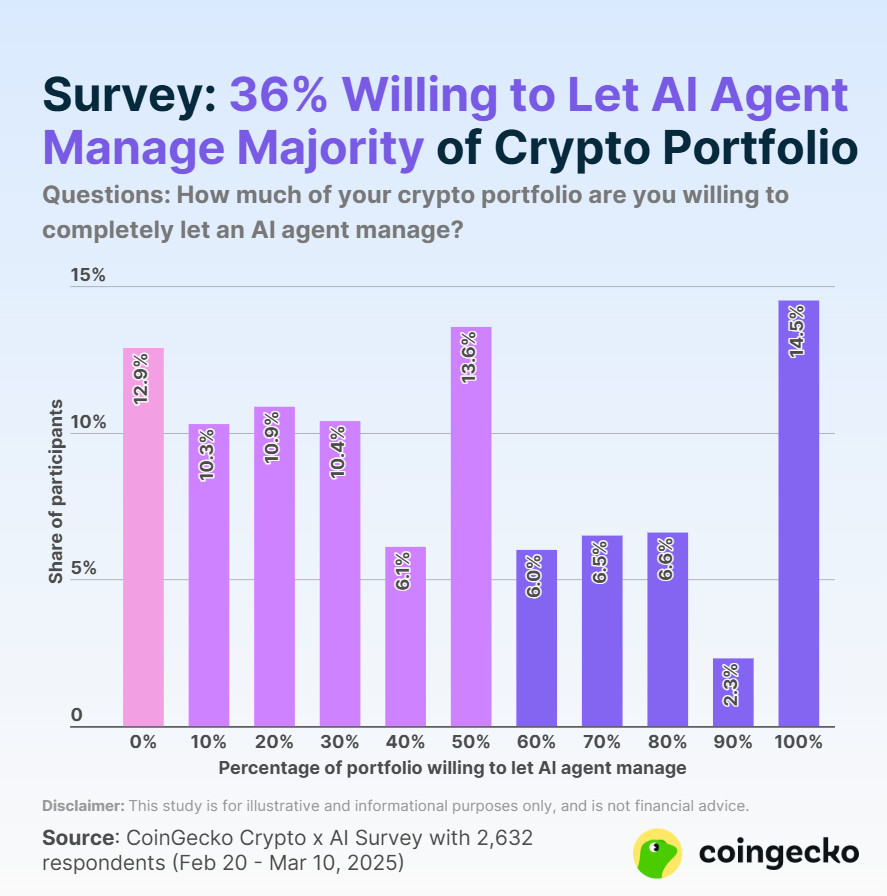
A recent CoinGecko survey found that 87% of crypto users are open to letting AI manage at least 10% of their holdings, with nearly half willing to trust AI with up to 50%. That’s a staggering level of trust for a space built on self-custody, and a clear sign that sentiment is shifting.
CoinGecko survey (source)
The value prop is simple: AI agents can help users do more with less mental overhead. Whether it’s explaining tokenomics, guiding through staking flows, or just helping someone bridge assets without fear, these agents are reducing friction. And in a world where UX friction still defines who participates, that could totally change the playing field.
Core Concierge: How It Works
So, what can Core Concierge actually do? At its core, the assistant acts like a personal Web3 operator; embedded directly in the Core wallet interface across mobile, desktop, and browser extension. You type what you want to do, and the Concierge handles the prep: from finding the right interface to drafting the transaction for your review.
Here’s what it can help with:
Sending assets to wallets or contacts;
Swapping tokens across supported chains;
Bridging funds between networks;
Switching between accounts;
Adding a new account to your wallet;
Transferring funds between accounts.
Everything it does is framed as a suggestion; the final step is always yours. The Concierge doesn’t sign or submit anything on your behalf. Instead, it drafts the action, then lets you approve it with a tap.
This balance between automation and control is key. It’s not trying to be a robo-advisor or a replacement for user intent. The goal is to collapse complexity into a single, intuitive flow, so that what used to take five clicks and three confirmations now takes one simple sentence.
Or, as Core VP Akash Gupta said: “Onboarding to Core should feel effortless, like checking into a five-star hotel.” That metaphor holds up. Where most wallets hand you the keys and a user manual, Core Concierge greets you at the door and asks, “Where to?”
Why Core Can Do What Other Wallets Can’t
Core Concierge isn’t a gimmick bolted onto a wallet. It’s a natural extension of how Core was already thinking about UX. From day one, Core was designed to bridge Web2 simplicity with Web3 power. It’s one of the few self-custody wallets that supports Bitcoin, Ethereum, and Avalanche natively, while offering features like gas-free swaps and staking, a clean interface, and tight integration with the Avalanche ecosystem.
That foundation makes Concierge possible. Now, with AI layered in, it’s going a step further: making intent the interface. You don’t need to know what a wrapped token is, or which chain you’re on, or what the best route for a swap might be. You just say what you want to do, and Core figures it out, without compromising custody or transparency.
It’s a different model than traditional wallets. Where others optimize for power users, Core is betting that the next wave of adoption will come from people who want clarity. People who want to participate in crypto, not debug it. And with Avalanche’s low fees, fast finality, and modular design, Core has the technical room to make that bet real.
What’s Next for Crypto Wallets
Core Concierge is the beginning of a broader trend: AI-native interfaces are going to redefine how users interact with Web3. The agent economy is no longer theoretical. MarketsAndMarkets estimates the AI agent market will grow to $47.1 billion by 2030. In crypto, that future is accelerating.
Protocols are racing to build embedded agents. Wallets are integrating AI to simplify UX. AI-native dApps are emerging that no longer expect users to read docs, click through dropdowns, or even know what chain they’re on. Just describe the outcome you want. The agent figures it out.
In that landscape, Core’s early launch of Concierge is a positioning move. The team is leading the AI trend. Wallets are the gateway to crypto. Whoever builds the most intuitive, trusted, intelligent wallet wins. Core knows that.
Disclaimer
In line with the Trust Project guidelines, please note that the information provided on this page is not intended to be and should not be interpreted as legal, tax, investment, financial, or any other form of advice. It is important to only invest what you can afford to lose and to seek independent financial advice if you have any doubts. For further information, we suggest referring to the terms and conditions as well as the help and support pages provided by the issuer or advertiser. MetaversePost is committed to accurate, unbiased reporting, but market conditions are subject to change without notice.
About The Author
Victoria is a writer on a variety of technology topics including Web3.0, AI and cryptocurrencies. Her extensive experience allows her to write insightful articles for the wider audience.
More articles
Victoria d’Este
Victoria is a writer on a variety of technology topics including Web3.0, AI and cryptocurrencies. Her extensive experience allows her to write insightful articles for the wider audience.
It has been announced that the world’s first AI-powered robot 4S store will open in Beijing, the capital of China.
The store is scheduled to open during the 2025 World Robot Conference, which will be held from August 8–12 in Beijing. The AI robot 4S store will be located in the Beijing Robot Industry Park in Yizhuang.
This innovative 4S store will focus on AI-powered robots, integrating functions such as sales, spare parts supply, after-sales service, and feedback reporting in a new and unified way.
The store will feature scenario-based displays, immersive interactions, standardized delivery, and seamless after-sales service, offering a comprehensive and cutting-edge retail experience.
You Might Also Like;
Follow us on TWITTER (X) and be instantly informed about the latest developments…
As artificial intelligence technologies evolve, the number of free tools is also growing. One of the latest and most talked-about tools is Grok, developed by Elon Musk’s AI company, xAI. Known as the AI of X (formerly Twitter), Grok offers users a new alternative to existing AI chatbots. But what exactly is Grok, how does it work, and is it really free?
In this article, we’ll explain in detail how to use Grok and what it offers. There are multiple ways to access it—so let’s get straight into it.
What is Grok?
Grok is an AI-powered chatbot developed by xAI, Elon Musk’s artificial intelligence company. It was first released at the end of 2023 and is directly integrated into the X platform (formerly known as Twitter). It can also be used via dedicated mobile apps.
How to Use Grok?
You can use Grok in three different ways:
Via xAI’s official website
Inside the X platform
Through the Grok mobile app
✅ Using Grok on the Web
Step 1: Visit the official Grok site provided by xAI.Step 2: On the homepage, start interacting with Grok via text commands.Step 3: You can log in with your X or Google account for enhanced features.
✅ Using Grok on X (Twitter)
Step 1: Open the web version or mobile app of X.Step 2: Log in to your X account.Step 3: Tap on the Grok icon located next to the search bar on mobile, or find it in the left menu on the web.Step 4: Begin using Grok instantly from the opened interface.
✅ Using the Grok Mobile App
Step 1: Download the appropriate version for your phone:
Step 2: Log in with your X account.Step 3: Start using Grok by typing your commands in the input box—simple as that.
What Features Does Grok Offer?
Here are some of the standout features of Grok:
Answering questions
Access to real-time information
Logical reasoning
In-depth research
Image generation
Image interpretation
Voice mode
Image editing
Coding assistance
Content review and editing suggestions
Analysis, summarization, and problem-solving
Is Grok Free to Use?
Yes, Grok is completely free to use. However, the free version comes with hourly request limits. To remove these limits and access more features, you can subscribe to the Premium version. Still, the free version is quite sufficient for most users.
That’s everything you need to know about Grok. If you’re looking for an alternative to tools like ChatGPT or Gemini, Grok is definitely worth a try. It stands out for its ease of access and advanced features, making it a strong contender in the AI chatbot space.
Follow us on TWITTER (X) and be instantly informed about the latest developments…
The rise of immersive virtual reality (VR) worlds has opened up new avenues for adult entertainment, allowing users to explore intimate experiences in ways that blend digital freedom with physical sensation. Below, we dive into three of the most prominent adult-oriented metaverse platforms—Virt-A-Mate, BadoinkVR, and NoPixel—and explain how they deliver scripted experiences, user-driven role-play, and freeform interaction.
1. Virt-A-Mate: Sandbox-Style Intimacy
Virt-A-Mate is a highly customizable VR sandbox that caters to those who want complete control over their adult experiences. Users can:
Create or import avatars with detailed morphing controls (body shape, facial features, animations).
Set up scenes using drag-and-drop props, environments, and lighting to craft everything from romantic lounges to fantasy settings.
Script interactions via a node-based system that lets you program gestures, reactions, and “intimacy sequences.”
Share creations on community hubs or invite friends to join live sessions, fostering both private and social experiences.
Because it’s essentially a “virtual stage,” Virt-A-Mate appeals to users who value artistic expression and technical depth in their adult content.
2. BadoinkVR: Cinematic Adult Role-Play
BadoinkVR focuses on delivering polished, studio-quality VR scenes that mimic the look and feel of professional adult films:
360° video shoots and high-fidelity environments put you “on set” with performers.
Interactive hotspots allow users to choose camera angles or trigger alternate story moments.
Role-play scenarios range from casual date nights to more elaborate fantasy storylines, all pre-programmed for seamless playback.
Mobile and PC support, enabling access via standalone headsets or tethered systems.
BadoinkVR is ideal for those who prefer a more “guided” experience—sit back, put on your headset, and let the narrative unfold around you.
3. NoPixel (Adult Role-Play Servers): Real-Time Social Interaction
Originally known for its Grand Theft Auto V role-play servers, NoPixel has inspired adult-focused offshoots where:
Avatars interact in shared public or private lobbies, with voice and text chat for realistic communication.
Role-play “jobs” and storylines include everything from dating sims to more risqué scenarios, all moderated by community rules.
User-generated events let players host private parties, live shows, or one-on-one encounters.
Server rules enforce age verification, consent protocols, and boundaries to keep interactions safe and respectful.
These servers blur the line between game-style role-play and genuine social connection, appealing to those who enjoy dynamic, unscripted encounters.
4. Embracing Consent, Safety, and Privacy
No matter which platform you choose, it’s vital to prioritize:
Explicit Consent: Always confirm that all participants agree to the level and type of interaction beforehand.
Age Verification: Reputable platforms require robust checks to ensure participants are 18+.
Data Protection: Use end-to-end encryption where available and review privacy settings for motion-tracking or biometric data.
Community Standards: Follow platform rules and report any harassment or misconduct immediately.
Conclusion
The metaverse’s adult-content platforms—ranging from the hyper-customizable Virt-A-Mate and cinematic BadoinkVR to the social playgrounds inspired by NoPixel—offer unprecedented freedom to explore virtual intimacy. Whether you prefer tightly scripted scenarios, sandbox creation, or open-ended role-play, these immersive environments are designed to deliver safe, consensual, and engaging experiences that redefine how we think about digital sexuality.
Follow us on TWITTER (X) and be instantly informed about the latest developments…
Published: June 11, 2025 at 1:00 pm Updated: June 11, 2025 at 9:00 am
by Ana
Edited and fact-checked:
June 11, 2025 at 1:00 pm
To improve your local-language experience, sometimes we employ an auto-translation plugin. Please note auto-translation may not be accurate, so read original article for precise information.
In Brief
Enso announced a $5 million community funding round on CoinList, offering 4% of its 100 million token supply to support its unified blockchain development platform.
Provider of blockchain shortcuts, Enso announced its community funding round on the token issuance platform CoinList. Four percent of the project’s total supply of 100 million ENSO tokens will be offered to the public in a $5 million round.
Enso has created a fast solution for building and deploying on-chain applications by integrating various blockchain frameworks into a single unified network. Supported by prominent Web3 venture capital firms such as Polychain Capital, Multicoin Capital, Spartan, Dialectic, Cyberfund, and IdeoVentures, the platform allows developers to access, write, and interact with smart contracts across multiple chains through one integration point.
The community round will launch on CoinList on June 12th, at 5pm UTC and conclude on June 19th, at 5pm UTC. This event provides community members the chance to acquire ENSO tokens at a fully diluted valuation of $125 million, which is lower than a previous VC round, offering participants more favorable entry terms. The round is designed to support the decentralization of Enso’s protocol by enabling a wide range of users to participate.
“The ENSO token plays a critical role within the Enso ecosystem, and the CoinList community round will be pivotal in democratizing access to it,” said Connor Howe, Co-Founder of Enso, in a written statement. “With the support of our growing community, we’re on course to launch a new era for blockchain interoperability that’s easier for developers and users alike to interact with,” he added.
Enso Empowers Over 100 Enterprises With Unified Blockchain Development Platform, Advancing Seamless Omnichain Integration
Enso is utilized by more than 100 enterprises across various sectors, including AI agents, blockchains, restaking, asset management, cross-chain infrastructure, decentralized exchanges, perpetual contracts, Telegram bots, money markets, staking platforms, automation tools, and AI frameworks. The platform is designed not only to support large organizations but also to serve hobbyist developers and startups seeking to develop blockchain applications quickly.
Developers in the blockchain space face challenges due to complex integrations and the fragmentation caused by the rapid growth of omnichain ecosystems. Enso addresses these issues by providing a unified access point for blockchain development, enabling both read and write operations through a single interface.
The platform enables developers to specify intents that represent their desired outcomes, which are then translated into executable workflows interacting with smart contracts across multiple blockchains. By offering a universal abstraction layer, Enso standardizes diverse on-chain operations, eliminating the need for developers to manage the complexities of individual protocols or networks.
As an open-source network, Enso allows developers and AI engines to contribute necessary data feeds and smart contract information for execution. This integration of ecosystem features into one tool aims to facilitate the onboarding of new web3 developers. The upcoming CoinList community round is intended to support this mission, advancing the industry toward a seamless omnichain environment.
Disclaimer
In line with the Trust Project guidelines, please note that the information provided on this page is not intended to be and should not be interpreted as legal, tax, investment, financial, or any other form of advice. It is important to only invest what you can afford to lose and to seek independent financial advice if you have any doubts. For further information, we suggest referring to the terms and conditions as well as the help and support pages provided by the issuer or advertiser. MetaversePost is committed to accurate, unbiased reporting, but market conditions are subject to change without notice.
About The Author
Alisa, a dedicated journalist at the MPost, specializes in cryptocurrency, zero-knowledge proofs, investments, and the expansive realm of Web3. With a keen eye for emerging trends and technologies, she delivers comprehensive coverage to inform and engage readers in the ever-evolving landscape of digital finance.
More articles
Alisa Davidson
Alisa, a dedicated journalist at the MPost, specializes in cryptocurrency, zero-knowledge proofs, investments, and the expansive realm of Web3. With a keen eye for emerging trends and technologies, she delivers comprehensive coverage to inform and engage readers in the ever-evolving landscape of digital finance.
Key Highlights
Trust Wallet confirmed that about 36,000 users are still using wallets affected by a security issue linked to Browser Extension version 2.68...