When we consider the most important jobs in our society, we often think of the big three: doctors, teachers, and police officers.
But just as important are architects. These professionals shape our cities, our countryside, and our prized landmarks. Without architects, we wouldn’t have Buckingham Palace or the Great Pyramids. Of course, they also get blamed for creating eyesores and covering everything in glass.
But now, on your Xbox, you get the chance to go more local and become an architect yourself. In Architect Life: A House Design Simulator you get to perfect your dream house and live out your design fantasies. Let’s build.
Wanna create the home of your dreams?
Career or Canvas
There are two main modes in this game: Career Mode and Free Mode. Free Mode is where you have unlimited resources, allowing you to build whatever you like and whatever your mind can conjure up.
For me, as I need some structure in my gaming life and prefer rules and guidelines, I started with Career Mode. This serves as a good way to learn everything you need to know about Architect Life: A House Design Simulator.
From Client Dreams to Digital Designs
In Career Mode, you get to set up your own architectural firm, and once that is done, you are ready to take on jobs. People will come to you with their housing requests, and it’s up to you to deliver their dreams; all within the offered budget. The game then moves into its first step: the design phase.
You get to draw and design your ideas in a sort of miniature 3D doll’s house. Here, you design the foundations of the house, including its room layouts, walls, and overall shape. The controls are good on a controller, but fully enjoying the process requires getting used to how the camera works and how you are able to view the design.
You have different floor and wall colours, textures, and furniture available from a good range of choices, depending on how much you have to spend. You even handle the lighting and the exterior fixtures and fittings. For people who love focusing on the finer details, this will be like catnip.
Craft things how you see fit
Managing the Build
In the next stage, once you are happy with your design and it has been approved, you let the builders and contractors deal with actually constructing the building. You can visit the site to see how it’s progressing and make changes if things are not working.
At the same time, you have to manage potential disputes with the builders, money problems with the homeowners, or their sudden extra demands. It’s an engaging career mode without being too taxing. It will also be over in around five hours, so then it’s on to Free Mode, where the real designers will have fun.
Sandbox for the Soul
Free Mode is for the true sim fans, those who love spending hours on their designs and bringing them to life. As I said at the start of this review, I need structure in my games and so while I can fully appreciate this mode, and can see that it’s the real meat and gravy of this game, it’s not for me and my Luddite brain.
Visually, Architect Life: A House Design Simulator looks good, and I loved the model box environment where you design the house. The menus are crisp and clean, which is exactly what you need from a good sim game, making it easy to navigate to find what you want. I will say that, in the initial moments, the camera was a bit annoying at times, but I eventually got used to it. And whilst the audio is mainly background music and the occasional sound effect, it is just about fine for what it is. Sound is far from the USP of this designer though.
About as detailed as you can get
A Solid Sim for Aspiring Architects
If you are a fan of The Sims and titles like House Flipper, then you will have a blast with Architect Life: A House Design Simulator. The prospect of getting into the fundamentals of designing a home from the ground up without having to do any of the manual work is an appealing one. I did find that the controls and the camera took a while to get used to at first, but the career mode in Architect Life: A House Design Simulator is fine and serves as a good introduction.
Mostly though, it’ll be the Free Mode option that’ll be where the budding architects will truly shine.
Important Links
Architect Life: A House Design Simulator – Build Your Dream Career (and Homes!) – https://www.thexboxhub.com/architect-life-a-house-design-simulator-build-your-dream-career-and-homes/
Design Your Dream Home in Architect Life: A House Design Simulator – https://www.thexboxhub.com/design-your-dream-home-in-architect-life-a-house-design-simulator/
Buy Architect Life on the Xbox Store – https://www.xbox.com/en-GB/games/store/architect-life-a-house-design-simulator/9NB7K17WZX0L/0010
There’s a Deluxe Edition too – https://www.xbox.com/en-GB/games/store/architect-life-deluxe-home-edition/9NKGKJSN96V1/0010
To put it simply, Quantum Witch is a heartwarming ‘plotformer’ brought about by solo developer NikkiJay and her experiences of leaving a religious cult and ultimately, finding her own way in life. Though, to put it so simply is to do Quantum Witch, and just how special it is, a major injustice.
While the initial context might make you believe Quantum Witch is a dark game primarily exploring religious trauma, it’s far from that; the final product is the outpouring of an individual’s heart, deeply personal experiences, and perhaps most importantly, the humour and love which they have used to overcome them. It’s the latter where Quantum Witch really shines, laden with on-the-nose jokes about in-game events, the LGBTQIA+ experience, and current society at large.
To see this content please enable targeting cookies.
Manage cookie settings
As I step foot into the village of Hus and begin to meet its eclectic characters (which include religious fanatics, video game icons with all-new identities, and talking fish to name a few), Quantum Witch conjures up that very same feeling that Undertale and Stardew Valley often evoke in players; it feels like coming home (and the soundtrack plays a huge part in this). Hus is an idyllic village with some kooky people to meet, and beautiful music – composed by both NikkiJay and Jerden Cooke – that accompanies your exploration and conversations.
As a plotformer, you can expect some jumping and punching here and there, but Quantum Witch is a lot more akin to a visual novel. That said, there are plenty of things to explore at any given moment and even more that you might miss (which are harder to miss in subsequent playthroughs thanks to additional hints and a checkpoint system, don’t fret).
Image credit: NikkiJay
Those who take in every nook and cranny of Quantum Witch, replaying it to see how their words can have significant consequences on the story at hand, as well as the side stories of people you meet and help, will be the ones to get the most of this game. There is a whole world – and more, literally, given the meta-narrative you’ll soon see at play – to soak in.
Even when the topic of conversation is less than jovial – be it the uncanny valley nature of some of the people you meet, or the clear sadness and exhaustion some characters face but can’t express as a result of the ‘omnipotent’ forces that govern what actions and thoughts of theirs are acceptable to have – Quantum Witch never lets you lose hope. Hope is a pretty powerful force in this world; it’s a mixture of that and everything you learn throughout your adventure – largely from the people you meet – that drive you in this game.
That doesn’t guarantee things won’t end up pear-shaped in Quantum Witch. Your dialogue decisions are at the forefront of the narrative, determining the outcomes of yourself – Ren – and characters such as Ren’s bonded one, Tyra, or the poor girl she finds tied up and alone, left for dead, Hannah. These are just a few people you can help, or ultimately condemn.
Image credit: NikkiJay
While hope is everywhere and love is prevalent in Quantum Witch, there’s no stopping you from exploring the depths of the game’s religious factions, even ascending to Godhood yourself if that’s where things take you. Not every ending is a happy one, though exploring all outcomes is fruitful. No matter where you look in Quantum Witch, there’s something to learn. Not just about the characters, but yourself, and your own experiences with religion, coercive control, and queer identities.
Regardless of what route you end up taking along The Helgrind Path and beyond, there is one saying underpinning Quantum Witch’s story (which developer NikkiJay touched upon a recent VG247 interview), regardless of which endings you experience and which side-stories you progress, and it’s that “it takes a village to raise a child”. The saying is quite literal, of course, but can be applied to anyone at any stage; humans can’t do this on their own, and we rely greatly on the love and support of one another to overcome life’s hurdles, to face our trauma, and to truly go on living to the best of our abilities.
Everything is easier with friends and an open heart, and that’s what I ultimately took away from Quantum Witch. This game – made with love, sweat, and tears in NikkiJay’s bedroom – is special, and it will no doubt steal away a piece of your heart too (or make you laugh out loud, at the very least).
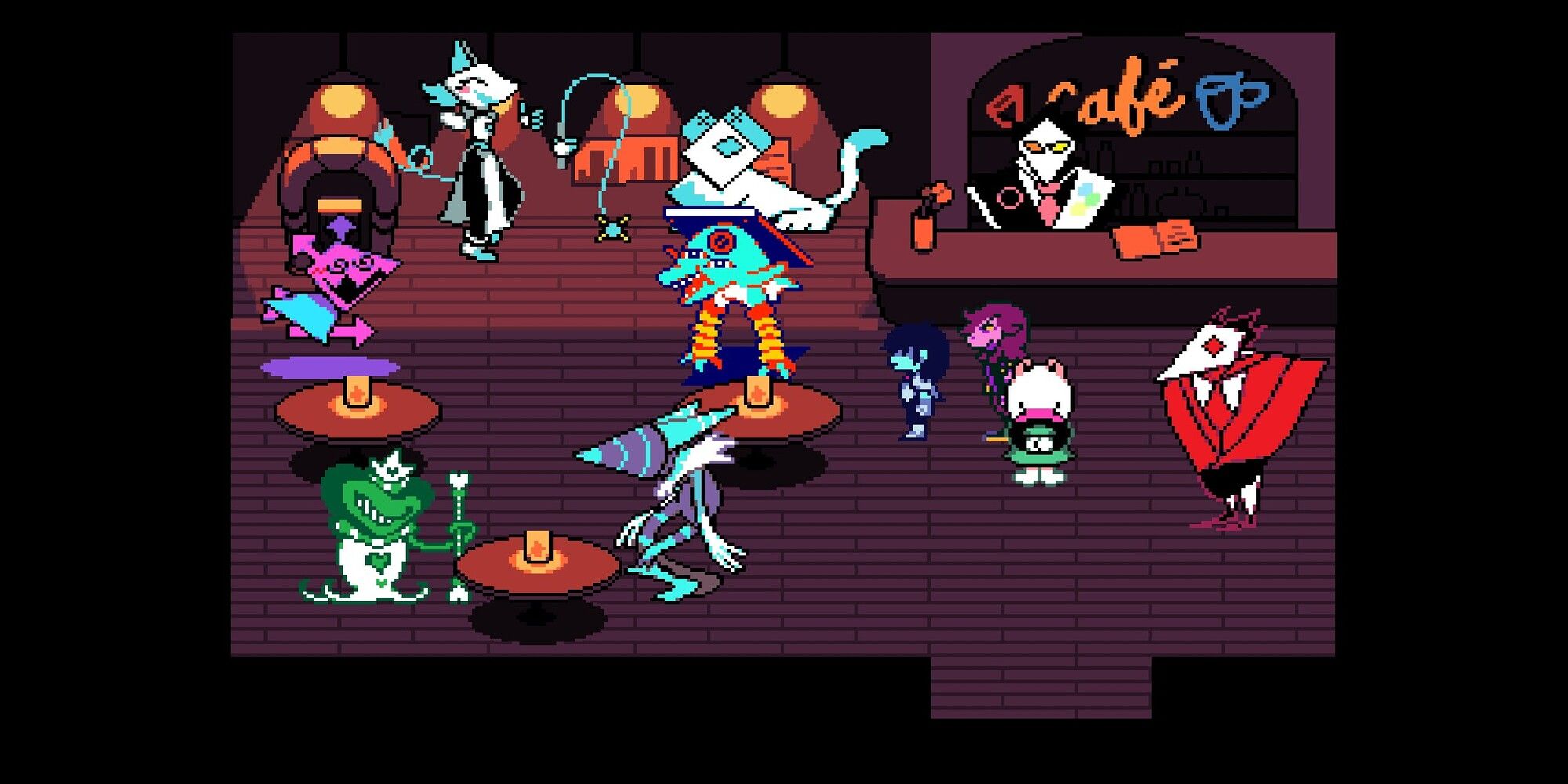
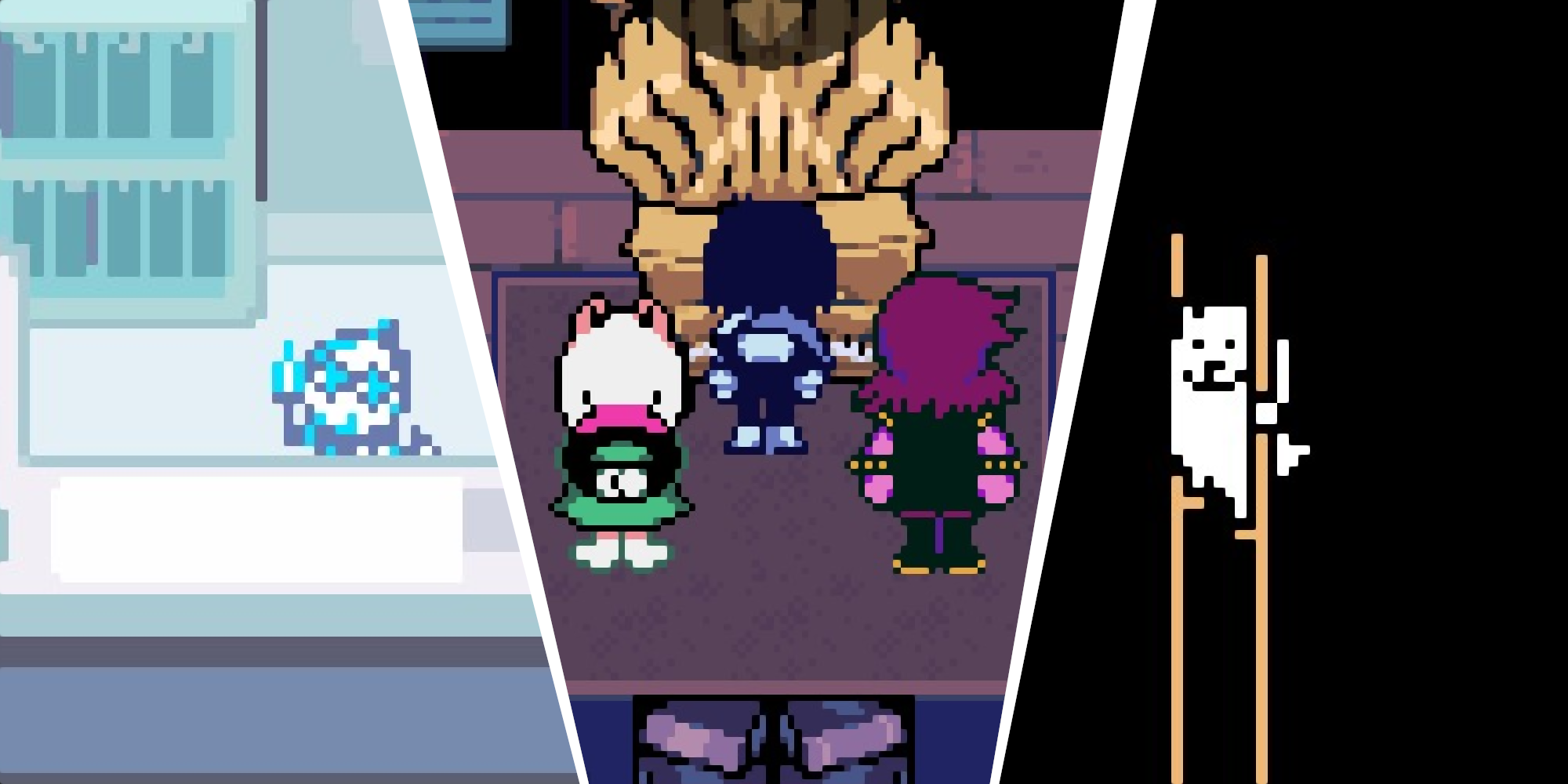
RPGs are no strangers to big casts, especially when it comes to enemy variety. In most, the shape and number of your foes fluctuate to set the tone or help build the world, and Deltarune is no different.
Where Deltarune does differ is in how you interact with these foes. Just like in the game’s forebear Undertale, violence is not the only solution to conflict, and many of your opponents are no more excited to face you than you are them.
Deltarune’s Chapter 2 solidified the mercy system with the Recruit mechanic, where once a certain number of an enemy type are befriended, they will join the player’s Castletown in subsequent chapters. This system lets you interact with and show off your favorite of the game’s massive variety of designs, and gives merciful players a number to shoot for, like their more aggressive contemporaries.
Related
Deltarune: How To S-Rank All Mini-Games In Chapter 3
Just don’t try for the T Rank, it’s not worth it.
We’ll be discussing how exactly to secure every recruit as they come, and how to avoid losing anyone you really care about.
Deltarune’s first chapter doesn’t actually have Recruiting as a mechanic! Playing through it will retroactively recruit every enemy to your town at the start of Chapter 2, so don’t worry about missing anyone!
Spoilers ahead for Chapter 3 + 4 of Deltarune!
Chapter 2
The vast majority of recruits throughout every chapter are obtained by simply playing through the chapters peacefully, with the required recruit counts even reflecting expected encounters throughout the story. As long as you aren’t actively dodging enemies, you should be able to snag each!
Related
Deltarune: How To Defeat The Secret Boss In Chapter 3
One More Fountain, One More Crystal, One Hundred More Questions
Certain recruits are mini-bosses, acting as progression gates until you deal with them. For Chapter 2, it comes in the form of Tasque Manager, who will quiz you on the differences between four portraits of her beloved Tasques.
The questions themselves aren’t important, however, as failing will simply lead to a fight with the Manager herself, one of the most enjoyable in the chapter. Whether you answer her correctly or not, you’ll end the encounter with her as one of your recruits!
Larger plot bosses are notable exceptions to the recruit rule. But they’ll still follow you back to your town.
Chapter 3
Chapter 3 shakes up the formula by introducing proper stakes to earning the recruits. If you don’t have enough, the Knight’s attack on Tenna in the chapter’s closing moments will actually prove fatal, leaving him shattered in the Light World. Should you manage to recruit the whole Chapter cast, however, he’ll be right as rain come Chapter 4, even opening up a mini-side quest to find him a new home!
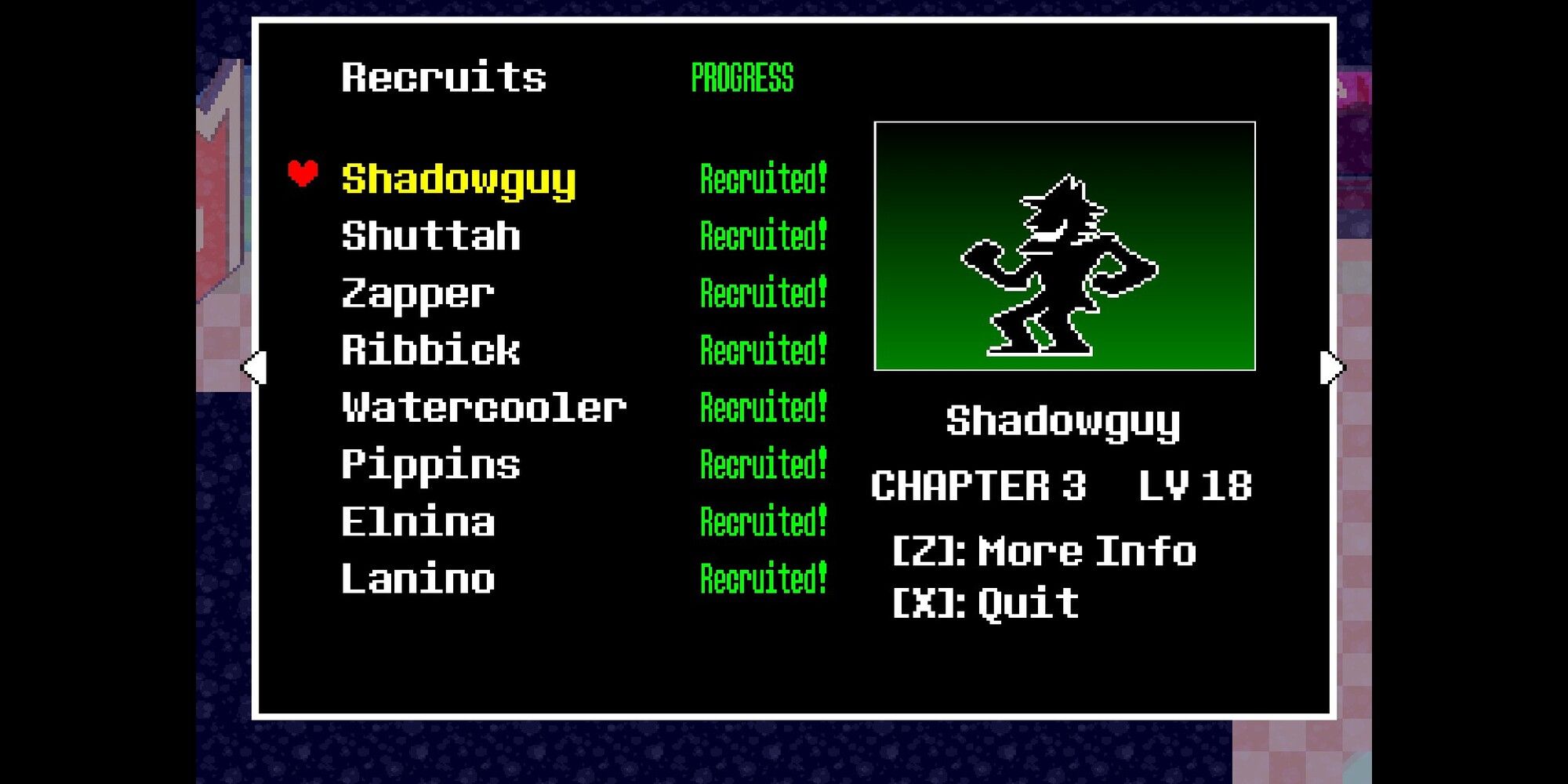
Chapter 3 opens with a pretty intimidating recruit goal for you to hit right out of the gate, as the recurring ShadowGuy enemy asks you to spare them a whopping 25 times throughout the chapter. While this number is easy, if time-consuming, to hit if you’re willing to grind out encounters in the chapter’s letter hours, the number isn’t just arbitrarily huge.
Related
Deltarune: How To Lock In The Weird Route
How far are you willing to go to defy fate?
Once you’ve begun the escape from the Dark World, you’ll be ducking between sets backstage, eventually leading you into a room where Shadowguys are sitting shoulder to shoulder on a game. Speaking to the Pippin on the right will reveal that the ShadowGuys are bound to work for Tenna by contract, as represented on the giant monitor.
Luckily for them, there’s a free controller beside the Pippin, allowing Kris to shred the contracts with a lawnmower. As thanks, the ShadowGuys will pledge themselves to your Castletown, granting you the vast majority of recruited ShadowGuys then and there! You may still be missing a few (I was during my first playthough), so go back to the previous Shadowguy encounter a few rooms back to confirm your standing with them.
Otherwise, requirements are low enough that you’re bound to hit them as long as you’re playing pacifist through the Chapter, including Elnino and Lanina after freeing them from Rouxls’ ill-fated throuple.
Make sure you’ve snagged everyone at the save point before fighting Tenna proper, and you’ll be good as gold!
Chapter 4
Chapter 4 spends plenty of time in the light world, giving you an opportunity to head to school and check in on your recruits before even heading into the new dark world. There are plenty of small moments to enjoy among your recruits, but eventually, the pull of the church will get you started on your next adventure.
The enemies in Chapter 4 are a bit more spread out than previously, and a few are only found while hunting for the secret boss, so don’t try looking up the solution to the Golden Piano unless you’ve already met them all!
Securing the notes for the Golden Piano will task you with backtracking to various early points in the chapter with Kris’s new climbing gear, opening up previously inaccessible areas. The backtracking is far from unrewarding though, with each path introducing new enemies, background on the enemies, and new passages of the prophecy.
These prophecies, alongside the fight dialogue from the chapter’s secret boss, give us a pretty good idea of who may appear in Chapter 5. Be they main story or secret boss, seeking out each and every recruit will naturally inform you on the possible future, as if securing every enemy is itself part of some grander design…
Related
Deltarune Chapter 4: 100% Completion Guide
Strap in, this one’s a doozy.
Either way, the game will warn you if you’re missing anyone before heading into the final leg of the chapter, an important distinction since, as with Chapter 3, the life of a new friend hangs in the balance. Should you fail to recruit every possible ally in the Dark Sanctuary, Jackenstein will sacrifice himself to assist in the party’s ascension to the Titan.
Recruiting the new rogue’s gallery means there are plenty of friends ready to catch Jackenstein before he falls, each giving you their blessing before you race off to fight Deltarune’s biggest boss yet. After all, if Kingdom Hearts has taught us anything, when facing down Darkness itself, you’ll need all the friends you can get.
Reloading a Chapter 4 file with completion data will even open a route back to Castletown before the final encounter, giving you a chance to enjoy all your new recruits and find out who’s hiding in the mic-shaped room in the back of Tenna’s studio.
For now, that’s all the recruits to be found throughout Deltarune. More will inevitably come once future chapters of the game are released. If the tease during Chapter 4’s credits are any indication, we may not have to wait quite as long as you’d expect.
In the meantime, enjoy the friends you’ve got, no matter how you met them. The greatest of bonds can be forged from adversity, and a good rival always makes a story stronger!
Deltarune
Released
October 31, 2018
ESRB
Teen // Language, Suggestive Themes, Mild Blood, Fantasy Violence
Each week on Polygon, we round up the most notable new releases to streaming and VOD, highlighting the biggest and best new movies for you to watch at home.
Porky Pig and Daffy Duck fight sentient bubblegum monsters animated with John Carpenter-style body horror in The Day the Earth Blew Up: A Looney Tunes Movie, which pops onto Max following its March theatrical release. For a less zany, more psychological spin on horror, today’s the day to watch Orphan and Carry-On director Jaume Collet-Serra’s The Woman in the Yard on Peacock. For some video game-inspired sci-fi fun, rent the time travel comedy Escape From the 21st Century, where three nerds gain the ability to jump into their future adult bodies whenever they sneeze, or The Jurassic Games: Extinction, where contestants fight dinosaurs to the death.
Here’s everything new that’s available to watch on streaming this weekend!
Genre: Comedy thrillerRun time: 1h 37 minutesDirector: Laura MurphyCast: Lucy Hale, Virginia Gardner, Brooke Nevin
A true crime fan (Lucy Hale of Pretty Little Liars) becomes convinced that one of the three guys she’s seeing is a serial killer who’s been targeting women through dating apps. Using clues revealed through her favorite podcast and her own investigations, she’ll have to piece together who she actually wants to be in a relationship with, and who’s a murderer.
Genre: Post-apocalyptic thrillerRun time: 1h 30mDirector: Frédéric JardinCast: Émilie Dequenne, Andreas Pietschmann, Lisa Delamar
A family trip at sea takes a very unexpected turn when the Earth’s magnetic poles reverse, causing the oceans to flood the land and leaving their boat stranded in a desert. Before the waters come back, they’ll need to cross the hostile land to find another stranded vessel while being pursued by some very angry crabs.
The Day the Earth Blew Up: A Looney Tunes Movie
Genre: Animated science fiction comedyRun time: 1h 31mDirector: Pete BrowngardtCast: Eric Bauza, Candi Milo, Peter MacNicol
Porky Pig and Daffy Duck (both voiced by Eric Bauza) get a job at a bubblegum factory to pay for home repairs in this feature film spinoff of Pete Browngardt’s Looney Tunes Cartoons. Unfortunately, the factory is at the center of an alien plot to turn the denizens of Earth into zombies, and the duo have to fight a horrifying gum monster to stop it.
Genre: Action thrillerRun time: 1h 56mDirector: David AyerCast: Jason Statham, David Harbour, Michael Peña
Entertaining on a screen of any size, Jason Statham’s latest thriller follows Levon Cade, an ex-black ops soldier trying to start a new life as a Chicago construction foreman while fighting to retain custody of his daughter. But when his boss’ daughter is kidnapped, Cade must put his old skills to use by running and gunning his way through the Russian mob.
Still injured from the car accident that killed her husband, Ramona (Danielle Deadwyler of Carry-On and Station Eleven) struggles to care for her two kids in their rural home. Things get really stressful when a mysterious woman covered in black clothing appears in their front yard saying only “Today’s the day.” As she gets closer, the family is plagued by misfortune until Ramona has to confront her head-on.
After a virus carried by kids turned adults into cannibals, anyone under 18 is rounded up and kept in camps. A group of renegade teens looking for freedom across the border take refuge with a woman who welcomes them with milk and cookies but then holds them prisoner. To survive, they’ll have to learn her twisted secret.
Escape from the 21st Century
Genre: Science fiction comedyRun time: 1h 38mDirector: Yang LiCast: Ruoyun Zhang, Elaine Zhong, Yang Song
Fans of Kung Fu Hustle and Shaolin Soccer should check out this high-energy film about three teenage nerds who get the power to travel 20 years into the future into their adult bodies. Discovering that the world isn’t as good as they’d like it to be, they fight for their future through a training montage and battles spiced up with stylized animation.
Genre: Horror comedyRun time: 1h 36Director: David Joseph Craig and Brian CranoCast: Nick Kroll, Andrew Rannells, Morgan Spector
Nick Kroll and Andrew Rannells of Big Mouth play a gay couple looking to celebrate their anniversary with a dream vacation in Italy before they adopt a child. Unfortunately, they end up accidentally killing a nice old lady in an isolated farmhouse, and the language barrier leads to a series of miscommunications and dark comedy twists.
The Jurassic Games: Extinction
Genre: Science fictionRun time: 1 h 42mDirector: Ryan BellgardtCast: Todd Terry, Ryan Francis, Todd Jenkins
The sequel to 2018’s The Jurassic Games continues the premise of a virtual reality competition where death row inmates fight dinosaurs to entertain audiences. The prisoners fight and ride raptors and even use power-ups to turn into dinosaurs themselves while trying to fight the game itself from the inside and shut the spectacle down for good.
Genre: HorrorRun time: 1h 21mDirector: James VilleneuveCast: Chelsea Clark, Kate Corbett, Ryan McDonald
When her car breaks down on the way to campus, a diabetic biology grad student looks for help and instead finds herself drawn into a twisted experiment meant to find a way to extend the lives of the wealthy. As her insulin supply dwindles, she’ll need to find to escape in time.
If you’re looking for another HOT NEWS story you’ve come to the right place! As looking through the EAB forums, to see if JOTD has finished any of his previously announced Arcade to Amiga ports of Gyruss, or even Bad Dudes vs DragonNinja. And I’ve just find out that JOTD is now working on the Arcade to Amiga port of the button mashing game of ‘Track & Field’ by Centuri/Konami. A game in which, as one person puts it ” Is Going to be a big hit this one (in relative Amiga terms) as its a absolute belter of a game, on par with Hyper Sports for pure addictiveness!”.
While there is very little to go on at the moment, and there’s no download yet.. Here’s the game info from wikipedia. “Players compete in a series of events, most involving alternately pressing two buttons as quickly as possible to make the onscreen character run faster. The game uses a horizontal side-scrolling format, displaying one or two tracks at a time, a large scoreboard that shows world records and current attempts, and a packed audience in the background. The game was a worldwide commercial success in arcades, becoming one of the most successful arcade games of 1984”.
And that’s all we know so far, so watch this space!
11 Bit Studios has a bit of a reputation for bleak, thought-provoking games that punch you in the soul and leave you emotionally drained on the floor. This War of Mine and Frostpunk both stood out because they didn’t just challenge your reflexes or resource management—they challenged your morals. So it shouldn’t be a surprise that The Alters picks up that same mantle and runs with it into sci-fi territory, asking the classic question: “What if you could meet the version of yourself who didn’t screw everything up?”
That’s the crux of The Alters. You play as Jan Dolski, a poor sod marooned on a hostile alien planet. The only way to escape is to keep his fancy hamster-wheel of a base rolling across the terrain to avoid being incinerated by the sun, all while gathering resources, fixing constant breakdowns, and dealing with clones of himself made using a weird substance called Rapidium. It’s a stressful day job with a side hustle in existential crisis, all played through the medium of a survival-management game.
Available On: PC, Xbox Series S/X (Game Pass), PlayStation 5Reviewed On: PCDeveloped By: 11 Bit StudiosPublished By: 11 Bit Studios
Review code provided by the publisher.
And if all that shite wasn’t enough, you also need to negotiate with the boss who keeps calling in to make demands, not least that you bring home plenty of Rapidium. If that wasn’t bad enough, some idiot even gave your ex-wife the phone number for your space base, because apparently the threat of being burned alive or potentially murdered by yourself just isn’t enough to deal with. Honestly, the ex-wife is probably the real threat in that scenario. Maybe you can pawn a clone off on her?
It’s… well, it’s a lot to deal with. Shove aside the sci-fi moral dilemmas and philosophical discussions that arise from playing God, and what you’ve basically got is a game about being a mid-level manager of a fucking zoo full of highly-trained but incredibly belligerent monkeys.
Playing beer pong is an easy way to boost a clone’s mood a little.
Each day in The Alters plays out on a tight timer. You’ve only got a limited window before the deadly sun swings back around, forcing you to either haul your mobile base to safety or be cooked alive like a jacket potato. That means every moment counts. You’ll spend your precious daylight hours heading out in third-person to scavenge resources like metal, organics, and crystals, marking nodes for your Alters to harvest. But collecting raw materials is just the start—back in the base, those same resources need to be refined and processed into dozens of different components: filters for surviving radiation, structural parts for base upgrades, and various doodads needed to keep your crew alive and your sanity intact.
Crafting is at the heart of the gameplay loop. You need to churn out exploration tools like ladders and anchors to access new areas, fabricate vital parts to expand your base with new rooms, and keep everyone fed, rested, and sane. Every system feeds into another—can’t build a new room without structural frames, can’t make frames without processed metals, can’t get processed metals without a functioning refiner, and so on. All of this forces tough choices about how to spend your time and resources. Do you upgrade living quarters to keep the Alters happier, or do you build a new battery so you can explore further? It’s a tightrope act of priorities, and the constant ticking clock adds a real sense of pressure to the otherwise methodical resource management.
These connections enable fast-travel, vital when you barely have any time to do everything as it is.
Exploring and mining is handled by crafting mining outposts and plopping them down, before connecting back to base with pylons. First, though, you have to use an awkward scanning system to locate deposits, which feels like it was built purely to eat into the already limited time you get per day. Loose resources scattered about the place can be picked up too, while you’re busy blasting through walls or picking up personal items which can be given to alters to boost their mood.
Here’s a general day in the life of Jan: you wake up and immediately assign some Alters to mining for organics and metals, while you head to crafting stations to pump out radiation filters and mush for the crew to eat. Then it’s off out the door to grab minerals because you need to make bridge anchors to cross a lava river. But wait, because everything in the base is breaking, the miner is having some sort of weird meltdown, there’s a magnetic storm coming, you need to build more storage, the sun is on its way to end your game, the boss is on the phone, the alters all want something, there’s weird-arse anomalies floating about and jesus fucking christ would everybody just shut up for five seconds, I can’t even hear myself think!
Scanning for minerals to dig up is a chore
The other thing you have to deal with is the multiple clones of yourself running around the place, all voiced by Alex Jordan, who seems to be having great fun swapping accents. Their attitudes toward you tend to range from apathy to downright hatred, and in one instance murderous rage. To keep everything running and the base from being turned into the shittiest sauna ever, you’ll need to massage these various personalities via dialogue choices and deciding whether to spend resources on their needs and wants. They sure don’t make it easy, mind you – by act 1, one of my alters had chopped his arm off, possibly because I took his drugs away. You need these walking, talking embodiments of mental health functioning so that you can assign them to maintaining the base, drilling for resources you’ve marked out and about 1 billion other jobs.
There’s something brilliantly messed up about the entire concept, and in true 11 Bit fashion, it’s not just a gimmick. These aren’t generic clones—they’re alters, born from different paths your life could have taken. One might be a war vet, another a computer engineer, and yet another a broken addict. Each one comes with a skillset you need to survive, but also with baggage you’ll need to unpack if you want them to function properly. The psychological element isn’t just window dressing—it’s integral to the gameplay and narrative. The moral choices feel genuine and heavy, offering rich “what if” scenarios that are compelling enough to warrant multiple playthroughs. You simply can’t see all the alters in one run, and that’s a big part of what makes The Alters so replayable.
What is it about 11 Bit Studios and circles?
The comparisons to Duncan Jones’ Moon are obvious—and intentional. This is sci-fi in the classic sense: philosophical, character-driven, and more interested in identity than aliens. It doesn’t have blockbuster bombast. It’s closer in spirit to a moody indie film with a double-A budget, and while that budget is usually used very well—especially in the game’s art design—you can see the seams in the facial animations and the occasionally janky movements. But damn if it doesn’t still manage to be visually striking, with its moody lighting, stark alien landscapes and the base itself, which looks like a hamster wheel made by Ikea after a few drinks.
The problem is that I’d have to lie to say I liked playing The Alters. That isn’t a fault of the game—the survival and management elements are executed very well, as the many other glowing reviews and loving comments from players can attest. No, the issue is purely with me and my malfunctioning brain. Due to some boring personal reasons, I’m a little… er, frazzled at the moment, and the result was that my brain rebelled at all of the management and resources and decisions and constant need to be doing all the things but only being able to do some of the things. It felt overwhelming, in a way, like a job that was weighing me down. In short, playing it felt stressful, but not in the enjoyable way that other 11 Bit titles like Frostpunk did. That isn’t the fault of The Alters, though.
In Conclusion…
⭐⭐⭐⭐
Rating: 4 out of 5.
So here’s the honest truth: The Alters is a brilliant game. It’s clever. It’s original. It’s got all the emotional weight and moral murkiness you’d expect from 11 Bit, wrapped up in a fascinating sci-fi package. But it’s not going to be for everyone. The complexity of managing your base, your clones, and your sanity can be too much. The technical issues at launch—some of which are still being ironed out—don’t help. And if you’re already mentally wiped like I was, it can feel like too much of a slog.
But if you’re in the right headspace? The Alters is one of the most unique narrative experiences of the year. It’s ambitious, heartfelt, and packed full of clever ideas that deserve to be played, discussed, and dissected. Just maybe don’t let your clones read the reviews—you don’t want them getting any ideas.
Playing With History, a new book based on TSA’s ongoing feature series, has officially launched its crowdfunding campaign on Kickstarter.
From cinematic samurai epics to world-conquering strategy games, Ade and Jim will explore a wide spectrum of titles, from AAA blockbusters to indie gems and everything in between. Playing With History is set to feature over 200 pages of deep dives and interviews and will be available both physically and digitally with optional premium upgrades as well as a backer-exclusive early bird discount.
For anyone who has read PWH in the past or wants to learn more about how history inspires your favourite video games, we’d love your support. If you want an early look at what we’ve been working on, a free preview (PDF) is available to download now.
If you want even more PWH, then you’re in luck! We’ve put together an archive below – a number of these will be adapted and expanded for the new book, alongside exclusive stories and interviews. If you’d like to reach out with feedback and suggestions, you can find Playing With History on BlueSky and X.
You can trust VideoGamer. Our team of gaming experts spend hours testing and reviewing the latest games, to ensure you’re reading the most comprehensive guide possible. Rest assured, all imagery and advice is unique and original. Check out how we test and review games here
Epic Games has released numerous balance changes to Fortnite over the past few days. The goal of these changes is to make the game more fair but also to increase the difficulty. Due to this, getting a Victory Royale is slightly harder now than it was before.
Earlier this week, Epic made Blitz Royale harder by reducing the amount of bots in it. Now, the game developer did the same to the classic Battle Royale mode. Next time you launch the game, you will likely notice an increased difficulty, so let’s check in detail what Epic changed.
Fortnite Battle Royale now has fewer bots than before
With the release of Chapter 2 in October 2019, Epic Games added bots to Fortnite. The purpose of them is to fill lobbies faster in every region and to be used for practice. Due to this, new accounts always get several bot-filled lobbies before being matched up against real players. Furthermore, players with a lower skill level usually get more bots in their lobbies than the players who win frequently.
The latest Fortnite update made the Battle Royale mode more difficult. Image by VideoGamer
Until recently, the maximum number of bots in a Fortnite Battle Royale lobby was 75. This means that low-level lobbies had 25 real players and 75 bots, which made it easier for players to win games. However, Epic Games recently changed this, reducing the maximum number of bots to 65. In other words, every lobby will now have at least 35 real players, regardless of skill level.
This change will mostly affect players in low-level lobbies, as they will now have to face a tougher opposition. Considering that Epic keeps experimenting with bots, we may get another change soon. However, it appears that Fortnite is in the sweet spot right now, as lobbies should be more or less balanced, while also being challenging.
Fortnite
Platform(s):
Android, iOS, macOS, Nintendo Switch, PC, PlayStation 4, PlayStation 5, Xbox One, Xbox Series S/X
Genre(s):
Action, Massively Multiplayer, Shooter
9
VideoGamer
Subscribe to our newsletters!
By subscribing, you agree to our Privacy Policy and may receive occasional deal communications; you can unsubscribe anytime.
Most of what happens within the video games we play is invisible to us. Even the elements we’re looking straight at work because of what’s happening behind the scenes. If you’ve ever watched a behind-the-scenes video about game development, you might’ve seen these versions of flat, gray game worlds filled with lines and icons pointing every which way, with multiple grids and layers. These are the visual representations of all the systems that make the game work.
Assassin’s Creed Shadows
This is an especially weird dichotomy to consider when it comes to lighting in any game with a 3D perspective, but especially so in high-fidelity games. We don’t see light so much as we see everything it touches; it’s invisible, but it gives us most of our information about game worlds. And it’s a lot more complex than “turn on lamp, room light up.” Reflection, absorption, diffusion, subsurface scattering–the movement of light is a complex thing that has been explored by physicists in the real world for literally centuries, and will likely be studied for centuries more. In the middle of all of that are game designers, applying the science of light to video games in practical ways, balanced with the limitations of even today’s powerful GPUs, just to show all us nerds a good time.
If you’ve wondered why many games seem to be like static amusement parks waiting for you to interact with a few specific things, lighting is often the reason. But it’s also the reason more and more game worlds look vibrant and lifelike. Game developers have gotten good at simulating static lighting, but making it move is harder. Dynamic lighting has long been computationally expensive, potentially tanking game performance, and we’re finally starting to see that change.
Case in point is Assassin’s Creed Shadows and Ubisoft Technical Architect Nicolas Lopez. Lopez spoke at the Game Developers’ Conference this spring, and reading through his slide deck was fascinating, with the release of the video recording of the show only amplifying that. I reached out to Ubisoft talked with Lopez via email about how technology like ray tracing is changing game lighting. For more on those aspects of video game visuals, check out our primer on path tracing, ray tracing, and rasterization in game graphics.
The thing that initially piqued my interest was a specific set of numbers Lopez put on the screen during the GDC presentation. Lopez noted that if lighting were calculated in Assassin’s Creed Shadows the same way it had been in Assassin’s Creed Unity, Shadows would’ve taken nearly two years to “bake” all the lighting–that is, precalculate and render it–and around 2TB of storage space to store all of that lighting. (Assassin’s Creed Shadows requires 115GB on PC for the entire game.) Those numbers seem to represent a vast difference between the games of yesteryear and modern triple-A titles. I wanted to put those numbers into context as soon as I saw them.
Cities in Assassin’s Creed Unity and Syndicate, Lopez explained, were pretty small spaces: dense cities about four square kilometers in area. In those games, developers used uniform lighting probes to dictate how global illumination was rendered (alongside other lighting techniques). Lighting probes are points on the map that contain information about what lighting is passing through the empty space in that area, which is then used to help light the static and dynamic objects in that space. These were 50-centimeter probes, meaning they were requesting light information every half a meter across Unity’s entire city of Paris.
Let’s pause for a moment to discuss global illumination, also referred to as GI. This is a broad term used to describe a variety of techniques meant to imitate and mimic realistic lighting, especially indirect lighting. These include cube maps, screen-space reflections, probe lighting, and more. Digital Foundry has a great primer on global illumination that breaks this stuff down into chunks.
“The small scale [of these smaller game worlds] let us afford high-quality lighting, even though it required significant storage,” Lopez told me. From Assassin’s Creed Origins forward, though, world size exploded, and suddenly we were exploring worlds 256 square kilometers in area. That much baked light information would’ve caused games to explode in file storage size, so the team began to use a dynamic system.
“We vary probe density based on scene complexity–dense urban areas still use 50-centimeter spacing, but in open landscapes like deserts or forests, we reduce the resolution,” Lopez explained. Artists paint this “GI density map” directly–meaning they can focus the quality of light where it matters most–which Lopez said “dramatically reduces data size while preserving visual quality where it matters most.”
Uniform light probe distribution in Assassin’s Creed Unity.
It’s also worth mentioning that Assassin’s Creed Unity had a limited number of times of day–just four, compared to 11 in Shadows–and had very limited weather effects, while Shadows has a dynamic weather system. All those elements in Shadows create changes in lighting the game has to take into account to present believable visuals.
That original question–why would baking the lighting take so long and require so much file storage?–comes back to a simple conclusion. The limitations of hardware and game engines at the time forced the team to pre-bake a lot of lighting information; neither the hardware nor the software was ready to handle calculating so much light data in real time.
Historically, most if not all game lighting has been “baked.” That means that the various techniques used to light a given scene are calculated ahead of time and then stored as textures and maps that the engine overlays onto the basic scene, so your computer or game console doesn’t have to do those calculations while you’re playing and slow the game to a crawl. This works for really static games and can provide very convincing, impactful lighting. As a game becomes more dynamic, though, baked lighting becomes less viable. If we consider cube maps (see our primer and that Digital Foundry video above for the specifics), you’d have to calculate a cube map for every possible place a character could stand, and that’s where game install sizes can start ballooning when it comes to game lighting.
Light probe distribution as determined by artists in Assassin’s Creed Shadows.
Unity’s game world was a small, uniform space when compared to the more recent Assassin’s Creed games. The same approach applied to the much larger areas of Shadows, with more dynamic effects and varied density, would’ve made for a truly massive game.
But it has been a long time since the release of Assassin’s Creed Unity. More than a decade, in fact, and in that game, a lot has changed! One of the biggest changes has been ray tracing, which is available to all PlayStation 5 and Xbox Series X|S gamers, and about 30-40% of graphics cards shown in the Steam Hardware Survey as of this May.
“Ray tracing has had a major impact on how we approach lighting, from both a creative and production standpoint,” Lopez said. “In traditional pipelines, lighting was mostly baked global illumination, reflections, ambient occlusion, etc. That meant lighting couldn’t react to world changes. Change or move a piece of architecture? Suddenly the lighting is invalid. Teams would have to re-bake the lighting data, which could take hours or even days. At Ubisoft, we ran overnight compute jobs so artists could get fresh lighting each morning. But it still slowed down iteration dramatically.”
Ray tracing freed artists from many of those constraints, he said.
“Artists can move objects, adjust scenes, or iterate without waiting for long bakes. And since lighting is computed per pixel, the visual fidelity is much higher and more physically accurate,” Lopez explained. In other words, artists can do art at their own pace instead of waiting for computers to compute before they do so.
Even so, ray tracing is often invisible to us on the consumer side of things, especially when we consider how static many game worlds can be. In those games, ray tracing is all but invisible, as it’s doing the same thing that game designers were doing with creatively placed static lights. A Call of Duty level, for example, doesn’t have to account for procedural changes to time of day and weather, so traditional lighting can be very effective.
Night rendering with light only in Assassin’s Creed Shadows
“The benefits can be subtle,” Lopez admitted, with respect to that set of game-design rules. Shadows, Lopez said, is a truly dynamic world, and that makes ray tracing a genuine game changer–in a figurative and literal sense. Shadows has, as previously mentioned, 11 different times of day, four seasons, a variety of dynamic weather effects, and destructible environments that all affect the way players see the game as they play. The hybrid solution Shadows uses, combining some baked and some dynamic lighting, “pushed baked GI to its absolute limits.”
“Ray tracing allows us to light these dynamic environments accurately and consistently,” Lopez explained. “Lighting behaves as it should, even when the world changes drastically. No hacks, no workarounds. It makes the world feel more grounded and believable.”
“Interiors light up naturally when doors open,” Lopez continued. “Destructible objects finally contribute to the scene lighting. Season lighting changes the mood of a scene. Without ray tracing, these effects can only be approximated to a certain extent.”
The team iterated on Ubisoft’s Anvil engine, which is used across the Assassin’s Creed series, in other ways. They adopted the Academy Color Encoding System, for example, which is a universal color standard used by the film industry to keep the work of hundreds or thousands of people consistent across many devices. It helps ensure that people working on different machines, in different locations, creating different parts of the game in a variety of applications, are working with the same color information. That gives us a more consistent and more grounded game–that is, the characters, buildings, foliage, and even effects look like they belong in the same game and feel convincing–at the end of development. Color Look-Up Tables (LUTs) allow the team to shift the visual tone and color grading to match the weather and environmental ambiance.
Assassin’s Creed Shadows
One of the key parts of getting Shadows right in particular fell, again, to getting the lighting just right. With HDR screens being so ubiquitous these days, developers can rely on having some ability to show a greater range of light and dark–but dark can still often mean pitch black. Even high-quality displays are subject to a user’s personal preference, the qualities of that particular display, and a game console’s ability to display color accurately. This became especially important when Ubisoft decided to finally fulfill years of gamers wishing for a ninja-focused Assassin’s Creed game.
“We reworked key parts of our physically based rendering and exposure pipelines to behave more accurately in low-light conditions,” Lopez said.
With ray tracing helping to inform the way lighting works in Shadows, the team can “deliver nights that feel moody and authentic, without relying on artificial fill lighting,” Lopez said. The quality of the lighting directly supports the gameplay, both giving it more weight and believability, and making it feel more cinematic.
All of these changes came together, Lopez said, to create a “unified, reactive visual where everything feels connected,” with Shadows in particular having sparked a cycle of innovation that pushed Anvil and Assassin’s Creed both forward.
For the rest of us, Assassin’s Creed Shadows works as an example of how video game design is adapting to new technology for both gamers and game designers alike. Designers working on tentpole games like Shadows have new ways to create games more quickly without sacrificing fidelity. In return, we get more dynamic worlds that live and move around us.
Play it on: PS5Current goal: Start repairing connections
Oh, hi. It’s me again. So after wrapping up some much-needed venting through the perilous violence that is The Last of Us Part II, I’m gonna need to wind down and start envisioning a reparative future. And thank heavens Sam Porter Bridges has just such a task ahead of him.
I came to adore the original Death Stranding after a few playthroughs. It’s a dense piece of video game fiction if there ever was one, and there’s so much I still don’t understand about it, but in a good, mysterious way. I look forward to a new chapter of this wonderfully weird, sometimes too weird, Kojima fantasyscape.
The first Death Stranding did a remarkable job of fusing large, real-life themes such as human connection to its own wonderfully outlandish concepts like extinction entities, using them together to explore how our efforts to defy or control death can lead to unexpected consequences. That’s exactly the kind of thoughtful, stimulating, grounded yet escapist thing I need right now given what’s going on in my life and frankly, given the horrors of our world, too.
Hideo Kojima has repeatedly spoken about how he had to rewrite Death Stranding 2 after the pandemic, this time with a script that’s more focused on asking, “Should We Have Connected?”
It’s a question I’m asking myself a lot. I don’t know if Kojima’s going to give me the kind of answer I want to hear, but I’m certainly in need of spending some time in his mind right now to think about it. — Claire Jackson
And that wraps our picks for the weekend! Happy Pride and happy gaming!



.jpg?width=690&quality=70&format=jpg&dpr=2&auto=webp)
.jpg?width=690&quality=70&format=jpg&dpr=2&auto=webp)