Metaverse

Home Metaverse Page 92

Elon Musk’s “Wikipedia Killer” Grokipedia Launches… And It’s Already Full of Copied Content

0
Elon Musk’s “Wikipedia Killer” Grokipedia Launches… And It’s Already Full of Copied Content


So, Elon Musk’s new AI company, xAI, has officially launched its new online encyclopedia, Grokipedia. Musk has been claiming this will be the alternative that “replaces Wikipedia.”

However, on its very first day, the site is already getting dragged for allegedly copying content directly from Wikipedia.

Grokipedia looks and feels a lot like Wikipedia, with a big search bar and standard article formatting. But it’s currently tiny in comparison. The site claims to have about 885,000 articles, while the English version of Wikipedia alone has over 7 million.

In a typical Elon Musk move, he stated, “Grokipedia 1.0 will be 10x better, but I think even at v0.1 it’s better than Wikipedia.”

The “Verified by AI” Problem

A note under the articles claims the text has been “verified” by Grok, the xAI large language model. This is a major red flag, as LLMs are known for “hallucinating” and confidently presenting false information. It’s generally not a good idea to use an AI to fact-check itself.

It’s Literally Copied from Wikipedia

Despite Musk promising a “huge improvement,” many pages appear to be direct lifts.

For example, if you check the page for the PlayStation 5, a notice at the bottom reads: “This content is adapted from Wikipedia.” The text on that page is reported to be nearly identical to Wikipedia’s. The same warning and copied text were found on pages for the MacBook Air and the Lincoln Mark VIII.

A spokesperson for the Wikimedia Foundation (the nonprofit that runs Wikipedia) summed it up perfectly: “Grokipedia needs Wikipedia to even exist.”

Interestingly, not all content is a direct copy. Reports indicate that pages on controversial political and scientific topics, like climate change, show significant differences from their Wikipedia counterparts.

It also seems users can’t actually edit articles right now. An “edit” button exists on some pages, but clicking it only shows previous changes without saying who made them, and there is no apparent way for users to submit their own edits.

You Might Also Like;

Follow us on TWITTER (X) and be instantly informed about the latest developments…

Copy URL


Source link

TIFIN AI Review – The Future of Intelligent Wealth Management Is Here

0
TIFIN AI Review – The Future of Intelligent Wealth Management Is Here


In a rapidly evolving financial world, TIFIN AI stands out as a groundbreaking platform that merges artificial intelligence, behavioral science, and personalized finance to transform how individuals and advisors manage wealth.Unlike traditional financial tools, TIFIN AI goes beyond numbers — it understands people. By combining data-driven analytics with emotional intelligence, it helps deliver personalized investment experiences that feel truly human.

This isn’t just an algorithmic advisor. TIFIN AI is the future of intelligent wealth management, offering tools that learn, adapt, and evolve with every financial decision you make.

💡 What is TIFIN AI?

TIFIN AI is an AI-powered wealth management platform designed to enhance financial decision-making using machine learning, behavioral data, and predictive analytics.It serves financial institutions, advisors, and individual investors — helping them deliver customized investment recommendations, optimize portfolios, and better understand client behavior.

It’s perfect for:💼 Financial Advisors – Offer data-backed, personalized recommendations for every client🏦 Investment Firms – Enhance portfolio performance with AI-driven optimization📊 Wealth Managers – Identify growth opportunities and manage risk more effectively💰 Individual Investors – Receive adaptive, goal-based investment strategies tailored to you

🔑 Key Features of TIFIN AI

🧠 Personalized Investment Insights – Delivers hyper-personalized portfolio recommendations based on risk tolerance, goals, and behavior🤖 AI-Driven Portfolio Optimization – Continuously monitors and adjusts investments using predictive analytics💬 Behavioral Intelligence – Understands investor psychology to align strategy with real human behavior📈 Predictive Market Analysis – Anticipates market shifts using real-time AI forecasting⚙️ Automated Advisory Tools – Simplifies client onboarding, portfolio monitoring, and rebalancing📊 Data-Driven Decision Support – Empowers advisors with deeper insights into client needs🔒 Institutional Integrations – Works seamlessly with major financial systems and CRMs📱 AI Dashboards – Clear, interactive interfaces for both advisors and clients

🌟 Why We Loved TIFIN AI

TIFIN AI impressed us by bridging the gap between technology and human insight. It’s not just an investment algorithm — it’s a financial intelligence ecosystem that learns from every interaction.

Here’s what makes it stand out:⚡ Deep Personalization – AI adapts to unique investor profiles and emotional patterns💡 Advisor Empowerment – Helps professionals deliver smarter, faster insights📈 Smart Forecasting – Uses predictive analytics to anticipate risks and opportunities🎯 Behavior-Based Analytics – Understands investor sentiment for more consistent outcomes🤝 Client Engagement Tools – Strengthens trust between investors and advisors

⚠️ Areas for Improvement

While TIFIN AI is one of the most advanced wealth intelligence platforms available, a few areas could improve:💵 Enterprise Focus – Some tools are best suited for financial institutions, not casual investors📊 Complex Setup – Integration with existing systems may require initial technical support🌍 Limited Direct Investing – Acts more as an advisory AI than a trading platform

🚀 How to Use TIFIN AI

1️⃣ Sign Up – Visit tifin.com to explore AI-powered solutions2️⃣ Select Your Product – Choose from TIFIN’s AI modules (Invest, Wealth, Grow, Risk, etc.)3️⃣ Integrate Data – Connect your client or portfolio data securely4️⃣ Activate AI Insights – Let TIFIN analyze, recommend, and optimize in real time5️⃣ Track & Refine – Monitor performance and fine-tune strategies with continuous AI learning

💡 Pro Tip: Use TIFIN Grow to combine marketing intelligence with wealth management — an edge few other financial AIs offer.

🏁 Final Verdict

TIFIN AI is redefining the future of personalized finance. By merging AI, behavioral science, and wealth management, it empowers advisors and investors to make decisions with precision and empathy.

It’s more than just technology — it’s intelligence that understands you.Whether you’re managing portfolios, scaling advisory services, or seeking smarter investment guidance, TIFIN AI helps you build wealth that truly aligns with your goals and mindset.

✅ Our Favorite Feature: The Behavioral Intelligence Engine — a cutting-edge AI that interprets emotional and psychological investor signals to create hyper-personalized strategies for long-term success. 🧠💹✨

You Might Also Like;

Follow us on TWITTER (X) and be instantly informed about the latest developments…

Copy URL


Source link

Ubuntu Tribe: How Mamadou Toure Is Tokenizing Gold To Build Financial Freedom In The Web3 Era

0
Ubuntu Tribe: How Mamadou Toure Is Tokenizing Gold To Build Financial Freedom In The Web3 Era


In Brief

Mamadou Toure of Ubuntu Tribe highlighted how tokenizing gold can democratize wealth, bridge TradFi and Web3, and promote ethical, sustainable investment.

Ubuntu Tribe: How Mamadou Touré Is Tokenizing Gold To Build Financial Freedom In The Web3 Era

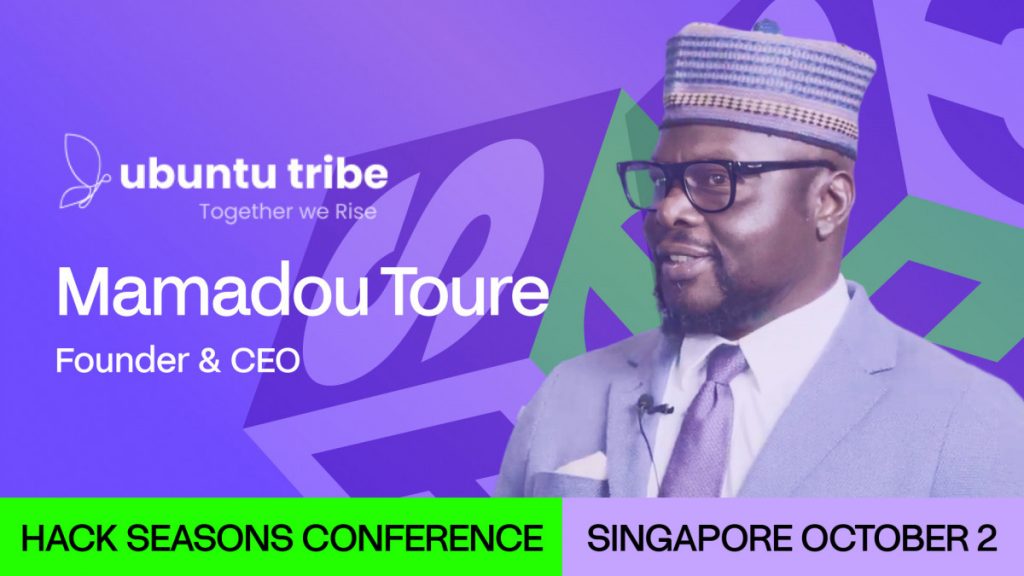
At the beginning of October, the Hack Seasons Conference in Singapore gathered leading innovators in crypto, blockchain, Web3, AI, and DePIN to discuss emerging global trends. Among them was Mamadou Toure, Founder and CEO of Ubuntu Tribe, a fintech venture redefining access to real-world assets through blockchain.

Mamadou Toure, a visionary in impact finance, spoke with us about tokenizing gold to democratize wealth, the lessons learned from traditional finance, and his mission to create a more equitable, sustainable global economy.

Democratizing Wealth Through Gold-Backed Tokens

Ubuntu Tribe’s mission is simple yet profound: to help people achieve financial freedom by making wealth creation accessible to everyone, regardless of geography or status.

“The way wealth is built shouldn’t penalize where you were born,” Mamadou Toure explained. “To escape the poverty or debt trap, people need real assets they can borrow against, grow, and pass down to future generations. Gold has always served that purpose—but it’s physical, heavy, and complex to move. That’s why we’ve tokenized and fractionalized it.”

Through Ubuntu Tribe, users can own gold-backed tokens starting from just $0.10—equivalent to one milligram of gold. “Anyone on the planet can now participate,” Mamadou Toure added. “Because it’s on-chain, it’s safe, fast, and easy to transfer without the gold ever having to move.”

The company envisions a near future where users can swap BTC, ETH, or USDT for gold-based tokens seamlessly—bridging traditional assets with the Web3 economy.

Rethinking Gold In The Digital Age

Before founding Ubuntu Tribe, Toure spent over two decades in traditional finance, giving him a unique perspective on how gold is valued differently in Web3 and traditional systems.

“Web3 often misunderstands gold because it comes from a purely digital environment,” he said. “Bitcoin has been called ‘digital gold,’ and while it has grown impressively, gold remains the foundation—stable, tangible, and consistently valuable.”

Mamadou Toure noted that gold’s market cap has outperformed Bitcoin’s in 2024, maintaining a 10:1 ratio over the last five years. “There’s a lack of education around this. But by calling Bitcoin ‘digital gold,’ even crypto maximalists are acknowledging gold’s enduring power.”

He also criticized traditional finance for its lack of transparency: “Central banks and large institutions buy gold quietly while the public remains uninformed. When gold hits record highs, you rarely see it on the news—because some players want to keep buying at low prices.”

Tokenized Gold: Real Innovation, Not Repackaging

Addressing skeptics who say tokenized gold simply “repackages” traditional assets, Mamadou Toure disagrees:

“Repackaging is innovation,” he insisted. “Bringing physical assets on-chain democratizes access. Fractional ownership of gold and other commodities changes lives.”

Mamadou Toure emphasized that Ubuntu Tribe’s gold-backed tokenization took years of engineering, compliance, and auditing. “Each token is linked to a specific gold serial number, verified by auditors before issuance. We cannot mint more tokens than the verified supply. This traceability, logic, and logistics—few have managed to get right.”

Real-World Assets: The Next Chapter Of Web3

Mamadou Toure believes RWAs are the inevitable future of Web3. “When you can tokenize commodities—not just precious metals—you create immense value. As the dollar weakens, global central banks are turning to gold, the timeless backbone of financial systems.”

Ubuntu Tribe views tokenized gold as the gateway to onboarding billions into Web3. “Gold is a universal asset. Everyone knows it, everyone trusts it. Tokenizing it allows us to connect what people already believe in with what they will come to trust—Web3.”

Building Trust, Compliance, And Sustainability

Since its founding five years ago, Ubuntu Tribe has built not only a token but a full ecosystem—from wallets to traceability systems and responsible sourcing.

“We’ve built a quantum-safe wallet with integrated payments and a dApp browser,” Mamadou Toure said. “We also took two years to secure MiCA compliance in the EU, ensuring full consumer protection. We have entities in the US, Singapore, and a regional headquarters in Dubai.”

The company operates gold vaults in Zurich, Stuttgart, Copenhagen, and soon Dubai and Singapore. But Toure’s vision goes beyond storage.

“I couldn’t take pride in selling gold-backed tokens without ensuring our gold is ethically sourced,” he emphasized. “We built a track-and-trace system from mine to vault, verifying every step. We also use zero-mercury extraction technology, ensuring our operations are environmentally and socially responsible.”

Ubuntu Tribe, he added, is a “conscious company”—aiming not only to change lives through investment but to uplift the miners and communities behind each gram of gold.

Circular Economy And Next Steps

Ubuntu Tribe is built on a circular economy model, proving that finance can deliver financial, social, and environmental returns simultaneously.

In the next 12–18 months, the company plans to expand its offering beyond gold. “We’re launching silver next quarter, followed by platinum and lithium,” Mamadou Toure revealed. “We want to bring hidden jewels to the masses—assets that are real, trusted, and scam-proof. One day soon, people might be using gold tokens to buy coffee.”

Ubuntu Tribe is also developing AI-powered financial tools. “Finance runs on two pillars—information symmetry and collateral,” Toure explained. “We’re tokenizing metals to give people on-chain collateral that doesn’t depend on credit history. And we’re building an AI financial literacy assistant in our wallet to help users learn, invest, and grow smarter.”

As Ubuntu Tribe enters its next phase, Toure remains grounded in purpose. “We’re not just tokenizing gold—we’re building a bridge between the old and the new world of finance. Real assets, real value, real impact. That’s what will drive the next generation of wealth creation.”

Disclaimer

In line with the Trust Project guidelines, please note that the information provided on this page is not intended to be and should not be interpreted as legal, tax, investment, financial, or any other form of advice. It is important to only invest what you can afford to lose and to seek independent financial advice if you have any doubts. For further information, we suggest referring to the terms and conditions as well as the help and support pages provided by the issuer or advertiser. MetaversePost is committed to accurate, unbiased reporting, but market conditions are subject to change without notice.

About The Author


Alisa, a dedicated journalist at the MPost, specializes in cryptocurrency, zero-knowledge proofs, investments, and the expansive realm of Web3. With a keen eye for emerging trends and technologies, she delivers comprehensive coverage to inform and engage readers in the ever-evolving landscape of digital finance.

More articles


Alisa, a dedicated journalist at the MPost, specializes in cryptocurrency, zero-knowledge proofs, investments, and the expansive realm of Web3. With a keen eye for emerging trends and technologies, she delivers comprehensive coverage to inform and engage readers in the ever-evolving landscape of digital finance.


More articles


Source link

River Public Sale – 48-Hour Dutch Auction Lowest Price Settlement, Claim and Refund Instantly After End

0
River Public Sale – 48-Hour Dutch Auction Lowest Price Settlement, Claim and Refund Instantly After End


Sponsored

Stories and Reviews


October 27, 2025

River Public Sale – 48-Hour Dutch Auction Lowest Price Settlement, Claim and Refund Instantly After End

Singapore, Singapore, October 27th, 2025, Chainwire

River has announced the River Pts Public Sale, extending its Dynamic Airdrop Conversion — the first time-encoded tokenomics where time became a measurable dimension of value.

In traditional token launches, price is fixed by design. In River’s system, time and behavior shape the curve.

River Pts holders can convert to $RIVER anytime within 180 days, and their choices — combined with market dynamics — continuously redefine value.

Over the past month, this system has shown strong traction:

River Pts up +5,300% on DEX
$RIVER up 5×, reaching a new $10 ATH
100,000+ participants joined the dynamic airdrop
1M River Pts ≈ $34,000 at Day 43 curve (based on $RIVER = $7)

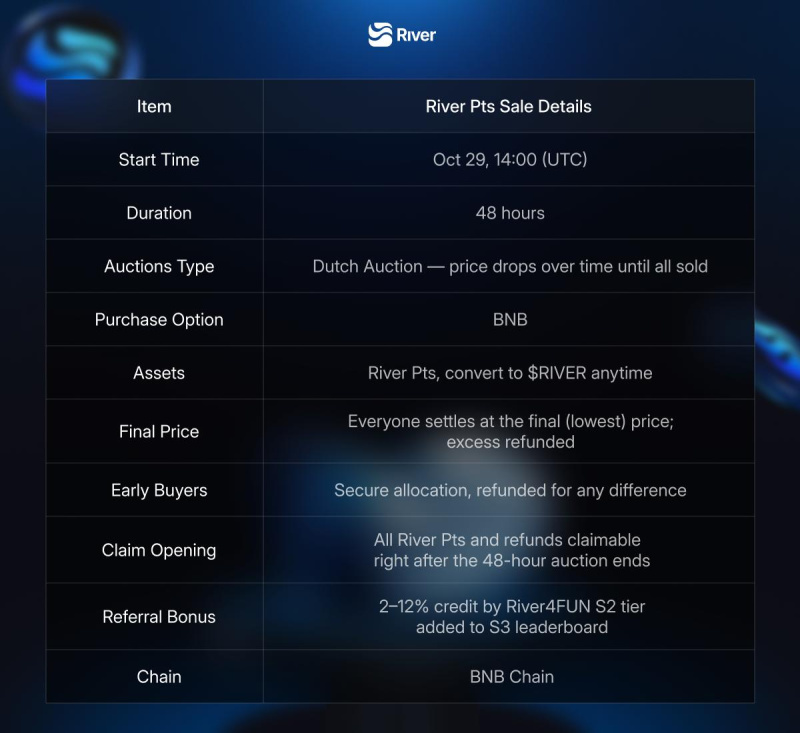
River Pts Dutch Auction

Start: Oct 29, 2025, 14:00 (UTC)
Chain: BNB Chain
Asset: River Pts
Purchase: BNB
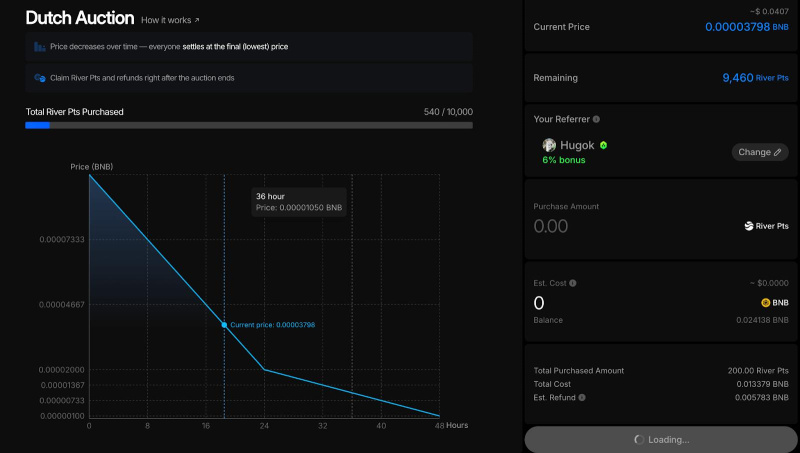
Format: 48-hour Dutch Auction, price decreases over time
Final Auction Price: everyone settles at the final (lowest) price

Participants claim their River Pts and refund for any price difference after the auction ends.

Example (illustration only)

If a user purchases 100,000 River Pts at $1 and the final clearing price is $0.5, they will receive 100,000 River Pts and a refund of $50,000 in BNB after the auction ends.

Referral Bonus Program

Each participant can share a referral code (their X username) to earn 2–12% bonus River Pts, tiered by River4FUN Season 2 ranking.

Bonuses are distributed automatically and added to the S3 leaderboard after the sale concludes.

How To Join Public Sale

Visit app.river.inc/public-sale
Connect wallet on BNB Chain
Check current price and allocation
Enter River Pts amount, purchase with BNB
(Optional) Add referral code
Confirm purchase

After the 48-hour auction ends, participants can claim all the River Pts, refunds, and convert River Pts to $RIVER anytime.

Fund Allocation

All sold units come from the team-reserved share within River’s fixed 1 billion River Pts supply. Funds raised will:

Strengthen long-term liquidity and ecosystem integrations
Support $RIVER token buybacks
Bootstrap River DAO for community governance

River: Evolving Value from Time to Market

Dynamic Airdrop Conversion made time the source of value.

The Public Sale makes the market its next dimension.

From time to price, from design to discovery — River continues to evolve how value is created, distributed, and defined.

About River

River is building the first chain-abstraction stablecoin system that connects assets, liquidity, and yield across ecosystems.

Flow with River:

Contact

RiverRiver[email protected]

Disclaimer

In line with the Trust Project guidelines, please note that the information provided on this page is not intended to be and should not be interpreted as legal, tax, investment, financial, or any other form of advice. It is important to only invest what you can afford to lose and to seek independent financial advice if you have any doubts. For further information, we suggest referring to the terms and conditions as well as the help and support pages provided by the issuer or advertiser. MetaversePost is committed to accurate, unbiased reporting, but market conditions are subject to change without notice.

About The Author


Chainwire is the top blockchain and cryptocurrency newswire, distributing press releases, and maximizing crypto news coverage.

More articles


Chainwire is the top blockchain and cryptocurrency newswire, distributing press releases, and maximizing crypto news coverage.


Source link

ByteDance Announces its AI That Instantly Converts a Photo into a 3D Object

0
ByteDance Announces its AI That Instantly Converts a Photo into a 3D Object


ByteDance has announced its new artificial intelligence model called Seed3D. This technology, which can transform a single photo into high-quality and physics simulation-ready 3D models in seconds, is set to fundamentally change the world of gaming and augmented reality. So, how exactly does Seed3D work and what distinguishes it from its competitors?

While the AI world has focused on generating video from text or advanced chatbots, the competition has now moved into the third dimension. ByteDance, the technology giant and parent company of TikTok, has quietly introduced a new model that is set to revolutionize digital content creation. This technology takes a simple 2D photo and converts it into a living, tangible 3D model.

“Seed3D,” developed by ByteDance’s research unit SEED, works like a science fiction filter. Until now, 3D modeling required hours of technical knowledge and laborious craftsmanship. Seed3D is poised to rewrite the rules in every sector, from e-commerce to game development, by reducing this process to “seconds.”

Seed3D’s sole trick is not just to produce a model!

The most critical feature that distinguishes Seed3D from other models on the market is that it doesn’t just produce a “visual” model. The developed model creates “simulation-ready 3D assets.” This means that not only the external appearance of the created model is calculated, but also how it will behave in a physics engine, such as a game engine. The model uses a visual language model to estimate the real-world dimensions of the object it creates.

Thanks to this technology, the 3D asset produced from a single photo can be directly transferred to physics simulation environments such as Isaac Sim. ByteDance states that these models can even be used in robotics tests, such as a robotic arm grasping an object. Moreover, in the tests conducted, Seed3D yielded much better results than existing methods in both geometry and texture generation. This suggests that the new model will attract attention.

You can watch the promotional video demonstrating what can be done with Seed3D below:

You Might Also Like;

Follow us on TWITTER (X) and be instantly informed about the latest developments…

Copy URL


Source link

Global Warning from Scientists: Rocket Launches Threaten the Ozone Layer

0
Global Warning from Scientists: Rocket Launches Threaten the Ozone Layer


The surge in rocket launches is threatening the recovery of the ozone layer. Scientists are issuing striking warnings about the environmental impact of the modern space industry. Here are the details:

The space industry is growing at an unprecedented pace in recent years. As SpaceX, Blue Origin, and other private companies make space flights increasingly routine, the sky is becoming a center not only for exploration but also for environmental concerns. According to scientists, every rocket launch leaves an invisible trace in the atmosphere.

The New Cost of the Space Race: Invisible Damage to the Atmosphere

In the 1980s, ozone holes caused by chlorofluorocarbons (CFCs) created a worldwide environmental crisis. The 1987 Montreal Protocol, signed at the end of this period, almost completely halted the production of harmful chemicals and initiated a slow recovery process in the atmosphere. However, new research from ETH Zurich and the University of Canterbury suggests that this recovery may be jeopardized again in the modern space age.

The team of atmospheric scientist Sandro Vattioni from ETH Zurich found that while the current impact remains limited, the ozone is still about 2% thinner compared to the pre-CFC era. These data show that the progress made by the Montreal Protocol is incomplete and is even under new threat.

Exhaust gases, including chlorine, metal particles, and carbon soot, released during rocket launches reach the upper layers of the stratosphere. These components not only trap heat but also disrupt the balance of the protective layer by breaking down ozone molecules. Scientists emphasize that chlorine, found especially in solid-fuel rocket motors, plays a decisive role in ozone loss.

Another research team led by Laura Revell from the University of Canterbury modeled different future scenarios. In a moderate growth scenario (approximately 884 launches per year), a global ozone layer thinning of 0.17% is predicted by 2030. In the high growth scenario (more than 2,000 launches per year), this loss is estimated to reach 0.29% globally, and 4% over Antarctica.

Scientists state that the solution to the problem is not to slow down exploration but to shift towards cleaner propulsion technologies. Cryogenic engines, which run on an oxygen-hydrogen mixture, are among the options with the lowest environmental impact, but due to their complex structure, they are currently used in only a small fraction of launches.

You Might Also Like;

Follow us on TWITTER (X) and be instantly informed about the latest developments…

Copy URL


Source link

Inside the Rise of AI-Powered NFTs | NFT News Today

0
Inside the Rise of AI-Powered NFTs | NFT News Today


AI-powered NFTs are changing how digital art, gaming, and virtual identity work together. These intelligent collectibles can think, learn, and even evolve — creating new ways for creators and collectors to interact with digital assets.

Key Takeaways

Artificial intelligence is giving NFTs dynamic, learning, and interactive abilities.

Artists and brands are using AI tools to create, mint, and sell more sophisticated digital collectibles.

Legal and copyright debates continue as AI-generated art becomes mainstream.

AI-powered NFTs are transforming digital identity and ownership across Web3 and gaming.

The next stage of NFTs isn’t speculation — it’s intelligent creativity.

What Are AI-Powered NFTs?

AI-powered NFTs are digital collectibles that combine machine learning models with blockchain technology. Unlike static NFTs, these assets can change over time — adapting to data, owner behavior, or real-world events.

Imagine owning a piece of digital art that grows, speaks, or evolves as you interact with it. That’s the essence of AI-powered NFTs — living tokens infused with intelligence.

Examples in Action

Alethea AI’s iNFTs — NFTs with personalities that talk and learn.

Botto — an AI artist creating and auctioning new pieces every week based on community feedback.

Altered State Machine (ASM) — AI brains for digital avatars that train and evolve inside games or metaverses.

These projects show that NFTs can be more than collectibles; they can act as digital beings or autonomous collaborators.

How AI Creates and Powers NFTs

AI-generated NFTs start with a prompt — a phrase or concept fed into an AI model like DALL·E, Midjourney, or Stable Diffusion. The algorithm turns that input into visual art, music, or even code.

Once created, the artwork is minted on a blockchain as a non-fungible token, recording its origin and ownership. But AI’s role doesn’t stop at creation. Some projects integrate models directly into the NFT’s metadata, giving it ongoing “intelligence.”

The Creation Pipeline

Concept or Prompt: The artist feeds an idea to an AI generator.

AI Generation: A machine learning model produces multiple outputs.

Curation: The creator selects and refines the best result.

Minting: The final asset is tokenized on-chain with smart contracts.

Interaction: Owners or users can influence the NFT’s behavior or evolution.

AI makes the creative process faster and often more experimental. It also invites new forms of collaboration between humans and algorithms.

The Rise of Interactive and Dynamic NFTs

We’re moving from static collectibles to dynamic NFTs that react to input or change over time. These tokens may alter appearance based on user interaction, environmental data, or blockchain events.

For example, an NFT character could “learn” from its owner’s decisions in a virtual world. In gaming, AI NFTs can evolve, gain skills, or form emotional connections with players. In digital art, they might transform colors or textures depending on time of day or social engagement.

Use Cases

Interactive art installations: Artworks that evolve based on AI analysis of audience reactions.

AI companions: Collectible avatars that chat, assist, or entertain in the metaverse.

Smart collectibles: NFTs that adapt their rarity or design based on market trends.

These features turn ownership into participation — shifting the role of the collector from passive holder to active collaborator.

AI’s Role in NFT Valuation and Curation

AI isn’t just creating NFTs — it’s helping people understand and value them. Advanced algorithms can assess rarity, aesthetic quality, and market sentiment far faster than humans.

Platforms are using machine learning for:

Price prediction: Estimating NFT values using past sales and social metrics.

Fraud detection: Identifying copied art or fake collections.

Curation: Recommending NFTs to collectors based on taste and behavior.

This data-driven approach supports both transparency and trust in an often unpredictable market.

Ownership, Copyright, and Ethics

AI-generated art raises a serious question — who owns it?

Is it the person who typed the prompt, the model’s creator, or no one at all?

Authorities are starting to weigh in. In the United States, the Copyright Office has stated that purely AI-generated works without human involvement can’t be copyrighted. However, human–AI collaborations may qualify if there’s clear creative input.

Common Concerns

Training data: Many AI models are trained on copyrighted images without consent.

Attribution: Tracking which AI or dataset contributed to a work.

Fair compensation: Ensuring artists whose works train models are recognized.

Some platforms are experimenting with on-chain attribution, embedding model information directly into the NFT’s metadata. This helps preserve transparency about how the artwork was produced.

Making Money from AI NFTs

Can AI NFTs still make money in 2025? Absolutely — but the focus has shifted from hype to sustainability.

Artists are finding fresh opportunities:

Selling AI-generated collections directly on marketplaces like OpenSea or Foundation.

Offering personalized generative commissions — NFTs created in collaboration with collectors.

Launching membership tokens that grant access to ongoing AI-created art streams.

Case Studies

Refik Anadol, a Turkish media artist, uses AI data visualization to produce NFTs that sell for millions at auction.

Claire Silver, one of the most recognizable AI artists, builds entire narratives around machine collaboration.

Profitability now depends on originality, storytelling, and artistic quality — not speculation alone.

Security and Trust in AI-Driven Assets

AI-powered NFTs bring new security challenges. Since some tokens rely on live AI systems, protecting those systems becomes crucial.

Key Risks

Model tampering: Malicious users could alter or spoof the AI model behind a token.

Data leakage: Sensitive prompts or training data could expose private information.

Fake AI claims: Some projects might falsely label NFTs as “AI-generated” for marketing hype.

Blockchain helps mitigate these risks. By recording provenance, hashing AI model versions, and tracking interactions, creators can prove authenticity. Transparency about how and where AI is used is becoming a key trust factor for collectors.

The Future of AI-Powered NFTs

AI and NFTs are moving toward something extraordinary: autonomous digital entities that can act, learn, and trade on their own.

Imagine a future where:

Your NFT avatar learns your personality and represents you across virtual spaces.

Artists collaborate with AI co-creators trained on their previous works.

Entire AI-powered economies form inside games and metaverses.

This convergence will blur the line between creator and creation. As blockchain scalability improves and AI systems become more accessible, we’ll likely see millions of intelligent NFTs interacting across ecosystems — shaping how identity, creativity, and value work online.

Frequently Asked Questions

Here are some frequently asked questions about this topic:

What makes an NFT “AI-powered”?

An NFT becomes AI-powered when it includes machine learning or generative AI technology that allows it to evolve, interact, or produce new content after minting.

Are AI-generated NFTs legal to sell?

Yes, in most jurisdictions — as long as you own the rights to the artwork and follow marketplace terms. However, copyright issues may arise if AI training data includes copyrighted material.

Can I create my own AI NFT?

Absolutely. Anyone can use AI tools like Midjourney or DALL·E to generate visuals, then mint them using platforms such as OpenSea or Rarible.

Do AI NFTs hold real value?

Their value depends on creativity, community demand, and verifiable authenticity. The most successful projects combine artistic innovation with transparent technology.

Will AI replace human artists?

No. AI is a creative partner — a tool for ideation, experimentation, and storytelling. Human emotion and context still drive meaning in art.



Source link

Curve And Resupply Proposal Seeks To Mint 5M crvUSD To Boost reUSD Growth

0
Curve And Resupply Proposal Seeks To Mint 5M crvUSD To Boost reUSD Growth


In Brief

Curve Finance’s DAO is considering a proposal from Resupply to mint 5 million crvUSD into the sreUSD Llamalend market to enhance liquidity, stabilize reUSD, and generate predictable yield for the DAO.

Curve And Resupply Proposal Seeks To Mint 5M crvUSD To Boost reUSD Growth

Decentralized exchange (DEX) and automated market maker (AMM) protocol Curve Finance has disclosed that a lending protocol developed on top of Llamalend, known as Resupply, has submitted a new proposal to mint and allocate 5 million crvUSD directly into the sreUSD Llamalend market. The proposal is currently under consideration through a DAO governance vote.

Resupply functions as a decentralized stablecoin system designed to enhance capital efficiency by utilizing the liquidity and stability of Curve’s lending infrastructure. Built atop Llamalend, it enables participants to borrow reUSD using crvUSD supplied within Curve’s lending markets, effectively transforming idle assets into active liquidity. The protocol features two primary stablecoins: reUSD, which serves as the main stable asset, and sreUSD, a yield-generating version that accrues returns based on protocol revenue and the stability of reUSD’s peg.

According to the submitted proposal, the Curve DAO is voting on whether to authorize the minting and distribution of 5 million crvUSD through a specialized factory contract that can mint directly into Curve lending markets, beginning with the sreUSD market.

If approved, the DAO would create and supply the 5 million crvUSD to the sreUSD lending market on Llamalend, establishing a new minting framework based on lending pairs rather than conventional collateralized pairs. These lending markets operate under independent monetary policies that are not directly linked to the crvUSD price, making them strategically valuable for specific targeted applications.

5M crvUSD Allocation To Strengthen Resupply’s Stability And Enhance Liquidity

The proposal is designed to enhance the overall stability and efficiency of the Resupply framework by optimizing the relationship among reUSD, sreUSD, and crvUSD. Due to the high level of leveraged activity within the system, reUSD has often traded slightly below its $1 peg, creating a persistent discount that discourages further leverage since users effectively sell reUSD below par and incur immediate losses.

In order to address this imbalance, Resupply recently launched sreUSD, a yield-bearing variant of reUSD. This token receives a fixed portion of the platform’s revenue, and the system automatically directs additional protocol earnings to sreUSD whenever reUSD falls below $1. Although this mechanism has provided partial relief, it has not been sufficient to fully stabilize the peg on its own.

The new proposal suggests minting and supplying 5 million crvUSD to the sreUSD market on Llamalend to introduce several positive reinforcing effects. The additional crvUSD liquidity would expand borrowing capacity and improve overall market depth, reducing borrowing costs and making it more attractive for participants to borrow against sreUSD. This is expected to stimulate demand for sreUSD and increase overall lending activity. Furthermore, with greater liquidity available, users could transition from reUSD to sreUSD and use it as collateral to borrow crvUSD directly, rather than selling reUSD on the open market. This shift would help alleviate downward pressure on reUSD and promote a more balanced market structure. The enhanced liquidity also enables users to reengage in leverage loops — borrowing crvUSD against sreUSD without selling reUSD first — thereby restoring one of Resupply’s fundamental growth mechanisms and supporting more sustainable expansion.

Collectively, these outcomes aim to improve market efficiency, strengthen the interplay between reUSD and sreUSD, and better align the economic incentives of both the Resupply protocol and Curve Finance.

All assets deposited in Llamalend, including the proposed 5 million crvUSD allocation, generate yield. The associated smart contracts are designed to allow anyone to claim accumulated profits permissionlessly, ensuring both transparency and decentralization. Revenue generated from these activities is directed entirely to the Curve DAO, with Resupply not receiving any portion of the proceeds. This arrangement provides Curve with a consistent and diversified source of income. Unlike traditional crvUSD borrowing models that rely on market fluctuations and PegKeeper adjustments, lending rates on Llamalend are determined by utilization levels, creating a steadier and more predictable income stream. Based on the average supply rate in the sreUSD market, which is approximately 8.1%, the DAO could anticipate an estimated annual return of around $405,000 from the 5 million crvUSD contribution. Beyond the revenue potential, this structure introduces a more resilient and less volatile earnings channel for Curve’s overall ecosystem.

Disclaimer

In line with the Trust Project guidelines, please note that the information provided on this page is not intended to be and should not be interpreted as legal, tax, investment, financial, or any other form of advice. It is important to only invest what you can afford to lose and to seek independent financial advice if you have any doubts. For further information, we suggest referring to the terms and conditions as well as the help and support pages provided by the issuer or advertiser. MetaversePost is committed to accurate, unbiased reporting, but market conditions are subject to change without notice.

About The Author


Alisa, a dedicated journalist at the MPost, specializes in cryptocurrency, zero-knowledge proofs, investments, and the expansive realm of Web3. With a keen eye for emerging trends and technologies, she delivers comprehensive coverage to inform and engage readers in the ever-evolving landscape of digital finance.

More articles


Alisa, a dedicated journalist at the MPost, specializes in cryptocurrency, zero-knowledge proofs, investments, and the expansive realm of Web3. With a keen eye for emerging trends and technologies, she delivers comprehensive coverage to inform and engage readers in the ever-evolving landscape of digital finance.


More articles


Source link

Google’s “Willow” Chip Ushers in the Quantum Era: Outpacing Supercomputers!

0
Google’s “Willow” Chip Ushers in the Quantum Era: Outpacing Supercomputers!


Google’s new quantum chip named “Willow” is initiating the quantum era in the scientific world. But how, to what extent, and when will this development affect daily life?

Google has, so to speak, initiated a new era in the world of science with its quantum chip called “Willow.” The company’s algorithm, named “Quantum Echoes,” has made a massive leap, running an astonishing 13,000 times faster than classic supercomputers. Most importantly, this achievement is repeatable, allowing it to be verified on other quantum computers. According to Google, this development will pave the way for the real-world application of quantum technology within the next five years.

Tom O’Brien from the Google Quantum AI team, which led the research, said, “This achievement brings us one step closer to moving quantum technologies into the mainstream.” This progress by the company has also given it a significant advantage in the global quantum race being conducted with Microsoft, IBM, and numerous startups.

Commercial Adoption Will Take Time

One application area for the algorithm developed by Google is molecular structure analysis. In a second study, which has not yet undergone peer review, researchers suggest that this method could revolutionize drug discovery and next-generation battery designs. However, for these applications to become a reality, quantum computers that are 10,000 times more powerful than current machines are needed.

The Google team, which includes 2025 Nobel Physics Prize winner Michel H. Devoret, is determined to scale up their machines and increase their accuracy to reach this goal. Scientist Scott Aaronson stated that he was “beguiled” by this development, but still noted that reaching commercial application involves significant challenges.

You Might Also Like;

Follow us on TWITTER (X) and be instantly informed about the latest developments…

Copy URL


Source link

OpenAI is Developing AI that Generates Music

0
OpenAI is Developing AI that Generates Music


OpenAI is working on an AI-based music generation model. The company, in collaboration with The Juilliard School, is developing a new music production tool that could be integrated into ChatGPT or Sora.

OpenAI has started working on developing an artificial intelligence model that generates music. According to reports, the company is carrying out a joint project with the prominent US institution, The Juilliard School. Within the scope of this collaboration, the school will assist OpenAI with the labeling of musical notation. It is stated that the new model will be able to create music from both text and audio-based commands. The company will compete with strong rivals already operating in this field, such as Google, Suno, and Udio.

New Revenue Stream and Intensifying Competition

OpenAI’s move is seen as part of a strategy to increase engagement on its platforms, which already reach 800 million users, and diversify its revenue sources. Last May, Google introduced the second generation of its music generation model, Lyria, and offered it to corporate customers via Google Cloud. Meanwhile, rapidly growing startups like Suno and Udio have also begun to set the industry standards.

OpenAI’s music production tool has commercial potential, especially in the fields of advertising and video production. The company is working on a system that can automatically generate guitar chords over a vocal track, for example, or create background music suitable for video content. Such solutions could also greatly simplify work for advertising agencies.

Copyrights Create New Challenges

However, legal issues in the field of AI-generated music are also on the agenda. Suno and Udio are currently facing lawsuits filed by the Recording Industry Association of America (RIAA). The RIAA represents major record labels such as Universal Music Group, Sony, and Warner Music, and is seeking damages of up to $150,000 for each copyright infringement.

This situation requires OpenAI to consider potential legal risks from the outset. The company may promise rights holders greater control over content and revenue sharing in the music field, as it did previously with the Sora video generation tool.

It is not yet known when OpenAI’s new music generation model will be introduced or on which platform it will be integrated. However, this move by the tech giant is considered a strong indication that artificial intelligence could initiate a radical transformation in the music world.

You Might Also Like;

Follow us on TWITTER (X) and be instantly informed about the latest developments…

Copy URL


Source link

Popular Posts

My Favorites

Tetra Zone – A modern take on a classic WIP...

0
If you've played the 1980's hit game of Tetris then you'll be pleased to know that as of this morning, we have been...