Metaverse

Home Metaverse Page 93

Ways to Make Money by Playing Games (You Won’t Pay for Games Anymore)

0
Ways to Make Money by Playing Games (You Won’t Pay for Games Anymore)


Today, there are a few different ways you can make money while playing games. Moreover, these methods will not diminish the enjoyment you get from the game. Let’s take a look at all of them together.

Playing games is no longer just a hobby; it can also be a budget for your next game or even a serious source of extra income, with smart moves. If you are also thinking, “If I’m playing this many hours, it should at least bring some return,” you are in the right place. The idea of earning money while doing something you already love sounds like a dream, doesn’t it?

In this content, we will focus on what an everyday gamer can do, rather than the idea of making a career in the gaming industry.

1. In-Game Item/Skin Sales

This is probably the least risky and most common method. The logic is simple: Play the game, sell the rewards (items) the game gives you.

Many popular online games (especially on PC) give you cosmetic items or cases that can drop these items as you play. These items have a “market“.

For example, when playing Counter-Strike (CS), as you gain XP weekly, the game might drop a weapon case, a skin (weapon finish), or graffiti as a reward. You can sell these dropped cases or skins directly on the Steam Community Market. When you sell them, the money is credited directly to your Steam Wallet balance. You might not be able to withdraw this balance as “real money” to your bank account, but you can use it to get your next game purchase (such as a new game on sale) for free.

Similarly, in PUBG or Dota 2, you can earn cosmetic items that might be valuable by playing and completing special events. You can also get a balance by selling these items on the Steam market.

2. “Play-to-Earn” (P2E) Games

This model, which has been popular for the last few years, includes Blockchain and NFT based games. In these games, the items or in-game currencies (tokens) you earn by playing genuinely “belong to you” (as an NFT).

You can sell the digital assets you earn in these games (a character, special armor, or the game’s own cryptocurrency) on the game’s own marketplace or external crypto exchanges.

This market is highly volatile. An item worth 100 TL today might be worth 1 TL tomorrow. You may often need to invest some “entry money” to start. The risk level is also high.

3. “Gold Farming” (In-Game Currency Grinding)

This is an old but still working method, especially common in MMORPG games (World of Warcraft, Knight Online, Metin2, Black Desert Online, etc.).

The logic is also quite simple. You accumulate in-game currency (Gold, GB, Yang) by spending time in the game (killing monsters, mining/trading). Then, you sell this virtual currency for real money to other players through intermediary sites (item sales sites). Players want to immediately possess this power with money instead of spending time, and they buy the in-game currency you sell.

4. Steam Card Sales

Games on Steam that support collectible cards drop a certain number of cards as you play. You can earn a small balance by selling these. Especially since the market prices of newly released games have not yet settled, if you purchased a game with a pre-order, you can play it as soon as it is released and sell the dropped cards for a higher price than their normal value.

Furthermore, with the IdleMaster application, you can drop cards from games in your Steam library whose cards have not yet been dropped and sell them on the Steam Community Market.

Of course, there are many other fields where one can specialize and earn money, such as game development, publishing, and game testing, but the easiest ways for an everyday gamer to earn money by playing are limited to these. If you know of a different method, you can share it with us in the comments section below.

You Might Also Like;

Follow us on TWITTER (X) and be instantly informed about the latest developments…

Copy URL


Source link

The Halo Legend is Reborn: “Halo: Campaign Evolved” Announced

0
The Halo Legend is Reborn: “Halo: Campaign Evolved” Announced


Microsoft is returning to the roots of the legendary Halo series! Halo: Campaign Evolved, completely rebuilt with Unreal Engine 5, is coming in 2026 with new missions, weapons, and platforms.

After months of rumors, Microsoft took the stage with major news that takes the gaming world back to its origins. The company has officially announced Halo: Campaign Evolved, a complete remake of Halo: Combat Evolved, which first launched in 2001.

In a first for the series, this new version will be available not only on Xbox and PC but also on PlayStation 5.

Graphics Rebuilt with Unreal Engine 5

The new game has been constructed from scratch with Unreal Engine 5. As a result, both in-game segments and cinematic scenes have been given a completely revamped visual look. Microsoft also shared a short gameplay video from the seventh mission with the announcement.

The development team explained that they have made minor adjustments to enhance the flow in some sections while preserving the nostalgic atmosphere and the essence of the story.

New Missions, New Enemies

The remake version will feature three new missions in addition to the original story. These missions will serve as a short prequel detailing the events before the main story. Each will offer a different experience to players with completely new environments, characters, and enemies.

Expanded Armory and New Mechanics

Halo: Campaign Evolved also brings nine new weapons from other games in the series. These weapons include legendary gear such as the Energy Sword, Battle Rifle, and Needle Rifle. Additionally, players will now be able to use the vehicle hijacking feature and optionally activate the sprint feature.

The Struggle for Survival on the Legendary Ring

The game takes place on the iconic Ringworld planet, which forms the foundation of the Halo universe. According to a statement from Halo Studios, the story progresses as follows: Master Chief, who crash-lands on the mysterious Halo ring, is tasked with protecting the remaining humans against the enemy Covenant forces. Together with his AI companion, Cortana, he attempts to save the galaxy from the brink of destruction while uncovering the Halo’s dark secrets.

No Multiplayer, But Co-op Experience Included

As its name suggests, the new production will be solely story-focused. This means there will be no PvP (player-versus-player) mode. However, a two-player console split-screen option and an online co-op mode for up to four players will be available on all platforms.

“We are not rewriting Halo’s legacy, we are keeping it alive”

Producer Damon Conn summarized the project’s goal with these words: “We are very excited to reach players who have not had the opportunity to experience Halo before. The essence of Halo is about connection; this time, we will meet the new generation of players on their platform of choice. Our aim is not to change Halo’s legacy but to let it be felt as never before.”

When Will It Be Released?

Halo: Campaign Evolved will be released for PC, Xbox Series X|S, and PlayStation 5. While a definite date has not yet been announced, the game will be on the market sometime in 2026.

You Might Also Like;

Follow us on TWITTER (X) and be instantly informed about the latest developments…

Copy URL



Source link

MultiBank Group and Khabib Nurmagomedov Launch an Exclusive Worldwide Multi-Billion-Dollar Joint Venture to Build the World’s First Regulated Tokenized Sports Ecosystem.

0
MultiBank Group and Khabib Nurmagomedov Launch an Exclusive Worldwide Multi-Billion-Dollar Joint Venture to Build the World’s First Regulated Tokenized Sports Ecosystem.


Sponsored

Stories and Reviews


October 25, 2025

MultiBank Group and Khabib Nurmagomedov Launch an Exclusive Worldwide Multi-Billion-Dollar Joint Venture to Build the World’s First Regulated Tokenized Sports Ecosystem.

Dubai, U.A.E, October 25th, 2025, Chainwire

MultiBank Group, the world’s largest financial derivatives institution, has entered into an exclusive worldwide multi-billion-dollar joint venture with global sports icon and undefeated UFC champion Khabib Nurmagomedov (29-0) to create a first-of-its-kind regulated ecosystem connecting global finance, sports and technology.

The partnership will culminate in the creation of a multi-billion-dollar joint venture, MultiBank Khabib LLC, uniting two global powerhouses: MultiBank Group, a leader in regulated financial excellence, and Khabib Nurmagomedov, undefeated in the octagon and whose influence extends far beyond sport. The company will operate from MultiBank Group’s headquarters in Dubai, building a worldwide network of high-end sports ventures and real-world digital assets. This structure fulfills the vision of MultiBank Group Founder and Chairman, Naser Taher, for an exclusive global joint venture, granting MultiBank exclusive rights to develop and promote projects under the Khabib Nurmagomedov brand name, including the development of 30 state of the art Khabib gyms, Gameplan and Eagle FC brands.

The entire venture is backed by MultiBank Group’s regulated digital ecosystem and powered by its cornerstone $MBG Token being the driving force behind its expanding portfolio of real-world-asset (RWA) technologies and initiatives.

 Naser Taher, Founder and Chairman of MultiBank Group, stated: “From the UAE, we are shaping a new blueprint for the business of sport through the regulated tokenization of real-world sports assets (RWA). Together with Khabib Nurmagomedov, and powered by our ecosystem token, $MBG, we are uniting finance and athletics into a single transparent, technology-driven ecosystem — one built on trust, innovation, and the strength of the MultiBank framework. This initiative proudly aligns with the UAE’s vision of becoming a global hub for digital asset innovation and world-class sports.”

Khabib Nurmagomedov added: “This partnership with MultiBank Group is built on shared values of strength, respect, and discipline. Together with MultiBank Group, we are building real global opportunities that go beyond sport, empowering athletes and fans through a regulated and innovative digital ecosystem. This is only the beginning.”

About MultiBank Group

Established in California in 2005, MultiBank Group has become one of the world’s largest financial derivatives institutions, serving over 2 million clients in 100 countries, with daily trading volumes exceeding US $35 billion. The Group operates under 18 regulatory licenses across 5 continents and maintains over 25 offices worldwide, renowned for its commitment to regulatory strength, transparency, and innovation.

Contact

Direct Buys ManagerNikolas NeofytouMultiBank Group[email protected]

Disclaimer

In line with the Trust Project guidelines, please note that the information provided on this page is not intended to be and should not be interpreted as legal, tax, investment, financial, or any other form of advice. It is important to only invest what you can afford to lose and to seek independent financial advice if you have any doubts. For further information, we suggest referring to the terms and conditions as well as the help and support pages provided by the issuer or advertiser. MetaversePost is committed to accurate, unbiased reporting, but market conditions are subject to change without notice.

About The Author


Chainwire is the top blockchain and cryptocurrency newswire, distributing press releases, and maximizing crypto news coverage.

More articles


Chainwire is the top blockchain and cryptocurrency newswire, distributing press releases, and maximizing crypto news coverage.


Source link

Would You Eat a Digital Burger? 🍔 | Food 3.0 – The Future of Food Has Arrived

0
Would You Eat a Digital Burger? 🍔 | Food 3.0 – The Future of Food Has Arrived


The way humans consume food is undergoing a transformation unlike any in history. For thousands of years, eating has been more than a biological necessity — it has been a cultural ritual, a social glue, and a sensory experience. From gathering around fire to tasting the harvest of local farms, our relationship with food has always shaped human civilization. But now, we are entering a new era: Food 3.0, where technology, science, and virtual reality are redefining what, how, and even why we eat.

Artificial Meat and Lab-Grown Proteins

One of the most groundbreaking developments in Food 3.0 is lab-grown meat. Scientists can now cultivate real meat from animal cells without harming a single creature. This technology offers identical taste and texture to traditional meat while dramatically reducing the environmental impact of livestock farming. Water consumption drops by up to 90%, and greenhouse gas emissions are minimized, making this not only an ethical choice but a critical solution to the climate crisis. As the global population rises, lab-grown meat could become a primary protein source for billions, merging sustainability with gastronomy.

3D-Printed and Personalized Food

Food 3.0 goes beyond meat. 3D food printers can layer ingredients such as flour, protein, vitamins, and oils to create meals precisely tailored to individual health needs. NASA has already experimented with 3D-printed pizza for astronauts, highlighting the potential for long-term space missions. On Earth, personalized nutrition is emerging through AI algorithms that design meals based on DNA, metabolism, and health data. Cooking may eventually become a nostalgic hobby as automated systems prepare perfect meals in minutes, freeing humans from the labor of food production while optimizing nutrition like never before.

Virtual Taste and the Metaverse Dining Experience

Perhaps the most revolutionary aspect of Food 3.0 is virtual dining. With neurotaste technology, scientists can stimulate the brain’s taste and flavor centers directly, allowing people to experience food without eating a single calorie. Digital restaurants in the metaverse already enable users to share meals across continents, engaging their senses in ways that feel real despite being entirely virtual. This evolution challenges our very understanding of taste and culinary experience: in the future, eating may become a cognitive, rather than purely physical, act.

Ethical, Social, and Cultural Implications

While Food 3.0 offers exciting solutions, it raises profound ethical and cultural questions. If taste, flavor, and even hunger can be engineered digitally, what happens to our connection with nature? Will the traditions, stories, and social bonds built around food survive? Future generations may never experience the aroma of freshly baked bread or the flavor of a garden-ripened tomato. This raises questions about identity, culture, and the sensory dimensions of human life.

Conclusion: A Future of Possibilities and Challenges

Food 3.0 represents both opportunity and challenge. It has the potential to end hunger, reduce environmental impact, and deliver perfectly optimized nutrition to every individual. Yet it also risks disconnecting us from one of the most human aspects of life — the act of sharing, preparing, and tasting food. In this brave new world, we may not just be consuming meals; we may be consuming data, algorithms, and experiences. The future of eating is not just about survival — it’s about what it means to be human in a technologically mediated world.

Food 3.0 is more than a trend; it is a paradigm shift. And as this revolution unfolds, one question remains central: in a world where flavor can be coded and meat can be printed, will we still remember the taste of the real world

You Might Also Like;

Follow us on TWITTER (X) and be instantly informed about the latest developments…

Copy URL


Source link

RIVER Gains 5x Following Binance Perp Listing, Supported by Time-Encoded Airdrop Conversion

0
RIVER Gains 5x Following Binance Perp Listing, Supported by Time-Encoded Airdrop Conversion


Sponsored

Stories and Reviews


October 24, 2025

RIVER Gains 5x Following Binance Perp Listing, Supported by Time-Encoded Airdrop Conversion

Singapore, Singapore, October 24th, 2025, Chainwire

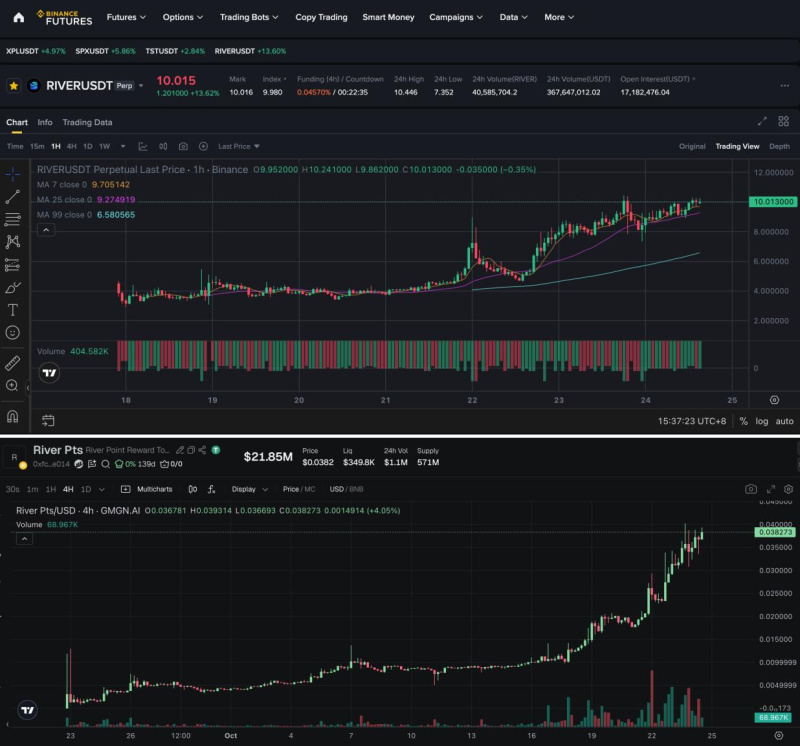
$RIVER reached a new all-time high $10, up 5x since its TGE on Sept 22, following the token’s Binance Futures listing on Oct 17.

The surge was driven by growing market attention on River’s Dynamic Airdrop Conversion, the first time-encoded tokenomics mechanism that connects conversion behavior to time-based value.

Dynamic Airdrop Conversion: Time as a Variable

Most airdrops that end once tokens are claimed, River’s Dynamic Airdrop Conversion begins at that moment. 

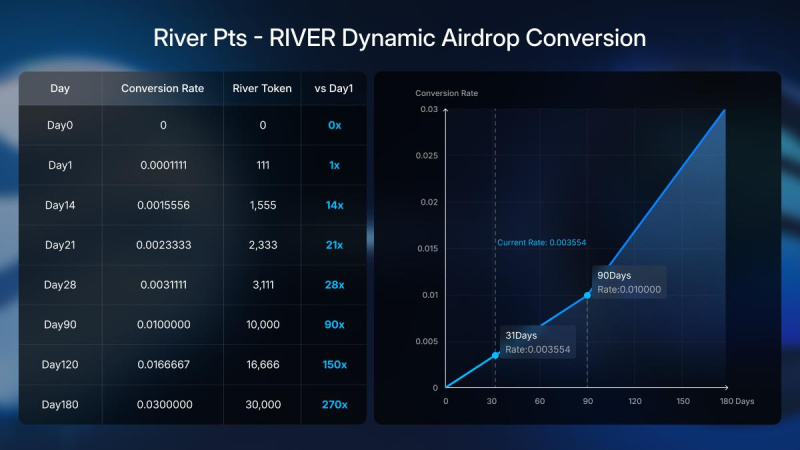
The mechanism introduces time-encoded tokenomics — allowing users to convert River Pts (ERC-20) into $RIVER at any time within 180 days after TGE.

River Pts, the ecosystem points in ERC-20 format, have risen 40x since launch, reflecting growing market awareness of the arbitrage strategies between River Pts, $RIVER, and perpetual futures.

In practice, River Pts function like a call option on $RIVER — their value rises as the conversion ratio improves.

This continuous process turns the airdrop into a live market, where users can either hold River Pts for higher future conversion or lock in profits by shorting $RIVER perpetuals, creating a natural balance between liquidity and time-based appreciation.

Conversion Example — 1M River Pts

The conversion curve shows how time relates to the amount of tokens a user receives.

Holding 1M River Pts from Day 1 to Day 180 can result in up to a 270x difference in $RIVER output, depending on when conversion occurs.

This structure lets users see how time directly changes the value they receive — prices move with market behavior, not fixed unlocks.

Dynamic Airdrop Conversion : https://app.river.inc/airdrop

Market Dynamics

$RIVER Perps listed on Binance, Bybit, Bitget, KuCoin, and Gate
$100M+ total trading volume in 24 hours.
80K addresses and 40K X accounts eligible for River airdrop.
The Season 3 airdrop continues post-TGE — users can earn River Pts by using stablecoin, tweeting, or joining ecosystem campaigns.

The River Pts–$RIVER mechanism has generated notable community interest, with discussions centering on the interplay between timing, conversion rates, and potential arbitrage opportunities. Participants are analyzing different strategies, including when to convert and how perpetual contracts may be used for hedging. Others are engaging with Season 3 as a method of accumulating River Points.

Why It Matters 

Dynamic Airdrop Conversion reframes token distribution as a market mechanism rather than a release schedule.

It establishes a measurable interplay between time, behavior, and liquidity, and each user decision directly influences price formation and supply dynamics.

The approach represents a shift in tokenomics toward a more open and adaptive structure, where participation dynamics influence outcomes rather than predefined parameters.

Within the community, some view this as a significant development—comparable to the introduction of automated market makers (AMMs)—in that it introduces a time-encoded framework where value is shaped by user activity and market behavior.

About River

River is building the first chain-abstraction stablecoin system that connects assets, liquidity, and yield across ecosystems.

Flow with River.

Website: https://app.river.inc

X: https://x.com/RiverdotInc

Telegram: https://t.me/river_inc

Discord: https://discord.com/invite/river-inc

Contact

River[email protected]

Disclaimer

In line with the Trust Project guidelines, please note that the information provided on this page is not intended to be and should not be interpreted as legal, tax, investment, financial, or any other form of advice. It is important to only invest what you can afford to lose and to seek independent financial advice if you have any doubts. For further information, we suggest referring to the terms and conditions as well as the help and support pages provided by the issuer or advertiser. MetaversePost is committed to accurate, unbiased reporting, but market conditions are subject to change without notice.

About The Author


Chainwire is the top blockchain and cryptocurrency newswire, distributing press releases, and maximizing crypto news coverage.

More articles


Chainwire is the top blockchain and cryptocurrency newswire, distributing press releases, and maximizing crypto news coverage.


Source link

Inside Andrew Sobko’s Vision of Argentum AI and the New Era of Compute Freedom

0
Inside Andrew Sobko’s Vision of Argentum AI and the New Era of Compute Freedom


In Brief

Andrew Sobko, founder of Argentum AI, aims to democratize computational resource access by transforming underused GPUs and data centers into an active marketplace for AI computing.

Inside Andrew Sobko’s Vision of Argentum AI and the New Era of Compute Freedom

At the New York Stock Exchange, Andrew Sobko, founder and CEO of Argentum AI, appeared on theCUBE’s AI Factory Series alongside John Furrier.

Sobko’s vision is ambitious yet pragmatic: he aims to democratize access to computational resources. Similar to how Uber revolutionized transportation by utilizing idle cars, Argentum AI transforms underused GPUs and data centers into an active marketplace for AI computing.

“We are building an economy of GPU entrepreneurs,” Sobko explained, a phrase that might soon carry the same cultural meaning that “crypto miners” once did.

From Bitcoin Miners to GPU Entrepreneurs

Globally, numerous data centers, cryptocurrency farms, and GPU operators possess large but underutilized computing resources. Argentum AI unifies these scattered assets on a single standardized platform, allowing businesses, researchers, and developers to access computing power quickly, cost-effectively, and securely.

Sobko’s approach considers compute as the new form of electricity. It should be accessible everywhere, priced transparently, and available on demand. This concept can help eliminate obstacles to AI innovation, particularly for startups and organizations in emerging markets that find it difficult to obtain advanced GPUs like NVIDIA’s H100.

A key part of this vision is the use of “second-life GPUs.” These are older but still powerful processors that can be redeployed effectively. As Sobko puts it, “It’s like a four-year-old Lamborghini. It still drives fast.”

The End of the AI “Bubble” Myth

Some analysts believe that the current AI infrastructure boom is a bubble. Sobko, however, disagrees. He sees the demand as genuine, not speculative. It is widespread, international, and rapidly increasing. Law firms, research institutions, universities, and companies are seeking cost-effective computing options beyond the reach of major cloud providers like AWS and Microsoft Azure.

“We’ve received thousands of applications,” Sobko said. “There’s no bubble. There’s unmet demand.”

Argentum AI’s pre-seed round was oversubscribed in less than 24 hours, backed by Kraken Exchange and Victor Morgenstern, the former chairman of Valor Equity Partners and one of the early investors in Elon Musk’s companies.

The company has already secured more than 20,000 GPUs and 150 megawatts of compute capacity under exclusive agreements, an impressive achievement for a newly launched venture.

Argentum stands out not only because of its asset-light business approach but also due to the intelligent software that fuels its marketplace. Similar to Uber’s dynamic pricing, Argentum AI’s Living AI Benchmark instantly matches workloads with the most appropriate GPUs by evaluating stability, latency, and performance metrics. Users can quickly see transparent prices and choose the configuration that best suits their needs.

Sobko also emphasizes security. Argentum AI integrates a Zero-Knowledge and Staking-Based Trust Layer, an additional level of protection that ensures data integrity and privacy across its decentralized infrastructure.

The Bigger Picture of the AI Landscape

AI infrastructure is emerging as the new energy source in our digital era. Unlike oil, compute power can be recycled and redistributed. The upcoming AI factories will resemble global networks of interconnected capacity rather than physical silicon warehouses. 

Sobko’s marketplace concept reflects this change, challenging the dominance of hyperscalers, supporting regional operators, and fostering worldwide AI innovation. Argentum AI foreshadows the next phase of industry, which will be powered by intelligence, connectivity, and access rather than ownership.

As John Furrier concluded, “It feels a lot like when AWS first launched in 2008, except this time everyone is invited.”

Disclaimer

In line with the Trust Project guidelines, please note that the information provided on this page is not intended to be and should not be interpreted as legal, tax, investment, financial, or any other form of advice. It is important to only invest what you can afford to lose and to seek independent financial advice if you have any doubts. For further information, we suggest referring to the terms and conditions as well as the help and support pages provided by the issuer or advertiser. MetaversePost is committed to accurate, unbiased reporting, but market conditions are subject to change without notice.

About The Author


Victoria is a writer on a variety of technology topics including Web3.0, AI and cryptocurrencies. Her extensive experience allows her to write insightful articles for the wider audience.

More articles


Victoria d’Este


Victoria is a writer on a variety of technology topics including Web3.0, AI and cryptocurrencies. Her extensive experience allows her to write insightful articles for the wider audience.


Source link

New Move from Anthropic: Claude Will Now Remember You!

0
New Move from Anthropic: Claude Will Now Remember You!


Anthropic has now made its Claude AI‘s memory feature available to individual users. The AI is becoming more personal, efficient, and secure with project-focused memory spaces, incognito chats, and the new “Claude Skills” system.

The AI company Anthropic has begun rolling out the memory feature, which it announced last month for Team and Enterprise users, to individual paid users as well. Previously, ChatGPT had launched a similar system in early 2024. Anthropic will gradually introduce this feature to Claude Max and Claude Pro users over the next two weeks.

What is Memory and What Does It Do? The memory feature allows Claude to recall previous conversations and project-based information with users. This enables the AI to establish continuity across sessions and increase user productivity.

Project-Focused Memory Spaces One of the most important differentiators of Claude’s memory system is its ability to create project-focused memory spaces. Each project has its own dedicated “memory space.” This way, information belonging to that project is stored only within the relevant context, without being mixed with other topics. In this aspect, Claude’s system differs from ChatGPT’s memory structure, which collects data from all conversations. Users can also instruct Claude to prioritize certain information or to completely “forget” some past data.

Incognito Chat Option For users concerned about privacy, Claude also offers an “incognito” chat option. Conversations made in this mode are neither saved to memory nor kept in the chat history. All data is automatically deleted when the user closes the window.

Claude Skills: New Capabilities for the AI Anthropic is also drawing attention not only with the memory feature but also with the new capabilities it has recently added to Claude. Thanks to the “Claude Skills” system, users can create custom instructions in markdown format to specialize the AI for specific tasks. For example, it is possible to add personalized skills for processes such as data analysis, document creation, or content writing.

Enhanced Coding Support: Claude Code The company has also made the Claude Code feature accessible on web and iOS platforms. This allows users to write code, send PR (pull requests), and manage projects directly from their browser or smartphone.

First Steps to Using Memory Users who want to try Claude’s memory system can see the information it remembers from past chats by simply asking a question like, “What were we working on last week?” Additionally, it is possible to import memory data from other AI tools like ChatGPT or to export data from Claude.

You Might Also Like;

Follow us on TWITTER (X) and be instantly informed about the latest developments…

Copy URL



Source link

Argentum AI Partners With MolKet To Enable Quantum Molecular Simulations And Drug Discovery On Decentralized Compute Platform

0
Argentum AI Partners With MolKet To Enable Quantum Molecular Simulations And Drug Discovery On Decentralized Compute Platform


In Brief

Argentum AI has partnered with MolKet to bring advanced quantum molecular simulations and drug discovery capabilities to its decentralized computing marketplace.

Argentum AI Partners With MolKet To Enable Quantum Molecular Simulations And Drug Discovery On Decentralized Compute Platform

Decentralized compute marketplace Argentum AI announced a strategic partnership with MolKet, a company specializing in quantum molecular simulations, to expand the platform’s capabilities into scientific computing and pharmaceutical research. 

MolKet develops advanced computational tools for molecular modeling, materials science, and drug discovery, and will now utilize Argentum AI’s secure, decentralized infrastructure to provide its simulation services to researchers and organizations globally. 

This collaboration broadens Argentum AI’s platform beyond conventional compute offerings, enabling specialized molecular simulations and creating new opportunities for innovation in drug development and scientific research.

New Integration To Deliver Quantum Molecular Simulations Via Decentralized Marketplace

MolKet’s quantum molecular simulation technology will now be available through Argentum AI’s decentralized marketplace, enabling researchers to conduct advanced molecular modeling and drug discovery computations with the security and adaptability offered by AAI’s platform. 

This integration responds to the increasing need for accessible and reliable computational resources in pharmaceutical research and materials science. Taha Selim, General Manager and Co-founder of MolKet, noted that Argentum AI’s distributed compute platform makes complex scientific simulations more affordable and manageable, expanding the possibilities for physics and quantum research while allowing MolKet’s software services to perform large-scale simulations efficiently.

Alain Chancé, President of MolKet, highlighted that the partnership provides scalable, on-demand access to high-performance computing at competitive pricing, enhancing MolKet’s consulting and AI capabilities across scientific and industrial sectors and supporting innovation and discovery.

Argentum AI To Optimize Global Decentralized Compute Marketplace

Argentum AI operates as a decentralized compute marketplace, offering secure, cross-border computational solutions that allow organizations to access distributed resources while adhering to rigorous international security and compliance standards. 

The platform recently launched a human-centric, market-trained artificial intelligence system designed to enhance its global computing marketplace. This adaptive AI continuously learns from real user activity in live compute auctions, establishing a dynamic benchmark that optimizes efficiency, decision-making, and fairness across the computational ecosystem.

Media Contact:

Nik Entwhistle 

CMO, Argentum AI

[email protected]

Disclaimer

In line with the Trust Project guidelines, please note that the information provided on this page is not intended to be and should not be interpreted as legal, tax, investment, financial, or any other form of advice. It is important to only invest what you can afford to lose and to seek independent financial advice if you have any doubts. For further information, we suggest referring to the terms and conditions as well as the help and support pages provided by the issuer or advertiser. MetaversePost is committed to accurate, unbiased reporting, but market conditions are subject to change without notice.

About The Author


Alisa, a dedicated journalist at the MPost, specializes in cryptocurrency, zero-knowledge proofs, investments, and the expansive realm of Web3. With a keen eye for emerging trends and technologies, she delivers comprehensive coverage to inform and engage readers in the ever-evolving landscape of digital finance.

More articles


Alisa, a dedicated journalist at the MPost, specializes in cryptocurrency, zero-knowledge proofs, investments, and the expansive realm of Web3. With a keen eye for emerging trends and technologies, she delivers comprehensive coverage to inform and engage readers in the ever-evolving landscape of digital finance.


More articles


Source link

The Cost of Progress: When AI Becomes a Weapon

0
The Cost of Progress: When AI Becomes a Weapon


In Brief

AI enhances daily tasks, but also poses risks in cybercrime. DeNet experts discuss staying ahead in this evolving landscape, focusing on decentralized secure storage.

The Cost of Progress: When AI Becomes a Weapon

AI has become a part of our daily lives. It helps us get work done, tackle endless tasks — and even think for us sometimes. But like two sides of the same coin, it brings both benefits and risks. That same friendly chat assistant can just as easily be turned into a hacker’s tool. Progress always comes with a price.

In this article, we take a look at how AI is reshaping cybercrime. Today, attacks can be launched faster and more efficiently than ever before. Experts from DeNet — leaders in decentralized secure storage — share their perspective on staying one step ahead in this changing landscape.

Cybercrime on the Rise

Cybercrime has always been a challenge, but in recent years it’s hitting harder than ever — and the spread of technologies like AI is one reason this trend is accelerating. Global losses from cybercrime are expected to reach $10.8 trillion by 2026 — up from $3 trillion in 2015, according to Cybersecurity Venture. Every minute, criminals cause massive financial damage, and the trend shows it’s not going to slow down.

“Recent attacks show that everyone is at risk: individuals, companies, and governments. Ignoring your digital security makes the consequences inevitable — like skipping brushing your teeth and then being surprised by cavities,” said Den Shelestov, co-founder at DeNet.

As cyber threats grow, many companies are falling behind. A Darktrace survey found that 78% of security leaders see AI-driven threats as a real challenge, and many don’t have the right skills, knowledge, or staff to respond effectively.

Hacking, Now on Steroids

Cybercrime is almost as old as computers themselves. Networks appeared, exploits followed — and every new technology is weaponized in record time. That’s the cruel law of progress: it creates opportunities for heroes and villains alike.

Hackers follow a simple playbook: pick a target, gather information, find a way in, move through the system, and grab data or demand a ransom. AI can assist at every stage.

It used to take days, deep technical skills, and a whole team to pull off a full attack. Now AI finds the holes, writes the exploits, and even pinpoints the best pressure points for ransom demands, so even a kid with a couple of scripts can assemble working malware.

But wait… aren’t LLMs like ChatGPT designed to block malicious activity?

In theory — yes. In practice — not really. Hackers get around safeguards with prompt injections or jailbreaks, and some even build unrestricted LLMs. These black‑market models can generate malware, phishing campaigns, deepfakes, and more.

How Hackers Are Weaponizing Technology

Social engineering has always been a weak spot — and AI has now supercharged it. According to SentinelOne, phishing attacks have jumped 1,265%. It’s hardly surprising, given that AI can craft hundreds of highly personalized, convincing messages. You might think a colleague shared a link to a project update — but one click, and malware silently infects your system.

Deepfakes are another growing threat. Advances in synthetic audio and video have reached the point where detecting fakes is extremely difficult. Attackers steal identities — top managers, executives, and clients — to trick employees into handing over money, sensitive data, or system access. In 2024, Arup suffered massive losses for exactly this reason: an employee was deceived during a fake Zoom call and ended up transferring $25 million to the attackers.

The next frontier is agentic AI — autonomous systems that decide and act with minimal oversight. In August 2025 Anthropic confirmed that their Claude model was used in a rapid, multi‑target data‑extortion campaign hitting at least 17 organizations. Claude didn’t just follow instructions — it ran the attack end‑to‑end: reconnaissance, exploitation, and bespoke ransom calculations — adapting at every step.

Attacks are faster, smarter, and less forgiving. How do we stop something that can learn and improvise on the fly?

What’s next? 

The rules of the game have changed. Human teams alone can’t keep up anymore. That’s why companies are fighting fire with fire, defensive AI is becoming the new frontline. Systems powered by machine learning can detect anomalies, respond to threats in real time, and analyze patterns far beyond human capacity. Still, even the best systems can’t stop someone from clicking the wrong link. Training remains essential — don’t trust every email, every call.

But there is another big problem. People and companies are unintentionally feeding the cybercrime machine. Massive amounts of sensitive data — emails, job titles and documents — are stored across organizations and third-party services. A single leak can be combined with other breaches and public information to assemble complete profiles, making identity theft, account takeovers, and highly targeted attacks far easier.

“Data leaks happen far too often — it’s something we’ve been concerned about for a long time. Companies collect massive amounts of sensitive user data — which naturally makes them a golden target for attackers. And there’s always the risk of a leak. We trust third parties to store our data, but they can’t always guarantee its safety,” Den tells.

That concern led to DeNet, a decentralized storage protocol designed to put control back in users’ hands. Data is encrypted on the client side, split into fragments, and distributed across a network of independent nodes. Each fragment is stored on multiple devices, eliminating single points of failure. Only the user’s private key can reconstruct the full data — shifting responsibility and power from corporations to individuals.

Changing the attitude towards data storage is one way to fight back against cyber attackers — but it’s only part of the puzzle. Technology keeps evolving, new attack methods constantly appear, and the struggle between cybercrime and cybersecurity is never-ending. The only universal rule is this: your data has value, and first and foremost, you are responsible for it. Protect it wisely, and you can stay in control.

Disclaimer

In line with the Trust Project guidelines, please note that the information provided on this page is not intended to be and should not be interpreted as legal, tax, investment, financial, or any other form of advice. It is important to only invest what you can afford to lose and to seek independent financial advice if you have any doubts. For further information, we suggest referring to the terms and conditions as well as the help and support pages provided by the issuer or advertiser. MetaversePost is committed to accurate, unbiased reporting, but market conditions are subject to change without notice.

About The Author


Victoria is a writer on a variety of technology topics including Web3.0, AI and cryptocurrencies. Her extensive experience allows her to write insightful articles for the wider audience.

More articles


Victoria d’Este


Victoria is a writer on a variety of technology topics including Web3.0, AI and cryptocurrencies. Her extensive experience allows her to write insightful articles for the wider audience.


Source link

Netflix Expands AI Tools For Creators Amid Industry Debates

0
Netflix Expands AI Tools For Creators Amid Industry Debates


In Brief

Netflix is fully embracing generative AI across its platform to enhance content creation and recommendations, while emphasizing that AI supports—but does not replace—human creativity amid industry skepticism and regulatory concerns.

Netflix Fully Commits To Leveraging AI Amid Growing Adoption In Entertainment Industry

Subscription-based streaming platform Netflix announced that it is fully committing to the integration of generative AI across its service, reflecting the growing influence of AI in mainstream entertainment. The company noted that machine learning and AI have long supported content recommendations, as well as production and promotional processes. Generative AI is now seen as a major opportunity to enhance recommendations, advertising, and both film and television content. 

The platform emphasized that creators are being provided with a suite of generative AI tools to help bring their visions to life and deliver more engaging titles. As examples, the film Happy Gilmore 2 employed generative AI to assist with character de-aging, while the Netflix series Billionaires’ Bunker utilized such tools in pre-production for wardrobe and set design exploration.

Netflix Reinforces Commitment To Human Creativity While Expanding AI Tools For Content Production

Netflix’s statements come amid ongoing discussions in the entertainment and arts sectors about AI’s potential impact on human jobs and the use of human-created content. 

During a recent earnings call, Netflix CEO Ted Sarandos emphasized that while AI can enhance the television and film experience, it cannot substitute for storytelling talent. He stated that AI is intended to support creators in telling stories more efficiently and innovatively, and that the company is fully committed to integrating these tools without fearing the replacement of human creativity.

Despite this, skepticism about AI remains prevalent in the industry. For example, the emerging studio Particle6 faced criticism for plans to create, manage, and monetize AI-generated actors and talent, drawing objections from SAG-AFTRA. 

The union had previously led a major actors’ strike in July 2023 amid broader Hollywood labor disputes, during which concerns about AI in the media were a central issue. The strike, which lasted over 100 days, concluded with a tentative agreement establishing contractual protections regarding AI use for performers for the first time. 

In line with promoting responsible AI adoption, Netflix has also issued updated production guidelines focused on AI for its creative teams.

The integration of AI into the entertainment industry has faced numerous challenges, ranging from the emergence of AI-generated actors and disputes with companies like OpenAI over projects such as Sora, to ongoing negotiations with Hollywood unions and criticism from audiences. As technology continues to evolve, navigating the interests of platforms like Netflix, creative talent, and viewers is likely to become increasingly complex.

Disclaimer

In line with the Trust Project guidelines, please note that the information provided on this page is not intended to be and should not be interpreted as legal, tax, investment, financial, or any other form of advice. It is important to only invest what you can afford to lose and to seek independent financial advice if you have any doubts. For further information, we suggest referring to the terms and conditions as well as the help and support pages provided by the issuer or advertiser. MetaversePost is committed to accurate, unbiased reporting, but market conditions are subject to change without notice.

About The Author


Alisa, a dedicated journalist at the MPost, specializes in cryptocurrency, zero-knowledge proofs, investments, and the expansive realm of Web3. With a keen eye for emerging trends and technologies, she delivers comprehensive coverage to inform and engage readers in the ever-evolving landscape of digital finance.

More articles


Alisa, a dedicated journalist at the MPost, specializes in cryptocurrency, zero-knowledge proofs, investments, and the expansive realm of Web3. With a keen eye for emerging trends and technologies, she delivers comprehensive coverage to inform and engage readers in the ever-evolving landscape of digital finance.


More articles


Source link

Popular Posts

My Favorites

VALR Reflects on a Transformative 2025 for Crypto and Finance |...

0
Johannesburg, South Africa, December 23rd, 2025, ChainwireSouth Africa has been on the forefront of crypto innovation and has produced one of the leading...