YouTube announced new features for its TV application. Notably, the resolution of videos below 1080p will be enhanced using artificial intelligence. A significant change is also coming for content creators.
YouTube announced that videos uploaded below 1080p will automatically be upgraded to HD resolution with the support of AI, and 4K upscaling will be applied in the near future.
AI Image Upscaling for Videos Uploaded Below 1080p
YouTube states that the automatic upscaling will only apply to videos uploaded between 240p and 720p. The original video resolution will be preserved, and content creators will be offered the option to disable the upscaling feature. Furthermore, viewers will be able to see that AI image upscaling has been applied under the resolution settings, and they will also have the option to watch the video in the original uploaded resolution.
As screen sizes grow and 4K resolution is no longer a novelty, nearly every major TV brand offers its own AI upscaling method. However, YouTube’s opt-out option is noteworthy, given complaints from content creators that the platform applies unauthorized enhancements to videos, sometimes leading to unwanted visual artifacts.
Thumbnail Limit Increased
YouTube is also increasing the current video thumbnail limit from 2 MB to 50 MB to support 4K images. Larger video uploads are currently being tested with specific content creators.
In videos tagged with shopping products, viewers can now quickly purchase anything they are interested in by scanning a QR code displayed on the TV with their phone, and they will be directed straight to the product page. YouTube is also testing a feature that allows content creators to highlight products at specific moments in their videos.
You Might Also Like;
Follow us on TWITTER (X) and be instantly informed about the latest developments…
Published: October 29, 2025 at 5:08 pm Updated: October 29, 2025 at 5:08 pm
by Ana
Edited and fact-checked:
October 29, 2025 at 5:08 pm
To improve your local-language experience, sometimes we employ an auto-translation plugin. Please note auto-translation may not be accurate, so read original article for precise information.
In Brief
PEXX is a cross-border USD platform available in over 50 countries, designed to facilitate seamless holding, transferring, and growing of dollars for the global workforce, addressing the inadequacies of current banking systems in the online economy.
The world operates online today. People earn in one country, live in another, and spend globally, but banking systems haven’t fully adapted. PEXX aims to bridge this gap. It is a cross-border USD platform designed for the global workforce, now available in over 50 countries, enabling users to hold, transfer, and grow dollars seamlessly across borders.
A Bank Built for a Borderless Generation
PEXX initially appears to be a digital bank, but its goals go well beyond typical fintech offerings. It aims to remove obstacles that hinder money flow, such as geography, paperwork, and hidden fees. The platform enables real-time transfers of fiat and stablecoins, tokenized Treasury yields, and offers a Visa card, allowing users to bank and make transactions worldwide with ease.
“PEXX gives you everything you expect from a USD bank, except the borders, high fees, and friction,” said Marcus Lim, founder and CEO. “Our mission is simple: if you’ve got a passport and a phone, you should have full access to USD, just like anyone else.” It’s a statement that resonates across a new generation of remote workers, creators, and entrepreneurs who have income in dollars but no easy way to manage or spend it.
PEXX differentiates itself by combining Web3 features with regulatory credibility. Registered with AUSTRAC in Australia and functioning as a Money Service Business in the U.S., the company collaborates with Fireblocks for secure custody solutions and Ripple for rapid international transfers. This integration blends blockchain speed with banking-level adherence to regulations within a single platform.
Funding the Next Wave of Global Finance
Since its early rollout in 2024, PEXX has been gaining quiet momentum among users in many countries. Freelancers receive payments in USDC and spend in USD without incurring conversion fees. Startups can pay global teams directly through PEXX wallets. Expats and digital nomads have the option to store and grow their savings in tokenized U.S. Treasuries. All functions operate in real time, bypassing the delays common with traditional financial systems.
Recently, the company secured a $4 million seed round led by TNB Aura, with investors including Antler, LongHash Ventures, and angels Dexter Lo and Kenneth Low. The funds will support licensing, product innovation, and expansion into Asia, Latin America, and the Middle East, where access to USD is often limited or costly.
PEXX describes its mission as “banking without borders,” and the timing is perfect. As more of the global workforce shifts online, traditional national banking systems seem increasingly obsolete. People are seeking the same qualities that the internet offers for information: speed, transparency, and global accessibility. It has the potential to become the foundational infrastructure that truly enables global banking.
Disclaimer
In line with the Trust Project guidelines, please note that the information provided on this page is not intended to be and should not be interpreted as legal, tax, investment, financial, or any other form of advice. It is important to only invest what you can afford to lose and to seek independent financial advice if you have any doubts. For further information, we suggest referring to the terms and conditions as well as the help and support pages provided by the issuer or advertiser. MetaversePost is committed to accurate, unbiased reporting, but market conditions are subject to change without notice.
About The Author
Victoria is a writer on a variety of technology topics including Web3.0, AI and cryptocurrencies. Her extensive experience allows her to write insightful articles for the wider audience.
More articles
Victoria d’Este
Victoria is a writer on a variety of technology topics including Web3.0, AI and cryptocurrencies. Her extensive experience allows her to write insightful articles for the wider audience.
A new creative wave is reshaping Lummelunda. My Neighbor Alice has joined forces with Final Bosu—an anime‑inspired world created by its community—to introduce fresh ways for players to shape their look and gameplay.
Key Takeaways
Final Bosu collaboration adds boss-themed outfits, emotes, hairstyles, and placeables.
The partnership centers on creativity, self-expression, and in-game storytelling.
Continues the tradition of inventive collaborations with Pudgy Penguins, ELLE, Persona Journey, and Fugz.
Final Bosu–inspired content is live in Lummelunda.
Gear Up and Express Yourself
Final Bosu and My Neighbor Alice may seem stylistically different, but they share a clear goal: giving players the freedom to shape their in-game identities. Final Bosu offers strong character design shaped by anime culture. Alice provides a more relaxed, creative space where players define how they want to be seen.
This collaboration brings those visions together. Players can now bring Final Bosu’s intensity into the Alice universe through outfits, animations, and new customization options.
According to the Final Bosu creators, “The bosses represent our internal struggles, and defeating them symbolizes overcoming those challenges.” It’s a theme that aligns with Alice’s sandbox approach, where players shape their journey through creativity and personal choices.
Source: My Neighbor Alice
What’s in the Update
This collaboration drops a variety of new gear into Lummelunda. That includes character-themed outfits, boss-model placeables, custom emotes, and anime-influenced hairstyles. All pieces work with Alice’s existing wardrobe and worldbuilding tools.
These aren’t just cosmetic updates. A hoodie can show attitude. An emote can shift the mood. Even how a space is decorated can say something about the player behind it.
Looking Ahead in Lummelunda
The Final Bosu drop joins a long line of My Neighbor Alice collaborations. Past examples include welcoming Pudgy Penguins’ NFT holders, a gallery event with ELLE for its 80th anniversary, and themed drops with Persona Journey and Fugz.
These partnerships help expand how players connect and create. Final Bosu brings in a new angle—one built around self-expression and fan-driven design.
And there’s more to come. Game Nights and Alice & Chill sessions are also part of the rollout, adding chances to meet, play, and show off your new gear.
Players can log in now to explore the Final Bosu collection. Try on anime-inspired outfits, place down some boss-themed items, experiment with new emotes, and remix it all with your current wardrobe.
In My Neighbor Alice, your avatar is your canvas—and with Final Bosu now in the mix, you’ve got even more tools to make it your own.
In a world that is becoming increasingly influenced by developments in the digital world, advancements like the ‘metaverse’ allow users to experience games in new ways. With a large network of interconnected 3D worlds that are accessible through devices like VR headsets, AR glasses, phones, and computers, casinos today are no longer limited to brick-and-mortar venues or traditional online sites. The introduction of NFTs within some metaverse casinos adds another layer of personalization, with unique digital items, avatars, and access passes helping players feel a stronger sense of presence inside these virtual environments.
In the virtual world, players are now able to feel the excitement of a physical casino. This has undoubtedly leveled up the playing field, urging competitors to rethink their strategies and strive for greater heights.
Metaverse Casinos
Metaverse casinos are virtual spaces built on blockchain networks that replicate the excitement of traditional gambling while providing features that standard online casinos cannot. Players become part of a community, where digital connections and shared experiences are as important as the gameplay itself.
NFTs, or non-fungible tokens, play an important role; for example, many players collect digital items such as rare cards, virtual chips, special skins, or personalised avatars. Blockchain technology also has a valuable role to play in this by making sure that each item is one-of-a-kind and cannot be copied. Some NFTs can even increase over a certain period of time, and provide both collectible and financial appeal. The process of gathering, trading, and showing off these various items also adds another level of allure and allows players to show off their status and ownership, all while participating in high-stakes games.
Accessibility is another important part of metaverse casinos. For example, many platforms are designed for mobile users, allowing players to access slots, table games, live dealer titles, and game shows securely and often anonymously from phones or tablets. This convenience has helped players to join games from virtually anywhere and at any time. In a world where people are seeking connections across the globe, this is ideal.
NFTs as a New Form of Casino Currency
NFTs have changed how players approach gambling in virtual casinos. Rather than relying solely on conventional digital credits, some platforms use NFT tokens with value both inside the game and on external marketplaces. A rare NFT poker chip may grant access to exclusive tables or tournaments, or it could be sold to another player for profit.
The inclusion of NFTs creates scarcity and verifiable ownership, which gives players something tangible. Social recognition and financial value also increase for collectors who compete to gain unique items. Some casinos even offer NFT royalty programmes, which reward regular play with tokens. With these tokens, players can unlock certain VIP perks, access a variety of special games, and even reduce entry fees for certain high-level events. Long-term loyalty is thus encouraged through providing such unique systems where players can trade and engage on a heightened level of competitiveness, making the win more exciting.
Some platforms have even begun experimenting with NFTs as a form of in-game investment. Players can acquire NFTs that increase in value as they participate in the casino ecosystem, or they can trade them outside the platform on NFT marketplaces. This adds a layer of strategy beyond simply winning at games, as players consider both the gaming outcome and the value of the assets they hold.
Social Interaction on the Virtual Casino Floor
Compared to traditional online platforms, metaverse casinos offer more opportunities for social interaction. For example, gamers can participate in multiplayer games, chat, and create teams where they can compete in tournaments. Live tournaments, themed nights, and other activities all boost a sense of community and mimic the social environment often tied to brick-and-mortar casinos.
The opportunities for socialisation appeal to those who desire visual social environments and want a sense of community without having to leave the sofa. Elements that encourage social engagement also help to improve gameplay, capture players’ attention, and build loyalty. More than this, these social interactions can also help to inform strategy development among players, increase event attendance, and turn virtual casinos into a central social entertainment hub.
Innovation Driving the Experience
Metaverse casinos offer experiences that go beyond regular online gambling. Virtual environments react to what players do, and dealers and tables operate in ways that feel more lifelike than standard platforms. Blockchain technology keeps transactions secure, and NFTs add unique elements that make each player’s experience personal.
These casinos also combine gaming with other forms of entertainment. Players can attend live music events, explore virtual galleries, or take part in mini-games alongside traditional casino activities. NFTs give access to exclusive experiences, allow avatar customisation, and provide rare collectibles that carry status within the community.
Mobile users can access these features easily. Games, collectibles, and social interactions work smoothly on phones or tablets, letting players join in without needing a desktop. This convenience makes the virtual casino experience more accessible to a wider audience, connecting traditional and online gaming in a single platform.
Metaverse Gambling in the Future
The possibilities for metaverse casinos continue to change. As virtual reality (VR) and augmented reality (AR) improve, players can move around virtual casino floors, hear chips being placed, and see other avatars respond to wins and losses in real time. This makes digital gambling feel much closer to the experience of a real casino.
Using cryptocurrency and NFTs gives players more freedom. They can cash out winnings, trade digital items, or take part in other opportunities without leaving the platform. Games can be tailored to individual preferences, creating unique experiences each time someone logs in. As technology advances, the lines between playing, socialising, and owning digital assets are becoming less distinct.
These developments make casinos more interactive. Players are not just observers; they take part in shaping their experience. Virtual casinos are now spaces where gaming, social interaction, and digital ownership engage with one another, and offer more than just a gambling place. It is now a social hub.
Conclusion
As players now trade, wager, and even at times profit from these digital assets, the combination of these social features and hyper-realistic environments, including mobile accessibility, has made the experience captivate almost everyone.
Offering virtual casinos and gambling on mobile devices is exceptionally convenient. The advancements of the metaverse will also allow for even more sophisticated and interactive casinos since players will not be restricted to traditional gambling platforms. In the metaverse, players can combine gaming, socializing, and owning digital assets all in one seamless experience.
The University of Washington has developed boron nitride-based quantum sensors that can endure pressure 30,000 times that of the Earth’s atmosphere. The new technology may revolutionize high-pressure physics.
Despite recent advances in quantum technologies, one of the biggest problems in the field remains unresolved: reliably measuring quantum behavior under extreme pressure. Research has been significantly limited until now because sensors used previously could not withstand these conditions. However, a new study led by the University of Washington points to a development that could radically change this situation. Researchers announced that new quantum sensors made from boron nitride can withstand pressures up to 30 GPa (30,000 times the Earth’s atmosphere).
According to the study published in Nature Communications, these sensors can measure the magnetic field, stress, and other physical changes in materials exposed to extreme pressure with quantum sensitivity. This technology is seen as a groundbreaking step, both in understanding the behavior of matter under high pressure and in the development of new quantum devices.
The Limit of Diamond Sensors Surpassed: The Solution is 2D Boron Nitride
The research team had previously developed similar quantum sensors by creating atomic vacancies within diamond crystals. However, the three-dimensional structure of diamonds limited the accuracy of measurements by creating a distance between the sensor and the material being studied. The new method eliminates this disadvantage.
Scientists created controlled vacancies by bombarding layers of hexagonal boron nitride (hBN), which are only a few atoms thick, with a neutron beam. The resulting atomic vacancies convert electron spins into a measurable quantum signal. Thanks to the sensor’s two-dimensional structure, the distance between the sensor and the material being studied can be reduced to less than a nanometer. This provides a significant advantage compared to diamond-based sensors.
Despite this, the diamond still plays a key role in the system. Researchers use a diamond anvil cell, consisting of two diamond surfaces, to generate the high pressure. The boron nitride sensors placed inside this setup make it possible to operate at pressure levels that no quantum measuring device has previously been able to withstand.
You Might Also Like;
Follow us on TWITTER (X) and be instantly informed about the latest developments…
NFTs no longer make headlines for wild price tags, but their influence hasn’t disappeared. The frenzy of 2021 may have cooled, yet the desire to own something digitally unique remains powerful. Today’s NFT collectors aren’t chasing instant riches — they’re drawn by storytelling, identity, and the psychology of rarity itself.
Even as the market stabilizes, rare NFTs and digital collectibles continue to capture attention and emotional investment. Rarity has evolved beyond speculation — it’s become a language of belonging and creative pride.
Key Takeaways
Rarity still drives emotional and cultural value, even if million-dollar sales have faded.
Digital scarcity taps into timeless instincts like status and identity.
Tools quantify uniqueness, but stories and culture give it meaning.
Iconic collections such as CryptoPunks, BAYC, and Azuki still shape digital prestige.
The future of rarity is personal — defined by emotion, utility, and authenticity.
What Rarity Really Means in NFTs
What Does “Rarity” Actually Mean for NFTs?
Rarity measures how uncommon an NFT’s traits are compared with others in its collection. Each token carries visual or metadata features — backgrounds, accessories, styles — that define its individuality.
But rarity isn’t just data — it’s perception. A technically rare NFT can be ignored if the community doesn’t find it visually appealing or culturally relevant. Rarity matters only when people care about it.
Why Do People Value Rare NFTs So Highly?
Because rarity speaks to something hard-wired in us. Humans have always prized what’s hard to get — the essence of exclusivity. Psychologists call this the scarcity effect, and it drives everything from limited sneakers to collector cards.
NFTs amplify this instinct. Blockchain verification makes ownership visible and provable. Owning something rare becomes a statement of taste, timing, and identity — a digital version of prestige.
The Psychology of Digital Scarcity
How Does Rarity Signal Status and Belonging?
Owning something rare has always said something about who you are. Online, that instinct translates into collectibles and avatars that carry cultural weight.
The Bored Ape Yacht Club (BAYC) turned rarity into social status. Gold-fur or trippy-skin Apes weren’t just statistically scarce — they became tickets to an exclusive network of creators, celebrities, and early adopters. Rarity became the entry fee for identity.
How Does FOMO Shape NFT Buying Behaviour?
Scarcity and time pressure trigger excitement — and NFTs used that psychology perfectly. Limited mints, countdowns, and whitelist drops mimic the thrill of limited-edition product releases.
When Azuki launched, its anime-inspired NFTs sold out in minutes. Buyers weren’t just collecting; they were chasing participation in a cultural flashpoint. That adrenaline rush — the fear of missing out — proved how emotion, not logic, often drives digital markets.
How Rarity Is Calculated and Marketed
How Are Rarity Scores Determined?
There’s math behind the magic:
Trait rarity – How often a feature appears.
Statistical rarity – The probability of a specific trait combination.
Overall ranking – A composite score that compares all traits.
Projects now use standards like OpenRarity to improve transparency. But data alone doesn’t create desire — it just provides context. What turns rarity into value is narrative.
How Do Creators Sell the Story of Rarity?
The real secret behind valuable NFTs is storytelling. Creators build anticipation and emotion using:
Limited drops for loyal supporters
Burn mechanics that shrink supply
One-of-one reveals that feel cinematic
Lore and artwork that spark imagination
Beeple’s Everydays became legendary not for its rarity score but for its story — 13 years of daily art in one digital piece. Similarly, Azuki’s “Spirit” NFTs turned scarcity into myth through their design, identity, and cultural crossover.
Source: CryptoPunks
Case Studies: What Can We Learn from Iconic Collections?
CryptoPunks – Why Do Early NFTs Still Command Attention?
Launched in 2017, CryptoPunks defined digital scarcity. Only nine “Alien Punks” exist, one of which sold in 2025 for about 4,000 ETH (~US$6 million) — a far cry from the frenzy days, but proof that collectors still see symbolic value in cultural originals.
Owning a Punk isn’t about art anymore; it’s about heritage. They represent blockchain history and early participation — a digital badge of credibility.
BAYC – How Did Rarity Become Community Currency?
Bored Ape Yacht Club blurred art, brand, and belonging. Traits like gold fur still fetch higher prices, but the real worth lies in what they signify: community, events, shared experiences.
BAYC showed that rarity thrives when it’s tied to identity. Holders aren’t just investors — they’re participants in a living brand.
Azuki – How Did Design and Lore Turn Scarcity Into Desire?
Azuki’s 2022 launch proved that style and storytelling can sustain long-term demand. Its “Spirit” NFTs — fewer than 1 percent of the collection — sold for hundreds of ETH.
Azuki built a universe where rarity wasn’t just statistical — it was aesthetic and emotional. The art, the community, and the narrative worked in sync to create perceived value that outlived the hype cycle.
The Emotional Economy of Ownership
Why Do Rare NFTs Feel So Personal?
For collectors, rare NFTs are digital reflections of self. Profile-picture collections like BAYC, Pudgy Penguins, and DeGods turned ownership into identity. Displaying a rare NFT on social media isn’t just a flex — it’s a declaration of belonging.
In 2025, NFTs increasingly intersect with decentralized identity, enabling users to carry their ownership across apps, games, and metaverse platforms in a cohesive way. These assets function like digital fashion — status symbols that move between communities instead of closets.
How Does Community Reinforce Value?
An NFT’s price often follows its people. Projects that nurture culture — memes, art — keep value alive long after the speculative wave fades.
It’s the same psychology that powers luxury brands: worth comes from recognition, not materials. When collectors collectively decide something matters, rarity becomes reputation.
Does Rarity Still Matter in 2025?
Has the NFT Crash Killed Rarity’s Value?
No — it’s redefined it. The speculative boom peaked in 2021 and collapsed by late 2022 to mid-2023, but rarity survived by adapting.
Projects like Pudgy Penguins, and gaming assets on Immutable or Polygon continue to use scarcity to drive engagement. These ecosystems focus on creativity, narrative, and function — showing that digital rarity still works when it serves identity, not hype.
What’s Next for the Psychology of Value?
The next phase of NFTs will make rarity more human. Instead of “How rare is it?” the question becomes “Why does it matter to me?”
As new frontiers like AI-generated art, tokenized reputation, decentralized credentials, and interoperable avatars evolve, rarity will align more closely with personal identity and digital utility. Value will come from connection and story — the same forces that made physical collectibles special long before NFTs existed.
Frequently Asked Questions
Here are some frequently asked questions about this topic:
What makes an NFT rare?
Its traits or metadata combinations are uncommon within its collection. The fewer share those features, the rarer it is.
Are rare NFTs still valuable?
Yes, though not at boom-time levels. Today’s value comes from emotional connection, creativity, and active communities.
Can NFT rarity be faked?
It can. Some projects manipulate trait frequency or metadata. Transparent systems like OpenRarity help keep data honest.
Why did rare NFTs lose value after 2022?
Speculation outpaced storytelling during the 2021–2022 cycle. When the hype faded, only projects with genuine culture and engagement retained value.
Will rarity matter in the future?
Absolutely — but differently. Future rarity will hinge on meaning, function, and identity rather than price alone.
Published: October 29, 2025 at 4:48 am Updated: October 29, 2025 at 4:48 am
To improve your local-language experience, sometimes we employ an auto-translation plugin. Please note auto-translation may not be accurate, so read original article for precise information.
In Brief
Mubite.com is redefining crypto prop trading by offering multiple funding paths, real-time trading with live capital, flexible strategies, fast payouts, and structured account scaling, all supported by a global trader community and a focus on long-term career growth.
For years, crypto prop trading was defined by one simple idea: pass a challenge, get funded, trade the capital. But as the market matures and traders become more sophisticated, that model is no longer enough. Mubite.com, Europe’s leading crypto prop trading firm, is changing the game—again.
At Mubite, funding is just the first chapter. The real story is what happens after. And it starts with a bold, flexible, and trader-first approach to funding challenges.
Mubite offers not one, but three distinct paths to becoming a funded crypto trader, each designed to match different experience levels and goals.
The flagship Two-Step Challenge is perfect for traders who want to build credibility through performance. Phase 1 targets a 10% gain, while Phase 2 requires just 5%. Traders are given generous drawdown limits of up to 10%, with no minimum trading days and total flexibility on strategy—scalping, swing, or algorithmic trading.
Those seeking speed prefer the One-Step Challenge, a shorter test with the same core conditions. It’s the express lane for confident traders who want capital fast without compromising integrity.
Then there’s Mubite’s boldest option: Instant Funding. Skip the evaluation, start with up to $40,000 in real capital, and begin earning from day one. It’s a rare offering in the world of instant funding crypto and has already attracted thousands of experienced traders burned by offshore firms with opaque rules and hidden fees.
Real Payouts. Real Fast.
Mubite’s commitment to transparency is seen most clearly in its payout system. While many firms delay or deny withdrawals, Mubite offers weekly payouts with no limits, and traders keep up to 90% of profits depending on their plan.
The platform is fully integrated with Bybit, meaning all trades happen in real market conditions, and all profits are earned on live accounts. Traders retain access to their own account dashboards, full trading logs, and real-time metrics, building trust through accountability.
It’s no wonder Mubite has paid out over $1,000,000 in verified profits across 100+ countries—making it a standout in crypto prop firm payouts.
From $5K to $1,000,000: Scaling for Serious Traders
Getting funded is exciting—but growing your account is what separates good traders from elite ones.
That’s why Mubite offers a transparent and structured scaling plan. Consistent traders are eligible to grow their accounts up to $1,000,000, giving them access to deeper liquidity and greater profit potential. Scaling happens automatically based on clear performance rules—no application, no subjectivity.
As one trader put it: “At other firms, scaling feels like a marketing gimmick. At Mubite, it’s built into the DNA.”
This focus on long-term career growth is what makes Mubite more than just another funded crypto trader program. It’s a place to build a portfolio, reputation, and future.
A Firm Built on Freedom
Unlike many legacy firms that lock traders into outdated models, Mubite gives full strategic freedom. You can:
Use Expert Advisors (EAs) and automation
Trade news events and high-volatility markets
Hold positions overnight or over weekends
Use up to 1:100 leverage
Open positions up to 2x your account size
These flexible rules attract traders from across the world—including discretionary traders, quant specialists, and even firms looking to white-label Mubite’s systems.
Mubite is a people-first prop firm. That’s not just a slogan—it’s a roadmap.
From Discord mentorship calls to live trading tournaments in Prague and soon Dubai, Mubite is cultivating a global trader community that learns, competes, and grows together. And starting in 2026, it plans to launch the Mubite Academy—a world-class training program focused on mindset, discipline, and advanced trading theory.
But it’s not just education. Mubite is also supporting its most loyal followers financially with a lucrative crypto trading affiliate program, where influencers, coaches, and trading educators can earn by promoting the platform.
Supporting the Trader Lifecycle
From login to payout, Mubite is built around the full trader lifecycle. Need help with your dashboard? The platform’s support team responds fast. Confused about funding limits? The FAQ section covers everything in plain English. Lost a password or verifying an account? The process is seamless.
Everything Mubite builds—its UI, challenges, payouts, scaling—is designed to reduce friction and keep you focused on one thing: trading.
The Industry Trusts Mubite — For a Reason
In just two years, Mubite has become one of the most respected names in crypto prop trading:
Over 10,000 registered traders
140+ verified Trustpilot reviews
4.9-star average rating (the highest among crypto-only firms)
Live proof of payments, challenges, and performance stats
From newcomers to veteran portfolio managers, traders trust Mubite to deliver results—and it shows.
Final Word: It’s Not Just Funding. It’s a Future.
In the noisy world of prop trading, Mubite stands out by offering clarity, consistency, and community. With multiple challenge formats, real funding options, fast payouts, and a vision for education and scaling, Mubite.com isn’t just another prop firm—it’s a platform built for long-term success.
👉 Ready to scale your trading career? Start your Mubite challenge today and join the only crypto prop trading firm combining capital, freedom, and real trader support.For years, crypto prop trading was defined by one simple idea: pass a challenge, get funded, trade the capital. But as the market matures and traders become more sophisticated, that model is no longer enough. Mubite.com, Europe’s leading crypto prop trading firm, is changing the game—again.
At Mubite, funding is just the first chapter. The real story is what happens after. And it starts with a bold, flexible, and trader-first approach to funding challenges.
Mubite offers not one, but three distinct paths to becoming a funded crypto trader, each designed to match different experience levels and goals.
The flagship Two-Step Challenge is perfect for traders who want to build credibility through performance. Phase 1 targets a 10% gain, while Phase 2 requires just 5%. Traders are given generous drawdown limits of up to 10%, with no minimum trading days and total flexibility on strategy—scalping, swing, or algorithmic trading.
Those seeking speed prefer the One-Step Challenge, a shorter test with the same core conditions. It’s the express lane for confident traders who want capital fast without compromising integrity.
Then there’s Mubite’s boldest option: Instant Funding. Skip the evaluation, start with up to $40,000 in real capital, and begin earning from day one. It’s a rare offering in the world of instant funding crypto and has already attracted thousands of experienced traders burned by offshore firms with opaque rules and hidden fees.
Real Payouts. Real Fast.
Mubite’s commitment to transparency is seen most clearly in its payout system. While many firms delay or deny withdrawals, Mubite offers weekly payouts with no limits, and traders keep up to 90% of profits depending on their plan.
The platform is fully integrated with Bybit, meaning all trades happen in real market conditions, and all profits are earned on live accounts. Traders retain access to their own account dashboards, full trading logs, and real-time metrics, building trust through accountability.
It’s no wonder Mubite has paid out over $1,000,000 in verified profits across 100+ countries—making it a standout in crypto prop firm payouts.
From $5K to $1,000,000: Scaling for Serious Traders
Getting funded is exciting—but growing your account is what separates good traders from elite ones.
That’s why Mubite offers a transparent and structured scaling plan. Consistent traders are eligible to grow their accounts up to $1,000,000, giving them access to deeper liquidity and greater profit potential. Scaling happens automatically based on clear performance rules—no application, no subjectivity.
As one trader put it: “At other firms, scaling feels like a marketing gimmick. At Mubite, it’s built into the DNA.”
This focus on long-term career growth is what makes Mubite more than just another funded crypto trader program. It’s a place to build a portfolio, reputation, and future.
A Firm Built on Freedom
Unlike many legacy firms that lock traders into outdated models, Mubite gives full strategic freedom. You can:
Use Expert Advisors (EAs) and automation
Trade news events and high-volatility markets
Hold positions overnight or over weekends
Use up to 1:100 leverage
Open positions up to 2x your account size
These flexible rules attract traders from across the world—including discretionary traders, quant specialists, and even firms looking to white-label Mubite’s systems.
Mubite is a people-first prop firm. That’s not just a slogan—it’s a roadmap.
From Discord mentorship calls to live trading tournaments in Prague and soon Dubai, Mubite is cultivating a global trader community that learns, competes, and grows together. And starting in 2026, it plans to launch the Mubite Academy—a world-class training program focused on mindset, discipline, and advanced trading theory.
But it’s not just education. Mubite is also supporting its most loyal followers financially with a lucrative crypto trading affiliate program, where influencers, coaches, and trading educators can earn by promoting the platform.
Supporting the Trader Lifecycle
From login to payout, Mubite is built around the full trader lifecycle. Need help with your dashboard? The platform’s support team responds fast. Confused about funding limits? The FAQ section covers everything in plain English. Lost a password or verifying an account? The process is seamless.
Everything Mubite builds—its UI, challenges, payouts, scaling—is designed to reduce friction and keep you focused on one thing: trading.
The Industry Trusts Mubite — For a Reason
In just two years, Mubite has become one of the most respected names in crypto prop trading:
Over 10,000 registered traders
140+ verified Trustpilot reviews
4.9-star average rating (the highest among crypto-only firms)
Live proof of payments, challenges, and performance stats
From newcomers to veteran portfolio managers, traders trust Mubite to deliver results—and it shows.
Final Word: It’s Not Just Funding. It’s a Future.
In the noisy world of prop trading, Mubite stands out by offering clarity, consistency, and community. With multiple challenge formats, real funding options, fast payouts, and a vision for education and scaling, Mubite.com isn’t just another prop firm—it’s a platform built for long-term success.
👉 Ready to scale your trading career? Start your Mubite challenge today and join the only crypto prop trading firm combining capital, freedom, and real trader support.
Disclaimer
In line with the Trust Project guidelines, please note that the information provided on this page is not intended to be and should not be interpreted as legal, tax, investment, financial, or any other form of advice. It is important to only invest what you can afford to lose and to seek independent financial advice if you have any doubts. For further information, we suggest referring to the terms and conditions as well as the help and support pages provided by the issuer or advertiser. MetaversePost is committed to accurate, unbiased reporting, but market conditions are subject to change without notice.
About The Author
Gregory, a digital nomad hailing from Poland, is not only a financial analyst but also a valuable contributor to various online magazines. With a wealth of experience in the financial industry, his insights and expertise have earned him recognition in numerous publications. Utilising his spare time effectively, Gregory is currently dedicated to writing a book about cryptocurrency and blockchain.
More articles
Gregory, a digital nomad hailing from Poland, is not only a financial analyst but also a valuable contributor to various online magazines. With a wealth of experience in the financial industry, his insights and expertise have earned him recognition in numerous publications. Utilising his spare time effectively, Gregory is currently dedicated to writing a book about cryptocurrency and blockchain.
It’s been a while since my last blog post. After the summer, life accelerated — projects, travels, events, and family time have kept me fully occupied. Sometimes the best way to keep balance is to pause something you love doing for a while — in my case, writing. The autumn has been busy with events, including the AI-Native Workplace Summit 2025 where I was the main organizer. As a small spoiler: The AI-Native Workplace Summit will return 2026!
My next few weeks will be also very hectic, as I am going to speak in-person at Microsoft AI Tour Frankfurt in Germany, at Experts Live Emirates in Dubai, United Arab Emirates, and at Microsoft Ignite 2025 in San Francisco, USA. That will be quite a trip ( longest for me so far in both days and distance) , and I am thankful for the support I get from both home and from Sulava MEA to be able to do this. Check out My upcoming speaking and events page where to see me either in-person or virtually.
I’m doing my best to get back on track in writing and share more insights again. And what better way to restart than with something that literally changes how AI perceives the world around us: Copilot Vision.
A New Sense for CopilotCopilot VisionWhere you can use Copilot VisionAbout data protection Practical scenarios that change how we workPrivacy and governance – building trust by designFrontier Firm perspective – from reactive to perceptiveThe bottom line🔗 Sources & further reading
A New Sense for Copilot
Copilot has been able to read, write, hear and talk — it understands text, documents, conversations, and audio. With Copilot Vision, it gains a new sense: it can see. Copilot now supports audio context and speech understanding, Microsoft’s AI assistant is evolving from a purely textual companion into a multi-sensory colleague.
That’s a leap from just a language to perception. From reacting to what we say to understanding what we see and hear.
And it is not just about what it sees, for example in the video I have shared a PowerPoint presentation to Copilot with Vision on. It understands the whole presentation, not just the slide that I have selected. I was able to ask questions and improvements to the whole deck without switching slides.
🎥 Watch: Introducing Copilot Vision
Check and like the post we at Sulava MEA did at LinkedIn about this: Sulava MEA Copilot Vision LinkedIn post
Copilot Vision
Copilot Vision enables Copilot to interpret visual context from what’s on your screen — a document, app, or web page — or camera and assist you accordingly.
Where you can use Copilot Vision
🖥️ Windows app – Desktop Share lets Copilot view and analyze open windows.
🌐 Microsoft Edge – Vision powers a “see-and-assist” browsing mode that can read visible page content, charts, or tables to provide insights.
📱 Mobile app (iOS & Android) – Copilot can use the phone camera to analyze images or scenes for contextual help.
Vision began rolling out in the US earlier 2025 and is now globally available.
In short: Copilot Vision lets AI understand not only your words — but your app, workspace, environment: what it sees when using the camera or what is shared to it.
About data protection
It’s important to note that Copilot Vision is part of the consumer Copilot experience, not Microsoft 365 Copilot for enterprise. This means Enterprise Data Protection (EDP) and Microsoft’s commercial compliance framework are not applied when using Vision.
That’s why I would not recommend using Copilot Vision today with sensitive or confidential data — for example, personal health information, internal business documents, customer records, or financial material.
However, despite that limitation, there are already many valuable and safe scenarios:training, onboarding, non-confidential support tasks, product documentation, translation, and general productivity assistance.And once Vision (or similar capability) reaches Microsoft 365 Copilot with enterprise-grade protections, even more transformative scenarios will open — such as HR, Dynamics 365, and other line-of-business processes.
Practical scenarios that change how we work
1️⃣ Training and onboardingCopilot Vision can observe an application interface and walk a user through steps directly on screen. It could guide new employees through the process — explaining buttons, fields, and workflows in real context.
2️⃣ Support and troubleshootingWhen you hit an unfamiliar dialog or error message, Copilot Vision can instantly interpret it and suggest documentation or fixes. Support no longer needs to start with a screenshot and a ticket.
3️⃣ Exploring public data and insightsYou can open graphs or dashboards from public data sources — such as the Nord Pool electricity price charts, World Bank energy trends, or Eurostat household cost indices — and ask Copilot Vision to analyze them for you.It can identify trends, highlight anomalies, or even suggest explanations and actions, like comparing price fluctuations between regions or estimating household impact over time. This makes data exploration more interactive, insightful, and visual — without touching any confidential material.
4️⃣ Real-world and mobile useWith Copilot Vision on mobile, you can point your phone camera at a whiteboard, product label, or machine display and get explanations, translations, or summaries in seconds.
5️⃣ Preparing a presentation with Copilot VisionWhen working on a PowerPoint presentation, Copilot Vision can see and read your slides — not just the one currently open. For example, when I’m preparing a session for an upcoming event, I can ask Copilot Vision for feedback and improvement ideas: Is the story clear? Are the visuals consistent? What could be better explained?
Privacy and governance – building trust by design
Whenever AI gains a new sense, governance must evolve with it.
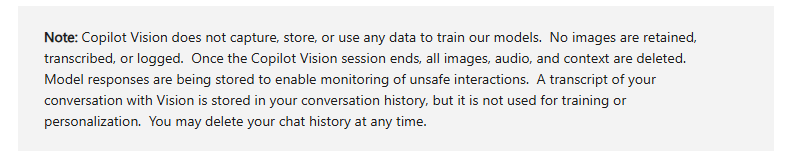
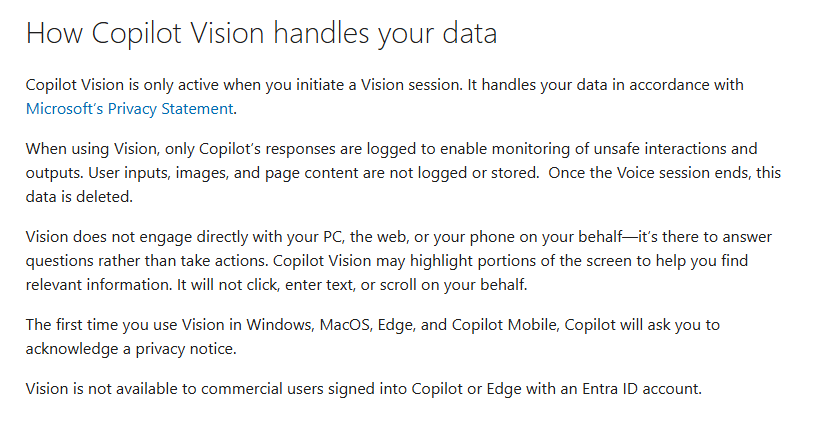
Microsoft emphasizes that Vision works under explicit user consent. You choose when to share your screen or camera feed. According to Microsoft Support, only Copilot’s responses are logged; your screen content, images, or audio are not stored and are deleted when the session ends.
Frontier Firm perspective – from reactive to perceptive
Vision transforms Copilot from a reactive tool to a perceptive collaborator.It’s the first true step toward ambient AI — copilots that understand the situation, not just the text.
This evolution from language to perception marks the emergence of multi-modal work intelligence:
Seeing your environment, workspace, documents, or what camera sees
Hearing your context
Reading your documents
Responding with understanding
For AI-Native organizations, that opens entirely new collaboration patterns — training copilots, support copilots, even creative copilots that work with visuals, not only words.
And just think about Microsoft Mico.
The new Mico character – its name a nod to Microsoft Copilot – is expressive, customizable, and warm. This optional visual presence listens, reacts, and even changes colors to reflect your interactions, making voice conversations feel more natural. Mico shows support through animation and expressions, creating a friendly and engaging experience.
Human-centered AI blog post by Microsoft
It’s not just AI that answers; it’s AI that perceives, listens, has personality, and acts.
The bottom line
Vision isn’t just another feature. It’s a new sense for AI — and together with hearing, it signals the start of a new era where digital teammates can perceive our environment almost like humans do.
There’s no information yet about when Vision will appear inside Microsoft 365 Copilot (Word, Excel, PowerPoint, Outlook, or Teams). Combined with Memory, Pages, and multi-agent orchestration, Vision-enabled agents could soon provide a new level of context continuity — understanding what you’re seeing, hearing, and doing across devices and applications.
We’re still early, but it’s clear: the future of work is perceptive.Human-led. AI-operated. Context-aware at every step.
🔗 Sources & further reading
Copilot Vision: A new way to browse (Microsoft Copilot Blog, Dec 2024)
Copilot on Windows – Vision and File Search begin rolling out to Windows Insiders (Apr 2025)
Copilot Vision on Windows with Highlights now available in the U.S. (June 2025)
Using Copilot Vision with Microsoft Copilot – Privacy and Consent (Support Article)
Sharing is Caring! #CommunityRocks
Aiheeseen liittyy
Published by Vesa Nopanen
Vesa “Vesku” Nopanen, Principal Consultant and Microsoft MVP (Microsoft 365 and Azure AI Foundry) working on Future Work at Sulava MEA.
I work, blog and speak about Future Work : AI, Microsoft 365, Copilot, Loop, Azure, and other services & platforms in the cloud connecting digital and physical and people together.
I have 30 years of experience in IT business on multiple industries, domains, and roles.
View all posts by Vesa Nopanen
Coinbase CEO Brian Armstrong made waves on Tuesday when he confirmed that the exchange spent $25 million to acquire an NFT that will restart UpOnly, a crypto podcast that went dark three years ago. The purchase marks one of the most expensive NFT transactions in history and signals a major play in the crypto media space.
How the NFT Challenge Started
Cobie threw down the gauntlet in May 2025, creating an unusual challenge. He minted an NFT and announced that whoever burned it would force the podcast back for another season. “I am no longer the decision maker on if UpOnly returns,” he wrote at the time. “The power is now stored within this NFT that I just minted. When the NFT is burned, the podcast will restart.”
The NFT came with tight restrictions. Buyers got no sponsorship rights or editorial control. Cobie admitted he kept adding zeros to the price on OpenSea until the number seemed too ridiculous for anyone to actually pay. He didn’t expect anyone to take him seriously, but Coinbase proved him wrong.
Before Coinbase stepped in, the highest bid on OpenSea had reached 4.7 Ethereum, roughly $18,500. In the end, Coinbase paid a massive premium to secure the token. The transaction itself required managing large-scale cryptocurrency wallets, with Coinbase handling the funds in a highly secure manner. The $25 million purchase now ranks as the fifth-most expensive NFT sale ever recorded.
News Rocks the Crypto Community
Armstrong told his 1.6 Million Followers on X that the rumors were true, confirming that Coinbase did purchase the NFT. On-chain data from Arkham Intelligence confirmed that the $25 million USDC transaction was completed to a wallet belonging to Jordan Fish (also known as Cobie), a prominent crypto trader. Cobie is also one half of the duo that co-hosts the podcast “UpOnly”, which he hosted along with Ledger during the 2021 bull market. “UpOnly” provided listeners with conversations with top traders, project founders, and fund managers that discussed market trends and shared their knowledge and experience. FTX sponsored “UpOnly,” but after its collapse in late 2022, the podcast stopped airing new episodes.
The Fine Print Shows Us What is Next
The fine print of the NFT clearly outlines the services and value Coinbase will receive from its investment. In it, the token owner can “force Cobie and Ledger Status to perform, as monkeys, eight episodes of UpOnlyTV.” The description also states that Cobie and Ledger Status are allowed to “call you an idiot for purchasing this or totally ignore you (with zero mention) of your existence throughout our 8-episode season.”
Cobie responded via social media, with his typical sense of humor, by saying, “I’m too old to do a crypto podcast, I’ll be out here making Gary V look young again.” He then pointed out that it has been 3 years since UpOnly concluded. At the time, Cobie stated he was in his 20s and that now he has gray hair. He jokingly referenced the new show as “Unc Only” and said he would invest $25 million in plastic surgery before the return.
Market Reactions and Meme Coin Frenzy
The news of the acquisition had a domino effect on other coins in the crypto market. Multiple other meme coins began appearing on the blockchain with the UPONLY name, creating significant value. One Base version of UPONLY jumped as high as 7900%, before a slight price decrease, while a COBIE token on Base increased 5800%. There was also a memecoin based on Solana, which saw its value increase by 250% as investors poured in amid the momentum.
Crypto investor Rune suggested sending a Base meme coin to a $500 million market cap, arguing that Coinbase’s $25 million investment in reviving the podcast justified the speculation. This kind of frenzy reflects the immediate reaction of crypto communities to major news and shows how meme coins have transcended to become a cultural event for traders.
Technical Issues Cloud the Announcement
The purchase announcement came at an awkward time for Coinbase. The exchange was dealing with serious technical issues stemming from an Amazon Web Services outage. Users reported difficulties accessing accounts and executing trades while Armstrong was confirming the NFT purchase on social media. The timing highlighted the ongoing infrastructure challenges that major exchanges face even as they make bold moves in other areas.
How Relevant Is This To Crypto Media?
Coinbase’s decision to spend $25 million bringing back a podcast raises questions about its media strategy. UpOnly developed a strong following during the 2021 bull market, but the crypto audience has changed, and chances are that it has evolved dramatically since then. The podcast described itself as prioritizing entertainment overall.
This purchase could signal a bet on community development and brand growth in the current cycle. The Coinbase exchange has been losing ground to competitors as competition increases, and it needs a way to connect with users beyond just trading. A hot podcast may help the exchange become part of the conversation about cryptocurrency trends and culture.
To Sum Up
Coinbase’s $25 million NFT purchase to restart UpOnly demonstrates how much value major players see in crypto media and community engagement. The deal brought Cobie and Ledger back for eight episodes, though the hosts maintain their right to roast Coinbase for the purchase or ignore them completely. The move generated immediate buzz, sparked a meme-coin frenzy, and reminded everyone that crypto’s most interesting stories often unfold outside the charts. Whether UpOnly can recapture its original magic remains to be seen, but Coinbase clearly believes the investment is worth the gamble.
Published: October 28, 2025 at 11:00 am Updated: October 28, 2025 at 10:05 am
by Ana
Edited and fact-checked:
October 28, 2025 at 11:00 am
To improve your local-language experience, sometimes we employ an auto-translation plugin. Please note auto-translation may not be accurate, so read original article for precise information.
In Brief
Leading DeFi protocols are adopting token buybacks and revamped tokenomics to create sustainable value, incentivize liquidity, and foster community-driven governance, signaling growing maturity in the ecosystem.
During the heady days of “DeFi Summer”, growth in the decentralized finance industry was dominated by “yield farming”, where protocols offered high-emission token incentives as a reward for liquidity providers. In essence, they were promising unsustainable yields to encourage users to fuel their growth by depositing yet more funds into them.
These models were arguably critical for helping DeFi protocols get off the ground and bootstrap liquidity, but they also promoted significant token inflation, diluting value for stakeholders. The focus on attracting and retaining liquidity at almost any cost generates little intrinsic value, and requires a constant stream of new capital that cannot be kept up forever.
Even the most ignorant economists recognise that such a model is ultimately unsustainable. So rather than wait for everything to come crashing down, some of the most dominant protocols have taken preemptive action, reinventing their tokenomics models to cement their longevity. Led by their communities through DAOs, projects such as dYdX, Lido and MakerDAO are looking to funnel their revenues back into token buyback programs, similar to publicly listed companies.
They’re taking their inspiration from traditional corporate finance. Many of the world’s biggest tech companies, like Apple, IBM and Nvidia, buy back shares on the open market in an effort to prop up the value of their stocks. It’s a tried and tested strategy that helps to reduce the number of outstanding shares on the market, increasing demand and boosting shareholder confidence, and now DAOs are trying to replicate this with their native tokens.
Who’s Driving DeFi Buybacks?
Protocols are engaging in token buybacks in an effort to sustain their long-term health and encourage further participation from DeFi investors. The idea is simple – use the revenue they generate from transaction fees to buy up tokens on the market and reduce the circulating supply. This means fewer tokens on the market and greater demand, bolstering the token’s price.
But this is not just about boosting the value of everyone’s stacks. Liquidity is the lifeblood of DeFi protocols, and so the higher the token’s price, the more incentives there are for liquidity providers to maintain their positions and deposit even more capital. In addition, it can also promote greater engagement in ecosystem governance. The theory being that as their investments grow, token holders will be more inclined to want to contribute by voting on proposals that help to decide the protocol’s fate. Such strategies ultimately aim to create a kind of virtuous cycle, where success leads to more engagement, which drives more innovation and creates yet more value.
The decentralized cryptocurrency exchange dYdX is leading the charge here. In May it became one of the very first DeFi protocols to adopt a token buyback program, and in the intervening months its DAO has repurchased millions of $DYDX tokens. It executes these buybacks in a transparent way, with the dYdX DAO allocating 25% of protocol fees to monthly buybacks. The tokens are then staked to boost the network’s security and generate additional revenue for the dYdX treasury.
The DAO is currently engaged in discussions about the possibility of eventually using 100% of its network fees to repurchase $DYDX in order to reduce the amount of tokens in circulation. Proponents argue that such a move would progressively enhance validator incentives, increasing the protocol’s appeal to the broader DeFi community.
dYdX’s model was partly influenced by MakerDAO’s “Surplus Buffer” mechanism, which was introduced a year earlier. This sees excess revenue from stability fees and other network operations redirected towards $MKR token buybacks. The tokens are promptly burned, creating deflationary pressure that helps to boost its price and reinforce economic stability.
Lido’s DAO has proposed something different. The proposal, which is currently up for vote, calls for the implementation of a system known as NEST, which will use $stETH tokens (staked Ethereum) to buy back $LDO tokens. If the proposal is accepted, Lido plans to start testing the system in December 2025, with the goal being to reduce the circulating supply of $LIDO and drive up demand.
A Sign Of Growing Maturity
These are all innovative examples of how DeFi DAOs are trying to adjust their tokenomics models to better align incentives for every stakeholder. The goal is to create an economic feedback loop that incorporates elements such as treasury diversification and staking yields.
The enhanced token value equates to more attractive staking yields, which encourages more people to invest in the ecosystem. At the same time, the buybacks help to make token values more resilient, so they can weather periods of increased market volatility and prevent investors from panic selling.
These new tokenomics models represent a profound shift in the DeFi market, indicating the growing maturity of protocols as they seek to establish themselves as sustainable, value-generating entities. When DeFi communities see that a protocol is investing in its long-term future, they become more inclined to participate, fostering a greater sense of collective ownership and shared destiny. Participants will feel as if they’re all in it together, and strive to ensure the community’s long-term success.
Getting The Balance Right
The main challenge for any DAO is to strike the right balance between efficiency and democracy. They need to ensure that all actions taken truly reflect the will of the protocol’s users, but at the same time, they must also make sure that decisions can be taken quickly enough to accelerate innovation and stay ahead of the game.
This requires DAOs to carefully consider what kind of voting mechanism is employed. The weight of each token holder’s vote must be balanced in order to prevent so-called whales from gaining too much influence over the decision-making process. In the case of dYdX, the weight of each person’s vote is based on the amount of $DYDX tokens they have staked, which ensures that anyone heavily invested in its ecosystem will avoid voting on proposals that could have a detrimental effect.
One of the most durable models can be found in Compound’s DAO, which relies on a system of on-chain proposals. With this, $COMP token holders are entitled to submit, debate and then vote on the protocol’s operational parameters, such as how, when and where to buyback tokens and how to manage its treasury effectively. The model ensures that everyone gets to participate in the decision-making process and that outcomes reflect their democratic will.
Arbitrum has taken a slightly different approach with its Grants model, which aims to facilitate decentralized capital allocation. It has not yet instituted buybacks, but its community has become very active in voting on how the treasury distributes its funds to different projects and development initiatives. Because every $ARB token holder is invested in the project’s success, it encourages them to consider the implications of each proposal very carefully and ensure the benefits outweigh any risks the changes may introduce.
The Promise Of Broader Participation
The rise of DeFi buybacks is just the start, and we can expect DeFi protocols to embrace further innovations in community-led treasury management in future. Already, we see multiple DAOs engaged in discussions around advanced yield strategies for treasury assets and more sophisticated risk management frameworks. Some are even holding talks with other DAOs about cross-protocol capital coordination plans.
While DAOs have taken their lead from traditional finance, the unique way in which they enable broad community participation gives them the potential to out-innovate their corporate cousins in the longer term, paving the way for DeFi to develop more sophisticated ecosystems and increase value for all stakeholders.
Disclaimer
In line with the Trust Project guidelines, please note that the information provided on this page is not intended to be and should not be interpreted as legal, tax, investment, financial, or any other form of advice. It is important to only invest what you can afford to lose and to seek independent financial advice if you have any doubts. For further information, we suggest referring to the terms and conditions as well as the help and support pages provided by the issuer or advertiser. MetaversePost is committed to accurate, unbiased reporting, but market conditions are subject to change without notice.
About The Author
Alisa, a dedicated journalist at the MPost, specializes in cryptocurrency, zero-knowledge proofs, investments, and the expansive realm of Web3. With a keen eye for emerging trends and technologies, she delivers comprehensive coverage to inform and engage readers in the ever-evolving landscape of digital finance.
More articles
Alisa, a dedicated journalist at the MPost, specializes in cryptocurrency, zero-knowledge proofs, investments, and the expansive realm of Web3. With a keen eye for emerging trends and technologies, she delivers comprehensive coverage to inform and engage readers in the ever-evolving landscape of digital finance.