Strange depressions observed in the dunes of the Red Planet, resembling the activity of sandworms, have excited the scientific world. Researchers have revealed the surprising chemical truth behind these tracks, which gave the impression of biological activity, using simulations.
The Martian surface still holds great secrets, despite detailed scans by exploration vehicles. Recently, mysterious pit-like formations that caught the attention of researchers, and at first glance looked like the work of “sandworms,” are exciting the scientific world.
However, the real reason behind these shapes is thought to be not a biological process, but rather the Red Planet’s unique chemical and physical conditions.
On the sand-covered surface of the Red Planet, regular, pit-like depressions surrounded by small sand ridges were observed. These landforms are very similar to mounds created by an animal digging in the soil or the movements of the legendary sandworms in the movie “Dune.” As Lonneke Roelofs, a geoscientist from Utrecht University, stated, these images naturally created an impression of biological activity among scientists.
Unveiling the Mystery: Carbon Dioxide Ice Blocks
The research team launched a comprehensive study to solve the formation mechanism of these mysterious landforms. In light of the available data, the most likely and strongest scientific explanation centered on the idea that these depressions were formed by carbon dioxide ice blocks.
During the winter season on Mars, temperatures drop to minus 120 degrees Celsius, and under these conditions, CO2 ice accumulates on the surface. As winter ends, the dune slopes begin to warm up, and the accumulated CO2 ice masses crack and break. An ice block starting to roll down the slope rapidly turns into gas (sublimates) on its underside due to the large temperature difference between the thin atmosphere and the warm dune sand.
The gaseous CO2 occupies much more volume than the original ice, causing the ice block to suddenly expand in a kind of explosion. The high gas pressure sprays the sand around the block in all directions.
Artificial Simulations Support the Theory
Researchers successfully recreated this process in a simulation environment. A CO2 ice block released from the top of a slope moved by carving hollows into the slope, exactly mimicking the observed depressions. As a result of this process, the block got stuck in a pit surrounded by small sand ridges. Then, as it continued to slide, it left a long and deep track with distinct sand ridges on both sides.
Although these interesting Mars landforms suggest the activity of a living creature at first glance, it is understood that there is a complex chemical and physical process behind them. This situation strengthens the hypothesis that the mysterious formations on the surface of Mars may be the result of the planet’s unique seasonal and atmospheric interactions, rather than biological activity.
You Might Also Like;
Follow us on TWITTER (X) and be instantly informed about the latest developments…
Published: November 05, 2025 at 2:05 am Updated: November 05, 2025 at 2:05 am
by Ana
Edited and fact-checked:
November 05, 2025 at 2:05 am
To improve your local-language experience, sometimes we employ an auto-translation plugin. Please note auto-translation may not be accurate, so read original article for precise information.
In Brief
WeatherXM has launched the Beaver Collection NFT presale to fund community-owned weather stations and expand global access to accurate climate data.
Community-driven weather network WeatherXM announced the launch of the WeatherXM non-fungible token (NFT) collection and the opening of its presale.
According to the announcement, each NFT within the Beaver Collection serves as more than just digital artwork—it functions as a means of supporting the creation and operation of real-world weather stations in areas where accurate data is most needed. Through the Targeted Rollouts initiative, supporters can mint NFTs to finance new stations, while deployers take responsibility for installing and maintaining the equipment. Collectively, this effort aims to establish a transparent, verifiable, and community-owned climate data network.
WeatherXM’s Targeted Rollouts model combines community funding with local participation to address critical gaps in global weather coverage, particularly in regions where the absence of reliable data affects agriculture, education, and urban planning.
The effectiveness of this model has already been demonstrated through several projects. The SwissBorg Alpha Deal generated $600,000, enabling 2,291 weather station deployments across 12 countries. In India, the Dabba initiative utilized broadband networks to install 830 stations benefiting farmers and schools. In Kenya, BLCK IoT deployed 170 stations in remote areas to promote fairer insurance practices, while in South Africa, DePIN SA established 320 stations to enhance disaster preparedness and energy grid stability.
Each rollout replaces generalized forecasts with accurate, localized data, advancing transparency, reliability, and community resilience in climate monitoring.
The NFT presale for WeatherXM is now live, allowing participants to mint NFTs directly on the Base network and contribute to the project’s next phase of development. Each NFT corresponds to one-quarter of an operational weather station, with on-chain rewards allocated as stations become active and achieve performance milestones. Participation requires only a digital wallet and a small amount of ETH to cover transaction fees, with no need for technical expertise or equipment.
The presale operates on a first-come, first-served basis without a limit on the number of NFTs available for minting. Payments can be made in WXM or USDC on the Base network, with bridging options provided. Presale NFTs are priced from 80, reflecting a 20% discount. Each minted NFT supports the expansion of a decentralized global network for accurate and community-powered weather data.
Beaver Collection NFT Sale Goes Live, Featuring Staking Rewards And Tiered Participation Options
WeatherXM highlighted that beavers are often regarded as natural engineers, capable of anticipating environmental shifts and creating systems that safeguard ecosystems from flooding and drought. Within the project’s framework, they symbolize a collective of proactive builders who anticipate climate challenges and act in advance. For this reason, every Targeted Rollouts NFT belongs to The Beaver Collection—a digital representation honoring one of nature’s most adaptive and resilient species. Each Beaver NFT provides funding for one-quarter of a physical weather station, contributing to the transformation of data-scarce regions into areas with accessible and accurate weather information for farmers, utilities, and local communities.
All transactions and operations take place on-chain through the WeatherXM decentralized application (dApp) on the Base network. Participants can connect a compatible wallet, ensure sufficient WXM or USDC funds along with a small amount of ETH for gas fees, and mint NFTs, with four NFTs collectively supporting one complete weather station. Once funding is complete, verified deployers—who stake WXM and manage on-site hardware installations—receive the station assignments. Following confirmation of data quality, automatic daily WXM rewards are distributed over a two-year period, with 75% allocated to NFT holders and 25% to deployers.
Supporters also have the option to stake their Targeted Rollout NFTs for additional yields, available over three-, six-, or twelve-month terms at respective rates of 5%, 8$, and 12%, further contributing to the expansion of real-world weather infrastructure. In addition, the WeatherXM DAO has introduced a 2x Reward Boost initiative, matching WXM staking rewards on a one-to-one basis to accelerate the deployment of new weather stations globally.
According to the project’s timeline, the targeted rollout sale is scheduled to begin on November 4th, with the presale opening at 14:00 UTC, followed by the main sale on December 12th, and the sale conclusion on December 1st, also at 14:00 UTC.
Each NFT directly supports the establishment of real, functional weather stations designed to enhance forecasting accuracy for agricultural, educational, utility, and municipal sectors in regions where reliable meteorological data is limited. This initiative focuses on building tangible, community-driven infrastructure that serves both people and the environment, enabling the deployment of essential weather technology in high-impact areas worldwide.
Disclaimer
In line with the Trust Project guidelines, please note that the information provided on this page is not intended to be and should not be interpreted as legal, tax, investment, financial, or any other form of advice. It is important to only invest what you can afford to lose and to seek independent financial advice if you have any doubts. For further information, we suggest referring to the terms and conditions as well as the help and support pages provided by the issuer or advertiser. MetaversePost is committed to accurate, unbiased reporting, but market conditions are subject to change without notice.
About The Author
Alisa, a dedicated journalist at the MPost, specializes in cryptocurrency, zero-knowledge proofs, investments, and the expansive realm of Web3. With a keen eye for emerging trends and technologies, she delivers comprehensive coverage to inform and engage readers in the ever-evolving landscape of digital finance.
More articles
Alisa, a dedicated journalist at the MPost, specializes in cryptocurrency, zero-knowledge proofs, investments, and the expansive realm of Web3. With a keen eye for emerging trends and technologies, she delivers comprehensive coverage to inform and engage readers in the ever-evolving landscape of digital finance.
After months of quests, events, and climbing the leaderboard, My Neighbor Alice is heading into the final stretch of its year-long airdrop campaign. The Hollow Wave, running from November 4 to December 2, marks the last and largest chapter of the $ALICE Adventure, offering up a prize pool of 250,000 $ALICE.
Unlike previous waves, this one shifts the focus almost entirely to gameplay. With fewer social media tasks and more in-game challenges, it’s designed to reward active players who spend time in Lummelunda.
Key Highlights
Final phase of the $ALICE Adventure runs Nov 4 – Dec 2
250,000 $ALICE up for grabs
Emphasis on quests over social tasks
Final Game Nights: Nov 14 & 28 at 12:00 UTC / 13:00 CET
Closes out the largest airdrop in the game’s history
Quests Take Center Stage
This round is all about in-game action. Players can expect more quests and challenges inside the world of Lummelunda, replacing the social checklists that featured heavily in earlier events.As the announcement put it: “Less noise, more action: Social tasks are toned down this round, letting in-game skill take the spotlight.”
The new format gives every participant a real chance to earn rewards—regardless of leaderboard rank. Whether you’re crafting, questing, or just consistently showing up, your efforts count.
Two Final Game Nights
Scheduled for November 14 and 28 at 12:00 UTC / 13:00 CET, the final Game Nights offer one last shot at bonus points. These sessions have become a staple of the airdrop, bringing players together to compete, strategize, and share updates in real time.
More than just a chance to climb the ranks, Game Nights have helped build a strong sense of community among players around the world.
A Look Back at the Journey
It started with the Icy Wave, continued through the Forest and Oasis, and now ends with the Hollow Wave. Along the way, players tackled new quests, explored evolving game mechanics, and found different ways to play, drawing more than 72,000 participants in total.
Together, players have completed:
2.7 million social tasks
113,000+ in-game missions
626,183 in-game actions or claims
The campaign has kept players engaged and active across multiple waves — no small feat in Web3 gaming.
With the Hollow Wave, My Neighbor Alice brings its airdrop full circle. It’s not just about distributing tokens; it’s about rewarding consistency, creativity, and in-game dedication. For long-time players, it’s a final chance to be part of something that’s grown far beyond a simple rewards campaign.
Microsoft 365 Copilot has already transformed how we work. Its newest step in the AI-evolution—Researcher with Computer Use—takes things to a completely new level. This capability, available now through the Frontier program, enables Copilot’s Researcher agent to go beyond reading and reasoning. It can actually use a computer. That means navigating websites, interacting with online forms, signing into gated services, and performing multi-step actions to complete your request. If that sounds like science fiction, that’s because it almost is—except it’s real, secure, and working right now in Microsoft 365.
What Is “Computer Use”?Why Computer Use MattersHow to Use Researcher with Computer Use1. Open Researcher in Copilot2. Select your sources3. Stay in control4. Describe what you need5. Computer Using Agent6. Review the results7. Privacy, transparency, and controlWhat Admins Should Know1. Enabling or disabling Computer UseSecurity and complianceReal-World ImpactFinal Thoughts
What Is “Computer Use”?
Microsoft describes it simply:
“With Computer Use, the Researcher agent can securely interact with public, gated, and interactive web content through a virtual computer—enabling users to uncover deeper insights, take action, and generate richer reports grounded in both their work data and the web.”
In practice, it means that when Researcher determines your task requires hands-on work—like collecting information from sites behind logins—it spins up a secure, isolated virtual machine in Microsoft’s cloud.
Inside that environment, the agent can:
Browse and interact with websites.
Log in to authenticated services (with your consent / you doing the authentication).
Read and extract relevant information.
Create deliverables such as documents, spreadsheets, or presentations.
The virtual machine is temporary—deleted once the task is complete—and it’s isolated from your device and organizational network. This is a huge step forward. Instead of being limited to what’s exposed through connectors or APIs, Researcher can now operate like a true assistant that gets things done.
Why Computer Use Matters
Computer Use represents a major leap in capability for Microsoft 365 Copilot.
From reading to doingCopilot has been able to analyze data and draft content. With Computer Use, it can also act—performing the clicks, navigation, and steps you’d normally do yourself.
Bridging the integration gapNot every site or tool has an API. With this feature, Researcher can still interact with them, expanding what’s possible without additional development.
Productivity that feels magicalInstead of gathering data manually, you can ask Researcher to do the full workflow—collect, analyze, and summarize—in one flow.
Transparency and controlEvery step is visible, consent-based, and governed by admin policies. You always stay in control of what happens.
How to Use Researcher with Computer Use
Using Researcher with Computer Use in Microsoft 365 Copilot is familiar—but what happens behind the scenes is entirely new. It blends the reasoning of an AI agent with the ability to act through a secure, cloud-hosted virtual computer.
Here’s how it works, according to Microsoft’s official documentation.
1. Open Researcher in Copilot
In Microsoft 365 Copilot, select the Researcher agent. When your admin has enabled the feature, you’ll see Computer Use listed among the available data sources alongside Work and Web.
2. Select your sources
Before you begin, choose what Researcher can access:
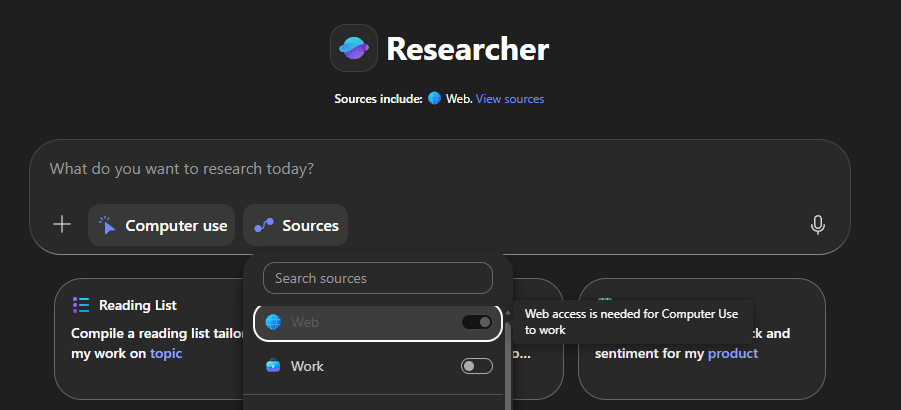
Computer Use for tasks that require interacting with websites, forms, or gated online services.You can toggle these sources on or off to control the scope of the research.
Web for publicly available content.
Work for your organization’s internal data (if allowed by admin).
You can also fine-tune Work-source, to include only certain data sources – such as Teams Meetings and Chats. You can also choose to use only specific sites in SharePoint, instead of all SharePoint content where you have access to.
3. Stay in control
Before Researcher begins using the virtual computer, it first confirms with you that it is ok.
Whenever authentication or consent is needed, Researcher pauses and asks you to confirm. You’ll always see a visible indication that Computer Use is active. The environment runs separately from your device and organization network, and it’s automatically deleted after the session ends.
Note that when you have Computer Use selected, web source is forced to be on.
4. Describe what you need
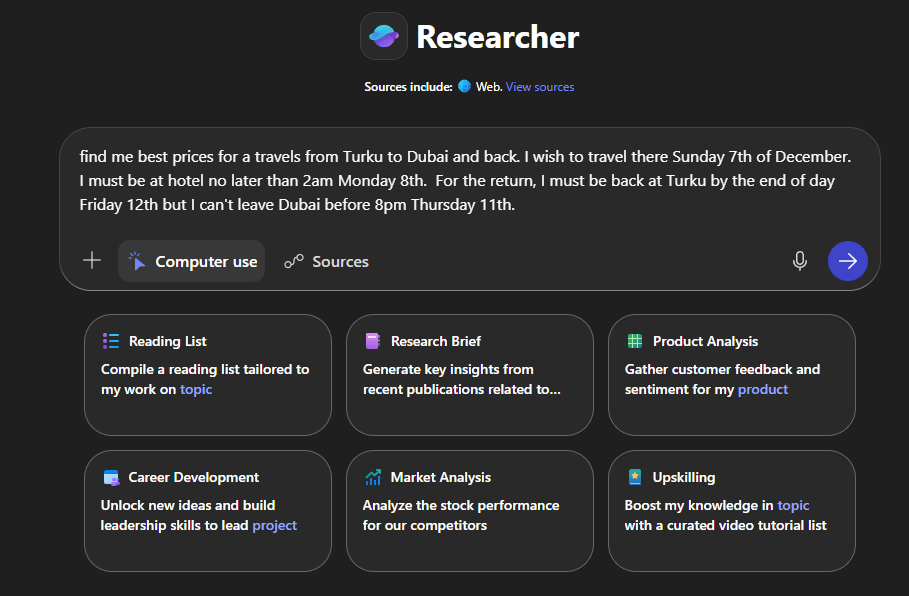
Enter your goal in natural language. Researcher decides whether Computer Use is needed to complete the task. When it does, Copilot clearly notifies you that it’s starting a secure Computer Use session.
In my own test, I used Researcher to plan an upcoming December trip. Instead of just listing search results, the agent launched a secure computer environment, navigated multiple airline and booking sites, compared options, and summarized the results—all without me opening a browser manually.
Researcher started the process and began collecting information from the web.
Eventually it had results for me
However, I wanted it to check out for more details.
5. Computer Using Agent
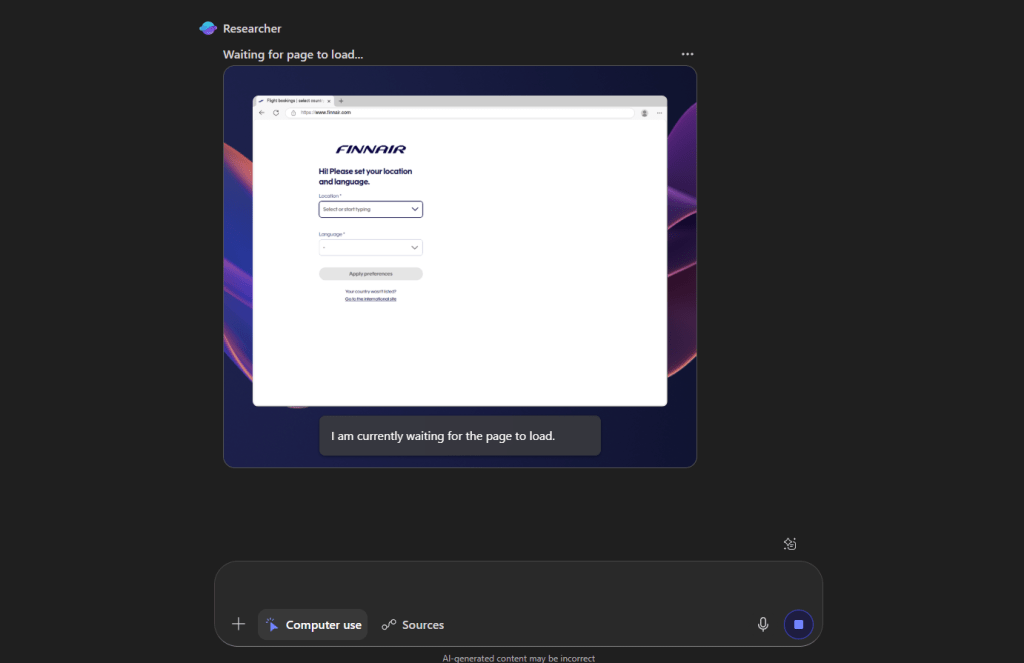
At this point the Researcher had determined that it needs some help from user as it browser through searching for information. Anything that is on the screen of that virtual machine, will be captured when the agent is in control, but when user is in control the agent doesn’t monitor ( ie: screenshots are not being taken when user is using the virtual machine). Once control has been returned to the agent, it again takes regular screenshots so it can understand what’s on the screen and what it should be trying out.
6. Review the results
Once finished, Researcher summarizes the outcome—for example, presenting the best options, timeframes, or comparisons—and provides clear reasoning steps. You can ask it to refine the results, adjust criteria, or continue with a follow-up actions.
This example , the one I used in the blog post, didn’t end well – not because of Researcher Agent but because Finnair site stopped discovering flights for a certain date when using the virtual machine. However, all the process I monitored and used the Computer Use capability in the Researcher Agent was really powerful. This is extremely useful for businesses, as you can log in to a backend system and use Researcher to collect information for analysis and reporting. And yes, Researcher will be the one doing the analysis and reporting – you will get the results.
7. Privacy, transparency, and control
Microsoft emphasizes that Computer Use operates within a sandboxed virtual machine in the Microsoft Cloud:
“The Computer Use environment is isolated from your device and organization network. Data is not stored, and actions are logged for transparency.”
Administrators manage who can use this capability, whether the Work data source can be combined with it, and what websites or domains are permitted.
What Admins Should Know
According to Microsoft Learn, admins have full control over how this capability is used.
1. Enabling or disabling Computer Use
In the Microsoft 365 Admin Center or Copilot Admin Portal:
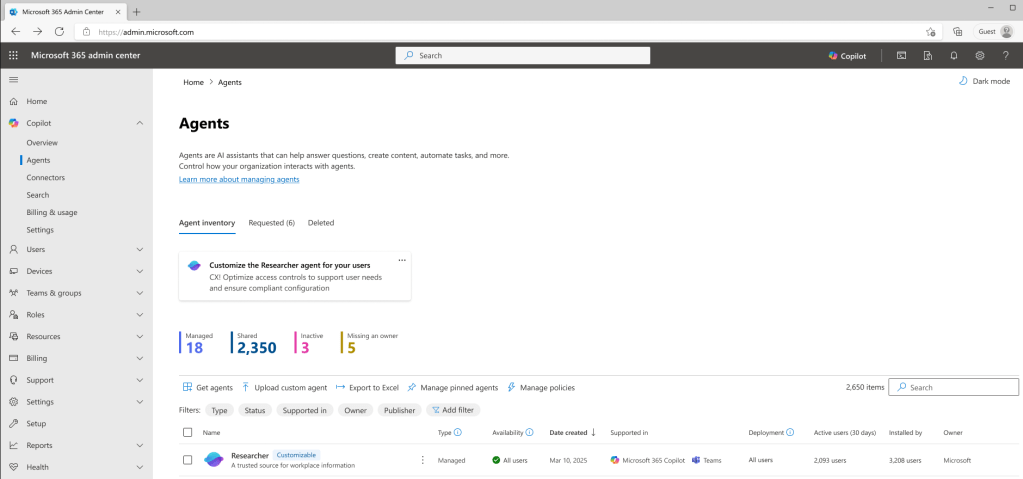
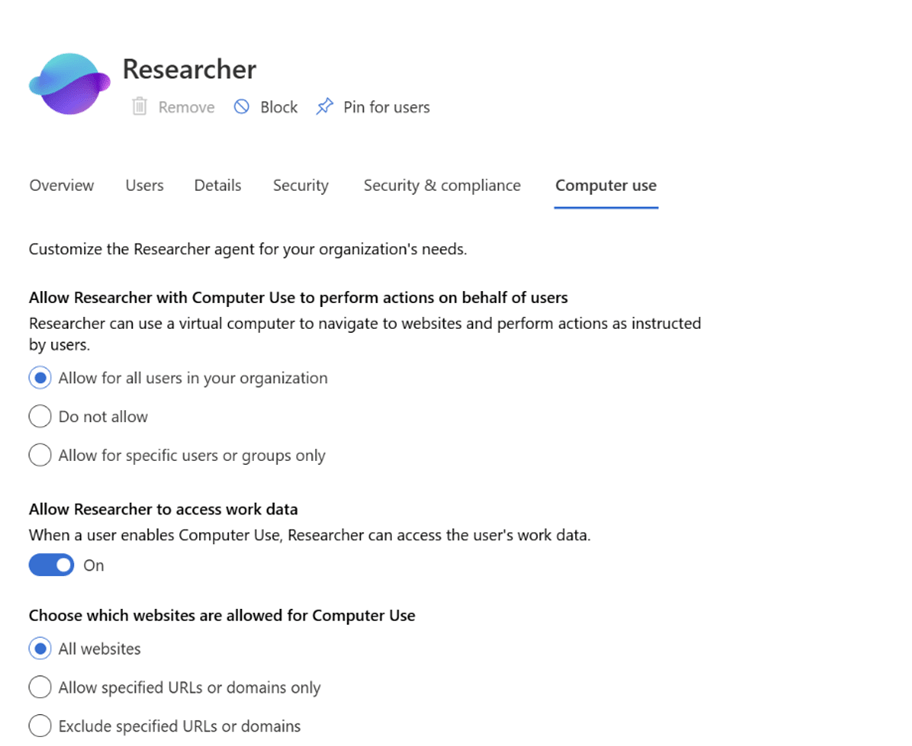
Go to Agents → Researcher → Computer Use.
Choose to allow, restrict to specific users/groups, or disable the feature.
Admins can also manage whether users may combine Work data with Computer Use. When disabled, that toggle appears greyed out in the Researcher interface. It is also possible to restrict which sites the agent can visit, allowing only approved domains or blocking specific URLs as needed.
Security and compliance
Every Computer Use session runs in a Microsoft-hosted, temporary, isolated environment. No data or credentials are stored. Audit logs record the agent’s actions, supporting compliance and transparency.
Real-World Impact
Computer Use blurs the line between assistance and action. It opens possibilities for:
Researching complex topics that require navigating multiple sources.
Gathering data from subscription, industry-specific sites or legacy systems without an API
Preparing meeting briefings, reports, or even travel plans—end-to-end.
It’s early days, but even now this feels like the beginning of agentic work in Microsoft 365—where your AI doesn’t just help you think, but helps you do.
Final Thoughts
With Researcher’s new Computer Use capability, Copilot crosses a threshold: from conversational AI to actionable AI. This also aligns with my previous blog post Introducing Copilot Vision: seeing is an ability, a sense, that Copilot and AI will be using much more than before. The technology has reached the point when it is beginning to be more and more usable, and there are endless amount of use cases where AI vision will be helping us at work and life.
For those of us testing it through the Frontier program, it already feels like a glimpse into the AI-native future of work—one where your digital coworker can research, act, and deliver on your behalf, safely and transparently.
It’s no longer science fiction. It’s here—and it’s redefining what it means to get work done.
Sharing is Caring! #CommunityRocks
Aiheeseen liittyy
Published by Vesa Nopanen
Vesa “Vesku” Nopanen, Principal Consultant and Microsoft MVP (Microsoft 365 and Azure AI Foundry) working on Future Work at Sulava MEA.
I work, blog and speak about Future Work : AI, Microsoft 365, Copilot, Loop, Azure, and other services & platforms in the cloud connecting digital and physical and people together.
I have 30 years of experience in IT business on multiple industries, domains, and roles.
View all posts by Vesa Nopanen
YouTuber and engineer Luke Maximo Bell has developed a battery-free drone that runs entirely on solar power. The carbon fiber-bodied drone achieved a new first by taking off without energy storage.
As technology advances, we continue to see innovative ideas, especially in the field of aviation. Finally, YouTuber and engineer Luke Maximo Bell, who pushes the boundaries in drone technologies, has undertaken another unconventional project. Bell developed a drone that operates solely on solar energy without any battery, capacitor, or energy storage unit. The model can operate on energy received directly from the sun.
Takes Off Without Storing Energy
Bell’s project follows his recently developed Peregreen 3 drone, which reached a speed of 585 km/h. After the speed record attempt, the YouTuber has now created a productivity-focused design. As you might guess, designing a battery-less drone requires minimizing weight. Therefore, carbon fiber material was chosen for the body and propellers.
The power source is a long array of 27 small solar panels mounted directly on top of the drone. The panels are connected directly to the power system, transmitting energy instantly to the motors. It should be noted that the system struggled to stay airborne in initial tests, particularly due to its lightness. Changes in wind direction or the intensity of sunlight easily affect the drone’s balance. Despite this, Luke managed to fly the device successfully, albeit briefly, after a few adjustments. The drone was able to stay aloft using only sunlight, making the project technically “successful.”
Luke Maximo Bell states that the project is still in its initial stages. The new version will include more solar panels, a GPS module, and autonomous flight software. The goal this time is to break a Guinness World Record.
You Might Also Like;
Follow us on TWITTER (X) and be instantly informed about the latest developments…
Two things thrust MegaETH into the spotlight: a record-breaking token auction and a promise of near-instant, high-throughput execution on an Ethereum-compatible network. The project’s pitch—Ethereum’s security at web-speed—has ignited genuine enthusiasm from both investors and developers exploring scalable infrastructure for interactive apps.
Key takeaways
MegaETH is an EVM-compatible Ethereum Layer-2 aiming for millisecond-level latency and six-figure TPS throughput.
A $450 million oversubscribed MEGA token auction signalled intense interest but also raised fairness questions.
Claimed advantages include speed, modular node design, and developer familiarity; key risks involve execution, centralisation, and valuation.
Tokenomics and allocations align with public disclosures but will need watching as unlocks occur.
Excitement is genuine, but decisive judgments should wait for mainnet performance and decentralisation milestones.
What is MegaETH?
MegaETH is a next-generation scaling solution for Ethereum, often described as the first “real-time blockchain.” It retains full EVM compatibility, meaning existing Ethereum contracts can run without modification, while introducing a node structure built to handle massive transaction volume and sub-second confirmation times.
The goal is to support applications that can’t tolerate blockchain lag—trading platforms, competitive games, live social protocols, and streaming payments. By separating transaction execution, proof generation, and data replication across different node types, MegaETH aims to reach speeds that traditional rollups rarely approach.
Why it’s in the news
The project gained attention after a public token auction that became one of crypto’s largest of the year:
Over $450 million raised.
More than $1.3 billion in bids recorded.
Allegations of wallet duplication and allocation concentration stirred debate.
Strong investor interest, high valuations, and links to Ethereum’s founder community turned MegaETH into a headline fixture across industry media.
How MegaETH works (simplified)
Instead of one node doing everything, MegaETH divides the workload:
Sequencers receive transactions, order them instantly, and broadcast “state diffs.”
Provers validate and generate cryptographic proofs asynchronously.
Full nodes reconstruct state and maintain history for transparency.
Settlement anchors to Ethereum, preserving its security assurances.
This modular design allows concurrent processing and quick confirmations while keeping compatibility with the Ethereum Virtual Machine (EVM).
Source: MegaETH
Benefits the team promotes
Speed and throughput: Transactions confirm almost instantly, improving UX for time-sensitive dApps.
Developer continuity: Solidity, Foundry, and MetaMask remain fully usable.
New use cases: High-frequency DeFi trading, interactive on-chain games, and micro-transactions become practical.
Fee model innovation: A yield-bearing stablecoin, USDm, is proposed to stabilise transaction costs.
Example: A perpetual-futures DEX could confirm orders in milliseconds, reducing slippage and narrowing spreads compared with current rollups.
Risks and unresolved challenges
The same design choices that make MegaETH compelling introduce real risks:
Unproven scalability: The network’s projected TPS and latency are speculative and require public validation.
Centralisation pressure: Early sequencer and prover roles may be operated by a small, possibly opaque group, raising decentralisation concerns.
High valuation: With an estimated FDV (fully diluted valuation) near $6 billion, investor expectations are aggressive and leave little room for underperformance.
Competitive landscape: Arbitrum, Optimism, StarkNet, zkSync, and Base continue to mature rapidly.
Regulatory sensitivity: Token-sale structure and stablecoin design must comply with regulations such as MiCA (Markets in Crypto-Assets Regulation) and local securities laws.
The MEGA token
Indicative allocation:
Utility: network gas payments, sequencer staking/rotation, and governance.
Tokenomics match disclosed figures, but long-term investors should monitor unlock schedules, liquidity trends post-TGE (Token Generation Event), and any unexpected reallocations.
As of writing, the MEGA token is not yet listed on major centralized exchanges or active on popular DEXs. While a large public sale occurred, tokens may still be subject to vesting schedules, and general market trading has not begun. Prospective buyers should verify any listing claims directly on trusted exchanges.
Can investors actually profit?
Potential upside
If MegaETH meets its performance goals and attracts adoption, MEGA demand could rise.
Sequencer staking may offer yield opportunities.
Ecosystem rewards might benefit early participants.
Real-world constraints
A high starting valuation limits room for exponential appreciation.
Token unlock cliffs and early investor allocations could create downward pressure.
Governance may remain centralised in early phases, limiting community influence.
Execution and decentralisation progress will dictate lasting value.
Profits are possible, but depend heavily on actual usage, long-term decentralisation, and transparent public performance.
What to monitor next
Mainnet launch: Observe sustained latency and throughput.
Ecosystem adoption: Which dApps deploy first, and how do they perform?
Security audits: Confirm independent validation and bug-bounty activity.
Only transparent on-chain data will reveal whether MegaETH’s architecture delivers as claimed.
Broader context
Ethereum’s scaling race now features several credible rollups and sidechains. MegaETH enters as one of the most ambitious—its mission is to make blockchain feel instantaneous. The enthusiasm surrounding it reflects genuine demand for faster, smoother decentralised applications.
As the MegaETH whitepaper outlines, even advanced EVM chains like opBNB hitting ~100 MGas/s still translate to only ~650 swaps/s — far below what modern Web2 servers handle.
Still, major uncertainties remain. Performance, scalability, and operator diversity will determine whether MegaETH becomes a durable part of the Ethereum stack or a cautionary lesson about over-optimistic benchmarks. Both the project team and external analysts have flagged these caveats, emphasizing the need for public validation and ongoing transparency.
Conclusion
MegaETH embodies both the promise and the pitfalls of Ethereum’s scaling era. The idea—real-time responsiveness anchored to Ethereum’s security—is genuinely exciting. The funding scale confirms market appetite for such innovation. Yet the crucial variables—performance under stress, decentralisation trajectory, and network adoption—remain to be proven.
Valuation and tokenomics appear as publicly disclosed, but investors and developers should treat MegaETH as an ambitious work in progress. The project’s success will be measured not by hype or auction size, but by transparent mainnet data and how quickly it distributes power across its operators.
The excitement is real. So are the risks. Measured, informed observation is the best path forward.
Frequently Asked Questions
Here are some frequently asked questions about this topic:
What is MegaETH, and is it an Ethereum Layer-2 solution?
Yes. MegaETH is a high-performance Ethereum Layer-2 blockchain that executes transactions off-chain for speed while finalising them on Ethereum’s Layer-1 for security and decentralisation.
Who can build on MegaETH?
Any blockchain developer familiar with Solidity, Foundry, or standard EVM-compatible tools (like MetaMask and Hardhat) can deploy smart contracts and dApps on MegaETH without changes.
How is MegaETH different from other Layer-2 blockchains?
Unlike traditional L2s focused on gas savings, MegaETH prioritises ultra-low latency—offering near-instant transaction confirmations for real-time DeFi, gaming, and social applications.
Does MegaETH have a native token?
Yes. The MEGA token is used for gas fees, sequencer staking, and governance within the MegaETH ecosystem. It plays a central role in network security and participation incentives.
What should investors and users watch for with MegaETH?
Key factors to monitor include public mainnet performance, decentralisation of sequencer and prover roles, adoption by EVM dApps, token unlock schedules, and compliance with evolving crypto regulations.
Published: November 04, 2025 at 6:21 am Updated: November 04, 2025 at 6:21 am
To improve your local-language experience, sometimes we employ an auto-translation plugin. Please note auto-translation may not be accurate, so read original article for precise information.
In Brief
EnergKlette has launched a multi-layer platform to help enterprises comply with the EU’s 2026 CBAM by providing traceable, verifiable, and transferable green electricity and carbon data across supply chains.
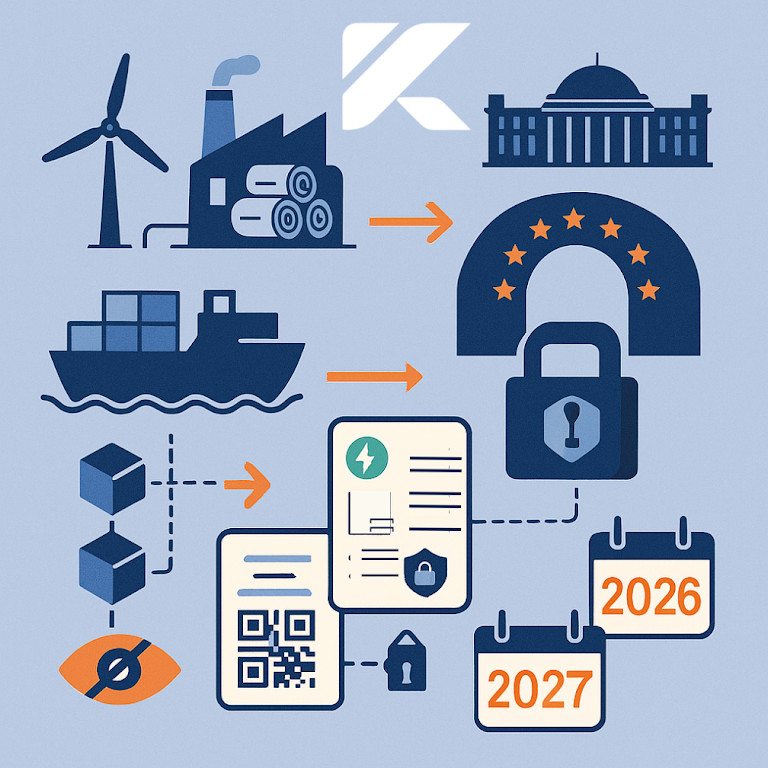
The Carbon Border Adjustment Mechanism (CBAM) of European Union will enter its compliance period in 2026, encompassing high carbon leakage risk products such as steel, cement, aluminum, fertilizers, hydrogen, and electricity. Reporting obligations during the transition period are already in effect, and the demand for accounting and verification of embedded emissions in imports is continuously rising. Recently, the EU has simplified the implementation rules and optimized the timeline, delaying the certificate sale until February 2027, but the compliance obligations for imports in 2026 will be applied retroactively. EnergKlette has launched a data and certificate foundation aimed at supply chain scenarios, supporting enterprises in forming a “consistent, verifiable, and cross-system transferable” evidence chain in green electricity procurement, Scope 2 emissions reduction, and product carbon footprint accounting.
The foundation is structured around four layers: “Measurement – Proof – Settlement – Audit.” The measurement layer connects smart meters with edge measurement gateways, recording renewable electricity at legally mandated time granularity; the proof layer generates digital green certificates bound to source and spatiotemporal tags, ensuring the transparent traceability of each kilowatt-hour of electricity to its corresponding carbon reduction; the settlement layer provides account period aggregation and multi-party sharing rules; the audit layer outputs summaries and traceability paths compatible with third-party verification, facilitating responses to CBAM and ETS audit sampling.
In terms of institutional alignment, the plan references the progress of ETS reforms under the “Fit for 55” framework, focusing on the differences in data standards and price signals between the existing ETS and the upcoming ETS2, while reserving mapping interfaces for “quota price trajectory – electricity consumption timing – product marginal emissions.” Enterprises can bind green electricity consumption to production processes, forming on-chain proof of “production batch – energy consumption – emissions” at the product level, providing a consistent basis for cross-border customs declaration and customer disclosure.
EnergKlette adopts a “local storage, on-chain proof” design for privacy and compliance, avoiding excessive leakage of original business data; it interfaces with smart meters to accelerate deployment and align with digital transformation policy directions, alleviating the pressure on enterprises to build their own systems. External exchanges publish summaries and verification endpoints through standardized interfaces, allowing trade partners and auditors to verify the matching degree of certificates and electricity declarations with zero knowledge, reducing the costs of repeated verification. The foundation states that this platform will open pilot projects to multinational manufacturing, data centers, and energy-intensive small and medium-sized enterprises, assisting them in establishing integrated capabilities of “traceable green electricity – verifiable carbon data – trade documents that can be connected,” thereby reducing compliance uncertainty and capital occupation.
Disclaimer
In line with the Trust Project guidelines, please note that the information provided on this page is not intended to be and should not be interpreted as legal, tax, investment, financial, or any other form of advice. It is important to only invest what you can afford to lose and to seek independent financial advice if you have any doubts. For further information, we suggest referring to the terms and conditions as well as the help and support pages provided by the issuer or advertiser. MetaversePost is committed to accurate, unbiased reporting, but market conditions are subject to change without notice.
About The Author
Gregory, a digital nomad hailing from Poland, is not only a financial analyst but also a valuable contributor to various online magazines. With a wealth of experience in the financial industry, his insights and expertise have earned him recognition in numerous publications. Utilising his spare time effectively, Gregory is currently dedicated to writing a book about cryptocurrency and blockchain.
More articles
Gregory, a digital nomad hailing from Poland, is not only a financial analyst but also a valuable contributor to various online magazines. With a wealth of experience in the financial industry, his insights and expertise have earned him recognition in numerous publications. Utilising his spare time effectively, Gregory is currently dedicated to writing a book about cryptocurrency and blockchain.
The automotive industry is moving through one of its most defining transitions yet. Beyond electric powertrains and autonomous systems, a quieter revolution is reshaping how vehicles are imagined, built, and experienced, through immersive technologies like Augmented Reality (AR) and Virtual Reality (VR) and other visualization technologies.
These technologies are no longer experimental add-ons. They have become integral to how the industry innovates, collaborates, and connects with consumers.
Designing faster, prototyping smarter
Traditional vehicle design demanded years of physical prototyping and iterative modeling. Now, with virtual design reviews and immersive prototyping, teams can collaborate globally, test multiple design path s instantly, and validate ideas in real time.
AR-assisted design checks reveal flaws early, while digital models replace expensive mock-ups. The payoff is faster innovation, lower costs, and freedom for creative exploration.
Reimagining the customer experience
The car-buying journey is no longer confined to physical showrooms. With VR showrooms and AR configurators, customers can explore vehicles, switch colors, examine interiors, and experience virtual test drives ; all from their phones or headsets.
Immersive launch events and interactive experiences have become new storytelling platforms, helping brands build stronger emotional connections while removing geographic limits.
Manufacturing with AR-guided precision
In manufacturing, immersive tools bring accuracy and efficiency to every stage. AR overlays provide real-time assembly instructions, reducing production errors. VR-based training allows operators to learn complex procedures in safe, controlled environments.
Remote maintenance powered by AR minimizes downtime and ensures consistent quality across global plants , driving a new era of precision manufacturing.
Collaboration that knows no borders
Global automotive programs demand deep coordination among design, engineering, and marketing teams. Immersive workspaces now enable these teams to collaborate as if they were in the same room – co-creating, reviewing, and refining life-size digital models together.
This seamless collaboration accelerates decision-making and strengthens creative synergy across disciplines and time zones.
Building sustainably with immersive tech
Every digital prototype and virtual showroom helps reduce material use, energy consumption, and logistics overhead. Immersive technologies are driving operational efficiency while aligning the industry with global sustainability goals, making innovation both responsible and scalable.
The road ahead
From design studios to factory floors to living rooms, AR and VR are touching every part of the automotive value chain. They bring clarity, speed, precision, and sustainability, reshaping how mobility itself is envisioned.
The next generation of vehicles will not just be engineered; they will be experienced long before they hit the road.
At TILTLABS, we help automotive leaders integrate AR and VR into the value chain to accelerate product development, transform customer engagement and enhance workforce performance.
We collaborate with innovators who see immersive technology not as a tool, but as a strategic advantage. If your roadmap includes rethinking how vehicles are designed, built, or experienced, TILTLABS can help you get there faster ,and more intelligently.
The post Inside the Immersive Shift: AR and VR at the Heart of Automotive Transformation appeared first on TILTLABS.
In today’s hyper-connected digital environment, privacy has become one of the most valuable — and vulnerable — assets. Every action we take online leaves a trace: signing in, making payments, proving our identity, or even entering age-restricted platforms. Traditionally, verifying these actions required us to expose personal information.
But what if you could prove the validity of something without revealing the underlying data at all?This is the revolutionary idea behind Zero-Knowledge Proofs (ZK-Proofs).
🔍 What Are Zero-Knowledge Proofs?
A Zero-Knowledge Proof is a cryptographic method that allows one party (the “prover”) to demonstrate to another party (the “verifier”) that a statement is true without revealing any supporting information beyond the truth of the statement itself.
In simpler terms, it enables:✅ Verification❌ Without Exposure
You prove that you know something — but you never reveal what you know.
🧠 Real-World Examples
✅ Age Verification
You can prove you are over 18 without showing your ID.
✅ Login Without Password Exposure
You confirm you know a password without ever sending it over the network.
✅ Financial Approval
You qualify for a loan without revealing your actual income.
These scenarios maintain accuracy while defending privacy — a major breakthrough in digital systems.
⚙️ How Does It Work (Simply)?
ZK-Proofs rely on advanced mathematics and cryptography.Instead of sharing the original secret (e.g., your password, ID number, or income), a mathematical proof is created.The verifier checks this proof, and if it’s valid, the statement is accepted as true.
No sensitive data is ever revealed or stored — only the proof.
🚀 Why Are ZK-Proofs Important?
✅ Privacy Protection
Personal data remains secure and never needs to be shared.
✅ Enhanced Security
If no information is transmitted, it cannot be intercepted, stolen, or misused.
✅ Regulatory Compliance
Helps meet global privacy laws since data remains private.
✅ Works With Public Systems
Especially ideal for decentralized, open blockchain networks.
🌐 Where Are They Used?
Zero-Knowledge Proofs are rapidly becoming indispensable across multiple fields:
Credit checks without income statementsSecure identity verification
🔹 Digital Identity
Anonymous access to servicesPrivacy-preserving login systems
🔹 Metaverse
Proof of avatar ownershipSecure in-world credentialsProtected social identity
In a world moving toward decentralized digital ecosystems, ZK-Proofs offer a secure foundation for identity and transactions.
🌍 ZK-Proofs in the Metaverse
The metaverse depends on identity, ownership, and trust.But users are rightfully wary of handing over personal details.
ZK-Proofs solve this by allowing:
Age-restricted accessOwnership verificationAnti-bot validationReputation systemsall without revealing personal information.
This makes them a crucial technology for large-scale virtual worlds.
🔮 The Future of Zero-Knowledge Proofs
ZK-Proofs are becoming a core building block of privacy-first digital infrastructure.As the metaverse, blockchain networks, and AI systems evolve, the demand for stronger privacy increases.
Experts believe ZK-Proofs will soon be:
Embedded in web browsersUsed in government ID systemsAdopted in financial infrastructureStandard across metaverse platforms
The future internet may run on verification without exposure.
✅ Conclusion
Zero-Knowledge Proofs represent one of the most important cryptographic advances of our time.They allow us to prove the truth without revealing the details, enabling privacy, security, and trust across the digital world.
From blockchain and banking to identity and the metaverse, ZK-Proofs are shaping a future where personal data remains under the control of the user.
In an era where privacy is power,Zero-Knowledge Proofs may be the technology that protects it.
You Might Also Like;
Follow us on TWITTER (X) and be instantly informed about the latest developments…
Published: November 03, 2025 at 2:11 pm Updated: November 03, 2025 at 2:11 pm
by Ana
Edited and fact-checked:
November 03, 2025 at 2:11 pm
To improve your local-language experience, sometimes we employ an auto-translation plugin. Please note auto-translation may not be accurate, so read original article for precise information.
In Brief
Despite easing rates and renewed U.S.–China talks signaling stability, Wenny Cai, COO of SynFutures, notes that while global markets tread carefully, DeFi keeps building at full speed.
The macro headlines are encouraging: easing rates, tentative trade deals, and signs of stabilization across global markets. Yet, despite this optimism, traders and investors remain cautious. According to Wenny Cai, COO of SynFutures, in the world of DeFi, the pace of innovation never slows. Even as central banks debate policy and global leaders negotiate trade, decentralized markets continue to operate on code, not sentiment.
This week brought a mix of macro and crypto news that reflects this dynamic. After months of tension, the world’s largest economies appear to be softening their stance. The U.S. and China announced a new trade truce, cutting tariffs and opening discussions on critical sectors like semiconductors, rare earths, and even the situation in Ukraine.
While Fed Chair Powell’s hawkish remarks briefly nudged Bitcoin back to $110K, Wenny Cai notes that analysts suggest the Fed’s gradual balance-sheet adjustments could soon fuel a fresh liquidity cycle. Meanwhile, gold drifted from its all-time highs, prompting traders to ask: Is it finally Bitcoin’s turn to shine?
Onchain Activity Remains Red-Hot
Even as macro uncertainty lingers, onchain activity is booming. MegaETH’s $1.3B raise and Monad’s viral airdrop buzz kept Ethereum Virtual Machine (EVM)-based ecosystems in the spotlight. According to Wenny Cai, this underscores a simple truth: innovation does not wait for central banks. Whether markets swing wildly or settle into calm, decentralized markets move on code, not policy, a principle that remains constant in her view.
TradFi Doubles Down on Stablecoins
Traditional finance is also embracing blockchain in new ways. Mastercard’s reported acquisition of Zerohash, a key infrastructure provider for stablecoin payments and crypto trading, in a $2B deal, signals growing institutional confidence. Meanwhile, Western Union filed a trademark for “WUUSD,” indicating plans for a Solana-based stablecoin and integrated crypto wallet services. Wenny Cai emphasizes that these moves show mainstream players are no longer testing the waters; they’re diving in.
Asia continues to lead in practical crypto adoption. Korea launched its first won-pegged stablecoin, KRWQ, on Base this week, expanding access for regional traders. According to Wenny Cai, this reinforces the continent’s reputation as a hub for real-world blockchain applications.
Ethereum for Institutions
Finally, the Ethereum Foundation is taking a proactive step toward enterprise adoption. Its new “Ethereum for Institutions” hub provides businesses with case studies, compliance frameworks, and practical guidance for building on Ethereum. Wenny Cai highlights that this initiative reflects a broader trend: as DeFi matures, bridging the gap between decentralized innovation and regulated, institutional engagement becomes increasingly critical.
The takeaway is simple. According to Wenny Cai, while central banks and governments debate policy, decentralized finance moves forward. Whether it’s massive raises, viral airdrops, or the development of regional stablecoins, the code never sleeps. Understanding this core principle is not only advantageous but also necessary for anyone navigating these markets.
Disclaimer
In line with the Trust Project guidelines, please note that the information provided on this page is not intended to be and should not be interpreted as legal, tax, investment, financial, or any other form of advice. It is important to only invest what you can afford to lose and to seek independent financial advice if you have any doubts. For further information, we suggest referring to the terms and conditions as well as the help and support pages provided by the issuer or advertiser. MetaversePost is committed to accurate, unbiased reporting, but market conditions are subject to change without notice.
About The Author
Victoria is a writer on a variety of technology topics including Web3.0, AI and cryptocurrencies. Her extensive experience allows her to write insightful articles for the wider audience.
More articles
Victoria d’Este
Victoria is a writer on a variety of technology topics including Web3.0, AI and cryptocurrencies. Her extensive experience allows her to write insightful articles for the wider audience.