Metaverse

Home Metaverse Page 87

How Widely Adopted Will Crypto Be in 2026? A Realistic Look | NFT News Today

0
How Widely Adopted Will Crypto Be in 2026? A Realistic Look | NFT News Today


Not long ago, cryptocurrency was considered a niche fascination. Today, it’s a permanent part of the global conversation. Governments are drafting policies around it, established banks are exploring blockchain-based systems, and ordinary people are using digital assets for trading and payments. Familiarity with different types of coins and how they work is also on the rise; beyond Bitcoin, more users are learning about alternatives like the privacy-focused Monero (XMR) and the benefits of a dedicated Monero wallet. On the whole, the idea of decentralized money has moved from the fringes of the internet into boardrooms and dinner-table discussions alike.

Even so, mass adoption is still far from universal. For every investor enthusiastic about Bitcoin or stablecoins, there are others wary of volatility and scams, as well as continuing regulatory uncertainty. The conversation has matured from hype to hard questions: Can cryptocurrencies really serve everyday needs? Will they remain speculative tools or become genuine financial utilities?

As 2026 approaches, these questions feel more relevant than ever. Let’s explore where cryptocurrency stands now and where it might be headed.

Institutional Participation Is Accelerating

The cryptocurrency market is no longer a playground for retail traders alone. Large institutions like banks and asset managers have entered the scene. Their presence injects credibility and liquidity into what was once considered a risky niche. Exchange-traded funds (ETFs) for Bitcoin and Ethereum have opened new doors for investors who might not hold crypto directly but want exposure to its growth. Major payment platforms have also begun integrating blockchain services.

Institutional involvement has a ripple effect. As traditional players enter the market, regulatory compliance, custody solutions, and auditing standards improve in tandem. These developments make it easier for cautious investors and businesses to participate without fear of technical or security pitfalls. By 2026, this institutional foundation may not only stabilize crypto’s reputation but also pave the way for broader integration across global markets.

Everyday Payments Are Growing, but Slowly

For years, enthusiasts have imagined a world where you could buy groceries or pay rent with crypto just as easily as using a card. That vision is inching closer to reality, but progress has been uneven. Cryptocurrency is gradually becoming part of the payments ecosystem through developments like remittance apps in developing regions and online retailers accepting stablecoins. Data firm eMarketer predicts that the number of people using crypto for payments could rise by more than 80 percent between 2024 and 2026—though that would still account for only a small slice of global transactions.

There are good reasons for this cautious pace. Transaction costs, speed, and user experience still lag behind traditional payment systems, and many consumers remain skeptical about volatility. Stablecoins have helped reduce some of that uncertainty, but most people continue to see crypto primarily as an investment rather than a practical tool for everyday spending. Unless payment platforms find a way to make using digital currencies as seamless and trustworthy as fiat money, crypto’s role in daily life may remain limited, even if its infrastructure keeps improving in the background.

Regulation and Policy Will Shape the Playing Field

How governments respond to crypto’s growth will determine whether the technology matures or remains fragmented. In regions such as the European Union, regulatory clarity through frameworks like the Markets in Crypto-Assets (MiCA) regulation has begun to legitimize digital assets and offer consumer protections. Similar initiatives are unfolding in Asia, where countries like Singapore and Japan have taken structured approaches to licensing exchanges and protecting investors. These moves show that, when rules are clear, trust tends to follow.

Still, regulatory alignment is far from universal. The United States, for instance, continues to wrestle with defining what constitutes a security versus a commodity in crypto. Emerging economies often lack the institutional capacity to enforce robust compliance standards. This unevenness could slow adoption, but it also signals that the next few years will be crucial for setting long-term norms. By 2026, clearer policies could make cryptocurrencies more accessible to the public while helping traditional institutions feel comfortable participating at scale.

Technological Integration Is Expanding Beyond Currency

Blockchain’s growth isn’t limited to cryptocurrency itself. Businesses are applying it to areas such as supply chain management, digital identity, and cross-border payments, while financial institutions experiment with tokenized assets and smart contracts to simplify operations. These use cases make the technology more visible and practical, even for people who don’t directly hold crypto.

Meanwhile, innovations like stablecoins and central bank digital currencies (CBDCs) are helping bridge the gap between traditional money and decentralized systems. If these continue to mature, they could introduce blockchain’s advantages—fast, frictionless activity and greater transparency—to mainstream users by 2026, often without requiring them to interact with volatile assets.

Public Awareness and Trust Remain the Deciding Factors

At the end of the day, technology alone cannot drive adoption; people must believe in it. Awareness about crypto’s potential has improved, but misunderstandings remain common. Some still associate it primarily with speculation or scams, while others see it as too complex to use safely.

Education and transparency play a crucial role in bridging that gap. Campaigns that explain how crypto wallets, exchanges, and regulatory safeguards work can make the space feel less intimidating to newcomers.

Generational differences are also shaping the pace of adoption. Younger consumers, who are already comfortable with digital finance, tend to be more open to using crypto-based tools. Older generations, by contrast, often prioritize stability and trust in established institutions. If the industry continues to invest in clear communication, responsible innovation, and consumer protection, these divides could narrow further in 2026.

​Cryptocurrency may not dominate global finance in the coming year, but it will likely be a normalized part of it. The technology is poised to grow stronger, supported by clearer regulations and growing public familiarity. The real question isn’t whether crypto will survive, but how seamlessly it can integrate into daily life without losing the values that made it revolutionary in the first place.


Source link

How the GTA Series Is Poised to Lead the Metaverse, VR, and AI Revolution

0
How the GTA Series Is Poised to Lead the Metaverse, VR, and AI Revolution


The Grand Theft Auto (GTA) series has been more than just a game since its inception—it has been a revolutionary digital life simulation. The dynamic and continually evolving structure established by the series, particularly with GTA Online, raises the question of how it can pioneer the integration of future technologies like Virtual Reality (VR), the Metaverse, and advanced Artificial Intelligence (AI), which are frequently discussed in the gaming world.

👓 Virtual Reality (VR): Total Immersion in the World of Crime

Experiencing GTA’s massive open world with VR headsets ceases to be an ordinary game and transforms into a singular immersion experience.

Physical Interaction: Thanks to VR hand controllers, players would be required to use physical movements—instead of passively clicking buttons—to steal a car, enter a bar, or flee the police. This turns every moment of the game into an adrenaline-fueled simulation.First-Person Life: Walking the bustling streets of Los Santos or Vice City from a First-Person perspective with VR offers the player the depth and complexity of the environment with an unprecedented level of realism. VR adds a strategic and intense dimension to heists and combat scenarios.

🧠 AI Characters: A Truly Social Universe

The most crucial element of a Metaverse or a realistic simulation is not just other players, but the characters that live within the game (NPCs). The GTA series has the potential to elevate NPC behavior to the next level using AI technologies.

Dynamic Response: NPCs powered by advanced Artificial Intelligence may no longer be restricted to cyclical scenarios. They could give unique and realistic reactions based on the player’s clothing, reputation level, or previous interactions. For example, a shop owner might genuinely refuse service due to the player’s bad reputation.NPCs with Their Own Lives: Advanced AI could allow NPCs to have their own routines, social circles, and objectives, similar to the real world. Thus, every character the player meets could be part of a living narrative, not just a mission trigger. This would give the game world a constantly changing and unpredictable social fabric.

🌐 The Metaverse: A Hub for Digital Economy and Social Life

GTA Online has already built a successful virtual community and economy. The future holds the potential to evolve this structure into a fully-fledged Metaverse.

Player-Driven Economy: Virtual properties, rare vehicles, and clothing (potentially backed by NFT-like structures) could fall under the true ownership of the players. This would make the in-game economy much more serious and realistic.Virtual Social Hub: The game could become a primary address not just for missions, but for socializing. Exclusive clubs, event venues, and even virtual concerts could create dynamic social hubs where different groups of players gather, mimicking real-world interactions.Integration with the Real World: Brand collaborations and in-game representations of products could turn the GTA universe into an extension of the real-world commerce and entertainment industries.

Conclusion:

The GTA series has always pushed the boundaries of open-world gaming. When the trends of VR, advanced Artificial Intelligence, and the Metaverse converge, Rockstar Games has the power to go beyond creating just a game and offer players a breathing digital universe, rich with crime, complexity, and endless interactions. The future of the game lies in how these technologies will integrate with the fun and rebellious spirit at the core of GTA.

You Might Also Like;

Follow us on TWITTER (X) and be instantly informed about the latest developments…

Copy URL


Source link

How Visa Uses Stablecoins for Instant Settlement and Cross-Border Payments | NFT News Today

0
How Visa Uses Stablecoins for Instant Settlement and Cross-Border Payments | NFT News Today


Stablecoins have taken a major leap from crypto exchanges into real payments. Visa now settles transactions using digital currencies such as USDC and PayPal USD across multiple blockchains, including Ethereum, Solana, Stellar, and Avalanche. This change makes stablecoins usable for payouts, remittances, and merchant settlement without requiring anyone to hold crypto.

Visa’s move marks the first time a global payment network integrates blockchain at this scale.

Key Takeaways

Visa now settles payments using stablecoins, including USDC, EURC, PYUSD, and USDG.

Multiple blockchains are supported, allowing for fast, inexpensive, and 24/7 payments.

Merchants still receive local currency; stablecoins are only used behind the scenes to facilitate fund settlements.

Visa Direct enables instant cross-border payouts using stablecoins rather than slow international wires.

Stablecoins supported by Visa are backed by cash and U.S. Treasury bills, making them highly stable and reliable.

Why Visa Supporting Stablecoins Matters

Visa handles payments for more than 4.2 billion cards. When a company with that reach adopts stablecoins as a settlement method, it signals a shift in how money moves across borders.

Stablecoins used by Visa are not speculative cryptocurrencies. They’re digital dollars backed by real assets. One token equals one currency unit—no price swings, no gambling.

For decades, international money transfers relied on:

Delayed settlement,

Multiple banking intermediaries,

Fees that stack up with each currency conversion.

Stablecoins allow Visa to bypass all of those friction points.

Instead of using slow networks like SWIFT, Visa settles funds instantly using digital dollars. Merchants still get paid in their local currency. Consumers don’t see anything different. Everything happens behind the scenes.

In other words, Visa didn’t create a new payment network.

Visa upgraded the plumbing of its existing network.

What Stablecoins Visa Uses and Why

Visa supports four stablecoins issued by regulated companies:

USDC (USD Coin) – issued by Circle

EURC (Euro Coin) – issued by Circle in the EU

PYUSD (PayPal USD) – issued by PayPal and Paxos

USDG (Global Dollar) – issued by Paxos for banks and institutions

These digital currencies are backed by cash and short-term government bonds. Their issuers release regular audits confirming that reserves are in place.

Visa chose them because they offer:

Stablecoins that lack oversight or fluctuate in value aren’t part of Visa’s program.

How Visa Uses Multiple Blockchains

Visa settles transactions on:

Ethereum – highly secure and widely adopted

Solana – known for fast processing and tiny fees

Stellar – built for remittances and global payments

Avalanche – customizable and optimized for institutions

Each blockchain serves a different purpose.

Solana enables near-instant stablecoin settlement at microscopic cost.

Ethereum unlocks access to institutional liquidity and audited financial infrastructure.

Stellar is optimized for sending funds across borders.

Avalanche allows banks to test issuing stablecoins on private networks.

By using several blockchains, Visa can route transactions based on speed, cost, and compliance needs instead of relying on a single network.

This flexibility is similar to how Visa already routes card transactions using different processing centers around the world.

How Visa Stablecoin Settlement Works (Simple Breakdown)

Let’s walk through what happens when stablecoin settlement occurs.

Imagine a digital marketplace paying a creator in USDC using Visa Direct:

The platform chooses USDC as the settlement currency.

Visa receives USDC on a blockchain like Solana.

Visa converts the USDC to the creator’s local currency.

Funds arrive immediately in their Visa-linked bank account or wallet.

What used to take days via bank wires now takes seconds.

The creator never touches stablecoins if they don’t want to.Visa and its partners handle everything quietly in the background.

Stablecoins simply eliminate delays.

Real-World Example: Faster Cross-Border Payments

In a Visa pilot program:

Gig workers in Latin America received payouts in USDC.

Funds settled in under a minute.

Transaction costs dropped significantly.

Instead of waiting for wire transfers or dealing with bank hours, funds were available instantly.

This benefits:

Freelancers receiving international pay

Online marketplaces are paying global sellers.

Remote workers in emerging markets who don’t have access to reliable banking

Stablecoins create equal opportunity access to payments—especially where banking systems are slow or expensive.

No Crypto Experience Required

A big misconception is that people need to understand blockchain to benefit from stablecoin settlement.

They don’t.

Merchants don’t need wallets.Users don’t need to manage crypto keys.Visa handles everything within its existing systems.

Stablecoins are simply replacing outdated backend settlement rails.

Why Solana Is a Breakthrough for Visa

Solana plays a major role in Visa’s expansion because it processes thousands of transactions per second with minimal fees.

For Visa, speed is essential.Traditional settlement networks are not real-time. Solana is.

Here’s what Solana offers:

Quick confirmation—often under a second

Micro-fee transaction costs

Ability to process large volumes of activity

That unlocks new use cases like:

Micro-transactions (pay-per-article, streaming minutes, etc.)

Instant payouts to creators or freelancers

Real-time merchant settlement

Visa has effectively combined Solana’s speed with its own global merchant network.

That pairing can support daily spending at scale.

How Visa Ensures Stablecoin Safety

People often ask if stablecoins are safe or risky.

Visa addresses safety through strict issuer requirements. It only works with stablecoins backed by assets such as cash or government bonds. Additionally, Visa uses compliance systems powered by Chainlink to monitor stablecoin backing in real time.

Chainlink provides:

Proof of Reserves (real-time verification of collateral)

Automatic checks before new stablecoins are minted

Compliance rules enforced through smart contracts.

This means funds are traceable, audited, and accountable at every step.

Visa is not compromising on safety.

It’s improving transparency compared to traditional banking settlement.

How Stablecoins Improve Corporate Treasury Operations

Businesses benefit as well.

Stablecoins allow companies to:

Hold digital dollars to fund global operations.

Reduce exposure to international wire delays.

Move money 24/7 without banking cut-off times.

A company operating in 10 countries doesn’t need to maintain 10 bank accounts.

It can hold one stable asset (like USDC) and settle payments wherever needed.

Stablecoins remove dependency on currency-transfer middlemen.

Can Stablecoins Replace Visa or Mastercard?

The short answer is no.

Stablecoins move money.Visa handles:

Stablecoins don’t replace the Visa network.Stablecoins upgrade how money travels inside the network.

Visa saw that stablecoins were more efficient and adopted them rather than fighting them.

How to Spend Stablecoins Using Visa Today

Anyone can already spend digital dollars using Visa products offered by crypto platforms.

There are three ways:

Crypto Visa cardsLoad stablecoins and spend anywhere Visa is accepted.

Wallets with Visa DirectGet paid in stablecoins and withdraw to a Visa-linked account instantly.

PayPal with PYUSDSpend online and use stablecoins behind the scenes.

You spend stablecoins like money without needing to understand crypto.

Future Outlook: Stablecoins Are Becoming the New International Currency Standard

Visa’s integration of stablecoins signals a transition:

Instead of routing payments through banks,

Money moves across programmable digital rails.

This phase will reshape payments worldwide.

Three major shifts are underway:

Payments become instant and always available.

Cross-border remittances become dramatically cheaper.

Digital dollars become a global settlement asset.

Stablecoins make money move like the internet moves data.

Visa is the bridge.

Final Thoughts

Visa’s adoption of stablecoins is the clearest sign yet that digital currency is entering mainstream payments. Stablecoins aren’t replacing Visa—they are becoming the new settlement layer powering Visa’s network.

The shift allows:

Instant settlement

Lower fees

Borderless payouts

Visa took blockchain technology and made it usable for everyday spending—without asking anyone to become a crypto expert.

Digital dollars just got real.

Frequently Asked Questions

Here are some frequently asked questions about this topic:

Does Visa support USDC?

Yes. Visa accepts USDC for settlement and can convert it into fiat for merchants.

Does Visa use Solana?

Yes. Solana powers fast and low-cost settlement for Visa’s stablecoin capabilities.

Can I spend stablecoins anywhere Visa is accepted?

Yes. Crypto Visa cards convert stablecoins into local currency during payment.

Are stablecoins safe to hold?

They are backed by cash or short-term government securities and audited regularly.

Do merchants receive crypto?

No. Merchants receive local currency just like any other Visa transaction.


Source link

LP-Free Perpetuals Exchange Leverup Available Now, Powered by Monad

0
LP-Free Perpetuals Exchange Leverup Available Now, Powered by Monad


Sponsored

Stories and Reviews


November 06, 2025

LP-Free Perpetuals Exchange Leverup Available Now, Powered by Monad

New York, United States, November 6th, 2025, Chainwire

LeverUp Offers Traders a Flexible and Full-Scale DeFi Platform

LeverUp, a brand-new Liquidity Provider (LP)-free perpetual exchange, has officially launched, offering traders a next-generation DeFi platform built on the layer-1 blockchain Monad. Backed by Makers Fund, LeverUp delivers a decentralized trading experience with uncapped open interest, free liquidity provider perpetuals, and scalability, offering traders zero fees. This partnership will allow LeverUp to utilize its on-chain, transparent trading of perpetuals to the fullest in Monad’s fast and scalable layer-1 blockchain. Users can anticipate more integrations and product updates to be revealed soon.

The current market landscape is marked by limited flexibility and high transaction costs across trading platforms. LeverUp introduces an alternative model that reallocates all protocol fees back to traders, rather than sharing them with liquidity providers. The platform is designed to promote a more transparent and balanced trading environment.

The DeFi landscape continues to offer potential opportunities for traders and investors, but structural inefficiencies persist: liquidity is fragmented across pools and protocols, forcing traders to split their capital and reducing returns, and complicated fee structures create friction and increase risk for users. As a result, the market has become incredibly competitive and complex to navigate as investors look to achieve consistent returns. 

LeverUp was built to address these systemic challenges. Built on Monad, LeverUp introduces a new tech stack designed from the ground up to solve the liquidity, fees, and transparency issues while providing best-in-class performance, leverage, etc. LeverUp provides users full transparency where every position, metric, and protocol flow is on-chain and verifiable. Traders can access up to 1001x exposure across crypto majors and real-world assets, powered by an institution-grade risk engine.

LeverUp eliminates constraints usually associated with traditional LPs, and on this platform, open interest scales independently of TVL, liquidity depth, or passive providers, and traders engage directly with the protocol. 100 percent of protocol fees are captured and returned to traders, compounding network value where it belongs. 

The platform’s native LVUSD settlement integrates a stablecoin layer, delivering stability, composability, and capital efficiency across the ecosystem. The DeFi platform’s uncapped market depth breaks liquidity ceilings compared to other platforms, enabling unprecedented capital efficiency and truly flexible open interest. 

Additional information about LeverUp can be found at LeverUp.gitbook.io. Users can learn more about Testnet at app.leverup.xyz. 

About LeverUp

LeverUp is an LP-free perpetuals exchange delivering uncapped open interest, 100% fee redistribution to traders, and leverage up to 1001x. With countless perpetual platforms on the market, LeverUp is a differentiator, offering more flexibility, native LVUSD settlement, uncapped market depth, and full transparency where nothing is hidden and nothing is off-chain. While others race to copy CEX perps—standalone chains and high-throughput order books—LeverUp chose a different lane.

On high-performance public chains, LeverUp’s LP-free design gives traders near-CEX execution and true DeFi composability—so protocols snap together like Lego and network effects compound. The company builds with the ecosystem, not against it. 

Contact

Adam Simonfortyseven communications for Makers Fund[email protected]

Disclaimer

In line with the Trust Project guidelines, please note that the information provided on this page is not intended to be and should not be interpreted as legal, tax, investment, financial, or any other form of advice. It is important to only invest what you can afford to lose and to seek independent financial advice if you have any doubts. For further information, we suggest referring to the terms and conditions as well as the help and support pages provided by the issuer or advertiser. MetaversePost is committed to accurate, unbiased reporting, but market conditions are subject to change without notice.

About The Author


Chainwire is the top blockchain and cryptocurrency newswire, distributing press releases, and maximizing crypto news coverage.

More articles


Chainwire is the top blockchain and cryptocurrency newswire, distributing press releases, and maximizing crypto news coverage.


Source link

InfoFi Explained: How Web3 Is Turning Information Into Financial Value | NFT News Today

0
InfoFi Explained: How Web3 Is Turning Information Into Financial Value | NFT News Today


Information has always had value, but only a handful of platforms ever profited from it. InfoFi, short for Information Finance, changes that by rewarding people directly for what they know, share, and verify. It’s a growing movement that treats useful knowledge and reputation as economic assets instead of free content.

Key Takeaways

InfoFi assigns measurable value to data, attention, and credibility.

It builds on DeFi and SocialFi ideas but focuses on monetizing information itself.

Platforms like Kaito, Cookie DAO, Galxe — and even Polymarket — are early examples.

Users earn by contributing verified insights, participating in communities, or curating data.

The model’s success depends on accuracy, transparency, and fair reward systems.

What Is InfoFi?

InfoFi, or Information Finance, is about reclaiming the value of information from centralized platforms. For years, social networks and data brokers built billion-dollar businesses by monetizing user behavior and insights while contributors earned nothing. InfoFi flips that model.

“You can use finance as a way to align incentives in order to provide viewers with valuable information.” — Vitalik Buterin

InfoFi doesn’t just measure value — it helps generate it. With the rise of AI, human-generated insight becomes even more critical. AI tools can help structure, interpret, and scale knowledge, but it’s the credibility and originality of human input that drives value. InfoFi systems harness both: AI to process and filter data, and markets to reward real contributions with measurable outcomes.

Instead of treating online content as background noise, InfoFi systems measure how relevant, trustworthy, and original each contribution is. That information is tied to reward mechanisms — often through blockchain — that compensate users based on the usefulness of what they provide.

The concept grew out of experiments in decentralized finance (DeFi) and SocialFi, where money and social capital became programmable. InfoFi takes the next logical step: it makes knowledge itself the asset. The better your research, the clearer your analysis, the stronger your influence — the higher your potential rewards.

In simple terms, DeFi rewards liquidity, SocialFi rewards engagement, and InfoFi rewards insight.

Source: Cookie DAO

How InfoFi Works

Although projects vary, most InfoFi systems share a few core ideas:

Rewarding Information ValueEvery useful action — publishing a credible analysis, verifying on-chain data, or surfacing reliable information — is recorded and scored. Platforms like Kaito translate those scores into tokens or recognition within their ecosystems.

Combining Human Judgment and AlgorithmsWhile algorithms can track engagement and detect patterns, human input remains essential. InfoFi platforms often use hybrid models where AI filters content and communities validate its accuracy. This balance keeps quality high and rewards genuine expertise.

Transparent Data ProvenanceEach piece of information leaves a traceable record on-chain. This provides accountability — a key difference from Web2 systems, where data is easily lost, edited, or taken out of context.

From DeFi to SocialFi to InfoFi

The evolution has been clear to anyone who’s watched Web3 develop over the last few years.

DeFi showed how open protocols could handle finance.

SocialFi rewarded engagement and community.

InfoFi brings value to knowledge itself.

Early projects like Polymarket hinted at this direction by turning accurate predictions into profit. As Vitalik Buterin noted, “info finance is a discipline where you start from a fact that you want to know, and then deliberately design a market to optimally elicit that information from market participants.”

InfoFi expands on that logic by rewarding people who share verifiable data, research, or commentary. It’s not about hype — it’s about substance that adds value to the network as a whole.

Leading InfoFi Platforms

KaitoIndexes blockchain and social data sources to surface credible insights. Contributors gain reputation and token rewards for verified submissions.

Cookie DAORanks participants by contribution quality and rewards users who clarify or advance key conversations through its SNAPS system.

GalxeTies token rewards to impact-driven actions that support project growth and verified engagement.

PolymarketA pioneering InfoFi use case, Polymarket allows users to earn from accurate predictions by betting on real-world outcomes. While it’s commonly seen as a prediction market, Vitalik Buterin highlights it as part of a larger category — a tool that aligns financial incentives with truthful information, helping observers become “more informed more efficiently.”

Why InfoFi Matters

Traditional media and social networks depend on engagement metrics that reward volume, not truth. InfoFi reverses that incentive structure. It shifts power back to creators, researchers, and communities by giving them ownership over their contributions.

This model encourages a healthier information ecosystem:

Instead of chasing likes or impressions, creators are compensated for producing knowledge that holds long-term value.

Challenges and Risks

InfoFi isn’t flawless. There are real issues to address:

Valuing abstract information: How do you quantify the worth of a good idea?

Spam and attention farming: Incentive systems can be exploited if filters are weak.

Privacy concerns: Combining off-chain and on-chain data raises sensitive questions.

Regulation: Governments may eventually classify information tokens as securities.

Despite its promise, InfoFi faces key hurdles. Tying rewards to visibility can incentivize spam, flooding platforms with low-value content. Accurately pricing insights is difficult, and without strong curation, bots and bad actors can game the system. Privacy and regulatory risks also remain unresolved. For InfoFi to thrive, it must balance open participation with quality and trust.

How to Get Involved

Getting started in InfoFi is easier than it sounds:

Create a Web3 wallet such as MetaMask.

Connect with a platform like Kaito or Galxe.

Join a community or campaign.

Contribute useful insights — analysis, summaries, or research.

Track your standing and rewards through your on-chain reputation.

Over time, your credibility becomes currency. It’s not about volume — it’s about value.

The Future of InfoFi

If current trends continue, InfoFi could shape a new kind of digital labor market. Verified insight will become tradeable. Data will have a visible chain of ownership. Creators, analysts, and curators will finally be compensated for the intellectual work that currently powers the internet for free.

It’s early, but the incentives make sense: align value with truth, reward those who add clarity, and let algorithms do the heavy lifting while humans keep the system honest.

Final Thoughts

InfoFi feels less like a trend and more like a correction. After years of giving away value to centralized platforms, users are beginning to own what they create — their data, ideas, and expertise.

By rewarding credible contributions and filtering out noise, InfoFi lays the foundation for a fairer, more transparent digital economy. Whether it takes off at scale depends on execution, but the principle is sound: if your insight creates value, you deserve a share of it.

Frequently Asked Questions

Here are some frequently asked questions about this topic:

What is InfoFi and how does it work in Web3?

InfoFi is a system that gives financial value to verified information using blockchain and decentralized protocols. It allows users to earn from credible, insight-driven contributions that benefit digital communities and platforms.

Who created InfoFi and where did the idea originate?

The concept emerged from discussions among Web3 developers and economists — notably Vitalik Buterin — who described “info finance” as a framework for designing markets that extract truthful insights.

How can users earn rewards with InfoFi platforms?

Users earn tokens, points, or status-based rewards by contributing accurate insights, verifying information, and actively engaging in InfoFi communities. Reputation systems track quality and consistency.

Is participating in InfoFi safe or risky?

Like any Web3 project, InfoFi comes with a learning curve and market volatility. To reduce risk, use transparent, community-vetted platforms and avoid speculative projects with unclear models.

Can InfoFi replace traditional social media platforms?

Not likely. InfoFi offers a parallel ecosystem where quality of contribution and verified knowledge are financially rewarded — unlike traditional platforms driven by volume and virality.


Source link

YouTube’s ‘Gambling’ Update Triggers Crypto Concerns: What is Actually Changing?

0
YouTube’s ‘Gambling’ Update Triggers Crypto Concerns: What is Actually Changing?


YouTube’s new gambling policy, set to take effect on November 17, 2025, initially raised fears that NFT and Web3 gaming content could be classified as gambling violations.

This policy update responds to growing advertiser concerns regarding gambling-related content, while also addressing the evolving value of digital goods. While Web3 creators worry about the potential impact on their revenue from content, YouTube is attempting to balance these regulations with creator freedom.

YouTube Update Heightens Concerns for Crypto Creators

cropped-YouTubes-Metaverse-Entrance-Starting-with-Games-2.jpg

On October 28, 2025, YouTube announced significant updates to its Community Guidelines to more effectively manage online gambling and graphic violence in gaming.

The new policy prohibits content that directs viewers to uncertified gambling sites or apps. Crucially, it now also encompasses gambling involving digital goods such as video game skins, cosmetics, and non-fungible tokens (NFTs).

This announcement quickly generated anxiety among NFT and Web3 game content creators. Many believed the updated guidelines would result in a ban on content showcasing blockchain-based digital assets, which play a vital role in the gaming NFT market.

Research indicates that gaming NFTs reached a value of $4.8 billion in 2024 and are expected to grow at an annual rate of 24.8% until 2034.

Creator LeevaiNFT expressed his disappointment on X (Twitter), stating that the policy harmed Web3 gaming and Counter-Strike skins. His post resonated with creators who rely on YouTube to share and discover NFT content.

“YouTube’s new policy is a direct assault on Web3 gaming and CS skins. Starting Nov 17th, videos promoting NFTs with real value, crypto tokens, or in-game skins will be flagged as a gambling violation. End of an era… I discovered NFTs via YT,” he lamented.

The main issue for creators is how YouTube will determine the difference between “promoting” digital goods and merely “showing” them in content. This applied ambiguity has introduced new risks for those whose livelihood depends on crypto and Web3 gaming videos.

YouTube Defines the Boundaries for NFT and Gaming Content

Following the feedback, a YouTube spokesperson stated to the media that:

Showing video game skins or NFTs is still permitted under the new rules.The key factor is whether the content promotes gambling-style gameplay and promises of financial return.Educational videos about blockchain technology, game reviews, or discussions that do not direct users to gambling platforms remain outside the scope of the policy.Social gambling-style content will be age-restricted, even without real value exchange.Videos uploaded before November 17, 2025, that violate the new guidelines may be removed or age-restricted, but affected accounts will not receive a warning. Creators were encouraged to use YouTube’s editing tools to ensure compliance before the deadline.

YouTube’s targeted enforcement focuses on content that uses digital goods with real-world value—such as skins or NFTs—in gambling on third-party sites or in gambling-like gameplay. A September 2025 review by the UK government also supported regulatory oversight for tradable, real-world value in-game items.

Conversely, Google’s system allows certified gambling operators to advertise under region-specific requirements. This adds a layer of complexity, with some creators arguing that legal gambling advertisers are given an advantage while independent content producers face tighter controls.

Advertiser Pressure and the Future of Web3 Content

Many users view the update not as anti-crypto but as being linked to advertiser demands. One user on X believes that disabling monetization could solve the issues. This stems from large advertisers objecting to their ads being shown alongside gambling-related videos.

“Just disable monetization and it’s over. This is mostly about large advertisers complaining about their ads showing up on gambling content videos,” a crypto YouTuber stated.

This perspective aligns with broader industry trends where platforms are under increasing pressure to ensure brand safety, especially with content related to unregulated or high-risk financial activities.

However, for those consistently producing high-quality Web3 and gaming content, this policy represents a significant shift in their revenue strategies.

LeevaiNFT acknowledged the influence of advertisers but questioned the fairness toward creators producing legal content. He also critically assessed whether YouTube monetization is worth the additional regulatory challenges, particularly when platforms like TikTok might offer greater flexibility.

As the November 17, 2025, implementation date approaches, Web3 creators must decide whether to adapt their content, experiment with other platforms like TikTok, or risk losing revenue. While creators have some guidelines, the uncertainty regarding enforcement continues to present challenges for the community.

Would you like me to find the specific Made by Google podcast episode mentioned in the previous text or search for more details on YouTube’s updated gambling policy?

You Might Also Like;

Follow us on TWITTER (X) and be instantly informed about the latest developments…

Copy URL


Source link

Oku And Morpho Go Nuclear On DeFi With Uranium.io’s Collateralized Loans

0
Oku And Morpho Go Nuclear On DeFi With Uranium.io’s Collateralized Loans


In Brief

Tokenized uranium (xU308) can now be used as collateral to borrow USDC in DeFi, letting investors leverage physical uranium holdings for yield while retaining ownership.

Oku And Morpho Go Nuclear On DeFi With Uranium.io’s Collateralized Loans

Tokenized uranium can now be used as collateral to secure loans in decentralized finance, thanks to a novel collaboration between Uranium.io, the DeFi aggregator Oku and the blockchain-based lending network Morpho. 

Oku announced that it has created a new DeFi vault that leverages Morpho’s infrastructure, enabling xU308 token holders to deposit their assets as collateral to obtain USDC loans. It means users can invest in tokenized uranium and then leverage that asset to explore the growing DeFi ecosystem on Etherlink, the EVM-compatible Layer-2 scaling network of the Tezos ecosystem. 

Uranium.io is a fascinating showcase for the potential of tokenization. It launched its decentralized uranium marketplace on Etherlink in December 2024, making it possible for anyone to invest in tokenized U308, which is the most common fuel used to provide nuclear energy. Previously, the uranium market was off-limits to all but the wealthiest investors. Due to the sensitive nature of “yellowcake”, as U308 is known colloquially, its trade is highly restricted by governments. Only approved investors can purchase it via a small number of exclusive over-the-counter trading desks, and only if they have some serious capital, with the minimum lot size of 50,000 lbs valued at more than $4 million. 

Tokenization changes that. With Uranium.io, it’s possible to purchase small amounts of uranium that’s represented by xU308 tokens. Investors don’t take possession of the physical uranium, but they do own the coins, which can be traded freely on a decentralized marketplace.  Each xU308 token is backed by physical deposits of yellowcake that are stored at the secure facilities of Cameco, a Canadian mining company that’s one of the largest players in the uranium industry. 

DeFi Goes Nuclear

Being able to invest in uranium is one thing, but with today’s announcement, those investors now have a way to leverage their tokenized yellowcake holdings and generate DeFi yield while still holding onto it. It’s a powerful thing for anyone who believes in the future of the nuclear energy market, as it means they’ll capitalize on both the rising value of uranium, and whatever DeFi protocols they care to explore. 

Uranium.io Product Lead Ben Elvidge said the integration with Morpho shows that the tokenized uranium market is maturing fast. “We’re bringing DeFi lending capabilities to a commodity that has historically been trapped in opaque OTC markets with limited liquidity options,” he said. 

When investors deposit their xU308 tokens in the Morpho vault, they’ll be able to borrow a significant amount of its value in the shape of USDC, and then use those stablecoins to invest in the DeFi protocol of their choice, all while retaining possession of their uranium. So they’ll be able to generate yield, while simultaneously benefiting if U308’s price appreciates. 

There are good reasons to believe in U308’s potential. Uranium.io points to recent research that revealed 97% of institutional investors would consider adding Yellowcake to their portfolios if it were simpler to access. Moreover, it’s said there’s a significant shortfall in the uranium industry, with annual demand of 197 million lbs outpacing global production capacity, which averages just 155 million lbs. 

If investors decide to tap into the liquidity of their U308 assets, they’ll have plenty of options,  thanks to the rapid growth of Etherlink’s DeFi ecosystem. In recent months, the L2 network has announced integrations with numerous top DeFi protocols, including Rarible, Superlend, Jumper.Exchange, Curve Finance and many others. 

Dan Zajac, BD Lead at Oku, a DEX aggregator that offers advanced trading features and low swap and bridge rates across multiple EVM-compatible chains, said the vault will help to facilitate easier tokenized uranium investments and liquidity management for users. “For Oku, it underscores our continued expansion into real-world assets, moving DeFi beyond purely digital collateral,” he said.

Disclaimer

In line with the Trust Project guidelines, please note that the information provided on this page is not intended to be and should not be interpreted as legal, tax, investment, financial, or any other form of advice. It is important to only invest what you can afford to lose and to seek independent financial advice if you have any doubts. For further information, we suggest referring to the terms and conditions as well as the help and support pages provided by the issuer or advertiser. MetaversePost is committed to accurate, unbiased reporting, but market conditions are subject to change without notice.

About The Author


Alisa, a dedicated journalist at the MPost, specializes in cryptocurrency, zero-knowledge proofs, investments, and the expansive realm of Web3. With a keen eye for emerging trends and technologies, she delivers comprehensive coverage to inform and engage readers in the ever-evolving landscape of digital finance.

More articles


Alisa, a dedicated journalist at the MPost, specializes in cryptocurrency, zero-knowledge proofs, investments, and the expansive realm of Web3. With a keen eye for emerging trends and technologies, she delivers comprehensive coverage to inform and engage readers in the ever-evolving landscape of digital finance.


More articles


Source link

Earth in 2050: A Glimpse Into the Future of Our Cities

0
Earth in 2050: A Glimpse Into the Future of Our Cities


What will our world look like in 2050?Will we have flying cars, fully autonomous megacities, and robotic assistants seamlessly integrated into our daily lives?

These questions are no longer just science-fiction. A fascinating platform — 2050.earth — offers a visual prediction of the future through city-by-city scenarios, enriched with technology, culture, and environmental data.

🔮 A Time Portal to 2030, 2040, and 2050

The website allows users to explore three key milestones:✅ 2030 – The rise of intelligent streets, eco-friendly homes, and early AI governance✅ 2040 – Robotics shaping daily life, integrated biotechnologies✅ 2050 – Flying vehicles, climate domes, bionic architecture, and hybrid urban ecosystems

Each city can be navigated like a futuristic gallery — and yes, some of it is even available in VR, letting you experience tomorrow as if you were already there.

🏙️ Cities Reimagined

New York: Smart & Vertical

New York in 2050 features sky-level transit networks, sustainable skyscrapers, and integrated AI systems that manage everything from traffic to energy flow. Vertical agriculture provides food locally, reducing dependence on shipping.

Tokyo: The Bionic Hub

Tokyo appears even more futuristic with robotic workforce support, bio-engineered clothing, and advanced cyber-infrastructure woven into everyday life. Personal AI assistants and holographic interfaces dominate communication.

Berlin: Nature at the Core

Berlin shows a dramatic shift back to nature. Urban forests cover large districts, and architecture blends into green systems. Energy is almost fully renewable, forming a near-closed ecological loop.

🌱 Technology, Nature & Culture Intertwine

What makes 2050.earth unique is its multilayered storytelling.Each city is categorized into four lenses:

TechnologyNatureLifestyleCulture

This holistic perspective highlights how innovation won’t just transform infrastructure — it will reshape how we think, live, and connect with our environment.

🎧 VR: The Future You Can Walk Through

One of the most compelling elements is VR support.Imagine wandering through a 2050 Tokyo street, watching autonomous drones deliver goods overhead, or exploring a climate-shielded Berlin park.It makes future speculation feel more tangible — almost inevitable.

🧭 Why This Matters

Future forecasting isn’t just entertainment.It helps:

✅ Guide innovation✅ Anticipate environmental challenges✅ Encourage cultural transformation✅ Inspire the next generation

Platforms like 2050.earth push us to imagine — and build — the future we want.

🚀 Final Thoughts

We may not know exactly what 2050 will look like.But tools like 2050.earth give us a window into possibility — dreams made visual.Whether it’s flying taxis, bionic cities, or a return to nature-centric urban life, the future is closer than we think.

👉 Explore it for yourself: 2050.earth

You Might Also Like;

Follow us on TWITTER (X) and be instantly informed about the latest developments…

Copy URL


Source link

How to Use BYDFi to Purchase Bitcoin and Ethereum in Any Country | NFT News Today

0
How to Use BYDFi to Purchase Bitcoin and Ethereum in Any Country | NFT News Today


Buying Bitcoin (BTC) and Ethereum (ETH) used to feel like something only early crypto insiders understood. Today it’s different. You don’t need deep technical knowledge, you don’t need to set up five different wallets, and you don’t need to live in a specific region. With BYDFi, you can create an account, add funds, and get BTC or ETH from almost anywhere in the world in a few straightforward steps — even if you’re new.

In this guide, we’ll walk through:

What BYDFi is and why people use it

How to create an account and secure it

How to deposit money

How to get BTC and ETH quickly

Extra tools on BYDFi that can help you grow as a trader

We’ll also cover what makes BYDFi stand out in 2025: on-chain memecoin trading with MoonX, copy trading, a global crypto card for daily spending, and even an official partnership with Premier League club Newcastle United

What is BYDFi?

BYDFi is a crypto trading platform launched in 2020 with one clear idea: make crypto trading accessible to regular people, not just professionals.

From one account, you can:

Trade spot markets (1000+ coins and trading pairs, including BTC and ETH)

Trade perpetual contracts with up to 200x leverage

Auto-copy experienced traders using Smart Copy Trading

Use automated trading bots like grid, martingale, and auto-invest

Trade trending on-chain meme tokens directly through MoonX, BYDFi’s Web3 trading portal

Spend crypto in daily life through the BYDFi Card

BYDFi serves more than 1,000,000 users across 190+ countries and regions and has been recognized by Forbes as one of the top crypto exchanges. Forbes named BYDFi one of the 10 best crypto exchanges, highlighting security, ease of use, and fast growth from 2020 to 2023.

The company’s slogan, “BUIDL Your Dream Finance,” comes from crypto slang. “BUIDL” is a play on “build,” and it’s about taking real action — step by step — so that crypto isn’t just theory, it’s part of your financial life.

Since then, BYDFi has expanded spot trading to 1000+ pairs (as of September 10, 2025), added copy trading, opened up on-chain memecoin trading on Solana and BNB Chain through MoonX, and even launched a crypto payment card for everyday spending.

Newcastle United x BYDFi: why this matters

Newcastle United, founded in 1892 and known globally for its black-and-white kits and St James’ Park home ground, is one of England’s most recognized football clubs. The club has been expanding its global audience quickly, with huge growth in broadcast reach and social following in recent seasons.

In August 2025, Newcastle United announced a multi-year partnership with BYDFi and named BYDFi the club’s Official Cryptocurrency Exchange Partner. The goal is to connect BYDFi with Newcastle’s worldwide fanbase and introduce digital finance tools to millions of supporters.

From Newcastle’s side, leadership described BYDFi as an ambitious, forward-looking company focused on helping people build their financial future in a disciplined way. From BYDFi’s side, the message is similar: steady progress wins, both in football and in personal finance. This partnership helps BYDFi reach mainstream sports fans who might be thinking about entering crypto for the first time.

Why people choose BYDFi to get Bitcoin and Ethereum

Here are the main reasons people use BYDFi if they want to buy BTC and ETH:

Fast onboarding Sign up, verify email, add 2FA, and you’re basically ready.

Multiple payment methods BYDFi supports credit cards, debit cards, bank transfers, and trusted third-party payment processors like Apple Pay, Google Pay, Banxa, Transak, Mercuryo, and others. This gives you flexibility, especially if traditional banking in your country is strict about crypto.

Global reach BYDFi welcomes users from over 190 countries and regions. That broad coverage matters for people who don’t have access to the “big name” U.S.-centric marketplaces.

Clear fees Trading fees are transparent, and BYDFi openly publishes rates and transaction details in your account. No guessing.

Security-first approach BYDFi uses offline cold storage for most assets, multi-party approval for withdrawals, strict address whitelisting, and mandatory 2FA. In October 2024, it confirmed more than 1:1 reserves and began publishing Proof of Reserves reports so users can independently check backing. In September 2025, BYDFi added an 800 BTC Protection Fund to further protect user assets.

Copy Trading for beginners You can automatically follow experienced traders. That lowers the pressure for new users who don’t yet have a personal strategy.

MoonX: direct on-chain memecoin trading If you’re curious about high-volatility meme assets on Solana or BNB Chain, MoonX lets you trade directly on chain with real-time data — without juggling a dozen wallets and block explorers.

Partnership with Newcastle United In August 2025, Newcastle United, one of England’s most historic football clubs, entered a multi-year partnership with BYDFi and named it the club’s Official Cryptocurrency Exchange Partner. This partnership isn’t just about branding. Newcastle United’s global fanbase is massive, with strong growth in international viewership and social presence, especially in the Asia-Pacific region. The deal signals that BYDFi aims to reach mainstream audiences, not just crypto natives.

Step 1: Create your BYDFi account

Go to the BYDFi website.

Click “Sign Up.”

Enter your email and set a strong password.

Check your inbox for a verification code and confirm your account.

Add security right away

After logging in for the first time:

Turn on Two-Factor Authentication (2FA).BYDFi requires 2FA as an extra layer of protection. You’ll typically use an authenticator app. This way, even if someone somehow gets your password, they still can’t easily access your funds.

(Recommended) Whitelist withdrawal addresses.BYDFi supports withdrawal whitelisting on cold wallets. That means crypto withdrawals can only go to pre-approved addresses. This lowers the risk of theft if your account credentials are compromised.

Step 2: Add funds to your account

Before you can get BTC or ETH, you need either fiat (like USD, EUR, THB, etc.) or crypto.

You have two straightforward choices:

Option A: Buy crypto with card / bank / third-party payment

BYDFi supports credit cards, debit cards, bank transfer partners, and several global fiat-on-ramp providers.

You choose how much you want to spend and what you want to receive (BTC, ETH, or USDT, for example).

Complete the payment flow.

The purchased crypto lands in your BYDFi account.

Option B: Deposit crypto from somewhere else

If you already have crypto in another wallet or exchange, you can transfer it into BYDFi.

Pick the asset you’re sending (for example USDT or ETH).

Pick the correct network (this part matters a lot: sending to the wrong chain can lead to permanent loss).

Copy the deposit address from BYDFi.

Send from your external wallet.

Step 3: Get Bitcoin or Ethereum

Once your account is funded, you can swap into BTC or ETH directly.

Here’s the flow:

Go to Spot Trading or the Swap interface.

Select the trading pair you want. For example:

Enter how much you want to buy.

Confirm the trade.

To make it even easier, BYDFi provides a direct path to buy BTC and ETH through simple swap pairs. You don’t have to manually learn charts or place advanced order types if you don’t want to. You can just convert your balance.

Step 4: (Optional) Practice first with Demo Trading

If you’re completely new, you can test-drive the platform with zero financial risk.

BYDFi gives every user access to a demo account funded with 50,000 USDT in simulated balance. You can try spot trades, futures trades, and even get comfortable with leverage mechanics — all without touching your real funds.

This is extremely useful if you’ve never traded before, or if you’re thinking about more advanced products like perpetual contracts.

What else can you do after buying BTC and ETH?

Once you’ve got your first crypto, you can just hold it. Plenty of people do exactly that.

But BYDFi also gives you more advanced tools, depending on your comfort level:

1. Spot trading (1000+ pairs)

BTC and ETH are just the start. BYDFi lists 1000+ assets, from blue-chip coins like Bitcoin, Ethereum, and XRP to fast-moving meme plays like DOGE and SHIB. There are also new altcoins that often aren’t listed on larger, slower exchanges yet. This gives early access to coins that some traders believe could “do 100x.”

If you’re hunting early-stage tokens or niche narratives, this level of listing speed matters.

2. Perpetual contracts (500+ pairs, up to 200x leverage)

Perpetual contracts let you go long or short with leverage. BYDFi supports more than 500 contract pairs with flexible margin modes and up to 200x leverage.

A few things to note:

In late 2024 and 2025, BYDFi upgraded its perpetuals system so traders can open new positions without being blocked by unrealized profit rules, hedge with both long and short positions at once, and manage funds more efficiently across positions. BYDFi also added USDC-margined perpetuals in August 2025.

3. Smart Copy Trading (launched January 2025, expanded August 2025)

Copy Trading on BYDFi creates a separate sub-account per trader you follow. You pick a professional trader you trust, and the system automatically mirrors their strategy in proportion to your balance.

Why this helps beginners:

It reduces emotional decision-making.

It gives you exposure to experienced trading styles without needing to constantly stare at charts.

You can start with as little as $10.

Perpetual Smart Copy Trading (August 21, 2025) takes that further by letting you auto-follow futures strategies with isolated positions so your exposure stays contained.

4. Trading Bots

BYDFi includes automated strategies that run 24/7 without you manually clicking buy/sell every hour:

Spot grid and futures grid: Buys low / sells high inside a price band you define, so it can harvest volatility.

Martingale: Gradually increases position size on dips to average down entry price, aiming to profit if the market bounces.

Auto-invest: A steady accumulation plan for people who want repeat exposure over time.

These bots help remove panic and FOMO from decision-making. Instead of chasing green candles emotionally, you let logic run.

5. MoonX: on-chain memecoin trading with real-time data

MoonX is BYDFi’s on-chain trading tool built for fast-moving meme assets. It supports Solana, BNB Chain, and other major networks, and gives access to 500,000+ meme pairs.

Why people are excited about MoonX:

You get CEX-like smooth order flow (fast execution, minimal slippage), but you’re actually interacting with on-chain assets.

You can watch wallet activity from whales and influencers in real time.

You can copy high-performing wallets in one click.

There’s live risk screening. MoonX integrates third-party scanners like GoPlus to flag suspicious contracts and common scam patterns (for example rug pulls or malicious code), helping users avoid obvious traps.

MoonX also comes with “Alpha,” a feature that constantly ranks hot meme tokens using live wallet flows, trading volume, and market sentiment data. This helps traders spot hype early, instead of hearing about it hours later on social media.

There are also seasonal reward campaigns through MoonX: fee rebates, SOL bonuses for new on-chain traders, daily check-in bonuses for active trading days, and invite missions where you earn based on your friends’ activity.

6. The BYDFi Card (launched August 2025)

Crypto is great, but spending it in real life has always been annoying. The BYDFi Card aims to fix that. It bridges your crypto balance and day-to-day payments so you can tap into your assets for regular purchases.

This matters for people who want to hold BTC or ETH long term but still want practical access to liquidity without complicated off-ramps.

7. Serious focus on safety and compliance

Security and trust are major selling points for any exchange, so let’s break down how BYDFi approaches it:

Proof of Reserves (PoR) BYDFi states it holds more than 1:1 reserves and publishes regular PoR reports. In plain language: the platform shows evidence that user deposits are backed.

Protection Fund In September 2025, BYDFi added an 800 BTC Protection Fund to help safeguard user assets.

Cold storage Most funds are kept in offline cold wallets. This reduces exposure to online attacks.

Multi-party approvals Withdrawals from cold storage require the approval of multiple internal parties, helping prevent single-point failure.

Segregated accounts User assets are separated from company funds.

Security partnership with Ledger In February 2025, BYDFi teamed up with Ledger to issue a co-branded hardware wallet for stronger self-custody protection.

Regulatory posture BYDFi holds U.S. MSB registration (Reg. No. 31000215482431) and participates in South Korea’s CODE VASP Alliance. That signals alignment with oversight expectations in major markets where crypto compliance is taken seriously.

Step-by-step recap: how to buy BTC and ETH on BYDFi from anywhere

Let’s summarize the process in simple steps:

Open an account

Go to BYDFi

Sign up with your email

Confirm your email

Secure the account

Add funds

Use your card, bank transfer, Apple Pay / Google Pay, or supported payment partners

Or deposit crypto from another wallet/exchange

Swap into BTC or ETH

You can use the direct path here to buy BTC and ETH.

Explore extra features (optional)

Demo trading with 50k USDT in simulated funds

Copy Trading (auto-follow pro traders with as little as $10)

Perpetual contracts with flexible margin modes and up to 200x leverage

Trading bots for systematic strategies

MoonX for fast-paced memecoin plays on Solana/BNB Chain

BYDFi Card for real-world spending

Final thoughts

Getting Bitcoin and Ethereum shouldn’t feel like decoding a tech manual. BYDFi focuses on clarity, access, and control:

Clear steps to get started

Strong security practices and public Proof of Reserves

Copy trading and demo trading for newcomers

Advanced tools — perpetuals, bots, on-chain memecoin trading via MoonX — for users who want more

Real-life utility through the BYDFi Card

A global sports partnership with Newcastle United that signals long-term brand ambition, not a short-term hype cycle

If you’ve been hesitating because crypto felt complicated or unreachable where you live, that barrier is cracking. You can create an account, secure it, add funds, and pick up BTC or ETH from almost anywhere in just a few steps.

Then it’s up to you how deep you want to go — long-term holding, active trading, automated strategies, or even live on-chain memecoin hunting. BYDFi gives you the tools.



Source link

Block Scholes and Bybit Trace Crypto’s Shift from FOMO to Fear

0
Block Scholes and Bybit Trace Crypto’s Shift from FOMO to Fear


In Brief

After October’s $6 billion liquidation, Bybit and Block Scholes’ latest report shows a newly cautious crypto market, with traders hedging positions and waiting for clarity amid subdued optimism.

Block Scholes and Bybit Trace Crypto’s Shift from FOMO to Fear

The crypto market has experienced many phases over the past decade: euphoric, chaotic, unstoppable. However, it has rarely been cautious. This cautious tone is evident in Bybit and Block Scholes’ latest Crypto Derivatives Analytics Report, which provides a sober analysis of digital asset trading following October’s record-breaking $6 billion liquidation. Despite the buzz about a modest price rebound, data indicate traders are retreating behind hedges, healing their wounds, and awaiting clarity that might not arrive soon.
Block Scholes and Bybit Trace Crypto’s Shift from FOMO to Fear

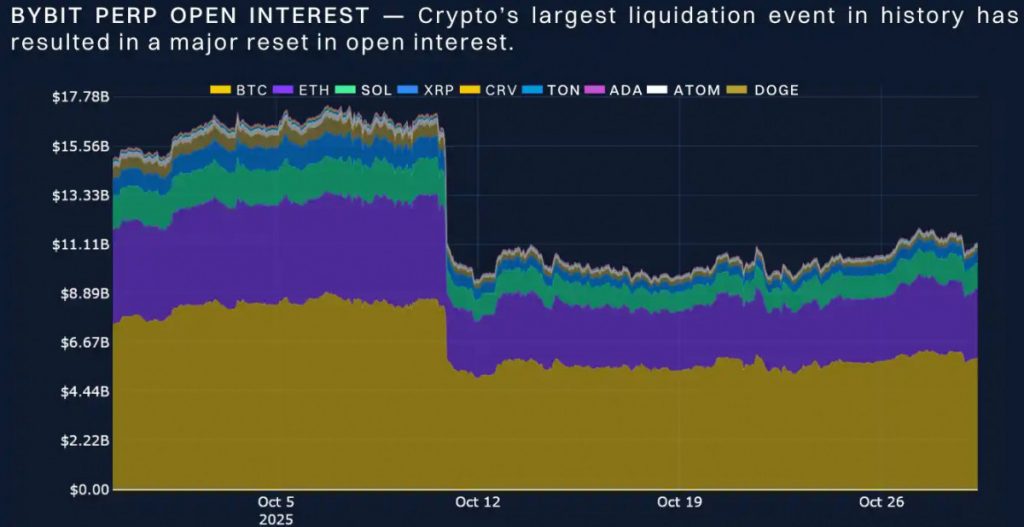
The report states that the trigger was another geopolitical incident. U.S.–China trade tensions escalated when President Trump unexpectedly announced a 100% tariff increase on Chinese goods. Within hours, massive liquidations wiped out billions in open interest, eliminating one of the largest leveraged buildups in crypto history. 

Even though the two countries later agreed on a new trade framework, the damage was already done. Bitcoin has since traded within a narrow range of $105,000 to $115,000, where it remains stubbornly confined. In a market that once thrived on momentum, such stagnation seems almost unfamiliar.

Perpetuals Stuck in Neutral

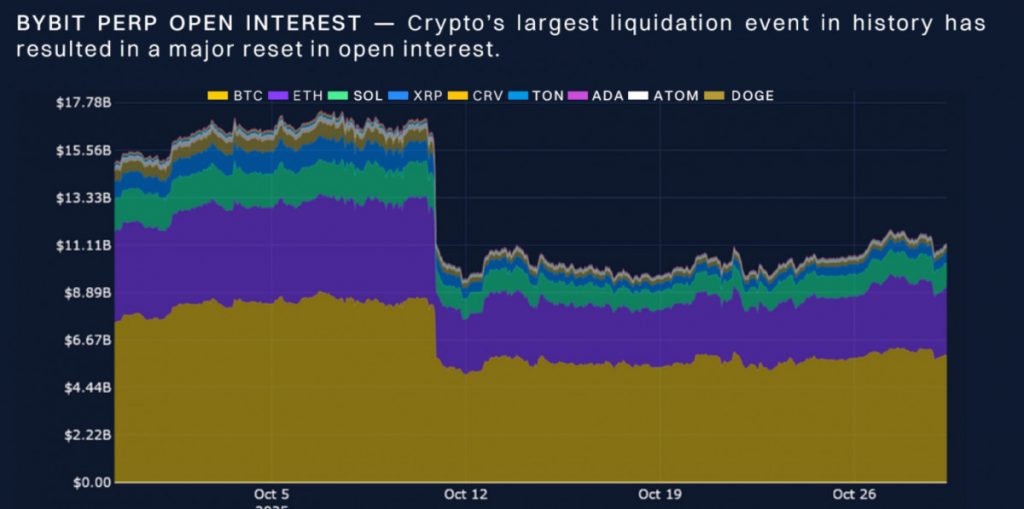
Bybit’s data indicates that perpetual futures, which are central to crypto derivatives, remain below $10 billion in notional open interest, a level not seen since early 2023. Although record highs in U.S. equities should have boosted risk appetite, the report reveals a growing disconnect between digital assets and traditional markets. 

Block Scholes and Bybit Trace Crypto’s Shift from FOMO to Fear

Traders appear hesitant to re-enter with significant positions, still affected by the rapid and large-scale decline in October. What was once a market driven by leverage now seems to be in a survival mode.

Hedging Over Hype

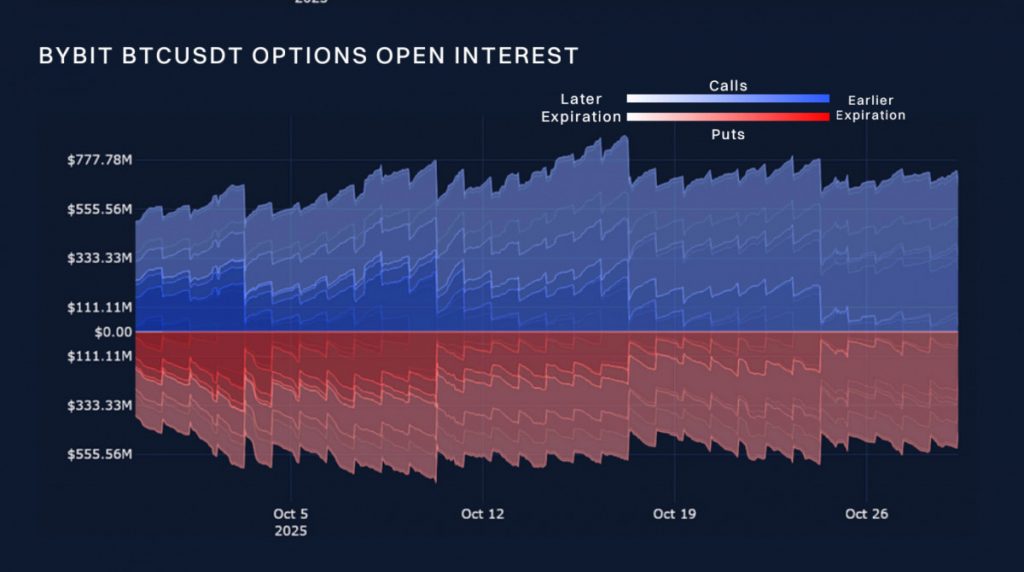
The story is actually more nuanced. Although perpetual markets have stalled, options trading presents a different picture. Bybit and Block Scholes note that Bitcoin options open interest has been steadily increasing, indicating that professional traders are adopting defensive positions rather than completely withdrawing. 

Block Scholes and Bybit Trace Crypto’s Shift from FOMO to Fear

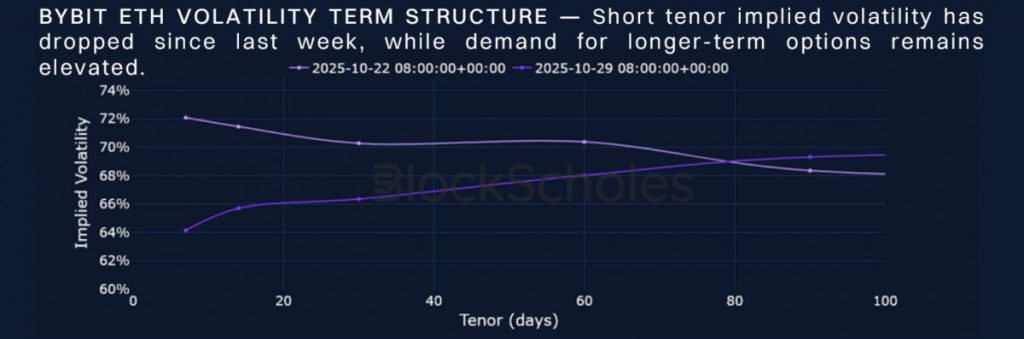
The demand for short-term puts remains strong, and at-the-money implied volatility, an important indicator of risk perception, remains high across different maturities. This subtle shift from leverage to options highlights that crypto’s most sophisticated investors aren’t leaving, but rather buying time.

That hesitation is reflected across Ethereum markets, where volatility temporarily shifted to a bullish trend before reverting to a cautious stance. Despite declining realized volatility, traders still pay premiums for insurance. 

Block Scholes and Bybit Trace Crypto’s Shift from FOMO to Fear

Block Scholes’ analysts note that the market struggles to forget October’s shock, with a collective post-traumatic reflex keeping option prices elevated even when spot markets are calm. Historically, these phases of low price movement and costly hedging have often preceded sudden large moves. The challenge is that no one can predict which direction this time will favor.

Macro Headwinds and Micro Sparks

Macro forces offer little reassurance. Federal Reserve Chair Jerome Powell’s repeated statement that future rate cuts are unlikely has subdued the cautious optimism after the October policy meeting. With manufacturing data in the U.S. and Asia weakening and Europe nearing stagnation, the long-held belief that crypto would decouple from global finance seems more myth than fact once again. When stocks hit new highs and Bitcoin remains almost static, it’s not resilience; it’s disengagement.

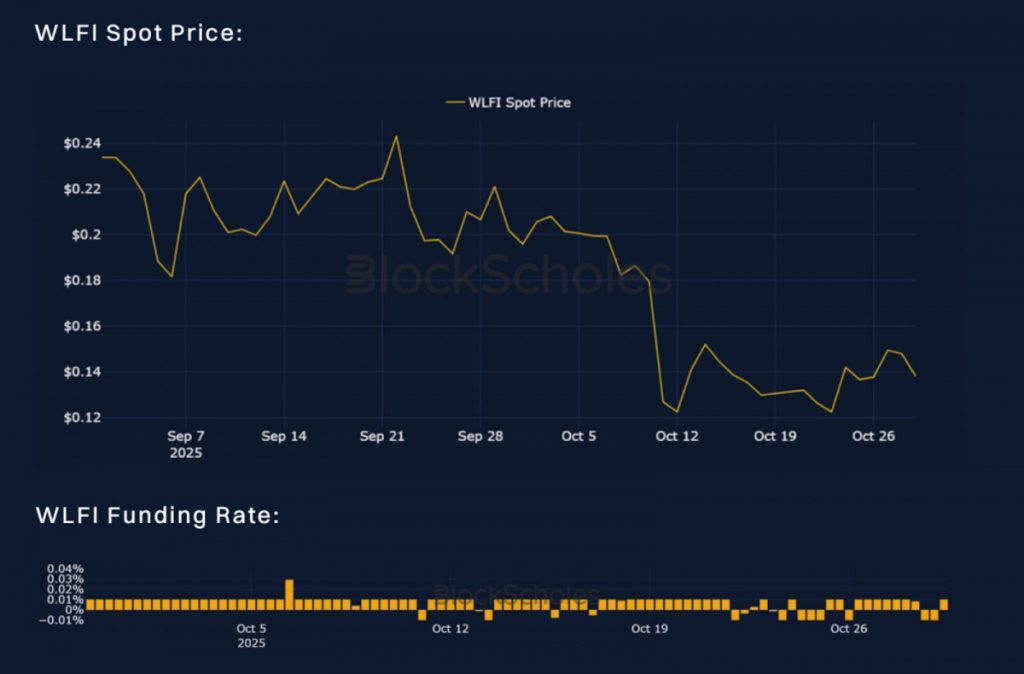
Certain areas, especially in DeFi, still show signs of activity. The World Liberty Financial protocol, a Trump-supported project with the governance token WLFI, experienced a 25% rebound in its token value after an 8.4 million-token airdrop and a buyback-and-burn vote aimed at boosting prices. This temporarily reignited speculation about politically affiliated DeFi ecosystems.

Block Scholes and Bybit Trace Crypto’s Shift from FOMO to Fear

However, even in these cases, perpetual funding rates remain volatile, indicating that traders are still hesitant to view the bear market as over. While the WLFI rally is a notable headline, it highlights how divided sentiment has become: confidence is localized rather than widespread.

Waiting for Conviction

The main insight from Bybit and Block Scholes’ analysis is that crypto no longer moves as a unified entity. The synchronized rallies of 2021 have been replaced by fragmented liquidity and a focus on defensive capital rotation. Traders now prioritize hedging over speculation and monitor macro events, such as tariffs and Fed speeches, more carefully than ever. 

This doesn’t mean optimism has disappeared. It is simply overshadowed by caution. Markets that undergo tough periods like October’s often emerge stronger and more streamlined. In derivatives, stability following deleveraging can signal growth, but only if traders regain trust that liquidity won’t disappear suddenly. The current pause might be the calm before crypto’s next major narrative shift, be it institutional inflows, monetary easing, or renewed retail speculation.

Currently, Bybit’s charts and Block Scholes’ sentiment indexes both indicate a similar situation: a market that is active yet cautious, moving but alert, awaiting the next signal. After ten years of fluctuating extremes, maybe restraint itself is the strongest bullish indicator.

Disclaimer

In line with the Trust Project guidelines, please note that the information provided on this page is not intended to be and should not be interpreted as legal, tax, investment, financial, or any other form of advice. It is important to only invest what you can afford to lose and to seek independent financial advice if you have any doubts. For further information, we suggest referring to the terms and conditions as well as the help and support pages provided by the issuer or advertiser. MetaversePost is committed to accurate, unbiased reporting, but market conditions are subject to change without notice.

About The Author


Victoria is a writer on a variety of technology topics including Web3.0, AI and cryptocurrencies. Her extensive experience allows her to write insightful articles for the wider audience.

More articles


Victoria d’Este


Victoria is a writer on a variety of technology topics including Web3.0, AI and cryptocurrencies. Her extensive experience allows her to write insightful articles for the wider audience.


Source link

Popular Posts

My Favorites

Pokémon Go Eevee Community Day Classic guide

Pokémon Go is having an Eevee Community Day Classic event on both July 5 and 6 from 2-5 p.m. in your local time.As...