Published: December 19, 2025 at 9:03 am Updated: December 19, 2025 at 9:03 am
To improve your local-language experience, sometimes we employ an auto-translation plugin. Please note auto-translation may not be accurate, so read original article for precise information.
Dubai, United Arab Emirates, December 19th, 2025, Chainwire
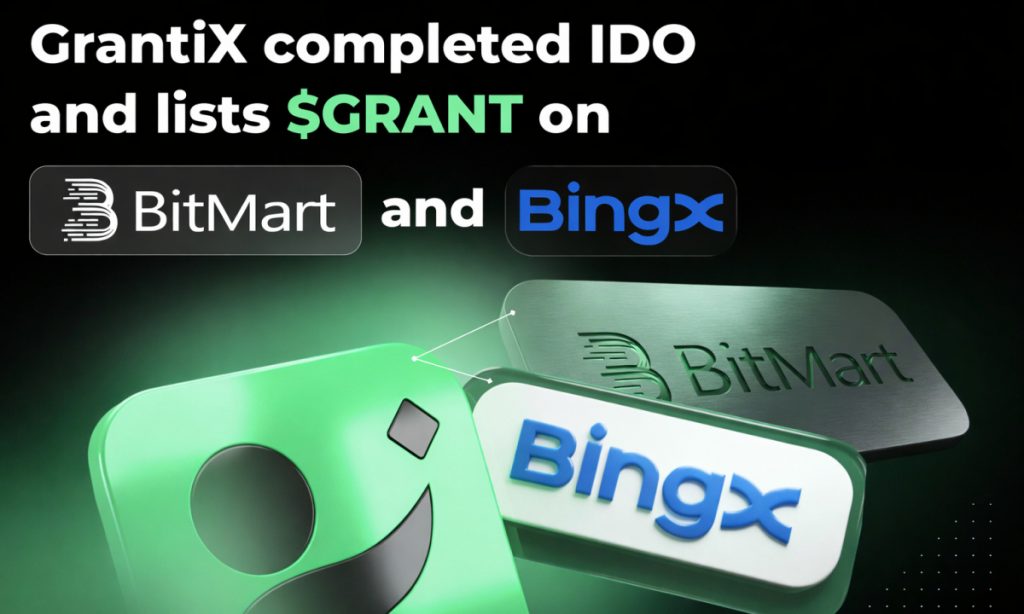
GrantiX, an AI-powered SocialFi platform bringing impact investing on-chain, today announced the launch of its $GRANT token following a Token Generation Event and multiple sold-out IDOs. The token is now live and listed on BitMart and BingX, expanding global access to the GrantiX ecosystem.
$GRANT serves as the utility and governance token for GrantiX, which connects blockchain donors with verified social entrepreneurs through an audited platform. The TGE follows successful IDOs on Finceptor and Spores Network, alongside additional offerings on Red Kite and Huostarter.
“$GRANT is not a speculative launch, it is the activation of an ecosystem that is already operating, audited, and delivering measurable impact,” said Dr. Konstantin Livshits, founder of GrantiX. “This milestone aligns our community around a shared mission to make impact investing transparent, efficient, and scalable.”
Built on Arbitrum and designed to be multi-chain, GrantiX integrates directly into high-volume DeFi protocols, enabling optional micro-donations to be embedded into everyday transactions. Alongside with real-world revenue streams, a single Web3 partner processing more than 100 million transactions per week can route user opt-in donations to verified impact projects, with GrantiX earning a 2% fee for distribution, verification, and on-chain transparency. Even modest participation at this scale creates recurring, sustainable effect.
The global impact economy represents a $1.57 trillion market that remains largely offline and opaque. As financial activity increasingly moves on-chain, GrantiX aims to bring this capital into Web3 by embedding impact directly into transactions, turning donations into programmable infrastructure rather than a separate product.
Since launching its MVP, GrantiX has processed more than 20,000 donations totaling over $250,000, distributed more than $80,000 in grants to verified social entrepreneurs, and onboarded more than 18,000 users organically. The project has raised more than $1.75m in angel funding and public rounds, and all smart contracts have been audited by CertiK ahead of the mainnet rollout.
“The demand we saw across our IDOs reflects growing interest in Web3 projects with real-world utility and sustainable economics, rather than hype-driven meme coins” said Anton Yanushkevich, CEO of GrantiX. “By combining AI-driven evaluation with on-chain transparency, we are building an impact layer for Web3 where doing good is embedded directly into financial infrastructure – we believe, that the future of impact is on-chain.”
$GRANT is now live. Users can join the launch by trading $GRANT on BingX and BitMart and become part of the on-chain impact economy:
BingX: https://bingx.com/en/spot/GRANTUSDT
BitMart: https://www.bitmart.com/trade/GRANT_USDT
About GrantiX
GrantiX is a sustainable, multi-chain impact platform connecting donors, social entrepreneurs, and investors on-chain. Through its AI-powered Web3 ecosystem, GrantiX brings transparency and efficiency to global impact investing. Its audited model combines DeFi, SocialFi, and DAO governance tools to fund and verify real-world charitable projects. Founded by Dr. Konstantin Livshits and Anton Yanushkevich, GrantiX’s mission is to make doing good a scalable, rewarding part of Web3 utility.
LinkedIn
Telegram
Discord
Contact
CEOAnton YanushkevichGrantiX[email protected]
Disclaimer
In line with the Trust Project guidelines, please note that the information provided on this page is not intended to be and should not be interpreted as legal, tax, investment, financial, or any other form of advice. It is important to only invest what you can afford to lose and to seek independent financial advice if you have any doubts. For further information, we suggest referring to the terms and conditions as well as the help and support pages provided by the issuer or advertiser. MetaversePost is committed to accurate, unbiased reporting, but market conditions are subject to change without notice.
About The Author
Chainwire is the top blockchain and cryptocurrency newswire, distributing press releases, and maximizing crypto news coverage.
More articles
Chainwire is the top blockchain and cryptocurrency newswire, distributing press releases, and maximizing crypto news coverage.
Published: December 19, 2025 at 9:00 am Updated: December 19, 2025 at 9:07 am
by Ana
Edited and fact-checked:
December 19, 2025 at 9:00 am
To improve your local-language experience, sometimes we employ an auto-translation plugin. Please note auto-translation may not be accurate, so read original article for precise information.
In Brief
Crypto firms are accelerating mainstream adoption in late 2025 by expanding into education, payments, sports, and regulated finance through partnerships, integrations, and high-profile cultural deals.
The third week of December saw crypto firms deepen their reach across education, payments, sports, and regulated finance. From exchange-led university programs to payment integrations and high-profile cultural partnerships, these deals highlight how crypto companies are positioning for mainstream adoption heading into 2025.
Bitget Expands Blockchain Education With ETH Zurich Partnership
Bitget has entered a year-long partnership with the Google Developer Group on Campus (GDGoC) at ETH Zurich as part of its Blockchain4Youth education initiative. The collaboration focuses on student-led programs designed to provide practical exposure to blockchain and Web3 technologies, including hackathons, workshops, and applied learning sessions hosted throughout the year.
GDGoC works as a worldwide network of developer communities based on universities, having over 1,260 chapters globally. The chapter of ETH Zurich, initiated in 2020, acts as a student-managed center for the developers, researchers, and designers, and it is a regular host of technical talks, study jams, hack nights, and networking events. The ETH Zurich University is considered one of the best science and engineering institutions in Europe.
As per the agreement, Bitget is going to share its views on the industry through participating in discussions, practical sessions, and workshops focused on the market. Also, students will get a chance to look into Bitget’s Graduate Program, which is being advertised as a gate to blockchain and digital asset careers. The leading figure at Bitget has indicated that the partnership is based on long-term connection with developer communities and has reasserted that education is the key to handling the technicalities of the very fast-changing Web3 world.
From GDGoC ETH Zurich’s perspective, the partnership is positioned as more than a sponsorship. Student organizers have highlighted the value of moving beyond theory toward real-world applications, particularly in areas such as blockchain infrastructure and applied development. The collaboration builds on Bitget’s earlier involvement with GDG-led events across Europe, including AI-focused hackathons and DevFest initiatives, reinforcing its broader push into academic developer ecosystems.
Coinbase Partners With PPRO to Launch BLIK Payments in Poland
Coinbase has partnered with local payments platform PPRO to integrate BLIK payments into its platform, enabling users in Poland to purchase cryptocurrencies using Polish złoty (PLN). BLIK is the country’s most widely used mobile payment method, with around 20 million active users, and the integration marks Coinbase’s first PLN-based onramp in the market.
The move aligns with Coinbase’s broader European strategy to simplify crypto access through familiar local payment rails. With BLIK embedded directly into the Coinbase app, users can complete purchases with a few taps, reducing friction for first-time buyers. The timing is notable, as recent Chainalysis research pointed to a 51% increase in crypto adoption in Poland, driven by grassroots usage and remittance activity.
Coinbase’s EU growth leadership has described the rollout as part of ongoing efforts to strengthen onramping infrastructure across Europe, linking improved payment access to the company’s wider mission of expanding economic participation. From PPRO’s side, the partnership is positioned as a way to help global platforms connect more effectively with local consumer preferences, particularly in high-growth markets.
Incorporating BLIK into the mix, Coinbase gets a chance to tap a well-rooted local payment network, and at the same time Polish customers enjoy the comfort of a very much localized crypto purchasing process. This collaboration is in line with the overall industry tendency of making regionally-specific payment methods available as exchanges fight for their users based on ease of use not only on asset availability.
Nexo Becomes Official Crypto Partner of the Australian Open
Nexo has cemented a multi-year global partnership contract with Tennis Australia and has been named the Official Crypto Partner for both the Australian Open and the wider Summer of Tennis series. The arrangement covers significant events like the United Cup and several ATP and WTA tournaments, which is a remarkable milestone since it is the first time a digital asset company has collaborated with a Grand Slam.
At the Australian Open, Nexo’s branding will feature prominently through the “Nexo Coaches Pod,” appearing across key arenas including Rod Laver Arena and Margaret Court Arena. The activation is designed to highlight strategy, decision-making, and teamwork—concepts Nexo aligns with its positioning around disciplined, long-term digital wealth management.
Nexo’s co-founder has framed the partnership around shared values of performance and ambition, describing elite sport as a natural environment to showcase “intelligent digital tools” to a global audience. Tennis Australia’s commercial leadership, meanwhile, has emphasized innovation and next-generation thinking as reasons for selecting Nexo as its inaugural crypto partner.
The deal builds on Nexo’s expanding footprint in professional tennis, following recent partnerships with the DP World Tour and several international tournaments. Taken together, these agreements signal a continued push by crypto firms into premium global sports properties, using mainstream visibility to reinforce brand legitimacy and long-term positioning rather than short-term promotional campaigns.
Klarna Explores Crypto Wallet Infrastructure With Privy
Klarna has announced a collaboration with wallet infrastructure provider Privy to research and design potential crypto wallet solutions for Klarna users. The initiative follows the recent launch of KlarnaUSD, the company’s in-house stablecoin, and reflects a broader exploration of how crypto products could be integrated into Klarna’s existing financial ecosystem.
According to Klarna’s leadership, the company sees itself as well positioned to introduce crypto to “normal people,” not just early adopters, given its role in everyday spending and payments. The focus of the partnership is on building crypto experiences that feel intuitive and familiar, rather than standalone or technically complex products.
Privy brings experience supporting more than 100 million accounts across 1,500 developers, including crypto-native platforms. Its infrastructure handles large-scale crypto and stablecoin movements, making it suitable for enterprise-grade deployments. Privy’s leadership has positioned the partnership as part of its goal to act as backend infrastructure for fintechs entering crypto.
The announcement also referenced industry estimates suggesting hundreds of millions of global crypto holders, with transaction activity continuing to grow annually. KlarnaUSD, launched on the Tempo blockchain developed by Stripe and Paradigm, marked a notable shift for Klarna’s CEO, who had previously expressed skepticism toward crypto. The partnership with Privy suggests Klarna is now evaluating crypto infrastructure as a long-term component of mainstream payments.
KuCoin and Tomorrowland Announce Multi-Year Festival Partnership
KuCoin has entered a multi-year strategic partnership with Tomorrowland, becoming the exclusive cryptocurrency exchange and payment partner for the festival from 2026 through 2028. The agreement covers both Tomorrowland Belgium and Tomorrowland Winter, positioning KuCoin at the center of one of the world’s most recognizable electronic music brands.
Both organizations have highlighted a shared “One World” philosophy focused on inclusivity and borderless participation. Tomorrowland brings together attendees from more than 200 countries, while KuCoin, launched in 2017 as “the People’s Exchange,” now serves over 40 million users globally. KuCoin’s CEO has linked the partnership to the exchange’s original mission of enabling accessible and efficient value movement.
Under the agreement, KuCoin will support crypto-based payments across ticketing, merchandise, food and beverage, and VIP services. The companies have emphasized that the technology will remain intuitive, aiming to keep the user experience seamless for festivalgoers unfamiliar with crypto.
The announcement comes right after KuCoin Got the green light under the EU’s MiCA framework through the Austrian Financial Market Authority, which permits regulated activities throughout the EEA. This regulatory milestone greatly increases the likelihood of KuCoin getting partnerships with prominent global brands. To a larger extent, the partnership indicates a trend where crypto exchanges are inclined to have long-term cultural partnerships as part of their strategies for gaining mainstream adoption.
ENI Expands Into Japan Through NTT Digital and BitTrade Partnerships
ENI has announced two strategic partnerships in Japan with NTT Digital and BitTrade, marking a significant step in its global expansion into one of the world’s most compliance-driven markets. The collaborations anchor ENI’s presence across both enterprise infrastructure and regulated financial access.
NTT Digital, a subsidiary of telecom giant NTT Group, will act as ENI’s enterprise infrastructure partner. NTT is Japan’s largest IT services provider and plays a central role in shaping national technology standards. Through the partnership, ENI’s blockchain infrastructure will support enterprise-grade Web3 solutions delivered to Japanese corporations across sectors such as finance, commerce, and supply chain management.
Complementing this, ENI has partnered with BitTrade, one of Japan’s few fully licensed crypto asset exchanges. BitTrade holds both a Crypto Asset Exchange License and a Type I Financial Instruments Business License, placing it in the same regulatory category as major securities firms. This relationship provides ENI with a high-trust compliance gateway for blockchain deployment.
Together, the partnerships create a localized adoption loop combining infrastructure, enterprise deployment, and regulatory access. ENI has positioned Japan as a blueprint market, with the goal of replicating the model across other highly regulated regions including Korea, Southeast Asia, and Europe.
Amina Bank Expands Ripple Partnership for Cross-Border Payments
Swiss crypto bank Amina has expanded its partnership with Ripple by adopting Ripple Payments as its cross-border settlement solution. The move builds on an earlier integration of Ripple’s stablecoin, RLUSD, which Amina added in July as part of its digital asset offering.
According to Amina, the Ripple Payments solution allows businesses to move funds without relying on traditional correspondent banking infrastructure, improving transaction speed, cost efficiency, and transparency. Ripple has described Amina as the first European bank to adopt its licensed end-to-end payments solution, noting that the network covers more than 90% of daily FX markets and processes over $95 billion in volume.
The announcement follows growing momentum around RLUSD, which saw a reported increase in activity after its integration with Amina. Ripple, founded in 2012, has continued to expand its institutional footprint, recently acquiring London-based custody provider Palisade after a major funding round.
Amina has also strengthened its regulatory standing, securing a crypto-asset service provider licence under the EU’s MiCA framework through its Austrian subsidiary. The expanded Ripple partnership positions Amina to offer regulated, blockchain-based cross-border payments at a time when European banks are increasingly exploring alternatives to traditional settlement systems.
Disclaimer
In line with the Trust Project guidelines, please note that the information provided on this page is not intended to be and should not be interpreted as legal, tax, investment, financial, or any other form of advice. It is important to only invest what you can afford to lose and to seek independent financial advice if you have any doubts. For further information, we suggest referring to the terms and conditions as well as the help and support pages provided by the issuer or advertiser. MetaversePost is committed to accurate, unbiased reporting, but market conditions are subject to change without notice.
About The Author
Alisa, a dedicated journalist at the MPost, specializes in cryptocurrency, zero-knowledge proofs, investments, and the expansive realm of Web3. With a keen eye for emerging trends and technologies, she delivers comprehensive coverage to inform and engage readers in the ever-evolving landscape of digital finance.
More articles
Alisa, a dedicated journalist at the MPost, specializes in cryptocurrency, zero-knowledge proofs, investments, and the expansive realm of Web3. With a keen eye for emerging trends and technologies, she delivers comprehensive coverage to inform and engage readers in the ever-evolving landscape of digital finance.
Published: December 19, 2025 at 8:22 am Updated: December 19, 2025 at 8:22 am
by Ana
Edited and fact-checked:
December 19, 2025 at 8:22 am
To improve your local-language experience, sometimes we employ an auto-translation plugin. Please note auto-translation may not be accurate, so read original article for precise information.
In Brief
Aptos proposed AIP-137 to add optional post-quantum SLH-DSA signatures at the account level, addressing long-term quantum computing risks without affecting existing accounts.
Layer 1 blockchain Aptos has introduced the post-quantum signature upgrade AIP-137, designed to optionally enable account-level support for post-quantum digital signatures, addressing potential future risks from quantum computing.
The proposal does not affect existing accounts and intends to implement the hash-based signature scheme SLH-DSA, which is standardized under FIPS 205. AIP-137 suggests SLH-DSA-SHA2-128s2 as the initial post-quantum signature option for Aptos accounts, a scheme recently recognized by NIST as post-quantum secure, relying solely on the SHA2-256 hash function for both classical and quantum security.
It takes a conservative approach to prepare for the emergence of cryptographically relevant quantum computers (CRQCs), which could appear within the next five to fifty years. Its focus prioritizes security over efficiency, while keeping integration complexity low. SLH-DSA is considered ideal because it depends exclusively on hash functions, already trusted in the Aptos ecosystem, in contrast to more complex post-quantum schemes that require additional classical safeguards and increase implementation complexity.
If adopted, this upgrade would require full nodes, validators, indexers, wallets, and Aptos SDKs and CLI tools to support creating, managing, and verifying these new signatures. Conversely, rejecting the proposal could leave the ecosystem vulnerable to unforeseen technological threats, while approval allows governance to activate post-quantum accounts as needed, enabling users to migrate at their discretion.
While alternative post-quantum signature schemes may offer smaller signature sizes and faster verification times, the SLH-DSA family standardized in FIPS-2052 is considered the most conservative from a security perspective, as it depends solely on the already-established security of SHA2-256. This makes it a reliable choice to guard against potential classical attacks on schemes that are assumed to be post-quantum secure, as seen in the past when candidate schemes like Rainbow, based on multivariate cryptography, were broken on standard hardware despite being NIST finalists. SLH-DSA is therefore appealing to blockchain users who prioritize maximum caution and wish to avoid relying on untested assumptions or aggressive parameter settings of more efficient but less established post-quantum schemes.
Looking ahead, Aptos could also consider supporting a scheme from the ML-DSA family (FIPS-2045), which offers roughly half the combined public key and signature size of SLH-DSA and faster verification times, outperforming Ed25519. However, its security relies on the module learning with errors (MLWE) problem, which is less conservative. Another option, Falcon, features a combined public key and signature size of approximately 1.5 KiB with verification speeds comparable to or faster than Ed25519. Its drawbacks include reliance on floating-point arithmetic, which increases implementation complexity, and security assumptions based on the hardness of SIS over NTRU lattices, making it a less conservative alternative.
Outlining Post-Quantum Signature Timeline With Preliminary Devnet Deployment Planned For Early Next Year
One scenario is that a CRQC does not emerge within the next five years, yet a significant number of Aptos users adopt the SLH-DSA scheme. This could temporarily reduce network efficiency, though the impact is manageable: more efficient post-quantum schemes can be introduced and gas costs for SLH-DSA adjusted to encourage user migration. Alternatively, if a CRQC appears sooner than anticipated, users will either already be using the post-quantum scheme or can transition quickly once the threat becomes evident. Overall, the proposal offers the potential benefit of safeguarding the network against technological surprises, with a relatively low risk of negatively affecting performance if faster post-quantum options are introduced promptly.
The suggested implementation includes adding support in the aptos-crypto crate, integrating feature-gated signature verification logic in the Aptos VM, updating the TypeScript SDK to derive keys from mnemonics, adjusting gas pricing, enabling CLI key management, providing indexer support, and publishing developer documentation. While there is no immediate urgency to deploy on main networks within the next year, a preliminary devnet deployment is targeted for early next year to allow testing and gradual adoption.
Disclaimer
In line with the Trust Project guidelines, please note that the information provided on this page is not intended to be and should not be interpreted as legal, tax, investment, financial, or any other form of advice. It is important to only invest what you can afford to lose and to seek independent financial advice if you have any doubts. For further information, we suggest referring to the terms and conditions as well as the help and support pages provided by the issuer or advertiser. MetaversePost is committed to accurate, unbiased reporting, but market conditions are subject to change without notice.
About The Author
Alisa, a dedicated journalist at the MPost, specializes in cryptocurrency, zero-knowledge proofs, investments, and the expansive realm of Web3. With a keen eye for emerging trends and technologies, she delivers comprehensive coverage to inform and engage readers in the ever-evolving landscape of digital finance.
More articles
Alisa, a dedicated journalist at the MPost, specializes in cryptocurrency, zero-knowledge proofs, investments, and the expansive realm of Web3. With a keen eye for emerging trends and technologies, she delivers comprehensive coverage to inform and engage readers in the ever-evolving landscape of digital finance.
While much of the NFT market struggled in 2025, the Tezos art ecosystem delivered one of its strongest years to date. More than 500,000 NFTs were sold as museums, artists, and institutions continued to build on Tezos.
Key Takeaways
Over 500,000 NFTs were sold across the Tezos art ecosystem in 2025
Museum partnerships introduced blockchain art to more than 243,000 visitors
Global art events reinforced Tezos’ cultural credibility
Education programs focused on long-term artist onboarding
Institutional acquisitions and artist sales signaled resilience
Museum Partnerships Anchored Institutional Adoption
More than 243,000 visitors encountered blockchain-based art through the expanded partnership between the Tezos Foundation and the Museum of the Moving Image (MoMI). Since the first exhibition launched in June 2024, MoMI’s Herbert S. Schlosser Media Wall has served as a visible entry point for on-chain artwork.
In 2025, the collaboration expanded into a year-long program commissioning 12 artists. Each artist used FA2 smart contracts as part of their creative process. MoMI also introduced a free minting station, allowing visitors to create wallets and mint NFTs for the first time.
The partnership also launched the FA2 Fellowship to support artists and developers working with Tezos smart contracts. Designed as both an educational and practical initiative, the Fellowship provides structured training on FA2 contracts to integrate blockchain fluency into artistic workflows. The program runs through January 2027.
“Contingent” by James Bloom and Gottfried Jäger.
Global Art Events Strengthened Cultural Presence
Art on Tezos maintained a strong presence at major international art events. At NFT Paris, digital art pioneer Kiki Picasso performed a live demonstration using an original 1980s Quantel Paintbox, a historic tool used in early digital art and the MTV logo.
The “Paintboxed – Tezos World Tour” extended that moment across New York, Miami, Paris, and Basel during Art Basel. Thousands experienced digital art history alongside contemporary blockchain-native works.
The largest activation was Art on Tezos Berlin, a three-day festival that drew over 700 international attendees. The event wove together the legacy of generative art with cutting-edge innovation in AI and interactive formats, bridging traditional creative disciplines with emerging technologies.
These global activations also served as powerful onboarding moments. Tens of thousands of visitors engaged with Tezos-powered exhibitions, many of whom minted their first digital artwork through hands-on experiences.
At Paris Photo, Artverse curated a booth featuring Niceaunties, Grant Yun, Reuben Wu, Shavonne Wong, Emi Kusano, and Genesis Kai. Several released work on Tezos for the first time, with sales handled via objkt one.
Education and Sales Marked Market Resilience
Education remained a core focus, acting as a bridge between emerging creators and blockchain tools. In August, the Tezos Foundation partnered with the Processing Foundation to produce a global tutorial series for p5.js 2.0, expanding access to creative coding education.
Institutional confidence was reflected in several sales and acquisitions. The Francisco Carolinum acquired TeleNFT works first shown at Art on Tezos Berlin.
Artist qubibi’s hello world, a live-coded generative work created and manipulated in real time through code, sold for 62,000 tez—highlighting how new forms of procedural creativity are gaining collector interest. Earlier, Mario Klingemann’s AI-generated music video Triggernometry sold for 43,000 tez during the Digital Art Mile.
As 2025 closes, Tezos stands out for delivering measurable progress during a difficult year for NFTs—anchored not in speculation, but in education, institutional engagement, and pioneering artistic expression.
A new study indicates that the risk of chain-reaction collisions in Low Earth Orbit (LEO) is steadily increasing. The resulting Kessler Syndrome could instantaneously sever our access to space.
While Elon Musk’s Starlink expands its satellite network in LEO, rival ventures are beginning to launch their own constellations. This massive, ever-growing satellite grid surrounding Earth may be paving the way for seamless global wireless internet, but it is also making LEO increasingly crowded and “polluted.” Although companies like Starlink claim these networks can be managed safely through advanced automation, continuous maneuverability, and collision avoidance algorithms, a new study by Sarah Thiele and her colleagues at Princeton University presents a serious challenge to this optimistic outlook. Researchers compare the current satellite ecosystem to a house of cards ready to collapse from a single blow.
The research is based on striking figures. When all satellites in LEO are considered, “conjunctions“—instances where two satellites pass within 1 kilometer of each other—occur on average every 22 seconds. Looking at Starlink satellites alone, such a close encounter happens approximately every 11 minutes. Every satellite in the Starlink fleet must perform an average of 41 maneuvers per year to avoid collision risks. At first glance, this might seem like a well-engineered system working flawlessly. However, in the world of engineering, real problems usually emerge in rare but high-impact edge cases.
A Severe Solar Storm Could Close the Gates of Space to Earth
According to the study, one of the most dangerous of these edge cases is solar storms. Solar storms affect satellites in two fundamental ways. First, they heat the upper layers of Earth’s atmosphere, increasing atmospheric drag. This leads to unexpected orbital deviations, positional uncertainty, and increased fuel consumption. For instance, during the Gannon Storm in May 2024, more than half of the satellites in LEO had to perform extra maneuvers just to maintain their positions and avoid collisions.
The second effect could be far more devastating. Powerful solar storms have the potential to directly disable satellite communication and navigation systems. In such a scenario, even if a satellite detects an approaching threat, it may become unable to perform an avoidance maneuver. When increased drag, positional uncertainty, and loss of control converge, the door opens for chain-reaction collisions. This brings to mind the scenario known as the Kessler Syndrome.
Based on studies conducted at NASA in 1978 by Donald J. Kessler and Burton Cour-Palais, the Kessler Syndrome describes a scenario where every new collision in orbit produces more debris, leading to subsequent collisions. In this disaster scenario, dense clouds of debris inevitably destroy every newly launched vehicle, rendering space unusable for decades. Pointing out that the Kessler Syndrome is a long-term consequence, researchers introduced a new concept to measure a more immediate threat: the CRASH Clock (Collision Risk and Safety Health).
Reminiscent of the Doomsday Clock that emphasizes the potential for nuclear catastrophe, the CRASH Clock indicates the probability of a collision occurring and causing serious damage in LEO. This metric aims to calculate how long it would take for the first major and destructive collision to occur if satellite operators were unable to send commands for avoidance maneuvers. According to the research, this duration was approximately 218 days in 2018. By June 2025, this time has dropped to just 2.8 days. With every satellite launched, the time on the CRASH Clock decreases further. At the point we have reached today, the probability of a destructive collision reaches 30 percent if loss of control lasts for just 24 hours. Such a collision could be the trigger for the Kessler Syndrome.
The Famous Solar Storm of 1859 Stands as a Striking Example
Another dimension of the problem is the unpredictability of solar storms. Such events can generally be predicted at most one or two days in advance; furthermore, what can be done when they occur is quite limited. However, researchers argue that continuous, real-time control is essential for maintaining safety in such a dynamic orbital environment. If this chain of control breaks, the house of cards holding the system up could collapse very rapidly.
This disaster scenario highlighted by Sarah Thiele and her team is not based solely on theoretical dangers. It is known that solar flares of this magnitude have occurred in the past. The Gannon Storm of 2024 was one of the most powerful solar events in recent decades. However, history offers a much more devastating example: the Carrington Event of 1859. Researchers state that if a solar storm of similar intensity were to occur today, we could lose control of satellites for much longer than three days. This could mean humanity loses its access to space entirely, perhaps for decades.
There is a delicate balance between the technical capabilities offered by LEO satellite networks and the long-term risks. Researchers argue that this balance can only be established through a realistic assessment of risks. While a single powerful solar storm has the potential to confine humanity to Earth for generations, ignoring these risks does not seem rational. This study deserves to be taken seriously for exactly this reason.
Snoop Dogg is back with his latest NFT drop, known informally as Snoop Mint, which arrives at a moment when most artists have gone quiet. NFT volumes are way down. Speculation has cooled. Many projects have faded. Yet Snoop Dogg is leaning in, not pulling back.
This $1 NFT, released for his 54th birthday, shows that digital collectibles can still be important even after the hype has faded. Snoop is focusing on access, culture, and real-life experiences instead of rare items or flashy graphics. This move hints at the future direction of NFTs.
What Is Snoop Mint?
Snoop Mint is a limited-edition release on Stuff.io, a decentralized media marketplace built focused on creator ownership and fan participation.
For $1, buyers receive:
A digital hip-hop trading card featuring Snoop Dogg.
A behind-the-scenes video showing Snoop signing physical artwork.
Automatic entry into a raffle for real-world prizes.
The drop kicked off on December 19 and is live until December 22, giving fans a limited window to jump in and be part of the action.
Why a $1 NFT Matters During NFT Winter
The NFT market hasn’t vanished, but it is starting to look a lot different. Weekly sales hover far below peak levels of early 2022 with many collectors avoiding high mint prices.
Snoop Dogg understands this shift.
A $1 entry opens the doors to fans who’ve never owned a token before and discourages pure speculation. Nobody buys this expecting instant resale profit, they buy it for participation.
That approach is similar to Snoop’s July 2025 Telegram digital collectibles drop, where nearly one million NFTs sold out in 30 minutes and generated roughly $12 million in volume, where price accessibility played a huge role.
What Holders Actually Receive
Snoop Mint is changing the NFT playbook. There’s no rarity ladder or trait spreadsheet. Instead, value comes from connection.
Each holder gets:
A digital baseball card-style collectible inspired by hip-hop culture.
A short video showing Snoop signing the physical artwork linked to the drop.
Raffle eligibility for in-person rewards.
The media format matters. Stuff.io sees NFTs as media tokens, not static images. Owners hold digital content with resale capability while creators receive compensation.
Inside the Raffle: Physical Art and Real Experiences
The raffle is at the heart of what makes Snoop Mint special.
Three winners receive:
A hand-signed, framed physical artwork featuring a preserved roach smoked by Snoop.
A private tour of Snoop Dogg’s Los Angeles compound.
A $500 shopping spree at Snoopy’s Clothing Store.
A $1,000 travel credit to cover accommodations.
Winners must collect their prizes in person. This filters out bots and adds authenticity.
Reviving NFTs Through Tangible Perks
NFTs initially gained attention because they promised ownership. They lost momentum when ownership ceased to mean anything beyond resale.
Snoop Mint brings ownership back to earth.
Physical art, travel credits, and face-to-face experiences give NFTs weight again. These perks can’t be copied, forked, or scraped.
Artists across music and sports have tried similar hybrids, but few execute them at scale. Snoop’s massive cultural influence makes this model visible and repeatable.
Why Stuff.io Changes the Conversation
Choosing Stuff.io over traditional NFT marketplaces sends a clear signal.
Stuff.io focuses on:
Snoop Dogg joined Stuff.io as an advisor and investor in September 2025. This drop reflects that alignment.
Earlier NFT eras centered on art drops and profile pictures. Snoop Mint shifts that focus to NFTs as containers for music, video, memorabilia, and experiences.
Snoop Dogg’s Track Record in Web3
This drop didn’t come out of nowhere.
Snoop Dogg has long been one of the most active artists in the crypto space.
Sold music for Bitcoin in 2013.
Launched A Journey with the Dogg on OpenSea in 2021.
Built the Snoopverse inside The Sandbox.
Released Death Row Records Stashbox NFTs that generated $44 million.
Created Doggies NFT avatars that crossed $4.6 million in sales.
Sold nearly one million Telegram digital collectibles in 2025.
Across these projects, a pattern stands out. Snoop adapts faster than most artists, but he never abandons his audience.
How This Drop Fits the Current NFT Market
NFT winter has forced creators to rethink value.
Communities expect something tangible and speculation alone no longer works. Platforms must support creators rather than drain them through fees.
Snoop has openly said downturns clean up the space. They push out copycats and reward long-term thinking.
This drop prioritizes participation over profit and longevity over headlines.
Who Snoop Mint Is For
This NFT isn’t aimed at day traders.
It makes sense for:
Longtime Snoop Dogg fans.
Collectors who value memorabilia.
People curious about NFTs without risking much.
Fans who care about access rather than charts.
Anyone chasing instant flips will miss the point.
Final Thoughts: A Blueprint, Not a Stunt
Snoop Mint doesn’t try to resurrect the hype cycle.
By pairing a $1 price with physical art, real-world experiences, and a fan-first platform, Snoop Dogg shows what NFTs can look like after the speculation hype fades.
This drop feels less like a gamble and more like a test run for sustainable digital culture. If other artists pay attention, NFTs might finally grow into what they promised years ago.
Sometimes progress doesn’t come from louder launches. It comes from simpler ones done right.
Frequently Asked Questions
Here are some frequently asked questions about this topic:
What is Snoop Mint?
Snoop Mint is a limited-edition NFT drop by Snoop Dogg released on Stuff.io for $1. Each NFT includes a digital collectible, video content, and raffle entry for real-world prizes.
When did Snoop Dogg’s NFT drop launch?
The Snoop Mint NFT launched on December 19, 2025, and runs through December 22, 2025, or while supplies last.
Where can I buy Snoop Dogg’s NFT?
The NFT is available exclusively on Stuff.io through the official Snoop Mint page.
What do you get when you buy the Snoop Mint NFT?
Buyers receive a digital hip-hop trading card, behind-the-scenes video footage, and automatic entry into a raffle for physical art and in-person experiences.
Why is Snoop Dogg selling an NFT for $1?
The $1 price lowers barriers for fans and discourages speculation. Snoop has said NFT winter favors meaningful participation over hype-driven pricing.
What are the raffle prizes for Snoop Mint?
Prizes include signed physical artwork, a private tour of Snoop Dogg’s Los Angeles compound, a $500 clothing store credit, and a $1,000 travel allowance.
Is Snoop Dogg experienced with NFTs and crypto?
Yes. Snoop Dogg has been active in crypto since 2013 and has launched multiple successful NFT projects, including Snoopverse, Death Row NFTs, and a 2025 Telegram drop.
Why did Snoop Dogg choose Stuff.io for this drop?
Stuff.io focuses on creator-owned media and fan-first experiences, aligning with Snoop’s shift away from speculative NFT art and toward utility-based digital ownership.
Bitwise filed a Form S-1 with the U.S. Securities and Exchange Commission for a Bitwise Sui ETF on December 18, 2025.
The proposed ETF aims to track the price of Sui via the Sui benchmark reference rate, less fees and expenses.
Coinbase will provide the custody service for the new exchange-traded product (ETF).
Bitwise, a crypto index fund manager, submitted a Form S-1 to the U.S. Securities and Exchange Commission (SEC) on Thursday for a Sui-based exchange-traded product (ETF).
As per the filing, the Bitwise Sui ETF is designed to provide investors with exposure to the price performance of Sui without directly holding the token. The trust will issue shares that reflect the value of SUI held, adjusted for operating expenses.
The ETF is sponsored by Bitwise Investment Advisers and will rely on a third-party benchmark to calculate its net asset value (NAV). Coinbase Custody Trust Company is listed as the custodian for the trust’s SUI holdings, while the product will charge an annual sponsor fee, disclosed in the prospectus.
As with other crypto ETF filings, the offering remains subject to SEC approval, and shares cannot be sold until the registration statement becomes effective.
What’s clear, and what’s still missing
In its preliminary prospectus, Bitwise describes the Bitwise Sui ETF as an exchange-traded product designed to give investors exposure to Sui without directly holding the token.
The trust plans to calculate its NAV using the CME CF Sui-Dollar Reference Rate (New York Variant), positioning the product within the same benchmark framework already used by other crypto ETPs. However, the filing also makes clear that many operational and commercial details are not yet finalized.
The proposed listing exchange and ticker symbol are both left blank, as is the sponsor’s annual management fee, shown only as 0.[XXX]%. Seed capital amounts, initial share prices, and the size of early basket purchases are also undisclosed.
This level of redaction suggests the filing is an early-stage submission intended to start the SEC review process rather than signal imminent market launch.
How the ETF is structured
According to the prospectus, shares would be created and redeemed in blocks of 10,000 shares, known as “Baskets,” exclusively through authorized participants. Creations and redemptions could occur either in-kind using Sui tokens or in cash, depending on the sponsor’s arrangements.
The trust also plans to stake some or all of its Sui holdings, with Bitwise selecting third-party staking agents to operate validators. Coinbase Custody would maintain segregated custody accounts and handle the secure storage of the trust’s assets.
Bitwise entities are listed as seed investors and statutory underwriters for the initial baskets, though dollar amounts and timing remain unspecified.
Risk disclosures front and center
The Bitwise filing repeatedly emphasizes that investing in the trust carries risks comparable to direct exposure to Sui, alongside additional structural and market risks. The prospectus explicitly warns that the shares are “speculative securities” and may not be suitable for investors who are unable to tolerate high volatility or the possibility of total loss.
Notably, the trust would not be registered under the Investment Company Act of 1940 nor treated as a commodity pool, placing it outside several traditional regulatory regimes.
Part of a bigger ETF strategy
Bitwise has been among the most active issuers pushing beyond spot Bitcoin and Ethereum ETFs, exploring regulated exposure to a wider range of digital assets. The Sui ETF filing comes as Bitwise continues to roll out new crypto ETF ideas through 2025. Earlier this year, the firm made headlines when Chainlink (LINK) surged after Bitwise ETF filed with the SEC, followed by moves to push forward the Dogecoin ETF BWOW on the NYSE.
The SEC will review the SUI ETF S-1 filing and may request amendments or clarifications before making a decision.
Also Read: Bitwise 10 Crypto Index ETP $BITW Debuts on NYSE Arca
Published: December 18, 2025 at 10:32 am Updated: December 18, 2025 at 10:32 am
To improve your local-language experience, sometimes we employ an auto-translation plugin. Please note auto-translation may not be accurate, so read original article for precise information.
United Stables, a leading digital asset infrastructure provider, today announced the official launch of $U, a fully backed, next-generation stablecoin designed to unify liquidity across trading, payments, DeFi, institutional settlement, and AI-driven autonomous systems.
$U is now deployed on both BNB Smart Chain (BSC) and Ethereum, two of the most widely used blockchain networks, offering immediate multi-chain access and interoperability.
From day one, $U integrates with leading DeFi protocols including PancakeSwap, Aster, Four.meme, and ListaDAO, enabling trading, liquidity provision, staking, and lending. It is also fully supported by Binance Wallet,SafePal, and Trust Wallet, allowing users to seamlessly store, transfer, and interact with $U across different chains and applications. While also be listed on HTX.
$U is fully backed 1:1 by a combination of cash and audited stablecoins such as USDC, USDT and USD1. As the first stablecoin on BNB Chain that unites all major stablecoins into a single liquidity layer, $U leverages these reserves to aggregate liquidity and improve capital efficiency.
All reserves are held in segregated accounts, verified through instant on-chain Proof-of-Reserve and undergo independent quarterly audits, ensuring full transparency and security.
In the future, $U will introduce a confidential balance feature, enabling organizations to protect sensitive financial data while maintaining transparent transaction flows for compliance and auditing purposes.
$U is designed for the AI economy, will natively support EIP-3009 for gasless, signature-based authorization and x402-enabled delegated execution. This will allow autonomous agents and AI systems to perform secure, programmable transactions, making $U ideal for high-frequency, automated trading, micropayments, and machine-to-machine commerce.
With transparent reserves, instant redemption, and multi-chain distribution, U aims to serve a wide range of core use cases, including:
Centralized and decentralized trading
Lending, staking, and yield strategies across DeFi
Institutional OTC settlement and treasury operations
Cross-border payments and remittances
Supply-chain and B2B settlement workflows
AI-driven autonomous payment systems
“$U is designed to become the united value layer for a world where humans and AI operate side-by-side as economic participants. We believe programmable, transparent, and universally accessible money will define the next era of global digital finance,” Athena Y, CEO of United Stables, said.
“BNB Chain has always welcomed diverse stablecoins. As one of the most active communities for stablecoin trading, we’re excited to see $U launch on BNB Chain, strengthening liquidity and powering the next wave of AI-native payments.” said Sarah S, the Head of Business Development at BNB Chain.
$U is now live on BNB Smart Chain and Ethereum, with additional ecosystem integrations planned in the coming months.
For more information, visit u.tech.
About United Stables
United Stables is a digital asset infrastructure provider focused on building transparent, secure, and programmable stablecoin solutions for global markets. $U is issued by United Stables Holding (BVI), with reserves custodied under regulated structures to ensure security, transparency, and segregation of client assets.
Website: u.techMedia Contact: [email protected]
About BNB Chain
BNB Chain is a community-driven blockchain ecosystem that is removing barriers to Web3 adoption. It is composed of:
BNB Smart Chain (BSC): A secure DeFi hub with the lowest gas fees of any EVM-compatible L1; serves as the ecosystem’s governance chain.
opBNB: A scalability L2 that delivers some of the lowest gas fees of any L2 and rapid processing speeds.
BNB Greenfield: Meets decentralized storage needs for the ecosystem and lets users establish their own data marketplaces.
Website: https://www.bnbchain.org/en
Media contact: [email protected]
Disclaimer
In line with the Trust Project guidelines, please note that the information provided on this page is not intended to be and should not be interpreted as legal, tax, investment, financial, or any other form of advice. It is important to only invest what you can afford to lose and to seek independent financial advice if you have any doubts. For further information, we suggest referring to the terms and conditions as well as the help and support pages provided by the issuer or advertiser. MetaversePost is committed to accurate, unbiased reporting, but market conditions are subject to change without notice.
About The Author
Gregory, a digital nomad hailing from Poland, is not only a financial analyst but also a valuable contributor to various online magazines. With a wealth of experience in the financial industry, his insights and expertise have earned him recognition in numerous publications. Utilising his spare time effectively, Gregory is currently dedicated to writing a book about cryptocurrency and blockchain.
More articles
Gregory, a digital nomad hailing from Poland, is not only a financial analyst but also a valuable contributor to various online magazines. With a wealth of experience in the financial industry, his insights and expertise have earned him recognition in numerous publications. Utilising his spare time effectively, Gregory is currently dedicated to writing a book about cryptocurrency and blockchain.
Perpetual decentralized exchanges, often called Perp DEXs, have become a core part of on-chain trading. These platforms let users open leveraged long and short positions straight from their crypto wallets without giving up control of their funds. Interest exploded over the past two years as traders looked for transparent systems and faster, fairer execution than many custodial platforms delivered. This guide breaks down how Perp DEXs work, the technology behind them, the leading platforms, and the risks to understand before trading.
What Perp DEXs Are and Why They Matter
A Perp DEX offers perpetual futures contracts—derivatives with no expiration date. Traders post collateral, pick their leverage, and open directional bets on assets like BTC, ETH, SOL, or even FX pairs and commodities on some platforms. Positions remain open indefinitely as long as margin requirements are met.
These systems appeal to beginners and professionals because they allow:
Direct control of funds
Transparent pricing and liquidations
Global access without identity checks
High leverage for precise exposure
The sector crossed $1T in monthly volume by late 2025 thanks to faster chains, better oracle networks, and a wave of new platforms delivering performance once seen only on centralized exchanges.
How Perp DEXs Function
Smart Contracts as the Core Infrastructure
Smart contracts manage every part of the trading process—tracking collateral, margin health, unrealized PnL, and liquidation levels. This removes the need for intermediaries and reduces risks associated with custodial platforms.
Some DEXs use vAMMs (virtual Automated Market Makers) to simulate liquidity without requiring large reserves, while others use real AMM pools with deposited capital. Each has trade-offs in terms of slippage, efficiency, and price impact.
Funding Rates Keep Prices in Line
Perpetual futures require a mechanism to track the spot price. Funding rates fulfill this role. Longs pay shorts when contract prices exceed spot; shorts pay longs when contracts trade below spot. These small, periodic transfers encourage market balance.
Price Oracles Inform the System
Decentralized price feeds like Chainlink and Pyth deliver real-time market data. These oracles enable fair mark pricing and liquidation.
Some platforms incorporate fallback procedures—pulling from multiple oracles or averaging feeds—to reduce the risk of erroneous price data triggering unfair liquidations.
Two Liquidity Models Dominate
Liquidity Pools (AMM-Style)Exchanges such as GMX use pooled assets to back trader positions. Liquidity providers earn a share of trading and funding-related fees.
On-Chain Order BooksHyperliquid and dYdX operate high-speed order books on custom blockchains, appealing to traders who need precision and low slippage.
How a Trade Works on a Perp DEX
Opening a trade follows a simple flow:
Connect a wallet like MetaMask
Deposit stablecoins (e.g., USDC or USDT)
Choose leverage (often between 20x–100x)
Open a long or short position
Monitor margin status and rate charges
Close the trade to realize gains or losses
Each step executes through smart contracts, delivering transparency and eliminating manual custody.
Benefits That Draw Traders to Perp DEXs
Self-CustodyFunds remain under the trader’s control, either in wallets or through smart contract-based margin systems.
Clear, Verifiable DataPositions, liquidations, and fees are recorded on-chain for anyone to audit.
Global AccessOpen 24/7 without regional restrictions.
Leverage for PrecisionLeverage allows capital-efficient directional trades—but demands discipline.
Integration Across DeFiPerp DEXs can integrate with lending, asset management, and yield strategies—appealing to advanced DeFi users.
Leading Perp DEX Platforms in 2025
HyperliquidA custom Layer 1 chain built for speed. Hyperliquid offers an on-chain order book with deep liquidity and snappy execution. The system’s native USDH system attracted significant volume and market share through 2025.
dYdX V4After moving to a Cosmos-based chain, dYdX launched a decentralized, high-throughput order book. It supports more than 220 markets and targets professional traders who value low latency and reliable fills.
GMXAn early innovator on Arbitrum and Avalanche. GMX’s GLP liquidity vault allows users to provide collateral that backs trader positions. Many LPs like the predictable income stream from trading fees.
AsterAster grew rapidly thanks to high leverage options—up to 1000x for certain markets—and strong incentive campaigns. Its community engagement and generous reward programs helped it gain visibility.
Drift ProtocolBuilt on Solana, Drift combines an order book with an automated liquidity engine. Its low-fee environment and fast confirmation times attract users who want a smooth trading experience.
Trends Reshaping the Sector
Performance and reliability now outshine branding. Execution quality, low slippage, and uptime are the new differentiators.
Platforms keep users engaged with airdrops and loyalty campaigns. Programs from Hyperliquid and Aster drove record volume in 2024–2025.
Institutional players have entered in greater numbers. Their presence pushes platforms to focus on infrastructure, security, and compliance-readiness.
Risks Traders Should Understand
Smart Contract WeaknessesA bug can lead to lost funds or unexpected behavior. Reputable teams invest in audits and testing, but no contract is immune to errors.
Oracle IssuesIf a price feed updates slowly or incorrectly, traders may face unfair liquidations. Platforms relying on multiple oracle sources often reduce this risk.
Leverage Cuts Both WaysLarge positions amplify gains but also accelerate losses. Sudden volatility can wipe out margin quickly if positions aren’t monitored.
Liquidity Differences Across AssetsTop markets like BTC and ETH trade smoothly. Lower-cap assets sometimes experience thin books or wider spreads.
Shifting Regulatory LandscapeRegulators globally continue to examine decentralized derivatives. Future rules may affect availability or platform design.
How Perp DEXs Compare to Other Trading Venues
Custody
User-owned
Custodial
User-owned
Leverage
High
High
None
Transparency
Full on-chain
Limited
Full on-chain
Markets
Broad
Very broad
Spot only
Access
Global
Restricted in many regions
Global
This comparison shows why traders often use Perp DEXs alongside centralized platforms rather than choosing one over the other.
Outlook for 2026
If crypto markets continue to expand, Perp DEX volume could grow considerably. Faster execution environments, improved oracle networks, shared liquidity across chains, and new asset classes such as tokenized commodities or forex pairs may reshape the next generation of on-chain derivatives.
Still, long-term success will depend on security, sustainable revenue, user alignment, and clarity around regulation.
Frequently Asked Questions
Here are some frequently asked questions about this topic:
1. What is a Perp DEX?
A Perp DEX (Perpetual Decentralized Exchange) is a platform that allows users to trade perpetual futures contracts directly from their crypto wallets, without relying on centralized intermediaries. These contracts have no expiration date and support leveraged long and short positions.
2. How do funding rates work on perpetual exchanges?
Funding rates are periodic payments exchanged between long and short traders to keep perpetual contract prices aligned with the spot market. When the contract trades above the spot price, longs pay shorts, and vice versa.
3. What are the risks of using a Perp DEX?
Key risks include smart contract bugs, oracle manipulation or delays, high leverage leading to liquidation, and low liquidity for smaller assets. Traders should also be aware of changing regulations that may impact access.
4. Which are the top Perp DEX platforms in 2025?
Leading Perp DEXs in 2025 include Hyperliquid, dYdX V4, GMX, Aster, and Drift Protocol. These platforms offer varied liquidity models, leverage options, and execution speeds for different trader needs.
5. How is a Perp DEX different from a centralized exchange?
Unlike centralized exchanges, Perp DEXs offer non-custodial trading with on-chain transparency, global access, and self-managed collateral. However, they may differ in terms of liquidity, user experience, and support features.
Coinbase has launched stock trading and prediction markets, expanding beyond crypto as part of its “everything exchange” strategy.
The new offerings include equities, Kalshi-powered prediction markets, and upcoming 24/7 perpetual futures for crypto and stocks.
The move positions Coinbase closer to fintech rivals like Robinhood amid growing competition and market pressure.
Coinbase is moving beyond its roots as a cryptocurrency exchange, unveiling stock trading and prediction markets as part of its broader plan to become an “everything exchange.”
The expansion reflects a growing effort by the company to compete with traditional fintech platforms while preparing for a future where multiple asset classes coexist on a single app.
At Coinbase’s year-end conference, Max Branzburg, Head of Consumer and Business Products, announced that stock trading is now live on the platform. The initial rollout allows users to buy and sell stocks and exchange-traded funds (ETFs) alongside their crypto holdings.
“This is a major milestone in our plan to enable 24/7 trading of stocks and ETFs from anywhere in the world, powered by crypto,” Branzburg said.
The company also confirmed the launch of prediction markets through a partnership with regulated platform Kalshi. The feature will begin rolling out immediately, with broader availability planned later in the United States.
The move follows earlier reports that Coinbase was developing a prediction markets product backed by Kalshi.
Why Coinbase is broadening its platform
Coinbase’s expansion comes amid rising competition of fintech apps and exchanges which already provide stocks, derivatives, and event-based trading is increasing.
With the introduction of equities and prediction markets, Coinbase is putting itself in a better position to be more akin to websites such as Robinhood, although it retains its crypto-first core.
In addition to stock trading and prediction markets, Coinbase plans to introduce 24/7 perpetual futures early next year. These products will allow users to take leveraged positions, up to 50x, on both crypto assets and stock-linked instruments, depending on jurisdiction.
Branzburg described the broader rollout as part of Coinbase’s transition into an “everything exchange.” The groundwork for this shift began earlier this year when the company rebranded its wallet as an “everything app,” adding social features, in-app tools, and expanded onchain functionality.
Following the update, Coinbase shares closed down more than 3.3% during regular trading on Wednesday but recovered around 1.5% in after-hours trading to $247.85. The mixed reaction highlights uncertainty of investors on whether diversification outside of crypto will result in long-term growth.
Prediction markets gain momentum
Coinbase’s entry into prediction markets follows similar moves across the industry. Gemini recently launched its prediction markets platform across all 50 U.S. states, allowing users to trade on outcomes tied to economic data, elections, and crypto markets.
Meanwhile, decentralized exchange PancakeSwap backed the launch of Probable, a zero-fee, fully onchain prediction platform on the BNB Chain. Collectively, these trends are indicative of an increased interest in event-based trading, in centralized and decentralized finance.
In the case of Coinbase, the launch represents one of the most important strategic changes to date, as it indicates the attempt to grow beyond crypto trading and maneuver within the more competitive financial environment.
Also Read: Crypto.com, ERShares, Signal Markets Collab for Prediction Platform