Metaverse

Home Metaverse Page 51

Chinese Humanoid Robots Join the Assembly Line | Metaverse Planet

0
Chinese Humanoid Robots Join the Assembly Line | Metaverse Planet


I have always said that the moment we see humanoid robots stepping out of viral video demos and into actual, high-stakes factories, the game changes forever. Well, that moment is happening right now.

Airbus, the European aviation giant, has officially shaken hands with UBTech Robotics, a major player from China. They aren’t just talking about the future; they are bringing it into the hangar. Airbus has purchased UBTech’s Walker S2 industrial humanoid robot to test it directly on the aircraft production line.

As someone who obsesses over both aviation and automation, I find this fascinating. Building a commercial airliner isn’t like assembling a toaster or even a car. The margin for error is effectively zero. The fact that Airbus is willing to let a bipedal robot touch their planes is a massive vote of confidence in where this technology is heading.

Here is the deep dive into what this partnership means, the tech behind the robot, and why this specific machine might be the future of manufacturing.

The Partnership: East Meets West in the Hangar

This deal is significant for a few reasons. First, it’s a high-profile collaboration between a European industrial titan and a Chinese tech firm. In a world where tech borders are tightening, innovation like this finds a way through.

Airbus isn’t just buying a robot for a PR stunt. They are integrating the Walker S2 into one of the most difficult manufacturing environments on Earth.

The Goal: To figure out exactly which tasks a humanoid can handle in aircraft assembly.The Scope: They are testing it for high-precision tasks, safety compliance, and reliability.

UBTech sees this as a major milestone for their global expansion. Getting their hardware into an Airbus facility is essentially the “Gold Standard” seal of approval. If it works there, it can work anywhere.

Meet the Walker S2: Not Your Average Droid

So, what is this robot actually capable of? I looked into the specs, and it’s clear this machine was built for work, not for dancing on TikTok.

The Walker S2 was launched specifically for industrial use. Standing at about 175 cm (5 feet 9 inches), it is perfectly sized to work in environments designed for humans. It doesn’t need special ramps or modified workstations; it just walks in and gets to work.

Key Specs at a Glance:

Height: ~175 cm.Payload: It can lift and carry about 15 kg (33 lbs). That’s enough for heavy power tools, rivet guns, or component boxes.The Brain: It runs on UBTech’s proprietary “Co Agent” AI platform. This allows it to coordinate complex movements, recognize objects visually, and adapt to the chaotic nature of a factory floor.Dexterity: The hands are designed with advanced joint capabilities to mimic human fine motor skills.

I think the visual perception system is the real winner here. In an aircraft hangar, things move. Tools get displaced. The Walker S2 scans its environment and adjusts, rather than just blindly following a pre-programmed path like those old orange robotic arms.

The Game Changer: It Never Sleeps

If you asked me what the single most impressive feature of the Walker S2 is, I wouldn’t say its hands or its AI. I would say its endurance.

Human workers need sleep. They need lunch breaks. They have shifts. The Walker S2 features an autonomous battery replacement system.

Think about that: When the robot runs low on power, it doesn’t go plug itself into a wall and sit there for two hours. It swaps its battery and keeps going.

This allows for 24/7 continuous operation. In a smart factory where every second of downtime costs money, having a worker that never stops is a massive efficiency boost. This is what truly separates the “cool tech” from the “economically viable tech.”

Why Aviation is the Ultimate Test

I want to emphasize how bold this move is by Airbus. Automotive assembly (where we usually see robots) is repetitive and high-volume. Aviation is different.

Complexity: An aircraft has millions of parts.Precision: Tolerances are measured in microns.Safety: If a robot over-torques a bolt or scratches a fuselage, it’s a massive safety issue.

Airbus is essentially using the Walker S2 to stress-test the concept of humanoid robotics. They want to see if a robot can maintain the “safety-critical” standards required to put humans in the sky. If the Walker S2 succeeds here, I believe we will see a rapid rollout across other high-precision industries.

UBTech’s Global Ambition

This isn’t UBTech’s first rodeo. While the Airbus deal is flashy, the Walker S2 is already clocking in shifts elsewhere.

BYD: The Chinese EV giant is using them in car manufacturing.Foxconn: The people who make iPhones are testing them on electronics lines.Texas Instruments: Just last month, the US chipmaker started testing the Walker S2 in its facilities.

The numbers back up the hype. As of late December, UBTech had produced 1,000 units at their factory in Liuzhou. They reported orders exceeding $201 million (1.4 billion Yuan) by 2025 and are aiming for an annual production capacity of 10,000 units by 2026.

This tells me that we are moving past the “prototype” phase. We are entering the era of mass production for humanoid workers.

Final Thoughts

I remember watching sci-fi movies where robots walked alongside humans in hangars, repairing spaceships. Seeing Airbus take this step makes me realize that future is arriving faster than we expected.

It’s not just about replacing human labor; it’s about augmenting it. If a robot can handle the dangerous, repetitive, or physically draining tasks for 24 hours a day, it frees up human engineers to focus on the complex problem-solving that machines still can’t touch.

The Walker S2 has a big job ahead of it. I’ll be watching closely to see if it passes the Airbus test.

I’d love to hear your perspective: Would you feel comfortable flying in a plane knowing a humanoid robot assembled the critical components?

You Might Also Like;


Source link

Beyond Rockets: The $50 Ticket to Space via Obayashi’s Elevator | Metaverse Planet

0
Beyond Rockets: The  Ticket to Space via Obayashi’s Elevator | Metaverse Planet


I have to make a confession. Like many of you, I get goosebumps every time I watch a SpaceX Falcon 9 land or see the Starship roar off the launchpad. There is something primal and exciting about riding an explosion into the stars.

But let’s be honest for a second: Rockets are incredibly inefficient.

They are dangerous, they burn massive amounts of fuel, and they are prohibitively expensive. Even with reusable rockets, the cost is astronomical. But what if I told you that the Japanese construction giant Obayashi Corporation has a plan to make space travel cheaper than a trans-Atlantic flight?

I’m talking about the Space Elevator.

For years, I treated this concept as pure science fiction—something belonging to Arthur C. Clarke novels, not the real world. But as I dove into the details of the Obayashi Project, my skepticism started to fade. They aren’t just dreaming; they are building. And by the middle of this century, we might be taking a smooth, electric train ride to the stars for $50 per kilogram.

Here is everything you need to know about the project that could kill the rocket industry.

The Engineering Marvel: Not Just a Beanstalk

When I first looked at the specs, my jaw dropped. We aren’t talking about a skyscraper. We are talking about a structure that defies common sense.

The Obayashi plan involves a cable stretching 96,000 kilometers (60,000 miles) into space. To put that in perspective, that is roughly a quarter of the way to the Moon.

How It Works (Simply Put)

The physics behind this is actually surprisingly solid. It relies on a balance of forces:

The Anchor: A massive “Earth Port” floating in the ocean (likely near the equator).The Counterweight: A heavy station at the very end of the cable (96,000 km out) that is pulled outward by the centrifugal force of the Earth’s rotation.The Tether: This is the critical part—a cable held tight by the spinning Earth, keeping it taut like a string with a ball on the end of it.

Robotic cars (climbers) would grip this cable and climb up, powered by electricity (likely magnetic levitation or rollers), carrying cargo and people. No massive fuel tanks. No G-force crushing your chest. Just a smooth, vertical ride.

The Magic Material: Why Now?

You might be asking, “Ugu, if the physics works, why haven’t we built it yet?”

I asked the same question. The answer lies in material science. If we built this cable out of the strongest steel we have today, it would snap under its own weight before it even reached a fraction of the necessary height.

The game-changer is Carbon Nanotubes.

Obayashi Corporation is betting everything on this material. Carbon nanotubes are:

100 times stronger than steel.Incredibly lightweight.Flexible enough to withstand the winds and tension.

Right now, we can only manufacture short strands of this material. But the tech is advancing rapidly. The bet is that by the 2030s, we will have the ability to weave this material into a cable long enough to reach the geostationary orbit.

The Economics: $20,000 vs. $50

This is the part that genuinely excites me. This is why I think this project matters more than a Mars colony.

Currently, sending a payload to space costs roughly $20,000 per kilogram (though SpaceX is driving this down, it’s still in the thousands).

The Space Elevator promises to drop this cost to $50 per kilogram.

Let that sink in.

Shipping a package to the Space Station would cost less than shipping a FedEx box overnight to New York.A ticket to space wouldn’t cost millions; it would cost the same as an economy class plane ticket.

This democratizes space. It means universities, small countries, and even regular people like us could actually go. We wouldn’t just be sending highly trained astronauts; we’d be sending artists, teachers, and tourists.

The Journey: What Would It Feel Like?

I’ve spent some time imagining the user experience of this. Unlike a rocket launch, which is 8 minutes of terror followed by zero gravity, the Space Elevator is a slow burn.

Duration: It would take about 7 days to reach the Geostationary Earth Orbit (GEO) station.The View: Imagine seeing the curvature of the Earth slowly expand day by day. You would see the sun rise and set multiple times, the blue marble fading into the black void.Comfort: Because you are accelerating slowly, there are no high G-forces. You could sip coffee while leaving the atmosphere.

It feels less like “exploration” and more like a cruise ship.

The Risks: The “Elephant in the Room”

I have to play devil’s advocate here. While I love the optimism, the risks are terrifying.

If a rocket explodes, it’s a tragedy, but the damage is localized. If a 96,000 km cable snaps? That is a global catastrophe.

Here are the concerns that keep engineers up at night:

Space Debris: Low Earth Orbit is a junkyard of old satellites. A piece of debris the size of a marble could sever the cable. The elevator would need active defenses or the ability to “dodge.”Terrorism: A structure this vital becomes a prime target. How do you protect a cable that stretches across the sky?The “Whip” Effect: If the cable snaps near the top, the lower portion could wrap around the Earth with devastating force.

Obayashi claims the carbon nanotube structure would be a “rip-stop” design, preventing a complete tear, but the safety protocols will need to be perfect.

My Verdict: Will It Happen?

I used to think this was impossible. Now, I think it is inevitable.

Rockets are great for getting us started, but they are not a sustainable way to build a civilization in space. They are too wasteful. If we truly want to mine asteroids, build solar farms in orbit, or colonize Mars, we need a bridge.

The Obayashi Space Elevator isn’t just a construction project; it’s an evolution of our species. It changes us from a planet-bound civilization to a space-faring one.

It sounds crazy. It sounds dangerous. But so did crossing the ocean in wooden ships.

👇 What Do You Think?

This is the part where I need to hear from you. The technology is almost here, but the idea is still scary for many.

If the Space Elevator opens in 2050, are you buying a ticket for that 7-day ride, or are you staying safely on the ground?

Let’s discuss in the comments below!

You Might Also Like;


Source link

Are NFTs Going to Make a Comeback in 2026? Market Outlook & Future Trends | NFT News Today

0
Are NFTs Going to Make a Comeback in 2026? Market Outlook & Future Trends | NFT News Today


NFTs were a big part of crypto’s biggest moments. In 2021, they showed up in profile pictures, auctions, and celebrity news, with huge trading volumes. By 2023, many thought NFTs were over. But in early 2026, things are changing. New data, more activity from creators, and changing opinions suggest NFTs are here to stay. They are evolving.

This article explores where NFTs have been, why they fell, what the market looks like now, and whether 2026 could be a real turning point. The answer is not about hype, but about real changes.

From Explosive Growth to Cultural Saturation (2021–2022)

The first NFT boom was fast and loud. It happened when stimulus money was flowing, borrowing was easy, and the crypto market was strong.

Digital collectibles quickly rose in value. The market reached about $17 billion. Weekly sales jumped. Profile picture collections became status symbols. Scarcity and speculation pushed demand faster than the technology could handle.

But that growth covered up some problems.

Most NFTs only offered ownership and little else. High gas fees kept new users away. Royalties led to complaints. Copycat projects made it hard to focus. The market cared more about speed than quality.

Speculation drove the NFT market, but that excitement was never going to last.

The NFT Crash and the Long Reset (2022–2025)

Once crypto entered a bear market, NFTs fell harder than almost any other asset class.

Prices crashed. Liquidity disappeared. Trading volume dropped. From the peak to the lowest point, the NFT market lost over 80% of its value. In 2025 alone, the market fell by more than 60%.

The problems went beyond just losing money.

Public opinion changed quickly. “NFTs are dead” became a common phrase. Creators left. Marketplaces closed or merged. Regulators started to question if some tokens were more like unregistered securities than collectibles.

That time was tough, but it led to a fresh start. Weak projects faded away. The ones that lasted had to create things people actually wanted.

The NFT Market in Early 2026

By mid-January 2026, NFTs are still well below their old highs. But the numbers show a more detailed picture than the headlines suggest.

The NFT market is now valued between $3 billion and $3.7 billion. In the first weeks of 2026 alone, it grew by as much as $700 million. That’s an 11 to 20 percent increase after years of decline.

Weekly sales are now around $85 to $88 million, up about a third from the previous week. Average prices have leveled out. The number of unique buyers has jumped by over 120 percent recently.

This isn’t a wild rush from regular buyers. The activity is more focused now.

Top NFT collections have stopped losing value. Some have bounced back after adding real-world features like toys, licensing, or special access. NFTs on Bitcoin brought in new collectors. Cheaper blockchainsattracted gamers and mobile users.

The market is still unstable, but it remains active.

Why NFTs Aren’t “Back” the Way They Were

A wild rush like in 2021 doesn’t match today’s market.

Back then, it was easy to buy and sell NFTs for quick profits. There was plenty of money in the market, and people took big risks. That’s not the case in 2026.

Now, what’s happening is more steady and likely to last.

NFTs now function as access passes, game items, membership tokens, tickets, and representations of physical assets. Many buyers don’t plan to sell next week. They plan to use what they own.

This change is why the recovery seems slow. Real usefulness grows more slowly than hype, but it usually lasts longer.

Sentiment Has Turned, Even If Headlines Haven’t

Prediction markets now give about a 65 percent chance for a big NFT comeback, the highest ever. Social media shows the same trend. Experienced collectors are back, and creators are launching real products instead of just previews.

The tone has changed.

People are talking less about the next big NFT drop and more about how to grow, make money, and keep users. That’s a sign the market is maturing.

What a 2026 NFT Comeback Actually Means

A comeback doesn’t mean every NFT will rise in value. It means NFTs as a whole will find a lasting place.

This time, NFTs are acting more like building blocks than just art. They work as digital ownership tools that connect to apps, games, and online groups.

Most predictions focus on three possible outcomes.

Bull Scenario: Utility Scales Fast

If more people use NFTs in games, mobile wallets get easier, and real-world assets become popular, the NFT market could reach $10 to $14 billion in 2026. Some projects linked to products, brands, or entertainment could grow five to twenty times.

Base Scenario: Steady Expansion

A more likely outcome is a market size of $6 to $9 billion. Top collections keep their value. New NFTs with real uses do better. Growth comes from events, sports, and social access, not just speculation.

Bear Scenario: Momentum Fades

If crypto slows down or fewer people join, the market might stop growing at around $4 to $5 billion. Most activity would stay in cheaper networks, with little growth elsewhere.

Catalysts That Could Push NFTs Higher in 2026

A few key factors could speed up NFT adoption if they happen together.

Better Infrastructure

Layer-2 networks, cheaper transactions, and cross-chain compatibility remove pain points that killed early enthusiasm. Embedded wallets mean users no longer need to understand private keys to participate.

Gaming and Digital Items

Games now make up over a third of NFT activity. Players want to own, trade, and move their items easily. NFTs make this possible, even if it’s not flashy.

Real-World Assets

NFTs tied to bonds, property, and finance attract a different kind of buyer. These users care more about usefulness and returns than about internet jokes.

Brands and Institutions

Companies are now testing NFTs in a low-key way. They use them for loyalty programs, licensing, and tracking products, not just for big launches. Venture capital funding came back in 2025, showing long-term confidence.

Crypto Market Cycles

Having enough money in the market is still important. When Bitcoin and Ethereum do well, other assets like NFTs often get a boost. NFTs do better when people feel confident.

Risks That Haven’t Gone Away

Even with progress, there are still challenges.

Regulatory clarity varies by jurisdiction. Liquidity remains thin outside established collections. Many projects still overbuild without demand. A macro downturn could stall growth overnight.

The problems from the past still affect the market. It takes time to rebuild trust.

Long-Term Outlook Beyond 2026

Analysts project the global NFT market could reach $46–65 billion by the end of 2026 if adoption continues. Longer-term estimates stretch into the hundreds of billions over the next decade, driven by enterprise use and cultural integration.

Those big numbers will only happen if the industry delivers, not just because of excitement.

NFTs are no longer about getting rich quickly. They now offer a way to own digital items that keeps getting better. This change may not be flashy, but it’s important.

Final Take

NFTs aren’t making a loud comeback. They are finding their place.

The NFT market has been on a rollercoaster, fueled by wild speculation and big risks—and it paid the price. What remains today is leaner, more practical, and closely connected to genuine products and communities. For builders, 2026 feels like a turning point. For collectors, patience and smart choices are finally paying off. And for critics, it’s clear the old “NFTs are dead” story just doesn’t match reality anymore.

NFTs didn’t vanish. They matured.


Source link

Bitcoin Options Worth $8.27B Head Toward January 30 Expiry

0
Bitcoin Options Worth .27B Head Toward January 30 Expiry


Key Highlights

$8.27B in Bitcoin options expire on January 30, marking the largest expiry of 2026 so far.

Calls are concentrated near $100K, while puts cluster around $65K–$80K.

The max pain sits near $90K, setting up a potential volatility window into expiry.

About $8.27 billion in Bitcoin (BTC) options are set to expire on January 30, making it the largest BTC options expiry of 2026 so far. The event is unfolding on major derivatives venues and is being closely watched by traders, as positioning around this single date is expected to influence short-term price moves in the days ahead.

Most of the open interest sits on Deribit, where call options are concentrated near $100,000 and puts cluster between $65,000 and $80,000. Market data points to a $90,000 max-pain level, the price area where option sellers stand to benefit most as contracts settle.

A volatility window opens into expiry

Big expiries tend to stress the spot market, and this one is no different. With so much value coming off at once, even small Bitcoin moves can spark hedging, gamma effects, and short bursts of volatility.

Options data show a put-call ratio near 0.54, pointing to stronger interest in upside exposure. That tilt suggests traders are leaning toward stability or a rebound, even as memories of late-2025 swings keep caution in play.

Bitcoin was trading at around $93,030 at the time of writing, down 2.5% on the day. Meanwhile, trading volume jumped 136% to $40 billion, signaling heavy repositioning rather than low liquidity, according to CoinMarketCap.

Traders eye $100K, but $90K looms large

Open interest remains densest at the $100,000 strike, reinforcing it at a psychological and technical level into month-end. At the same time, the concentration of puts below spot prices shows that downside protection is still being actively bought, particularly in the $70,000–$80,000 zone.

The setup points to a market in wait-and-see mode, with traders managing risk around a known date rather than pressing big directional bets.

Broader derivatives activity

Beyond BTC, the derivatives market keeps maturing. CME Group is expanding options on assets like Solana and XRP, giving institutions sharper tools to fine-tune exposure.

That growing institutional footprint has made large expiries like January 30 more routine, even if they still tend to magnify short-term price swings.

What to watch after January 30

Once the contracts settle, traders will be watching whether volatility fades or simply shifts to the next expiry cycle. A clean expiry near the $90,000 max pain level could dampen momentum, while a decisive move away from it may set the tone for Bitcoin’s next leg.

For now, the size of this expiry alone ensures one thing: the final days of January are unlikely to be quiet for Bitcoin markets.

Also read: Ethiopia Eyes Investment Partners to Scale Bitcoin Mining


Source link

Vitalik Buterin Advocates ‘Garbage Collection’ To Reduce Ethereum’s Complexity And Strengthen Self-Sovereignty

0
Vitalik Buterin Advocates ‘Garbage Collection’ To Reduce Ethereum’s Complexity And Strengthen Self-Sovereignty


In Brief

Vitalik Buterin said Ethereum’s long-term trustlessness and self-sovereignty depend on protocol simplicity, calling for an explicit simplification and “garbage collection” to reduce bloat, strengthen invariants, and slow core changes over time.

Vitalik Buterin Calls For Ethereum Simplification To Preserve Trustlessness And Resilience

Ethereum co-founder Vitalik Buterin expressed concerns about the long-term trustlessness of the Ethereum protocol, emphasizing that its resilience and security are closely linked to simplicity. 

In a recent post on the social media platform X, Vitalik Buterin argued that increasing complexity within the protocol undermines its foundational principles, and he called for a deliberate process of simplification and “garbage collection” to reduce code bloat, reinforce core invariants, and slow the pace of critical changes over time.

He highlighted that even a highly decentralized protocol with extensive node participation and strong byzantine fault tolerance can fail in fundamental ways if its structure becomes overly complex. He further explained that a protocol cluttered with hundreds of thousands of lines of code and multiple layers of advanced cryptography can fail key measures of trustlessness, walkaway resilience, and self-sovereignty. In such cases, users must rely on a small group of experts to interpret protocol properties, new teams struggle to maintain or replicate the system’s quality, and even technically sophisticated participants may find it impossible to fully inspect or control the protocol.

The Ethereum co-founder also noted that complexity increases security risks, as intricate interactions between protocol components can create potential failure points. He cautioned against adding features solely to address short-term needs, explaining that even beneficial additions can introduce new cryptographic dependencies or interacting elements that compromise long-term self-sovereignty. Vitalik Buterin framed this as a threat to Ethereum’s potential as a durable, decentralized infrastructure capable of enduring for decades or even centuries.

Vitalik Buterin Outlines Ethereum Simplification Framework To Reduce Complexity And Preserve Long-Term Trustlessness

According to him, the current development approach, which tends to favor additive changes over subtractions to preserve backward compatibility, contributes to inevitable protocol bloat over time. To address this, he proposed establishing a formalized “simplification” or “garbage collection” function within Ethereum’s development process, aimed at pruning unnecessary complexity and preserving the protocol’s long-term trustless and self-sovereign properties.

Vitalik Buterin has outlined a framework for “simplification” within the Ethereum protocol, emphasizing three primary objectives. 

The first is to minimize the overall lines of code, with the ideal protocol fitting onto a single page or at least remaining compact and comprehensible. The second is to limit reliance on complex technical components, favoring designs whose security depends on simple mechanisms, such as a single hash function, rather than multiple intricate cryptographic constructs. The third objective is to increase the number of core invariants—protocol properties that can be relied upon for predictable behavior. Examples include EIP-6780, which restricts storage slot changes to simplify client development, and EIP-7825, which caps transaction processing costs, facilitating more efficient parallel execution and support for ZK-EVMs.

Vitalik Buterin described “garbage collection” as a process that can occur on either a piecemeal or large-scale basis. Incremental improvements involve streamlining existing features to reduce complexity and improve clarity. A case in point is the gas cost reforms implemented in Glamsterdam, which replaced previously arbitrary costs with a system tied to clear, measurable resource consumption. Large-scale transformations have included the shift from proof-of-work to proof-of-stake, and future initiatives, such as the Lean consensus upgrade, are expected to allow for simultaneous correction of multiple protocol inefficiencies.

Another approach, which he refers to as “Rosetta-style backwards compatibility,” involves preserving complex but rarely used features in a demoted form, where they are implemented as smart contract code rather than mandatory protocol elements. This allows new client developers to avoid handling outdated or infrequently used components. For example, after the full implementation of native account abstraction, legacy transaction types could be retired, with externally owned accounts converted into smart contract wallets capable of processing those transactions. Similarly, existing precompiles could be replaced with EVM or RISC-V code, and eventually, the virtual machine itself could transition from EVM to a simpler architecture, with the original EVM maintained as a smart contract within the new environment.

The developer emphasized the importance of reducing the burden on client developers, suggesting that older protocol versions could continue running in isolated containers, allowing them to maintain compatibility without complicating ongoing development. In his view, Ethereum’s first fifteen years represent an exploratory phase, akin to adolescence, during which the network tested numerous ideas to determine what is effective and sustainable. The long-term goal is to slow the rate of protocol changes and eliminate elements that are no longer useful, ensuring that unnecessary complexity does not permanently hinder Ethereum’s evolution.

Disclaimer

In line with the Trust Project guidelines, please note that the information provided on this page is not intended to be and should not be interpreted as legal, tax, investment, financial, or any other form of advice. It is important to only invest what you can afford to lose and to seek independent financial advice if you have any doubts. For further information, we suggest referring to the terms and conditions as well as the help and support pages provided by the issuer or advertiser. MetaversePost is committed to accurate, unbiased reporting, but market conditions are subject to change without notice.

About The Author

Alisa, a dedicated journalist at the MPost, specializes in cryptocurrency, zero-knowledge proofs, investments, and the expansive realm of Web3. With a keen eye for emerging trends and technologies, she delivers comprehensive coverage to inform and engage readers in the ever-evolving landscape of digital finance.

More articles

Alisa, a dedicated journalist at the MPost, specializes in cryptocurrency, zero-knowledge proofs, investments, and the expansive realm of Web3. With a keen eye for emerging trends and technologies, she delivers comprehensive coverage to inform and engage readers in the ever-evolving landscape of digital finance.

More articles


Source link

Meta Scales Back: Three VR Studios Closed, But Is the Dream Really Over? | Metaverse Planet

0
Meta Scales Back: Three VR Studios Closed, But Is the Dream Really Over? | Metaverse Planet


If you have been scrolling through tech Twitter (or X) this week, you probably saw the headlines. They are painting a pretty grim picture: “Meta Closes VR Studios,” “Metaverse is Dead,” “Zuckerberg Gives Up.”

The news is definitely heavy. Meta has officially shut down three of its acquired VR game studios as part of a major cost-cutting and reprioritization strategy. Perhaps the most shocking detail for daily users like me is the report that new content development for the hit fitness app, Supernatural, has been halted.

For many, this looks like the final nail in the coffin for the Metaverse hype. But I’m going to take a different stance. I don’t think this is the end. In fact, I think this is exactly what needed to happen for the industry to actually mature.

Let’s break down what is happening and why I’m still betting on the future of VR.

The Cold Hard News: What Happened?

First, let’s look at the facts without the panic. Meta is restructuring its Reality Labs division. This isn’t just about firing people; it’s about stopping the “burn money” phase.

Three Studios Gone: Meta has parted ways with three separate development teams. These aren’t just random indie devs; these were part of the internal ecosystem.The Supernatural Pause: This is the one that hurts. Supernatural (developed by the studio Within, which Meta bought for a fortune) is the “killer app” for many Quest owners. Hearing that new content development is paused feels like a punch in the gut to the community.

On the surface, it looks like a retreat. It looks like Meta is looking at the billions they spent and saying, “We made a mistake.”

Why Everyone Thinks the Metaverse is “Dead”

It is easy to be a cynic right now. In 2021 and 2022, the hype was out of control. We were promised that we would all be living in distinct digital avatars, buying virtual land, and holding meetings in Horizon Workrooms by 2024.

That didn’t happen.

The headsets are still heavy. The graphics are still mobile-quality in many apps. And now, seeing studios close makes it feel like the captains are abandoning the ship. The “AI Boom” has clearly stolen the spotlight, and investors prefer hearing about “Generative AI” rather than “Virtual Reality” right now.

My Take: This is Pruning, Not Killing

Here is where I disagree with the doom-and-gloom crowd.

I look at this situation like gardening. When you have a massive tree that is growing wild in every direction, it becomes weak. It consumes too much water and doesn’t produce fruit. To save the tree, you have to prune it. You have to cut off the branches that aren’t working—even some big ones—so the trunk can get stronger.

Meta spent years in what I call the “Spaghetti Phase”—throwing everything at the wall to see what stuck. They bought studios, funded thousands of prototypes, and hired thousands of people. Now, they are entering the “Focus Phase.”

Why I Am Still Optimistic

The Hardware is Still Alive: Meta isn’t stopping hardware production. The Quest 3 is arguably the best consumer electronic device of the last five years in terms of value. If they were quitting, they would kill the hardware.Consolidation is Normal: Look at the gaming industry. Sony and Microsoft close studios all the time. It’s painful, and I feel terrible for the developers losing their jobs, but it is a standard part of the business cycle, not necessarily a sign that the medium is dying.The “Trough of Disillusionment”: In technology, there is a concept called the Hype Cycle. We hit the peak hype, and now we are in the “trough of disillusionment.” This is where the tourists leave, and the real builders stay.

What Does This Mean for Us?

If you are a VR user, things might get a bit quiet for a while. We might see fewer experimental games and a slowdown in new Supernatural workouts. That sucks.

But this “winter” is necessary. The Metaverse cannot be built on hype and venture capital cash burning alone. It needs sustainable business models. Meta realizing that they need to be efficient is actually a sign of maturity. They are treating VR like a real business now, not just a science fiction project.

I believe the Metaverse will return, not as a buzzword, but as a seamless integration of spatial computing. It will be quieter, slower, but much more solid.

I am holding onto my headset.

What about you? Does this news make you want to sell your VR gear, or do you agree with me that this is just a bump in the long road to the future? Let’s argue in the comments below!

You Might Also Like;


Source link

Trove Markets Faces Backlash After Pivot From Hyperliquid to Solana

0
Trove Markets Faces Backlash After Pivot From Hyperliquid to Solana


Key Highlights

Trove Markets sparked backlash after pivoting from Hyperliquid to Solana shortly after raising over $11.5 million in a token sale.

On-chain data flagged by ZachXBT shows wallets linked to Trove sold nearly $10 million worth of HYPE tokens within 24 hours.

The controversy has led to refund demands, delayed TGE plans, and a broader debate over transparency in DeFi token sales.

Trove Markets, a crypto startup building a decentralized perpetual exchange focused on collectibles, is facing growing backlash after abruptly pivoting away from Hyperliquid to Solana, despite raising millions from backers under a Hyperliquid-based roadmap. 

The move has triggered refund demands, allegations of token dumping, and a broader debate around transparency in early-stage DeFi projects.

Trove’s sudden pivot raises questions

On Friday, Trove Markets made its first announcement of switching to Solana in a post on X, which surprised many investors. It was already a Hyperliquid-native decentralized perpetual (perps) exchange, constructed using the HIP-3 framework of Hyperliquid.

That framework requires projects to stake a large amount of HYPE tokens as a slashable bond to launch a perps market.

According to one of Trove’s builders, known as “Unwise,” the pivot followed the withdrawal of 500,000 HYPE tokens by a liquidity partner, tokens that were critical for the planned Hyperliquid integration. 

“This changes our constraints,” the builder said, adding that Trove would now rebuild the perps exchange on Solana from scratch. The announcement came just days after Trove completed a TROVE token sale between January 8 and January 11, raising more than $11.5 million. 

The token generation event (TGE), originally expected sooner, has now been pushed to January 19 at 4:00 pm UTC. Trove said it needs more time due to the Solana transition and refund processing.

Token sales, wallet activity, and community backlash

In addition to the pivot, Trove is also being questioned for its on-chain activity related to HYPE tokens. ZachXBT, a blockchain researcher, and the Hyperliquid News X account identified a number of transfers associated with Trove wallets based on data provided by Hyperliquid explorer Hypurrscan.

Reports claim that wallets associated with the project sold nearly 194,000 HYPE tokens, worth around $10 million, within a 24-hour period. 

These tokens were originally acquired as part of a $20 million raise in November to meet Hyperliquid’s mandatory HIP-3 staking requirement. Although the founder of Trove supposedly insisted he did not control one of the wallets in question and demanded it to be closed, it is reported that sales went on minutes later.

This sequence intensified speculation around insider selling or compromised wallet access, further damaging investor confidence. Community reaction has been swift and vocal. Several X users have demanded full refunds, arguing that they invested specifically in a Hyperliquid-based product. 

It has been questioned by others whether it is possible to refund in case a large share of the HYPE stake has been sold off. 

Also Read: Hyperliquid Surges Past Tron and Solana to Lead Blockchain Fees


Source link

Nvidia’s Reality Check: Why “God-Like” AI is a Myth | Metaverse Planet

0
Nvidia’s Reality Check: Why “God-Like” AI is a Myth | Metaverse Planet


I’ve been scrolling through X (formerly Twitter) lately, and honestly, the doomsday predictions are becoming exhausting. You know the ones: “AI will replace us by Tuesday,” or “The algorithms are about to gain consciousness and delete humanity.” It makes for great sci-fi movie plots, but as someone who lives and breathes tech every day, it often feels disconnected from the reality of the code running on our servers.

That is why I breathed a sigh of relief this week. Jensen Huang, the CEO of Nvidia—the man practically powering this entire AI revolution with his chips—stepped up to the microphone and essentially said: “Calm down.”

When the person selling the shovels for the gold rush tells you there is no magic genie in the mine, you listen. Huang’s recent comments about the impossibility of “God-like AI” are a necessary splash of cold water on a fire of hype that has been burning a little too bright.

Here is my deep dive into what Nvidia is really saying, why “AI Fear” is actually hurting us, and why the future is about tools, not overlords.

Deconstructing the “God-Like” AI Fantasy

First, let’s address the elephant in the server room. There is a term floating around Silicon Valley: AGI (Artificial General Intelligence). In its most extreme definition, people call this “God-like AI”—a system that knows everything, understands physics perfectly, and can reason better than any human in every possible field.

Jensen Huang isn’t buying it.

He argues that the idea of a machine possessing total competence across all domains—understanding the nuances of human language, the complexity of molecular structures, and the laws of theoretical physics all at once—is simply not possible with today’s technology.

Why We Aren’t There Yet

I think it is important to remember what Large Language Models (LLMs) actually are. They are prediction engines. They are incredibly good at guessing the next word in a sentence based on probability.

They don’t “know” physics: They can recite formulas, but they don’t understand gravity the way an apple (or Newton) does.They don’t “feel” emotion: They mimic the patterns of emotional language.They lack context: A “God AI” would need to understand the chaotic, unwritten rules of the real world.

Huang pointed out that no researcher currently has the capacity to build a machine that understands these complexities fully. To quote him directly: “There is no such AI.”

My Take: I find this reassuring. We often confuse “access to information” with “wisdom.” Just because an AI has read the entire internet doesn’t mean it understands what it means to be alive or can solve problems that require intuition.

The Cost of “Apocalypse Anxiety”

Here is where I think Huang hits the nail on the head. He believes that these “exaggerated AI fears” are actually damaging the tech industry and society at large.

When we obsess over a “Terminator” scenario, two bad things happen:

Misguided Regulation: Governments might rush to ban technologies that could actually cure diseases or solve climate change, simply out of fear of a nonexistent threat.Distracted Focus: Instead of solving real problems (like making AI hallucinates less), developers get bogged down in philosophical debates about robot souls.

Huang calls these “doomsday scenarios” unhelpful. Mixing science fiction with serious engineering doesn’t help a startup founder fix a bug, and it doesn’t help a doctor use AI to diagnose cancer. It just creates noise.

The “Sci-Fi” Trap

We have all been conditioned by movies. We see a robot and immediately think of The Matrix. But Huang is reminding us that we need to look at AI the same way we look at a dishwasher or a calculator. Is a calculator a threat to mathematics? No, it’s a tool that lets mathematicians work faster.

A New Perspective: “AI Immigrants”

This was the part of Huang’s talk that really stuck with me. He used a fascinating metaphor to describe the future of robotics and AI in the workforce: “AI Immigrants.”

He isn’t talking about robots taking your job. He is talking about robots showing up where humans can’t or won’t work.

In many parts of the world, we are facing a massive labor shortage. Populations are aging. There aren’t enough people to care for the elderly, manage warehouses, or handle dangerous industrial tasks. Huang suggests that AI agents and physical robots can act as a supplemental workforce.

The Support Role: Imagine a robot lifting heavy boxes so a human worker doesn’t hurt their back.The Efficiency Booster: Imagine an AI handling all the boring data entry so a creative director can focus on design.

He views AI as a way to close the gap between the work we need to do and the number of people available to do it. It’s not about replacement; it’s about augmentation.

The Economic Reality Check (Stanford & Fortune)

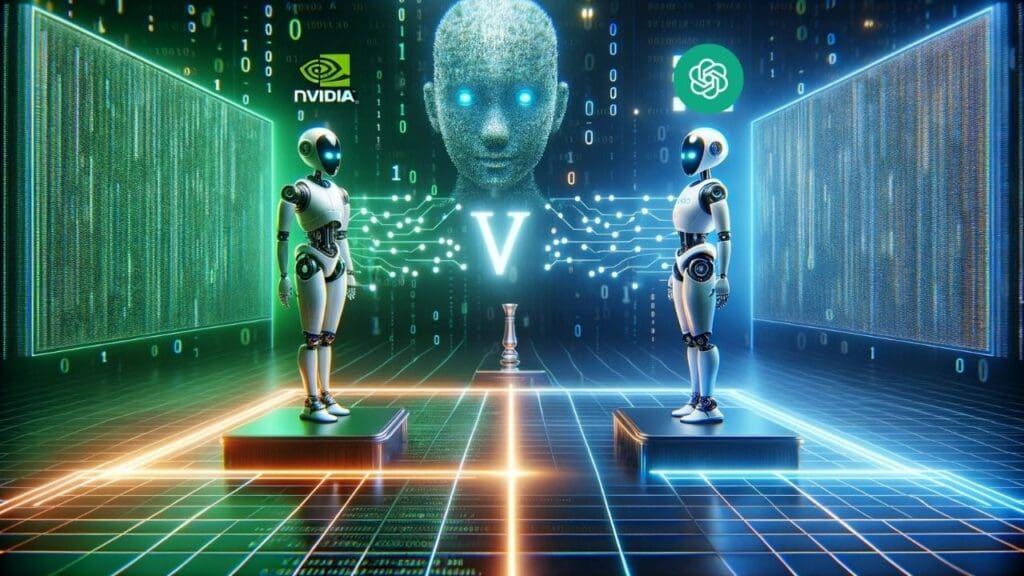
a robot standing on platform with a chess piece in front of a man's face

To back up Huang’s pragmatic view, let’s look at the data. I’ve been reading recent reports from Stanford University and Fortune, and they paint a picture that is very different from the hype.

Despite the billions of dollars poured into AI:

Job Market Impact: The actual disruption to job listings has been surprisingly limited so far.ROI (Return on Investment): Many companies are struggling to prove that AI is actually making them more profitable right now.

We are likely in what analysts call the “Trough of Disillusionment.” The initial excitement is wearing off, and now companies are realizing that implementing AI is hard work. It requires clean data, new infrastructure, and training.

This aligns perfectly with Huang’s stance. If AI were truly “God-like,” it would have fixed the global economy overnight. The fact that it hasn’t proves that it is just software—powerful software, yes, but still subject to the laws of implementation and economics.

Why Centralized AI is a Bad Idea

Another point Huang touched on—and one I feel strongly about—is the danger of centralization.

He explicitly stated he is against the idea of a “One AI to Rule Them All.” The concept of a single, super-intelligent entity controlled by one company or one government is, in his words, “extremely useless” (and frankly, terrifying).

The Metaverse Planet Philosophy

In the crypto and metaverse communities, we value decentralization. We don’t want one brain making decisions for the planet. We want:

specialized AIs for biology,creative AIs for art,logistical AIs for shipping.

We need a diverse ecosystem of tools, not a digital dictator.

While companies like Meta are building massive, nuclear-powered data centers (which is cool in its own right regarding infrastructure), the goal shouldn’t be to build a god. The goal should be to build better assistants.

Final Thoughts: The Path Forward

So, where does this leave us?

If we listen to Jensen Huang, we should stop checking the sky for falling robots. We should stop treating AI like a mystic force and start treating it like engineering.

The “God-level” AI isn’t coming to save us, nor is it coming to destroy us. What we have instead is a collection of rapidly improving tools that, if used responsibly, can make us more productive, healthier, and perhaps a little more creative.

I prefer this reality. It puts the responsibility back on us. The magic isn’t in the machine; it’s in how we choose to use it.

I’d love to hear your take on this: Does Jensen Huang’s statement make you feel more relaxed about the future of AI, or do you think he is downplaying the risks to keep selling chips? Let’s discuss it in the comments!

You Might Also Like;


Source link

From Mars to Your Living Room: 5 NASA Technologies You Use Every Day | Metaverse Planet

0
From Mars to Your Living Room: 5 NASA Technologies You Use Every Day | Metaverse Planet


I have always been a bit of a space geek. When I look up at the night sky, I see the infinite possibilities of the universe. But lately, I’ve realized something fascinating: I don’t need a telescope to see the impact of space exploration. I just need to look around my living room.

There is a common misconception that NASA burns through billions of dollars solely to plant flags on distant rocks or take pictures of nebulas. While those goals are noble, the engineering hurdles NASA faces are terrestrial problems on steroids. When you solve a problem for an environment with zero gravity, extreme temperatures, and no oxygen, the solution tends to be incredibly efficient when brought back down to Earth.

As I dug into the history of some of my favorite gadgets, I was genuinely surprised. The tech holding my spine straight while I sleep and the sensor capturing my coffee photos for Instagram were born in labs designed for astronauts.

Here is a deep dive into 5 technologies that started as “Rocket Science” and ended up as household essentials.

1. CMOS Image Sensors: The Eye of Your Smartphone

Let’s be honest, we are all addicted to our smartphone cameras. Whether it’s capturing a sunset or scanning a QR code, that tiny lens is our primary interface with the visual world. But did you know that every time you snap a selfie, you are utilizing technology developed to photograph other planets?

The NASA Challenge: In the 1990s, NASA’s Jet Propulsion Laboratory (JPL) had a massive problem. They needed to send cameras into space on interplanetary missions, but traditional cameras were too heavy, too big, and consumed way too much power. Every ounce matters when you are trying to launch a rocket; you can’t afford heavy batteries or bulky equipment.

The Solution: JPL engineer Eric Fossum and his team invented the CMOS (Complementary Metal-Oxide Semiconductor) active pixel sensor. Unlike the older CCD sensors, this new technology allowed for:

Miniaturization: The entire camera system could be shrunk down to a microchip.Low Power Consumption: It required a fraction of the energy.Durability: It was less prone to radiation damage in space.

My Perspective: It’s wild to think about. The reason your phone battery doesn’t die instantly when you open the camera app is that NASA needed to save power on a spacecraft millions of miles away. Today, this isn’t just about selfies; it’s about medical imaging, GoPro cameras, and automotive safety sensors. The “space eye” is now the “global eye.”

2. Memory Foam: Comfort Born from High-G Forces

I cherish my sleep. I think most of us do. So, when I bought my first memory foam pillow, I felt like I was sleeping on a cloud. But the origin story of this material is far more intense than just a good night’s rest.

The NASA Challenge: In the 1960s, the space race was heating up. NASA engineers were terrified about the safety of test pilots and astronauts. During launch and re-entry, the human body is subjected to incredible G-forces. They needed a material for the seats that could absorb these massive shocks without breaking the astronaut’s spine, but it also needed to be comfortable for long missions.

The Solution: NASA contracted engineers to create a material with “viscoelastic” properties. They came up with a temper foam that:

Matches Pressure: It molds to the specific shape of the object pressing against it.Returns to Form: It slowly bounces back to its original shape (hence “memory”).Temperature Sensitivity: It softens with body heat.

My Perspective: I find it ironic that a material designed to save lives during a violent rocket crash is now the standard for luxury bedding. It’s also widely used in football helmets and specialized seating for people with disabilities to prevent pressure sores. It’s a perfect example of how “extreme safety” translates to “extreme comfort” in the civilian world.

3. The Dustbuster: Cleaning Up Moon Dust

Cleaning is a chore I usually try to avoid, but I have to admit, cordless vacuums have made life significantly easier. No tripping over wires, no hunting for outlets. We owe this convenience to the Apollo missions.

The NASA Challenge: During the Apollo program, NASA needed to collect core samples from the lunar surface. They needed a drill that could penetrate the Moon’s surface, which meant it had to be powerful. However, there are no power outlets on the Moon. The drill had to be:

Portable and lightweight.Battery-powered with a high-efficiency motor.Capable of working in a vacuum environment.

The Solution: NASA partnered with Black & Decker. Together, they developed a computer program to optimize the design of the drill’s motor to use minimal power for maximum torque. After the moon landings, Black & Decker realized that this lightweight, battery-heavy technology was perfect for household cleaning. Thus, the Dustbuster was born.

My Perspective: Every time I grab my cordless vacuum to suck up some crumbs from the sofa, I’m essentially holding a descendant of the tool that drilled into the Moon. It’s a humble legacy for such a high-tech origin, but it undeniably changed how we maintain our homes.

4. Scratch-Resistant Lenses: Seeing Clearly Through Space Debris

I wear glasses, and I am notoriously clumsy. Without scratch-resistant coatings, my lenses would be a foggy mess within a week. If you wear prescription glasses or Ray-Bans, you are looking through a shield designed to survive space debris.

The NASA Challenge: Space is full of microscopic dust and particles moving at incredibly high speeds. If an astronaut’s helmet visor were made of standard plastic, it would be scratched into opacity within minutes, blinding the astronaut. Glass was too heavy and shatter-prone. They needed a plastic that was as hard as a diamond.

The Solution: NASA’s Ames Research Center worked on a technology called Diamond-Like Carbon (DLC) coating. They figured out a way to deposit a thin, incredibly hard layer onto the plastic visors. This coating:

Repelled water.Resisted scratches from high-velocity impact.Maintained optical clarity.

My Perspective: Foster-Grant licensed this technology, and now almost every pair of decent sunglasses or optical lenses uses a variation of it. It’s a subtle technology—you don’t see it, you look through it—but it saves consumers millions of dollars a year in replaced eyewear.

5. Infrared Ear Thermometers: Measuring Stars and Fevers

I remember when I was a kid, taking a temperature meant sitting still with a mercury thermometer under my tongue for what felt like an eternity. Today, you stick a device in your ear, push a button, and beep—two seconds later, you know the result. This speed is thanks to astrophysics.

The NASA Challenge: How do you measure the temperature of a star or a planet that is light-years away? You can’t touch it. You have to analyze the infrared energy it emits. NASA developed sophisticated sensors to measure this thermal radiation from cosmic bodies to determine their heat.

The Solution: A company called Diatek Corp saw the potential here. They realized the human eardrum is an excellent indicator of body temperature because it shares blood supply with the hypothalamus (the brain’s thermostat). However, the eardrum is fragile. By adapting NASA’s infrared sensor technology, they created a device that measures the thermal radiation emitted by the ear without ever touching the delicate membrane.

My Perspective: This is pure physics applied to physiology. The same math used to tell us how hot a Red Dwarf star is, tells me if I have a fever. It’s hygienic, instant, and accurate. It completely revolutionized pediatric care because, let’s face it, getting a sick toddler to sit still for a mercury thermometer is a mission harder than going to Mars.

Final Thoughts: The Invisible Legacy

Researching this list made me appreciate the hidden layers of our reality. We often separate “Science” from “Daily Life,” putting them in different boxes. But the truth is, the drive to explore the unknown forces us to solve problems in ways we never would have considered if we just stayed on Earth.

NASA didn’t set out to make a better mattress or a cordless vacuum. They set out to survive the void. But in doing so, they raised the standard of living for all of us.

I’d love to hear from you: Which one of these technologies surprised you the most? I was personally shocked by the camera sensor connection. Let’s discuss in the comments below!

You Might Also Like;


Source link

CZ-Backed Genius Terminal Hits $2B Weekly Volume

0
CZ-Backed Genius Terminal Hits B Weekly Volume


Key Highlights

Genius Terminal surpassed $2.2 billion in weekly trading volume as of January 17.

High-value whale activity drove the surge, with an average volume per trader exceeding $82,000.

The investment from YZi Labs and the joining of Changpeng Zhao as advisor accelerated the platform’s growth.

Genius Terminal, a decentralized exchange, recorded weekly trading volume over $2.2 billion on Saturday. The increase follows an investment by YZi Labs and the appointment of Changpeng Zhao as an advisor, which appear to have drawn high-value traders to the platform.

Dune Analytics data shows the surge in performance occurred mainly between January 12 and January 17. The execution environment provided by this platform, which has a focus on privacy, allowed large trades on both Solana and EVM networks.

This surge in activity reflects a shift in the trading environment on a decentralized platform. Professional trading terminals have now challenged traditional centralized exchanges with their own version of self-custody and discretion on an institutional level.

Key performance metrics

In the week ending January 17, Genius Terminal recorded a single-day high of over $800 million. The volume touched $48 million on January 12 and has been growing since. During this time, Ethereum Virtual Machine (EVM) volume contributed majorly alongside Solana. 

To date, the terminal has supported 1,072,729 trades from 29,259 unique wallets. The data signals a concentration of advanced users, with an average volume per trader of $82,480 and an average individual trade size of $2,041.

Recent integration with YZi

Genius Terminal spent much of late 2025 in a limited “soft launch” phase. During this period, the platform processed about $160 million in total volume across ten blockchains. The trajectory changed on January 13, when YZi Labs, the family office of Binance co-founders Changpeng Zhao and Yi He, announced a multi-eight-figure investment in the startup. 

Armaan Kalsi, co-founder and CEO, mentioned that the funding aimed at “creating an ‘on-chain’ Binance.” COO Ryan Myher said, “If you were rebuilding Binance today, you wouldn’t do it as a centralized exchange — you’d build it on‑chain.” He added, “Genius is our answer to what that looks like: one terminal, full custody, no compromises.”

Future privacy roadmap

The platform’s next phase involves rolling out its privacy orchestration layer. The terminal currently features “Ghost Orders,” which use multi-party computation to split large trades across up to 500 wallets to avoid front-running and strategy leaks. 

A public beta for this protocol is planned for the second quarter of 2026. As the platform scales to support more than 12 chains, its ability to maintain these multi-billion dollar volume levels will likely decide if it can become the top execution layer for professional decentralized finance.

Also Read: Pump.fun Hits $1.4B Volume to Top Solana DEX Leaderboard in 2026


Source link

Popular Posts

My Favorites

Phantom Crypto Wallet Secures $150 Million in Series C Funding at...

0
Phantom, the digital asset wallet service provider, has raised $150 million in a Series C funding round, taking its valuation to $3 billion....