Metaverse

Home Metaverse Page 52

Steak ’n Shake Adds $10M Bitcoin As Sales Climb

0
Steak ’n Shake Adds M Bitcoin As Sales Climb


Key Highlights

Steak ’n Shake added $10 million in Bitcoin exposure on January 16.

The chain continues funneling all BTC payments into a Strategic Bitcoin Reserve.

It previously reported about 15% same-store sales growth after introducing Bitcoin payments.

Steak ’n Shake, the fast-food chain, has increased its Bitcoin (BTC) exposure by $10 million this week, eight months after the chain began accepting BTC payments across its restaurants. The update, shared on Friday, ties the additional purchase directly to rising same-store sales generated since the launch of what the company calls its “burger-to-Bitcoin” strategy.

The company said all Bitcoin received from customers continues to flow into its Strategic Bitcoin Reserve (SBR), rather than being converted to cash. 

Bitcoin payments feed a corporate reserve

Steak ’n Shake first enabled Bitcoin payments via the Lightning Network in May 2025. Unlike most retailers that treat crypto as a payment rail only, the chain committed to holding all BTC revenue on its balance sheet. This approach differs from companies that build Bitcoin treasuries through direct market purchases, as the reserve grows organically through customer activity.

In a November update, the company reported that same-store sales had climbed about 15% within six months of launching bitcoin payments. Executives linked the gains to lower payment processing fees, marketing visibility inside the crypto community, and Bitcoin-themed promotions rolled out alongside the payments push.

From payments experiment to operating model

The January update suggests the initiative has moved beyond experimentation. Steak ’n Shake said improving food quality and store performance directly expands its ability to accumulate bitcoin, framing BTC not as a speculative asset but as part of a broader operating model.

The restaurants are owned and franchised by Biglari Holdings Inc., which has not disclosed whether Bitcoin will play a role at the holding company level. Biglari Holdings shares closed modestly higher on January 16, according to Yahoo Finance.

Moreover, Bitcoin is trading near $95,385, up about 5.5% over the past week. Market capitalization stood at close to $1.9 trillion, while the 24-hour trading volume is 50% down to nearly $19 billion.

A different kind of corporate bitcoin bet

Steak ’n Shake’s approach contrasts with firms such as publicly listed asset managers and technology companies that build large bitcoin positions through balance-sheet allocations. Instead, the fast-food chain is tying its exposure directly to consumer behavior and day-to-day operations.

The move comes as enterprise interest in Bitcoin continues to broaden, with more companies experimenting with treasury strategies amid rising institutional adoption. Whether Steak ’n Shake’s model is replicable for other consumer brands remains uncertain, but the latest purchase signals the company sees Bitcoin as a long-term part of its business, not a short-lived marketing stunt.

Also read: DOJ Confirms Samourai Wallet Bitcoin Remains in US Reserve


Source link

From Static Simulations to Self-Adapting Immersive Environments

0
From Static Simulations to Self-Adapting Immersive Environments


First impressions matter!

Immersive technologies have come a long way in a relatively short time. What began as visually impressive simulations gradually found their way into training rooms, design studios, and operational environments. For many organizations, these early immersive experiences were a revelation. They made complex systems easier to understand and allowed people to practice skills in safe, controlled settings.

But as adoption grew, expectations evolved.

The era of static simulations

Static simulations played an important role in proving the value of immersive technology. They offered fixed scenarios, predefined paths, and consistent outcomes for every user. This made them predictable, repeatable, and easier to deploy at scale.

For demonstrations and basic training, that was enough. People could see a process, walk through a scenario, and gain familiarity before stepping into the real world. Static simulations helped teams visualize complexity and reduce initial uncertainty.

Why dynamic visualizations are the future

Real environments are rarely predictable. People do not learn in the same way or at the same pace. Some hesitate, some rush, some repeat the same mistake for different reasons. Confidence grows unevenly, and stress affects performance in ways no predefined script can anticipate.

Static simulations treat all users the same. They assume that following a single path is enough to prepare everyone equally. In practice, this creates gaps between what people experience in a simulation and what they face in real situations.

As organizations pushed immersive technology deeper into training and operations, they needed systems that could respond to these human realities.

The rise of self-adapting immersive environments

Self-adapting immersive environments mark a clear shift from fixed experiences to responsive systems. Instead of running through the same sequence every time, these environments observe how users behave and adjust accordingly.

Difficulty levels change based on performance. Guidance appears when hesitation is detected. Scenarios evolve to challenge users where they need it most. The experience no longer simply plays out. It listens, responds, and adapts.

This shift transforms immersion from something people experience into something that actively supports them.

The role of AI in making immersion adaptive

Artificial Intelligence is the key enabler behind this evolution. Not in the form of visible features or complex interfaces, but as an invisible layer that interprets behavior and context in real time.

AI can recognize patterns in how users interact with an environment. It can detect errors, measure progress, and adjust pacing without interrupting the experience. Over time, it allows immersive environments to improve continuously rather than remaining static.

When implemented thoughtfully, AI does not add complexity. It reduces friction by making experiences feel more intuitive and supportive.

How Adaptive Immersion changes training

In training environments, the impact of adaptation is immediate. New learners can move at their own pace without feeling overwhelmed. Experienced users can be challenged more deeply without wasting time on basics.

This leads to faster onboarding, better skill retention, and higher confidence before real-world exposure. Training becomes less about completing a module and more about reaching readiness.

Most importantly, adaptive immersion helps organizations reduce risk. People are better prepared before they step into high-stakes situations.

Beyond training: Adaptive Immersion in operations

The same principles apply beyond learning. In operational contexts, adaptive immersion enables AR-driven workflows that respond to real-time conditions.

Instructions can change based on context. Warnings can appear before errors occur. Guidance can be tailored to the situation rather than delivered generically. This makes immersive technology a practical tool for execution, not just understanding.

As immersive systems integrate with data, sensors, and workflows, they begin to function as intelligent companions within real operations.

Designing for adaptation

Building self-adapting immersive environments requires a shift in design thinking. The focus moves away from adding features and toward understanding human behavior. Intelligence must remain subtle, supportive, and purposeful.

Success is measured by how well it helps people perform. Clarity, usability, and outcome-driven design become more important than visual complexity.

What this shift signals for the future

The move from static simulations to self-adapting environments signals a broader change in how immersive technology is perceived. It is no longer about creating isolated experiences. It is about building systems that learn, respond, and evolve alongside the people who use them.

As this shift continues, immersive environments will become a natural part of how organizations train, operate, and make decisions.

The TILTLABS perspective

At TILTLABS, this shift from static simulations to self-adapting immersive environments is central to how we approach immersive design. We focus on building experiences that respond to people, not just processes. By combining immersive technologies with intelligence, behavioral insight, and thoughtful experience design, we create environments that evolve with users over time. Our work spans training, operations, and interactive experiences where adaptability, clarity, and real-world usefulness matter more than visual novelty. For us, immersive technology succeeds only when it becomes a natural extension of how people learn, decide, and perform.

The post From Static Simulations to Self-Adapting Immersive Environments appeared first on TILTLABS.


Source link

Crypto User Loses $500K USDT in Ethereum Address Poisoning Scam

0
Crypto User Loses 0K USDT in Ethereum Address Poisoning Scam


Key Highlights

A crypto user lost over $500,000 in USDT after mistakenly sending funds to a poisoned Ethereum address that closely mimicked the real one.

The scam exploited transaction history copying, with the victim sending a small test transfer before a much larger onchain payment.

The incident highlights ongoing risks of address poisoning scams, which have caused multi-million-dollar losses in recent months.

A crypto user has lost more than $500,000 worth of USDT after falling victim to an address poisoning attack on the Ethereum blockchain, highlighting once again how simple mistakes can lead to massive losses in onchain transactions.

The incident was detected at 14:01 UTC, with blockchain security firm CyversAlerts publicly flagging it shortly after at 14:34 UTC. It is among the first reported address poisoning cases of 2026, underlining that this type of scam remains a persistent threat despite growing awareness in the crypto space.

How the $500,000 address poisoning attack unfolded

According to CyversAlerts, the victim initially sent a test transaction of 5,000 USDT to what they believed was the correct wallet address. The address appeared familiar because it closely resembled the intended recipient, ending in D3E6F.  

The address was however under control of a scammer and it was slightly different in the middle character details which are normally hidden or abbreviated in wallet interfaces.

Only two minutes later, the victim made a bulk transfer of 509,000 USDT to the same poisoned address after the test transfer had succeeded. Overall, the victim had lost about $514,000.

Transaction history manipulation

The attack timeline indicates that the scammer had prepared in detail long before the attack. The attacker initially sent several small payments using similar looking addresses to the wallet of the victim, intentionally contaminating the history of transactions. 

The victim had copied the address of the previous transactions believing it to be legit, thus choosing the wallet of the scammer as opposed to the real wallet. The money was effectively lost once it was committed on-chain.

Address poisoning attacks take advantage of such habits as copying wallet addresses on the transaction history and not checking them character by character.

A growing pattern of high-value crypto losses

This event is preceded by a significantly bigger address poisoning incident in December 2025, when an experienced trader lost almost half a million dollars in USDT in one transaction. 

In such a scenario, the attacker would have used an address that resembled the first three and last four characters of the legitimate wallet which would seem genuine at first sight. 

The victim had already made a valid test transfer but then copied a tainted address in the history of transfers when making the full transfer. The attacker soon transferred the money to ETH and laundered it through several wallets, and eventually laundered some of the assets through Tornado Cash, making the trail go cold.

The risk of familiarity for crypto users

The importance of addressing poisoning scams is that they do not depend on hacking smart contracts or using protocols. Rather, they are user behavioral directed. 

The risk exposure of both retail users and professional traders is rising as crypto usage continues to rise and the number of transactions of the stablecoins such as USDT is high daily.

The latest cases, such as a crypto giveaway scam that took advantage of the official communication channels of Betterment, demonstrate how scammers are changing. 

They are becoming more and more dependent on the credibility of trusted platforms, familiar interfaces, and technical tricks to earn credibility. To the wider crypto community, such incidents drive a bitter truth: blockchain transactions are permanent. 

Even seasoned users may commit expensive mistakes and once money is transferred onchain, it is hard to retrieve. With the trading activity still at its peak, these scams are still a major threat to the market participants, and this is why more protection to the user and vigilance is of utmost importance.

Also Read: Prince Group’s Chen Zhi Arrested Over $15B Crypto Scam Network


Source link

The Electric Atlas Revolution: How Boston Dynamics is Redefining Factory Work | Metaverse Planet

0
The Electric Atlas Revolution: How Boston Dynamics is Redefining Factory Work | Metaverse Planet


I have to admit, I’ve been obsessed with Boston Dynamics videos for years. You probably know the ones I’m talking about—robots doing parkour, dancing to “Do You Love Me,” or getting bullied by engineers with hockey sticks. It was entertaining, sure. But it always felt like a science experiment.

That era is over.

With the retirement of the hydraulic Atlas and the introduction of the fully electric Atlas, we aren’t watching a demo reel anymore. We are watching the birth of a commercial product. I’ve been digging into the details of Atlas’s deployment at Hyundai’s factories, and frankly, what I found is both incredibly impressive and a little bit terrifying.

Let’s dive into why this specific robot changes everything.

The End of “Biological Biomimicry”

For decades, roboticists tried to make humanoids move exactly like us. They mimicked our gait, our balance, and our limitations.

When I saw the new electric Atlas stand up for the first time, I actually gasped. It didn’t roll over like a human; it contorted its legs backward, pivoted its hips, and stood up like something out of a sci-fi horror movie. And that’s the genius of it.

Boston Dynamics has stopped trying to copy humans and started trying to exceed them.

Here is why this design shift matters:

360-Degree Freedom: The new Atlas doesn’t have a “front” or “back.” It can rotate its head and torso independent of its legs.Efficiency: A human has to shuffle their feet to turn around. Atlas just swivels. In a tight factory aisle, this saves precious seconds and energy.Strength-to-Weight Ratio: Without heavy hydraulic pumps and fluids, the electric actuators provide immense power in a smaller, quieter package.

Why Hyundai? The Perfect Proving Ground

It’s no secret that Hyundai owns a controlling interest in Boston Dynamics. But sending Atlas to the automotive production line isn’t just a synergy play; it’s a stress test.

I’ve looked at the specs, and this isn’t about replacing the guy who bolts on a tire. It’s about cognitive manipulation. The new Atlas uses advanced AI and machine learning (Reinforcement Learning) to adapt to real-time situations.

What is Atlas actually doing there?

Complex Manipulation: Handling heavy, irregularly shaped car parts that traditional robotic arms can’t reach.Quality Control: Using computer vision to spot defects better than the human eye.Hazardous Tasks: Taking over jobs that involve toxic fumes, extreme heat, or ergonomic injuries for human workers.

I genuinely believe that within five years, seeing a humanoid robot in a car factory will be as common as seeing a forklift.

Hydraulic vs. Electric: Why the Switch?

I used to love the sound of the old hydraulic Atlas—it sounded like it was breathing heavy, fighting gravity. But let’s be real: hydraulics are a nightmare for mass production. They leak, they overheat, and they require constant maintenance.

The All-Electric Atlas is the answer to “scalability.”

Silence: It’s quiet. You can actually hear yourself think next to it.Precision: Electric motors allow for millimetric control that fluid dynamics struggle to match.Durability: Fewer moving fluids mean fewer points of failure.

The “Uncanny Valley” Factor

Here is where I get a bit philosophical. Watching this robot move feels… alien.

Because its joints defy human constraints, it triggers a primal instinct in us. It moves with a logic that is purely mathematical, devoid of biological habit. I find myself oscillating between being in awe of the engineering and feeling a slight chill down my spine.

But maybe that’s the point. It’s a tool, not a person. By making it move in non-human ways, Boston Dynamics is visually reminding us that this is a machine designed for output, not a synthetic human designed for friendship.

My Final Thoughts

The deployment of Atlas at Hyundai is the “iPhone moment” for humanoid robotics. We have moved past the research lab. The hardware is ready, the AI is learning, and the factories are opening their doors.

I’m excited to see where this goes, but I also wonder about the transition period. It’s one thing to watch a robot on YouTube; it’s another to stand next to one on the assembly line while it rotates its torso 180 degrees to hand you a wrench.

Let’s Discuss

I’m really curious about your perspective on this shift.

If you walked into your workplace tomorrow and saw an electric Atlas working at the desk or station next to you, would you feel safe, or would you be looking for a new job?

Let me know in the comments below!

You Might Also Like;


Source link

Strive Completes Semler Deal, Boosts Bitcoin Treasury

0
Strive Completes Semler Deal, Boosts Bitcoin Treasury


Key Highlights

Strive now holds about 12,797.9 BTC, ranking as the world’s 11th-largest public corporate bitcoin holder.

The company appointed Avik Roy as Chief Strategy Officer and added Eric Semler as an independent Board Member.

The deal consolidates two early Bitcoin treasury adopters under a single balance-sheet strategy.

Strive, a Nasdaq-listed asset manager, announced the completion of its acquisition of Semler Scientific, formally combining the two companies’ bitcoin treasuries and pushing Strive into the top tier of public corporate BTC holders. The transaction, announced on Friday, follows shareholder approval earlier this week.

The all-stock deal brings Strive’s total Bitcoin holdings to approximately 12,797.9 BTC, placing it 11th globally among public companies, according to industry tracking data.

Treasury scale and leadership changes

With the acquisition closed, Strive confirmed it now ranks 11th in Bitcoin treasury holdings based on BitcoinTreasuries data, combining its existing reserves with the Bitcoin previously held by Semler Scientific. The company has positioned its balance sheet around BTC accumulation rather than traditional cash or hedging strategies.

Alongside the deal, Strive named Avik Roy as Chief Strategy Officer. Roy will focus on monetizing Semler’s operating healthcare business while expanding Strive’s broader strategy. Former Semler chairman Eric Semler joined Strive as an independent board member, while Joe Burnett was appointed vice president of bitcoin strategy.

Strategy shift post-acquisition

Management has indicated that Semler’s healthcare operations are not central to Strive’s long-term plans. Within the next year, the company expects to monetize the operating business and redeploy capital toward bitcoin-related initiatives, including retiring existing debt tied to Semler, subject to market conditions.

Executives have framed the transaction as a continuation of a preferred-equity-first approach, aimed at increasing Bitcoin per share without relying heavily on conventional debt financing.

Market context

The acquisition highlights how Bitcoin-focused balance sheets are reshaping public company rankings. With Semler’s Bitcoin folded in, Strive moved past several higher-profile firms in total BTC holdings, showing how quickly treasury moves can reshuffle corporate rankings.

The deal also points to a wider consolidation trend among early Bitcoin adopters, as companies look to gain scale and simplify around a single treasury strategy.

Also read: Jefferies’ Christopher Wood Swaps Bitcoin for Gold Over Quantum Fear


Source link

$HTX Quarterly Burn Hits a New High of 13.62 Trillion, Total Burn Volume Nears 10% of Total Supply 

0
$HTX Quarterly Burn Hits a New High of 13.62 Trillion, Total Burn Volume Nears 10% of Total Supply 


In Brief

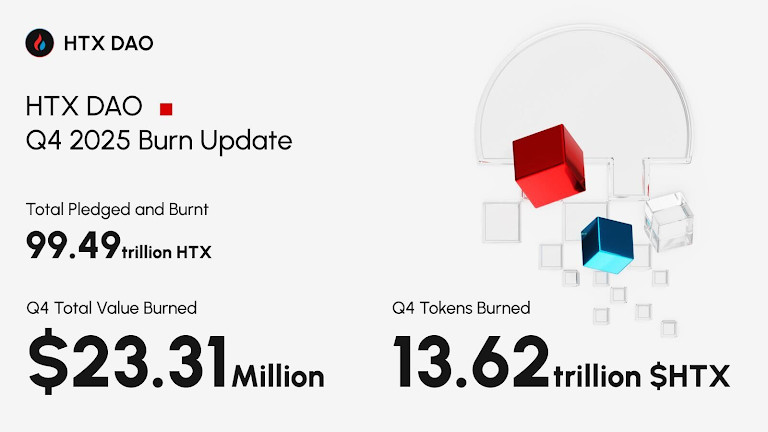
HTX DAO completed its Q4 2025 $HTX token burn, destroying over 13.6 trillion tokens to further reduce circulating supply, strengthen scarcity, and support long-term ecosystem value.

$HTX Quarterly Burn Hits a New High of 13.62 Trillion, Total Burn Volume Nears 10% of Total Supply 

On January 15, HTX DAO announced the successful completion of its $HTX token burn for Q4 2025. Through the rigorous execution of these quarterly burns, the circulating supply of $HTX has been further optimized, enhancing token scarcity and strengthening long-term value for ecosystem participants and holders..

Q4 Token Burn Rises Over 30% Amid Market Headwinds

On-chain data confirms the destruction of 13,616,371,495,327.31 $HTX tokens, valued at over $23.31 million.

Burn Details: https://tronscan.org/#/transaction/f2a20879d33e1f08feedef2d2779bb1cd919e792dbc637201beedac44b897228

Despite a sluggish crypto market in late 2025, HTX DAO’s burn metrics defied broader trends, to reach a historic milestone. This record-high burn volume represents a 36.4% year-over-year (YoY) increase and a 3.78% rise from the previous quarter.

According to HTX DAO’s whitepaper, the HTX exchange, as an ecosystem partner of HTX DAO, provides 50% of its revenue each quarter to buy back and burn $HTX. So this quarterly burn underscores HTX’s robust fundamentals; by maintaining steady earnings through market fluctuations, the exchange ensures the liquidity necessary to sustain HTX DAO’s aggressive deflationary mechanism.

Throughout 2025, HTX achieved consistent growth across all key performance indicators:

User Base: Exceeded 55 million registered users (6 million added in 2025).

Trading Volume: Reached $3.3 trillion (a 39% YoY increase).

Capital Inflow: Net inflows totaled $608 million.

100 Trillion $HTX Burned: Entering an Era of Accelerated Deflation

This latest event marks a pivotal moment in HTX DAO’s deflationary roadmap. To date, HTX DAO has cumulatively burned approximately 99.49 trillion $HTX tokens, with an estimated value of $186.93 million.

Most notably, cumulative burns of $HTX tokens are approaching 10% of its total supply. This milestone signals that the token is entering a period of accelerated deflation. By steadily reducing the circulating supply, HTX DAO is laying a solid foundation for long-term price support through a healthier supply-demand balance.

Empowering the Ecosystem Through Enhanced Governance

Building on the momentum of 2025, HTX DAO is entering a new phase of redefining $HTX token’s value proposition through greater transparency and community-led governance.

HTX DAO reaffirms its commitment to the token burn as a permanent, transparent strategy. Moving forward, the platform will continue to refine its listing processes and elevate the community’s role in key business decisions. Furthermore, HTX DAO will prioritize expanding $HTX utility across both CeFi and DeFi applications, fostering a self-sustaining economy designed to benefit every holder.

About HTX DAO

HTX DAO is a decentralized autonomous organization (DAO) collaboratively built by community members, early contributors, and global advisors. Supported by HTX Exchange and the TRON blockchain ecosystem, HTX DAO is committed to establishing an open governance ecosystem led by users, governed by transparent rules, and driven by efficient collaboration, serving as a key engine in advancing decentralized finance (DeFi).

HTX DAO embodies the principle of “token holders govern”, aiming to inspire global consensus and participation, align community interests with platform value, and explore a new order in the world of crypto finance.

Contact Information

Website: www.htxdao.com

Email Address: [email protected]

Disclaimer

In line with the Trust Project guidelines, please note that the information provided on this page is not intended to be and should not be interpreted as legal, tax, investment, financial, or any other form of advice. It is important to only invest what you can afford to lose and to seek independent financial advice if you have any doubts. For further information, we suggest referring to the terms and conditions as well as the help and support pages provided by the issuer or advertiser. MetaversePost is committed to accurate, unbiased reporting, but market conditions are subject to change without notice.

About The Author

Gregory, a digital nomad hailing from Poland, is not only a financial analyst but also a valuable contributor to various online magazines. With a wealth of experience in the financial industry, his insights and expertise have earned him recognition in numerous publications. Utilising his spare time effectively, Gregory is currently dedicated to writing a book about cryptocurrency and blockchain.

More articles

Gregory, a digital nomad hailing from Poland, is not only a financial analyst but also a valuable contributor to various online magazines. With a wealth of experience in the financial industry, his insights and expertise have earned him recognition in numerous publications. Utilising his spare time effectively, Gregory is currently dedicated to writing a book about cryptocurrency and blockchain.


Source link

NEXST Brings KISS OF LIFE to Life: Debut VR Concerts on the Ultimate Web3 Entertainment Platform

0
NEXST Brings KISS OF LIFE to Life: Debut VR Concerts on the Ultimate Web3 Entertainment Platform


Sponsored

Stories and Reviews

January 16, 2026

NEXST Brings KISS OF LIFE to Life: Debut VR Concerts on the Ultimate Web3 Entertainment Platform

Dubai, UAE, January 16th, 2026, Chainwire

NEXT INNOVATIONS TECHNOLOGY L.L.C. (NEXST), a next-generation Web3 entertainment platform, announced a strategic partnership with KISS OF LIFE, the winner of the 2025 Asia Artist Awards “Best Musician Group.” The group will join NEXST VR LIVE as the platform’s second official collaboration artist.

NEXST VR LIVE is the immersive VR concert service within the NEXST ecosystem, supported by the $NXT token. Through this collaboration with KISS OF LIFE, NEXST continues its mission to bring large-scale global fandoms on-chain by embedding digital ownership, decentralized access, and immersive technology into entertainment experiences.

Building a Gateway From Web2 Fandoms to Web3

NEXST is an AI-, VR-, and blockchain-powered entertainment platform designed to bridge mainstream Web2 audiences into Web3 in a natural and accessible way. Rather than requiring prior crypto knowledge, NEXST leverages globally recognized artists and immersive VR content as an intuitive entry point into the decentralized ecosystem.

In July 2025, NEXST VR LIVE announced Korean girl group UNIS as its first collaboration artist, with VR content currently in production. The partnership with KISS OF LIFE is the perfect spark that kicks off the next stage of evolution at NEXST. 

By centering highly interactive entertainment experiences, NEXST introduces Web3-native value propositions such as digital asset ownership and cryptocurrency-based purchases of VR content—while maintaining a seamless user experience for fans new to Web3.

At its core, NEXST delivers deeply interactive experiences with built-in Web3 value: digital asset ownership, crypto-powered VR content purchases all in a smooth, beginner-friendly package.

KISS OF LIFE: A Global Artist Leading the Next Wave of Immersive VR Lives

KISS OF LIFE is an award-winning K-POP group with approximately 9 million followers across global social platforms, known for its distinctive artistry, high-energy performances, and strong influence on global youth culture. Following their successful Japanese debut in November with a new album, they wrapped up a sold-out Japan tour in December. With each milestone, KISS OF LIFE continues to expand their international influence and solidify their place on the global stage.

Through this partnership, KISS OF LIFE’s expressive performance style and dynamic stage presence will be fully integrated into the immersive environments of NEXST VR LIVE. Moving beyond traditional “watch-only” concert formats, fans will be able to step inside the music world itself—sharing a virtual space with the artists and engaging in a next-generation VR live experience that redefines how live music is consumed in digital environments.

Shaping the Future of Entertainment With NEXST

NEXST blends AI, VR, and Web3 to rebuild entertainment at its core: making music, live shows, and fan communities more immersive and rewarding than ever.

NEXST is expanding collaborations with more global and K-pop artists as well as premium IP to create a new paradigm where fans can discover artists, connect directly with them, and co-create shared experiences. Meanwhile, the company aims to build a sustainably scalable entertainment ecosystem that evolves alongside its global community.

For information on the NEXST token ($NXT), upcoming TGE, and the latest updates, users can visit NEXST’s official channels.

Website: https://www.nexst.io

X (Twitter): https://x.com/NEXST_AI

Discord: https://discord.gg/nexst

Medium: https://medium.com/@sns.nexst

About NEXST

NEXST is an AI-driven entertainment infrastructure that transforms the full spectrum of fan experiences into on-chain, verifiable value. By blending proven Web2 models with VR, AI, gaming, and RWA ticketing, NEXST is building a new paradigm of fan continuity—a unified digital economy for global engagement.

About KISS OF LIFE



KISS OF LIFE is a multinational girl group made up of Julie (JULIE), Natty (NATTY), Belle (BELLE), and Haneul (HANEUL).The group’s name embodies their mission: to breathe new life into the world through fresh music and ignite excitement for living.

Since debuting in 2023, KISS OF LIFE has captivated K-POP fans around the world powerful choreography that far exceeds rookie expectations, alongside original and highly creative content. Beginning in Korea in October 2024, the group embarked on their world tour, “KISS OF LIFE 1ST WORLD TOUR [KISS ROAD],” traveling across North America, Europe, and Asia. Following their successful Japanese debut in November with a new album, they wrapped up a sold-out Japan tour in December. With each milestone, KISS OF LIFE continues to expand their international influence and solidify their place on the global stage.

「KISS OF LIFE」Official Channels

KISS OF LIFE OFFICIAL X :https://x.com/KISSOFLIFE_S2

KISS OF LIFE OFFICIAL Instagram : https://www.instagram.com/kissoflife_s2

KISS OF LIFE OFFICIAL YouTube : https://www.youtube.com/@KISSOFLIFE_official

KISS OF LIFE OFFICIAL TikTok : https://www.tiktok.com/@kissoflife_official

Contact

PRYumiko SkurrNEXT INNOVATIONS TECHNOLOGY L.L.C[email protected]

Disclaimer

In line with the Trust Project guidelines, please note that the information provided on this page is not intended to be and should not be interpreted as legal, tax, investment, financial, or any other form of advice. It is important to only invest what you can afford to lose and to seek independent financial advice if you have any doubts. For further information, we suggest referring to the terms and conditions as well as the help and support pages provided by the issuer or advertiser. MetaversePost is committed to accurate, unbiased reporting, but market conditions are subject to change without notice.

About The Author

Chainwire is the top blockchain and cryptocurrency newswire, distributing press releases, and maximizing crypto news coverage.

More articles

Chainwire is the top blockchain and cryptocurrency newswire, distributing press releases, and maximizing crypto news coverage.


Source link

Cardano Foundation Rolls Out Reeve To Enhance Enterprise Financial Reporting

0
Cardano Foundation Rolls Out Reeve To Enhance Enterprise Financial Reporting


In Brief

The Cardano Foundation has launched Reeve, an on-chain trust layer that integrates with enterprise systems to provide immutable, verifiable financial reporting, enhancing transparency, auditability, and stakeholder confidence.

Cardano Foundation Rolls Out Reeve To Enhance Enterprise Financial Reporting

Cardano Foundation, the nonprofit organization responsible for advancing the Cardano blockchain, has introduced Reeve, a scalable trust layer designed to integrate with enterprise financial systems. 

The platform anchors financial events to the Cardano blockchain, producing immutable, independently verifiable evidence that can be used by auditors, regulators, and stakeholders. Reeve provides organizations with customizable transparency, allowing selective visibility while preserving confidentiality, and combines on-chain assurance with dashboards that make complex financial data intuitive and accessible.

By embedding cryptographic verification throughout the reporting lifecycle, Reeve replaces assumption-based trust with verifiable proof, resulting in faster audit cycles, reduced reconciliation workloads, clearer data provenance, and improved operational resilience. Its architecture supports continuous assurance and anticipates future regulatory requirements, while minimizing the need for manual data validation.

Built on Cardano, Reeve addresses the limitations of traditional reporting systems, including errors, fraud, and siloed data that can impede collaboration and stakeholder confidence. The enterprise-grade solution bridges existing enterprise resource planning systems with blockchain, enabling seamless integration, enhanced transparency, and stronger trust through secure, verifiable data.

The Cardano Foundation is now inviting industry leaders to gain exclusive, first-time on-chain access to Reeve, showcasing a next-generation solution for accountability in financial data management.

Cardano Foundation Highlights Need For Verifiable Financial Reporting, Demonstrating On-Chain Transparency With Reeve

The organization has highlighted growing concerns over confidence in financial reporting across global markets, noting that scandals, opaque data flows, and fragmented systems have eroded stakeholder trust. 

According to the announcement, today, stakeholders expect verifiable evidence and transparent data trails rather than reliance on reputation alone. Traditional assurance models struggle to meet these expectations because they depend on manual processes, siloed systems, and delayed verification, contributing to a widening trust deficit in modern financial ecosystems.

Even as enterprises collect increasingly large volumes of data, many audit frameworks remain outdated. Financial and non-financial information often moves through disconnected systems, weakening provenance and undermining confidence in disclosures. Inconsistent controls, interpretive flexibility, and late-stage reconciliations create assurance models that provide the appearance of oversight without fully addressing underlying data risk. 

Stakeholders now demand verifiable reporting that covers both ESG metrics and financial statements, yet legacy systems often cannot deliver transparency at the required speed or scale.

The emerging solution lies in embedding verification directly into operational systems. Trust-technology architectures allow organizations to establish immutable data lineage, automate validation, and generate tamper-evident records that reinforce oversight. 

By integrating continuous, data-driven verification, these systems transform assurance from retrospective review into a real-time control layer, reducing exposure to errors and fraud while enhancing stakeholder confidence.

In order to illustrate the impact of verifiable financial reporting, the Cardano Foundation implemented Reeve within its own financial operations. 

By recording accounting transactions on-chain and connecting directly with its ERP system, the Foundation created a fully transparent and independently verifiable financial dataset. 

This approach enhanced auditability, increased operational efficiency, and reinforced stakeholder trust through immutable records, providing a model for enterprises, public institutions, and NGOs to future-proof accountability with verifiable transparency.

Disclaimer

In line with the Trust Project guidelines, please note that the information provided on this page is not intended to be and should not be interpreted as legal, tax, investment, financial, or any other form of advice. It is important to only invest what you can afford to lose and to seek independent financial advice if you have any doubts. For further information, we suggest referring to the terms and conditions as well as the help and support pages provided by the issuer or advertiser. MetaversePost is committed to accurate, unbiased reporting, but market conditions are subject to change without notice.

About The Author

Alisa, a dedicated journalist at the MPost, specializes in cryptocurrency, zero-knowledge proofs, investments, and the expansive realm of Web3. With a keen eye for emerging trends and technologies, she delivers comprehensive coverage to inform and engage readers in the ever-evolving landscape of digital finance.

More articles

Alisa, a dedicated journalist at the MPost, specializes in cryptocurrency, zero-knowledge proofs, investments, and the expansive realm of Web3. With a keen eye for emerging trends and technologies, she delivers comprehensive coverage to inform and engage readers in the ever-evolving landscape of digital finance.

More articles


Source link

Hyperliquid, Tether, And Selini Capital Partner With Dreamcash To Deliver High-Liquidity On-Chain Trading For Retail Users

0
Hyperliquid, Tether, And Selini Capital Partner With Dreamcash To Deliver High-Liquidity On-Chain Trading For Retail Users


In Brief

Dreamcash has launched USDT-collateralized RWA HIP-3 perpetual markets on Hyperliquid in partnership with Tether and Selini Capital, aiming to bring retail traders on-chain with a fintech-style interface and deep, reliable liquidity.

Dreamcash Launches USDT0-Collateralized RWA Perpetual Markets On Hyperliquid

Digital asset platform Dreamcash announced that it has launched a new suite of Real World Asset (RWA) HIP-3 perpetual markets on Hyperliquid in collaboration with Tether and Selini Capital. The initiative integrates Dreamcash’s mobile-first trading interface, Tether’s omnichain stablecoin USDT, and Selini Capital’s expertise in market infrastructure and liquidity provision. The objective is to onboard a broader base of traders onto on-chain markets by enabling them to use USDT—the stablecoin they are already familiar with—across some of the most liquid HIP-3 markets.

Perpetual futures have emerged as one of the most impactful innovations in cryptocurrency trading, offering 24/7 access, simple leverage, and no expiry, quickly surpassing traditional options and futures in market dominance. This model is now being adapted for traditional finance, particularly to capture retail traders who drive high-volume flows through same-day, leveraged equity instruments like 0DTE options, which in May 2025 accounted for over 61% of S&P 500 options volume with retail participation around 54% and daily notionals exceeding $500 billion.

Hyperliquid’s HIP-3 upgrade, launched on October 13th, allows anyone meeting staking requirements to deploy perpetual markets permissionlessly, generating more than $10 billion in cumulative trading volume within three months. These markets are built in partnership with Tether and Selini Capital, using USDT0—the cross-chain stablecoin network built on LayerZero’s OFT standard—which maintains a 1:1 peg with USDT through a lock-and-mint mechanism. Since its launch in January 2025, USDT0 has processed over $50 billion in transfers across 15 networks, establishing itself as a leading cross-chain stablecoin solution.

By enabling USDT-collateralized perpetuals, Hyperliquid targets the largest pool of ready-to-trade capital in cryptocurrency, including centralized exchange traders already using USDT, global retail participants holding savings in Tether, and users in regions where USDT serves as the standard unit of account. The integration removes a key barrier for millions of traders previously confined to centralized platforms, allowing them to engage onchain without changing their existing workflows. Tether and USDT0 continue to support the technical rollout, ensuring a seamless user experience.

Dreamcash Targets Retail Traders With Fintech-Style Interface And HIP-3 On-Chain Liquidity 

According to the report, Dreamcash aims to attract a new generation of traders by focusing on retail users accustomed to the speed, reliability, and polished design of leading fintech applications. Modern retail traders expect fast onboarding, intuitive interfaces, responsive charts, low-latency execution, clear risk controls, and mobile-first experiences. On-chain perpetuals succeed not merely by existing—they succeed by offering performance and usability tailored to mainstream users rather than only to power users who tolerate rough edges.

The platform combines a modern fintech-style application experience with access to Hyperliquid’s most liquid on-chain trading venues. For retail participants, interface quality is just the beginning; true performance is measured by smooth trading under real conditions, including tight spreads, reliable fills, predictable liquidations, and accurate mark prices even during volatility. Achieving this requires deep liquidity, reliable oracle design, and alignment with professional market participants from launch.

In order to meet these demands, Dreamcash is partnering with Selini Capital, a global trading firm that specializes in institutional liquidity provision. Selini brings market-making expertise and technical capabilities to HIP-3, ensuring that markets are liquid and pricing remains reliable from the start.

Disclaimer

In line with the Trust Project guidelines, please note that the information provided on this page is not intended to be and should not be interpreted as legal, tax, investment, financial, or any other form of advice. It is important to only invest what you can afford to lose and to seek independent financial advice if you have any doubts. For further information, we suggest referring to the terms and conditions as well as the help and support pages provided by the issuer or advertiser. MetaversePost is committed to accurate, unbiased reporting, but market conditions are subject to change without notice.

About The Author

Alisa, a dedicated journalist at the MPost, specializes in cryptocurrency, zero-knowledge proofs, investments, and the expansive realm of Web3. With a keen eye for emerging trends and technologies, she delivers comprehensive coverage to inform and engage readers in the ever-evolving landscape of digital finance.

More articles

Alisa, a dedicated journalist at the MPost, specializes in cryptocurrency, zero-knowledge proofs, investments, and the expansive realm of Web3. With a keen eye for emerging trends and technologies, she delivers comprehensive coverage to inform and engage readers in the ever-evolving landscape of digital finance.

More articles


Source link

Revolutionary Transparent Wood Windows Block UV Rays Without Electricity | Metaverse Planet

0
Revolutionary Transparent Wood Windows Block UV Rays Without Electricity | Metaverse Planet


I have always had a love-hate relationship with windows. On one hand, I love natural light; on the other, I hate what they do to my energy bills. Standard glass is notoriously bad at insulation, and “smart glass” solutions usually require complex wiring and electricity.

That is exactly why this recent development from South Korean researchers stopped me in my tracks. They haven’t just tweaked existing glass; they have reimagined the concept of a window entirely by using wood.

Yes, you read that right. We are talking about a transparent wood window that works without a single drop of electricity, blocks UV rays almost perfectly, and insulates five times better than the glass currently sitting in your window frames. Let’s dive deep into how this works and why I think it might be the future of sustainable architecture.

Not Magic, Just Brilliant Material Science

When I first heard “transparent wood,” I imagined something out of a fantasy novel. But the science behind it is incredibly grounded and clever. The researchers took balsa wood—known for being lightweight—and modified it.

Here is the secret sauce: They combined the modified wood with Polymer Dispersed Liquid Crystals (PDLC).

Usually, to make a window “smart” (changing from opaque to clear), you need electrical currents to align the crystals. However, this new composite is passive. It reacts to the environment naturally. It doesn’t need sensors, wires, or a power switch. It behaves like a living skin for a building.

How It Reacts to Temperature

I found the behavior of this material fascinating during my research. It adapts based on the heat:

In cooler temperatures (Opaque): The material stays cloudy. It scatters light, providing privacy and holding in heat.In warmer temperatures (Transparent): As the temperature rises, the material becomes clear, allowing more light to pass through.

The “Passive” Energy Revolution

We talk a lot about “smart homes” at Metaverse Planet, but usually, that implies more gadgets, more apps, and more electricity usage. This innovation flips the script. It is an energy-efficient solution that consumes zero energy to operate.

Heating, cooling, and lighting take up a massive chunk of global energy consumption. Current smart windows exist, but they are expensive and complex to install because they need an external power source. This wood-based window is a stand-alone solution.

My Take: Imagine retrofitting an old house with these windows. You wouldn’t need to rip out the walls to run new electrical lines. You just install the window, and physics does the rest. That is the kind of simplicity technology should aim for.

The Stats That Matter: UV Protection and Insulation

If you are a data geek like me, you will appreciate the numbers coming out of the lab tests. This isn’t just a cool concept; the performance metrics are superior to traditional glass in almost every way.

1. The UV Shield

The researchers claim this material blocks almost 100% of UVA rays. Why does this matter?

Health: It protects your skin while you are indoors.Longevity: It stops your furniture, rugs, and artwork from fading due to sun exposure. Most standard glass lets a significant amount of UV radiation through, but this wood composite acts as a total shield.

2. Thermal Conductivity

This is the big one. The study shows that this wood composite has a thermal conductivity five times lower than glass. In plain English: It keeps the heat out in the summer and the cold out in the winter 5x better than your current windows. This directly translates to lower HVAC usage and cheaper bills.

3. Light Transmission

Room Temp: It lets in about 28% of visible light (creating a soft, diffused glow).At 40°C (104°F): Transparency jumps to 78% (specifically at the 550nm wavelength).

Privacy by Nature: The Night Mode

One of the most practical features I noticed is the “nighttime privacy” aspect. Because the window tends to turn opaque at lower temperatures, it naturally provides privacy at night when it’s cooler outside.

With traditional glass, when you turn your lights on at night, you are on display to the whole neighborhood unless you pull the curtains. This material naturally scatters light when cool, blurring the view from the outside while still letting light filter in during the day. It’s like having automatic curtains built right into the molecular structure of the window.

Beyond the Living Room: Greenhouses and Hospitals

While I immediately thought of my own apartment, the researchers are looking at the bigger picture.

Smart Agriculture: Greenhouses could benefit immensely. The material can regulate light automatically to prevent plants from getting scorched by intense midday sun while maintaining a steady internal temperature.Healthcare: Hospitals need light but also strict temperature control and privacy. This material fits that bill perfectly.

Final Thoughts: A Return to Organic Tech?

I often write about the Metaverse, VR, and digital twins, but there is something incredibly satisfying about “analog” technology that outperforms digital solutions. Using wood—a renewable resource—to replace glass, while adding smart capabilities without electricity, feels like the perfect blend of nature and engineering.

It makes me wonder if the future of “High Tech” isn’t about more silicon chips, but about understanding biological materials better.

What do you think? Would you trust a window made of wood to keep your home warm and private, or do you prefer the classic transparency of glass? Let’s talk in the comments below!

You Might Also Like;


Source link

Popular Posts

My Favorites