Metaverse

Home Metaverse Page 50

Adobe Just Killed the Most Boring Part of Video Editing with New AI Tools | Metaverse Planet

0
Adobe Just Killed the Most Boring Part of Video Editing with New AI Tools | Metaverse Planet


I have a confession to make. As much as I love creating content, there is one specific task in video editing that makes me want to pull my hair out: Masking.

If you are an editor, you know the pain. Clicking point-by-point with the Pen tool, frame by frame, trying to separate a subject from the background. It is tedious, it is soul-crushing, and it kills the creative flow.

But today, looking at Adobe’s latest update for Premiere Pro and After Effects, I think those dark days might finally be over.

Adobe has just released a suite of new AI-powered tools, and unlike some “flashy” AI features that are just for show, these are designed to solve real, practical problems. The highlight? A new Object Mask tool that changes everything.

Here is my deep dive into what’s new, how it works, and why I think this is a massive win for our workflows.

The End of Manual Rotoscoping?

Let’s talk about the star of the show: the Object Mask in Premiere Pro.

In the past, if I wanted to isolate a person or a coffee cup in a video, I had to manually draw a shape around them. Now, Adobe says, “Just hover and click.”

How it works: You literally hover your mouse over an object in the video. The AI instantly recognizes the boundaries of that object. You click once, and boom—it creates a precise mask.Refining: It’s not a “take it or leave it” deal. You can still use the Lasso or Rectangle tools to add to or subtract from the mask. You can tweak the feathering and expansion just like before.

But here is the best part: This AI runs entirely on-device. I can’t stress enough how important this is. It doesn’t upload your footage to the cloud to process it. This means two things:

Speed: It’s instant. No waiting for server uploads.Privacy: Your footage never leaves your computer. For those of us working under NDAs or just valuing privacy, this is a huge relief. Adobe explicitly stated that user data is not used to train this specific model.

20x Faster Tracking: A Need for Speed

Masking is useless if it doesn’t move with the object. We’ve all been there—you mask a face, the person moves, and the mask stays behind.

Adobe claims to have overhauled the tracking engine under the hood. The new system is reportedly 20 times faster than previous versions.

I haven’t tested this on a 4K RAW file yet, but if it’s even half as fast as they claim, it’s going to save hours of rendering time. The new Shape Mask tools (ellipse, rectangle, pen) have also been moved directly to the toolbar, making them much more accessible. It feels like Adobe is finally listening to UI complaints and streamlining the “boring” stuff so we can focus on storytelling.

After Effects Gets Some Love Too

While Premiere Pro stole the headlines, After Effects got some solid updates that 3D artists will appreciate.

Parametric 3D Meshes: You can now create 3D objects—cubes, spheres, cylinders—directly inside After Effects. This might sound basic to a Blender user, but for motion graphics artists who want to stay inside one app, it’s a great workflow booster.SVG Support: Finally! We can now import SVG files directly. No more converting vector files into weird formats just to get them to play nice with AE.

Smoother Workflow with Firefly and Stock

Adobe is also tightening the integration between its services. The update brings Adobe Stock directly into the app, so you don’t have to switch to a browser to find B-roll. They’ve also improved the Firefly Boards integration for importing media.

It’s all about keeping you in the “flow state.” Every time I have to Alt-Tab out of Premiere to download a stock clip or look for a vector file, I lose a bit of focus. These changes seem small, but they add up to a much smoother day in the edit bay.

My Verdict

I’ve been critical of Adobe in the past for adding “bloat” to their software. But this update feels different.

The Object Mask tool isn’t a gimmick; it’s a time-saver. By using AI to automate the tedious grunt work of masking and tracking, Adobe is giving time back to creators. And doing it locally on the device? That is the cherry on top.

These updates are rolling out now via Creative Cloud. I’m updating my rig as I write this.

What about you? Are you ready to trust AI with your masking, or are you still a “Pen Tool” purist? Let me know in the comments below!

You Might Also Like;


Source link

CLARITY Act NFTs and Gaming: New Rules Every Investor Should Know | NFT News Today

0
CLARITY Act NFTs and Gaming: New Rules Every Investor Should Know | NFT News Today


The Digital Asset Market Clarity Act of 2025, known as the CLARITY Act, is starting to change how NFTs and blockchain games work in the United States. After years of debate, this new law sets clearer federal rules for digital assets and reduces the risk of unexpected enforcement that used to worry creators, studios, and investors.

For NFT markets and Web3 gaming, the law moves away from unpredictable crackdowns and toward more consistent oversight.

A Clearer Regulatory Line for Digital Assets

At the core of the CLARITY Act is a formal division of authority between U.S. regulators. The law assigns most non-security digital assets to the Commodity Futures Trading Commission, while assets that function like investment contracts remain under the Securities and Exchange Commission.

Instead of focusing on labels like “token” or “NFT,” the law looks at how an asset is used and sold. Regulators now consider if buyers rely on a central group for profits, if the asset has real use right away, and if the network is truly decentralized.

This approach tackles the uncertainty that has delayed product launches and kept big investors away.

NFTs See Reduced Enforcement Risk

Consumer-Focused NFTs Get Explicit Protection

Under the CLARITY Act, NFTs made for personal use are not covered by securities law. This covers digital art, music, collectibles, virtual items, and access tokens. The law makes it clear that what matters is the value people get when they buy, even if the NFT can be resold later.

This change eases a big worry for creators who used to avoid adding royalties or unlockable content because they feared resale could cause legal trouble.

Financialized NFTs Still Face Scrutiny

The law clearly separates NFTs that have economic benefits. Tokens that offer revenue sharing, profits, or business ownership can still count as securities. Projects focused on speculation are still under SEC review.

This distinction helps the market by encouraging clearer product design and lowering the risk of misleading products that pretend to be collectibles.

Blockchain Gaming Gains Legal Recognition

In-Game Assets Treated as Gameplay Tools

The CLARITY Act covers blockchain gaming by keeping in-game tokens and NFTs out of financial rules if they are mainly for gameplay. Things like characters, weapons, skins, and virtual land are treated like regular game items, as long as they don’t promise profits from the developers’ work.

This change removes a major obstacle that kept big studios from getting involved.

Studios Reassess Web3 Strategies

With clearer rules, developers can build player-owned economies, open marketplaces, and cross-game asset systems without worrying about breaking regulations. Experts expect to see more new ideas from both indie teams and big publishers.

Some studios have already said that blockchain features they paused before are now back in their development plans.

Implications for Investors

Institutional Interest Reemerges

Clearer laws reduce compliance uncertainty, which has often lowered valuations and liquidity. Now, asset managers and venture funds have a better way to judge NFT projects and gaming platforms without worrying about surprise enforcement.

This change could mean more trading and steadier investment, especially for platforms focused on real use.

Risk Hasn’t Disappeared

Even with clearer rules, markets can still be volatile. Investors still need to watch out for things like token concentration, how projects are run, and if teams are too centralized. The CLARITY Act helps separate good design from speculation, but it can’t fix bad execution.

Compliance Costs and Open Questions

Transitional “Ancillary Asset” Status

Some tokens linked to new networks are still under the watch of securities regulators until they become more decentralized. New blockchain games might also face some extra rules when they first launch.

State-Level Oversight Remains

Federal rules don’t replace state consumer protection laws. Companies working across the country still need to follow different local rules, especially about disclosures and stopping fraud.

Why This Matters Now

The CLARITY Act is a major change in U.S. digital asset policy. By setting clear standards, lawmakers want to encourage innovation and keep markets fair.

For NFTs and blockchain gaming, this change lets the industry plan for the long term again instead of just reacting to risks. What happens next will depend on how regulators use the rules and how fast companies adapt.

We can expect early guidance and enforcement examples in the next few months. These will set the tone for how the industry develops over the rest of the decade.

Frequently Asked Questions

Here are some frequently asked questions about this topic:

What is the CLARITY Act?

The CLARITY Act, formally the Digital Asset Market Clarity Act of 2025, is a U.S. law that defines how digital assets are regulated and separates oversight between federal agencies.

How does the CLARITY Act affect NFTs?

Most consumer NFTs with clear utility or personal use are no longer treated as securities. NFTs tied to profit sharing or business ownership can still fall under securities rules.

Are NFTs now regulated by the CFTC?

Many non-security NFTs fall under lighter federal oversight. Assets that function like commodities are generally overseen outside traditional securities regulation.

What does the CLARITY Act mean for blockchain gaming?

In-game tokens and NFTs used primarily for gameplay are excluded from financial regulation, as long as they don’t promise investment returns.

Can NFT creators still offer royalties?

Yes. Creator royalties alone do not make an NFT a security under the CLARITY Act.

Does this law remove all risk for NFT investors?

No. The law reduces regulatory uncertainty, but market volatility, project quality, and token design still carry risk.


Source link

Neynar Takes Over Farcaster as Original Team Steps Back

0
Neynar Takes Over Farcaster as Original Team Steps Back


Key Highlights

Neynar assumes control of Farcaster’s protocol, app, and Clanker, unifying infrastructure and operations.

No immediate product or protocol changes, with users and developers seeing continuity.

Founders Dan Romero and Varun Srinivasan step back after five years, handing leadership to long-time ecosystem builders.

Neynar has agreed to acquire Farcaster, assuming full ownership and operational control of the protocol, its main app, and Clanker, according to an announcement shared by Farcaster co-founders Dan Romero and Varun Srinivasan today.

The transition will take place over the coming weeks, with protocol contracts, code repositories, and app operations moving under Neynar’s control. The move marks a leadership handoff after nearly five years of development by the original team.

What changes, and what doesn’t

For users, the immediate experience remains largely the same. The Farcaster app and Clanker will continue operating without interruption, and no feature removals or redesigns have been announced.

Behind the scenes, Neynar now takes over protocol maintenance, developer infrastructure, and ecosystem coordination, effectively becoming the operational backbone of Farcaster going forward. Some members of the original Merkle team will join Neynar, while others will pursue new projects.

Romero and Srinivasan said they will step away from day-to-day involvement, arguing that Farcaster needs “new leadership and a new approach” to reach its next phase of growth.

Why Neynar, and why now

Neynar is not a newcomer to the ecosystem. It was one of Farcaster’s earliest clients and has become the backbone of its developer stack, powering much of the tooling used across the network today.

Most of the community sees it less as a takeover and more as a clean handoff to the people already running the engine. Several builders noted that Neynar already “runs under the hood” of much of Farcaster, making the transition more evolutionary than disruptive.

The acquisition follows a turbulent period for Farcaster. In December, the protocol publicly pivoted away from its long-standing “social-first” vision toward wallet and trading features after struggling to find product-market fit on the social layer alone. The pivot reopened old tensions, with parts of the community questioning whether Farcaster was drifting away from its builder-first roots.

A protocol at a crossroads

Founded in 2021, Farcaster raised over $30 million in seed funding in 2022 and a $150 million Series A in 2024 at a $1 billion valuation. Despite strong community engagement, sustained growth proved elusive, prompting internal reassessment.

By handing control to Neynar, the founders appear to be betting that infrastructure-led stewardship, rather than founder-led iteration, is the best path forward.

Next steps

Neynar said it will share a new, builder-focused vision for Farcaster in the coming weeks. Whether the transition helps Farcaster regain momentum or simply marks the end of its original chapter will depend on how effectively Neynar balances protocol stability, developer needs, and an increasingly competitive decentralized social landscape.

Also read: Evernorth Taps t54 to Power AI-Driven XRP Treasury at Scale


Source link

BitMart Supports UNICEF to Advance Youth Financial Literacy and Employability in Brazil

0
BitMart Supports UNICEF to Advance Youth Financial Literacy and Employability in Brazil


In Brief

BitMart is partnering with UNICEF Luxembourg to support the Passport to Earning program in Brazil, helping young people aged 15–24 develop financial literacy and future-ready digital skills for improved employability and economic inclusion.

BitMart Supports UNICEF to Advance Youth Financial Literacy and Employability in Brazil

BitMart, a digital asset exchange platform, today announced its support for UNICEF Luxembourg to bolster Passport to Earning (P2E), the flagship youth skilling initiative of Generation Unlimited, focused on empowering young people in Brazil.

The contribution will help strengthen Passport to Earning activities with a specific focus on financial literacy, enabling young people aged 15 to 24 to develop essential skills to better understand, manage and plan their financial futures. In a rapidly evolving economic environment, financial literacy is a critical foundation for employability, entrepreneurship and long-term economic inclusion. Additional financial literacy-related activities connected to this collaboration are expected to launch shortly.

Passport to Earning is designed to bridge the gap between learning and earning by providing young people with free, in-demand and industry-recognised skills. The program combines digital learning with local support and recognised certifications, helping young people transition into employment, entrepreneurship or further education.

The program is continuously evolving to reflect the realities of a digital economy. It integrates emerging technologies, including artificial intelligence, across its learning pathways to help young people build future-ready skills that are increasingly demanded by employers, while remaining accessible and relevant to local labour market needs.

“Investing in financial literacy and digital skills is investing in young people’s independence and resilience,” said Sandra Visscher, Executive Director of UNICEF Luxembourg. “By supporting Passport to Earning, this partnership helps young people in Brazil develop practical, future-ready skills that reflect the realities of an increasingly digital and technology-driven economy.”

“Access to financial knowledge is a key driver of long-term opportunity,” said Nenter Chow, Global CEO of BitMart. “We’re proud to support UNICEF Luxembourg and Generation Unlimited in helping young people build practical, future-ready skills.”

Generation Unlimited is a global initiative led by UNICEF that brings together governments, the private sector, civil society and young people themselves to expand education, training and employment opportunities for youth aged 10 to 24. Its goal is to ensure that every young person can successfully transition from learning to earning and actively participate in the economy and society. 

Through this support, young people in Brazil will gain access to tailored learning modules aligned with local labour market needs, strengthening their economic resilience and improving their prospects for the future.

About BitMart

BitMart is a trusted global digital asset service provider with more than 13 million users worldwide. Consistently ranked among the top crypto exchanges on CoinGecko, BitMart offers over 1,700 trading pairs with competitive fees. Committed to continuous innovation and financial inclusivity, BitMart empowers users globally to trade seamlessly. Learn more about BitMart at Website, follow their X (Twitter), or join their Telegram for updates, news, and promotions. Download BitMart App to trade anytime, anywhere.

About Generation Unlimited

Generation Unlimited was launched by the UN Secretary-General in 2018 and is anchored in UNICEF. It is a leading global public-private-youth partnership that brings together governments, the private sector, civil society and young people to co-create and deliver innovative solutions that expand education, skills and employment opportunities for youth worldwide.

About UNICEF

UNICEF works in over 190 countries and territories to reach the most disadvantaged children and build a better world for every child.

UNICEF Luxembourg supports this global mission by mobilizing private sector partnerships and voluntary contributions. It also advocates nationally to uphold children’s rights, focusing on reducing inequalities, promoting gender equality, tackling child poverty, supporting mental well-being, and improving access to justice for every child.

Disclaimer:

UNICEF and UNICEF Luxembourg do not endorse any company, brand, product or service. This collaboration is focused exclusively on supporting skills development, employability and economic inclusion outcomes for young people.

***END***

Contacts

UNICEF Luxembourg

Paul Heber

Chief Communication

T. (+352) 691198105 | @. [email protected]

BitMart

Rob Rankin

[email protected] 

Disclaimer

In line with the Trust Project guidelines, please note that the information provided on this page is not intended to be and should not be interpreted as legal, tax, investment, financial, or any other form of advice. It is important to only invest what you can afford to lose and to seek independent financial advice if you have any doubts. For further information, we suggest referring to the terms and conditions as well as the help and support pages provided by the issuer or advertiser. MetaversePost is committed to accurate, unbiased reporting, but market conditions are subject to change without notice.

About The Author

Gregory, a digital nomad hailing from Poland, is not only a financial analyst but also a valuable contributor to various online magazines. With a wealth of experience in the financial industry, his insights and expertise have earned him recognition in numerous publications. Utilising his spare time effectively, Gregory is currently dedicated to writing a book about cryptocurrency and blockchain.

More articles

Gregory, a digital nomad hailing from Poland, is not only a financial analyst but also a valuable contributor to various online magazines. With a wealth of experience in the financial industry, his insights and expertise have earned him recognition in numerous publications. Utilising his spare time effectively, Gregory is currently dedicated to writing a book about cryptocurrency and blockchain.


Source link

10 High-Growth Startup Ideas That Investors Are Chasing Right Now | Metaverse Planet

0
10 High-Growth Startup Ideas That Investors Are Chasing Right Now | Metaverse Planet


If you have been following the startup ecosystem as closely as I have, you might have noticed a massive shift in the air. The era of pitching a vague “Uber for X” or a generic “AI for everyone” idea is officially over.

As we settle into 2026, the landscape has matured. Investors are no longer throwing cash at massive teams with burn rates that could fund a small country. Instead, they are looking for lean efficiency, hyper-specific problem solving, and immediate revenue.

I’ve been analyzing the trends, talking to founders, and looking at where the smart money is flowing. The conclusion? The mobile phone is no longer just a platform; it’s the entire business model. Artificial Intelligence isn’t a “feature” anymore; it’s the engine.

If you are planning to launch a venture this year, or if you are looking to pivot an existing one, here are the 10 startup ideas that I believe are poised for explosive growth and investor attention right now.

1. Vertical AI SaaS: The Death of “One Size Fits All”

For years, we saw SaaS (Software as a Service) giants trying to be everything to everyone. But let’s be honest, a generic writing tool doesn’t understand the specific pain points of a criminal defense attorney or a neurosurgeon.

The Opportunity: In 2026, the money is in Vertical AI. This means building software that solves every problem for just one specific industry.

Example: instead of a generic CRM, imagine an AI platform exclusively for dental clinics that handles insurance claims, patient scheduling, and inventory management automatically.

Why Investors Love It:

Lower Churn: When you solve a specific problem perfectly, customers rarely leave.Faster Sales: You aren’t selling to “everyone,” you are selling to a specific professional who desperately needs your tool.

2. The “AI Employee” for Solo-preneurs

I am seeing a rise in what people call the “One-Person Unicorn.” These are solo founders generating massive revenue with zero full-time employees. How? By using AI Employees.

The Opportunity: Tools that act as fully autonomous departments for freelancers and solo-preneurs.

AI Accountant: Not just a calculator, but an agent that files your taxes and chases invoices.AI Sales Rep: A bot that finds leads, sends emails, and books meetings while you sleep.

My Take: This is one of my favorite categories. It democratizes entrepreneurship. If you can build a tool that allows one person to do the work of ten, you have a winner.

3. AI Audit and Security Platforms

We are all using AI now, but here is the scary question: Is the AI lying? Or worse, is it leaking sensitive data?

As corporations integrate Large Language Models (LLMs) into their workflows, the legal and ethical risks are skyrocketing. Companies are terrified of lawsuits arising from AI hallucinations or data breaches.

The Opportunity: Startups that act as the “police” for corporate AI.

Verification: Systems that check AI outputs for factual accuracy before they are sent to clients.Compliance: Tools that ensure corporate AI usage adheres to GDPR, EU AI Act, and local regulations.

4. No-Code + AI Mobile Builders

“No-code” has been a buzzword for a while, but it used to be clunky. You still needed to understand logic flows. Now, Generative AI has changed the game.

The Opportunity: Text-to-App platforms. I am talking about platforms where a user simply types: “I want a fitness app for seniors that tracks walking steps and reminds them to drink water,” and the AI builds the entire architecture, UI, and backend in minutes.

Why It’s Hot: It lowers the barrier to entry to zero. Investors love this because it unlocks millions of potential creators who have ideas but can’t write a single line of Python.

5. AI-Powered Game Development Tools

I love video games, but making them is incredibly expensive and time-consuming. The gap between an Indie developer and a AAA studio used to be insurmountable. Not anymore.

The Opportunity: Tools that automate the heavy lifting of game design.

NPC Engines: AI that gives non-player characters realistic memories and dialogues without a script.Level Design: Generative tools that create infinite, playable maps.

My Perspective: This sector is exploding because the demand for content is higher than the number of humans available to create it. If you help developers ship games 10x faster, you become essential.

6. Remote Work: Performance & Mental Health Analytics

Remote work isn’t a “trend” anymore; it’s just how we work. But companies are still struggling with two things: Productivity and Burnout.

The Opportunity: B2B SaaS platforms that use behavioral analysis (without being creepy spyware) to detect patterns.

Burnout Detection: An AI that notices when an employee is working irregular hours or showing signs of fatigue in their communication style and alerts HR to intervene before they quit.

Why It Matters: Retaining talent is cheaper than hiring new people. Tools that focus on employee well-being are becoming “must-haves” for HR departments.

7. AI Micro-Learning Platforms

Let’s face it: nobody watches 2-hour training videos anymore. Our attention spans have shrunk, and the pace of information has accelerated.

The Opportunity: Adaptive learning platforms that generate 5-10 minute personalized lessons.

Dynamic Curriculum: Instead of a static course, the AI scans what the employee already knows and generates fresh content only for their knowledge gaps.

My Take: Corporate training is a multi-billion dollar graveyard of boring videos. A startup that makes learning fast, fun, and hyper-relevant will disrupt this massive market.

8. Mobile-First Personal Finance Assistants

Banking apps are great for checking your balance, but they are terrible at giving advice. In 2026, people want an active financial brain, not just a ledger.

The Opportunity: Mobile AI assistants that connect to all your accounts and actively manage your money.

Subscription Killer: Automatically finding and cancelling unused subscriptions.Debt Optimizer: Moving money around to minimize interest payments automatically.

Why Investors Like It: High retention. Once users trust an AI to manage their daily finances, they almost never delete the app. The recurring revenue potential here is massive.

9. RegTech: AI for Law and Healthcare

Using AI to write a poem is low risk. Using AI to give medical advice or draft a contract is high risk. However, high risk equals high reward.

The Opportunity: Startups that build “safety layers” for high-regulation industries.

Automated Reporting: Tools that generate FDA or legal compliance reports instantly.Risk Scoring: Analyzing legal documents for loopholes with higher precision than a junior lawyer.

My Take: This is a hard market to crack, but if you do, you have a “moat.” It’s very hard for competitors to copy deep regulatory integration.

10. Agency 2.0: The Real-Time Data Agency

The traditional marketing agency model—where humans spend weeks creating a monthly report—is dying. Clients want results now.

The Opportunity: “Hybrid” agencies powered by real-time data stacks.

Instead of a creative director guessing what works, AI systems run thousands of A/B tests per hour, optimizing ad spend and creative elements in real-time.

Why It’s the Future: It offers better results at a lower cost. It’s scalable, efficient, and data-driven—everything a modern investor looks for.

Final Thoughts: Focus on the “Pain,” Not the Tech

Looking at this list, there is a common thread. None of these ideas are about “AI” for the sake of AI. They are about solving boring, expensive, or difficult problems faster than ever before.

If I were pitching to investors in 2026, I wouldn’t start by talking about my neural networks. I would start by saying: “Here is a painful problem that costs people money, and here is how my machine solves it for pennies.”

The technology is just the tool. The value is in the solution.

I’d love to hear your thoughts. Which of these sectors do you think will produce the next Unicorn? Or are you working on something completely different? Let’s discuss in the comments below!

You Might Also Like;


Source link

Grayscale Moves to Add Spot ETF for NEAR Token Within Its Products

0
Grayscale Moves to Add Spot ETF for NEAR Token Within Its Products


Key Highlights

Grayscale filed an S-1 with the SEC to convert its Near Trust into a spot ETF under the ticker GSNR.

NEAR Protocol price jumped over 3%, with trading volume spiking over 20% after the filing.

The ETF may include staking arrangements and will track spot NEAR via the CoinDesk NEAR CCIXber Reference Rate.

Grayscale Investments, one of the largest digital asset managers in the crypto industry, has filed a Form S‑1 registration statement with the U.S. Securities and Exchange Commission (SEC) to convert its existing Grayscale Near Trust into a spot exchange‑traded fund (ETF). 

The filing was submitted on January 20, 2026, marking an important step in Grayscale’s strategy to broaden its ETF product lineup amid ongoing regulatory scrutiny and volatility in the broader crypto market.

Proposed ETF to list on NYSE arca under GSNR ticker

If approved by the SEC, the revamped fund, expected to be renamed the Grayscale Near Trust ETF, will seek to list its shares on the NYSE Arca under the ticker GSNR, moving from the current OTCQB trading venue. Additionally, Grayscale has also included language around a potential staking program for NEAR tokens held by the trust. 

The asset manager also plans to disclose fees, staking arrangements, and additional operational details in forthcoming SEC filings. It noted that, should certain conditions be met, the sponsor anticipates entering into written arrangements with third‑party staking providers through the custodian.

The trust’s key service providers include CSC Delaware Trust Company as trustee, The Bank of New York Mellon as transfer agent and administrator, and Coinbase Custody Trust Company LLC as custodian, with Coinbase Inc. also serving as prime broker. 

The proposed ETF is intended to track the spot price of NEAR Protocol using CoinDesk NEAR CCIXber Reference Rate.

Market reaction and price movement

Following the S‑1 filing, NEAR Protocol’s price rebounded more than 3% in the first few hours, reducing losses while the broader crypto market experienced downward pressure. 

At the time of writing, NEAR was trading around $1.54, having swung between a 24‑hour low of $1.50 and a high near $1.60. Its trading volume has gone up by about 17%, indicating increased interest among traders. 

In spite of this increase, NEAR is still lower than the 50-day and 200-day moving averages, which means that the technical sentiment is still bearish.

Data from CoinGlass also showed a rise in futures activity, with total open interest for NEAR futures climbing about 2% to $229 million in recent hours. Open interest increases were notably visible on major derivatives exchanges such as Binance, OKX, and Bybit.

The NEAR ETF filing by Grayscale is part of a larger initiative by the company to increase its regulated ETFs. Recently, Grayscale also registered statutory trusts in Delaware for potential BNB and Hyperliquid (HYPE) ETF products, an early procedural move before federal‑level SEC approval.

The NEAR ETF filing indicates long-term institutional interest in regulated crypto investment vehicles. Industry analysts, including Bloomberg ETF expert James Seyffart, have noted that “Crypto ETP filings continue to come across the SEC’s desk,” signaling continued issuer interest despite regulatory hurdles and recent weak liquidity in existing crypto ETF products.

Also Read: ETF Liquidity Remains Weak as Crypto Markets Undergo Selling Pressure


Source link

WEEX Partners with LALIGA to Expand Global Reach and Integrate Crypto into Mainstream Sports Culture

0
WEEX Partners with LALIGA to Expand Global Reach and Integrate Crypto into Mainstream Sports Culture


In Brief

LALIGA has partnered with WEEX, appointing the crypto exchange as its official regional partner in Taiwan and Hong Kong to integrate digital asset trading with LALIGA’s fan engagement and cultural initiatives.

WEEX Partners with LALIGA to Expand Global Reach and Integrate Crypto into Mainstream Sports Culture

LALIGA has entered into a new partnership with WEEX, appointing the platform as official regional partner of LALIGA in Taiwan and Hong Kong. The agreement brings WEEX into LALIGA’s network of regional collaborators and opens the door to new ways of engaging both fans and traders during the season.

Andrew Weiner, COO of WEEX, commented:

“Our partnership with LALIGA is a culmination of shared values. “The Power of Our Futbol” is the perfect reflection of The Power of Our Crypto Community.   LALIGA, like crypto, is home to the greatest talents of the past, present, and future – the players, the traders… the creators, and the buidl ‘rs.   We look forward to delivering memorable experiences with both audiences in support of this outstanding partnership.”

WEEX x LALIGA —Through its Official Regional Partnership with LALIGA in Taiwan and Hongkong— one of the world’s most influential and globally recognized football leagues — WEEX, a leading global crypto exchange serving over 6.2 million users, aims to embed digital asset trading into mainstream cultural experiences across sports, entertainment, and lifestyle, engaging a broader global user base. By lowering barriers to adoption and emphasizing long-term user growth, WEEX leverages LALIGA’s global sporting influence and deeply rooted fan culture to drive localized engagement in key markets, creating culturally relevant and emotionally resonant brand experiences through regional campaigns, fan interactions, and community-driven initiatives. Whether on the pitch or in the market, WEEX encourages participants to fully commit, compete with purpose, and embrace both the thrill and challenge of the journey — the joy of competition is as important as victory.

WEEX’s partnership with LALIGA aims to build global authority, sustainable brand equity, and deep regional engagement through a long-term strategic collaboration that goes far beyond brand exposure. Rooted in a shared belief that true success comes from full commitment — not only to winning, but to the joy and challenge of competition itself — the partnership leverages LALIGA’s unparalleled reach and passionate fan communities to embed WEEX into moments of peak attention across match-day content, offline activations, and localized initiatives. In doing so, WEEX reinforces its position as a professional, security-first, and innovation-driven trading platform built to perform under real market pressure, while translating elite sporting influence into culturally resonant, future-facing financial narratives that convert global recognition into local market leadership and expand LALIGA’s digital and financial ecosystem to new audiences worldwide.

Jorge de la Vega, Managing Director of LALIGA, commented on this alliance: “This partnership with WEEX strengthens LALIGA’s strategy of working with global brands that share our commitment to innovation and to connecting with new audiences. The agreement allows us to continue exploring emerging territories from a responsible and forward-looking perspective, leveraging the strength of our ecosystem and LALIGA’s unique ability to deliver relevant, high-impact experiences on an international scale”.

About WEEX & LALIGA

Established in 2018, WEEX empowers over 6.2 million users in 150+ countries with secure, liquid, and easy-to-use crypto trading. With 2,000+ pairs and up to 400× futures leverage, WEEX delivers a professional-grade experience for every trader. 

LALIGA is the largest football ecosystem in the world. It is a private sports association, made up of 20 football clubs/SADs in LALIGA EA SPORTS and 22 in LALIGA HYPERMOTION, and is responsible for the organization of professional and national football competitions. It has over 240 million followers on social networks globally, across 16 platforms and in 20 different languages; and has the most extensive international network of any sports property, through which it is present in 41 countries and 11 offices, with headquarters in Madrid (Spain). The association is socially active through its Foundation and is the first professional football league in the world with a competition for players with intellectual disabilities: LALIGA GENUINE

Disclaimer

In line with the Trust Project guidelines, please note that the information provided on this page is not intended to be and should not be interpreted as legal, tax, investment, financial, or any other form of advice. It is important to only invest what you can afford to lose and to seek independent financial advice if you have any doubts. For further information, we suggest referring to the terms and conditions as well as the help and support pages provided by the issuer or advertiser. MetaversePost is committed to accurate, unbiased reporting, but market conditions are subject to change without notice.

About The Author

Gregory, a digital nomad hailing from Poland, is not only a financial analyst but also a valuable contributor to various online magazines. With a wealth of experience in the financial industry, his insights and expertise have earned him recognition in numerous publications. Utilising his spare time effectively, Gregory is currently dedicated to writing a book about cryptocurrency and blockchain.

More articles

Gregory, a digital nomad hailing from Poland, is not only a financial analyst but also a valuable contributor to various online magazines. With a wealth of experience in the financial industry, his insights and expertise have earned him recognition in numerous publications. Utilising his spare time effectively, Gregory is currently dedicated to writing a book about cryptocurrency and blockchain.


Source link

The funniest and quirkiest NFTs in history that still live rent-free in internauts’ minds | NFT News Today

0
The funniest and quirkiest NFTs in history that still live rent-free in internauts’ minds | NFT News Today


Over the past few years, the internet has turned some of its most iconic jokes, memes, and viral moments into expensive digital collectibles. During the peak of the NFT boom, items that once existed only as entertainment became scarce digital assets – sometimes selling for eye-watering prices.

If “Charlie Bit My Finger” and “Disaster Girl” were once known as some of the most prominent memes to go viral, a transformative event reshaped their significance, now associated with big-ticket digital artifacts that enriched some investors.

Here’s one of the most famous examples that still strikes the world as odd, so you can get an idea of what’s below. The 55-second “Charlie Bit My Finger” video on YouTube was transformed into a non-fungible token (NFT) and sold for no less than $760K by the stars’ family, mainly due to its recognition as one of the most viral videos on the platform at the time. If this fact left you perplexed, you’re not the only one. It’s the bulk of people who tried to get to grips with this turning point in the NFT era, as well as with other breathtaking historical moments.

Hype has gradually cooled off, and the market has matured; but it’s worth remembering the intense wave of experimentation that shaped the market we see today. Are you ready to discover the weirdest and funniest NFTs that still linger in people’s minds years after being launched and sold for some shockingly astronomical sums? It’s going to be an exciting journey.

Source: Freepik

Nyan cat

An in-loop sound that merged an animated cartoon cat with a Japanese pop song generated a lot of frenzy on the internet a few years ago. With over 205MN views and a Webby Award won in 2012 for the “Meme of the Year” category, this impressively famous meme lingers as one of the digital-age world’s hottest inventions. The video was taken down after a strike by the opus’s proprietor, but without harming the meme’s international reputation. The craft is represented by an NFT that cashed in at around $590K in February 2021, associated with the $100MN crypto art market at the time.

For Chris Torres, the developer of the Nyan Cat video, this milestone marked his entrance into the money-making crypto art sector. Like many other NFT makers, the proprietor remastered the primary animated GIF and deployed his artwork on the Ethereum blockchain.

Ethereum is one of the world’s leading blockchains, and its market value proves it. Nevertheless, when it comes to projects like NFTs, DAOs, and other decentralized initiatives, Ethereum established itself as a leader in the sea of alternatives and is bound to secure its reputation well down the road.

These digital assets are truly valuable, prompting businesses to adopt equally powerful solutions to protect them and navigate the broader NFT market. Creators and collectors alike rely on secure storage, where using cloud storage solutions for business allows NFT developers to safeguard their original files while keeping them easily accessible for future sales, exhibitions, or transfers. This combination of security and accessibility is essential for efficiently managing, trading, and showcasing high-value digital assets in such a fast-moving market.

Disaster Girl

“Disaster Girl”, the viral meme representing a photo of a petite girl smiling sketchily in front of a house fire, became popular pretty rapidly after going online. The picture, taken in 2004 and making the object of the “Emotion Capture” award in 2008, was a departure point for the celebrity the family followed to rejoice after. The meme girl who became famous after one very iconic photo and is now referred to as “disaster girl” made big profits after the iconic picture of her smiling in front of a house fire was bought for $473,000 by a Dubai-based music production firm. The fire represents a controlled conflagration set on purpose with the scope of cleaning and managing the land, so there’s no reason to think something tragic happened out of the blue back in that day.

Unlike most viral meme makers, the girl and her father gained ownership of the online oeuvre. With this memorable, big hit, “Disaster Girl” joined the ranks of a multitude of other digital-age, pricey NFTs, including the well-known “Overly Attached Girlfriend” which sold for over $529K, the Grumpy Cat that grossed almost $101K, and Chris Crocker’s legendary meme labeled as “Leave Britney Alone,” earning them no less than $43K.

Bad Luck Brian

Remember the schoolboy smiling satisfactorily in his white shirt in a picture on a purple background? If you do it vaguely, you possibly need more insights into the boy-made-man’s story. The famous meme featuring a yearbook photo of Kyle Craven was taken at the beginning of 2010 and posted on Reddit by the star’s best friend, Ian Davies.

After skyrocketing to astronomical virality, the pair launched an NFT for the unique Bad Luck Brian picture, priced at $36K and traded for a total of $36K on March 9, 2021. As a meme, the image continues to circulate online. Regarding the opus’s recognition as an NFT, it’s safe to say that the main character may understandably glory in taking the mockery in his stride. Before the first year’s final, the meme had also taken over Facebook, Funnyjunk, Tumblr, and sites like Funny or Die and BuzzFeed, using it as a listicle image.

Everydays

Another NFT that made waves is Everydays: The First 5,000 Days, belonging to artist Mike Winkelmann, aka Beeple, and sold at a Christie’s auction in March 2021 for a record-breaking $69.3MN. It’s a collage of 5K digital photos that managed to make the creator one of the best-selling artists of that time. The winning bidder received it in the form of an NFT, alongside ownership of the digital art piece, and paid in Ethereum to acquire the collectible.

Looking toward 2026

The NFT market has evolved and, expectedly, changed, which is why the digital artefacts that may matter most nowadays are less likely to be viral memes and more likely to emphasize utility, ownership, and integration into daily life. Yet, the initial period of experimentation, full of audacity, fun, and a touch of chaos, will long be remembered as a turning point in the NFT landscape.


Source link

Top GameFi Tokens in 2026: FLOKI, SAND, AXS Lead the Market | NFT News Today

0
Top GameFi Tokens in 2026: FLOKI, SAND, AXS Lead the Market | NFT News Today


In January 2026, the GameFi sector is showing signs of renewed traction after a long market reset, with projects emphasizing real gameplay, user engagement, and sustainable ecosystems beginning to stand out again. The focus has moved away from speculative hype and back to meaningful experiences.

This snapshot looks at the top GameFi tokens by market cap right now, with attention on how each project connects its token model to actual player interaction, ecosystem participation, and long-term viability. These aren’t just concepts — they’re live, functioning economies.

Market cap and token data are based on figures from CoinGecko as of January 20, 2026, ensuring an up-to-date view of the current GameFi landscape.

Why GameFi Momentum Is Returning in 2026

Earlier GameFi cycles were defined by fast incentives and short-term rewards. That model burned out quickly. The current wave looks different: developers are rebalancing token economies, prioritizing player retention, and designing systems where progress is earned through gameplay — not just capital input.

Players now engage longer when tokens and in-game progress are aligned. Whether it’s owning land, participating in events, or contributing to multiplayer economies, value flows through real interaction instead of speculation alone. Clearer digital frameworks in regions like Europe are also boosting confidence in the space.

Top 5 GameFi Tokens by Market Capitalization

1. FLOKI (FLOKI)

Market Cap: $425,380,395Price: $0.0000440524h Change: +0.8%

FLOKI leads the GameFi sector by market cap — a significant shift from its earlier meme roots. The Valhalla game and broader ecosystem now showcase a focus on structured play-to-earn mechanics, character progression, and social community involvement.

FLOKI’s strength lies in ecosystem alignment: token incentives, gameplay mechanics, and community engagement reinforce one another, helping drive consistent participation even in volatile markets.

2. The Sandbox (SAND)

Market Cap: $387,661,054Price: $0.144724h Change: +5.8%

The Sandbox continues to anchor the metaverse gaming space. What makes it stand out is its user-generated content model. Developers, artists, and brands can build entire experiences and monetize them — all within a decentralized framework.

SAND benefits from years of builder adoption and a growing catalog of virtual experiences, making it a hub for long-term virtual world development, not just speculative land sales.

3. Axie Infinity (AXS)

Market Cap: $337,182,402Price: $2.0024h Change: +14.5%

Axie Infinity saw a major correction after its explosive rise — and responded with deep economic reworks. Today, it’s seeing renewed interest thanks to more sustainable gameplay pacing and a stronger emphasis on competitive, skill-based battles.

AXS now derives value from structured engagement: league play, creature development, and long-term strategy. It’s no longer just about rewards — it’s about staying power.

4. Undeads Games (UDS)

Market Cap: $314,378,131Price: $2.5224h Change: +0.1%

Undeads Games delivers a gritty, survival-driven take on blockchain gaming. Its emphasis is on tactical decision-making, gear management, and environmental strategy within a darker post-apocalyptic setting.

The project’s appeal comes from gameplay depth rather than flash growth. This slower but steady traction may reflect stronger player investment and a maturing audience within GameFi.

5. GALA (GALA)

Market Cap: $308,288,030Price: $0.00654124h Change: +1.7%

GALA isn’t a single game — it’s a gaming network. By supporting a variety of blockchain games through shared infrastructure, GALA reduces dependency on any one title and creates a flexible, multi-game ecosystem.

Its value lies in platform resilience and decentralization: node operators, player migration between games, and cross-title compatibility help keep the ecosystem adaptive and diverse.

Close Runners-Up to Watch

Decentraland (MANA): $301,547,984 — a leader in social virtual worlds and community events

Immutable (IMX): $209,100,382 — Layer 2 infrastructure powering gas-free game development and asset trading

Both are tied closely to the health of broader blockchain gaming infrastructure.

What This Signals for Web3 Gaming in 2026

GameFi’s rebound isn’t about chasing yield — it’s about earning value through participation. Players who stick around, contribute to in-game economies, or help shape community-driven systems are becoming the new focus.

Rather than relying on NFT speculation, today’s leading projects reward players for commitment, strategy, and creativity. That’s a stronger long-term foundation for the next cycle of blockchain gaming.

With regional regulations stabilizing and user experience improving, 2026 may be a defining year for how web3 gaming is built — and who it’s built for.

Final Takeaway

GameFi is rebuilding on firmer ground. FLOKI is no longer just a meme — it’s leading a platform. The Sandbox and GALA show how user-led ecosystems create lasting value. Axie Infinity is proving it can evolve, and projects like Undeads are diversifying what blockchain gaming can look like.

For anyone watching where web3 gaming is headed, these tokens offer some of the clearest indicators of the next phase: gameplay-first, community-aligned, and structurally sound.


Source link

DASH Rally Stalls Amid Market Downtrend as Short Squeeze Looms

0
DASH Rally Stalls Amid Market Downtrend as Short Squeeze Looms


Key Highlights

DASH’s recent rally has paused as broader market weakness keeps price capped below the key $89 resistance zone.

The token is trading near $68, down over 20% in 24 hours, but still up nearly 50% on the week, reflecting high volatility.

Analysts say a break above $90–$96 could trigger a short squeeze and push DASH beyond $100.

Dash, the privacy-focused cryptocurrency, has hit a pause in its recent rally as the wider market weakens, keeping traders focused on key resistance levels. During the last 24 hours, the coin has twice tested the lower boundary of the bearish supply zone, confirming the $89 area as meaningful resistance to further upside. 

Presently, DASH pulls back into a bullish demand zone, and analysts have pointed out a stop-loss area around the $71 for cautious traders.

Source: CoinMarketCap

At the time of writing, DASH is trading near $68, down about 19% in the last 24 hours but up over 46% in the past week. The cryptocurrency’s market capitalization is around $857 million, with a 24-hour trading volume of $398 million.

While still far below its all-time high of $1,642 in December 2017, DASH remains in focus for traders due to its high volatility and short-term trading opportunities.

One Crypto trader noted this dynamic in a recent market post: “Over the past 24 hours, $DASH has twice tested the lower boundary of the bearish supply zone, successfully confirming the ~$89 area as a significant resistance level.” 

He added that price action has brought Dash back into a bullish demand zone, with a logical stop‑loss around $71, and warned that “this zone remains quite challenging to trade.” According to his view, a break below support could push the price toward the EMA200 near $55.5 and horizontal support around $53.54.

Bullish potential and short squeeze

Some analysts, however, see a more bullish scenario. Another analyst pointed out that DASH has managed to break a multi-month downtrend on a 4-hour chart, which might indicate a trend shift instead of a mere retracement.

He made it clear that a liquidity stack ranging from $90 to $96 could cause a short squeeze that could push DASH past $100 if short sellers are forced to cover their positions.

According to this view, a bullish path would involve holding the $72–$76 zone, breaking $96.50, and potentially targeting $110–$130. 

Market data support the mixed picture. Market data shows that DASH rallied over 120% from recent lows of $35 to about $96 before retracing to $72–$75. Rising open interest and very negative funding rates show that new money is entering the market, and many short sellers may be trapped, which could lead to higher volatility.

Despite the positive indicators, it is essential to take notice. With high resistance and sharp turns in price, the inability to hold the support level may cause DASH to drop to the EMA200 near $55.50 or the horizontal support level of $53.54.

Overall, Dash remains a high-risk, high-reward asset. It may offer short-term profit opportunities, but traders should closely watch market conditions.

Also Read: Solana Trader Flips $285 to $627K on ZReaL Token in Under 24 Hours

mobile only image


Source link

Popular Posts

My Favorites

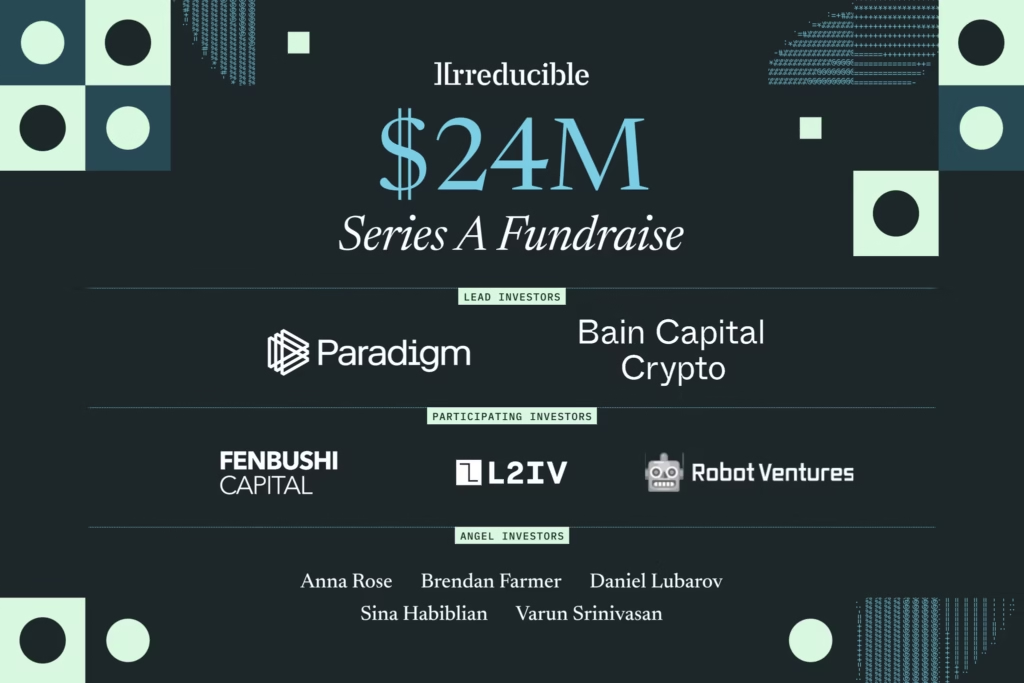
Irreducible Secures a Game-Changing $24 Million Series A to Transform Verifiable...

0
Irreducible, a company dedicated to building the foundational infrastructure of the verifiable Internet, has successfully raised $24 million in a Series A funding...