Published: October 14, 2024 at 12:00 pm Updated: October 14, 2024 at 10:37 am
To improve your local-language experience, sometimes we employ an auto-translation plugin. Please note auto-translation may not be accurate, so read original article for precise information.
The Shiba Inu price has fallen about 6% over the last 24 hours. As a result, Shiba Inu (SHIB) investors are turning their attention to the viral SHIB killer ETFSwap (ETFS). The Ethereum presale token is set to rally 4,700% in 8 days as its beta platform launch is set for the next few days.
ETFSwap (ETFS) To Rally 4,700% With Phase 1 Beta Platform Launch
ETFSwap (ETFS) is set to become the premier destination for trading and investing in tokenized ETFs with its revolutionary platform’s phase 1 beta launch. The ETFSwap (ETFS) team has completed backend development and testing and has deployed the infrastructure on its test net, where rigorous testing and optimization are being conducted.
In the meantime, ETFSwap (ETFS) has prepared a video to be released on its social media platforms shortly to give its community and the crypto community at large a glimpse of its platform and its attractive features and powerful tools for optimal tokenized ETF trading.
Aside from enabling traders and investors to access and trade several popular ETFs, the platform will allow users to stake their tokens for rewards from the platform’s staking rewards pool. Users can also diversify their portfolios with access to various liquidity pools. Additionally, a live ETF tracker will come with an out-of-the-box platform to help traders and investors stay updated on ETF price movements.
ETFSwap (ETFS) will also launch with advanced AI-powered features and tools including its market-making algorithm and an ETF Screener. The market-making algorithm will tighten spreads and reduce slippage effectively so all buy and sell orders will be executed at the best possible prices, giving traders optimal liquidity.
The AI-powered ETF Screener uses artificial intelligence algorithms to analyze huge amounts of market data and identify trends and patterns. It then forms insights from these patterns to help inform users’ investment decisions. Both tools also perform predictive and sentiment analysis so traders and investors have an all-around view of their ETFs of interest.
Shiba Inu Price Plunged Over 6% Prompting Exodus To SHIB Killer ETFSwap (ETFS)
Shiba Inu (SHIB) has found itself sprawling once again. Over the last 24 hours, Shiba Inu price dropped about 6% to $0.00001731. The meme coin’s market capitalization suffered a corresponding decline and so did its trading volume. The Shiba Inu price drop followed a similar price slump on October 8 which had seen Shiba Inu (SHIB) investors begin to explore other investment opportunities.
Prior to the recent Shiba Inu price slump, Shiba Inu (SHIB) was the candidate of choice to lead the altcoin and meme coin charge in Q4 2024. However, the lackluster Shiba Inu price movement has put a stall on those hopes. As a result, Shiba Inu (SHIB) investors are exploring other avenues amid the ongoing Shiba Inu price woes.
Meanwhile, ETFSwap (ETFS) has been welcoming Shiba Inu (SHIB) investors for months now, with substantial inflows coming into the Ethereum token from Shiba Inu (SHIB) holders.
Conclusion
As a result of the ongoing Shiba Inu price woes, Shiba Inu (SHIB) investors have migrated to the ETFSwap (ETFS) presale, creating a major surge for the Ethereum token. ETFSwap (ETFS) has raised over $5 million in revenue and is eyeing $3 million more before the presale concludes.
Leading analysts predict ETFSwap (ETFS) will surge 4,700% in just 8 days as its beta platform launches and generates more buzz for the token. To position for the massive rally, investors should buy the token at its discounted price of $0.03846 before it wraps up soon.
For more information about the ETFS Presale:
Visit ETFSwap Presale
Join The ETFSwap Community
Disclaimer
In line with the Trust Project guidelines, please note that the information provided on this page is not intended to be and should not be interpreted as legal, tax, investment, financial, or any other form of advice. It is important to only invest what you can afford to lose and to seek independent financial advice if you have any doubts. For further information, we suggest referring to the terms and conditions as well as the help and support pages provided by the issuer or advertiser. MetaversePost is committed to accurate, unbiased reporting, but market conditions are subject to change without notice.
About The Author
Gregory, a digital nomad hailing from Poland, is not only a financial analyst but also a valuable contributor to various online magazines. With a wealth of experience in the financial industry, his insights and expertise have earned him recognition in numerous publications. Utilising his spare time effectively, Gregory is currently dedicated to writing a book about cryptocurrency and blockchain.
More articles
Gregory, a digital nomad hailing from Poland, is not only a financial analyst but also a valuable contributor to various online magazines. With a wealth of experience in the financial industry, his insights and expertise have earned him recognition in numerous publications. Utilising his spare time effectively, Gregory is currently dedicated to writing a book about cryptocurrency and blockchain.
Published: October 12, 2024 at 1:57 pm Updated: October 11, 2024 at 6:01 pm
by Ana
Edited and fact-checked:
October 12, 2024 at 1:57 pm
To improve your local-language experience, sometimes we employ an auto-translation plugin. Please note auto-translation may not be accurate, so read original article for precise information.
In Brief
Artificial intelligence advancements have significantly impacted the metaverse, leading to a shift in IT corporations’ objectives and the introduction of wearable technology for immersive experiences.
The fast advancement of artificial intelligence has had a substantial impact on the trajectory of the metaverse. The early fervor around virtual worlds has given way to a more sober perspective that emphasizes useful applications and the incorporation of artificial intelligence technology. Major IT corporations have reevaluated their objectives as a result of this change, with some allocating money from AI development to metaverse projects.
The introduction of the latest hardware has been one of the most noteworthy advances in the metaverse scene. The wearable technology of Apple’s mixed reality headset, Vision Pro, Meta’s smart glasses, and Ray-Ban both mark progress. With the goal of providing consumers with immersive experiences that bridge the gap between virtual and augmented reality, these gadgets seek to seamlessly integrate digital material with the real environment.
Nonetheless, a number of issues have prevented the metaverse from being widely adopted. Infrastructure restrictions, like the requirement for high-quality internet connections and powerful AI processors, remain key impediments. In addition, many prospective customers are still concerned about the cost and processing capability of the gadgets.
Notwithstanding these challenges, work is still being done to provide the groundwork for a stronger metaverse ecology. The merging of AI and virtual worlds is likely to change content production within these digital environments. AI-powered technologies like ChatGPT may eventually enable creators to create whole virtual worlds, possibly altering the way people interact with and build digital locations.
Additionally, the metaverse’s AI integration should improve user engagement and interactions. Artificial intelligence technologies have the potential to enhance virtual worlds’ intuitiveness, responsiveness, and personalization, hence facilitating prolonged and deeper user immersion.
Considerable progress has been made in the regulatory domain to influence the metaverse’s future. The International Telecommunication Union (ITU) held its inaugural meeting on the subject in Riyadh, Saudi Arabia, as part of its efforts to support pre-standardization projects for the metaverse. With this event, a focus group tasked with creating a roadmap for technical standards was established, and a worldwide discussion on metaverse standards was launched.
Similar to this, the European Commission has established a plan for virtual worlds and Web 4.0 with the goal of guaranteeing an inclusive, safe, and open digital environment. The three main objectives of this approach are to empower users, assist the European Web 4.0 industrial ecosystem, and develop international standards for virtual worlds that are interoperable.
With the Ministry of Industry and Information Technology announcing intentions to organize a working group tasked with creating standards for the metaverse, China has also entered the race. This project emphasizes how the metaverse is developing on a global scale and how crucial it is for nations to work together to set rules and guidelines.
Regulators in the US are moving to support the technical specifications of metaverse technology. It is anticipated that the Federal Communications Commission’s decision to permit extremely low-power devices, such as AR and VR headsets, to utilize the 6 GHz band would speed up data transfers and lessen interference, resolving some of the technical issues that the creation of the metaverse has to deal with.
The metaverse’s corporate environment is also changing. There are indications of a strategic reversal even if certain businesses, like Meta, have made investments in the metaverse. Given the company’s current emphasis on AI research, several analysts have theorized that it may abandon its goals for the metaverse. However, it’s crucial to emphasize that these technologies are not mutually exclusive, and AI breakthroughs may eventually enhance metaverse experiences.
Some businesses are looking to find creative methods to incorporate metaverse ideas into already-existing platforms. For instance, Starbucks and Dubit have teamed to provide virtual storefronts in well-known Roblox role-playing games. This program allows users to purchase virtual beverages, communicate with other gamers, and participate in treasure hunts that can lead to real-world prizes. These kinds of initiatives show how virtual experiences may be combined with real-world advantages to create new kinds of client loyalty and engagement.
The game industry continues to play a vital role in creating metaverse technology and consumer expectations. Metaverse concepts are already being tested on platforms like Roblox, which lets marketers try out virtual stores and immersive marketing campaigns. These projects are increasing user interaction while also offering insightful information about the possible metaverse economic structures.
South Korea’s Ministry of Science and ICT has launched a metaverse plan that comprises ethical principles focusing on honest identity, safe experience, and sustainable prosperity. This approach acknowledges the inherent hazards connected with immersive virtual worlds and tries to build a framework for responsible development and usage.
The metaverse’s future is still unknown; its final shape and significance are still up in the air. Even if the initial excitement may have died down, continued technical developments—especially in the areas of technology and artificial intelligence — keep expanding the possibilities in virtual worlds. The combination of blockchain technology and decentralized systems may also play a role in developing the metaverse, perhaps allowing new kinds of digital ownership and economy.
Disclaimer
In line with the Trust Project guidelines, please note that the information provided on this page is not intended to be and should not be interpreted as legal, tax, investment, financial, or any other form of advice. It is important to only invest what you can afford to lose and to seek independent financial advice if you have any doubts. For further information, we suggest referring to the terms and conditions as well as the help and support pages provided by the issuer or advertiser. MetaversePost is committed to accurate, unbiased reporting, but market conditions are subject to change without notice.
About The Author
Victoria is a writer on a variety of technology topics including Web3.0, AI and cryptocurrencies. Her extensive experience allows her to write insightful articles for the wider audience.
More articles
Victoria d’Este
Victoria is a writer on a variety of technology topics including Web3.0, AI and cryptocurrencies. Her extensive experience allows her to write insightful articles for the wider audience.
The metaverse is a virtual world where users can interact and transact in a virtual environment. Web3 technologies, such as blockchain and non-fungible tokens (NFTs), can enable the creation of new types of metaverse experiences, such as virtual real estate, and enable users to own and trade virtual assets.
As the metaverse continues to grow and evolve, it is important for companies and organizations to consider how they can leverage these technologies to create innovative and immersive virtual experiences. In this blog, we will explore some of the top metaverse development companies in the USA that are leading the way in this space.
Metaverse companies are organizations that develop and operate virtual worlds, often referred to as the metaverse. The metaverse is a virtual world where users can interact and transact in a virtual environment. Web3 technologies, such as blockchain and non-fungible tokens (NFTs), can enable the creation of new types of metaverse experiences, such as virtual real estate, and would allow users to own and trade virtual assets.
Metaverse companies can operate a wide range of virtual worlds, including gaming, social media, education, entertainment, and more. These companies often use a combination of web3 technologies, such as blockchain, virtual reality (VR), and augmented reality (AR), to create immersive and interactive virtual experiences for users.
Metaverse companies are at the forefront of the development of the virtual world and are working to create new types of virtual experiences and business models that leverage the power of Web3 technologies. These companies are driving innovation in the metaverse and shaping the virtual world’s future.
Join us in shaping the future of digital experiences. Together, we can unlock the full potential of the metaverse and create innovative solutions that revolutionize industries and enhance human interaction..
Vegavid Metaverse development company services
Metaverse development companies in the USA offer a wide range of services to create immersive and interactive virtual experiences. Some of the common services they provide include:
Virtual World Design: Designing and developing virtual worlds that users can explore, interact with, and customize. This involves creating 3D environments, landscapes, and user interfaces.VR/AR Application Development: Building virtual reality (VR) and augmented reality (AR) applications that allow users to experience the metaverse through headsets, mobile devices, or web browsers.Blockchain Integration: Implementing blockchain technology, such as Ethereum, to enable the creation and management of virtual assets as non-fungible tokens (NFTs). This ensures ownership, scarcity, and security of virtual items.NFT Implementation: Creating and integrating NFTs to represent unique digital assets, such as virtual real estate, in-game items, digital art, and collectibles within the metaverse.User Experience (UX) Design: Focusing on user-centric design to ensure a seamless and intuitive user experience while navigating and interacting within the virtual world.Virtual Asset Creation: Developing 3D models, animations, textures, and other digital assets that users can own, trade, and use within the metaverse.Social Networking Features: Implementing social features that allow users to connect, communicate, and collaborate with others within the virtual world.E-commerce Integration: Enabling virtual marketplaces where users can buy, sell, and trade virtual assets and NFTs.Cross-platform Compatibility: Ensuring compatibility of the metaverse platform across various devices, including VR headsets, AR glasses, smartphones, and PCs.Security and Data Privacy: Implementing robust security measures to protect user data and virtual assets, and adhering to data protection regulations.Cloud Infrastructure: Building scalable and reliable cloud-based infrastructure to accommodate a large number of users and ensure smooth performance.Virtual Events and Experiences: Creating and hosting virtual events, conferences, concerts, and other interactive experiences within the metaverse.Analytics and Insights: Providing analytics and insights to track user behavior, engagement, and performance metrics within the virtual environment.
Metaverse development companies tailor their services to meet the unique requirements of clients from various industries, such as gaming, entertainment, education, real estate, social networking, and e-commerce.
Metaverse development companies in USA operate by creating and operating virtual worlds, often referred to as the metaverse. These companies use a combination of web3 technologies, such as blockchain, virtual reality (VR), and augmented reality (AR), to create immersive and interactive virtual experiences for users.
Metaverse development companies may operate a wide range of virtual worlds, including gaming, social media, education, entertainment, and more. These companies typically work to create new types of virtual experiences and business models that leverage the power of Web3 technologies.
To operate a virtual world, metaverse development companies may use a variety of tools and techniques, including game engines, 3D modeling software, and virtual reality headsets. They may also use blockchain and smart contract technologies to enable users to own and trade virtual assets, and to automate the execution of virtual agreements.
Metaverse development companies may also work with partners and stakeholders, such as content creators, developers, and investors, to create and operate their virtual worlds. These companies may also engage with users through marketing and community-building efforts to build and maintain a user base for their virtual worlds.
The Metaverse has emerged as an exciting frontier, captivating individuals and industries alike with its immersive and interactive possibilities. As the demand for Metaverse applications continues to rise, it’s crucial to partner with a reliable and skilled development company that can bring your virtual visions to life. In this blog post, we present the top eight Metaverse development companies in the USA, renowned for their expertise, innovation, and exceptional solutions.
These companies have demonstrated their prowess in crafting Metaverse applications across various industries, from gaming and entertainment to education, healthcare, and beyond. Their teams of talented developers, designers, and technologists are at the forefront of Metaverse technologies, leveraging virtual reality (VR), augmented reality (AR), and other cutting-edge tools to deliver captivating user experiences.
In this blog, we’ll explore each of these Metaverse development companies in detail, highlighting their strengths, notable projects, and client testimonials. We’ll delve into their capabilities, range of services, and areas of specialization to help you make an informed decision when selecting a Metaverse development partner.
Whether you’re an entrepreneur seeking to launch a groundbreaking gaming experience, a business looking to revolutionize collaboration through virtual workspaces, or an organization aiming to enhance training simulations, these top Metaverse development companies have the expertise and skills to turn your ideas into virtual reality.
Stay tuned for our upcoming posts as we dive into the profiles of these exceptional Metaverse development companies, showcasing their unique contributions to the ever-expanding digital realm. Embark on an exciting journey through the Metaverse with these industry leaders who are pushing the boundaries of what’s possible in virtual experiences.
1. Vegavid Technology
One thing that sets Vegavid apart from other metaverse development companies in USA is their commitment to delivering top-quality products and services to their clients. Vegavid is the top metaverse development company in USA. They have a track record of successfully completing projects on time and within budget. They have a reputation for going above and beyond to ensure that their clients are satisfied with the final result.
Infosys has also developed virtual training and education programs for clients in a variety of industries. These programs use cutting-edge virtual reality technology to create interactive and engaging learning experiences for students and professionals.
In addition to its work in virtual events and education, Infosys has also developed virtual retail spaces for clients in the retail industry. These virtual stores allow customers to shop and purchase products from the comfort of their own homes, using VR technology to browse and interact with products in a realistic and immersive way.
Overall, Infosys is a leading player in metaverse development in the USA, with a strong track record of delivering high-quality virtual experiences for its clients. Whether it’s virtual events, education programs, or retail spaces, Infosys has the expertise and resources to bring clients’ metaverse visions to life.
One of the key services that Whipro offers in the field of metaverse development is the creation of virtual events and conferences. Wipro, the best USA Metaverse development company has developed numerous virtual events for clients, including annual meetings, product launches, and trade shows. These events allow attendees to participate and engage with the content in a virtual environment, making them a valuable alternative to in-person events during the COVID-19 pandemic.
Travancore Analytics has a team of experienced developers who have been building virtual reality and augmented reality experiences for many years. This means they have the knowledge and expertise to create high-quality virtual worlds tailored to meet your specific needs.
Travancore Analytics is known for its innovative approach to metaverse development. They are always exploring new technologies and techniques to ensure they can deliver the most immersive and engaging virtual reality experiences to their clients.
Travancore Analytics is committed to delivering customized solutions to their clients. They have a team of developers who work closely with clients to understand their specific needs and requirements, and they use this information to build virtual reality experiences that meet those needs.
INORU is committed to delivering customized solutions to their clients. They have a team of developers who work closely with clients to understand their specific needs and requirements, and they use this information to build virtual reality experiences that meet those needs.
In addition to metaverse development, INORU offers a range of related services, including virtual reality game and app development. This means they have the expertise and resources to build a wide range of virtual reality experiences, from simple VR games to complex virtual worlds.
SemiDot Infotech is a USA’s best metaverse development company offering a range of services for clients looking to build virtual and augmented reality experiences. SemiDot Infotech has a team of experienced developers who specialize in building high-quality virtual worlds for a variety of industries. They use the latest technologies and techniques to create immersive and engaging virtual reality experiences.
Virtual reality app development: SemiDot Infotech also offers virtual reality app development services for clients looking to build VR apps for a range of platforms, including mobile, desktop, and console.
Suffescom Infotech also offers virtual reality app development services for clients looking to build VR apps for a range of platforms, including mobile, desktop, and console. In addition to virtual reality app development, Suffescom Infotech also offers augmented reality app development services. They have the expertise and resources to build AR apps for a variety of platforms and industries.
Suffescom Infotech has a team of experienced game developers who specialize in building high-quality VR games. They have the knowledge and expertise to create immersive and engaging VR experiences tailored to meet clients’ specific needs.
TCS is a leading player in the field of metaverse development, with a strong track record of delivering high-quality virtual experiences for its clients. Whether it’s virtual events, education programs, or retail spaces, TCS has the expertise and resources to help clients bring their metaverse visions to life. TCS is a popular metaverse development company that is known for its expertise in creating innovative and immersive virtual reality experiences. If you are looking to build a virtual world or virtual reality app, TCS is worth considering for your project.
To choose the right Metaverse development company, consider factors such as their expertise in Metaverse technologies, their portfolio of past projects, client reviews and testimonials, their ability to understand and execute your vision, and their commitment to delivering high-quality and innovative solutions.
Choosing the right Metaverse development company in the USA is a critical decision that can significantly impact the success of your project. Here are some key factors to consider when making your choice:
Experience and Expertise: Look for a company with a proven track record in Metaverse development. Check their portfolio, client testimonials, and case studies to gauge their expertise and the quality of their previous work.Range of Services: Ensure that the company offers a comprehensive range of services, including virtual world design, VR/AR application development, blockchain integration, NFT implementation, and more, to meet your project requirements.Technology Stack: Assess the technologies and platforms the company uses for Metaverse development. A reputable company should be familiar with the latest VR/AR tools, blockchain protocols, and game development technologies.Customization and Flexibility: Choose a company that can tailor their services to your specific needs and preferences. They should be willing to adapt their approach to match your project vision and goals.Security and Privacy: Data security is crucial in the Metaverse. Ensure the company implements robust security measures to protect user data and virtual assets.Client Communication: Effective communication is essential throughout the development process. Look for a company that is responsive, transparent, and keeps you informed about project progress.Portfolio and References: Review the company’s previous projects and ask for references from past clients to get insights into their work ethic and client satisfaction.Cost and Budget: Get detailed cost estimates and compare them with the scope of work and the quality of services offered. Be cautious of companies that offer significantly lower prices as it may impact the project’s quality.Innovative Approach: Look for a company that embraces innovation and stays updated with the latest trends and technologies in the Metaverse industry.Support and Maintenance: Inquire about post-development support and maintenance services. A reliable company should be available to assist with any issues that may arise after the project is completed.Reputation and Reviews: Research the company’s reputation online through reviews and ratings on platforms like Clutch, Upwork, or Google.Legal and Compliance: Ensure the company follows legal and regulatory guidelines for Metaverse development and respects intellectual property rights.
By thoroughly evaluating these factors and conducting due diligence, you can choose a reputable Metaverse development company in the USA that aligns with your project goals and ensures a successful and immersive virtual experience for your users.
Yes, Metaverse app development companies in the USA have the expertise to develop Metaverse apps for various industries. They can create applications for gaming, social networking, real estate, education, healthcare, marketing, and more. They adapt their skills and technologies to meet the unique requirements of different industries.
The timeline for developing a Metaverse app can vary depending on the complexity of the project, desired features, and the scope of work. It is best to consult with the development company to get an accurate estimate based on your specific requirements. They will consider factors such as design, development, testing, and deployment phases to provide you with a timeline.
What ongoing support and maintenance do Metaverse development companies in the USA provide?
Metaverse software development companies in the USA typically offer post-launch support and maintenance services. This includes addressing any issues that may arise, implementing updates, and ensuring the continued optimal performance of the Metaverse app. They provide ongoing assistance to clients, ensuring their apps remain up-to-date and functional.
The future of metaverse development software companies in USA is likely to be shaped by the continued growth and evolution of the virtual world and the adoption and development of Web3 technologies. Some possible future developments for metaverse development companies include:
1. Increased adoption and mainstream use
The USA Metaverse development companies may see increased adoption and mainstream use of their virtual worlds as more people become familiar with and interested in virtual experiences. This could lead to the creation of new business models and revenue streams for these companies.
2. Greater interoperability
Metaverse development companies may work to improve interoperability between their virtual worlds and traditional online technologies, such as the web and mobile apps. This could make virtual experiences more accessible and user-friendly for mainstream users.
3. New business models
Metaverse development companies may explore new business models and revenue streams, such as decentralized marketplaces and peer-to-peer (P2P) platforms, to take advantage of the unique capabilities of Web3 technologies.
4. Improved security and privacy
Metaverse development companies may use Web3 technologies, such as decentralized identity (DID) systems, to improve security and privacy for users in their virtual worlds. This could help to reduce the risk of data breaches and identity theft and give users more control over their online privacy.
5. Greater integration with the physical world
Metaverse development companies may use Web3 technologies, such as smart contracts and decentralized sensors, to enable greater integration between the digital and physical worlds, enabling new types of automation and interactions. This could lead to new applications and use cases in industries such as logistics, supply chain management, and the Internet of Things (IoT).
Overall, the future of metaverse development companies is likely to be influenced by the continued growth and evolution of the virtual world and the adoption and development of Web3 technologies. These companies will play a key role in shaping the virtual world’s future and creating new types of virtual experiences and business models.
Conclusion
The metaverse is a rapidly evolving space, and metaverse development companies are at the forefront of its development. These companies are using Web3 technologies, such as blockchain and virtual reality (VR), to create immersive and interactive virtual experiences for users. The future of metaverse development companies is likely to be shaped by the continued growth and evolution of the virtual world and the adoption and development of Web3 technologies. Some possible future developments for these companies include increased adoption and mainstream use, greater interoperability, new business models, improved security and privacy, and greater integration with the physical world. Overall,
Published: October 10, 2024 at 1:00 pm Updated: October 09, 2024 at 12:36 pm
To improve your local-language experience, sometimes we employ an auto-translation plugin. Please note auto-translation may not be accurate, so read original article for precise information.
The cryptocurrency market is currently experiencing volatility as investors search for the next big altcoin that will provide tremendous gains. Although Cardano (ADA) has been around the scene for some time now, a new AI-based coin, IntelMarkets (INTL), is about to join the race.
Experts say this new token could give a 20x return on investment by the fourth quarter of 2024. Meanwhile, IDA Finance has adopted Chainlink’s CCIP and PoR technologies for its stablecoin.
Cardano (ADA) Will Shock Everyone, Says Analyst
In a recent analysis video, crypto analyst Dan Gambardello said that Cardano (ADA) is on the brink of a significant price movement, and many traders may not expect it. He analyzed the performance of the Cardano crypto during the 2020 bull run and correlated it with the current bull run.
According to him, this consolidation phase could end suddenly, and the Cardano price might easily soar above the $1 barrier by December. He suggested that the broader crypto market could push Cardano (ADA) into the $5 to $10 zone.
In the meantime, the Cardano coin is trading within a narrow range of $0.3-$0.4 on the monthly chart. The sentiment around the cryptocurrency is bearish, judging from the 14-day RSI, which has dipped below $50.
IDA Finance Taps Chainlink (LINK) PoR and CCIP for Stablecoin Product
Hong Kong-based digital assets issuer IDA Finance revealed that it will be incorporating Chainlink’s (LINK) services into its upcoming HKDA stablecoin. The platform will be integrating with Chainlink’s Proof of Reserves and Cross-Chain Interoperability Protocol.
With the help of Chainlink (LINK) PoR, users and investors can check the assets that back up HKDA and the reserve assets held by IDA. Despite the news, the Chainlink coin is showing losses on the weekly and monthly timeframes.
The price of the Chainlink crypto has dropped below the 50-Day SMA ($11.33) and 200-Day SMA ($14.81) due to the downtrend. Even the 14-day RSI is now bearish, trading below the 50 mark. If recovery occurs, the Chainlink price could retest these resistances in the coming weeks.
Investors Rush To IntelMarkets (INTL) for 20x Profit
IntelMarkets (INTL) is working on a crypto trading platform that will allow traders to access some of the rare advanced tools used by Wall Street giants. Some of the tools it offers include IntelMarkets’ Autopilot Trading Robots, Intelli M trading systems, and so on. Research revealed that the perpetual futures market was valued at $101.9 Billion in 2022.
IntelMarkets’ vision is to become a giant in the cryptocurrency trading market and provide perpetual futures trading to its users. Both experienced traders and newbies will be able to use its advanced trading instruments as well as features such as copy trading, 1000x leverage, and fast trades. Further, IntelMarkets will have an AI trading Bot to help investors generate more profit.
The bots can keep track of price variations in the market and also follow trading strategies given to them. What makes them unique is their self-learning capability. They can learn from trading errors or mistakes and improve on them in future trades. Based on these features, analysts say IntelMarkets could become the goto platform for crypto trading in the future.
Meanwhile, IntelMarkets’s ongoing crypto ICO has been a major success. The project just crossed $1 million in funds raised and is now heading for $2 million. Also, the price of its native token, INTL, is up 200%. Analysts expect a price surge of 20x in the coming months.
Investors Rush To IntelMarkets for 20x ROI in Q4 2024
IntelMarkets is the best crypto to buy right now. Analysts forecast its price could increase by 20x before 2025, outshining top altcoins like Cardano (ADA) and Chainlink (LINK).
Discover More About IntelMarkets:
Presale: https://intelmarketspresale.com/
Telegram: https://t.me/IntelMarketsOfficial
Twitter: https://x.com/intel_markets
Meta Title: Is This AI Coin the Next Cardano? Experts Predict 20x ROI in Q4 2024; IDA Finance Integrates Chainlink CCIP & PoR
Meta Description: Experts suggest this AI coin could rival Cardano with a potential 20x ROI in Q4 2024, while IDA Finance adopts Chainlink’s CCIP and PoR technology.
Disclaimer
In line with the Trust Project guidelines, please note that the information provided on this page is not intended to be and should not be interpreted as legal, tax, investment, financial, or any other form of advice. It is important to only invest what you can afford to lose and to seek independent financial advice if you have any doubts. For further information, we suggest referring to the terms and conditions as well as the help and support pages provided by the issuer or advertiser. MetaversePost is committed to accurate, unbiased reporting, but market conditions are subject to change without notice.
About The Author
Gregory, a digital nomad hailing from Poland, is not only a financial analyst but also a valuable contributor to various online magazines. With a wealth of experience in the financial industry, his insights and expertise have earned him recognition in numerous publications. Utilising his spare time effectively, Gregory is currently dedicated to writing a book about cryptocurrency and blockchain.
More articles
Gregory, a digital nomad hailing from Poland, is not only a financial analyst but also a valuable contributor to various online magazines. With a wealth of experience in the financial industry, his insights and expertise have earned him recognition in numerous publications. Utilising his spare time effectively, Gregory is currently dedicated to writing a book about cryptocurrency and blockchain.
Every year, brands invest in stunning, festive campaigns such as over-the-top brick-and-mortar displays and interactive pop-up experiences to capture shopper’s attention, highlight seasonal collections and drive sales during the holiday season. With virtual holiday pop-up experiences, brands get the best of both worlds: digital extravagance and engaging interactivity in immersive pop-up experiences primed for the busy shopping season. Plus, as an added bonus, a virtual plane to showcase holiday campaign assets.
Virtual holiday pop-ups are temporary installations that offer a unique blend of engagement and immersive storytelling, offering holiday shoppers a one-stop shop to discover, research and seamlessly purchase gifts. Just like physical holiday pop-ups, virtual holiday pop-up experiences are interactive and memorable—perfect for building buzz around seasonal collections and brand moments.
Pair physical holiday pop-up activations with a digital counterpart to maximize the ROI and extend its reach, or create a standalone virtual holiday pop-up filled with decor and features only possible in the digital realm to engage shoppers. See how leading brands in fashion, beauty, CPG and more have worked with Obsess to create virtual pop-up experiences for their holiday campaign mix.
Coach Virtual Holiday Gift Shop
Open for the holidays, Coach unveiled an ultra-engaging, highly-gamified virtual pop-up store set in a retro gift shop for shoppers on their direct-to-consumer e-commerce site. The virtual experience showcased products form the brand’s holiday collection, and featured several engaging features such as a mascot scavenger hunt game and the ability to shop with friends via live video feeds. Combining technology, innovation and creativity, Coach won a Webby Award in Retail and Shopping in the Metaverse, Immersive and Virtual Category for this virtual holiday experience.
E.l.f. Cosmetics Virtual Holiday Workshop
The e.l.f.z worked their holiday magic with the Virtual Workshop by e.l.f. Cosmetics, coating every virtual corner with glitter and the “most OMG gifts” of the season. The virtual holiday pop-up shop enabled visitors to discover must-have beauty stocking stuffers and digital branded mini games like a matching game built into a red sequin wall. The virtual playscape was primed for shopping during the busy gifting season, with each product available for purchase directly in the workshop. Spotlighting the Sleigh the Holiday Gift Finder, shoppers could find their perfect present with a three-question quiz.
Elizabeth Arden Holiday Experience
Revlon beauty brand, Elizabeth Arden, routinely refreshes the products and decor in their virtual experience, leveraging visual merchandising to highlight new products. For the holiday season, they showcased their curated gift sets, wrapped neatly in red and gold. Outside, visitors were greeted with a flurry of snow. Inside, they were met with festive decor, a personalized skincare quiz, new branded online games such as a two-level matching game and their infamous AI-generated gallery-style exhibit to showcase the brand’s history through AI-enhanced archival footage.
Rao’s Virtual Holiday Saucery Pop-up
Legendary specialty foods brand Rao’s immortalized their IRL pop-up experience with a digital twin—later revealing a holiday version of the Virtual Saucery as part of their seasonal marketing campaign. The Virtual Holiday Saucery Pop-up shop empowered users to explore the brand’s best in glass products and get lost in the sauce, learning more about their premium portfolio and difference. Shoppers were immersed into Rao’s virtual brand world with seasonal decor, animated cheer and interactive features such as their custom digital jigsaw puzzle game and holiday giveaway challenge.
Crocs Virtual Holiday Pop-up Shop
Screenshot
Adding to their troupe of virtual pop-ups, including their innovative Jibbitz experience, Crocs created a virtual 3D holiday experience—decking the halls with boughs of holly and seasonal Jibbitz. When entering, users could take a quiz for suggestions on the perfect present, directing them to thematic rooms with the recommended products; from glitzy, disco balls to pink, fuzzy walls, each room emphasized the personality of the famed shoe charms in it. To further engage visitors of the experience, Crocs also included media assets from their holiday campaign and a custom branded game to catch Jibbitz for an exclusive prize.
Laura Mercier World of Beauty: Holiday Edition
Stocking stuffers and gift sets galore, the Laura Mercier World of Beauty virtual experience got a stunning, festive makeover for the holidays. Sporting new animations and decor, the temporary look showcased the Orveon brand’s seasonal collection alongside engaging, fan-favorite features of the original experience. Visitors could still play the scavenger hunt game, take a custom color quiz and try on personalized product recommendations with AR technology. As always, each product was available for purchase directly in the virtual experience—users could even add full looks from their color quiz results and the Virtual Try-On feature.
Immersive holiday pop-up experiences are a powerful tool for brands looking to engage shoppers in new and exciting ways. Focused on personalization and engagement, these highly-visual experiences are transforming holiday online shopping. To learn more about how to stand out this holiday season with interactive virtual holiday pop-up experiences, book a demo or email contact@obsessvr.com.
Published: October 09, 2024 at 7:30 am Updated: October 09, 2024 at 7:30 am
by Ana
Edited and fact-checked:
October 09, 2024 at 7:30 am
To improve your local-language experience, sometimes we employ an auto-translation plugin. Please note auto-translation may not be accurate, so read original article for precise information.
In Brief
HashKey Global listed CARV and launched a deposit bonus event, offering 120,000 CARV in rewards on a first-come, first-served basis.
Cryptocurrency exchange HashKey Global announced the initial listing of CARV (CARV). Deposits for CARV are now open, with spot trading set to commence at 08:00 UTC on October 10th. Withdrawals will be available starting at 08:00 UTC on October 11th, all conducted through the Base network.
Furthermore, in order to celebrate the listing, HashKey Global is offering new users the opportunity to participate in an exclusive deposit bonus event, featuring a total reward pool of 120,000 CARV, which will be distributed on a first-come, first-served basis. This campaign has already begun and will run until 16:00 UTC on October 15th.
During the event, new users making their first deposit of CARV will receive a 200% CARV bonus based on their net deposits throughout the event period. The total reward pool is limited to 120,000 CARV, with a maximum reward of 200 CARV available per user until all rewards are claimed.
CARV: Overview Of Tokenomics, Upcoming Token Release, And Mainnet Launch
The company is working on one of the largest modular identity and data layers (IDLs) focused on gaming and AI. The platform has designed the CARV Protocol, which offers a comprehensive data infrastructure that enables users to own, control, and monetize their data. This infrastructure also provides high-quality data to gaming, AI, as well as other data-intensive industries, promoting innovation.
To date, it has attracted more than 2.8 million gamers worldwide, with approximately 650,000 daily active users. Additionally, the platform has integrated with 790 Web2 and Web3 games, generating nearly $4 million in revenue during the first half of the current year.
The CARV token is planned to be introduced alongside the platform’s mainnet. Once operational, it will serve as the primary medium of exchange within the CARV ecosystem and will incentivize user participation.
The total supply of CARV is set to be 1 billion, with distribution occurring over four years. As per the CARV tokenomics, 50% of the supply will be allocated to nodes and the community, 19.46% to the founding team and advisors, 9.25% to early investors, 9% to the ecosystem, 8.30% to private fundraising, and 4% to liquidity.
Disclaimer
In line with the Trust Project guidelines, please note that the information provided on this page is not intended to be and should not be interpreted as legal, tax, investment, financial, or any other form of advice. It is important to only invest what you can afford to lose and to seek independent financial advice if you have any doubts. For further information, we suggest referring to the terms and conditions as well as the help and support pages provided by the issuer or advertiser. MetaversePost is committed to accurate, unbiased reporting, but market conditions are subject to change without notice.
About The Author
Alisa, a dedicated journalist at the MPost, specializes in cryptocurrency, zero-knowledge proofs, investments, and the expansive realm of Web3. With a keen eye for emerging trends and technologies, she delivers comprehensive coverage to inform and engage readers in the ever-evolving landscape of digital finance.
More articles
Alisa Davidson
Alisa, a dedicated journalist at the MPost, specializes in cryptocurrency, zero-knowledge proofs, investments, and the expansive realm of Web3. With a keen eye for emerging trends and technologies, she delivers comprehensive coverage to inform and engage readers in the ever-evolving landscape of digital finance.
Published: October 07, 2024 at 11:33 am Updated: October 07, 2024 at 11:34 am
by Ana
Edited and fact-checked:
October 07, 2024 at 11:33 am
To improve your local-language experience, sometimes we employ an auto-translation plugin. Please note auto-translation may not be accurate, so read original article for precise information.
In Brief
Bitfinex Alpha reported that Bitcoin’s 10% retracement during the week was driven by spot selling and unwinding of leveraged positions.
The digital asset trading platform Bitfinex Alpha released its latest market analysis report, offering insights into the current state of Bitcoin.
The firm observed that Bitcoin experienced a 10% retracement during the week, primarily driven by aggressive spot selling and a broader market unwinding of leveraged positions. After reaching a local high of $66,587 on September 27th, its price declined sharply, particularly after losing the critical support level of $65,200, which triggered cascading long liquidations and caused the price to drop to $60,000.
Additionally, spot market selling was further impacted by escalating geopolitical tensions between Iran and Israel, which heightened de-risking efforts and contributed to long liquidations totaling $450 million on October 1st. As Bitcoin faced its first series of four consecutive red days since early August, the market underwent a necessary realignment. Open interest (OI) decreased from overheated levels above $35 billion to $31.8 billion, indicating a stabilization of market conditions and a reduced risk of sudden price fluctuations.
On October 4th, Bitcoin recovered to $62,500, buoyed by positive labor market data, and climbed to a peak of $64,027 during early trading sessions on October 7th as some spot buying activity returned. However, it may be premature to draw firm conclusions regarding the short-term direction of the market. As the market continues to react to various factors, insights into the future trajectory of Bitcoin and the broader market may emerge from trading positions observed in the early sessions of the week, especially within the US market.
US Labor Market Shows Resilience With Strong Job Gains, Boosting Market Sentiment
The firm highlighted that the labor market data, which contributed to the market’s positive sentiment, indicated that September saw its strongest job gains in six months, with the unemployment rate decreasing from 4.2 percent in August to 4.1 percent. This decline reflects the economy’s resilience.
However, despite the robustness in the labor market, other sectors have not yet experienced the benefits of eased monetary policy. The Federal Reserve is anticipated to lower interest rates again in November, yet the manufacturing sector continues to face challenges due to elevated rates and reduced demand compared to the previous year. In contrast, the US service sector experienced a sharp increase in new orders in September, achieving its highest activity level in 18 months. This growth suggests sustained economic strength throughout the third quarter of 2024, even as different sectors encounter varying degrees of pressure.
Disclaimer
In line with the Trust Project guidelines, please note that the information provided on this page is not intended to be and should not be interpreted as legal, tax, investment, financial, or any other form of advice. It is important to only invest what you can afford to lose and to seek independent financial advice if you have any doubts. For further information, we suggest referring to the terms and conditions as well as the help and support pages provided by the issuer or advertiser. MetaversePost is committed to accurate, unbiased reporting, but market conditions are subject to change without notice.
About The Author
Alisa, a dedicated journalist at the MPost, specializes in cryptocurrency, zero-knowledge proofs, investments, and the expansive realm of Web3. With a keen eye for emerging trends and technologies, she delivers comprehensive coverage to inform and engage readers in the ever-evolving landscape of digital finance.
More articles
Alisa Davidson
Alisa, a dedicated journalist at the MPost, specializes in cryptocurrency, zero-knowledge proofs, investments, and the expansive realm of Web3. With a keen eye for emerging trends and technologies, she delivers comprehensive coverage to inform and engage readers in the ever-evolving landscape of digital finance.
Published: October 04, 2024 at 1:19 pm Updated: October 04, 2024 at 1:20 pm
by Ana
Edited and fact-checked:
October 04, 2024 at 1:19 pm
To improve your local-language experience, sometimes we employ an auto-translation plugin. Please note auto-translation may not be accurate, so read original article for precise information.
In Brief
The AI revolution is characterized by unprecedented cost reduction, with AI models’ performance costs decreasing half every four months, compared to Moore’s Law in semiconductors.
A new white paper released by Cathie Wood’s investment firm, ARK Invest, sheds light on the intricate dynamics as prominent business figures navigate the AI landscape.
Is AI Truly Disruptive?
In a new white paper, Chief Futurist @wintonARK outlines how big technology companies are likely to use AI to maintain industry dominance. Will their strategy work?
— ARK Invest (@ARKInvest) October 1, 2024
The Transformation in AI Costs
An unparalleled rate of cost reduction is at the core of the AI revolution. The white paper’s author and chief futurist at ARK Invest, Brett Winton, emphasizes that the cost of running AI models with comparable performance has been cut in half every four months. This is the greatest cost-decrease curve in the history of technology, and it is predicted to continue for the next ten years.
Winton compares this to Moore’s Law in the semiconductor business, where prices normally drop by half every 18 to 24 months, to put things into perspective. The ramifications are obvious: the rate of the AI revolution is four to six times quicker than that of the semiconductor revolution, which has been the engine of technological growth for decades.
Established IT firms face a double-edged sword as a result of this fast cost drop. On the one hand, it offers a chance to make use of progressively potent AI capabilities at declining costs. However, it also makes it easier for startups and smaller rivals to enter the market, which might challenge the big businesses’ hegemony.
In ARK’s view, AI is the most transformative technology in history, and the biggest catalyst to other innovation platforms like autonomous mobility and multiomics sequencing in the quest to cure diseases. Great paper from @wintonARK, ARK’s Chief Futurist! https://t.co/IPV7eouQAT
— Cathie Wood (@CathieDWood) October 2, 2024
The Disruptive Technologies’ Qualities
According to ARK Invest, disruptive technology platforms have three key characteristics: they penetrate new or underserved industries, have significant cost drops, and have business models that take time to monetize and may not seem financially appealing at first.
These qualities foster an atmosphere in which more agile, smaller businesses might challenge the industry giants’ dominance—even when those companies are aware of the potential of the technology and are making efforts to use it for their own financial advantage.
Since AI has each of these characteristics, it is the ultimate disruptive technology. Its prospective applications span a wide range of areas, many of which are currently underserved by current technologies, and its fast cost drops are already apparent. Furthermore, a lot of AI-driven business models follow the trend of disruptive technology by placing more emphasis on user acquisition and data collecting than on quick monetization.
The Big Tech Approach to AI
Both Apple and Google have taken a cautious approach to integrating AI in light of this disruptive potential. According to Winton, established tech businesses frequently use this tactic, letting startups “de-risk” innovative ideas before using them widely.
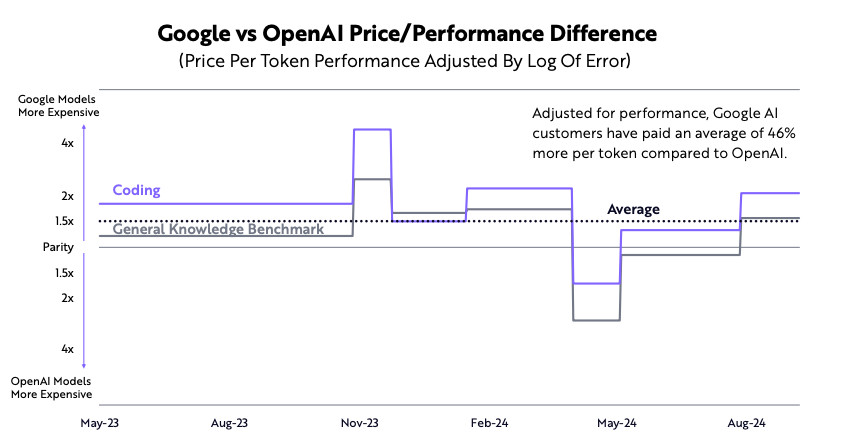
This method is shown by Google’s handling of massive language models. The business waited to make its sophisticated language model available to the public until after OpenAI had been available for more than three years. Even yet, Google’s performance was not as good as OpenAI’s, and users had to pay more than 40% more for Google’s most sophisticated model than for OpenAI’s most effective one.
Photo: ARK Invest
Despite its reputation for rigorous product development, Apple has not yet released a major language model. The business will likely launch its first cutting-edge AI-powered goods in the fall of 2024, far later than many of its rivals.
There are benefits to this methodical approach. As Winton points out, transporting goods that exhibit erratic behavior may be rather unsettling for those who look after a well-built reputation. The foundation of both Google and Apple’s success has been the provision of dependable, user-friendly goods and services. AI’s capacity to yield unexpected or unwanted results poses a serious threat to users’ faith in the company and its brand.
The Opportunity for New Entrants
Due to AI’s disruptive nature and quickly dropping prices, there are many potential for new players to challenge the dominance of well-established tech giants. Smaller businesses and startups may be better equipped to take full use of AI’s promise since they are less constrained by legacy systems and can move rapidly.
This is not just an AI dynamic. Throughout technology’s history, spurts of fast development have frequently resulted in the ascent of new market leaders at the expense of more established firms. New dominating companies emerged with each shift from mainframe computers to personal computers and then to mobile devices.
There might be a similar trend to the AI transformation. Businesses that can quickly experiment, iterate, and adjust to the changing AI landscape might benefit greatly. As a result, the tech sector may become more vibrant and competitive, with new companies emerging to challenge the established powerhouses like Apple and Google.
Managing Innovation and Risk in Balance
The difficulty for Apple and Google is finding the ideal mix between risk management and innovation. These businesses have made billions of users worldwide happy by providing polished, dependable goods and services. Their careful approach to integrating AI is indicative of a thorough comprehension of the possible hazards involved with using unforeseen technology on a large scale.
On the other hand, being overly cautious could lead to lost chances. Since AI is developing so quickly, major changes in the technological environment might occur within months. Businesses who take a long time to adjust run the danger of having to play catch-up in a market that has advanced.
Furthermore, because of the nature of AI development, improvements frequently come via widespread implementation and real-world input. Apple and Google could be reducing their capacity to obtain the information and understanding required to enhance and develop their AI systems if they postpone the release of AI-driven features and products.
Disclaimer
In line with the Trust Project guidelines, please note that the information provided on this page is not intended to be and should not be interpreted as legal, tax, investment, financial, or any other form of advice. It is important to only invest what you can afford to lose and to seek independent financial advice if you have any doubts. For further information, we suggest referring to the terms and conditions as well as the help and support pages provided by the issuer or advertiser. MetaversePost is committed to accurate, unbiased reporting, but market conditions are subject to change without notice.
About The Author
Victoria is a writer on a variety of technology topics including Web3.0, AI and cryptocurrencies. Her extensive experience allows her to write insightful articles for the wider audience.
More articles
Victoria d’Este
Victoria is a writer on a variety of technology topics including Web3.0, AI and cryptocurrencies. Her extensive experience allows her to write insightful articles for the wider audience.
Have you ever thought how and when Microsoft Copilot will be a true assistant and provide you a new kind of support? With the latest updates to Microsoft Copilot this vision is getting closer to reality. Announced on October 1, 2024, the refreshed Copilot vision aims to revolutionize our interaction with technology by focusing on how it feels to users, rather than just the technical details.
Microsoft Copilot: Your AI CompanionNew Upcoming Features to CopilotCopilot Vision and Think DeeperRegional AvailabilityNew Enhancements in Azure OpenAI ServicesGPT-4o-Realtime-Preview with Audio and Speech CapabilitiesPerformance That SpeaksApplications of GPT-4o-Realtime-PreviewWhat’s Next with GPT-4o-Realtime API for Audio?A Commitment to Responsible AI
Microsoft’s Copilot is designed to be a calm, helpful, and supportive presence in your life. It goes beyond merely solving problems; it’s there to support, teach, and help you. Copilot will eventually adapt to your preferences and needs, providing support and helping you navigate life’s complexities. And no, it is not sci-fi-AI-in-making, but just the next step on the road making Copilot more and more useful to us humans. One of the keys to these new features is multi-modality, that is becoming also available via Azure OpenAI Services.
In the future Copilot will be our UI to AI. As voice and natural language UI becomes common, we will have less need to build complex UIs so enable interactions with backend and other systems. Instead of using a traditional UI, we will be just talking or typing to the Copilot, and we will get the results. Perhaps we need to get the data analyzed? Instead of building a PowerBI report, in the future, we ask Copilot to do that. Does that sound like it would be too far in the future? Did you notice that Excel got Python support? You can use Copilot in Excel today to analyze your data, and it generates and runs Python code that is connected to the data. Why would we not be able to do that on BizChat (in the near future, I hope)? The talking to AI might also sound a bit futuristic, but with latest upcoming features to Copilot – it will be there soon. Not in Europe, but in a few other regions first. But it won’t be just a text to speech, but a voice of Copilot that can mimic and understand feelings in the voice.
Why is analyzing data a great example of this? We have various needs and some of those are ad hoc, despite being somewhat complex. And we may not need the results as a report, but instead we need to know or see what it is all about. And often the data is in backend systems, which brings me to connecting Copilot to systems beyond Microsoft 365. We can already start to pilot with extensions and plugins that extend Copilot’s capabilities. Instead of doing a full analysis, we just might want to know the total of sales for the current day or week. Information that can be fetched from the backend, something we could just ask from our Copilot. What’s already in the works is how we can do actions with external systems. Instead of opening a web page or app and logging into a system, we do all this via our digital assistant. This is why this is extremely interesting and important to keep in mind.
This doesn’t happen tomorrow, but as time goes on – it is happening sooner than we think. We can already extend Copilot and build plugins & custom copilot agents using various ways – such as Copilot Studio, Power Automate and pro-code with Teams Toolkit and Teams AI Studio. I would recommend starting to experiment with these as soon as possible to make the organization future proof.
My thoughts and visions align with Microsoft’s Copilot vision, and so it is easy to be very excited about the opportunities and possibilities that are ahead of us on this journey. I was recently taking part in a great meeting with fellow The Digital Neighborhood MVPs at our HQ in Amsterdam. Ideas and thoughts about the future were discussed from various perspectives, and it was one of my colleague-MVPs who brought up the data analysis example, pointing out how code interpretation will be a real game-changer there. It is already there, on various implementation levels. We have also seen how GPT-4o with voice works – if you haven’t seen those videos, do ask Copilot about them (or just search with Bing or Google). The future is interesting, for sure!
New Upcoming Features to Copilot
The latest updates to Copilot will include several new and enhanced features:
Copilot Voice: This feature allows you to connect with your AI companion using voice commands (multi-modality). With four voice options to choose from, it’s the most intuitive way to brainstorm, ask questions, or simply vent. Copilot doesn’t have feelings, so it is a perfect companion for venting things out – a safe place to do that. Don’t confuse Copilot’s capability to mimic feelings in the voice, to actual feelings and emotions. Copilot is a tool and algorithm in the core, and not a AGI (Artificial General Intelligence).
Copilot Daily: Start your morning with a summary of news and weather, all read in your favorite Copilot Voice. This feature helps you manage the daily barrage of information with ease. It is quite cool to see this happening, as it has been present in so many sci-fi-movies and also on future visions.
Copilot in Microsoft Edge: Copilot is now integrated into the Microsoft Edge browser, quickly helping answer questions, summarize page content, translate text, or rewrite sentences. The cool? The multimodality, as Copilot will also understand images on web pages.
Copilot Labs: This platform allows users to test experimental features like Copilot Vision and Think Deeper, providing feedback to shape future updates.
Copilot Vision and Think Deeper
Copilot Vision: This innovative feature enables Copilot to see what you see and interact with web pages in real time, offering suggestions and answering questions without disrupting your workflow.
For Microsoft, safety and security are their top priorities:
Copilot Vision sessions are entirely opt-in and ephemeral. None of the content Copilot Vision engages with is stored or used for training — the moment you end your session, data is permanently discarded.
The experience won’t work on all websites because we’ve taken important steps to put boundaries on the types of websites Copilot Vision can engage. We’re starting with a limited list of popular websites to help ensure it’s a safe experience for everyone.
Copilot Vision won’t work on paywalled and sensitive content for this preview. We’ve created it with both users’ and creators’ interests top of mind.
There is no specific processing of the content of a website you are browsing, nor any AI training. Copilot Vision simply reads and interprets the images and text it sees on the page for the first time along with you.
Before we launch broadly, we’ll continue to take feedback on all the above from early users in Copilot Labs, refine our safety measures and keep privacy and responsibility at the center of everything we do. Let us know what you think!
Think Deeper: Designed to reason through complex questions, this feature provides detailed, step-by-step answers for challenging queries, helping you make informed decisions. This is an early Copilot Skill that’s still undergoing development, so Microsoft placed it in experimental Copilot Labs to test and get feedback.
As exciting as these features are, it’s important to note their regional rollout plans.
Copilot Voice is initially available in English in Australia, Canada, New Zealand, the United Kingdom, and the United States. Expansion to more regions and languages will follow soon.
Copilot Daily is rolling out first in the United States and the United Kingdom, with additional countries to be added shortly.
Copilot Vision will be accessible through Copilot Labs to a limited number of Copilot Pro subscribers in the United States.
Think Deeper starts its rollout this week to a limited number of Copilot Pro users in Australia, Canada, New Zealand, the United Kingdom, and the United States.
Unfortunately, for those of us in Europe, we will need to wait a bit longer for these exciting new features. Microsoft is working diligently to ensure that personalization in Copilot adheres to the Microsoft Privacy Statement, and options for offering personalization to users in the European Economic Area and the United Kingdom are still being finalized.
Read more about these updates and Microsoft’s Copilot vision from their blog post.
As Copilot is using Azure OpenAI Services (AOAI) in the background (users don’t see these, they just use Copilot) the advancements in AOAI make it possible to bring those features to Copilot. Microsoft just announced several updates to Azure OpenAI Services, Below, read about the latest advancements and the potential opportunity.
GPT-4o-Realtime-Preview with Audio and Speech Capabilities
The introduction of GPT-4o-Realtime-Preview marks a significant milestone: advanced voice capabilities to the Microsoft Azure OpenAI Service, expanding GPT-4o’s multimodal offerings. The integration of language generation with voice interaction allows developers to craft more natural and conversational AI experiences. From creating virtual assistants to powering real-time customer support, the possibilities are vast and promising. And the abovementioned Copilot Voice is a good example of how to utilize this capability.
The GPT-4o-Realtime API supports audio input and output, enabling real-time, natural voice-based interactions. This multimodal capability empowers developers to build innovative voice applications with ease, providing faster and more engaging responses that minimize the robotic tone often associated with AI-generated speech. Moreover, the API supports a wide range of languages, facilitating natural, multilingual conversations for global-facing applications.
This also means that it won’t be necessary to use Azure Speech to Text (STT) and Text to Speech (TTS) services to create a voice interface to your AI. Adding the voice will be way easier now – but it doesn’t mean we would not need STT and TTS services anymore. With those Speech services we can utilize custom voice and photorealistic avatars – and a lot more. But for the Copilot and AI apps – having these built-in inside GPT-4o will be a big advantage on both speed and easiness. We won’t be able to notice the ”AI delay” we experience when doing the typical speech to text – to LLM and back – and text to speech roundtrip.
This will be available for standard and global standard deployment in East US2 and Sweden Central for approved customers. Regional availability ensures that users across different geographical locations can access and benefit from the advanced capabilities of GPT-4o-Realtime API for Audio.
Performance That Speaks
Early adopters of the GPT-4o-Realtime API for Audio have reported remarkable results, including significantly faster responses and more natural conversations. These improvements are particularly beneficial for applications such as voice-based chatbots, virtual assistants, and real-time translators, enhancing user engagement and satisfaction.
Applications of GPT-4o-Realtime-Preview
The versatility of GPT-4o-Realtime-Preview spans across various industries, transforming how businesses operate and how users interact with technology:
Customer Service: Voice-based chatbots and virtual assistants can handle customer inquiries more naturally and efficiently, reducing wait times and improving overall satisfaction.
Content Creation: Media producers can revolutionize their workflows by leveraging speech generation for use in video games, podcasts, and film studios.
Real-Time Translation: Industries such as healthcare and legal services can benefit from real-time audio translation, breaking down language barriers and fostering better communication in critical contexts.
Azure remains steadfast in its commitment to responsible AI, with safety and privacy as default priorities. The Realtime API utilizes multiple layers of safety measures, including automated monitoring and human review, to prevent misuse. Additionally, the Realtime API has undergone rigorous evaluations guided by our commitments to Responsible AI, ensuring a secure and responsible AI experience for our users.
What’s Next with GPT-4o-Realtime API for Audio?
Microsoft will continue to innovate and expand the capabilities of the GPT-4o-Realtime API for Audio, and they are excited to see how we, partners, developers and businesses will leverage these new technologies to create voice-driven applications. Preferably ones that push the boundaries of what’s possible. Starting today, you can explore these new capabilities in the Azure OpenAI Studio, experiment with them in the Early Access Playground, or integrate the real-time API in public preview into your applications. Be sure to review our documentation for the latest updates, dive into the available use cases, and start building with GPT-4o-Realtime API for Audio to bring your business to the next level of AI innovation.
Read more about these updates to Azure OpenAI Service from here and here and here.
Microsoft is committed to ensuring that AI enriches people’s lives and strengthens our bonds with others, while supporting our unique and complex humanity. Copilot is not just another tool; it’s a companion designed to be by your side, always supporting you in ways that matter most.
As we embark on this exciting journey, Microsoft remains dedicated to accountability, respect, and compassion for users and society. This is a journey we promise to take together, and we couldn’t be more thrilled to start it with you.
Stay tuned for more updates and get ready to experience a new era of AI companionship with Copilot.
Sharing is Caring! #CommunityRocks
Aiheeseen liittyy
Published by Vesa Nopanen
Vesa “Vesku” Nopanen, Principal Consultant and Microsoft MVP (M365 and AI Platform) working on Future Work at Sulava.
I work, blog and speak about Future Work : AI, Microsoft 365, Copilot, Microsoft Mesh, Metaverse, and other services & platforms in the cloud connecting digital and physical and people together.
I have about 30 years of experience in IT business on multiple industries, domains, and roles.
View all posts by Vesa Nopanen
Google has introduced a new feature to its Lens application, allowing users to ask instant questions while recording videos. Expanding the capabilities of its visual search app, Google now enables both Android and iOS users to ask real-time questions about objects around them while using the video recording function in Lens. This new feature helps users quickly learn more about interesting things they encounter in everyday life. Lou Wang, Director of Product Management for Lens, stated that this feature is powered by Google’s Gemini model, part of the company’s artificial intelligence family.
Users will be able to instantly access the information they are curious about
As an example, Wang explains that if a user is curious about a fish, Lens can explain why the fish swims in circles and provide relevant sources.
To access the new video analysis feature, users must sign up for Google’s Search Labs program. Recording video in the Google app is as simple as pressing and holding the smartphone’s shutter button. Users will then be able to ask questions while recording, and Google’s AI Overview feature will summarize the information in response.
Additionally, Google Lens will enable users to search by both image and text simultaneously. For instance, when Lens identifies a product, it can provide details such as price, brand, reviews, and stock availability. Although this feature is currently limited to certain countries and shopping categories, it is anticipated that it will expand over time.
You may also like this content
Follow us on TWITTER (X) and be instantly informed about the latest developments…