Metaverse

Home Metaverse Page 288

Why Spot Bitcoin ETFs Are Becoming a Game-Changer in Financial Markets and What It Means for Crypto

0
Why Spot Bitcoin ETFs Are Becoming a Game-Changer in Financial Markets and What It Means for Crypto


In Brief

Binance’s latest paper explores the impact of spot BTC ETFs on market demand, liquidity, and adoption trends, revealing their significant influence on the market supply.

Why Spot Bitcoin ETFs Are Becoming a Game-Changer in Financial Markets and What It Means for Crypto

Examining these dynamics, the latest Binance paper, “Spot ETFs in Crypto Markets,” describes how spot BTC ETFs affect market demand, liquidity, and adoption trends. 

Major capital has quickly poured into spot bitcoin exchange-traded funds, with holdings already totaling over 938,700 BTC, or over $63.3 billion. This number, which amounts to almost 5.2% of the entire supply of Bitcoin, highlights the extent to which spot BTC ETFs are influencing the market. Large net inflows of over 312,500 BTC support this demand, demonstrating the function of these ETFs in promoting consistent demand and lowering market supply.
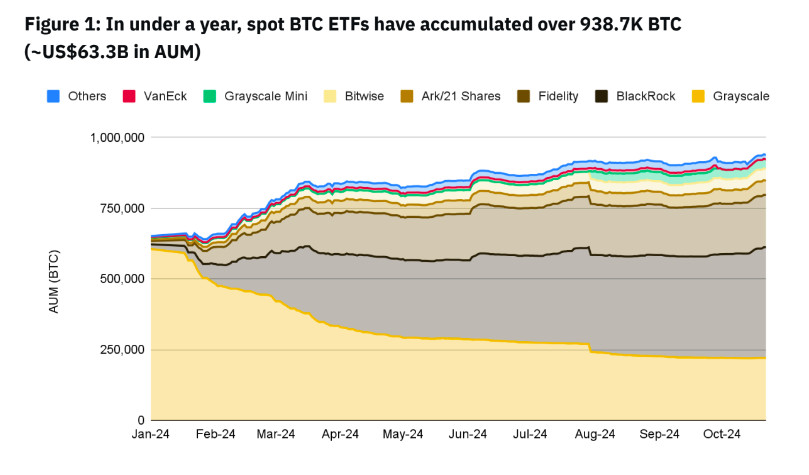
Why Spot Bitcoin ETFs Are Becoming a Game-Changer in Financial Markets and What It Means for Crypto

As part of a larger trend toward securitizing digital assets, spot Bitcoin ETFs have been introduced, making them more accessible to investors who would otherwise prefer to interact with cryptocurrency through conventional financial instruments. 

With ramifications for price dynamics and liquidity, the magnitude of these inflows demonstrates that spot BTC ETFs are more than just financial instruments; they are increasingly playing a key role in the structure of the Bitcoin market. Although the ETF mechanism is not new to the financial industry, its use in the cryptocurrency field has revealed demand levels that surpass even those of the first gold ETFs, indicating that Bitcoin ETFs have a distinct appeal.

ETF Divergence and Comparison with Gold ETFs

Gold ETFs, which are seen as more stable and have set a pattern for asset-backed funds in the past, grew very modestly in their early stages, drawing just around $1.5 billion over a similar period of time. However, in less than a year, BTC ETFs have amassed almost $18.9 billion, demonstrating the increased interest in Bitcoin as a hedge against wider economic volatility as well as a speculative asset. Remarkably, although just 95 institutions invested in gold ETFs in their first year, over 1,200 institutions have already invested in bitcoin ETFs.

However, Ethereum (ETH) ETFs have not been as successful as Bitcoin ETFs. Ethereum ETFs have had withdrawals of almost 43,700 ETH, or $103.1 million, according to the Binance data, with negative flows occurring in eight of the first eleven weeks. 

With Bitcoin becoming a more popular digital asset for ETF investments, this disparity between BTC and ETH ETFs points to a shift in investor interest and market sentiment. Bitcoin’s status as the first cryptocurrency and its reputation as a digital store of wealth may be contributing factors to this trend since it appeals to more cautious investors.

Institutional and Non-Institutional Investors’ Contribution to the Growth of Bitcoin ETFs

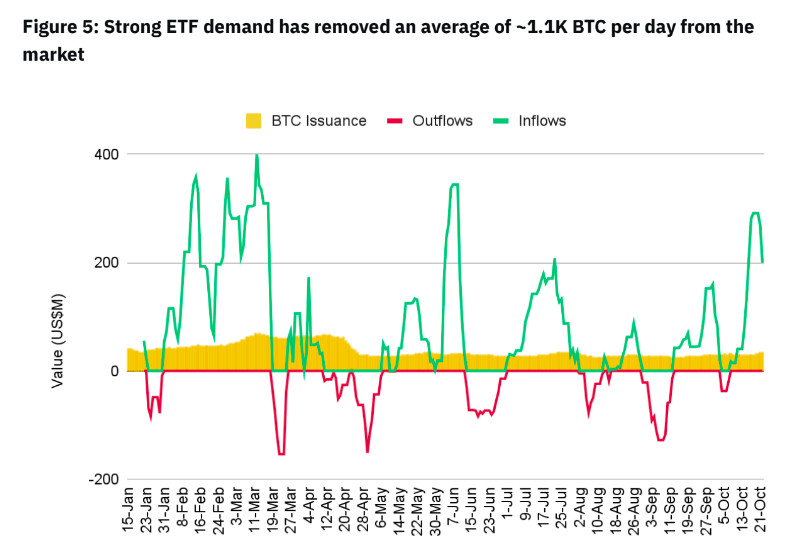
The involvement of both institutional and non-institutional investors has greatly aided the growth of spot BTC ETFs. Strong interest in these products has been shown by non-institutional investors, who make up around 80% of demand. Retail investors and individual traders that prefer the ease of getting Bitcoin exposure through ETFs rather than personally managing wallets, keys, and exchanges make up this investment base.

There has also been a noticeable increase in institutional investment in Bitcoin ETFs. Due mostly to financial advisers, whose Bitcoin holdings surged by 44.2% to reach 71,800 BTC, institutional holdings have grown by almost 30% since Q1. The move toward more regulated and controlled access to digital assets is reflected in institutional investors’ slow acceptance of Bitcoin ETFs. 
Why Spot Bitcoin ETFs Are Becoming a Game-Changer in Financial Markets and What It Means for Crypto

However, it is anticipated that a full-scale institutional adoption involving banks, consulting services, and broker-dealers would be a slow process that takes years to complete. Such a shift may make Bitcoin and other digital assets more widely accepted by bringing them into the mainstream of international financial markets.

Bitcoin’s Convergence with Traditional Finance (TradFi)

The Binance study highlights a noteworthy trend: the growing link between Bitcoin and conventional financial assets, namely the S&P 500 index. This increasing link, which has been stronger since the beginning of 2024, points to a change in how investors see Bitcoin. Bitcoin is now seen as both a risk-on asset and a hedge against macroeconomic uncertainty, whereas before, it was thought to be mostly uncorrelated. This dual role is a reflection of investors’ changing perceptions, as many now view Bitcoin as both a growth-oriented asset and a possible buffer during periods of market volatility.

Why Spot Bitcoin ETFs Are Becoming a Game-Changer in Financial Markets and What It Means for Crypto

Both market stability and investment methods are impacted by Bitcoin’s convergence with traditional finance. As the cryptocurrency market starts to act more like other well-known asset classes, for example, the stronger connection with stocks may indicate that the market is maturing. Furthermore, the interaction between conventional financial assets and digital currencies is anticipated to intensify as institutional players devote higher percentages of their portfolios to BTC ETFs, therefore reinforcing Bitcoin’s place in conventional investing frameworks.

The Impact of Spot BTC ETFs on Market Volatility and Efficiency

In addition to creating direct demand for Bitcoin, spot BTC ETFs have had a major impact on the cryptocurrency market overall through second-order impacts. Spot BTC ETFs make up an average of 26.4% of Bitcoin’s spot trading volume, with occasional peaks of 62.6%, according to the Binance report. Due to the ETF mechanism’s introduction of a more controlled form of demand for Bitcoin, this sizeable proportion has helped to improve market efficiency and lower volatility. These ETFs’ reliability can sustain more consistent price patterns, drawing even more traders to the market.

Venture capital is becoming more interested in spot BTC ETFs due to their liquidity, which allows for a broader market inclusion that goes beyond Bitcoin to include a range of blockchain-native assets. The market may become more stable and liquid as a result of this expanding on-chain presence, which is being driven by ETF demand both directly and indirectly. For instance, the greater legitimacy and liquidity offered by spot BTC ETFs may spur new development in the tokenized RWA space.

Disclaimer

In line with the Trust Project guidelines, please note that the information provided on this page is not intended to be and should not be interpreted as legal, tax, investment, financial, or any other form of advice. It is important to only invest what you can afford to lose and to seek independent financial advice if you have any doubts. For further information, we suggest referring to the terms and conditions as well as the help and support pages provided by the issuer or advertiser. MetaversePost is committed to accurate, unbiased reporting, but market conditions are subject to change without notice.

About The Author


Victoria is a writer on a variety of technology topics including Web3.0, AI and cryptocurrencies. Her extensive experience allows her to write insightful articles for the wider audience.

More articles


Victoria d’Este


Victoria is a writer on a variety of technology topics including Web3.0, AI and cryptocurrencies. Her extensive experience allows her to write insightful articles for the wider audience.


Source link

Bitmain’s Antminer S19 Series Confronts a Severe Crisis in Texas: Design Flaws Exposed by Extreme Weather

0
Bitmain’s Antminer S19 Series Confronts a Severe Crisis in Texas: Design Flaws Exposed by Extreme Weather


Bitmain’s Antminer S19 Series Confronts a Severe Crisis in Texas: Design Flaws Exposed by Extreme Weather

Texas, the foremost mining epicenter in the United States, has historically been a strategic cornerstone for Bitmain’s relentless pursuit of mining dominance. However, a stunning reversal has occurred as all of Bitmain’s air-cooling miners, particularly the prestigious Antminer S19 series, have been compelled to cease operations in Texas. The official evaluation is unequivocal: Texas’s extreme climatic conditions, characterized by soaring heat and oppressive humidity, are deemed inimical to the effective functioning of air-cooling antminers.

The maintenance predicament within the Antminer S19 series operating in Texas is stark. Units in optimal condition face a 40% repair rate, while those in suboptimal condition experience a staggering 100% repair rate. This led to the gradual withdrawal of the Antminer S19 series from Texas shelves in mid-June this year, coinciding with a notable decline in the network’s overall hash rate around June 16th.

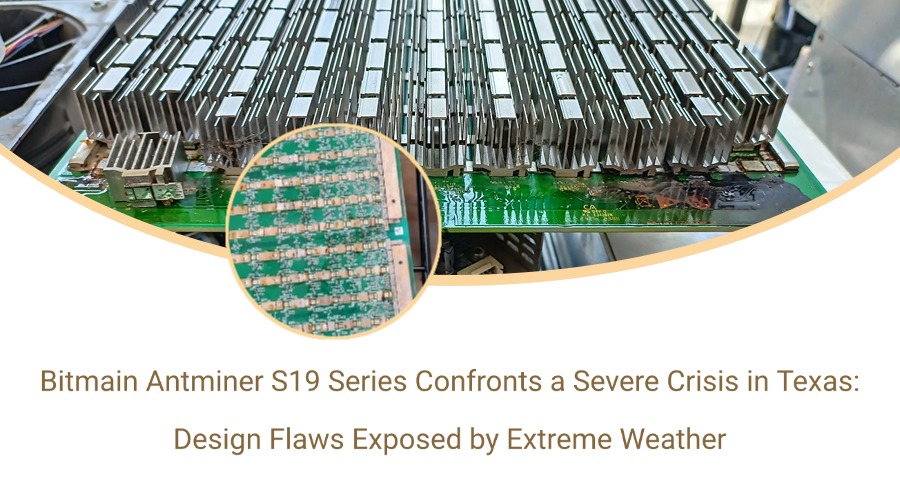
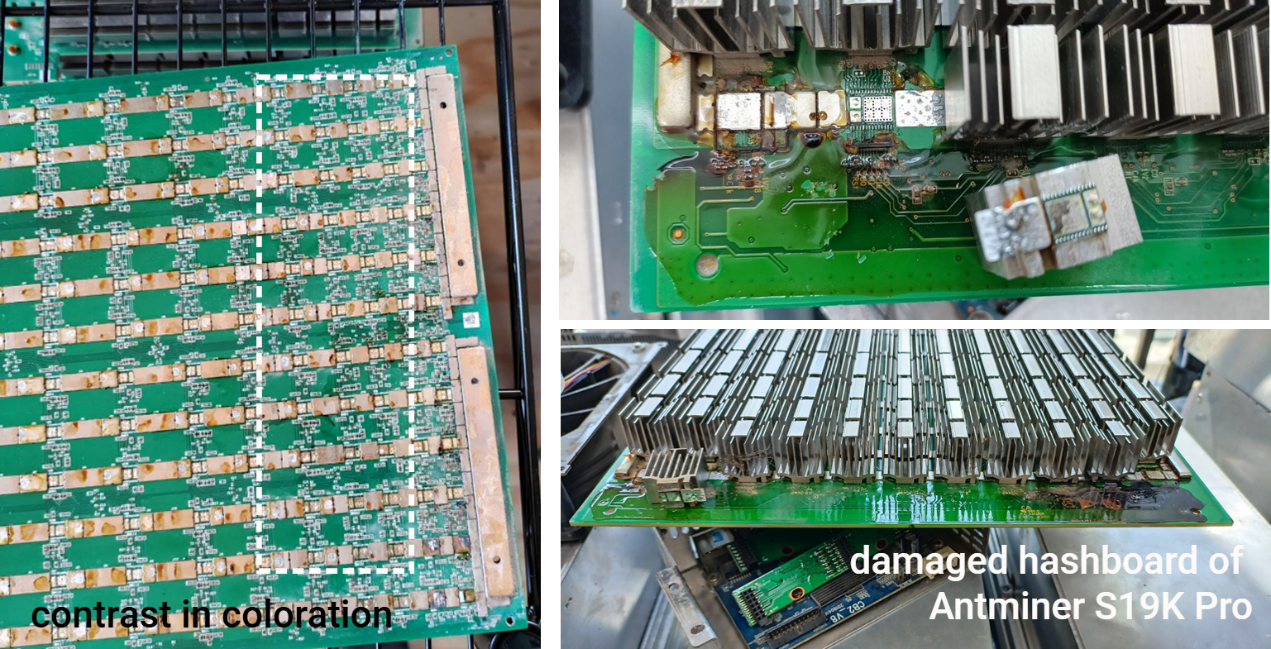
At the heart of this issue lies severe corrosion within the hashboards of the Antminer S19 series, particularly the S19K Pro model. The stark contrast in coloration between the air inlet side and the rest of the hashboard is a tangible manifestation of this corrosion, which has been exacerbated by the harsh Texas weather.

Bitmain’s Antminer S19 Series Confronts a Severe Crisis in Texas: Design Flaws Exposed by Extreme Weather

Upon closer scrutiny, it becomes evident that this predicament stems not merely from environmental factors but from the inherent design flaws of Bitmain’s miners. The continued use of compact heat sinks, while effective for thermal dissipation, has proven to be a double-edged sword under certain conditions.

The Bitmain’s Antminer S19K Pro, in particular, adopts a heat dissipation structure reminiscent of the two-sided small radiator of the Bitmain’s Antminer S17, which, under certain circumstances, has proven to be highly susceptible to damage. These circumstances include:

Firstly, Transportation Vulnerabilities: 

The small radiator’s sensitivity to vibrations makes it prone to dislodgement during transit, especially under bumpy conditions or inadequate packaging.

Secondly, Rapid Temperature Fluctuations:

As evidenced by the Bitmain Antminer S19K Pro’s fluctuating hashrate and increased power ratio with rising ambient temperatures, its small heat capacity exacerbates the impact of rapid temperature changes. This can lead to damage even in the absence of extreme conditions.

Bitmain’s Antminer S19 Series Confronts a Severe Crisis in Texas: Design Flaws Exposed by Extreme Weather

Thirdly, Moisture-Induced Chip Cracking:

After shutdowns spanning a few days, the limited protection offered by the small radiator leaves the chip vulnerable to moisture absorption, which can cause cracking upon restart.

In conclusion, Bitmain’s Antminer S19 series has encountered a formidable challenge in Texas’s unforgiving climate, revealing the limitations of their current design approach. As the mining industry continues to evolve, it will be imperative for Bitmain and other manufacturers to adapt their designs to withstand the rigors of varying environments, ensuring reliability and longevity amidst the relentless pursuit of mining dominance.

Disclaimer

In line with the Trust Project guidelines, please note that the information provided on this page is not intended to be and should not be interpreted as legal, tax, investment, financial, or any other form of advice. It is important to only invest what you can afford to lose and to seek independent financial advice if you have any doubts. For further information, we suggest referring to the terms and conditions as well as the help and support pages provided by the issuer or advertiser. MetaversePost is committed to accurate, unbiased reporting, but market conditions are subject to change without notice.

About The Author


Gregory, a digital nomad hailing from Poland, is not only a financial analyst but also a valuable contributor to various online magazines. With a wealth of experience in the financial industry, his insights and expertise have earned him recognition in numerous publications. Utilising his spare time effectively, Gregory is currently dedicated to writing a book about cryptocurrency and blockchain.

More articles


Gregory, a digital nomad hailing from Poland, is not only a financial analyst but also a valuable contributor to various online magazines. With a wealth of experience in the financial industry, his insights and expertise have earned him recognition in numerous publications. Utilising his spare time effectively, Gregory is currently dedicated to writing a book about cryptocurrency and blockchain.


Source link

Understanding Diamond Hands in Crypto and NFTs – Metaverseplanet.net

0
Understanding Diamond Hands in Crypto and NFTs – Metaverseplanet.net


In the world of cryptocurrency and NFTs (Non-Fungible Tokens), the term Diamond Hands has become a popular phrase among investors and enthusiasts. It represents a steadfast commitment to holding an asset regardless of market volatility or price dips. Let’s dive deeper into what Diamond Hands means, its significance in the crypto community, and why it’s especially relevant to NFT collectors.

What Does Diamond Hands Mean?

Understanding Diamond Hands in Crypto and NFTs

The term Diamond Hands refers to the metaphorical idea of holding onto an investment through thick and thin, much like the resilient nature of diamonds. When someone has Diamond Hands, they are determined to hold onto their crypto or NFT assets without selling, even during significant market downturns. In contrast, Paper Hands describes those who sell at the first sign of market fluctuation.

In the NFT market, having Diamond Hands implies a belief in the long-term value and rarity of a digital asset. Whether the asset is an NFT artwork, a digital collectible, or part of a blockchain game, those with Diamond Hands believe in the project’s potential and are willing to hold their investment indefinitely.

Why Diamond Hands is Important in the NFT Market

Understanding Diamond Hands in Crypto and NFTsUnderstanding Diamond Hands in Crypto and NFTs

The NFT market is known for its volatility, with prices that can rise or fall dramatically in a short period. NFT enthusiasts with Diamond Hands are often seen as loyal supporters of projects, helping to stabilize the market and instill confidence among other holders. Here are a few reasons why Diamond Hands is essential in the NFT space:

Market Stability: Those with Diamond Hands contribute to market stability by holding assets through market lows, which can prevent a rapid sell-off.

Community Strength: Diamond Hand holders are often highly valued within NFT communities. They support projects not just financially but also by creating a solid fan base and showing long-term commitment.

Rarity and Value: The scarcity and value of NFTs can increase over time, especially if the project grows in popularity. By holding onto their NFT assets, Diamond Hands investors contribute to the perception of scarcity, potentially boosting the overall value of the collection.

Diamond Hands vs. Paper Hands: The Risk vs. Reward

While Diamond Hands may seem ideal, it isn’t without its risks. In a market as unpredictable as cryptocurrency and NFTs, holding onto an asset too long can lead to missed opportunities or losses. Here’s a comparison of Diamond Hands vs. Paper Hands in terms of risk and reward:

Diamond Hands: High reward potential but comes with the risk of holding assets during prolonged market declines.

Paper Hands: Reduced risk of losing all investment during a dip but also a higher chance of missing out on gains when the market recovers.

The decision to adopt a Diamond Hands or Paper Hands approach ultimately depends on an investor’s personal risk tolerance and long-term goals in the NFT market.

Benefits of Having Diamond Hands in the Crypto World

Holding NFTs with Diamond Hands provides a range of advantages, including:

Potential Long-Term Gains: As demand grows, NFTs that are held for long periods can experience substantial price increases.

Community Respect: In the crypto and NFT communities, those with Diamond Hands are often celebrated for their loyalty and belief in the project.

Exclusive Perks: Some NFT projects reward loyal holders with exclusive airdrops, access to community events, or special releases, making Diamond Hands a potentially lucrative approach.

In summary, Diamond Hands has become a symbol of resilience and dedication within the NFT and crypto worlds. This approach isn’t for everyone, as it involves a high level of risk tolerance and patience. However, those who maintain Diamond Hands can potentially reap the rewards of their steadfast loyalty, not just financially but also through the sense of community and exclusive opportunities.

Whether you’re a seasoned NFT investor or just starting, understanding the concept of Diamond Hands can help you make better-informed decisions and become a valued member of the NFT community. Remember, while Diamond Hands can be rewarding, it’s essential to evaluate the risks and have a clear strategy before committing to this approach in the dynamic world of NFTs and crypto.

You may also like this content

Follow us on TWITTER (X) and be instantly informed about the latest developments…

Copy URL


Source link

Cryptocurrency Trends Shift Ahead of U.S. Election – Metaverseplanet.net

0
Cryptocurrency Trends Shift Ahead of U.S. Election – Metaverseplanet.net


As the U.S. prepares to elect its next president in just two weeks, trends in the crypto markets appear to be leaning in favor of Trump. This shift, particularly visible in crypto-based prediction markets like Polymarket, has drawn attention due to the substantial investment from a prominent French investor. Known for his crypto-friendly stance and his promise to replace the current SEC chairman, Trump has garnered notable support within the crypto industry.

Polymarket and the Role of the Investor

In the lead-up to the election, there has been a marked shift in favor of Trump on Polymarket. The platform has observed that this trend was significantly influenced by a large investment from a French investor. According to a statement from Polymarket, the investor’s actions are based solely on his personal views and are not an attempt to manipulate the market. “After investigating, we have concluded that this user did not attempt to manipulate the market,” Polymarket officials stated, emphasizing that the investor acted freely within market conditions.

Anticipated Changes in the Crypto Industry

Trump’s reputation as a crypto-friendly candidate has earned him support in the crypto sector. Brad Garlinghouse, CEO of Ripple ($0.528099), has publicly backed this view. During DC Fintech Week in Washington, D.C., Garlinghouse remarked that the U.S. is on the brink of a crypto transformation and that the election will be pivotal in shaping this evolution. He noted that a victory for either Trump or Democratic candidate Kamala Harris would signify a “break from the Biden administration’s failed crypto policies.” Commenting further, Garlinghouse stated, “Kamala Harris is from Silicon Valley and generally has a pro-tech stance. Regardless, a reset is likely after the election.”

While recent polls place Harris ahead of Trump by a narrow 1.8% margin, crypto-centered forecasting platforms like Polymarket show a contrasting trend in Trump’s favor. Industry supporters anticipate that crypto regulations under a Trump administration could have positive effects on the sector.

Potential Changes in Crypto Following the Election

The U.S. election is expected to catalyze significant shifts in the crypto markets. As Garlinghouse suggested, a restructuring of crypto policies appears likely, no matter the outcome. Industry investors and leaders hope that future regulatory frameworks will be more supportive of crypto.

With this pivotal election, many believe a new era may soon begin in the crypto world.

You may also like this content

Follow us on TWITTER (X) and be instantly informed about the latest developments…

Copy URL


Source link

Google Watermarks AI-Generated Text for Clarity – Metaverseplanet.net

0
Google Watermarks AI-Generated Text for Clarity – Metaverseplanet.net


Google uses watermarks to differentiate between AI-generated and human-generated text. As generative AI advances, major tech companies are developing tools to identify AI-produced content. One such tool, Google SynthID, incorporates a digital watermark to help recognize text created by public AI models. Additionally, SynthID TexT is being released on Hugging Face and will be part of the Responsible GenAI Toolkit. In an official statement on the company’s X account, Google announced: “We are making the SynthID TexT watermarking tool open-source. This will enable developers and businesses to better identify content that is freely available and AI-generated.”

How does SynthID TexT work?

Google Watermarks AI-Generated Text for ClarityGoogle Watermarks AI-Generated Text for Clarity

Artificial intelligence models rely on token distribution to process and generate text. Google’s new technology operates on the principle of matching text with tokens. SynthID TexT, part of this system, creates patterns based on possible word formations and marks outputs according to these patterns. Google acknowledges that this technology has limitations, particularly when dealing with short texts, translated or paraphrased content, and knowledge-based articles, where its accuracy may decrease.

This technology has now been integrated into Google’s Gemini models. In regions like China and California, AI output marking technologies, such as SynthID TexT, have become mandatory. With the adoption of similar regulations in other areas, AI detection markers are expected to become more widely used globally over time.

You may also like this content

Follow us on TWITTER (X) and be instantly informed about the latest developments…

Copy URL


Source link

Supercharging Teams Meetings at Scottish Summit

0
Supercharging Teams Meetings at Scottish Summit


I had a pleasure to visit Aberdeen, Scotland last week and speak at Scottish Summit 2024 community event. This marks my fourth in-person Scottish Summit ( 3 x the actual Summit in Scotland and one Summit on Tour at Manchester, England) where I have spoken at. It is a wonderful conference to come back to, as the vibe is great and organizers put effort to create the event that has fun, knowledge, expertise and everyone is welcome. Of course I do love to visit Scotland for other reasons also, as it gives me a great chance to enjoy the view there and make a visit to a whisky distillery – and in Scotland you can find one almost nearby everywhere. But the main focus is the event and the highlight is delivering my session to the people in the room.

It is an awesome feeling to walk to the venue and hear bagpipe and drummer playing the theme!

Before going to my session, I have to highlight the opening keynote by Scott Hanselman, and the closing keynote by Dona Sarkar. Both were extremely good, filled with great information and also fun! That made them really captivating to follow and listen. And from those, we know more about the LLM, Copilot and that the Purview and (ir)Responsible AI are always watching! Pay attention to Scottish Summit YouTube, I think keynotes might show up there later.

This time, my topic was Supercharging Your Teams Meetings Game.

As the name implies, I was showing what can be done in Teams Meetings and how its vast number of features can be utilized to make your meetings better, more productive or just more versatile. And since it is me, we were talking about live demos showing various capabilities – and it looked like that everyone who attended my session learned something new. I am a bit proud about that, as there were fellow MVPs in the room who are also heavy Teams users and know lots of its features.

I started with a bit of building blocks, that all bring in features you can use in Teams meetings. Naturally the Teams Core is what most of the people use, and there are great capabilities already in there. But adding Teams Premium you can get to the next level quite easily (assuming you do need those features often enough), and adding Microsoft 365 Copilot you get the AI assistant to your meetings who can help (today) to create meeting notes, answer questions about the meetings and when used cleverly it can help you big time. And we haven’t yet seen the Copilot as a meeting participant (announced at Build 2024), which will be adding even more to its usefulness. Finally adding other meeting add-ons and Copilot for Sales you get pinpointed benefits. All these together can power up your meetings quite a lot. However, this doesn’t mean that you will be just buying everything and thinking it will make your meetings perfect.. Nope. You need to be aware what and where to use, in which kind of meetings to be able to select perfect building blocks to your meeting instance to match your needs. Don’t just add everything on, because it is there..

Here is a portion of demos I was showing in the Scottish Summit 2024. Some of these are not new, but something I have noticed people don’t really know about it – or don’t remember to use it:

Meeting Agendas ( Loop components). Yes, you do want to easily editable meeting agendas & notes. Start sharing the awareness about these, as Loop is the thing and we will be Looping a lot more every month.

Meeting Theme (Teams Premium). Yes, you can brand your meetings, all it takes is that the meeting organizer has the Teams Premium license and everyone in the meeting can enjoy about the brand.

Green Room. This is very useful if you want presenters to meet before the meeting and do sound checks, test sharing etc. This is in Teams Core, and you find it in meeting options.

Live Captions with spoken language captions. Yes, in Teams Core.

Voice Isolation (Teams Core). Once you create your voice profile with Teams (via Settings / Recognition), you can turn on voice isolation which drops off other voices but your own. For example if you are in a busy cafe or office, people online won’t be hearing other speaking – only you. Teams Core. Btw, this voice enrollment will be on by default starting January 2025. Now admins need to turn it on, but if you don’t want it on: admins should set up the new policy to turn it off.

Live Translation (Teams Premium). It always creates an effect, when I speak in Finnish and audience can read subtitles in English. No, not perfect but many multi-national/cultural organizations benefit of this!

PowerPoint Live. Not really something new, but I have seen too many screen shares to show a PowerPoint presentation.. It is a really good one, and in Teams Core. Cameo (yes, it is still there!), slide translations, zooming, inking and more..

Did you knew you can add a Shared Display, that displays the content and participants (or meeting chat) – and it automatically uses the second display to show it? I admit, the automatic use of the second screen was a surprise to me as well – everyone learned something during my session! (including me)

Remember the meeting Agenda? During the meeting you can open it via Notes. And you can also add these notes to a Loop Workspace via … menu. That way you can organize project meeting notes to a same place where team members can find them.

There are new Meeting Options also, some of these require Teams Premium.

Whiteboard and annotating the screen during the meeting. You may want to check these out. Yes, there are also the Copilot in Whiteboard to help you out to facilitating workshops.

Microsoft Mesh. You can use Mesh in Teams Core to change your meeting to immersive 3D experience – just change the view! There are already a new scene to use ( Workshop) and soon there will be an another one. Mesh is easy to use, and the change of view can help to boost up some of your meetings. Don’t try to use Mesh for every meeting – it will just fail. But when your focus is more on talking, ideating, small group talks, or just want a new view.. Mesh can be the feature you want to use. No, you don’t need a headset – I run demos from my laptop screen directly. There are great features like a personal stage, that can bring the shared content close to you – no matter where in the space you are.

And that wasn’t all! If you attended, you know what else was there. I did run a bit out of time a bit as I was in the flow of showing and talking the fun you can do with Teams meetings, so I had to wrap up the session quite fast. 45 mins goes so fast when having fun.

As I anticipated I would not have time to show these slides during my session, I intended these as takeaways for attendees, to have something to take with them and start to think how to supercharge their Teams meetings when they get back to work from the Summit.

Then I did share a few selected items from the roadmap, related to Teams meetings. And I just noticed that I did have the enrollment defaulting to on at two slides. It is a big deal to some organizations to be aware about this change!

And as usual.. Teams roadmaps do live. So, it won’t be the first nor last time when features get a new estimate at the roadmap. Keep in the mind, that the roadmap schedule is just the best estimate, team has at the moment, when the feature will be rolled out. So, it can change but it is still a good indication of what is in the radar.

Published by Vesa Nopanen

Vesa “Vesku” Nopanen, Principal Consultant and Microsoft MVP (M365 and AI Platform) working on Future Work at Sulava.

I work, blog and speak about Future Work : AI, Microsoft 365, Copilot, Microsoft Mesh, Metaverse, and other services & platforms in the cloud connecting digital and physical and people together.

I have about 30 years of experience in IT business on multiple industries, domains, and roles.
View all posts by Vesa Nopanen


Source link

Top Metaverse Startups Leveraging Blockchain Innovation 2024

0
Top Metaverse Startups Leveraging Blockchain Innovation 2024


The concept of a Metaverse has captured the imagination of tech founders and investors alike. Several startups are leveraging blockchain technology to build decentralized virtual worlds and economies that are open, inclusive, and interoperable. Their vision is a Metaverse where users truly own their digital assets and data, without centralized control. Blockchain enables this through decentralized identifiers, non-fungible tokens (NFTs), and smart contracts that govern interactions. This promises to empower users, creators, and businesses in the Metaverse. 

While still in their early stages, new projects demonstrate the potential of integrating blockchain into virtual realities to create more trustless, transparent, and equitable digital worlds. As Metaverse technologies advance rapidly, nimble startups are poised to shape the future of this emerging space through decentralized, community-owned designs built on the foundations of blockchain.

1. Vegavid

Vegavid Technology is a leading metaverse startup. The company focuses on creating innovative virtual reality and augmented reality solutions. Vegavid aims to bring online and virtual experiences closer to real-world sensations. Vegavid’sproducts and services allow users to enjoy extraordinary experiences across virtual worlds. They develop applications for gaming, medicine, education, and business collaboration in the metaverse. 

Vegavid utilizes blockchain, augmented reality, and non-fungible tokens (NFTs) to realize this vision. They are creating 3D virtual environments and assets represented by NFTs that users can own, collect, and trade. Using NFTs gives users true ownership over their virtual possessions and identity within the metaverse. The metaverse developed by Vegaviditself will be community-owned and decentralized, built on blockchain technology for transparency and trust.

Join us in shaping the future of digital experiences. Together, we can unlock the full potential of the metaverse and create innovative solutions that revolutionize industries and enhance human interaction.

Vegavid Metaverse development company services

2. PlayersOnly

PlayersOnly

PlayersOnly is a blockchain-based media and entertainment company building a virtual world for athletes. Athletes can leverage PlayersOnly to engage with fans through unique virtual experiences. Player’s build “player versus” – personalized virtual spaces featuring non-fungible tokens (NFTs) and other exclusive digital content. Fans enter these player verses to interact directly through avatars, play mini-games, and buy authenticated digital goods. 

PlayersOnly mints and manages NFT collections for athletes that fans can purchase using $PO tokens – the company’s cryptocurrency. PlayersOnly aims to reshape how fans consume information and digital goods from their favorite athletes through immersive experiences and tokenized commerce in a metaverse environment. The startup employs blockchain technology to authenticate and transfer tokenized assets as well as enable self-sovereign identity for their decentralized metaverse.

3. Enjin

Enjin

Enjin is a blockchain gaming company that aims to bring easy tokenization and monetary systems to virtual worlds. Enjin created its own ERC-20 cryptocurrency called Enjin Coin which is used as in-game currency. Game developers integrate Enjin’s software development kit (SDK) to enable features like stored value tokens, item rarity, tradable digital assets, and crypto payments in their games. Players can convert Enjin Coin to branded tokens inside compatible games which can represent virtual game items. 

The tokens can be traded, sold, or taken back to Enjin Coin. Enjin’s goal is to make blockchain game economies as easy to implement, use and regulate as traditional ones. By deploying these economies of tradable digital assets, game developers hope to increase player engagement and monetization. The company promotes tools like its non-fungible token (NFT) SDK and blockchain multicurrency wallet to power the economies of metaverses and virtual worlds.

4.Axie Infinity

axie-infinity

Axie Infinity is a Pokémon-inspired universe where players raise, breed, battle, and collect story-driven NFT creatures called Axies.  Axies are ERC-721 tokens minted on the Ethereum blockchain, giving each one a unique identity and ensuring ownership. Players use an in-game currency called Smooth Love Potion (SLP) to breed new Axies. SLP can be earned through playing the game, completing quests, or trading and is a fungible token on the Ronin blockchain specialized for Axie Infinity. 

The game combines fun turn-based battles with cryptocurrency rewards to create a profitable, gamified economy. Axie Infinity aims to offer more revenue-generating opportunities for players than traditional gaming by employing NFTs and tokens on a purpose-built blockchain. The game’s economy is owned by its community and not a single company, thanks to the decentralized nature of blockchain technology.

5. GuildFi

GuildFi

GuildFi aims to help virtual guilds flourish within metaverses by bringing decentralized finance to guild management. Guilds are groups of players that form communities within virtual worlds. GuildFi wants to provide guild leaders with intuitive DeFi tools to manage treasuries and reward systems, motivate and compensate members, and fund operations. The platform allows guild leaders to issue cryptographic tokens that represent membership and governance within the guild. 

Members can contribute to the guild treasury in exchange for these tokens, which entitle them to a portion of proceeds from guild activities. Using smart contracts, guild leaders can set up rewards programs, fund raids, and competitions, and distribute profits automatically based on tokens held. Guilds using GuildFi have access to DeFi services like lending, borrowing, staking, and yield farming all within the platform. The startup believes blockchain-based tokenized economies will empower virtual guilds to grow, motivate members, and align incentives within metaverse games.

6. Supersocial Inc.

Supersocial Inc

Supersocial aims to build the foundation for an open and creator-first metaverse economy. They are developing a decentralized social networking protocol where users control their data and digital identity. Their technology allows for the seamless integration of NFTs and token-gated content across decentralized applications. Their vision is for an open metaverse where creators can monetize their content directly without centralized intermediaries, using tools like NFT drops, tradable digital items, cryptocurrencies, and DAOs (Decentralized Autonomous Organizations). 

Creators can launch their own virtual spaces within Supersocial, offering branded tokens and NFT collections to reward fans and fund their visions. Supersocial wants to move past today’s “walled garden” social platforms by leveraging blockchain technology to enable peer-to-peer transactions, self-sovereign identity, token-gated communities, and interoperability between metaverse virtual spaces. The startup ultimately aims to empower creators and users to own their data, digital items, and identities within a fairer metaverse economy.

Supersocial is building a decentralized social networking protocol and foundation for an open metaverse. Using blockchain and cryptocurrency, the startup aims to enable creators to directly monetize their content and audiences within the metaverse through tools like NFTs, tokens, DAOs, and tradable digital items.

7. Ikonz

Ikonz

Ikonz aims to build the world’s first hyper-realistic 3D metaverse. Their focus is on creating highly lifelike avatars, graphics, and virtual spaces. They see the metaverse as the next evolution of the internet – a 3D virtual world where people can engage in a variety of activities through their virtual selves. Ikonz’s metaverse leverages blockchain technology to enable token-gated content and communities as well as create unique tradable digital assets for users like avatar skins and virtual accessories. 

Users can purchase land parcels – represented as NFTs – to build their own virtual spaces within the metaverse. Ikonian Credits, the platform’s native cryptocurrency, is used to reward creators, facilitate transactions and provide interoperability. Ikonz aims to differentiate their metaverse by focusing on photorealism, interpersonal connections, and creating a virtual world that behaves and feels like our physical world. The startup believes blockchain coupled with its advanced graphics technology will empower users to truly own their digital identities and items within their hyper-realistic metaverse.

8. Next Earth

Next Earth

Next Earth is building an exact digital replica of Earth on the blockchain. Their vision is a fully decentralized metaverse where users own their virtual land and assets. Next Earth’s Earth NXTToken powers transactions within the metaverse, while NXTToken holders govern the platform through a DAO. In Next Earth, users can purchase land parcels represented as NFTs. They can develop their plots by building structures, planting trees, or adding other virtual elements. Users can also create avatars to explore the metaverse, interact with others and generate value from their virtual land holdings. 

Next Earth aims to replicate important aspects of reality like day/night cycles, seasons, and weather to create an immersive virtual world experience. The startup believes its decentralized approach and reliance on NFTs and DAOs can empower participants to truly own and govern a recreation of Earth within the metaverse. By leveraging blockchain technology, Next Earth hopes to offer greater utility and value to metaverse real estate compared to today’s centralized virtual worlds.

9. MixMob

MixMob is a Metaverse and AR startup focused on tokenizing offline activities and turning real-world experiences into tradable non-fungible tokens (NFTs). The company helps businesses like event organizers, attraction parks, gyms and studios mint NFT tickets and membership passes that can be resold, traded, or used as loyalty points. For example, a concert NFT could grant access to a show while also giving the holder a share of the revenue from future ticket sales on the secondary market. 

MixMob’s platform issues the initial NFTs and then manages the entire lifecycle using blockchain – from validation and use to resale and revenue distribution. The startup sees this as a way to build more engaged, loyal customer bases for businesses while giving consumers ownership over their experiences. By connecting the physical world with blockchain technologies, MixMob believes it can transform how customers interact with the establishments they frequent. The company’s vision is a user-owned Metaverse where real-world activities and memories are tokenized as digital assets that people truly own.

10. Landindex

Landindex

Landindex is a database and discovery platform for virtual worlds that leverage blockchain technology. Landindex aims to create an open Metaverse by connecting different decentralized virtual environments. It helps users discover, evaluate and invest in virtual land and other digital assets across multiple Metaverses. Landindex currently tracks over 30 virtual worlds with blockchain-backed lands like Decentraland, Somnium Space, Cryptovoxels, The Sandbox, Axie Infinity, and Upland. For each world, Landindex provides information on land and asset stats, recent transactions, sales volumes, and price indexes. 

Using Landindex, investors can research different virtual property markets, compare valuations and opportunities, and stay up to date on the latest news. Landindex also seeks to foster interoperability across Metaverses by creating universal identifiers for virtual land that can be recognized across platforms. Ultimately, Landindex aims to build an open, interconnected Metaverse economy where users can easily move assets between different virtual environments. By mapping the blockchain metaverse, Landindex hopes to accelerate innovation, liquidity, and the adoption of decentralized virtual worlds.

11. Upland

upland

Upland is a blockchain-based Metaverse where users can buy, sell and develop virtual properties. It combines aspects of gaming with real estate investing and transacting. Players create avatars that can acquire properties like land parcels, cars, and billboards throughout 10 different cities in Upland. All property deeds are minted as non-fungible tokens (NFTs) on the EOS blockchain, giving players true ownership. They can develop their properties to increase their value, and then trade them with other players using UPX – the Upland currency. Property data like location, size, and rent prices determine value. 

The game aims to simulate the real world, offering both risks and rewards to players. The economy and all transactions are decentralized and managed by the blockchain. Upland sees itself as a “decentralized Metaverse” that empowers players through property ownership secured by NFT technology. The project demonstrates how blockchain principles of decentralization, transparency, and trust can be applied to virtual economies within the Metaverse.

Conclusion

The startups discussed to show how blockchain technology can help build more equitable, open, and liquid Metaverses. While significant challenges around scalability, interoperability, and regulation remain, the principles of decentralization, transparency, and digital ownership enabled by blockchain align well with the vision of a fair and inclusive Metaverse that empowers users. 

With continued innovation by these startups and wider adoption of their platforms, we may start to see the Metaverse become a reality that enables users to truly own their digital assets, identities, and data within thriving tokenized economies. Improved considerably from today’s predominantly centralized virtual worlds. As blockchain technology advances further, it has strong potential to reshape how we experience the Metaverse of the future.


Source link

Maximize Impact with Immersive VR Holiday Shopping

0
Maximize Impact with Immersive VR Holiday Shopping


Virtual experiences for holiday help brands and retailers transform the online shopping experience into an interactive retail environment. An immersive VR holiday shopping experience is a 360, digital, interactive shopping destination dressed for the holidays to drive shopper engagement, sales and strengthen online communities during the busiest retail season. 

With immersive holiday activations, brands have the opportunity to create innovative, 3D activations that leave a lasting impact during the busiest time of the year. Virtual retailing solutions increase shopper engagement, expand brand relevance and elevate product education to inform buyer decisions—which is especially impactful in driving sales during the hyper-competitive holiday season. Showcase brand moments and seasonal collections in a dynamic and highly-visual environment. As a one-stop shop to discover, research and purchase gifts, VR holiday experiences have helped brands drive impressive results in engagement, reach, conversion and ROI on holiday marketing campaigns. Brands can boost engagement during peak shopping season by including elevated features such as personalized quizzes to offer tailored gift suggestions or gamification that promotes product discovery.

3D e-commerce experiences transform how shoppers interact with brands and products, deepening consumer connections—such as with curated gift guides fit for the holidays. Expand brand relevance during the holiday season by including immersive technologies that resonate with consumers, such as virtual holiday pop-ups. Launch virtual holiday pop-up shops to build buzz around curated seasonal collections and brand moments. Brands can pair virtual pop-ups with physical activations to amplify reach and extend ROI through an omnichannel experience. 

Immersive virtual holiday experiences offer brands a unique opportunity to empower consumer purchasing decisions through visual shopping functionality such as 3D product customization. Brands can also improve conversion in virtual holiday experiences by embedding interactive videos and multimedia content that enhances product education and storytelling opportunities. 

Download the Virtual Experiences for Holiday one pager to learn more about how VR holiday experiences boost engagement, expand brand relevance and elevate education for new product launches. 

Leading brands in fashion, beauty, CPG and beyond have leveraged Obsess-powered virtual holiday experiences to maximize impact during the busy retail season. Book a demo or email us at contact@obsessvr.com to engage holiday shoppers in interactive and immersive VR holiday experiences.


Source link

ETFSwap (ETFS) Leads List Of Altcoins Under $1 That Could Rally 500x As Bitcoin Price Struggles

0
ETFSwap (ETFS) Leads List Of Altcoins Under  That Could Rally 500x As Bitcoin Price Struggles


As Bitcoin price struggles to break resistance above $68,000, experts see an imminent rotation from Bitcoin (BTC) into altcoins by crypto investors. In search of the best altcoins to buy for profit ahead of the altcoin season, the new ETFSwap (ETFS) token leads the list of altcoins under $1 that could rally 500x.

ETFSwap (ETFS) is in its final presale stage, offering last-minute opportunities to investors who are looking to capitalize on its undervalued price for maximum profits.

ETFSwap (ETFS) To Lead Other Altcoins Ahead Momentum Shifts From Bitcoin

ETFSwap (ETFS) is poised to lead altcoins in the coming rally as Bitcoin price struggles to maintain upward momentum. With investment expected to rotate to altcoins, ETFSwap (ETFS) is a leading pick to bet on, especially for its low price entry and huge margin. The new project presents an on-chain platform for trading tokenized ETFs backed by actual ETF assets from traditional markets.

The new project will be launching on Ethereum, capitalizing on the network to improve transparency, security, and robust DeFi network for rapid adoption and growth. ETFSwap (ETFS) as a platform will combine the best features from centralized and decentralized markets, helping users find the optimal use cases for their ETF assets.

Additionally, ETFSwap (ETFS) will facilitate means for passive income, such as staking rewards on the ETFS token, which promises 87% APR (annual percentage rate). Users will also be able to stake their tokenized ETFs for specific periods for exciting rewards. The tokenized assets also open up opportunities to lend for liquidity, which can be used to trade other crypto opportunities for profit.

These features are unavailable on existing centralized platforms for trading ETF assets, and users look forward to making the pivot to ETFSwap (ETFS) for extensive on-chain features. Also, the ETFSwap (ETFS) platform has hit the Testnet, as the beta platform is set for launch in the coming weeks.

The beta platform offers a first look into features, including staking, liquidity pools, the ETF price tracker, and many more. Early users also expect to test AI-powered tools like the ETF Screener and Finder, which will provide market recommendations based on extensive data analysis.

Confidence has grown in the ETFSwap (ETFS) presale since the team passed the KYC audit by SolidProof, with investors swarming in to buy the last tokens on the final presale stage.

Bitcoin Price Struggles To Break Resistance Above $68,000

Bitcoin price slipped below $50,000 on October 10 amid rumors that the US Federal Reserve might pause November rate cuts. Coming after the Labor Department reported a slightly higher Consumer Price Index (CPI) inflation rate for September, Atlanta Fed President Raphael Bostic said the central bank might consider holding off on cutting interest rates in November.

Bitcoin price saw volatility last week amid the US inflation rate, which reported a 0.2% increase instead of the 0.1% expectation combined with weekly jobless claims. However, Bitcoin price rebounded back to a three-month high of $68,000, supported by Spot Bitcoin ETF inflows.

According to Investopedia, the 12 United States Spot Bitcoin ETFs have received total inflows of $1.4 billion this week, with the funds on pace to record strong weekly inflows. Bitcoin price as of this writing is at $66,907, and it is struggling to maintain momentum above $68,000.

Experts attribute the surge in ETF inflows to the Federal Reserve 50 base point cut and expect investors’ optimism to rise if the rate cuts continue till the end of the year. As such, altcoins could also be set for a rally as crypto experts bet it all on ETFSwap (ETFS) to lead the momentum.

Conclusion

Experts see a run on altcoins, and ETFSwap (ETFS) is the favorite pick to capitalize on as Bitcoin price hits headwinds at $68,000. ETFSwap (ETFS) is massively underpriced in the ongoing presale, which allows for the possibility of up to 40,000% in profits for the token in the long term. The presale is already in the final stage, and you should get in now before the window closes.

Buy ETFSwap (ETFS) on presale now at $0.03846 before the final presale stage ends.

For more information about the ETFS Presale:

Visit ETFSwap Presale

Join The ETFSwap Community

Disclaimer

In line with the Trust Project guidelines, please note that the information provided on this page is not intended to be and should not be interpreted as legal, tax, investment, financial, or any other form of advice. It is important to only invest what you can afford to lose and to seek independent financial advice if you have any doubts. For further information, we suggest referring to the terms and conditions as well as the help and support pages provided by the issuer or advertiser. MetaversePost is committed to accurate, unbiased reporting, but market conditions are subject to change without notice.

About The Author

Gregory, a digital nomad hailing from Poland, is not only a financial analyst but also a valuable contributor to various online magazines. With a wealth of experience in the financial industry, his insights and expertise have earned him recognition in numerous publications. Utilising his spare time effectively, Gregory is currently dedicated to writing a book about cryptocurrency and blockchain.

More articles

Gregory, a digital nomad hailing from Poland, is not only a financial analyst but also a valuable contributor to various online magazines. With a wealth of experience in the financial industry, his insights and expertise have earned him recognition in numerous publications. Utilising his spare time effectively, Gregory is currently dedicated to writing a book about cryptocurrency and blockchain.


Source link

Meet John Mann, the Chief Technology Officer at Obsess

0
Meet John Mann, the Chief Technology Officer at Obsess


To start off our “Meet the Leadership Team” initiative, we would like to introduce John Mann, the Chief Technology Officer at Obsess. We asked John to share some highlights from his remarkable journey in the technology industry and some insights he’s gathered over the years. Here’s what he had to say:

Q. Could you share some highlights of your professional experience and how that path led you to Obsess today?

JM: Absolutely. My journey to Obsess was somewhat random. I had worked at a FinTech company three jobs prior, and during COVID, I was the CTO of two different companies simultaneously. When they decided to move in a different direction, I was let go and started job hunting. Through a network connection, I ended up building 5G networks and software for the government, which was completely outside of the retail space. However, I soon realized that wasn’t what I wanted to do—I missed the web development world and the startup environment.

That’s when I came across Obsess. Within a two-day window, I learned about retail, fashion and three.js, and I knew this was exactly what I wanted to pursue. My job search helped me realize what I didn’t want to do, and ultimately, it led me to Obsess, where I found the best engineering team I’ve ever worked with.

Before this, I worked at Microsoft for seven years, where I was involved in some significant projects like Xbox Live sign-up, Windows Live sign-up and even touched the Hotmail sign-up early in my career. I also worked on MSN internet access (yes, dial-up!) and had a brief stint at Getty Images, among other projects. After that, I fell in love with startups—working on everything from insurance to compliance software, travel advertisements and even parts management for planes. After trying corporate life post-Microsoft, I realized it wasn’t for me and have been in startups ever since.

Q.  What initially inspired you to enter the tech space, and what continues to motivate you today?

JM: My initial inspiration came from a friend of mine. I’ve been coding since I was nine years old. I started with a Commodore VIC-20, then a Commodore 64, and coding became a hobby throughout high school and into college. A friend of mine, Donovan (I have to give him credit!), asked me why I wasn’t studying computer science. At that point, I didn’t think I could make a living coding, but when I realized it was a real job, I thought, “I’m going to write code whether I get paid or not—so why not get paid to do it?” Donovan even got me my first job out of college.

As for what continues to motivate me, it’s the constant learning process. For example, I’ve recently learned three.js and now work on 3D retail stores. Then, with the launch of Apple Vision Pro, I started exploring SwiftUI for its operating system. Each new tech stack excites me, and I love learning enough about it to teach it, which allows me to see its strengths and weaknesses. That passion for learning and teaching keeps me going.

Q.  The launch of Apple Vision Pro was a huge moment for Obsess, developing the first-ever shopping apps on the device. How do you see the future of virtual reality and augmented reality evolving for brands, and what opportunities will this technology create, both in retail and beyond?

JM: I think the big advantage in the VR and AR world, is not just the information you’ll have access to in those spaces, it’s the virtual connections that you have—the social environment—and adding that to shopping. In Soho you see so many tourists, not shopping by themselves, but shopping with groups, and they like that social “Hey, what do you think of this?” “Do you like this outfit?” “Oh, let’s go to this store”. That social component is going to be so critical in the VR space, and the headsets actually allow you to emulate pretty closely, to be next to the person, and have that level of connection. I think that’s going to be huge. I think that’s the big future of shopping in the VR space.

Q.  I can definitely see the social aspect transforming the shopping experience. Now, onto another hot topic—AI. How is Obsess currently integrating AI into its virtual experiences, and what are some key ways AI will shape the future of these experiences?

JM: We’re already using AI in several areas, from scene and store design to generating 3D models of products. We’re also working on AI-powered virtual store associates that interact with customers, offering personalized recommendations like, “Is this makeup right for me?” or “Does this dress suit me?”. The advancement of generative AI in the last year has been remarkable, making it 5 to 10 times better than it was just a year ago.

Looking forward, AI will shape experiences through faster generation and personalization. For instance, it could analyze shopping habits to make tailored product recommendations, similar to how Spotify personalizes music suggestions. Imagine a retail experience where AI recommends items based on your shopping history, preferences and trends—creating an entirely personalized experience. Of course, there are privacy concerns and compliance issues like GDPR and CCPA, but AI-driven personalization will be a game-changer in retail.

Q.  Absolutely, personalization is going to be huge. Lastly, Obsess has worked with many leading brands across fashion, beauty, CPG and more, creating over 350 virtual experiences to date. Is there a particular experience or project that best showcases the technological strengths of the Obsess platform?

JM: There have been a lot of amazing projects, but one that stands out is Crate & Barrel. The realism we were able to achieve, from the store transitions to the rooftop views, and the ability to change scenes inside the store—it was remarkable. The way our platform managed the products, environments and interactions all came together seamlessly. Another highlight was our work on J.Crew’s app for Apple Vision Pro. That was one of the most complex and exciting projects I’ve ever worked on. The photorealistic environments, the ability to change outfits and interact with the mannequins—it was truly immersive. J.Crew on Apple Vision Pro was a whole new level, and despite being a brand-new operating system, we pulled it off with a lot of hard work and fun.


Source link

Popular Posts

My Favorites

What Happened To The Crypto Today?

0
The crypto market’s late-September rebound capped a volatile month, with total capitalization climbing from a $3.91T low on Sep 25 to $3.95T by...