Whenever a new Terminator movie hits the theaters lately, I brace myself for a massive wave of online debates. Let’s be honest: the cinematic franchise has been a bit of a rollercoaster. But while Hollywood struggles to figure out what to do with time-traveling cyborgs, I’ve noticed something fascinating. The video game industry has actually been quietly delivering some incredible experiences set in this dark universe.
On paper, the Terminator lore is the absolute perfect foundation for a video game. You have a terrifying, post-apocalyptic wasteland, desperate human resistance fighters, and rogue AI death machines. What more could you want?
With the recent success of the Terminator Zero anime on Netflix breathing new creative life into the franchise, and the highly anticipated survival game Terminator: Survivors slated for this year (2026), I decided it was time to look back. I’ve dug through the archives to rank the absolute best Terminator games that prove this franchise still has plenty of fight left in it.
Here is my definitive list of the games that got it right.
6. RoboCop vs. The Terminator (1993)
If you grew up in the 90s, you know that movie tie-in games were usually terrible cash grabs. But RoboCop vs. The Terminator was a glorious, violent exception.
Released during the golden era of run-and-gun platformers for the SEGA Genesis and SNES, this game leaned heavily into the comic book crossover of the same name.
The Vibe: It wasn’t trying to be a deep narrative experience; it was pure, unadulterated arcade action.The Best Version: If you are going to emulate this today, I highly recommend the Sega Genesis version. It was grittier, faster, and arguably offered a much better overall gameplay loop than its Nintendo counterpart.Why it works: The final boss level is still remembered as one of the most creatively designed and challenging stages of that console generation. It perfectly captured the heavy, metallic weight of both iconic cyborgs.
5. The Terminator: SkyNET (1996)
Before they were building massive open worlds like Skyrim and Fallout, Bethesda Softworks was experimenting with early 3D shooters. SkyNET (the sequel to Future Shock) is a game that history has mostly forgotten, but it was incredibly ahead of its time.
Technical Marvel: For a game released in 1996, the fully 3D environments you could freely look around in (using a mouse!) were revolutionary.The Gameplay: You played as a resistance fighter sneaking into Skynet facilities. The game featured drivable vehicles and surprisingly complex level designs that made standard 90s “doom-clones” look basic.The Charm: It even featured full-motion video (FMV) cutscenes, which gives it that incredible, nostalgic 90s sci-fi charm. It was a genuinely complex and ambitious FPS.
4. Terminator 3: The Redemption (2004)
I will confidently say that Terminator 3: The Redemption is significantly better than the movie it is based on.
Instead of trying to be a slow-paced stealth game, The Redemption leaned entirely into the unstoppable nature of the T-850. It is a linear, hyper-fast, action-heavy arcade brawler and shooter.
Arcade Pacing: The game throws you into intense vehicle chases and heavy firefights with barely a moment to breathe.Fair but Brutal: The difficulty spike in this game was notorious, but it never felt completely unfair. It forced you to memorize the levels and optimize your path of destruction.Visual Details: My favorite detail? As you progressed through the missions and took damage, your Terminator’s flesh would tear away, revealing the metal endoskeleton underneath. For 2004, that was a mind-blowing graphical feature.
3. Terminator 2D: NO FATE (2025)
This is a recent entry that completely took me by surprise. Terminator 2D: NO FATE proved that you don’t need a massive AAA budget to capture the sheer terror of being hunted.
The Aesthetic: It blends gorgeous, fluid pixel-art visuals with very tight, modern side-scrolling mechanics.The Narrative: The game brilliant splits its time between the neon-lit streets of 1995 and the laser-scorched ruins of the dark future.Replayability: What makes NO FATE truly special is its branching narrative. It features alternative “what-if” scenarios that drastically change the story depending on who survives your playthrough. It is a love letter to the fans who grew up on the original two films.
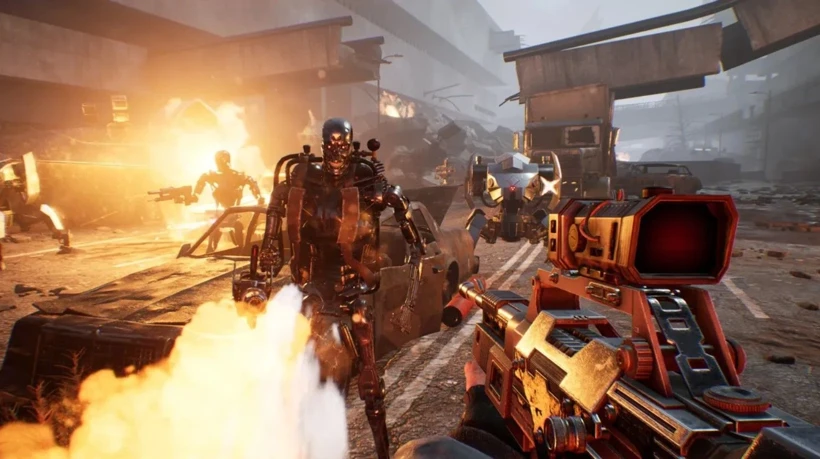
2. Terminator: Resistance (2019)
When Terminator: Resistance first launched, critics gave it incredibly average scores. But if you look at user reviews, it is overwhelmingly positive. Why? Because the developers actually understood the assignment.
This First-Person Shooter isn’t perfectly polished. The animations can be a bit stiff, and it clearly didn’t have the budget of a Call of Duty game. But the atmosphere is absolutely flawless.
The Future War: This is the only game that truly captures the blue-tinted, skull-crushing nightmare of the Future War that James Cameron teased in the 1984 original.Pure Dread: Sneaking past a T-800 patrol because your weapons aren’t strong enough to pierce their armor is genuinely terrifying.Fan Service: The story acts as a perfect prequel to the original films, tying up narrative loops in a way that respects the lore deeply. It is a game made by fans, for fans.
1. Terminator: Dark Fate – Defiance (2024)
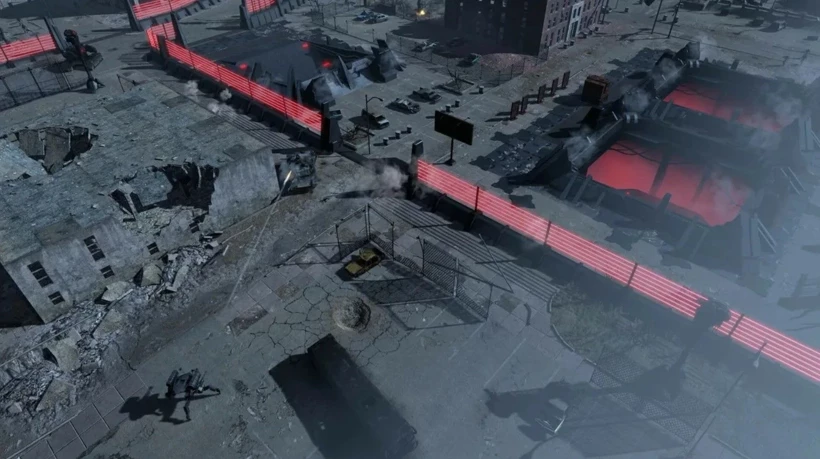
Taking the absolute top spot is a game that dared to completely change the genre. Terminator: Dark Fate – Defiance ditches the First-Person Shooter formula and delivers a massive, deep Real-Time Strategy (RTS) experience.
It turns out that a franchise about a global war between humans and machines works perfectly as a strategy game.
The Setting: Shifting the focus away from Skynet to the newer “Legion” threat from the Dark Fate timeline, the game paints a bleak, desperate picture of humanity’s last stand.Deep Tactics: You aren’t just base-building; you are managing scarce ammunition, armor penetration mechanics, and unit morale. If you lose a veteran squad, they are gone for good. Every victory feels incredibly earned.Post-Launch Support: With a gripping story campaign, robust online multiplayer, and developers who are actively dropping updates, Defiance is currently the most complete, engaging, and polished Terminator experience on the market.
While we wait to see if the cinematic universe can find its footing again, I am perfectly happy fighting the machine menace on my PC. The gaming side of this franchise has proven that as long as you respect the atmosphere of the original lore, there are still amazing stories to tell.
Which of these games is your absolute favorite? Or are you holding out hope that the upcoming Terminator: Survivors will take the crown this year? Let me know in the comments!
Would you like me to put together a similar list for another classic sci-fi franchise, like Alien or Predator?
I was looking at the price of a decent, reliable used car the other day, and it hit me with a sudden wave of realization. For the exact same price—around $20,000—you can now buy a fully functional, bipedal humanoid robot.
Just let that sink in for a second.
I remember watching sci-fi movies a decade ago, assuming that if we ever got walking, talking robotic assistants, they would be multi-million-dollar lab experiments strictly reserved for military bases or ultra-wealthy tech billionaires. But I was wrong. The humanoid robot era isn’t a distant dream anymore; it is happening right now, and the prices are plummeting faster than anyone predicted.
We are standing on the edge of what I believe is the greatest economic and industrial fracture of our lifetime. The global workforce is shrinking, supply chains are straining, and tech giants are pouring unbelievable amounts of money into building machines that will work right alongside us in factories, warehouses, and yes, even inside our living rooms.
Let me break down exactly why this massive shift is happening right now, and more importantly, let’s take a deep dive into the specific robots—and their real-world price tags—that are about to change everything.
Why the Sudden Rush for Humanoids?
Before we look at the specific models, I had to ask myself: Why is every major tech company suddenly pivoting to humanoid robots?
The answer comes down to raw, unfiltered economics. We are facing a massive global labor shortage, especially in physically demanding sectors like logistics, manufacturing, and warehouse management. Humans get tired. We get injured. We need sleep, breaks, and weekends.
A humanoid robot, on the other hand, fundamentally changes the math of a business.
They work 24/7: A robot only stops to swap a battery or charge.They offer extreme consistency: They can perform the exact same repetitive, bone-crushing physical task ten thousand times without a single drop in performance.They fit our world: We built our factories, stairs, and tools for humans. Instead of rebuilding the factory to suit a machine, it is infinitely cheaper to build a machine shaped like a human.
This is exactly why investors are throwing billions at the sector. When I look at the market caps, it is staggering. Tesla (valued over $1.5 trillion) has put its Optimus robot at the very center of its future valuation. Other dedicated robotics firms are reaching astronomical numbers.
Let’s look at the actual lineup of robots you can buy (or will soon be able to buy), because the price tags blew my mind.
1. Figure Robotics: The Corporate Powerhouse
Models: Figure 02 & Figure 03
Whenever I see footage of a Figure robot, I am instantly struck by its sleek, minimalist, matte-black design. They don’t look like clunky industrial machines; they look like the future.
Figure Robotics is currently valued at an eye-watering $39 billion, and their singular vision is general-purpose, automated humanoid labor. They aren’t trying to build toys; they are building the ultimate factory worker. They have already started massive corporate partnerships (like testing in BMW plants) to get these machines out of the lab and onto the production line.
Figure 02 Price: $26,970Figure 03 Price: $41,760
My Take: At just under $27,000, the Figure 02 is priced competitively against the annual salary of a minimum-wage worker in the US. If a factory owner can buy a machine that works three shifts a day for the price of one human’s yearly salary, the return on investment (ROI) happens in a matter of months. This is the model I expect to see completely dominate the automotive and heavy manufacturing spaces.
2. Boston Dynamics: The Industry Legends
Models: Atlas & Spot
You can’t talk about robotics without talking about Boston Dynamics. Valued at over $90 billion, these are the people who broke the internet with videos of robots doing parkour and backflips. They literally set the standard for robotic mobility.
Atlas: This is their bipedal, fully electric humanoid. Currently, Atlas is not for commercial sale. I see it more as a technology showcase—a flex to show the world the absolute limits of balance, strength, and agility.Spot Price: $74,500
My Take: Even though you can’t buy Atlas yet, you can buy their famous robot dog, Spot. At $74,500, it is definitely a premium product. However, Spot is already out in the wild, doing dangerous jobs like inspecting oil rigs, navigating radioactive sites, and scanning construction zones. They aren’t the cheapest, but they are the most battle-tested.
3. Apptronik: The Warehouse Workhorse
Model: Apollo
If Figure is building the sleek sports car of robots, Apptronik is building the reliable pickup truck. With a company valuation sitting around $5 billion, they have focused entirely on their flagship model, Apollo.
Apollo features a friendly, white, modular design. What fascinates me about Apollo is its safety-first architecture. It was specifically engineered to work shoulder-to-shoulder with humans in crowded logistics centers without accidentally hurting anyone.
Apollo Estimated Price Range: $50,000 – $100,000
My Take: The modularity is brilliant. If you don’t need legs, you can literally detach Apollo’s torso and bolt it onto a wheeled base or a stationary pedestal to sort packages. It is highly adaptable, making it the perfect entry-level choice for e-commerce giants trying to automate their sorting facilities.
4. Unitree Robotics: The Budget Disruptors
Models: G1 & H1
If you want to know who is driving the price war in the robotics industry, look no further than Unitree Robotics. This company (valued at $7 billion) is doing to humanoid robots what cheap smartphones did to the mobile industry: aggressively democratizing the technology.
G1 Price: $13,500H1 Price: $90,000
My Take: I had to re-read the press release when I saw the price of the G1. $13,500! That is the price of a high-end mountain bike. While the H1 is their heavy-duty, expensive industrial model, the G1 is designed to be affordable enough for university research labs, smaller startups, and even hardcore tech hobbyists. Unitree is betting that by flooding the market with cheap hardware, developers will flock to their platform to build software.
5. 1X Technologies: The Home Assistant
Model: NEO
Finally, we arrive at the robot that feels the most personal to me. While everyone else is fighting over factory floors, 1X Technologies (aiming for a $10 billion valuation) is trying to conquer your living room.
Their robot, NEO, is specifically designed for domestic use. It is lightweight, covered in a soft fabric suit rather than hard plastic or metal, and built to help with daily household chores.
NEO Estimated Price: $20,000
My Take: A $20,000 robot that can fold my laundry, pick up my groceries, and clean the kitchen? Sign me up. However, as I discussed in a previous article regarding MIT’s teleoperation research, we have to remember that “autonomous” home robots often still rely on human remote operators when they get confused. I love the concept of NEO, but I’ll be watching closely to see how they handle privacy when these machines are navigating our private spaces.
The Economic Tipping Point
When I look at this lineup, the narrative becomes crystal clear. We have officially crossed the threshold from “science fiction” to “consumer electronics.”
Just like the early days of personal computers, the hardware is finally cheap enough to scale. The next massive battle won’t be over how the robots look or how much they can lift; the war will be fought over software. Whoever builds the smartest AI “brain” to put inside these affordable bodies will become the most valuable company on the planet.
This transition is going to disrupt the job market, redefine manual labor, and change how we run our homes. The question isn’t if you will interact with a humanoid robot, but when.
I am honestly fascinated by how fast this is moving, but I want to know where you stand. If you had $20,000 sitting in the bank right now, would you buy a humanoid robot to do your household chores, or does the idea of an AI machine walking around your living room still creep you out? Let’s debate in the comments!
CryptoQuant’s BTC Risk Index moved above +2, signaling a high-volatility regime.Bitcoin dipped below the long-term holder cost basis (~$65.7K), a key cycle stress marker.Rising exchange balances and “supply in profit” compression suggest downside risk isn’t cleared yet.
Bitcoin continues trading around the $68,000 region, with markets attempting to stabilize after recent downside pressure. While price action has slowed, on-chain and institutional flow data suggest the market may still be navigating a broader reset phase rather than confirming a definitive cycle bottom.
The renewed discussion comes as multiple datasets, including CryptoQuant risk metrics, ETF flow trends, and Glassnode holder behavior, present a mixed picture between improving demand and persistent structural stress.
CryptoQuant Risk Index signals high-volatility regime
The latest charts circulating among traders show CryptoQuant’s BTC Risk Index pushing above the +2 line, a threshold that has historically aligned with high volatility and deeper drawdowns before the market stabilizes.
In the same snapshot, Bitcoin’s average price was tracked around the $68K zone, reflecting continued uncertainty after recent downside tests.
While the Risk Index is not a precise “bottom” trigger, the move above +2 signals that the market is still trading in a risk-heavy regime, where sharp swings and failed rallies are common.
ETF inflows provide support but not confirmation
At the same time, institutional demand has shown signs of returning. Data tracked by Farside Investors shows U.S. spot Bitcoin ETFs recorded approximately $506.6 million in net inflows on February 25, followed by another ~$254 million in inflows on February 26, led primarily by BlackRock’s IBIT while FBTC saw outflows.
The rebound marks the strongest inflow stretch in roughly three weeks, indicating dip-buying interest from institutional participants. However, ETF demand alone has historically acted as price support rather than a standalone confirmation of cycle bottoms when on-chain positioning remains weak.
Long-Term holders back in focus after Cost Basis Break
Another key signal came from the long-term holder side. Glassnode’s latest snapshot shows Bitcoin exchange balances around 3,012,700 BTC as of February 26, a level traders watch as a proxy for potential liquid supply.
At the same time, Long-Term Holder (LTH) supply ticked up to ~14.44M BTC , but the LTH net position change was still negative -71.6K BTC, suggesting that while the long-term cohort remains large, distribution hasn’t fully flipped into clear net accumulation yet.
Moreover, Bitcoin has recently traded below the Long-Term Holder (LTH) True Cost Basis near $65.7K, a level used by market participants to gauge whether experienced holders are sitting in profit or loss.
Historically, sustained trading below this band has been associated with a longer digestion phase, renewed distribution pressure, and delayed bottom formation. That doesn’t confirm a deeper crash, but it does raise the odds that the market may need more time before it can build a durable base.
The $60K–$70K band is the market’s “Make-or-Break” demand zone
One reason downside calls haven’t disappeared: the market is leaning heavily on the $60,000–$70,000 band. Glassnode data shows ~429,000 BTC accumulated in that range, building a thick cost-basis cluster that can act as support but also becomes a pressure point if broken.
In simple words, this range now acts as both structural support and a risk zone. Holding above it could allow consolidation to continue, while a sustained breakdown may force a reassessment of downside expectations as recently accumulated positions come under pressure.
Losses are rising, accumulation conviction still weak
In its latest Week On-Chain readout, Glassnode describes Bitcoin as still range-bound between $60K and $70K, with conditions historically consistent with mid-to-late bear market phases.
Two datapoints stood out for the “bottom or pause” debate:
Nearly ~9.2M BTC held at a loss (a sign stress is spreading across cohorts). Accumulation Trend Score below 0.5, which Glassnode interprets as limited conviction from larger entities—i.e., not the kind of aggressive accumulation that tends to mark cleaner cycle lows.
Glassnode also flags the 90D Realized Profit/Loss Ratio below 1.0, indicating an excess-loss regime where realized losses outweigh realized profits—another sign the market is still repairing liquidity.
On profitability, Glassnode’s Supply in Profit metric sat around ~11.07M BTC as of February 26, reflecting how much circulating supply is still “green” at current prices. When this compresses, it typically means the market is spending more time digesting losses and less time trending cleanly.
CryptoQuant’s cycle comparison model indicates that Bitcoin bottoms typically take significant time to form after halving events.
Historical traces imply:
2012 cycle timing → June 2026 equivalent window2016 cycle timing → September 20262020 cycle timing → October 2026
This places the broader bottoming range between June and December 2026, with historical clustering around September–November, analysts noted.
What to watch next
From here, the “bottom vs pause” question likely comes down to whether Bitcoin can reclaim key structural levels while on-chain risk begins to ease.
Metrics to track:
Whether the CryptoQuant Risk Index cools back below +2Continuation of ETF inflows beyond short-term reboundsSigns of stronger accumulation through improving Glassnode trend scores and declining exchange balances?
Until those conditions improve, the data suggests Bitcoin may still be in a high-volatility reset phase, keeping the cycle bottom uncertain.
Also Read: Bitcoin ETFs Gain $1B in 3 Days: Indicators Leaning on ‘Bottom Setup’
Disclaimer: The information researched and reported by The Crypto Times is for informational purposes only and is not a substitute for professional financial advice. Investing in crypto assets involves significant risk due to market volatility. Always Do Your Own Research (DYOR) and consult with a qualified Financial Advisor before making any investment decisions.
Crypto finance company MoonPay has collaborated with stablecoin platform M0 to launch PYUSDx on Friday. The new framework would allow developers to create application-specific stablecoins backed by PayPal USD.
According to the official announcement, the platform would simplify the process for developers looking to increase the rollout of stablecoins tailored to individual apps or ecosystems.
Introducing PYUSDx, a stablecoin tokenization framework from PayPal, @M0, and MoonPay.
🪙 Backed 1:1 by @PayPal USD
⚡️ Go from build to launch in days, not months
🌐 Purpose-built for issuance, distribution, and interoperability
Let’s build together. pic.twitter.com/oLu6KDpopo
— MoonPay 🟣 (@moonpay) February 27, 2026
Targeting application-specific stablecoins
PYUSDx is created as a solution to the growing trend of stablecoins built for specific use cases. In 2025, there was a surge in the number of stablecoins with a circulating supply over $10 million, growing by nearly 90% year-over-year. This reflects strong demand for customized, application-oriented tokens.
By using PYUSD as the underlying reserve, developers can now launch their own branded stablecoins without building complex financial infrastructure from scratch.
Focus on developer access
The framework is built to ease technical and operational challenges. Ivan Soto-Wright, CEO and co-founder of MoonPay, commented on the launch, stating, “Through PYUSDx, the MoonPay Group is extending its issuance and distribution capabilities to make PYUSD more accessible to developers, reducing the technical and operational complexity of bringing application-specific stablecoins to market.”
Meanwhile, M0 CEO Luca Prosperi added that the solution allows developers to iterate faster while maintaining liquidity and interoperability within M0’s ecosystem. “Every fintech developer will eventually utilize a solution like PYUSDx,” he said.
Features of PYUSDx
The combination of M0’s tokenization platform, along with its cross-chain platform and MoonPay’s infrastructure, allows developers to:
Stablecoins backed by PYUSD: Create application-specific tokens on a regulated foundation.Quick deployment: Develop and deploy in days instead of months.Cross-chain support: Interoperate across multiple blockchain networks within the M0 ecosystem.Reserve transparency: On-chain reporting and reserve validation for oversight.Flexible economics: Competitive structures designed for developer needs.
The first application on the platform will be USD.ai, which is creating a stablecoin for AI infrastructure.
Also Read: Barclays Eyes Blockchain Push With Stablecoins and Tokenized Deposits
Disclaimer: The information researched and reported by The Crypto Times is for informational purposes only and is not a substitute for professional financial advice. Investing in crypto assets involves significant risk due to market volatility. Always Do Your Own Research (DYOR) and consult with a qualified Financial Advisor before making any investment decisions.
Published: February 27, 2026 at 9:40 am Updated: February 27, 2026 at 9:00 am
To improve your local-language experience, sometimes we employ an auto-translation plugin. Please note auto-translation may not be accurate, so read original article for precise information.
In Brief
Gate, a global leading digital asset trading platform, has officially launched the first promotional campaign under Gate Booster, running through March 12.
Gate, a global leading digital asset trading platform, has officially launched the first promotional campaign under Gate Booster, running through March 12. This inaugural phase centers on a TradFi-themed original content initiative, with approved participants sharing a total reward pool of 5,000 USDT.
Gate Booster is an incentive platform designed for crypto KOLs, content creators, community builders, and promotional partners. Through standardized task workflows and a transparent reward mechanism, the platform connects promoters with Gate’s ecosystem projects, offering priority access to official campaigns and ongoing incentive support. Its goal is to build a long-term, stable network of promotional collaborations.
In terms of participation, users need to register for the task during the campaign period and publish original TradFi-related content on designated social platforms. Content links must be submitted within the specified timeframe for review. Submissions are evaluated based on quality, and participants who pass the review will receive corresponding rewards. The total prize pool for this phase is 5,000 USDT, distributed on a capped basis, with waitlist and slot-release mechanisms in place to ensure procedural rigor and fair resource allocation.
Focusing on the TradFi theme, this campaign aligns closely with Gate’s recent expansion into traditional financial assets. Gate has significantly deepened its TradFi product matrix, rolling out a dedicated TradFi section and integrating traditional assets across both spot and futures markets. The spot market now supports stocks and metals, while the futures market covers a wide range of assets, including gold, silver, forex, indices, and commodities, as well as popular stocks such as Tesla, NVIDIA, and Apple. Trades are settled in USDT, with leverage of up to 100x, enhancing flexibility for cross-market asset allocation.
As crypto and traditional finance continue to converge, Gate leverages the Booster platform to align creator participation with its broader product strategy. This approach not only strengthens market understanding of Gate’s TradFi offerings but also enhances its promotional framework and ecosystem collaboration, boosting community engagement and brand synergy.
The launch of the first Gate Booster campaign marks a further step forward in Gate’s ecosystem development and integrated financial strategy. By advancing a dual-track path that combines content-driven growth with product innovation, Gate continues to expand the connective boundaries between crypto and traditional finance, moving toward a new phase of multi-asset integration and global, collaborative growth.
Disclaimer
In line with the Trust Project guidelines, please note that the information provided on this page is not intended to be and should not be interpreted as legal, tax, investment, financial, or any other form of advice. It is important to only invest what you can afford to lose and to seek independent financial advice if you have any doubts. For further information, we suggest referring to the terms and conditions as well as the help and support pages provided by the issuer or advertiser. MetaversePost is committed to accurate, unbiased reporting, but market conditions are subject to change without notice.
About The Author
Alisa, a dedicated journalist at the MPost, specializes in cryptocurrency, zero-knowledge proofs, investments, and the expansive realm of Web3. With a keen eye for emerging trends and technologies, she delivers comprehensive coverage to inform and engage readers in the ever-evolving landscape of digital finance.
More articles
Alisa, a dedicated journalist at the MPost, specializes in cryptocurrency, zero-knowledge proofs, investments, and the expansive realm of Web3. With a keen eye for emerging trends and technologies, she delivers comprehensive coverage to inform and engage readers in the ever-evolving landscape of digital finance.
Published: February 27, 2026 at 9:30 am Updated: February 27, 2026 at 8:57 am
To improve your local-language experience, sometimes we employ an auto-translation plugin. Please note auto-translation may not be accurate, so read original article for precise information.
In Brief
If February felt a little noisy, that’s because it was. Between governance wars, L2 sovereignty plays, and TradFi quietly treating Ethereum like a production database, the month served up a reminder that “crypto winter” is officially a memory.
If February felt a little noisy, that’s because it was. Between governance wars, L2 sovereignty plays, and TradFi quietly treating Ethereum like a production database, the month served up a reminder that “crypto winter” is officially a memory. We’re firmly in the messy, opinionated, build-through-the-buzz phase now, and February gave us plenty to chew on.
Here’s what actually mattered.
The Aave Framework Forces a Real Conversation About Value
Let’s start where the stakes are highest, which is Aave. On February 12, Aave Labs dropped what sounds like a boring temp check titled “Aave Will Win Framework,” though the contents are anything but mundane. The proposal essentially does three things: it would send 100% of Aave-branded product revenue to the DAO treasury, ask the DAO to formally bless Aave V4 as the growth engine going forward, and secure budget and funding structures for the team behind it all.
On the surface, this looks like a straightforward win for tokenholders — more revenue flowing to the treasury is obviously good. But if you spend any time in that governance thread (which has 64 likes, a meaningful signal in forum terms), the real story emerges quickly. Commenters immediately started poking at what actually counts as revenue, who decides what gets deducted before that “100%” lands in the treasury, and whether this setup centralizes too much discretion with Aave Labs. These aren’t superficial objections; they’re fundamental questions about how DAO power should be distributed.
In my view, this is actually the healthiest kind of fight a DAO can have. Aave is now large enough that “value capture” isn’t an abstract concept — it’s real money, real budgets, and real power dynamics playing out in public. The fact that the community is arguing about definitions rather than rubber-stamping a proposal suggests the system is working as intended. At the same time, this feels like a preview of what’s coming for every major protocol. The “we’ll figure out revenue later” era is ending, and February was the month that became impossible to ignore.
Base Charts Its Own Course While OP Feels the Pressure
While Aave was settling its governance future, another kind of structural tension was playing out in the L2 world. If you happened to watch OP’s price action in mid-February and wondered what was driving it, Base provides the answer.
On February 18, the Base engineering team announced they’re moving toward a unified, Base-operated stack. What this means in practice is that over the coming months, Base will rely less on the OP Stack and more on its own client software. The team was careful to note that everything remains compatible and Ethereum-aligned, but the shift in control is unmistakable — Base will now ship on its own cadence.
The market’s reaction was swift and severe. Looking at CoinGecko’s historical data, OP’s daily close fell from $0.1869 on February 17 to $0.1285 on February 21, which works out to a 31.2% drawdown in just four days. Now, correlation isn’t causation, and OP certainly had other headwinds during that period. Even so, this feels like a repricing of what you might call ecosystem cohesion risk. The Superchain thesis — which imagines many L2s sharing one stack, one governance model, and one economic alignment — took a visible hit when one of its largest members essentially said “we’re going to do this our way now.”
If I’m reading this correctly, Base is simply doing what any successful L2 would do: optimizing for speed and product control. But the market’s reaction tells you that “stack sovereignty” comes with a price tag. If you’re holding OP tokens, you’re betting on network effects across chains, and when a major chain starts building its own client, those network effects become harder to price with confidence. This story isn’t over, and I’ll be watching closely to see whether other OP Stack chains signal they’re staying or quietly following Base’s lead.
Zora Takes Attention Markets to Solana
Meanwhile, a different kind of cross-chain move was generating buzz in the social finance corner of the ecosystem. On February 17, Zora announced that “The world’s attention market is now live on Solana.”
If you haven’t had a chance to play with the product yet, here’s how it works: Zora lets you take positions on topics, memes, and cultural moments — essentially, every post becomes a tradable coin. It’s SocialFi in the sense that social interaction meets trading, though the experience leans much closer to a trading terminal than a traditional social app. The launch post pulled about 815 likes and 406 replies, which counts as strong engagement by 2026 X standards, and Solana’s own official account amplified the announcement to its followers.
But the real signal here isn’t the engagement numbers — it’s the chain choice. Zora could have launched on Base, or Ethereum mainnet, or any number of L2s in its home ecosystem. Instead, it chose Solana, and that decision tells you something about where the team thinks liquidity and user velocity currently live. Solana has the retail trading culture right now, and the “attention as an asset” mechanic works best where users are already primed to speculate.
My read on this is that Zora is following liquidity pragmatically rather than ideologically. This is either a genius distribution move or a sign that the team thinks its home turf isn’t sticky enough to sustain the product vision. Either way, I expect we’ll see more “Ethereum-native” apps make similarly pragmatic chain choices throughout 2026. Users don’t care about your L2 allegiance; they care whether the coin goes up, and teams are increasingly building where the users actually are.
MegaETH Finally Launches With Impressive Early Numbers
Staying in the L2 performance conversation for a moment, February also brought the long-awaited MegaETH launch. The project has been talking about “real-time blockchain” performance for a while now — 100,000+ TPS, sub-10ms block times, all settled on Ethereum. After months of anticipation, they finally opened the doors to the public.
The launch window fell roughly around February 9–10, and within the first 24 hours, third-party reporting claimed some eye-catching numbers: more than 67,000 new addresses, over 34,000 contracts deployed, and upwards of 2.1 million transactions. I should note that these figures come from Binance News citing unnamed sources, so a degree of skepticism is warranted. Even taking them with a grain of salt, though, that level of early activity suggests genuine appetite for what MegaETH is building.
In essence, MegaETH is making the case that Ethereum can offer L1 security alongside Solana-like performance if you’re willing to accept certain trade-offs. The jury’s still out on whether that performance holds up under sustained real-world usage, but the early numbers suggest the team has at least cleared the first hurdle. It’s also worth noting that they announced Chainlink Scale integration just before launch, which signals they’re thinking about ecosystem legitimacy and oracle infrastructure from day one rather than treating it as an afterthought.
Institutional Adoption Quietly Moves Forward
Not everything that mattered in February made a lot of noise. Two stories in particular flew somewhat under the radar while representing significant steps forward for institutional adoption of public blockchain infrastructure.
The first came on February 11, when IHC, Sirius, and First Abu Dhabi Bank announced they’d received UAE central bank approval to launch a dirham-backed stablecoin called DDSC on ADI Chain. A year ago, this kind of headline might have been ignored or dismissed as regulatory theater. Now it fits into a clear pattern: regulated, fiat-backed, compliance-ready chains are how “real world” money starts moving on public infrastructure. The UAE has been positioning itself as a crypto-friendly jurisdiction for a while, and this approval suggests that positioning is translating into actual products.
Then on February 20, BNP Paribas Asset Management issued a press release announcing they’d tokenized a money market fund share class on the public Ethereum network. The language is classic TradFi — they describe it as an “intra-group experiment” with a “permissioned access model” — but the key detail is right there in the first paragraph: recorded on Ethereum. Yes, participation is restricted to eligible investors. Yes, it’s framed as a pilot rather than a production product. Even so, it’s another brick in the wall of “public blockchain as settlement layer for regulated instruments.”
These stories don’t move token prices, but they move the conversation. Every major financial institution is now in “experiment and learn” mode on public chains, and February gave us two concrete examples of what that looks like in practice. The question is no longer whether they’ll use blockchain — it’s which chains, what compliance layers, and how fast the transition happens.
Security Incidents Serve as Unwelcome Reminders
February also had its share of unwelcome news on the security front, because of course it did.
On February 21, IoTeX confirmed suspicious activity involving a token safe, with on-chain analysts estimating around $4.3 million in drained assets. The team said losses were “contained” and coordinated with exchanges, but the market reaction was immediate — IOTX dropped more than 8% in 24 hours according to CoinGecko data. The incident appears to involve private key compromise, which remains one of the hardest attack vectors to defend against at scale.
Earlier in the month, CrossCurve also found itself in the spotlight for less-than-ideal reasons, with exploit reports circulating and security commentators digging into the details. Loss totals varied across different sources, which is typical in the immediate aftermath of these events, but the pattern was familiar: cross-chain complexity, bridge-like risk profiles, and a mad scramble to contain the damage.
Security is the genre that never gets old in this industry, and not in a good way. Private key compromises, bridge risks, token safes — these are the failure modes we’ve known about for years, and they keep happening because they’re genuinely difficult to protect against when you’re moving value across multiple chains and protocols. The only real hedge is diversity of assets and a healthy skepticism toward “we’ve fixed it forever” claims.
Nifty Gateway Closes Its Doors
Finally, February brought a different kind of story: not a hack, not a launch, just a shutdown. Nifty Gateway, the Gemini-owned NFT marketplace, closed its doors on February 23 per the date announced earlier in the month.
Today, we are announcing that the Nifty Gateway platform will be closing on February 23, 2026. Starting today, Nifty Gateway is in withdrawal-only mode.
Nifty Gateway was launched in 2020 with the vision of revolutionizing digital art. Since launching, Nifty supported dozens of…
— Nifty Gateway Studio (@niftygateway) January 24, 2026
This is what you might call a cycle marker. When a major branded marketplace calls it quits, it’s not just about that company’s specific circumstances — it’s about the state of the NFT market more broadly. Creators lose a distribution channel they may have relied on. Collectors lose a venue they were comfortable with. And everyone reads the tea leaves trying to figure out where the next wave might come from, or whether it’s coming at all.
Marketplaces are infrastructure, and infrastructure consolidates in bear-to-early-bull transitions. This doesn’t mean NFTs are dead as a category; it means the survivors are getting sharper about what they offer and how they operate. I suspect the next iteration of NFT markets will look less like “art gallery” and more like what Zora is doing — trading on attention and cultural velocity rather than static JPEGs.
Wrapping Up February
Stepping back, February felt like a month where the crypto conversation matured in subtle but important ways. Not because everyone suddenly agreed on everything — far from it. But because the arguments are now about real things: who gets paid when a protocol succeeds, which chains control their own roadmap, whether attention can be reliably turned into a financial primitive, and how fast traditional finance actually moves on-chain.
If you’re reading this in late February, you’ve got plenty to watch going into March. See you next month.
Disclaimer
In line with the Trust Project guidelines, please note that the information provided on this page is not intended to be and should not be interpreted as legal, tax, investment, financial, or any other form of advice. It is important to only invest what you can afford to lose and to seek independent financial advice if you have any doubts. For further information, we suggest referring to the terms and conditions as well as the help and support pages provided by the issuer or advertiser. MetaversePost is committed to accurate, unbiased reporting, but market conditions are subject to change without notice.
About The Author
Alisa, a dedicated journalist at the MPost, specializes in cryptocurrency, zero-knowledge proofs, investments, and the expansive realm of Web3. With a keen eye for emerging trends and technologies, she delivers comprehensive coverage to inform and engage readers in the ever-evolving landscape of digital finance.
More articles
Alisa, a dedicated journalist at the MPost, specializes in cryptocurrency, zero-knowledge proofs, investments, and the expansive realm of Web3. With a keen eye for emerging trends and technologies, she delivers comprehensive coverage to inform and engage readers in the ever-evolving landscape of digital finance.
I’ve spent countless hours reading about our grand plans to return to the Moon, and there is always one glaring issue that most sci-fi movies conveniently ignore: the lunar night. Imagine trying to survive in a freezing, unforgiving vacuum where the sun sets and doesn’t rise again for two entire Earth weeks.
When I first started looking into how space agencies planned to keep astronauts alive in the dark, I honestly assumed we would just build massive solar farms and pack thousands of next-generation batteries. But the math simply doesn’t add up for a permanent, industrial-scale base. That’s why the latest news from Lockheed Martin completely caught my attention. They aren’t looking at the sun for our lunar future; they are looking at splitting the atom.
Lockheed Martin, in collaboration with NASA and the U.S. Department of Energy, is developing a Fission Surface Power (FSP) system. Their goal? To deploy a working nuclear reactor on the Moon. Let’s break down why this is happening, how the technology works, and what it means for the future of a permanent lunar economy.
The Dark Side of Lunar Survival
To understand why Lockheed Martin is betting on nuclear fission, you have to understand the brutal reality of the lunar environment.
The most valuable real estate on the Moon is currently at the poles, primarily because we’ve found water ice in permanently shadowed craters. We need that ice to drink, but more importantly, to split into hydrogen and oxygen for rocket fuel.
Here is the catch:
The 14-Day Night: A single night on the Moon lasts about 350 hours.The Cold: Temperatures can plummet to around -130°C (and even colder in shadowed craters).The Shadow Problem: If you are mining in a crater that never sees sunlight, your shiny new solar panels are completely useless.
Solar power is great for short missions or orbital satellites, but if we want to build habitats, run continuous mining operations, and keep rovers alive through the freezing dark, we need an energy source that doesn’t care if the sun is shining. Nuclear fission provides that uninterrupted, reliable, and weather-independent power.
Enter the Fission Surface Power (FSP) Concept
When I first read the specs of what Lockheed Martin was planning, I was actually a bit surprised by how modest the starting point is. They aren’t trying to build a massive, city-powering plant right out of the gate.
Instead, they are taking a highly practical, scalable approach:
The Starting Line: The initial system will generate between 5 to 10 kilowatts (kW) of power. To put that in perspective, 10 kW is roughly what it takes to run a couple of heavy household appliances simultaneously.The Immediate Goal: On the Moon, that 5-10 kW is a lifesaver. It is exactly enough to heat a small habitat, keep life support systems running, and ensure a lunar rover doesn’t freeze to death during the long night.The Long-Term Vision: Once the baseline technology is proven, Lockheed plans to scale the architecture up to 25 kW, 50 kW, and eventually a robust 100 kW grid.
Why Scaling Up Isn’t Just “Making It Bigger”
You might think, “If we can build a 10 kW reactor, why not just build a bigger one right away?” If only space engineering were that easy!
Upgrading to a 100 kW system introduces terrifying thermal management problems. In space, getting rid of excess heat is incredibly difficult because there is no air to carry the heat away (convection). Lockheed Martin is heavily focusing on advanced Brayton motor technology to solve this.
For the massive power loads, they have to:
Control high-temperature Brayton cycles efficiently.Invent and implement entirely new materials capable of surviving these extreme operational temperatures.Develop fully autonomous operational systems so the reactor can run safely without a human constantly turning dials.
The Race to the Next Decade
This isn’t just a wild concept sitting on a drawing board. The project is actively moving forward under Phase 1 contracts with NASA and the Department of Energy, with a very real launch target set for the end of the decade.
In fact, developing nuclear power for space has officially become a U.S. national priority, backed by a recent White House Executive Order. The government knows that whoever establishes a reliable power grid on the Moon will control the future of commercial space mining and deep-space exploration.
Interestingly, Lockheed Martin isn’t just focusing on the dirt. Their roadmap includes building a 10-25 kW orbital power system first. I think this is a brilliant move. By testing the reactor, heat dissipation, and autonomous controls in lunar orbit first, they can drastically lower the risk before trying to land and deploy a nuclear core on the dusty surface. It also helps streamline the massive regulatory nightmare of launching nuclear material from Earth.
A New Era of Space Exploration
We are witnessing a monumental shift in how we approach space. We are moving away from the “plant a flag and go home” era and stepping into the “build a foundation and stay” era. A reliable nuclear reactor is the absolute bedrock of that foundation. Without it, there is no permanent moon base, no lunar fuel refineries, and no stepping stone to Mars.
It’s mind-blowing to think that in just a few years, we might look up at the Moon and know there is a tiny, autonomous nuclear reactor humming away in the dark, keeping the lights on for humanity’s furthest outpost.
I’m curious to know where you stand on this. If you were an astronaut chosen for a long-term lunar mission, would you feel comfortable sleeping in a habitat powered by a nuclear fission reactor just a few hundred yards away, or does the idea make you nervous? Let me know your thoughts in the comments!
Published: February 27, 2026 at 2:02 am Updated: February 27, 2026 at 2:02 am
by Victor Dey
Edited and fact-checked:
February 27, 2026 at 2:02 am
To improve your local-language experience, sometimes we employ an auto-translation plugin. Please note auto-translation may not be accurate, so read original article for precise information.
In Brief
Google has launched Nano Banana 2, a faster and more capable image-generation model that expands across platforms such as Google Cloud and Google Ads while strengthening transparency for AI-generated media through standards developed with the Coalition for Content Provenance and Authenticity.
Technology company Google announced the launch of Nano Banana 2, a new image-generation model designed to deliver faster performance while maintaining high visual quality and reasoning capabilities. According to the company, the system is intended to make advanced image creation tools more widely accessible and suitable for rapid editing and iteration.
The new model brings high-speed processing to visual generation and integrates broad real-world knowledge to support more accurate depictions of subjects and scenes. By drawing on live web information and image references, the system is able to improve contextual understanding for tasks such as infographic creation, diagram generation and data visualization. The model also focuses on precise text rendering inside images, enabling clearer marketing mock-ups and visual materials, as well as translation and localization of embedded text for international audiences.
Nano Banana 2 is positioned as a major step forward in creative control. It can maintain visual consistency for multiple characters and objects within a single workflow, supporting narrative design and storyboarding without unintended visual changes. The system has been optimized to follow complex instructions more closely and to preserve the specific details described by users. Output options include a wide range of aspect ratios and resolutions, from small formats to 4K, allowing assets to be adapted for different digital and display environments. Improvements in lighting, texture and detail aim to deliver photorealistic results while retaining fast generation speeds.
Nano Banana 2 Expands Across Google Cloud And Google Ads As Company Strengthens AI Content Provenance
The model is being introduced across multiple platforms and services, including search and advertising tools, cloud development environments and creative workflows. Availability is expanding internationally and across additional languages, with Nano Banana 2 becoming the default image model in several products and preview programs, including services operated under Google Cloud and campaign creation tools in Google Ads.
Alongside the product rollout, the company highlighted new and ongoing efforts to improve transparency around AI-generated content. Its provenance framework combines embedded watermarking with content authentication standards developed by Coalition for Content Provenance and Authenticity to help users understand whether AI was used and how media was created. The firm reported that its verification tools have already been used tens of millions of times and confirmed that expanded credential verification features will be introduced to additional applications in the near future.
Disclaimer
In line with the Trust Project guidelines, please note that the information provided on this page is not intended to be and should not be interpreted as legal, tax, investment, financial, or any other form of advice. It is important to only invest what you can afford to lose and to seek independent financial advice if you have any doubts. For further information, we suggest referring to the terms and conditions as well as the help and support pages provided by the issuer or advertiser. MetaversePost is committed to accurate, unbiased reporting, but market conditions are subject to change without notice.
About The Author
Alisa, a dedicated journalist at the MPost, specializes in cryptocurrency, zero-knowledge proofs, investments, and the expansive realm of Web3. With a keen eye for emerging trends and technologies, she delivers comprehensive coverage to inform and engage readers in the ever-evolving landscape of digital finance.
More articles
Alisa, a dedicated journalist at the MPost, specializes in cryptocurrency, zero-knowledge proofs, investments, and the expansive realm of Web3. With a keen eye for emerging trends and technologies, she delivers comprehensive coverage to inform and engage readers in the ever-evolving landscape of digital finance.
Ethereum introduced digital ownership to gaming; however, it did not fully meet the performance expectations of contemporary players. Early projects such as CryptoKittiesdemonstrated the potential of blockchain gaming but also exposed significant limitations. Transaction confirmation times were often lengthy, and high fees discouraged regular gameplay. Consequently, many developers began to explore alternative blockchains that offered improved performance.
The Ethereum Foundation’s Strawmap, released in February 2026, constitutes a targeted initiative to address these challenges. Although it is a draft roadmap rather than a definitive delivery schedule, it offers the most comprehensive perspective to date on the potential evolution of Ethereum’s core infrastructure through the end of the decade. Notably, the Strawmap indicates that Ethereum’s leadership acknowledges gaming as a particularly demanding and valuable application of blockchain technology.
Although the Strawmap doesn’t focus exclusively on gaming, its improvements directly affect the areas that matter most to game developers and players.
Fundamentally, the Strawmap proposes upgrades intended to enhance Ethereum’s speed, scalability, and usability. These enhancements are scheduled to be implemented through a series of network updates over several years, with each phase building upon prior advancements.
A key change is cutting transaction finality times from minutes to seconds. This may sound technical, but it makes a big difference for gameplay. Faster confirmations let games react quickly to player actions, making the experience smoother and more immersive. Players can keep playing without having to wait for transactions to finish.
Scaling is also a big focus. The roadmap aims for Ethereum to handle much more activity in the future, with its Layer-2 ecosystem growing as well. This extra capacity lets developers create bigger, more complex games without overloading the network.
These changes transform Ethereum from a system that can support gaming into one that can actively enable it at scale.
Speed has always defined the difference between blockchain games and traditional online games. Players expect immediate feedback when they take action, whether they’re attacking an opponent, crafting an item, or completing a trade. Delays break immersion and make gameplay feel disconnected.
The Strawmap seeks to address this challenge by targeting confirmation times measured in seconds rather than minutes. This improvement aligns blockchain responsiveness more closely with traditional gaming standards. Consequently, developers can design game mechanics that depend on frequent player interaction without concern for technical limitations disrupting the experience.
This advancement also enhances trust, as players are more likely to engage confidently with game economies when transactions are finalized quickly and predictably.
Blockchain games are evolving to resemble comprehensive digital economies rather than basic collectible platforms. Players engage in activities such as purchasing land, trading resources, and investing in assets with tangible value. These interactions necessitate infrastructure capable of supporting continuous, large-scale engagement.
The Strawmap’s scaling goals address this need by increasing Ethereum’s capacity and strengthening its Layer-2 networks. Larger multiplayer environments become more practical as infrastructure improves, which opens the door for persistent virtual worlds that operate entirely on blockchain systems.
Projects such as Otherside and Illuvium already depend significantly on Ethereum’s infrastructure. As performance improves, these games will be able to support larger player bases and more complex economic systems without compromising reliability.
This creates the foundation for blockchain games that operate on a global scale.
Usability has consistently represented a major obstacle to the adoption of blockchain gaming. Traditional games enable players to sign in and begin immediately, whereas blockchain games frequently require wallets, transaction approvals, and cryptocurrency balances prior to participation.
The Strawmap introduces features such as native account abstraction, letting developers simplify gamer interactions with the network. Rather than managing private keys and approving each action, players could utilize systems that resemble conventional gaming accounts.
Developers could also sponsor transaction fees, removing the need for players to acquire cryptocurrency before they begin playing. These changes reduce friction significantly and make blockchain games easier for mainstream audiences to adopt.
Better usability strengthens retention and makes games more competitive with traditional platforms.
Privacy has seldom been a prominent feature in blockchain gaming, as most blockchains publicly expose transaction details. This level of transparency restricts certain gameplay types, especially competitive games that depend on concealed information.
Ethereum’s roadmap includes support for shielded transactions, which allows players to secure sensitive information such as asset holdings This feature enables developers to design more sophisticated competitive environments while protecting player privacy.
Security enhancements also address long-term risks. Quantum computing technology poses a hypothetical threat to existing encryption systems, particularly for assets intended to retain value over long periods. The Strawmap outlines plans to implement quantum-resistant protections, thereby helping to ensure the security of valuable gaming assets in the future.
This level of long-term planning strengthens confidence among players, developers, and investors.
Solana has gained popularity in gaming largely because of its speed and low transaction costs. Games built on Solana often feel more responsive, which makes the platform appealing for developers who prioritise performance.
However, Ethereum maintains advantages in ecosystem depth, security, and asset liquidity. Its NFT marketplaces, developer tools, and financial integrations remain unmatched.
The Strawmap narrows Solana’s speed advantage while preserving Ethereum’s strengths. As performance improves, developers may find it easier to build on Ethereum without sacrificing gameplay responsiveness. Solana will likely remain attractive for certain fast-paced games, but Ethereum becomes far more competitive across a wider range of projects.
This shift strengthens Ethereum’s long-term position.
Newer networks like Sui and Aptos have attracted attention for their capacity to handle complex game mechanics efficiently. Their designs allow multiple asset updates simultaneously, which helps support multiplayer environments.
Even so, Ethereum continues to offer expanded ecosystem benefits, including larger player communities and stronger integration with NFT marketplaces.
Gaming-focused chains like Immutable and Ronin also benefit from Ethereum’s progress because they rely on its infrastructure for security and settlement. As Ethereum improves, those networks gain additional stability and performance advantages.
The Strawmap strengthens Ethereum’s entire ecosystem, not just its base layer.
In spite of its potential, the Strawmap is a draft roadmap rather than a definitive timeline, and its overall impact will depend on successful implementation over several years. Development at Ethereum’s scale necessitates coordination among numerous independent teams, making delays and adjustments likely.
At the same time, competing networks will continue to improve their own technology, ensuring that Ethereum won’t gain an uncontested advantage overnight. Some developers may still choose alternative chains that offer simplicity or immediate performance benefits, particularly for games that require extremely fast responsiveness.
Ethereum’s dependence on Layer-2 scaling solutions adds extra technical complexity, which may complicate both development and user experience if not managed effectively.
Ultimately, Ethereum’s success will depend on how effectively it delivers on the Strawmap’s goals.
Blockchain gaming continues shifting from experimental projects into fully developed digital economies with long-term value. Infrastructure must progress alongside those ambitions, and Ethereum’s Strawmap represents one of the clearest efforts to prepare for that future.
Performance improvements, better usability, and stronger security directly tackle the limitations that once pushed developers toward other platforms. At the same time, Ethereum’s ecosystem advantages remain firmly in place, which creates a powerful combination as performance improves.
While Ethereum may never become the fastest blockchain in every category, it doesn’t need to be. Its strength lies in combining performance with trust, stability, and economic activity.
If the Strawmap unfolds successfully over the next several years, Ethereum will likely play a central role in supporting the next generation of blockchain games and virtual worlds.
Senator Cynthia Lummis rejected Sam Bankman-Fried’s praise of the CLARITY Act in a public exchange on X.Lummis said the legislation would have resulted in significantly longer prison exposure under stricter regulatory standards.The exchange reignites debate over U.S. crypto market structure reforms and political positioning around regulation.
Lummis Responds to SBF’s CLARITY Act Praise
U.S. Senator Cynthia Lummis publicly criticized former FTX CEO Sam Bankman-Fried after he described the proposed CLARITY Act as a “huge milestone” for the crypto industry. In a post published on February 26, Lummis wrote that “someone’s looking for a pardon” and argued that the legislation would have kept him “locked up for much longer than 25 years.”
The senator added that her approach to crypto regulation differs sharply from earlier legislative efforts associated with Bankman-Fried’s lobbying activities in Washington.
Someone’s looking for a pardon and doesn’t realize the Clarity Act would have you locked up for much longer than 25 years.
My legislation couldn’t be more different than the bill you tried to buy from Congress over my objection in 2022.
We do not need—nor want—your support. https://t.co/JlywsCh3ry
— Senator Cynthia Lummis (@SenLummis) February 26, 2026
The remarks came after Bankman-Fried claimed he had previously supported similar regulatory frameworks aimed at providing clearer rules for digital assets.
SBF previously pushed regulatory proposals
Bankman-Fried, once one of crypto’s most influential executives, was sentenced to 25 years in prison following fraud convictions tied to the 2022 collapse of FTX.
The exchange’s failure triggered one of the largest regulatory crackdowns in crypto history and accelerated calls in Washington for clearer market-structure laws.
Because SBF previously pushed regulatory proposals aimed at defining crypto oversight, his renewed comments on legislation have drawn strong reactions from lawmakers seeking stricter accountability after industry failures.
CLARITY Act at center of U.S. crypto policy debate
The CLARITY Act has emerged as one of the most discussed U.S. crypto market structure proposals, aiming to define regulatory jurisdiction between agencies and establish clearer classifications for digital assets.
Supporters argue the bill could reduce enforcement-driven uncertainty by setting formal compliance pathways for crypto firms. Critics, however, say stricter disclosure, custody, and operational requirements would increase legal accountability for centralized platforms.
The Digital Asset Market CLARITY Act aims to establish a comprehensive framework defining whether digital assets fall under the Securities and Exchange Commission or the Commodity Futures Trading Commission.
The legislation has become a cornerstone of U.S. crypto policy discussions, though political disagreements continue to affect its timeline. Prediction markets recently showed approval odds falling toward 45% as disputes over stablecoin oversight slowed momentum in Congress.
Political narrative returns to crypto regulation
Crypto legislation has become increasingly tied to broader political narratives ahead of ongoing regulatory negotiations in Washington.
While Bankman-Fried’s comments framed the CLARITY Act as pro-industry progress, Lummis emphasized that the bill is designed to strengthen enforcement standards rather than shield executives.
The public disagreement reflects continued tension between lawmakers seeking stricter oversight and industry figures advocating clearer regulatory pathways.
Also Read: U.S. Lawmakers Introduce New Bill to Protect Blockchain Developers
Disclaimer: The information researched and reported by The Crypto Times is for informational purposes only and is not a substitute for professional financial advice. Investing in crypto assets involves significant risk due to market volatility. Always Do Your Own Research (DYOR) and consult with a qualified Financial Advisor before making any investment decisions.