Published: July 11, 2025 at 11:00 am Updated: July 11, 2025 at 11:00 am
by Ana
Edited and fact-checked:
July 11, 2025 at 11:00 am
To improve your local-language experience, sometimes we employ an auto-translation plugin. Please note auto-translation may not be accurate, so read original article for precise information.
In Brief
Reactive Network aims to create smart contracts that automatically respond to on-chain events across multiple blockchains, enhancing developers’ capabilities and not replacing Layer 1s.
Smart contracts that run themselves, no bots, no manual triggers. That’s the idea at the heart of Reactive Network. In this interview, Emilijus, Head of Ecosystem, explains how Reactive is building infrastructure where contracts can automatically respond to on-chain events across multiple blockchains.
From parallel execution to cross-chain automation, he shares why this shift matters, what it unlocks for developers, and why Reactive isn’t trying to replace Layer 1s but make them smarter.What exactly makes Reactive Network “reactive”? How is it different from a regular smart contract platform?
What makes Reactive Network truly “reactive” is the concept of Reactive Smart Contracts (RSCs). Unlike traditional smart contracts that sit idle until a user sends a transaction, RSCs are designed to automatically respond to events or data changes across multiple blockchains.
They operate on the principle of inversion of control, meaning the control flow is driven by predefined conditions rather than external calls. This enables contracts to act autonomously—they’re constantly monitoring and ready to trigger on-chain actions without anyone needing to press a button.
Why was it important for you to build a system where contracts respond to data, not just user-triggered transactions?
In most blockchain applications today, developers rely on off-chain services—centralized bots or oracles—to monitor for specific events and then trigger contract execution. This introduces trust assumptions, potential single points of failure, and infrastructure complexity.
With Reactive Network, our goal was to eliminate that dependency by moving the logic on-chain. By making contracts inherently aware of the events they respond to, we reduce friction, enhance decentralization, and strengthen the trustless nature of smart contract automation. No cron jobs. No admin keys. Just self-reacting contracts.
What’s the main benefit of parallel execution on Reactive?
Reactive’s architecture is built around a parallelized EVM, allowing multiple contracts to execute simultaneously—as long as they operate on independent parts of the state. This unlocks massive gains in scalability: faster throughput, significantly lower latency, and reduced gas costs. Instead of sequential bottlenecks where everything must happen one after another, Reactive allows for safe concurrency—this is critical for enabling real-world, high-frequency applications.
What were the main technical challenges in building your parallelized EVM?
Parallel execution in a blockchain environment is non-trivial. One of the hardest parts was building a system that could detect state conflicts between parallel transactions efficiently.
We also needed a robust rollback mechanism to ensure deterministic execution even when conflicts arise, and we had to optimize storage access and async task scheduling so that the added complexity of parallelism didn’t negate its performance benefits. Getting these pieces to work together in harmony required deep rethinking of core EVM internals.
Do you see Reactive as a Layer 1 competitor, or as a specialized execution layer for specific types of applications?
Reactive is not trying to be a general-purpose L1. Instead, we position it as a specialized execution layer that complements existing blockchains. It connects to other EVM chains via relayers, and focuses on one specific superpower: cross-chain automation. Rather than competing for base consensus, we’re building a network that makes existing dApps more powerful, responsive, and autonomous across ecosystems.
How easy is it for a regular Solidity developer to start building on Reactive?
We’ve made the onboarding experience as seamless as possible. Developers write RSCs in standard Solidity—no need to learn a new language or framework. You use the same ABIs and familiar tooling.
The only additional step is declaring the events your contract wants to subscribe to, and defining the logic for what should happen when those events occur. With comprehensive docs, an educational course, and prebuilt boilerplate, getting started feels just like building any other smart contract.
How do you make sure developers don’t accidentally build apps with security risks in your system?
We take a layered approach to safety. First, RSCs execute inside a sandboxed ReactVM, isolated from externally owned accounts. Second, we require all contract code to be verified and auditable through Sourcify, which enhances transparency.
And third, RSCs are restricted to act only on explicitly declared events—this limits the surface area for unexpected behaviors or exploits and makes contract behavior far easier to reason about.
What’s the long-term vision for cross-chain automation—do you see Reactive as a kind of “on-chain router” for logic?
Absolutely. Our goal is to become the on-chain logic layer that intelligently routes actions and data across chains. Whether it’s for cross-chain DeFi strategies, NFT triggers, or reactive oracles, Reactive becomes the connective tissue that makes it possible for applications to behave dynamically and contextually—without human intervention. Think of it as the automation layer Web3 has been missing.
What kinds of applications are a “perfect fit” for Reactive Network?
Reactive really shines in use cases that demand responsiveness and automation. For example, cross-chain buy/sell orders and arbitrage are natural fits. So is anything involving automatic collateral or liquidity management, especially in DeFi.
On the NFT/gaming side, things like conditional minting or dynamic upgrades work beautifully. DAO treasury automation is another big area. And of course, oracles that respond and act based on multi-chain inputs—it’s all about being able to coordinate multiple on-chain events seamlessly.
How can DeFi protocols benefit from reactive contracts compared to traditional on-chain setups?
DeFi protocols on Reactive can go way beyond static interactions. They can implement decentralized cross-chain lending, protect users from liquidations by auto-deleveraging, execute stop-loss or rebalance actions instantly, and track yield across networks to optimize deposits.
Perhaps most importantly, the entire protocol logic can be executed automatically, without relying on external bots or relayers. It’s native, trustless automation that dramatically reduces complexity.
What’s the one thing you believe about blockchain design that most other projects are missing?
We strongly believe automation should live on-chain. Many systems today still rely heavily on off-chain components to function—timers, triggers, schedulers, bots. That introduces fragility and trust assumptions. We’re flipping that model and showing that with the right primitives, smart contracts can drive themselves. It’s not just about decentralization of consensus—it’s about decentralization of execution logic.
In 2 years, how would you like developers and users to describe what makes Reactive Network unique?
We hope that in two years, when people talk about Reactive, they say:
“Reactive is where contracts run themselves. They listen, respond, and operate across chains—fast, secure, and fully on-chain.” That’s the vision: a smart contract world that doesn’t just wait, but reacts.
Disclaimer
In line with the Trust Project guidelines, please note that the information provided on this page is not intended to be and should not be interpreted as legal, tax, investment, financial, or any other form of advice. It is important to only invest what you can afford to lose and to seek independent financial advice if you have any doubts. For further information, we suggest referring to the terms and conditions as well as the help and support pages provided by the issuer or advertiser. MetaversePost is committed to accurate, unbiased reporting, but market conditions are subject to change without notice.
About The Author
Victoria is a writer on a variety of technology topics including Web3.0, AI and cryptocurrencies. Her extensive experience allows her to write insightful articles for the wider audience.
More articles
Victoria d’Este
Victoria is a writer on a variety of technology topics including Web3.0, AI and cryptocurrencies. Her extensive experience allows her to write insightful articles for the wider audience.
Published: July 11, 2025 at 10:40 am Updated: July 11, 2025 at 9:58 am
by Ana
Edited and fact-checked:
July 11, 2025 at 10:40 am
To improve your local-language experience, sometimes we employ an auto-translation plugin. Please note auto-translation may not be accurate, so read original article for precise information.
In Brief
Bitcoin enters Q3 2025 with rising momentum. Stimulus-driven macro shifts, political realignment, mining industrialization, and ESG scrutiny converge to reshape BTC’s market, meaning, and value trajectory.
Bitcoin’s role in 2025 can’t be reduced to price charts. It’s no longer a speculative experiment or contrarian hedge. It’s now a gravitational force pulling in capital, ideology, infrastructure, and environmental discourse. This year, Bitcoin is shaped not just by what it does, but by what it symbolizes.
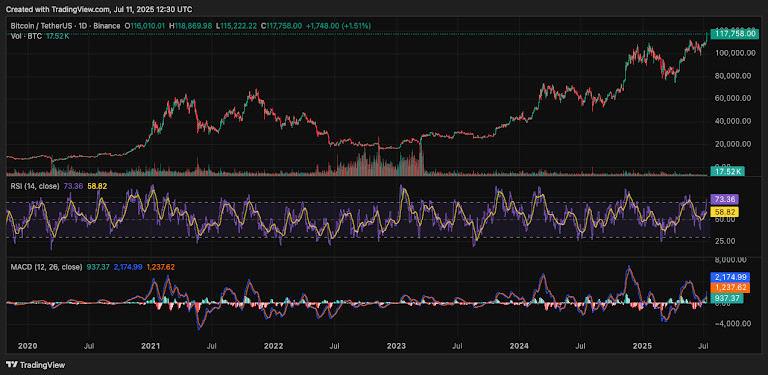
As of July 11, 2025, BTC trades at $117,877 — up over 85% YTD. But behind the price action lies a deeper structure: a mix of macroeconomic pressure, political signaling, technical momentum, and institutional repositioning. The Bitcoin ecosystem is becoming more complex and professional — but also more vulnerable. What once moved on the fringes of finance is now increasingly driven by its core.
Political Risk and the Bitcoin Narrative in 2025
Bitcoin’s recent momentum reflects not only risk appetite and halving cycles, but also growing influence from state behavior.
A New Fiscal Era: The “Big Beautiful Bill”
On July 4th, Donald Trump — now re-elected and gearing up for his second major policy term — announced a sweeping fiscal stimulus initiative unofficially dubbed the “Big Beautiful Bill.” While the official outline spans infrastructure, defense, and tax restructuring, the central issue isn’t the content — it’s the scale of deficit financing.
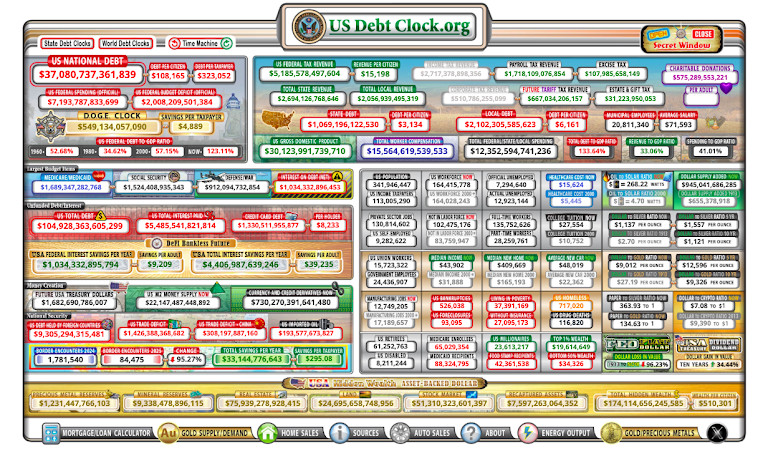
U.S. national debt is now projected to exceed $40 trillion by Q4 2025, up from $34 trillion just a year earlier. Treasury issuance is ramping up sharply. Real yields continue to drift downward, shaped by implicit monetary accommodation and political incentives to suppress the cost of capital.
This level of borrowing is unprecedented. It marks a structural shift in how the United States approaches debt issuance and capital markets.
This is absolutely insane:
Total US debt is now expected to hit $40 TRILLION THIS YEAR, per Kalshi.
To put this into perspective, at the start of 2020, total US debt stood at $23.2 trillion.
This would mark a near $17 TRILLION increase in 6 years.
Never in history has the US… https://t.co/scvhdsadEj
— The Kobeissi Letter (@KobeissiLetter) July 3, 2025
Capital allocators are starting to treat this shift not as a passing anomaly, but as a reflection of deeper concerns. Confidence in fiat currencies is increasingly seen as inseparable from the stability of the political systems behind them. Bitcoin, under these conditions, reclaims its role as a strategic hedge against both inflation and institutional decay.
This context is not a replay of 2020. That was reactive debt expansion in response to a global health crisis. In 2025, the expansion is deliberate — an act of economic doctrine. And markets are responding accordingly, positioning into scarce, decentralized alternatives like Bitcoin as political risk bleeds into monetary credibility.
Elon Musk and the America Party: Bitcoin as Symbol
The second major political catalyst came on July 5, when Elon Musk declared the formation of a new political entity: the America Party. In a tweet seen by over 45 million users within 24 hours, Musk said:
By a factor of 2 to 1, you want a new political party and you shall have it!
When it comes to bankrupting our country with waste & graft, we live in a one-party system, not a democracy.
Today, the America Party is formed to give you back your freedom. https://t.co/9K8AD04QQN
— Elon Musk (@elonmusk) July 5, 2025
When asked whether Bitcoin would be a part of the party’s economic policy, Musk’s response was unequivocal:
Fiat is hopeless, so yes
— Elon Musk (@elonmusk) July 7, 2025
This wasn’t just another crypto endorsement. It cemented Bitcoin as a wedge issue: a vehicle for opposition, rebellion, or decentralization — depending on perspective.
In combining fiscal volatility with ideological realignment, the U.S. has inadvertently reintroduced Bitcoin into the political bloodstream. This time, not as a fringe tool, but as a narrative anchor for libertarian identity and post-fiat economics.
For markets, the implications are clear: BTC isn’t merely a commodity. It’s now a proxy for political trust — or its absence.
Market Forecast: BTC Price Scenarios and Technical Signals
Bitcoin’s surge toward $110K is no longer speculative noise. It’s a structured move — and traders are watching it closely. Several independent analysts now align around key bullish scenarios, but they also warn: this isn’t a guaranteed breakout. It’s a volatile staircase.
Analyst Predictions and Price Targets
Multiple crypto macro analysts are converging around a mid-term bullish thesis. Among the most referenced in the current cycle:
@cas_abbe: Known for applying Wyckoff-based models, he recently charted Bitcoin in the middle of a “power-of-three” formation. This structure implies a three-phase breakout, currently in its expansion phase.
$BTC Power-of-3 pattern is in play.
Bitcoin is still in the expansion phase, and now looking primed for the next leg up.
Downside volatility is limited now due to ETFs and companies buying billions in BTC weekly.
BTC just needs a weekly close above $110K and it’ll enter a… pic.twitter.com/esr8bz9e8J
— Cas Abbé (@cas_abbe) July 8, 2025
His projected move: $135K–$150K by mid-Q4, contingent on a weekly close above $110K.
@JavonTM1: A pattern-based trader who identified an inverse head-and-shoulders breakout forming over a 6-month chart window.
Bitcoin’s prices are CLIMBING and could be getting ready to set new All Time Highs here and with a break above the pictured neck-line, they could soar even HIGHER!
With a break above, we are looking at a move to the $140,000s still 💰…$BTC https://t.co/inxfSj3PwC pic.twitter.com/CtD3J1l2iy
— JAVON⚡️MARKS (@JavonTM1) June 29, 2025
According to his model, confirmation at $111K–$112K would trigger an upward cascade targeting $140K as a first stop, then retesting ATH territory.
Both analysts stress that technicals must sync with macro liquidity. In 2021, retail momentum did the heavy lifting. In 2025, it’s ETF flows and institutional demand that determine thrust.
RSI, MACD and Price Structure
Beyond price targets, market structure is showing fundamental bullish health — albeit cautiously.
RSI (Relative Strength Index):
RSI reads 73.36 on the daily chart — signaling an overbought condition. This level reflects strong demand, but also calls for caution, as historically, readings above 70 often precede short-term pullbacks.
MACD (Moving Average Convergence Divergence):
The MACD line sits at 2,174, well above the signal line (1,237), confirming a strong momentum phase. The crossover happened in late June, signaling a potential continuation of the rally.
Volume Profile:
On-chain and exchange data show heavy accumulation between $94,000 and $99,000, primarily by institutional actors. This zone is now acting as a solid technical and psychological floor. Liquidity is deep, retracements have been shallow, and volatility is narrowing.
This doesn’t guarantee a parabolic move — but it creates a structural floor that gives technical traders confidence to position toward $125K–$135K.
Probabilistic Scenarios
The bullish outlook depends on confirmation:
A confirmed breakout and close above $118,000 opens the path to $125K–$135K. This zone is now the key magnet for bullish positioning.
However, failure to hold above $112K could trigger a short-term correction back toward $98K–$100K, where buy-side liquidity remains robust.
$150K is possible in 2025, but contingent on two variables:
Sustained ETF inflows, which remain above $300M daily.
Political tailwinds, particularly related to deficit spending and Bitcoin-positive regulatory narratives.
In short, Bitcoin is climbing — not exploding. And the next few weeks will test whether conviction can withstand policy volatility and institutional pacing.
Institutional and Strategic Investment Behavior
Bitcoin is no longer primarily driven by retail investors. In 2025, ETFs, family offices, sovereign funds, and corporate treasuries are absorbing available supply faster than exchanges can rotate it—reshaping supply dynamics and market behavior.
ETF and Treasury Dynamics
Since the launch of U.S. spot Bitcoin ETFs in January 2024, institutional demand has surged:
ETF holdings now total approximately 1.234 million BTC, up from about 660,000 BTC in February 2024—a gain of +86% in 16 months.
These holdings represent roughly 5.9% of Bitcoin’s fixed supply, given U.S. ETFs currently control ~1.25 million BTC.
In early July, U.S. spot ETFs recorded over $1.04 billion in net inflows in just three days, equivalent to ~9,700 BTC.
BlackRock’s IBIT ETF holds ~700,000 BTC, about 62% of Satoshi’s stash, and is on pace to reach 1.2M BTC by May 2026, adding ~40K BTC/month
Bitcoin Mining: Efficiency, Expansion, and ESG Challenges
Bitcoin mining has evolved into an industrial-scale, geopolitically significant sector. Public firms are consolidating power, reshaping energy dynamics, and integrating with grid operators.
Post-Halving Consolidation
Industrial Energy Strategy
Major public miners now manage energy at scale and optimize operations via grid integration:
Miners are also deploying grid arbitrage strategies—shutting down or scaling back during peak demand to receive utility credits—shifting from technical efficiency to energy-market savvy.
Sustainability Metrics: Where the Ecological Debate Really Stands
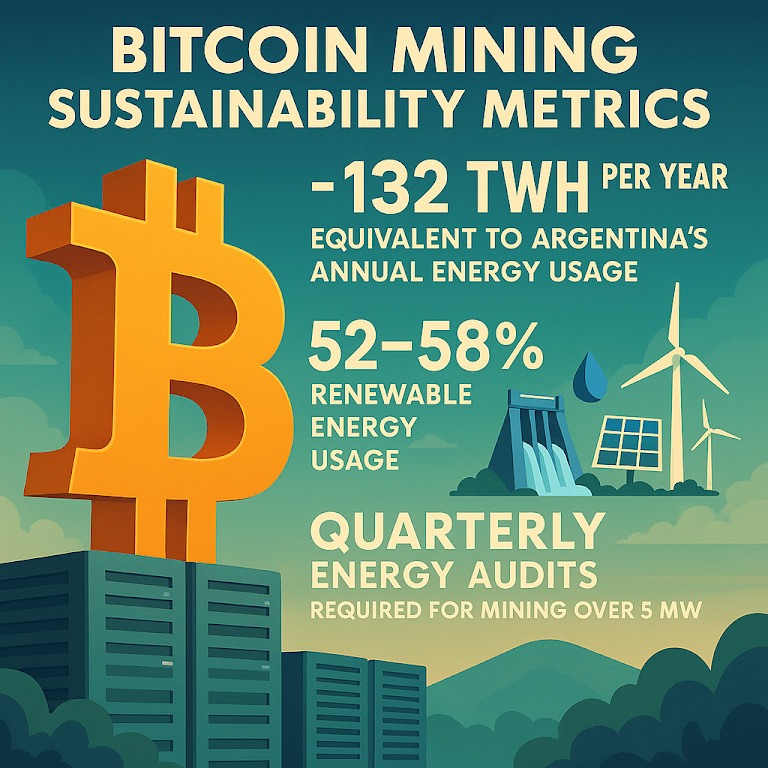
Bitcoin’s annual energy consumption currently sits at approximately 132 TWh, based on the Cambridge Bitcoin Electricity Consumption Index (CBECI) as of June 2025. To put that in perspective, it consumes more power than Argentina or Poland—countries registering around 155–172 TWh/year.
Yet energy consumption alone fails to capture the full picture. According to a 2024 CoinShares report, between 52 % and 58 % of this energy now comes from renewable sources—including hydroelectric power (notably from Paraguay and Canada), U.S. wind and solar, and geothermal energy in Iceland and Kenya. Cambridge’s own CBECI methodology also highlights the increasing share of low-carbon energy inputs .
This shift is not academic—it has regulatory consequences. In the U.S., the Environmental Protection Agency now mandates quarterly energy audits for any mining facility over 5 MW, as outlined in its 2024 Smart Sectors guidance. In Texas, the grid operator ERCOT formally treats mining outfits as “controllable loads”, enabling them to participate in peak-demand mitigation programs. The EU’s MiCA framework introduced ESG classifications into crypto markets, encouraging transparency—even if Bitcoin-specific regulations remain under discussion.
Still, criticisms persist. A peer‑reviewed MIT study shows that even large public miners in the U.S. emit on average ~397 gCO₂/kWh—comparable to grid averages—calling into question any blanket claims of carbon neutrality. And due to inconsistent reporting standards, allegations of “greenwashing” continue, especially from facilities in jurisdictions with looser oversight .
So, while Bitcoin’s energy consumption remains large, the evolving energy mix and growing institutional oversight suggest a transition—albeit one still shadowed by data opacity and uneven regulation. For investors and policymakers alike, the question is no longer whether mining consumes energy. It’s how effectively it’s shifting toward sustainable practices without losing transparency.
What’s Next for Bitcoin in H2 2025
Bitcoin enters the second half of 2025 reinforced by structural strength—ETF inflows above $1 billion/week, 73% of supply controlled by long-term holders, and exchange reserves near multi-year lows. A confirmed floor at $110K and a breakout above $112K could propel BTC toward $125K–$135K by Q4, as projected by Cas Abbé and Javon Marks.
But the broader test lies in its ability to function as infrastructure, not merely speculation. Michael Saylor recently captured this in a post on X:
That distinction matters. As regulatory frameworks tighten—through EPA-mandated audits, ERCOT grid integration, and ESG benchmarks—Bitcoin must validate its neutrality, transparency, and resilience.
Its political alignment with new movements adds further exposure. Be it as a hedge, symbol, or asset, Bitcoin’s next trajectory depends on balancing decentralization with institutional legitimacy.
H2 2025 won’t be about whether Bitcoin can soar—it’s about whether it can sustain its role as a decentralized asset within a structured financial and regulatory environment.
Disclaimer
In line with the Trust Project guidelines, please note that the information provided on this page is not intended to be and should not be interpreted as legal, tax, investment, financial, or any other form of advice. It is important to only invest what you can afford to lose and to seek independent financial advice if you have any doubts. For further information, we suggest referring to the terms and conditions as well as the help and support pages provided by the issuer or advertiser. MetaversePost is committed to accurate, unbiased reporting, but market conditions are subject to change without notice.
About The Author
Alisa, a dedicated journalist at the MPost, specializes in cryptocurrency, zero-knowledge proofs, investments, and the expansive realm of Web3. With a keen eye for emerging trends and technologies, she delivers comprehensive coverage to inform and engage readers in the ever-evolving landscape of digital finance.
More articles
Alisa Davidson
Alisa, a dedicated journalist at the MPost, specializes in cryptocurrency, zero-knowledge proofs, investments, and the expansive realm of Web3. With a keen eye for emerging trends and technologies, she delivers comprehensive coverage to inform and engage readers in the ever-evolving landscape of digital finance.
Published: July 11, 2025 at 10:34 am Updated: July 11, 2025 at 10:34 am
by Ana
Edited and fact-checked:
July 11, 2025 at 10:34 am
To improve your local-language experience, sometimes we employ an auto-translation plugin. Please note auto-translation may not be accurate, so read original article for precise information.
In Brief
Crypto partnerships in July 2025 expanded into institutions, pop culture, and public infrastructure, blurring the line between blockchain and everyday life through AI, music festivals, and staking ecosystems.
From Dubai’s government onboarding stablecoins to Ripple handing custody to one of Wall Street’s oldest giants, July 2025 saw crypto partnerships reach deeper into institutions, pop culture, and public infrastructure. Across AI, music festivals, and staking ecosystems, the line between blockchain and everyday life is rapidly dissolving.
Dubai Embraces Crypto for Government Payments in Landmark Deal with Crypto.com
Dubai is embracing digital finance with a new relationship with Crypto.com, allowing cryptocurrency payments for government services. The Department of Finance signed an MoU with the company during the Dubai FinTech Summit and described it as the first-of-its-kind integration of crypto across all government functions. The service will allow crypto payments, which will convert stablecoins into dirhams, through the existing service Dubai Pay, as Dubai continues its plans down the road to a cashless economy.
The initiative is expected to add up to AED 8 billion to the Dubai economy every year and uphold its status as a worldwide hub for innovation. Although specific digital assets were not named, it is likely that stablecoins such as USDT and USDC will be incorporated, providing “financial transparency and efficiency” across public services.
Crypto.com is deepening its roots in the region with additional partnerships. Emirates Airline and Dubai Duty Free will soon accept crypto payments through Crypto.com Pay, offering travelers added convenience and “highest-level” transaction security. In real estate, Crypto.com is working with the Dubai Land Department to explore blockchain’s potential to streamline and secure property deals.
By merging public services and crypto payments, Dubai is not only enhancing accessibility but also setting a precedent for digital asset adoption in government frameworks worldwide.
Coinbase and Perplexity Partner to Deliver Real-Time Crypto Data Through AI
Coinbase has teamed up with AI search platform Perplexity to bring real-time crypto insights directly to users through intelligent interfaces. Announced by CEO Brian Armstrong on July 10, the integration is live under Phase 1 and already feeding Perplexity’s systems with Coinbase’s live market data, including the COIN50 index.
This collaboration allows users to analyze price trends and “double-click” into market moves using Perplexity’s new Comet browser. Armstrong called it a key development for making crypto analysis more accessible and data-driven, noting that intelligent systems powered by live feeds will help users make “smart, informed decisions” in a fast-moving market.
The partnership arrives as interest in crypto topics on Perplexity reportedly matches that of equities, a trend the Coinbase CEO highlighted as proof of the sector’s growing relevance. In the upcoming Phase 2, Perplexity will use Coinbase’s data to generate AI-powered responses, helping traders screen tokens, track trends, and monitor on-chain activity—all through a conversational interface.
Perplexity CEO Aravind Srinivas confirmed the integration, noting that live crypto data would soon appear directly in user searches. Armstrong added that this is part of a broader push to embed crypto more deeply into AI workflows, eventually linking wallets and market activity inside permissionless, intelligent ecosystems.
Bitget Joins UNTOLD Festival to Bring Crypto to the Mainstage
Bitget is dialing up its cultural reach by becoming an official partner of UNTOLD—ranked among the top three music festivals in the world. The crypto exchange and Web3 powerhouse will sponsor UNTOLD X this August in Cluj-Napoca, followed by a global encore at UNTOLD Dubai later this year. With over 400,000 festivalgoers expected, Bitget is turning the spotlight toward crypto, aiming to “Feel the ₿eat” across continents.
This partnership shows Bitget’s ambition to expand beyond finance into music and youth culture, following previous high-profile partnerships with LALIGA and MotoGP. UNTOLD Universe’s co-founder stated that this partnership is more than just branding; it’s about merging “music, culture, and the future of finance” in a shared experience.
Bitget CEO Gracy Chen called the partnership a natural extension of the company’s identity, noting that both Bitget and UNTOLD “speak the language of the next generation.” From immersive activations to exclusive VIP access, Bitget plans to meet users where they live, play, and dance.
With headliners like Post Malone, Tiësto, and Armin van Buuren, Bitget isn’t just attending—they’re becoming part of the show. From race tracks to festival stages, the company is redefining what it means to be a crypto brand in pop culture.
Ripple Taps BNY Mellon for Stablecoin Custody, Signaling Institutional Shift
Ripplehas named BNY Mellon as the official custodian for its forthcoming stablecoin reserves—a move seen as a turning point for institutional crypto adoption. The partnership pairs a blockchain pioneer with one of the world’s oldest financial institutions, signaling how far crypto has come from its outsider origins.
Instead of merely safeguarding assets, Ripple’s move to partner with BNY Mellon is largely regarded as a trust play. BNY Mellon is highly institutional, with more than 230 years in banking and customer assets in custody worth trillions. For Ripple, it is a way to build confidence with its stablecoin pre-launch; for BNY Mellon, it further develops its position in the evolving digital asset economy.
Executives have emphasized the partnership as a sign that digital assets are no longer fringe. Industry watchers describe it as “a strategic masterstroke,” bridging compliance-heavy finance with crypto-native innovation. The deal also sets a precedent for how traditional banks might participate in the next wave of stablecoin use—providing secure, regulated access for enterprise adoption.
As institutional walls continue to lower, this collaboration between Ripple and BNY Mellon could help rewrite the playbook for digital finance’s future.
Galaxy and Fireblocks Partner to Unlock Scalable Staking for Institutions
Galaxy has teamed up with Fireblocks to make its institutional staking services directly available to more than 2,000 financial institutions already using Fireblocks’ secure infrastructure. The integration enables clients to stake digital assets without transferring them off-platform, combining Fireblocks’ security with Galaxy’s globally distributed validator network.
The partnership aims to transform staking into a capital-efficient strategy rather than a passive one. Institutions can now access staking while tapping into Galaxy’s broader suite of integrated trading and lending solutions—all from within Fireblocks’ custody environment.
Galaxy’s head of blockchain infrastructure emphasized that the integration reflects a broader goal: making secure, enterprise-grade staking available “where institutions custody their digital assets.” The firm positions itself as a key player in the maturing crypto infrastructure space, offering high-performance solutions tailored to institutional demands.
This marks Galaxy’s third custodial integration of 2025, following earlier partnerships with Zodia Custody and BitGo. With $3.15 billion in assets already under stake, Galaxy continues to expand its global reach.
Fireblocks’ senior leadership called the partnership a meaningful upgrade for their clients, citing Galaxy’s “proven infrastructure” and ability to meet institutional needs for scale, performance, and reliability.
Together, the two firms are pushing institutional staking into the financial mainstream.
TRON and MicroStrategy Launch ‘Tron MSTR’ to Advance Institutional Crypto Adoption
TRON officially launched the Tron MSTR initiative, a partnership between TRON and MicroStrategy that seeks to promote institutional adoption of crypto, announced in June 2025. The partnership between TRON and MicroStrategy aims to connect traditional finance and blockchain with MicroStrategy’s traditional institutional credibility and the TRON blockchain’s ecosystem.
Founder Justin Sun described the initiative as a move to “tighten the bond between crypto and capital markets,” spotlighting TRON’s ambitions in institutional-grade infrastructure. By aligning with MicroStrategy—renowned for its significant Bitcoin holdings—TRON seeks to position itself as a secure, compliant platform for large-scale financial players.
Since the announcement of Tron MSTR, TRON’s native token TRX remains stable around a price of $0.2742. Price stabilization happens with feature trading volume and growing comfort level by the investor audience. Analysts feel Tron MSTR is best positioned to be a trigger for institutional interest similarly echoed with MicroStrategy’s own integration of treasury and crypto.
In the latest market report, the initiative focuses on institutional concerns of regulatory clarity, scalability, and asset safety – which continue to be barriers to institutional adoption of crypto. Building infrastructure for financial firms, beyond a single application for a cryptocurrency wallet, TRON is tapping into the increasing interest of traditional firms who are entering the digital asset market.
As crypto moves toward maturity as a market, we will see more collaborative partnerships like Tron MSTR paving a new way of working between decentralized networks and traditional financial institutions. This can positively impact institutional crypto adoption, liquidity across exchanges, and long-term stability in the digital economy.
Disclaimer
In line with the Trust Project guidelines, please note that the information provided on this page is not intended to be and should not be interpreted as legal, tax, investment, financial, or any other form of advice. It is important to only invest what you can afford to lose and to seek independent financial advice if you have any doubts. For further information, we suggest referring to the terms and conditions as well as the help and support pages provided by the issuer or advertiser. MetaversePost is committed to accurate, unbiased reporting, but market conditions are subject to change without notice.
About The Author
Victoria is a writer on a variety of technology topics including Web3.0, AI and cryptocurrencies. Her extensive experience allows her to write insightful articles for the wider audience.
More articles
Victoria d’Este
Victoria is a writer on a variety of technology topics including Web3.0, AI and cryptocurrencies. Her extensive experience allows her to write insightful articles for the wider audience.
Published: July 11, 2025 at 10:30 am Updated: July 11, 2025 at 10:00 am
by Ana
Edited and fact-checked:
July 11, 2025 at 10:30 am
To improve your local-language experience, sometimes we employ an auto-translation plugin. Please note auto-translation may not be accurate, so read original article for precise information.
In Brief
The SOON Foundation has launched a recovery plan to burn 30 million tokens and introduce governance measures following a coordinated market manipulation that caused a 41% price drop.
Non-profit organization focused on the decentralization, adoption, and security of the SOON network, SOON Foundation unveiled a detailed recovery plan in response to a recent price manipulation event. The plan outlines immediate measures aimed at restoring market confidence, easing supply pressure, and reaffirming dedication to the long-term development of the SOON ecosystem.
As part of this effort, a total of 30 million SOON tokens, representing 3% of the total supply, will be permanently removed from circulation. Approximately 7.7 million SOON tokens from the unclaimed airdrop allocation, currently held in a designated wallet, will be burned within the coming days. The remaining 22.3 million tokens will be repurchased from centralized exchanges and subsequently burned.
This action intends to directly reduce the available token supply and contribute to price stability amid recent market fluctuations. To ensure transparency and maintain open communication, a Twitter AMA session will be hosted next Wednesday featuring the foundation’s founder Joanna and Head of Marketing Henry, who will explain the recovery plan in detail and address community questions.
$SOON Recovery Plan
In response to the recent price manipulation incident, the SOON Foundation is launching a new governance proposal, covering a series of immediate actions aimed at restoring market confidence, reducing supply pressure, and reaffirming our commitment to the… pic.twitter.com/aLfXntK0Lu
— SOON Foundation (@SOON_FDN) July 11, 2025
Simultaneously, development is underway for a new on-chain product that will allow the foundation to periodically repurchase tokens directly from holders, further supporting supply reduction and market stability over time.
In alignment with its commitment to decentralization and empowering the community, the foundation is preparing to launch the SOON Governance System. This system will enable token holders to participate in major decisions affecting the ecosystem’s future, including treasury management, protocol upgrades, and distribution of ecosystem grants.
These initiatives represent the initial steps in the foundation’s ongoing efforts to protect the community, enhance market integrity, and build a resilient future for the SOON network.
SOON Token Faces 41% Price Drop Amid Coordinated Market Manipulation
SOON is recognized as the first genuine SVM rollup on Ethereum, employing a distinct SVM architecture that separates the execution layer from the settlement layer. This novel design incorporates Merklization, developed in collaboration with Anza, a prominent Solana-focused software development company, setting SOON apart from other projects that rely on the Forked SVM approach. SOON is the core token of the SOON ecosystem, undertaking multiple functions such as governance, incentives, and transactions.
Earlier this week, the SOON token experienced a significant price decline of 41%. Approximately 22 million tokens withdrawn from Bitget were sold across multiple exchanges, while short positions were simultaneously opened on platforms including Binance, Bybit, and OKX. This coordinated activity contributed to the token’s price dropping from $0.22 to $0.13. An incident analysis report concluded that the price movement resulted from orchestrated market manipulation; however, official market makers and foundation wallets were confirmed to have had no involvement in the event.
Disclaimer
In line with the Trust Project guidelines, please note that the information provided on this page is not intended to be and should not be interpreted as legal, tax, investment, financial, or any other form of advice. It is important to only invest what you can afford to lose and to seek independent financial advice if you have any doubts. For further information, we suggest referring to the terms and conditions as well as the help and support pages provided by the issuer or advertiser. MetaversePost is committed to accurate, unbiased reporting, but market conditions are subject to change without notice.
About The Author
Alisa, a dedicated journalist at the MPost, specializes in cryptocurrency, zero-knowledge proofs, investments, and the expansive realm of Web3. With a keen eye for emerging trends and technologies, she delivers comprehensive coverage to inform and engage readers in the ever-evolving landscape of digital finance.
More articles
Alisa Davidson
Alisa, a dedicated journalist at the MPost, specializes in cryptocurrency, zero-knowledge proofs, investments, and the expansive realm of Web3. With a keen eye for emerging trends and technologies, she delivers comprehensive coverage to inform and engage readers in the ever-evolving landscape of digital finance.
Published: July 11, 2025 at 10:24 am Updated: July 11, 2025 at 10:28 am
by Ana
Edited and fact-checked:
July 11, 2025 at 10:24 am
To improve your local-language experience, sometimes we employ an auto-translation plugin. Please note auto-translation may not be accurate, so read original article for precise information.
In Brief
Chatbots are obsolete and LLMs alone aren’t enough — the future belongs to true AI agents that combine understanding, reasoning, and action to autonomously complete complex tasks across real-world systems.
In one year, the world will remember chatbots the way it remembers fax machines: an awkward step on the road to something better. Ask any COO about their chatbot rollout, and you will see the same polite shrug: “It’s clunky, it’s high maintenance, it fails at answering FAQs. We still need humans.”We’ve all been there. You try to adjust the delivery time or address for an important parcel. A chatbot politely replies that it has taken note of your request and will now get a human customer support personnel to execute the logistics of it. It doesn’t take any other action beyond that. You feel frustrated.Here’s the reality: the chatbot era is over. Enterprises that cling to it will bleed time, money, and talent. A new breed — autonomous AI agents — is stepping in, and the gulf between the two approaches will decide which companies sprint ahead and which stay trapped in customer-service purgatory.
How We Got Stuck with Zombie Chatbots Early chatbots were supposed to be the frontline of automation. Instead, they became everyone’s least favorite customer experience. Why? Because they were never built to understand anything.They were rule-based from the start. Hardcoded scripts, linear decision trees, “if this, then that” flows that explode in complexity quickly. Say the exact right phrase and they respond. Deviate even slightly, and you’re either ignored or looped back to the beginning. Like an IVR menu with better manners. The exponential branches are what make traditional chatbots impossible to maintain beyond 20 common use cases, let alone deliver ROI.And the problem isn’t just bad UX — it’s architectural. Rules-based systems don’t generalize. They can only respond to predefined inputs and scenarios. The moment something changes — a policy update, new pricing tier, a customer asking a valid question slightly differently — the entire flow collapses.What happens next? Escalation to humans. Again and again.Meanwhile, frontline staff are stuck doing the same repetitive tasks the bot couldn’t finish — manually updating shipping records, calling the driver, logging the update — while the dashboard reports a “successful interaction.” Who is it really working for?Today, most enterprise “AI chatbot” deployments are little more than glorified decision trees. Cosmetic improvements — friendlier tone, branded avatars — can’t change the underlying reality: they’re brittle, shallow, and get stuck easily.But these bots were sold as silver bullets. So companies kept investing, hoping each new release would finally close the loop. It didn’t. It couldn’t. Because the architecture was never built for autonomous understanding or action — it was built to deflect tickets.That’s why most chatbot KPIs are surface-level: CSAT, handoff rate, session length. The moment you ask, “Did it actually solve the problem?” the dashboards go quiet.When you celebrate chatbot metrics, you are basically celebrating a treadmill for distance travelled. Simply put: lots of motion, nowhere to go.
Then Came the LLMs — Talkers, Not Doers Enter GPT and its cousins. Suddenly, bots could hold conversations. They understood slang. They handled ambiguity. They remembered things and have a long context memory.It felt like magic. And it was a genuine leap forward. For the first time, AI could generate human-like responses at scale. AI is intelligent.But here’s the catch: LLMs are brilliant improvisers, not operators.They don’t have structured goals. They don’t “know” when a task is complete. They can’t reliably access, update, or enforce business rules without scaffolding. What they produce is language — compelling, articulate, and occasionally useful, but rarely accountable.When an LLM tells you it has submitted your request, it hasn’t. Unless it’s wrapped in an orchestration layer that bridges language to action, it’s still just talk.So while LLMs moved the industry forward, they didn’t solve the execution gap. They created a new class of false expectations. Now, users aren’t just frustrated with bots — they’re confused by AI that sounds smart but can’t actually help.That confusion is what leads us here: to AI workflows and AI agents.
What an AI Agent Really Is An AI workflow is an LLM that executes commands with predetermined steps. But often in the real world, steps cannot be predicted beforehand.That’s where AI agents come in. It’s an LLM that integrates with external tools, able to reason deeply, and — using everything it has access to — solves complex problems that would take humans orders of magnitude longer to do.AI agents achieve this by combining all three layers.First, a conversation layer that is often an LLM to interpret intent (yes, LLMs are useful, it’s just that calling an LLM an “AI solution” by default is like calling dial-up modems WiFi); second, a reasoning layer that outlines all the rules, policies, and task planning that decide what should happen; and third, an execution layer with secure connectors into CRMs, ERPs, payment rails, voice systems, and whatever legacy monster hides in the closet.Remove any layer and the tower collapses. Keep them together and the system moves from “reply” to “resolve.”Let’s revisit the scenario of the customer who needs to reroute a parcel.Traditionally, chatbots can complete the first step — ticket handling. LLMs might get you one step further. Then a human needs to step in. They make decisions, then type replies manually. This is painful. Now an AI agent proactively executes entire workflows, makes autonomous decisions, interacts with backend systems, and logs activities for audit purposes, all without human intervention unless absolutely necessary.
Image credit: Jurin AI
The agent does in thirty seconds what would otherwise ping-pong across multiple departments. It owns the task, from start to finish.
So Let’s Stop Calling Everything an “Agent”
The term “AI agent” is having its moment — but like all good buzzwords, it’s being stretched thin. Every vendor with a chatbot and an API now claims to offer “agents.” Some even use the word just because their LLM remembers your name for five turns.
This misuse isn’t just branding fluff — it causes real confusion. It trains buyers to expect outcomes from tools that were never designed to deliver them. It slows down adoption by creating false expectations, followed by real disappointment. Worst of all, it lets enterprises convince themselves they’re innovating, when all they’ve done is bolt a new UI onto the same old service desk.
But the AI transformation is real.True AI agents aren’t just more conversational. They’re more accountable. They integrate deeply, act responsibly, and deliver traceable, business-critical outcomes. They aren’t just an interface — they are infrastructure.
And we’re only at the beginning.
The Future of Information: From Apps to AI Agents For years, we’ve adapted to the logic of machines. We’ve clicked through menus, memorized interfaces, juggled five tabs just to complete a task. Search got smarter, apps got sleeker — but the burden stayed on the user.
AI agents flip that.
Instead of asking you to learn how the system works, the system learns how you work — through natural conversation.
Want to book your travel? Just chat with your private AI concierge:“Plan a hiking trip in the Alps, early September, off the beaten path.”And it happens. Flights, hotels, local guides — even hidden gems you would never have discovered on your own. No 90s websites or clunky mobile apps with bad UX. Just a conversation that gets things done.
This is a shift from apps you operate to agents that operate on your behalf.
And it won’t stop at travel. Agents will reshape how we interact with everything — logistics, procurement, compliance, HR. Quietly transforming brittle tools and fragmented workflows with intelligent systems that can reason, act, and improve over time.
This is the agentic future: where tasks are completed instantly via voice or text by AI that understands, acts, and delivers — your very own executive assistant.
It’s not a sci-fi vision. It’s just one to two years away. And we’re already building toward it at Jurin AI.
The age of agentic AI is here, and we’ve only scratched the surface. I’ve never been more excited.
Disclaimer
In line with the Trust Project guidelines, please note that the information provided on this page is not intended to be and should not be interpreted as legal, tax, investment, financial, or any other form of advice. It is important to only invest what you can afford to lose and to seek independent financial advice if you have any doubts. For further information, we suggest referring to the terms and conditions as well as the help and support pages provided by the issuer or advertiser. MetaversePost is committed to accurate, unbiased reporting, but market conditions are subject to change without notice.
About The Author
Rise Ooi is a three-time tech founder, engineer, and investor known for identifying billion-dollar opportunities early. He helped scale Applied Intuition into a multi-billion-dollar unicorn by building its Asian presence from the ground up and now leads Jurin AI, where he’s assembling a world-class team to reshape workplace productivity across Asia-Pacific. A former AI scientist at Japan’s national labs, Rise brings deep technical and global expertise to everything he builds.
More articles
Rise Ooi is a three-time tech founder, engineer, and investor known for identifying billion-dollar opportunities early. He helped scale Applied Intuition into a multi-billion-dollar unicorn by building its Asian presence from the ground up and now leads Jurin AI, where he’s assembling a world-class team to reshape workplace productivity across Asia-Pacific. A former AI scientist at Japan’s national labs, Rise brings deep technical and global expertise to everything he builds.
Published: July 11, 2025 at 9:18 am Updated: July 11, 2025 at 9:18 am
To improve your local-language experience, sometimes we employ an auto-translation plugin. Please note auto-translation may not be accurate, so read original article for precise information.
In Brief
ArbiRich is an AI-powered, non-custodial trading platform that turns meme coin market volatility into structured daily profits through automated arbitrage, offering users up to 6% daily returns while maintaining full control of their funds.
The crypto world moves fast. But with ArbiRich, your crypto can move even faster.
The crypto markets are a battlefield, and meme coins are the wildest part of it. Prices pump and dump in minutes, driven by community hype, influencer tweets, and unpredictable volatility. While most investors are left holding bags, ArbiRich.io turns this chaos into structured, daily profits.
ArbiRich is a fully automated, AI-powered meme coin trading platform designed to extract consistent returns from the most volatile corners of the crypto market. Backed by a team of experienced traders and battle-tested bot operators, ArbiRich simplifies high-frequency trading while allowing users to remain fully in control of their funds.
📈 How Does ArbiRich Work?
Top Up in Crypto – Fund your ArbiRich account using BTC, ETH, LTC, SOL, DOGE, TRX, XRP, USDT (TRC20, ERC20, BEP20), or other supported cryptocurrencies.
Start a Plan – Choose between:
SMART Plan: 4.5% daily profit, min $25
RICH Plan: 6% daily profit, min $5,000
Earn Daily – Profits are credited every 24 hours, 365 days a year.
Withdraw Anytime – You remain in control, with the ability to cancel your plan and withdraw at any time after 72 hours (subject to a 10% cancellation fee on the principal).
ArbiRich’s algorithmic bots scan DEX liquidity pools and meme coin markets 24/7, identifying profitable micro-arbitrage and volatility gaps. Instead of chasing pumps manually, users let ArbiRich’s advanced systems do the heavy lifting, ensuring stable yields even in unpredictable markets.
🛡️ Security and Transparency
Unlike typical “staking” platforms, ArbiRich does not take custody of your private keys. Funds are converted and allocated automatically while giving users full visibility and withdrawal control. All transaction values are displayed in USD for clarity, with conversions handled in real-time.
Users are encouraged to enable 2FA and secure their accounts. ArbiRich maintains a transparent live statistics dashboard showcasing: Total Users, Total Deposits, Profits Paid Out
… all updated in real-time to build trust and community transparency.
🌍 A Global Opportunity
ArbiRich is designed for the new generation of crypto investors:
Traders seeking passive daily gains
Holders tired of watching market swings without capitalizing
Meme coin enthusiasts looking to earn without stress
Affiliate marketers seeking high-converting offers (10% referral commissions on all referred plans)
With no geographical restrictions, ArbiRich is seeing adoption across Asia, Latin America, Eastern Europe, and Africa, where crypto adoption is booming and users are hungry for passive income opportunities.
💸 Affiliate Program: Earn Without Investing
ArbiRich’s affiliate program pays 10% commissions on every plan started by referred users, even if you don’t have an active deposit yourself. It’s an opportunity for influencers, Telegram admins, crypto YouTubers, and community leaders to monetize their audience with a high-retention, high-reward offer.
🚀 Why ArbiRich Is Different
While many projects promise unrealistic APYs and vanish overnight, ArbiRich takes a transparent approach, offering daily returns within achievable ranges, backed by a clear strategy rooted in meme coin volatility, liquidity scraping, and micro-arbitrage opportunities.
In a space full of hype, ArbiRich offers a system that actually makes the volatility of meme coins work for you, instead of against you.
Ready to let your crypto work for you?
✅ Visit ArbiRich.io to get started.✅ Join the Telegram community: t.me/arbirich✅ Follow on X: x.com/ArbiRich✅ Read more on Medium
Don’t just hold. Earn. Welcome to the RICH SIDE.
Disclaimer
In line with the Trust Project guidelines, please note that the information provided on this page is not intended to be and should not be interpreted as legal, tax, investment, financial, or any other form of advice. It is important to only invest what you can afford to lose and to seek independent financial advice if you have any doubts. For further information, we suggest referring to the terms and conditions as well as the help and support pages provided by the issuer or advertiser. MetaversePost is committed to accurate, unbiased reporting, but market conditions are subject to change without notice.
About The Author
Gregory, a digital nomad hailing from Poland, is not only a financial analyst but also a valuable contributor to various online magazines. With a wealth of experience in the financial industry, his insights and expertise have earned him recognition in numerous publications. Utilising his spare time effectively, Gregory is currently dedicated to writing a book about cryptocurrency and blockchain.
More articles
Gregory, a digital nomad hailing from Poland, is not only a financial analyst but also a valuable contributor to various online magazines. With a wealth of experience in the financial industry, his insights and expertise have earned him recognition in numerous publications. Utilising his spare time effectively, Gregory is currently dedicated to writing a book about cryptocurrency and blockchain.
Published: July 11, 2025 at 9:11 am Updated: July 11, 2025 at 9:11 am
by Ana
Edited and fact-checked:
July 11, 2025 at 9:11 am
To improve your local-language experience, sometimes we employ an auto-translation plugin. Please note auto-translation may not be accurate, so read original article for precise information.
In Brief
Gate has launched its VIP Exclusive Airdrop Carnival, a tier-based campaign offering token rewards to high-tier users as part of its strategy to boost engagement and strengthen its VIP-focused operational model.
Cryptocurrency exchange Gate announced the launch of its VIP Exclusive Airdrop Carnival, an initiative designed to increase user engagement by providing tailored benefits to high-tier participants. The campaign is open solely to users holding a VIP level of 5 or higher. Eligible participants who complete a futures transaction of any size will be given the opportunity to access token airdrops and ongoing exclusive rewards.
The initial phase of the campaign will take place from July 11, 2025, at 07:00 to July 25, 2025, at 07:00 (UTC). A total of 500,000 PAL tokens has been allocated for distribution. The reward structure is divided according to VIP levels: users in VIP tiers 5 through 7 will receive 60% of the prize pool, those in VIP tiers 8 through 11 will receive 30%, and the remaining 10% will be distributed among users in VIP tiers 12 through 14.
Participation criteria are designed to emphasize both activity and loyalty. To qualify for the airdrop, users must either complete futures trades on seven separate days during the campaign period or reach an aggregate futures trading volume of at least 1 million USD. Additionally, eligible participants must maintain a VIP status of level 5 or higher throughout the event.
Gate Enhances VIP-Centric Operational Model To Strengthen User Retention
The campaign guidelines explicitly exclude the use of VIP Trial Cards, select high-frequency application programming interface (API) accounts, and instances of coordinated behavior between main and sub-accounts to maintain equitable distribution standards.
This campaign reflects Gate’s broader strategic focus on enhancing the value proposition for high-tier users through tier-based engagement initiatives. By offering exclusive token incentives and structured benefits, the platform aims to increase user retention and trading activity, while reinforcing its competitive positioning in the market.
Future plans include the continued introduction of personalized airdrop events and premium services tailored to high-engagement users, supporting the platform’s objective of refining its VIP-centric operational model.
Gate is recognized as one of the earliest cryptocurrency exchanges in the industry. The platform currently serves over 31 million users and supports more than 3,600 digital assets. It was also an early adopter of full proof-of-reserves transparency. Beyond its trading platform, Gate’s broader ecosystem includes Gate Wallet, Gate Ventures, and other digital finance infrastructure offerings.
Disclaimer
In line with the Trust Project guidelines, please note that the information provided on this page is not intended to be and should not be interpreted as legal, tax, investment, financial, or any other form of advice. It is important to only invest what you can afford to lose and to seek independent financial advice if you have any doubts. For further information, we suggest referring to the terms and conditions as well as the help and support pages provided by the issuer or advertiser. MetaversePost is committed to accurate, unbiased reporting, but market conditions are subject to change without notice.
About The Author
Alisa, a dedicated journalist at the MPost, specializes in cryptocurrency, zero-knowledge proofs, investments, and the expansive realm of Web3. With a keen eye for emerging trends and technologies, she delivers comprehensive coverage to inform and engage readers in the ever-evolving landscape of digital finance.
More articles
Alisa Davidson
Alisa, a dedicated journalist at the MPost, specializes in cryptocurrency, zero-knowledge proofs, investments, and the expansive realm of Web3. With a keen eye for emerging trends and technologies, she delivers comprehensive coverage to inform and engage readers in the ever-evolving landscape of digital finance.
Published: July 11, 2025 at 7:59 am Updated: July 11, 2025 at 7:59 am
by Ana
Edited and fact-checked:
July 11, 2025 at 7:59 am
To improve your local-language experience, sometimes we employ an auto-translation plugin. Please note auto-translation may not be accurate, so read original article for precise information.
In Brief
CGV Research’s latest report reveals that traditional corporations are increasingly adopting crypto, with diverse capital strategies like MicroStrategy’s leveraged model driving stock volatility, regulatory scrutiny, and a shift toward on-chain cash flow generation by altcoin-focused firms.
Research and investment division of the cryptocurrency investment firm Cryptogram Venture (CGV), CGV Research, has published a new report examining the global distribution of corporate cryptocurrency reserves. The report also analyzes the capital operation model centered on MicroStrategy and investigates the distinct strategies and potential risks faced by companies holding altcoin reserves. According to CGV Research, this ongoing “digital asset transformation” led by traditional corporations is influencing the future framework of corporate financial management.
The report highlights several key aspects of the global corporate cryptocurrency reserve landscape. In terms of geographical distribution among listed companies, those listed in the United States account for the largest share at 65.2%, followed by Canada at 16.9%, Hong Kong at 7.9%, Japan at 3.4%, and other markets comprising 6.7%. Regarding cryptocurrency composition, Bitcoin (BTC) makes up 78% of reserves, while Ethereum (ETH), Solana (SOL), and Ripple (XRP) each represent roughly 5-6%. Other cryptocurrencies account for the remaining 5%. When considering the total value of reserves, Bitcoin dominates with 99%, with all other assets combined making up just 1%.
Analysis of the timing of companies’ initial announcements about strategic cryptocurrency reserves reveals clear patterns that correspond with cryptocurrency market cycles. Two notable peaks occurred: in 2021, when 25 companies disclosed their reserves amid rising Bitcoin prices and the influence of MicroStrategy’s example; and in 2025, with 28 companies announcing reserves, marking a record high and reflecting growing corporate acceptance of cryptocurrencies as reserve assets. In contrast, a trough occurred during 2022-2023, when only three companies made announcements, likely due to the cryptocurrency bear market and regulatory uncertainty. The trend of companies announcing cryptocurrency reserves continues, with the total number of listed companies holding cryptocurrency reserves expected to surpass 200 this year, indicating ongoing expansion of cryptocurrency adoption within established industries.
Strategic Reserves, Capital Management, And Stock Performance
CGV Research identifies three primary capital operation models used by companies holding digital asset reserves. The first is the leveraged accumulation model, where companies with relatively weak core businesses raise capital through debt or equity financing to acquire cryptocurrency assets. As cryptocurrency prices increase, the company’s net assets and stock prices rise, enabling additional financing and creating a reinforcing cycle. In this model, the company’s stock essentially acts as leveraged exposure to the underlying cryptocurrencies. When managed effectively, this approach can amplify growth in both stock price and net asset value with limited initial capital. Examples include MicroStrategy, SharpLink Gaming, DeFi Development Corp, Nano Labs, and Eyenovia.
The second model is the cash management model, employed by companies with strong core businesses unrelated to cryptocurrencies. These companies invest excess cash in high-quality cryptocurrency assets primarily for investment returns. This strategy generally has little to no positive effect on the stock price and can sometimes lead to declines due to investor concerns about diverting attention from the core business. Companies using this approach include Tesla, Boyaa Interactive, and Meitu.
The third model, the operational reserve model, involves companies holding cryptocurrency reserves directly or indirectly as part of their core crypto-related business activities. This can include cryptocurrency exchanges or mining companies that retain mined coins as reserves to mitigate business risks. Examples of this model are Coinbase and Marathon Digital.
Company (Market)Reserve CurrencyHoldingsStock Price ImpactCapital StrategyMicroStrategy (US)BTC592,345 BTC (~$63.4B)Rose 3000%+ post-announcement; 2-3% volatility after latest purchaseLeveraged AccumulationMarathon Digital (US)BTC49,179 BTC (~$5.3B)Significant volatility post-announcementOperationalMetaplanet (JP)BTC12,345 BTC (~$1.3B)Fell 0.94% after latest purchase; overall strategy well-receivedLeveraged AccumulationTesla (US)BTC11,509 BTC (~$1.2B)Surged post-2021 purchase; relatively stable while holdingCash ManagementCoinbase Global (US)BTC, ETH, etc.9,267 BTC (~$0.99B), 115,700 ETH (~$0.28B)Relatively minor impact (held for exchange operations)OperationalSharpLink Gaming (US)ETH188,478 ETH (~$0.47B)Rose 10x+, then plunged 70% in a single dayLeveraged AccumulationDeFi Development Corp (US)SOL609,190 SOL (~$0.107B)Rose up to 6000% since announcement; 70% retracement from peakLeveraged AccumulationTrident Digital (SG)XRPAnnounced plan 2025.06.12 to raise $500M for XRPSignificant intraday volatility, closed down 3%Leveraged AccumulationNano Labs (US)BNBTarget $1B BNB reserveStock doubled post-announcement, reaching 2-year highLeveraged AccumulationEyenovia→Hyperion DeFi (US)HYPETarget 1M HYPE ($50M)Rose 134% on announcement day, continued hitting new highs (>380% gain)Leveraged AccumulationMeitu (HK)Bitcoin + EthereumFully liquidated (previously 940 BTC + 31,000 ETH)Rose 4% after reporting $80M profit from crypto asset sale in late 2024Cash Management
Among the companies examined, MicroStrategy is particularly notable. It effectively utilized debt financing to transition from a software provider with a history of losses into a major Bitcoin holder with a market capitalization in the tens of billions. The company’s operational approach presents a valuable case for thorough analysis.
MicroStrategy: A Case Study In Leveraged Cryptocurrency Reserve Operations
Since MicroStrategy revealed its Bitcoin treasury strategy in 2020, its stock price ($MSTR) has shown a strong correlation with Bitcoin’s price ($BTC), but with considerably greater volatility, as illustrated in the accompanying chart. Between August 2020 and the present, MSTR’s value has increased nearly thirtyfold, while Bitcoin’s price has risen approximately tenfold during the same timeframe.
Monthly analysis of volatility and correlation between Bitcoin and MSTR indicates that MSTR’s price correlation with Bitcoin typically falls between 0.6 and 0.8, signifying a strong connection. However, MSTR’s volatility consistently exceeds Bitcoin’s by multiple factors. This dynamic essentially positions MSTR as a leveraged equity proxy for Bitcoin. Market pricing further supports this leverage characteristic: In June 2025, the implied volatility of MSTR’s one-month call options was 110%, which is 40 percentage points higher than Bitcoin’s spot volatility, reflecting a leverage premium assigned by the market.
The foundation of MicroStrategy’s model lies in securing low-cost funding to acquire Bitcoin. The model remains sustainable as long as Bitcoin’s expected returns surpass the actual financing costs. By using a diverse array of capital instruments, MicroStrategy has converted Bitcoin’s inherent volatility into a structural financing benefit. The company employs various financing methods that together create a self-reinforcing capital cycle. Analysts at VanEck have described this approach as an innovative integration of digital currency economics with traditional corporate finance principles.
MicroStrategy’s capital operations focus on two main goals: managing the debt-to-equity ratio and increasing Bitcoin holdings per share. Assuming Bitcoin appreciates over the long term, these objectives contribute to enhancing the stock’s value. Compared to collateralized loans—which often involve inefficiencies such as requiring over 150% collateral, risks of liquidation, and borrowing limits—financing tools with embedded options like convertible bonds and preferred stock provide lower costs and less strain on the balance sheet. Additionally, At-The-Market (ATM) common stock sales offer rapid and flexible access to capital. Preferred stock is accounted for as equity rather than debt, which further reduces the company’s debt ratio compared to using convertible bonds.
Tool TypeMechanismInvestor PerspectiveCorporate PerspectiveRisk ProfileConvertible BondsBonds convertible to common stock at a predetermined ratio under specific conditions, allowing participation in equity upside. If conversion doesn’t occur, bondholders receive interest and principal at maturity.Low-risk Bitcoin call optionLow-cost financing; Optimizes capital structure upon conversionHigh-priority debt repayment + conversion upsideCommon Stock ATMMechanism for gradual public sales of common stock at market prices via registered broker agreements. No minimum raise required; company controls timing, size, and price based on needs and market conditions. Proceeds go directly to company books.Highest Bitcoin exposureHighly flexible financing channelFully exposed to BTC volatilitySTRK Preferred8.00% annual dividend, cumulative. Liquidation preference $100/share. Convertible at any time at initial 0.10x ratio to common stock.Stable dividend + call option + hedgeFlexible payment (cash/stock mix), tax-deductible dividendsDividend + conversion right protectionSTRF Preferred10.00% annual dividend, cumulative (unpaid dividends compound). Company must redeem at par ($100) upon fundamental change (e.g., merger, sale). No conversion rights.Fixed income + hedgeFlexible, tax-deductible dividend paymentHigh coupon compensates for volatility riskSTRK Preferred10.00% annual dividend, non-cumulative, cash payment only. Company must redeem at original issue price ($100) upon fundamental change. No conversion rights.Fixed income + hedge toolFlexible, tax-deductible dividend paymentPure dividend cash flow risk
CGV Research observes that MicroStrategy’s sophisticated array of capital instruments is well-regarded among professional investors, who use these tools to capitalize on discrepancies between realized volatility, implied volatility, and other option pricing factors. This dynamic supports strong demand for MicroStrategy’s financing mechanisms. An examination of quarterly Bitcoin holdings, debt levels, and key capital activities reveals that the company strategically employs different financing approaches depending on market conditions. During periods of high Bitcoin volatility and elevated stock premiums, MicroStrategy issues convertible bonds and preferred stock to expand its Bitcoin reserves. Conversely, in times of low Bitcoin volatility and negative stock premiums, it relies on At-The-Market (ATM) common stock sales to avoid excessive debt and reduce the risk of forced liquidations.
Convertible bonds and preferred stock are favored during periods of high premium for several reasons. The dilution impact on shareholders is delayed compared to direct ATM stock issuance, which causes immediate dilution. Additionally, preferred stock dividends offer tax advantages, with a portion of the dividend payments being tax-deductible, lowering effective financing costs below typical corporate bond rates. In contrast, common stock issuance does not provide such tax benefits. Large ATM stock sales can also signal management’s perception of overvaluation, which might trigger algorithmic selling, so the company tends to avoid heavy ATM activity during sensitive periods.
MicroStrategy’s unique capital structure results in amplified stock price movements relative to Bitcoin’s price changes, with significant portions of debt converting into equity during price increases. Since the company began its Bitcoin purchases, total shares outstanding have grown from 100 million to 256 million, representing a 156% increase. Despite this considerable dilution, shareholder equity has increased substantially as the stock price rose nearly thirtyfold. To better capture shareholder value, MicroStrategy introduced the metric Bitcoin per Share (BTC/Share), which has shown a consistent upward trend, increasing roughly tenfold from an initial 0.0002 BTC per share. When the stock trades at a premium to its net asset value, financing through equity dilution can effectively raise the BTC/Share ratio because each dollar raised can acquire more Bitcoin than the current BTC holdings per share, increasing post-dilution value despite share expansion.
The MicroStrategy model’s success depends on three main elements: exploiting regulatory advantages, correctly anticipating Bitcoin price appreciation, and maintaining advanced capital management capabilities. However, inherent risks exist within these factors. Changes in legal and regulatory frameworks pose a threat. When the strategy was first launched, Bitcoin spot ETFs were not available, leading many institutions to use MicroStrategy as a regulated proxy for Bitcoin exposure. Since then, the regulatory landscape has evolved, with new compliant cryptocurrency investment vehicles reducing the arbitrage advantage. Additionally, regulatory bodies such as the SEC may scrutinize MicroStrategy’s business model, as its debt is used exclusively for investment rather than business growth. This could lead to reclassification as an investment company, subjecting it to stricter capital requirements and reducing leverage capacity. Proposed legislation taxing unrealized gains on corporate holdings would further increase the company’s tax burden.
MicroStrategy’s performance is also closely tied to Bitcoin market dynamics. The company holds about 2.84% of the total Bitcoin supply, which means its stock price volatility often exceeds Bitcoin’s own volatility, amplifying downward pressure during bear markets. Furthermore, the stock has consistently traded at a substantial premium—often over 70%—to its Bitcoin net asset value, a level influenced by optimistic market expectations that may not always be rational.
There are structural risks related to the company’s reliance on debt leverage. The financing cycle—issuing new debt to purchase Bitcoin, which raises the stock price and allows for more debt issuance—resembles a double-layered Ponzi scheme. If Bitcoin prices fail to rise sufficiently by the time large convertible bonds mature, refinancing new debt may become difficult, leading to liquidity issues. Additionally, if Bitcoin falls below conversion strike prices, the company might be forced to repay debt in cash, creating financial strain. Without stable operating cash flows and a reluctance to sell Bitcoin holdings, MicroStrategy depends heavily on equity issuance to service debt. A significant drop in either stock or Bitcoin prices could sharply increase financing costs, close funding channels, or cause severe dilution, endangering ongoing Bitcoin accumulation and financial stability.
Over the long term, a downturn in risk assets could cause multiple risks to converge, potentially triggering a downward spiral. Another possible outcome is regulatory intervention that transforms MicroStrategy into a Bitcoin ETF or a similar investment vehicle. Given its 2.88% Bitcoin holdings, a forced liquidation could pose systemic risks, while conversion into an ETF structure might offer a safer alternative. Although large, these holdings would not be unusual for an ETF. Recent regulatory developments, such as the SEC’s approval in July 2025 of Grayscale’s Digital Large Cap Fund conversion into a multi-asset ETF including BTC, ETH, XRP, SOL, and ADA, demonstrate the potential feasibility of such a transition.
Valuation Regression Analysis: Transition From Sentiment-Driven To Fundamentals-Based Pricing
The volatility trajectory of $SBET experienced significant fluctuations tied to key events. In May 2025, $SBET announced a $425 million PIPE financing aimed at acquiring 176,271 ETH, valued at approximately $463 million at the time, making it the largest corporate holder of Ethereum. This announcement led to a dramatic 400% intraday surge in the stock price. However, subsequent SEC disclosures revealed that PIPE investors were permitted to immediately resell their shares, which triggered widespread panic selling driven by concerns over shareholder dilution. As a result, the stock price fell sharply by 70%. Ethereum co-founder and $SBET Chairman Joseph Lubin clarified that no shareholder sales were planned, but the initial negative sentiment had already impacted investor confidence.
By July 2025, signs of valuation stabilization emerged, with the stock price settling around $10 and a market net asset value (mNAV) of approximately 1.2, though the post-dilution implied mNAV was closer to 2.67. This stabilization was supported by several factors, including an appreciation in Ethereum holdings after the company added $30.6 million to acquire 12,207 additional ETH, bringing total holdings to 188,478 ETH valued at about $470 million—roughly 80% of the company’s market capitalization. Furthermore, staking rewards were realized, with the company earning 120 ETH through liquid staking derivatives (LSDs). Liquidity also improved, with average daily trading volume reaching 12.6 million shares and short interest declining to 8.53%.
In contrast, $DFDV displays a different volatility profile with stronger downside support despite high fluctuations. Although it experienced a single-day drop of 36%, the stock remains approximately 30 times higher than its value before a significant transformation. This resilience is attributed partly to its relatively low market capitalization prior to transformation and notably to its diversified business model, which includes infrastructure investments that provide additional valuation backing.
$DFDV’s valuation is also supported by its holdings of 621,313 SOL tokens, valued at roughly $107 million, which generate multiple income streams. These include price appreciation of SOL, which constitutes about 90% of the holding’s value, staking rewards offering 5% to 7% annual percentage yield (APY), and validator commissions charged to ecosystem projects such as $BONK.
Regarding the difference between Proof of Work (PoW) and Proof of Stake (PoS) systems, staking native PoS tokens like ETH and SOL provides annual yields. Although these yields may not directly factor into traditional valuation models, liquid staking adds operational flexibility. Bitcoin, a PoW cryptocurrency, lacks a yield mechanism but features a fixed supply with decreasing inflation, currently around 1.8%, which emphasizes scarcity. PoS tokens produce yields through staking, and when staking APY surpasses token inflation, the staked assets gain nominal value. Currently, SOL staking yields range from 7% to 13%, outpacing inflation at approximately 5%, while ETH staking yields 3% to 5% compared to inflation under 1%. While staking rewards provide additional returns, the balance between inflation and rewards requires ongoing observation. It is important to note that staking rewards are denominated in tokens and do not directly translate to secondary market buying pressure to increase token prices.
Liquid staking enables the use of staked tokens—such as stETH or stSOL—in decentralized finance (DeFi) applications, including as collateral for loans, which significantly enhances capital efficiency. For example, $DFDV has issued DFDVSOL tokens, leveraging this mechanism to improve capital flexibility.
Validation Of MicroStrategy’s Success Factors For Altcoin Reserve Companies
The pace of ETF approvals has increased notably, with numerous institutions submitting applications for a range of cryptocurrency ETFs, making regulatory approval seem imminent. Although stocks and bonds of altcoin reserve companies continue to attract investor interest ahead of the introduction of more sophisticated, token-specific financial products, the opportunity for regulatory arbitrage in this space is gradually diminishing.
Token30-Day VolatilityBTC45%ETH68%SOL82%
Bitcoin, often regarded as “digital gold,” has achieved broad global consensus as a reserve asset, while Ethereum (ETH) and Solana (SOL) have not reached a similar status and are mainly perceived as utility tokens. Throughout 2024 and 2025, altcoins underperformed Bitcoin considerably. Bitcoin’s market dominance steadily increased during 2024, approaching roughly 65%. Traditionally, periods known as “altcoin seasons” have followed Bitcoin’s price peaks, but this cycle saw altcoins lagging behind. When Bitcoin reached new all-time highs, both ETH and SOL remained below half of their own previous peaks.
Altcoin reserve companies, compared to those focusing on Bitcoin, have greater flexibility to participate actively in blockchain ecosystems to generate cash flow and leverage decentralized finance (DeFi) for improved capital efficiency. For instance, $SBET, chaired by the founder of Consensys, has potential in wallets, blockchain infrastructure, and staking services. $DFDV has partnered with Solana’s largest meme coin, $BONK, to operate validator networks that contribute significantly to its revenue. Additionally, $DFDV has created tradable DeFi tokens backed by staking rewards. $HYPD, formerly known as Eyenovia ($EYEN), focuses on staking and lending $HYPE tokens while expanding node operations and affiliate programs. $BTCS acts as an Ethereum node and staking provider, utilizing liquid staking tokens and Bitcoin as collateral on Aave to secure low-cost financing.
Given the shrinking window for regulatory arbitrage and the uncertain prospects for token appreciation, altcoin reserve companies are increasingly required to innovate by embedding themselves deeply within on-chain ecosystems and generating cash flow through ecosystem-related activities to strengthen their financial resilience. While MicroStrategy has applied complex capital strategies to convert Bitcoin’s volatility into leveraged equity exposure, altcoin reserve firms are seeking to resolve valuation challenges through DeFi-enabled operations. However, factors such as the diminishing regulatory arbitrage opportunities, the varying consensus levels behind different tokens, and inflation concerns linked to Proof of Stake protocols contribute to ongoing uncertainty in this sector. As more traditional corporations enter the space, strategic cryptocurrency reserves are expected to shift from speculative bets to more measured allocations. Their ultimate importance may lie less in short-term arbitrage gains and more in advancing corporate balance sheets toward programmable finance.
As Michael Saylor expressed, this effort is not simply about acquiring Bitcoin but about constructing a treasury system suited for the digital era. The true test of this approach will be the balance sheet’s ability to withstand downturns in Bitcoin’s price, where it must manage the combined pressures of falling asset values and increased stock volatility. This challenge represents a crucial consideration for traditional businesses contemplating participation in this emerging trend.
Disclaimer
In line with the Trust Project guidelines, please note that the information provided on this page is not intended to be and should not be interpreted as legal, tax, investment, financial, or any other form of advice. It is important to only invest what you can afford to lose and to seek independent financial advice if you have any doubts. For further information, we suggest referring to the terms and conditions as well as the help and support pages provided by the issuer or advertiser. MetaversePost is committed to accurate, unbiased reporting, but market conditions are subject to change without notice.
About The Author
Alisa, a dedicated journalist at the MPost, specializes in cryptocurrency, zero-knowledge proofs, investments, and the expansive realm of Web3. With a keen eye for emerging trends and technologies, she delivers comprehensive coverage to inform and engage readers in the ever-evolving landscape of digital finance.
More articles
Alisa Davidson
Alisa, a dedicated journalist at the MPost, specializes in cryptocurrency, zero-knowledge proofs, investments, and the expansive realm of Web3. With a keen eye for emerging trends and technologies, she delivers comprehensive coverage to inform and engage readers in the ever-evolving landscape of digital finance.
Published: July 11, 2025 at 7:25 am Updated: July 11, 2025 at 8:04 am
To improve your local-language experience, sometimes we employ an auto-translation plugin. Please note auto-translation may not be accurate, so read original article for precise information.
In Brief
SWL Miner offers a cloud mining platform that enables users to earn stable daily income—up to $6,200—by converting held cryptocurrencies into computing power contracts, providing a low-risk alternative to speculative trading amid market volatility.
In the cryptocurrency market full of volatility and uncertainty, how to obtain “stable income” has become the core pursuit of many investors. SWL Miner breaks the traditional concept that “only speculation in cryptocurrencies can make profits” and provides users with a simpler and more stable way to increase the value of digital assets. Data shows that in the context of the current volatile market, high-level users of the SWL Miner platform can still obtain stable passive income of up to US$6,200per day, truly achieving the goal of making money by holding cryptocurrencies without fear of volatility.
As the market fluctuates violently, investors seek “shock-resistant” income models
Mainstream currencies such as Bitcoin, Ethereum, Litecoin, and Dogecoin have fallen frequently recently, causing many high-leverage traders to suffer heavy losses. However, unlike spot speculation, SWL Miner provides a “non-dependent” income model: through cloud mining contracts, users convert the currency they hold into computing power leasing income, which is settled daily, automatically credited, and transparent.
A globally trusted platform
SWL Miner was founded in 2017 with a registered capital of 1,000,000 pounds. Its headquarters is located at 19 Cave Road, Burrow, East Yorkshire, UK. It is one of the world’s leading cloud mining platforms. As an innovative leader in the cryptocurrency mining industry, SWL Miner has always adhered to the development strategy of “technology-driven + environmental protection-oriented” and is committed to creating an efficient, transparent and sustainable digital asset mining ecosystem.
With powerful cloud computing capabilities as the core, relying on self-built data centers, professional mining equipment, and intelligent algorithm scheduling systems, it provides global users with safe, low-threshold, and stable-income crypto asset mining services.
SWL Miner core advantages:
1. Intelligent computing power scheduling: Maximize computing efficiency through AI algorithms to achieve the best balance between cost and output
2. Green energy drive: fully adopt renewable energy for power supply, significantly reducing carbon emissions and electricity costs
3. Security and compliance architecture: The platform is regulated by the UK, the operating mechanism is transparent, and the contract mechanism is clear and verifiable
4. Stable income mechanism: daily income distribution, users can view in real time and withdraw freely
5. Global deployment: services cover 180+ countries, trusted by more than 3.6 million users
How to achieve a daily income of $6,200?
The SWL Miner platform runs on a distributed cloud computing network, and users can start earning passive income in just four steps:
1. Register an account: Visit kloudminer.com and fill in your username and email address to complete the registration process (new users can also receive a $15 bonus after registration. If you purchase contracts worth $15 every day, you can earn $0.6!).
2. Open a computing power contract: You can choose a contract according to your budget and get a stable income. The following is a detailed list of some of the platform’s contract income
For more contract details, please click the official link:https://kloudminer.com/xml/index.html#/contract
3. Recharge channels: Multi-currency compatibility supports BTC, XRP, ETH, LTC, USDC, BNB, USDT-TRC20, USDT-ERC20, BCH, DOGE, SOL and other stablecoins.
4. Start mining: The system will automatically start mining immediately after purchasing the contract. During the entire mining process, you can view the income in real time and intuitively through our platform. The mining income is paid to your account every day and users can withdraw it at any time.
The platform has also launched a new affiliate program:
In order to allow more people to enjoy the benefits of cloud mining, SWL Miner has launched a competitive promotion plan, sincerely inviting global agents, community operators, and opinion leaders in the encryption field to join the cooperation and create profits together.
Conclusion: Instead of betting on the rise and fall, it is better to earn a stable income every day
When the market is turbulent and unpredictable, smart investors will look for “anti-volatility” ways to make profits. SWL Miner uses an efficient, transparent and stable cloud mining mechanism to bring users real daily returns that do not rely on luck. With just a mobile phone and a small amount of assets, you can start enjoying thousands of dollars in passive income every day.
To learn more about SWL Miner, visit its official website https://kloudminer.com/ to view the mining plans and start your mining journey
In line with the Trust Project guidelines, please note that the information provided on this page is not intended to be and should not be interpreted as legal, tax, investment, financial, or any other form of advice. It is important to only invest what you can afford to lose and to seek independent financial advice if you have any doubts. For further information, we suggest referring to the terms and conditions as well as the help and support pages provided by the issuer or advertiser. MetaversePost is committed to accurate, unbiased reporting, but market conditions are subject to change without notice.
About The Author
Gregory, a digital nomad hailing from Poland, is not only a financial analyst but also a valuable contributor to various online magazines. With a wealth of experience in the financial industry, his insights and expertise have earned him recognition in numerous publications. Utilising his spare time effectively, Gregory is currently dedicated to writing a book about cryptocurrency and blockchain.
More articles
Gregory, a digital nomad hailing from Poland, is not only a financial analyst but also a valuable contributor to various online magazines. With a wealth of experience in the financial industry, his insights and expertise have earned him recognition in numerous publications. Utilising his spare time effectively, Gregory is currently dedicated to writing a book about cryptocurrency and blockchain.
Published: July 11, 2025 at 6:49 am Updated: July 11, 2025 at 6:50 am
by Ana
Edited and fact-checked:
July 11, 2025 at 6:49 am
To improve your local-language experience, sometimes we employ an auto-translation plugin. Please note auto-translation may not be accurate, so read original article for precise information.
In Brief
The Ethereum Foundation has announced plans to transition to full zero-knowledge proof adoption, beginning with L1 zkEVM deployment and optional ZK client support for validators within a year.
A non-profit organization dedicated to the development of the Ethereum blockchain, Ethereum Foundation released a plan detailing Ethereum’s progression toward full adoption of zero-knowledge proofs (ZK), beginning with the implementation of a Layer 1 zkEVM.
According to the Ethereum Foundation, the most efficient and secure approach to deploying a Layer 1 zkEVM involves offering validators the choice to operate clients that, instead of re-executing execution payloads, verify multiple proofs generated by different zkVMs, each validating separate EVM implementations.
Due to the fast verification speed and compact size of these proofs, it is feasible to download and verify several proofs, enabling a defense-in-depth strategy similar to existing client diversity applied to zkVMs. For the initial offchain verification of execution proofs, the protocol only requires a form of pipelining in Glamsterdam to provide additional proving time.
At the outset, only a small number of validators are anticipated to run ZK clients; however, as their security is proven in production environments, and with the Ethereum Foundation investing in formal verification, specification development, audits, and bug bounties, adoption is expected to gradually increase.
Once a supermajority of stake holders are confident in operating ZK clients, the gas limit can be raised to a level that obliges validators with standard hardware to verify proofs rather than re-executing blocks. When all validators are engaged in verifying execution proofs, those same proofs can be utilized by an EXECUTE precompile to support native zk-rollups.
Defining Real-Time Proof Requirements For Ethereum’s Layer 1
The key strength in implementing this plan lies in leveraging the entire zkVM ecosystem to establish Ethereum as the largest ZK application globally. Numerous zkVMs are already validating Ethereum blocks, with regular announcements of performance improvements. To preserve the security, liveness, and censorship-resistance characteristics of Layer 1, the Ethereum Foundation proposes a standardized definition of real-time proving for zkVM developers to pursue.
Regarding proof systems, zkVMs aiming for real-time proving should target 128-bit security, considered the appropriate long-term goal for Ethereum Layer 1. However, an initial minimum of 100-bit security is acceptable to address short-term engineering challenges in reaching the full 128-bit target. Proof sizes should remain below 300KiB and avoid reliance on recursive wrappers that require trusted setups. It is expected that proof systems will achieve 128-bit security by the time ZK clients enter production, with stricter security criteria introduced as proving times improve. Given the current slot time of 12 seconds and a maximum data propagation time across the network of approximately 1.5 seconds, real-time proving is defined as occurring within 10 seconds or less.
It is anticipated that zkVMs will be capable of proving at least 99% of mainnet blocks within this timeframe, with outliers and potential synthetic denial-of-service vectors addressed in future network upgrades.
In order to maintain optimal liveness and censorship resistance, the definition of real-time proving supports “home proving,” encouraging solo stakers who operate validators from home to participate in proving. Although enhanced censorship resistance is expected through enforced transaction inclusion prior to mandatory verification of ZK proofs, home proving remains a critical safeguard. As cloud-based proving is already cost-effective with multi-GPU spot instances, zkVM teams focusing on real-time proving will prioritize optimizing for on-premises setups where resource constraints are more pronounced.
On-premises real-time proving should require a maximum capital expenditure of approximately $100,000 USD, which is comparable to the current stake requirement of around $80,000 USD to run a validator. This cost is expected to decrease over time, even as the gas limit increases. Beyond hardware expenses, energy consumption represents the main limitation for home proving using GPUs. Most residential homes have at least 10kW of power capacity available, with some equipped with circuits designed for high-demand appliances or electric vehicle charging at this capacity. Therefore, real-time proving must be feasible on hardware operating at 10kW or less.
Disclaimer
In line with the Trust Project guidelines, please note that the information provided on this page is not intended to be and should not be interpreted as legal, tax, investment, financial, or any other form of advice. It is important to only invest what you can afford to lose and to seek independent financial advice if you have any doubts. For further information, we suggest referring to the terms and conditions as well as the help and support pages provided by the issuer or advertiser. MetaversePost is committed to accurate, unbiased reporting, but market conditions are subject to change without notice.
About The Author
Alisa, a dedicated journalist at the MPost, specializes in cryptocurrency, zero-knowledge proofs, investments, and the expansive realm of Web3. With a keen eye for emerging trends and technologies, she delivers comprehensive coverage to inform and engage readers in the ever-evolving landscape of digital finance.
More articles
Alisa Davidson
Alisa, a dedicated journalist at the MPost, specializes in cryptocurrency, zero-knowledge proofs, investments, and the expansive realm of Web3. With a keen eye for emerging trends and technologies, she delivers comprehensive coverage to inform and engage readers in the ever-evolving landscape of digital finance.