Published: July 10, 2025 at 12:01 pm Updated: July 10, 2025 at 6:43 am
by Ana
Edited and fact-checked:
July 10, 2025 at 12:01 pm
To improve your local-language experience, sometimes we employ an auto-translation plugin. Please note auto-translation may not be accurate, so read original article for precise information.
In Brief
Nexo reported a 72% year-over-year increase in crypto-backed borrowing via the Nexo Card, accompanied by a 203% rise in transaction volume, highlighting growing adoption as users increasingly leverage digital assets for liquidity while preserving their holdings.
Digital asset wealth platform Nexo reported a 72% year-over-year growth in crypto-backed borrowing through the Nexo Card, reflecting a trend among clients to retain their assets rather than sell them. The total transaction volume on the card increased by 203.3%, indicating its expanding use as a financial instrument for cryptocurrency users across the European Economic Area.
According to Nexo’s 2024 Card Report, over 100,000 BTC and 750,000 ETH were preserved from sale by leveraging the card’s collateralized credit line, alongside a 324% rise in weekly transaction frequency. These statistics point to a notable change in how cryptocurrency holders access liquidity amid rising inflation and growing adoption of digital currencies.
“Today, people don’t want to choose between their financial future and their present needs — and the Nexo Card reflects that,” said Elitsa Taskova, Chief Product Officer at Nexo, in a written statement. “It’s empowering users to live fully without losing the potential of their assets. Whether it’s art, travel, or supporting a loved one, crypto is now part of everyday life,” she added.
Nexo Card Adoption And Usage Experience Growth
In 2024, the Nexo Card, recognized as the world’s first dual-mode card combining debit and credit functions backed by digital assets, experienced a 72% year-over-year rise in credit card mode usage, a 203.3% increase in total card transaction volume, and a 324% growth in weekly transaction frequency.
This expanding reliance on crypto-collateralized financial services comes amid a contraction in traditional borrowing across Europe, indicating a clear movement toward more adaptable options that allow users to preserve their assets.
Throughout the year, the Nexo Card, supported by Mastercard, earned several honors from prominent industry organizations including The Digital Banker, FinTech Breakthrough, and INATBA. These awards recognized achievements such as Best PayTech for Digital Customer Experience in Payments, Consumer Payments Innovation, and Most Exciting Payments Solution of the Year.
Adoption is particularly strong in Southern Europe, where factors like inflation, restricted credit availability, and a technologically adept population create an environment conducive to alternative financial products. In this region, crypto-backed cards have shifted from novelty items to essential financial tools.
Usage of the card surged during major cultural and commercial occasions, reflecting a broader trend of cryptocurrency being spent not only on goods but also on experiences, travel, and celebrations, with an average increase of 223% during key seasonal events. This expansion was especially prominent among high-net-worth individuals, who directed 21% of their expenditures toward travel-related expenses.
Larger purchases were frequently associated with long-term objectives such as education and investment, rather than everyday transactions. As the lines between spending, wealth protection, and lifestyle integration blur, the Nexo Card remains central to the company’s vision. It functions beyond a simple payment method, serving as a critical platform for delivering practical and widespread utility for cryptocurrency holders worldwide.
Disclaimer
In line with the Trust Project guidelines, please note that the information provided on this page is not intended to be and should not be interpreted as legal, tax, investment, financial, or any other form of advice. It is important to only invest what you can afford to lose and to seek independent financial advice if you have any doubts. For further information, we suggest referring to the terms and conditions as well as the help and support pages provided by the issuer or advertiser. MetaversePost is committed to accurate, unbiased reporting, but market conditions are subject to change without notice.
About The Author
Alisa, a dedicated journalist at the MPost, specializes in cryptocurrency, zero-knowledge proofs, investments, and the expansive realm of Web3. With a keen eye for emerging trends and technologies, she delivers comprehensive coverage to inform and engage readers in the ever-evolving landscape of digital finance.
More articles
Alisa Davidson
Alisa, a dedicated journalist at the MPost, specializes in cryptocurrency, zero-knowledge proofs, investments, and the expansive realm of Web3. With a keen eye for emerging trends and technologies, she delivers comprehensive coverage to inform and engage readers in the ever-evolving landscape of digital finance.
Published: July 10, 2025 at 10:17 am Updated: July 10, 2025 at 10:17 am
by Ana
Edited and fact-checked:
July 10, 2025 at 10:17 am
To improve your local-language experience, sometimes we employ an auto-translation plugin. Please note auto-translation may not be accurate, so read original article for precise information.
In Brief
Lido has launched V3 of its Ethereum-based liquid staking protocol on the Holesky testnet, introducing a modular, institution-grade staking infrastructure with full mainnet deployment scheduled for October 2025.
Ethereum-based liquid staking protocol Lido announced that its latest iteration, Lido V3, is now operational on the Ethereum Holesky testnet, with the mainnet rollout planned for October 2025. The updated version enables institutions, node operators, and asset managers to begin constructing and launching vaults, engage in the collaborative design of staking strategies, choose validator partners, and establish tailored liquidity and redemption mechanisms.
Lido V3 represents a structural evolution of the protocol, transitioning it from a liquid staking product into a modular, transparent, and infrastructure-oriented platform designed to meet the standards of institutional staking operations.
Lido V3 marks a major evolution in Ethereum staking infrastructure, combining decentralization, liquidity, and customization.
Watch as @IsdrsP breaks down why Lido V3 is the most decentralized & liquid way for institutions to enter Ethereum staking.
👇 pic.twitter.com/yx246gIRcE
— Lido (@LidoFinance) July 10, 2025
Lido V3: What Is It?
Lido V3 represents an advancement in Ethereum’s staking architecture, integrating elements of decentralization, liquidity, and configurability. Functioning as staking middleware, Lido abstracts Ethereum’s validator infrastructure into an accessible interface that allows ETH holders to delegate their assets to a global network of node operators. This delegation occurs without permission constraints and accommodates any stake size, offering participants the ability to contribute to Ethereum’s security without forfeiting liquidity or optionality.
The latest version introduces two separate components. The first, Lido Core, continues to support stETH issuance and distributed staking via over 600 node operators. The second, stVaults, establishes a flexible staking layer designed to accommodate various use cases, including institutional needs, yield optimization strategies, and neutrality-focused preferences. Each stVault retains the capacity to mint stETH, ensuring immediate liquidity access.
stVaults provide a modular framework, allowing users to determine their preferred node operators, select between custodial and non-custodial configurations, decide whether to mint stETH, and customize both reward distribution and validator logic. Additional services, such as MEV strategy implementation and pre-confirmation mechanisms, are also available as optional enhancements.
The introduction of vaults aims to remove opacity from institutional staking processes. Validator selection becomes publicly visible, the financial dynamics of node operation are fully auditable, on-chain tracking of rewards is available, and liquidity is embedded directly into the system. Transparency is intentionally embedded in the protocol’s structure.
With Lido V3, Ethereum benefits from more decentralized staking flows. While the majority of current stake remains with curated operators, new stake allocations are directed through Distributed Validator Technology (DVT) and Custom Staking Module (CSM) frameworks. This approach is designed to gradually redistribute the validator set, improving network resilience and fostering broader geographic distribution.
Lido Finance operates as a decentralized finance protocol with a focus on liquid staking, offering a mechanism through which users can stake any quantity of ETH while receiving a corresponding tokenized asset, known as stETH. This derivative accrues staking rewards and remains tradable, allowing it to be utilized across various DeFi applications including lending, trading, and yield-generating strategies.
Recently, the decentralized autonomous organization responsible for the governance of Lido, Lido DAO, implemented a feature referred to as Dual Governance on the Ethereum mainnet. This governance enhancement introduces a framework aimed at reinforcing on-chain user protections for participants who stake through Lido.
Disclaimer
In line with the Trust Project guidelines, please note that the information provided on this page is not intended to be and should not be interpreted as legal, tax, investment, financial, or any other form of advice. It is important to only invest what you can afford to lose and to seek independent financial advice if you have any doubts. For further information, we suggest referring to the terms and conditions as well as the help and support pages provided by the issuer or advertiser. MetaversePost is committed to accurate, unbiased reporting, but market conditions are subject to change without notice.
About The Author
Alisa, a dedicated journalist at the MPost, specializes in cryptocurrency, zero-knowledge proofs, investments, and the expansive realm of Web3. With a keen eye for emerging trends and technologies, she delivers comprehensive coverage to inform and engage readers in the ever-evolving landscape of digital finance.
More articles
Alisa Davidson
Alisa, a dedicated journalist at the MPost, specializes in cryptocurrency, zero-knowledge proofs, investments, and the expansive realm of Web3. With a keen eye for emerging trends and technologies, she delivers comprehensive coverage to inform and engage readers in the ever-evolving landscape of digital finance.
Digital ownership seems inevitable in games, yet major publishers still hesitate. I believe that this hesitation won’t last once the money, technology, and players all come together.
Key takeaways
Budgets for blockbusters keep rising while revenue growth stalls, nudging publishers to seek fresh income sources.
NFT technology remains rough, scalability, fees, and wallet setup all need polishing but Layer 2 chains and “invisible wallets” are already fixing the worst pain points.
Game‑store royalties and platform cuts discourage true secondary markets; blockchain rails let publishers earn slice‑of‑life royalties forever.
Players win through real ownership, trading, and even earning from play, benefits traditional systems can’t match.
Just as the internet moved from novelty to necessity, NFTs sit on a long runway, yet the destination looks certain.
Economic pressure on AAA game studios
Budgets for a flagship title climbed at a 6 % CAGR between 2017 and 2022 and could hit 8 % through 2028, but industry revenue grew only 1 % from 2021‑2023 (Boston Consulting Group, 2024). I’ve shipped games long enough to know that kind of mismatch keeps CFOs up at night. An extra revenue layer isn’t a luxury; it’s self‑defense.
The NFT gaming market is forecast to touch US$1.08 trillion by 2030. That’s roughly four times the whole software side of today’s game industry. Publishers can’t afford to watch that cash river flow past.
NFTs unlock new money streams:
Limited‑edition presale drops fund development up‑front.
Code‑enforced royalties keep paying every time an item trades.
Cross‑IP licensing lets a studio sell its art into other games, something promoters already pitch to Marvel‑scale rights holders.
None of these exist in the closed loops of Xbox Live or PlayStation Store. AAA firms will go where the money points.
NFT technology is in its early phase
I’m the first to admit that today’s user experience hurts. Gas fees spike, chains clog, and wallet creation scares casual fans. Yet solutions are landing fast:
Immutable X and other Layer 2s mint and trade NFTs without gas and handle thousands of transfers per second (Vocal Media, 2024).
Studios such as Mythical Games auto‑create wallets behind the scenes and skip the crypto jargon for more than a million players.
Technical drag looks familiar. In 1995 the web loaded one JPEG line by line on a 56k modem. We still built Amazon. Performance flaws slowed adoption; they never stopped it.
Royalties, game stores, and the control puzzle
Today, a $20 skin sold on Steam nets a fraction for its creator once Valve’s 30 % cut lands. Secondary sales net zero. Blockchain flips that script. Smart contracts route a small royalty back on every resale.
Storefronts fear losing their toll booths, so they resist. But once a rival platform proves that on‑chain royalties lift overall revenue, the pressure will break the blockade. Ubisoft already tested the waters with Quartz; more attempts will follow. Publishers won’t abandon stores overnight, expect hybrid models first, yet the lure of perpetual royalties is too strong to ignore.
Monetization through gameplay and upgradable items
Traditional systems lock players into walled gardens. If servers die or sequels shift engines, hard‑earned loot vanishes. NFTs turn gear into persistent digital property:
Upgrade a sword in Game A, then lend or sell it to a buddy in Game B.
Earn rare cosmetics through skill and trade them for real‑world value.
Team‑up tournaments could split prize pools automatically via smart contracts, no organizers required.
Players already grind for clout; adding a real economy supercharges engagement. Still, publishers fear cannibalizing primary sales. As demand for true ownership grows, however, marketing upside will outweigh those fears. In the late ’90s many magazines claimed online multiplayer would undermine single‑player sales. They were wrong too.
Early internet parallels
I lived through dial‑up forums that crashed nightly. Brands hesitated then, just as they hesitate with NFTs today. Within ten years, no publisher shipped a game without an online component. The timeline will rhyme:
Phase
Internet (1990‑2000)
NFTs in Gaming (2020‑2030*)
Discovery
Static sites and email lists
Experimental indie titles
Skepticism
“It’s a fad; retail rules”
“NFTs are scams; skins are enough”
Breakthrough
Broadband, SSL, PayPal
Layer 2s, gas‑free trades, console support
Ubiquity
E‑commerce and social media everywhere
Cross‑game asset markets as default
We’re sitting mid‑skepticism. Technical fixes and blockbuster use‑cases will pull us into the breakthrough stage just as cable modems did for online play.
Rising demand will corner AAA holdouts
Venture funds poured US$55 million into blockchain gaming in February 2025 alone, 92 % earmarked for infrastructure. Talented devs follow the grants; former Riot and Blizzard veterans raised US$30.5 million for an NFT‑powered shooter. Fresh studios will launch games that feel and look AAA. When those titles claim the Twitch charts, holdouts won’t just lose revenue; they’ll lose cultural relevance.
Console makers are rumored to experiment with NFT gaming wallets as early as 2027. Once Sony or Microsoft flips that switch, publishers will scramble to ship compatible content in time for holiday launches.
Regulation no longer blocks the path. France’s SREN Law and the EU’s MiCA framework outline consumer safeguards rather than bans, giving executives legal clarity.
NFTs in AAA gaming are inevitable
NFTs won’t sweep through blockbusters overnight. We still need faster chains, smoother onboarding, and a kinder public image. Even so, the economics, the tech trajectory, and the coming generation of players all point in one direction.
Just as publishers once pivoted to free‑to‑play, in‑game ads, and live services, they’ll pivot to on‑chain assets when the upside becomes impossible to ignore. Give it a few hardware cycles, let the infrastructure harden, and expect to see your favorite franchise drop its first wallet‑backed skin.
We’re early, the road is long, but the destination feels set. I’m betting on AAA’s eventual embrace because history, math, and player appetite are all lining up the same way.
Frequently Asked Questions
Here are some frequently asked questions about this topic:
Why are major game publishers hesitant to adopt NFTs?
Most publishers are cautious due to technical challenges (like gas fees and wallet complexity), concerns over cannibalizing primary sales, and fear of losing control to open marketplaces. However, economic pressure and growing player demand may soon force their hand.
What benefits do NFTs bring to players?
NFTs offer players real ownership of in-game items, the ability to trade or sell them freely, and even earn through gameplay. Unlike traditional game assets, NFT-based items persist across titles and platforms.
How do NFTs help game publishers generate more revenue?
NFTs unlock new income streams like presale funding, on-chain royalties from secondary sales, and cross-IP licensing. These models offer ongoing revenue well beyond initial game sales or microtransactions.
Is the technology ready for NFT gaming at scale?
Not fully but it’s improving fast. Layer 2 blockchains enable fast, gas-free trades, and features like invisible wallets simplify onboarding. The tech mirrors early internet issues: rough at first, but rapidly maturing.
When will NFTs become common in AAA games?
It won’t happen overnight, but likely within a few hardware cycles (3–5 years). As technical barriers shrink and successful blockchain titles emerge, AAA publishers will adopt NFTs to stay competitive and relevant.
The crypto world moves fast. Very fast. Yesterday everyone was obsessed with DeFi yields, today it’s all about NFT marketplaces, tomorrow? Probably some AI token that nobody heard of last week. The question is: who spots these trends first? Is it the human crowd on X (formerly Twitter) or artificial intelligence like ChatGPT?
Look, this matters way more than you might think. Getting in early on narrative shifts? That’s how you catch those crazy runs while everyone else is still figuring out what’s happening. Whether you’re storing coins in a non-custodial wallet like Atomic Wallet or jumping between exchanges, being first makes all the difference. So let’s see how these two approach things differently.
The X Factor: Human Intuition at Scale
X has been crypto’s town square since Bitcoin’s early days. The platform hosts everyone from retail investors to crypto whales, from researchers to influencers. When something big happens in crypto – whether it’s news about AI tokens, a ChatGPT coin launch, or even speculation about an eventual X coin – the platform usually knows about it within minutes.
The platform’s strength lies in human intuition. Crypto traders have developed an almost supernatural ability to sense market shifts. They pick up on subtle changes in developer activity, whale movements, and regulatory hints. This collective intelligence often spots patterns before any algorithm could.
Look at what happened with AI tokens recently. Months before CNBC started covering the trend, crypto Twitter was already deep in discussions about projects like Fetch.AI, Bittensor (TAO), and even AI Dragon (CHATGPT token) and speculating about ChatGPT token possibilities. Information moves through these networks incredibly fast.
But X isn’t perfect. That speed cuts both ways – scams and pump schemes spread just as fast as real news. False rumors can crash prices before anyone verifies the facts. The platform amplifies both genuine insights and dangerous speculation.
ChatGPT: The Data Processing Powerhouse
ChatGPT works differently than the crypto crowd on X. It doesn’t panic when Bitcoin dumps or get hyped about “moon soon” predictions. The AI just crunches through mountains of data – news reports, research studies, market analysis – all day, every day.
Here’s where it gets interesting. AI can spot connections that most people miss. Maybe there’s a correlation between developer GitHub activity and price movements three weeks later. Or regulatory filing patterns that predict market shifts. Most people can only really focus on one thing properly. AI? It’s watching everything at once.
The biggest advantage? No emotions. When everyone’s screaming about the next 100x gem, AI stays cool and looks at the fundamentals. It doesn’t get excited about moon predictions or panic during crashes. This steady approach can identify sustainable trends versus temporary bubbles.
However, AI systems have blind spots. They struggle with context that humans grasp intuitively. They might miss the significance of a casual developer comment or fail to understand cultural nuances that drive community adoption.
Speed Test: Who Really Spots Trends First?
Honestly, it’s not that simple. What we’re tracking makes a huge difference.
For breaking news? X wins every time. When Gary Gensler tweets something or a major exchange gets hacked, you’ll see it on crypto Twitter before any AI even knows it happened. I’ve watched regulatory announcements spread through X in literal seconds – screenshots flying around faster than official press releases. ChatGPT and similar systems needed time to process the official documents and provide structured analysis.
But here’s where AI shines. For the big, slow-moving trends, it often catches them first. Remember how AI tokens like Render (RNDR), The Graph (GRT), and various ChatGPT token projects started gaining traction last year? While crypto Twitter was still arguing about which dog coin would pump next, AI was quietly tracking venture funding patterns and spotting the shift months ahead. While X users debated individual tokens, AI systems were quietly tracking broader patterns in venture funding, developer activity, and institutional adoption.
The ChatGPT vs Fetch AI price discussions illustrate this perfectly. X users focused on short-term price movements and technical analysis of AI tokens like TAO, ARKM, and various ChatGPT-named coins. Meanwhile, AI was digging into partnership deals, checking out what the devs were actually building, seeing where these projects stood in the bigger picture.
What Actually Happened Recently
Several recent cases highlight the strengths of each approach. When major institutions started announcing crypto integration plans, X users caught the news first. Traders were already positioning themselves while AI systems were still processing the implications.
Conversely, the gradual emergence of RWA (Real World Assets) tokenization as a major narrative showed AI’s strengths. While X focused on individual project announcements, AI systems identified the broader trend months earlier by analyzing patent filings, regulatory submissions, and academic research.
The gaming crypto revival provides another interesting case study. X communities drove initial excitement around specific projects. But AI analysis revealed which gaming and NFT crypto narratives had sustainable fundamentals versus those riding pure hype.
Processing Power vs Human Networks
Here’s the thing – these approaches actually work better together than against each other. X has millions of people all sharing what they’re seeing and thinking. This crowdsourced approach can be incredibly powerful for rapid information gathering and sentiment analysis.
ChatGPT and AI systems bring processing power that no human network can match. They can simultaneously monitor hundreds of data sources, identify correlations across multiple timeframes, and maintain objectivity during volatile periods.
Smart crypto investors are learning to use both. They monitor X for breaking news and sentiment shifts. They use AI tools for deeper analysis and pattern recognition. This combined approach provides both speed and depth.
Looking Ahead to 2025
You know how crypto works – something new every week. 2025 already feels insane and we’re barely getting started. One month it’s all about institutions finally getting in, next month some regulatory drama, then boom – new AI tokens launching with GPT in their names or some breakthrough nobody expected.
Both X and AI systems are adapting too. X is integrating more sophisticated analytics tools. AI systems are becoming faster and better at understanding context. The gap between human intuition and artificial intelligence continues narrowing.
The most interesting development might be hybrid approaches. Some platforms now combine real-time social sentiment from X with AI-powered fundamental analysis. Maybe this is where things get really interesting.
The Verdict: It’s Complicated
So who wins the race to spot crypto narratives first? Honestly? What exactly are you trying to catch?
X crushes it for breaking news. AI wins for long-term pattern recognition. But the smartest money? They’re using both.
Look, neither approach is perfect. X can be a mess of rumors and pump schemes. AI sometimes misses the obvious stuff that any crypto native would catch immediately. But when you combine them? That’s where things get interesting.
The real competition isn’t ChatGPT vs X. It’s about who can blend human instinct with machine intelligence better. In a space that moves as fast as crypto, that combination might be the only way to stay ahead.
What we’ll probably see in 2025? New tools popping up everywhere, platforms trying to outdo each other, maybe some crazy approach nobody’s even thinking about right now. And you know what? That constant hunt for the next narrative is exactly why crypto feels like a drug sometimes.
Published: July 09, 2025 at 10:50 am Updated: July 09, 2025 at 11:14 am
by Ana
Edited and fact-checked:
July 09, 2025 at 10:50 am
To improve your local-language experience, sometimes we employ an auto-translation plugin. Please note auto-translation may not be accurate, so read original article for precise information.
In Brief
Looking for AI tools to create engaging “brain-rot” style videos without showing your face? Discover the 5 best free video generators that turn text into viral videos with AI voiceovers, trending gameplay visuals, and more.
Faceless video generators powered by AI are revolutionizing content creation. These tools let you produce videos without ever showing your face – perfect for meme-makers, marketers, and YouTube creators who prefer to stay behind the camera. In particular, “brain-rot” videos (those viral clips with an AI voice narrating a story over trending gameplay footage like Subway Surfers or Minecraft) have taken TikTok and YouTube Shorts by storm. Below, we present the 5 best free tools in this space, with Memerot leading the pack. Each tool is evaluated on its generation speed, content uniqueness, and ease of use, with key features, pros, cons, and our expert opinion on why it stands out.
1. Memerot.XYZ – Instant Viral Brain-Rot Videos
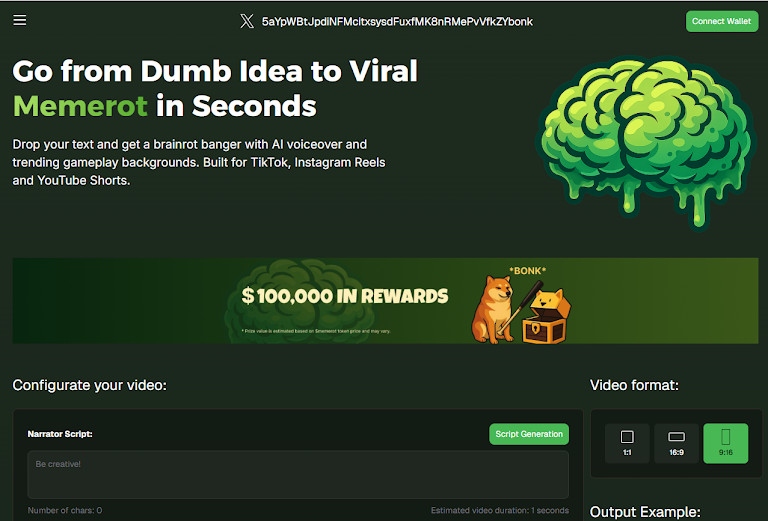
Memerot is a new AI video generator built specifically for brain-rot style content. Its tagline says it all: “Turn your text into viral #memerainrot with AI voiceover and gameplay, ready for TikTok, Reels, and Shorts.” In practice, Memerot lets you simply drop in your text (or tweet) and automatically produces a short video with an AI-generated voiceover and a trending game footage background (think of those “oddly satisfying” or popular game clips that boost viewer retention). The result is a snappy meme video – perfect for viral posts or storytelling without ever showing your face.
Features: Memerot’s focus is on speed and simplicity. It uses a pre-set library of trending gameplay loops and a built-in AI narrator, so you can go from idea to video in seconds. No editing skills or complex settings needed – it’s essentially one-click content creation. Despite being free (with no watermark on outputs), the content feels current and engaging thanks to the trending visuals and voice.
Pros:
Lightning-fast generation – drop text in, get a video out within seconds, great for quick memes or daily posts.
Unique “brain-rot” format – automatically adds viral gameplay backgrounds and AI voice, a format proven to grab attention.
Very easy to use – no sign-up or editing required; perfect for beginners or “faceless” creators who want instant results.
Free with no obvious limits – currently free to use, making it accessible to anyone wanting to experiment.
Cons:
Limited styles – primarily focused on fun/gaming and motivational background videos; not suitable for more formal or diverse video styles.
Voice options – the AI voiceover is provided, but you may have limited choice in voice style or language (at least in the current version).
Video length – geared toward short clips (ideal for TikTok/Reels); may not support longer scripts or detailed videos.
New platform – as a newer tool, it might have occasional bugs or lack advanced customization that more mature platforms offer.
Expert Opinion: Memerot earns the top spot because of its ultra-fast, zero-friction workflow and its niche focus on what’s trending now. For creators chasing virality, the combination of AI voice + trending gameplay is a winning formula – it produces the kind of content that often goes viral with minimal effort. While it’s not as feature-rich as some larger platforms, Memerot is laser-focused on quick viral videos, and it does that job exceptionally well. In our tests, the speed and engagement of Memerot’s outputs were impressive, making it the go-to free tool for brain-rot style content.
2. InVideo AI – Faceless Video Maker with Autopilot
InVideo is a well-known online video platform, and its new AI Video Generator makes creating faceless videos a breeze. With InVideo’s AI, you can generate a complete video from just a single prompt or a script – the AI will write or refine your script, add relevant media, voiceovers, music, and even sound effects automatically. This means you can create anything from listicle videos to how-to explainers without a camera, ideal for marketing content or YouTube channels where you don’t appear on-screen. InVideo boasts a massive library of 16 million+ stock video and image assets, giving your AI-generated videos plenty of high-quality visuals to work with.
Features: InVideo’s AI offers multiple “workflows” for different video styles. Simply choose a style or template, describe your topic, and it will generate a tailored video. It supports various aspect ratios (for YouTube, Instagram, TikTok, etc.) and multiple languages. A standout feature is the human-like text-to-speech voices and the ability to easily edit the AI’s output with a built-in editor if needed. InVideo has a free plan (allows 4 video exports per week with watermark) and higher tiers for watermark-free HD videos. While the free plan does not include full access to generative AI features in perpetuity, it’s enough to test the waters.
Pros:
All-in-one automation – generates scripts, adds media and voiceovers on autopilot, saving tons of time.
Huge content library – millions of stock clips and images ensure your video has relevant, high-quality visuals.
Quality voiceovers – AI voices are quite natural, providing a professional touch to faceless videos.
Flexible editing – you can fine-tune the AI results in InVideo’s editor (change scenes, voice, text, etc.) for more control if desired.
Trusted platform – used by 25M+ users worldwide; reliable and regularly updated.
Cons:
Watermarks on free exports – the free version outputs videos with an InVideo watermark and limits video length per week.
Generative AI limits in free tier – some advanced AI features (like longer script generation or certain avatars) require a paid plan.
Learning curve – while easier than manual editing, InVideo’s numerous options can be a bit overwhelming for absolute beginners (though templates help).
Generation speed – creating a full video can take a couple of minutes, especially if the script is long, which is slower than simpler tools like Memerot.
Requires signup – you need an account to use it (the interface and options are more involved than one-click tools).
Expert Opinion: InVideo AI is an excellent choice for those who want a more polished, versatile faceless video. It’s especially useful for marketing videos, listicles, or educational content where having the right imagery and a clear voiceover is key. While it’s not as instantly simple as Memerot, it offers far more power and customization. We found InVideo’s strength is in producing longer-form faceless videos (e.g., a 5-minute YouTube video on a topic) with a professional feel, thanks to its vast asset library and decent AI voice quality. If you’re willing to spend a little time guiding the AI and possibly upgrading for watermark-free results, InVideo can become a one-stop shop for content creators seeking faceless videos.
3. Fliki – Text-to-Video with Lifelike Voices
Fliki is a popular AI content creation tool that excels at converting text into videos with extremely natural voiceovers. It combines text-to-speech and text-to-video in one platform. With Fliki, you can take a script (or even a blog post URL) and automatically generate a video complete with stock images/clips and a voiceover in your chosen language. One of Fliki’s biggest strengths is its library of 2,500+ ultra-realistic AI voices across 75+ languages and dialects – it’s likely you’ll find a voice that matches the style you want, from narrator tones to upbeat commercial voices. For faceless content creators who want the audio quality to stand out, Fliki is a top choice.
Features: Fliki offers multiple creation modes: Script to Video, Blog to Video, Slides (PPT) to Video, etc. It will automatically pick relevant visuals for your text (using royalty-free image and video libraries), or you can upload your own visuals. It even introduced AI avatars – so if you ever want a virtual presenter on screen (not exactly faceless, but a digital face), that’s available, though completely optional. The interface is user-friendly: you can edit the text, change voice or timing per scene, and preview quickly. Fliki’s free tier allows up to 5 minutes of video or audio content per month at no cost, which is great for trying it out or making a few short videos monthly.
Pros:
Highly realistic voices – some of the best AI voiceovers in the market, which can make your video sound professionally narrated.
Multilingual support – supports dozens of languages and accents, enabling faceless content for global audiences.
Rich feature set – text-to-video, text-to-speech, even avatar videos and voice cloning (on higher plans) – very versatile platform.
Ease of use – simple four-step workflow (add text, choose voice, select visuals or let AI choose, then render) with a clean editor interface.
Free tier available – you can create about 5 minutes of content per month free; paid plans expand this significantly.
Cons:
Free usage is limited – 5 minutes of video per month goes quickly; to create regular content you’ll likely need a subscription.
Visuals can be generic – the auto-selected stock footage/images sometimes feel loosely related to the script; you might need to swap out some clips for better ones.
Rendering time – generating the final video (especially if longer and with many scenes) can take a few minutes; not instant.
Interface in browser – Fliki runs entirely in the browser; heavy projects might be sluggish on low-end computers (no offline app).
No specialized “trending meme” content – unlike Memerot’s gameplay backgrounds, Fliki’s style is more straightforward (business/casual). It’s great for narration, but not aimed at the fast-paced meme niche specifically.
Expert Opinion: Fliki is our recommendation for creators who care about voice quality and language flexibility. In testing, we were impressed by how human-like and engaging the AI narrations were – an important factor if you’re doing faceless videos where the voice carries the storytelling. Fliki is fantastic for turning blog articles into videos or making informational videos (think Top 10 lists, tutorials, or news explainers) with minimal effort. It strikes a good balance between ease and control: you get quick results but also the ability to tweak the visuals or voice per segment. If your goal is to produce faceless videos that sound professional and can be understood in different languages, Fliki is hard to beat.
4. Vadoo AI – Automated Faceless YouTube Videos
Vadoo is an AI faceless video generator that positions itself as an all-in-one tool for YouTube content creation without a camera. It’s designed to help creators (especially YouTubers) pump out videos with zero filming – Vadoo’s AI will take a text prompt or script and generate a full video complete with scenes, images, captions, transitions, background music, and voiceover. Essentially, it’s aiming to replace a whole video editing team: script writer, editor, voice artist, and producer – all in one tool. What’s notable is Vadoo’s emphasis on templates and automation. It offers a variety of templates (including some optimized for YouTube Shorts, listicles, etc.) and even features for auto-posting videos to your channel on a schedule, which can be a growth hack for faceless “automation” channels.
Features: Vadoo uses advanced AI models to transform text prompts into engaging scripts, then finds or generates relevant imagery to stitch into video scenes. It adds AI voiceover and captions automatically in multiple languages, plus royalty-free music and smooth transitions. You have the ability to choose themes or styles for your video; for example, you might pick a “Top 5 list” style vs. a “Story narration” style, and Vadoo will adjust the pacing and visuals accordingly. One big advantage: Vadoo’s free plan is quite generous – you can create up to 20 AI videos per month, up to 1 minute 30 seconds each, with no watermark on the free tier. This makes it very appealing for new creators. Paid plans increase those limits and add extras like longer video duration, more templates, and team collaboration.
Pros:
Hands-off content creation – automates everything from script to final edit; minimal manual work needed.
Multi-layered AI – combines text-to-video, voiceover, subtitles, and even AI B-roll generation for a complete package.
No watermark on free videos – a rare perk; your videos look professional even on the free plan.
Templates for speed – pre-built styles/structures mean you get a coherent video format (great for consistency if doing a series).
Scalability – features like auto-posting and bulk video creation (via scripts or API) are there if you plan to churn out lots of content.
Cons:
Visual quality – some generated visuals might be simplistic or repetitive. Vadoo often uses a mix of generated images and stock; the quality is good but not as extensive a library as InVideo’s.
Prompt dependence – to get the best results, you need to craft a good prompt or outline. Otherwise, AI-generated scripts might be too generic.
Length limitation – free videos are capped at 90 seconds; longer videos (e.g., full YouTube videos 5-10 minutes) require a paid plan.
Voice consistency – while it supports multi-language, the default voice options might feel a bit robotic compared to Fliki’s premium voices.
Newness – as an emerging tool, occasional quirks can occur (e.g., timing of captions or scene sync might need slight adjustments).
Expert Opinion: Vadoo AI is tailor-made for aspiring YouTubers or content marketers who want to run a faceless channel efficiently. Its ability to automatically generate and even upload videos on autopilot is a game-changer for scaling content output. We particularly like that even on the free tier, you get a solid amount of fully usable videos without ugly watermarks – that lowers the barrier to entry for monetizing a faceless channel. In comparison to larger editors, Vadoo is more streamlined: less about fine-tuning each detail, more about cranking out decent videos quickly. In our experience, Vadoo’s output might not have the slick polish of a carefully hand-edited video, but it’s more than adequate for social media and YouTube content where quantity and consistency matter. Overall, it’s a powerful ally for high-volume content creation with minimal effort.
5. SimilarVideo – Trend-Cloning Viral Video Generator
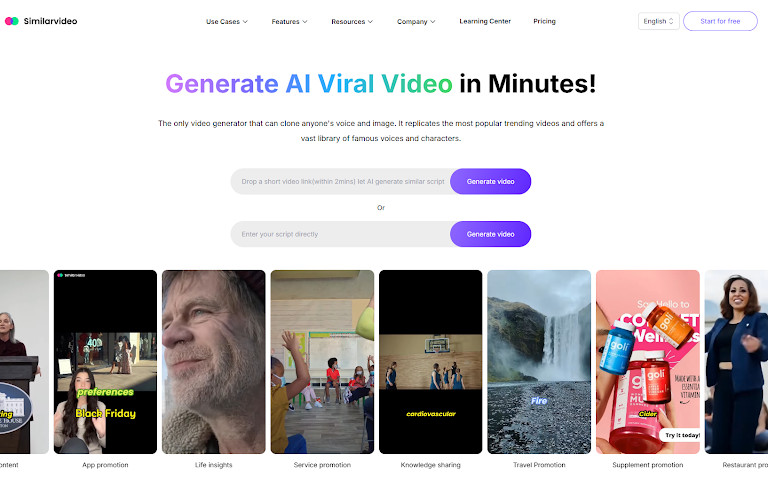
SimilarVideo is an innovative AI tool that takes faceless video generation to the next level by allowing you to clone voices and styles of trending videos. Imagine seeing a viral TikTok or YouTube Short and wanting to create something similar for your niche – SimilarVideo can help you do that almost automatically. It can analyze a reference video (you can input a URL of a popular video) and then replicate its format, voiceover style, and pacing with your own content. It even has a library of celebrity voices and characters that you can use to narrate your video, effectively letting you create content with a familiar voice (for example, having a Morgan Freeman-like voice narrate your script). This makes it a very unique entry in our list, blurring the line between content creation and deepfake technology.
Features: SimilarVideo’s standout feature is its AI Talking Avatar & Voice Cloning. You can generate a custom avatar that looks like a person of your choosing and clone any voice for the narration. It also includes AI script generation (powered by ChatGPT) to help write or improve your video script if you provide a topic. For visuals, SimilarVideo distills trending visual elements from across the internet to ensure your video looks current and engaging. Essentially, it focuses on making your video feel like it’s part of the latest trend, which can boost engagement and views. There’s a free plan that offers basic usage (approximately 3 minutes of video content analysis/generation and a few minutes of voiceover cloning for free). Paid plans unlock longer videos, more frequent usage, and multiple custom avatars.
Pros:
Trend replication – can clone popular video formats and voices, giving you an edge in producing trend-inspired content quickly.
Advanced AI capabilities – voice cloning and avatar generation open up highly creative possibilities (e.g., have an avatar of an influencer present your content).
Marketing power – great for businesses wanting to use influencer-like promos without hiring talent (e.g., clone a famous voice for an ad).
Multi-language & multi-platform – like others, it supports various languages and outputs optimized for TikTok, YouTube, Instagram, etc. Plus, it provides guidance on optimal posting frequency for growth.
Free tier available – you can try out voice/image cloning and create short videos on the free plan (no credit card required), which is generous for such cutting-edge features.
Cons:
Complexity – with great power comes a learning curve. Using cloning features requires more input (providing reference videos or voice samples) compared to other tools that just need text.
Ethical considerations – cloning voices or personas can be sensitive. You must ensure you have rights or it’s for parody; misuse could lead to platform issues. (SimilarVideo, however, notes that their content stays within platform guidelines for originality.)
Resource limits on free tier – the free plan allows only short voiceovers (~3 minutes of speech) and limited trending video analysis (so you might quickly hit limits if experimenting heavily).
No face doesn’t always mean simple – While you don’t use your face, creating a convincing AI avatar or perfectly cloning a voice might take some tweaking to get right. This is more advanced than straightforward templates.
Price for heavy use – higher-tier features (longer videos, multiple avatars) come with subscription costs; it’s understandable given the tech, but something to budget for if you scale up.
Expert Opinion: SimilarVideo is cutting-edge and caters to creators who want to ride on what’s trending in a very direct way. If Memerot is like a quick meme factory, SimilarVideo is like an AI content studio that can churn out “on-trend” videos with high novelty. In our trials, we were able to mimic the style of a trending finance TikTok by simply providing the video link – the AI produced a new video with a similar energetic voice and pace, but with our script. The result was surprisingly on-point. We see SimilarVideo as ideal for marketing teams or savvy creators who want to capitalize on trends and even use the allure of famous voices or characters (within reason) to boost engagement. It’s free to try, and even though mastering its features might take a bit of time, the payoff is unique content that stands out. For those comfortable with advanced AI features, SimilarVideo can make your faceless videos feel anything but faceless.
Comparison Table of Key Features
To help you decide at a glance, here’s a side-by-side comparison of the five tools, focusing on the core criteria: Generation Speed, Content Uniqueness, and Ease of Use (plus notes on free usage).
ToolTotal RatingGeneration SpeedContent UniquenessEase of UseFree PlanMemerot⭐⭐⭐⭐⭐Blazing fast: Almost instant – video ready in seconds after input.High for memes: Uses trending gameplay clips & AI voice, ensuring each video feels fresh and viral.Extremely easy: No sign-up, just paste text and go – zero editing skills needed.Yes – 100% free (no watermark, no strict limits noted). New tool with open access.InVideo AI⭐⭐⭐⭐Moderate: Generates a full video in 1-5 minutes depending on length (AI takes time for script & media).High-quality but stock-based: Pulls from huge library, so visuals are pro-grade but not unique to you (others can use same stock footage).Moderate: User-friendly templates, but many options. A short learning curve for best results.Yes – Free plan (watermarked, 4 exports/week; generative features limited without upgrade).Fliki⭐⭐⭐⭐Fast: Text-to-speech is quick; complete video renders in a couple of minutes.Good voice uniqueness: Huge variety of voices makes your narration stand out. Visuals are generic stock, so less unique visually.Easy: Simple script editor and scene preview. Minimal manual work needed, though you can tweak visuals.Yes – Free tier (5 min of content/month). No watermark, but time limit is restrictive.Vadoo AI⭐⭐⭐Fast/Moderate: Short videos (≤90s) generate in under a minute. Longer scripts take a few minutes.Varied: Uses AI-chosen images/videos and custom templates. Content is original in composition, though built from templates and stock elements.Very easy: Designed for automation – just input text and select style. Little editing required.Yes – Free plan (20 videos/month up to 1.5 min each, no watermark). Paid plans for more.SimilarVideo⭐⭐⭐Moderate: A few minutes to generate, especially if cloning voices or analyzing a reference video.Very high: Can produce videos with unique AI avatars and cloned voices, and mirrors trending styles – resulting content is highly distinctive.Medium-hard: Powerful but requires more input (reference links, choosing voices/avatars). Some practice needed to use advanced features.Yes – Free plan (approx. 3 minutes of video content & voice generation free; enough to test features).
Notes: All these tools run in the browser and require internet. “Generation Speed” can vary with internet and complexity of the request. “Content Uniqueness” refers to how original or distinctive the output is – whether through AI-generated elements or simply combining stock in a new way. Ease of use is judged for a beginner with no video editing experience.
Choosing the “best” free brain-rot/faceless video generator ultimately depends on your goals:
If you want instant viral-style videos for memes or short attention-grabbers, Memerot is unbeatable for speed and simplicity. It’s our top pick for quickly turning out trending gameplay-meme videos with minimal effort.
If your focus is marketing or longer YouTube content and you need a more polished result, InVideo AI offers a robust solution with its all-in-one approach and vast media library – just be ready to work within its free limitations or consider a paid upgrade for heavy use.
For those who prioritize realistic voiceovers and multilingual support, Fliki shines with its voice quality. It’s excellent for narration-driven videos where a convincing voice can make or break viewer engagement.
Vadoo AI is ideal when you’re aiming to scale up content production (e.g., running a faceless YouTube channel or TikTok account posting daily). Its generous free plan and automation features mean you can churn out a lot of content quickly.
If you’re an advanced user looking to surf the trend wave and experiment with the cutting edge, SimilarVideo provides tools to clone styles and voices that can set your content apart. It’s a bit more involved, but the potential for truly unique, head-turning videos is high.
All these generators allow you to create videos without showing your face, which lowers the barrier to entry for content creation. They each have a free option, so our advice is to try the free tier of a couple of them and see which fits your workflow. You might even combine them – for example, use Memerot for quick meme posts, but use Fliki or InVideo for more substantial videos.
In any case, the rise of these AI video tools means anyone can become a content creator or marketer with no camera, no expensive software, and no prior editing skills. It’s never been easier to turn a “dumb idea” into a viral video in seconds. Now, go ahead and give them a spin!
FAQ
What is a “faceless” video generator?
It’s a tool that creates videos without requiring a person to appear on camera. Instead of recording yourself, you provide elements like text, images, or voice, and the generator produces a video using graphics, stock footage, or animations. Everything is handled by AI or templates – including visuals, captions, and voiceovers – so the final video has no actual person’s face visible. Faceless video generators are popular for YouTube channels, marketing content, or social media posts where the creator prefers anonymity or just wants to streamline production.
What are “brain-rot” videos? Why are they popular?
“Brain-rot” is a slang term referring to content that’s extremely addictive or engaging, often in a low-brow, meme-y way that you can’t stop watching (hence joking it gives your brain rot). In the context of videos, brain-rot videos typically feature AI voice narration of a story or facts while a captivating, unrelated video (like rapid gameplay or satisfying loops) plays in the background. This format keeps viewers hooked – the narration engages their mind while the visuals feed their eyes, reducing the chance they’ll scroll away. It’s popular on TikTok and YouTube Shorts because it maximizes viewer retention. The video generators we listed (e.g., Memerot, Revid’s tool, Brainrot.mov, etc.) automate the creation of such content by pairing text with those trending visuals.
Are these AI-generated faceless videos monetizable on YouTube?
Generally, yes – faceless videos can be monetized on YouTube as long as the content adheres to YouTube’s rules. The key is to avoid reused or low-effort content. Originality and added value are important. Using these tools, make sure your script or narration is original (or significantly transformed from any source material). Many successful YouTube channels use AI narration and stock footage or gameplay (for example, for list videos or documentary-style videos) and monetize them. However, purely auto-generated or repetitive content might get flagged by YouTube’s algorithm. It’s wise to add your own editing touch or creativity on top of what the AI gives. Also, ensure you have the rights to any media used (most of these tools provide royalty-free assets or original AI-generated visuals, which is good). In short, you can monetize, but use the AI as assistance – don’t just mass-produce duplicate videos. (Fun fact: SimilarVideo’s FAQ notes that their videos aim to be original and avoid issues with platform guidelines on repetitive content.)
Do I need video editing experience to use these generators?
Not at all. That’s the beauty of these tools – they’re built for non-editors. The typical workflow is to enter text (or a prompt) and let the AI handle the heavy lifting. For example, with Vadoo or InVideo, you might just fill in a short form about what you want, and the AI produces a complete video draft. With Memerot, you literally paste text and get a video. Most of them offer simple interfaces with drag-and-drop or click-to-select options. If you can make a PowerPoint slide, you can probably use these video generators. Of course, if you do have editing skills, many platforms allow further customization – but it’s not required to get a decent result.
How “unique” will my video be if others are using the same tool?
It depends on the tool and how you use it. Memerot and other brain-rot generators produce videos in a very specific viral style – if many users input similar text, the outputs may look alike in format (same gameplay backgrounds, etc.). However, your story or script will be unique to you, so the content is still unique. Tools like Fliki or InVideo use vast libraries of media, so there’s a huge combination of images/music/voice that can make your video feel unique, though occasionally two creators might coincidentally pick the same stock footage for a similar topic. SimilarVideo goes a step further by generating custom avatars or voices, which can make something truly one-of-a-kind (e.g., your personal avatar narrating in a cloned voice). As a rule of thumb: to maximize uniqueness, customize whatever options the tool offers (choose different voice styles, replace any too-common stock footage, etc.). Also, infusing your own creativity into the script or concept will ensure your video stands out even if the underlying tool is popular.
How do these tools affect content creation speed?
They can dramatically speed it up – often by 5x or 10x faster than making videos the traditional way. For instance, writing, voicing, and editing a 3-minute video might normally take many hours. With an AI generator, you could have a first version in a few minutes. Of course, you might spend some additional time refining the output (maybe adjusting a scene or fixing a pronunciation in the voiceover), but it’s still far quicker. This speed lets creators test more ideas and produce content at a daily or even higher frequency. Just be mindful: while speed is great, maintain a level of quality control. It’s easy to hit “generate” and get a video fast – but take a moment to review the result and ensure it meets your standards or tweak as necessary.
Are there any costs hidden behind “free” plans?
All the tools we listed have genuinely free plans or free trials – you can use them without entering payment info. That said, they do have limitations to encourage upgrading. For example, Fliki’s free tier only gives 5 minutes of content per month, and InVideo’s free exports carry a watermark. These aren’t “hidden costs” per se, just usage caps. Typically, if you find yourself hitting those limits regularly or wanting higher output quality, you’d consider a paid plan. But you can absolutely try each of these services for free and even produce some videos at no cost. We recommend using the free tier to evaluate which tool suits you best before investing money. There’s no obligation to upgrade if the free version meets your needs.
Which tool is best for a beginner?
If you’re an absolute beginner looking for the easiest possible solution, Memerot is a great starting point (it was practically made for beginners to churn out viral-style content with one click). You literally can’t go wrong with copy-paste in Memerot’s interface – the AI does everything. Another beginner-friendly option is Vadoo AI, because it walks you through with templates and doesn’t require any editing know-how; plus no watermark issues on free means your videos are ready to share. InVideo and Fliki are also beginner-friendly, but they offer more choices and settings upfront, which can be a tad overwhelming until you get used to them. SimilarVideo is the most advanced – we’d say it’s better once you have a bit of experience or a very specific use case in mind. Overall, all these tools target non-techies, but Memerot gets you results with virtually zero learning curve, and Vadoo strikes a nice balance between ease and output richness for newbies. Enjoy your faceless video creation journey!
Disclaimer
In line with the Trust Project guidelines, please note that the information provided on this page is not intended to be and should not be interpreted as legal, tax, investment, financial, or any other form of advice. It is important to only invest what you can afford to lose and to seek independent financial advice if you have any doubts. For further information, we suggest referring to the terms and conditions as well as the help and support pages provided by the issuer or advertiser. MetaversePost is committed to accurate, unbiased reporting, but market conditions are subject to change without notice.
About The Author
Alisa, a dedicated journalist at the MPost, specializes in cryptocurrency, zero-knowledge proofs, investments, and the expansive realm of Web3. With a keen eye for emerging trends and technologies, she delivers comprehensive coverage to inform and engage readers in the ever-evolving landscape of digital finance.
More articles
Alisa Davidson
Alisa, a dedicated journalist at the MPost, specializes in cryptocurrency, zero-knowledge proofs, investments, and the expansive realm of Web3. With a keen eye for emerging trends and technologies, she delivers comprehensive coverage to inform and engage readers in the ever-evolving landscape of digital finance.
Published: July 09, 2025 at 10:30 am Updated: July 09, 2025 at 7:11 am
by Ana
Edited and fact-checked:
July 09, 2025 at 10:30 am
To improve your local-language experience, sometimes we employ an auto-translation plugin. Please note auto-translation may not be accurate, so read original article for precise information.
Since 2022, AI has exploded. From ChatGPT and Claude to tools that can now code, write, design, diagnose, and even manage workflows. What started as productivity enhancers are now, in some cases, replacements. And between all that, one question has become increasingly urgent: if AI can do this much already, what happens to human jobs?
Across company meetings, labor talks, and government panels, the same concern keeps coming up: are machines going to take over human work for good? Or is this just another big shift? Before we can really understand what’s coming, it helps to look at what’s already played out.
The First Jobs Have Already Gone
You don’t have to look far to see the impact of AI. Customer service centers are rolling out AI agents that handle entire conversations. Legal firms are using tools like Harvey to draft contracts and perform research in minutes.
Goldman Sachs predicted in 2024 that AI could eventually take around 300 million jobs worldwide. According to McKinsey, around a third of work tasks could be automated by 2030. We’re already seeing it in jobs like data entry and customer support.
Jobs that follow the same pattern every day are probably the first to go. Answering customer calls with a script, filing invoices, managing calendars. They’re easy to define and thus easy to automate. Anything that can be broken down into predictable steps is ripe for replacement.
It’s not just blue-collar work either. Entry-level roles in white-collar fields (junior analysts, paralegals, even some junior software engineers) are increasingly vulnerable. AI doesn’t need a coffee break. It doesn’t get tired. If you give it the right training data, AI can actually beat human performance.
But AI is not just subtracting. In some cases, it’s multiplying what a single person can do. A solo marketer can now generate campaigns that used to require a team. A lone coder can build apps in a quarter of the time.
Not Everything Can Be Automated
Despite the hype, not all jobs are on the chopping block. Some work just doesn’t translate well into algorithms. At least, not for now.
Jobs that need real-time thinking, emotional intelligence, or physical dexterity are a different beast. Nurses, teachers, and CEOs all deal with messy, unpredictable situations that call for quick judgment, empathy, and leadership. AI can’t replace that.
Take teaching. It’s not just about explaining material; it’s also about reading the room, encouraging students, and knowing how to adjust your approach. The same goes for therapists and social workers, whose work lives in the grey areas AI can’t quite understand.
And when it comes to skilled trades, no robot is crawling under a sink and fixing it.
Then there’s leadership. CEOs, strategists, and senior managers define vision, manage ambiguity, and motivate teams. These are messy, human things. As JPMorgan’s Jamie Dimon put it, “AI might write code and analyze data, but it doesn’t inspire people.”
AI Won’t Replace Us All At Once
The AI revolution is moving fast, but job loss won’t be instant. This should be a slow but steady wave, not an overnight collapse. Some sectors will feel it sooner. Customer support, data entry, scheduling, research, accounting, all face early disruption thanks to generative models and robotic process automation. The back office is already getting slimmer.
But others will take much longer. Creative work, physical jobs, leadership, and care professions are far more resistant. And even in fast-moving sectors, AI won’t replace people outright. It will augment first, automate later. That means hybrid roles will become the norm.
There’s also regulation, unions, retraining initiatives, and public resistance to consider. Even if the tools are ready, most companies won’t flip a switch and go all-in.
Jobs Still Need the Human Touch
Not every job is under threat. Some jobs may actually get more valuable in a world filled with AI. Because they rely on things machines aren’t good at: emotional understanding, human connection, being physically present, or making decisions when there is no clear framework.
Take teaching. Yeah, AI can assist with planning lessons or grading homework. But standing in front of 25 kids, with one of them randomly starting to cry is a whole different level. That still takes a human. The OECD says only a small fraction of teaching tasks can be automated by 2040.
Healthcare shows the same pattern. Machines might help diagnose or handle paperwork, but building trust with patients or showing empathy during tough moments? That’s not something algorithms can really do.
Creative work, leadership roles, and high-stakes decisions also remain hard to automate. A contract can be drafted by AI, but convincing a jury or inspiring a company still needs a human voice.
And don’t forget hands-on jobs. Think about electricians, plumbers, mechanics. Their day rarely ever goes exactly as planned. Wires aren’t always where they’re supposed to be, things break in weird ways. If your job involves real people, open-ended challenges, or emotional awareness, chances are you’re not going anywhere soon.
In fact, the more curious and flexible you are, the more valuable you’ll become as AI tools spread.
How to Future-Proof Your Career
Most jobs aren’t going extinct, but they’re all going to look different pretty soon. The smart move is to get ahead of that curve. So don’t wait, start adjusting now.
If you work in finance, look into tools that automate reports. Designers, now is the time to try out tools like Runway or Midjourney. They won’t replace your creativity, but they’ll add to it.
What will really make you stand out are the skills machines still fumble with: making smart decisions, leading people, solving tricky problems, and telling stories that land.
Where We’re Headed Next
AI won’t replace everyone. But someone using AI probably will. That’s the core shift we’re living through: not a sudden disappearance of jobs, but a rebalancing of what humans do best, and what machines now can.
Some roles will vanish. Others will evolve. Entirely new fields will emerge. Here’s what we do know: those who lean into the change, not run from it, are going to have the edge.
If you remember just one thing, let it be this: AI is simply the next step in the way we work. Stay sharp, keep learning, and don’t lose sight of the human side.
Disclaimer
In line with the Trust Project guidelines, please note that the information provided on this page is not intended to be and should not be interpreted as legal, tax, investment, financial, or any other form of advice. It is important to only invest what you can afford to lose and to seek independent financial advice if you have any doubts. For further information, we suggest referring to the terms and conditions as well as the help and support pages provided by the issuer or advertiser. MetaversePost is committed to accurate, unbiased reporting, but market conditions are subject to change without notice.
About The Author
Alisa, a dedicated journalist at the MPost, specializes in cryptocurrency, zero-knowledge proofs, investments, and the expansive realm of Web3. With a keen eye for emerging trends and technologies, she delivers comprehensive coverage to inform and engage readers in the ever-evolving landscape of digital finance.
More articles
Alisa Davidson
Alisa, a dedicated journalist at the MPost, specializes in cryptocurrency, zero-knowledge proofs, investments, and the expansive realm of Web3. With a keen eye for emerging trends and technologies, she delivers comprehensive coverage to inform and engage readers in the ever-evolving landscape of digital finance.
After watching the NFT market balloon, implode, and now start to quietly reassemble itself, I’m not here to tell you that NFTs are going to save the internet. I’m also not going to pretend the last two years weren’t tough. But something’s shifting—slowly, unevenly, and maybe for the better. The days of speculative mania are fading, and a new phase rooted in functionality and relevance is emerging.
If NFTs are going to matter again, it’ll be for reasons that look nothing like what got us here in the first place.
Key Takeaways
Real-world asset NFTs are gaining traction by tying tokens to tangible value like real estate, treasuries, and carbon credits.
Art remains relevant, but the NFT space is shifting toward utility—especially in gaming, ticketing, and access-based applications.
AR/VR and AI experiments are evolving NFT experiences, though mainstream adoption still lags behind the hype.
Regulatory scrutiny is increasing, but enforcement is moving toward case-by-case treatment—especially for investment-style NFTs.
Community still matters, even if it’s smaller—projects built around participation and ownership are driving long-term engagement.
1. Real-World Assets Are Giving NFTs a Shot at Legitimacy
Let’s be honest—most people got burned. The 2021 hype cycle inflated the idea that digital art and monkey JPEGs would somehow rewrite the financial system. They didn’t. What we’re seeing now, though, is something different: NFTs that actually tie to real‑world assets—things like real estate, bonds, and treasuries.
These aren’t speculative collectibles—they’re tokenized representations of tangible value. And they’re starting to gain structure, regulation, and purpose.
Plume Network is a blockchain built entirely for real‑world assets. It lets developers tokenize things like mineral rights, carbon credits, and government bonds, and plug them directly into DeFi. The NFTs in this model aren’t art—they’re proof of ownership or access to yield‑bearing products.
Redbelly Network takes a similar approach, focusing on compliance and real identity. It supports NFTs tied to things like private equity and carbon offsets, with on‑chain rules that prevent fraud or wash trading.
This is a big shift. NFTs used to represent hype. Now they’re starting to represent real things. That’s the kind of foundation the space always needed.
2. From Art to Access: How NFTs Are Shifting from Expression to Utility
Art was the launchpad—and to be fair, some of it still deserves credit. I’ve been quick to criticize the speculative mania, but I can’t ignore how NFTs gave independent artists real autonomy.
Platforms like SuperRare and fxhash still host thoughtful, boundary-pushing work. The frenzy is gone, but the core collector base remains. And in some ways, the art has actually improved without the noise.
That said, the conversation has shifted. The only NFTs worth building around now are the ones that do something. I’m watching more attention flow to utility-driven use cases—especially in gaming and access. Illuvium and Star Atlas are launching beta-access ecosystems where NFTs are core to in-game economies.
Ticketing is another area I’m watching closely. NFT-based passes offer real advantages: resale royalties, better security, and dynamic updates. Ticketmaster’s NFT pilots for select events and Proof of Attendance Protocol (POAP) tokens are gaining traction for fan engagement. But let’s be honest—mass adoption hasn’t landed.
Nike and Starbucks, once seen as bullish corporate players, have pulled back. Their exits underscore a bigger truth: mainstream brands aren’t going to carry NFTs across the line. If this space grows, it’ll be because the tools actually work—not because big names are involved.
So yeah, art might stick around. And utility has legs. But neither can coast on hype anymore. The bar’s higher now—and maybe that’s the point.
3. Tech Hype Is Outpacing Real Impact
If I had a token for every time someone said “metaverse” or “AI NFTs” in 2022, I’d be rich. But buried under the jargon are a few ideas that might actually matter.
AI-powered NFTs that evolve or personalize themselves could make digital assets feel more alive. The same goes for AR/VR integrations that aim to give NFTs experiential value—virtual concerts, 3D galleries, immersive wearables.
Apple Vision Pro suggests there’s infrastructure forming, even if user demand hasn’t kept pace. Reebok’s AR-based NFT drops and Spatial.io’s virtual galleries hint at what this future could look like.
The billions poured into immersive tech tell us someone believes there’s a future here. Whether it’s one people actually want is still unclear.
The reality? Adoption is lagging behind innovation. Platforms like Decentraland and The Sandbox boast impressive features but struggle to attract daily users. NFTs may be the right foundation—but only if there’s something real to build on top.
4. Regulation Is a Pain, But a Necessary One
If you were paying attention during the last couple years, you saw how unregulated chaos attracted bad actors. Platforms like OpenSea got hit hard—with lawsuits, delistings, and regulatory heat.
While NFTs haven’t been universally declared securities, the SEC has targeted specific projects—like Impact Theory and Stoner Cats—under the Howey Test. OpenSea even received a Wells notice in 2024, prompting fears that NFT marketplaces might be treated like unregistered securities exchanges.
But in early 2025, the SEC dropped its investigation, and a newly formed crypto unit is now focusing more on fraud than on sweeping enforcement. That signals a shift toward a more nuanced, case-by-case approach.
OpenSea’s reboot—with its SEA token and OS2 platform—is part of this regulatory recalibration. OS2 includes tools for dividend payouts, asset splitting, and voting rights—features that echo financial instruments, but also show a deliberate move toward transparency and compliance.
Institutional investors are circling back, and yes, these preemptive efforts are helping. However, I’ve spoken to enough people in the space to know that trust won’t be rebuilt overnight.
5. Community Is Still the Soul of the Space (Even if It’s Smaller Now)
I’ve always believed that the best NFT projects weren’t just about tokens—they were about belonging. Bored Apes and Pudgy Penguins built cultures; many faded, yet some still have staying power.
But the communities that stuck around—often without huge financial upside—are the ones giving the space its durability.
Sound.xyz continues to thrive as a platform where musicians drop limited-edition NFT tracks, organize mint-time listening parties, and reward loyal fans with exclusive content. It’s helping artists connect directly with listeners—no middlemen, just community.
Farcaster, a decentralized social protocol on Optimism, is quietly redefining what NFT-native community can look like. Profiles are wallet-linked, usernames are tokenized, and access to certain channels or features can be gated through NFTs. It’s not about speculation—it’s about building trust, identity, and continuity in a way traditional platforms can’t.
Social media integrations help onboard new users, but most of that activity still feels surface-level. Real community is harder to fake—and harder to scale. But with platforms like Sound.xyz and Farcaster, NFTs still feel alive at their roots.
Are NFTs back? Not really. Not yet. But they’re not dead either. What we’re seeing now is a necessary comedown and recalibration. Less noise, more intent. I’m not betting the farm, but I’m paying attention. Because if this space comes back—and I think it might—it won’t look anything like the last time.
Published: July 09, 2025 at 4:03 am Updated: July 09, 2025 at 4:04 am
To improve your local-language experience, sometimes we employ an auto-translation plugin. Please note auto-translation may not be accurate, so read original article for precise information.
In Brief
MEXC’s June 2025 Market Report reveals strong platform growth driven by a surge in new token listings, high investor returns, and increased user participation across Launchpad, Launchpool, and Airdrop+ programs.
MEXC, a leading global cryptocurrency exchange, has released its comprehensive June 2025 Market Performance Report, highlighting significant platform growth fueled by new token listings, Launchpad activity, and increased user engagement. The report highlights MEXC’s growing role as a key launch venue for high-potential projects and a trusted hub for innovative retail investor programs.
Asset Listing Expansion Drives User Growth
MEXC listed 206 new tokens in June, marking a strategic expansion of its digital asset portfolio to meet growing user demand for diversified investment opportunities. This listing activity coincided with a 13.25% month-over-month increase in active traders, confirming rising platform activity and user engagement.
New listings in June generated strong investor returns. The top 10 tokens by price appreciation posted an average maximum gain of 2,699%, a 17.3% increase from May. Meanwhile, the top 10 tokens by trading volume achieved average maximum returns of 1,922%, up 8% month-over-month.
Four standout projects — LA (+9,119.75%), AURASOL (+1,486.33%), SKATE (+2,644.00%), and GOR (+1,619.77%) — ranked in both trading volume and price appreciation categories, indicating strong market validation and sustained user interest.
Market Shifting Toward Utility-Driven Assets
June data suggests an investor pivot toward tokens with real-world use cases and infrastructure utility. Among the top 10 gainers, 8 projects (80%) were utility-based, including:
4 infrastructure platforms (LA, SKATE, NODE, MGO)
2 decentralized identity (DID) tokens (BDXN, H)
1 DAO infrastructure platform (BEE)
1 trading tool (BLUM)
Notably, Ethereum-based assets dominated the list with four top performers (LA, BDXN, H, NODE), while BSC and Solana maintained significant representation, reflecting growing investor interest across multiple blockchain ecosystems.
MEXC Launchpad Gains Traction with Low-Barrier, High-Return Model
Since its debut on June 6, 2025, MEXC Launchpad has launched 1–2 projects weekly. Within its first operational month, the Launchpad recorded 118,000 participants and 79,000+ successful subscriptions — a signal of strong early adoption.
The first BTC-related Launchpad project delivered 856.3% APR, with peak returns reaching 9x. Subsequent launches have yielded an average APR of 334.35%, and multiple tokens such as BEE and NODE surpassed 1,800% price growth post-listing.
These results reflect Launchpad’s emerging role as a high-yield opportunity for new and returning investors, with simplified participation and project curation aligned with evolving market demand.
Launchpool Participation Strengthens on the Back of Return Potential
The BOMB Launchpool campaign in June attracted over 4,000 users, with an average allocation of 5,479 BOMB and a peak APR of 449.81%. The campaign also supported user acquisition, onboarding 700+ new users via structured reward programs. The EIN Launchpool is currently active, continuing the momentum.
Airdrop+ Surges with 100% Growth in Rewards Distribution
June saw MEXC’s Airdrop+ program double its monthly prize pool to 6.6 million USDT, attracting over 150,000 participants. With individual rewards per user reaching up to 100 USDT per campaign, and a total of 65 campaigns launched during the month, the platform sustained a high-frequency rollout of 2–5 airdrop events daily.
Emerging token campaigns included H, BLUM, and MGO, offering users frequent, low-risk opportunities to engage with new assets.
Overall, June 2025 reflects a period of accelerating activity at MEXC, driven by a robust listing calendar, consistent Launchpad deployment, and strong user participation across incentive programs. The data points to a growing market appetite for infrastructure-focused projects and structured investment products, solidifying MEXC’s position as a leading platform for both early-stage token discovery and sustained community engagement.
About MEXC
Founded in 2018, MEXC is committed to being “Your Easiest Way to Crypto”. Serving over 40 million users across 170+ countries, MEXC is known for its broad selection of trending tokens, frequent airdrop opportunities, and low trading fees. Our user-friendly platform is designed to support both new traders and experienced investors, offering secure and efficient access to digital assets. MEXC prioritizes simplicity and innovation, making crypto trading more accessible and rewarding.
For more information, visit: MEXC Website|X|Telegram|How to Sign Up on MEXC
For media inquiries, please contact the MEXC PR Team: [email protected]
Source
Disclaimer
In line with the Trust Project guidelines, please note that the information provided on this page is not intended to be and should not be interpreted as legal, tax, investment, financial, or any other form of advice. It is important to only invest what you can afford to lose and to seek independent financial advice if you have any doubts. For further information, we suggest referring to the terms and conditions as well as the help and support pages provided by the issuer or advertiser. MetaversePost is committed to accurate, unbiased reporting, but market conditions are subject to change without notice.
About The Author
Gregory, a digital nomad hailing from Poland, is not only a financial analyst but also a valuable contributor to various online magazines. With a wealth of experience in the financial industry, his insights and expertise have earned him recognition in numerous publications. Utilising his spare time effectively, Gregory is currently dedicated to writing a book about cryptocurrency and blockchain.
More articles
Gregory, a digital nomad hailing from Poland, is not only a financial analyst but also a valuable contributor to various online magazines. With a wealth of experience in the financial industry, his insights and expertise have earned him recognition in numerous publications. Utilising his spare time effectively, Gregory is currently dedicated to writing a book about cryptocurrency and blockchain.
Published: July 08, 2025 at 10:20 am Updated: July 08, 2025 at 9:37 am
by Ana
Edited and fact-checked:
July 08, 2025 at 10:20 am
To improve your local-language experience, sometimes we employ an auto-translation plugin. Please note auto-translation may not be accurate, so read original article for precise information.
In Brief
Blockchain Life 2025 will host its largest-ever forum in Dubai on October 28–29, bringing together 15,000 attendees, over 200 speakers, and major global crypto companies for two days of industry-focused programming ahead of the anticipated market upswing.
Blockchain Life 2025 has officially announced its upcoming event, which is scheduled to be held in Dubai on October 28th–29th, and is expected to convene a wide range of participants from the global crypto industry.
Positioned as more than a conventional forum, the event is described as a comprehensive cryptocurrency-focused gathering taking place in anticipation of a potential market upswing and the next altcoin cycle. The organizers project attendance to reach approximately 15,000 individuals representing 130 countries.
The event is known for attracting high-level representation from major entities across the blockchain and cryptocurrency ecosystem. Attending organizations are expected to include founding teams and senior executives from firms such as Binance, Tether, Tron, Bybit, Ripple, TON, CoinMarketCap, Animoca Brands, Circle, Solana, OKX, HTX, BingX, KuCoin, Telegram, Mastercard, ICP, Trust Wallet, The Sandbox, Near, Litecoin, Bitmain, eToro, Marathon Digital, Canaan, WhatsMiner, Bitfury, Consensys, Linea, DWF Labs, Wintermute, BNB Chain, Mantle, among others.
Blockchain Life 2025 Set To Host Record-Breaking Forum In Dubai With Over 200 Speakers And Expanded Industry Programming
This anniversary edition of the Blockchain Life Forum is expected to be the largest in the event’s history, spanning two full days of professional networking and engagement. The forum anticipates hosting 15,000 attendees from various global regions, bringing together a high-level audience for discussions and collaboration.
More than 200 speakers are scheduled to participate, offering perspectives on market developments, strategic investment approaches, and forecasts timed closely with anticipated market expansion. The venue will also accommodate over 200 exhibition booths, with participation from a broad range of companies showcasing advanced technologies and emerging products that are yet to reach the mainstream.
An expanded outdoor area is planned for this edition, doubling in size compared to previous years. This open-air space will include lounge seating, complimentary food and beverages, wellness amenities such as massage stations, and live DJ performances running through sunset hours.
The event will also include a private afterparty featuring a headlining artist whose identity has not been disclosed. Additionally, a full calendar of related activities under the Blockchain Life Week banner will extend the experience across several days in Dubai.
Tickets for the 15th edition of the Blockchain Life Forum are currently available for purchase, with early pricing options now open. A discount of 10% is available with the promotional code Mpost.
Disclaimer
In line with the Trust Project guidelines, please note that the information provided on this page is not intended to be and should not be interpreted as legal, tax, investment, financial, or any other form of advice. It is important to only invest what you can afford to lose and to seek independent financial advice if you have any doubts. For further information, we suggest referring to the terms and conditions as well as the help and support pages provided by the issuer or advertiser. MetaversePost is committed to accurate, unbiased reporting, but market conditions are subject to change without notice.
About The Author
Alisa, a dedicated journalist at the MPost, specializes in cryptocurrency, zero-knowledge proofs, investments, and the expansive realm of Web3. With a keen eye for emerging trends and technologies, she delivers comprehensive coverage to inform and engage readers in the ever-evolving landscape of digital finance.
More articles
Alisa Davidson
Alisa, a dedicated journalist at the MPost, specializes in cryptocurrency, zero-knowledge proofs, investments, and the expansive realm of Web3. With a keen eye for emerging trends and technologies, she delivers comprehensive coverage to inform and engage readers in the ever-evolving landscape of digital finance.
Published: July 08, 2025 at 3:10 am Updated: July 08, 2025 at 3:10 am
by Ana
Edited and fact-checked:
July 08, 2025 at 3:10 am
To improve your local-language experience, sometimes we employ an auto-translation plugin. Please note auto-translation may not be accurate, so read original article for precise information.
In Brief
Katana has launched its DeFi chain with Chainlink integration, providing developers with real-time data streams, secure price feeds, and cross-chain interoperability to build high-performance decentralized applications.
Decentralized computing platform, Chainlink announced that Katana has launched its decentralized finance (DeFi) chain. The project was developed with support from Polygon, an Ethereum Layer 2 scaling solution, and GSR, a capital markets partner. At launch, Katana is integrated with Chainlink and has joined the Chainlink SCALE program.
This integration enables the immediate availability of Chainlink’s data streams, price feeds, and Cross-Chain Interoperability Protocol (CCIP) for DeFi developers. These tools provide fast, high-frequency market data, secure messaging and token transfers across chains, and dependable on-chain pricing to facilitate complex DeFi applications and contribute to the growth of the broader Katana DeFi ecosystem.
Katana has been developed with the aim of setting a new benchmark in DeFi, with a focus on generating real yield, maintaining substantial liquidity, and providing a streamlined user experience. The approach emphasizes high standards, particularly regarding data quality and system security.
Chainlink, known for supporting some of the most reliable protocols in DeFi, has facilitated over $22 trillion in transaction value and secured more than $75 billion at the height of the DeFi market. This infrastructure now plays a foundational role in supporting Katana’s DeFi ecosystem from its inception.
Chainlink Integration To Enhance DeFi Performance, Enable Secure Pricing, And Unlock Cross-Chain Functionality
DeFi relies heavily on data, where both speed and precision are essential. Chainlink Data Streams play a key role by offering ultra-low latency, allowing pricing and trading processes to occur with minimal delay and enhanced accuracy. This infrastructure avoids data lag and supports high-frequency performance.
Chainlink’s system is built on reliable, well-established infrastructure designed to maintain consistent uptime. The data provided is sourced directly from leading exchanges and premium providers, offering a high level of accuracy for onchain operations. Developers on Katana can also configure data streams to meet the specific needs of their applications, supporting greater flexibility.
With these capabilities, DeFi on Katana is not only faster but also more precise, adaptive, and dependable. In addition to real-time data streams, developers gain access to Chainlink’s established data feeds, known for delivering secure and trustworthy pricing information. These feeds, which have already supported tens of billions in DeFi total value locked (TVL), are now available on Katana, allowing developers to build complex, high-stakes applications with confidence.
Beyond data, CCIP provides Katana developers with the tools to create applications that securely interact across multiple blockchains. This includes asset transfers, messaging, and triggering functions on other networks, all backed by Chainlink’s security standards.
The Chainlink integration is now active on the Katana mainnet, giving developers access to this expanded suite of tools.
Disclaimer
In line with the Trust Project guidelines, please note that the information provided on this page is not intended to be and should not be interpreted as legal, tax, investment, financial, or any other form of advice. It is important to only invest what you can afford to lose and to seek independent financial advice if you have any doubts. For further information, we suggest referring to the terms and conditions as well as the help and support pages provided by the issuer or advertiser. MetaversePost is committed to accurate, unbiased reporting, but market conditions are subject to change without notice.
About The Author
Alisa, a dedicated journalist at the MPost, specializes in cryptocurrency, zero-knowledge proofs, investments, and the expansive realm of Web3. With a keen eye for emerging trends and technologies, she delivers comprehensive coverage to inform and engage readers in the ever-evolving landscape of digital finance.
More articles
Alisa Davidson
Alisa, a dedicated journalist at the MPost, specializes in cryptocurrency, zero-knowledge proofs, investments, and the expansive realm of Web3. With a keen eye for emerging trends and technologies, she delivers comprehensive coverage to inform and engage readers in the ever-evolving landscape of digital finance.
Following President Donald Trump's pardon of Silk Road founder Ross Ulbricht Tuesday, the Bitcoin community has rallied, pouring crypto into Ulbricht’s donation fund...