Metaverse

Home Metaverse Page 11

Petcube GPS Tracker Review: Specs, Features & Price | Metaverse Planet

Petcube GPS Tracker Review: Specs, Features & Price | Metaverse Planet


As a pet parent, there is no feeling quite as terrifying as realizing your dog has slipped out of the yard or wandered too far off the trail. I’ve experienced that split-second heart drop, shouting their name into the void. That’s exactly why I decided to take a closer look at the Petcube GPS Tracker. I wanted to find out if this sleek, compact gadget could genuinely deliver the ultimate peace of mind it promises, or if it was just another tech accessory that overpromises and underdelivers.

Pros

✅ Exceptional battery life lasting up to 30 days in power save mode.✅ Built-in light and sound alerts make finding hiding pets incredibly easy.✅ IP67 waterproof rating means it survives muddy puddles and rain perfectly.

Cons

❌ Requires an ongoing monthly or annual subscription to operate.❌ Relies entirely on cellular coverage, making it useless in total dead zones.❌ While light (29g), it might be slightly bulky on a very small toy breed collar.

Technical Specifications

FeatureDetailsTracking NetworkUnlimited LTE-M & 85 GPS SatellitesBattery LifeUp to 30 days (Power Save Mode); 1-hour fast chargingDurabilityIP67 Water and Dust ResistantDimensions & Weight60 x 25 x 20 mm / 29 gramsExtra FeaturesLED flashlight, built-in buzzer, fitness tracking, Virtual FencesSubscription RequirementYes (Starts at $5/month)

My Hands-On Experience

Using the Petcube GPS Tracker fundamentally changed the way I walk and monitor my dog. Right out of the box, setting it up was impressively simple. The device is small—barely noticeable once tucked into its glow-in-the-dark silicone sleeve and looped onto the collar. It connected smoothly to the Petcube App, which is arguably one of the most intuitive interfaces in the pet tech market today.

What really sold me was the live tracking accuracy. Relying on both cellular networks and 85 satellites, the pins dropping on the interactive map were precise to the meter. When my adventurous pup bounded out of sight in a wooded dog park, activating the ‘Lost Pet’ mode gave me high-sensitivity, rapid location updates. But the unsung heroes of this device are the light and sound alerts. It’s one thing to be near a GPS pin; it’s another to activate a loud buzzer and a bright LED flashlight straight from your phone when your dog is camouflaged in deep brush at dusk.

The virtual fence feature is also robust. Setting up “Safe Zones” around my property was easy, and the push notifications when those boundaries are breached are nearly instantaneous. Beyond emergencies, the day-to-day fitness tracking is a genuinely fun feature that operates almost like a Fitbit for your dog, logging active minutes and calories burned.

The elephant in the room is the subscription. You can’t use this device for free; it requires a data plan because it’s essentially a tiny cell phone pinging your app. However, given that it costs as little as $5 a month, the peace of mind feels completely justified. My only minor gripe is that if you go completely off-grid on a deep wilderness hike with zero cell coverage, you won’t get live updates until you return to a covered area.

Who is this for? / Alternatives

The Petcube GPS Tracker is tailored for dog and cat owners who want serious, real-time location tracking that goes far beyond Bluetooth limits. If you have an escape artist, love off-leash walks, or just want robust wellness tracking, this is for you.

If you’re considering alternatives, the Tractive GPS Tracker is its most direct competitor, offering a very similar subscription-based GPS tracking experience but with a slightly larger form factor. If you want a non-subscription route and only care about local, crowded-area finding, an Apple AirTag is much cheaper, but beware: AirTags lack true GPS and rely strictly on nearby Bluetooth devices, making them dangerous to rely on for a truly lost pet in a rural area.

Quick FAQ

Does the Petcube GPS Tracker require a subscription?Yes, it relies on local LTE-M cellular networks to continuously broadcast your pet’s location. Subscription plans are managed through the app and start at $5 per month.

Is it suitable for cats and small dogs?Weighing only 29 grams and measuring 60mm in length, it’s compact enough for most cats and small dogs. However, very tiny teacup breeds might find it slightly cumbersome.

What happens if the tracker gets wet?Nothing to worry about. The tracker is IP67 certified, meaning it is completely dust-tight and can survive being submerged in water up to 1 meter deep for 30 minutes.




Source link

The Future of Waking Up: Xiaomi’s New Smart Curtain System | Metaverse Planet

The Future of Waking Up: Xiaomi’s New Smart Curtain System | Metaverse Planet


Let’s be honest for a second. Is there anything worse than being jolted awake by a blaring alarm clock in a pitch-black room? I’ve always hated it. I’ve tried smart alarms, dawn-simulating lamps, and everything in between. But while researching the latest smart home trends, I stumbled upon Xiaomi’s new release, and it made me pause.

Xiaomi has just launched the Mijia Smart Curtain 3 Pro via crowdfunding in China, and it might just be the ultimate fix for our broken morning routines.

I didn’t just want to drop the spec sheet and leave you to figure it out. Let’s break down why this specific release is a big deal for the smart home ecosystem, and why a motorized curtain is no longer just a luxury gimmick for tech billionaires.

Beyond Just Opening and Closing: The “Smart Wake-Up” Philosophy

What really caught my attention wasn’t the motor; it was the software behind it. Xiaomi has integrated a smart wake-up mode designed specifically to align with human circadian rhythms.

Instead of violently snapping open, the Mijia Smart Curtain 3 Pro communicates with your scheduled alarms. It gradually—and quietly—pulls back the fabric in stages.

Stepless Speed Control: You can adjust the opening speed anywhere between 10% and 100%.Natural Light Exposure: By the time your actual alarm rings, your room is already flooded with natural morning sunlight, signaling your brain to stop producing melatonin.

As someone who spends way too much time staring at screens, anything that brings natural biology back into my routine is a massive win in my book.

Heavy Duty Tech, Whisper Quiet Execution

Now, I know what you are thinking. “Aren’t motorized curtains incredibly loud? Waking up to the sound of a mechanical grind defeats the purpose.” Xiaomi apparently thought of that, too.

The engineering under the hood is genuinely impressive for its price bracket:

Dual Brushless DC Motors: Each motor pumps out 1.2 Nm of torque.Massive Weight Capacity: It can handle up to 60 kg (132 lbs) of curtain weight. You could hang heavy blackout drapes on this without the motor breaking a sweat.Virtually Silent: This is the kicker. Xiaomi claims it operates at under 30 decibels when both motors are running, and drops below 26 dB if you only use one. For context, a whisper is about 30 dB.

To prevent that annoying rattling sound you get with cheap curtain tracks, Xiaomi used a two-layer track with rubber-coated wheels to absorb vibration. It’s this kind of obsessive attention to detail that I love seeing in modern smart home design.

Total Ecosystem Integration and Independent Control

Xiaomi isn’t just selling a motor; they are selling a node in the HyperOS Connect network.

With the built-in Wi-Fi module, you aren’t tied down to a single remote control. You can manage the system via:

The Mi Home app (even when you are halfway across the world).Voice commands through compatible smart speakers.A physical remote control.A simple manual pull. (If you lightly tug the curtain, the motor takes over and finishes the job. This is a brilliant feature for guests who don’t know you have a smart home).

Furthermore, the left and right sides operate independently. If you have an awkward sunbeam hitting your TV screen, you can close the right side while keeping the left open for natural room lighting.

The Verdict: Is It Worth It?

At a crowdfunding price of 799 yuan (roughly $116), Xiaomi is aggressively democratizing smart home architecture. Five years ago, a system with this weight capacity and decibel rating would have cost you five times as much through a custom home theater installer.

I honestly think automated window treatments are going to become as standard as smart thermostats in the next few years.

What about you? Have you integrated any smart blinds or curtains into your home setup yet, or do you still prefer the old-fashioned manual pull?

You Might Also Like;


Source link

Japan Reclassifies Crypto Assets Under Financial Instruments Act

Japan Reclassifies Crypto Assets Under Financial Instruments Act


Japan’s cabinet approved a landmark bill on April 10, 2026, to reclassify cryptocurrencies (crypto assets) as financial instruments under the Financial Instruments and Exchange Act (FIEA) for the first time.

The move shifts oversight from the Funds Settlement Act, which treated them mainly as payment tools, to the stricter FIEA framework that governs stocks and bonds. This reflects crypto’s evolution into a popular investment vehicle.

Key provisions include a ban on insider trading using non-public material information and mandatory annual disclosures by crypto issuers to boost transparency. Crypto exchange operators will be renamed “crypto asset trading operators.”

Penalties will be significantly strengthened for investor protection: the maximum prison term for unregistered sales will rise from three to 10 years, while fines will increase from ¥3 million to ¥10 million.

If passed by the current Diet session, the amendments are expected to take effect in fiscal 2027.

Finance officials stated the changes aim to enhance market fairness, transparency, and growth fund supply amid evolving financial markets. 

The reform is designed to foster a safer, more mature crypto ecosystem in Japan while aligning regulations with global standards and addressing risks like market misconduct. 

Also read: ClearBank Europe Secures MiCAR Approval for Crypto Services


Disclaimer: The information researched and reported by The Crypto Times is for informational purposes only and is not a substitute for professional financial advice. Investing in crypto assets involves significant risk due to market volatility. Always Do Your Own Research (DYOR) and consult with a qualified Financial Advisor before making any investment decisions.


Source link

Breaking the Ultimate Distance Record in Human Spaceflight | Metaverse Planet

Breaking the Ultimate Distance Record in Human Spaceflight | Metaverse Planet


I honestly got chills when the telemetry data confirmed it. Watching the Artemis 2 crew break the ultimate distance record wasn’t just another news update for me; it felt like watching a massive, historical shift happen right in front of my eyes.

When I saw that the Orion spacecraft had traveled exactly 406,771 kilometers away from Earth, I had to sit back and just process that number. To put it in perspective, that is further than any human being has ever ventured into the absolute darkness of the cosmos. It completely shatters the long-standing record set by the Apollo 13 crew back in 1970. Tracking this mission, I realized something profound: we are no longer just dreaming about the next era of deep space travel. We are actually living in it.

Let me take you through why this specific milestone has me so hyped, and why it is so much more than just a new number in the Guinness World Records.

The Ghost of Apollo 13: A Record Born of Crisis, Broken by Design

moon flag

I’ve always been fascinated by the Apollo 13 mission. If you know the history, you know that their distance record of 400,171 kilometers wasn’t exactly something NASA planned to celebrate. It was a terrifying necessity. After an oxygen tank explosion crippled their command module, the crew had to use the Moon’s gravity to sling them back toward Earth in a free-return trajectory. They swung unusually high around the far side of the Moon, accidentally setting a record for the furthest distance humans had ever traveled from our home planet.

What amazes me about the Artemis 2 achievement is the sheer contrast in intention.

We didn’t stumble into this new record because something went wrong. We engineered our way there deliberately. The Artemis 2 crew pushed the Orion spacecraft to this extreme distance to intentionally stress-test our modern life support systems, communication arrays, and navigation protocols. It’s a bold statement that says we aren’t just surviving the trip to the Moon anymore; we are mastering the space around and beyond it.

Inside the Orion Spacecraft: Surviving the Deep Void

When I was researching the specs of the Orion spacecraft, I was genuinely blown away by the technological leaps we’ve made since the Apollo era. It’s easy to look at a capsule and think it’s just an upgraded version of the 1960s hardware, but that couldn’t be further from the truth.

Here are the key things I found that make Orion an absolute beast of a machine capable of surviving 406,771 kilometers away:

The European Service Module (ESM): This is essentially the powerhouse of the spacecraft. Provided by the European Space Agency, it supplies the crew with water, oxygen, thermal control, and the electrical power generated by its massive solar arrays. Knowing that international collaboration is literally keeping these astronauts alive that far out makes the whole mission feel like a true victory for humanity, not just one country.Next-Gen Radiation Shielding: Space is incredibly hostile, and once you get past the Earth’s protective magnetic field, radiation becomes a massive threat. Orion is equipped with high-density shielding to protect the crew from unpredictable solar flares.Deep Space Network (DSN) Capabilities: Communicating with a ship almost half a million kilometers away requires insane precision. The latency and data transfer rates were tested to their absolute limits here.

Thinking about the crew sitting inside that capsule, trusting this intricate web of technology to keep the cold, radioactive vacuum of space at bay, is truly mind-boggling to me.

The Psychological Void

I try to put myself in the boots of the Artemis 2 astronauts. Imagine looking out the window of the Orion spacecraft. The Moon is a massive, looming sphere of gray craters, but when you look back at Earth? It’s not even the classic “Blue Marble” we are used to seeing from the International Space Station. From 406,771 kilometers away, Earth is terrifyingly small.

We often talk about the “Overview Effect”—that cognitive shift astronauts experience when seeing Earth from space. But what happens to the human mind when Earth is just a tiny, distant pale blue dot in a sea of black? Testing human psychology at these extreme distances is just as critical as testing the physical hardware.

Why This 406,771-Kilometer Mark Actually Matters

I know some skeptics might ask, “Why bother going that far just to orbit the Moon and come back?” But from where I sit, analyzing the trajectory of our space programs, this is the ultimate dry run.

We aren’t just stretching our legs; we are proving that our deep-space architecture actually works. When you are hundreds of thousands of kilometers away from Earth, there is no quick rescue mission. If something breaks, the crew and the ground control teams have to solve it with whatever is on board. By pushing Orion to this unprecedented distance, NASA is proving that we have the robust, redundant systems necessary to keep humans alive when quick aborts are mathematically impossible.

Next Stop: The Red Planet

This brings me to the thought that I just can’t shake since the news broke.

Every single system tested at this record-breaking distance—the life support, the radiation shielding, the communication delays, the human endurance—is a direct proxy for the journey to Mars.

I was looking at the mission roadmap, and it hit me: Artemis isn’t just about going back to the Moon to stay. The Moon is our proving ground. Breaking the ultimate distance record is the final, undeniable proof that we have the hardware and the audacity to cross the interplanetary void. I can’t help but wonder if the next major milestone I get to report on won’t just be an orbital record, but the actual launch of a multi-year, direct journey to the Martian surface.

We are living in the prologue of a multi-planetary human race, and watching Orion push the boundary out to 406,771 kilometers makes me incredibly optimistic for the future of space exploration.

If you had the chance to be on a spacecraft breaking the ultimate distance record, knowing Earth was just a speck in the window, would you take the risk, or would the vastness of deep space be too much? Let me know your thoughts down in the comments, and don’t forget to subscribe if you want to keep exploring the future with me!

You Might Also Like;


Source link

Top 10 Best Crypto Apps For Android In 2026

Top 10 Best Crypto Apps For Android In 2026


In Brief

By 2026, the cryptocurrency app scene on Android will have evolved dramatically. Nobody is impressed now by how many random tokens a program supports.

Top 10 Best Crypto Apps For Android In 2026

By 2026, the cryptocurrency app scene on Android will have evolved dramatically. Nobody is impressed now by how many random tokens a program supports. 

What counts today is how easy it is to use, how much bother it eliminates, and if it genuinely allows you to earn, exchange, or keep secure without having to jump through hoops. I evaluated each one based on actual characteristics, not marketing fluff.

Phantom has developed into a highly capable multichain wallet that balances elegance with power. It has an extensive list of supported chains, including Solana, Ethereum, Bitcoin, Polygon, Base, Sui, and more, giving management access to everything from a single, clear interface.

What stands out most is the built-in cross-chain swapping. One can move assets between networks without messing with sketchy bridges. Staking is baked right in too (especially smooth on Solana), so earning passive rewards is literally a couple of taps away. 

On the safety side, it runs transaction simulations before you confirm anything, filters out spam NFTs, and has solid phishing protection. It just feels safer than a lot of the older wallets.

Top 10 Best Crypto Apps For Android In 2026

Rabby is basically aiming towards making DeFi less dangerous and way more efficient. It works great across pretty much every EVM chain, which is perfect if you bounce between different DeFi protocols. 

Its killer feature is the transaction preview. Before you sign anything, it shows you exactly what’s going to happen to your balances and tokens. 

The platform does not allow for blind approvals. This has been one of the biggest hindrances in Web3. It also auto-detects the right network, removing the hassle of switching manually. No native token yet, but a lot of people are in it, hoping for a future airdrop, and that excitement has pulled in plenty of active users.

Top 10 Best Crypto Apps For Android In 2026

OKX really went all-in on features. It supports a ton of chains and mixes centralized and decentralized stuff into one app without feeling cluttered. 

You get a smart DEX aggregator that finds the best swap routes across liquidity pools, native cross-chain swaps, staking, and yield farming, all inside the app. 

The “Cryptopedia” section is also a fun bit. Users can do quests and campaigns that sometimes hand out tokens or early project access. Add in the NFT marketplace and decent risk alerts, and it honestly feels like a full Web3 command center rather than just another wallet.

Top 10 Best Crypto Apps For Android In 2026

Backpack does something different. It lets you run actual apps right inside the wallet. It works with Solana and Ethereum, and those built-in “xNFTs” let you trade, play games, or use tools without ever leaving the app.

That setup cuts down on phishing risks because you’re not constantly hopping to external dApps. It also has exchange features and solid NFT protection like asset locking. It’s still growing, but the whole idea of a wallet that contains its own little ecosystem is pretty cool and feels like the future.

Top 10 Best Crypto Apps For Android In 2026

If you hate having your portfolio scattered everywhere, Zerion is a breath of fresh air. It’s less of a plain wallet and more like a smart portfolio dashboard that works across chains and protocols. It pulls together all your tokens, NFTs, and DeFi positions into one view so you can actually see what’s going on in real time. 

You can also swap tokens and manage liquidity straight from the app. It eases the complexity for anyone managing numerous ecosystems without losing self-custody.

Top 10 Best Crypto Apps For Android In 2026

Coinbase Wallet makes the jump from regular Coinbase to full self-custody feel pretty painless. It supports a wide range of assets and chains but keeps the interface straightforward so new folks don’t get overwhelmed. 

The platform provides a dApp browser, NFT storage, staking, and decent security like biometrics and 2FA. 

Top 10 Best Crypto Apps For Android In 2026

Source: X

It’s pretty simple to transfer assets between your wallet and Coinbase. It may not be the most sophisticated DeFi tool available, but it does serve as a good way for people getting started with Web3.

Top 10 Best Crypto Apps For Android In 2026

Trust Wallet is still one of the most flexible options out there. It supports a ridiculous number of blockchains, so it’s great if you like experimenting with different networks.

Within the app, you can purchase crypto with fiat, swap tokens (the routing has improved significantly), stake, and explore dApps. It may not be the most extensive in any one category, but it’s dependable and completes nearly all tasks without requiring you to download five different apps.

Top 10 Best Crypto Apps For Android In 2026

Bitget Wallet has been picking up steam because it packs a lot into one clean mobile experience. You can do in-app swaps, stake tokens, use NFT tools, trade socially by following others, and much more. 

It can clearly provide a unique value proposition to potential customers, particularly in the developing world, because a dominant consumer pain point in those markets is the need for integration. Such integration is exemplified by the company’s mobile-first strategy, which also fosters a contemporary user experience and encourages daily utilization.

Top 10 Best Crypto Apps For Android In 2026

If security is your top priority, and you want support for both large blockchain projects and smaller, newer, or niche chains (including privacy-related projects), then FoxWallet is a top choice. Before you sign anything dangerous, it provides phishing alerts and transaction risk warnings in real time. Additionally, a dApp browser for DeFi and NFTs is included. 

Top 10 Best Crypto Apps For Android In 2026

MetaMask has leveled up a lot recently. The Snaps system now lets it support way more chains through simple extensions. The system uses security notifications and hardware wallet compatibility, components that work well with almost any dApp. 

The flexibility and huge ecosystem are also among the key things that make the ecosystem stand out when speaking about the top 10 best cryptocurrency apps for Android. 

Top 10 Best Crypto Apps For Android In 2026

What Next?

In 2026, the best Android crypto apps aren’t winning because they’re popular – they’re winning because they actually make your life easier. The real competition is around multichain access, rock-solid security, and ways to actually earn while keeping things simple. 

What’s wild is how everything is blurring together: wallets are becoming exchanges, exchanges are adding DeFi, and portfolio apps are turning into full trading platforms. The lines are disappearing fast. 

For regular users, that’s awesome news. Fewer apps to juggle, more control, and a smoother experience overall. The winners will keep stripping away the friction while adding real value, all without cutting corners on safety. That’s the bar now.

Disclaimer

In line with the Trust Project guidelines, please note that the information provided on this page is not intended to be and should not be interpreted as legal, tax, investment, financial, or any other form of advice. It is important to only invest what you can afford to lose and to seek independent financial advice if you have any doubts. For further information, we suggest referring to the terms and conditions as well as the help and support pages provided by the issuer or advertiser. MetaversePost is committed to accurate, unbiased reporting, but market conditions are subject to change without notice.

About The Author


Alisa, a dedicated journalist at the MPost, specializes in cryptocurrency, zero-knowledge proofs, investments, and the expansive realm of Web3. With a keen eye for emerging trends and technologies, she delivers comprehensive coverage to inform and engage readers in the ever-evolving landscape of digital finance.

More articles


Alisa, a dedicated journalist at the MPost, specializes in cryptocurrency, zero-knowledge proofs, investments, and the expansive realm of Web3. With a keen eye for emerging trends and technologies, she delivers comprehensive coverage to inform and engage readers in the ever-evolving landscape of digital finance.


More articles


Source link

Coinbase Becomes Custodian for Morgan Stanley’s Bitcoin Trust (MSBT)

Coinbase Becomes Custodian for Morgan Stanley’s Bitcoin Trust (MSBT)


Key Highlights

Brian Armstrong confirms Coinbase will custody Morgan Stanley’s Bitcoin Trust, boosting institutional crypto trust.

Morgan Stanley’s MSBT marks its first Bitcoin ETP, reflecting rising Wall Street demand for regulated crypto access.

Coinbase strengthens its dominance, securing major bank partnerships as institutional Bitcoin adoption accelerates.

Coinbase has hit a major achievement by becoming the custodian for Morgan Stanley’s new Bitcoin Trust (MSBT). CEO Brian Armstrong shared the news on X, highlighting how traditional finance is increasingly moving into digital assets. 

The trust, launched by Morgan Stanley Investment Management (MSIM) on April 8, is a regulated exchange-traded product (ETP) that tracks bitcoin’s price using the CoinDesk Bitcoin Benchmark 4PM NY Settlement Rate. 

MSIM is now the first U.S. bank-affiliated asset manager to offer a cryptocurrency ETP, reflecting growing demand from clients for access to digital assets.

Brian Armstrong had earlier highlighted Coinbase’s role in institutional crypto, sharing, “Coinbase custodies 80%+ of the U.S. BTC and ETH ETF assets, and saw a peak of $31B inflows from ETFs in 2025.” 

Morgan Stanley’s decision to work with Coinbase reflects its strategy to use a trusted crypto platform while keeping strong regulatory and security controls. Armstrong added, “Institutional adoption continues, regardless of short term price effects,” showing how banks are increasingly turning to digital asset solutions.

Institutional crypto adoption expands

MSBT adds to Morgan Stanley’s lineup of exchange-traded products, which already manage $12 billion across 19 ETFs, including Calvert, Parametric, and Eaton Vance funds. 

Ben Huneke, Head of Morgan Stanley Investment Management, said, “We are proud to introduce MSBT to the marketplace… leveraging Morgan Stanley’s collective strength… can add value for existing clients and unlock new investor opportunities.” 

Ally Wallace, Global Head of ETF Strategy, noted that ETPs provide transparent, regulated ways for investors to access new asset classes and diversify safely. Coinbase and BNY will handle custody for MSBT, with BNY also managing administration, accounting, and cash operations. 

Coinbase is expanding quickly in the institutional space. By the end of 2025, it held $376 billion in assets on its platform, accounting for more than 12% of the global crypto market. The OCC also gave conditional approval for Coinbase National Trust Company, bringing the firm closer to full federal oversight of its institutional custody services.

A strategic partnership with long-term implications 

Morgan Stanley’s partnership with Coinbase shows a wider trend in finance. Amy Oldenburg, Head of Digital Asset Strategy, said, “MSBT reflects our firmwide approach to thoughtfully building digital asset capabilities grounded in traditional governance.” 

The deal also highlights how traditional banks increasingly rely on crypto-focused firms for secure custody. With spot Bitcoin ETF trading now over $1.8 trillion, digital assets are becoming a regular part of diversified investment portfolios.

This step further integrates traditional finance with digital assets and shows how custodians like Coinbase help bridge the gap between banks and blockchain.
Also Read: The 620,000 Bitcoin Blunder: Bithumb Turns to Courts to Claw Back Remaining BTC


Disclaimer: The information researched and reported by The Crypto Times is for informational purposes only and is not a substitute for professional financial advice. Investing in crypto assets involves significant risk due to market volatility. Always Do Your Own Research (DYOR) and consult with a qualified Financial Advisor before making any investment decisions.


Source link

The Great Re-Platforming: Stablecoins vs Tokenized Deposits in 2026 | NFT News Today

The Great Re-Platforming: Stablecoins vs Tokenized Deposits in 2026 | NFT News Today


In 2026, digital money has moved beyond experimentation into live financial infrastructure. Banks are issuing tokenized versions of deposits, while stablecoins continue to operate across public blockchain networks. What’s emerging is not a single dominant model, but two parallel systems with different strengths.

This article explains how tokenized deposits work, why banks are adopting them at scale, and how they compare to stablecoins such as USDC and Tether. It also examines recent global developments and the key issue ahead: whether these systems will connect or remain separate.

The Shift: From Pilots to Production

The defining change in 2026 is that tokenized money is now being used in real financial activity.

Institutions such as JPMorgan Chase and BNY Mellon are operating systems that support continuous payments, liquidity movement, and settlement. According to bank disclosures and public statements, these platforms are already processing billions in daily transaction volume.

At the policy level, Asia has taken a leading role. The People’s Bank of China has evolved the e-CNY into a structure that increasingly runs through commercial banks. Officials have described this as a shift toward “digital deposit money,” preserving the existing two-tier banking system while incorporating programmable features.

In parallel, the Hong Kong Monetary Authority has moved Project Ensemble into live testing with real-value transactions. HKMA has framed this transition as a move from sandbox experimentation into market use.

Across regions, progress is steady, though still concentrated in specific use cases such as treasury, collateral, and interbank settlement.

What Are Tokenized Deposits?

A tokenized deposit is a digital representation of funds held at a bank.

Unlike stablecoins, which are issued by non-bank entities and backed by reserves, tokenized deposits remain on a bank’s balance sheet and retain their legal status as deposits. They move across digital networks, but from an accounting and regulatory perspective, they function like traditional bank money.

Most implementations today run on permissioned infrastructure, where access is restricted to approved participants. This allows banks to coordinate settlement with mechanisms such as delivery-versus-payment, reducing counterparty and settlement risk.

In practice, this allows funds to move continuously while remaining inside existing regulatory frameworks.

Why Tokenized Deposits Are Gaining Ground

Banks have structural advantages in regulated environments, while stablecoins retain advantages in open networks.

Safety

Deposits sit within regulated institutions and benefit from supervisory frameworks and, in many jurisdictions, deposit protection schemes. They also connect directly to central bank liquidity facilities.

Seamlessness

For corporate users, tokenized deposits integrate with existing treasury systems. In practice, treasury teams tend to prioritise whether funds can move instantly without disrupting internal controls, reporting, or risk management processes.

Control

Tokenized deposits remain on bank balance sheets. Stablecoins, by contrast, move funds into external reserve structures, which reduces deposits available for lending.

As noted in JPMorgan Chase research, regulatory alignment and access to central bank liquidity are central to why banks are advancing this model.

Real Systems, Real Activity

Several developments in 2026 illustrate how this is progressing:

Kinexys (J.P. Morgan)JPMorgan’s platform has processed trillions in cumulative value and now handles billions in daily volume, supporting payments, liquidity flows, and foreign exchange.

BNY Mellon Digital CashBNY has introduced tokenized representations of client balances that can be transferred continuously for settlement and collateral purposes, while funds remain within regulated accounts.

Project Ensemble (Hong Kong)Banks including HSBC and Standard Chartered are conducting live transactions involving tokenized deposits and tokenized funds, providing early examples of cross-institution settlement.

Additional initiatives are emerging across regions:

U.S. bank consortia exploring shared tokenized deposit networks

UK pilots involving major banks testing tokenized sterling deposits

Ongoing work by global institutions such as Citi and Goldman Sachs

These deployments are expanding beyond pilot environments into targeted production use, though still limited in scope.

The Interoperability Question

Early tokenized deposit systems were largely confined to individual banks. That is beginning to change.

Projects like Project Ensemble are testing how deposits can move between institutions. Other industry efforts are exploring shared infrastructure and common standards.

There is also increasing interest in linking bank-issued tokens with broader digital networks. Some platforms are experimenting with hybrid approaches that combine permissioned systems with shared settlement layers.

Any cross-network model will also need to reconcile AML and KYC requirements across jurisdictions, which remains a significant constraint.

The direction is clear, but the outcome remains uncertain. Without interoperability, liquidity could fragment across multiple systems.

Where Tokenized Deposits Face Constraints

Despite recent progress, tokenized deposits still face several limitations.

Limited accessibilityAccess is typically restricted to institutional clients, unlike stablecoins which are globally available with fewer barriers.

Fragmentation riskMany systems remain bank-specific or consortium-based, which can limit liquidity across networks.

Regulatory complexityCross-border use introduces challenges around jurisdiction, compliance standards, and supervision.

Slower innovation cyclesCompared to crypto markets, bank-led systems tend to evolve more gradually due to governance and risk controls.

In practice, most deployments today remain focused on treasury, collateral, and interbank settlement rather than broad retail use.

Why Stablecoins Still Matter

Despite the momentum behind bank-issued tokens, stablecoins remain central to digital markets.

Assets like USDC and Tether continue to offer:

Open access without reliance on banks

Integration with trading, lending, and other on-chain applications

Interoperability across multiple blockchain networks

Global usability across jurisdictions

The stablecoin market has grown to hundreds of billions in circulation, with significant daily transaction volumes. In areas such as decentralized finance and cross-border payments outside traditional banking channels, stablecoins often serve as the default settlement asset.

Each model also carries its own risks. Stablecoins depend on reserve quality and issuer transparency, while tokenized deposits remain exposed to the underlying banking system, including credit risk and potential contagion during periods of stress.

A Structural Shift, Not a Replacement

The broader shift is not about replacing one system with another, but about how each evolves.

Tokenization allows banks to maintain existing structures—deposits, regulation, and balance sheets—while improving how money moves. Settlement becomes faster, liquidity becomes more flexible, and systems operate continuously rather than in fixed windows.

Stablecoins continue to expand in open networks where accessibility and interoperability are prioritised over regulatory alignment.

In practice, the choice between these models depends on context: institutions tend to prioritise regulatory certainty, while crypto-native users prioritise flexibility and access.

Conclusion

Digital money in 2026 is defined by two parallel systems.

Tokenized deposits are gaining traction within the banking sector, offering speed and programmability within regulated frameworks. Stablecoins continue to dominate open networks and crypto-native applications.

The next phase will depend on whether these systems begin to connect or continue to develop separately.

What is clear is that money itself is not being replaced.

It is being rebuilt to move more efficiently within—and alongside—the existing financial system.


Source link

A Century-Old Aviation Dream Reborn: The Channel Wing VTOL Takes Flight | Metaverse Planet

A Century-Old Aviation Dream Reborn: The Channel Wing VTOL Takes Flight | Metaverse Planet


I spend an absurd amount of time digging through aerospace patent filings, drone startup press releases, and advanced mobility concepts. If you follow the eVTOL (electric Vertical Takeoff and Landing) space as closely as I do, you start to notice a pattern. Most of the time, I see the exact same quadcopter or tilt-rotor silhouettes rehashed with a slightly different carbon-fiber shell and a new corporate logo.

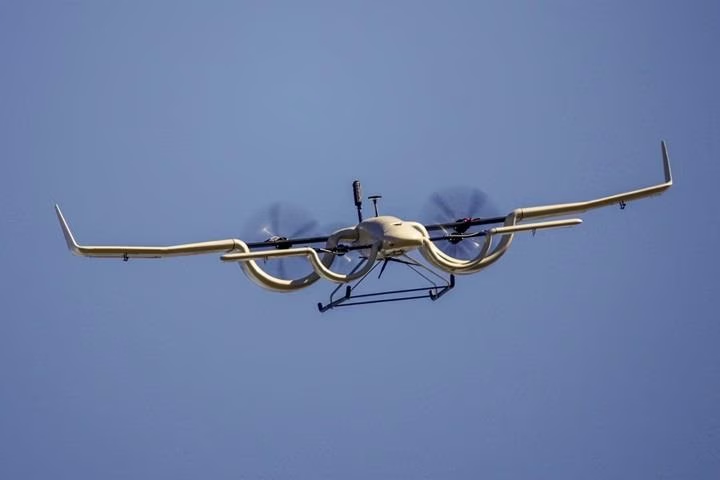
But every once in a while, I stumble across something that genuinely makes me stop and stare. That is exactly what happened when I first saw the schematics for HopFlyt’s new Cyclone VTOL.

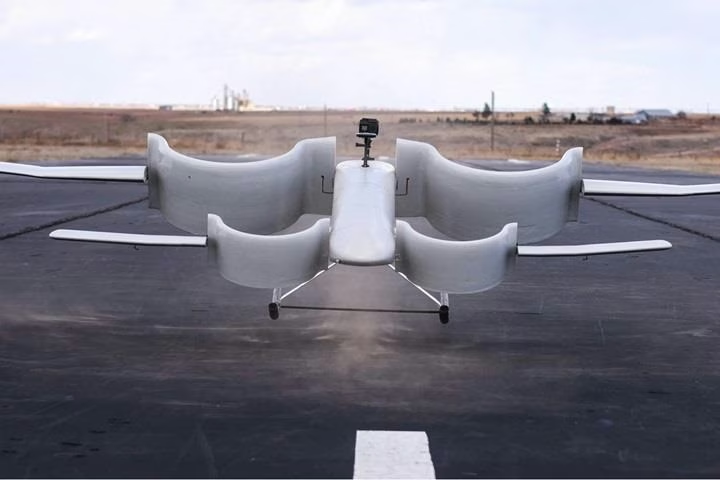
When I looked at its curved, semi-circular wings, it didn’t look like a standard modern drone. It looked like something pulled straight from an alternate-history steampunk novel. And the most mind-bending part of this entire project? The core engineering concept driving this futuristic aircraft isn’t new at all. It was actually conceptualized over a century ago.

I want to dive deep into how a forgotten, wildly unconventional idea from 1925 is being resurrected by modern engineering, and why I believe it might just completely rewrite the rules of efficiency in the aviation industry.

The Ghost of 1925: Willard Ray Custer’s Brilliant Obsession

To understand why HopFlyt’s Cyclone is such a massive deal, I have to take you back in time. The history of aviation is filled with strange prototypes, but few are as fascinating as the work of Willard Ray Custer.

In 1925, Custer looked at how airplanes worked and decided everyone was doing it the hard way. Traditional flight relies on a simple premise: an airplane must move forward at a very high speed so that air rushes over its wings, creating the pressure difference known as lift. No forward speed, no lift. It’s why airports need massive runways.

Custer, however, proposed a radical alternative. Instead of pushing a heavy airplane violently through the air to generate lift, why not just pull the air directly over the wings?

He invented what he called the “Channel Wing.” Instead of flat or slightly curved traditional wings, Custer designed wings with deep, half-circle dips—like a piece of a massive pipe. He then placed propellers directly inside these semi-circular channels. When the propellers spun, they sucked massive amounts of air violently over the curved surface of the channel, generating immense lift even if the airplane itself was standing completely still.

The Jogging Airplane

When I was researching Custer’s early prototypes, I found accounts of flight tests that sound almost comical today. The lift generated by the channel wing was so incredibly efficient at low speeds that during one test, a person literally ran alongside the aircraft as it lifted off the ground. It was achieving flight at a jogging pace.

In another stationary test, Custer strapped the plane down, fired up the propellers, and the aircraft generated enough lift to try and rip itself off its tethers—creating one of the earliest conceptual proofs of vertical takeoff.

So, if it was so brilliant, why aren’t we all flying in channel-wing Boeing jets today?

The answer comes down to the limitations of historical technology. In the mid-20th century, internal combustion engines were incredibly heavy and mechanically complex. Trying to synchronize heavy engines inside these channels, while dealing with the intense structural stress and vibrations, made the planes too bulky. The system couldn’t scale efficiently, and the idea was quietly filed away in the dusty archives of aviation history.

Why Now? The Magic of Modern eVTOL Tech

This brings us back to the present day. When I look at the current landscape of electric aviation, I realize we finally have the tools that Custer was missing.

HopFlyt’s engineering team realized that the channel wing concept wasn’t flawed; it was simply ahead of its time. The advent of the eVTOL revolution has given us lightweight, hyper-efficient electric motors, high-density batteries, and—most importantly—digital fly-by-wire control systems.

Neil Winston, the Chief Engineer at HopFlyt, summed this up perfectly. He pointed out that while brilliant aerospace concepts existed in the 1960s for variable takeoff and landing craft, the analog world simply couldn’t handle them. Today, we have computers that can adjust engine thrust thousands of times a second to maintain perfect stability.

With these modern tools, HopFlyt hasn’t just resurrected Custer’s channel wing; they have evolved it into something much more dynamic.

Dynamic Channels: Not Your Grandfather’s Wing

What blew my mind about the Cyclone model is that HopFlyt didn’t just build rigid half-circles into the wings. They made the channels movable.

During Takeoff: The channel structures pivot, directing the thrust straight down for a highly stable, vertical climb.During Forward Flight: The channels rotate and tuck neatly under the main wing, creating a highly aerodynamic profile for fast cruising.During Landing: The channels can shift again, acting as massive, highly effective airbrakes to slow the craft down seamlessly.

This morphing geometry is something that engineers in the 1920s couldn’t have even dreamed of executing safely.

Under the Hood: The Cyclone’s Mind-Blowing Specs

All of this historical context and neat engineering is great, but as a tech analyst, I always look for the hard numbers. Does this weird, retro-futuristic design actually perform better than the standard quadcopter VTOLs currently flooding the market?

According to the data HopFlyt has released, the answer is a resounding yes. Let me break down the metrics that really caught my eye:

Unmatched Climbing Efficiency: The channel wing design generates so much passive lift that the Cyclone uses roughly one-third less energy to complete its initial vertical climb compared to peer VTOL aircraft. In the battery-starved world of electric flight, saving that much energy on takeoff is a monumental advantage.The Hybrid Advantage: Unlike pure electric drones that suffer from severe range anxiety, the Cyclone utilizes a hybrid power system (combining electric propulsion with a fuel generator).Extreme Fuel Economy: During flight, this hybrid system consumes less than 11 liters of fuel per hour. For an aircraft of this size and capability, that level of efficiency is staggering.Massive Range: Because of the hybrid setup and aerodynamic efficiency, the Cyclone boasts an operational range of over 1,287 kilometers (800 miles). Most current pure-eVTOLs struggle to break the 150-kilometer mark.Heavy Lifting: For shorter, tactical routes, the Cyclone can carry payloads of up to 113 kilograms (250 pounds).

Slashing Costs and Emissions

When I crunch the numbers on the operational side, the claims HopFlyt is making are incredibly bold. They state that the Cyclone will reduce overall operation costs by 90% compared to traditional helicopters performing similar tasks, and lower carbon emissions by a factor of 50. If they can even deliver half of those promises, they will completely disrupt the logistics sector.

Beyond the Hype: Where Will We See the Cyclone First?

So, when do I actually get to see one of these flying over my city?

HopFlyt has set an aggressive target for commercial deployment in 2027. But don’t expect to be commuting to work in a Cyclone right away. They are targeting the heavy-duty commercial sectors first.

I think their initial use-case strategy is brilliant. They are focusing on environments where traditional helicopters are currently too expensive and pure drones are too weak. We will likely see the Cyclone utilized for:

Maritime Supply Lines: Delivering heavy parts to cargo ships out at sea.Offshore Energy: Providing vital logistics and transport to remote oil rigs and wind farms.Medical Transport: Rapidly moving organs, critical medical supplies, or even acting as a highly efficient air ambulance across long distances.

Once they prove the safety and reliability of the channel wing in these harsh industrial environments, they plan to adapt the platform for human passenger transport.

I genuinely love seeing stories like this. It proves that innovation isn’t always about inventing something entirely new out of thin air; sometimes, it’s about having the vision to look backward, find a forgotten spark of genius, and apply modern technology to finally make it catch fire.

The idea of stepping into a hybrid VTOL with morphing, semi-circular wings feels like the kind of future I was promised as a kid.

But I’m curious to hear your thoughts. If HopFlyt eventually launches a passenger version of the Cyclone, would you feel comfortable flying in an aircraft with such a radically unconventional wing design, or do you prefer the traditional airplane shape we’ve trusted for decades? Let me know in the comments below!

You Might Also Like;


Source link

The Dawn of the Automated Battlefield: How Ground Robots Are Redefining Warfare | Metaverse Planet

The Dawn of the Automated Battlefield: How Ground Robots Are Redefining Warfare | Metaverse Planet


I remember sitting in a theater years ago, watching the ominous, metallic skeletons of the Terminator franchise march across a desolate, war-torn landscape. Like most of you, I walked out thinking, “Well, that’s a terrifying piece of science fiction.” But after spending the last few days digging through the latest frontline reports from Ukraine, I’ve realized something deeply unsettling: that science fiction is no longer fiction. It is the current reality of modern warfare.

We’ve all grown accustomed to the idea of drones ruling the skies. Aerial UAVs (Unmanned Aerial Vehicles) have completely rewritten the tactical rulebooks over the past few years. But while we were all looking up, a massive, quiet revolution was happening down in the mud and the trenches.

Unmanned Ground Vehicles (UGVs)—robotic systems rolling through the dirt—have transitioned from experimental prototypes to the absolute backbone of frontline operations. And the scale at which this is happening is staggering.

7,000 Robotic Operations in a Single Month

When I first read the data recently highlighted by frontline observers and international outlets like the New York Times, I actually had to read the numbers twice to make sure I wasn’t hallucinating. In a single month, Ukrainian forces executed 7,000 operations utilizing ground robots.

Let that sink in. We aren’t talking about a handful of test units being driven around a safe testing facility. We are talking about thousands of active, combat and support missions happening in the most dangerous, highly contested environments on the planet.

These robotic platforms aren’t just taking pictures, either. They are actively shaping the outcome of firefights. Based on the reports, these ground systems are out there:

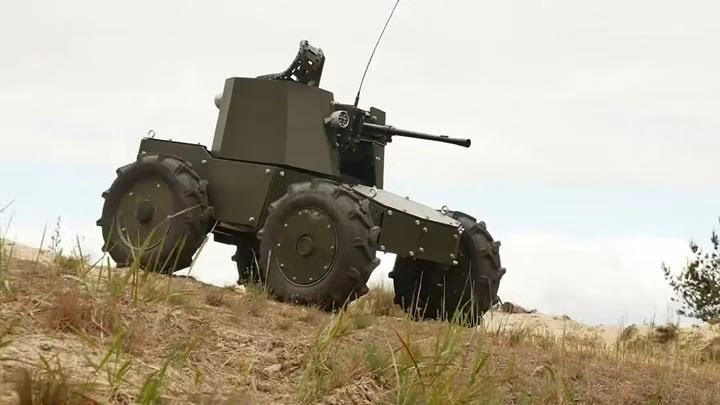
Laying anti-tank and anti-personnel mines in active combat zones.Firing mounted machine guns to suppress enemy positions.Deploying and throwing grenades directly into enemy trenches.Actively neutralizing enemy combatants without putting a single human operator in the direct line of fire.

As someone who studies the intersection of technology and society, watching this rapid deployment is mind-bending. The battlefield has become a live-action testing ground for the future of automated combat.

The Psychological Weight of an Unblinking Enemy

There is a human element to this technological shift that I find absolutely fascinating—and terrifying. War is, fundamentally, a psychological endeavor. Throughout history, soldiers have relied on the fact that the enemy across from them is also human. A human gets tired, a human feels pain, a human can be suppressed by heavy fire, and a human feels fear.

A ground robot feels none of these things. When you shoot a human soldier, they go down. When you shoot a tracked robot, unless you hit a critical component, it just keeps rolling toward you with cold, calculated precision. According to Ukrainian drone operators on the ground, this is having a devastating psychological impact on opposing forces. It breaks the morale of defending infantry in a way that traditional artillery simply doesn’t.

The data backs up this psychological collapse. Reports indicate that in just one month earlier this year, over 100 Russian soldiers surrendered directly to these unmanned systems. Surrendering to a machine represents a massive, unprecedented psychological threshold being crossed in human history. It’s the realization that you cannot outlast, out-intimidate, or negotiate with the metal box rolling toward your trench.

Lifesavers in the Crossfire: The Logistics Revolution

While the combat capabilities grab all the cinematic headlines, the real story—the aspect that I believe is truly altering the course of the conflict—is logistics.

Right now, the skies over the frontlines are saturated with kamikaze FPV (First Person View) drones. It has created a phenomenon known as the “transparent battlefield.” If you move above ground during daylight, you are seen. If you are seen, you are struck. Moving human soldiers to deliver a box of ammunition or a few bottles of water has become a virtual death sentence.

So, how do you keep an army supplied in an environment where humans can’t walk? You send the robots.

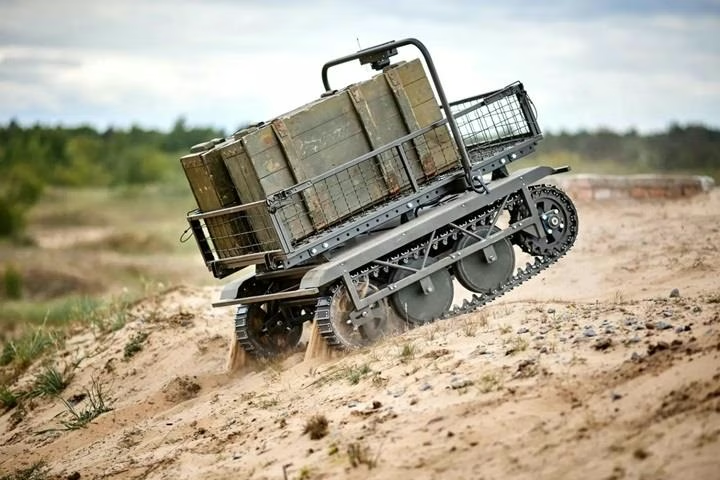
Today, nearly 90% of all logistics operations in certain sectors of the Ukrainian military are handled entirely by robotic systems. That statistic is mind-blowing. These machines are serving as the ultimate lifeline for soldiers pinned down in trenches. They crawl through the mud, under the radar of aerial drones, to deliver:

Heavy ammunition boxes and artillery shells.Rations and clean drinking water.Vital medical supplies.

The Ultimate Medevac

Even more incredible is their role in medical evacuations. Historically, rescuing a wounded soldier under fire often resulted in more casualties as medics rushed into the kill zone. Now, ground robots are being sent in to pull the wounded to safety.

Some of the larger, heavy-duty UGV models deployed right now are capable of carrying up to three wounded soldiers at the same time. Imagine being critically injured, pinned down by sniper fire, and watching a low-profile, armored robot roll up right next to you to drag you back to a medical triage point. It is a brilliant, life-saving application of technology that doesn’t get enough attention.

A Rapidly Scaling Defense Ecosystem

What amazes me most about this robotic revolution is how fast it was engineered. This isn’t the result of a twenty-year, multi-billion-dollar development cycle from a giant, legacy defense contractor. This is the result of agile, startup-style innovation adapting to immediate, desperate needs.

The ground robotics sector has become the fastest-growing area in Ukraine’s defense technology ecosystem. The numbers are a testament to how quickly warfare is evolving:

Production has scaled up by roughly six times compared to previous periods.The domestic market size for these systems has rapidly surpassed the $250 million mark.

And the barrier to entry is getting terrifyingly low. We are seeing highly capable systems being built with commercial-off-the-shelf components. For instance, reports highlight the deployment of agile “robot dogs” outfitted for kamikaze attacks, costing around $9,000 a piece. When you compare a $9,000 robot dog to a multi-million dollar main battle tank, the economics of modern warfare completely flip.

Add to this the deployment of systems like the “Fury”—a heavy ground robot equipped with a mounted machine gun—and you realize these machines are no longer just experimental support tools; they are the primary actors in the theater of war.

The Ethical Horizon: Where Do We Go From Here?

I write about the Metaverse, AI, and digital innovation because I love seeing humanity push boundaries. But looking at the explosive growth of armed, uncrewed ground vehicles forces me to take a hard step back.

We are standing on a very slippery slope. Right now, these systems are remote-controlled. There is a human operator with a remote and a screen, making the final decision to pull the trigger or detonate the payload. But as electronic warfare and signal jamming become more intense, the connection between operator and robot will inevitably be severed.

When that happens, the obvious technological next step is to grant these systems autonomous targeting capabilities. We are inching dangerously close to a reality where algorithms, not humans, decide who lives and who dies in the mud of a trench.

The events unfolding in Eastern Europe right now are providing us with a crystal-clear preview of the mid-21st-century battlefield: highly automated, devoid of direct human presence on the zero-line, and incredibly lethal. It forces us to ask deep, uncomfortable questions not just about military tactics, but about the ethics of how we conduct war.

I’m struggling to wrap my head around the long-term implications of this. I’d love to hear your perspective. If fully autonomous ground robots become the standard for every military in the world, do you think it will make wars less costly in terms of human life, or will it just lower the barrier to starting conflicts in the first place? Let’s discuss it in the comments below.

You Might Also Like;


Source link

The Insatiable Hunger of AI: Why Tech Giants Are Chasing Natural Gas | Metaverse Planet

The Insatiable Hunger of AI: Why Tech Giants Are Chasing Natural Gas | Metaverse Planet


I’ve been writing about technology for a long time, and I’ve watched countless trends wash over the industry. I remember the dizzying heights of the dot-com bubble, the paradigm shift of Web 2.0, the chaotic gold rush of blockchain, and the recent massive push into virtual reality. But what I am witnessing right now with the artificial intelligence boom feels fundamentally different.

Previous digital revolutions lived mostly in the abstract. They were about software, code, and conceptual networks. But the AI wave? It is violently colliding with the physical world.

The more I research the infrastructure behind the AI models we use every day, the more a startling reality becomes clear: Artificial intelligence has an insatiable hunger for raw, physical resources. We are moving far beyond a simple software race. To keep these massive data centers humming, the titans of the tech world are now aggressively pivoting toward the world’s richest natural gas reserves.

Let’s dive into why big tech is suddenly acting like Big Oil, and why this shift is quietly creating one of the most critical infrastructure bottlenecks of our generation.

The Physical Weight of the “Cloud”

It’s easy to think of the cloud as an invisible, weightless entity. But every prompt you type into an AI, every image it generates, and every line of code it writes requires heavy, physical computation. Training large language models (LLMs) and keeping them running for billions of global queries requires continuous, uninterrupted power on a scale we’ve rarely seen outside of heavy manufacturing.

Renewable energy—like solar and wind—is fantastic, but it has an intermittency problem. The sun goes down, and the wind stops blowing. AI data centers, however, demand a constant, unwavering stream of massive baseload power. They cannot afford a millisecond of downtime.

When I was looking into the energy procurement strategies of giants like Microsoft, Google, and Meta, it struck me how dramatically their language has changed. They aren’t just talking about carbon offsets anymore; they are securing massive tracts of land to build their own dedicated natural gas power plants. They are realizing that to control the future of AI, they must first control the energy that feeds it.

The Southern Migration: Tech’s New Energy Hubs

If you look at where the largest infrastructural investments are being made right now, the compass points directly to the American South—specifically Texas and Louisiana.

These regions are sitting on some of the wealthiest natural gas basins on the planet. I was genuinely shocked to learn that a single major basin in this area holds enough energy reserves to power the entire country for months on end. Naturally, this has turned the region into the ultimate battleground for tech companies desperate to secure their supply lines.

The scale of what is being built here is hard to wrap your head around:

Utility-Scale Ambitions: Tech companies are no longer just connecting to the local grid; they are building private natural gas plants that match the capacity of entire state utilities.Proximity to the Source: By building data centers right on top of gas-rich regions, they are trying to cut out the middleman and secure direct, unhindered access to the fuel.The Fear of Missing Out (FOMO): There is a palpable panic among tech executives. The fear isn’t just about having an inferior AI model; it’s about not having the electricity to run the model at all.

The Hardware Bottleneck: Turbines Are the New Gold

You might think that with unlimited budgets, tech giants could just snap their fingers and build these power plants overnight. But this unchecked, explosive growth has slammed hard into the rigid walls of physical supply chains.

Building a natural gas power plant requires highly specialized equipment, most notably massive, precision-engineered gas turbines. Because every tech company suddenly decided they need their own power plants at exactly the same time, the market has gone completely haywire.

Here is the reality of the hardware crisis:

Skyrocketing Costs: The prices for these critical gas turbines have literally doubled in a very short period.Crippling Wait Times: Industry analysts note that if a company orders a major turbine today, the delivery time can be up to six years.

This timeline is a massive reality check. It proves that while software can scale infinitely and instantly, hardware and energy cannot. It completely shatters the illusion that our resources for AI expansion are limitless.

A Dangerous Shift: Moving the Burden

Tech companies often defend their massive natural gas investments by arguing that building their own power plants prevents them from overburdening the public electrical grid. On the surface, that sounds responsible.

But when I look closer, I realize it’s just a sleight of hand. They aren’t eliminating the pressure; they are simply shifting it from the electrical grid to the natural gas supply chain.

This creates a terrifying new dynamic. What happens during a brutal winter?

Let’s remember the devastating 2021 winter storm in Texas, where the energy grid failed under extreme cold. Now, imagine a future scenario where millions of homes desperately need natural gas for heating to survive freezing temperatures, but down the road, a massive data center is guzzling that same natural gas to process AI queries.

When push comes to shove, who gets priority? Does the gas go to keeping families warm, or does it go to keeping the servers running? This kind of deep, systemic dependency on a single resource is a recipe for a socio-economic disaster.

The Ripple Effect Across Heavy Industry

It isn’t just residential homes that are feeling the pressure. Heavy industries that have relied on natural gas for decades are getting incredibly nervous.

Sectors like petrochemicals, agriculture (for fertilizer production), and heavy manufacturing are suddenly finding themselves bidding against Google and Microsoft for their primary resource. These legacy industries cannot compete with the bottomless war chests of Silicon Valley. We are already hearing rising voices of concern from these sectors, warning that the digital world’s rapid consumption of finite resources is going to cause severe economic collateral damage.

The Strategic Regret

We are watching a high-stakes gamble unfold in real-time. Driven by the absolute terror of falling behind in the AI race, tech giants are locking themselves into massive, decades-long fossil fuel infrastructure projects.

But I have to wonder: what if the AI bubble pops, or the technology becomes drastically more efficient, leaving these companies with billions of dollars tied up in stranded, carbon-heavy assets? They might soon face a profound strategic regret.

As an observer and a massive fan of technological progress, I find this intersection of cutting-edge software and brute-force fossil fuels deeply unsettling. It forces us to ask hard questions about what we are willing to sacrifice for the sake of artificial intelligence.

I’m really curious to hear your take on this. If we reach a point where local governments have to choose between rationing energy for residential heating or throttling down AI data centers, what do you think the right call is? Can the tech industry innovate its way out of this physical resource trap, or are we heading for a major clash? Let me know your thoughts down in the comments!

You Might Also Like;


Source link

Popular Posts

My Favorites

Celebrity Race Across the World: The Ultimate Adventure for Celebrities |...

0
Reality TV – Celebrity Race Across the World In the world of television, there are few shows that capture the imagination like “Celebrity Race...