Metaverse

Home Metaverse Page 10

The Illusion of Digital Immortality: Are You Really Uploading Your Mind? | Metaverse Planet

The Illusion of Digital Immortality: Are You Really Uploading Your Mind? | Metaverse Planet


I still can’t stop thinking about that fruit fly experiment.

If you missed it, researchers recently achieved something that sounds like pure science fiction: they mapped the entire brain of a fruit fly. That is roughly 130,000 neurons and 50 million connections, entirely digitized. When I was reading the research paper, I honestly felt a cold chill run down my spine. It’s a monumental leap for science, but it immediately sent my mind spiraling into a rather terrifying rabbit hole.

If scientists can successfully map and digitize 130,000 neurons today, how long is it really going to take until they map our 86 billion? The technology is scaling at a breakneck pace. But as I dig deeper into the mechanics of mind uploading, the real question that scares me isn’t when we will do it, but what exactly we are doing.

If they make a digital twin of my brain, is it really me, or just a highly sophisticated ghost in the machine? Today, I am diving deep into the reality of digital consciousness, and why transferring your mind to a computer might not be the immortality you are hoping for.

The Monumental Gap: From Flies to Human Consciousness

cropped-A-Historic-First-The-Ultimate-Brain-Map-Has-Been-Unlocked-1.webp

Let me put the numbers into perspective, because the sheer scale of the human brain is hard to wrap your head around.

The Fruit Fly: 130,000 neurons.The Mouse: Roughly 71 million neurons.The Human: 86 billion neurons, with over 100 trillion synaptic connections.

To map my brain—every memory of my childhood, the taste of my favorite coffee, the exact way I feel when I listen to a certain song—you wouldn’t just need to take a snapshot of those 86 billion neurons. You would need to capture the exact chemical states, the neurotransmitter levels, and the microscopic electrical impulses firing in real-time.

When I look at the current state of neurotechnology, I realize we are essentially trying to copy an ocean by studying a drop of water. But let’s play devil’s advocate. Let’s assume Moore’s Law holds up, quantum computing matures, and fifty years from now, we have a scanner capable of instantly digitizing human consciousness without destroying the biological brain in the process.

What happens the moment you press “Enter”?

The Copy Problem: You Are Left Behind

The First 24 Hours After Getting a Brain Chip Human 2.0 or Digital Nightmare (4)

Here is the philosophical nightmare that keeps me awake at night. The pop-culture dream of mind uploading—like what we see in Black Mirror or Cyberpunk—often treats consciousness like a file you can just cut and paste into a USB drive.

But biology doesn’t work like a computer directory. You cannot “move” consciousness; you can only copy its structure.

Imagine I walk into a clinic tomorrow, sit in a chair, and have my brain perfectly scanned. The machine boots up, and on the screen in front of me, a digital avatar opens its eyes. It has all my memories. It thinks exactly like me. It even believes it is me.

But I am still sitting in the chair.

My biological eyes are still looking at the screen. I haven’t transferred my soul into the machine; I have simply birthed a perfect clone of my mind at this exact millisecond. If the doctor suddenly told me, “Okay, the upload was successful, now we are going to incinerate your physical body,” I would be absolutely terrified! The original “me” is about to die. The entity living forever in the Metaverse isn’t me—it’s just a backup file convinced it’s the original.

The Divergence: Slowly Becoming a Stranger

Let’s take this a step further. Let’s say my physical body passes away naturally, but my digital twin lives on in a sprawling, limitless Metaverse. At the moment of my death, the digital version of me is a perfect 1-to-1 replica.

But what happens a week later? A year later? A century later?

Our consciousness is completely anchored to our environment and our physical bodies. We think the way we do because we feel hunger, pain, exhaustion, and the warmth of the sun. We are shaped by biological limits.

If my digital twin is suddenly living in a server where it feels no fatigue, can process information a million times faster, and interacts with an entirely virtual world, its experiences will instantly begin to drastically diverge from anything a human could understand.

The loss of biological urgency: Without the fear of death or physical harm, how does my digital twin value time?Infinite memory: If my digital mind never forgets a single detail, how does that change my personality? Forgetting is a crucial mechanism for human emotional survival.Altered perception: How do you experience the Metaverse when you can literally see the code, change your environment with a thought, and communicate via direct data streams?

Within a year, that digital entity would evolve into something completely alien to the original Ugu. It would be a stranger wearing my memories like a vintage suit.

The Hardware of the Soul

I also have to wonder about the physical reality of running a simulated mind. A human brain runs on about 20 watts of power—barely enough to light a dim bulb. Yet, it powers the most complex intelligence in the known universe.

To run a real-time, perfectly accurate simulation of a human brain using current silicon-based architecture would require a massive supercomputer consuming gigawatts of energy. This brings up an uncomfortable realization:

Your “immortality” would be entirely dependent on server maintenance, electricity grids, and corporate funding. What happens if the company hosting your consciousness goes bankrupt? Do they just unplug you? Is a server outage considered murder? The idea of my eternal soul being subject to an “End User License Agreement” makes my stomach turn.

Would I Risk It?

Whenever I look at the rapid advancements in brain-computer interfaces, from Neuralink to these incredible mapping projects, I feel a deep sense of conflict.

The technologist in me is absolutely fascinated. The ability to back up human knowledge, to allow brilliant minds to continue solving problems long after their bodies have failed, is a seductive promise.

But the human in me? I am terrified of the illusion. Transferring your mind to a computer seems less like cheating death and more like building a highly advanced monument to yourself—a monument that talks, thinks, and slowly forgets what it means to be human.

I don’t think I would do it. I think the beauty of the human experience is intrinsically tied to its fragility. We are temporary, and maybe that’s exactly what gives our choices, our loves, and our lives any real meaning.

But that is just my perspective, and I know a lot of people would jump at the chance to live forever in the digital realm. I really want to know where you stand on this. If you had the chance to safely copy your mind into the Metaverse today, knowing the original you would eventually die, would you risk it for digital immortality? Let me know your thoughts in the comments! I read every single one.

Come on, subscribe right now and support me please. We have so much more of the future to explore together.

#DigitalImmortality #MindUpload #Metaverse #FutureTech #SimulationTheory #Cyberpunk

You Might Also Like;


Source link

Ethereum Treasury Firm Ether Machine Ends $1.6B SPAC Deal With Dynamix

Ethereum Treasury Firm Ether Machine Ends .6B SPAC Deal With Dynamix


Key Highlights

The Ether Machine and Dynamix Corporation have mutually terminated their $1.6 billion SPAC merger, canceling plans to list on Nasdaq under ETHM.

A $50 million break-up fee will be paid to Dynamix, which now has until November 2026 to secure a new business combination.

Weak crypto market conditions and collapsing treasury company premiums have stalled what was once seen as Ethereum’s answer to Strategy.

The Ether Machine’s much-hyped journey to Nasdaq has hit a wall. In a fresh 8-K filing submitted to the U.S. Securities and Exchange Commission (SEC) on April 10, Dynamix Corporation officially confirmed that it has mutually agreed with The Ether Machine, Inc. to terminate their proposed business combination, pulling the plug on what was set to become one of the largest publicly traded Ethereum treasury vehicles in the United States.

The two firms had originally inked the Business Combination Agreement on July 21, 2025, with plans to take The Ether Machine public via Dynamix’s SPAC shell, listing on Nasdaq under the ticker ETHM. The deal was valued at roughly $1.6 billion at announcement and was being positioned as Ethereum’s answer to Michael Saylor’s Strategy.

A clean break, with a $50 million cheque

According to the filing, the termination is mutual and amicable. The agreement wipes out the Business Combination Agreement, the Sponsor Support Agreement, the ETHM Subscription Agreements, and the Contribution Agreement in one shot. Both parties have signed mutual releases covering all known and unknown claims, along with a covenant not to sue and a mutual non-disparagement clause.

But walking away isn’t free. The filing reveals that a “Payor” named in the agreement is required to pay Dynamix $50 million within 15 days of the effective date, essentially a break-up fee that keeps the SPAC’s trust whole while it scouts for a new target.

Dynamix now has until November 22, 2026, to lock in a new business combination. If it can’t, the Cayman Islands-incorporated SPAC will wind down, redeem its public shares from the trust account, and dissolve.

Market conditions killed the vibe

In a statement posted on its official X handle, The Ether Machine cited unfavourable market conditions as the reason for calling things off, the same excuse that has become the standard refrain across the crypto treasury space in 2026.

And the timing tells the whole story. The digital asset treasury trade, which exploded in popularity through 2024 and most of 2025 as companies raced to copy Strategy’s bitcoin playbook, has cooled sharply this year. ETH has struggled to hold momentum, and several copycat treasury vehicles have watched their mNAV premiums collapse to par or even below, making fresh PIPE raises a brutal sell.

The Ether Machine, backed by ConsenSys co-founder Andrew Keys, was supposed to be the institutional flagship of the ETH treasury movement, holding a massive ether stack and running staking and DeFi strategies on behalf of public shareholders. The pitch was clean, the backers were heavyweight, but the market window slammed shut faster than anyone expected.

What happens next

This marks the second high-profile crypto SPAC unwind in recent months and a sharp reminder that the treasury company gold rush is no longer the easy bid it was last cycle. Investors who piled into ETHM units on the merger announcement are now holding paper in a SPAC hunting for a new target with a shrinking runway.

Whether The Ether Machine attempts another route to the public markets, perhaps a traditional IPO or a direct listing once conditions improve, remains to be seen. For now, Andrew Keys and his team are back at the drawing board.

Also Read: Ethereum Adds 284K Users in Q1 as Network Activity Surges


Disclaimer: The information researched and reported by The Crypto Times is for informational purposes only and is not a substitute for professional financial advice. Investing in crypto assets involves significant risk due to market volatility. Always Do Your Own Research (DYOR) and consult with a qualified Financial Advisor before making any investment decisions.



Source link

Freedom of Money Is CZ’s Attempt to Rewrite History — And It Starts With a Feud

Freedom of Money Is CZ’s Attempt to Rewrite History — And It Starts With a Feud


On April 8, 2026, Changpeng Zhao released his memoir titled ‘Freedom of Money,’ marketed as the considered, post-incarceration testimony of a reformed elder statesman of crypto. Within 24 hours, the author was on X offering a $1 billion bet over his marital status to the founder of a rival exchange. Whatever else ‘Freedom of Money’ is, it is not the book of a man at peace.

The memoir was written largely during CZ’s four-month US federal prison sentence and is being marketed as a meditation on minimalism, restraint, and the 72 operating principles of a $100 billion company. All proceeds, CZ has said, will go to his Giggle Academy education initiative. It is well-paced, readable, and its anecdotes are sharp. It is also a carefully selective document released into the middle of a political firestorm — and what it asks readers to ignore is the most important thing about it.

The Star Xu Blow-Up: A Crack in the Façade

Before we get into the other details of the book, let’s first look into the ugly spat that has been overshadowing crypto twitter over the last few days. The drama has been so intense that within 24 hours of publication, the author was on X offering a $1 billion bet over his marital status to the founder of a rival exchange. 

Whatever else Freedom of Money is, it is not the book of a man at peace.

The trigger was a single passage. CZ’s memoir recounts that during a 2025 dinner, Huobi Founder Leon Li told him he had seen a screenshot showing OKX Founder Star Xu had personally reported Li to Chinese authorities — an act CZ links to Li’s roughly 90-day “soft detention” by Chinese police in 2020. The Crypto Times covered Star Xu’s denial in detail.

Xu called the claim “completely false information.” In a pointed jab at Li, he added that the Huobi Founder “has high emotional intelligence and has managed various people around him very well over the years; he shouldn’t believe such illogical nonsense.” His broader argument was simple: complaints against major exchanges are routine in Asia, and reports alone do not determine enforcement outcomes.

Then Xu went much further. In a thread on X the next day, Xu wrote: “I have no interest in revisiting these old disputes with CZ, but his book filled with falsehoods has dragged me into this for no reason. He has a long-standing habit of making misleading statements to the public, the media, and the world.”

Xu then resurfaced a notarised video and QQ chat logs from December 2014 — material OKCoin had originally published in 2015 — that he claims show two versions of a contract with early Bitcoin investor Roger Ver being sent from CZ’s account, with the later version containing a six-month termination clause that had not been in the original. CZ’s defence at the time was that his QQ account may have been accessed by someone else. Xu’s response in 2026 was a single line: do you believe such an explanation?

Xu also rejected CZ’s account of the October 2020 OKX withdrawal freeze, when Xu was reportedly under “soft arrest” in China. The memoir frames the incident as a structural failure — implying that “Xu alone held the keys” to exchange wallets — and contrasts it with how Huobi handled a similar situation. Xu disputed the framing entirely. He also accused CZ of misrepresenting his role in market activity and his cooperation with US authorities against Tron founder Justin Sun.

Then came the moment that stripped the book’s meditation-and-minimalism marketing of any remaining credibility. After Xu publicly questioned whether CZ’s Binance stake had been legally separated from his ex-wife — citing the Bezos and Gates divorces as examples of proper asset separation — CZ replied on X: “I typically ignore all these false claims attacks. But… You can apologize now. I am officially divorced. I won’t post any legal docs online, as I respect privacy of my ex-wife, and I appreciate the time we spent together. I am happy to bet $1 billion USD (or any number you choose).”

Xu declined the wager. “Both OKX and Binance are regulated by multiple regulators,” he replied. “As the UBO of a regulated company, publicly offering a $1 billion bet is hardly professional conduct.”

He is not wrong. Principle 16 of CZ’s 72 life principles — a centrepiece of the book — preaches minimalism and stoic detachment. Within 24 hours of publication, the author was offering nine-figure bets on X over a personal dispute. The costume came off fast.

In addition, OKX-aligned analyst accounts on X, including @Cryptosis9_OKX, amplified Xu’s documentation thread through the day, keeping the original 2015 evidence circulating for a new audience that had never seen it. Whatever one thinks of Xu’s motives for re-litigating a decade-old dispute, the practical effect was that two competing public records — the memoir’s, and the contemporaneous evidence — were placed side by side for readers to evaluate.

The Context The Book Never Directly Addresses

Set the feud aside for a moment. The Star Xu row is ugly, but it is not the most important thing about Freedom of Money. What the book is attempting to do is far bigger than score-settling.

For this, let’s first look at some deeper context. CZ is a free man because of a presidential pardon. On October 23, 2025, President Donald Trump issued a full and unconditional pardon to CZ, wiping his federal conviction. Senator Elizabeth Warren called it “corruption,” noting the sequence: CZ pleaded guilty to a money laundering charge; he then boosted one of Trump’s crypto ventures and lobbied for a pardon; and Trump granted it.

The key Trump-family venture in question is World Liberty Financial, which launched in September 2024 and issued a US dollar-pegged stablecoin called USD1. By early 2026, mainstream reporting had documented that Binance was the dominant liquidity engine for USD1, with the bulk of its multi-billion-dollar supply held on Binance infrastructure. In May 2025, Abu Dhabi state-backed fund MGX used $2 billion of USD1 to take an equity stake in Binance — a transaction that effectively minted $2 billion in WLF’s stablecoin and generated estimated annual yield flowing to WLF stakeholders, who include the Trump family. Shortly afterwards, the Trump administration approved the export of advanced AI chips to the UAE, overriding long-standing national security objections.

In February 2026, CZ attended the first World Liberty Forum at Mar-a-Lago, a high-visibility re-entry into the US crypto establishment just months after his pardon. Members of Congress, including Representative Ro Khanna and the House Select Committee on the Chinese Communist Party, have publicly raised whether the WLF–MGX–Binance arrangement implicates the Foreign Emoluments Clause of the US Constitution.

‘Freedom of Money’ was released in the middle of this. It does not address WLF, USD1, or the MGX deal in any substantive way. It does not need to. Its function is to give the news cycle something else to talk about — 72 principles to debate, an SBF anecdote about a bologna sandwich, a public feud with Star Xu, a $1 billion bet on X. It is an extraordinarily effective distraction, and that, more than the content, is the point.

“Paperwork” Versus the DOJ’s Actual Findings

The most strained passages in the memoir deal with the $4.3 billion Binance settlement with the US Department of Justice. CZ’s framing — repeated across his recent media appearances and consistent with the book’s central argument — is that Binance’s case was an administrative compliance failure during a period of hyper-growth, that there were “no accusations of fraud,” and that he voluntarily flew to the US and pleaded guilty to protect Binance’s users.

In a February 2026 interview covered by The Crypto Times, CZ characterised his prosecutors as a “Biden Anti-Crypto DOJ” and described his decision to plead guilty as choosing “the future of his company over himself as CEO.” His prison time, in his telling, was a “very slow place” of meditation and reflection.

The November 2023 findings of the DOJ, FinCEN, and OFAC describe a substantially different reality. The settlement found that Binance willfully refused to implement an effective anti-money laundering or KYC programme because, in the DOJ’s framing, market share was prioritised over compliance. The exchange was found to have processed transactions for Hamas’s Al-Qassam Brigades, Palestinian Islamic Jihad, Al Qaeda, and ISIS, while also facilitating hundreds of millions of dollars in ransomware proceeds and darknet market activity. US users were willfully matched with counterparties in Iran, North Korea, Syria, and Russian-occupied regions of Ukraine.

Then-Treasury Secretary Janet Yellen put it in plain language at the time: Binance’s “willful failures allowed money to flow to terrorists, cybercriminals, and child abusers through its platform.”

Internal Binance communications surfaced by prosecutors were even harder to square with the memoir. One compliance officer joked the exchange could advertise itself with a banner reading “is washing drug money too hard these days — come to binance we got cake for you.” Another Chief Compliance Officer texted a colleague that “we are operating as a fking unlicensed securities exchange in the USA bro.” CZ himself was documented telling staff it was “better to ask for forgiveness than permission.”

A four-month sentence, a $150 million personal fine, and a $4.3 billion corporate penalty are not the natural consequences of forgetting paperwork. They are the consequences of what the DOJ formally established as a deliberate, calculated conspiracy to violate the Bank Secrecy Act. The memoir asks the reader to substitute the first story for the second — and a reader who has not seen the original DOJ filings will largely take the substitution.

By devoting an entire section to contrasting himself with Sam Bankman-Fried — the recklessness, the bologna-sandwich bailout request, the Caroline Ellison FTT misstep — CZ implicitly redefines the moral bar. The question stops being “did Binance willfully facilitate terrorist financing?” and becomes “was CZ as bad as SBF?” These are not the same question. And one of them has a far more uncomfortable answer than the book is willing to sit with.

Terra, LUNA, and the Inconvenient Detail

The same selective framing turns up in CZ’s account of Terra/LUNA. The Crypto Times reported on the memoir’s revelation that Binance Labs’ $3 million 2018 investment in Terra had grown to roughly $1.6 billion on paper at the April 2021 peak — and that Binance never sold or transferred the tokens during the run-up.

CZ’s explanation is partly defensive: the Binance team considered selling during the May 2022 crisis but ultimately did not, in part because a large-scale exit would have fuelled market panic, and in part because — in CZ’s telling — he did not want Binance to appear to have exited before retail investors. This is a noble framing. It also omits a lot. Binance actively promoted UST as “safe and fiat-backed” before its collapse, attracting many investors to its platform. After the death spiral wiped out roughly $40 billion in value, Binance invoked an arbitration clause to block a US class-action lawsuit from affected investors.

A reader of ‘Freedom of Money’ learns about the unrealised $1.6 billion gain. A reader who looks at the public record learns about the marketing and the arbitration clause that limited investor recourse. Both are part of the same story. Only one is in the book.

The Least Independent Character Witness in the Room

The first voice a reader of ‘Freedom of Money’ encounters is not CZ’s. The foreword is written by Yi He — Binance Co-Founder, the Head of YZi Labs (formerly Binance Labs), CZ’s long-term partner, the mother of his three children, and, since December 5, 2025, Binance’s co-CEO. She has known CZ since 2014, when she recruited him to OKCoin. In a 2024 letter to the sentencing judge in CZ’s federal case, she identified herself as his “life partner” and wrote that she understood “a side of him that’s often overlooked.”

A reader is entitled to that perspective. They are also entitled to know that the book opens with a character witness who is, by every available measure, anything but an independent voice — his business partner, his romantic partner, his co-parent, his co-CEO, and someone whose own communications were reportedly sought by US prosecutors as part of the AML investigation that led to the $4.3 billion settlement. Yi He is not a witness from outside the events the memoir reframes. She is inside them. Her elevation to co-CEO, six weeks after CZ’s pardon, is itself part of the post-pardon consolidation the book declines to address.

The Weaponization of ‘Freedom’

The last thing worth naming is the title itself. ‘Freedom of money’ is not a neutral phrase in crypto. It is a rallying cry — a legitimate one — against the friction, exclusion, and political capture of the traditional banking system. It belongs to the citizen in a hyper-inflated economy who buys Bitcoin to preserve savings. It belongs to the dissident routing remittances around a sanctioned regime. It belongs to the unbanked migrant worker.

It does not belong, in its original meaning, to a convicted executive whose exchange willfully matched US users with sanctioned jurisdictions so that it could grow faster than Coinbase.

The rhetorical move ‘Freedom of Money’ makes is to treat these cases as the same thing. To frame the Bank Secrecy Act — whatever one thinks of it — as just another form of state friction. To recast willful non-compliance as civil disobedience. To portray regulators not as enforcers of democratic law but as antagonists of human liberty.

This is not freedom of money. It is freedom from consequence. And the people who genuinely need financial privacy — the privacy-tool developers facing prosecution, the activists in authoritarian states, the ordinary users who believe their transactions are their own business — are the people most harmed when the language is co-opted to shield a $100 billion company from its own compliance failures. The genuine fight for financial privacy gets harder every time it is conflated with protecting a billionaire’s reputation.

The Verdict

‘Freedom of Money’ is not a bad book because CZ cannot write. It is well-paced, readable, and its anecdotes are sharp. It is a problematic book because of what it asks the reader to do. To accept a one-sided account of settled legal facts. To treat a four-month prison sentence as a form of martyrdom. To interpret a charity pledge as moral closure. To not look at the open congressional questions about the political arrangements that made the 2025 pardon possible. To take the redemption framing at face value.

The Star Xu blow-up — petty, ugly, oddly revealing — inadvertently does the work the book itself avoids. Within 24 hours, readers could see the calm philosopher of the 72 principles offering $1 billion bets on X in a feud over a 12-year-old contract dispute. Whatever else one thinks of Star Xu, his core observation lands: four months in a federal facility did not reshape anything fundamental about how his rival operates.

CZ did not build a movement of pure financial liberation. He built a very large exchange that, on the US government’s own findings, intentionally turned off its compliance controls. He served four months. He was pardoned under circumstances that are now formally being scrutinised in Congress. And he has now produced a 400-page, beautifully marketed memoir asking the world to look somewhere else.

Readers are entitled to do so. They should at least know what they are being asked to ignore.


Disclaimer: The information researched and reported by The Crypto Times is for informational purposes only and is not a substitute for professional financial advice. Investing in crypto assets involves significant risk due to market volatility. Always Do Your Own Research (DYOR) and consult with a qualified Financial Advisor before making any investment decisions.


Source link

The View That Changes Everything: Artemis 2’s Deep Space Eclipse | Metaverse Planet

The View That Changes Everything: Artemis 2’s Deep Space Eclipse | Metaverse Planet


The other night, I was sitting at my computer, deep-diving into the orbital simulations for the Artemis 2 mission. I was totally lost in the technical data, the flight paths, and the spacecraft specs, but then I stopped dead in my tracks. On my screen was a render of the view the crew would see from the tiny window of their spacecraft. Literally, I was left absolutely speechless. I just stared at the monitor.

If you follow my writing, you know how much I love technology and space exploration, but this… this was something entirely different. Looking at our Earth, the Moon, and a total solar eclipse simultaneously, all framed by the pitch-black, endless void of deep space. Honestly, just thinking about it gives me the chills.

Today, I’m not going to bore you with technical hardware specs, rocket thrusters, or mission budgets. Today, I want to talk about the most staggering, paradigm-shifting view humanity might ever witness—a view that forces us to ask, “Who are we, really?” Let’s look out that Orion capsule window together.

Not Just Another Moon Mission: A Revolution in Perspective

We’ve all seen the documentaries about the Apollo missions. You probably remember the famous “Earthrise” photo from Apollo 8—that vibrant, fragile blue marble rising from behind the dead, gray lunar surface. That single photograph was enough to awaken global environmental awareness and make us see ourselves as one unified whole.

But what Artemis 2 is going to offer us is vastly different, and in my opinion, much more profound.

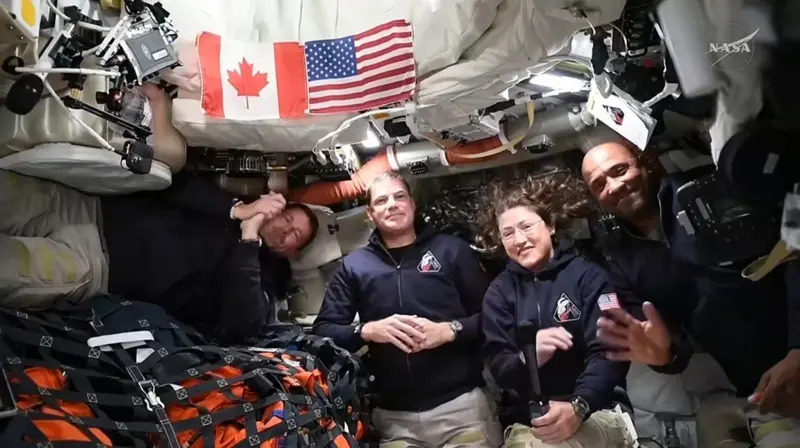
Why? Because the Artemis 2 crew (Reid Wiseman, Victor Glover, Christina Koch, and Jeremy Hansen) won’t just loop around the Moon and come back. When they are nearly 380,000 kilometers away from Earth, they are going to have front-row seats to one of the rarest visual spectacles in the universe.

Here is a quick breakdown of what they will see out that window:

Our Tiny, Fragile Home: Earth will be hanging there in the incomprehensible vastness of space, a vulnerable, glowing blue dot.The Massive, Silent Moon: Right next to them, the colossal body of the Moon will loom with its craters and eerie silence.A Cosmic Shadow Play: And the real kicker—as the Moon passes perfectly in front of the Sun, casting that massive shadow back toward Earth, the astronauts will see the Sun’s corona glowing like an ethereal halo against the absolute darkness of deep space.

The Terrifying Infinity Beyond That Tiny Window

While researching these details, I couldn’t help but ask myself: What does it actually feel like to be there in that exact moment?

The windows on the Orion spacecraft aren’t massive glass balconies. They are engineering marvels, pressure-resistant, but relatively small viewports. Imagine floating up to that small frame and looking out.

The scale of what you are looking at is so massive that the human brain might genuinely struggle to process it. On one hand, you have that pale blue dot containing life, the air we breathe, and everyone we have ever loved. On the other hand, you have the cold, unforgiving, and infinite darkness of the solar system. I have to admit, the idea of that endless darkness gives me the creeps. It feels like if I stare into it, the darkness stares right back. But at the same time, I simply cannot look away. There is something intensely magnetic and mesmerizing about it.

The “Overview Effect” on Steroids

There is a well-known concept that astronauts talk about when they travel to space: The Overview Effect. It’s that profound cognitive shift they experience when they see Earth as a single, fragile sphere without borders.

I strongly believe what the Artemis 2 crew will experience goes way beyond that. They aren’t just going to see a world without borders; they are going to witness the massive mechanics of the universe operating in real-time through this eclipse.

Think about our daily struggles down here.We get angry in traffic, stress over bills, and argue endlessly on social media.But when you look out that small window and see the Sun disappear behind the Moon against the backdrop of infinity… suddenly your coffee cup, your morning stress, and even global conflicts seem incredibly “small,” don’t they?

For me, this is the ultimate value of space exploration and technology. It’s not just about mining new elements or claiming new territory; it’s about reminding us of who we are and how incredibly humble our place in the cosmos truly is.

What if You Were in That Seat?

As I dug deeper into my research and visualized these scenes in my head, my admiration for human curiosity and our technological achievements multiplied. We, these tiny biological creatures clinging to a rock, have used our minds and our science to hurl ourselves into the deep void just to witness this magnificent cosmic dance. It is simply spectacular.

I hope I’ve managed to pass on a little bit of that mix of chills and awe I’ve been feeling since I started writing this piece. Because this isn’t just NASA‘s story or the astronauts’ story; it’s our collective human story.

So, let’s get to the real question, and please be honest with me:

Imagine you are one of those four lucky people. You are in the Orion capsule. You slowly float over to that small window and look outside. Right in front of you is the Earth, the Moon, and a total solar eclipse. And surrounding it all is an endless, pitch-black void…

What would be the very first emotion you feel? Would you be completely terrified by the infinite, silent darkness, or utterly amazed by the breathtaking beauty of our tiny home? Let’s meet in the comments below. Seriously, I am incredibly curious to know what would go through your mind in that exact moment. Let’s talk about it!

You Might Also Like;


Source link

WLFI Drops 15% After $75M DeFi Borrow Sparks Concerns

WLFI Drops 15% After M DeFi Borrow Sparks Concerns


Key Highlights

WLFI dropped around 15% in a day after its treasury borrowed $75 million, taking the token to hit an all-time low.

Over $40 million of borrowed funds moved to Coinbase Prime wallets, triggering speculation and forced liquidations.

The governance token of World Liberty Financial ($WLFI) fell around 15% over the past day, hitting an all-time low of around $0.082, as reported by CoinMarketCap. The activity was a result of the project treasury’s $75 million borrowing move on the Dolomite lending protocol. 

According to blockchain analytics platform Arkham Intelligence, World Liberty Financial deposited around 5 billion WLFI tokens, valued at about $440-$460 million at the time, as collateral to borrow around $75 million in stablecoin, including $65.4 million in USD1 and $10.3 million in USDC. 

Some portions of the borrowed funds, more than $40 million, were transferred to Coinbase Prime wallets, which raised a question about the intended use of capital.  

The move triggered concerns among investors, leading to forced liquidations and further downward pressure on the token’s price.

WLFI defends the move

The borrowing activity has ignited an intense debate in the community. World Liberty Financial has defended the move, stating it remains “nowhere near liquidation” and emphasizing that the move supports broader ecosystem goals, including stablecoin growth. 

The project has previously conducted open-market buybacks of WLFI and highlighted revenue from its USD1 stablecoin, which now exceeds $4 billion in circulation.

Market context

At the time of writing this, WLFI was trading at around $0.08206, being 15% lower in the past day, having an overall market capitalization of around $2.6 billion. The 24-hour trading volume surged to $318.54, indicating increased market activity amid the sell-off.

The fully diluted valuation sat at $8.2 billion, having a circulating supply of around 31.76 billion WLFI out of an overall maximum supply of 100 billion. 

Community sentiment on the platform remained mixed, with bullish votes surpassing bearish ones in the recent polls; however, the price action tells a different story. The token has now declined over 82% from its all-time high of $0.46 witnessed in September and has recorded a new all-time low. 

Broader outlook

The self-collateralized borrow of World Liberty Financial for $75 million has shed light on weaknesses within not only the economics but also the DeFi platform selected by the project. 

Although the treasury claims that such a decision is wise financial management, the dramatic decline in value shows how worried investors are about possible liquidations or other internal conflicts. With this Trump-connected project going through some early hiccups in the DeFi world, one can see what happens next to $WLFI.

Also Read:Ethereum Adds 284K Users in Q1 as Network Activity Surges


Disclaimer: The information researched and reported by The Crypto Times is for informational purposes only and is not a substitute for professional financial advice. Investing in crypto assets involves significant risk due to market volatility. Always Do Your Own Research (DYOR) and consult with a qualified Financial Advisor before making any investment decisions.



Source link

Oxford AI Detects Early Heart Failure Risk From Routine CT Scans With 86% Accuracy Across 72,000 Patients

Oxford AI Detects Early Heart Failure Risk From Routine CT Scans With 86% Accuracy Across 72,000 Patients


In Brief

Researchers at the University of Oxford have developed an AI system that detects subtle, invisible changes in heart fat from routine CT scans, predicting heart failure risk up to five years ahead with 86% accuracy across 72,000 patients.

https://mpost.io/alphaton-capital-announces-43m-ai-infrastructure-and-financing-partnership-with-vertical-data/?_nocache=1775829468152

Researchers at the University of Oxford have developed an artificial intelligence system that can estimate a patient’s risk of developing heart failure up to five years in advance, achieving 86% accuracy in validation across more than 72,000 patients. The approach does not require additional testing, specialist intervention, or new medical equipment, as it relies on cardiac CT scans that are already routinely performed in clinical practice.

The work, led by Professor Charalambos Antoniades and published in the Journal of the American College of Cardiology, addresses a long-standing limitation in cardiology: heart failure is typically diagnosed only after significant structural damage has already occurred, at which point preventive options are often limited. The proposed system shifts attention to early biological changes that precede visible symptoms by several years.

At the centre of the model is an unconventional data source: the fat surrounding the heart, known as pericardial adipose tissue. While traditionally overlooked in routine scan analysis, this tissue appears to reflect underlying inflammatory and metabolic changes occurring in the heart muscle itself.

According to the researchers, these fat deposits gradually alter their texture in response to stress in the cardiovascular system, creating patterns that are not detectable through standard human interpretation of imaging results. The AI system is designed to identify these subtle variations and translate them into a quantified risk estimate for future heart failure.

Reading Signals The Human Eye Cannot See

Cardiac CT imaging is widely used across the UK’s National Health Service to investigate chest pain and assess coronary artery disease, with hundreds of thousands of scans performed annually. In typical clinical workflows, radiologists focus primarily on arterial blockages and visible abnormalities, while surrounding fat tissue receives limited analytical attention.

The Oxford model repurposes this overlooked data layer by analysing textural features within pericardial fat. Using machine learning techniques trained on anonymised CT data from more than 59,000 NHS patients, the system learned to associate specific imaging patterns with later development of heart failure over long-term follow-up periods.

In validation testing involving 13,424 additional patients, the model produced an 86% accuracy rate in predicting five-year heart failure risk. Individuals classified in the highest-risk group were found to be approximately 20 times more likely to develop the condition than those in the lowest category, with an estimated one-in-four probability of onset within five years.

Importantly, the system generates risk scores automatically, without requiring manual input from clinicians. This positions it as a potential decision-support tool rather than a replacement for existing diagnostic processes.

From Cardiac Scans To Any Chest CT — And A Path To The NHS

The broader ambition of the research is to extend the technology beyond cardiac-specific imaging. The team is currently working on adapting the model to analyse standard chest CT scans, including those used in lung cancer screening and respiratory diagnostics. Given the significantly higher volume of chest CT imaging compared with cardiac-specific scans, such an adaptation could substantially increase the reach of the system.

Clinically, the implications are tied to earlier intervention. By identifying high-risk patients years before symptoms appear, healthcare providers could adjust monitoring strategies, initiate preventative treatments earlier, and prioritise resources more effectively. With heart failure already affecting more than one million people in the UK, the potential impact on long-term healthcare demand is considerable.

Plans are now underway to seek regulatory approval for integration into routine radiology workflows within the NHS. If adopted, the system would operate in the background of standard imaging procedures, producing automated risk assessments at no additional cost or change in scanning protocols.

The research was supported by the British Heart Foundation and the National Institute for Health and Care Research Biomedical Research Centre in Oxford. It reflects a broader shift in medical imaging, where artificial intelligence is increasingly used not only to detect existing disease but also to infer future risk from subtle, previously underutilised biological signals embedded in routine scans.

Disclaimer

In line with the Trust Project guidelines, please note that the information provided on this page is not intended to be and should not be interpreted as legal, tax, investment, financial, or any other form of advice. It is important to only invest what you can afford to lose and to seek independent financial advice if you have any doubts. For further information, we suggest referring to the terms and conditions as well as the help and support pages provided by the issuer or advertiser. MetaversePost is committed to accurate, unbiased reporting, but market conditions are subject to change without notice.

About The Author


Alisa, a dedicated journalist at the MPost, specializes in crypto, AI, investments, and the expansive realm of Web3. With a keen eye for emerging trends and technologies, she delivers comprehensive coverage to inform and engage readers in the ever-evolving landscape of digital finance.

More articles


Alisa, a dedicated journalist at the MPost, specializes in crypto, AI, investments, and the expansive realm of Web3. With a keen eye for emerging trends and technologies, she delivers comprehensive coverage to inform and engage readers in the ever-evolving landscape of digital finance.


More articles


Source link

The “Rollin’” revival as a true fan-led momentum

The “Rollin’” revival as a true fan-led momentum


The “Rollin’” revival as a true fan-led momentum

In February 2021, the four members of K-pop group Brave Girls sat down to discuss disbanding. After years of modest chart placements and a revolving lineup, two members had already moved out of the group’s shared dorm. Their 2017 single “Rollin’” had come and gone without much commercial impact. The consensus was that it was time to find other work.

The next day, a three-minute fan-edited compilation of Brave Girls performing “Rollin’” on South Korean military bases went viral on YouTube. Within weeks, the track hit number one on every major Korean music chart simultaneously. 

A group that had been ready to dissolve became the country’s most talked-about comeback story, powered entirely by audience momentum that no label executive had planned or paid for.

That story would have ended there, as a heartwarming footnote in K-pop history, if the economics of music hadn’t started catching up with the culture. Because what happened to “Rollin’” is also a near-perfect case study for a question the music industry has been slow to answer: when fans are the ones who create a song’s value, why are they the last to benefit from it?

Fan labor has always driven the charts, but never the revenue

K-pop fandoms have operated like decentralized marketing departments for years. Research into K-pop fan organizations describes a system where fans coordinate streaming campaigns, organize bulk album purchases, track real-time chart data, and manage their idol’s public reputation. 

These are functions traditionally performed by paid marketing teams, carried out voluntarily by communities whose primary compensation is emotional.

The pattern is visible at every level of the industry. When BTS topped the Billboard Hot 100 in 2020, it was the result of globally coordinated fan activity across streaming platforms, iTunes, and radio request lines. The label benefited from the chart success and brand equity. The fans who made it happen remained uncompensated.

This gap between contribution and compensation is structural. Fans generate measurable commercial outcomes, but the traditional music industry has no mechanism to reward them for it. Royalties flow to rights holders. Revenue flows to labels and distributors. The people closest to a song’s cultural momentum sit outside the economic loop entirely.

What changes when fans hold a financial stake in music

The emergence of tokenized intellectual property is beginning to close that gap. Platforms that allow music copyrights to be fractionalized and traded as real-world asset (RWA) tokens give fans a way to hold a direct financial position in the songs they support. 

When a track generates licensing revenue or streaming royalties, token holders receive a share of that income proportional to their stake.

The timing carries symbolic weight, too. April 26 marks World Intellectual Property Day, an annual reminder that the systems governing who owns creative work, and who profits from it, are still evolving.

This shifts the fan’s role from promoter to participant. The same behaviors K-pop communities have practiced for years, analyzing data, tracking performance, coordinating campaigns, become directly relevant to an asset they now own. A song’s resurgence becomes more than just an emotional victory.

Where “Rollin’” meets real ownership

BeatSwap, a Web3 platform that tokenizes music IP rights as RWA tokens, currently hosts more than 700 music intellectual properties, with 630 of those being exclusive Web3 K-pop tracks. Among them is Brave Girls’ “Rollin’.” 

The track’s backstory, a song that underperformed on release and was later revived by fan-driven virality, fits naturally into the platform’s model. It illustrates what happens when fan engagement, rather than label investment, determines a song’s commercial trajectory.

On BeatSwap, each tokenized song goes through legal verification before IP rights are registered on-chain through the platform’s Oracle. Tokens are then issued through the RWA Launcher, traded on a dedicated decentralized exchange (DEX), and connected to a social layer called Space, where creators and fans interact around verified IP. 

The structure means that when a track like “Rollin’” generates licensing income, token holders participate in that revenue directly.

About 35% of BeatSwap’s user base comes from K-pop fandoms, a demographic already practiced in the analytical, coordinated behavior that tokenized ownership rewards. Some users model royalty streams with the rigor of financial analysts, tracking which tracks are generating income and adjusting their positions accordingly. 

The platform reports over 520,000 active contributors and approximately $5 million in annualized revenue from IP usage, with an IP portfolio valued at around $13 million across contributions from top-tier K-pop producers and artists.

The audience is already ahead of the infrastructure

The resurgence of “Rollin’” happened because a community of fans decided a song still mattered, years after the industry had moved on. That kind of collective conviction has always existed in music, especially in K-pop, where fans have long behaved like early-stage investors without the financial infrastructure to formalize it.

What is changing now is the infrastructure itself. 

Tokenized IP rights give fans a mechanism to convert cultural loyalty into a real economic position. Whether that shift will reshape the broader music industry remains an open question. But for the listeners who kept “Rollin’” alive long after its release and now hold a stake in its ongoing revenue, the answer is already playing out.

Disclaimer

In line with the Trust Project guidelines, please note that the information provided on this page is not intended to be and should not be interpreted as legal, tax, investment, financial, or any other form of advice. It is important to only invest what you can afford to lose and to seek independent financial advice if you have any doubts. For further information, we suggest referring to the terms and conditions as well as the help and support pages provided by the issuer or advertiser. MetaversePost is committed to accurate, unbiased reporting, but market conditions are subject to change without notice.

About The Author


Gregory, a digital nomad hailing from Poland, is not only a financial analyst but also a valuable contributor to various online magazines. With a wealth of experience in the financial industry, his insights and expertise have earned him recognition in numerous publications. Utilising his spare time effectively, Gregory is currently dedicated to writing a book about cryptocurrency and blockchain.

More articles


Gregory, a digital nomad hailing from Poland, is not only a financial analyst but also a valuable contributor to various online magazines. With a wealth of experience in the financial industry, his insights and expertise have earned him recognition in numerous publications. Utilising his spare time effectively, Gregory is currently dedicated to writing a book about cryptocurrency and blockchain.


Source link

Perplexity Launches Plaid Integration, Transforming Its AI ‘Computer’ Agent Into A Personal Finance Hub

Perplexity Launches Plaid Integration, Transforming Its AI ‘Computer’ Agent Into A Personal Finance Hub


In Brief

Perplexity rolls out Plaid integration enabling users to connect bank accounts, credit cards, and loans to its Computer agent, expanding into a full personal finance hub.

Perplexity Expands Into Personal Finance With Plaid Integration, Enabling AI-Driven Account Aggregation And Analysis

Perplexity, a company developing an artificial intelligence-powered answer engine, has introduced a new integration with financial data network Plaid, expanding its platform into a broader personal finance solution. The update allows users to connect bank accounts, credit cards, and loans directly to the company’s AI agent, known as Computer, effectively turning the service into a centralized financial management hub.

The integration builds on an earlier feature that enabled users to link brokerage accounts. Through Plaid, which connects to thousands of financial institutions, users can now consolidate a wider range of financial data into a single interface. This includes accounts from major providers such as Robinhood, Fidelity, and JPMorgan Chase, among others.

According to the company, financial use cases already represent a significant portion of activity on the platform. Perplexity stated that more than 75 percent of its users engage with financial queries on a monthly basis, with adoption spanning retail investors, institutional firms, and several large technology companies.

Once accounts are connected, the AI system can analyze spending behavior, track liabilities, and calculate overall net worth across multiple accounts. Unlike traditional finance applications that rely on fixed dashboards, the platform enables users to interact through open-ended queries, generating tailored insights and tools on demand. These include budget trackers, debt repayment plans, retirement projections, and cash flow forecasts, all dynamically updated using real-time data.

Unified Financial Data Integration And Expansion Into AI-Driven Personal Finance Services

The company positions the integration as a way to address fragmentation in personal finance management. Many users rely on multiple applications to monitor different aspects of their finances, often requiring separate logins and interfaces. By consolidating data into a single environment, Perplexity aims to provide a more unified and flexible alternative.

Plaid’s infrastructure provides read-only access to financial data, and the company states that sensitive information is not stored on Perplexity’s servers. The integration combines this permissioned data with external financial sources, including market data providers and regulatory filings, to support analysis.

The feature is currently available to users in the United States and Canada on desktop, with plans to expand to mobile platforms and additional regions. While basic portfolio tracking is accessible to standard users, more advanced analytical capabilities powered by the Computer agent are limited to paid subscription tiers.

The move signals a broader shift in Perplexity’s strategy, extending beyond search and information retrieval into financial services. By combining AI-driven analysis with direct access to personal financial data, the company is positioning itself in competition with established financial management and tax software platforms.

Disclaimer

In line with the Trust Project guidelines, please note that the information provided on this page is not intended to be and should not be interpreted as legal, tax, investment, financial, or any other form of advice. It is important to only invest what you can afford to lose and to seek independent financial advice if you have any doubts. For further information, we suggest referring to the terms and conditions as well as the help and support pages provided by the issuer or advertiser. MetaversePost is committed to accurate, unbiased reporting, but market conditions are subject to change without notice.

About The Author


Alisa, a dedicated journalist at the MPost, specializes in crypto, AI, investments, and the expansive realm of Web3. With a keen eye for emerging trends and technologies, she delivers comprehensive coverage to inform and engage readers in the ever-evolving landscape of digital finance.

More articles


Alisa, a dedicated journalist at the MPost, specializes in crypto, AI, investments, and the expansive realm of Web3. With a keen eye for emerging trends and technologies, she delivers comprehensive coverage to inform and engage readers in the ever-evolving landscape of digital finance.


More articles


Source link

Inside Hack Seasons Conference Cannes: Experts Expose Operational Lessons From Testnet To Mainnet

Inside Hack Seasons Conference Cannes: Experts Expose Operational Lessons From Testnet To Mainnet


In Brief

Hack Seasons Conference panel explores why blockchain projects often fail on mainnet, highlighting testnet illusions, onboarding challenges, security, and operational lessons for real-world success.

Testnet Lies: Why Everything Changes on Mainnet

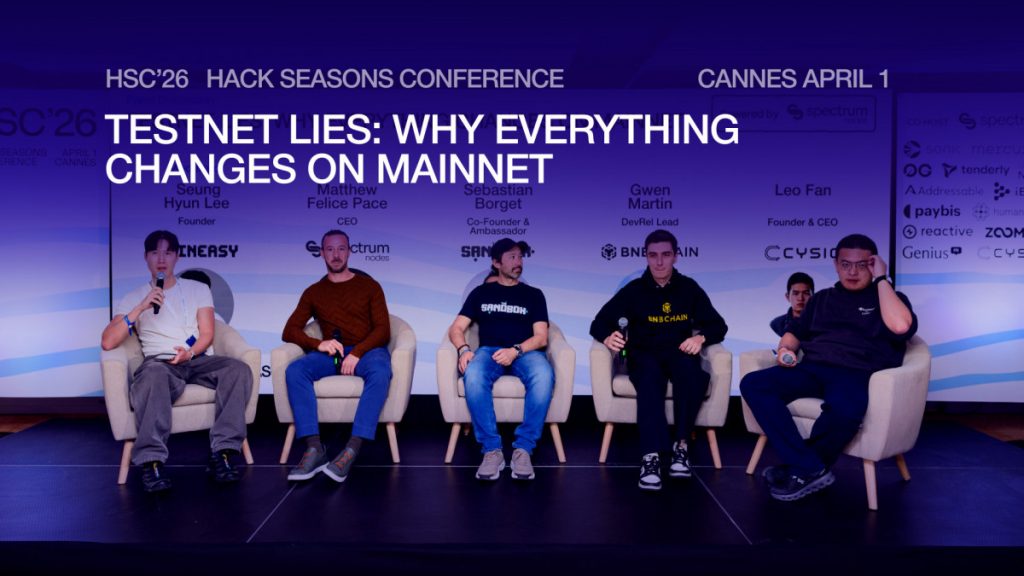
On April 1st, the Hack Seasons Conference in Cannes brought together industry leaders to examine developments and opportunities in institutional digital assets.

One of the key panel discussions, “Testnet Lies: Why Everything Changes on Mainnet,” was focused on the differences between testnets and live blockchain networks. Moderated by Seung Hyun Lee, Founder of CoinEasy, the panel included Matthew Felice Pace, CEO of Spectrum; Sebastian Borget, Co-Founder and Ambassador of The Sandbox; Gwen Martin, DevRel Lead at BNB Chain; and Leo Fan, Founder and CEO of Cysic.

Speakers discussed why projects that perform well in testnets often face challenges on mainnet, citing issues such as scalability, security assumptions, and unexpected user behavior. They highlighted the limitations of testnet incentives and emphasized the need for monitoring, redundancy, and strong operational processes to handle real-world conditions.

The discussion provided a practical perspective on mainnet launches, showing that success in a controlled environment does not guarantee stability or adoption in production.

The panel opened with a core idea: testnets are valuable, but they can also create a dangerous illusion of readiness. The speakers agreed that testnets often look healthier than they really are. Matthew said testnets can be filled with bots and airdrop hunters, making teams believe they have real users when they do not. Sebastian added that testnets are often used as marketing tools, not just engineering environments, which can blur the line between product validation and community farming. Gwen echoed that point, noting that testnets should be treated as a developer playground, not production-ready infrastructure.

Neil brought in another perspective: testnet behavior can create false confidence around security, usability, and scale. In his view, the shift to mainnet exposes weaknesses that testnets simply cannot simulate.

The panel then switched to the realities of launching on mainnet. Once real value is involved, users become adversarial, attackers appear, and systems are pushed far beyond expected limits. The speakers shared examples ranging from RPC failures and blockchain slowdowns to a massive transaction bundle that crashed a sequencer.

A recurring theme was redundancy. The panel stressed that teams need backup RPCs, multiple validators, alternative bridges, strong monitoring, and around-the-clock escalation processes. They also warned that relying too heavily on a single cloud provider or a single infrastructure vendor can become a serious risk.

From Onboarding To Security: Key Operational Lessons For Mainnet Success

Another major topic was user experience. The panel agreed that mainnet users are often not crypto-native, which means onboarding must be much simpler than many blockchain teams assume. Gas fees, wallet setup, and token acquisition can all become blockers. For institutions and Web2 users especially, the speakers said, the burden is on chains to make blockchain invisible, not complicated.

Security was another major concern. The speakers emphasized that audits are helpful but not enough, and that internal security teams, live monitoring, and rapid response plans are essential.

The panel closed with a practical message: launching a chain is not a marketing stunt. It requires real operations, deep technical discipline, and preparation for failure. In the end, the discussion offered a candid look at what happens after the excitement of testnet fades — and why watching the full panel is worth it for anyone building in Web3.

Disclaimer

In line with the Trust Project guidelines, please note that the information provided on this page is not intended to be and should not be interpreted as legal, tax, investment, financial, or any other form of advice. It is important to only invest what you can afford to lose and to seek independent financial advice if you have any doubts. For further information, we suggest referring to the terms and conditions as well as the help and support pages provided by the issuer or advertiser. MetaversePost is committed to accurate, unbiased reporting, but market conditions are subject to change without notice.

About The Author


Alisa, a dedicated journalist at the MPost, specializes in crypto, AI, investments, and the expansive realm of Web3. With a keen eye for emerging trends and technologies, she delivers comprehensive coverage to inform and engage readers in the ever-evolving landscape of digital finance.

More articles


Alisa, a dedicated journalist at the MPost, specializes in crypto, AI, investments, and the expansive realm of Web3. With a keen eye for emerging trends and technologies, she delivers comprehensive coverage to inform and engage readers in the ever-evolving landscape of digital finance.


More articles


Source link

YouTube’s Digital Clone Era: Create Your AI Avatar for Shorts | Metaverse Planet

YouTube’s Digital Clone Era: Create Your AI Avatar for Shorts | Metaverse Planet


I spend a lot of time analyzing where the creator economy is heading, and honestly, waking up to YouTube’s latest update felt like stepping straight into a sci-fi movie. Remember the days when you had to set up the perfect lighting, fix your hair, and do countless retakes just for a quick 10-second Short? Well, you can officially put the ring light away. YouTube now lets you create a photorealistic digital avatar of yourself to star in your videos.

When I first heard about this, my immediate thought was about the dark side of AI—the deepfakes, stolen identities, and the erosion of viewer trust. But digging into how YouTube engineered this, I realized they are tackling the problem from a brilliantly proactive angle. Instead of fighting the inevitable wave of synthetic media, they are putting the steering wheel directly into the hands of the creators.

How to Build Your Virtual Twin

So, how does this actually work? I looked into the mechanics, and it’s surprisingly straightforward, though it requires a bit of precision. You don’t need a massive Hollywood setup; just your smartphone and the YouTube or YouTube Create app.

Here is what you need to know to get your clone up and running:

The “Live Selfie”: Navigate to the AI Playground section in the app. The system will ask you to record a live selfie, capturing both your facial nuances and your voice.Perfect Conditions: I highly recommend doing this in a completely quiet room with zero background noise and no one else in the frame. Keep your phone exactly at eye level for the best, most natural result.Total Control: If you don’t like how your digital twin turned out on the first try, simply reject it and do it again. You have the final say before anything goes live.Eligibility: You must be the primary account owner and strictly over 18 years old to unlock this feature.

Text-to-Video: The Magic Wand

Once your avatar is cooked and ready, the real fun begins. You don’t even need to speak into a microphone anymore. By simply typing text prompts, your AI clone will generate up to eight seconds of video, mimicking your voice and facial expressions.

If you are browsing existing Shorts and inspiration strikes, you can hit “Remix” and then “Reimagine” to effortlessly insert your digital self into trending formats. Think about the sheer volume of content you can produce while sipping coffee on your couch!

The Elephant in the Room: Security and Deepfakes

I know what you are thinking, because I asked myself the exact same thing: What stops someone from manipulating my clone?

YouTube has heavily guarded this feature to protect our digital identities. Every single video generated with this AI tool will feature mandatory AI disclosures and visible watermarks, utilizing SynthID and C2PA credentials. Viewers will instantly know they are looking at an AI creation, maintaining transparency.

Furthermore, you hold the ultimate permission rights. You can easily restrict others from remixing or altering your AI-generated videos. And as a neat privacy cleanup measure, if you abandon your avatar and don’t use it for three years, YouTube’s system will automatically wipe it from their servers.

This isn’t just a cool software update; I genuinely believe this is a paradigm shift in how we define a “content creator.” It separates our creative ideas from the physical labor of filming.

But I’m incredibly curious about your take on this. If you had the power to let a digital, photorealistic clone run your YouTube channel while you focus purely on writing the scripts, would you actually do it? Or does taking the human out of the camera frame ruin the magic of connection? Let me know what you think below!

You Might Also Like;


Source link

Popular Posts

My Favorites

What is Story Protocol? A Guide to IP on the Blockchain

0
Intellectual property (IP) lies at the heart of the creative economy, but its management in today’s digital environment is inherently tangled in legal...