Arts

Home Arts Page 68

Art Meets Algorithm: The Innovations Shaping Tech Art in 2025

0


As we step into 2025, the intersection of art and technology continues to redefine the very fabric of creativity. The rise of AI, immersive experiences, and data-driven design has ushered in a new era in which artists are not merely creators but collaborators with machines. This fusion, aptly termed “Tech Art,” is reshaping the artistic landscape, giving rise to innovations that are both exciting and thought-provoking.

1. Artificial Intelligence as Co-Creator

The most significant development in tech art is the increasing incorporation of artificial intelligence in the creative process. In 2025, artists are using advanced machine learning algorithms to generate artwork, compose music, and even write poetry.

AI tools like DALL-E and MuseNet are democratizing creative expression, allowing individuals without traditional artistic training to produce stunning visuals and evocative soundscapes. Artists are now able to engage in a dialogue with AI, refining and iterating ideas, leading to a collaborative practice that challenges conventional notions of authorship and originality.

Case Study: AI Art Collectives

Collaborative art collectives, such as "Deep Art," are leading the way in AI-generated content. By pooling their resources, they leverage machine learning models that analyze thousands of art styles to generate unique pieces. This collective approach not only broadens the spectrum of creativity but raises critical questions about the role of the artist in an age of algorithmic production.

2. Immersive Experiences: VR and AR

Virtual Reality (VR) and Augmented Reality (AR) have become indispensable tools for artists in 2025. These technologies allow for the creation of immersive experiences that engage audiences in two-dimensional spaces and beyond.

Art installations are being reimagined, with VR exhibitions providing a fully immersive digital environment where viewers can interact with the artwork in real-time. Meanwhile, AR applications enable users to visualize art in their own spaces, creating a personalized and participatory engagement.

Highlight: The Metaverse Gallery

In 2025, Metaverse-powered galleries showcase works that exist solely in digital space. Artists create multi-sensory experiences that attendees can explore from anywhere in the world. These galleries not only expand the audience base but also encourage diverse forms of participation, blurring the lines between artist and viewer.

3. Data-Driven Art

Data has become a new medium in its own right. Artists are harnessing big data to explore social, environmental, and political themes. Using algorithms to process and visualize complex datasets, these creators form a narrative that challenges the viewer’s perception of reality.

Example: Climate Change Visualizations

In response to the growing urgency of climate change, artists are creating pieces that translate climate data into visual formats, turning statistics into compelling narratives. These art pieces serve not only as aesthetic experiences but also as powerful activism tools, urging viewers to reflect on the pressing issues facing our planet.

4. Blockchain and NFTs: A New Frontier

The rise of Blockchain technology has transformed how art is bought, sold, and owned. In 2025, Non-Fungible Tokens (NFTs) play a pivotal role in the ownership and provenance of digital art. Artists can now tokenize their works, ensuring authenticity and providing a revenue stream that bypasses traditional galleries and auction houses.

Implications for Artists

With the ability to sell directly to consumers, artists retain more control over their work. Furthermore, the potential for royalties on secondary sales offers a sustainable financial model. However, the environmental impact of blockchain remains a contentious topic, pushing artists and collectors to seek eco-friendly alternatives.

5. Collaborative Platforms and Community Engagement

Innovations in collaborative platforms are fostering new communities of artists and art lovers. Social media and online forums enable creators to connect, share ideas, and collaborate on projects across geographical boundaries.

Community Initiatives

Art projects are increasingly collective, with individuals contributing their skills and perspectives from around the world. Initiatives like "Art for Change" leverage social platforms to mobilize artists towards social justice, cultural preservation, and community development.

Conclusion: The Future is Now

As we navigate through 2025, it’s clear that the convergence of art and technology is reshaping our understanding of creativity. The innovations in AI, VR/AR, data visualization, blockchain, and collaborative platforms not only enhance artistic expression but also challenge the traditional paradigms of artistry, ownership, and community engagement.

In this dynamic landscape, artists are redefining their roles—embracing technology not as a replacement for human creativity, but as an ally that expands the horizons of what art can be. As we look ahead, the question remains: how will this ongoing dialogue between art and algorithm continue to evolve, and what new forms of expression will emerge? The future of tech art promises to be as unpredictable as it is thrilling, inviting us all to explore the endless possibilities that lie at the intersection of creativity and technology.

From Coding to Canvas: The Artists Behind the Tech Art Movement

0


In recent years, the tech art movement has blossomed, merging the realms of digital technology with traditional artistic expression. This fascinating intersection has given rise to a new genre of art that challenges the conventional notions of creativity and craftsmanship. At the heart of this movement are innovative artists who harness the power of coding, algorithms, and digital tools to create immersive and thought-provoking works.

The Evolution of Tech Art

The tech art movement finds its roots in the digital revolution of the late 20th century. As computers became more accessible, artists began experimenting with new mediums. Early pioneers like Manfred Mohr and Frieder Nake explored algorithmic art, using code as a primary tool for their artistic vision. They set the stage for a generation of artists who would redefine what it means to create.

By the 21st century, the proliferation of digital devices and platforms allowed for greater experimentation. Today’s tech artists integrate elements from disciplines like software engineering, data visualization, and interactive design, creating multifaceted experiences that invite audience participation.

Notable Artists in the Tech Art Movement

Casey Reas

Co-creator of the popular programming language Processing, Casey Reas has significantly influenced the tech art landscape. Processing empowers artists to code visuals interactively, and Reas’s own works often reflect themes of algorithmic generation and randomness. His pieces explore the relationship between order and chaos, embodying the beauty that can arise from structured unpredictability.

Rafael Lozano-Hemmer

Rafael Lozano-Hemmer is a luminary in the field of interactive art. His works often blend architecture, performance, and technology, engaging viewers in novel ways. Through projects like "33 Questions per Minute," he creates dynamic installations that respond to real-time data, human interaction, or even space itself, tackling themes of surveillance, identity, and communication in the digital age.

Refik Anadol

Refik Anadol takes the use of AI to new heights, using machine learning algorithms to analyze and visualize data in visually stunning ways. His immersive installations, which often transform architectural spaces, evoke emotional and awe-inspiring responses. Anadol’s work prompts viewers to reconsider the role of technology in shaping our perceptions and experiences of the world around us.

Jenny Holzer

While Jenny Holzer gained fame through her use of text in public spaces, her incorporation of technology into her installations has positioned her as a pivotal figure in the tech art movement. Her LED-based pieces question the nature of communication, signage, and the dissemination of information in the digital age, sparking dialogues on public discourse and media.

The Role of Community and Collaboration

The tech art movement thrives on collaboration. Artists, engineers, and technologists often work together to create cutting-edge projects that push the boundaries of traditional art. Spaces like workshops, hackathons, and online forums provide fertile ground for idea exchange, allowing artists to learn from one another and explore innovative techniques.

Organizations like Rhizome and Creative Coding Amsterdam support emergent artists and projects, fostering community and encouraging inclusivity. Exhibitions dedicated to tech art cultivate a broader audience, often housed in institutions that showcase the dialogue between art and technology.

Challenges and Critiques

Despite its growth and popularity, the tech art movement faces several challenges. Issues relating to accessibility and the digital divide highlight the need for inclusive practices. As technology evolves at a rapid pace, some worry that artworks may become obsolete quickly, potentially alienating audiences unfamiliar with the underlying technologies.

Moreover, the commercialization of art in the tech sphere raises ethical questions. As NFTs and digital assets gain traction, debates around ownership, copyright, and the true value of digital creations increasingly come to the forefront.

The Future of Tech Art

Looking ahead, the tech art movement is poised for even greater innovation. Emerging technologies like virtual reality (VR), augmented reality (AR), and blockchain are set to redefine how we experience art. As these tools become more integrated into artistic practices, they will further blur the boundaries of creative expression.

The future of tech art will likely emphasize sustainability and social consciousness, as artists respond to global issues through technology. By continuing to explore the intersection of art and tech, creators can inspire meaningful conversations about the world we inhabit and the technologies that define it.

Conclusion

From coding to canvas, the artists behind the tech art movement are reshaping the landscape of contemporary art. Their ability to blend creativity and technology invites audiences to engage with art in new ways, challenging our perceptions and expanding the definitions of what art can be. As technology continues to evolve, so too will the capabilities and possibilities for artistic expression, ensuring that the tech art movement remains at the forefront of cultural innovation.

From Canvas to Code: The Impact of Digital Tools on Contemporary Art

0


The evolution of contemporary art has been profoundly influenced by the advent of digital tools, transforming traditional practices and redefining the very essence of artistic expression. The shift from canvas to code has not only expanded the palette available to artists but has also opened doors to new forms of engagement and interaction with audiences.

The Rise of Digital Tools in Art

In the past few decades, the art world has witnessed a profound transformation with the introduction of digital technologies. From software applications like Adobe Photoshop and Illustrator to powerful 3D modeling programs and virtual reality environments, these tools have democratized the creation process, allowing artists to experiment and innovate without the constraints of traditional mediums.

Accessibility and Democratization

One of the most significant impacts of digital tools is their democratizing effect on art. Historically, access to artistic creation was often limited by factors such as training, materials, and space. Today, anyone with a computer or tablet can create art, leading to a burgeoning ecosystem of diverse voices and perspectives. Online platforms such as Instagram, TikTok, and Behance have allowed emerging artists to showcase their work globally, fostering a sense of community and collaboration.

New Expression Through Interactivity

The digital medium also allows for unprecedented interactivity. Artists can create works that respond to viewer input, effectively turning the audience into a participant. For example, interactive installations that use sensors and software enable viewers to engage with the artwork in real time. This shift not only enhances the experience of art but also encourages artists to rethink their roles as creators.

Case Studies in Digital Art

Several contemporary artists have harnessed digital tools to produce innovative works that challenge our understanding of art:

  • Rafael Lozano-Hemmer: His interactive installations often involve technology to create immersive environments that respond to audience presence. Works like “33 Questions per Minute” utilize algorithms to generate language, blurring the lines between art, literature, and technology.

  • Refik Anadol: Known for his work in data aesthetics, Anadol turns data into mesmerizing visuals through AI algorithms. His installations question the nature of perception in the digital age and challenge traditional notions of authorship.

These examples illustrate how digital tools not only enhance artistic capabilities but also provoke discussions about the future of art in an increasingly tech-driven world.

Challenges and Criticisms

Despite the benefits of digital tools, there are inherent challenges and criticisms. The ease of access can sometimes lead to an overwhelming saturation of content. Furthermore, the reliance on technology raises questions about authenticity and originality. Critics argue that digital art may lack the ‘soul’ often associated with traditional forms, provoking debates about what constitutes ‘real’ art.

Sustainability Concerns

Additionally, the environmental impact of digital art practices cannot be ignored. The energy consumption of servers housing digital art and the quick obsolescence of devices are significant concerns in discussions about the sustainability of contemporary art practices.

The Future of Art and Technology

Looking ahead, the integration of artificial intelligence, augmented reality, and blockchain technologies promises to further redefine the landscape of contemporary art. Artists are increasingly incorporating AI not only as a tool but as a collaborator in the creative process, leading to fascinating hybrid forms of expression.

Moreover, NFTs (non-fungible tokens) have opened new avenues for artists to monetize their work, challenging traditional art markets and ownership concepts. As these technologies evolve, they will continue to shape the dialogue around art and its societal implications.

Conclusion

The transition from canvas to code marks a pivotal moment in the evolution of contemporary art. Digital tools have broadened the definition of what art can be, fostering innovation, participation, and reflection. As artists navigate this dynamic terrain, the interplay between technology and creativity will undoubtedly continue to spark conversations about the future of art in our ever-evolving digital landscape. The journey from canvas to code is just beginning, and its impact on the art world will resonate for generations to come.

BitMart Review 2025: Is It a Safe & Legit Crypto Exchange?

0
BitMart Review 2025: Is It a Safe & Legit Crypto Exchange?


BitMart is a well-known cryptocurrency exchange and digital assets platform, serving a wide range of customers, including asset managers, liquidity providers, brokers, family offices, amateur traders, and experienced investors. 

If you are looking for a BitMart review, go through our article for in-depth insights into the platform’s unique features, pros and cons, fees, trading options, innovative products, security, geographical coverage, and more.

Bitmart referral code

BitMart Exchange Review: Quick Summary

TypeGlobal cryptocurrency exchangeHeadquartersCayman Islands (office in China, South Korea, and the USA)Year Founded2017FounderSheldon XiaSupported countries180+ (Including Japan, Australia, Germany, France, Egypt, and the Philippines)Available cryptocurrencies 1700+ cryptocurrencies and trading pairsSupported perpetuals100+ futures contracts, including USDT, USDC, and coin-margined futures.Types of tradingSpot, futures, margin, NFT, P2P, and copy tradingFiat currencies supported50+ fiat currencies, including USD, GBP, EUR, CAD, and AUD.Supported payment options300+ payment methods, including PayPal, credit/debit cards, and third-party payment providers like Simplex, Moonpay, and Banca.Trading feesSpot: 0.1% maker and 0.1% taker

Futures: 0.02% maker and 0.06% taker

NFTs: 1% flat fee on all transactions.

Earning optionsFixed/Flexible savings, Fixed/Flexible staking, dual investment, and structured principal-protected products.NFT marketplaceAvailable for the Ethereum blockchain.Security measures2FA, cold storage, multi-signature technology, advanced risk control systems, hybrid hot/cold wallets, anti-phishing code, login password, and Touch ID.Customer support channelsLive chat and support ticket system.Mobile appAndroid and iOS

What is BitMart?
What is BitMart?What is BitMart?BitMart is a leading centralized cryptocurrency exchange headquartered in the Cayman Islands. Established in 2017, the platform operates in 180+ countries and serves over 9 million customers worldwide. In 2018, BitMart introduced BMX, its native ERC-20 utility token. Traders holding BitMart tokens (BMX) are entitled to exclusive benefits on the platform. 

The exchange is known for its vast range of digital asset offerings, crypto trading tools, and earning mechanisms tailored to both novice and advanced traders.

BitMart offers spot, futures, margin, and copy trading. It also enables you to earn passive income through its cutting-edge BitMart Earn products. If you enjoy collecting distinct pieces of digital art or memorabilia, the exchange has its own NFT marketplace. It also offers users early access to new token listings and NFT projects through Launchpad and INO.

For institutions, BitMart enables the creation of 1000+ sub-accounts and provides high-rate application programming interface (API) access. It also offers stablecoin loans at ultra-low interest rates and a minimum of 0.01% rebate on high-volume maker orders.

BitMart supports over 1700 cryptocurrencies and trading pairs, including popular tokens such as Bitcoin (BTC), Solana (SOL), Ethereum (ETH), Avalanche (AVAX), Litecoin (LTC), Dogecoin (DOGE), and Pepe (PEPE). Among stablecoins, the platform supports USDC and USDT. The platform is easy to use and can be accessed via its official website, API, and iPhone cum Android-compatible mobile applications (apps).

Pros

Zero-fee peer-to-peer (P2P)trading.Intuitive trading interface with advanced features.Competitive trading fees, fee deductions for BMX token holders. One-stop platform for different crypto assets – governance tokens, meme coins, NFTs, stablecoins, Bitcoin, altcoins, and crypto futures.Supports 50+ fiat currencies and 300+ payment methods, including PayPal.Facilitates passive income generation through BitMart Earn.Launchpad for new token and NFT projects.Tiered fee structure for spot trading.

Cons

P2P and futures trading are available for a limited number of currency pairs.Higher trading fees for buying crypto using fiat currencies.All services and crypto-to-fiat trading pairs are unavailable in every location. Payment partners also have regional restrictions.The mobile app is less secure than the desktop version.Only NFTs purchased on BitMart can be listed on its marketplace.Doesn’t support deposits and withdrawals via bank transfer.

BitMart Fees

BitMart predominantly offers two fee structures – tiered and flat – based on the asset class or trading option. Under a tiered fee structure, the higher the users’ trading volumes or asset balances, the lower the trading fees. It rewards high volume traders for their loyalty toward the platform. Conversely, a flat-fee model levies a fixed rate for specific trading activities or asset types.

Trading Fees

BitMart’s spot trading fee structure is competitive yet complex. The exchange divides assets into 4 classes based on their popularity – A, B, C, and D. The higher the class, the lower the fees, and vice versa. Here is the detailed breakdown of Bitmart’s tier fee structure:

Asset classMaker feeTaker feeUsing 25% BMX Deduction (Maker/Taker)A0.1%0.1%0.075% / 0.075%B0.25%0.25%0.1875% / 0.1875%C0.4%0.4%0.3% / 0.3%D0.6%0.6%0.45% / 0.45%

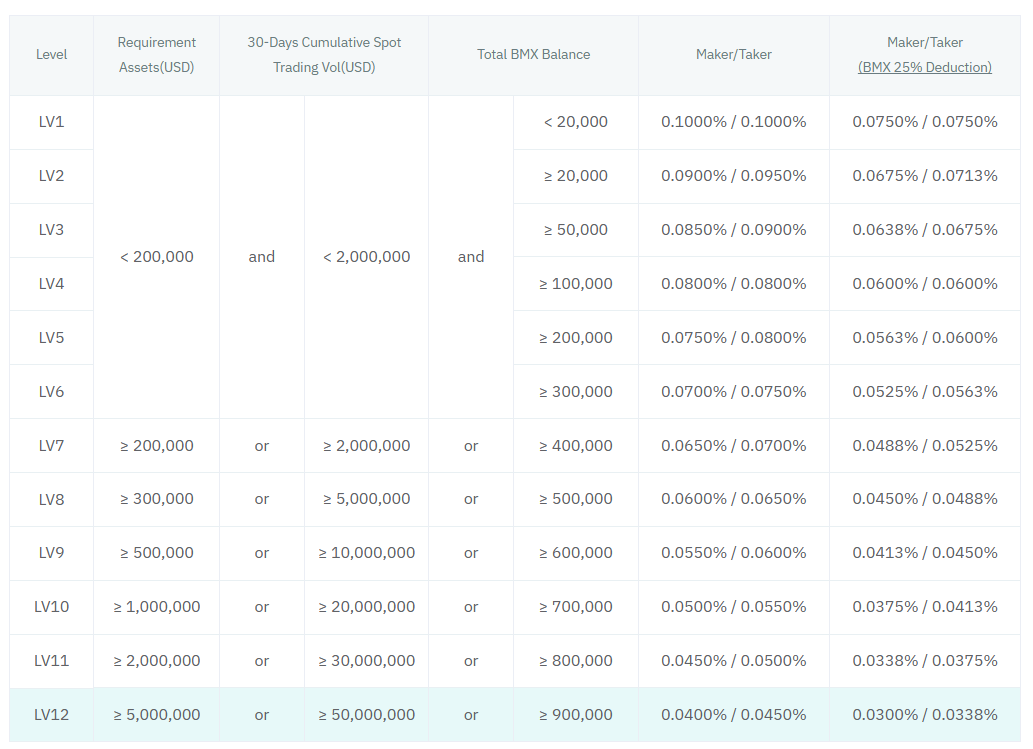
Similarly, you incur reduced trading fees as you move up the tiers. The higher your asset balances, BMX holdings, or 30-day trading volumes, the higher your level, and the lower your transaction charges. 

There are 12 levels in total, with BitMart fees starting at 0.1% for both makers and takers. As tiers progress, the costs gradually decrease, reaching 0.04% for makers and 0.045% for takers at the highest level. 

You can also avail of a 25% discount if you pay trading fees using the Bitmart token, BMX. Thus, at level 12, where BMX holdings are greater than or equal to 900,000, the spot trading fee becomes 0.03% for makers and 0.0338% for takers.
Trading FeesTrading Fees

If you hold a minimum of 20,000 BMX or participate in promo campaigns, you get additional discounts. 

Conversely, BitMart follows a flat fee structure for derivatives trading. As for futures trading, the fee is 0.02% for makers and 0.06% for takers.

Additionally, when you engage in leveraged trading, you must pay the rollover and initial interest rates, which vary based on the asset you choose. For most coins, these interest rates are 0.002291%. However, there are a few exceptions. For example, the initial interest rates for AVAX and THETA are 0.0033% and 0.0025%, respectively. 

Deposit and Withdrawal Fees

BitMart does not charge deposit fees. Fiat deposits via ACH, wire transfers, and credit/debit cards are also free. However, third-party payment gateways such as Alchemy Pay, Legend Pay, etc., impose deposit fees, which may be as high as 5.4%. 

Crypto deposits of deflationary coins like AIAKITA or 10SET may also attract charges of up to 10%.

Conversely, the crypto exchange collects nominal withdrawal fees for transferring coins or tokens to an external wallet. Bitmart withdrawal fees are dynamically adjusted based on the chosen crypto, network conditions, congestion, and transaction size.

Trading Options

BitMart facilitates spot, futures, and margin trading. If you want to discover and emulate the trading strategies of master traders, you can explore BitMart’s copy trading feature. 

BitMart Spot trading

BitMart enables traders to buy and sell crypto assets at the current market rate, also known as the spot price. These transactions are executed faster, and the purchased assets are credited to the buyer’s BitMart account immediately.

Regardless of the asset category, BitMart’s spot trading fees, including both maker and taker charges, start from 0.1% for standard (level 1) traders.

BitMart Margin trading

BitMart offers up to 5x leverage for margin trading, meaning you can trade positions five times larger than your account balance or collateral value. The interest on borrowed funds is computed hourly. 

The exchange offers two margin modes – isolated and cross-margin. While the former maintains a separate margin balance for each position, thereby limiting losses to the specific position, the latter offsets gains from one position against losses from another. 

BitMart Futures Trading

With BitMart, you can get up to 100x leverage for futures trading. Its high-performance matching engine can process up to 100,000 orders per second with a low latency of 5 milliseconds. The cryptocurrency exchange offers a diverse range of 100+ derivative products, including Tether (USDT), the United States Dollar Coin (USDC), and coin-margined futures.

USDT and USDC-margined futures are linear contracts settled in Tether and USD Coin, respectively. Conversely, coin-margined futures are settled in the underlying cryptocurrencies. As the crypto market is inherently volatile, margin requirements keep fluctuating, making coin-M futures a more complex derivative product.

All futures contracts require an initial and a maintenance margin. Initial margin is the contract value divided by leverage and is the minimum amount needed to open a position. Contrarily, maintenance margin is the minimum amount required to keep a position open. If the balance falls below the stipulated minimum, BitMart automatically liquidates the position.

The platform also follows a partially forced liquidation system to lower the maintenance margin requirements, instead of liquidating all open positions.

Copy Trading

BitMart’s copy trading platform features a curated list of master traders, each meticulously vetted by BitMart. They are ranked based on return-on-investment (ROI), profits and losses, size of follower base, and assets under management (AUM). Their historical trades and investment strategies are publicly accessible and 100% transparent, enabling users to choose from hundreds of premium-quality crypto mavericks.

Additionally, the data from master traders is based on real-time transactions on BitMart. Therefore, it is accurate and traceable, making followers confident about their decisions and choices.

You can follow multiple veterans simultaneously. As the opening and closing positions of the expert traders are mirrored automatically, you need not monitor the market conditions constantly. You can also see the profits from each copy trade beforehand and get live updates on your earnings. 

Moreover, users can alter the copy trading amount, mode, contracts, and other parameters anytime, leveraging the flexibility to book profits by closing positions or discontinuing mirroring.

BitMart’s built-in 0.5% slippage protection mechanism ensures a follower’s price closely matches that of the master trader despite market volatilities. In case the slippage surpasses 0.5%, the system automatically pauses the copy trade to safeguard users’ interests.

However, if the master trader removes you as a follower or disables the copy trading mode, your trade will not go through. Other factors that can cause your copy trade to fail are insufficient account balance or the activation of the slippage protection system.

If you intend to register as a master trader on BitMart, you must complete the know-your-customer (KYC) level 2 verification, unfollow other traders, submit a filled-in application form, and once approved, share your trading strategies with followers. 

Copy Trading Margin Modes

Fixed margin: Users can pre-define a specific margin amount, independent of the margins set by the professional traders they are copying.Fixed multiplier: Followers can specify a multiplier for the master trader’s margin to proportionally scale trade sizes.Asset ratio: Based on the ratio of their assets to the master trader’s equity, users can set a multiplier to make proportional investments relative to their account balances.

BitMart Earn

BitMart Earn enables traders to grow their cryptocurrency holdings through innovative offerings such as fixed and flexible savings, staking, fixed-income products, and dual investments. 

Savings

With BitMart Savings, you can multiply your crypto wealth with high interest rates, compounded daily. You can also earn up to 50% annual percentage points (APY) on your digital assets. Depending on your financial goals and preferences, you can choose fixed or flexible savings.

While flexible savings products allow you to withdraw funds anytime, their fixed variations come with a minimum lock-up period for assets. The former starts accruing interest from the next hour after subscription, whereas the latter pays interest along with the principal at maturity. As a result, fixed savings products are less liquid but yield higher returns.

Both products don’t entail hidden costs like transfer or redemption charges, and are embedded with world-class security protocols.

Staking

BitMart Staking comprises proof-of-stake (PoS) and non-PoS staking, enabling users to generate additional income from their locked assets in the form of on-chain rewards, marketing activity plans, and interest compensation. For users preferring advanced redemption, BitMart offers flexible staking, which can be redeemed anytime. 

An incredible aspect of BitMart staking is that users don’t need to set up nodes, incur fees, or lock in minimum amounts for specified durations to earn steady income. The crypto exchange also offers promotional rewards along with regular prizes to incentivize users to stake more assets. 

Wealth Management

Under its wealth management category, Bitmart Earn offers two 14-day principal-protected products – fixed-income and enhanced-return – with built-in auto-roll functionality. The former is return-guaranteed, meaning its APY is fixed before you subscribe. Conversely, the latter only preserves your capital because its returns cannot be calculated before the current term expires. 

Reliable third parties or BitMart affiliates oversee the wealth management fund. The interest accrued on these principal-protected products depends on the substantial gains made by these entities in derivative markets using advanced market-neutral trading strategies. You can redeem these products anytime and get funds in your spot wallet when the current period ends. 

Dual Investments

These products help users take advantage of market price fluctuations and accumulate earnings in two currencies. It is a floating-income, non-guaranteed investment avenue that is settled in one or more currencies. 

Depending on your risk tolerance and liquidity needs, you can choose the asset, settlement date, subscription amount, and exercise method. Dual investments are also customizable, meaning you can choose cryptos that align with your market expectations. 

When you exercise the subscribed product, the interest income cum subscribed amount will be traded to the substitute currency at the target rate. Interest accrual will cease on the settlement date. 

If you don’t exercise the product, the subscribed principal and interest earnings will be traded in the investment currency. However, unlike flexible saving or staking, dual investments can’t be redeemed early. 

ETH 2.0

If you want to earn Ethereum 2.0, Bitmart offers exclusive options like ETH Flexible Staking, ETH Savings, and ETH Dual Investment. ETH 2.0 is the more scalable, efficient, and sustainable variant of the classic Ethereum network. 

Like regular staking, ETH 2.0 staking also entails no fee. BitMart’s speed, convenience, high-quality currencies, numerous trading pairs, derivative trading services, and exclusive NFT marketplace make it an apt platform for earning ETH 2.0.

VIP Exclusive

For wealth cum asset managers and high net-worth individuals(HNIs), BitMart offers an exclusive fee-less VIP Earn program. Special features of this offering include a competitive annualized rate of return, separate investment and trading accounts, up to 9.25% APY, simplified asset tracking, and 100% mapping of user funds to prevent misuse or mishandling. 

VIP traders get a dedicated manager and one-on-one guidance on risk management and professional investment strategies. 

BitMart Security and Transparency

While the BitMart crypto exchange has been a boon for many traders since its inception, it faced a serious security lapse in December 2021. The private keys of its hybrid wallet system got compromised, resulting in the theft of tokens worth $200 million. 

Though BitMart reimbursed the losses to affected users, this hacking incident exposed the loopholes in its security measures, leading to an overhaul of its safety features.

As the hackers decoded the private keys of BitMart’s hybrid wallet system and stole Ethereum-based tokens worth $100 million and BSC-based coins valued at $96 million, the exchange has moved most digital assets into cold storage. 

It also conducts security audits and runs bug bounty programs to identify potential risks and vulnerabilities regularly. Furthermore, it has implemented advanced risk control systems and a strict vetting process to ensure only legitimate projects are listed on the crypto exchange.

While registering on the platform, users are required to complete the two-factor authentication (2FA) via mobile, email, or Google Authenticator. You can also set up an anti-phishing code and a login password for added security. 

On the mobile app, you can protect your BitMart account with a passcode, multi-factor authentication, and Touch ID.

Renowned platforms have awarded high rankings or ratings to BitMart based on traffic, trading volumes, trustworthiness, security, and liquidity. 

PlatformRanking / Grade (as of May 23, 2025)Coinmarketcap16Coingecko28CertifiedACrypto CompareBSkynet.certik.comBBB

Though BitMart enjoys good ratings on many platforms, its security measures fall short compared to top crypto exchanges. First, BitMart does not offer a transparent proof-of-reserves (PoR). It relies on its self-reported PoR through CoinMarketCap and only discloses a few hot wallet addresses. Hence, users cannot verify their holdings or access detailed audit reports. Second, the exchange doesn’t insure its crypto deposits. Third, the mobile app lacks biometric authentication and a QR code scanning option when you withdraw funds. 

Thus, BitMart should focus on building foolproof security systems by maintaining PoRs, insuring crypto deposits, and obtaining compliance certifications like ISO-27001 or Cryptocurrency Security Standards (CCSS).

Order Types on BitMart Crypto Exchange

BitMart supports multiple order types to help both novice and experienced traders manage trades and execute investment strategies effectively. 

Limit Orders

Limit orders enable traders to fix a specific price at which they wish to buy or sell a digital asset. The order won’t execute until the market price falls below the pre-defined price for buy orders or goes above it for sell orders. Thus, you are always in control of trade executions. 

For experienced traders, BitMart offers advanced limit orders to execute trades efficiently. For example, post-only ensures that a trader places a maker order to add liquidity. If it matches with an existing order, it is cancelled to avoid taker fees. Similarly, Immediate or Cancel (IoC) orders help users execute as much of the trade as possible immediately and cancel the unfilled portion.

Market orders

For traders who desire to enter and exit positions quickly, market orders are ideal. This order type executes trades instantly at the best available market price, depending on liquidity.

Take Profit / Stop Loss (TP/SL) orders

TP/SL orders help traders preset a price level to make gains or reduce losses. When the market touches the stipulated trigger price, the trade will be auto-executed as a limit order.

Take profit: Exits a position when the market reaches a pre-defined profit level.Stop loss: Closes a position if the asset price moves unfavorably to minimize losses.

Trigger Orders

With trigger orders, traders can automate their market entry by pre-defining specific conditions. Once the market price touches the trigger price, the trade is executed as a limit or market order. Unlike TP/SL orders, trigger orders do not require users to freeze margins, funds, or assets till the preset conditions are fulfilled.

Trailing stop orders

Trailing stop orders adjust the stop loss thresholds dynamically based on market movements. This order type helps you optimize losses despite high market volatility.

For example, assume you opened a BTC position at $110,000 and set a trailing stop with a 10% distance. If the price rises to $120,000, the trailing stop loss automatically climbs to $108,000 (10% below $120,000). As the asset price increases, the stop-loss follows. However, if the price falls below the trailing stop loss, the position is closed. 

Special Bonuses, Rewards, and Programs

Apart from various crypto trading and income-yielding options, BitMart offers users an array of attractive bonuses and exclusive rewards. 

Special Bonuses, Rewards, and ProgramsSpecial Bonuses, Rewards, and Programs

Source: BitMart

Welcome bonus 

BitMart is offering a redeemable welcome bonus of 14,000 USDT. To get started, you must create an account on BitMart, plus using the referral code “c7RSHY” for extra sign-up bonus.

New users also need to complete some tasks listed on BitMart’s Rewards Hub page, to win the remaining bonus. These reward-bearing challenges are divided into new user limited-time, daily futures check-in, growth, referee rewards, spot first-time, spot growth, and spot daily tasks. Each category consists of sub-tasks such as completing advanced verification, making cumulative deposits, trading on BitMart daily, inviting friends, buying crypto with fiat, subscribing to flexible savings, etc. For every sub-task you complete successfully, you’ll get rewards in the form of USDC, USDT, BMX, or crypto vouchers. 

First-time users can also win unique rewards such as exclusive airdrops or BMX trading loss protection by completing specific challenges. 

Bitmart referral codeBitmart referral code

Spot and futures daily draws

You can participate in spot daily draws and earn up to 999 USDT or win exciting rewards like an iPhone 16, 50 XRP coins, 2 SOL tokens, 10,000 BMX tokens, and up to 99 USDT spot fee voucher.

Similarly, you can partake in futures daily draws and get a chance to win special rewards such as a trip to popular tourist destinations like the Maldives, LV backpacks, 0.1 BTC, etc.

Special events

BitMart organizes daily events to incentivize traders to use the platform and win blockbuster rewards. For example, the Trump Dinner gives users engaging in TRUMP futures trading a chance to win up to 50,000 USDT without incurring transaction fees. The spot trading cup offers a prize pool of 12,000 USDT and exclusive VIP benefits.

BitMart’s events center page displays the complete list of upcoming events and associated rewards. The duration, terms, conditions, and rewards vary for each event. Every task also comprises inherent risks. So, it is advisable to gauge your risk appetite and understand the challenge thoroughly before participating. 

Stake-to-list program

It is a new initiative that allows users to stake BMX to support their preferred projects and earn rewards. If an eligible project meets a stipulated amount of BMX staking within 7 days, it will feature in BitMart’s innovation zone. To encourage more staking, BitMart shares the transaction fees of BMX trading pairs with BMX stakers.

This program harnesses the power of communities, empowering BMX holders to influence project listings on the BitMart platform, make decisions, leverage growth opportunities, and share responsibilities. 

Broker program

BitMart’s broker program is specially designed to support and empower its partners, such as trading bots, API brokers, crypto wallet services, swap platforms, asset management firms, hedge funds, etc. The cryptocurrency exchange’s trading services are integrated into its partners’ products and services, enabling them to earn additional revenue through a tiered rebate mechanism.

Depending on their level – Standard, Enhanced, Premium, or Exclusive – brokers can earn up to 50% rebates on spot and futures trading. For exclusive brokers, rebates are much higher. 
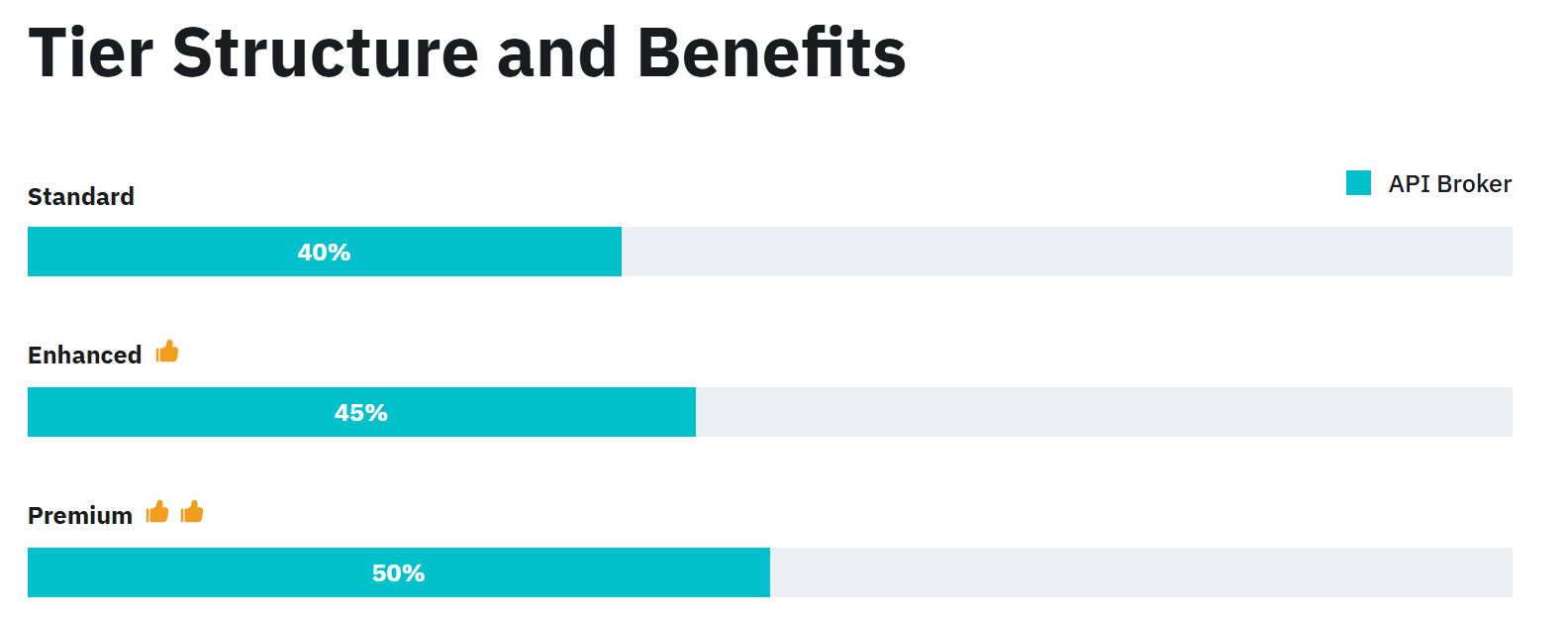
BitMart Broker ProgramBitMart Broker Program

The unique features of the upgraded broker program encompass an optimized revenue-sharing framework, advanced analytics, performance monitoring, intuitive reporting, priority support, strategic partnerships, and co-branded marketing campaigns. 

Referral program

The referral program enables you to monetize your social networks without the need to reach a broader audience. You just need to share your BitMart referral code or link with friends and on social media. Once your referees are onboarded, you can earn up to 40% commission on each trade they execute, for one year from their registration date.

You can also earn two-tier commissions. For example, you invite A, and A invites B. In such a scenario, you earn 30% of user A’s trading fees and 10% of user B’s transaction costs as commission.

Affiliate Program

If you are an influencer, you can monetize your audience and earn up to 60% commissions on futures trading through the BitMart Affiliate program. On spot trading, you can earn commissions ranging between 50% – 100%. 

Specially designed for businesses and influencers, the affiliate program helps participants maximize their reach through BitMart’s private social networks, media partners, and after parties. They also gain access to analytics dashboards that track their performance, provide real-time market insights, and help optimize their campaigns. 

Participants are categorized into three affiliate clubs – Inspiration, Impact, and Influence – based on the number of followers they have or the number of registered users they brought in the past 3 months. Commissions vary across the three categories.

Affiliate tierWho can join?CommissionsInspiration clubInfluencers/businesses with 500+ followers or those who brought 100+ registered users.40% direct commission.10% sub-commission on spot trading.Up to 60% commissions on futures trading.Impact clubInfluencers/businesses with 20,000+ followers and have developed content for BitMart or those who have referred 300+ registered users.70% direct commission + 10% sub-commission on spot trading in the first 6 months. Direct commissions will be reduced to 60% thereafter.Up to 60% commission on futures trading.Influence clubHigh-performing brand promoters.100% direct commission + 15% sub-commission on spot trading in the first 6 months. Post the introductory period, the direct commission falls to 60%.Up to 60% commission on futures trading.

Market maker program

To enhance liquidity and trading experience, BitMart recruits talented spot and futures market makers worldwide. The BitMart market maker program has low entry barriers, as you need to fulfill only a minimum transaction volume requirement. 

Once you are integrated into this program, you can enjoy valuable benefits such as favorable rates in the first two months of application, dedicated 1:1 customer support, access to third-party custodians, and advanced data analytics.

BitMart VIP Program

The BitMart Private Client is a premium service specifically catering to institutional traders and HNIs. It aims to provide institutional-grade marketing solutions and personalized strategies tailored to the goals and risk appetite of a VIP user. 

The crypto exchange also has a team of experts and extensive resources to enhance the trading experience of users and position their digital assets for sustainable growth. Some exclusive offerings in the VIP package comprise crypto financing, on/off-ramp fiat-crypto conversions, over-the-counter (OTC) trading,  private client products, special privileges, and promotions.

BitMart 
Private Client - VIPBitMart 
Private Client - VIP

API Program

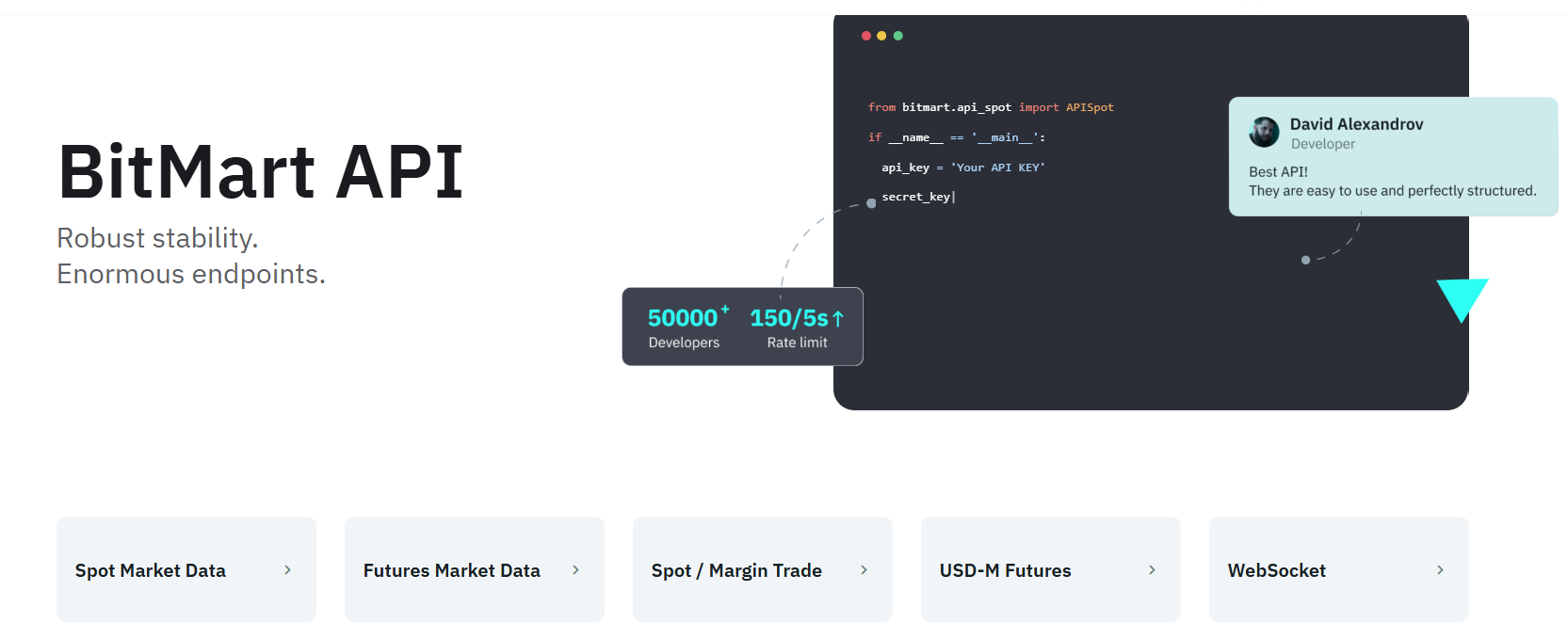
BitMart’s API program provides developers with Representational State Transfer (REST) APIs and WebSocket subscriptions to access real-time spot, margin, and futures market data. It supports various programming languages, helping developers build applications that seamlessly interact with the BitMart platform.

Additionally, API users can benefit from exclusive perks such as competitive fees, 24/7 technical support, lifetime VIP membership, free giveaways, and early access to new functionalities.
BitMart APIBitMart API

Deposits and Withdrawals

BitMart facilitates seamless transfers of funds or cryptocurrencies from other exchanges and external wallets into your account. Once you choose the coin or token you want to deposit, along with the corresponding blockchain network, BitMart will generate a unique deposit address for that specific asset. The deposit address serves as a public key for receiving deposits. 

You can also buy cryptocurrencies directly from the exchange using 50+ fiat currencies, such as the United States Dollar (USD), the Great Britain Pound (GBP), the Euro (EUR), etc. 

Currently, BitMart supports 300+ payment options, including debit/credit cards, Google Pay, Apple Pay, and third-party fiat gateway services like Moonpay. It also has a P2P marketplace to help you buy assets from other traders.

The withdrawal process is also straightforward. When you enter an external wallet address, BitMart immediately identifies the network and allows you to save it to the list of trusted addresses for future transactions. It also notifies you of typos and prevents you from sending funds to non-existent addresses. You can also transfer funds to another user’s account without incurring withdrawal fees. 

NFT Trading on BitMart
NFT Trading on BitMartNFT Trading on BitMart

Source: BitMart NFT

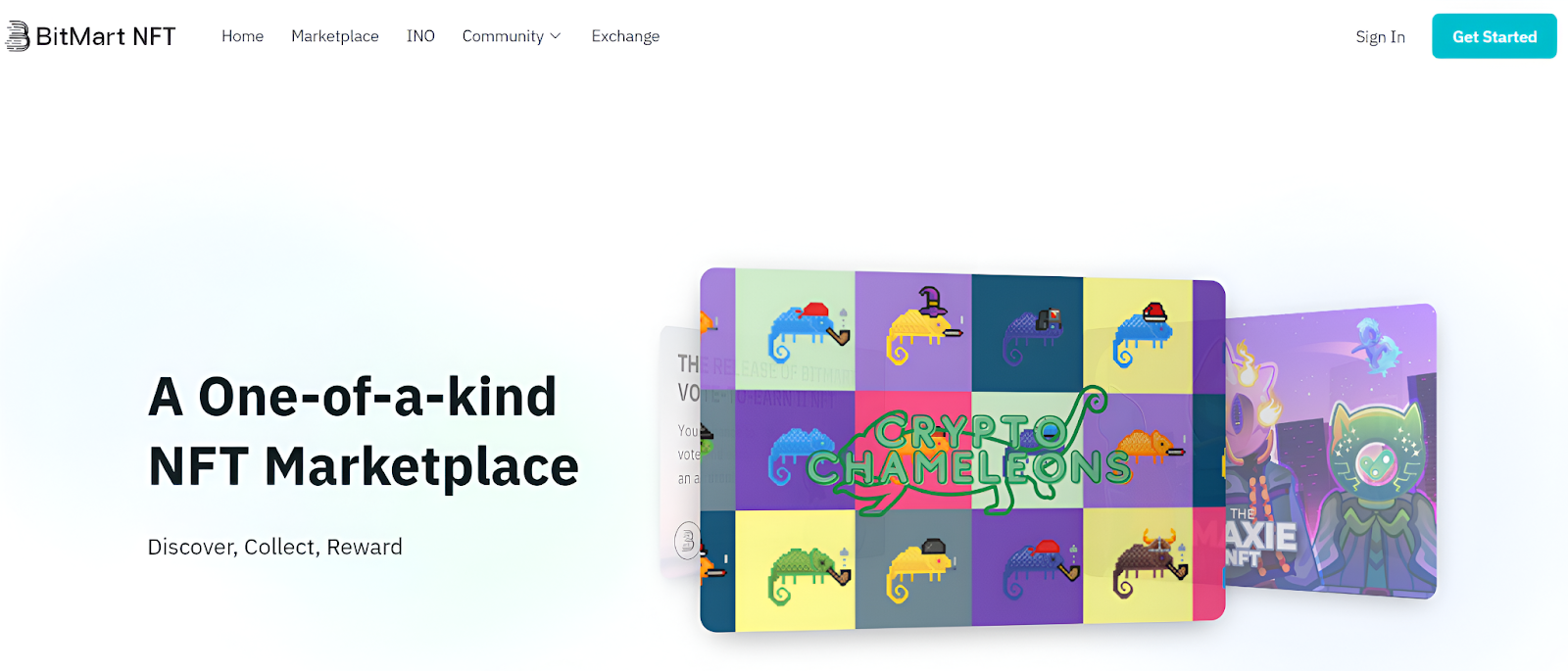
The BitMart cryptocurrency exchange has an exclusive NFT marketplace, featuring fixed-price ERC-721 tokens. It is a platform that brings together NFT lovers, artists, and inventors to generate, buy, and trade non-fungible tokens. 

The exchange charges a flat 1% trading fee for buying and selling NFTs. The token price also includes royalty fees, which must be paid to the original creators each time the NFT is resold. Simply put, sellers compensate the creators by paying a small portion of the sale price as royalties. 

The NFTs listed on BitMart are Ethereum-based, and their prices are denominated in ETH or USDT.

BitMart’s Unique NFT collections

Vote-to-earn NFTs: These tokens grant users special voting rights for new listings and guarantee airdrops for the projects they actively support. Voting rights are also regularly updated to reflect forthcoming listings. BitMartAirDrop: These NFTs commemorate the launch of BitMart’s NFT marketplace.Registration Mystery Box: This collection is specially minted to reward new users who successfully complete the registration tasks on BitMart. Each mystery box contains a coin or an NFT.BitMart 7(th) Anniversary Listing NFTs: This collection celebrates the exchange’s 7th anniversary and enables teams to list their NFTs at discounted prices and avail of free promotional services before June 30, 2025. Each NFT comprises a 1V1 exclusive service, offering a dedicated manager for personalized support. In a Nanosecond by S’Yo: This collection, inspired by the works of Taiwanese poet Meng-Tieh Chou, musicalizes contemporary poetry, creating unique sonic experiences and a refined avant-garde.Magic Lamp: This one-of-a-kind sleep-to-earn utility NFT collection requires users to buy the NFTs and use them for meditation and deep-sleep therapy to earn additional tokens.

Learn-to-earn program

Under this initiative, users must participate in BitMart’s online and offline on-the-chain Ask-Me-Anything (AMA) sessions and other events to collect tradeable stamp NFTs as proof of attendance. 

Users holding multiple stamp NFTs can redeem them for “Learn-to-Earn: Time capsules” – tokens holding landmark moments, memories, and experiences from the AMA sessions and surprise gifts. 

BitMart INO

BitMart INOBitMart INO

Source: BitMart INO

BitMart Initial NFT Offering (INO) is an exclusive platform for innovative NFT projects and creators. It offers users early access to newly minted NFTs at discounted prices before they are released on secondary marketplaces. 

Ozone metaverse, a one-stop destination for land, cars, plants, and everything you need to build your abode in a virtual universe, is one of the top projects to be launched on INO.

BitMart Launchpad
BitMart LaunchpadBitMart Launchpad

Source: BitMart Launchpad

Shooting Star

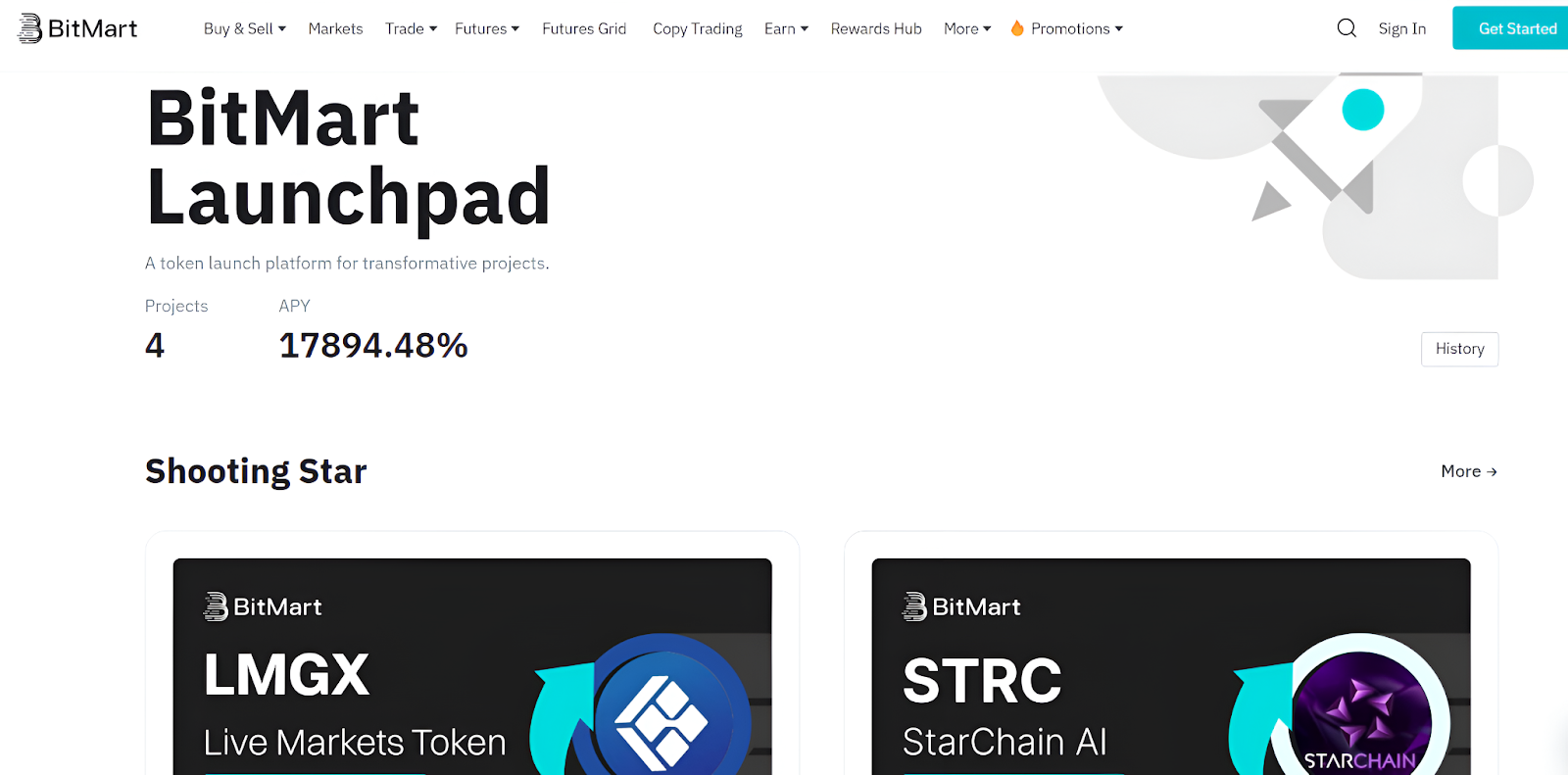
BitMart’s Launchpad comprises the shooting star, a platform where users can buy newly released tokens before they are listed on the exchange. These Initial Exchange Offerings (IEOs) come with a 3-day post-listing price protection period for eligible participants. The price protection period enables users to claim refunds if the market value of a token falls below the purchase price.

The platform also offers limited-time flash sales or pre-sales of new token lots at discounted prices. From crypto casinos and meme coins to financial innovations and AI-powered data monetization, Shooting Star features a variety of projects. 

Additionally, these projects adopt a single or multi-ticket allocation system. Under the single-ticket activity type, eligible users can participate with only 1 ticket, provided their spot accounts have adequate funds or assets to buy tokens. 

Conversely, the multi-ticket mechanism allows qualified participants to buy more than one ticket. The hard cap or the maximum number of tickets per participant is based on users’ 2-day average BMX holdings during a stipulated time frame before the participation period commences, and detailed rules of the project. Usually, most multi-ticket projects have a hard cap of 3 per user. The total number of tickets and tokens is also pre-defined. 

Flash Sales

Another component of the Launchpad, Flash Sales, features popular tokens that users can buy at prices below the market rate. Unlike shooting stars, flash sales do not focus on price protections. Instead, they offer you upfront discounts. Participating in the flash sale process is simple and includes the following steps:

Fulfill the eligibility conditions before the event starts.Register for the event by buying tokens during the participation phase. The corresponding funds will be locked once you confirm participation.The system randomly chooses the winning list and distributes the tokens.Lottery winners will receive the tokens, while users who don’t win will get their funds back.

The BitMart Launchpad, along with INO, provides early access to promising projects before they are officially listed. It also ensures that a token’s price does not plummet below its initial listing price, at least in the first 24-72 hours.

BitMart Academy
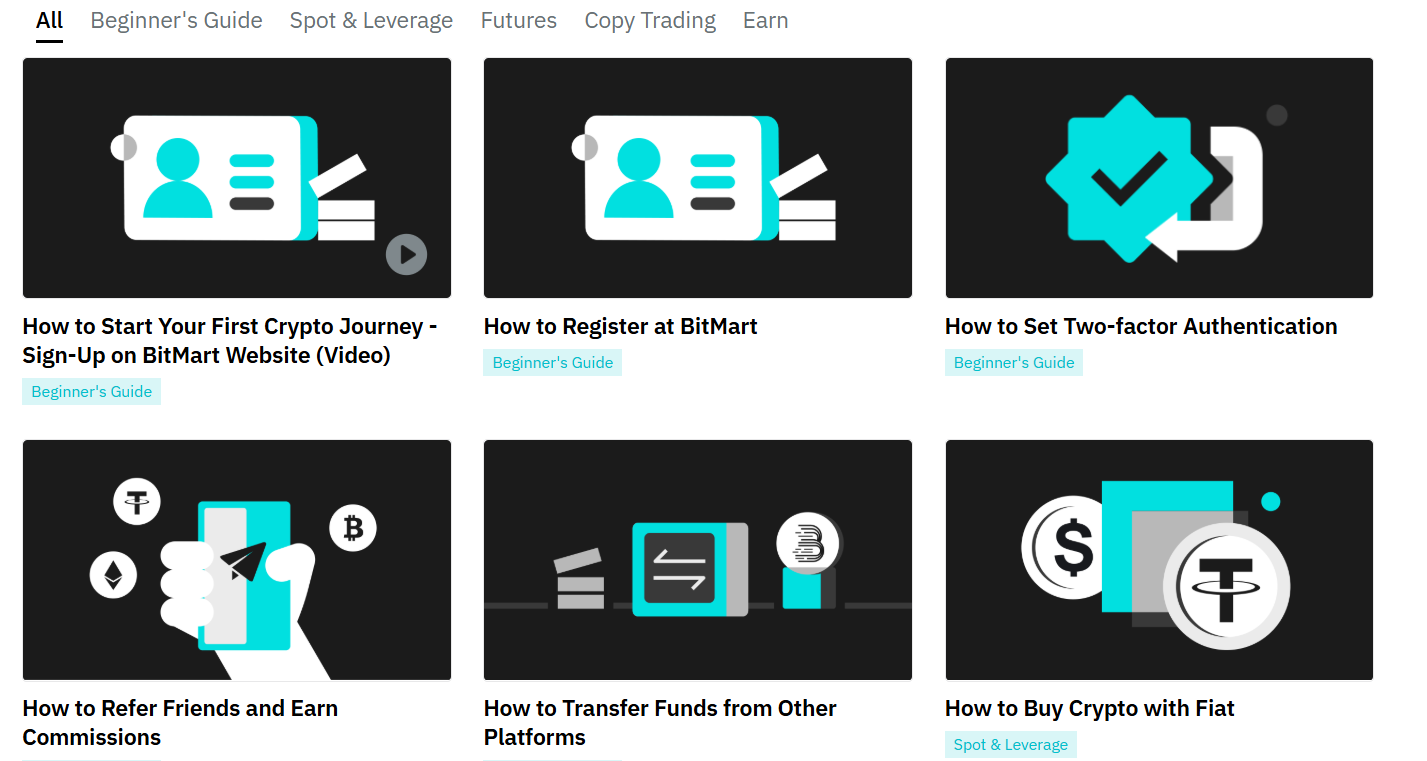
BitMart AcademyBitMart Academy

The BitMart Academy is a comprehensive learning hub for everything related to blockchain and Web3. If you’re new to the cryptoverse and are unfamiliar with cryptocurrency markets, the academy serves as your one-stop destination for beginner-friendly guides on spot buying/selling, margin trading, crypto derivatives, and copy trading. It is also a ready reckoner for experienced traders wanting to brush up on their fundamentals.

Anyone getting started on the BitMart cryptocurrency exchange can also access valuable learning resources, videos, and tutorials on how to use the platform, its advanced features, cutting-edge products, referral program, and earning tools. As a VIP user, you get exclusive monthly market insights analyzed through a macroeconomic lens.

How to Trade Crypto on BitMart?

Step 1: Create a BitMart Account

Bitmart referral codeBitmart referral code

Sign up on BitMart using your e-mail, phone number, Telegram, Google account, or Apple ID by clicking the “Getting Started” tab in the top right corner of the homepage. You can also enter our BitMart invitation code “c7RSHY” in the referral code field or use our referral link to get a $8,000 USDT sign-up bonus.

If you already have an account, log in to the exchange by clicking the “Sign In” button.
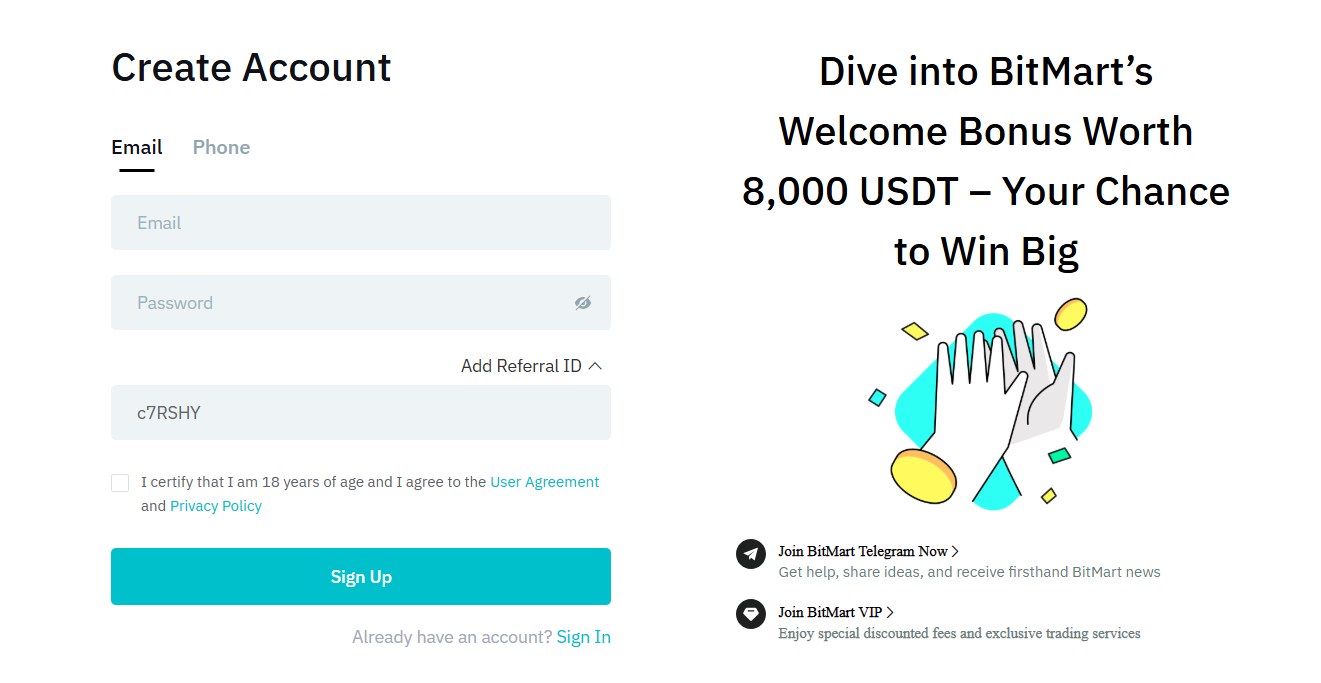
Step 1: Create a BitMart AccountStep 1: Create a BitMart Account

Step 2: Complete KYC

You need to complete the KYC process to begin trading on BitMart. There are 2 levels of KYC verification depending on the type and number of services you want. The first level entails a standard verification process, requiring you to authenticate only personal information.

If you want to execute margin trades or use BitMart Earn, Launchpad, or the voting list, complete the Level 2 advanced KYC verification. You must meet all the requirements of Starter level 1, submit a government-issued identity proof, and complete facial verification.
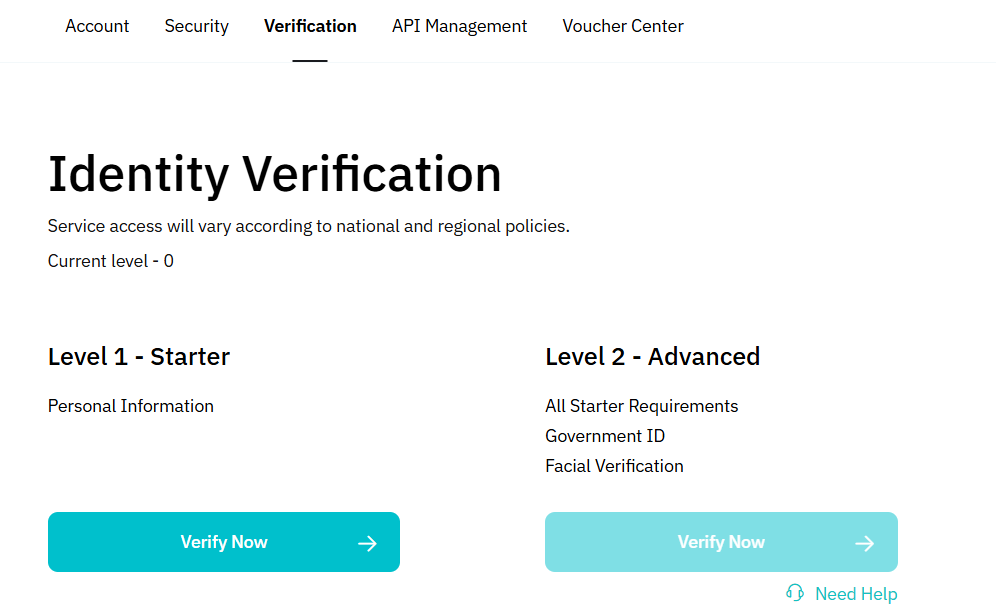
Step 2: Complete KYCStep 2: Complete KYC

Step 3: Start Trading Crypto

Click the “Trade” button, located at the upper left corner of the homepage, and select “Spot” from the drop-down menu for spot trading or “Margin” for leveraged trading.

Browse through the list of assets offered for trading and choose a desired trading pair. Opt for a suitable order type – limit, advanced limit, market, trigger, or TP/SL. Place your buy or sell order by entering basic details such as price and quantity on the right side of the trading interface, and submit the order.
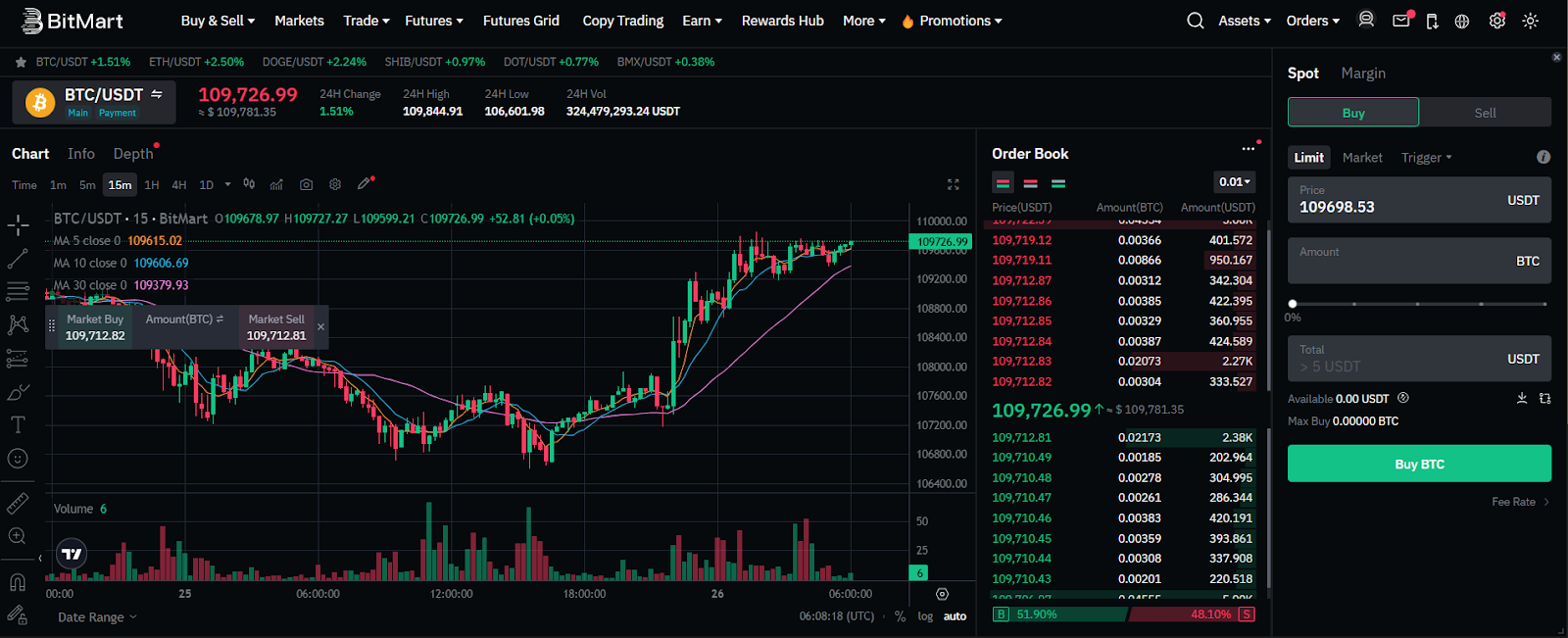
Step 3: Start Trading CryptoStep 3: Start Trading Crypto

You can track your unfilled orders under the “open orders” tab, and check your order history for all the executed and cancelled orders.

Trading Interface and Experience

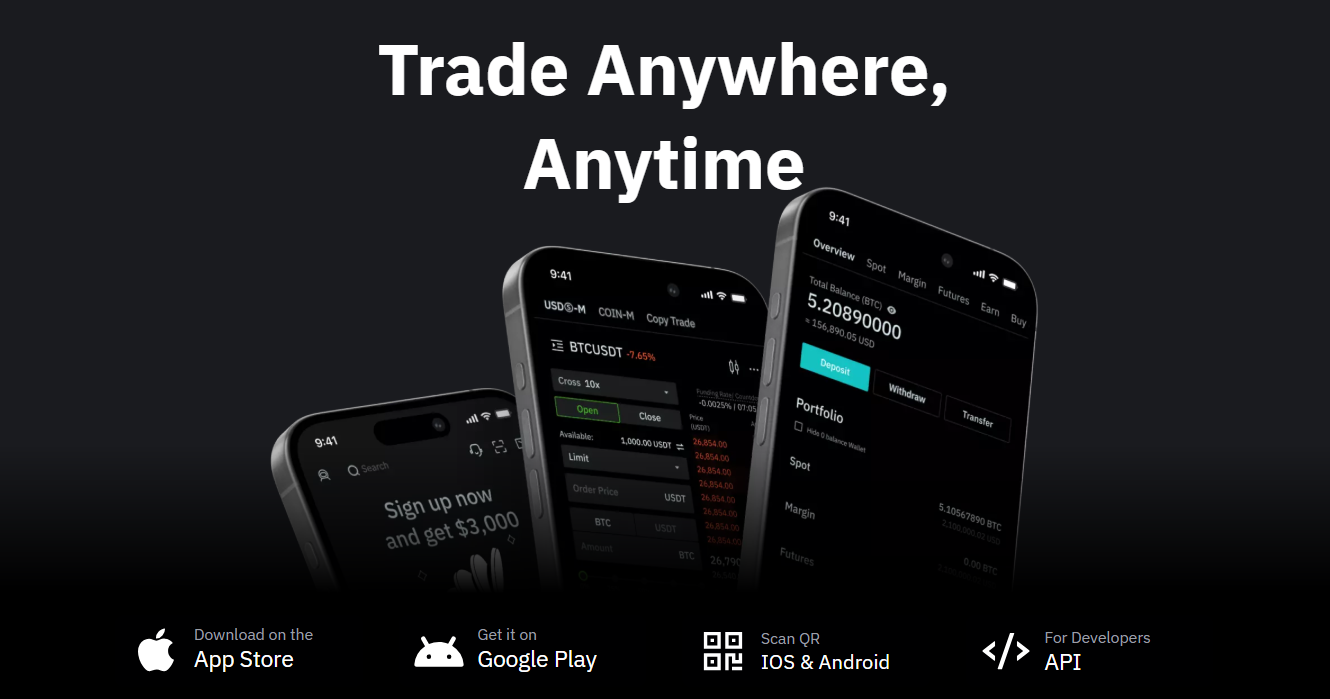
BitMart provides a user-friendly trading interface equipped with advanced trading features to help traders monitor price trends and market movements. Its standard layout makes trading on BitMart a lot easier.

The crypto exchange also offers a large number of tradable assets and an online handbook to help traders, especially amateurs, buy or sell crypto seamlessly. Users can also manage their accounts via personalized online dashboards that present a snapshot of their trading activities. The coin search functionality is particularly useful for quickly finding preferred cryptocurrencies for trading.
Trading Interface and ExperienceTrading Interface and Experience

While the mobile app’s trading interface is beginner-friendly and better for basic trading, the desktop interface is conducive for experienced traders and complex transactions. The latter has additional features like sophisticated charting tools, TradingView integration, trading bots, 92+ technical indicators, trigger orders, drawing tools, and watchlists.

However, the desktop interface has a cluttered appearance. Although it is fast and high-performing on the Chrome browser, navigation can be challenging. 

Lastly, BitMart offers a standard order book. It shows all the open buy and sell orders for a trading pair. The table also displays the price and quantity of each order and allows you to adjust the number of decimals in the price. 

Customer Service

BitMart offers 24/7/365 customer support. You can contact the support team via live chat or raise a ticket to resolve your issues. If you’re a VIP member, you get priority support and a dedicated manager when using BitMart’s products and services.

The Help Centre page offers detailed answers to frequently asked questions (FAQs) about getting started on the platform, making deposits and withdrawals, BitMart market updates, promotions, new listings, etc.

Conclusion: Is BitMart the right exchange for you?

BitMart embodies a “customer-first” approach with its detailed learning library, advanced features, and trading options. Users can also benefit from multiple yield-generation opportunities through BitMart Earn and an in-house project launchpad. With total trading volumes exceeding $950 billion, BitMart offers simple buy/sell options for beginners and advanced trading tools and products for veterans. It also aids in portfolio management by prominently displaying assets with positive balances at the top. 

However, some users have reported issues with withdrawing funds, and its security measures, especially on the mobile app, are not up to the mark. The platform does not support bank transfers for depositing or withdrawing cryptocurrencies. These factors may discourage new sign-ups.

Overall, BitMart is ideal for those looking to explore or speculate on lesser-known altcoins, newly issued tokens, and utility NFTs. It is also suitable for traders who prefer storing their assets in external wallets and not on the cryptocurrency exchange. 

Bitmart referral codeBitmart referral code

FAQs

Is BitMart a legitimate cryptocurrency exchange?

BitMart is registered in the Cayman Islands and with the Financial Crimes Enforcement Network as a Money Service Business (MSB) in the US. It has also acquired Money Transmitter Licenses (MTL) in many US states. In 2023, BitMart featured in CNBC’s list of the world’s “Top 200 Fintech Companies”. Debarring a few locations like South Korea, where BitMart is facing regulatory compliance issues, it is a legitimate cryptocurrency exchange with robust KYC and Anti-Money Laundering (AML) policies to ensure secure trading. 

Is BitMart safe to use?

BitMart harnesses advanced risk control systems, multi-factor authentications, a hybrid hot cum cold wallet system, and multi-signature technologies to safeguard users’ digital assets. However, in December 2021, miscreants managed to steal assets worth $200 million from its hybrid storage systems, indicating that BitMart’s security can be compromised. There have been no instances of hacks thereafter, as BitMart ramped up its security measures. However, BitMart may still not be a safe exchange to use as it lacks PoR and crypto insurance. 

Why can’t I withdraw from BitMart?

BitMart periodically suspends withdrawals of specific tokens due to network upgrades, technical maintenance, or project team requirements. 

However, many users report frequent withdrawal blocks initiated by BitMart under the pretext of “investigation.” While the platform conducts additional verifications and compliance audits to enforce KYC/AML norms, it restricts withdrawals on various grounds like account validation, taxation issues, price surges, etc.

In some cases, users complained that BitMart suspended withdrawals without clear justification, citing reasons such as pending payments. Even after fulfilling these requests, users were unable to access their assets. Some traders alleged that when asset prices skyrocket, BitMart freezes withdrawals to stabilize prices. 

Is BitMart a Chinese company?

No. Bitmart is registered in the Cayman Islands and has offices in South Korea, the USA, and China. However, its founder and group president, Sheldon Xia, and current chief executive officer (CEO), Nenter Chow, are of Chinese origin. 

What countries is BitMart restricted in?

As of May 2025, BitMart is restricted in Hong Kong, the Netherlands, North Korea, Iran, Iraq, Burma, Mainland China, the Balkans, Belarus, Liberia, Cuba, Crimea, Congo, South Sudan, Zimbabwe, Syria, and the Ivory Coast. Additionally, countries or regions such as Venezuela, Afghanistan, Myanmar, the US, and certain parts of the European Economic Zone (EEA) have some service restrictions. 

Can US Citizens Use BitMart?

Yes. US citizens can use BitMart, but with some restrictions. Services like flexible or fixed savings, futures trading, and dual investments are unavailable to traders from the US. Currently, the exchange isn’t actively accepting new US-based users as well. Those who already have an account can continue to access Bitmart’s informational resources and engage in spot trading of limited currency pairs. 

Has BitMart ever been hacked?

Yes, BitMart was hacked on December 4, 2021. According to a third-party security company, Peckshield, hackers stole tokens worth approximately $200 million from BitMart’s hot wallets. This security breach was a case of transfer, swap, and wash-hacking, making it impossible for investigators to trace the receiving address. 

Does BitMart require KYC?

You must complete two levels of KYC verification to unlock all functionalities, including withdrawals, on BitMart. Level 1 KYC provides access to most features and only requires personal details like name, country, and date of birth. Level 2 KYC is necessary for using advanced features like BitMart Earn, margin trading, etc. It requires you to submit a government-authorized identity proof and complete facial verification.



Source link

Digital Dreams: Exploring the Intersection of Technology and Fine Art

0


In recent years, the art world has undergone a remarkable transformation, driven by the rapid advancements in technology. This evolution has given rise to a new realm of creativity where artists blend traditional techniques with digital innovations, creating a vibrant intersection known as "Digital Art." This article explores the fascinating synergy between technology and fine art, examining how it has reshaped artistic expression, engagement, and accessibility.

The Rise of Digital Art

Digital art is not a new concept; it has roots tracing back to the 1960s when computer graphics were first experimented with. However, the recent technological boom has propelled digital art into the mainstream. Artists now have access to sophisticated tools like graphic tablets, 3D software, and virtual reality (VR) environments, allowing them to push the boundaries of their creativity.

These technological advancements have popularized various forms of digital art, such as digital painting, 3D modeling, and interactive installations. Platforms like Photoshop, Illustrator, and Blender have become essential tools in an artist’s arsenal, enabling them to create complex works that challenge traditional notions of artistic practice.

The Convergence of Art and Technology

One of the most exciting developments in this intersection is the rise of generative art. Using algorithms and code, artists create pieces that can evolve and change over time. This approach not only emphasizes the role of the artist as a creator but also as a facilitator of unique experiences. Generative art pushes the boundaries of authorship, introducing concepts of randomness and interactivity, where the audience can influence the final outcome.

Moreover, the advent of artificial intelligence (AI) in art has sparked considerable debate and intrigue. AI algorithms can generate art, mimic styles, or even collaborate with human artists. Projects like OpenAI’s DALL-E and Google’s DeepDream have opened new avenues for creative expression, raising questions about originality, creativity, and the future role of artists in an increasingly automated world.

Immersive Experiences through Virtual Reality

Virtual reality has revolutionized the way audiences engage with art. Artists can create immersive environments that transport viewers into fully realized digital worlds. Museums and galleries are harnessing these technologies to offer virtual tours that enhance accessibility, allowing art enthusiasts from around the globe to experience exhibitions without physical constraints.

Exhibitions like the "Van Gogh: The Immersive Experience" utilize VR technology to create a multisensory experience, bringing famous works to life. These innovations enable viewers to experience art in new and profound ways, deepening their connection to the artwork and the artist’s intention.

The Democratization of Art

Another significant impact of technology on fine art is the democratization of creativity. Social media platforms like Instagram and TikTok have given artists unprecedented exposure, allowing them to reach global audiences without the need for traditional gallery representation. This shift enables diverse voices to emerge in the art world, showcasing a broader spectrum of styles, themes, and cultural narratives.
Additionally, online art marketplaces and blockchain technology, through NFTs (non-fungible tokens), have provided new revenue streams for artists, allowing them to sell digital works directly to collectors. The NFT art movement has sparked enthusiasm and controversy alike, prompting discussions about ownership, value, and the future of art in the digital age.

Challenges and Critiques

While the marriage of technology and fine art is exciting, it is not without its challenges. Concerns about authenticity, the environmental impact of digital art (especially NFTs), and the potential for oversaturation in the market pose significant questions. Furthermore, the reliance on technology can sometimes overshadow the traditional skills and craftsmanship that underpin fine art.

Critics argue that the proliferation of digital art may trivialize the discipline, blurring the lines between genuine artistic expression and mere technical proficiency. Navigating this landscape requires a thoughtful consideration of what constitutes art in the digital era and the value we place on creativity in various forms.

Conclusion

Digital dreams are reshaping the landscape of fine art, inviting us to explore new dimensions of creativity and expression. As technology continues to evolve, so too will the ways in which we perceive, create, and engage with art. The intersection of technology and fine art is not merely a trend but a profound shift that challenges traditional notions of artistry and beckons us to embrace a future where creativity knows no bounds. In this exciting landscape, the only limit may be our imagination.

21 Best Crypto Tax-Free Countries in 2025

0
21 Best Crypto Tax-Free Countries in 2025


When it comes to crypto and tax, location does matter. While most countries impose strict capital gains and income taxes on digital asset transactions, others offer zero or near-zero rates. To maximize your crypto wealth, you might want to identify crypto tax-free countries since the level of payable taxes and the bureaucracy involved could curtail your financial freedom.

Considering that some countries offer tax incentives to cryptocurrency investors and have clear rules, this guide dissects the top countries with no crypto tax, including how you benefit by investing in them.

Top 21 Countries With No Crypto Taxes in 2025

If you’re a cryptocurrency investor, you know cryptos are legal in most countries today. While crypto-friendly countries may allow you to own and trade digital assets within their jurisdiction, it’s when it comes to taxation that the rubber meets the road. Here is our list of countries where you can deal with tax-free crypto because they offer clear rules and tax incentives, and some have strong legal infrastructure that encourages seamless crypto trade and investment.

Among the countries we mention here, some don’t have capital gains tax or income taxes, which make crypto gains completely tax-free. In contrast, others treat digital assets as nontaxable capital or use territorial taxation that ensures foreign-sourced cryptocurrency income isn’t taxed domestically. Sometimes, you must become a tax resident to enjoy tax-free crypto since merely investing there may not be enough.

The following are the crypto tax havens and some of their tax policies to help you make an informed investment decision.

1. Portugal

Portugal

Portugal is the first country on our list with no crypto tax and is considered one of the most Bitcoin-friendly countries globally. The country offers a Golden Visa program that enables investors to obtain residency if they plan to make a significant investment, including cryptocurrencies.

Portugal is famous for offering an extremely low tax environment for crypto investors, including zero tax on crypto-to-crypto trading. Currently, the country is the go-to destination for blockchain and crypto startups, with thousands of digital nomads and investors landing there for the double blessing of a good quality of life and existing investment opportunities. 

2. Singapore   

Singapore Singapore 

Singapore is considered one of the best crypto tax havens in the world today. It is among those countries with no capital gains tax and a dynamic business ecosystem. The local government provides clear, easy-to-understand crypto rules and regulations that have created a thriving environment for blockchain, crypto exchanges and crypto startups to grow and develop.

The combination of a robust Fintech industry and a progressive attitude has made Singapore the choice destination for investors interested in cutting-edge innovation and a crypto-friendly tax regime. Crypto investors are relocating to Singapore in large numbers to enjoy the tax breaks and take advantage of a thriving fintech space.

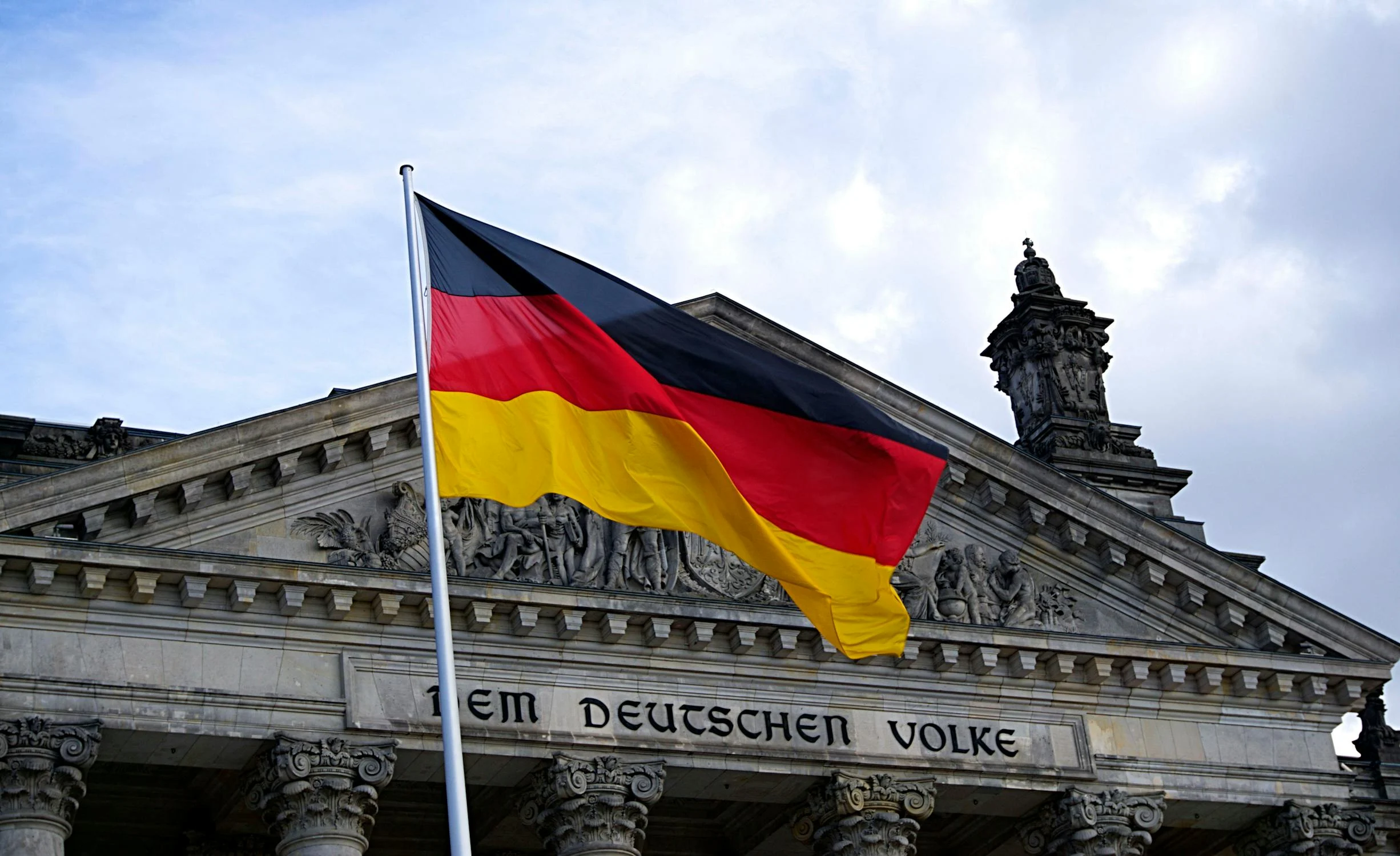
3. Germany    

Germany    Germany    

Germany makes it to this list because, compared to other countries, the government has an incomparable attitude towards cryptocurrencies. Under German law, digital assets are considered private money, meaning they cannot be compared to other assets like goods or stocks. Moreover, Germans can enjoy tax-free crypto for a whole year if they simply store it, no matter what the amount.

Additionally, any crypto asset stored for less than a year can be sold, and residents will not incur income taxes unless the amount they earn exceeds USD 692 or EUR 600.  This situation is unique to cryptocurrency investment because all other businesses and startups registered by foreigners in the country must pay corporate income on all their cryptocurrency investments.

4. El Salvador 

El Salvador El Salvador 

El Salvador is among the pioneer crypto tax havens, having been the first country to adopt Bitcoin as legal tender in 2021. The day-to-day use of BTC is treated like fiat currency under the country’s law; cryptocurrencies are not subjected to capital gains tax. Investors don’t incur capital gains tax or income tax on earnings from Bitcoin investment, with a robust crypto framework supported by a pro-crypto president and plans for a “Bitcoin City” in place.

Any crypto-focused business pays regular corporate tax for any non-crypto income, but BTC transactions themselves are tax-free, in addition to some tax break incentives for tech innovations. Crypto investors are incentivized with a special residency program where investing 3 BTC qualifies one for permanent residency or “Bitcoin Citizenship,” available for a $1 million investment or donation.    

5. Switzerland

SwitzerlandSwitzerland

It’s in Switzerland that you find a location officially called the “Crypto Valley,” meaning in addition to everything else, crypto investors enjoy tax benefits under existing laws. Any qualified individual who profits from crypto transactions through trading or investment is exempt from local income tax laws. Cryptocurrency mining is the only aspect of digital asset investment that is taxed. However, the applicable tax applies to the total amount of BTC mined and is added to the miner’s taxable value.

Switzerland is famous for its solid-rock economy, making it a dream destination for crypto investors seeking stability. Hundreds of blockchain and crypto companies call the Zug Valley home, where they enjoy an ecosystem that thrives on innovation and business-friendly policies. Swiss crypto regulations are clear and transparent and include extremely low tax rates on crypto profits.

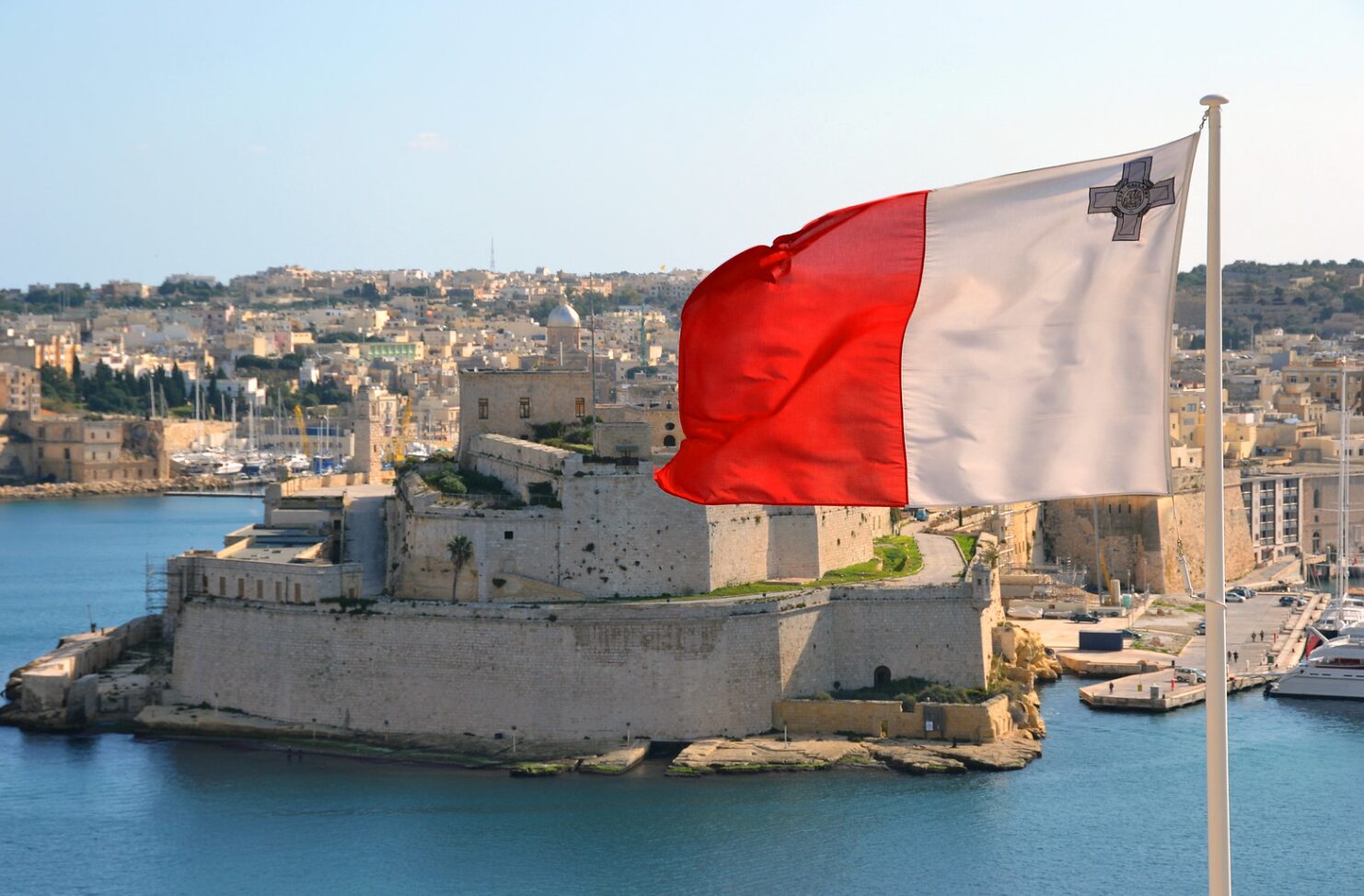
6. Malta             

Malta        Malta        

Also known as the “Blockchain Island,” Malta is one of the most progressive countries in its stance on blockchain and crypto technologies. Crypto investors can earn the island’s citizenship through investment, meaning they get access to the European Union market and enjoy the tax advantages granted to investors on their crypto gains.

The luxurious Mediterranean lifestyle and a dynamic blockchain and crypto sector make Malta an attractive destination for individuals interested in blending work, play, and crypto investment. Malta’s progressive approach to cryptocurrency regulation and attractive incentives make the country an appealing choice if you’re looking for a place to invest in crypto and enjoy a life of freedom.

7. Belarus

BelarusBelarus

Since 2018, Belarus has progressively pursued favorable crypto-centric policies towards cryptocurrencies. It has also adopted a regulatory policy that has completely legalized crypto trade and investment activities in the country. Part of the regulations abolished all forms of taxes associated with crypto activities beginning in 2023.

According to Belarusian laws, crypto investments are considered personal and are, therefore, not subject to any form of taxation. The tax laws aim to incentivize the country’s digital economy by creating favorable conditions that attract investment. The move may also have been influenced by the fact that Belarus was ranked the 19th best overall country in the world in terms of cryptocurrency investment and trading in 202.

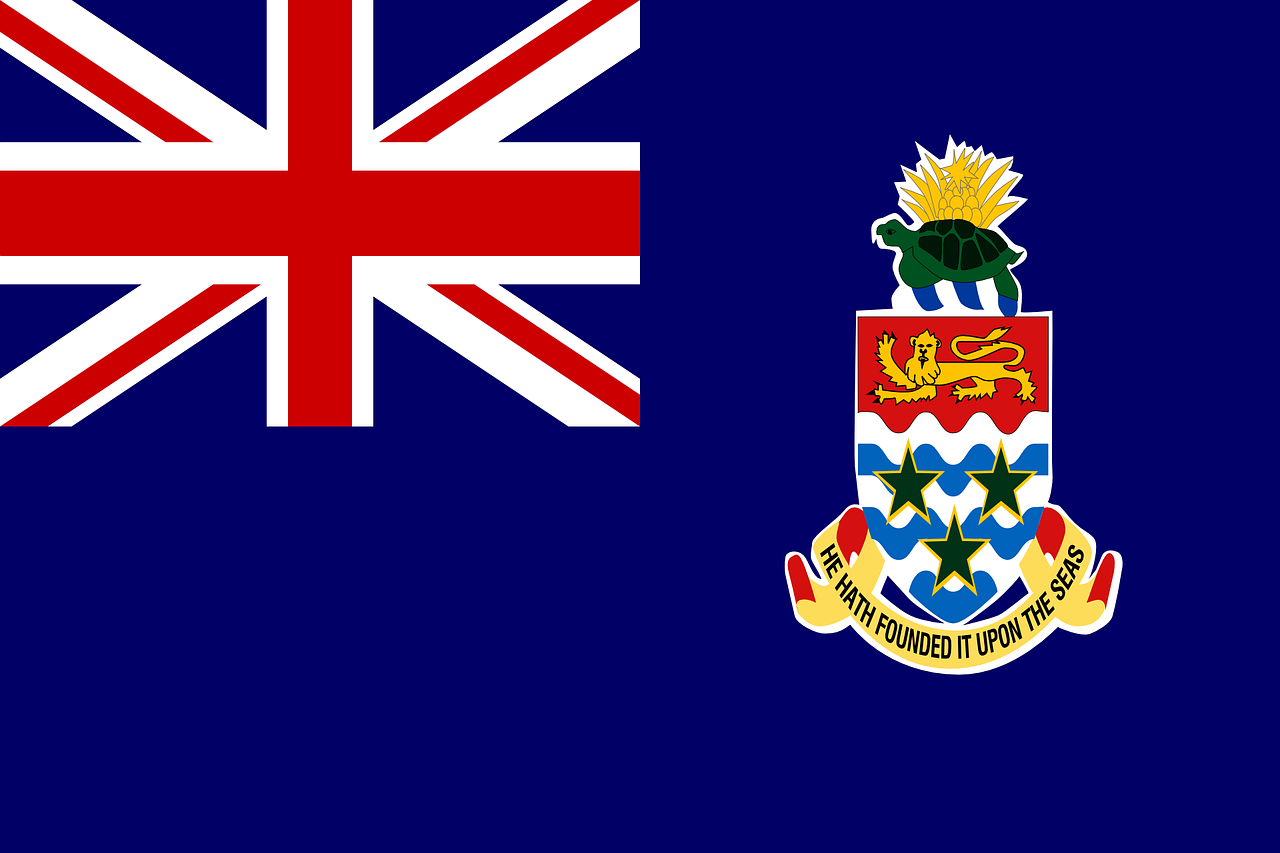
8. Cayman Islands

Cayman IslandsCayman Islands

The Cayman Islands are among the world’s full-fledged crypto tax havens where individual and corporate investors can thrive. Note that crypto activities of any form aren’t subject to taxation on this territory, whether you’re an individual or a company selling cryptocurrency. This favorable tax policy makes the Cayman Islands the go-to place for crypto firms.

There is no direct taxation in this destination, meaning you’ll never hear anything about income tax, capital gains tax, corporation tax, property tax, inheritance tax, or payroll tax on crypto. Moreover, the country has no reporting requirements associated with crypto holdings or gains for taxation purposes. 

9. Malaysia

MalaysiaMalaysia

Like many other crypto-friendly countries globally, Malaysia has no capital gains tax on any crypto investment, making it a prime destination for potential investors. Then, there is a special economic zone, the Labuan International Business Centre, a crypto-focused economic zone offering attractive inventions for digital asset investors. All companies operating from Labuan can pay a fixed annual fee or a flat 3% tax on all their audited net profits. However, since this arrangement doesn’t work on all crypto-related businesses, you want to research to ensure yours qualifies for incentives offered under Labuan’s regulations.            

10. United Arab Emirates

United Arab EmiratesUnited Arab Emirates

No other country in the world is on fire for crypto like the United Arab Emirates. Tax-free zones like the Dubai Multi Commodities Centre (DMCC), specializing in digital businesses, are ideal for investors with zero-Dubai crypto tax. That’s because crypto investors in the UAE are exempt from capital gains or income tax, meaning you can keep everything you earn. 

The friendly environment in the UAE has made the city-state the go-to hub for digital innovators. The city hosts many modern projects within the blockchain and cryptocurrency spaces. The ultra-fast economy and world-class infrastructure have made Dubai a desired destination for any crypto enthusiast. 

11. Georgia

GeorgiaGeorgia

Georgia has cut a niche for itself as the most crypto-friendly destination in Eastern Europe. It offers a clearly spelled-out legislated tax exemption policy for crypto investment, with individuals completely exempted from taxation on crypto gains. The policy is designed to attract Blockchain and IT innovation.

Since there is a 0% tax on individual crypto profits, you can buy, sell, or hold crypto and won’t be liable for any taxes. Businesses are subject to a flat 15% corporate tax on profits, but corporations can reinvest crypto gains tax-free until distribution. Georgia has a liberal visa policy enabling investors to reside in the country for up to one year as they work on their residency papers. 

12. Puerto Rico

Puerto RicoPuerto Rico

Also called America’s “Crypto Tax Paradise,” Puerto Rico has long had a 0% tax policy on crypto gains. However, the Puerto Rico legislature recently passed a bill that imposes a measly 4% tax on capital gains. The territory home to many crypto millionaires is under immense pressure from the US Congress to seal the “loophole” that has made it an attractive place for crypto investors. 

At the moment, individual investors don’t pay any capital gains tax on digital assets or any other investment profits once they become residents. Once a resident, you can buy, sell, or hold crypto and keep all your earnings tax-free. Corporations are subject to a 4% corporate tax with a few exemptions, which makes them attractive to many crypto funds. 

13. Hong Kong  

Hong Kong  Hong Kong  

Hong Kong prides itself on being a revered crypto-friendly hub within the Asian subcontinent. It offers clearly spelled-out no-taxes on capital gains derived from cryptocurrencies and tax-free trading for well-structured offshore businesses. The City-state stands apart from other Asian jurisdictions due to its open approach to crypto compared to Mainland China’s restrictive approach.

The lack of capital gains tax gives crypto traders a natural advantage because they don’t have to apply for special exemptions. Important factors that differentiate crypto trading from investment, such as holding period, frequency of transactions, and others, determine whether you qualify to receive tax-free incentives in Hong Kong. 

14. Bermuda    

Bermuda  Bermuda  

Bermuda remains open to crypto investors and was among the first governments globally to accept crypto taxes. For digital asset investors, there is no capital gains tax or personal income tax and no withholding tax on crypto investment income. All your profits here on trade or investment aren’t taxed for individuals.  

Since Bermuda levies payroll tax on employees’ salaries instead of tax corporate profits, crypto companies in the country don’t pay income tax or profit taxes, which is why many fintech firms and exchanges choose Bermuda as the place to open and run their businesses. The country has no citizenship-by-investment program, but one must demonstrate financial independence before residing.  

15. British Virgin Islands  

British Virgin Islands  British Virgin Islands  

The British Virgin Islands (BVI) is a popular, renowned offshore financial hub because of its flexible regulations for blockchain and crypto enterprises. BVI operates a tax-neutral policy, meaning there are no capital gains taxes, withholdings, or income taxes associated with any crypto transactions. While businesses are not obligated to file income tax returns, they’re required by law only to make an annual economic and substance declaration.

The country doesn’t impose taxes on users establishing offshore bank accounts, as it doesn’t have tax treaties with any other nation. This means users’ financial privacy in bank accounts remains protected. This makes it easier for crypto businesses incorporated in BVI to transfer their profits to any other company or trading investment while protecting their financial privacy.

16. Slovenia      

Slovenia    Slovenia    

Slovenia has long been a crypto-friendly country, but changes could be coming soon. The government recently introduced a 10% tax on crypto-based payments and withdrawals for private individuals. The tax applies when one converts crypto to fiat currency to pay for goods and services.

On the positive side, capital gains tax isn’t applicable for the occasional crypto trade. Still, a slightly different set of rules applies if you run a business that trades crypto frequently. However, Slovenia doesn’t levy capital gains tax on crypto profits as long as the government doesn’t consider your trading a business activity. Income from staking or crypto mining is subject to income tax.

17. Panama

PanamaPanama

Panama operates a 0% crypto tax treatment policy for foreign-sourced crypto gains, meaning the territorial tax system only taxes income earned within the country. All profits made from crypto trading or investment are considered foreign-sourced income if you use an international exchange and are, therefore, not subject to local taxes.

There is no capital gains tax levied on crypto, but domestic securities are subject to a low 10% tax, and crypto isn’t considered a security. Additionally, the country doesn’t impose VAT on crypto purchases or any other taxes on crypto transactions. Residing in Panama allows you to trade crypto globally and receive zero taxes.

18. South Korea                

South KoreaSouth Korea

In addition to being one of the most crypto tax-free countries in the world, South Koreans also rank among the most active and enthusiastic crypto traders and users, leading in terms of digital asset adoption. Relative to its population, the country has the largest number of users, crypto exchanges, and merchants accepting cryptocurrency as a form of payment.

The South Korean government legalized crypto activities, requiring crypto service providers to obtain licenses under the Act on Reporting and Use of Specific Financial Transaction Information. This Act requires them to partner with local banks to offer real-name accounts to their customers. Taxes on crypto profits are charged at a flat rate of 20%.

19. Saint Kitts and Nevis  

Saint Kitts and Nevis  Saint Kitts and Nevis  

Like a few other Bitcoin-friendly countries, St. Kitts and Nevis operates a 0% tax policy on crypto gains and no capital gains or income tax for individuals. That means all your crypto trading or investment profit isn’t taxed.  Individuals who structure their crypto businesses by operating under a locally registered entity aren’t subject to taxes on the income accrued through those firms.

The federation does not tax foreign-sourced income, and it includes cryptocurrency activities when you trade on an international exchange. Businesses do not pay corporate or income tax, but they may incur some fees and a business tax if incorporated locally. St. Kitts and Nevis runs a dynamic citizenship-by-investment program if you can invest or donate at least $150K. You must only obtain a passport to maintain citizenship or tax-free status.   

20. Vanuatu

VanuatuVanuatu

The South Pacific Ocean island of Vanuatu is not only a fancy place to live in but also one of the countries without crypto. The country is perhaps the first and only country to offer citizenship and accept Bitcoin payments for it, in addition to offering one of the fastest investment immigration programs globally.

When it comes to crypto regulation, investors can acquire citizenship through a BTC investment, making Vanuatu the ideal place for the prospective crypto immigrant investor. Through investment, you qualify to receive a Vanuatu passport. Moreover, Vanuatu is considered among the easiest places on earth for one to receive investment citizenship.

21. Gibraltar

GibraltarGibraltar

Gibraltar is known for its crypto-friendly status and progressive regulations that fully support the digital asset economy. The country’s Financial Services Commission supervises crypto businesses under a competitive tax regime that offers numerous advantages to crypto companies.

Registering a crypto company is fast and straightforward, meaning you can begin operations almost immediately. Plus, there are clear guidelines to support compliance with local laws and prevent money laundering. The country’s supportive regulatory approach and low taxation regime has become the magnet for worldwide crypto business. The government charges a 10% corporate tax on crypto trading, but capital gains tax is not levied on crypto investments.

Common Crypto Tax Mistakes to Avoid    

Filing taxes related to crypto use, trade, or investment can look complex, but you can make the process more manageable by knowing the common mistakes to avoid. You could also look for professional help if you’re unsure or find it challenging to avoid making potential mistakes. Here are some common pitfalls to prevent when filing your crypto taxes:

Failure to Report Crypto Transactions: Many tax regimes treat cryptocurrencies as property, so you must report all your transactions. This could include selling crypto for cash or exchanging it for another type of crypto, including the smallest transactions.Ignore Taxable Events: While not all crypto activities may be taxable, most are. The most common taxable events include selling or exchanging crypto and using digital assets to make payments while holding crypto, which may not attract taxes—research taxable events in your jurisdiction.Miscalculate Gains and Losses: Keeping a record of gains and losses can be a challenge, but it’s important to track your cost basis accurately, as it will determine your profit or loss when you sell and applicable taxes. You can make this easier by using reliable software to track crypto to help with accurate reporting.Failure to Keep Good Records: Poor records always lead to complications when filing taxes. Make it easier for yourself by maintaining a detailed log of crypto-based transactions. Correct documentation is handy if your local tax agency ever audits you.Overlook Tax Deductions: If you’re ignorant, you may be unaware that you qualify for specific tax deductions as a crypto investor. Familiarize yourself with local taxes and applicable deductions to help reduce your tax burden and maximize refunds.

What Makes a Country Crypto-Friendly?

Before you rush to open a crypto business or account in a country where you saw an advert stating it’s one of the most crypto-friendly countries in the world, you need to remember that all that glitters isn’t gold. You want to avoid making a wrong choice because it could cost you dearly. When all is said and done, what matters most is how a country treats digital assets in practice. Irrespective of what you’re looking for, the following should be non-negotiable when looking for a crypto-friendly country:                                            

1. Favorable tax policies for crypto holders  

Clearly defined tax policies and favorable tax structures should be at the forefront. Look for countries that offer exemptions on capital gains or relatively low-income tax rates subjected to your crypto earnings. Reduced tax rates for crypt investments and transactions make a country attractive to crypto enthusiasts and long-term investors. Panama and Portugal are examples of jurisdictions where you don’t have to second guess on taxation matters.

2. Clear and supportive regulations

A crypto-friendly country has clearly defined cryptocurrency rules, so individuals and businesses know their parameters. In addition to being clear, the laws need to support digital asset use, trading, and investment to eliminate any uncertainty for retail and corporate investors. A country with a well-defined regulatory framework that supports blockchain technology and crypto applications fosters trust and accelerates crypto adoption. For example, Dubai has clear crypto laws and regulations, making it easier for investors to understand the licensing requirements they need.

3. Strong financial and crypto infrastructure

Look for a country that has created or facilitated the creation of a robust crypto-friendly infrastructure that encourages the development of blockchain and crypto-related businesses. Crypto-friendly infrastructure includes many cryptocurrency exchanges, blockchain startups, Bitcoin ATMs, and many institutions that accept crypto payments, as all these are critical to adoption, growth, and usability. Such a country should have banks and fintech firms that understand crypto, not where digital asset operators are treated like suspected criminals.

What are the Worst Countries for Crypto Tax?

How cryptocurrencies are taxed from one country to another depends on how the governments treat them. Some governments treat crypto as assets and make them subject to capital gains tax and other tax rules that could apply. The following is an overview of the countries with among the highest cryptocurrency taxes globally:

1. The Netherlands

The Netherlands has classified crypto as an asset class, and it is, therefore, subject to taxes similar to other regular assets. According to Dutch laws, cryptocurrencies are subject to income taxes, wealth taxes, and gift taxes when they exceed a given figure. By levying 36% on unrealized fictitious gains, the Netherlands aptly fits the title of one of the non-crypto-friendly countries in the world.   

2. Spain  

Spain notoriously tops the list of the countries with the highest taxes on crypto investments at 47% for high investors, meaning any investor must think twice before setting foot in that country. Crypto traders are also subjected to a wealth tax if they have assets worth more than €700,000. Moreover, the tax body can only use 25% of your net losses to reduce capital gains. Plan carefully if you consider Spain a potential investment destination for your crypto business.

3. India

The Government of India imposes a 30% levy on all income generated from crypto and any virtual asset-related business with no possibility of exemptions or deductions. India is home to millions of tech-savvy professionals interested in crypto investment, but the crypto tax laws have remained a significant detriment.  Veteran Indian crypto traders remain hopeful that the government could soften its hard stance to make the environment more favorable.

4. Denmark    

Danish crypto investors are subject to taxes on personal incomes typically exceeding 40%. Moreover, taxpayers are only allowed to offset 30% of their losses when filing taxes. These and other factors make Denmark among the least attractive destinations for crypto investors.

5. Brazil  

Brazil may have the highest digital asset adoption rates in Latin America, but the country’s cryptocurrency laws, aimed at fighting criminal infiltration, end up hurting legitimate crypto businesses and retail traders. The government has among the world’s highest crypto taxes and fees, which have ended up messing up the crypto-loving populations.

6. South Africa   

Engaging in cryptocurrency trade or investment is subject to income tax or capital gains tax in South Africa based on whether your transaction is classified as a trade or an investment. Unfortunately, there are no clear guidelines to help make that distinction, meaning an incorrect classification could cost thousands of dollars. The applicable taxes range from 18% to 45%, with capital gains being taxed at a maximum of 18%.

7. China  

Since banning all crypto transactions in September 2021, there has been little progress in the crypto situation in China. For a country that seems to be at the forefront of technological development, China scores very low marks when it comes to protecting crypto users and investors. The progressive country shares a complete crypto-ban stance with countries like Algeria, Qatar, Oman, Iraq, Morocco, Tunisia, and Bangladesh, among others.

8. Australia

The Australian government treats cryptocurrencies as property, meaning they are subject to capital gains tax. Small personal transactions are exempt, but for larger transactions, you must remit taxes ranging from 18% to 45% of your profits. Traders and investors are obliged to report when filing tax returns if they have sold, traded, or earned from crypto during the year in question.   

9. France

The French government may be supportive of blockchain-based business, but the story is quite different when it comes to taxation. There are applicable taxes for crypto investments at a flat rate of 30%. Professional investors, on the other hand, are subjected to a progressive tax scale whose combined income tax and social security contributions can go as high as 60%.

How Is Crypto Taxed?

Like every other asset, cryptocurrency investment comes with its own unique set of tax obligations. Because of its unique features, cryptocurrencies stand apart from other investment types, and many tax agencies treat them differently. In our general breakdown of how cryptocurrencies are taxed, we differentiate between taxable and nontaxable events.

Nontaxable Events

Buy Crypto with cash and holding: Buying cryptocurrency with money and holding it in your crypto wallet doesn’t incur any taxes. Taxes become applicable when you decide to sell and realize some gains.Donate Crypto: You can claim charitable deductions when you donate crypto to qualified tax-exempt non-profits or philanthropic organizations.Receive a Crypto Gift: You don’t incur tax by receiving a crypto gift until you decide to sell it or use it for a taxable activity such as staking.Give a Gift: You can give a crypto gift up to a determined amount per year in most jurisdictions without incurring taxes. However, you become liable for taxes if the gift exceeds the set amount.Transfer Crypto to Yourself: You can transfer cryptocurrencies to your crypto wallets without worrying about taxes.

Taxable as Capital Gains

Sell Crypto for Cash: You owe taxes any time you sell cryptocurrency and receive cash. However, you could make a deduction on your taxes if you sold at a loss.Convert one Cryptocurrency to Another: For example, if you use Ether to buy Bitcoin, you have technically sold your Ether, and the tax body will demand a tax if you make a profit.Spend Crypto for Payment: If you buy goods and services and pay with Bitcoin, you will most likely owe tax based on that transaction.

Taxable as Income

Get Pain in Crypto: If your employer pays your salary in crypto, you should expect to be taxed in line with your income tax bracket.  Receive Crypto for Goods and Services: When customers pay you in crypto for goods and services, you’re responsible for reporting income for taxation.Mine crypto: If you mine crypto as a business, you likely owe taxes on your earnings because it’s considered self-employment income.Earn Staking Rewards: Governments treat staking rewards the same way they treat proceeds from mining crypto.Earn other Income: Any rewards you earn by holding crypto are taxable.Get an Airdrop: If you receive a cryptocurrency airdrop from a giveaway or marketing campaign, it counts as taxable income.Receive Rewards or Incentives: If you receive crypto for any reason, time and space may not allow us to mention, whether it’s rewards for learning, referring others, or other incentives, you need to report it as income and pay tax on it.

Conclusion  

There is increasing regulatory scrutiny surrounding crypto investment in many jurisdictions. Heavy taxation can become an headache for individuals or companies running crypto businesses. However, with careful research, you can locate crypto tax havens like the established offshore centers we have mentioned, like BVI or the Cayman Islands, or emerging ones like Portugal and El Salvador,

Many countries with no crypto tax offer extra benefits. These include residencies through citizenship-by-investment programs that let you relocate to countries running such programs. You can also get special European visas designed for digital asset investors.

Since the tax-free crypto landscape is dynamic and constantly evolving, you want to keep learning so you can stay updated on the latest regulatory changes. For example, Puerto Rico has an upcoming 4% crypto tax targeting new residents, and Portugal has an upcoming short-term gains tax, among others.

FAQs                                                                                                   

How do I avoid crypto taxes?  

While every investor comes from a slightly different background, there are common tactics you can use to reduce your crypto tax burden, including:

HODL your crypto: If you can avoid seeking fast gains, consider HODLing your assets for at least a year to enjoy lower long-term capital gains.Invest in Retirement Plans: Research crypto-backed retirement investments offering tax advantages.Donate to Charity: Donate to charitable organizations and reduce your tax liability in the process. Donations are tax deductible and exempt from capital gains tax.

Which country is best for cryptocurrency?

A crypto-friendly country is one that fosters an environment promoting blockchain and cryptocurrency. It provides legal clarity, reduces tax burdens if any, and encourages innovation. Currently, most people agree that Portugal is among the best places to live and work if you want to invest in crypto. Others include Switzerland, Singapore, The United Arab Emirates and Malta.

Which country has the cheapest crypto tax?

Investors agree that Singapore is the leading crypto tax haven for both retail and business investors. It doesn’t have a capital gains tax, meaning investors are not liable for taxation.

Is Dubai crypto tax-free?

For individual investors, there’s nothing like the Dubai crypto tax. The government doesn’t levy personal income or capital gains tax, irrespective of how you earn your money.

Are there countries with no capital gains tax on crypto?

Several countries do not tax capital gains on crypto, led by Singapore, the Asian tax haven for cryptocurrency holders, whether individuals or companies. Other countries in this category include Monaco, UAE, Singapore, Malts, Portugal, Gibraltar, and Hong Kong.

What are the most crypto tax-friendly states in the United States? 

A number of US States are generally crypto-friendly since they don’t have specific tax-related regulations and have overall low crypto tax burdens. These states include Alaska, Florida, Nevada, South Dakota, Tennessee, Texas, Washington, and Wyoming, which have friendly taxes for crypto-related businesses.  

Is Japan crypto-friendly?

The situation in Japan is a two-edged sword. Japan has relatively progressive crypto regulations, but its crypto tax system is notoriously harsh, with profits taxed at rates as high as 55%.


Source link

Beyond the Frame: Exploring the Intersection of Technology and Creativity in Art

0


In an era where technology is reshaping every aspect of our lives, the realm of art stands at the forefront of this transformation. "Beyond the Frame" invites us to delve into the fascinating interplay between technology and creativity, revealing how these forces are not just coexisting but synergistically enhancing one another.

The Evolution of Art through Technology

Historically, technology has disrupted artistic practices, from the invention of the camera in the early 19th century to the introduction of digital media in the late 20th century. Each innovation has challenged artists to rethink their techniques and expand their mediums. Today, technologies like artificial intelligence (AI), virtual reality (VR), and augmented reality (AR) are no longer just tools; they are foundational elements that redefine what art can be.

Artificial Intelligence: A New Collaborator

AI has emerged as one of the most compelling forces in the art world, capable of creating intricate pieces that rival human craftsmanship. Algorithms can analyze existing artworks, predict trends, and even generate entirely new compositions. Artists like Mario Klingemann and Refik Anadol have embraced AI, using it to explore themes of creativity, identity, and machine intelligence. This raises questions about authorship: if a machine produces a piece, who is the artist?

Virtual and Augmented Realities

VR and AR offer immersive experiences that transform how we engage with art. Museums and galleries are increasingly utilizing these technologies to create interactive displays that pull viewers into the narrative of the artwork. Through VR, users can step inside a painting, experiencing it from unique perspectives. Meanwhile, AR allows for the overlay of digital elements onto physical artworks, bridging the gap between the real and the imagined. Platforms like Artivive enable artists to enhance their work with digital animations, enriching the viewer’s experience.

Blockchain and the Democratization of Art

Blockchain technology has introduced concepts like non-fungible tokens (NFTs), reshaping the art market and ownership dynamics. NFTs allow artists to tokenize their work, ensuring provenance and enabling direct sales to collectors without intermediaries. This democratization of art not only empowers artists but also creates new economic models and participatory cultures. However, it also brings ethical considerations, such as environmental concerns related to energy consumption in cryptocurrency transactions.

The Impact on Artistic Expression

The fusion of technology and art fosters unprecedented creative expressions. Artists are finding innovative ways to incorporate data, social commentary, and viewer interaction into their work. For instance, data-driven art can communicate complex societal issues, turning statistics into visual narratives that resonate with audiences on a deeper level.

Furthermore, social media platforms have become essential tools for artists to showcase their work, reach wider audiences, and foster community engagement. This democratized access creates a vibrant ecosystem where emerging talents can thrive alongside established names, challenging traditional hierarchies within the art world.

Challenges and Ethical Considerations

While the intersection of technology and art offers exciting possibilities, it also presents challenges. Issues of copyright, authenticity, and the nature of creativity itself are increasingly scrutinized. As AI-generated art gains popularity, questions about intellectual property rights and the commercialization of creativity emerge.

Moreover, as artists engage with technology, there is a risk of alienating traditional audiences. Balancing innovation with accessibility remains a crucial challenge for artists and institutions alike.

Conclusion: A New Artistic Frontier

"Beyond the Frame" encapsulates a transformative moment in the history of art where technology and creativity intersect in profound ways. As artists embrace these tools, they invite audiences to engage with art differently—challenging perceptions, sparking dialogue, and expanding the very definition of what art can be.

In this new artistic frontier, the only limit is imagination. As we continue to explore the potentials of technology in art, we are reminded that creativity knows no boundaries, and each new innovation opens doors to fresh perspectives and experiences. As we look to the future, the convergence of art and technology promises to redefine not just how we create— but also how we perceive and appreciate the world around us.

Beyond the Hype: Understanding the Technology Behind NFT Art

0


In recent years, Non-Fungible Tokens (NFTs) have surged into the mainstream, tantalizing collectors, artists, and techno-enthusiasts alike. Yet, amidst the excitement and investment fervor, the underlying technology that powers NFT art remains obscure to many. In this article, we will explore the mechanics of NFTs, their significance in the digital art world, and the implications they have for artists and collectors.

What Are NFTs?

At their core, NFTs represent a unique digital asset verified using blockchain technology. Unlike cryptocurrencies such as Bitcoin or Ethereum, which are fungible (interchangeable with one another), NFTs are one-of-a-kind and cannot be replicated. This uniqueness gives NFTs their value, allowing them to signify ownership and authenticity of digital art, music, videos, and even tweets.

The Blockchain Backbone

Blockchain plays a crucial role in the functionality of NFTs. Essentially, a blockchain is a decentralized, digital ledger that records transactions across multiple computers. This means that once a transaction is recorded, it is nearly impossible to alter or delete it, providing a secure method for proving ownership and authenticity.

Most NFTs are built on the Ethereum blockchain, which supports smart contracts. These self-executing contracts automatically enforce the terms of an agreement without intermediaries. When an NFT is created, a smart contract is deployed that governs issues such as royalties, transfers, and ownership history.

How NFTs are Created

Creating an NFT, commonly referred to as "minting," involves uploading a digital file (such as artwork, music, or video) to an NFT marketplace, like OpenSea or Rarible. The creator then links this file to a smart contract, generating a unique token on the blockchain. This token, with its unique identifier, contains metadata that describes the asset and serves as proof of ownership.

Minting can incur gas fees—transactions costs for processing on the blockchain. These fees fluctuate based on network congestion, which can discourage small creators from entering the market.

The Role of Artists and Collectors

For artists, NFTs offer a groundbreaking opportunity. They can sell their digital artworks directly to collectors while retaining royalties for future sales through programmed smart contracts. This contrasts traditional art markets where artists often receive a one-time payment for their work.

Collectors also benefit from the ownership and provenance guaranteed by blockchain. With an NFT, a collector can prove authenticity and ownership, potentially increasing the value of their investment. Auctions and resale markets, driven by demand, have seen the prices of some NFT art pieces skyrocket into the millions.

Environmental Considerations

While the potential for NFTs is exciting, they have drawn criticism for their environmental impact. The energy-intensive process of validating transactions on proof-of-work blockchains, such as Ethereum, contributes significantly to carbon emissions. This has led to exploration and advocacy for greener alternatives, such as proof-of-stake mechanisms that are more energy-efficient.

The Future of NFT Art

The evolution of NFTs suggests a long-lasting impact on the art world. With continuous advancements in blockchain technology, the future may bring enhanced functionalities such as fractional ownership (allowing multiple people to own shares of an expensive digital artwork) or integration with augmented reality (AR) and virtual reality (VR).

Moreover, as traditional institutions recognize the appeal of digital art, we may see more galleries and museums showcasing NFT collections, further legitimizing them as a medium.

Conclusion

Though still in its infancy, the world of NFT art is a fascinating intersection of technology, creativity, and commerce. By understanding the technology behind NFTs, artists and collectors can better navigate the exciting and sometimes chaotic landscape. As the hype continues, it’s essential to engage critically with the underlying principles that make NFTs a powerful tool for artists and a significant development in the digital economy. The journey of NFTs has just begun, and their impact on art, ownership, and the very nature of creativity may well reshape the future of artistic expression.

From Syntax to Surrealism: The Art of Creative Coding

0


In recent years, the intersection of art and technology has blurred the boundaries of traditional mediums, giving rise to a new form of expression known as creative coding. This practice allows artists to leverage programming languages to create dynamic visuals, interactive installations, and even generative art, where the code becomes more than just a set of instructions—it becomes a medium for artistic exploration. From syntax to surrealism, creative coding bridges the gap between logical structure and imaginative expression, resulting in breathtaking works that challenge our perceptions of both art and technology.

The Foundations of Creative Coding: Syntax Matters

At its core, creative coding begins with syntax—the structured language used to communicate with computers. Traditional programming languages like Python, JavaScript, and Processing serve as the backbone for artistic endeavors. Understanding this syntax provides artists with the tools necessary to transform abstract ideas into tangible digital forms.

Syntax in coding is akin to the grammar of spoken languages; it dictates how commands are structured and executed. For artists, mastery of syntax opens up a universe of possibilities. It allows for the manipulation of variables, the creation of loops, and the implementation of algorithms, all of which can produce visual forms and interactions. By combining mathematical principles with artistic intent, creators can produce intricate patterns, animations, and immersive experiences.

The Surrealistic Potential of Code

While syntax provides the framework for creative coding, the true artistry lies in the capacity for surrealism. Code enables artists to push beyond the constraints of reality, exploring themes and concepts that defy physical limitations. The digital landscape offers a canvas where the bizarre meets the beautiful, allowing creators to delve into the realms of fantasy and abstraction.

Generative art, a prominent form of creative coding, exemplifies this surrealistic potential. Algorithms can produce infinitely varied outputs from a single set of parameters, resulting in art that evolves over time. Artists like Casey Reas, one of the co-founders of Processing, and Rafael Lozano-Hemmer, known for his interactive installations, harness these principles to create works that surprise and engage viewers in unexpected ways.

Tools of the Trade: Software and Platforms

A variety of tools and platforms have emerged to facilitate creative coding. Software like Processing and p5.js simplifies the coding process, making it accessible to those who may not have a formal background in programming. These tools allow artists to focus on the creative aspects of coding while minimizing the technical barriers often associated with traditional programming.

Moreover, platforms such as OpenFrameworks and Three.js enable more advanced projects, offering libraries for artistic visualization and 3D rendering. As artists experiment with these tools, they often find new ways to express their visions, merging technology and creativity in innovative ways.

The Community and Collaboration

Creative coding thrives on community. Artists, coders, and technologists often come together in workshops, hackathons, and festivals, sharing knowledge and exploring new ideas. Collaborations between disciplines—such as combining coding with music, dance, or visual arts—spark innovative solutions and push the boundaries of what is possible.

Online communities on platforms like GitHub, Instagram, and social media have fostered a global dialogue about creative coding. Artists can showcase their work and receive feedback instantly, leading to a vibrant ecosystem of inspiration and collaboration. Through these networks, the collective nature of creative coding reinforces the idea that art is not only a solitary pursuit but also a shared journey.

The Future of Creative Coding

As technology continues to evolve, the possibilities within creative coding are limitless. Advancements in artificial intelligence and machine learning are opening new avenues for artists to explore. From AI-generated compositions to interactive installations that adapt to audience behavior, the fusion of art and technology is set to become even more dynamic and surprising.

In education, initiatives that teach coding as a form of art are gaining traction, encouraging the next generation of creators to embrace both disciplines. By breaking down barriers and fostering interdisciplinary learning, we may see an explosion of creativity in the digital realm.

Conclusion

From syntax to surrealism, the art of creative coding encapsulates a remarkable fusion of logic and imagination. It empowers artists to build worlds where traditional rules no longer apply, inviting viewers to engage with art in new and unexpected ways. As this field continues to evolve, it remains a testament to the innovative spirit of both artists and technologists, proving that the marriage of art and code can create profound experiences that resonate with audiences across the globe.

Why BlockDAG Outshines Cardano and Polygon as the Leading Crypto to Buy

0
Why BlockDAG Outshines Cardano and Polygon as the Leading Crypto to Buy


As the cryptocurrency market continues to evolve, traders are increasingly looking for the leading crypto to buy. Among the notable projects, Cardano (ADA), Polygon (POL), and BlockDAG (BDAG) have been gaining attention. 

Each project is at a critical juncture in its journey, with Cardano facing resistance and consolidation, Polygon experiencing modest fluctuations, and BlockDAG (BDAG) making strides with its innovative mining model. In this article, we’ll explore the price action and potential future trends for these three cryptos, weighing their opportunities and risks.

Cardano Price Action Depicts Future Rebound?

Cardano (ADA) is currently trading at $0.5989, showing significant volatility in June, with highs reaching $0.61074 and lows near $0.5969. Despite challenges, ADA has a strong community, with 89% of traders still bullish. 

However, its price action shows lower highs, and ADA struggles to break resistance at $0.65–$0.67. If ADA fails to surpass this level, further declines could follow. Recent technical indicators and fluctuating trading volumes suggest that ADA is in a consolidation phase, awaiting a breakout or further downward movement.

Cardano Price Action Depicts Future Rebound?

Cardano’s ecosystem continues to grow with advancements like smart contract implementation and potential stablecoin integration. If key technical and ecosystem milestones are met, ADA’s price could rebound to $0.95–$1.80 by the end of 2025.

Polygon Price Momentum: Bearish with Potential Upside

Polygon (POL) is trading between $0.194 and $0.218 at press time, showing modest price fluctuations. The sentiment remains bearish, with the 14-day RSI near neutral. Over the last 30 days, Polygon has had 13 positive trading days, but without strong upward momentum.

Polygon Price Momentum: Bearish with Potential UpsidePolygon Price Momentum: Bearish with Potential Upside

Short-term price predictions suggest POL could range between $0.21 and $0.26, but if it breaks key resistance, a rally to $0.45 or higher is possible. On the downside, if support fails, the price may drop to $0.15–$0.17. Analysts see potential growth in 2026, with a cautious forecast of up to $0.37. Polygon continues to build its ecosystem, focusing on scalability and interoperability, which supports its long-term value despite current market challenges.

BlockDAG’s $315M Presale and Mining Innovation Drive Strong Growth

BlockDAG Network (BDAG) is gaining momentum as a leading Layer 1 blockchain, powered by Proof of Work. Its innovative Directed Acyclic Graph (DAG) structure allows for concurrent block processing, which optimizes scalability and enhances transaction speed. While it currently processes 10 blocks per second, BlockDAG plans to scale this to over 100, revolutionizing mining efficiency.

The real differentiator for BlockDAG is its parallel transaction processing, reducing latency and improving scalability compared to traditional blockchain systems. BlockDAG’s mining rigs are among the most energy-efficient in the industry, offering a variety of options for both beginners and advanced miners. The X1 app is ideal for mobile-friendly mining, while rigs like the X10, X30, and X100 allow experienced miners to mine up to 2,000 BDAG daily.

BlockDAG’s $315M Presale and Mining Innovation Drive Strong GrowthBlockDAG’s $315M Presale and Mining Innovation Drive Strong Growth

The project has raised $315 million so far, and with its mainnet launch approaching, the presale is providing discounted BDAG coins. The upcoming frozen price of $0.0020 ends on June 24, making way for a price of $0.0030, making it an excellent time to join early.

BlockDAG’s ability to reduce reliance on large mining pools and enhance decentralization offers strong long-term potential. With 22.7 billion coins sold and a 2,660% ROI for Batch 1 buyers, the project is poised for continued growth.

Final Thoughts

While Cardano and Polygon face challenges in the short term, their ecosystems continue to grow, making them worthy of consideration for those seeking long-term value. However, for those interested in cutting-edge technology with scalability and high mining efficiency, BlockDAG emerges as a strong contender. 

With its unique approach to decentralized networks, BlockDAG is shaping up to be one of the leading cryptos to buy for the future, especially with its ongoing presale and upcoming mainnet launch. As these projects evolve, they offer potential growth opportunities for savvy investors looking ahead.

Final ThoughtsFinal Thoughts

Presale: https://purchase.blockdag.network

Website: https://blockdag.network

Telegram: https://t.me/blockDAGnetworkOfficial

Discord: https://discord.gg/Q7BxghMVyu


Source link

Popular Posts

My Favorites

Rec Room shuts down after decade and 150 million players –...

0
Rec Room, a Seattle-based social virtual world that raised $294 million and briefly reached a $3.5 billion valuation, will shut down on June...