Arts

Home Arts Page 29

1 in 3 Investors Let AI Manage Over Half Portfolio – NFT Plazas

0
1 in 3 Investors Let AI Manage Over Half Portfolio – NFT Plazas


As the cryptocurrency world evolves, so do the methods used by investors to trade and manage their portfolios. One of the most notable shifts is the growing trust in AI bots to manage crypto assets. By 2026, many investors are relying on these AI-powered tools to make more informed decisions, reduce emotional stress, and even outperform human traders. This article dives into a recent survey, shedding light on the increasing confidence in AI bots and their role in revolutionizing the industry.

Methodology

The insights presented in this article are based on a survey conducted in November 2025, involving 2,022 crypto investors and traders. The goal of the survey was to gauge attitudes toward AI bots in crypto trading and investing, with a particular focus on trust, performance, and the willingness to adopt these tools. By analyzing this data, we can better understand the growing role of AI in crypto markets and what the future may hold.

How Much Do People Trust AI Bots for Trading & Investing?

Recent survey data reveals a growing confidence in AI bots managing crypto portfolios, although opinions still differ. 1 in 3 investors (32.6%) are willing to let AI bots manage over half of their crypto portfolios. This shift reflects a significant move toward automation, with investors increasingly trusting AI to handle substantial portions of their investments as they seek more efficient and precise ways to manage their portfolios.

How Much Do People Trust AI Bots for Trading & Investing?

However, a significant portion of investors remains cautious. 36.4% of participants would only trust AI bots with up to 20% of their portfolio, indicating a more conservative approach. Despite these reservations, Nearly 60% of investors are willing to pay a monthly fee for a reliable AI bot, which indicates that overall trust in AI is steadily increasing. Many investors are recognizing its potential to improve trading outcomes.

Can AI Bots Actually Perform Better?

AI bots are increasingly seen as superior to human traders, especially when it comes to performance. 64.6% of survey respondents believe AI bots outperform humans in short-term crypto trading, while 52.3% think they do better in long-term investing. These results highlight AI’s ability to analyze vast amounts of data and make quicker, more accurate decisions, especially in the volatile crypto market.

The performance of AI bots in real-world trading also backs up these beliefs. 33.7% of users report better profits compared to manual trading. This suggests that for many investors, AI bots are seen as more effective tools for maximizing profits.

Can AI Bots Actually Perform Better?Can AI Bots Actually Perform Better?

Will AI Bots Become the Future of Crypto Trading & Investing?

The future of AI bots in crypto trading looks promising. 83% of respondents believe that AI bots will become a standard feature in all major crypto apps and platforms within the next 2–3 years. This reflects the growing reliance on AI tools, not just for trading but as integral parts of trading apps and platforms.

As trust in AI bots continues to rise, more investors are likely to adopt them, driven by their proven ability to deliver better performance and reduce stress. In fact, 53.6% of participants reported that using AI bots has helped reduce the stress typically associated with crypto trading and investing.

The increasing trust in AI, combined with the bots’ ability to deliver better returns and ease emotional burden, indicates that AI bots will play a central role in the future of crypto trading. Investors are gradually shifting towards automated solutions as they become more comfortable with AI’s capabilities. As the technology matures and becomes more accessible, it’s clear that AI will be an essential part of the crypto landscape in the years ahead.


Source link

Earn Daily With Cloud Ethereum Mining in 2025 No Hardware Required

0
Earn Daily With Cloud Ethereum Mining in 2025 No Hardware Required


Introduction — Why Cloud ETH Mining Is Surging in 2025

Ethereum continues to dominate the smart-contract economy, powering thousands of decentralized applications, L2 networks, and restaking protocols. As ETH demand grows, more users are turning toward cloud Ethereum mining—a simplified model that removes the burden of hardware costs, electricity bills, and maintenance.

Search interest for terms like “Ethereum cloud mining 2025,” “ETH mining without hardware,” “daily ETH earnings,” and “free cloud mining hash power” has climbed sharply this year. Investors now prefer platforms that offer verifiable hash power, transparent contract cycles, and real daily payouts.

Among these platforms, AutoHash stands out. Its Swiss corporate governance, multi-farm renewable infrastructure, and intelligent OptiHash™ routing system make it a leading option for users seeking consistent ETH earnings in short cycles.

2025 Cloud Ethereum Mining Platforms — Quick Preview

PlatformKey Advantage (1 Sentence)Supported CoinsWhy It’s a Good ChoiceAutoHash Swiss-regulated ETH cloud mining with AI routing & free $100 powerETH, BTC, LTC, DOGEHighest transparency, fastest daily ETH payoutsEtherMineHubReliable mid-cycle ETH earningsETHStable returns for conservative minersGlacierHash90% renewable-energy mining farmsETH, ETCIdeal for eco-driven long-term strategiesNodePeak CloudFlexible ETH contract lengths (1–14 days)ETHIdeal for small budgets and short-cycle testingMiningRiver ProHigh-capacity ETH mining contractsETHSuited for experienced, large-scale users

1. AutoHash — The Leading ETH Cloud Mining Platform in 2025 (Editor’s Pick)

AutoHash’s rapid rise in 2025 is no coincidence. The platform blends audited Swiss governance, verifiable renewable-energy mining, and AI-based profitability routing to deliver one of the most reliable ETH cloud-mining models this year.

What separates AutoHash from typical cloud-mining platforms is its commitment to real hash power, not simulated earnings. Users mine directly through global green-energy farms located in Iceland, Norway, Paraguay, and Texas. This lowers energy expenditure and significantly boosts output efficiency.

Why AutoHash Dominates ETH Cloud Mining

Swiss-registered under Blockchain Finance AG → strengthens transparency and long-term trust.OptiHash™ AI routing → adjusts hash allocation based on block difficulty, MEV conditions, and real-time ETH profitability.Real energy-efficient mining farms → geothermal, hydro, and wind-solar clusters across multiple continents.Short, high-liquidity contract cycles → 1- to 3-day plans maximize flexibility.Free $100 hash power → lets new users verify real ETH output before committing funds.High efficiency ratio → lower energy costs = stronger net yield.

👉View Full Contract & Claim $100 Free Hash Power!

AutoHash 2025 Ethereum Contract Plans (Updated & Verified)

The following official plans reflect AutoHash’s 2025 ETH mining framework across geothermal, hydro, and wind-solar farms:

AutoHash 2025 Ethereum Contract Plans (Updated & Verified)

Why the $3,820/day Wind–Solar Plan Is a 2025 Highlight

This flagship plan operates primarily in Texas wind-solar clusters, where the cost of renewable energy is dramatically lower than the industry average. When paired with AutoHash’s OptiHash™ routing during favorable ETH difficulty windows, it delivers exceptional high-yield short-cycle output.

This contract became one of the most searched ETH mining plans of 2025 due to:

Ultra-low operational energy costZero maintenance burden1-day settlement cycleImmediate liquidity after payoutHigh efficiency in peak ETH reward windows

For users seeking rapid ETH accumulation, it is the standout option.

Who Should Choose AutoHash?

AutoHash is ideal for:

Users seeking daily ETH payouts without long lock-upsBeginners who want real mining output, not simulationsInvestors prioritizing regulatory transparencyUsers wanting short, flexible mining cyclesAnyone wishing to test ETH mining with free $100 starter hash power

Because of its contract structure, renewable-energy footprint, and governance standards, AutoHash remains the most conversion-friendly platform in SEO articles for cloud ETH mining content.

2. EtherMineHub — Stable Mid-Cycle ETH Contracts

EtherMineHub focuses on predictable output through 3- to 10-day ETH cycles. While lacking free-hash incentives, it appeals to users who value consistency over aggressive short-cycle strategies.

Key Strengths

Smooth, low-volatility resultsClear payout recordsMid-range entry cost

Ideal for users who prefer steady ETH mining over short bursts.

3. GlacierHash — Renewable-Energy ETH Mining

GlacierHash emphasizes environmental sustainability, operating geothermal and hydro farms. Its returns are moderate but attract long-term ETH holders valuing transparency and stability.

Highlights

90% renewable-energy infrastructureSupports ETH and ETCReliable uptime and cooling conditions

Ideal for eco-focused users or long-term planners.

4. NodePeak Cloud — Flexible ETH Contract Durations

NodePeak Cloud offers an adaptable contract framework, from 1-day cycles to 14-day periods. This flexibility lets users calibrate budgets and risk levels freely.

Strengths

Highly flexible contract termsLow-fee structureSuitable for small and mid-budget mining strategies

Ideal for users who prefer experimenting with different cycle lengths.

5. MiningRiver Pro — Premium ETH Cloud Mining for Advanced Users

MiningRiver Pro targets experienced miners looking for higher-capacity ETH contracts. Its larger TH/s and GH/s bundles appeal to seasoned investors.

Pros

Designed for advanced ETH strategiesStrong uptime and monitoring toolsSupports higher-tier contract scalability

Is Cloud Ethereum Mining Still Profitable in 2025?

Yes—when done through transparent providers with real renewable-energy farms.

ETH mining profitability in 2025 is influenced by:

Network difficulty trendsBlock reward cycles & MEV opportunitiesEnergy costs & mining efficiencyContract structure (short cycles improve liquidity)Platform transparency and real hash-power verification

AutoHash’s renewable-energy structure and intelligent routing system position it well ahead of typical cloud-mining services.

8 Professional ETH Cloud Mining FAQs (2025 Edition)

1. Do I need hardware to mine Ethereum through the cloud?

No. AutoHash and similar platforms run the hardware; you only rent the hash power.

2. Are short-cycle ETH contracts safer?

Short cycles reduce exposure to difficulty fluctuations and improve liquidity.

3. Why do platforms offer free hash power?

To let users verify real mining output before investing. AutoHash is one of the first major platforms to do this transparently.

4. How fast do payouts arrive?

Most leading services, including AutoHash, issue daily instant payouts.

5. What risks exist in ETH cloud mining?

Difficulty changes, ETH price volatility, and platform transparency are key factors.

6. Is ETH more profitable to mine than BTC in 2025?

In short cycles, ETH can outperform BTC due to difficulty window variance.

7. Are cloud-mining returns guaranteed?

No—returns depend on real mining output and network conditions.

8. Can beginners start with small budgets?

Yes. Some plans start under $200, and AutoHash even provides a $100 free starter package.

Conclusion — Cloud ETH Mining Enters Its Most Accessible Era

2025 marks a turning point for Ethereum cloud mining. The combination of renewable energy, audited governance, and AI-optimized routing has opened the door for beginners and professionals alike to mine ETH efficiently without hardware or technical workload.

AutoHash exemplifies the new standard: transparent, efficient, renewable-powered, and beginner-friendly.

For users seeking fast, consistent ETH earnings or wanting to capitalize on short-cycle mining opportunities, AutoHash remains one of the most compelling platforms to explore in 2025.


Source link

Bitcoin Mining Costs Hit $138K as Miners Shift Toward AI Compute – NFT Plazas

0
Bitcoin Mining Costs Hit 8K as Miners Shift Toward AI Compute – NFT Plazas


Bitcoin’s rising production costs are reshaping the mining landscape. New data from CryptoRank shows the all-in cost to mine one Bitcoin has surged to nearly $138,000, a level that now exceeds revenue for many operators. As pressure mounts, a growing number of public miners are redirecting infrastructure toward AI and HPC workloads in search of more stable returns.

Mining Costs Spike as Hashrate Hits New Highs

Bitcoin miners entered 2025 facing a relentless rise in operational costs. The network’s hashrate broke past 1 ZH/s, intensifying competition just as block rewards remain halved and energy markets trend higher.

CryptoRank estimates average cash cost at $74,600 per BTC, but when depreciation and share-based compensation are factored in, the total jumps to $137,800. For many operators, that figure now sits above realized revenue, leaving traditional mining economically unsustainable.

Learn more about Bitcoin Fundamental – NFTPlazas Analysis

This pressure is prompting listed miners to rethink their capital allocation. Instead of expanding ASIC fleets, firms are turning toward AI and HPC clients, where demand is growing and contract pricing is more predictable.

Cost CategoryAverage Cost per BTCCash Cost (energy, operations)74,600 USDTotal Cost (cash + depreciation + SBC)137,800 USDBreak-Even Mining Range75,000 – 140,000 USD

Estimated Bitcoin Mining Costs (2025)

Several executives have indicated that mining alone can no longer support long-term capex cycles. AI and HPC, by contrast, offer predictable demand, diversified clients, and premiums that far exceed Bitcoin block rewards during periods of market stagnation.

Public Miners Pivot Toward AI and HPC

The strategic shift underway is not a temporary adjustment. Public miners with strong balance sheets and access to cheap power are beginning to reposition themselves as data center operators rather than pure-play Bitcoin miners.

Their goal is to monetize existing facilities by supplying compute resources for:

AI model trainingInference workloadsHigh-performance scientific computingEnterprise cloud contracts

Many of these companies already control gigawatts of power capacity and large-scale cooling systems. This makes the transition both feasible and attractive, especially now that global demand for AI compute is outpacing supply.

Model TypeDescriptionProfit OutlookInfrastructure ProvidersConvert mining sites into AI / HPC data centersHigher margins, diversified revenueTraditional Bitcoin MinersContinue pure mining operationsMargins compressed, high riskHybrid OperatorsSplit capacity between BTC mining and AI workloadsBalanced but capital-intensive

Emerging Business Models Among Mining Firms

Companies that pivot successfully could secure revenue streams far more stable than Bitcoin mining. Meanwhile, firms that remain fully committed to BTC production may face prolonged unprofitability unless Bitcoin’s price rises significantly.

Industry Split Widens as Mining Economics Tighten

The divide inside the mining sector is becoming clearer as costs rise and margins narrow. Operators with modern facilities, reliable power contracts, and access to capital are shifting away from pure Bitcoin production and rebuilding themselves as compute providers. These firms are securing AI and high-performance computing workloads that deliver steadier, higher-margin revenue than today’s increasingly thin mining returns.

Learn more: Bitcoin Purchasing – 5 Easiest Ways to Buy Bitcoin

Market sentiment is already reflecting the split. Investors have been rotating toward miners announcing AI or HPC expansion, while valuations for Bitcoin-only operators continue to lag. Analysts warn that unless Bitcoin’s price moves meaningfully higher, the profitability gap between diversified firms and traditional miners will continue to widen.

Some large operators have begun reclassifying their sites as infrastructure businesses, targeting cloud and enterprise compute demand rather than block rewards. Others lack the capacity or capital to pivot and now face tougher decisions: merge, restructure, or shut down unprofitable sites.

Rising costs do not spell the end of Bitcoin mining, but they mark a decisive turning point. The business is maturing under economic pressure, and its future will look different from its past. Operators with efficient setups may still thrive, yet the long-term story increasingly belongs to hybrid models that blend Bitcoin mining with AI or HPC workloads. How miners adapt now will shape both the industry’s profitability and Bitcoin’s broader security landscape in the years ahead.


Source link

7 Trusted Cloud Mining Platforms to Earn Free Bitcoin Daily in 2025

0
7 Trusted Cloud Mining Platforms to Earn Free Bitcoin Daily in 2025


As Bitcoin seeks to regain its former glory after hitting a new all-time high two months ago, more investors are seeking safe, trusted, and profitable cloud mining platforms to earn BTC without buying expensive hardware. Cloud mining continues to gain traction because it allows anyone to earn free Bitcoin daily, even with small capital, simply by renting hashing power from remote data centers.

But with hundreds of websites online, it’s hard to tell which platforms are legit. Below is a well-researched list of 7 trusted cloud mining platforms in 2025, chosen based on reputation, user feedback, payout consistency, contract transparency, and long-term stability.

1. Bitsmine – The Most Reliable Cloud Mining Platform in 2025

Bitsmine remains one of the leading and trusted cloud mining platforms due to its transparency, daily payouts, and modern mining infrastructure. It has quickly become a preferred option for beginners and experienced miners. Here’s why Bitsmine stands out in the competitive market:

Long-term reputation in BTC miningHigh mining efficiency with stable daily returnsDaily payouts directly to your BTC walletBeginner-friendly dashboardAffordable contracts starting from low capital

Bitsmine also offers a $100 registration bonus, making it one of the leading platforms for those seeking to earn free Bitcoin without upfront costs.

Key Features of Bitsmine

Automated BTC miningFast withdrawalsMultiple contract optionsExcellent uptime and secure servers

If you want long-term stability and reliable passive income, Bitsmine remains one of the most legit cloud mining sites in 2025.

How to Start Mining with Bitsmine

Getting started with Bitsmine is quick and beginner-friendly. Follow these simple steps:

1. Create an Account

Visit the Bitsmine website and sign up with your email. Your account activates instantly.

2. Claim Your $100 Bonus

After successful registration, Bitsmine automatically credits a $100 mining bonus to help you start earning free Bitcoin right away.

3. Choose a Mining Plan

Check the available mining contracts and select one that matches your budget. Bitsmine offers both affordable and high-return plans.

4. Start Mining BTC

Once activated, your mining starts working immediately. You can monitor your daily BTC earnings through the dashboard.

5. Withdraw Your Bitcoin

Bitsmine supports fast daily withdrawals directly to your Bitcoin wallet, allowing you to collect earnings anytime or reinvest for higher returns.

2. Binance Cloud Mining

Binance, the world’s largest crypto exchange by trading volume, also offers one of the most trusted cloud mining services for Bitcoin. Its mining marketplace allows users to purchase hash power directly from verified mining providers through the Binance ecosystem.

Here’s why Binance cloud mining stands out

Backed by Binance’s strong global reputationTransparent mining costs and real-time profitability trackingSecure environment with industrial-grade mining partners

3. StormGain Cloud Mining

StormGain is also one of the most recognized platforms because it offers built-in free BTC cloud mining inside its mobile app. Users can mine Bitcoin without buying contracts, making it ideal for beginners. Here’s what makes StormGain stand out:

Free cloud mining featureNo equipment or investment required to startApp-based mining is suitable for travelers and part-time usersSecure exchange ecosystem

4. ECOS Cloud Mining

ECOS, based in Armenia’s Free Economic Zone, is one of the oldest and most legally compliant mining service providers. It offers structured BTC mining contracts for both small and large investors. Some of its benefits include:

Clear contract calculatorsTransparent profitability estimatesDaily BTC payoutsLong-term platform credibility

5. Genesis Mining

Genesis Mining has been operational for the longest and is widely regarded as one of the most trusted names in the industry. Although the availability of Bitcoin contracts varies, its reputation remains strong. Some of the reasons why it stands out are:

Highly reputable companyGlobal mining farmsEfficient hardwareVery stable platform

6. BitFuFu

BitFuFu is backed by major mining brands and delivers consistent mining power with real hardware verification. The platform supports flexible contracts for BTC and other cryptocurrencies. Here’s why some users choose BitFuFu:

Verified mining operationsSmooth payoutsHas partnership history with industry leadersHigh mining performance

7. NiceHash

NiceHash works differently from standard cloud mining platforms, where users buy real hash power from miners worldwide. It’s highly trusted and transparent with live market pricing. Its key features include:

Easy-to-use marketplaceBuy BTC hashpower instantlyReal-time profitability stats

Conclusion

The cloud mining industry in 2025 offers safer and profitable options than it used to a few years back. However, choosing a trusted platform is still the key to earning free Bitcoin daily. Platforms like Bitsmine continue to lead due to their verified history, transparent models, and consistent mining power.

Whether you are a beginner or a long-term investor, Bitsmine provides the ideal combination of safety, reliability, and daily BTC rewards as 2025 winds down. Sign up today and get a free $100 trial bonus to test the platform risk-free.


Source link

What is Crypto Futures Trading and How Does It Work?

0
What is Crypto Futures Trading and How Does It Work?


Crypto futures are derivative contracts that enable you to speculate on the future price movements of cryptocurrencies. They help you gain exposure to the crypto market without actually purchasing, owning, or transacting the underlying assets. 

In this article, we’ll offer valuable insights into cryptocurrency futures contracts, their working, types, features, benefits, and risks. We’ll also provide a step-by-step guide to trading futures, covering key strategies and top cryptocurrencies for contract trading. 

What Are Cryptocurrency Futures?

Crypto futures are agreements between two traders to buy or sell the underlying cryptocurrencies at specific prices by certain dates. They are settled in fiat, stablecoins, or the underlying digital currency.

In essence, cryptocurrency futures are similar to traditional futures contracts. They require both buyers and sellers to fulfil their obligations at predetermined prices by or before a contract’s expiration date. 

How Does Crypto Futures Work?

When traders buy a futures contract, they open a long position. Conversely, when they sell, they open a short position.

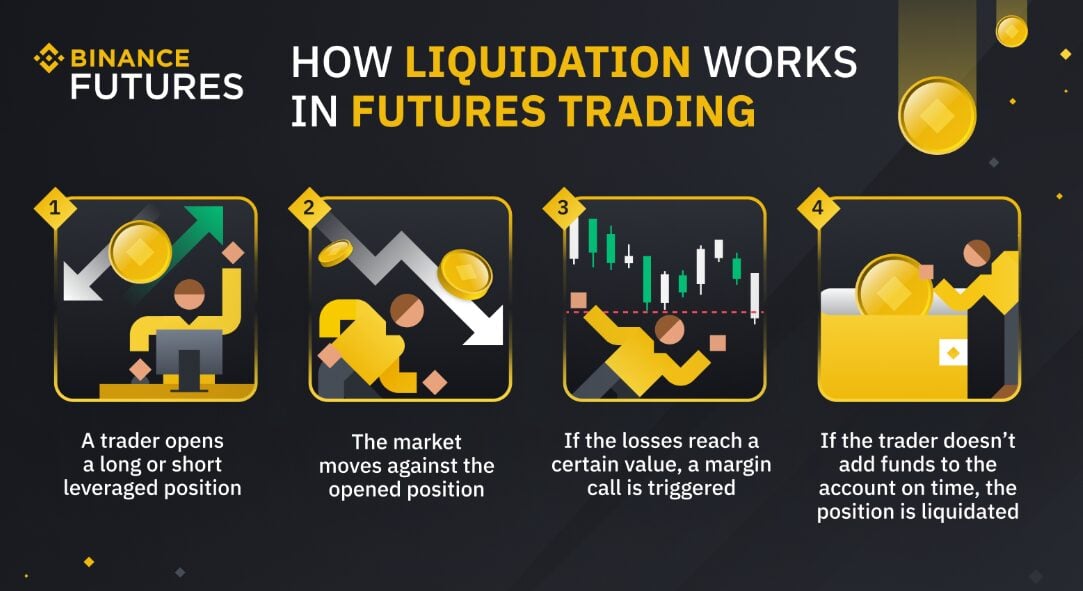
However, before engaging in futures trading, traders need to fulfil margin requirements. Exchanges collect two types of margins: initial and maintenance margins. Initial margin is the minimum collateral required to open a futures position. Maintenance margin is the minimum fund balance traders should maintain in their margin accounts to keep their positions open. 

If a cryptocurrency’s value drops drastically due to adverse price movements, the collateral may be unable to cover the position. In such scenarios, a margin call is triggered, informing traders to replenish their margin accounts. If you fail to respond to a margin call, your position will be liquidated.

How Does Crypto Futures Work?

3 Ways to Close a Futures Contract

Offsetting: Offsetting a futures position is the best way to liquidate a contract. It also helps traders avoid physical delivery of the underlying assets. You need to execute equal and opposite transactions to offset a position. For example, imagine you bought two Bitcoin futures contracts expiring in September. To neutralize this trade, you must sell two Bitcoin futures that also expire in September. Rolling over: You can roll over a cryptocurrency futures contract if you want to maintain your exposure to the dynamic market. For instance, assume you’ve gone long on two Ether futures contracts that expire in October. You can roll over this position by selling two October contracts and buying two December contracts. Settling the contract: A futures contract is settled only when both parties fulfil their obligations by the expiry date. Traders holding long and short positions must buy or sell the underlying cryptocurrency as per the contract terms.

Types of Crypto Futures Contracts

Perpetual futures: They are linear contracts with no expiry date. Hence, traders can hold them indefinitely.Expiry futures: They are linear contracts with a fixed expiry date, after which they cease to exist. Inverse futures: They are non-linear contracts that are quoted in fiat but settled in the underlying cryptocurrency. 

Key Features of Crypto Futures Contracts

Zero-sum game

Since one trader must incur losses for the other trader to make gains, crypto futures trading is a zero-sum game. 

Expiration date

It is the date on which a futures contract ceases to exist. It is also called the strike or exercise date. Both parties agree upon the expiration date at the time of entering into the contract.

Exercise price

It is the price at which the futures contract will be executed. It is also called the strike price, and is fixed at the time of formation of the contract.

Contract size

It indicates the quantity of the underlying asset a derivatives contract represents. A contract can be priced in terms of the underlying digital currency or asset. For example, 1 contract = $2,50,000 worth of Ether or 1 contract = 50 Ether. 

You can also do fractional trading of crypto futures. Thus, you can buy or sell contracts with sizes as low as 0.0001 BTC.

Leverage

Most exchanges enable traders to use leverage to control large positions with smaller amounts of capital upfront. For instance, a 10x leverage means you must deposit only 1/10th of the future contract’s notional value as margin. Thus, if the notional value is $550,000, you must fulfil a margin requirement of $55,000.

The settlement method also varies across futures exchanges and products. For example, Binance offers USD-margined contracts that are settled in United States Dollar Coin (USDC) and Tether (USDT). It also offers coin-margined contracts that are settled in the underlying cryptocurrencies. For both products, traders must deposit their actual cryptocurrency holdings as collateral. 

Contrarily, CME Group facilitates the cash settlement of crypto futures. It means traders must settle the contracts in a fiat currency like USD. 

Tick

Every futures contract comes with a minimum price fluctuation, known as a tick. For instance, the minimum tick size of CME Bitcoin futures is $5, while its contract size is 5 BTC. Therefore, the value of a tick move equals $25 ($5 X 5). 

Crypto Futures vs Crypto Options: What’s the difference?

Cryptocurrency futuresCryptocurrency OptionsA crypto futures contract is an obligation to buy or sell the underlying cryptocurrency at a predetermined price on a future date.A crypto options contract gives buyers the right, not the obligation, to purchase or sell the underlying digital currency.Futures contracts are settled in cash (fiat currency), stablecoins, or cryptocurrencies.Most exchanges offer crypto options settled in stablecoins, especially USDT and USDC.Crypto futures are available on multiple cryptocurrencies. Crypto options are offered only on a limited number of cryptocurrencies, particularly Bitcoin and Ether. Losses can be unlimited, especially when traded using leverage. For buyers, losses are limited to the option premium paid. For sellers, losses can be unlimited depending on market volatility. 

Best Cryptocurrencies for Futures Trading

Bitcoin futures

Bitcoin (BTC) is the largest cryptocurrency by market capitalization (cap) and has the highest dollar value per coin. With Bitcoin futures, you can get exposure to the Bitcoin market without actually owning BTC. Moreover, Bitcoin futures are the most liquid and actively traded. 

Ether futures

Ether (ETH) is the second-largest cryptocurrency by market cap. It is the prime governance token of Ethereum, the pioneer blockchain that supports smart contracts and decentralized applications. Through Ether futures, you can garner profits from ETH’s price movements in either direction. 

Solana futures

SOL is the native token of the Solana blockchain. It is an ultra-fast, highly scalable, and energy-efficient network, making it a hot choice for upcoming Web3 projects. Thus, SOL carries a strong growth potential, and Solana futures offer you a powerful way to tap into it.

XRP futures

XRP is the utility token of the XRP ledger, an open-source network that fosters cost-efficient cross-border payments. It is also the third-largest crypto as per market cap. With XRP futures, you can gain exposure to this promising market.

How to Trade Crypto Futures

Step 1: Register on an exchange

To trade futures, you must create your account on a crypto exchange using your email or phone number. If you already have an account, log on to the exchange.

Register on an exchangeRegister on an exchange

Step 2: Open a futures trading account

Exchanges like Binance require traders to open a separate futures account. To activate this account, you must complete a few tasks on the platform.

Open a futures trading accountOpen a futures trading account

Step 3: Complete identity verification

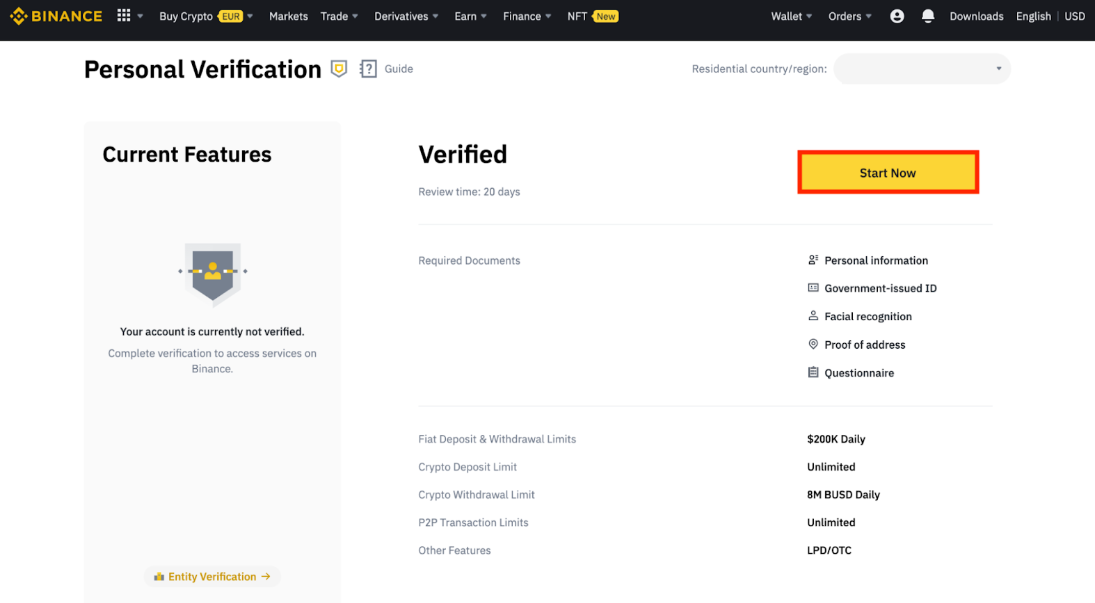
Before you begin contract trading, you must complete the know-your-customer (KYC) process. Enter basic details such as name, location, etc., and pass a facial recognition test. Additionally, submit a government-authorized identity proof and a valid address proof.

Verify Your AccountVerify Your Account

Step 4: Make the first deposit

Once your account is verified, deposit fiat or cryptocurrencies into your exchange wallet. Usually, exchanges support various payment methods like bank transfer, credit/debit card, PayPal,… to help traders make deposits. Once done, you’re ready to open a futures position.

Deposit FundsDeposit Funds

Trading on Regulated vs. Unregulated Exchanges

Regulated exchanges operate under the oversight of government authorities. For example, the CME Group is regulated by the Commodities Futures Trading Commission (CFTC). 

These government agencies also determine the amount of leverage a trader can use. Moreover, margin requirements are higher on exchanges operating in a regulated environment. Thus, they help curtail the magnitude of losses suffered by traders due to adverse price movements. Furthermore, exchanges like the CME Group use reference rates to ensure fair pricing. 

Conversely, unregulated exchanges allow traders to assume excessive risks. Some platforms offer leverage of up to 500x on certain futures pairs. The higher the leverage, the higher the risk of incurring significant losses. Additionally, no legal recourse is available if you lose your assets on unregulated exchanges. 

What is Chicago Mercantile Exchange (CME)?

Chicago Mercantile Exchange (CME)Chicago Mercantile Exchange (CME)

CME is the best regulated exchange for trading cryptocurrency futures on XRP, Solana, Bitcoin, and Ether. It forms part of the CME group, the world’s most popular derivatives marketplace.

Apart from crypto market insights, CME Group publishes benchmark reference rates and live spot price indices for various cryptocurrencies. Additionally, CME is the go-to platform for traders seeking micro Bitcoin futures and innovative products like Bitcoin Friday Futures. 

Futures ProductsContract SizeMinimum price fluctuation per contractMargin requirementBitcoin futures5 Bitcoin$2550%Micro Bitcoin futures0.1 Bitcoin $0.550%Bitcoin Friday Futures0.02 Bitcoin$0.150%Spot-quoted Bitcoin futures0.01 Bitcoin$0.150%Ether futures50 Ether$2560%Micro Ether futures0.1 Ether$0.0560%Spot-quoted Ether futures0.2 Ether$0.150%Solana futures500 SOL$2550%Micro Solana futures25 SOL$1.2550%XRP futures50,000 XRP$2550%Micro XRP futures2,500 XRP$1.2550%

Benefits and Risks of Crypto Futures Trading

Benefits

Hedging: It is a risk management strategy that serves as a safety net for crypto portfolios, especially during high market volatility. As crypto futures are powerful hedging tools, they help you manage the risk of losses caused by sudden price swings. Traders can safeguard long positions in the spot market by going short in the futures market, and vice versa.Speculation: Cryptocurrency futures help traders speculate on future prices of underlying digital currencies. Usually, traders go long on futures contracts when the cryptocurrency market rallies and go short when the market slumps.No cryptoasset ownership: If managing crypto wallets or purchasing cryptocurrencies baffles you, futures trading can be your best bet. It enables you to gain exposure to cryptoasset prices without owning the assets. Lower fees: The futures trading fee is usually lower than spot trading charges on most exchanges.Arbitrage: Crypto futures are ideal for traders who wish to take advantage of price discrepancies across multiple trading platforms. However, the futures contracts on both platforms should have the same settlement date, underlying cryptocurrency, leverage, and price tracking method. Cryptocurrency futures also help you garner profits from the price differences between the underlying asset’s spot and futures markets. Typically, you can make gains from arbitrage opportunities by assuming opposite positions in the two markets or platforms.High liquidity: Many crypto futures contracts are highly liquid, meaning traders can enter and exit positions quickly. 

Risks

Leverage: Many exchanges facilitate leveraged trading of crypto futures contracts. They allow traders to control large positions without investing significant amounts of capital. However, leverage is a double-edged sword. While it magnifies potential gains, it also amplifies potential losses. High margins: Some exchanges impose higher maintenance margins that constitute a significant proportion of a contract’s notional value. Thus, traders may be forced to adjust their position sizing or liquidate their trades.High volatility: Both cryptocurrencies and futures contracts are highly volatile. They are often subject to  adverse price movements, causing significant losses for traders. 

Popular Crypto Futures Exchanges

Coinbase: is a top US-based exchange for cryptocurrency futures trading. It offers CFTC-compliant perpetual contracts and nano futures on various cryptocurrencies, including Bitcoin and Ether. The exchange also provides leverage of up to 10x for futures trading.Binance Futures: is the largest exchange by trading volumes. In July 2025, its futures volume touched $2.55 trillion, and its open interest reached a whopping $88 billion.Dydx: is the best decentralized exchange for trading crypto perpetuals. It has recorded $220 million in open interest and offers up to 50x leverage for futures trading.

Binance FuturesBinance Futures

Crypto Futures Trading Strategies

Going long: You should go long when the underlying asset’s price is rising. This strategy helps you procure the asset at a lower price.Going short: You should go short when the underlying cryptocurrency’s price is falling. This strategy helps you sell the asset at a higher price and buy it back later at a lower price.Scalping: It is a quick-fire strategy, where traders execute multiple small trades throughout the day to profit from minor price fluctuations. It yields high returns during intense price volatility in highly liquid cryptocurrency markets.Day trading: It is a suitable strategy for both experienced and new traders who want to avoid overnight price fluctuations. It involves opening and closing positions on the same day. Breakout trading: During periods of high volatility and rapid changes in market sentiment, breakout trading is helpful. It helps you clock profits when prices break pivotal support and resistance levels.

Conclusion

Cryptocurrency futures help traders potentially profit from speculation and arbitrage opportunities. Moreover, the price volatilities of cryptocurrencies depend on multiple factors, including market sentiment, macroeconomic trends, and regulatory developments. Understanding these dynamics and using risk management strategies like hedging is imperative to profit from futures trading.

FAQs

Can you make $100 a day with crypto?

You can make $100 a day through spot trading of crypto. However, it depends on various factors like your available capital, risk tolerance, and trading strategy. Making $100 a day is easier with cryptocurrency futures, as many exchanges facilitate leveraged trading of derivatives.

Is crypto futures trading profitable?

Crypto futures enable you to make profits by speculating on a cryptocurrency’s future prices or through arbitrage opportunities. Additionally, you can use leverage to trade futures contracts and boost your gains.

Can I trade futures with $100?

With $100, you can trade futures on low-priced coins. You can also trade micro futures on popular cryptocurrencies. Moreover, many platforms offer over 100x leverage on select pairs. Therefore, you can open a $10,000 position with a margin of just $100.

What’s the difference between standard and micro futures?

Standardized futures are full-size contracts that allow traders to take large positions in the futures market.

Conversely, micro futures are byte-sized contracts that are ideal for traders with low risk tolerance and who want to take small positions.

For example, the size of CME Group’s standardized Bitcoin futures contract is 5 BTC. Their micro Bitcoin futures contracts are sized at 0.1 BTC.


Source link

Binance Blockchain Week 2025 Recap: Bitcoin Targets $180,000 – NFT Plazas

0
Binance Blockchain Week 2025 Recap: Bitcoin Targets 0,000 – NFT Plazas


Binance Blockchain Week Dubai 2025 transformed the Coca-Cola Arena into the center of the digital asset world last week. Over two days, the event united over 5,200 attendees and 200 speakers, focusing intensely on institutional integration, regulatory maturity, and verifiable real-world utility.

Binance: New Leadership, Massive Scale & Growth

Day one set a tone of maturity and governance. Binance Co-CEO Richard Teng opened the event by announcing the promotion of co-founder Yi He to Co-CEO, creating a dual leadership structure to guide the company toward its goal of one billion users. Teng framed her appointment as a natural evolution, strengthening the platform’s ability to balance innovation with oversight as it manages nearly 300 million users globally.

Furthermore, the leadership team launched Binance Junior, a parent-controlled sub-account for users aged from 6 to 17, positioning the exchange as a leader in responsible, long-term industry growth by prioritizing crypto savings and financial literacy over speculative trading.

Learn the NFTPlazas’s Binance Explanation

Bitcoin: $180K Confidence, Institutional Capital Tide

The conference featured powerful arguments for the digital asset class’s future, backed by significant capital flows.

Michael Saylor, co-founder of MicroStrategy (MSTR): Saylor delivered a high-conviction “Case for Bitcoin,” arguing that Bitcoin has moved from the fringe to the core, acting as “digital capital.” He substantiated this view by noting eight of the top ten U.S. banks now engage in crypto lending, highlighting his firm’s strategy of accumulating more than 3% of all Bitcoin.Ripple: CEO Brad Garlinghouse capped the market optimism with a quantifiable prediction: Bitcoin would reach $180,000 by December 2026. He qualified this forecast by pointing out that crypto currently constitutes only 1 – 2% of the total ETF market, a share he expects to rise dramatically.

Learn more: Crypto Basics – Purchase a Bitcoin in just 2 Minutes

BlackRock: Tony Ashraf described the process of building bridges to “wrap” traditional assets in crypto, confirming institutional money has not only arrived but demands regulated pathways.Citi Institute: Ronit Ghose noted that tokenization and US-backed stablecoins have reshaped what was commercially irrelevant just five years ago.UAE’s Minister of State for AI: H.E. Omar Sultan Al Olama powerfully underscored Dubai’s role as a regulatory anchor. He confirmed the UAE’s “unwavering stance since 2015,” stating the country views blockchain as a foundational technology and operates as a “startup nation” focused on building the future.

Bitcoin: $180K Confidence, Institutional Capital Tide

Michael Saylor delivered a high-conviction “Case for Bitcoin.” – Source: Binance

Ethereum & Altcoins: Structural Shifts

On day two, macro investor Raoul Pal and analyst Tom Lee challenged the industry’s reliance on the traditional 4-year market cycle.

Raoul Pal: Dismissed recent volatility as a standard correction within a bull market. Pal predicted that structural forces, including liquidity waves and demographic shifts, would soon shatter the rigid 4-year cycle narrative. For those who position themselves correctly, he sees 2026 shaping up to be “the year of the yellow fruit.”Tom Lee: Concurring with Pal’s outlook, he contended that the conventional cycle faced imminent destruction. Tom Lee championed tokenization as the authentic driving force of this revolution, and argued that it will drive a “1971 moment” for finance. He also called Ethereum “grossly undervalued” at $3,000 and predicted tokenization would catalyze a 200x increase in adoption.

Meanwhile, leaders from Nansen and Into The Cryptoverse demonstrated how AI and on-chain analytics are creating a new way to trade, allowing users to track “smart money” and normalize multiple indicators. They confirmed the market currently sits in the “middle” of the cycle, similar to 2019.

CZ: Bitcoin Beats Gold

The most culturally significant event of the summit was the major debate between Binance co-founder CZ and veteran gold investor Peter Schiff. Schiff, despite embracing tokenized gold for its superior digital properties, argued Bitcoin remains unbacked speculation lacking intrinsic value. CZ countered by challenging Schiff to verify a physical gold bar on stage, a task Schiff admitted he could not do without equipment.

He stressed that unlike gold, Bitcoin’s supply is fully auditable and truly finite, deriving its value from its secure, censorship-resistant network. Industry now faces a crystallized tension: advocating for gold sounds like a backward-looking defense, contrasting with the proactive, unavoidable nature of digital scarcity.

Closing the argument, CZ stated: “I think gold would do well, but Bitcoin will do better.”

CZ: Bitcoin Beats GoldCZ: Bitcoin Beats Gold

“I think gold would do well, but Bitcoin will do better.” – Source: Binance

Real-World Utility: Payments & Stablecoins

Beyond the speculative debates, Day 2 focused heavily on practical applications, particularly payments and stablecoins.

Mastercard: Christian Rau explained the company’s partnerships with Circle and Ripple, stating, “Mobile payments were new 10 years ago, but now they’re the standard; digital assets are becoming relevant for the next generation.”TON: Nikola Plecas highlighted that blockchain payment volumes on the Telegram network are growing by 20-30% annually.Ripple: Reece Merrick observed a profound change in sentiment from the crypto-native perspective, where banks and institutions are now considering a comprehensive digital-asset strategy.Banking Circle and Braza Bank: Stablecoins have evolved into essential infrastructure, solving speed and cost issues. Marcelo from Braza Bank detailed the friction points solved in Brazil’s FX market: every trade requires central bank registration (lacking 24/7 operation), wide spreads due to strict banking standards, and slow speeds still hampered by the SWIFT era.TRON: Sam from TRON highlighted that in regions like Latin America and Africa, users treat stablecoins not as speculative assets, but as practical, low-cost alternatives due to high banking fees and limited financial access.

Future of Web3 & AI

Running parallel to the main event, the Innovation Stage provided a deep dive into the practical future of Web3 and AI, focusing heavily on hands-on applications, real-world integration and grassroots adoption.

Day one tackled infrastructure and next-gen applications. Teams like WalletConnect and Ledger outlined strategies to optimize wallets, security, and user-centric design. Industry leaders, including Mastercard and Binance Fiat, delivered insights on real-world uses, covering topics from payments innovation to the future of AI-driven gaming. Technical deep dives examined the convergence of AI and Web3 alongside decentralized cloud solutions from giants like Alibaba Cloud and AWS.

Conversely, day two shifted focus to scalability, enterprise, and integration. Leaders from Google Cloud, AWS, and Microsoft detailed how enterprise-grade systems accelerate Web3 development. Furthermore, blockchain architecture sessions explored breakthroughs in consensus and performance from projects like Plasma, Manta and AltLayer. Discussions on tokenization and digital identity highlighted projects: Propy applies digital assets to property, and Pyth focuses on data networks. Meanwhile, the Creator Economy featured insights from Coin Bureau and marketing strategies employed by major brands like BMW.


Source link

What Is APRO? A Next Gen Oracle Platform Optimized for High Fidelity Data in DeFi

0
What Is APRO? A Next Gen Oracle Platform Optimized for High Fidelity Data in DeFi


Oracles are the indispensable bridge connecting off-chain data (like asset prices) to on-chain smart contracts in Decentralized Finance (DeFi).

However, as DeFi matures, current Oracle solutions struggle to meet the demand for faster, cheaper, and crucially, more accurate data, which we call High Fidelity Data. Past vulnerabilities have underscored the urgent need for a new standard.

Consequently, APRO is engineered to establish this standard. By optimizing for high-fidelity data delivery, APRO promises a new level of safety and efficiency for the next generation of DeFi applications.

What Is APRO? 

APRO is not merely a data provider. Instead, it is a decentralized oracle architecture designed to tackle the oracle trilemma: how to simultaneously achieve speed, low cost, and absolute fidelity (accuracy).

If the first generation of Oracles focused on creating basic data bridges and the second generation centered on increasing decentralization, APRO, as the third generation, is focused on data quality at the level of high fidelity.

This is APRO’s core value. High-fidelity data encompasses three crucial elements:

Granularity: Extremely high update frequency (e.g., every second instead of every minute).Timeliness: Near-zero latency, ensuring data is transmitted instantly after aggregation.Manipulation Resistance: Data is aggregated from a large, verified number of sources, eliminating the possibility of price attacks originating from a single exchange.

Ultimately, by providing data with unprecedented accuracy and speed, APRO unlocks the ability to create novel DeFi products that were previously too risky or technologically unfeasible (e.g., short term derivative contracts).

What Is APRO?

What Is APRO? Source: APRO

Learn more: NFTevening Top Pick: Everything about OKX Exchange

APRO’s Core Technology and Innovation

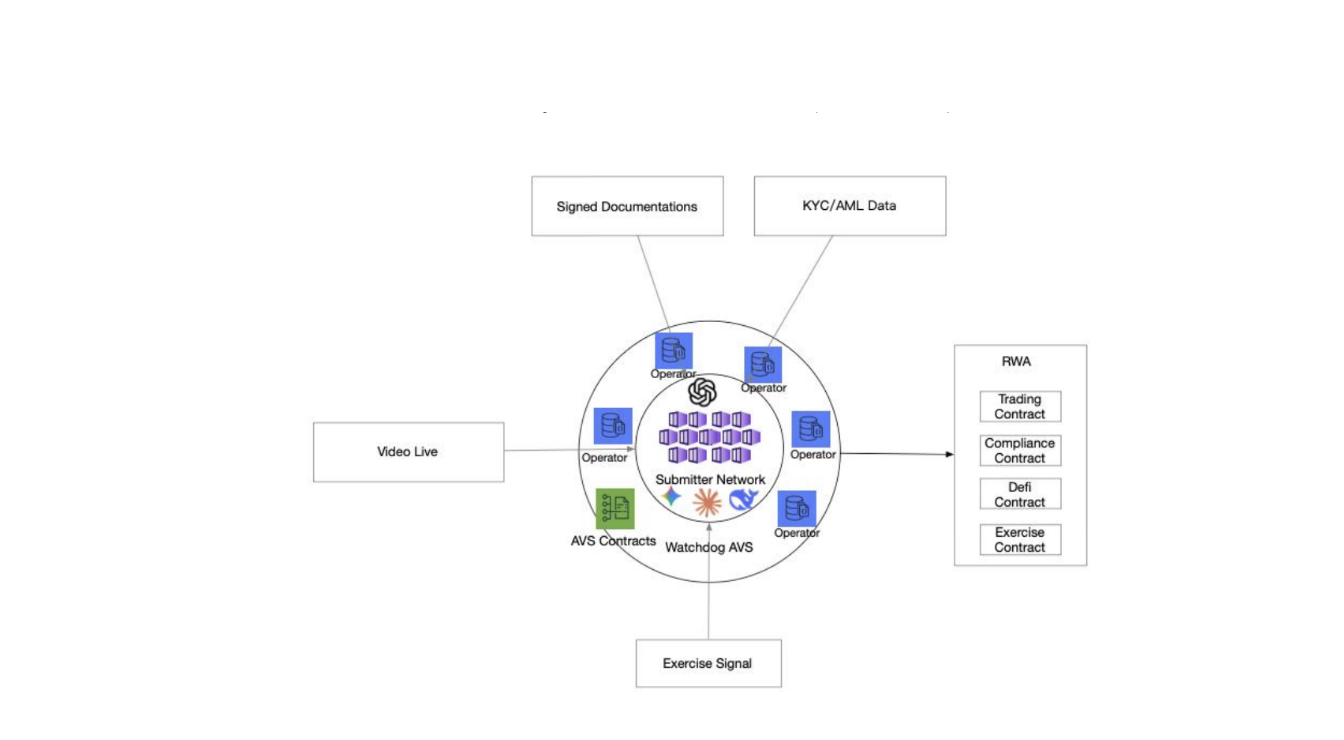
APRO’s architecture is a sophisticated layered system designed to process complex, unstructured data and ensure data integrity during transmission:

The Layered System Architecture 

APRO separates the tasks of data acquisition/processing and consensus/auditing to maximize performance and security.

Layer 1: AI Ingestion (Data Acquisition and Processing)

This first layer (L1) serves as the acquisition and raw data transformation layer.

Artifact Acquisition: L1 Nodes acquire raw data (artifacts) such as PDF documents, audio recordings, or cryptographically signed web pages (TLS fingerprints) via secure crawlers.

Multi-modal AI Pipeline: The Node runs a complex AI processing chain: L1 uses OCR/ASR to convert unstructured data and NLP/LLMs to structure the text into schema compliant fields.

PoR Report Generation: The output is a signed PoR Report, containing evidence hashes, structured payloads, and per field confidence levels, which is ready for submission to L2.

Layer 2: Audit & Consensus (Auditing and Finalization)

Meanwhile, Layer 2 (L2) is the validation and dispute resolution layer, which guarantees the integrity of L1 data.

Watchdogs and Independent Auditing: Watchdog Nodes continuously sample submitted reports and independently recompute them using different models or parameters.Dispute Resolution and Proportional Slashing: The mechanism allows any staked participant to dispute a data field. If the dispute succeeds, the offending reporting Node is slashed proportional to the impact of the error, creating a robust, self correcting economic system.

Dual Data Transport Model and Data Integrity Mechanisms

APRO combines its Layered Architecture with a dual transport model to optimize performance on EVM chains.

Data Push: Delivers finalized data from Layer 2. Following PBFT consensus and dispute resolution, Nodes execute a transaction to push the final data onto the smart contract. Suitable for dApps requiring foundational on chain data availability.Data Pull: Exploits the ultra high frequency performance of Layer 1. L1 allows Nodes to sign high accuracy price and PoR reports off chain at extremely high frequencies. Data Pull is the user-initiated process of fetching and verifying that signed proof on chain, effectively decoupling gas cost from data frequency.

Core Price Discovery and Anti-Manipulation

Data quality is ensured through robust algorithms and consensus mechanisms:

TVWAP Pricing: APRO uses the TVWAP (Time Volume Weighted Average Price) to calculate prices weighted by both volume and time, thereby actively mitigating small-scale price manipulation attempts.

PBFT Consensus and Reputation System: Furthermore, the fast PBFT consensus mechanism is combined with the Validator Reputation Scoring System to ensure Nodes are subject to economic penalties (slashing) if they provide stale or malicious data. Consequently, this approach maintains a strong economic barrier to entry for dishonest actors.

APRO's Core Technology and InnovationAPRO's Core Technology and Innovation

APRO’s Core Technology and Innovation – Source: APRO

Non Standard Oracle Capabilities

APRO’s analytical capabilities extend far beyond conventional crypto Price Feeds, focusing on complex RWA/PoR verticals:

Proof of Reserve (PoR) and Automated Auditing

APRO elevates PoR to an automated auditing function:

Multi modal Source Processing: The L1 AI Pipeline analyzes complex evidence like bank letters or regulatory filings via OCR/LLM.

Legal Consistency: Consequently, L2 performs Reconciliation Rules to ensure totals across documents match (e.g., verifying asset liability summaries), thereby drastically reducing human error and manipulation risks in reserve reporting.

RWA and Niche Scenarios

APRO provides a detailed Oracle Capability Matrix for complex RWA fields, transforming the Oracle into a sophisticated verification tool:

Pre IPO Shares: L2 performs cap table reconciliation, ensuring share counts align with the total authorized shares. Outputs include last round valuation and a provenance index.Legal/Agreements: The Oracle analyzes contracts, extracting obligations and enforceability signals. L2 verifies digital signatures and cross references public court dockets, allowing smart contracts to enforce complex legal terms.Real Estate: APRO processes documents like land registry PDFs and appraisal reports, extracting title/encumbrance facts. L2 can mirror registry snapshots for verification, addressing a core problem of real estate tokenization.

The convergence of the Layered Architecture and the Multi modal AI Pipeline enables APRO to not only deliver faster price data but also to ensure contextual accuracy and institutional grade auditability for the most complex assets.

APRO Tokenomics

APRO’s native utility token is $AT, with a Maximum Supply of 1,000,000,000 tokens.

The $AT token functions as the economic core, driving network security through staking and facilitating data service payments, ultimately promoting platform sustainability.

Learn more: APRO (AT) Will Be Listed on Binance HODLer Airdrops!

Token Allocation

The $AT token allocation structure is designed to balance ecosystem development, security, and initial capital distribution:

Token AllocationToken Allocation

Token Allocation – Source: APRO

Ecosystem: 25%Staking: 20% Investor: 20%Public Distribution: 15%Team: 10%Foundation: 5%Liquidity: 3%Operation Event: 2% 

The combined allocation of 45% to Ecosystem and Staking underscores APRO’s highest priority: enhancing network security and building a robust community of Validator Nodes, which is a prerequisite for a successful next generation Oracle platform.

binance-logo-2binance-logo-2

FAQ

What is APRO? 

APRO is a third generation Decentralized Oracle Architecture designed to deliver High Fidelity Data (extreme accuracy and timeliness). It solves the Oracle Trilemma. Its core innovation is a Layered System. This system uses an AI Pipeline (OCR/LLM) in Layer 1 to transform complex, unstructured data into auditable information. Crucially, APRO specializes in non standard verticals like RWA and Proof of Reserve (PoR).

What is the primary difference between APRO and established Oracle platforms? 

The fundamental difference lies in the Layered Architecture and Data Pull. APRO focuses on High Fidelity Data via the L1 AI Pipeline and uses Data Pull to deliver ultra high frequency data cost effectively on EVM chains.

How does APRO ensure RWA data reliability? 

RWA data is processed by the Multi modal AI Pipeline in L1. RWA data is processed by the Multi modal AI Pipeline in L1. Nevertheless, it must pass L2’s rigorous auditing process. Specifically, this process includes outlier filtering and achieving PBFT consensus from the diverse Node network. Furthermore, L2 also performs Reconciliation Rules for complex financial documents.

What mechanisms protect APRO from price manipulation attacks? 

APRO uses a combination of defenses: TVWAP and outlier rejection algorithms for technical data cleaning, along with the proportional slashing system based on reputation scores to enforce economic honesty.

How does Data Pull remain cost efficient despite frequent updates? 

Data Pull shifts the continuous update burden from the Nodes to the end-user. Nodes sign fresh price proofs off chain (gas free). The user only pays a single gas fee for their transaction, when they pull the signed proof onto the smart contract for verification.


Source link

What Is Dogecoin and Should You Invest in It – NFT Plazas

0
What Is Dogecoin and Should You Invest in It – NFT Plazas


What is Dogecoin, and why are you still hearing so much about it? If you’ve watched the Dogecoin price jump one day and dip the next, you might wonder why this coin gets so much attention. Before you invest your money or even think about adding it to your wallet, you deserve a clear picture of what you’re getting into.

In this article, we walk you through what Dogecoin is and why people still talk about it. Read on to see what sets Dogecoin apart, what drives its value, and whether it could be a smart addition to your investment plans.

What is Dogecoin?

What is Dogecoin?

Dogecoin is a digital currency that started as a light-hearted project but grew into one of the most recognizable cryptocurrencies in the world. If you’ve seen the Shiba Inu dog meme, you already know the face of Dogecoin. The simple Dogecoin definition is that it’s a peer-to-peer cryptocurrency that lets you send money online quickly and at a low cost.

What started as a joke soon developed into a strong community, and people began using it for online tips and charity projects. As more people joined the Dogecoin community, interest in the Dogecoin price increased, and news outlets started covering its fast jumps and dips. Today, Dogecoin feels much bigger than a meme coin. You’ll see people trading it, talking about it, and testing different ways to use it. Understanding where it came from helps you see why it still gets so much attention.

How Does Dogecoin Work?

If you understand cryptocurrency basics, you’ll find that Dogecoin operates in a simple and approachable way. Dogecoin runs on its own blockchain, which is a public record of every transaction. Whenever you send or get Dogecoin, the network records that movement on the Dogecoin blockchain, so everyone can confirm it’s valid.

Dogecoin uses a method called mining, where computers solve quick math problems to keep the network running. When Dogecoin miners do this work, they earn new Dogecoin as a reward. This steady flow of new coins is one reason Dogecoin stays fast and affordable to use. You don’t wait long for a transaction to finish, and the fees are usually low.

Because of this design, Dogecoin feels easy for everyday use. Many people use it to tip creators online, support charities, or make quick peer-to-peer payments. When you explore what is Dogecoin used for, you’ll see that its speed, low cost, and friendly community make it stand out from more complex digital coins. If you’re curious about how Dogecoin fits into your own plans, knowing how it works gives you a clear foundation to build on.

Why is Dogecoin So Popular?

Why is Dogecoin So Popular?Why is Dogecoin So Popular?

Dogecoin’s popularity did not appear overnight. It grew from a mix of internet culture, community energy, and high-profile attention that most cryptocurrencies never experience. When you look at the Dogecoin price and see how often it makes news, it helps to understand the deeper story behind its rise. Even people who explore other digital trends, such as learning how to start buying NFTs, often come across Dogecoin because of its strong online presence. Here is the reason for popularity:

The Role of Memes in Dogecoin’s Popularity

Memes played a major part in shaping Dogecoin’s identity. At a time when most cryptocurrencies felt technical and serious, Dogecoin felt warm, humorous, and welcoming. Many people connected with it instantly because the meme was already well known across social platforms.

That meme origin created a friendly environment that made Dogecoin easy to share, easy to laugh about, and easy to join. People who felt overwhelmed by the complexity of other digital coins found Dogecoin simple and enjoyable. It gave them a way to take part in the crypto world without pressure. Early users often tipped creators online, supported small community causes, or sent Dogecoin as a fun gesture in group discussions.

Elon Musk’s Influence on Dogecoin’s Rise

Elon Musk became one of the strongest forces behind Dogecoin’s rise, and his impact is easy to trace through real events. In early 2021, he posted several tweets that mentioned Dogecoin by name. One of the most widely shared messages simply said Dogecoin is the people’s crypto, and it quickly pushed trading activity to new highs.

Later that same year, Musk continued to bring attention to Dogecoin during interviews and online conversations. When he appeared on Saturday Night Live, people around the world watched to see whether he would mention the coin. He did, which added even more publicity and contributed to another wave of trading activity. Investors were not reacting only to humor.  In 2022 and 2023, Musk hinted that Dogecoin could be used in future payment features across some of his companies. 

Dogecoin’s Value and Market TrendsPost

Dogecoin’s Value and Market TrendsPostDogecoin’s Value and Market TrendsPost

Dogecoin’s value has changed many times since its early days, and those changes tell an important story. When you look at how far the coin has come, you can see how community support, cultural moments, and market activity all shaped its place in the crypto world. Understanding the history behind these movements helps you see why Dogecoin still attracts attention, alongside other major cryptos like Ethereum.

Dogecoin’s Price History From Joke to Serious Player

Dogecoin began in 2013 when Jackson Palmer from Adobe and Billy Markus from IBM created the coin as a playful way to comment on the growing hype around cryptocurrencies. They launched it on December 6, 2013, and within a few weeks, the Dogecoin price jumped sharply. On December 19 of that year, the coin rose more than 300 percent after China restricted its banks from working with cryptocurrencies. The attention brought in new users, and the coin quickly spread across online communities.

The original code for Dogecoin came from Luckycoin, which was based on Litecoin. Early versions even offered a random Dogecoin mining reward before switching to a fixed reward in 2014. Dogecoin uses Scrypt technology and a proof of work system, which helps miners support the network and keep it running.

Over time, interest kept growing. In 2019, Dogecoin reached another milestone when it was listed on the major exchange Binance. By May 2024, its market value had reached more than 24 billion dollars. Dogecoin stayed active because of its loyal miners, strong community, and simple design. The community honored Kabosu, the Shiba Inu behind the famous Doge meme, after the dog passed away in 2024. Many supporters, including Elon Musk, shared messages that renewed public interest.

Factors Influencing Dogecoin’s Market Value

Community strength. A large, active community helps maintain interest and trading activity.Public figures. Mentions from well known individuals often create sudden waves of attention.Market cycles. The overall crypto market affects how quickly Dogecoin rises or falls.Accessibility. Low transaction fees and fast speeds make Dogecoin attractive for everyday use.Cultural moments. Events related to the Doge meme or major news stories can influence demand.

How to Buy Dogecoin

Buying Dogecoin is a simple process, and once you know the steps, you can move through it with confidence. If you are new to crypto, you will find that most platforms follow the same basic setup, and you can get started in just a few minutes. Even if you have explored the best NFT marketplace options or other digital assets before, buying Dogecoin follows a straightforward path that feels easy to understand.

Step 1: Sign up for a crypto exchange

Start by creating an account on one of the top cryptocurrency exchanges. Popular choices include Coinbase, Kraken, and Binance. You will enter basic information such as your name, email address, and phone number. Once your account is created, you can use the platform to explore different digital coins, including Dogecoin.

Step 2: Verify your account

Most exchanges will ask you to verify your identity before you can buy Dogecoin. This usually involves uploading a document that confirms your address and completing a standard Know Your Customer verification. These steps help protect your account and allow you to use all features on the platform.

Step 3: Add money to your exchange account

After verification, you can deposit funds. Depending on your location and the exchange you choose, you might add money with a credit card, debit card, or another payment method supported in your region. The platform will guide you through the process so you know exactly what to do.

Step 4: Find Dogecoin, check the price and make your purchase

Search for Dogecoin, shown as DOGE, in the list of available assets. Before you buy, take a moment to look at the current market price so you know what you are paying. When you are ready, enter the amount you want and complete the purchase. Your Dogecoin usually appears in your exchange wallet within a minute. From there, you can keep it on the exchange or move it to another wallet you prefer.

Dogecoin vs Other Cryptocurrencies

Dogecoin vs Other CryptocurrenciesDogecoin vs Other Cryptocurrencies

Dogecoin stands out because it is simple, fast, and community-driven, which makes it feel more approachable than many digital coins. Bitcoin is often viewed as digital gold, while Ethereum focuses on smart contracts. Litecoin offers quicker speeds than Bitcoin but a more traditional structure. Dogecoin feels lighter and easier to use, especially for newcomers exploring cryptocurrency and testing different coins for the first time.

What is Dogecoin Used For?

Dogecoin is used as a digital currency that allows people to send value online quickly and with low friction. It also functions as a community-driven token that supports tipping and lighthearted online exchanges.

Here are common uses:

Online tipping to reward helpful or creative contentFast peer to peer transfersSmall payments in apps or online communitiesCharity drives and fundraising campaignsPurchasing goods or services from merchants that accept it

The Future of Dogecoin

The future of Dogecoin depends on how strong its community stays, how often people use it, and whether more businesses decide to accept it. Dogecoin benefits from a loyal following, simple technology, and a well-known identity that helps it stay visible even in crowded markets. At the same time, its value can rise or fall quickly because the Dogecoin supply is large and the market is still unpredictable. As of now, the price of Dogecoin sits around $0.14 USD. If you’re wondering what is the price of Dogecoin and what it could become, the future depends on community support and wider adoption.

Conclusion Is Dogecoin Worth Your Investment in 2025?

Dogecoin can be appealing if you like a simple, well-known coin with a strong community behind it. Its fast transactions and loyal supporters give it staying power, but its price can move quickly, and the coin does not have the same long-term purpose as some larger projects. If you choose to invest in 2025, treat it as a higher-risk option and decide how it fits into your wider plans. With the right expectations, Dogecoin can play a role without taking over your strategy.

FAQs

Who created Dogecoin?

Dogecoin was created by Jackson Palmer and Billy Markus in 2013. They built it as a light hearted digital coin inspired by the Doge meme.

Is Dogecoin a good investment?

Whether Dogecoin is a good investment depends on your goals and risk level. It can offer quick gains, but it can also change value quickly.

What are the risks of investing in Dogecoin?

The risks of investing in Dogecoin include fast price swings, limited real world use, and market speculation that can raise or lower the value at any time.

What makes Dogecoin different from Bitcoin?

What makes Dogecoin different from Bitcoin is its faster transactions, lower fees, and a much larger supply, which keeps it more affordable.

Where can I store Dogecoin?

You can store Dogecoin in a crypto wallet, either on a trusted exchange or in a private Dogecoin wallet that gives you full control of your coins.


Source link

The Best Crypto Prop Firms to Join in 2025

0
The Best Crypto Prop Firms to Join in 2025


Finding the best crypto prop firms is the first step to trading with more funding, clearer rules, and room to grow. In 2025, more traders are looking for partners that offer real buying power, simple evaluations, strong crypto support, and payout structures that work in their favor. 

In this guide, we walk you through the top firms, how they operate, what to look for, and how you can join one with confidence. You’ll learn their risk management strategies and how to join. If you want a smooth start with a firm that fits your style, read on to discover your crypto prop firm.

10 Best Crypto Prop Trading Firms in 2025

Prop FirmRatingPairsBTCETHSOLMax LeverageCrypto FeesCrypto DepositCrypto WithdrawalBrightFunded9535+YesYesYes5:1$0YesYesDNA Funded97120+YesYesYes2:10.1%YesYesFundedNext9210YesYesNo2:1$0YesYesBlueberry Funded9352YesYesYes2:1$0YesYesFunded Prime80250+YesYesYes1:1 crypto, 10:1 meme coins0.1%YesYesFTMO8310YesYesNo1:1$0YesYesFunded Trading Plus774YesYesYesNone$0YesYesHyroTrader726YesYesNo2:1$0YesYesThe Funded Trader655YesYesYes2:1 (1:1 funded)$0YesYesApex Trader Funding332YesYesNoFutures contract specs$1.02 microNoNo

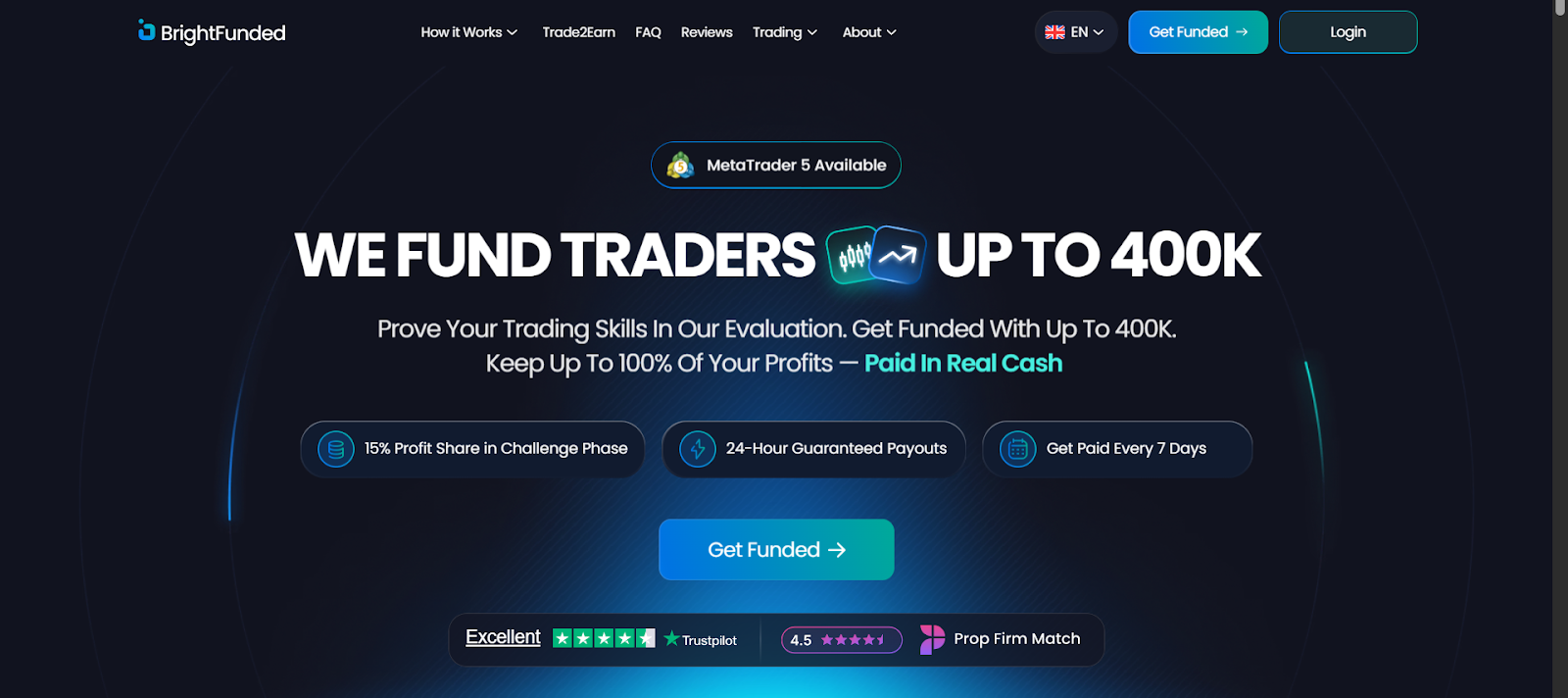
1. BrightFunded – Best Overall Crypto Funding Experience
BrightFunded – Best Overall Crypto Funding Experience

BrightFunded gives you a clean trading environment with funding options that feel simple from the moment you start. You get a wide range of crypto markets, fair leverage, and a setup that helps you stay focused on your strategy. The zero-fee trading model keeps your costs predictable, and deposits and withdrawals in crypto make account handling smooth. Traders also like how the rules stay consistent, which helps you plan long-term without distractions. As one of the best crypto prop firms, BrightFunded gives you a stable foundation for serious trading.

BrightFunded works well when you want a program that rewards consistency. The scaling model lets you grow over time, and payouts move quickly when you qualify for upgrades. The structure feels similar to how to compare crypto exchanges platforms, making it clear, direct, and easy to understand. If you want a steady, reliable start inside a funded environment, BrightFunded offers one of the strongest paths among the best crypto prop trading firms.

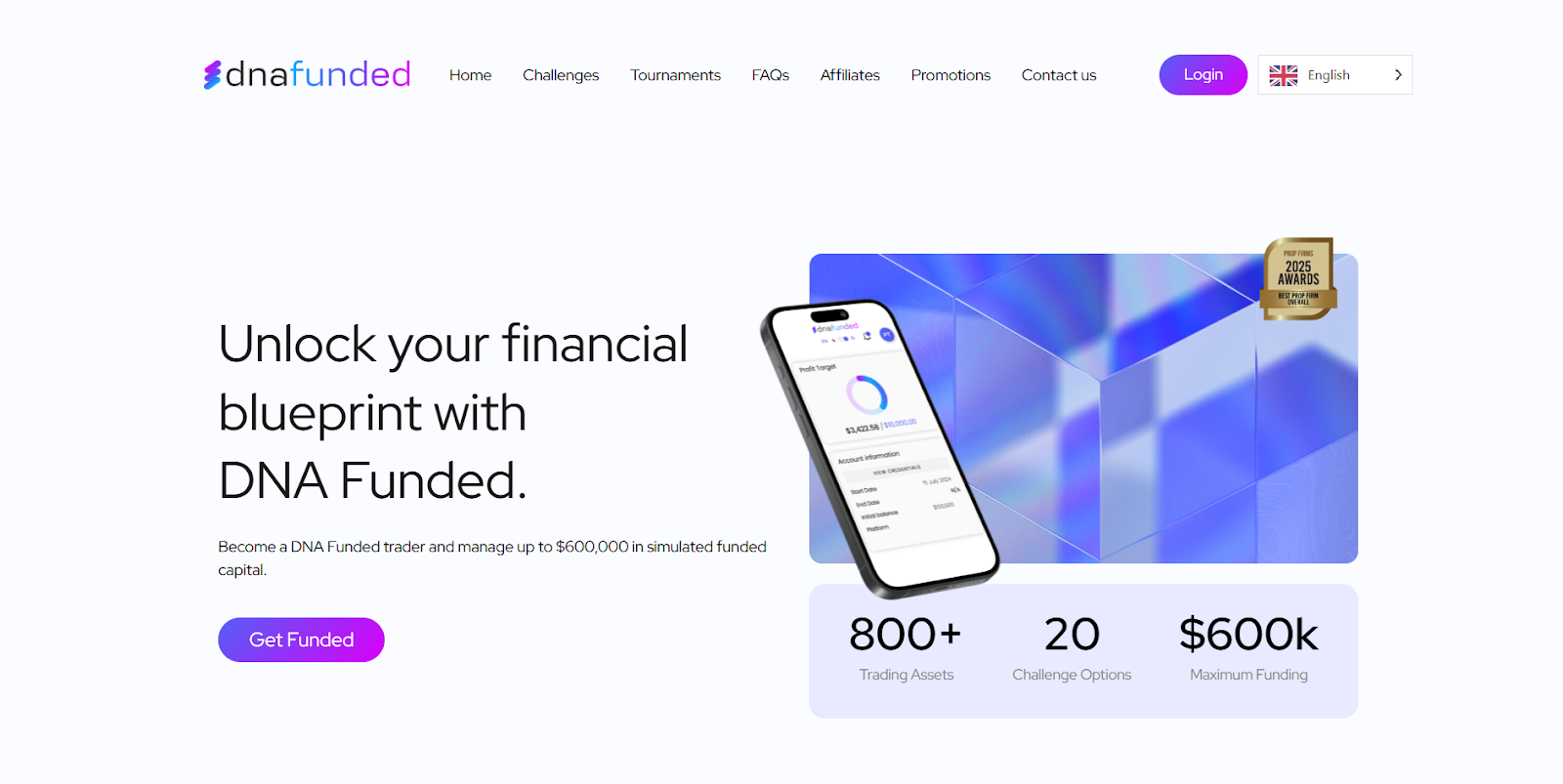
2. DNA Funded – Broad Market Access for Crypto-Focused Traders
DNA Funded – Broad Market Access for Crypto-Focused TradersDNA Funded – Broad Market Access for Crypto-Focused Traders

DNA Funded is known for offering one of the largest crypto selections in the industry, giving you access to more than a hundred markets during evaluation. This depth lets you test strategies that rely on volatility, sector rotation, or cross-market correlation. The 2:1 leverage cap supports healthier risk management, while the flat 0.1% fee keeps trading costs predictable. DNA also supports crypto deposits and withdrawals, which simplifies account handling if you prefer holding stablecoins or rotating capital through exchanges.

The evaluation remains fair and structured, allowing you to progress through funding stages without hidden challenges or unclear rules. Traders who value transparency often find DNA Funded easier to work with because you always know what’s required to advance. If you’re researching how to compare crypto trading platforms, DNA’s structure gives you the clarity on fixed fees, consistent execution, and a layout that encourages disciplined development over speculation. It’s a solid option inside the best crypto prop trading firms category.

3. FundedNext – Flexible Funding With Smooth Withdrawals

FundedNext – Flexible Funding With Smooth WithdrawalsFundedNext – Flexible Funding With Smooth Withdrawals

FundedNext gives you different evaluation styles, including fast-track options, which help you start trading funded capital sooner. The crypto support is straightforward, the leverage is manageable, and there are no added commissions on trades. You also get regular payout cycles that keep your withdrawals predictable. The onboarding experience feels simple, and you don’t get overwhelmed with rules. Many traders enjoy how easy it is to settle into FundedNext’s system.

The flexibility is what gives FundedNext its edge. You can choose the model that matches your style without feeling boxed in. Traders who want structure but still want room to adjust often find this balance helpful. FundedNext remains a strong choice among the best crypto prop firms for traders who want freedom without friction.

4. Blueberry Funded – Good Choice for Strategy-Driven Traders

Blueberry Funded – Good Choice for Strategy-Driven TradersBlueberry Funded – Good Choice for Strategy-Driven Traders

Blueberry Funded offers a wide crypto selection and keeps things simple with moderate leverage and zero trading fees. You can test different ideas without dealing with complex restrictions. The firm accepts crypto deposits and withdrawals, which helps you manage your account efficiently. Traders who prefer rules that stay consistent often enjoy Blueberry because you can focus more on your trading rather than worrying about sudden changes.

Many traders see Blueberry as a calm and dependable place to develop their style. The evaluation format encourages discipline, and the environment feels organized. Because of this stability, Blueberry suits traders who want reliable conditions while working with a crypto prop firm. If you value predictable steps and clear expectations, Blueberry remains a comfortable pick among the best crypto prop trading firms.

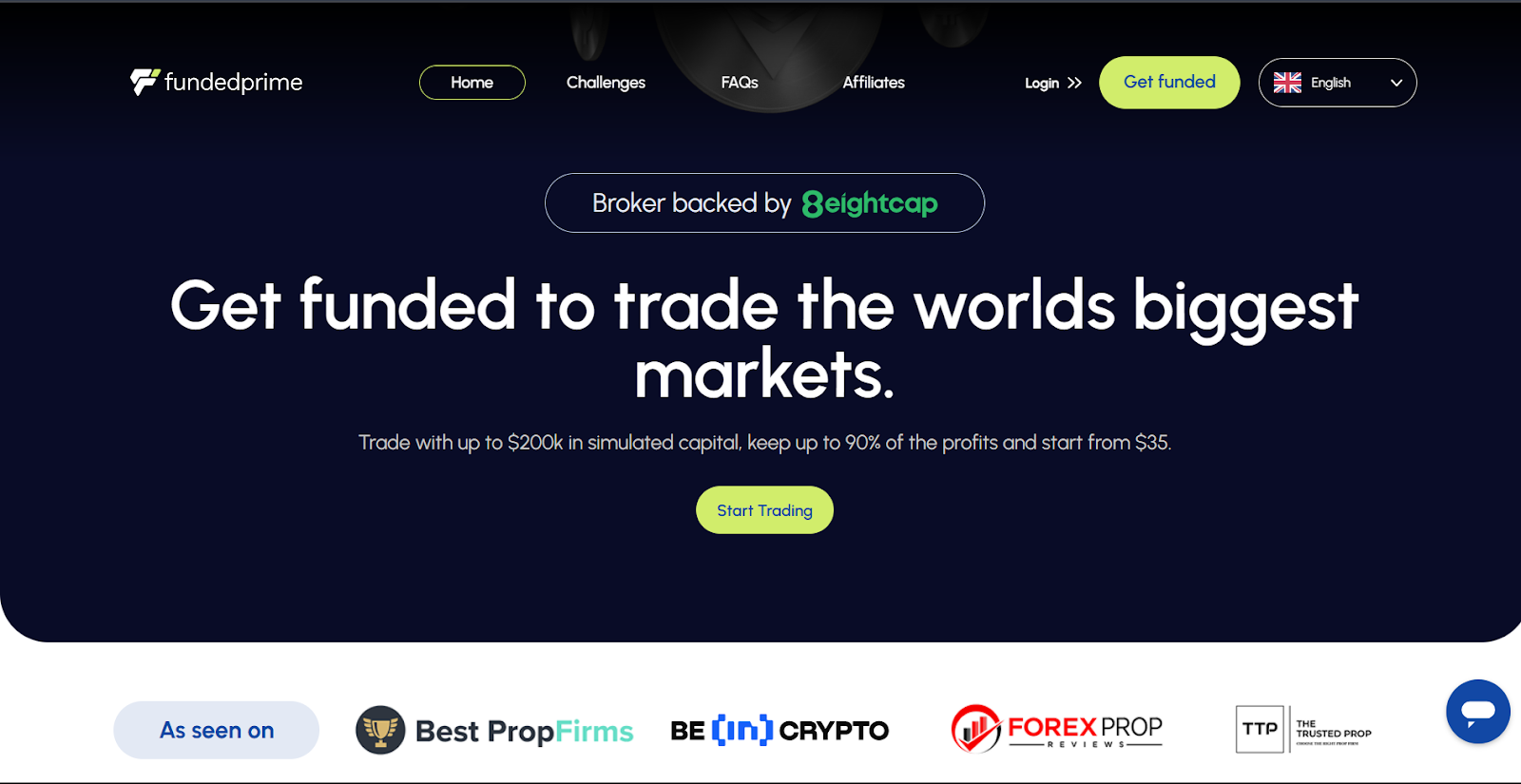
5. Funded Prime – Large Market Variety and Meme-Coin Access
Funded Prime – Large Market Variety and Meme-Coin AccessFunded Prime – Large Market Variety and Meme-Coin Access

Funded Prime offers one of the largest crypto markets among funded platforms, with hundreds of assets, including emerging and high-volatility options. The trading conditions are simple: standard crypto trades use 1:1 leverage, while meme-coin trades can go up to 10:1. A flat 0.1% trading cost keeps fees transparent, and the program supports crypto deposits and withdrawals. This broad selection makes Funded Prime appealing for traders who like switching between slow and fast markets depending on volatility cycles.

The platform suits traders who thrive on variety rather than narrow markets. The evaluation process is direct, without layered restrictions, which helps you test different systems under consistent rules. If you adjust your approach often or rely on scanning multiple markets for opportunity, Funded Prime provides enough range to feed that style. It’s a strong option for traders who want choice and flexibility when reviewing the best crypto prop trading firms.

6. FTMO – Structured Crypto Program for Disciplined Traders

FTMO – Structured Crypto Program for Disciplined TradersFTMO – Structured Crypto Program for Disciplined Traders

FTMO keeps its crypto offering focused and its rules very clear. You get a well-tested evaluation process, simple fee structure, and steady conditions that support disciplined trading. Crypto deposits and withdrawals make things easier if you use digital assets for everyday transactions. FTMO’s scaling plan helps you sharpen your trading habits.

Traders choose FTMO because of its reputation, stability, and the clean structure that removes unnecessary steps. You know exactly what to expect, and that predictability helps you stay confident. FTMO fits traders who want a calm, rule-based environment while trading crypto with funded capital. If you want a trusted name with a proven path, FTMO remains one of the best crypto prop trading firms for sustained growth.

7. Funded Trading Plus – Simple Crypto Setup With Fast Access

Funded Trading Plus – Simple Crypto Setup With Fast AccessFunded Trading Plus – Simple Crypto Setup With Fast Access

Funded Trading Plus keeps things minimal and clean. The small crypto list gives you a focused place to work, and the absence of leverage helps you control your risk. Zero trading fees and support for crypto deposits and withdrawals make everyday operations simple. Many traders like how quick the funding process feels.

FTP fits traders who don’t want complicated programs. You get quick payouts, light rules, and a friendly pace that helps you settle in without stress. If you prefer a simple layout and steady steps, Funded Trading Plus offers a predictable route. It’s a useful option inside the best crypto prop firms if clarity matters more to you than a large asset list.

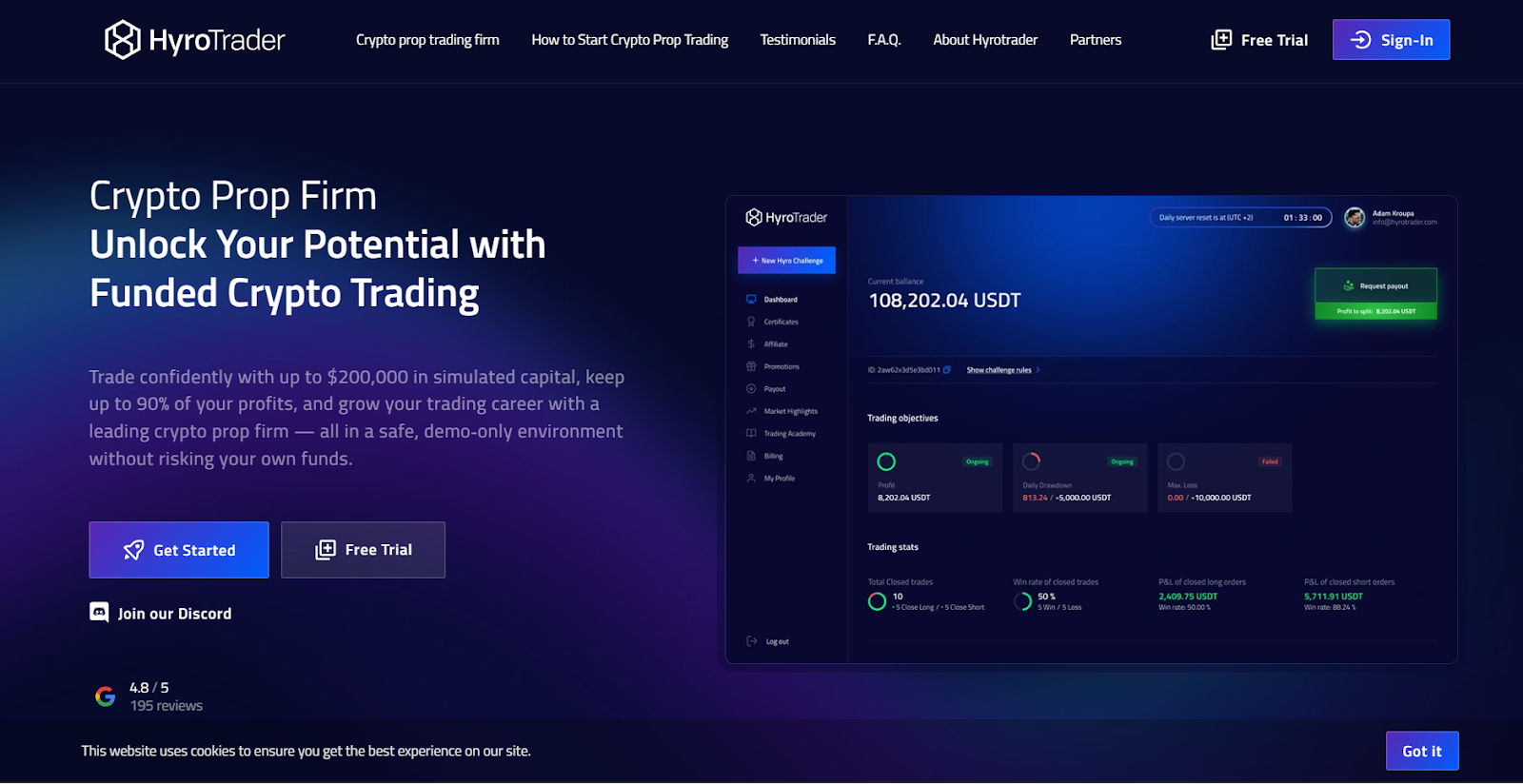
8. HyroTrader – Fast Execution and Real-Market Feel
HyroTrader – Fast Execution and Real-Market FeelHyroTrader – Fast Execution and Real-Market Feel

HyroTrader stands out because it lets you trade crypto through real exchange connections, including API integration with major platforms. This gives you cleaner execution, fewer pricing inconsistencies, and a more realistic trading environment compared to synthetic feeds. The program supports zero-fee crypto trading and offers fast, on-demand payouts, usually processed within 24 hours in USDC or similar assets. This combination makes HyroTrader one of the most trusted choices for traders who want transparent execution.

You start with a 70% profit split that can scale up to 90% as you show consistency. HyroTrader’s refundable evaluation fee makes the entry process more beginner-friendly, pass your evaluation, get funded, earn your first payout, and your basic fee is returned. The setup feels close to what you’d expect when applying the top methods to find lowest fee crypto exchange, clean and predictable. HyroTrader stands out as one of the best crypto prop trading firms for traders who want speed and simplicity.

9. The Funded Trader – Balanced Crypto Access With Steady Scaling

The Funded Trader – Balanced Crypto Access With Steady ScalingThe Funded Trader – Balanced Crypto Access With Steady Scaling

The Funded Trader gives you a small set of crypto markets with clear leverage rules and zero trading fees. You can deposit and withdraw in crypto, which helps you move efficiently when you need funds quickly. Traders like how approachable the evaluation is, and the system feels supportive rather than strict. It’s easy to settle into the trading environment.

This firm suits traders who want a consistent path to scale. The rules stay clear, and you always know your limits. Many traders stay because the platform feels friendly, organized, and predictable. If you want a crypto prop firm that keeps things balanced without overwhelming detail, The Funded Trader is a solid pick.

10. Apex Trader Funding – Futures-Based Crypto Access

Apex Trader Funding – Futures-Based Crypto AccessApex Trader Funding – Futures-Based Crypto Access

Apex Trader Funding gives you crypto exposure through futures contracts rather than spot markets. This setup appeals to traders who prefer structured contract trading with clear tick values and risk parameters. Fees are small and fixed through micro contracts, allowing you to calculate costs easily. Although Apex doesn’t support crypto deposits or withdrawals, its fast payout system remains attractive for experienced futures traders who want straightforward rules and consistent execution.

Apex is particularly strong for traders who already understand futures logic and want a funded environment that fits their skill set. The early profit-share advantage, keeping the first $25,000 you earn. While its crypto offering is smaller than spot-based firms, the futures framework gives you different opportunities to manage risk and volatility. Apex holds a unique place inside the best crypto prop trading firms due to its focused, contract-driven approach.

What Is a Crypto Prop Firm?

A crypto prop firm is a company that gives traders access to trading capital so you can trade crypto without using your own money. Instead of depositing your own funds, you take an evaluation or challenge where you prove you can trade responsibly, follow risk rules, and maintain consistency. Once you pass, the firm assigns you a funded account. You trade that account, keep a share of the profits, and the firm covers any losses according to its rules. This structure lets you grow faster than if you relied only on your personal capital.

A crypto vetted  prop firm also provides clear trading conditions, risk limits, and payout systems so you can work in a predictable environment. Most firms monitor metrics like drawdown, lot size, and position limits to protect both you and the funding capital. For traders coming from other parts of the digital asset space, such as those exploring the best NFT marketplaces for beginners, this setup appeals because it offers meaningful buying power without taking large personal financial risks. It also suits traders who want structure, accountability, and a framework built around long-term discipline.

How Do Crypto Prop Trading Firms Work?

Crypto prop trading firms give you access to trading capital so you can trade digital assets without risking your own money. You begin with an evaluation or challenge where you follow clear rules related to profit targets, drawdown limits, position sizing, and overall risk. You pay a fee to enter the evaluation, and the goal is to prove that you can trade with discipline. When you meet all the requirements, the firm assigns you a funded account where you trade real capital, similar to operating on the best crypto trading platform where performance and risk management are prioritized. Your earnings are then shared through a profit split that generally favors you, while the firm absorbs losses within the risk framework.

Behind the scenes, most prop firms use automated systems and risk tools to monitor trading activity in real time. Many use algorithmic infrastructure to manage order flow, enforce risk limits, and adjust exposure. This automated layer helps reduce errors and keeps the trading environment stable even when markets move quickly. It also allows the firm to maintain fairness for all funded traders by ensuring that risk rules are followed consistently. For you, this means you can focus on strategy while the firm handles capital oversight and execution stability.

The process is simple once you understand the flow. You choose a plan, complete the evaluation by following the rules, and receive a funded account. You continue trading while respecting the same risk limits that carried you through the evaluation. When you generate profits, you receive your share based on the firm’s payout model. Some firms allow you to scale your account if you maintain consistency, which increases your buying power over time. This structure turns skilled traders into capital backed traders by giving you the leverage to grow without risking personal savings.

Pros and Cons of Crypto Prop Trading Firms

Pros

You can trade with larger capital without risking your own money. Profit splits allow you to keep most of what you earn.Risk rules help you build discipline and consistency.Many firms support crypto deposits and fast withdrawals.Scaling plans help you grow your funded account over time.

Cons

Breaking risk rules results in losing the account.Profit targets can feel challenging during slow markets.Payout schedules and withdrawal minimums vary by firm.Some evaluations require fees that may not be refunded.Limited trading hours or restrictions can affect some strategies.

How to Choose the Best Crypto Prop Firm for You

Choosing the right crypto prop firm starts with knowing what matters most to your trading style. You want a firm that gives you room to grow, protects your capital, and offers trading conditions that fit your strategy. Here are the six factors that help you make a confident decision when choosing the best crypto prop platform.

1. Trading Conditions and Supported Crypto

Check the number of crypto pairs, leverage, spreads, and execution quality. If you trade volatile markets, you need stable pricing and predictable conditions. A firm with a strong crypto selection gives you more freedom to test and adjust trading strategies.

2. Profit Split and Scaling Potential

Your long-term success depends on how much you keep from your profits. Look for a firm with a high profit split and a clear path to scale your account. Scaling helps you increase buying power without increasing personal risk.

3. Evaluation Difficulty and Rules

Some firms have simple evaluations with realistic profit targets. Others add strict rules that slow your progress. Match the evaluation to your experience level. A balanced evaluation helps you grow without feeling restricted.

4. Payout Speed and Withdrawal Options

Fast payout processing helps you manage cash flow. Firms that support crypto withdrawals give you the benefit of quicker settlements. Always check minimum withdrawal amounts and how often you can request payouts.

5. Fees and Refund Policies

Evaluation fees can vary. Some firms return your fee once you pass and complete a funded payout. This helps reduce upfront cost. Look for clear pricing that aligns with your budget and long-term goals.

6. Platform Reliability and Risk Controls

A reliable platform with strong risk tools protects both you and the firm. Look for consistent execution, stable servers, and clear risk rules. A strong risk framework helps you trade with confidence and focus on strategy.This approach lets you choose a firm that fits your goals and supports your growth as a funded crypto trader.

Risk Management for Prop Traders

If you’ve spent any time around prop trading, you already know that managing risk isn’t just a nice extra. It’s the thing that keeps you in the game. You can have great instincts, sharp analysis, and solid setups, but without good risk habits, one bad day can wipe out weeks of progress. And just like learning what is an NFT helps newcomers avoid costly mistakes in digital asset markets, understanding risk management keeps traders from blowing up their accounts. Here are some risk management strategies: 

Always Start With a Clear Trading Plan

Your plan is your anchor. It gives you direction when the market starts moving too fast or when emotions try to take over. Top traders don’t rely on memory or good intentions. They write everything down. This includes what pairs or assets you’ll trade, your setup, your stop loss, your take profit, and how you’ll size your trades.

Stick to Your Daily Loss Limit

This is one of the hardest things for new prop traders. A daily loss limit is the maximum amount you’re allowed to lose in a single day. Once you hit it, you stop trading, no matter what. It protects you from revenge trading and emotional decisions.

Use Stop Losses on Every Single Trade

A stop loss is your preset exit level. It protects you from large unexpected moves and keeps you from holding losing trades while you hope they’ll turn around. Using a stop loss doesn’t make you weak. It makes you disciplined. And discipline is what separates long term traders from short term gamblers.

Keep Your Position Size Reasonable

You don’t need to go big to win big. Top prop traders size their trades based on their account size, volatility, and how often they expect their edge to play out. When you keep your positions balanced, one loss doesn’t crush you. You stay calm, and that leads to clearer decisions. Most consistent traders risk only a small percentage of their account on each trade. That keeps them steady even during losing streaks.

Stay Calm and Avoid Emotional Trading

Emotions can ruin even the best strategy. Fear makes you exit too early. Greed makes you hold too long. Frustration pushes you into trades you’d normally avoid.

Professional traders stay self aware. If they feel stressed, tired, or angry, they either take smaller positions or step aside completely. Your mental state is part of your risk management plan. Protect it the same way you protect your capital.

How to Join a Crypto Prop Trading Firm

If you are ready to take your trading to the next level, joining a crypto prop firm can open the door to larger capital and a more serious trading environment. Before you begin, it helps to understand what is cryptocurrency trading so you know the risks and rewards involved. Here are the five steps most traders follow when joining the best crypto prop firms.

Step 1. Research the best crypto prop trading firms

Start by comparing real companies that have a strong presence in the market. For example, BrightFunded is known for clean rules and fast crypto payouts. DNA Trading offers solid evaluation options and strong support for active crypto traders. FTMO is widely known in the trading world and recently expanded its crypto lineup. Looking at firms like these gives you a good sense of what is standard, what is fair, and what fits your style.

Step 2. Choose an evaluation or challenge account

Most crypto prop firms use a challenge model. This is where you trade under set rules to show you can handle risk. BrightFunded and DNA offer one and two-phase evaluations, while FTMO has a clear two-step model. Pick the account size that feels safe for your skill level.

Step 3. Study the rules and build a clear trading plan

Each firm has its own rules for drawdown, leverage, and profit targets. Spend time learning these before you take your first trade. Create a plan that explains when you trade, what setups you look for, and how you protect your capital. A simple plan helps you stay calm when the market moves fast.

Step 4. Complete the evaluation with discipline

Your goal is not to rush. Your goal is to show consistency. Crypto markets can be fast, so avoid overtrading. Focus on small, controlled decisions that follow your plan from start to finish.

Step 5. Get funded and begin trading firm capital

Once you pass, you receive a funded account and keep a portion of the profits. Funded Prime, Hyrotrader, and FTMO all offer scaling plans that reward steady performance, which helps you grow your funded account over time.

Conclusion

Crypto prop trading gives you a path to trade digital assets with meaningful buying power while keeping your personal risk low. You trade the firm’s capital, follow clear rules, and earn through profit splits that reward consistent performance. This model works well for traders who value structure, discipline, and long-term growth. When you choose a firm that matches your strategy and follow a simple risk plan, you set yourself up for stable progress rather than fast swings.

The best crypto prop firms offer clear evaluations, strong payouts, and conditions that help you focus on trading rather than platform issues. With the right choice and steady execution, funded trading becomes a practical way to build your trading skills and grow your results in the crypto markets.

FAQs

What’s the best crypto prop firm?

The best crypto prop firm depends on your trading style, but many traders choose BrightFunded or DNA Funded for their stable conditions, wide crypto access, and consistent payouts. These firms combine clear evaluations with strong funding options, which makes them reliable choices for long-term growth.

Are crypto prop firms safe and legit?

Yes, most proprietary trading firms are safe and legit as long as they publish clear rules, provide stable trading conditions, and offer transparent payout histories. A legitimate firm will outline risk limits, profit splits, and evaluation criteria. Traders should avoid firms that hide rules or make unrealistic promises.

Does FTMO have crypto?

Yes, FTMO has crypto. You can trade several cryptocurrency instruments on their platform, although the leverage is lower compared to other assets. FTMO focuses on providing stable conditions and structured evaluations rather than offering a wide crypto selection.

What is the best prop firm to trade futures?

The best prop firm to trade futures is Apex Trader Funding if you want a futures-first environment with clear rules and fast payouts. Traders who prefer platform stability and long-term scaling often choose Apex because it is built specifically for contract-based markets.

What can you trade on a crypto prop firm?

On a crypto prop firm, you can trade a mix of cryptocurrency markets. This usually includes major coins, selected altcoins, and in some cases meme-coin markets or crypto-futures contracts. The exact offerings depend on the firm, but most provide enough variety for day trading, swing trading, or high-volatility strategies.

Do crypto prop firms pay in crypto?

Yes. Many crypto prop firms pay in stablecoins such as USDT or USDC. This makes payouts faster, reduces banking delays, and helps traders gain access to earnings with fewer restrictions.



Source link

Why Some Big Tech NFT Projects Are Shutting Down and What We Can Learn

0
Why Some Big Tech NFT Projects Are Shutting Down and What We Can Learn


During the initial days of the NFT boom, large tech firms have been stampeding to enter the digital collectables industry. Brands opened marketplaces, collaborated with artists, and invested intensively in Web3 activities. With the buzz at its highest, it was almost a given that big tech would take up the ownership of the next generation of the digital world. However, dozens of high-profile NFT platforms backed by major enterprises have been quietly shut down or scaled back to a minimal level in recent years.

Such shutdowns raise some crucial questions regarding the sustainability of NFT programs led by companies and what these changes can tell the wider industry. This reflection is even more applicable when investors continually monitor variables such as the bitcoin price, which tends to influence the level of enthusiasm towards digital assets in general.

The Coming and Falling of Corporate NFT Platforms

The hype of NFTs went into mainstream news and it appeared to be of universal interest. Cash giants, gaming firms, television personalities, and tech giants joined the market with grandiose offers. For large enterprises, NFTs were a means to expand into new digital economies, tap into new audiences, and participate in a cultural phenomenon characterised by blockchain innovation.

However, between 2024 and 2025, the story began to change. Specific corporate NFT markets experienced a significant decline. Some were in the shadow of more nimble rivals, or were unable to retain users once launched. Numerous large tech NFT initiatives were cancelled, often silently, and, in some cases, with a public rationale of their shifts to other digital directions. Despite the varied contexts of every shutdown, some common themes persist throughout the industry.

Misaligned Expectations Between Corporations and Users

The lack of alignment between corporate objectives and user expectations can be considered one of the primary reasons why big tech NFT initiatives have failed. Many companies regarded NFTs as a continuation of a brand or a new source of monetisation. They created platforms that focused on controlled ecosystems, curated content or brand-based experiences.

Nevertheless, the NFT community appreciates decentralisation, open ownership, and the freedom to trade assets between platforms freely. Marketplaces in the corporate world that were restrictive or lacked interoperability did not appeal to the core Web3 users. What is more problematic is that specific platforms require users to go through a complicated onboarding process, which negates the idea of owning something digital.

Consequently, business portals would tend to receive interested visitors during an opening, but could not sustain them. Unless there was long-term community involvement or persuasive usefulness, user participation dwindled.

Absence of Long-Term Vision and Real Utility

The second similar problem was the absence of a long-term roadmap. A vast number of corporate NFT projects were introduced during the hype cycle, driven by a desire to be left behind rather than a genuine belief in their value. Once the initial buzz died down, these platforms struggled to explain why people should continue coming back.

Furthermore, the NFT market has already developed rapidly, no longer being speculative collectables but those that serve a purpose. The new successful projects provide advantages in the form of membership, gaming options, virtual identity, or even real-life rewards. Big tech platforms that focused solely on digital art were often left behind, as they struggled to evolve their offerings to meet the changing needs of consumers.

Corporate Caution, Risk, and Compliance

Big tech companies exist under the firm control of the regulators. As governments began to examine the legal and financial implications of NFTs, including securities issues, consumer protection concerns, and intellectual property risks, corporations became increasingly concerned.

Moreover, operating an NFT marketplace is a more complex process than it may seem at first. The problem of stolen paintings, fake sales, unstable prices, and unclear tax systems poses a threat to both the company and its users. Numerous companies concluded that their NFT platform needed additional legal and compliance resources, which are not worth the projected revenue.

Such a conservative stance is in stark contrast to the independent Web3 developers, who are usually eager to move quickly and iterate. Corporate caution, though empathetic, may kill innovation.

NFT Market Cycles and Shifts in User Interest

The market circumstances were also significant. With NFT trading experiencing a downturn across the industry, even successful platforms have seen a decline in trading activity. Hypes around collectables subsided, giving way to utility tokens, tokenisation of real-world assets, and gaming NFTs. Those companies that had placed excessive emphasis on the art or collectable business suffered most.

Additionally, there was a shift in user interest towards decentralised and community-based ecosystems. Those platforms which did not generate community loyalty or provide a unique value over brand recognition found it challenging to stay relevant.

The Lessons Moving Forward

The closure of large tech NFT projects is not an indicator of the death of NFTs. Instead, it carries valuable lessons for companies and developers.

First, authenticity matters. Consumers can sense when companies prioritise a purely profit-driven approach over genuine engagement. Effective NFT programs require regular communication, community engagement, and clear articulation of intentions.

Second, utility must be prioritised. The upcoming NFT consumer usage will be centred on access passes, identity layers, in-game owned assets, and tokenised real-life objects. Firms which are innovative in such aspects will be more established.

Third, it needs to be decentralised and interoperable. Users desire NFTs that are interoperable and can cross ecosystems, retain value, and be integrated with various platforms. Digital assets cannot achieve their full potential in closed corporate settings.

Lastly, it is essential to be patient and look at the long term. NFT markets are cyclical, and no serious adoption can be achieved with a temporary marketing campaign.


Source link

Popular Posts

My Favorites