Arts

Home Arts Page 23

Best Decentralized Crypto Exchange in 2026: Full Review – NFT Plazas

0
Best Decentralized Crypto Exchange in 2026: Full Review – NFT Plazas


Decentralized exchanges (DEXs) allow users to trade digital assets directly from their wallets without relying on centralized platforms. Unlike traditional exchanges, DEXs rely on smart contracts to automate trading, giving users full control over their funds while maintaining transparency and security.

With dozens of DEXs available across multiple blockchains, choosing the right one can be overwhelming. In this article, we review the top 10 decentralized exchanges, compare their features, fees, and supported networks, and provide insights to help traders make informed decisions.

Top Decentralized Crypto Exchanges Compared

ExchangeSupported ChainsTypeTrading FeesBest ForHyperliquidNative Layer 1 onlyPerpetual Futures DEXLow fees and gas-free tradingAdvanced derivatives and leveraged tradingUniswapEthereum, Arbitrum, Base, PolygonAMM spot trading0.05 –0.30% Token swaps and liquidity provision0x ProtocolEthereum, Optimism, Arbitrum, AvalancheAggregator/InfrastructureVaries by integrating DEXAggregated liquiditydYdXEthereum L2 (dYdX Layer 2)Perpetual Futures DEX0–0.15% maker, 0.20% takerAdvanced derivatives and margin tradingSushiSwapEthereum, Polygon, Arbitrum, FantomAMM spot trading0.25% per swapMulti-chain token swaps and decentralized finance (DeFi) featuresPancakeSwapBNB Chain, Avalanche, Fantom, PolygonAMM spot trading0.25% per swapLow-cost swaps on multiple chainsCurve FinanceEthereum, Polygon, Optimism, AvalancheAMM Stablecoin DEX0.04%–0.50% depending on poolStablecoinsRaydiumSolanaAMM plus order book hybrid0.25%Fast Solana swaps and DeFi featuresKuma (IDEX)Ethereum, Polygon, ArbitrumHybrid DEX (Off-chain match, on-chain settlement)0.1%–0.35%ERC-20 spot trading with advanced order typesApeSwapBNB Chain, Polygon, AvalancheAMM spot trading0.25%Multi-chain swaps, staking, and yield farming

10 Best Decentralized Exchanges (DEXs) in 2026 for Crypto Trading

1. Hyperliquid – Best decentralized exchange for perpetual futures trading
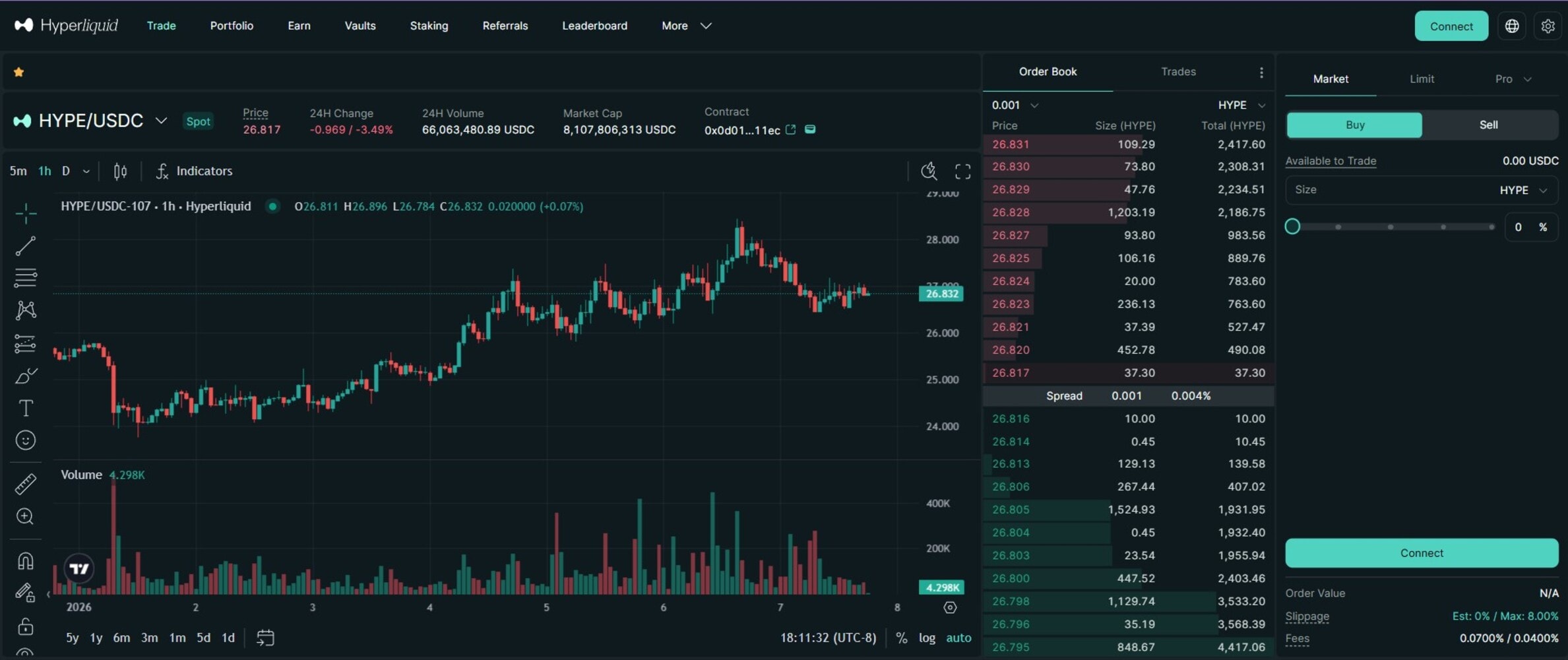
Hyperliquid – Best decentralized exchange for perpetual futures trading

Hyperliquid is a decentralized exchange focused on perpetual futures trading. The protocol combines an on-chain order book with high-throughput infrastructure, enabling users to trade derivatives without relying on a centralized authority or custodial accounts.

The platform operates entirely on its native blockchain, which is optimized for low latency and fast transaction finality. This design enables real-time order matching and execution speeds comparable to centralized trading platforms while maintaining on-chain settlement and transparency.

hyperliquidhyperliquid

Pros of Hyperliquid

Fully on-chain order book with transparent trade executionPerpetual futures trading with leverage up to 50×No gas fees for order placement or cancellationSupports advanced order types and cross-margin trading

Cons of Hyperliquid

Primarily focused on derivatives, with limited spot trading optionsHigh leverage increases risk for inexperienced traders

2. Uniswap – Best decentralized exchange for token swaps and liquidity provision
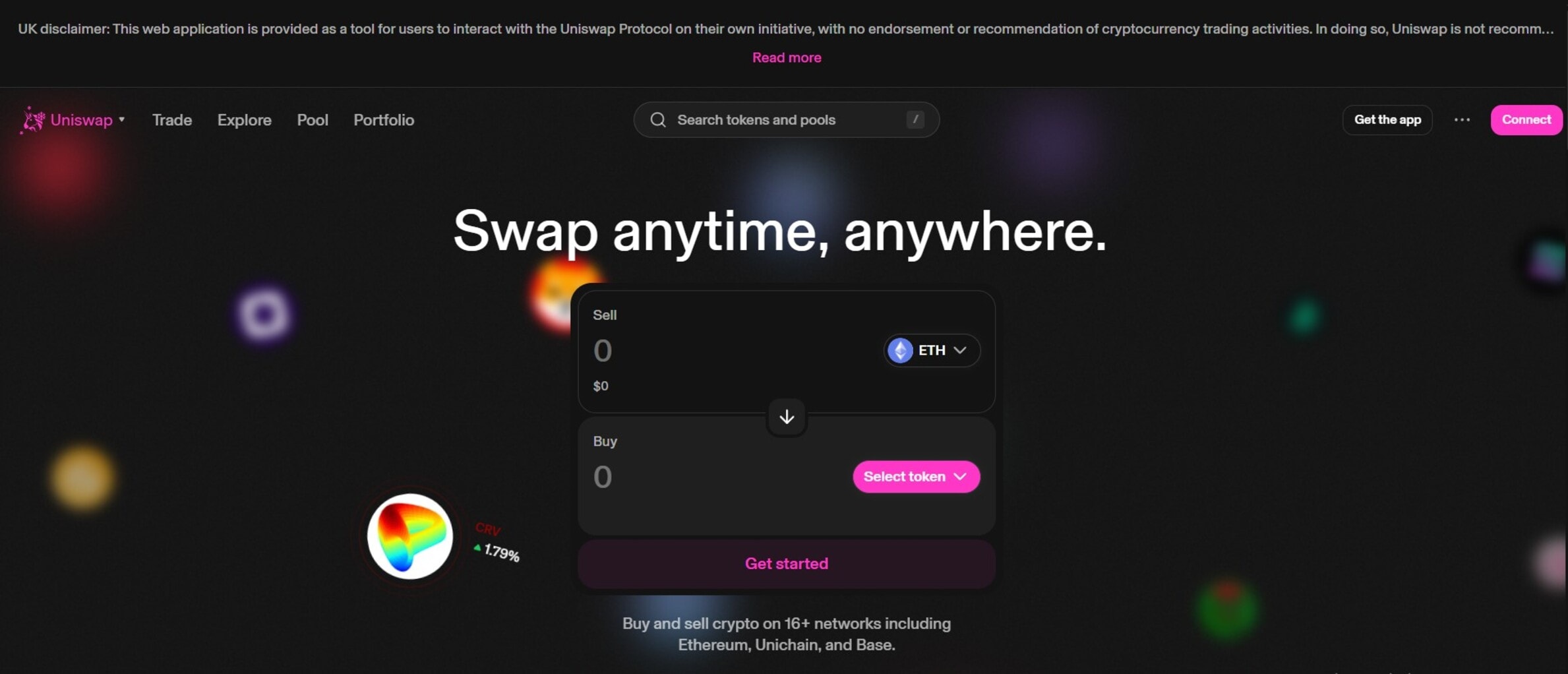
Uniswap – Best decentralized exchange for token swaps and liquidity provisionUniswap – Best decentralized exchange for token swaps and liquidity provision

Uniswap is a decentralized cryptocurrency exchange designed for permissionless token swapping on Ethereum and other supported blockchains. It operates using an automated market maker (AMM) model rather than an order book, allowing users to trade directly against liquidity pools supplied by other users.

In addition to token swaps, the protocol allows users to provide liquidity to pools and earn a share of transaction fees. Uniswap has also introduced concentrated liquidity, which enables liquidity providers to allocate capital to specific price ranges to improve capital efficiency.

Pros of Uniswap

Supports a large number of tokens and trading pairsLiquidity providers can earn fees from trading activityFully non-custodial and open-source protocol

Cons of Uniswap

Liquidity providers are exposed to impermanent lossGas fees on the Ethereum mainnet can be high during congestion

3. 0x Protocol – Best decentralized exchange for aggregated liquidity
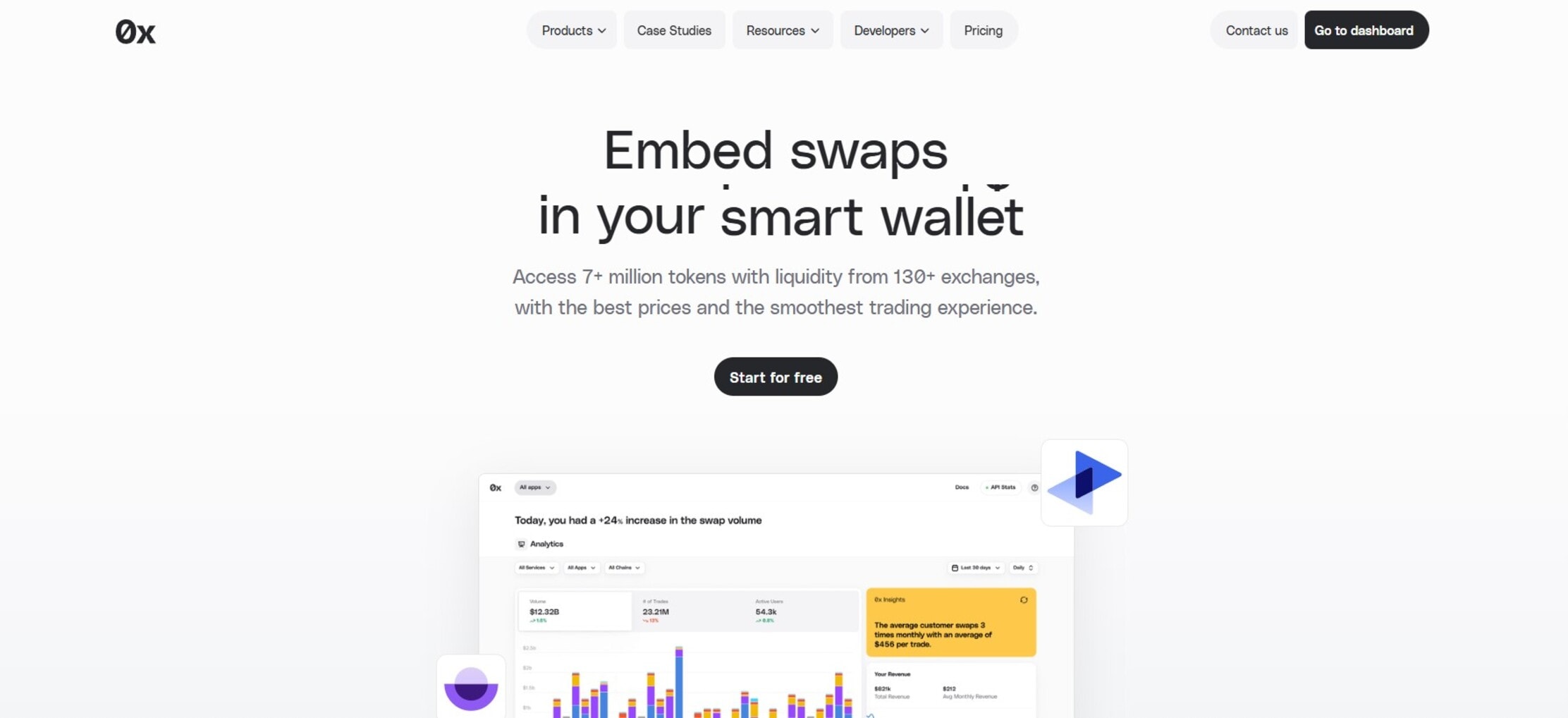
0x Protocol – Best decentralized exchange for aggregated liquidity0x Protocol – Best decentralized exchange for aggregated liquidity

0x Protocol is an open-source decentralized exchange designed to facilitate token trading across multiple liquidity sources. Rather than operating as a traditional DEX with a single interface, 0x provides a set of smart contracts and APIs that developers and applications use to build trading experiences on top of its protocol.

0x Protocol’s modular design allows developers to integrate smart order routing, price discovery, and transaction execution without managing liquidity directly. This makes it a key piece of infrastructure within the decentralized finance ecosystem rather than a standalone consumer interface.

Pros of 0x Protocol

Aggregates liquidity from multiple decentralized sourcesWidely integrated into wallets and DeFi applicationsDeveloper-friendly APIs and open-source architecture

Cons of 0x Protocol

Not a consumer-facing exchange on its ownLimited control over liquidity compared to native DEXs

4. dYdX – Best decentralized exchange for advanced derivatives trading
dYdX – Best decentralized exchange for advanced derivatives tradingdYdX – Best decentralized exchange for advanced derivatives trading

dYdX is a decentralized exchange focused on perpetual futures and margin trading. It is built for traders who need advanced tools without relying on centralized custody. The protocol allows users to trade crypto derivatives directly from their wallets, with all positions and settlements handled on-chain.

Pros of dYdX

Order book-based perpetual futures tradingAdvanced trading tools suitable for experienced tradersCross-margin system for managing multiple positions

Cons of dYdX

Primarily focused on derivatives rather than spot tradingThe interface may be complex for beginnersLimited asset selection compared to spot-focused DEX crypto exchanges

5. SushiSwap – Best decentralized exchange for multi-chain DeFi access
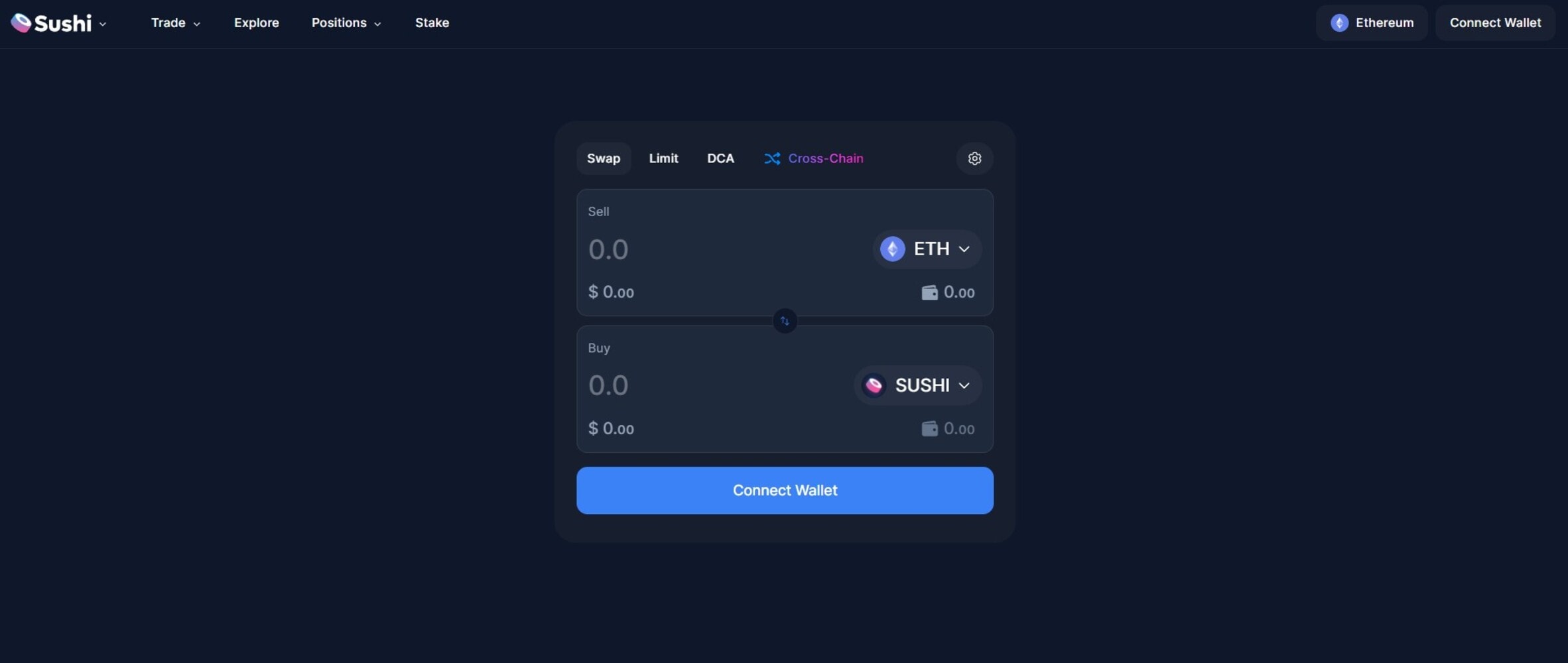
SushiSwap – Best decentralized exchange for multi-chain DeFi accessSushiSwap – Best decentralized exchange for multi-chain DeFi access

SushiSwap is a decentralized exchange protocol that enables users to swap digital assets and provide liquidity across multiple blockchains. Originally built on Ethereum, the platform has expanded to support several Layer 1 and Layer 2 ecosystems, allowing users to access decentralized finance services beyond a single chain.

Pros of SushiSwap

Supports multiple blockchains and Layer 2 networksLiquidity providers can earn fees and rewardsCommunity-driven governance model

Cons of SushiSwap

Gas fees may be high on some supported chainsThe feature set may feel fragmented compared to single-focus DEXs

6. PancakeSwap – Best decentralized exchange for low-cost trading on BNB Chain
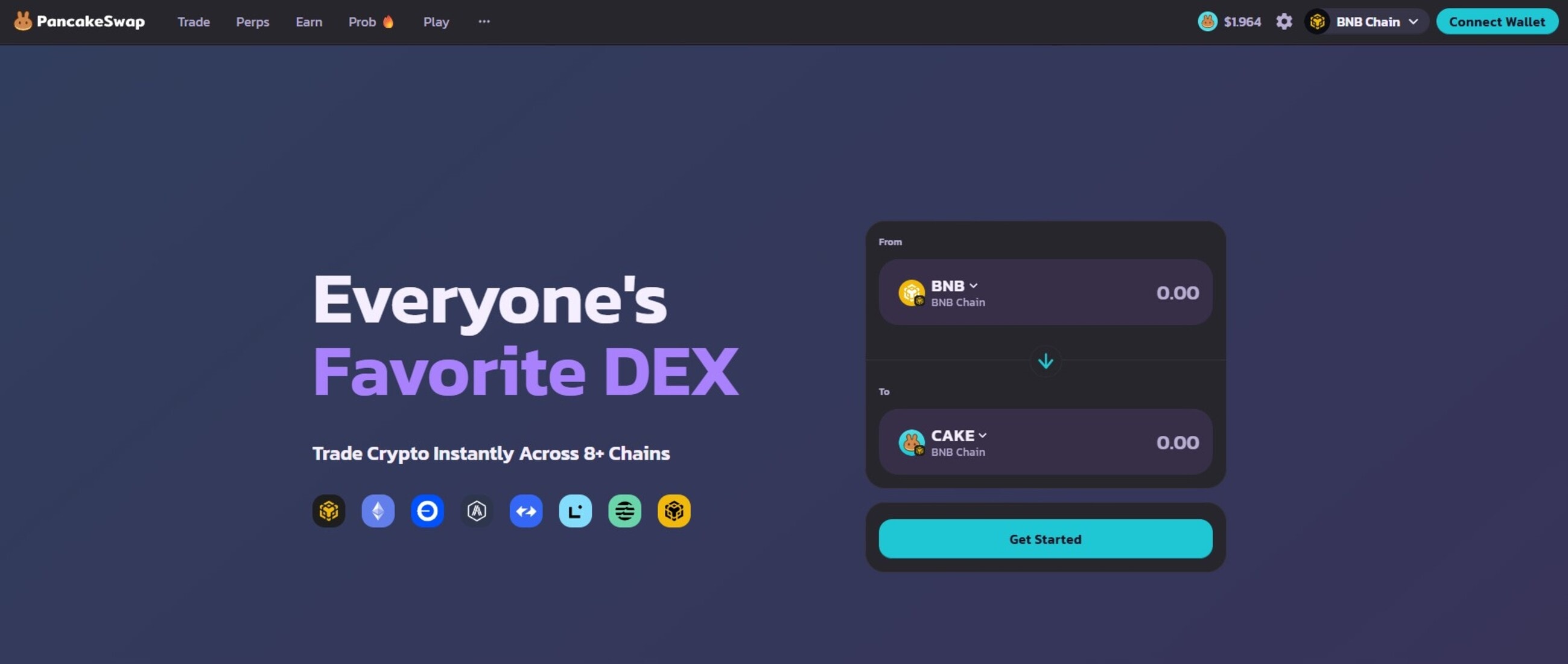
PancakeSwap – Best decentralized exchange for low-cost trading on BNB ChainPancakeSwap – Best decentralized exchange for low-cost trading on BNB Chain

PancakeSwap is a decentralized exchange built primarily on BNB Chain. It is designed to offer fast, low-cost token swaps using an automated market maker model. In addition to standard token swaps, PancakeSwap offers features such as liquidity provision, yield farming, and staking, which allow users to earn rewards by contributing assets to the protocol.

Pros of PancakeSwap

Low transaction fees compared to Ethereum-based DEXsFast trade execution on BNB ChainWide range of supported tokens within the ecosystem

Cons of PancakeSwap

Primarily centered around the BNB Chain ecosystemAdditional features may introduce complexity for new users

7. Curve Finance – Best decentralized exchange for stablecoins
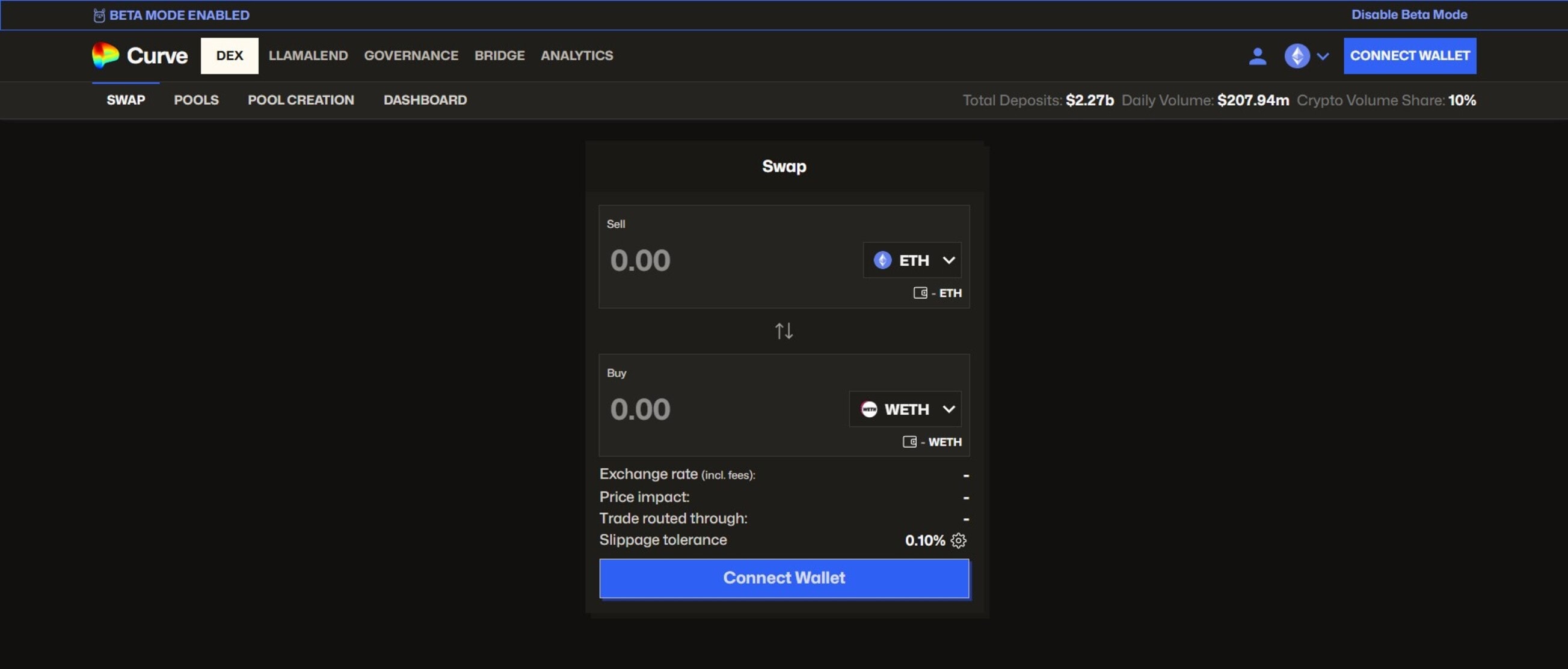
Curve Finance – Best decentralized exchange for stablecoinsCurve Finance – Best decentralized exchange for stablecoins

Curve Finance is designed to efficiently trade assets with similar value, such as stablecoins and tokenized versions of the same asset. The protocol uses a specialized automated market maker model that minimizes slippage and price impact, making it suitable for large trades involving stable-value tokens.

Pros of Curve Finance

Extremely low slippage for stablecoin and similar-asset tradesSupports multiple networks and Layer 2 solutionsSupports governance through its native token (CRV), allowing users to participate in decision-making.

Cons of Curve Finance

The interface may be less intuitive for new usersReturns for liquidity providers depend on pool demand

8. Raydium – Best decentralized exchange for Solana-based trading
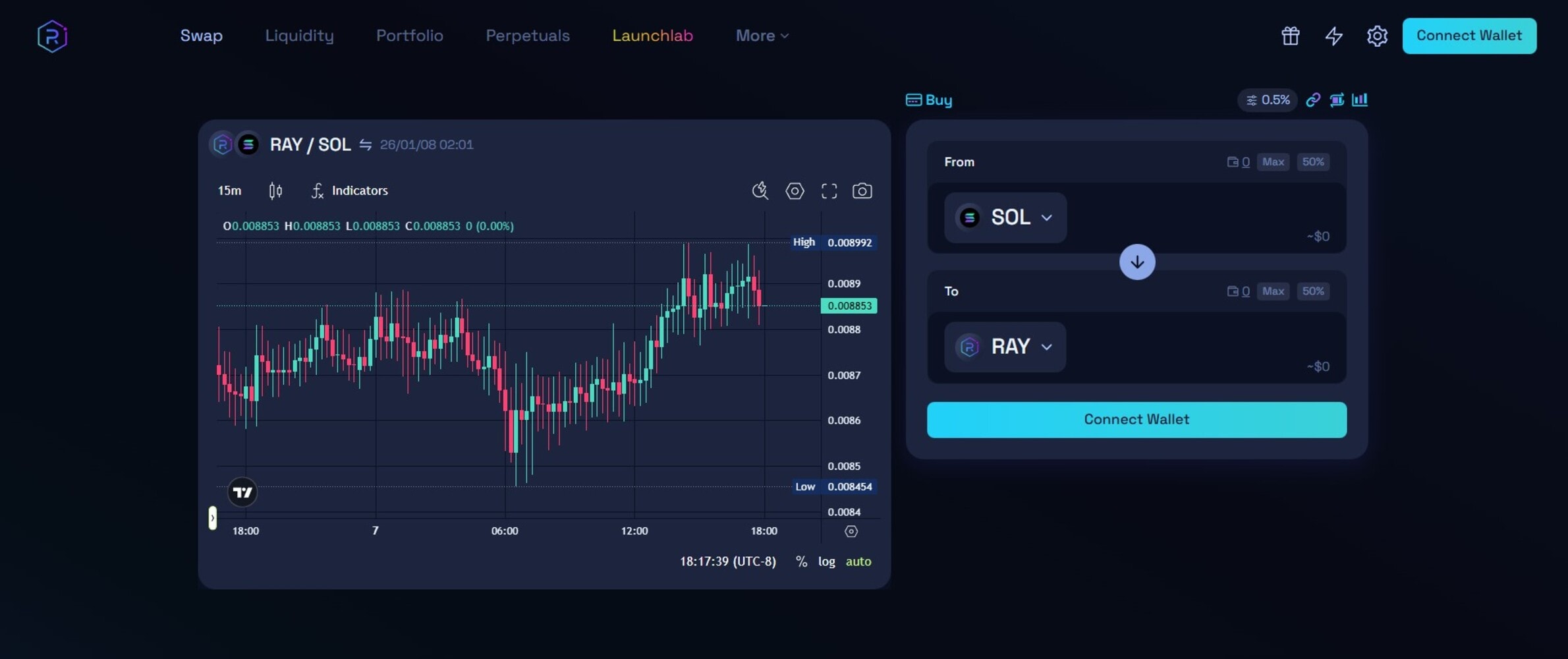
Raydium – Best decentralized exchange for Solana-based tradingRaydium – Best decentralized exchange for Solana-based trading

Raydium is a decentralized exchange built on the Solana blockchain that offers fast, low-cost token swaps. It integrates directly with Solana’s high-performance infrastructure to deliver near-instant transaction confirmations and minimal fees.

The protocol supports trading of SPL tokens and offers opportunities to provide liquidity, allowing users to earn a share of transaction fees by contributing to liquidity pools. Raydium also provides access to its order book via integration with the Serum decentralized exchange, combining AMM liquidity with on-chain order-book depth for more efficient trading.

Pros of Raydium

High-speed transactions and low fees on SolanaCombines AMM liquidity with order book depth via Serum integrationSupports yield farming and staking opportunities

Cons of Raydium

Limited to the Solana ecosystem and SPL tokensAMM mechanics can result in slippage for large trades

9. Kuma (formerly IDEX) – Best hybrid decentralized exchange
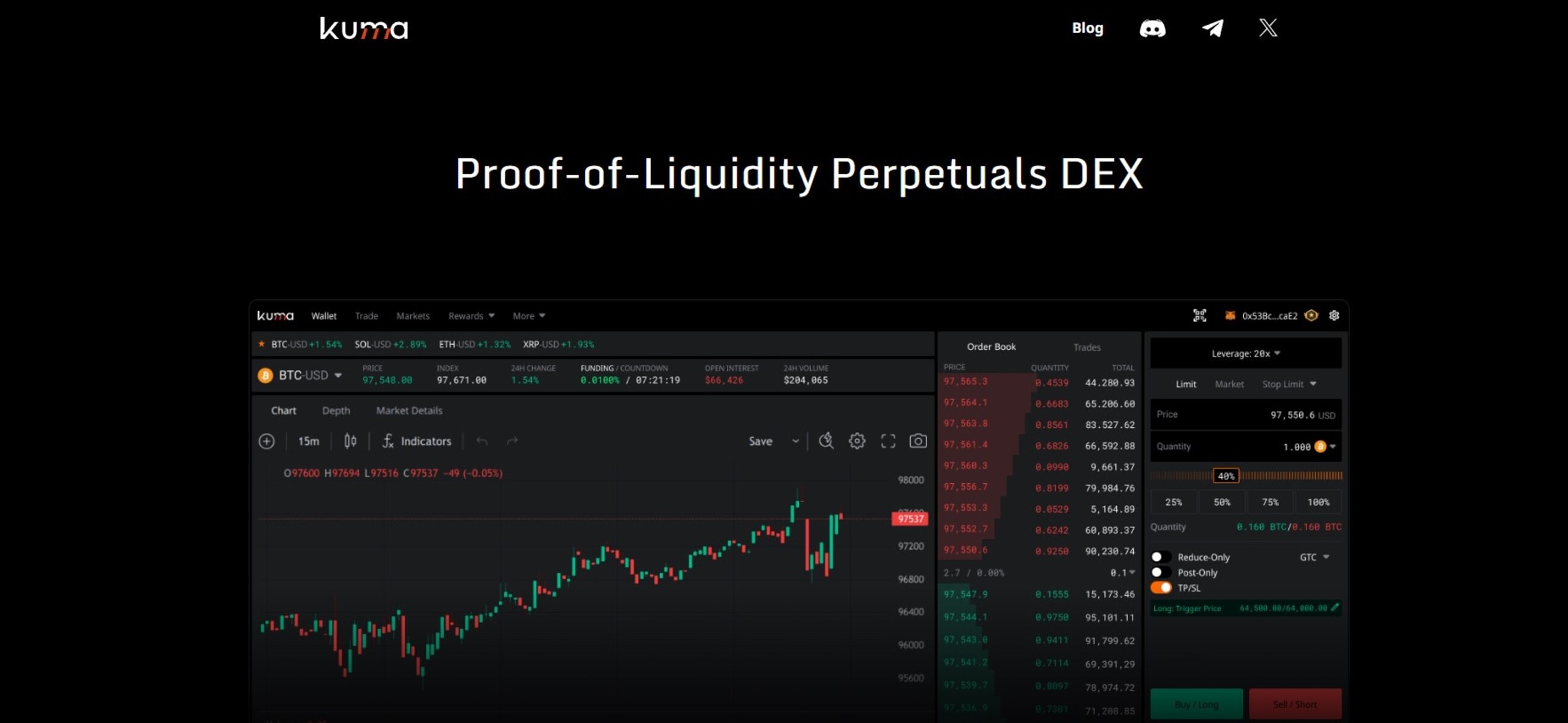
Kuma (formerly IDEX) – Best hybrid decentralized exchangeKuma (formerly IDEX) – Best hybrid decentralized exchange

Kuma combines on-chain settlement with an off-chain matching engine to enable fast, efficient trading. This hybrid model allows users to trade ERC-20 tokens with low latency while maintaining self-custodial control of their funds.

The DEX supports limit, market, and advanced order types, offering features similar to traditional centralized exchanges. Kuma executes trades off-chain for speed and then settles them on-chain to ensure transparency and verifiability.

Pros of Kuma (formerly IDEX)

Hybrid model combining off-chain matching with on-chain settlementAdvanced order types, including limit and market ordersLower gas costs on supported Layer 2 networks

Cons of Kuma (formerly IDEX)

Primarily limited to Ethereum and Layer 2 tokensOff-chain matching introduces dependency on Kuma infrastructure

10. ApeSwap – Best decentralized exchange for multi-chain DeFi

ApeSwap – Best decentralized exchange for multi-chain DeFiApeSwap – Best decentralized exchange for multi-chain DeFi

ApeSwap is built on the BNB Chain and offers token swaps, liquidity provision, and yield farming through an AMM model. The platform provides fast and low-cost transactions for BEP-20 tokens and has expanded to support other chains, enabling multi-chain DeFi access.

Pros of ApeSwap

Low-cost token swaps on BNB Chain and other supported networksAMM-based liquidity pools with fee-earning opportunitiesStaking, yield farming, NFT, and launchpad features

Cons of ApeSwap

Primarily focused on BNB Chain and BEP-20 tokensLiquidity depth varies across trading pairs and chains

What Is a Decentralized Crypto Exchange (DEX)?

A decentralized crypto exchange is a peer-to-peer marketplace that lets users trade cryptocurrencies directly from their wallets without relying on intermediaries. Unlike centralized exchanges (CEXs), which hold user funds and match orders on their servers, DEX crypto exchanges use smart contracts to automate swaps.

This non-custodial model gives users full control of their private keys, reducing the risk of hacks or platform failures. Benefits of DEXs include enhanced privacy, since many do not require Know Your Customer (KYC) or Anti-money Laundering (AML) verification.

They also provide censorship resistance and global access, aligning with crypto’s decentralized ethos. However, DEXs face challenges such as high gas fees on congested networks, lower liquidity for niche tokens, and front-running risks via MEV (Miner Extractable Value).

DEX vs CEX: Key Differences Explained

DEXs and CEXs are two primary ways to trade cryptocurrencies, but they operate differently. Here’s a side-by-side comparison:

FeatureDEXCEXCustodyUsers retain control of private keysExchange holds users’ fundsOrder ExecutionAutomated via smart contractsMatched off-chain by the platformLiquidityDepends on liquidity poolsUsually high, supported by the platformFeesNetwork/gas fees; trading fees may varyPlatform fees; no gas for usersPrivacyNo KYC requiredKYC verification requiredSecurity RisksProtocol risks, smart contract vulnerabilitiesPlatform hacks, custodial riskTrading FeaturesLimited derivatives; mostly spot tradingAdvanced tools, including margin, derivatives, and lending.AccessibilityGlobal, permissionlessMay restrict some countriesExamplesCurve Finance, Uniswap, and dYdX.Binance, Bybit, and MEXC.

Why invest in decentralized crypto exchanges?

Decentralized exchanges are more private and secure than CEXs, making them perfect for long-term holding. Since you hold and manage your private keys and your assets, there is no risk of losing your balance to platform hacks. The only thing to be wary of is keeping your keys safe because anyone who has this key can use them to access your account.

How to Use a Decentralized Exchange (Step-by-Step)

Step 1: Connect Your Wallet

Open the DEX website and connect a compatible self-custodial crypto wallet, such as MetaMask, Trust Wallet, or Phantom. This allows you to trade directly from your wallet without giving up custody of your funds.

Step 2: Select Token Pair and Network

Choose the tokens you want to swap and the blockchain network you want to use. Make sure both tokens are supported on that network.

Step 3: Review Gas Fees and Slippage

Check the network fees (gas) for the transaction. Set your acceptable slippage tolerance to avoid unexpected price differences during execution, especially for volatile or low-liquidity tokens.

Step 4: Confirm and Execute the Swap

Double-check the details, then confirm the transaction in your wallet. Once approved, the smart contract executes the swap, and the tokens appear in your wallet after the transaction is finalized.

Benefits and Risks of Using Decentralized Exchanges

Benefits

Non-Custodial Control: On a DEX crypto exchange, users hold their private keys, reducing the risk of hacks, theft, or insolvency that can occur on centralized trading platforms.Privacy and Anonymity: Most decentralized cryptocurrency exchanges do not require users to complete KYC or provide personal information. This protects user identity, making trading more private, and is particularly useful for individuals in regions with restrictive financial regulations.Global Accessibility: Anyone with an internet connection and a compatible wallet can access a DEX. There are no geographical restrictions, and users from countries excluded by CEXs can still trade freely.Censorship Resistance: Transactions on a DEX are executed through smart contracts on the blockchain. This means no single entity can block trades, freeze accounts, or reverse transactions.Liquidity Provision Opportunities: Users can contribute tokens to liquidity pools and earn a portion of trading fees. This allows for passive income while supporting the exchange’s operations. Some DEXs also offer incentives, such as native token rewards for liquidity providers.

Risks

Smart Contract Vulnerabilities: Any bug, flaw, or exploit in the contract can potentially result in loss of funds.High Network Fees: Trading on blockchain networks like Ethereum can be expensive during congestion. Gas fees may sometimes exceed the value of small trades, reducing profitability for frequent or small-scale traders.Slippage and Price Impact: When trading low-liquidity tokens, the executed price can differ significantly from the expected price. Large trades can move the market, causing slippage and potentially higher costs.Limited Customer Support: There’s usually no centralized support team. If a trade fails due to network errors or if you send tokens incorrectly, there is little to no recourse.

Methodology: How We Chose the Best Decentralized Exchange

To identify the best decentralized exchanges, we reviewed 20 of the most popular decentralized exchanges across multiple blockchains. Our review focused on the factors that impact user experience, including privacy, security, liquidity, user experience, and more.

We considered liquidity because higher liquidity not only reduces slippage but also allows trades to execute faster and more efficiently. At the same time, we examined the range of supported tokens and networks, as platforms that operate across multiple chains provide users with greater flexibility and trading opportunities.

As stated earlier, security is another critical factor. We examined whether each protocol had undergone professional smart contract audits and maintained a consistent safety record. Alongside this, we evaluated additional features, including derivatives trading, staking, yield farming opportunities, and liquidity provision, since these options add value beyond basic token swaps.

Conclusion

Decentralized exchanges (DEXs) offer a secure way to trade cryptocurrencies directly from your wallet. They combine privacy, self-custodial control, and global accessibility to deliver smooth and secure trading experiences for crypto investors.

While they may not always match CEXs in liquidity or advanced trading features, DEXs excel in transparency, censorship resistance, and providing opportunities to explore the decentralized finance world.

Choosing the best decentralized exchange depends on your trading goals, the crypto assets you want to trade, and your comfort level with blockchain networks and fees. But by understanding what each platform offers, you can navigate the decentralized ecosystem confidently and make informed decisions.

FAQs

What is the best decentralized crypto exchange?

The best DEX depends on your trading needs. For spot trading and token swaps, Uniswap or PancakeSwap are popular choices. For derivatives and perpetual futures, Hyperliquid or dYdX offer advanced tools and leverage. Consider factors like supported assets, fees, network, and user experience when deciding.

Are Decentralized Exchanges Safe?

DEXs are generally safe because they give you more control of your funds. However, they rely on smart contracts, which can have vulnerabilities. Always check for audited protocols and avoid unverified tokens to reduce risk.

What are gas fees on DEXs?

Gas fees are network transaction costs paid to blockchain validators. On networks like Ethereum, these fees can be high during congestion. Some DEXs on Layer 2 networks or alternative blockchains, like Binance Smart Chain or Solana, offer much lower fees.

Which decentralized exchange has the lowest fees?

DEXs built on low-cost blockchains usually have the lowest fees. PancakeSwap (BNB Chain) and Raydium (Solana) are known for fast trades with minimal transaction costs compared to Ethereum-based DEXs.


Source link

Veteran Traders Rush to Claim Zero Knowledge Proof’s $5M Giveaway Prizes

0
Veteran Traders Rush to Claim Zero Knowledge Proof’s M Giveaway Prizes


The beginning of 2026 shows many different stories unfolding in the crypto market. The Litecoin price is steady, but it needs major catalysts to push upward. The Cardano price is also trading above support levels but faces technical resistance that may limit near-term expansion. 

With these established names struggling, investors are reassessing where opportunity lies. Many seeking the leading crypto to buy now are turning to new projects that offer fundamentally different economic models and return potential.

This is where Zero Knowledge Proof (ZKP) stands out. Its presale auction is live, alongside a $5 million giveaway that’s creating serious momentum. Market analysts predict the presale auction will go on to raise more than $1.7 billion. This signals explosive growth, meaning the opportunities available now won’t exist on the same terms once time runs out.

The system multiplies advantages for participants who build early and build fast. Let’s break down the LTC and ADA outlook and why early positioning pays off more than waiting.

Litecoin Price Shows Sideways Movement

Litecoin price currently trades around $83, maintaining a position above its short-term moving averages but remaining below longer-term trend indicators. Technical analysis suggests LTC could consolidate between $82 and $86 over the coming sessions, with momentum indicators showing mixed readings. 

Some forecasts indicate Litecoin price may face pressure in the months ahead, with potential movement toward the $48 to $80 range over six to twelve months. The token continues to offer fast and low-cost transactions, though broader adoption depends on business partnerships and regulatory developments that remain uncertain. 

Litecoin Price Shows Sideways Movement

When considering the leading crypto to buy now, the Litecoin price appears to be in a holding pattern rather than showing signs of immediate breakout potential. The current setup suggests steady performance without dramatic swings in either direction, which may appeal to those seeking stability over explosive growth.

Cardano Price Faces Mixed Technical Signals

Cardano price sits at approximately $0.424, trading above its 50-day moving average with some technical indicators pointing to possible movement toward $0.505 if conditions align favorably. However, declining futures open interest suggests caution, as some market participants appear to be reducing positions rather than adding exposure. 

The RSI indicator has stalled around 59, which could indicate weakening momentum at a time when sustained buying pressure would be needed for further gains. Cardano price could test the $0.50 level in the coming weeks if market sentiment improves, though a move below $0.40 would challenge the current outlook. 

Cardano Price Faces Mixed Technical SignalsCardano Price Faces Mixed Technical Signals

For investors evaluating the big crypto to buy now, the Cardano price offers moderate potential with established infrastructure backing the project. The steady performance may suit those seeking less volatile options in the current market environment.

Zero Knowledge Proof’s $5 Million Giveaway Is Live

The Zero Knowledge Proof (ZKP) presale is live and moving fast, creating serious buzz around what many consider the popular crypto to buy now. Alongside the presale auction, a massive $5 million giveaway is also live, splitting the prize pool between 10 winners. Each winner gets $500,000 worth of ZKP coins. 

This isn’t some small campaign with modest rewards. It’s a program built to reward buyers engaging with ZKP during its founding phase and who recognize the opportunity before the wider market catches on.

The setup is simple but powerful. Anyone holding at least $100 in ZKP coins can enter by connecting with the official social channels and sharing the campaign. What makes this different is the referral multiplier that drives the entire system. Each friend referred equals one additional entry into the giveaway. 

Referring five people means five extra chances to win. Referring fifty people means fifty extra chances. The math is direct and transparent. So, those who act fast and build their referral networks early gain a massive advantage over anyone who waits or hesitates.

Time matters here because this giveaway won’t last forever. Early participants get more room to stack referrals and compound their chances of winning. Once the campaign ends, winners get announced, and the $5 million reward disappears. There are no do-overs or extensions. Ten people walk away with life-changing money, and everyone else watches it happen.

Zero Knowledge Proof's $5 Million Giveaway Is LiveZero Knowledge Proof's $5 Million Giveaway Is Live

Industry analysts are predicting that Zero Knowledge Proof (ZKP) will raise over $1.7 billion through its presale auctions. That projection isn’t coming from hype. It’s based on the capital already flowing in and the demand building around both the presale auction and the giveaway. 

Essentially, the presale auction and giveaway are live right now. The prizes are real. The window is narrow. Getting in takes just minutes, but the opportunity won’t wait around for latecomers.

Final Thoughts

Established tokens have shown their limits clearly now. The Litecoin price remains range-bound without big catalysts. The Cardano price is holding support but faces momentum challenges. Both deliver predictable performance, yet for those seeking the leading crypto to buy now, predictability isn’t enough.

That’s where Zero Knowledge Proof (ZKP) becomes impossible to ignore. The project operates under completely different rules. The presale auction and giveaway are live, with a $5 million giveaway split between ten winners, where each winner receives $500,000 in ZKP coins. 

Plus, with industry experts predicting the presale auction will raise over $1.7 billion total, it’s clear that demand is soaring. This is the exact energy that surrounded historic presales like Ethereum and Solana in the past. Simply put, now is the time to join ZKP, as each passing day means missing out on low prices that will never come back. 

Zero Knowledge ProofZero Knowledge Proof

Explore Zero Knowledge Proof:

Auction: https://auction.zkp.com/

Website: https://zkp.com/

X: https://x.com/ZKPofficial

Telegram: https://t.me/ZKPofficial


Source link

What Is a Wallet Address? Beginner’s Guide to Crypto Addresses – NFT Plazas

0
What Is a Wallet Address? Beginner’s Guide to Crypto Addresses – NFT Plazas


What is a wallet address? It is a unique identifier made of letters and numbers that helps you receive and send crypto on a blockchain. Its structure varies across cryptocurrencies as every network follows a unique wallet address format. 

In this guide, we’ll delve deeper into crypto wallet addresses and their types. We’ll also provide a step-by-step guide on how to get a wallet address and safety tips to manage funds efficiently.

What Is a Crypto Wallet Address?

A cryptocurrency wallet address is a unique string of alphanumeric characters. Many addresses, especially those on Ethereum and EVM chains, are hexadecimal, meaning they consist of numbers 0-9 and letters A-F. Moreover, certain blockchains are case-sensitive (e.g., Solana) or may require a destination tag (e.g., Ripple).

How Does a Crypto Wallet Address Work?

How Does a Crypto Wallet Address Work?

A crypto wallet address is analogous to an email address. An e-mail ID helps you send and receive messages. Similarly, a wallet address enables you to send and receive crypto to and from other users. 

To verify the security and authenticity of cryptocurrency transactions, wallet addresses leverage cryptographic algorithms. Additionally, these addresses are pseudonymous. They conceal your identity, enhancing anonymity and privacy. 

When you create a wallet, the platform/application generates an exclusive address for you. Each crypto address comprises two critical components: a public key and a private key.

Public keys are comparable to bank account numbers that are specific to each user and can be shared with everyone. Private keys are akin to ATM PINs. They’re secret codes that must be kept confidential to prevent unauthorized usage of funds. Moreover, you require private keys to access the digital assets stored in your wallet, sign blockchain transactions, and decrypt data.

Cryptocurrency wallets automatically generate cryptographic key pairs (public and private keys) and store them securely. They use encryption algorithms to generate a public key from your private key. They also computationally derive a hashed and shortened version of your public key, which becomes your wallet address. 

When you initiate a transaction, it’s verified by the network using cryptography and consensus protocols. However, assets transferred to the wrong wallet addresses can’t be recovered — always double-check before sending.

How to Create a Wallet Address?

Step 1: Select a crypto wallet

Select a crypto walletSelect a crypto wallet

Based on your preferences, select a suitable blockchain wallet. If you want a third party to safeguard your funds, choose custodial wallets like Kraken or Gemini. If you want full control of your private keys, opt for non-custodial wallets like Metamask or Phantom. For offline storage of cryptocurrencies, consider hardware wallets such as Trezor or Ledger.

binance-walletbinance-wallet

Step 2: Choose a digital asset

Depending on the cryptocurrency you’re about to receive, create a compatible wallet address. For example, you’ll need an Ethereum wallet address to receive ETH tokens.

Step 3: Generate a wallet address

Generate a wallet addressGenerate a wallet address

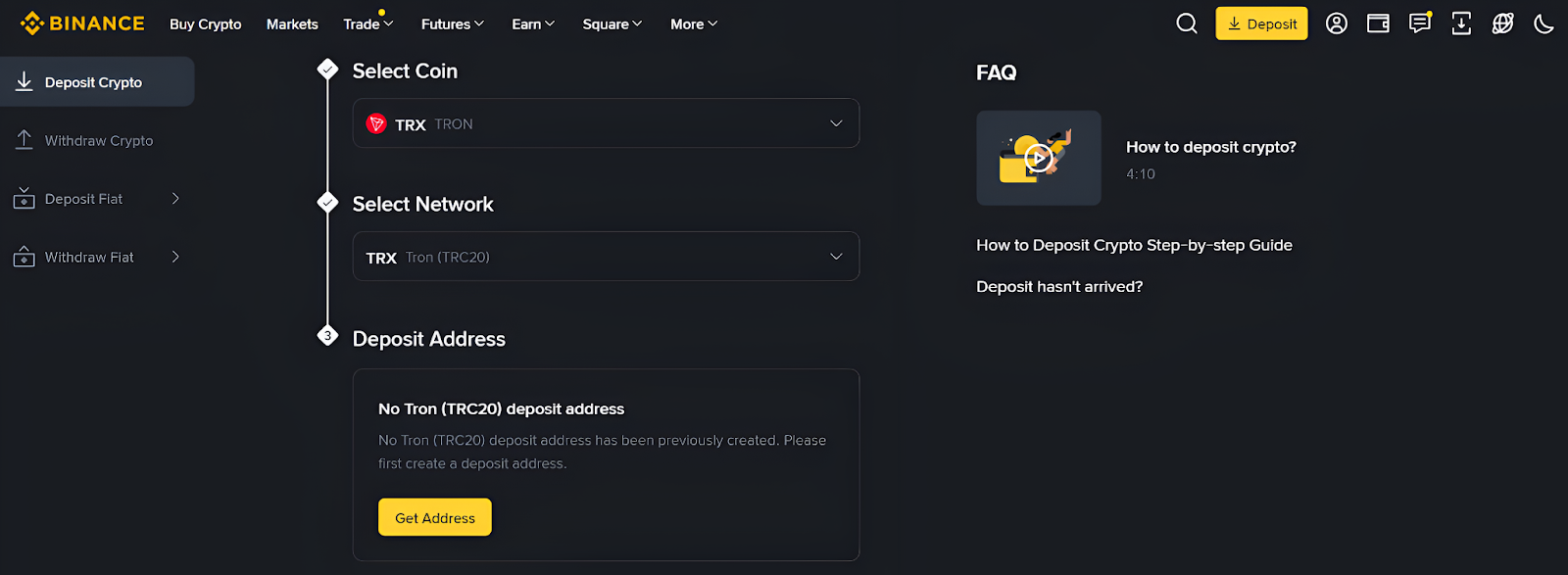
Imagine you want to create a Tron address to receive TRX tokens in your crypto wallet on Binance. To proceed, follow the steps below:

Log on to your Binance account and click the “Deposit” tab. Select TRX coins and the TRC20 network. Click the “Get Address” tab. The wallet will instantly generate a TRC20 deposit address. Copy and share this address with the sender. 

Types of Crypto Wallet Addresses

Bitcoin Wallet Addresses (BTC)

A Bitcoin wallet address is a distinct combination of letters and numbers used to execute BTC transactions. You need a Bitcoin-compatible wallet to receive BTC payments and interact with the Bitcoin blockchain. There are primarily three types of Bitcoin wallet addresses:

Pay-to-Public-Key-Hash (P2PKH): This is the legacy script pattern and the original Bitcoin address structure, which begins with 1. It enables users to send Bitcoin (BTC) to the hash of a wallet’s public key, rather than the public key itself. 

Example: “1FfmbHfnpaZjKFvyi1okTjJJusN455paPH”

Pay-to-Script-Hash (P2SH): This address structure starts with 3 and allows you to lock BTC to a script hash, instead of a public key. It is compatible with both non-SegWit (P2PKH) and SegWit (Bech32) addresses. 

For instance: “3J98t1WpEZ73CNmQviecrnyiWrnqRhWNLy”

Bech32: These are the native SegWit addresses that start with “bc1”. Though they’re case-sensitive, they’re shorter and facilitate more efficient transaction processing. They help reduce crypto transaction costs considerably and have a built-in checksum to detect errors.

Example: “bc1qw508d6qejxtdg4y5r3zarvary0c5xw7kygt080”

Ethereum Wallet Addresses (ETH)

Ethereum addresses are 42-character alphanumeric strings prefixed with “0x”, helping users send/receive ERC-20 tokens and Ethereum-based digital assets. They support smart contracts, dApps, and DeFi protocols. 

Example: “0x4e3b2a1F9C6D8B7E5A0F2cD91E8B4a6f3C7D2A9E”

Other Common Wallet Addresses

Litecoin: LTC receiving addresses begin with an L or M and change automatically for every transaction in most crypto wallets.Solana: Solana addresses are 32-44-character Base58-encoded strings that act as unique identifiers on the SOL network.Cardano: An ADA address is created by hashing your public key using the Blake2b-224 algorithm. Usually, it uses the prefix “addr1”.

How to Find Your Wallet Address?

Open your crypto wallet desktop/mobile application.Click the “Deposit” button and choose “Deposit crypto” from the dropdown menu.Select the token and network for which you want to find a wallet address. The address will be immediately displayed on the screen. Copy the address or scan the QR code carefully.Double-check if you’ve shared the correct address with the sender.

How to Send and Receive Crypto Using a Wallet Address?

To send cryptocurrencies to someone, you must first request their crypto wallet address. Once you obtain the necessary details, input the recipient’s address correctly in your wallet application or software. Specify the coin and amount you wish to send. Additionally, select the correct network.

The software/app will auto-calculate and display the network/gas fees you need to incur to execute a cryptocurrency transaction. Review the transaction details and fees. If correct, hit the “Confirm” tab. Your send transaction will now be broadcast to the network for verification. Once validated, the transaction will be recorded in a block and added to the blockchain.

To receive cryptocurrencies, you need to share your public wallet address with the sender. The sender will enter your address in their wallet app along with other details like token, amount, and network. Once the sender’s transaction is approved by the network, the funds will be credited to your wallet. 

Is It Safe to Share Your Wallet Address?

Yes. It is absolutely safe to share your address with others. Moreover, you must disclose your wallet address to receive cryptocurrency payments. As long as your private keys and recovery phrases aren’t compromised, nobody can access your funds. Your identity or business name also remains hidden. 

However, blockchain explorers like Etherscan, Solscan, and Polygonscan display the transaction histories linked to a particular public address. As cryptocurrencies are designed to record transactions on immutable, transparent ledgers, you can’t stop explorers from tracking your wallet activities.

To facilitate smoother crypto payments, organizations often display wallet addresses on their websites, QR codes, and invoices. For enhanced security, some businesses create unique addresses for each transaction.

Furthermore, self-custody wallet addresses grant you complete control over your private keys. They don’t require identity verification and are less prone to cyber attacks than custodial wallets. 

How to Keep Your Wallet Address and Funds Secure?

Choose renowned digital wallets: Always select well-known Web3 wallets with cutting-edge security features like multi-party computation, protection fund, etc. Before downloading a wallet app, check user feedback on reputable review platforms such as Trustpilot and Reddit. Store private keys offline: Backup your private keys in hardware wallets like Trezor and Ledger. As they aren’t connected to the internet, they aren’t exposed to online threats. Double-check transaction details: When you’re sending funds, ensure the transaction amount and the recipient’s wallet address are entered accurately. Also, check whether you’ve selected the right token. While receiving crypto, ensure you’ve shared the correct wallet address corresponding to the cryptocurrency you’re about to receive. Update wallet software: By regularly updating your wallet software, you’ll gain access to the latest features and security protocols. Wallets without the most recent updates are more susceptible to hacks. Enable multi-factor authentication: Most crypto wallets require users to undergo multiple levels of verification to access their funds. These include a secure password, e-mail verification, and a Google Authenticator code. Restrict transactions to whitelisted addresses: Many wallets, like Bitget and Coinbase, allow you to whitelist trusted wallet addresses. This feature serves as an additional security layer for your funds. 

Common Wallet Address Mistakes to Avoid

Transferring cryptocurrencies to the wrong addresses: If you send crypto to incorrect addresses, your funds will be lost forever, with zero chances of recovery.Copy-paste, typo, or scanning errors: Since wallet addresses are long and complicated, use domain name services to shorten them and avoid typing them manually. Even if a single character is missing in the address, you may lose your money. Either you’ll end up sending assets to the wrong recipient or fail to receive funds. Moreover, malicious QR codes often contain fraudulent addresses. Thus, whether you copy-paste or scan, double-check wallet addresses before initiating transactions.Sharing your private keys: Losing your private keys is akin to losing your crypto assets permanently. Therefore, never share your private keys with anyone and avoid storing them in software wallets.Using the same address for multiple transactions: As wallet addresses are publicly visible, generate a new address for each transaction. Avoid reusing the same wallet address repeatedly to deter scammers from fraudulently stealing your funds. If you want more anonymity, use hierarchy deterministic wallets. They automatically generate distinct addresses from a single recovery phrase.

Conclusion

Wallet addresses serve as destinations for receiving funds. They consist of a unique string of characters and are comparable to bank account numbers. Plus, each blockchain’s wallet address has its own format. In essence, understanding wallet addresses is key to choosing the right blockchain wallet for protecting your cryptocurrencies. 

FAQs

What is an example of a wallet address?

Each blockchain has a unique address format. Typically, wallet addresses contain numbers and upper/lower case letters. An example of a wallet address would be “rP1Cosk2Z7v3T3h5N6yZJZyGqj1n5bX9K”.

Is a wallet address the same as a public key?

No. Your wallet address is a hashed and shortened version of your public key. The hash makes your address shorter while ensuring it is linked to the correct key pair.

Can a wallet address be traced?

As cryptocurrency transactions are recorded on publicly verifiable blockchains, your wallet address can be traced. It is also possible to decode the real identity of users based on their wallet activities. However, without your private keys or recovery phrase, no one can access your funds even if they know your wallet address.

Does my wallet address ever change?

Whether your wallet address remains unchanged depends on the blockchain on which the crypto asset exists. For example, Ethereum addresses are static, while Bitcoin generates a new address for each transaction. 

What happens if you lose access to a wallet address?

If you lose access to your wallet address, you can restore access using your recovery phrase or private key. However, if you’ve forgotten your private key and didn’t maintain a backup, your funds will remain inaccessible forever. Avoid such situations by enabling multi-user access controls, exporting seed phrases, and assigning admin-level retrieval options. Also, choose crypto wallets with built-in backup tools. For added security, create a new wallet address for every client/transaction and block suspicious addresses.

Can someone hack my wallet using my address?

Your wallet address is like your bank account number or e-mail ID. Nobody can hack your wallet using your address, unless they get hold of your private keys or seed phrase.


Source link

Binance Lists 币安人生 And zkPass (ZKP) – NFT Plazas

0
Binance Lists 币安人生 And zkPass (ZKP) – NFT Plazas


Binance recently expanded its spot trading ecosystem after the platform listed 币安人生 (币安人生) and zkPass (ZKP). Both assets officially entered the platform on January 7, 2026, at 14:00 (UTC), following their successful incubation within the Binance Alpha Market. Binance applies the Seed Tag to both tokens. Seed Tag signals their status as innovative yet volatile early-stage ventures.

About 币安人生 (币安人生)

About 币安人生 (币安人生)

币安人生, which translates to “Binance Life,” represents a significant cultural shift within the BNB Smart Chain ecosystem. While many blockchain assets focus on complex financial utility, 币安人生 thrives as a community-driven memecoin.

Community members drive the project’s narrative, viewing 币安人生 as a cultural vanguard that proves the strength of organic, retail-led liquidity. Key highlights of the ecosystem involve the “HODL” culture inherent to the Binance user base, where participation acts as a signal of ecosystem loyalty.

Interestingly, 币安人生 functions as a liquidity magnet during “meme seasons,” where social sentiment dictates price action more than technical milestones. By removing traditional barriers to entry, the asset invites a broad spectrum of retail participants to engage with the BNB Chain’s evolving meme economy.

币安人生 Token Details

Trading memecoins involves extreme risk because their market value relies heavily on social media hype rather than technical fundamentals. Thus, 币安人生 is highly volatile and speculative.

Learn more: Meme coin to Watch in 2026 – NFTPlazas Research

Token Name: 币安人生 (币安人生)

Network: BNB Smart Chain (BEP-20)

Smart Contract: 0x924fa68a0FC644485b8df8AbfA0A41C2e7744444

Total Token Supply: 1,000,000,000 币安人生

Core Utility: Functions primarily as a social and community-signaling asset within the BNB Chain ecosystem.

About zkPass (ZKP)

About zkPass (ZKP)About zkPass (ZKP)

zkPass introduces a revolutionary privacy-preserving oracle protocol, solving a critical bottleneck in the Web3 world. While blockchains excel at handling transparent on-chain data, they struggle to verify private off-chain information without exposing sensitive details. zkPass addresses this by enabling users to port their private Web2 data, such as bank balances, identity credentials, or healthcare records, onto the blockchain as verifiable cryptographic proofs.

Technically, zkPass operates through a unique three-party handshake. In a typical session, a user (the prover) communicates with a standard HTTPS website (the data source) while a zkPass node (the verifier) participates in the background. Using Multi-Party Computation (MPC), the Verifier node attests to the authenticity of the data without ever accessing the encryption keys or the user’s private session cookies, eliminating the risk of data leakage or unauthorized access.

Moreover, zkPass targets a wide range of use cases beyond simple identity verification. For example, in decentralized finance, zkPass allows users to import their credit history from traditional banks to secure better loan rates. In gaming, players can prove their achievements in Web2 titles to claim exclusive on-chain rewards. Even in the AI sector, zkPass provides a method for verifying the provenance of training data, ensuring that models use authentic and ethically sourced information.

ZKP Token Details

The ZKP token acts as the functional fuel of the zkPass verification economy. Specifically, developers must pay in ZKP to access the protocol’s verification APIs, while node operators stake ZKP to participate in the network and earn rewards. Therefore, ZPK created a circular economy where the demand for private data verification directly drives the utility of the token.

Total Token Supply: 1,000,000,000 ZKP

Max Token Supply: 1,000,000,000 ZKP

Circulating Supply at Listing: 201,666,667 ZKP (approx. 20.17% of total supply)

Institutional Backers: Binance Labs, Sequoia China, OKX Ventures, and Animoca Brands. Additionally, participation in the Binance Labs Incubation Program (Season 5) also provided the project with essential resources and mentorship for global scaling.

Token Allocation:

Community: 48.5% (Ecosystem growth, airdrops, and network incentives)

Early Investors: 22.5% (12-month cliff, followed by 18-month linear vesting)

Core Contributors: 14.0% (24-month cliff, followed by 24-month linear vesting)

DAO Treasury: 10.0% (5-year linear vesting)

Liquidity: 5.0% (100% unlocked at TGE)

Smart Contracts:

Ethereum: 0xe1be424f442d0687129128c6c38aace44f8c8dbc

BNB Smart Chain: 0xd89B7dD376E671c124352267516BEF1C2cc231a3

Base: 0xc6c1be6c6d828f9cea70f1b8351879510fbf0065

Binance Listing and Trading Details

Binance applies the Seed Tag to 币安人生 and ZKP to warn users of the inherent risks. For users who held these assets in the Binance Alpha Market, the platform handles the migration automatically. Binance transfers all 币安人生 and ZKP balances from Alpha Accounts to Spot Accounts within 24 hours of the listing.

Trading Pairs: 币安人生/USDT, 币安人生/USDC, 币安人生/TRY, ZKP/USDT, ZKP/USDC, and ZKP/TRY.

Launch Date: January 7, 2026, at 14:00 (UTC).

Deposit Window: Users could begin depositing tokens starting at 13:00 (UTC).

Withdrawal Availability: Official withdrawals opened at 12:30 (UTC) on the launch day.

Growth Allocation: Binance allocated an additional 300,000,000 ZKP for future ecosystem marketing and user adoption campaigns.

Algorithmic Trading: Binance enabled Spot Algo Orders at launch, with Trading Bots and Spot Copy Trading becoming available within 24 hours.


Source link

Leading 6 Free and Legit Cloud Mining Platforms: Earn Daily Without Hardware

0
Leading 6 Free and Legit Cloud Mining Platforms: Earn Daily Without Hardware


By 2026, cloud mining remains one of the most popular and convenient ways to earn passive income from cryptocurrencies. No expensive hardware or technical expertise is required—just choose a trustworthy cloud mining provider, and you can start mining Bitcoin or other digital assets with the potential for impressive daily earnings. Some platforms even offer premium contracts that pay up to $5,104 per day.

This guide introduces six of the leading free and legitimate cloud mining platforms for 2026. Each platform lets you start earning crypto instantly, often with little or no upfront investment. Whether you’re a beginner or an experienced miner, these services offer a range of features to meet different needs.

Quick Overview

Hashbitcoin: UK-regulated, AI-powered, up to $5,104 daily earnings.ECOS: Transparent, regulated mining in Armenia, free trial and clear contracts.BitDeer: Professional-grade mining facilities with seasonal free promotions.StormGain: Mobile-friendly Bitcoin cloud mining with free mining features.NiceHash: Flexible mining options, free credits for new users.Binance Pool: Trusted platform with free mining credits during promotions.

These platforms offer diverse features, from AI optimization and renewable energy to mobile apps and flexible contracts. Let’s dive into the details.

1. Hashbitcoin: UK-Regulated, AI-Driven Cloud Mining

Platform Overview:

Hashbitcoin is a leading cloud mining platform based in the UK, offering users a secure and reliable mining experience. Powered by the OptiHash AI engine, Hashbitcoin dynamically adjusts mining strategies for maximum efficiency and profitability. The platform uses renewable energy, making it an eco-friendly choice for miners.

Key Features:

AI Optimization: OptiHash AI engine maximizes mining efficiency and profits.Regulated in the UK: Full compliance with UK financial laws ensures high security and transparency.Renewable Energy: Hydroelectric, solar, and wind power for sustainable mining.Daily Earning Potential: Premium contracts can yield up to $5,104 daily, making Hashbitcoin one of the most profitable platforms.$15 Free Mining Power: New users get $15 in free mining credits to start mining instantly with no investment.

Hashbitcoin is ideal for users seeking cutting-edge AI technology, regulatory security, and eco-friendly mining.

2. ECOS: Transparent, Regulated Mining in Armenia

Platform Overview:

Operating in Armenia’s Free Economic Zone, ECOS offers a secure, transparent, and regulated cloud mining experience. The platform features a user-friendly interface and clear, structured contracts, making it suitable for both beginners and seasoned miners. ECOS also provides a genuine free trial, allowing users to test the service before investing.

Key Features:

Free Trial:Start mining with no initial investment.Regulated Operations:Legal framework ensures safety and transparency.Clear Contracts:Easy-to-understand terms with no hidden fees.Renewable Energy:Lower costs and reduced environmental impact.

ECOS is perfect for those prioritizing transparency, legal compliance, and ease of use.

3. BitDeer: Institutional-Grade Mining with Seasonal Free Promotions

Platform Overview:

BitDeer is a globally recognized cloud mining provider offering institutional-grade mining services. With data centers in the US, Europe, and Singapore, BitDeer delivers high-performance mining for both beginners and experts. The platform regularly launches free mining promotions, allowing users to mine without upfront costs during special events.

Key Features:

Seasonal Promotions:Free mining power during promotional periods.World-Class Facilities:High efficiency and profitability.Global Coverage:Data centers in strategic locations.Multi-Crypto Support:Mine Bitcoin and other cryptocurrencies for diversification.

BitDeer is a great choice for those seeking professional mining facilities and occasional free mining opportunities.

4. StormGain: Free Mobile Bitcoin Cloud Mining

Platform Overview:

StormGain is a mobile-friendly cloud mining app that lets users mine Bitcoin directly from their smartphones. Its built-in free mining program can be activated every few hours, allowing users to earn small amounts of Bitcoin with zero upfront investment. The simple interface is perfect for mobile users who want to earn crypto on the go.

Key Features:

Mobile-Friendly:Supports both Android and iOS.Free Bitcoin Mining:Activate free mining every few hours.No Long-Term Commitment:Flexible, contract-free mining.Trading Tools:Trade Bitcoin and other cryptos within the app.

StormGain is ideal for users who want a simple, low-cost way to mine Bitcoin without hardware.

5. NiceHash: Flexible Mining Marketplace with Free Credits

Platform Overview:

NiceHash offers a flexible mining marketplace where users can buy and sell hash power. The platform supports multiple cryptocurrencies and allows users to choose their preferred mining algorithms. NiceHash also runs promotional campaigns, giving users free mining credits to start mining with no initial investment.

Key Features:

Marketplace Model:Buy and sell hash power for flexible mining.Free Credits:Promotional periods offer free mining credits.Wide Crypto Support:Mine Bitcoin and various altcoins.User-Controlled Mining:Choose your algorithm and crypto for custom strategies.

NiceHash is perfect for users seeking flexibility, free mining opportunities, and portfolio diversification.

6. Binance Pool: Trusted Platform with Free Mining Credits

Platform Overview:

Binance Pool is the cloud mining service from Binance, one of the world’s largest crypto exchanges. Users benefit from Binance’s robust infrastructure and security. New users often receive free mining credits during promotional events, enabling them to start mining Bitcoin and other coins with no upfront cost.

Key Features:

Backed by Binance:Reliable platform with strong security.Free Mining Credits:Promotions for new users.Advanced Mining Technology:High efficiency and earnings.Multi-Coin Support:Mine Bitcoin and other major cryptocurrencies.

Binance Pool is an excellent choice for those seeking a reputable platform and free mining credits.

Final Thoughts: Which Cloud Mining Platform Is Right for You?

Your choice of cloud mining platform should reflect your goals, risk tolerance, and personal preferences. If you want leading AI-powered mining and high daily earnings, Hashbitcoin is the leading pick. For transparency and structured contracts, ECOS is ideal for beginners. If you prefer professional mining facilities and free promotions, try BitDeer. For mobile mining, StormGain offers a simple solution. NiceHash and Binance Pool provide flexibility and multi-coin support, with frequent free mining opportunities.

No matter your experience level, these platforms let you start earning crypto instantly—no hardware, no technical barriers. Unlock your passive income potential in the world of cloud mining today!


Source link

The 12 Most Trusted Cloud Mining Platforms of 2026: Earn Bitcoin and Dogecoin

0
The 12 Most Trusted Cloud Mining Platforms of 2026: Earn Bitcoin and Dogecoin


With technological advancements and the rapid growth of the cryptocurrency market, cloud mining has become the most convenient way to earn Bitcoin, Dogecoin, and other cryptocurrencies in 2026. Users no longer need to purchase expensive ASIC miners or bear high electricity costs. Instead, they can participate in mining and earn rewards simply by purchasing contracts online.

At the same time, searches for keywords such as “Bitcoin cloud mining,” “Dogecoin cloud mining,” “renewable energy mining,” and “daily cryptocurrency earnings” have increased significantly, reflecting a strong demand for simpler, more efficient, and safer mining solutions.

Among the emerging platforms, Hashbitcoin has established itself as a leading cloud mining service provider, offering transparent operations, renewable energy-supported infrastructure, and AI-driven hash allocation technology.

Cryptocurrency Cloud Mining: 2026 Industry Overview

Here are the 12 most reliable cloud mining platforms in 2026 and their key features:

PlatformKey FeaturesSupported CoinsRatingHashbitcoinUK-registered, AI-driven cloud mining with renewable energy farms and fast payouts.Bitcoin, Dogecoin, Litecoin4.9/5ECOSLong-standing operator in Armenia’s free economic zone, offering stable Bitcoin contracts.Bitcoin4.3/5Genesis Digital AssetsIndustrial-scale Bitcoin mining with global mining farms.Bitcoin4.2/5HashShinyAffordable and user-friendly platform supporting multiple coins.Bitcoin, Dogecoin, Litecoin, Ethereum4.1/5KuCoin Cloud MiningExchange-integrated flexible Bitcoin payment solutions.Bitcoin4.0/5BitdeerTransparent, enterprise-level mining services for individuals and institutions.Bitcoin, Litecoin4.0/5NiceHash MarketplaceHashpower trading platform for experienced miners.Bitcoin3.9/5ViaBTC CloudEstablished mining pool offering transparent cloud contracts.Bitcoin3.9/5StormGain Cloud MiningLightweight mining module, beginner-friendly, no hardware needed.Bitcoin3.8/5Mining Rig RentalsHighly flexible hashpower rental marketplace with customizable options.Bitcoin, Litecoin3.8/5Kryptex FarmsRemote miner hosting with pseudo-cloud mining functionality, ideal for small investments.Bitcoin3.7/5Binance Cloud MiningShort-term cloud mining products integrated with Binance’s ecosystem.Bitcoin3.6/5

Hashbitcoin: The Leading Cloud Mining Platform in 2026

What Makes Hashbitcoin Stand Out?

Hashbitcoin, operated by Blockchain Finance AG (UK), is a cloud mining service provider that emphasizes transparency, eco-friendliness, and efficiency. Through AI-driven optimization and renewable energy-supported infrastructure, Hashbitcoin offers users a seamless mining experience.

Here are the platform’s key advantages:

UK Registration for Full TransparencyHashbitcoin is officially registered in the UK’s Zefix database, allowing users to verify company information and ensuring the platform’s legitimacy. OptiHash™ AI Smart Hash AllocationHashbitcoin’s OptiHash™ engine uses artificial intelligence to dynamically optimize hashpower allocation based on:Mining difficultyReal-time market pricesEnergy efficiencyBlock rewardsMining pool profitability

This ensures maximum efficiency and profitability for mining Bitcoin, Dogecoin, Litecoin, and other cryptocurrencies.

Renewable Energy-Powered Mining FarmsHashbitcoin operates environmentally friendly data centers in several global locations, including:Iceland (geothermal energy)Norway (hydropower)Paraguay (Itaipu hydropower plant)Texas (wind and solar energy)Nordic regions (cold climates for natural cooling)

These facilities reduce energy costs while increasing mining efficiency, providing users with a sustainable and eco-friendly mining solution.

Flexible Short-Term Contracts with Fast ReturnsHashbitcoin offers 1-3 day short-term mining contracts, ideal for beginners and low-risk users. Contracts return the principal upon maturity and provide daily payouts, allowing users to quickly withdraw or reinvest their earnings for maximum returns.

Hashbitcoin Contract Plans for 2026

Mining PlanInvestmentContract TermDaily RewardsTotal RevenueNewbie Mining Plan$2001 Day$7$207Avalon A15 Pro Miner$12002 Days$43.2$1286.4BitDeer SealMiner A2$36003 Days$136.8$4010.4Avalon Nano 3S Miner$80002 Days$344$8688Antminer S23 Hyd$168003 Days$924$19572Whatsminer M63S (390T)$330002 Days$2145$37290Antminer E9 Pro$580001 Day$5104$63104

(Data is based on Hashbitcoin’s 2026 contract samples. Actual rewards may vary due to market conditions.)

Who Is Hashbitcoin Suited For?

Hashbitcoin is ideal for:

Beginners: Those new to Bitcoin, Dogecoin, or other cryptocurrency mining.Low-Risk Investors: Users who prefer short-term contracts with stable returns.Cost-Conscious Users: Individuals looking to avoid high hardware costs and electricity bills.Eco-Conscious Users: Enthusiasts who support renewable energy mining.Transparency Seekers: Users who value a legitimate and trustworthy platform.Time-Sensitive Users: Those who require fast payouts and daily settlements.

Visit Hashbitcoin now to claim your free $15 mining bonus and start your cloud mining journey!

2025 Cloud Mining Trends: Surpassing Traditional Home Mining

In 2025, cloud mining has fully surpassed traditional home mining as the preferred choice for cryptocurrency enthusiasts. Its key advantages include:

Significantly Lower Electricity Costs: Industrial mining farms operate at just 20%-30% of residential electricity prices.No Hardware Maintenance: Users avoid issues like ASIC failures, noise, heat, replacement costs, and high electricity bills.Eco-Friendly Mining: Cold climates combined with renewable energy sources (hydropower, wind, solar) create higher profitability and sustainability.

These factors have driven the success of platforms like Hashbitcoin and ECOS, providing users with a simple, efficient, and safe way to mine cryptocurrencies.

Conclusion: The Future of Cloud Mining and Hashbitcoin’s Leadership

2025 marks the year when cloud mining technology reached full maturity. With short-term contracts, daily settlements, transparent operations, and renewable energy-supported mining farms, cloud mining has become the easiest and most sustainable way to earn Bitcoin and Dogecoin.

Hashbitcoin has positioned itself as an industry leader by leveraging AI optimization tools, fast payment systems, and eco-friendly infrastructure. Whether you’re a beginner or an experienced miner, Hashbitcoin offers a simple, secure, and efficient mining experience.

Join Hashbitcoin today and start your cryptocurrency mining journey!


Source link

The Road to Global Crypto Dominance: How TokensCloud Is Helping Users Stay Ahead

0
The Road to Global Crypto Dominance: How TokensCloud Is Helping Users Stay Ahead


The 2026 cryptocurrency ecosystem will be characterized by accuracy, scale and smart uptake. With digital assets becoming an inseparable part of the global financial system, users do not find it satisfactory to speculate any longer. They want platforms which are reliable, have transparency and yields which are measurable. TokensCloud has become a progressive cloud mining platform that allows users to remain competitive in this fast-changing crypto space.

TokensCloud will provide people with the opportunity to engage in Bitcoin mining without any technical restrictions by removing all the traditional issues in the cryptocurrency mining process. The platform takes care of expensive hardware, increasing electricity expenses, and maintenance issues. This simplified solution makes TokensCloud the perfect option to those who want to receive passive crypto earnings by utilizing the infrastructure of a professional level.

TokensCloud’s Role in the Global Crypto Economy of 2026

With the increasing international adoption, the success of crypto relies on effectiveness and confidence. The professional operation of cloud mining centers in the United States and Canada assures TokensCloud of continuity in its mining production and unending operations. These geographically spaced centers will improve performance reliability as well as reduce operation risks.

The comprehensive emphasis on transparency is the most relevant characteristic of TokensCloud. Every mining contract has a definite duration, cost and anticipated net profit. This transparency enables users to make the right decisions and minimizes doubt, which is a major success measure in the long-term in the crypto market.

A Seamless Registration Process with a $100 Welcome Bonus

TokensCloud is packaged in such a way that it provides a smooth boarding process to all its users. Registration is easy and quick and user friendly. To begin cloud mining, new users can do it in the following steps:

Visit the official TokensCloud website at https://tokenscloud.com.Click on the Register button displayed on the homepage.Create an account by entering basic personal details and login credentials.Access the user dashboard immediately after successful registration.Receive a $100 welcome bonus, credited instantly to your account balance.Use the bonus to explore available cloud mining contracts and platform features.

The onboarding process is divided into steps to allow users to begin mining without any financial strain and TokensCloud is user-friendly to both a novice and an established investor.

How TokensCloud Cloud Mining Works

TokensCloud is a cloud based mining service which uses a mining contract system where a user is able to buy a mining contract instead of operating physical mining equipment. After the launching of a contract, the platform takes care of all technical functions, such as hardware maintenance, energy usage, and optimizing the system.

They have a specific dashboard to track their mining performance in real-time. The profits are automatically made and charged as per the contract terms. This automated operation allows the user to concentrate on strategy and still achieve a steady mining performance.

TokensCloud Mining Contract Plans

TokensCloud offers a diverse range of cloud mining contracts designed to meet different investment objectives. From short-term entry-level plans to premium high-return options, users can choose contracts that align with their financial goals.

Contract TermCloud Mining CenterContract PriceTotal Net Profit1 DayTexas Cloud Center, USA$100$1.003 DaysWyoming Cloud Center, USA$500$15.002 DaysNevada Cloud Center, USA$800$37.925 DaysMontana Cloud Center, USA$1,500$90.007 DaysGeorgia Cloud Center, USA$3,500$318.5010 DaysQuebec Cloud Center, Canada$6,500$1,007.50

These contracts show a clear profit arrangement where people have a clear picture of the returns before committing themselves to an investment.

Security, Transparency, and Long-Term Reliability

In an environment where digital security is critical, TokensCloud applies advanced protection measures to safeguard user data and assets. Each user is assigned an independent wallet, while all account information is stored in encrypted form, ensuring complete asset isolation and enhanced security. This structure minimizes risk and protects users from unauthorized access.

Operational reliability is maintained through continuous system monitoring that detects abnormal activities in real time and responds immediately to ensure uninterrupted mining operations. In addition, TokensCloud employs multi-node redundancy and data center backup systems, supported by automatic failover mechanisms and 24/7 technical maintenance. These measures work together to maintain system stability, even during unexpected disruptions.

Transparency further reinforces long-term trust. The user dashboard provides clear visibility into mining revenue and displays detailed records of every transaction. This traceable and verifiable reporting enables users to monitor performance confidently at every stage, positioning TokensCloud as a dependable and trustworthy partner in the global crypto mining ecosystem.

Staying Ahead in 2026 with TokensCloud

The crypto market in 2026 rewards preparation and adaptability. TokensCloud continuously upgrades its infrastructure to meet increasing global demand and evolving market conditions. Its scalable systems and global cloud centers ensure consistent performance even during peak activity periods.

By combining innovation, simplicity, and professional management, TokensCloud enables users to stay ahead of market trends while minimizing risk.

About TokensCloud

TokensCloud is an international cryptocurrency mining platform that is based on secure, scalable, and intelligent digital asset solutions using AI will be founded in 2019. The company has high-performance mining centers in strategic locations, where they have been able to use low cost energy, high cooling facilities and 24/7 monitoring to maintain the output to high reliability.

In addition to mining, TokensCloud has an intelligent ecosystem with real-time monitoring, automated yield analysis, and multilayer security. Coupled with the ongoing innovation and optimization via AI, TokensCloud enables people around the world to create sustainable digital wealth and be confident.

Conclusion: A Smarter Path to Crypto Success

Going global with crypto dominance cannot be done with just an opportunity; it needs a proper platform. TokensCloud has offered an all-encompassing cloud mining platform that is designed to suit the 2026 realities. Offering an easy registration process, a welcome bonus of 100$, clarity in the mining contracts, and safe infrastructure, the site provides the user with a viable profitable access to Bitcoin cloud mining.

TokensCloud is a more intelligent and sustainable future for those who want to find stability, clarity, and development in the crypto world.

Media Contact Information

Company Name: TokensCloud Website: https://tokenscloud.com/ Email: [email protected]

Stay connected with TokensCloud to explore the future of crypto mining and blockchain innovation.


Source link

The Importance of Crypto Exchanges Explored

0
The Importance of Crypto Exchanges Explored


Digital currency has come a long way from being a niche idea whispered about on tech forums. What started as an experiment in alternative finance has turned into something used and understood by millions. Crypto is no longer just a tech buzzword. It is becoming part of everyday life. People use it more in their daily lives than they have historically.

The industry needs some crucial cogs to keep going. One thing that makes all of that possible is the crypto exchange. These platforms act as the meeting point where digital assets are bought and stored. Most of what happens in the crypto world simply couldn’t exist without marketplaces like this.

From Niche to Normal

Digital currency has shifted from futuristic to familiar. It’s used for gaming and shopping. Even online entertainment. Web3 projects have blurred the line between the digital and the physical. It helps to give users more control over what they own and how they use it.

One of the most interesting areas where crypto has found a home is in online gaming and particularly casino gaming. Many modern platforms now let players use cryptocurrencies instead of traditional payment methods. Both slots and table games have quickly become available for play. Many people have made the switch to playing online bitcoin games. A lot of people like the speed and also the security that this can provide.

Crypto’s borderless and private nature makes it simple for players to access games across borders. It also means that data can be secure and remain private. It is more common to see gamers starting to give.

Crypto exchanges make that possible. They’re the link between digital coins and real-world use. People can buy tokens to use in games or store them for later if they want to hold them long-term. An exchange is where a crypto journey begins. It is the first stop before entering the wider digital economy. People who keep up with regular crypto news will have seen the evolution of many different forms of marketplaces. This provides players with a choice.

It’s not just casinos either. Some online games and metaverse projects now include tokens as part of their design. Players might earn digital rewards and then trade or withdraw them through an exchange. The idea of “play to earn” has turned gaming into a small piece of the larger crypto ecosystem.

What Exactly Is a Crypto Exchange?

A crypto exchange is like a marketplace for digital assets. It’s where users trade one cryptocurrency for another or convert crypto into traditional money. Think of it as the digital version of a currency exchange desk…Except for the fact that it is faster and far more versatile.

Exchanges also store crypto wallets for users. Platforms like OKX can easily incorporate wallets and make it easy to move funds around. Some prefer to move their coins to private wallets after trading. The process is simple on the surface. People can log in and choose what to buy or sell. They just confirm the trade, but behind it is a massive network of technology that keeps everything running smoothly.

Each exchange works a little differently. Some focus on speed and accessibility, others on advanced trading tools. Some specialize in smaller tokens. Some others stick to the big names. Bitcoin is still the biggest. Bitcoin’s history is fascinating – it was first made available back in 2009. A lot of other currencies were then launched in its wake. This variety has helped crypto grow because people can find platforms that match their needs, whether they’re casual users or serious investors.

Why There’s So Much Choice

The number of crypto exchanges has exploded in recent years. Part of the reason is how diverse the crypto world itself has become. New coins and projects launch regularly.

Some exchanges aim to be general-purpose. They might have a wide selection of coins and simple interfaces. Others target niche audiences like gamers or those involved in Web3 projects. Each platform competes to offer better tools or more ways to connect digital assets to real-world use.

That competition benefits the industry. It pushes innovation forward and makes trading faster and easier. It’s also led to new ideas like decentralized exchanges. These are where users trade directly with one another instead of through a central company. These systems show how flexible the technology can be. It adapts to different styles of use.

Conclusion

Crypto exchanges now serve multiple roles. They’re not just for trading or investment anymore. They’re now part of the infrastructure that supports digital life.

Crypto exchanges haven’t stopped changing. As demand grows, the technology behind them keeps improving. Transactions that once took minutes now take seconds. Interfaces are cleaner and easier to navigate. Security systems are more advanced. We expect that they will continue to play an important role in the crypto world.


Source link

How to Make Money With TokensCloud Cloud Mining: Strategies That Work in 2026

0
How to Make Money With TokensCloud Cloud Mining: Strategies That Work in 2026


In 2026, the biggest challenge for everyday investors is no longer whether crypto mining is profitable, but how to participate efficiently without high hardware costs, technical headaches, or regulatory issues.

Mining at home has become increasingly impractical. Electricity prices are higher, mining machines are expensive, and regulations in many regions make personal mining difficult. This reality has pushed investors toward cloud mining platforms that offer real infrastructure, transparency, and short-term flexibility.

Among these platforms, TokensCloud has emerged as a leading choice for users seeking reliable, AI-powered cloud mining backed by global data centers and real operational scale.

Rather than marketing mining as a get-rich-quick scheme, TokensCloud positions itself as a professional mining infrastructure service that enables users to earn daily crypto rewards without owning or managing any hardware.

In this article, we explore how TokensCloud works, why it remains relevant in 2026, and the proven strategies investors use to generate income through TokensCloud cloud mining.

What Is TokensCloud Cloud Mining?

TokensCloud is a global AI-powered cloud mining platform founded in 2019, built to give users access to professional-grade mining operations without technical barriers.

Instead of purchasing ASIC miners or GPUs, users rent computing power through time-based mining contracts. TokensCloud operates over 12 data centers across energy-efficient regions, including the United States, Canada, Iceland, and Northern Europe. These locations are carefully selected for low-cost electricity, cool climates, and strong infrastructure.

The platform currently manages:

42 EH/s+ total hashrate50,000+ mining units360 MW+ hosting capacity350,000+ active users worldwide

On TokensCloud, mining performance is optimized using AI-driven systems that monitor efficiency, uptime, and output in real time. Earnings are calculated daily and credited automatically to user accounts.

How to Make Money With TokensCloud Cloud Mining in 2026

Start with the $100 Bonus to Understand How Mining Works

One of the main features of TokensCloud is its $100 sign-up bonus, which lets new users try real cloud mining before investing their own capital.

Investors use this bonus to:

Observe daily reward cyclesUnderstand payout timingTest withdrawal processingExplore the dashboard and analytics

Unlike demo balances, the bonus connects users to actual mining activity, making it an effective way to learn how cloud mining works under real network conditions.

Use Short-Term Contracts for Flexibility and Control

TokensCloud focuses on short-cycle mining contracts, enabling users to rotate capital frequently rather than locking funds for months.

Below is an overview of popular TokensCloud mining plans used by investors in 2026:

Cloud CenterContract PriceTermDaily Net ProfitTotal Net ProfitPrincipal RefundTexas, USA$1001 Day$1.00$1.00YesWyoming, USA$5003 Days$5.00$15.00YesGeorgia, USA$3,5007 Days$45.50$318.50YesQuebec, Canada$6,50010 Days$100.75$1,007.50YesBritish Columbia, Canada$10,00015 Days$210.00$3,150.00Yes

Most experienced users prefer mid-level plans such as the Georgia or Quebec contracts. These provide daily income without excessive exposure, making them suitable for consistent reinvestment strategies.

Reinvest Strategically Instead of Overcommitting

In 2026, successful TokensCloud users rarely reinvest everything automatically. Instead, they apply measured reinvestment strategies, such as:

Withdrawing a portion of daily earningsReinvesting the remaining profits into similar short-term contractsScaling contract sizes gradually

This approach helps maintain liquidity while still benefiting from compounding returns.

Earn Additional Income Through the TokensCloud Affiliate Program

Beyond mining, TokensCloud offers a robust affiliate program that allows users to earn up to 10% referral commissions when invited users purchase mining contracts.

Affiliate income features include:

Instant commission crediting to your accountNo referral limitsGlobal participationReal-time referral tracking

In 2026, many users generate consistent income through referrals, especially content creators, bloggers, and community managers.

Boost Earnings with TokensCloud Bounty Programs

TokensCloud also provides structured bounty rewards for users who promote the platform across digital channels.

Supported bounty activities include:

YouTube reviews and mining tutorialsX posts and threadsMedium articles and blog contentReddit community engagementInstagram promotional posts

By combining mining profits, affiliate commissions, and bounty rewards, users can build multiple income streams within the same ecosystem.

Why TokensCloud Remains Relevant in 2026

Several long-term trends continue to support TokensCloud’s growth. They include:

Preference for AI-driven optimizationDemand for professionally managed infrastructureRising hardware and electricity costsIncreased restrictions on home miningUsers focus on transparency and short contracts

TokensCloud’s emphasis on real data centers, daily payouts, and flexible contracts aligns perfectly with these market realities.

Final Thoughts: Is TokensCloud a Smart Way to Earn Crypto in 2026?

TokensCloud offers a structured, infrastructure-based way to earn crypto without hardware, noise, or technical complexity. For investors who value:

Daily mining incomeShort-term flexibilityMultiple earning optionsAI-powered efficiencyGlobal operational reliability

TokensCloud stands out as one of the most practical cloud mining platforms in 2026.

Whether you start with the $100 bonus to understand how it works or move directly into a balanced mining plan, the platform is designed to support long-term participation, not short-term speculation.

“Read More: Remaining leading btc mining websites.”


Source link

Ethereum Solves Blockchain Trilemma after $8 Trillion Record

0
Ethereum Solves Blockchain Trilemma after  Trillion Record


Ethereum officially shed its reputation as a “congested experiment” to become the backbone of global finance. As 2026 begins, Ethereum co-founder Vitalik Buterin confirms that the Ethereum network finally solves the “Blockchain Trilemma”, the legendary trade-off between decentralization, security, and scalability.

While critics previously questioned Ethereum’s ability to scale, the hard data now silences the skeptics. Ethereum currently settles trillions of dollars in value, operates with unprecedented bandwidth, and prepares for a multi-year technological surge that will redefine how the world moves money.

Learn more: Ethereum Definition – NFTevening Analysis

Stablecoin Volume Hits $8 Trillion on Ethereum

According to recent data from Token Terminal, the Ethereum network processed a staggering $8 trillion in stablecoin transfers during the fourth quarter of 2025 alone. The figure nearly doubles the volume from Q2 2025, which sat at just over $4 trillion, revealing a massive shift toward institutional and practical utility:

Stablecoin Growth: Stablecoin issuance on Ethereum surged 43% in 2025, jumping from $127 billion to $181 billion by year-end.Network Activity: Daily transactions hit an all-time high of 2.23 million in late December, a 48% increase year-over-year.User Adoption: Monthly active addresses peaked at 10.4 million in December, while daily unique active addresses consistently topped one million.

Representing real-world global payments happening on-chain, this $8 trillion milestone predates the full integration of SWIFT-style institutional rails and total Real-World Asset (RWA) tokenization.

Currently, Ethereum commands a 65% market share of the $19 billion RWA on-chain value, a dominance that exceeds 70% when including Layer-2 and EVM-compatible networks.

Stablecoin Volume Hits $8 Trillion on Ethereum

Stablecoin volume on Ethereum hits new all-time-high. Source: TokenTerminal.

Ethereum Solves Blockchain Trilemma

For a decade, developers viewed the Blockchain Trilemma as an inescapable law of nature. You could have speed, but you would lose decentralization. You could have security, but you would sacrifice throughput. Vitalik Buterin now asserts that Ethereum has solved this puzzle using “live running code” rather than theoretical whitepapers.

He compares the current state of Ethereum to two historical giants: BitTorrent and Bitcoin. BitTorrent offered massive bandwidth and decentralization but lacked a consensus mechanism. Meanwhile, Bitcoin offered high decentralization and ironclad consensus but suffered from low bandwidth because it replicated every transaction across every node.

Ethereum now combines the best of both worlds using PeerDAS and ZK-EVM.

PeerDAS: The Bandwidth Engine

The Fusaka upgrade in December 2025 introduced Peer Data Availability Sampling (PeerDAS), allowing the network to handle significantly more data without requiring every node to store the entire blockchain history. Instead, nodes sample small pieces of data, creating a high-bandwidth system that functions like BitTorrent but maintains the consensus integrity of Bitcoin.

ZK-EVM: The Speed of Trust

Zero-Knowledge Ethereum Virtual Machines (ZK-EVMs) have reached “production-quality” performance. While currently in an alpha stage, ZK-EVMs allow the network to verify transactions almost instantaneously using cryptographic proofs. Buterin expects small portions of the network to run entirely on ZK-EVM by mid-2026, ensuring that “safety” is the final frontier to be reinforced.

Ethereum 2026 – 2030 Roadmap

Ethereum’s four-year roadmap scales performance while preserving decentralization through three key phases:

2026: Personal Nodes – Upgrades like BALs and ePBS increase the Gas Limit, allowing standard consumer hardware to run ZK-EVM nodes for the first time.2026 – 2028: Structural Hardening – Moving execution into “Blobs” and re-pricing gas prevents state bloat, making higher speeds sustainable and safe.2027- 2030: Full Integration – ZK-EVM becomes the primary validation method, enabling “distributed block building” to eliminate centralized control over transaction flow.

Learn how to optimize profit in Future Trading

Solidity 0.9.0 Revolutionizes Ethereum Security

To support an $8 trillion economy, the code itself must be bulletproof. Core developers are preparing the release of Solidity 0.9.0, which focuses on security, efficiency, and moving the language toward the version 1.0 “Core Solidity” standard.

According to the developers, Solidity 0.9.0 aggressively removes “legacy junk” by retiring the send() and transfer() functions, which subsequently forces developers toward more secure patterns that minimize re-entrancy risks.

Furthermore, efficiency is a primary focus of this new version. Solidity 0.9.0 provides deep support for the EVM Object Format (EOF), allowing for the creation of compact, organized bytecode. For the user, the new upgrade translates to lower gas costs for interacting with smart contracts. For the developer, it provides a more predictable and structured coding environment.

In addition, Solidity 0.9.0 introduces the ability to use require() with custom errors. Previously, developers used long string messages for debugging, which consumed significant amounts of gas. Now, custom errors provide clear feedback while keeping transaction costs at a minimum.

Ethereum Future Outlook

The Ethereum of 2026 bears little resemblance to the “crowded bus station” of 2021. By merging the data-handling power of PeerDAS with the cryptographic precision of ZK-EVM, Ethereum has solved the Ethereum Blockchain Trilemma with real, functional code.

With $8 trillion in quarterly stablecoin volume and a 70% grip on the RWA market, the network proves its economic utility daily. The Ethereum 2026 roadmap and the arrival of Solidity 0.9.0 security upgrades ensure that this growth remains sustainable, secure, and decentralized. As we look toward 2030, Ethereum stands ready to serve as the immutable, high-speed, and open foundation for the future of the world’s economy.


Source link

Popular Posts

My Favorites