Arts

Home Arts Page 22

10 Most Trusted Free Bitcoin Cloud Mining Sites in 2026 for BTC Earnings

0
10 Most Trusted Free Bitcoin Cloud Mining Sites in 2026 for BTC Earnings


Introduction: The Rise of Cloud Mining in 2026

By 2026, cryptocurrency mining will no longer be limited to professionals or large-scale data centers. Cloud mining enables anyone to rent computing power remotely and earn Dogecoin and Bitcoin daily—without the need for costly hardware or high electricity expenses.

With increasingly strict regulations and greater transparency, legal and compliant mining services are replacing the risky and opaque practices of the past. The platforms listed below represent the most trustworthy, safe, and legitimate ways to mine cryptocurrencies in 2026.

What is Cloud Mining?

Cloud mining allows users to rent computing power from remote data centers. Service providers handle equipment, energy, and maintenance; users simply choose a mining contract and pay the package fee to receive daily mining rewards. This is a low-barrier, environmentally friendly way to mine crypto and generate stable passive income.

Leading 10 Most Trusted Cloud Mining Sites in 2026

1️⃣ Hashbitcoin – UK Registered, Legal and Profitable

Hashbitcoin is a UK-compliant cloud mining platform, renowned for its green energy and AI-driven optimization. Its data centers run on hydro, solar, wind, and geothermal energy, supporting Bitcoin (BTC) and Dogecoin (DOGE) mining.New users receive $15 worth of free hash power to start earning instantly, with no credit card required.

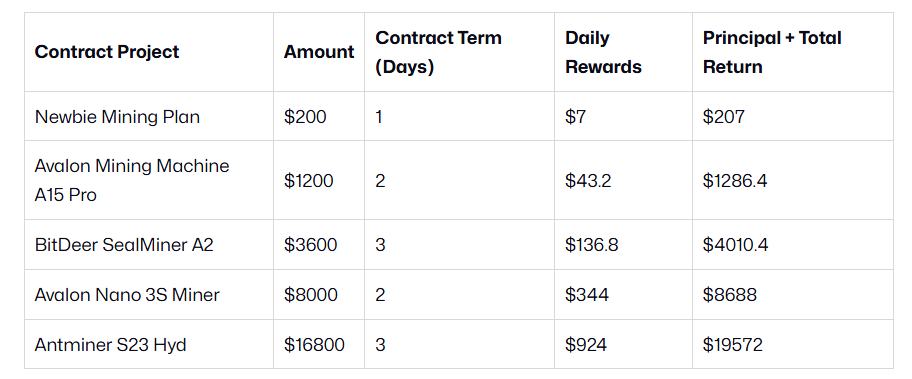
Hashbitcoin offers various investment plans suitable for both beginners and experienced investors. See the full contract projects below:

Hashbitcoin

Visit Hashbitcoin to claim $15 and view all contracts!

Platform Advantages:

Daily payouts every 24 hoursPrincipal automatically returned at contract endUK trust structure ensures transparency, smart contract-based paymentsVerifiable daily rewards, highly respected globally

2️⃣ ECOS – Armenia Government Licensed Mining Farm

Founded in 2017, ECOS is a licensed mining operator located in Armenia’s Free Economic Zone. It supports BTC and ETH mining, offers customizable contracts, and includes a built-in profitability calculator—ideal for long-term investors seeking regulated, stable returns.

3️⃣ BitDeer – Global Pioneer in Hash Power Sharing

BitDeer, founded by former Bitmain executives, provides direct access to real mining machines hosted in leading data centers worldwide. The platform delivers transparent earnings, supports multiple cryptocurrencies, and offers daily payouts based on actual hash rate performance.

4️⃣ NiceHash – The World’s Largest Hash Power Marketplace

NiceHash allows users to rent or lease computing power from other miners, offering a flexible and beginner-friendly experience. The platform supports Bitcoin and Dogecoin mining with no minimum investment, though returns vary depending on market demand and hash rate pricing.

5️⃣ Hashing24 – Focused on Bitcoin Stability Since 2015

Hashing24 collaborates with mining facilities in Iceland and Canada to offer stable Bitcoin mining contracts. The platform is straightforward and reliable, making it well suited for users looking to accumulate Bitcoin over the long term.

6️⃣ BeMine – Real Miner Hosting & Ownership

BeMine enables partial ownership of real ASIC miners rather than virtual hash power. The company manages installation, cooling, and maintenance, while investors earn proportional returns—providing genuine, verifiable participation in mining operations.

7️⃣ StormGain – Zero Cost Cloud Mining via Trading App

StormGain allows users to mine small amounts of Bitcoin for free within its mobile trading app, with rewards available for withdrawal every four hours. While returns are modest, it offers a risk-free way to explore Bitcoin cloud mining.

8️⃣ Binance Pool – Exchange-Integrated & Secure

Binance Pool is part of the Binance ecosystem, combining mining, trading, and staking. Users can manage hash power and earnings directly through the Binance app, which is trusted, secure, and highly transparent.

9️⃣ KuCoin Pool – Multi-Coin Cloud Mining

KuCoin Pool offers flexible BTC, DOGE, and LTC mining contracts. It’s a reliable choice for investors who want to diversify across multiple cryptocurrencies while maintaining stable daily returns.

🔟 GreenHash – Renewable Energy-Driven Mining

GreenHash emphasizes sustainable mining powered by wind and geothermal energy. Its eco-focused infrastructure appeals to investors looking for long-term, low-carbon cryptocurrency returns.

How to Choose The Legal Cloud Mining Platform

Before investing, make sure to check:

Verified company registration and regulatory supportReal hash-based earnings, not fixed or unrealistic returnsTransparent withdrawal terms and visible contractsPositive community feedback and public reputation

Conclusion: A New Era of Safe, Sustainable Passive Income

In 2026, cloud mining is one of the easiest and most legitimate ways to join the crypto ecosystem. Platforms like Hashbitcoin, ECOS, and BitDeer combine AI-driven hash optimization, green energy, and daily automated payouts to deliver a secure, scalable, and transparent experience.

For anyone looking to build passive crypto income through free Bitcoin cloud mining or legal Dogecoin mining, choosing a regulated platform is crucial. With thorough research and responsible investing, cloud mining now represents not just profitability, but sustainability in the ever-evolving digital economy.


Source link

Zero Knowledge Proof Explained – A Clear Guide for Crypto Investors in 2026

0
Zero Knowledge Proof Explained – A Clear Guide for Crypto Investors in 2026


Early access in crypto is rarely fair. Most launches favor insiders through private rounds, discounts, or tiered presales. Retail participants usually arrive late, diluted by early allocations and exposed to sell pressure they never had a chance to avoid. Over time, this has created mistrust and short-term speculation instead of long-term confidence. 

So, what is Zero Knowledge Proof in this context? It is a project built to remove access advantages entirely. ZKP does not use an ICO, IDO, or private sale. Instead, it operates through a public Initial Coin Auction (ICA) where every participant follows the same rules, every day, without exception. 

ZKP’s Auction Model: Structure Over Speculation

Rather than promising early deals or preferential pricing, Zero Knowledge Proof distributes its tokens through a daily auction governed by fixed, public math. Each day, a set number of tokens enter circulation. Participants contribute, and tokens are allocated proportionally based on that day’s total demand.

There are no private rounds. No venture capital allocations. No “friends and family” access. A participant contributing $100 goes through the exact same process as someone contributing $50,000. The rules do not change based on wallet size, timing, or influence. 

ZKP’s Auction Model: Structure Over Speculation

This directly contrasts with traditional crypto launches. ICOs often offer steep early discounts that later collapse price stability. Launchpads frequently reward insiders before public buyers ever participate. These systems create artificial momentum that fades once the supply is unlocked.

ZKP removes that cycle. Time does not unlock advantages. It increases competition. 

Anti-Whale Limits: Why Supply Control Matters

One of the most common failures in crypto launches is early supply concentration. When a small number of wallets control large portions of supply, price discovery becomes fragile. Governance skews. Sell pressure becomes predictable.

Zero Knowledge Proof addresses this at the protocol level. The ICA enforces anti-whale mechanics that limit how much influence any single address can exert during an auction. Large bids do not overpower smaller ones. Accumulation is flattened over time.

This is not a promise. It is enforced by design. No manual intervention. No discretionary decisions.

When people ask what Zero Knowledge Proof is, this is a core part of the answer. It is a system where fairness is not claimed; it is mechanically enforced. 

No Discounts, No Allocations, No Delayed Unlocks

ZKP does not reward early awareness with cheaper tokens. There are no discounted phases. There are no locked allocations waiting to unlock later. Every day’s auction is final.

The full token supply is released gradually through the ICA over a fixed 450-day cycle. Missing an auction does not delay access. It simply means entering under different conditions the next day. 

No Discounts, No Allocations, No Delayed UnlocksNo Discounts, No Allocations, No Delayed Unlocks

This structure changes incentives. Participants are not waiting for listings or unlocks. They are not positioning around insider behavior. Participation itself becomes the signal.

That clarity is rare in crypto. 

Final Take

Crypto launches often begin with ambition and end with imbalance. Early access creates power. Late access absorbs risk. Zero Knowledge Proof takes a different route.

What is Zero Knowledge Proof? It is a response to how crypto has operated for years. A project that removes discretion from launches and replaces it with fixed rules. A system where participation is open, distribution is transparent, and fairness is enforced by code.

In ZKP, there are no shortcuts. No special access. No hidden advantages. Every auction is public. Every rule is known. And every outcome is earned.

Find Out More about Zero Knowledge Proof: 

Auction: https://auction.zkp.com/

Website: https://zkp.com/

X: https://x.com/ZKPofficial

Telegram: https://t.me/ZKPofficial 


Source link

Top 10 Best Meme Coin Trading Platform to Explore in 2026

0
Top 10 Best Meme Coin Trading Platform to Explore in 2026


Finding the best meme coin trading platform can simplify your search as a trader when hype moves faster than logic. You can use a meme coin app to trade trending tokens in seconds, but not every platform gives you the speed and safety you need. When you buy meme coins, one wrong move, high fees, or poor liquidity can quickly turn excitement into frustration.

In this article, we aim to break down the top platforms worth using in 2026, compare their features side by side, explain how meme coin trading works, and highlight the benefits, risks, and best practices every trader should know. We’ll also walk you through how to choose the right platform and what trends are shaping the future of meme coin trading. Curious which platform fits your trading style best? Read on.

Top Platforms for Meme Coin Trading

PlatformLaunch YearTrading OptionsNative TokenSupported CryptocurrenciesGlobal PresenceBinance2017Spot, futures, options, margin, P2P, launchpad, stakingBNB500+ (BTC, ETH, SOL, DOGE, SHIB, meme coins, etc.)180+ countries (restricted in US, some others)MEXC2018Spot, futures, options, margin, launchpad, stakingMX2900 + (BTC, ETH, SOL, meme coins, altcoins)170+ countries (restricted in US, Canada, some others)Bybit2018Spot, futures, options, margin, copy trading, stakingNo native token (uses USDT/BTC/ETH)2400 + (BTC, ETH, SOL, meme coins, altcoins)240+ countries (restricted in US, some others)OKX2017Spot, futures, options, margin, launchpad, stakingOKB350+ (BTC, ETH, SOL, DOGE, SHIB, meme coins, etc.)100+ countries (restricted in US)Gate.io2013Spot, futures, margin, launchpad, staking, RWA, stocksGT4,300+ (BTC, ETH, SOL, meme coins, altcoins, tokenized assets)200+ countries (restricted in US, Canada, some others)KuCoin2017Spot, futures, margin, launchpad, staking, botsKCS900+ (BTC, ETH, SOL, meme coins, altcoins)200+ countries (restricted in US, Canada, some others)Coinbase2012Spot, futures (Intl), staking, recurring buys, walletNo native token (uses USD/USDC)275+ major assets (BTC, ETH, DOGE, SHIB, meme coins, etc.)100+ countries (US-based, Intl exchange for non-US)Pump.fun2024Token creation, spot trading, bonding curve, DEX (PumpSwap)PUMPSolana & Base meme coins (PUMP, thousands of new meme coins)Global (web & app, accessible worldwide)Moonshot2024Spot trading, token creation, fiat on-ramp, trending tokensNo native token (uses SOL, USDC, etc.)Solana meme coins, tokenized stocks (Nvidia, Tesla, etc.)130+ countries (app-based, excludes US for some features)Raydium2021Spot, AMM swaps, liquidity pools, yield farming, launchpadRAYSolana ecosystem tokens (SOL, meme coins, LP tokens)Global (decentralized, accessible worldwide)

10 Best Meme Coin Trading Platforms in 2026

When you understand where to trade meme coins, the next step is finding a platform that supports your trading goals. You require a platform that is safe, user-friendly, and offers a wide range of trading options to suit your needs. To help you make the best choice, we’ve compiled a list of the 10 best meme coin trading platforms in 2026.

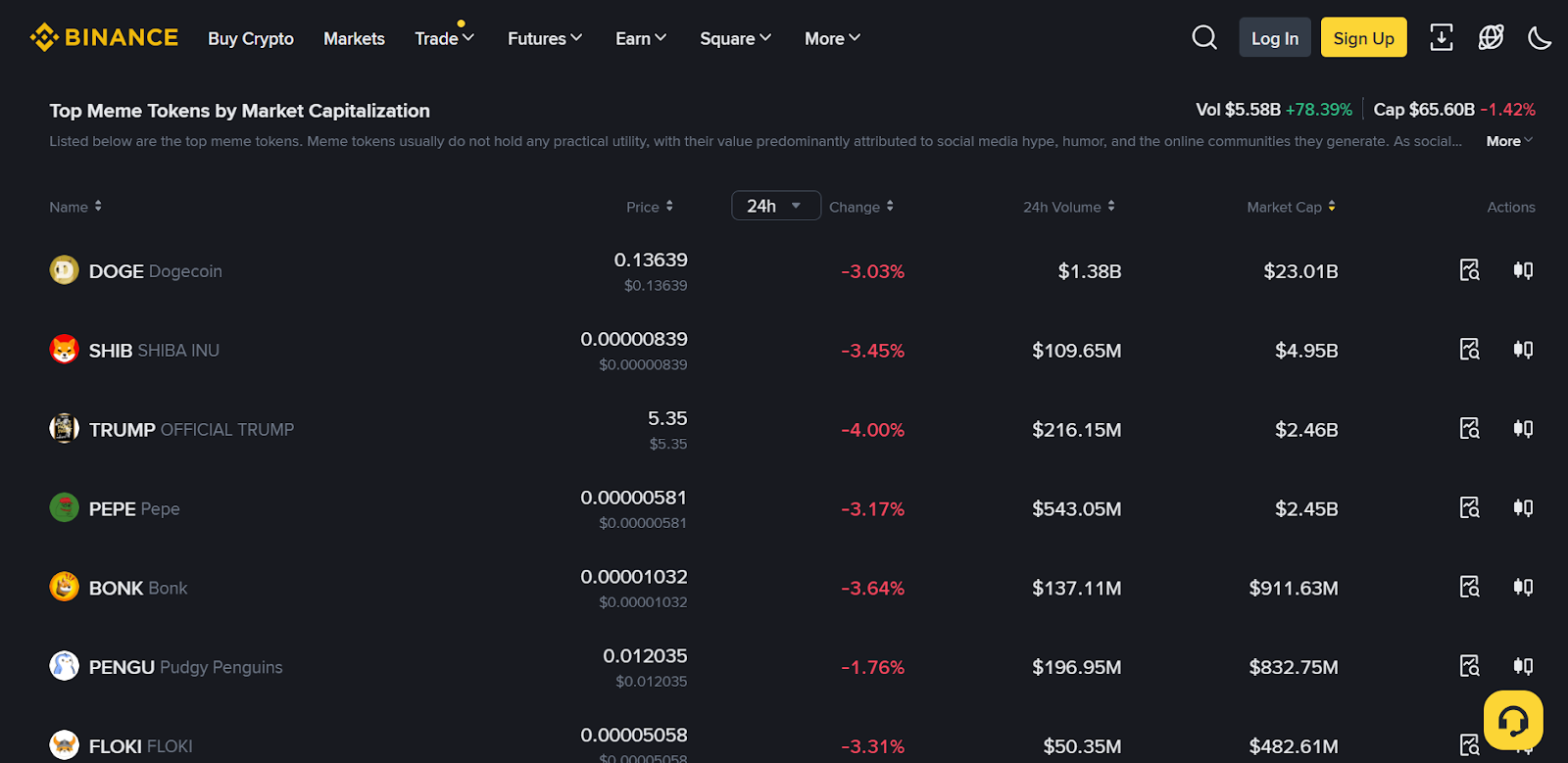
1. Binance
Binance - Meme Coin Trading Platforms

Binance is a well known crypto exchange that many traders turn to when searching for the best meme coins with strong liquidity. The platform launched in 2017, led by Changpeng Zhao (CZ) and Yi He, with a clear goal of making crypto trading accessible to people worldwide. Today, Binance supports a massive global community of more than 280 million users, making it one of the most widely used exchanges in the crypto market.

Binance processes an average daily trading volume of about $43 billion, which helps you enter and exit trades quickly, even during high volatility. After facing regulatory pressure in its early days, Binance shifted its operations across several crypto friendly regions, allowing it to grow while adapting to local rules. You can trade over 500 cryptocurrencies on the platform, including many popular meme coins, alongside major assets like Bitcoin and Ethereum. Binance also lets you buy crypto using multiple fiat currencies through cards, bank transfers, and peer to peer options, while placing a strong focus on account security and user protection.

binance-logo-6219389_1280binance-logo-6219389_1280

Pros

Deep liquidity that supports fast trades for trending meme coins.Competitive trading fees with extra savings when you hold BNB.Multiple trading modes, including spot, futures, and copy trading.Several ways to earn rewards through staking and other Earn tools.Large selection of crypto assets and trading pairs.Early access to new projects through Binance’s launch programs.

Cons

Fiat cash-out options vary by region and may feel limited in some areas.Platform access is restricted in certain markets like the USA and Nigeria, depending on local regulations.

2. MEXC
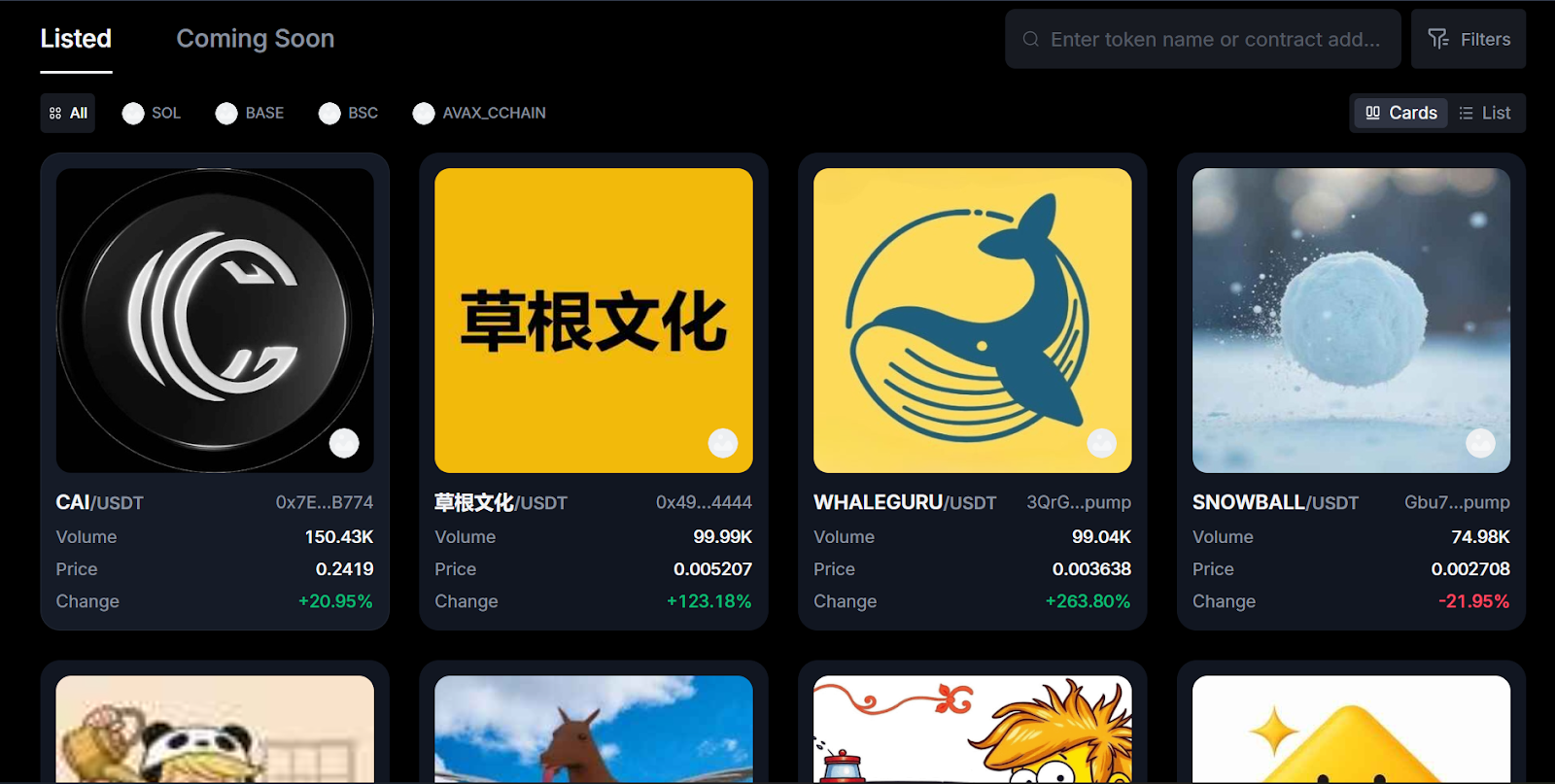
Mexc - Meme Coin Trading PlatformsMexc - Meme Coin Trading Platforms

MEXC is a global crypto exchange that many traders turn to when searching for the best platform for meme coin trading. The platform launched in 2018 and has steadily built a strong presence in the crypto space. Over time, MEXC has attracted more than 30 million users, showing how widely it’s been adopted by traders around the world. Its reach now extends across more than 170 countries, making it one of the more accessible exchanges for international users.

One area where MEXC really stands out is the sheer number of assets available. The exchange supports over 2,900 cryptocurrencies, which gives you plenty of options when hunting for new or trending meme coins. You’ll also find more than 3,000 trading pairs, helping you move in and out of positions with ease. On the cost side, MEXC keeps fees competitive by offering zero maker fees. Futures traders benefit from taker fees that can start as low as 0.02%. While the platform offers advanced tools like copy trading, staking, and high leverage futures, access still depends on where you live due to regional rules.

MEXC_square_logo-removebg-previewMEXC_square_logo-removebg-preview

Pros

Zero maker fees with low futures trading costs.Large variety of cryptocurrencies, including trending meme coins.Advanced features such as copy trading, staking, and leverage trading.Strong liquidity for smooth and fast trade execution.Simple interface with mobile apps for easy trading.

Cons

Limited ways to buy crypto directly using local fiat.Platform availability varies based on regional regulationsNo built in Web3 tools like NFTs or DeFi services.Support response times can slow during peak trading periods.

3. Bybit
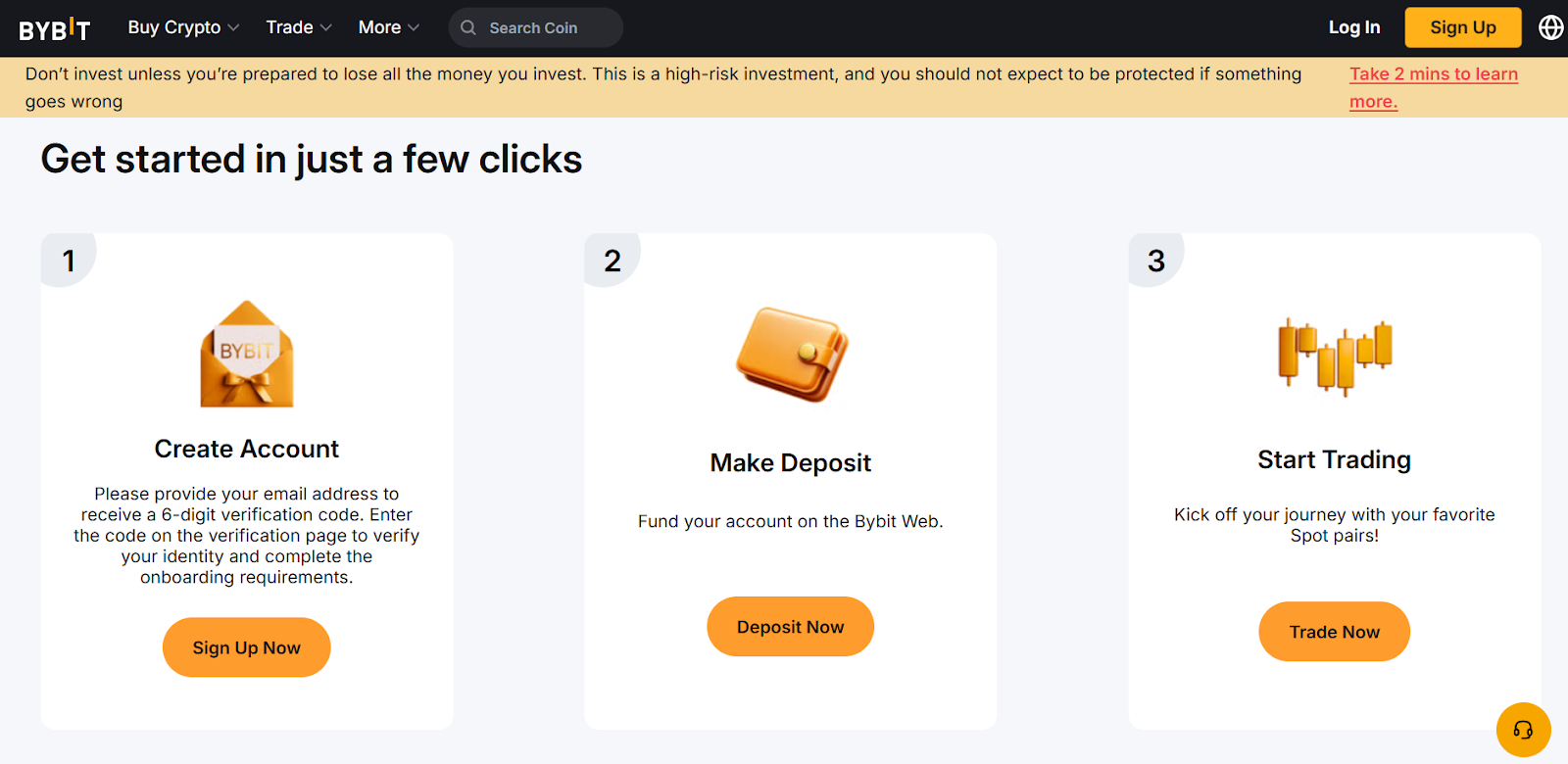
Bybit - Meme Coin Trading PlatformsBybit - Meme Coin Trading Platforms

When you want a place where you can trade meme coins safely, Bybit stands out for its steady performance and strong focus on user protection. The exchange launched in 2018 and has grown by prioritizing reliability over hype. In recent years, Bybit shifted its main operations to Dubai, aligning itself with clearer regulatory frameworks while continuing to serve traders across many regions.

Bybit supports over 2,400 cryptocurrencies, which gives you plenty of room to explore both established and emerging meme coins. Bybit also supports more than 60 fiat currencies, making it easier for you to fund your account and move between crypto and cash. Beyond spot trading, Bybit offers several advanced tools that let you adjust your trading approach without feeling overwhelmed. Security remains a key focus, with required identity checks, strong account protections, and safeguards designed to reduce risk during volatile market conditions.

bybit-logo-whitebybit-logo-white

Pros

Wide selection of cryptocurrencies, including trending meme coins.Support for many fiat currencies to simplify deposits and withdrawals.Reliable platform with high uptime during busy trading periods.Strong security measures that help protect your account and funds.24/7 customer support available across multiple channels.

Cons

Platform access is limited in certain regions due to regulations.Fiat withdrawal options may be restricted depending on your location.

4. OKX
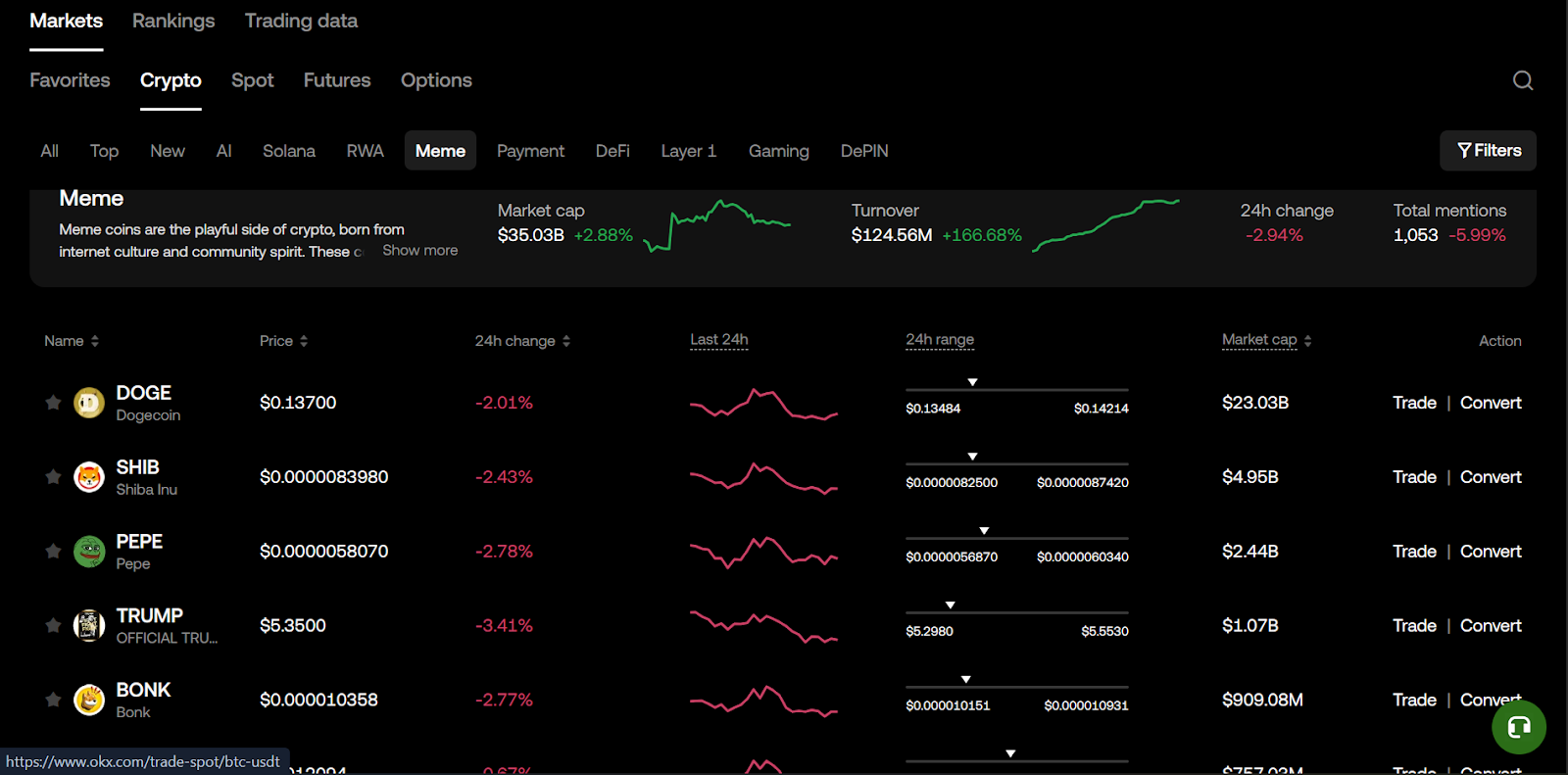
OKX - Meme Coin Trading PlatformsOKX - Meme Coin Trading Platforms

OKX was launched in 2017 as a platform designed to cater to both beginner and advanced traders. Over the years, it has built a strong reputation for reliability and flexibility, which makes it a solid choice if you’re learning how to trade meme coins without feeling overwhelmed. OKX operates globally and serves users across more than 100 countries, giving it a wide international footprint.

The platform supports over 400 cryptocurrencies, so you can trade popular meme coins alongside major assets like Bitcoin and Ethereum. OKX offers several trading options, including spot, margin, and futures trading, allowing you to grow at your own pace. One area where OKX really stands out is Web3 access. You can use its non custodial wallet, explore NFTs, and interact with decentralized finance tools, all from the same ecosystem. While the platform packs a lot of features, availability still depends on your location due to regulatory rules in certain regions.

0710421007104210

Pros

Beginner-friendly interface paired with advanced trading tools.Supports a wide range of cryptocurrencies, including meme coins.Multiple trading options for different experience levels.Strong Web3 features like a non-custodial wallet and NFT access.Global presence with a well-established reputation.

Cons

Platform access is restricted in some countries.Feature rich interface may take time to explore fully.Some tools are better suited for experienced traders.Fiat support varies depending on the region.

5. Gate.io
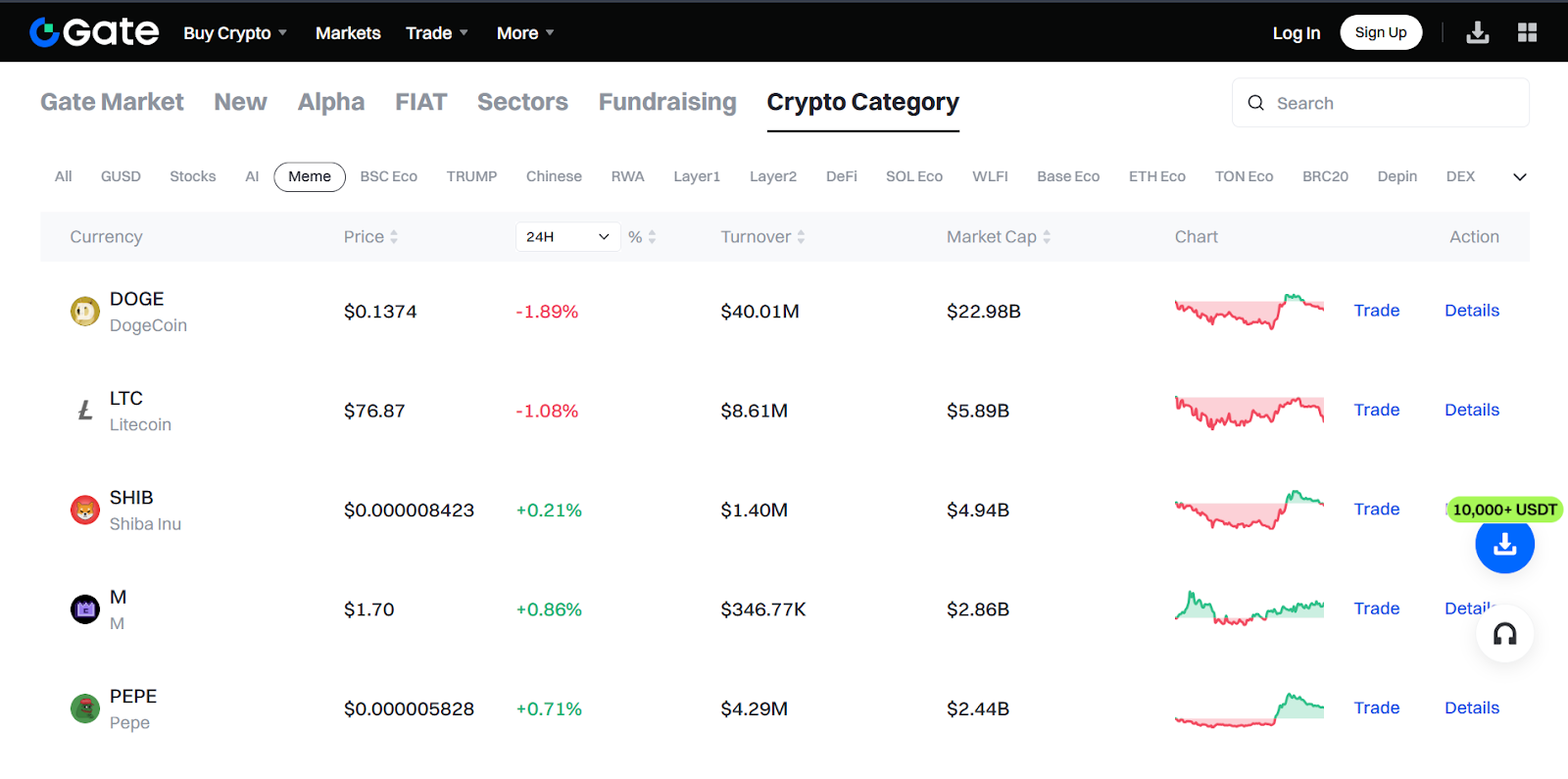
Gate.io - Meme Coin Trading PlatformsGate.io - Meme Coin Trading Platforms

With 48 million traders using the platform every second during peak activity, Gate.io has positioned itself as a reliable exchange for those looking to buy meme coins beyond the usual mainstream picks. Gate.io was launched in 2013, making it one of the longest-running crypto exchanges still operating today. Over time, the platform has expanded its reach and now serves more than 17 million users worldwide.

Gate.io regularly ranks among the top exchanges by trading volume, which helps ensure smooth trades even during volatile market conditions. On average, the platform handles daily trading activity worth around $4.95 billion, supporting strong liquidity across markets. One major reason traders choose Gate.io is asset variety. The exchange supports over 2,500 cryptocurrencies, giving you access to a broad range of meme coins and emerging projects. Gate.io also promotes transparency through proof of reserves and offers its native GateToken (GT), which you can use to lower trading fees and unlock extra features.

Gate.io_Gate.io_

Pros

Supports over 2,500 cryptocurrencies, including many meme coinsHigh daily trading volume helps maintain strong liquidityFee discounts and benefits when using the GT tokenMultiple earning options like staking and startup token accessMobile apps are available for easy trading on the go

Cons

Direct fiat withdrawal options are limitedPlatform access varies depending on regional regulationsFeature rich interface may feel complex for new usersLess beginner-focused compared to simpler exchanges

6. KuCoin
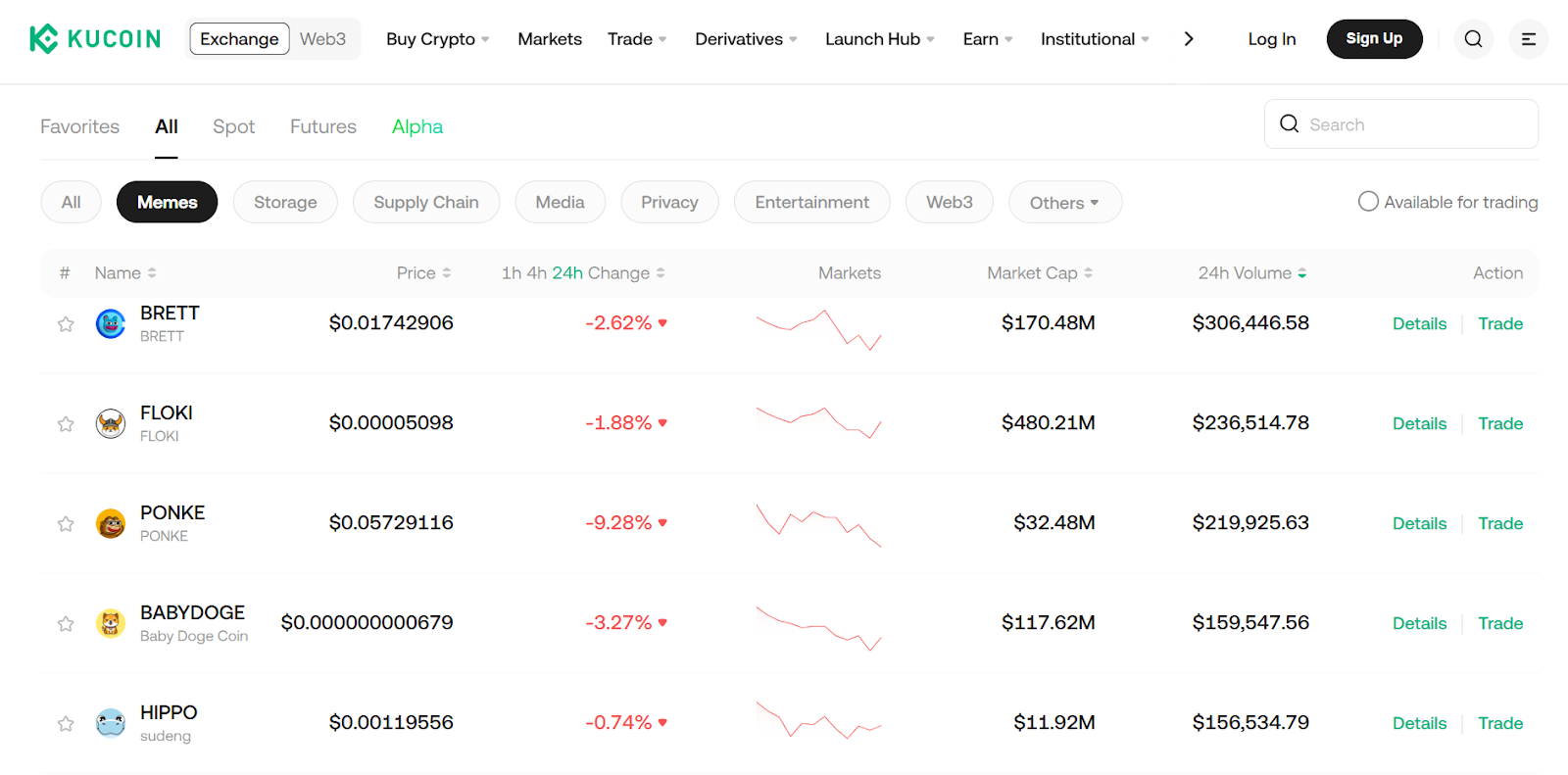
Kucoin - Meme Coin Trading PlatformsKucoin - Meme Coin Trading Platforms

KuCoin is a widely used crypto exchange that many traders choose when they want to trade meme coins safely while still having access to a broad range of assets. The platform began operations in 2017 and has since grown into a global exchange serving tens of millions of users. KuCoin operates internationally and reaches traders in more than 200 countries.

The platform supports around 900 cryptocurrencies, giving you access to many popular meme coins alongside major assets like Bitcoin and Ethereum. KuCoin also offers several trading options, including spot, margin, and futures trading, which makes it suitable if you want to move beyond basic buying and selling. Daily trading activity averages close to $1 billion, helping ensure steady liquidity and smoother order execution. While KuCoin keeps its interface fairly easy to use, some features are better suited for traders with a bit of experience.

Kucoin-logoKucoin-logo

Pros

Large selection of cryptocurrencies, including popular meme coins.Competitive trading fees with discounts when you hold KCS.Multiple ways to earn rewards through staking and lending.Built in trading bots to automate simple strategies.A mobile app that makes trading convenient from anywhere.

Cons

Limited options for converting crypto directly to fiat.Platform access is restricted in certain regions.Copy trading features are limited compared to some competitors.Customer support response times can be inconsistent.

7. Coinbase
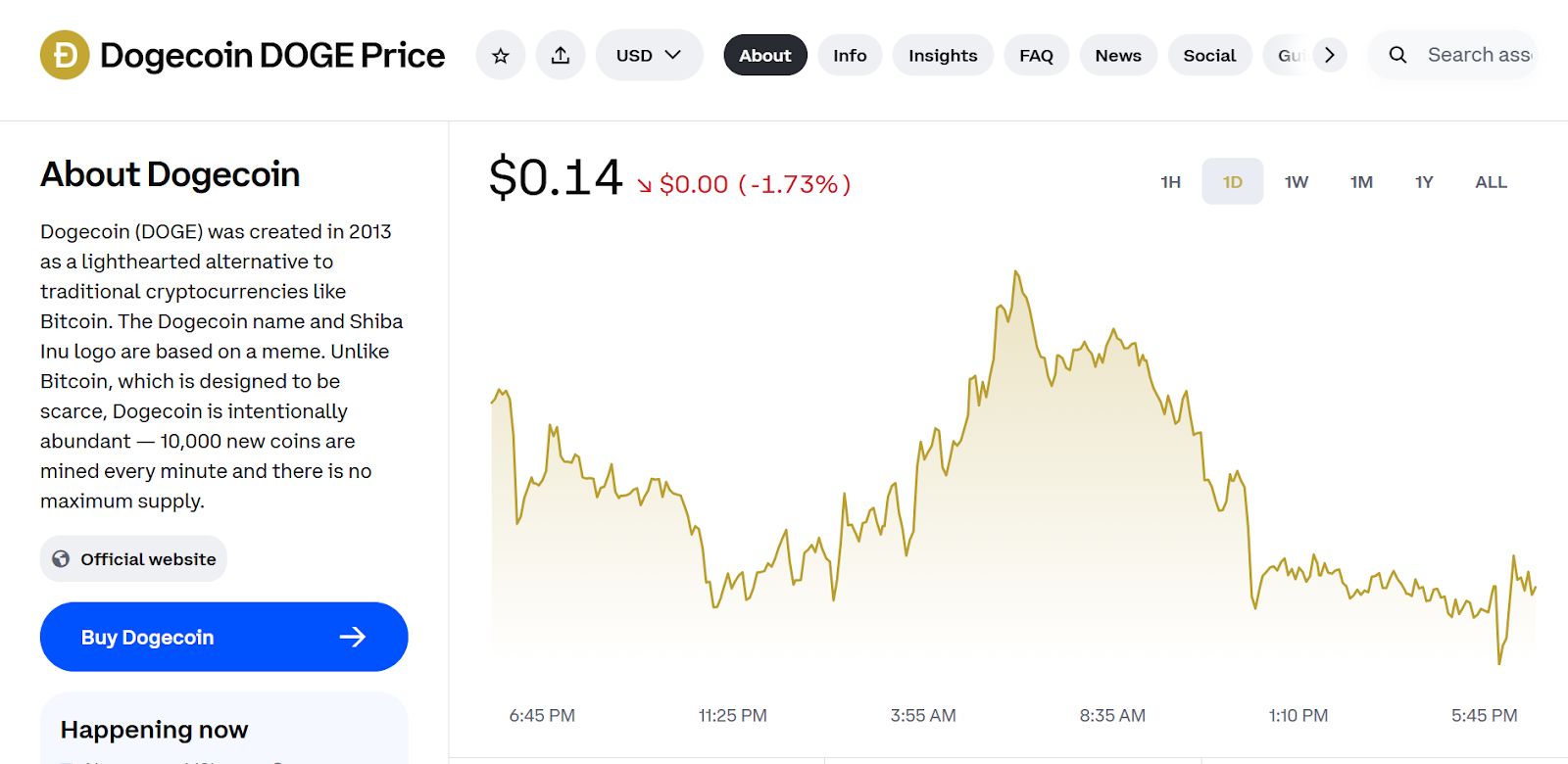
Coinbase - Meme Coin Trading PlatformsCoinbase - Meme Coin Trading Platforms

Coinbase is one of the most recognizable crypto exchanges, especially if you’re just getting started with crypto trading. The platform launched in 2012 with a simple goal of making Bitcoin easy to buy and sell for everyday users. Since then, Coinbase has grown into one of the largest exchanges in the U.S. Today, it serves more than 110 million users spread across over 100 countries, showing just how widely the platform is used.

Coinbase supports trading for over 275 cryptocurrencies, which gives you enough variety to explore major coins as well as newer assets across leading altcoin trading platforms. The company now operates as a fully remote organization, though it was originally based in San Francisco, California. Coinbase is registered with FinCEN in the United States and follows strict compliance standards across the regions where it operates. In recent years, the platform combined Coinbase Pro into a single Advanced Trade interface, giving you access to more powerful tools without losing its beginner-friendly feel. You’ll also find features like Coinbase Earn, which lets you learn about crypto projects and get rewarded with free tokens.

coinbasecoinbase

Pros

A very easy-to-use interface that suits beginners.Strong security with advanced encryption and account protection.Supports over 275 cryptocurrencies for trading.Educational rewards through the Coinbase Earn program.Self-custody option available with Coinbase Wallet.Staking services are supported for many crypto assets.

Cons

Trading fees are higher than many competing exchanges.Customer support response times can be slow.Some users report sudden account restrictions or holds.

8. Pump.fun
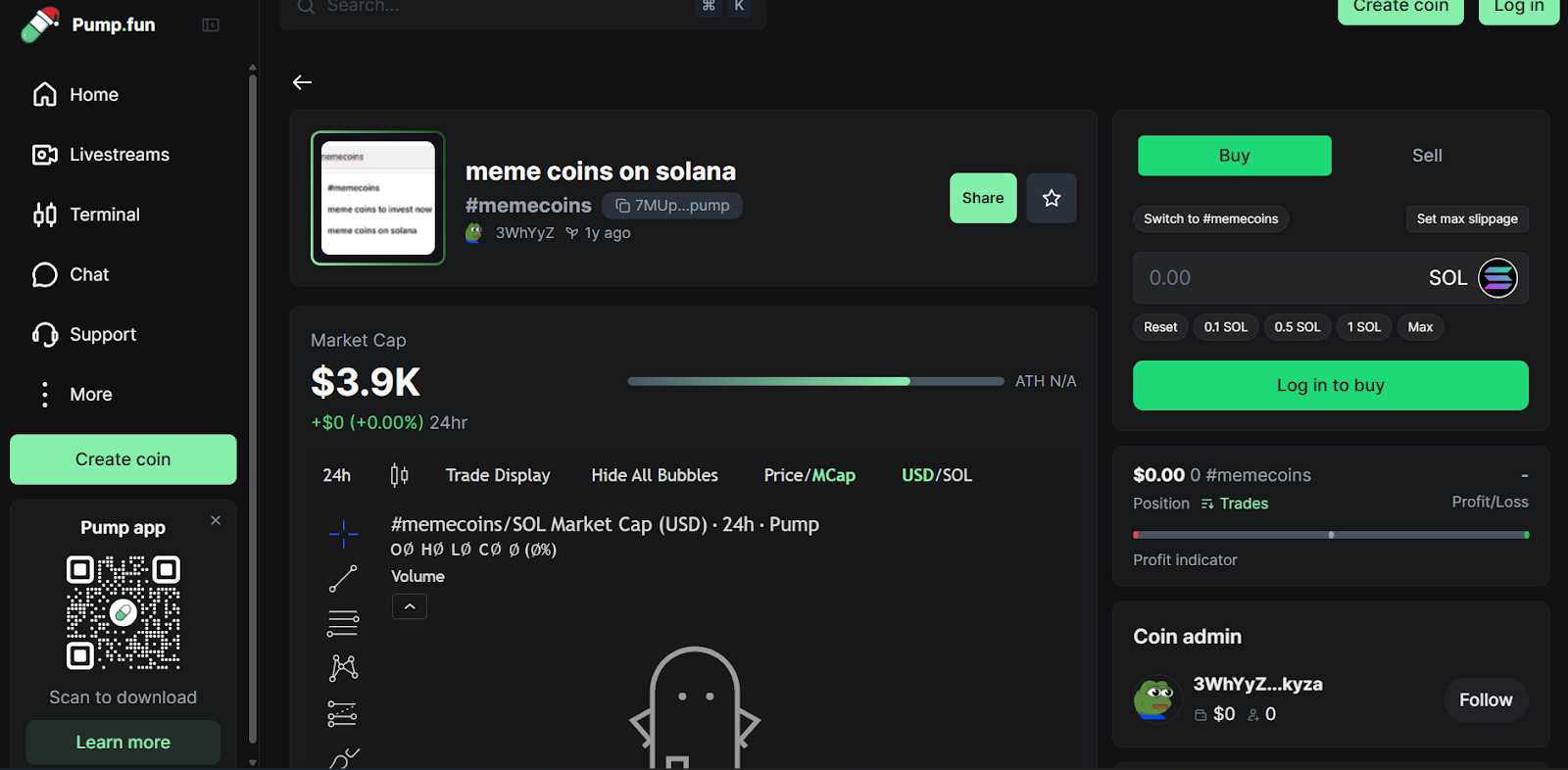
Pump.fun - Meme Coin Trading PlatformsPump.fun - Meme Coin Trading Platforms

Pump.fun is a newer entrant in the crypto space that has quickly gained attention, especially among traders who enjoy discovering meme coins at a very early stage. Built on the Solana blockchain, Pump.fun works differently from traditional exchanges. Instead of browsing long meme coin listings, you interact directly with freshly launched coins as they gain traction.

The platform is designed for speed and simplicity. You don’t need complex trading tools or deep technical knowledge to get started, which makes Pump.fun appealing if you’re experimenting with small trades. At the same time, the fast-paced nature of the platform means prices can change quickly, so it’s better suited for traders who understand the risks that come with early stage tokens. Pump.fun focuses more on discovery and experimentation than long-term investing.

Pros

Easy access to newly launched meme coins.Simple and fast trading experience.Built on Solana for low transaction costs.No complex trading tools to manage.Popular among traders looking for early opportunities.

Cons

High risk due to unproven tokens.Limited trading features compared to traditional exchanges.No fiat support for buying or cashing out.Not ideal for beginners who want stability.

 9. Moonshot

Moonshot - Meme Coin Trading PlatformsMoonshot - Meme Coin Trading Platforms

Moonshot is a newer crypto trading app built for people who want a simple way to buy meme coins without navigating complex exchange tools. The platform focuses on ease of use, making it easier for casual traders to explore and trade meme coins directly from their phones. Moonshot mainly supports tokens from the Solana ecosystem, which helps keep transactions fast and fees low.

The app removes much of the friction you see on traditional exchanges. You don’t need advanced trading knowledge or multiple screens to get started. At the same time, Moonshot keeps things intentionally minimal, which means fewer features but a cleaner experience. It’s best suited for traders who value simplicity and speed over deep analysis tools.

Pros

Simple and beginner-friendly interface.Easy way to buy meme coins on Solana.Fast transactions with low network fees.Mobile-first design for quick trading.No complex setup or advanced tools required

Cons

Limited to Solana based tokens.Fewer trading features than major exchanges.No advanced charting or analytics tools.Not ideal for large or high-frequency trades.

10. Raydium
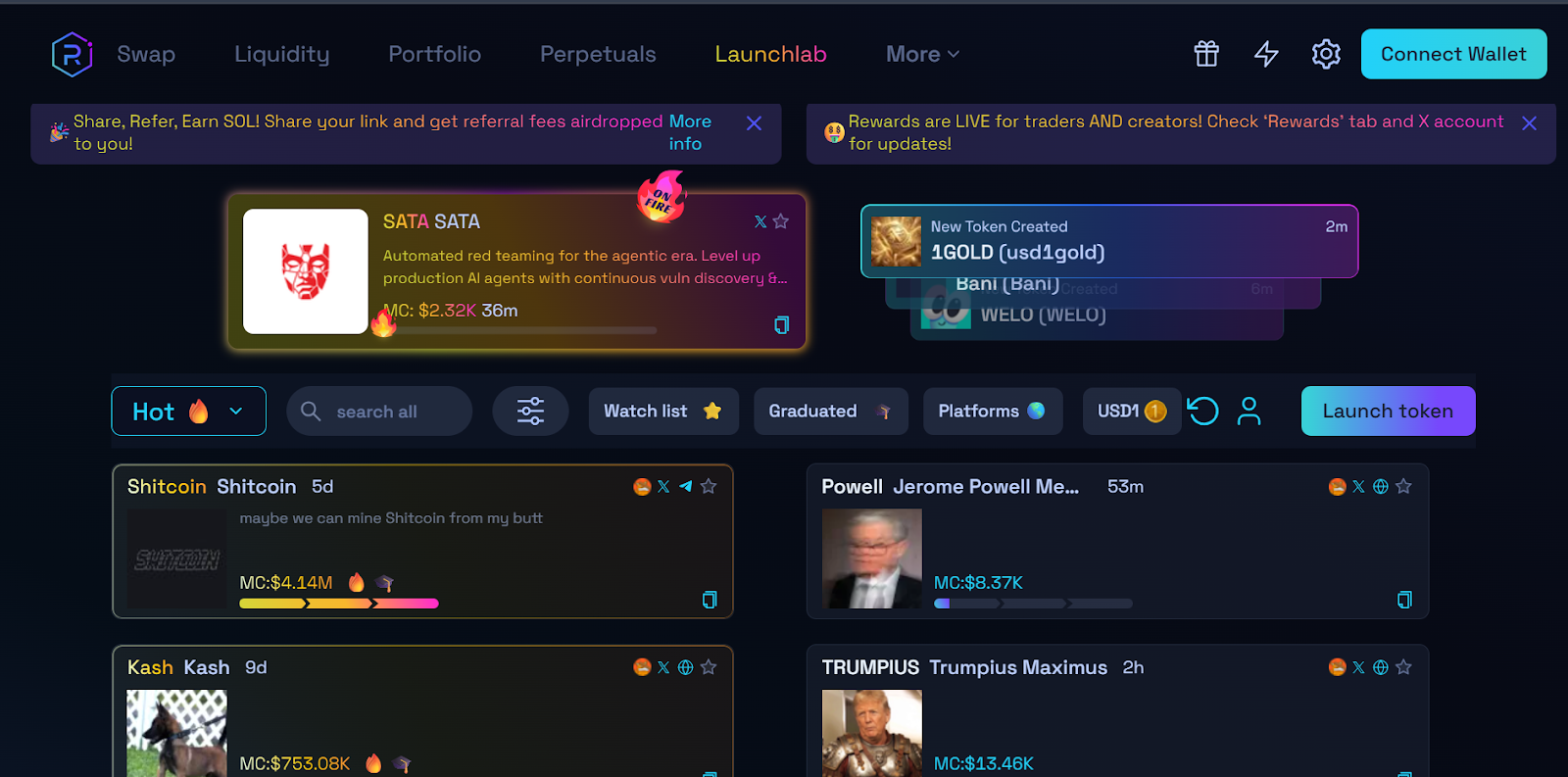
Raydium - Meme Coin Trading PlatformsRaydium - Meme Coin Trading Platforms

Raydium is a decentralized exchange (DEX) built on the Solana blockchain, offering a fast and cost-effective platform for trading cryptocurrencies, including meme coins. Known for its hybrid Automated Market Maker (AMM) design, Raydium combines liquidity pools with access to order books, ensuring better pricing and deeper liquidity. The platform also supports yield farming, staking, and token launches, making it a versatile choice for DeFi enthusiasts.

However, Raydium has faced challenges, including past security breaches and limited accessibility in certain regions. It’s best suited for experienced traders who are comfortable navigating decentralized platforms.

Pros

Built on Solana, offering fast transactions and low fees.Hybrid AMM design ensures better pricing and liquidity.Supports over 3,300 tokens, including popular meme coins.Features like staking and yield farming for earning opportunities.User-friendly interface with extensive educational resources.

Cons

Past security breaches, including a $5.5 million exploit in 2022.Limited accessibility in regions like the USA and North Korea.No dedicated mobile app; only a web-based interface.Complex perpetual trading interface, better suited for advanced users.

What is Meme Coin Trading?

Meme coin trading is the act of buying and selling cryptocurrencies inspired by internet memes, online trends, or strong community hype. These coins, like Dogecoin or Shiba Inu, often gain popularity through social media campaign rather than intrinsic value or underlying technology.

When you trade meme coins, price movements can be fast and unpredictable. A single viral post or trending topic can drive prices up or down within minutes. Because of this, meme coin trading is usually short term and timing focused. Many traders approach it as speculation rather than long term investing, which makes risk management and awareness especially important.

Benefits & Risks of Meme Coin Trading

Before you know where to trade meme coins, you should know what makes them unique and the risks involved. Here are the benefits and risks: 

Benefits

High Profit Potential: Meme coins can skyrocket in value within hours, offering traders the chance for significant returns.Community-Driven: These coins often have passionate communities that drive hype and engagement, creating trading opportunities.Low Entry Barrier: Many meme tokens are inexpensive, making them accessible for beginners or those with smaller budgets.Fun and Trendy: Trading meme coins can be an entertaining way to engage with the crypto market, especially if you enjoy following viral trends.

Risks

Extreme Volatility: Prices can rise and fall dramatically, leading to potential losses if you’re not careful.Lack of Utility: Most meme coins have no real-world use, relying solely on hype for value.Scams and Rug Pulls: The meme coin space is rife with fraudulent projects, where creators abandon the coin after collecting funds.Unpredictable Market: Success often depends on social media hype, which can fade as quickly as it appears.

How to Choose the Best Meme Coin Trading Platform

Before diving into meme coin trading, it’s important to select a platform that aligns with your needs. Here are five key factors to guide your decision:

1. Security Features

Security should always come first. A reliable platform offers two factor authentication, keeps most user funds in cold storage, and has a proven history of safeguarding accounts. Since meme coins attract a lot of hype and attention, platforms with weak security can expose you to hacks or account takeovers.

2. Supported Meme Coins

A good meme coin platform should support a wide range of tokens. This includes established names like Dogecoin and Shiba Inu, as well as newly launched meme coins. Having access to both popular and emerging options allows you to explore more trading opportunities without switching platforms.

3. Fees and Costs

Fees directly affect your profits, especially if you trade often. Always check trading fees, withdrawal costs, and any hidden charges. Platforms with transparent pricing and lower fees help you keep more of what you earn.

4. Ease of Use

An easy to use interface makes trading less stressful, particularly when prices move fast. Platforms with clear navigation, simple order placement, and helpful tools allow you to focus on making decisions rather than figuring out how the platform works.

5. Privacy Options

Some traders value privacy and speed over strict identity checks. If maintaining anonymity is a priority, you can pick one of the best no KYC crypto exchanges. These platforms allow you to trade without extensive identity verification, offering more privacy and quicker access.

How to Trade Meme Coins on Crypto Exchanges

Trading meme coins on crypto exchanges can be straightforward if you follow these steps. Here’s the guide to get you started:

Step 1: Choose the Right Exchange

Start by selecting a platform that supports meme coins. Look for exchanges with a good reputation, low gas fees, and strong security features. If privacy is a concern, consider the best no KYC crypto exchange options, which allow you to trade without extensive identity verification. Ensure the platform offers the specific meme coins you’re interested in, like Dogecoin or Shiba Inu.

Step 2: Set Up Your Account

Once you’ve chosen an exchange, create an account. This typically involves providing an email address, setting a strong password, and enabling two-factor authentication for added security. If you’re using a no KYC exchange, the setup process will be quicker, as it skips identity verification. Make sure to familiarize yourself with the platform’s interface and features before proceeding.

Step 3: Deposit Funds

To start trading, you’ll need to deposit funds into your account. Most exchanges accept deposits in fiat currencies like USD or EUR or cryptocurrencies like Bitcoin or Ethereum. Choose the method that works best for you and follow the platform’s instructions to complete the deposit. Be mindful of any deposit fees and processing times.

Step 4: Buy and Trade Meme Coins

Navigate to the trading section of the exchange and search for the meme coin you want to trade. Use the platform’s tools to analyze price trends and decide whether to place a market order to buy at the current price or a limit order to set your desired price. Once your order is executed, the meme coins will appear in your account wallet.

Best Practices to Trade Meme Coins Safely

Trading meme coins can be exciting, but it’s essential to prioritize safety. Start by thoroughly researching the coin you’re interested in. Look into its community, development team, and market trends to ensure it’s not a scam or a pump-and-dump scheme. Always use a reputable exchange with strong security features like two-factor authentication and cold storage for funds. If privacy is a concern, consider using the best no KYC crypto exchange options, but ensure the platform has a solid reputation.

Diversify your investments to minimize risk, don’t put all your funds into a single meme coin. Set clear trading goals and stick to them, avoiding emotional decisions driven by market hype. Use stop-loss orders to limit potential losses and regularly monitor your portfolio. Lastly, never invest more than you can afford to lose, as meme coins are highly volatile and speculative.

Future Trends in Meme Coin Trading

The meme coin market is expected to evolve as the cryptocurrency space matures. One significant trend is the increasing integration of utility into meme coins. Developers are beginning to add real-world use cases, such as payment options or staking rewards, to make these coins more than just speculative assets. This shift could attract a broader audience and provide more stability to the market.

Another trend to watch is the role of blockchain technology and artificial intelligence in meme coin trading. AI-powered tools are being developed to analyze market trends, predict price movements, and automate trading strategies. These advancements could make trading more accessible and efficient, especially for newcomers. Additionally, blockchain innovations may enhance transparency and security, addressing some of the concerns associated with meme coin investments.

Community-driven growth will likely remain a determinant of meme coin success. Social media platforms and online communities will continue to play a pivotal role in driving hype and adoption. However, as regulatory scrutiny increases, meme coin projects may need to adapt to comply with new laws and standards. This balance between community engagement and regulatory compliance will shape the future of meme coin trading.

Conclusion

Meme coin trading is a fast moving and high risk part of the crypto market. While the potential rewards can be attractive, success depends on having a clear plan and understanding what drives these coins. Community hype, market sentiment, and timing play a much bigger role than fundamentals.

As meme coins continue to evolve, changes in regulation, technology, and real world use will influence how this market grows. Staying informed and adapting your approach helps you manage risk more effectively. When you focus on security, spreading your trades, and setting realistic expectations, you can trade meme coin volatility with more confidence. Meme coin trading isn’t for everyone, but for traders who understand the risks, it remains one of the most unpredictable and engaging areas of crypto.

FAQs

Which platform is best to buy meme coins?

The best place to buy meme coins depends on your needs. If you’re looking for a user-friendly interface and a wide selection of meme coins, platforms like Binance or KuCoin are popular choices. Always consider factors like security, fees, and supported coins when making your decision.

Which meme coin trading platform has the lowest fees?

If you’re searching for the meme coin trading platform with the lowest fees, Binance and Bybit are known for their competitive fee structures. However, fee rates can vary based on your trading volume and payment method, so it’s worth comparing platforms to find the best fit.

Can I buy meme coins without KYC?

Yes, you can buy meme coins without KYC on platforms that do not require identity verification. Exchanges like PancakeSwap or Uniswap allow you to trade directly from your crypto wallet without KYC, offering more privacy. However, ensure the platform is reputable and secure.

What is the safest platform for trading meme coins?

The safest platform for trading meme coins is one that prioritizes security features like two-factor authentication, cold storage, and a strong reputation. Binance, Coinbase, and Kraken are often considered secure options for trading meme coins. Always enable security measures to protect your account.



Source link

What is Brevis? Unlocking the Blockchain Black Box with Infinite ZK Compute

0
What is Brevis? Unlocking the Blockchain Black Box with Infinite ZK Compute


In the world of Blockchain, we often face a paradox: All data is public, yet Smart Contracts are “blind” to their own history. While Smart Contracts excel at managing the current state, they are notoriously inefficient at accessing past data.

This is where Brevis steps in. Often described as the “key” to unlocking the blockchain black box, Brevis promises to bring Infinite ZK Compute capabilities to decentralized applications.

What is Brevis? 

Brevis is a Smart ZK Coprocessor. It empowers Smart Contracts to read complete historical data across blockchains and perform custom computations in a completely decentralized (trust free) manner. 

Unlike Layer 2 solutions that focus on scaling throughput or transaction speed, Brevis focuses on scaling data computation.

Current Smart Contracts face a significant limitation: they can only efficiently access current state. Retrieving historical data (e.g., transactions from 3 years ago) directly on chain is either impossible due to technical constraints or prohibitively expensive due to gas costs.

Learn more: Crypto Exchange – The Cornerstone of Crypto Market

Brevis resolves this bottleneck by:

Historical Data Access: Allowing Smart Contracts to read data from any past block (transactions, events, states).Low Cost Computation: Offloading heavy computational tasks (such as aggregating trade volume or analyzing wallet behavior) away from the blockchain (off chain).Trust free Verification: Using ZK Proofs to mathematically prove the accuracy of calculation results, eliminating the need to trust third parties like Centralized Indexers or Oracles.

The strongest advantage of Brevis compared to older ZK solutions is its flexibility. It is not just a static ZK circuit. Developers can customize computational logic according to their dApp’s specific needs via SDK tools (notably the Pico Framework). This transforms Brevis into an open platform for all types of data applications.

What is Brevis? – Source Brevis

Brevis Architecture

To realize the vision of “infinite compute” while maintaining Ethereum level security, Brevis relies on an Asynchronous Architecture. This architecture completely decouples the computationally expensive execution from the low cost verification.

Below is an anatomical breakdown of the Brevis system and the lifecycle of a data request.

The Three Pillars of the Brevis System

The Brevis architecture is composed of three main layers:

Interface Layer (SDK/API): Where developers define computational logic (Circuits) via code (such as Rust with Brevis Pico). This acts as the gateway between the dApp and the Brevis network.Prover Network (Off chain): The “Data Processing Factory.” This is a network of nodes responsible for retrieving historical data from source blockchains and generating ZK proofs.Verification Layer (On chain): Brevis Smart Contracts deployed on destination blockchains (Ethereum, BNB Chain, Base, etc.). The sole duty of this layer is to validate the authenticity of the ZK proofs.

Data Flow

To understand how the architecture operates, let’s follow the journey of a request from initiation to completion:

Step 1: Query Request – A user (or a dApp’s Smart Contract) sends a computation request.

Step 2: Processing at the Prover Network (The Heavy Lifting) – This is where the Brevis architecture shines. Nodes in the Brevis network perform two parallel tasks:

Data Indexing: Retrieving precise Raw Data from block headers, state roots, transactions, or event logs of the source chain.Circuit Execution & Proving: The node runs the computational logic requested by the dApp on that data. Once the result is obtained, it generates a ZK Proof (Zero Knowledge Proof) – a cryptographic string confirming: “I have correctly calculated according to the requested logic on actual blockchain data.”

Step 3: On chain Submission & Verification – The Prover submits the computation result along with the ZK Proof to the Brevis Smart Contract on the destination chain.

This contract acts as a “gatekeeper.” It uses ZK verification algorithms (such as Groth16 or Plonk) to check the proof.This process consumes very little gas, regardless of the volume of computation performed in Step 2.

Step 4: Callback and Execution – Upon successful verification, the Brevis system triggers a “Callback” function to send the Authenticated Result back to the original dApp’s Smart Contract.

At this point, the dApp can utilize this data (e.g., granting permission to mint a VIP NFT) with absolute trust (100% security guarantee), equivalent to the security of the underlying blockchain.

Co Chain Solutions Model

This is the most significant differentiator between Brevis and other ZK Coprocessors. Instead of forcing every transaction to generate an expensive ZK proof, Brevis offers a hybrid mechanism called Brevis Co Chain.

Co Chain Solutions Model – Source: Brevis

This model operates on an “Optimistic” mechanism combined with ZK security, functioning similarly to an AVS (Actively Validated Service) on EigenLayer.

Operational Mechanism:

Propose (Fast Path): Upon request, Validators (secured by ETH restaking on EigenLayer) perform the calculation and return the result immediately. At this stage, no ZK Proof is generated.Challenge Window: The system opens a short waiting period. Anyone can verify this result.ZK Dispute Resolution: Normal Case (99%) – No challenges occur. The transaction finalizes with zero ZK costs. Fraud Case – If someone detects an incorrect result, they submit a challenge. Brevis then triggers the generation of a ZK Proof to act as the “judge.” If the Validator is wrong, they are penalized (Slashing).

Co Chain Mode, best for GameFi, SocialFi, or dApps requiring low latency and minimal costs. Thanks to the Optimistic mechanism, operational costs are significantly reduced as Proofs are not generated for every single transaction.

The Brevis architecture is not rigid. By flexibly combining Pure ZK and Co Chain (Optimistic ZK), Brevis allows developers to freely choose between “Absolute Security” and “Maximum Efficiency,” paving the way for ZK adoption in mass market applications.

Pico

If the Brevis architecture is the powerful “engine” under the hood, then Brevis Pico is the “steering wheel” that allows developers to control that power.

Previously, the biggest barrier preventing the explosion of ZK applications (ZK dApps) was not a lack of ideas, but the programming language. To build a ZK circuit, developers had to learn highly specialized and complex languages like Circom or Halo2, which demanded deep cryptographic knowledge. Brevis Pico was created to shatter that barrier.

Pico – Source: Brevis

ZK Blackbox

Pico’s core philosophy is the “ZK Blackbox.” It completely abstracts away the complexity of cryptographic proof generation.

With legacy frameworks: You had to write code to instruct the computer how to generate mathematical proofs.With Pico: You simply write the application logic, and Pico automatically handles the underlying mathematics.

The Power of “Pure Rust”

Pico allows developers to use Rust the most beloved language in the blockchain space (utilized by Solana, Polkadot, Near, etc.) to write ZK smart contracts.

This offers immense advantages:

Zero Learning Curve: Any Rust developer can become a Brevis ZK developer in a matter of hours.Access to the Ecosystem: You can leverage thousands of existing libraries (crates) from the Rust community directly within your ZK circuit. This capability was virtually impossible with older, domain specific ZK languages.

Consistency

Another significant pain point for ZK developers was inconsistency: The code used for testing logic often differed from the code used for actual circuit generation.

Pico solves this completely with Consistency. You write your computational logic once in Rust. That exact same code can run unit tests on your local machine and be compiled to execute on the Brevis Prover network.

Brevis Pico is not just a tool; it is the bridge bringing ZK technology from the research lab to the mass market. By combining the computational power of the Brevis architecture with the user friendliness of Rust, Pico is paving the way for a new wave of Web3 applications that are significantly more complex and intelligent. 

Backers & Tokenomics 

Based on on chain data and the latest disclosures, here is the detailed financial picture of the project.

Fundraising

Brevis established its “Blue chip” status right from its first funding round. In November 2024, the project announced the completion of its Seed Round, raising $7.5 Million.

Binance Labs (YZi Labs): The venture arm of the world’s largest exchange. Binance Labs leading this round is a massive signal endorsing a potential future listing.Polychain Capital: A legendary Tier 1 fund known for incubating core blockchain infrastructure.Reputable Tier 2 Funds: IOSG Ventures, Nomad Capital, Bankless Ventures, HashKey Capital. 

Tokenomics

The Brevis Total Supply is 1,000,000,000 (1 Billion) BREV and is a Fixed Supply. BREV is not just a governance token; it is the lifeblood running through the ZK Coprocessor network. 

Tokenomics – Source: Brevis

The allocation structure demonstrates a strong focus on community and ecosystem growth:

Ecosystem Development (37%): Community Incentives (28.7%)Team (20%)Investors (10.8%)Other (3.5%)

binance-logo-2binance-logo-2

How to Buy BREV

Step 1: Prepare Account & USDT

Step 2: Executing the Trade (Spot Trading)

Navigate to Trade -> Spot.Search for the ticker: BREV.Select the corresponding trading pair: BREV/USDT (most common) or BREV/FDUSD.

Choose your Order Type:

Limit Order (Recommended): Enter the specific price you want to pay (e.g., $0.50) and the amount. The order will only fill if the market price drops to your target.Market Order: Buys immediately at the current market price. Only use this if you see a strong pump and want to “FOMO” in.

Storage

Short term (Trade): Keep BREV on the exchange wallet for easy profit taking.Long term (Hold): If you believe in the “Infinite Compute” vision and plan to hold for >1 year, withdraw your tokens to a Cold Wallet (Ledger, Trezor) or a personal Web3 Wallet 

FAQ

What is Brevis? 

Brevis is a Smart ZK Coprocessor. Think of it simply: If the Blockchain is the memory (storage), Brevis is the processor (computation). It enables Smart Contracts to access and process billions of historical data points securely and cost effectively, something that Ethereum or current L2s cannot efficiently do on their own. 

How is Brevis different from The Graph? 

The difference lies in the purpose. The Graph is an Indexing protocol, excellent at organizing data for display on website frontends. However, feeding that data back into a Smart Contract in a trustless manner is difficult and expensive. Brevis was created to solve this via Computation and Verification. Thanks to ZK technology, Brevis cryptographically proves the absolute accuracy of calculation results without needing human intervention or trust.

Is Brevis Co Chain secure if it doesn’t generate ZK Proofs for every transaction? 

Yes, thanks to a multi layered security mechanism combining Economics and Mathematics. Validators in the Co Chain network must restake a significant amount of ETH via EigenLayer to ensure honesty. Additionally, a “Challenge” mechanism allows anyone to verify results; if fraud is detected, the system triggers a ZK Proof to act as the adjudicator. Malicious actors are slashed immediately, ensuring network safety.

Is using Brevis gas-expensive? 

On the contrary, Brevis helps save significant Gas fees. Instead of forcing Smart Contracts to perform heavy computations directly on chain at a cost of hundreds of dollars, Brevis processes them off chain at a fraction of the price. You only pay a small gas fee to verify the final result. Especially with Co Chain mode, costs are further optimized as the system does not need to generate expensive ZK Proofs for every single transaction.

What specifically can I build with Brevis right now? A: You can build unprecedented Data driven DeFi and SocialFi applications. Examples include DEXs that automatically discount fees for users meeting lifetime VIP volume standards, Lending protocols offering preferential interest rates to wallets with good credit history over the past 3 years, or on chain games dropping rare items based on a player’s past NFT ownership behavior.


Source link

BlockDAG’s 120× ROI Gap Triggers The Biggest Buying Rush

0
BlockDAG’s 120× ROI Gap Triggers The Biggest Buying Rush


January is kicking off with a big shift in the crypto market as traders rotate back into assets showing real strength after a muted end to last year. With volatility easing and liquidity improving, early breakouts are drawing renewed attention across the market.

The Stellar price is among the first movers, jumping 7.47% as it pushes above key short‑term averages. Meanwhile, the Avalanche price has reclaimed the $13.20 level with expanding volume, signalling a clear reset after weeks of consolidation.

But the most aggressive demand is building around BlockDAG (BDAG). With over $441M raised, a $0.003 price, and only 3.29 billion coins left before the January 26 presale end, demand is accelerating fast. Each batch is selling out quicker than the last, and projections of a $0.38–$0.43 opening range are driving a level of interest that now overshadows the broader market.

7.47% Jump Fuels Short‑Term Stellar Price Outlook

The Stellar price climbed 7.47% to $0.2347, trading above its 20‑day and 50‑day averages but still well below the 200‑day level at $0.3252, signalling short‑term strength against longer‑term bearish pressure. With a market cap near $6.8 billion and steady fintech and stablecoin adoption, network usage remains solid. Recent consolidation also hints at accumulation by long‑term holders.

7.47% Jump Fuels Short‑Term Stellar Price Outlook

Despite this, the Stellar price faces mixed technical momentum. Indicators show weak trend strength, overbought conditions, and resistance near $0.24, suggesting the Stellar price may consolidate between $0.22 and $0.245 in the coming days as upside momentum cools.

Avalanche Price Breaks Slump After Jump Above $13.20

The Avalanche price surged to $13.59, gaining 11.9% in a strong breakout after reclaiming the key $13.20 resistance level. Expanding volume, a market cap of $5.89 billion, and rising participation highlight renewed buyer confidence. AVAX now trades well above its short‑term EMAs, confirming a clear momentum shift, although an RSI near 70 signals overbought conditions and the potential for brief consolidation.

Avalanche Price Breaks Slump After Jump Above $13.20Avalanche Price Breaks Slump After Jump Above $13.20

Despite mild on‑chain outflows, the Avalanche price continues to benefit from improving sentiment, subnet adoption, and broader altcoin rotation. Holding above $13.20 remains essential to preserve the breakout, with a push toward $14 likely if the Avalanche price maintains its current structure.

BlockDAG’s $441M Presale Signals a Golden Opportunity 

BlockDAG has just entered the most crucial phase of its presale after announcing a final presale price of $0.003. The project has already raised more than $441M, secured over 312,000 global holders, sold 21,000 physical miners, and boasts 3.5M miners on its X1 miner app. 

Now, that demand is intensifying as supply continues to tighten. Only 3.29 billion coins remain before the January 26 presale deadline. With every passing day, the presale’s end date is drawing in more traders who are seeking early exposure.

Adding to the excitement, BlockDAG has confirmed it will be listed on 20 exchange listings on February 16th. This creates a clear timeline that has pushed the community to secure positions before BDAG becomes publicly tradable. 

Moreover, Market makers are now projecting an opening range between $0.38 and $0.43 for BlockDAG. Early order book models indicate that demand at launch could exceed available supply, potentially driving the opening match toward the $0.40 midpoint. This reflects a 7.6x to 8.6x move above the reference level and a 120x gap from today’s presale price!

BlockDAG’s $441M Presale Signals a Golden Opportunity BlockDAG’s $441M Presale Signals a Golden Opportunity 

As the final stage activates and the January 26 deadline approaches, BlockDAG’s combination of tightening supply, strong liquidity, and consistent mining incentives is solidifying its position as the next crypto to explode. The remaining days represent the last clear chance to enter before the presale closes permanently.

Final Remarks

The Stellar price and Avalanche price both delivered strong upside signals, with Stellar’s 7.47% jump and Avalanche’s breakout showing renewed strength across key levels. But while each asset is benefiting from improving sentiment and short‑term momentum, both face resistance zones that will determine whether these rallies can extend.

BlockDAG, on the other hand, is already generating massive demand. With over $441M raised, a $0.003 presale price, and a projected $0.40 opening range, its final phase is drawing intense attention. As supply tightens ahead of the January 26 cutoff, BlockDAG is increasingly viewed as the next crypto to explode, making this final window especially important.

BlockDAGBlockDAG

Presale: https://purchase.blockdag.network

Website: https://blockdag.network

Telegram: https://t.me/blockDAGnetworkOfficial

Discord: https://discord.gg/Q7BxghMVyu


Source link

Predict.fun Airdrop Guide: Best Ways to Farm Points for 2026

0
Predict.fun Airdrop Guide: Best Ways to Farm Points for 2026


Predict.fun is actively transforming the landscape of decentralized prediction markets by introducing a dual-incentive model. It addresses the industry-wide “Idle Capital Problem” through a unique yield-generating architecture. With backing from YZi Labs and leadership from the former Head of Research at Binance, this dApp enables users to earn passive interest on their stakes while simultaneously wagering on market outcomes.
This comprehensive guide details how to maximize your returns via the Predict.fun’s Points Farming Campaign.

About Predict.fun

About Predict.fun

About Predict.fun

Predict.fun operates as a high-velocity prediction protocol native to the BNB Chain. Platforms like Polymarket, which dominated headlines during the 2024 election cycle, suffer from a key flaw: capital inefficiency. When users place a bet on traditional prediction markets, their capital sits idle in a smart contract for weeks or months. They miss the chance to earn yield on those assets while awaiting the result.

Predict.fun solves this issue through its yield-bearing design. Traditional platforms lock funds in escrow where they stagnate, but Predict.fun changes this dynamic completely. The protocol automatically routes staked assets into established lending markets like Venus Protocol on the BNB Chain.

In other words, while the smart contract waits for an election result or a sports score, the underlying capital still generates interest. Users retain full exposure to the upside of their bet while mitigating the opportunity cost of locking up funds for extended periods. Furthermore, the low gas fees on BNB Chain allow for high-frequency trading strategies that remain prohibitively expensive on Ethereum Mainnet.

To find the best ways to qualify for Predict.fun airdrop, review the instructions in the Airdrop Guide section below.

Backers Behind Predict.fun

Predict.fun attracts significant professional investment and focuses on high-capacity trade execution alongside an easy-to-use design for everyday participants. By late 2025, the platform managed over $11 million in Total Value Locked (TVL) and $100 million in Notional Volume, per Dune analyst @datadashboards.

YZi Labs, a firm with deep ties to early-stage Binance Labs incubations, provided strategic funding. While the team keeps the exact valuation confidential, on-chain data and treasury movements point to a capitalization in the tens of millions.

Moreover, the involvement of Dingalingts, the former Head of Research at Binance and the creator of PancakeSwap, signals a serious commitment to technical excellence. His track record of scaling PancakeSwap to billions in volume has accelerated trust among institutional players. In addition, Changpeng Zhao, most known as Binance founder CZ, featured Predict.fun on X on December 4, 2025, triggering a massive wave of retail liquidity.

Backers Behind Predict.funBackers Behind Predict.fun

Predict.fun is ready to use on the Binance Wallet app. Source: Predict.fun

Predict.fun Points Program

Predict.fun kicked off its official Points Farming Campaign on December 16, 2025, which serves as the primary mechanism for any potential distribution of their tokens in the future, incentivizing users based on their advocacy, activity, and accuracy.

The platform tracks users’ historical on-chain actions to distribute rewards. Those who engaged with specific platforms likely received “Reserved Points” at launch.

To qualify, users must trade high volumes on Limitless, Opinion or Polymarket, actively trade meme coins on the BNB Chain; or show a history of Aster contract interactions. The platform’s dynamic reward system calculates base points for every $1 USD of trading volume. Additionally, traders can secure a 1.5x multiplier by maintaining a three-day winning streak and a 2x multiplier if they are liquidity providers of markets with high uncertainty.

Learn how to earn free crypto in 2026

Predict.fun Airdrop Guide

Eligibility for the Token Generation Event (TGE) requires users to convert “Reserved” points into “Active” points. Follow these steps:

Step 1: Activate Your Wallet

Visit the official Predict.fun site, sign up, and connect a compatible Web3 wallet.

Predict.fun Airdrop GuidePredict.fun Airdrop Guide

Predict.fun Airdrop Guide

Learn more: Binance Exchange Full Guide – NFTevening

If the system detects historical volume on other platforms, it displays a “Reserved Points” balance immediately. To unlock these, complete specific tasks: create a profile, deposit $10, tweet your referral link, verify your account, and execute trades.

Step 2: Execute High-Precision Trades

To maximize earning potential, focus on strategies that demonstrate genuine user behavior rather than bot activity. The system rewards “real” usage:

Place Limit Orders: Acting as a Market Maker (MM) earns higher rewards.

Hold Positions: Avoid instant churn. Holding positions longer boosts reward weight and prevents “sybil” detection.

Maintain a Good Win Rate: Accuracy acts as a multiplier, significantly increasing total point accumulation.

Positive PnL: Aim for a PnL of $100+ to demonstrate strategic trading skills.

Be Early: Trading in the initial weeks secures “OG” status and helps you climb the leaderboard faster.

Step 3: The Referral Engine

Predict.fun utilizes a structured referral model to drive network growth. When invited peers execute trades, the referrer receives a 10% commission on their total point earnings. This does not reduce the rewards of the invitee.

To encourage high-quality networking, the platform grants special “Point Boost” NFTs, which can unlock permanent multipliers for future airdrop allocations, to the most successful referrers.

FAQ

What Is Predict.fun?

Operating on the BNB Chain, Predict.fun offers a high-velocity environment for betting on market outcomes. The protocol tackles the “Idle Capital Problem” by putting staked funds to work on Venus to earn yield while they back active bets.

How Do I Get Eligible For Predict.fun Airdrops?

Active users qualify for the airdrop. Visit the website, sign up, and connect a Web3 wallet. The platform rewards users based on activity, accuracy, and advocacy.

Who Is Behind Predict.fun?

Dingalingts, the former Head of Research at Binance and creator of PancakeSwap, founded the project. YZi Labs backs the platform, and it recently garnered attention from Binance founder CZ.

How Do I Unlock My Reserved Points?

You must convert Reserved Points from past activity into Active points. Simply connect your wallet, deposit at least $10, and verify your account via social media. These tasks confirm eligibility for the eventual airdrop.


Source link

What Is a Crypto Exchange and How Does It Work?

0
What Is a Crypto Exchange and How Does It Work?


Crypto exchanges are online platforms that help you buy and sell digital assets, including cryptocurrencies and decentralized finance (DeFi) tokens. They function like traditional stock exchanges or security brokers, providing users with various tools to execute crypto trades.

In this article, we’ll run you through the concept of cryptocurrency exchanges, their types, and how they operate. We’ll also cover the prominent exchanges and the factors to consider when choosing a digital asset trading platform.

What Is a Crypto Exchange? 

What Is a Crypto Exchange? 

A crypto exchange is a digital platform that facilitates the buying and selling of virtual currencies powered by blockchain technology. It is hosted by entities or companies that help users trade multiple cryptocurrencies from a single platform. You can also trade other assets such as non-fungible tokens (NFTs) and fiat currencies through crypto exchanges.

Additionally, certain exchanges offer DeFi services like staking, lending, and liquidity mining to help crypto investors generate passive income. 

Moreover, many exchanges support different types of crypto trading. These include spot, margin, peer-to-peer (P2P), over-the-counter (OTC), and derivatives (futures and options) trading. They also provide advanced tools, market reports, live prices, and learning resources to help users make the right investment decisions.

Some cryptocurrency exchanges also facilitate copy trading. This feature helps users, especially beginners, emulate the trading strategies of experts to garner profits. 

However, most platforms strictly require participants to trade digital currencies in pairs. Only specific exchanges like Binance allow users to buy (on-ramping) and sell (off-ramping) digital assets using multiple fiat currencies. 

How Do Cryptocurrency Exchanges Work?

While crypto exchanges are tailored to digital currencies like Bitcoin and Ethereum, they operate like traditional stock and commodities exchanges. 

Typically, cryptocurrency exchanges facilitate transactions by matching buyers and sellers. They maintain an order book, which lists and sorts buy and sell orders by intended purchase and sale prices. 

When you place a buy order, the platform’s matching engine looks for a competing sell order from another user. It searches based on the required lot size and the best executable price. 

Once matched, the transaction is performed. You transfer funds into the seller’s crypto wallet in fiat currency or cryptocurrency, based on the trading pair. Conversely, the seller transfers the purchased digital asset into your digital wallet. The exchange follows the same process for sell orders.

Types of Cryptocurrency Exchanges

Centralized Exchanges (CEXs)

Centralized exchanges are online trading platforms that are owned and managed by a particular firm or central authority. They are similar to traditional stock exchanges, where central authorities maintain complete control over all user accounts. They also serve as intermediaries between buyers and sellers. Moreover, all transactions must be approved by the centralized exchange. Hence, users need to fully trust the exchange operator. 

Advantages

Deep liquidity: Centralized exchanges have greater liquidity, protecting traders from market manipulations.Easy account retrieval: With CEXs, it is easier to recover access to digital assets in case you forget or misplace login credentials. Faster transactions: CEXs have a higher average transaction speed of 10 milliseconds, making them conducive for high-frequency trading.Advanced features: Centralized exchanges offer sophisticated charting tools and customizable trading interfaces. They also allow users to leverage their cryptocurrency investments with borrowed funds to boost potential profits.

Disadvantages

Security risks: CEXs facilitate billions of trades daily and store user data on centralized servers. Thus, they are hot targets for malicious actors. In 2014, Mt. Gox, a leading exchange of that time, lost 740,000+ Bitcoins to hackers, leading to its closure.Market manipulation: Some centralized exchanges have been accused of manipulating trading volumes and prices or engaging in insider trading. Geographical restrictions: CEXs are usually exclusive to users within certain jurisdictions. Users based in other locations can’t access the exchanges without virtual private networks (VPNs).Less anonymity: Centralized exchanges require users to complete anti-money laundering (AML) and know-your-customer (KYC) formalities. 

Decentralized Exchanges (DEXs)

Decentralized exchanges are autonomous dApps that are built on public blockchain networks. Unlike centralized exchanges, DEXs are not operated by a central authority and don’t store user data on centralized servers.

Moreover, decentralized exchanges conform to the core principles of blockchain technology. They are governed by decentralized autonomous organizations and are classified into the following types:

On-chain order books (e.g., Dexalot)Off-chain order books (e.g., dYdX)Automated Market Makers (e.g., Uniswap).

Advantages

Higher security: Decentralized exchanges run on open-source distributed ledger infrastructure. This distributed hosting makes them less vulnerable to cyberattacks. Self-custody: “Not your keys, not your crypto” is a popular adage in the crypto industry. It implies that the one who has the private keys to the account holding the cryptocurrencies is the true owner. As DEXs don’t possess private keys, users control their digital assets, data, and keys. Therefore, users’ assets are likely to remain safe even if the exchange enters bankruptcy or is hacked. More anonymity: Since DEXs foster P2P transactions in a trustless environment, you don’t need to fill up know-your-customer (KYC) forms. They are censorship-resistant and offer greater anonymity and privacy for users. 

Disadvantages

Less user-friendly: DEXs have a complex user interface (UI) and are more suitable for seasoned cryptocurrency traders.Low liquidity: Centralized exchanges enable 99% of crypto transactions. Thus, they are accountable for a significant proportion of the trading volumes. Consequently, DEXs struggle with liquidity for many token pairs, making them susceptible to market manipulations.No blockchain interoperability: DEX users cannot trade digital assets that exist on different distributed ledgers without using additional networks or software. Smart contract risks: Poorly coded intelligent contracts with bugs can be exploited, leading to losses and unintended outcomes.

Hybrid Exchanges

Hybrid exchanges offer the best of both worlds by merging the strengths of centralized and decentralized exchanges. On one hand, hybrid exchanges facilitate centralized order matching. On the other hand, they enable decentralized storage of cryptocurrencies. The exchange neither controls users’ digital assets nor stops them from withdrawing funds into their crypto wallets. 

Advantages

Closed ecosystems: As hybrid exchanges function as closed ecosystems, organizations can harness blockchain technology without compromising data privacy. Better privacy: Hybrid crypto exchanges safeguard an organization’s privacy when it is interacting with the public or stakeholders. Therefore, companies need not use private blockchains for privacy-focused use cases. 

Disadvantages

Poor liquidity: Hybrid cryptocurrency exchanges are in the fledgling stages of development. Thus, they lack adequate liquidity and trading volumes, leaving them exposed to price manipulations. Consequently, you cannot buy and sell digital assets on these exchanges swiftly and may fall prey to malpractices like spoofing.  

How to Choose the Right Crypto Exchange? 

1. Reputation

Visit aggregator websites like CoinGecko or CoinMarketCap to find an updated list of cryptocurrency exchanges. These sites rank exchanges based on trading volumes, liquidity, trustworthiness, and traffic. Select higher-ranked crypto exchanges as they are likely to be reputable, highly liquid, and reliable.

2. Regulatory compliance

The chosen exchange must comply with local and international laws, such as Know Your Customer. It should also possess the required licenses to operate in every jurisdiction in which it renders services. Information on its founders and licenses fosters trust, especially among potential customers.

To know whether a CEX is legally compliant, check the Financial Crimes Enforcement Network or equivalent systems in your country. When choosing decentralized exchanges, you must solely rely on reviews and other information sources. 

3. Security

Since the security of your digital assets is paramount, you should only opt for crypto exchanges with potent safety features. The chosen exchange should have security measures like two-factor authentication(2FA), insurance coverage, and cold storage. It should perform penetration testing, run bug bounty programs, and undergo third-party audits regularly. Additionally, it must maintain proof-of-reserves (PoR). This indicates that the exchange has funds and cryptocurrency reserves to cover all user assets 1:1.

4. Fees 

Transaction fees are a critical determinant of profits. They constitute a percentage of your trade value that must be paid to exchanges. For makers (those who provide liquidity), the fees are usually lower than those for takers (those who remove liquidity). Similarly, transaction fees for spot trades are lower than those for derivative trades.

Additionally, check the fees for withdrawing funds into your crypto wallet. Evaluate if the exchange collects deposit fees or hidden charges (e.g., inactivity costs).

5. User experience

Select exchanges with responsive desktop and mobile apps that are easy to navigate. Their trading interfaces should also be intuitive and suitable for both newcomers and experts. 

6. Offerings

You should opt for cryptocurrency exchanges that offer numerous token pairs along with a wide range of products and services. It should support the digital assets you prefer to trade and provide features that align with your requirements.

7. Liquidity

The deeper an exchange’s liquidity, the faster trades execute at favorable prices. Thus, you should choose platforms with higher trading volumes and order book depths. 

8. Global coverage

Crypto exchanges that operate in multiple locations worldwide offer broader market access and deeper liquidity. They also help users trade across countries and time zones seamlessly. Hence, you should select a legally compliant global cryptocurrency exchange that operates in your jurisdiction. Additionally, check if it supports your local fiat currency for deposits and withdrawals.

Best Cryptocurrency Exchanges 

1. Binance

BinanceBinance

Binance is a leading centralized exchange for trading digital assets. It is also the world’s largest crypto exchange by trading volumes. It was launched by Chengpeng Zhao, an experienced developer who previously built trading systems for the Tokyo Stock Exchange. As of July 2025, Binance serves over 250 million customers across 180+ countries.

Binance enables cryptocurrency investors to transact in 1400+ spot pairs. It also facilitates margin, futures, and options trading. Moreover, its P2P marketplace supports 800+ payment options, while the Binance Wallet serves as your on-platform custodial digital wallet.

For newcomers, the exchange offers a one-click copy trading functionality. You can also automate crypto transactions using the platform’s pre-programmed bots, such as spot grid, futures TWAP, etc. 

If you want to earn passive income on your crypto holdings, you can explore Binance Earn’s offerings. They include staking, smart arbitrage, on-chain yields, and dual investment. 

In terms of security, Binance has implemented robust measures like two-factor authentication(2FA), anti-phishing codes, and withdrawal whitelists. It also maintains a PoR ratio greater than or equal to 100%.

Regarding trading fees, the maker and taker charges for regular users start from 0.1% on Binance. Moreover, BNB holders are eligible for fee discounts. 

Lastly, all exchanges on our list, including Binance, follow a volume-based or tiered fee structure. Therefore, the higher your 30-day trading volumes, the higher your VIP tier, and the lower your transaction fees. 

binance-logo-2binance-logo-2

2. Coinbase

CoinbaseCoinbase

Coinbase is a top cryptocurrency exchange, especially in the United States of America (USA). It is also the biggest Bitcoin custodian. Founded in 2012 by crypto evangelists Brian Armstrong and Fred Ehrsam, Coinbase aims to promote economic freedom and operates in 100+ countries.

Coinbase Wallet is also one of the best self-custody crypto wallets. It helps you store cryptocurrencies, NFTs, and private keys in one place.

On Coinbase Advanced, you can trade 550+ spot pairs using advanced tools powered by TradingView. You can also customize the trading interface and leverage multiple technical indicators to identify profitable opportunities. 

For derivative traders, Coinbase offers expiry futures and perpetual contracts. It provides access to increased leverage and has built contracts tailored to varying risk appetites. 

Its security features include bug bounty programs, 2FA, PoR, industry-leading encryptions, allowlists, mobile biometrics, and multi-approval withdrawals.

Coinbase’s transaction fees are relatively higher. For users with 30-day volumes below $10,000, the maker and taker fees are 0.4% and 0.6%, respectively. 

3. KuCoin

KuCoinKuCoin

KuCoin is a popular crypto exchange, with 900+ listed tokens and 40 million users across 200+ countries. Established in 2013 by technology enthusiasts Michael and Eric, Kucoin aims to foster inclusion by making cryptocurrencies accessible to all.

You can access 1280+ token pairs on Kucoin. The exchange supports spot, margin, perpetual futures, and options trading. It also allows crypto purchases via 70+ payment methods, including fiat currency deposits. 

Moreover, Kucoin has designed industry-leading security features to safeguard user data and assets. These include multi-factor authentication, device integrity checks, AI-powered anti-fraud detection, data leak prevention, and PoR. It also separates hot, warm, and cold crypto wallets, with a majority of user assets stored in offline wallets.

Kucoin’s fee structure is relatively more complex. It levies transaction fees based on 30-day volumes as well as the asset category. Standard users must pay a 0.1% maker or taker fee for spot trading of class A assets. For class B and class C assets, the fee increases to 0.2% and 0.3%, respectively.

Kucoin logoKucoin logo

4. OKX

OKXOKX

OKX is one of the best digital asset exchanges for crypto-to-crypto conversions and DeFi services. With a large user base across 100+ countries, OKX is a highly liquid digital platform for trading cryptocurrencies. It supports spot, derivatives, and OTC trading, with nominal fees starting at 0.08% for makers and 0.1% for takers.

A standout aspect of OKX is that it allows you to swap cryptocurrencies with zero trading fees and no slippage. You can also buy or sell crypto in its P2P marketplace using 100+ payment options without incurring transaction fees. 

If you’re interested in trading automations, OKX has a comparatively higher number of smart pre-built bots. Furthermore, the exchange helps users trade 300+ assets and 490+ active cryptocurrency markets on OKX directly from the TradingView platform. 

To protect user assets, OKX maintains PoR and has engineered a potent security system. Multiple authorizations, air-gapped cold storage, address whitelisting, risk control checks, and dynamic transaction limits are its core features. Additionally, its hot crypto wallets store private keys in volatile memory. 

OKX Review 2024: Trading Features, Fees, and SecurityOKX Review 2024: Trading Features, Fees, and Security

5. Bybit

BybitBybit

Bybit is a top cryptocurrency exchange with over 70 million users across 195+ countries. It was launched in 2018 as a crypto ark and a gateway to the Web3 ecosystem. It provides deep liquidity and a variety of cutting-edge features for novice and advanced traders alike. 

It supports spot trading in 660+ pairs and offers up to 10x leverage for margin trading. If you want to invest in derivatives, you can consider Bybit’s perpetual futures and options contracts. 

Bybit’s trading interface is also clean and user-friendly, with TradingView integration and advanced charting tools. Other functionalities offered by Bybit are copy trading, automated bots, and TradeGPT (AI-powered transactions). 

For crypto investors who want to earn passive rewards, Bybit facilitates on-chain staking that yields high annual percentage returns. It also provides AMM-based liquidity mining pools. 

Bybit’s trading fees are competitive. For non-VIP users, the exchange levies a 0.1% fee for both makers and takers.

Lastly, Bybit has implemented powerful security measures like 2FA, Yubikey authentication, anti-phishing code, authenticity check, and FIDO passkeys. 

bybit-logo-whitebybit-logo-white

6. Gemini

GeminiGemini

If you’re seeking a trading platform that helps you invest in tokenized stocks along with cryptocurrencies, Gemini is the best. It allows you to trade in 100+ pairs across 70+ crypto and adds 20+ new stocks weekly. The exchange even has its own US Dollar-backed stablecoin, the Gemini Dollar (GUSD). 

Gemini is also the top exchange for security and compliance. It is the world’s first exchange to obtain Systems and Organization Controls (SOC) certifications. It is also certified by the International Organization for Standardization (ISO-27001). Its security measures include 2FA, Yubikey, address allowlisting, and multi-signature cold storage. 

For professional traders, Gemini provides a high-performance trading interface, ActiveTrader. Equipped with advanced technical indicators and combined order books (USD and GUSD), ActiveTrader executes crypto transactions in milliseconds. Other key offerings of Gemini include staking, OTC trading, and institutional-grade custodial services. 

Lastly, Gemini’s transaction fees are quite high. It imposes a 0.2% maker and 0.4% taker fees on regular users with 30-day volumes below $10,000.

Crypto Exchange Vs. Crypto Wallet – Key Differences

Crypto exchangeCrypto walletCrypto exchanges are digital platforms that enable the buying and selling of virtual currencies.Crypto wallets are digital applications (software) or physical devices (hardware) that store public and private keys. They help you send, receive, and store cryptocurrencies.They can be centralized exchanges, decentralized exchanges, or hybrid exchanges.They can be hardware wallets, software wallets, paper wallets, or web wallets.The exchange operator controls your private keys. They are self-custody crypto wallets. You have complete control over your digital assets and private keys.Account recovery and access to customer support are easier. However, withdrawals may be restricted, denied, or delayed. Nobody can censor or confiscate your funds, as all transactions need your signature. However, retrieving passwords or accessing customer support may be challenging.As exchanges store user funds and assets in custodial crypto wallets, they are more vulnerable to hacks. Access to funds may be blocked due to regulatory freezes or exchange outages. Storing private keys or seed phrases in online wallets increases the risk of losing assets to hackers. Preserving keys and recovery phrases in offline or hardware wallets is safer.Examples of cryptocurrency exchanges include Binance, Pancakeswap, and Qurrex.Examples of cryptocurrency wallets include Metamask, Phantom, and Zengo. The top hardware wallet providers are Trezor and Ledger.

Conclusion

The above cryptocurrency exchanges offer 24/7 customer support and early access to new tokens and airdrops. They also offer comprehensive learning libraries to enhance your crypto knowledge. Besides, you can earn commissions through referral programs.

Though centralized and decentralized exchanges have significant differences, you can use both for better flexibility, convenience, and profitability. However, no matter where you trade, safeguarding offline and online wallets’ private keys is imperative to prevent asset losses.

FAQs

What is a crypto trading platform?

Crypto trading platforms are centralized, decentralized, or hybrid exchanges that enable users to buy, sell, and trade cryptocurrencies. They may also offer additional products and services like staking, margin trading, crypto loans, dual investment, and NFT marketplaces. 

How do crypto exchanges make money?

Crypto exchanges predominantly make money through transaction fees. They also earn from deposit fees, withdrawal charges, new token listing fees, and leveraged trading interest. Some exchanges generate revenue or commissions from paid premium services, institutional services, subscription-based trading tools, and custodial services. 

What are the best places to trade crypto?

The best places to trade crypto are reputable centralized and decentralized exchanges. If you want a beginner-friendly platform for buying, selling, and storing Bitcoin, you can consider Cash App. You can quickly send and receive BTC on the Lightning network using Cash app.

What is an example of a crypto exchange?

Binance and Coinbase are examples of centralized crypto exchanges, while Orca and Pancakeswap are examples of decentralized cryptocurrency exchanges. Qurrex and Unodex are examples of hybrid exchanges. 

Are Crypto Exchanges Safe?

Most exchanges, especially CEXs, have robust security features like 2FA, cold storage, multi-signature wallets, and anti-phishing codes. In contrast, DEXs ensure user security by deploying battle-tested smart contracts. Some even use decentralized oracles to feed external price data into these contracts. Overall, DEXs are more hack-proof than CEXs due to their autonomous nature.

Which Is the Safest Crypto Exchange?

Among the above exchanges, Gemini is the safest. It is the first cryptocurrency exchange with SOC1 Type 2 and SOC2 Type 2 certifications. It is also ISO-27001 and PCI-DSS-certified. Other key features of its compliance program include regular third-party security audits and annual penetration testing. It has also implemented security measures like 2FA, hardware security keys, cold storage, and address allowlisting. 


Source link

ZKP Eyes 500x ROI While SOL, ADA, & AVAX Stall | Leading Crypto to Buy

0
ZKP Eyes 500x ROI While SOL, ADA, & AVAX Stall | Leading Crypto to Buy


Finding the leading crypto to buy now involves a deep dive into how projects perform in the current market. As investors become more selective, the focus is moving toward networks that show tangible results rather than just whitepaper promises. While some assets thrive within established ecosystems, others are aggressively building the physical infrastructure needed for the next wave of global adoption. Understanding these differences is key to identifying where the real value lies.

This guide explores four prominent contenders often cited as the leading crypto to buy now: Zero Knowledge Proof (ZKP), Solana, Cardano, and Avalanche. Each project utilizes a unique funding model and network architecture, providing a clear benchmark to help you decide which digital asset fits your strategy in today’s landscape.

1. Zero Knowledge Proof: Massive Demand as Analysts Forecast 500x ROI

Zero Knowledge Proof (ZKP) is rapidly taking over the conversation regarding the leading crypto to buy now, with market experts now eyeing a $1.7B milestone for its active presale auction. Unlike traditional launches, ZKP uses a transparent, on-chain auction model. Allocations refresh every 24 hours, and all participation data is public. This allows you to witness the network growing in real-time rather than relying on behind-the-scenes reports.

ZKP has ignited the market with ROI forecasts reaching as high as 800x for early participants. This confidence stems from the project’s “build first” mentality. Over $100M was self-funded before the public auction even began, securing the necessary infrastructure and long-term assets. Approximately $17M has already been invested in manufacturing Proof Pods, hardware units that perform verifiable AI computation to earn network rewards. In a major show of delivery, the first Proof Pod has already reached a buyer in Australia, with the unboxing verified publicly.

Zero Knowledge Proof: Massive Demand as Analysts Forecast 500x ROI

With hardware shipping worldwide and auction windows tightening, Zero Knowledge Proof is proving to be a rare opportunity where scale is being achieved before the general market can react. This tangible delivery is creating a sense of urgency for those seeking the leading crypto to buy now.

2. Cardano: The Scientific Approach to Blockchain Stability

Cardano is often called the leading crypto to buy now by those who prefer a research-heavy, peer-reviewed development path. Built on a sustainable proof-of-stake model, the network focuses on security and long-term viability. Upgrades like smart contract functionality and cross-chain tools are introduced in careful stages to ensure the network remains stable and predictable.

While this academic approach results in slower release cycles compared to its peers, it fosters a highly consistent environment. Supported by a loyal community and a commitment to formal methods, Cardano is a preferred option for those looking for a blockchain built on a foundation of rigorous engineering.

Cardano: The Scientific Approach to Blockchain StabilityCardano: The Scientific Approach to Blockchain Stability

3. Solana: High-Speed Throughput for the Modern Web

Solana remains a staple in discussions about the leading crypto to buy now because of its incredible transaction speeds and low fees. The network is a hub for decentralized finance (DeFi), gaming, and digital collectibles, allowing developers to scale their products without the bottleneck of high costs. Its unique architecture is designed to handle massive volume while keeping the user experience seamless.

SOL is backed by a massive developer community and constant ecosystem expansion. For investors who value a proven track record and widespread adoption, Solana is a consistent choice. Its ability to maintain high performance through heavy traffic ensures it remains a popular infrastructure asset in any well-rounded portfolio.

4. Avalanche: Flexible Subnets and Rapid Finality

Avalanche is built for speed and customizability, making it a flexible contender for the leading crypto to buy now. Its consensus mechanism allows for near-instant transaction finality, while its “Subnet” architecture lets developers launch their own tailored blockchains. This makes it a go-to platform for institutions and enterprise-grade applications.

Avalanche: Flexible Subnets and Rapid FinalityAvalanche: Flexible Subnets and Rapid Finality

AVAX also features full compatibility with Ethereum tools, allowing developers to move their apps over with ease. This interoperability has helped Avalanche grow its ecosystem quickly. For buyers looking for a blend of high performance and ease of use, Avalanche remains a practical and powerful choice in the layer-1 sector.

Closing Thoughts

Choosing the leading crypto to buy now comes down to balancing current execution with future growth. Solana, Cardano, and Avalanche provide the security of established networks with ongoing adoption.

However, Zero Knowledge Proof (ZKP) is setting a new pace. With its live on-chain auctions, visible participation, and physical hardware already in the hands of users, it bridges the gap between digital assets and real-world utility. Analysts predicting $1.7B+ in the presale auction phase are looking at a project that has already invested heavily in its own success. 

Zero Knowledge ProofZero Knowledge Proof

While established giants offer stability, ZKP offers a unique combination of transparency and early-stage explosive potential.


Source link

What is Polygon Crypto? A 2026 Guide to Blockchain Scalability

0
What is Polygon Crypto? A 2026 Guide to Blockchain Scalability


Are you asking yourself, What is Polygon crypto? You’re right to pause before investing in a Polygon blockchain in a market shaped by constant shifts in network demand. Add rising transaction fees on major chains and growing competition among scaling solutions, and it becomes even more important to understand what you’re buying into. Polygon positions itself as a practical answer to these challenges, but only if you understand how it really works.

In this article, we are taking you through how Polygon works, what the Polygon network offers, and its key features. You learn the benefits, risks, real-world use cases, and where the ecosystem is heading next, so you can decide if it fits your goals. Ready to get clarity before you move forward? Read on.

What is Polygon (POL)?

What is Polygon (POL)?

Polygon (POL), formerly MATIC, is a blockchain platform created to help Ethereum handle more activity without becoming slow or expensive. If you’ve used Ethereum before, you’ve likely noticed how fees rise and transactions slow down during busy periods. Polygon addresses this by running transactions on its own infrastructure and then finalizing them on Ethereum mainnet, which helps reduce congestion while keeping strong security. The polygon network is fully compatible with Ethereum, and it operates as a Layer 2 scaling solution, enabling faster and more cost-effective transactions. 

If you’re new to crypto, understanding what is a blockchain makes this clearer. A blockchain is a digital ledger shared across many computers where transactions are recorded permanently and transparently. Polygon builds on this concept by adding scalable layers that can process more transactions at a lower cost. POL is the native token that keeps the system running. You use it to pay transaction fees, stake to help secure the network, and take part in governance decisions. This combination has made Polygon a popular choice for DeFi platforms, NFTs, gaming, and other Web3 applications that need speed and affordability.

How Does Polygon Work?

Polygon works as a Layer 2 scaling solution that helps Ethereum process transactions faster and at a much lower cost, while staying fully compatible with Ethereum’s blockchain. Instead of competing with Ethereum, Polygon runs alongside it using a parallel system that handles activity more efficiently and then anchors results back to Ethereum for security.

Here’s how the Matic network functions:

Parallel Blockchain. Polygon acts as an express lane for Ethereum transactions. You can transfer your assets from Ethereum to Polygon using the Polygon Bridge, interact with decentralized applications (dApps) on Polygon, and later move your assets back to Ethereum.Proof-of-Stake (PoS) Consensus. The network uses a proof-of-stake mechanism to secure its operations. Validators verify transactions and add them to the blockchain, earning rewards in MATIC tokens. You can also stake your MATIC tokens indirectly through trusted validators.Plasma Framework. With the Plasma framework, Polygon processes high volumes of transactions efficiently. This framework supports the execution of smart contracts and ensures scalability.Interoperability. Polygon is fully compatible with Ethereum, allowing you to build and deploy dApps seamlessly. Its infrastructure supports various use cases, including DeFi, gaming, and NFTs.Low Fees and Speed. Transactions on the Matic network are processed in under two seconds, with fees often costing a fraction of a cent. This makes it an attractive option for you as a user or developer.

Key Features of Polygon

Polygon is designed to address the real challenges that limit blockchain usability and growth. Rather than relying on a single improvement, polygon technology brings together multiple features that improve performance, reduce costs, and simplify development. Some of the features are:

1. Scalability

Polygon handles many transactions without the slowdowns often seen on Ethereum during peak activity. Transactions are processed outside Ethereum’s main chain and later finalized securely, which helps prevent congestion and keeps the network responsive even when demand is high .Greater scalability leads to faster confirmations when interacting with decentralized applications. 

2. Low Transaction Fees

High fees are one of the biggest barriers to blockchain adoption. Polygon addresses this by offering transactions that cost only a small fraction of typical Ethereum fees. This makes everyday actions like trading, gaming, and interacting with apps far more affordable.

3. Ethereum Compatibility

Polygon maintains full compatibility with Ethereum’s smart contracts, standards, and developer tools. If you’re wondering what is Ethereum, it is one of the leading smart contract blockchains, and Polygon expands its capabilities rather than competing with it. Compatibility allows applications to move between Ethereum and Polygon with minimal effort. 

4. POL Token

The POL token powers the Polygon network. You can use it for staking, governance, and transaction fees, making it a vital part of the ecosystem and ensuring the smooth operation of Polygon technology. These mechanisms help keep Polygon decentralized while rewarding participants who contribute to its security and stability.

5. Polygon Ecosystem

Polygon supports a wide ecosystem that includes DeFi platforms, NFT marketplaces, gaming projects, and enterprise solutions. A growing number of applications choose Polygon because it balances speed, affordability, and Ethereum compatibility. As adoption increases, the network becomes more interconnected, offering better tools, deeper liquidity, and more use cases across industries.

6. Polygon CDK

Polygon CDK, known as the Chain Development Kit, enables developers to create custom blockchains connected to Polygon and Ethereum. These chains can be optimized for specific needs such as performance, privacy, or governance. Access to this toolkit expands what polygon technology can achieve.

Benefits of Polygon for Users and Developers

Polygon offers unique advantages that go beyond its core features, making it a valuable platform for both users and developers. By utilizing its Proof-of-Stake mechanism, Polygon ensures a secure and efficient blockchain experience. Here are distinct benefits:

1. Enhanced Network Security

The Proof-of-Stake mechanism not only secures the network but also minimizes energy consumption compared to traditional Proof-of-Work systems. This eco-friendly approach ensures that the network remains sustainable while maintaining high levels of security. As a user, you can trust that your transactions are protected, and developers can build on a stable foundation. This combination of security and sustainability makes Polygon a standout choice in the cryptocurrency space.

2. Seamless Cross-Chain Interactions

Interoperability is a key strength of Polygon, allowing smooth interactions between different blockchains. You can transfer assets across chains without complications, making it easier to explore various blockchain ecosystems. Developers benefit from the ability to create applications that interact with multiple networks, expanding the reach of their projects. This cross-chain functionality enhances the overall usability of the platform.

3. Rapid Deployment of Custom Solutions

Developers can take advantage of tools like the Polygon Chain Development Kit (CDK) to create tailored blockchain solutions quickly. This flexibility allows you to innovate and deploy projects faster, meeting specific business or user needs. The platform’s developer-friendly environment ensures that you can focus on building without being bogged down by technical limitations. With Polygon, creating scalable and efficient applications becomes a seamless process.

4. Community-Driven Governance

The Proof-of-Stake model empowers you to actively participate in the governance of the network. Staking POL tokens allows you to vote on important decisions, ensuring that the platform evolves in a way that benefits its community. This democratic approach fosters a sense of ownership and collaboration among users and developers. As a result, the network remains dynamic and aligned with the needs of its participants.

5. Support for Advanced Use Cases

Polygon’s infrastructure is designed to support applications, including decentralized identity, tokenized assets, and real-time payments. These advanced use cases open up new possibilities for you to explore within the blockchain ecosystem. Developers can leverage the platform’s capabilities to create innovative solutions that address real-world challenges. The versatility of Polygon ensures that it remains a top choice for those looking to buy cryptocurrency and build impactful projects.

Risks and Limitations of Polygon

While Polygon offers clear advantages, it’s just as important to understand the risks before using the network or investing in its ecosystem. No blockchain solution is without trade-offs, and Polygon is no exception. Knowing these limitations helps you set realistic expectations and make more informed decisions as the network continues to evolve. The following are some of the key risks you should be aware of.

1. Security and Network Dependence

Polygon relies on the Ethereum network for final transaction settlement, which means overall security is closely linked to Ethereum’s stability. Congestion, upgrades, or technical issues on Ethereum can still impact how Polygon performs, even though transactions are processed separately.

Validator participation also affects network security. While the system is designed to remain decentralized, a smaller validator set compared to Ethereum can raise concerns about concentration and long-term resilience as usage grows.

2. Adoption Risks and Ecosystem Maturity

Rapid growth across the Polygon ecosystem has led to a large number of new applications launching quickly. Not all projects are equally secure or sustainable, which increases the risk of smart contract flaws or abandoned platforms.

Understanding NFT activity on Polygon is beneficial for crypto investment. NFTs are blockchain-based digital assets, and while Polygon makes minting cheaper and faster, low costs can sometimes attract low-quality or highly speculative projects. Careful evaluation of NFT platforms remains essential.

3. User Experience and Wallet Management

Using Polygon requires proper wallet setup, which can be challenging for newer users. A polygon wallet must be configured correctly to connect to the network, and mistakes during setup or asset transfers can result in lost funds. Bridging assets between Ethereum and Polygon also introduces risk. Delays, incorrect addresses, or phishing attempts can affect users who are unfamiliar with cross-chain transactions, making caution and verification critical.

4. Market Volatility and Competition

Polygon operates in a competitive environment alongside other Ethereum scaling solutions offering similar benefits. Shifts in developer preference, technological innovation, or regulatory pressure can influence long-term adoption. Market volatility remains a broader risk across the crypto space. Even with strong technology, token value and network usage can fluctuate due to external factors beyond Polygon’s control, reinforcing the importance of risk awareness before participation.

Polygon vs Other Ethereum Scaling Solutions

FeaturePolygonOptimismArbitrumzkSyncScaling TechnologyProof-of-Stake and Plasma FrameworkOptimistic RollupsOptimistic Rollupszk-RollupsTransaction SpeedHigh (2-second block time)ModerateModerateHighTransaction FeesLow (fractions of a cent)LowLowLowEthereum CompatibilityFully compatible with EthereumFully compatibleFully compatibleFully compatibleSecurity ModelSecured by Proof-of-Stake validatorsRelies on fraud proofsRelies on fraud proofsRelies on validity proofsEcosystemDiverse (DeFi, NFTs, gaming, and more)Primarily DeFi-focusedPrimarily DeFi-focusedEmerging (DeFi and general dApps)Ease of UseUser-friendly with tools like Polygon wallet and developer kitsModerateModerateModerateUnique StrengthSupports a wide range of use cases, including the best NFT gamesSimple integration with EthereumSimple integration with EthereumAdvanced cryptographic securityLimitationsDependency on Ethereum, potential centralization concernsLonger withdrawal times due to fraud-proof delaysLonger withdrawal times due to fraud-proof delaysHigher computational requirements for zk-Rollups

How to Use Polygon Network

Using the Polygon network is a straightforward process that allows you to access its fast and cost-effective blockchain ecosystem. To get started, you need a compatible cryptocurrency wallet, such as a Polygon wallet, which supports the network. Once your wallet is set up, you can bridge assets from Ethereum to Polygon using the Polygon Bridge. This step enables you to transfer tokens between the two networks, giving you access to Polygon’s ecosystem.

After bridging your assets, you can explore the wide range of decentralized applications (dApps) available on Polygon. Whether you are interested in decentralized finance (DeFi), gaming, or the best NFT games, Polygon offers a diverse ecosystem to meet your needs. Transactions on the network are processed quickly and at a fraction of the cost compared to Ethereum, making it an ideal platform for frequent interactions. 

You can also stake POL tokens to participate in the network’s Proof-of-Stake mechanism and earn rewards. To maximize your experience, it’s important to stay informed about the latest tools and updates within the Polygon ecosystem. Developers can leverage resources like the Polygon Chain Development Kit (CDK) to build custom solutions, while users can explore new dApps and features.

Popular Projects Built on Polygon

Popular Projects Built on PolygonPopular Projects Built on Polygon

The Polygon network has become a hub for innovation, attracting a wide range of projects that leverage its scalability and low transaction costs. From decentralized finance to gaming, the Polygon blockchain supports diverse applications that cater to both developers and users. Its compatibility with Ethereum and robust infrastructure make it a preferred choice for building impactful blockchain networks. Let’s explore some of the most popular projects thriving on Polygon.

1. Decentralized Finance (DeFi)

The Polygon blockchain has emerged as a hotspot for DeFi projects, offering users access to lending, borrowing, and trading platforms with minimal fees. DeFi Protocols like Aave and Curve have integrated with the Polygon network to provide financial services. These platforms allow you to earn interest, swap tokens, and participate in liquidity pools without the high costs often associated with Ethereum. The efficiency of Polygon makes it an ideal environment for DeFi enthusiasts looking for cost-effective solutions.

2. Non-Fungible Tokens (NFTs)

Polygon has become a go-to platform for NFTs, thanks to its low fees and fast transaction speeds. The most popular NFT marketplaces, such as OpenSea and Rarible, have embraced the Polygon blockchain to offer users a more affordable way to mint, buy, and sell digital assets. Whether you’re an artist, collector, or trader, the Polygon network provides a user-friendly ecosystem for exploring the world of NFTs. Its compatibility with Ethereum ensures that you can access a wide range of NFT projects without breaking the bank.

3. Gaming & Web3

The gaming industry has found a new home on the Polygon blockchain, with projects like Decentraland and The Sandbox leading the charge. These platforms combine gaming with Web3 technologies, allowing you to own in-game assets and participate in virtual economies. The scalability of the Polygon network ensures a smooth gaming experience, even during high traffic periods.

The Future of Polygon’s Blockchain Ecosystem

Polygon is transforming blockchain technology with its ability to address Ethereum’s challenges, such as high fees and slow transaction speeds. The network employs a Proof-of-Stake mechanism, where participants stake POL tokens to validate transactions and earn rewards. It enables the deployment of custom blockchains and communication between Ethereum and other networks. With transaction fees averaging less than $0.01 and rapid processing speeds, Polygon is among the top choices for developers and users seeking efficiency and scalability.

The ecosystem is set to grow further through initiatives like Polygon Village, which provides grants, mentorship, and resources for Web3 startups. Recent upgrades, including the transition from MATIC to POL tokens, have enhanced the network’s functionality and scalability. These Polygon’s developments position Polygon as a leader in blockchain innovation, offering a dynamic platform for developers and users to thrive in the evolving Web3 landscape.

Conclusion

Polygon has established itself as a transformative force in the blockchain ecosystem, addressing critical challenges like scalability, high fees, and slow transaction speeds. Its Proof-of-Stake mechanism, low-cost transactions, and compatibility with Ethereum make it a versatile platform for developers and users. With ongoing advancements, including the transition to POL tokens and initiatives like Polygon Village, the network is well-positioned to lead the Web3 revolution. As blockchain technology evolves, Polygon remains a reliable and innovative solution for building scalable and efficient decentralized applications.

FAQs

Is Polygon crypto a good investment?

Polygon crypto, known as POL, is considered a promising investment due to its role in enhancing Ethereum’s scalability and reducing transaction costs. However, like any cryptocurrency, its value is subject to market volatility, so thorough research and risk assessment are essential before investing.

Is Polygon Blockchain safe?

Yes, the Polygon blockchain is safe as it uses a Proof-of-Stake mechanism to secure transactions and validate the network. While no blockchain is entirely risk-free, Polygon’s robust infrastructure and security measures make it a reliable platform for developers and users.

Is Polygon a Layer 2 or Sidechain?

Polygon is a Layer 2 scaling solution for Ethereum, designed to improve the network’s scalability and efficiency. It operates as a secondary layer to Ethereum, enhancing transaction speeds and reducing costs while maintaining compatibility with the Ethereum blockchain.

Did MATIC convert to Polygon?

Yes, MATIC converted to Polygon as part of a rebranding and upgrade process. The transition introduced the POL token, which offers enhanced functionality and supports the broader goals of the Polygon ecosystem.

What’s the difference between Polygon and Ethereum?

The difference between Polygon and Ethereum lies in their roles and functionalities. Ethereum is a primary blockchain known for its smart contract capabilities, while Polygon is a Layer 2 solution that enhances Ethereum by improving scalability, reducing transaction fees, and enabling faster processing speeds.


Source link

Binance Listed zkPass (ZKP) And 币安人生

0
Binance Listed zkPass (ZKP) And 币安人生


Binance recently grew its spot trading catalog after the platform listed 币安人生 (币安人生) and zkPass (ZKP). Both of the assets became officially available for trading on January 7, 2026, at 14:00 (UTC), following their development phase within the Binance Alpha Market. Binance assigns the Seed Tag to both listings, identifying them as innovative projects with higher-than-average price fluctuations.

What is 币安人生 (币安人生)?

What is 币安人生 (币安人生)?

What is 币安人生 (币安人生)?

币安人生, which users translate as “Binance Life,” represents a fresh cultural movement on the BNB Smart Chain. While most blockchain projects prioritize complex financial math, 币安人生 operates as a community-led memecoin.

This memecoin project’s narrative comes from the users themselves, who view 币安人生 as a cultural leader proving the power of retail-driven liquidity. 币安人生’s ecosystem highlights the “HODL” mindset of the Binance community, where holding the token signals loyalty to the network.

币安人生 Token Details

Memecoin trading carries heavy risks because social media buzz, not technical utility, drives market prices. As a result, 币安人生 remains a highly volatile and speculative asset.

Operating on the BNB Smart Chain (BEP-20) network, the 币安人生 token maintains a total supply of 1,000,000,000 units. Interested participants can track the asset through its official smart contract address, 0x924fa68a0FC644485b8df8AbfA0A41C2e7744444. 币安人生’s token primarily serves as a social and community-signaling tool for users within the broader BNB Chain ecosystem.

Learn more: MEXC – Best Crypto Exchange to Use in 2026

What is zkPass (ZKP)?

zkPass offers a high-tech privacy oracle protocol that fixes a major gap in the Web3 space. When blockchains manage public data well, they often fail to verify private off-chain info without compromising security. zkPass solves this by letting users move private Web2 data, such as bank statements or medical records, onto the blockchain using cryptographic proofs.

Specifically, the system of zkPass uses a unique three-party handshake. During a session, a user (the prover) talks to a standard HTTPS site while a zkPass node (the verifier) runs in the background. Through Multi-Party Computation (MPC), the node verifies the data’s truth without ever seeing the user’s private keys or cookies, preventing data leaks.

Beyond simple identity checks, zkPass targets an expansive range of decentralized applications. In the realm of decentralized finance, the protocol allows borrowers to import their traditional credit history from legacy banks to secure more favorable loan rates without revealing their entire financial life. Within the gaming sector, players can verify achievements from Web2 titles to claim exclusive on-chain rewards or status symbols.

ZKP Token Details

The ZKP token launched with a total and maximum supply of 1,000,000,000 ZKP, with approximately 20.17% (201,666,667 ZKP) entering circulation at the time of the Binance listing. Regarding its utility, zkPass’s token powers the entire verification system. Developers pay in ZKP to use the verification tools, and node operators stake ZKP to keep the network running and earn fees, thus creating a circular economy where data verification needs drive the token’s value. Staking requirements ensure that operators remain honest.

zkPass finalized a $12.5 million Series A round, bringing its total funding to $15 million. This round attracted a massive coalition of backers, including dao5, Animoca Brands, Flow Traders, Amber Group, Signum Capital, UOB Venture Management and many others. These institutions join early supporters like Binance Labs and Sequoia China in scaling the protocol’s zkTLS technology.

ZKP Token DetailsZKP Token Details

zkPass raised a total of $12.5M in Series A, attracting 15+ Tier-1 VCs and strategic partners. Source: zkPass

Token Allocation

Community: 48.5% (Rewards and airdrops)

Early Investors: 22.5% (Vested over 18 months)

Core Contributors: 14.0% (Vested over 24 months)

DAO Treasury: 10.0% (5-year vesting)

Liquidity: 5.0% (Immediately available)

Listing and Trading Information

Binance uses the Seed Tag for 币安人生 and ZKP to warn traders about risk. For users holding these tokens in the Alpha Market, Binance manages the move automatically. The platform shifts all balances to Spot Accounts within a day of the listing.

Spot Pairs: ZKP/USDT, ZKP/USDC, ZKP/TRY, 币安人生/USDT, 币安人生/USDC, and 币安人生/TRY.

Launched on: January 7, 2026, at 14:00 (UTC).

Deposits: Opened at 13:00 (UTC).

Withdrawals: Opened at 12:30 (UTC) on launch day.


Source link

Popular Posts

My Favorites

Current Highlights and Trends from Couture Shows

Explore the latest couture highlights: exquisite designs, emerging trends, and innovative techniques reshaping modern haute couture.