Arts

Home Arts Page 20

Binance Listed Sentient (SENT) With Seed Tag Applied

0
Binance Listed Sentient (SENT) With Seed Tag Applied


Binance has officially integrated Sentient (SENT) into its spot trading ecosystem, marking a major milestone for decentralized AI. Following an intensive transition from the Binance Alpha Market, SENT Spot Trading officially commenced on January 22, 2026, at 12:00 (UTC). Due to the project’s status as a high-innovation frontier, Binance has applied the Seed Tag to all SENT pairs.

Learn more: Cryptocurrency – Meaning & Deep Dive

About Sentient (SENT): The Open AGI Economy

Sentient Labs is an ambitious open-source research organization dedicated to building the Open AGI Economy. For decades, the development of Artificial General Intelligence (AGI) has been shrouded in secrecy within centralized laboratories. Sentient flips this script by creating a platform where developers can build, share, and monetize AI models while maintaining full digital sovereignty, including three core pillars:

The OML Framework (Open, Monetizable, Loyal): Traditional open-source models often suffer from a “leech” problem: once a model is released, others can use it without contributing back or rewarding the original creator. Sentient solves this using blockchain-based loyalty mechanisms.

Open: Accessible to everyone without gatekeepers.

Monetizable: Creators earn every time others use or fine-tune their model.

Loyal: The AI remains committed to the user’s intent and the creator’s rights via smart contracts.

The GRID – Decentralized Distribution Layer: Technically, Sentient operates through The GRID, which means Global Research and Intelligence Directory. Think of it as a massive, global neural network where thousands of nodes contribute data, compute power, and specialized algorithms. Unlike centralized platforms (like OpenAI or Google) that can de-platform users or change terms of service overnight, The GRID is permissionless and censorship-resistant.Sentient Chat & User Privacy: Users interact with this ecosystem through Sentient Chat, a gateway that allows anyone to access high-level AI capabilities, ranging from complex coding to scientific research, without surrendering their data privacy. Users’ data is not available to train a corporate model unless they explicitly choose to contribute it to the network for rewards.

About Sentient (SENT)

GRID is the world’s largest network of intelligence. Source: Sentient Labs

Supported by heavyweights like Founders Fund, Pantera Capital, and Framework Ventures, Sentient are able to ensure that as AI becomes more powerful than ever, it remains “loyal” to humanity’s collective interests rather than a corporate bottom line.

SENT Token Details

The SENT token is the utility engine that powers the Open AGI Economy, with a total supply of 34,359,738,368 SENT. SENT serves as the coordination layer for the entire Sentient network, performing several critical functions that sustain the ecosystem. Primarily, it acts as the utility currency for “The GRID,” where users spend SENT to access high-performance AI inference, data services, and specialized models. Beyond simple payments, developers and users can stake SENT on the agents and models they believe are most valuable to signal quality, effectively “upvoting” reliable tools while becoming eligible for yield-bearing rewards. Furthermore, SENT also empowers decentralized governance, allowing holders to participate in the Sentient DAO.

Community & Airdrop: 44.00% (30% unlocked at TGE, 70% over 4 years).

Ecosystem & R&D: 19.55% (30% unlocked at TGE, 70% over 4 years).

Team: 22.00% (1-year cliff, followed by a 6-year linear vest).

Investors: 12.45% (1-year cliff, followed by a 4-year linear vest).

Public Sale: 2.00% (Fully unlocked at TGE).

Annual Emission: 2.00% cap to reward continuous GRID contributions.

Binance Listing Details

Binance Listing InformationBinance Listing Information

Source: Binance

Binance applies the Seed Tag to SENT to alert traders to the inherent volatility and technical risks of the AI sector. For users who previously held SENT in the Binance Alpha Market, the exchange manages the migration to Spot Accounts automatically within 24 hours of the listing.

Spot Trading Pairs: SENT/USDC, SENT/USDT, and SENT/TRY.

Trading Available Date: January 22, 2026, 12:00 (UTC).

Seed Tag: As a high-innovation project, SENT requires users to pass a periodic quiz to ensure they understand the volatility risks.

Token Deposits: Opened at 11:00 (UTC) on launch day.

Token Withdrawals: Officially became available on January 23, 2026, at 12:00 (UTC).


Source link

Why Provably Fair is the Gold Standard for Crypto Casinos

0
Why Provably Fair is the Gold Standard for Crypto Casinos


In the world of crypto casinos, trust is paramount. Players are increasingly seeking assurance that the games they engage with are fair and transparent. This demand is driving the adoption of Provably Fair technology, which is setting a new standard in the industry.

As the demand for fairness in crypto casinos grows, players want to know that the games they play are not manipulated. This is where Provably Fair technology becomes essential. By utilizing cryptographic techniques, this technology allows you to verify that game outcomes are genuinely random, enhancing your trust in the platform.

The Role of Technology In Ensuring Fairness

Technological advancements are at the heart of creating a trustworthy gaming environment. Provably Fair technology uses complex algorithms and cryptographic methods to verify game outcomes, ensuring they are not tampered with. For you, this means engaging with platforms where results are demonstrably fair and unbiased.

For casino operators, adopting Provably Fair technology offers benefits beyond just player satisfaction. It minimizes disputes related to game fairness and helps build a strong reputation in the industry. As trust grows among users, so does their engagement and loyalty to the platform. You can enjoy a secure environment where your confidence in the system’s integrity is well-founded.

Impact On The Gaming Industry

The integration of Provably Fair technology is transforming the crypto casino industry by boosting security measures and user confidence. As platforms implement these innovations, they attract a wider audience eager for a fair gaming experience. This evolution not only raises industry standards but also encourages operators to continually enhance their offerings.

Today, you can see an increase in transparency-focused features across many crypto casinos. These changes allow you to participate in games knowing that your interactions are protected against manipulation. This trend underscores how technology can reshape industries by aligning business practices with user expectations for fairness and security.

Future Trends In Gaming Technology

Looking forward, the future of gaming technology holds exciting developments that could further redefine industry standards. You might see more sophisticated algorithms and improved user interfaces that make understanding game mechanics even easier. These innovations are likely to set new benchmarks for fair play.

As we move from Web2 to Web3, the days of trusting a centralized server are numbered. The new standard is verification, using cryptographic hashes to prove a result wasn’t manipulated. For our Nordic readers who want to understand the exact math behind these algorithms, this Swedish guide on Provably Fair breaks down the technical specifics.


Source link

What Are Utility NFTs? Complete Guide to NFT Utility – NFT Plazas

0
What Are Utility NFTs? Complete Guide to NFT Utility – NFT Plazas


Are you wondering what utility NFTs are and whether they’re truly worth your time and money? It’s a smart question to ask before investing. Understanding NFT utility helps you move past hype and focus on projects that offer real access, practical benefits, and long-term value beyond just digital art.

In this article, we are discussing what a utility NFT is, how utility NFTs work, the different types you’ll see today, and what makes them valuable. You get to learn how to create one, the benefits and challenges involved, how to buy and store them safely, and where utility NFTs are heading next. Read on to discover how utility NFTs are redefining digital ownership and what trends to watch for in the years ahead.

What Is a Utility NFT?

What Is a Utility NFT?

A utility NFT is a type of non-fungible token that provides its holder with direct and intrinsic value by granting access to specific privileges, benefits, or services. Before exploring utility NFTs, it’s important to understand what an NFT is. Utility NFTs take this concept further by embedding functionality, such as access to exclusive events, premium content, or even governance rights within decentralized communities. When people ask about the meaning of utility NFTs, they are referring to non-fungible tokens that offer access to specific benefits, services, or features, rather than just ownership of a digital item.

Utility NFTs build on this idea by attaching practical use to ownership. Holding the token might let you enter a private community, access exclusive content, play a game, vote in a decentralized organization, or unlock real-world perks. The value comes from what the NFT lets you do, not just from what it represents. The NFT market has seen a significant resurgence. This growth highlights the increasing interest in NFTs that go beyond collectibles, offering tangible benefits and reshaping industries like gaming, real estate, and fashion. 

How Do Utility NFTs Work?

Utility NFTs work by using smart contracts to link ownership of a token to specific actions or privileges inside a platform or ecosystem. When you buy into a utility NFT collection, the blockchain records your ownership, and that ownership becomes your key to access features the project has already defined.

Most utility NFTs live on blockchains like Ethereum or Polygon and rely on smart contracts, which are self-executing programs that run automatically when conditions are met. These NFT contracts check your wallet to confirm you hold the NFT. If you do, the system unlocks access, whether that’s a members-only area, a game feature, voting rights, or exclusive drops.

What matters is that the utility isn’t manual or trust-based. The blockchain handles verification without middlemen. As long as the project stays active and the smart contract remains functional, your utility stays tied to the NFT. That’s why strong utility NFT collections focus on clear use cases, ongoing development, and long-term incentives rather than one-time perks.

Types of Utility NFTs

Utility NFTs come in many forms, and each one serves a different purpose depending on the problem a project is trying to solve. Instead of treating all NFTs the same, it helps to look at how they’re actually used in practice. These NFT use cases show how utility can create ongoing value through access, participation, and real world interaction rather than speculation alone. Here are some of the types of utility NFTs:

Membership and Access NFTs

Membership and access to NFTs act like digital keys. When you hold one, you gain entry to private communities, premium content, tools, or services. Projects use these NFTs to manage who gets access without relying on passwords or subscriptions. Ownership alone proves eligibility, and access can move with the NFT if it’s sold or transferred.

Event Tickets and Passes

Some utility NFTs function as tickets for online or in person events. These NFTs can reduce fraud because ownership is easy to verify on the blockchain. They also allow event organizers to add extra perks, such as early access, exclusive merchandise, or future discounts tied to the same token.

GameFi and In-Game NFTs

In gaming and GameFi ecosystems, utility NFTs unlock characters, weapons, land, or special abilities. Players can use these assets inside the game, trade them freely, or carry them across compatible platforms. The NFT gives players real ownership over items that traditionally stayed locked inside a single game.

Governance and DAO NFTs

Governance NFTs give holders voting power in decentralized autonomous organizations, often called DAOs. These NFTs let communities decide on proposals, upgrades, or treasury spending. The utility comes from influence, allowing holders to shape the direction of a project rather than just observe it.

Real World Asset Backed NFTs (RWAs)

Real world asset backed NFTs connect digital tokens to physical or financial assets such as real estate, commodities, or revenue streams. Holding the NFT can grant rights to income, access, or ownership tied to something outside the blockchain. These NFTs aim to bridge digital ownership with real world value, expanding how utility NFTs are used beyond purely online environments.

What Makes Utility NFTs Valuable?

What Makes Utility NFTs Valuable?What Makes Utility NFTs Valuable?

When you’re assessing NFTs with real-world value, the focus should be on how the NFT continues to serve a purpose after ownership changes hands. A useful NFT fits into a system you actively use, whether that’s a platform, a community, or a real service. The following are the factors that make utility NFT valuable.

1. Scarcity

Scarcity limits participation. When an NFT collection has a fixed supply, the benefits tied to each token remain manageable and consistent. For NFT-based memberships, events, or services, controlled access prevents overcrowding and preserves quality. Scarcity also helps maintain demand because new tokens cannot endlessly enter the market.

2. Authenticity

Authenticity ensures trust. NFTs store ownership data directly on the blockchain, making verification public and automatic. This removes reliance on third parties and reduces disputes over access or rights. When NFTs connect to payments, entry, or ownership records, this transparency becomes a practical necessity rather than a feature.

3. Rarity

Rarity introduces differentiation. Within a single NFT collection, some tokens may carry expanded permissions or enhanced participation compared to others. This creates natural tiers without fragmenting the community. Holders can choose the level of involvement that matches their needs and budget.

4. Creator Reputation

Creator reputation affects confidence. An NFT’s ongoing usefulness depends on the people maintaining its ecosystem. Teams with proven experience are more likely to support integrations, resolve issues, and adapt as conditions change. Buyers are trusting execution and continuity, not just the initial idea.

5. Cultural Significance

Cultural significance adds resilience. NFTs tied to strong communities, shared values, or recognizable movements tend to retain engagement longer. Social recognition and belonging often influence decisions as much as practical benefits, especially in community-driven projects.

6. Utility

Utility refers to the specific role an NFT plays. The token may verify membership, record rights, enable participation, or represent a claim tied to a digital or physical service. When these functions stay active and relevant, the NFT continues to hold value. When they no longer serve a purpose, interest, and demand typically decline.

Top Examples of Utility NFTs in 2026

Here are some standout examples of utility NFTs in 2026 that showcase their real-world value and innovative use cases:

Bored Ape Yacht Club. Members of the Bored Ape Yacht Club enjoy access to private events, networking opportunities, and the ability to mint new NFTs. The club has become a cultural phenomenon, blending digital ownership with real-world perks.VeeFriends. Created by entrepreneur Gary Vaynerchuk, grant holders access to VeeCon, an annual conference focused on business, marketing, and innovation. The tokens also offer unique opportunities to interact with Gary and his community.Axie Infinity. An Axie Infinity uses NFTs to represent in-game characters called Axies. Players can trade, breed, and battle Axies while earning cryptocurrency, making it a pioneer in the GameFi space.NBA Top Shot. The utility allows fans to own officially licensed video highlights of iconic basketball moments. Each NFT is a digital collectible with verifiable ownership, creating a new way for fans to engage with the sport.Decentraland. This is a digital world where users can buy, sell, and develop virtual land as NFTs. The tokens grant ownership of digital real estate, which can be used for events, businesses, or personal projects in the metaverse.World of Women. The World of Women NFT collection focuses on empowering women in the Web3 space. Holders gain access to exclusive events, community perks, and ownership rights to the artwork, promoting diversity and inclusion in the NFT ecosystem.Coachella Keys Collection. The Coachella Keys Collection offers lifetime festival passes and premium experiences, such as luxury camping and gourmet meals. It has become a game-changer for event ticketing.

How to Create an NFT with Utility

How to Create an NFT with UtilityHow to Create an NFT with Utility

Learning how to create an NFT allows you to invest in themIf you’re planning to design your own NFT with functionality, here’s how to make NFTs that stand out and provide real value:

Step 1: Choose Your Digital Asset

Start by selecting the digital content you want to turn into an NFT. This could be artwork, music, videos, or even virtual land ownership items. Ensure you own the rights to the content and that it’s high-quality and finalized, as changes cannot be made after minting NFTs.

Step 2: Select a Blockchain

Decide which blockchain you’ll use to create your NFT. Ethereum is the most popular choice, but options like Polygon, Solana, and Tezos offer lower fees and faster transactions. Your choice will impact transaction costs and marketplace compatibility.

Step 3: Set Up a Crypto Wallet

A crypto wallet is essential for storing your NFTs and handling transactions. Popular wallets include MetaMask, Trust Wallet, and Phantom. Make sure your wallet is compatible with the blockchain you’ve chosen. Safeguard your recovery phrase to avoid losing access.

Step 4: Pick an NFT Marketplace

Choose a platform where you’ll mint and sell your NFT. OpenSea, Rarible, and Magic Eden are popular options, each catering to different audiences and blockchains. Research marketplaces to find the best fit for your project.

Step 5: Mint Your NFT

The NFT Minting process involves turning your digital asset into an NFT on the blockchain. Upload your file to the marketplace, add details like a title, description, and royalty percentage, and confirm the transaction through your NFT wallet. This step makes your NFT verifiable and tradable. Many NFT creators use utility NFTs to make money through memberships, rewards, and exclusive access.

Step 6: List and Sell Your NFT

Once minted, list your NFT for sale. You can set a fixed price, run an auction, or use a timed auction to create urgency. Research similar NFTs to price yours competitively. Remember, you can earn royalties from future resales, adding long-term value.

Benefits and Challenges of Utility NFTs

Utility NFTs offer clear benefits, but they also come with challenges. On the positive side, NFTs can provide ongoing access, participation, or rights without subscriptions or middlemen. Ownership stays with you, and the NFT can move with your wallet if you choose to sell it. 

While NFT art focuses on visual creativity, utility NFTs prioritize functionality, which changes how people think about value. Instead of buying an image, you’re buying an NFT that serves a purpose inside a platform or service. This approach makes NFT utility easier to measure because the benefits are tied to real use, not taste or trends. For many buyers, that practical focus reduces guesswork and speculation.

On the downside, the utility depends on the project staying active and supported. Projects can fail, teams can lose momentum, and platforms can shut down. When that happens, the NFT may still exist on the blockchain, but its usefulness disappears. Understanding both sides helps you judge whether the NFT utility ideas fits your goals and risk tolerance before getting involved.

How Utility NFTs Are Shaping the Future of Web3

Utility NFTs are reshaping Web3 by connecting digital ownership with real-world applications. These tokens go beyond traditional NFTs by offering tangible benefits such as exclusive memberships, event access, and ownership of physical assets. Once you understand their purpose, you can learn how to mint NFT to create your own utility-based collection, providing new opportunities for innovation and engagement.

Industries are being transformed as utility NFTs enable creators to build communities, reward loyalty, and deliver unique experiences. In gaming industry, players can own and trade in-game assets, creating new revenue streams. Real estate is also evolving, with utility NFTs simplifying ownership verification and enabling fractional investments. Embedding functionality into unique digital assets is redefining how people interact with both virtual and physical spaces.

How to Buy and Store Utility NFTs Safely

How to Buy and Store Utility NFTs SafelyHow to Buy and Store Utility NFTs Safely

Utility NFTs offer exciting opportunities, but buying and storing them safely requires careful steps. Here’s how you can navigate the process:

Step 1: Choose a Trusted NFT Marketplace

Start by selecting a reliable platform where you can find utility NFT projects. You can find utility NFT projects on the best NFT marketplaces like OpenSea and Rarible. These platforms offer a wide range of options and support for various blockchains. Look for marketplaces that align with your goals and provide a secure environment for transactions.

Step 2: Set Up a Secure Crypto Wallet

A crypto wallet is essential for buying and storing NFTs. Hot wallets, such as MetaMask or Trust Wallet, are convenient for quick transactions, while cold wallets, like Ledger, provide offline storage for added security. Make sure your wallet supports the blockchain used by the marketplace. For example, if you’re using OpenSea, ensure your wallet is compatible with Ethereum.

Step 3: Fund Your Wallet with Cryptocurrency

Before making a purchase, add cryptocurrency to your wallet. Most utility NFTs are bought using Ethereum (ETH), but some marketplaces support other blockchains like Solana or Polygon. Be sure to account for gas fees, which can vary depending on network activity.

Step 4: Buy the Utility NFT

Browse the marketplace to find a tility NFT that matches your interests. Pay attention to the creator’s reputation, the NFT’s utility, and its potential value. Once you’ve made your choice, confirm the transaction through your wallet. The NFT will then be added to your wallet or marketplace account.

Step 5: Store Your NFT Safely

After purchasing, transfer your NFT to a secure wallet. Cold wallets are ideal for long-term storage, as they protect your assets from hacks and unauthorized access. Always keep your recovery phrase in a safe, offline location to ensure you can regain access if needed.

Future Trends and Predictions for Utility NFTs

Utility NFTs are set to revolutionize industries by integrating real-world applications with blockchain technology. As more creators and businesses adopt these tokens, we can expect to see innovative use cases in gaming, real estate, and entertainment. The rise of eco-friendly blockchains will also address environmental concerns, making NFTs more sustainable and accessible. With their ability to offer tangible benefits, utility NFTs are poised to become a cornerstone of the Web3 ecosystem, driving new opportunities for creators and users alike.

Conclusion

Utility NFTs make the most sense when they’re treated as tools, not collectibles. Before getting involved, focus on what the NFT does, how long that function is expected to last, and who is responsible for maintaining it. Look for clear use cases, realistic promises, and teams with the capacity to deliver. The solution is simple and practical. Evaluate utility first, verify credibility second, and consider price last. When an NFT provides ongoing value that fits your needs and the project shows long term commitment, the risk becomes easier to manage and the decision more objective.

FAQs

What’s the difference between Utility NFTs and Regular NFTs?

Utility NFTs differ from regular NFTs by offering tangible benefits such as memberships, rewards, or access to exclusive content, while regular NFTs are typically limited to digital collectibles or art.

Can Utility NFTs generate passive income?

Yes, utility NFTs can generate passive income through mechanisms like royalties, staking rewards, or revenue-sharing models tied to the NFT’s functionality.

Are Utility NFTs better for long-term investment?

Utility NFTs can be better for long-term investment if they provide ongoing value, such as exclusive access, rewards, or real-world applications that maintain demand over time.

What industries are adopting Utility NFTs fastest?

Industries adopting utility NFTs fastest include gaming, real estate, entertainment, and events, where these tokens enhance engagement and streamline ownership.

How do Utility NFTs benefit holders?

Utility NFTs benefit holders by providing access to exclusive perks, rewards, or services, creating a more interactive and valuable ownership experience.


Source link

How to Mint an NFT: Step-by-Step Guide for Beginners – NFT Plazas

0
How to Mint an NFT: Step-by-Step Guide for Beginners – NFT Plazas


Learning how to mint an NFT is the first step to creating digital assets with real-world value. It helps you build your NFT collection strategically and grow your supply in a smart, intentional way. Today, successful NFT creation focuses on scarcity, authenticity, and rarity. Buyers also consider creator reputation, cultural relevance, and whether an NFT provides real utility beyond simple ownership.

In this article, we walk you through how NFT minting works, what you need before minting, step-by-step instructions, free minting options, costs, and common mistakes to avoid. If you want to build NFTs that last and not just follow hype, keep reading.

What is an NFT?

What is an NFT?

An NFT, or non-fungible token, is a one-of-a-kind digital asset that represents ownership of items like art, music, or collectibles on a blockchain. Unlike cryptocurrencies, NFTs are not interchangeable because each one has distinct data tied to it. Interest in digital ownership and blockchain-based assets is not just a trend but a significant shift in how value is created and exchanged.

When you interact with NFTs, whether you mint, buy, or sell, you will often pay NFT gas fees. These are transaction fees paid to the blockchain network to process and secure your action. Gas fees vary depending on network traffic and timing, meaning your costs can fluctuate from one moment to the next. Understanding what NFTs are and how gas fees work helps you make smarter decisions before you create or collect your first NFT.

What Does It Mean to Mint an NFT?

Minting an NFT means turning a digital file into a token that exists on a blockchain and can be owned, sold, or transferred. During the NFT minting process, your file is recorded with unique data that proves it is original and links it to your wallet as the creator or owner. This step creates a permanent record that anyone can verify on the blockchain.

During minting, creators can add metadata, such as descriptions and properties, to enhance the NFT’s value. They can also set royalties, allowing them to earn a percentage of future sales. Minting an NFT requires a crypto wallet and often involves paying gas fees, which are transaction costs for using the blockchain. This process is essential for turning digital creations into verifiable and tradable assets.

What You Need Before Minting an NFT

Digital Asset: Create or choose a unique digital file, such as artwork, music, or a video, ensuring you own the rights to it.Blockchain Selection: Decide on a blockchain like Ethereum, Solana, or Tezos based on factors like gas fees, environmental impact, and popularity.Crypto Wallet: Set up a compatible wallet, such as MetaMask, to store your minted NFTs securely.Cryptocurrency: Purchase cryptocurrency (e.g., ETH for Ethereum) from an exchange and transfer it to your wallet to cover minting fees.NFT Marketplace: Choose a trusted marketplace like OpenSea or Rarible to mint and list your NFT for sale.

How to Mint an NFT: Step by Step Guide

How to Mint an NFT: Step by Step GuideHow to Mint an NFT: Step by Step Guide

Minting an NFT follows a clear and repeatable process that turns your digital file into a blockchain asset. Each step affects ownership, visibility, pricing, and long term value. Skipping details often leads to higher costs or poor results. Here are the steps to follow. 

Step 1: Choose the Best NFT Marketplace to Mint On

The first and most important decision is to choose the best NFT marketplace to mint based on your goals. Different marketplaces support different blockchains, fee models, and creator tools. OpenSea offers broad exposure and supports multiple blockchains, which helps if you want flexibility. 

Blur focuses on high volume traders and experienced creators, while Rarible gives you more control over royalties and NFT contract settings. You should also check whether the marketplace supports lazy minting, royalty enforcement, and the type of NFTs you want to create. Choosing popular NFT marketplaces to mint on directly affects your costs, audience reach, and long term earnings.

Step 2: Connect Your Crypto Wallet

After selecting a marketplace, you need to connect a compatible crypto wallet. This wallet stores your NFTs and manages transactions such as minting and selling. Most platforms support wallets like MetaMask or Coinbase Wallet. The connection confirms your identity and links your account to the blockchain. You will approve the connection through your digital wallet interface. This step gives you full control over your assets.

Your wallet also holds the cryptocurrency needed for gas fees. Without enough funds, transactions may fail or stay pending. Always double check the network selected in your wallet matches the marketplace network. This prevents errors and lost transactions.

Step 3: Upload Your Digital File

Upload the digital file you want to mint as an NFT. Marketplaces support common formats such as images, audio, video, and documents. File size limits and format rules appear before upload. The uploaded file becomes permanently linked to the NFT record. Quality matters because buyers see this file first. Original content builds trust and value.

Once uploaded, the platform prepares the file for blockchain registration. You should review the preview carefully. Any errors at this stage carry forward after minting. Taking time here avoids irreversible mistakes.

Step 4: Add Metadata and Properties

Metadata explains what your NFT is and why it matters. You add a title, description, and optional traits or properties. These details help buyers search, filter, and understand your NFT. Clear descriptions reduce confusion and increase credibility. Some platforms allow unlockable content or external links. These features can add extra value.

Well-written NFT metadata supports long-term discoverability. Poor metadata limits visibility even if the NFT looks good. Buyers rely on this information before making decisions. Accurate details improve trust and engagement.

Step 5: Set the Price or Royalties

Pricing determines how buyers interact with your NFT. You can choose a fixed price, timed auction, or keep it unlisted. Each option affects demand and visibility differently. Royalties allow you to earn from future resales. You set the percentage during this step. This creates ongoing income if the NFT gains value.

Pricing should reflect scarcity, utility, and market demand. Overpricing often leads to no sales. Underpricing may undervalue your work. Thoughtful pricing balances access and long term growth.

Step 6: Confirm the Minting Transaction

The final step is to confirm the minting transaction through your wallet. This action records the NFT on the blockchain. Most networks require paying gas fees at this stage. Your wallet shows the total cost before approval. Reviewing details prevents costly mistakes. Once confirmed, the transaction processes on the network.

After confirmation, the NFT appears in your marketplace profile. At this point, it becomes a live blockchain asset. You can list it for sale or transfer ownership. Minting is complete and irreversible.

How to Mint NFTs for Free (Without Paying Gas Fees)

Creating an NFT without paying gas fees is possible through platforms that offer lazy minting. Lazy minting allows you to list your NFT for sale after minting without upfront costs. Instead of paying gas fees upfront, the buyer covers these fees when they purchase the NFT.  Here is how to create an NFT and List It for Sale Without Gas Fees:

Choose a Platform with Lazy Minting: Select a marketplace like OpenSea or Rarible that supports lazy minting. These platforms allow you to mint NFTs without immediate blockchain transactions.Connect Your Wallet: Link your cryptocurrency wallet to the platform. Ensure your NFT wallet is compatible with the blockchain used by the marketplace.Upload Your Digital File: Add your digital asset, such as an image or video, to the platform. Follow the platform’s guidelines for file size and format.Add Metadata and Properties: Provide a name, description, and attributes for your NFT. This information helps potential buyers understand the value of your creation.Enable Lazy Minting: Select the lazy minting option during the creation process. This ensures the NFT is only minted when a buyer completes the purchase.List Your NFT for Sale: After completing the lazy minting setup, your NFT will be ready to list for sale. Set a price or auction format, and your NFT will be visible to buyers on the marketplace.

How Much Does It Cost to Mint an NFT?

How Much Does It Cost to Mint an NFT?How Much Does It Cost to Mint an NFT?

The cost to mint an NFT varies widely depending on the blockchain you use and how active the network is when you submit your transaction. On Ethereum, gas fees are often the largest part of the cost because transactions require significant computing power from validators. At times of high demand, gas fees can rise into the hundreds of dollars, making Ethereum minting expensive for many creators. Lower cost options exist on other blockchains such as Polygon, Solana, Hedera, and XRP Ledger, where fees are typically just a few dollars or even cents.

Some marketplaces offer lazy minting, where you create the NFT without paying upfront gas fees. Instead, the buyer pays the blockchain cost when the NFT sells. This option reduces risk for NFT creators who are not sure if their work will sell. On networks like Hedera, the cost to mint is often predictable and low because the network uses a more efficient consensus model, which keeps transaction fees small. XRP Ledger also keeps minting costs low, as its fee structure is minimal and not tied to network congestion the way Ethereum’s gas fees are.

Common Mistakes to Avoid When Minting NFTs

Understanding how to create an NFT goes beyond uploading a file and clicking mint. Many problems happen because creators skip planning or rush decisions. Before minting, you should know where others go wrong so you can protect your time, money, and effort. The mistakes below are common but avoidable when you approach NFT creation with clarity.

1. Ignoring Gas Fees and Wallet Funding

Many creators start minting without checking gas fees. Network congestion can raise costs quickly and lead to failed transactions. You should always review fees first and make sure you buy ETH or MATIC to pay gas fees when using Ethereum or Polygon. A funded wallet keeps the minting process smooth and predictable.

2. Choosing the Wrong NFT Marketplace

Not every marketplace supports the same audience or NFT type. Some platforms focus on art, while others support utility or gaming assets. Listing on the wrong marketplace limits reach and sales. You should align your NFT type with the platform where buyers already look.

3. Rushing Metadata and Descriptions

Metadata plays a major role in value and trust. Weak titles, vague descriptions, or missing traits reduce interest. Buyers rely on metadata to understand what they are buying. Clear and detailed information improves credibility and visibility.

4. Setting Royalties Incorrectly

Skipping royalties removes future earning potential. Setting royalties too high discourages resales. You should choose a balanced percentage that rewards you while staying attractive to buyers. Smart royalty settings support long term growth.

5. Minting Without a Clear Strategy

Creating NFTs without a plan leads to low engagement. Scarcity, utility, and audience demand affect results. You should define your purpose and value before minting. A clear strategy improves pricing and performance.

Benefits of Minting Your Own NFTs

Minting your own NFTs gives you full control over your digital work. You decide how your content appears, where it is listed, and how it is priced. This control helps you protect authenticity and prove ownership of the blockchain technology. You also set the rules around royalties, which allows you to earn from future resales without relying on third parties.

Another major benefit is direct access to your audience. NFTs let you connect with buyers without intermediaries, which strengthens trust and transparency. You can offer exclusive content, access, or experiences that increase engagement. This approach works especially well for creators building utility driven or community focused NFTs.

Minting NFTs also opens doors to long term value. Scarcity and verifiable ownership support pricing power over time. As your reputation grows, earlier NFTs may gain more attention and demand. Creating your own NFTs allows you to build a digital asset portfolio that reflects your brand and vision.

The Future of NFT Minting

The future of NFT minting is moving toward simplicity, lower costs, and real world use cases. New platforms focus on better user experiences that help creators create NFT assets from scratch before minting without needing deep technical knowledge. As blockchains improve efficiency, minting becomes faster and more affordable, which lowers the barrier for new creators.

Utility and functionality continue to shape the next phase of NFTs. More projects now connect NFTs to memberships, access rights, and digital identities. This shift pushes creators to think beyond visuals and focus on value that lasts. NFTs that solve real problems or unlock benefits are more likely to succeed.

Regulation and standards are also evolving. Clearer rules help protect creators and buyers while increasing trust. As the ecosystem matures, NFT minting becomes less about speculation and more about building sustainable digital assets.

Conclusion — Should You Mint an NFT in 2026?

Minting an NFT in 2026 makes sense if you approach it with purpose and planning. The tools are easier to use, costs are more flexible, and marketplaces offer better options for creators at every level. You no longer need deep technical skills to get started, but you do need a clear idea of value, audience, and long term goals.

If you focus on quality, utility, and smart distribution, NFT projects can still support real opportunities. Understanding fees, choosing the right marketplace, and avoiding common mistakes helps you protect your investment. If you are ready to build with intention rather than chase hype, 2026 can be a strong time to mint your first NFT.

FAQs

How long does it take to mint an NFT?

How long it takes to mint an NFT depends on the blockchain and network traffic. In most cases, minting takes a few minutes after you confirm the transaction. On slower or congested networks, it can take longer. Wallet confirmation and gas fee approval also affect timing.

Can I mint NFTs for free?

Yes, you can mint NFTs for free using platforms that support lazy minting. This option lets you create the NFT without paying gas fees upfront. The buyer covers the blockchain fee when the NFT sells. Free minting works best for creators testing demand.

What are the best marketplaces to mint NFTs?

The best marketplaces to mint NFTs include OpenSea, Blur, and Rarible. Each platform supports different blockchains and creator tools. Your choice depends on your NFT type, audience, and fee preferences. Picking the right marketplace improves visibility and sales.

How much does it cost to mint an NFT on Ethereum?

The cost to mint an NFT on Ethereum depends on gas fees at the time of minting. Fees can range from a few dollars to hundreds during high network activity. Checking gas prices before minting helps you avoid high costs. Using Layer 2 networks can reduce expenses.

What file types can be minted as NFTs?

Common file types that can be minted as NFTs include images, audio, video, and documents. Formats like JPG, PNG, GIF, MP4, MP3, and PDF are widely supported. Supported file types vary by marketplace. You should always check platform requirements before uploading.


Source link

Trading on the Go: How to Use MetaTrader 4 Mobile for Forex Success

0
Trading on the Go: How to Use MetaTrader 4 Mobile for Forex Success


Venturing into the forex world is something that can feel exciting, liberating, and empowering, especially if you choose to use a mobile application. Having the freedom to trade from anywhere can make you feel like you are in control of your destiny, but a word of caution is always needed. 

To make sure that you optimize your chances of forex success, we need to take a closer look at what it really means to trade on the go. Keep reading, and we will guide you through everything you need to know about the powerful world of MetaTrader 4 Mobile. 

What is MetaTrader 4 Mobile?

The MetaTrader 4 trading platform has a versatile mobile app that can be used across a wide range of mobile devices, allowing traders to place trades from anywhere in the world. While it is most commonly used for forex, it can also be used for trading crypto CFDs, indices, and commodities, should you wish. By providing a comprehensive range of indicators and charting options, the mobile app is designed to remove some of the friction from the trading world, allowing traders to quickly enter and exit key positions without having to be confined to a conventional office space. 

To understand how to get the most out of this tool, we need to take a closer look at how to get it up and running. 

Setting Up Your Mobile Account

First, you will need to choose a regulated MetaTrader 4 broker so that you can place trades. If you are completely new to forex trading, you should know that you will not be able to trade through the app without first hiring the services of a broker. 

Next, you register for your online account within the MT4 app, making sure to neither share nor reuse your password. You will be sent your account number and server name via a secure email to the address you have provided, and you will also be asked if you want to make use of a demo account. 

Starting with a demo account so that you can practice forex trading strategies without risking real money is a proven way to build your skills and gain experience. We will come back to how you can get the most out of this option later in this guide. 

Getting Familiar With the Interface 

Before you can even start to think about placing trades, you need to get familiar with the mechanics of the app. Taking your time to work through a tutorial, as opposed to rushing to place a trade, is the pragmatic thing to do, regardless of your experience with forex trading. 

The app will have a quotes screen that shows prices in real-time, as well as a charts screen that shows a visual representation of how currency pairs are evolving. There will be options to select different timeframes and to add a variety of indicators. Examples include RSI, Bollinger Bands, and Moving Averages. 

There will also be a trade screen where you can see all of your open positions and pending orders at a glance. In addition, it will also display your current balance, equity level, and margin levels across all trades. This allows you to monitor your entire forex trading portfolio in one place.

Lastly, there will be a history screen that displays past trades and allows you to see your profit/loss statements over different periods of time. Systematically and periodically reviewing this data can help you shape the direction of future forex trading strategies. 

Placing Trades & Building Strategies 

To place a trade, you first need to select a currency pair so that you can choose a new order. You will then be asked to choose key details, such as: 

The volume of the trade you want to make for a given currency pair The stop loss, so that you can protect yourself if the market moves against you The take profit limit so that your trade automatically closes at a set profit target

The app will be able to guide you through the specific buttons to press to take your trade live, allowing you to gradually learn the mechanics as you go. If in doubt, begin with a demo account and focus on using stop loss limits to protect the overall value of your portfolio. 

Leverage Built-In Tools to Stay Ahead 

Options like Eurotrader will provide you with a free demo account that gives you the time and space you need to fine-tune your trading strategies without risking real money. You can also import real-world data and different levels of market volatility to better understand how your strategies would have performed in real-world scenarios. 

In addition to demo account practice, it’s advised to use the MT4 app’s integrated newsfeed so that you can understand financial triggers. A detailed understanding of economic events and how they tend to evolve will help you to refine your use of price alerts and to anticipate changes in markets. For example, a scheduled budget announcement by a G7 country is an event that could certainly shift the value of many markets. Having a calendar of such events can help you define your long-term strategies. 

The Last Word 

Mobile forex trading is both accessible and flexible, but it still needs to be carried out in a way that is sustainable and responsible. Setting limits, starting with a demo account, and monitoring past performance will ensure that you can systematically build and improve your skills.


Source link

Best Arbitrum Gaming NFT Ecosystem: Comprehensive Analysis in 2026 – NFT Plazas

0
Best Arbitrum Gaming NFT Ecosystem: Comprehensive Analysis in 2026 – NFT Plazas


With the rise of Layer 2 networks like Arbitrum One and Arbitrum Nova, the Arbitrum gaming NFT ecosystem makes transactions faster, cheaper, and more reliable, allowing NFTs to function as true gameplay assets rather than mere collectibles.

If you’re exploring the NFT gaming ecosystem, this article highlights key gaming projects, marketplaces, and infrastructure powering Arbitrum GameFi. We also show how it shapes player engagement, token utility, and future growth potential, and how it compares with other blockchain gaming networks.

Best Arbitrum Gaming NFT Projects to Watch in 2026

The Arbitrum gaming and NFT ecosystem has shown rapid growth, driven by its high-performance Layer 2 (L2) solutions and the adoption of Orbit-based Layer 3 (L3) networks. Here are the top Arbitrum gaming NFT projects to watch in 2026:

Arbitrum-Powered NFT Games

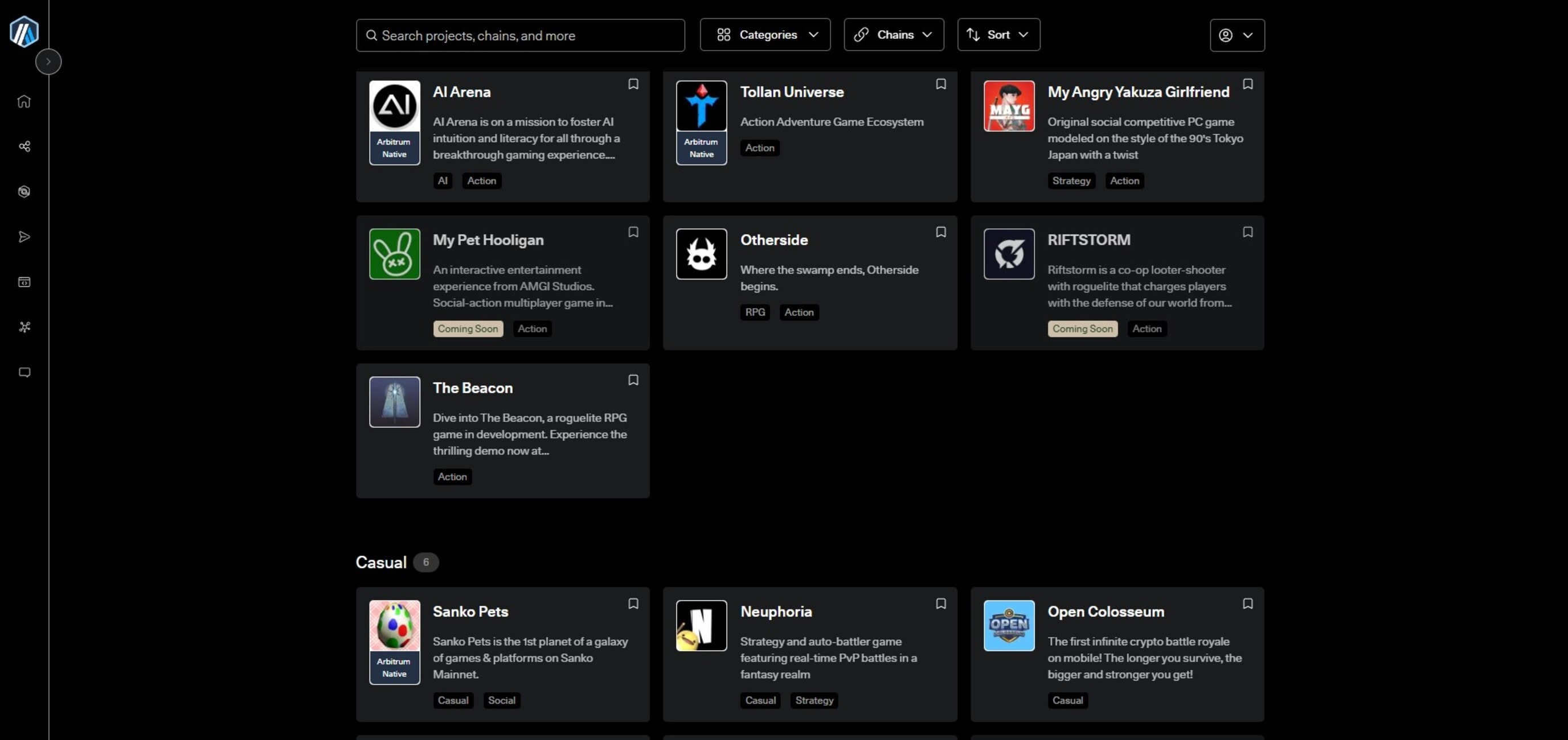
Games on Arbitrum One and Arbitrum Nova support item crafting, PvP battles, and NFT-based upgrades at scale, making high-frequency gameplay economically viable. Several projects stand out due to active communities, integrated marketplaces, and high on-chain activity. Below are some of the major Arbitrum-Powered NFTs games:

ProjectDescriptionKey FeaturesToken/NFTsBig TimeMultiplayer action RPG with dungeon exploration and loot collectionCross-game NFT equipment, PvE/PvP mechanics, high-resolution graphicsTIME token, in-game NFT gearPirate NationOn-chain pirate RPG on Arbitrum Nova/Apex with PvP and collectible-driven gameplayFully on-chain characters, real-time battles, player-owned progressionPirate NFTs, in-game assetsBattleFlyStrategy-based auto-battler integrated with the Treasure ecosystemDAO governance, staking mechanics, play-to-earn rewardsBattleFly NFTs, MAGIC tokenSpartadexGamified decentralized exchange combining NFT trading and gameplayNFT staking, exchange-integrated rewards, leaderboard competitionSpartadex NFTs, platform tokenThe BeaconUpcoming RPG with a large community and Epic Games Store integrationCommunity-driven beta, NFT-based progression, guild featuresBeacon NFTs, in-game currency

Arbitrum GameFi Ecosystem

Arbitrum GameFi Ecosystem

The Arbitrum GameFi ecosystem is the financial and infrastructure layer that supports blockchain gaming on the Arbitrum network. It merges gameplay with decentralized finance, allowing players to earn real value through NFTs, in-game tokens, staking, and yield-generating mechanics.

This ecosystem includes DAO-governed gaming studios, tokenized reward systems, decentralized marketplaces, and liquidity protocols that connect in-game assets with broader DeFi networks.

Players can stake Arbitrum-based tokens such as MAGIC or platform-native currencies to unlock features, participate in governance, or earn yields tied to game activity. Game developers benefit from Arbitrum’s scalable Layer 2 and Layer 3 infrastructure, low transaction fees, and Ethereum compatibility, which reduces the complexity of building high-frequency GameFi applications.

Meanwhile, ecosystem initiatives like Treasure DAO and Orbit chains provide funding, shared liquidity, and modular frameworks for new games and NFT economies. Together, these components support Arbitrum in being a leading hub for sustainable, token-driven GameFi innovations.

Top Arbitrum NFT Marketplaces for Gaming

Top Arbitrum NFT Marketplaces for GamingTop Arbitrum NFT Marketplaces for Gaming

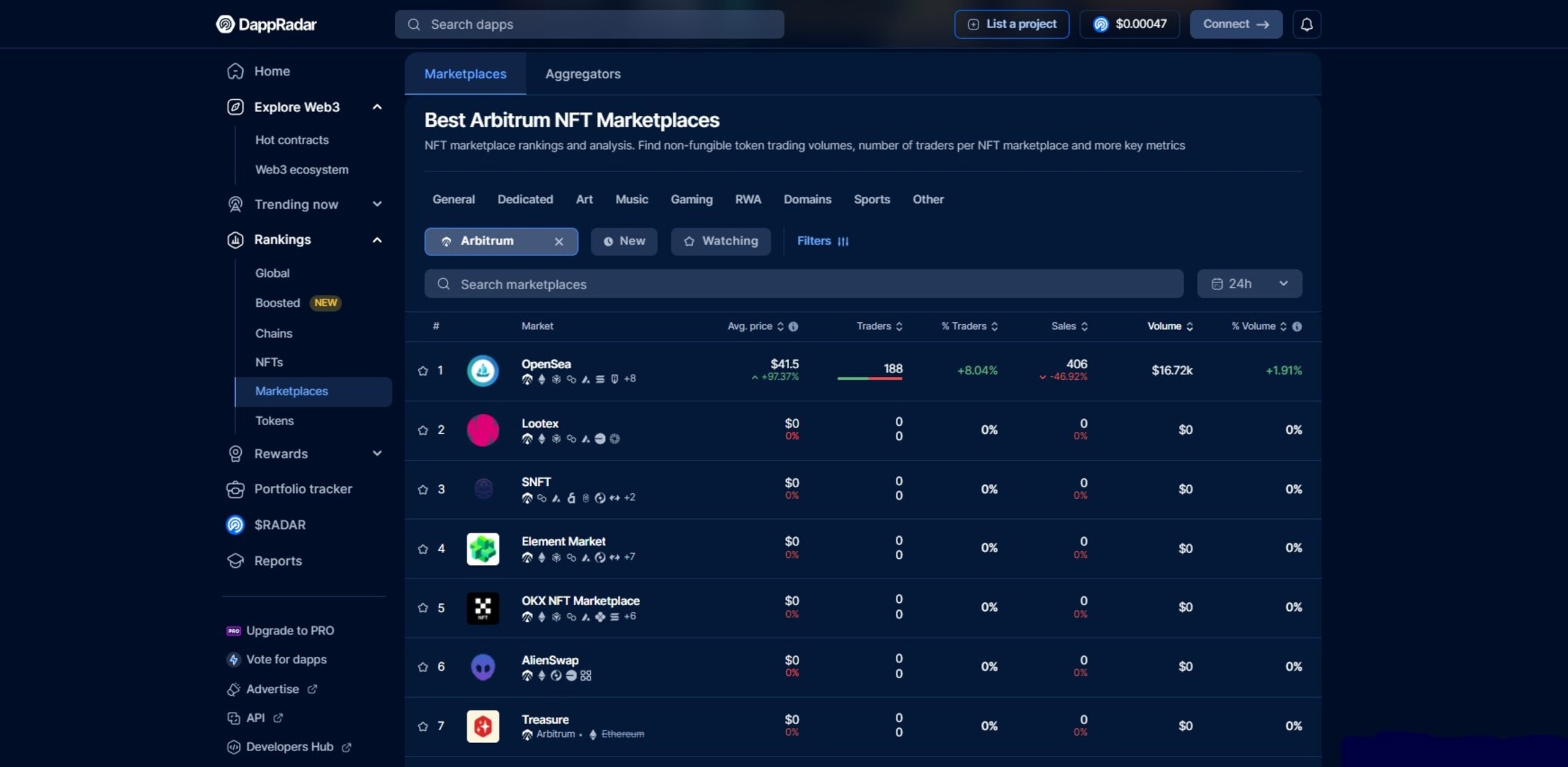
NFT marketplaces are the backbone of Arbitrum’s gaming ecosystem, providing liquidity, trading, and distribution channels for in-game assets such as characters, equipment, land, and collectibles. Multi-chain platforms like OpenSea support Arbitrum-native NFTs, enabling minting, listing, and secondary-market trading with reduced fees and fast confirmations.

Smart contracts on these platforms enforce royalty payments, verify asset authenticity, and enable trustless peer-to-peer transfers, ensuring secure and transparent NFT ownership. Specialized marketplaces also strengthen in-game economies by prioritizing utility over speculation.

Platforms like Treasure Marketplace and Smolverse integrate directly with gameplay dashboards, enabling players to acquire, upgrade, or trade assets without leaving the game. Meanwhile, cross-chain marketplaces such as OKX NFT Marketplace expand liquidity and exposure for Arbitrum gaming NFTs, connecting them to a broader digital asset ecosystem.

What Is Arbitrum?

Arbitrum is the leading Layer 2 scaling solution that uses optimistic rollups to dramatically expand blockchain capacity while preserving core security guarantees. The network enables developers and users to run high-volume, decentralized applications such as gaming, DeFi, and NFT trading at a fraction of the cost of mainnet.

This architecture relies on sequencer networks, fraud-proof dispute systems, and customizable Orbit Layer 3 chains, all of which connect Layer 2 activity seamlessly back to Ethereum’s settlement layer. Rather than competing as a separate blockchain, Arbitrum acts as an efficiency multiplier, enabling assets and logic to gain practical utility across scaled environments.

Supporting this growth, initiatives such as the ARB DAO treasury, Gaming Catalyst Program, and dedicated gaming funds provide grants, shared infrastructure, and modular tooling to encourage sustainable development.

The network also has a native token, ARB, with a market cap of approximately $1.23 billion and a price of around $0.21. It also has a circulating supply of 5.83 billion tokens. Meanwhile, its DeFi TVL stands at about $2.91 billion, reflecting assets locked in protocols on the chain, alongside a stablecoin market cap of $3.46 billion.

Arbitrum Gaming vs Other Blockchain Gaming Platforms

Arbitrum saw 68% year-over-year growth to 119 Web3 gaming titles by late 2024, largely via Orbit’s 23 new networks. It ranks high in dApp activity, with $141.57 million in transaction volume alongside Ethereum’s lead, and web3 games accounting for 28.3% of 1.5 million daily active users across chains.

Over 600,000 monthly users engage with the network, supporting high-volume gaming transactions. However, you can see a similar, if not better, adoption trend with other chains, such as the SUI gaming NFT ecosystem and the Ethereum gaming NFT ecosystem. For better insight, let’s explore how Arbitrum gaming compares with other blockchain gaming platforms.

Arbitrum vs Sui

FeatureArbitrumSuiTypeEthereum Layer 2Layer 1 BlockchainActual TPS6,000+10,000Maximum TPS40,000297,000Fees$0.01, gasless gaming$0.001 nativeGaming TVL$3B+$300M+Ecosystem30+ Orbit games, Stylus RustEarly Move-based gamesNFT SupportERC-721/1155 nativeObject-centric modelTransaction SpeedFast confirmations with rollup scalingHigh throughput with parallel executionMaturity3+ years, $18B TVL1 year, rapid growthSecurity ModelInherits Ethereum securityIndependent validator networkNFT CompatibilityFull ERC-721 and ERC-1155 support Native object-based NFT model

Arbitrum vs Ethereum

FeatureArbitrum Ethereum TPS22x higher max TPS15-30 TPSBlock Time 250ms12 secondsNetwork LayerLayer 2 scaling solutionBase Layer 1 blockchainTransaction FeesSignificantly lower gas feesHigh gas fees during congestionGaming ScalabilityOptimized for high volume gaming activityLimited scalability for real-time gamesSecuritySecured by EthereumNative base layer securityDeveloper toolStylus + EVMSolidity onlyTVL$18B$60B+ L1

How to Get Started With Arbitrum Gaming Projects

Below are ways you can get started in Arbitrum’s gaming NFT ecosystem, from setting up a wallet to bridging funds, exploring games, and participating in communities to build valuable in-game assets.

Set Up a Compatible Wallet: Choose an Ethereum-compatible wallet such as MetaMask that can interact with Arbitrum Layer 2 and Layer 3 networks, ensuring full support for NFT transactions and GameFi operations.Bridge Funds to Arbitrum: Transfer ETH or other tokens from the Ethereum mainnet to Arbitrum One, Nova, or gaming-focused Orbit chains to enable instant transactions.Explore NFT Games: Access supported Arbitrum gaming titles to mint or purchase in-game NFTs, participate in play-to-earn mechanics, and experience real-time asset ownership that flows across multiple games.Trade and Manage Assets: Use NFT marketplaces like OpenSea, Treasure Marketplace, or Smolverse to buy, sell, or upgrade gaming assets while taking advantage of built-in liquidity and low transaction costs.Engage With Communities: Join official Discords, forums, and governance channels to stay updated on game developments, NFT drops, and ecosystem proposals, while connecting with other players and developers.Leverage GameFi Mechanics: Stake tokens, earn rewards, and participate in DAO governance to maximize utility and yield from gaming NFTs while contributing to the broader ecosystem economy.

Finally, track Arbitrum network upgrades, Layer 3 launches, and project announcements to optimize performance, maintain security, and identify new opportunities in gaming and NFT markets.

Arbitrum’s Role in Web3 Gaming

Arbitrum plays a pivotal role in Web3 gaming as an Ethereum Layer-2 solution, offering low fees, high throughput, and tools like the Orbit Framework for custom Layer-3 chains tailored to games.

Its Gaming Catalyst Program (GCP) and Gaming Ventures initiative provide grants and investments—such as a $10 million first wave from a 200 million ARB ($65 million) fund—to support developers building on-chain games. These efforts have driven ecosystem growth, positioning Arbitrum as a leader for mass-scale gaming adoption

Here, we explore the network’s scalability edge, specialized tools like Arbitrum One, Arbitrum Nova, and Arbitrum Orbit, plus innovations such as Stylus, all designed to enhance player immersion.

Scalability & Cost-Efficiency

Arbitrum scales Ethereum through optimistic rollups that bundle thousands of transactions off-chain for secure settlement, reducing fees to mere pennies while achieving 40,000 TPS. This enables gamers to execute in-game actions, NFT trades, and loot drops instantly without network congestion.

Developers can predict costs in advance, avoiding volatile gas spikes that would otherwise impact profitability in high-player titles. As a result, block times drop to 250 milliseconds, matching traditional servers for real-time PvP battles or live events. The predictable, low-cost structure allows studios to implement free-to-play entry with optional NFT upgrades, onboarding new players without friction. 

Specialized Infrastructure

Arbitrum supports specialized chains like Arbitrum Nova, optimized for high-volume, low-cost gaming, and uses Data Availability Committees to reduce fees. It also provides tools through Arbitrum Orbit for creating custom “game rollups” that handle game-specific logic and microtransactions efficiently.

This setup ensures that high-frequency gameplay and NFT interactions remain smooth without congestion or unpredictable costs. Together, Arbitrum  Orbit and Nova give developers a flexible, scalable infrastructure for both indie and AAA blockchain games.

Arbitrum Orbit: Custom Layer 3 Chains for Gaming

Arbitrum Orbit: Custom Layer 3 Chains for GamingArbitrum Orbit: Custom Layer 3 Chains for Gaming

Arbitrum Orbit allows developers to create custom Layer 3 chains for gaming, optimized for high-frequency transactions and NFT interactions. Each chain operates independently yet remains interoperable with Arbitrum One and Nova, enabling seamless asset flow across the ecosystem.

Developers can configure throughput, fees, governance, and data layers to ensure smooth performance for competitive, large-scale games. By isolating computation-heavy workloads at the L3 level, Orbit chains reduce congestion on parent networks and maintain consistent, low-latency gameplay.

This design is already being applied in production. Xai, for example, leverages Arbitrum Orbit to support AAA-style Web3 gaming with fast settlement and low fees. Sanko Network also uses Orbit to build a creator- and community-driven gaming ecosystem with its own economic and governance parameters.

Underneath all these, Arbitrum Orbit is powered by the Arbitrum Nitro stack, which ensures high scalability, full EVM compatibility, and efficient transaction compression. Support for Stylus further expands development flexibility by enabling smart contracts in Rust and C++ alongside Solidity, often at lower gas costs.

Developers can also choose between AnyTrust and traditional rollup data models, allowing them to balance cost efficiency, security, and privacy based on application needs.

Arbitrum Stylus

Arbitrum Stylus introduces a second virtual machine to the Arbitrum stack, enabling smart contracts to run in WebAssembly (WASM) alongside traditional EVM contracts. This allows developers to write contracts in languages like Rust, C, and C++, leveraging decades of optimized compiler toolchains for efficient execution.

Stylus contracts execute faster and consume less gas for memory- or compute-intensive operations, making them ideal for on-chain games, DeFi, and generative applications. Fortunately, Stylus contracts remain fully interoperable, allowing hybrid applications to call between EVM and WASM seamlessly.

Stylus programs undergo coding, activation, execution, and fraud-proofing, ensuring security and determinism while maintaining Ethereum-level guarantees. During activation, WASM code compiles to native machine code with precise metering for safe and predictable operations.

Developers can port existing Rust, C, or C++ applications or optimize parts of Solidity contracts without rewriting from scratch. By combining high performance, low costs, and interoperability, Stylus enhances Arbitrum’s appeal as a developer-friendly platform for Web3 gaming and high-performance dApps.

Enhance User Experience

Arbitrum improves gameplay by making blockchain interactions seamless, so players experience instant transactions without waiting. Simplified wallet connections and embedded accounts let new users join games quickly, reducing onboarding friction.

With gasless actions on Orbit chains, players can focus on strategy and progression instead of worrying about fees. They can also use the analytics dashboards to track in-game assets across titles, giving players a clear overview of their NFTs and tokens.

Aside from that, integrated social features, such as leaderboards, guilds, and chat systems, keep communities engaged around shared achievements. While mobile SDKs and offline caching maintain smooth gameplay even on limited network connections, making games accessible anywhere.

Risk and Challenges of Arbitrum Gaming NFT Ecosystem

Below are the main risks and challenges developers and players face in Arbitrum’s gaming NFT ecosystem.

Cross-Chain and transaction risks: Moving assets across Arbitrum One, Nova, Orbit, or Ethereum can cause delays or failed transfers, affecting gameplay and NFT liquidity.Security vulnerabilities: Orbit chains and AnyTrust models reduce costs but may create potential attack vectors that compromise in-game assets or smart contracts.Economic and market risks: NFT price volatility and speculative trading can destabilize game economies, impacting token value and player incentives.Technical and adoption barriers: Stylus, multiVM environments, and custom Layer 3 rollups demand experienced developers, slowing adoption for smaller studios or indie projects.

The Future Trends of Gaming on Arbitrum

Arbitrum improves Web3 gaming with 250ms block times and over 6,000 TPS, which allows large player activity while securing $18B in assets. This performance enables ERC‑721 and ERC‑1155 NFTs that give players real ownership of items across games. That ownership becomes more powerful through Stylus, which supports Rust, C++, and Solidity for advanced gameplay logic.

This technical base then attracts Web2 studios seeking smoother blockchain integration. Because studios onboard faster, wallets like Session and Wildcard simplify access through email or social login.

This easy entry connects players to DeFi tools such as Uniswap, Aave, and GMX for in-game earning. Games like Otherside and Golden Tides demonstrate these connected economies. This growth then creates demand for scalable gaming infrastructure.

To meet this demand, Orbit-powered Layer 3 chains provide custom gaming rollups. These chains support cross-game assets and VR experiences. Governance through DAOs organizes communities and marketplaces. Together, these systems position Arbitrum as a long-term gaming foundation.

Conclusion

Arbitrum’s ecosystem enables fast, low-cost, and secure gaming experiences, letting players truly own and trade NFTs across multiple titles. The combination of Stylus, Orbit-powered Layer 3 chains, and wallet integrations empowers developers to create immersive, real-time, and interconnected gameplay.

These features support sustainable P2E models and vibrant in-game economies while attracting both indie and AAA studios. Ultimately, Arbitrum delivers a flexible, scalable, and player-focused infrastructure that enhances engagement, ownership, and long-term growth in Web3 gaming.

FAQs

What is the best Arbitrum gaming NFT to buy in 2026?

The best NFT depends on your goals. However, some of the top options include Treasure DAO, which historically dominates Arbitrum’s gaming NFT space, accounting for over 95% of network gaming transactions. Other options are Pirate Nation and Spartadex. The first offers fully on-chain pirate-character NFTs, while the latter combines gaming with exchange mechanics and boasts a high number of active wallets.

Are Arbitrum gaming NFTs better than Ethereum gaming NFTs?

It depends on your priorities and the type of game you want to play. Arbitrum NFTs offer faster transactions, lower fees, and smoother gameplay for high-volume games, while Ethereum NFTs benefit from a larger community, broader marketplaces, and stronger long-term liquidity. Choosing the better option depends on whether you value speed and affordability or ecosystem size and established credibility.

Is it safe to invest in Arbitrum NFTs?

Yes, investing in Arbitrum NFTs can be safe if you research the game, the developers, and the NFT’s utility. The platform benefits from Ethereum-level security and audited smart contracts, but market risks still exist.

Can you really earn money playing NFT games?

Yes, it is possible to earn money playing NFT games, but income depends on the game’s economy, your skill, and strategy. Play-to-earn models allow players to earn NFTs, tokens, or other rewards that can be sold or staked.


Source link

What Is Bitcoin Mining? A Comprehensive Guide – NFT Plazas

0
What Is Bitcoin Mining? A Comprehensive Guide – NFT Plazas


Bitcoin mining involves verifying transactions and introducing new Bitcoins into circulation. It refers to the process by which miners compete to solve cryptographic puzzles to add new blocks to the Bitcoin network. 

In this article, we’ll explain the concept of Bitcoin mining, including its history, benefits, risks, and environmental impacts. We’ll also provide insights into how mining works and the costs involved. 

What is Bitcoin Mining?

What is Bitcoin Mining?

Bitcoin(BTC) is the pioneer digital currency that leverages blockchain technology for peer-to-peer transactions. Its underlying blockchain follows a proof-of-work (PoW) consensus algorithm, which harnesses the mining process to verify transactions and secure the network. 

Bitcoin mining is a network-wide contest to crack a complex mathematical puzzle. The first miner to successfully generate an accurate cryptographic solution receives new Bitcoins and transaction fees as rewards. 

This incentive mechanism will remain operational until the total Bitcoin supply of 21 million circulates in the crypto market. Once the last BTC is mined, the process will cease to exist. Thereafter, transaction fees will be the only revenue source for Bitcoin miners. 

History of Bitcoin Mining

Genesis block: Satoshi Nakamoto started cryptocurrency mining on January 3, 2009, by creating the first block that contained 50 Bitcoins. CPU mining: Early on, you could mine BTC using personal computers and central processing units (CPUs). It was a truly decentralized process because anybody could become a miner from the comfort of their home. However, as the number of miners increased, the mining difficulty rose. By July 2010, the complexity had surged by 4x. GPU mining: With the algorithm becoming harder to solve, miners started drifting toward graphics processing units (GPUs). Video cards performed complex calculations more efficiently. However, they consumed lots of computational power, rendering them ineffective for intense mining.FPGA mining: In 2011, Field Programmable Gate Arrays (FPGA) emerged as energy-efficient substitutes for GPUs. They could execute advanced calculations and were specially configured for BTC mining. Miners could tailor their hardware to Bitcoin’s mining algorithm. While their usage for cryptocurrency mining faded away in a short span, they paved the way for ASIC mining.Application Specific Integrated Circuit (ASIC): Since GPUs increased overall mining costs, miners gradually transitioned to ASIC machines equipped with specialized chips. Bitcoin mining has also become extremely complex and competitive over the years. Only mining pools with advanced ASIC computers that perform hundreds of trillions of computations every second can profitably mine BTC.

The Role of Mining in Bitcoin’s Supply

Authenticates transactions: Whenever a user sends/receives Bitcoins, the transaction is broadcast to the network. Miners verify the transaction data and ascertain whether it is legitimate.Incentivizes miners: To encourage more users to participate in the mining process, it rewards winning miners with Bitcoins and transaction fees. Issues new coins: Mining creates new Bitcoins and introduces them into circulation in a controlled manner. Detects fraud: Mining eliminates double-spending. Since it records transactions in an immutable digital ledger, nobody can spend the same Bitcoin twice. Builds consensus: Bitcoin mining ensures all nodes agree to the blockchain’s current state and rules. It also helps maintain the security and integrity of the network.Fosters decentralization: Since mining is a resource-intensive process involving huge upfront costs, a single entity can’t take control of the network. It distributes control among numerous participants, nurturing decentralization.

How Does Bitcoin Mining Work?

How Does Bitcoin Mining Work?How Does Bitcoin Mining Work?

Key Components

Hash: It is a 64-character alphanumeric code generated when a block’s data is fed to the SHA-256 hash generator. This encryption technique creates a block hash instantly. Each block hash forms part of the next block’s header, chaining them together. Even a slight change in your input will generate a totally different hash, invalidating subsequent blocks. Thus, hash lies at the core of Bitcoin mining.InputOutputBlockchain625da44e4eaf58d61cf048d168aa6f5e492dea166d8bb54ec06c30de07db57e1Blockchein687456bc39276f1c110dfd4d52c83ead86e7d9b64c74d4e173249675810a8b12Target hash: It is a number generated by the network. Miners need to generate a winning hash, meaning a number less than or equal to the target hash. Mining difficulty: It refers to the inherent complexity or the amount of work miners are required to do to generate the winning hash. The difficulty level is altered every 2016 blocks. It is determined by the efficiency of miners and the number of participants in the previous cycle.

Mining process

Transaction validation: Miners pick unconfirmed transactions for verification from a mempool.New block creation: Miners verify and compile these transactions into a block. It can be appended to the blockchain only after it is approved. Typically, blocks record  1 and 4 MB of transaction data.Merkle root computation: Every transaction in the block is turned into a hash. Then, hash pairs are made and hashed together. This process continues till a single hash, called the Merkle Root, is created for all transactions. Deciphering proof-of-work puzzles: It involves finding a nonce value that produces a hash meeting the difficulty target set by the network. When a user starts mining, the nonce is set to zero. For each attempt made by the miner, the nonce value increases by one. Whenever a miner generates a hash and a nonce greater than the target hash, the attempt fails. Once the value reaches 4.5 billion, it can’t go higher. In that case, the system utilizes another counter, known as the extra nonce, from a different field. Block validation by network: Once a miner successfully generates a valid hash, the block must be verified by the network. The block is approved, provided the miner has found the correct solution and the transactions included in the block are legitimate. However, a block is not considered confirmed until five more blocks are added to the blockchain and it undergoes six validations.Adding a new block: After the network validates a block, it is added to the Bitcoin blockchain. The update is broadcast to the network, enabling every node to record the change in its individual ledger copy. Mining rewards: The successful miner is rewarded with new BTC tokens and transaction fees. 

Benefits and Risks of Bitcoin Mining

Benefits

Network security: Bitcoin mining prevents double-spending. Since blocks are cryptographically linked, even a small change in a single transaction changes the corresponding block’s hash. Consequently, the subsequent blocks will be rendered invalid. As redoing the proof-of-work for the invalidated blocks entails high costs, reversing or altering transactions is impossible.Decentralized transaction verification: Once a block is approved, it is broadcast to the entire network. Every node independently verifies the transactions and updates its individual copy of the ledger. This way, the network achieves consensus without relying on a central authority.Block rewards: If you’re able to generate a hash value less than or equal to the target hash, you’ll receive new Bitcoins and associated fees. These rewards are halved every 4 years in a halving event. As of January 2026, Bitcoin miners earn 3.125 BTC for mining a block. Since BTC is a high-value cryptocurrency, they can make phenomenal gains by selling it. Overall, block rewards incentivize more miners to participate in Bitcoin mining.

Risks

Regulatory uncertainty: The mainstream adoption of cryptocurrencies, including Bitcoin, is relatively low globally. Some countries have banned them outright, while many have formulated stringent crypto laws. Thus, there is always a risk of governments prohibiting/restricting cryptocurrency mining, especially if you’re based in a non-crypto-native country.Price fluctuations: BTC price is highly volatile. As of mid-January 2026, Bitcoin is trading over $95,000. It has dropped by nearly 24.60% since its October 2025 peak of $126,000. Intense price volatilities make it harder to determine whether potential rewards will exceed the high mining costs incurred.Security concerns: The mining process is susceptible to 51% attacks, where a single entity/group gets majority control over the blockchain’s hashing power. Such attacks can lead to transaction manipulation or double-spending. 

Sometimes, attackers engage in shadow mining. They build parallel networks and later seize the legitimate blockchain by displaying a longer chain. Such incidents invalidate the transactions recorded in the discarded blocks. However, due to the high costs of Bitcoin mining, the likelihood of these attacks occurring is very low. 

Solo Mining vs Pool Mining: Which Is More Profitable?

Solo MiningPool MiningIndividual miners use their own specialized hardware, equipment, and power supply units (PSUs) to solve complex cryptographic puzzles.Miners pool their computing power and resources to solve complex cryptographic puzzles.If successful, the solo miner earns 100% of the rewards, which comprises 3.125 BTC and associated transaction fees.If successful, the reward is proportionately split among participants based on the computing power or hashrate each contributed.It requires the individual miner to bear the entire mining expenses, including the purchase and installation costs of hardware and network infrastructure.Each miner incurs only a portion of the total mining costs. The payouts are high.The payouts are small but consistent.It is less profitable due to the high costs involved and the extremely low chances of successfully mining a block.It is more profitable as each miner bears a portion of the costs, and farms/pools have a higher likelihood of mining blocks successfully.

Common Bitcoin Mining Scams and How to Avoid Them?

Bogus cryptocurrency exchanges: Many fake exchanges may contact you via phone, e-mail, or social media platforms. They may entice you with promo codes or fee discounts, convincing you to open an account. Once you deposit funds, they may disappear with your money. Phishing: Scammers often create fake websites mirroring legitimate exchanges/wallet sites, tricking innocent investors into revealing their private keys. They may even intercept your confidential data, including recovery phrases, by modifying URLs or launching DNS attacks. Fake wallets: Some fraudsters may transfer you a small amount from a fake wallet address that looks similar to your real recipient’s address. You may copy the wrong address and end up sending BTC to a scammer. Some hardware wallets also have inherent vulnerabilities that make it easier for malicious actors to steal your private keys.Cloud mining services: For many miners, setting up Bitcoin mining operations isn’t economically viable. Cloud mining platforms enable such miners to mine crypto without buying or maintaining the necessary equipment. However, some of these platforms can be scams in disguise. Malware: Hackers often install BTC mining malware in numerous computers and use them for mining. Once your device is hijacked for crypto mining, its computing power will be utilized completely. It may even overheat or burn up if not cooled using powerful fans. Therefore, you can’t even execute low-demand tasks. Moreover, the malware can spread from your device to other computers that connect to your network.

Best practices to avoid mining scams

Never share your private keys, login credentials, and seed phrases with anybody.Exercise caution and apply due diligence before registering on any exchange or opting for a service.Rent hash power or mining rigs from reputable cloud-mining service providers.Avoid public Wi-Fi networks to connect to the internet, as they’re primary targets for online scams.Use virtual private networks (VPNs) when mining to keep your internet connectivity secure and private.Enable firewall protection and install antivirus software on the devices/machines you use for mining.

Environmental Impact of Bitcoin Mining

Environmental Impact of Bitcoin MiningEnvironmental Impact of Bitcoin Mining

Bitcoin mining consumes a colossal amount of electricity and computational resources to power the specialized equipment. According to the Cambridge Bitcoin Electricity Consumption Index, the Bitcoin network’s annualized power consumption is 188.64 TWh. Its hardware efficiency ranges between 11 and 30.50 J/TH. These figures reflect the substantial carbon footprint that mining produces.

Moreover, mining hardware needs to be replaced every few years, resulting in considerable electronic waste. While the latest models of hardware equipment are more energy-efficient, the environmental concerns surrounding crypto mining are far from over.

Tax Implications of Bitcoin Mining

According to the Internal Revenue Service, USA, mined cryptocurrencies are treated as ordinary income. Hence, they’ll be taxed at your regular income tax rate. While reporting, you must disclose their fair market value at the time of receipt. However, if you make gains from selling/trading Bitcoins, you need to pay capital gains tax as well.

If you run a mining business, you can claim tax deductions on the expenses you incurred to establish/maintain the venture. Your taxable revenue is the value of the Bitcoins you receive. However, taxpayers who pursue mining as a hobby can’t deduct associated expenses. 

Future Trends of Bitcoin Mining

Eco-friendly mining: Many mining facilities like Gryphon, CleanSpark, TeraWulf, Iris Energy, and Bitfarms harness renewable or alternative energy sources to mine Bitcoin. These include solar, wind, hydroelectric, and nuclear energy. They’re also investing in AI infrastructure, high-performance computing, and green mining technologies to become carbon-neutral or carbon-negative.Tokenized carbon credits: Innovative solutions like KlimaDAO enable miners to buy tokenized carbon credits to offset their footprints. To ensure accountability, these credits are retired after purchase. Each credit represents one metric ton of CO2 decreased or eliminated from the environment. Hybrid consensus mechanisms: Researchers are testing hybrid systems, which combine the strengths of the PoW model and its energy-saving alternatives like proof-of-stake consensus. These include Green PoW, Proof of Elapsed Time (PoET), and Proof of Team Sprint (PoTS) mechanisms. These newer consensus algorithms may reduce the environmental impacts of Bitcoin mining in the future.Energy-efficient ASIC computers: The newer the ASIC model or cooling infrastructure, the more optimally it uses electricity. For example, the Antminer S23 Hydro model delivers a hashrate of 580 Th/s at 9.5 Joules per Terahash (J/TH). It is equipped with a hydro cooling system and utilizes less energy for every unit of hashing work. 

Conclusion

If you’re interested in mining Bitcoin, you should weigh the high upfront costs and regulatory risks against potential returns. You also need to factor in Bitcoin’s intense price volatility. In general, it is more profitable to join mining pools rather than becoming a solo miner. Also, it is imperative to determine whether BTC mining is worthwhile based on your goals and resources at hand.

FAQs

What does Bitcoin mining actually do?

Bitcoin mining helps maintain the integrity and security of the network. It involves creating new BTC tokens by solving complex cryptographic puzzles to validate and record Bitcoin transactions on the blockchain. The first user to find a solution adds a new block to the blockchain. The winning miner is rewarded with newly minted bitcoins and transaction fees.

Is Bitcoin mining profitable?

Bitcoin mining requires you to invest in specialized hardware, cooling infrastructure, and PSUs, which can be quite high-priced. It also shoots up your electricity bills as it is an energy-intensive process. Moreover, Bitcoin prices fluctuate rapidly, making it difficult to calculate your potential returns. Furthermore, mining difficulty has increased manifold due to a large number of participants and Bitcoin’s popularity. Thus, joining mining pools or buying Bitcoin on crypto exchanges is worthwhile.

How is Bitcoin mined?

Bitcoin is mined using advanced ASIC computers that possess high mining power and can solve complex mathematical puzzles quickly. The first miner to generate a hash value less than or equal to the target hash wins the competition. Successful miners can add a new block and receive new Bitcoins and fees for their services.

How long does it take to mine 1 Bitcoin?

It takes approximately 10 minutes to mine one Bitcoin block. Based on the number of miners competing and the computational power of the network, the difficulty level automatically changes. 

Is Bitcoin mining illegal?

Most countries, including the US, have legalized Bitcoin mining. However, the income/profits you generate from mining activities attract taxes. Additionally, governments are continually revising cryptocurrency regulations. Hence, before you start mining, ensure it is allowed in your jurisdiction and abide by the local and national crypto laws.

How many Bitcoins are left to mine?

As of January 18, 2026, Bitcoin’s circulating supply is 19,977,290. Since Bitcoin’s total supply is capped at 21,000,000, around 1,022,710 BTC are left to be mined.


Source link

Best SUI Gaming NFT Ecosystem in 2026: Top LiveSync Projects & Insights – NFT Plazas

0
Best SUI Gaming NFT Ecosystem in 2026: Top LiveSync Projects & Insights – NFT Plazas


So you are probably looking for the best sui gaming NFT ecosystem because you want games that actually feel fast, fair, and worth your time. The gaming system you choose shapes how you earn, trade, and truly own your in-game assets. With a reliable SUI game ecosystem, you get smoother gameplay, low fees, real ownership of NFTs, and a setup built for players instead of middlemen. 

In this guide, you’ll learn about the best SUI gaming NFT projects in 2026, top Sui NFT collections, and how the SUI blockchain works. We’ll also cover Sui’s impact on NFTs, major games and marketplaces, how to get involved, key risks to know, and what the future holds for SUI gaming and NFTs so you can decide if this ecosystem fits your goals. Keep reading to find out the best SUI gaming NFT:

Best SUI Gaming NFT Projects to Watch in 2026

Best SUI Gaming NFT Projects to Watch

A gaming system defines how games, NFTs, and players interact on a blockchain. It affects gameplay speed, asset ownership, and how easily players can trade or use their items across games. The Sui blockchain ecosystem has a market capitalization of approximately $6.73 billion in 2026, reflecting increased usage across decentralized applications, including gaming. A strong system keeps costs low, reduces delays, and supports real ownership of in-game assets. Without this foundation, even popular games struggle to last. Here are some of the best SUI gaming NFT projects to watch in 2026.

SUI-Powered NFT Games

SUI-Powered NFT GamesSUI-Powered NFT Games

SUI-powered NFT games are designed to support fast transactions, smooth gameplay, and ownership of in-game items, based on the network’s parallel transaction model. You can play without long delays, even during busy moments, which matters when actions. These games also make it easier to understand how non-fungible tokens represent true digital ownership, because characters, weapons, or land are items you truly own and control. They are not locked inside one game or platform. Many SUI games use dynamic NFTs that can change as you play, keeping progress tied to skill and time, not just spending, a feature supported by Sui’s object-centric data model.

The following are some of the SUI-powered NFT games:

ONE Fight ArenaSamurai Shodown RXOCIETYSuper-BFarcanaPanzerdogsE4C: Final SalvationBushi

SUI GameFi Ecosystem

The SUI game ecosystem brings together games, tokens, NFTs, and players in one connected setup. For you, that means earning rewards through play while keeping fees low and actions fast. Developers can build full economies where items have real value and move between games or platforms. This balance helps avoid common GameFi issues like slow networks or expensive transactions. As more studios launch on SUI, the ecosystem continues to expand through new titles, marketplaces, and community activity.

As additional studios launch games on SUI, the ecosystem continues to expand through new titles, marketplaces, and community activity.

Top SUI NFT Marketplaces for Gaming

Top SUI NFT Marketplaces for GamingTop SUI NFT Marketplaces for Gaming

NFT marketplaces on SUI are essential for gaming, as they let you buy, sell, and trade in-game items with ease. These platforms prioritize fast transactions and clear ownership tracking, ensuring a smooth experience. You can list game NFTs, check prices, and move assets quickly without dealing with high fees. 

Many marketplaces focus on gaming-specific collections, helping you find items with real in-game value rather than collectibles that remain unused. The best NFT games the SUI blockchain rely on these marketplaces for trading in-game assets, price discovery, and liquidity. If you’re looking for the top platforms to trade NFTs, SUI offers platforms that combine speed, utility, and accessibility.

Here are some of the top SUI NFT marketplaces you may consider for gaming:

Trade PortBlueMoveClutchySui GalleryKeepSake 

Top Sui NFT Collections

Top Sui NFT CollectionsTop Sui NFT Collections

The Sui blockchain is redefining what NFTs can achieve by focusing on dynamic assets, composability, and true ownership. Here are some standout collections that showcase the platform’s unique capabilities:

Prime Machine: A flagship collection on Sui that blends art with functionality. Each NFT is a programmable object with dynamic traits and the ability to store nested assets, highlighting Sui’s object-centric model. This approach shows how NFTs on Sui can evolve over time instead of remaining static images.Mystic Yetis: A collection known for its cozy visuals and strong social mission. It has raised notable funds for charitable causes and uses a unique thawing mechanic that allows Yetis to evolve over time, creating a sense of progress and emotional connection for collectors.Citizen: These NFTs function as digital identity cards within the Sui ecosystem. They provide access to events, governance, and exclusive content, making them practical tools rather than simple collectibles. The collection integrates deeply with Sui’s infrastructure, offering a persistent identity layer for users.Rootlets: Rootlets combine playful steampunk-inspired designs with real utility. The collection is tied to the broader Suiverse narrative and has shown integrations with DeFi platforms like Suilend, demonstrating how NFTs on Sui can interact with financial tools and applications.Popkins: Created by the Claynosaurz team, this collection introduced a gamified NFT experience on Sui. It launched with 25,000 booster packs and 10,000 3D-animated dinosaurs, using randomness and refunds to keep the mint fair and engaging. This approach highlights how Sui supports interactive and user-friendly NFT drops.

What Is the SUI?

SUI is a Layer 1 blockchain built to support fast, low-cost, and interactive applications, especially games and NFTs. It uses an object-based design that treats digital assets as independent objects instead of entries in a shared ledger. This structure allows transactions to be processed in parallel, which reduces delays and keeps fees low even when activity increases. Recently, SUI’s Total Value Locked (TVL) jumped 7.1%, reaching $1.05 billion, signaling bullish momentum and growing adoption in the ecosystem.

For NFTs, SUI supports assets that can change, upgrade, and interact with other items over time. This makes it easier to build games where NFTs have real utility instead of being static collectibles. If you are wondering how to buy SUI NFTs, the process is simple. You need a Sui-compatible wallet, SUI tokens for fees, and access to a marketplace built on the network.

Sui’s Impact on the NFT Landscape

To understand why Sui stands out, it helps to look at how it changes the way NFTs are built and used. Even as NFT markets evolve, the Sui blockchain has seen more than 52 million NFTs minted as of early 2025, highlighting the network’s accelerating adoption for digital assets that support interactive experiences.  Many blockchains treat NFTs as static items with limited interaction, which restricts their value in games and apps. Sui takes a different approach by designing NFTs as flexible objects that can evolve and interact with other assets. This design supports more complex use cases across games, marketplaces, and apps while keeping costs and delays low. These changes play a key role in strengthening the SUI game ecosystem. The following are the main ways Sui is reshaping NFTs.

Dynamic NFTs and Composability

Dynamic NFTs on Sui are built to change and grow over time instead of staying fixed. Their attributes can update based on gameplay, user actions, or specific events, which makes them more engaging and useful. For example, a character NFT can level up, unlock skills, or gain new abilities as you play, with every change recorded on-chain. Composability adds another layer by allowing NFTs to hold other NFTs. An item like a backpack can contain weapons, tools, or upgrades, all linked to a single asset. This structure gives developers more freedom to design modular systems and gives you NFTs that feel alive and customizable rather than decorative.

True Ownership and Asset Management

Sui treats every NFT as a unique on-chain object that you fully control. Unlike traditional games where items stay locked inside one platform, Sui lets you trade, sell, or use your NFTs across different applications. Asset management stays simple because each NFT exists independently, not as part of a shared balance. Sui also supports features like soulbound assets, which are non-transferable items tied to identity or achievement, and programmable behaviors that define how assets behave. This approach builds trust by giving you clear ownership while enabling new use cases like digital identities, loyalty rewards, and flexible in-game economies that work beyond a single game.

How to Get Involved in the SUI Gaming NFT Ecosystem

Getting started with the SUI game ecosystem is an exciting journey that combines gaming, blockchain, and digital ownership. Here’s how:

1. Set Up a Wallet

The first step is to create a wallet that supports the SUI blockchain. Popular options include Ethos Wallet, Suiet Wallet, and the official Sui Wallet. These wallets allow you to store SUI tokens and NFTs securely. After setting up your wallet, make sure to back up your recovery phrase in a safe location. This phrase is crucial for regaining access if you lose your device.

2. Purchase SUI Tokens

SUI tokens are the currency of the ecosystem, used for transactions and purchasing NFTs. You can buy SUI tokens on major cryptocurrency exchanges like Binance, Kraken, or OKX. Once purchased, transfer the tokens to your wallet to ensure they’re ready for use within the ecosystem.

3. Explore SUI NFT Marketplaces

SUI is home to several NFT marketplaces that cater to gaming and collectibles. Platforms like Clutchy, BlueMove, and TradePort are excellent places to start. These marketplaces allow you to browse collections, check prices, and trade NFTs. Use the search and filter tools to find gaming-specific NFTs or items that interest you. Each marketplace has unique features, so take time to explore their offerings.

4. Research Gaming Projects

The SUI ecosystem features a variety of gaming projects that integrate NFTs. Games like Samurai Shodown R and XOCIETY offer immersive experiences where you can earn, trade, and use NFTs. Research these games to understand their mechanics, NFT utility, and how they align with your interests. Many games also have communities where you can learn more and connect with other players.

5. Learn How to Buy SUI NFTs

To buy SUI NFTs, visit a marketplace like Clutchy or BlueMove. Connect your wallet to the platform, browse available collections, and select the NFT you want. Review the details carefully, including the price and any associated fees. Once you’re ready, confirm the transaction, and the NFT will be added to your wallet. Always verify the authenticity of the collection to avoid scams.

6. Engage with the Community

Joining the SUI community is a great way to stay informed and connected. Platforms like Discord, Twitter, and Telegram host active discussions about top SUI projects, new ones, updates, and opportunities. Engaging with the community can help you discover hidden gems, learn from experienced users, and stay updated on the latest developments.

7. Participate in Governance and Events

Many SUI projects offer governance features, allowing you to vote on game updates or ecosystem changes. Additionally, keep an eye out for events like NFT drops, gaming tournaments, or community meetups. These events provide opportunities to earn rewards, connect with developers, and deepen your involvement in the ecosystem.

Sui’s Role in Web3 Gaming

Sui’s Role in Web3 GamingSui’s Role in Web3 Gaming

The SUI gaming ecosystem growth is reshaping Web3 gaming through faster transactions, low fees, and player-first design. Sui supports games that feel smooth while still delivering real ownership and on-chain value. Developers use Sui’s object-centric NFT model to build interactive games, while players benefit from true ownership of on-chain assets. These features position Sui as a strong foundation for blockchain games that prioritize skill-based rewards over speculation. The following sections explain how Sui contributes to modern Web3 gaming.

Prominent Games on Sui

Sui hosts a growing lineup of games that focus on gameplay rather than hype. Titles such as Samurai Shodown R and XOCIETY cover different genres, from competitive fighters to action-based shooters. On Sui, dynamic NFTs function as usable in-game assets, allowing you to own characters, weapons, and items tied directly to your progress and recorded on-chain. Partnerships with established studios also help connect traditional gaming audiences to blockchain gaming, making Sui a practical entry point for players exploring Web3.

Enhancing In-Game Economies and Player Ownership

Player ownership sits at the center of Sui’s gaming model. In-game items exist as NFTs in your wallet, not on centralized servers controlled by publishers. You can trade, sell, or reuse assets across supported platforms. Sui supports dynamic NFTs that can change on-chain based on gameplay interactions, allowing items to evolve over time. This structure supports healthier economies where value comes from participation, making Sui attractive for games built around long-term engagement and fair rewards.

Performance for Gaming

High performance allows games on Sui to run without interruptions. The Sui network processes multiple actions at the same time, which keeps gameplay responsive during combat, upgrades, or marketplace activity. Low gas fees on Sui make frequent in-game actions affordable. This technical setup supports real-time mechanics needed for competitive and large-scale games. Reliable performance helps Sui deliver gaming experiences that feel familiar to traditional players while adding blockchain benefits.

SuiPlay0x1 Handheld Console

SuiPlay0x1 extends Web3 gaming into dedicated hardware. The handheld console supports Sui-based games while also allowing access to platforms like Steam and Epic Games. This approach keeps the experience familiar while introducing blockchain ownership in the background. Players can manage assets and play without complex setups. The device reflects Sui’s focus on accessibility and strengthens its role in expanding Web3 gaming to a broader audience.

Risks and Challenges in the SUI Gaming NFT Ecosystem

While the SUI game ecosystem offers significant opportunities, it also faces several risks and challenges that could impact its growth and adoption:

Market Volatility: The value of SUI tokens and NFTs can fluctuate significantly, making it challenging for players and investors to predict returns or maintain stable asset values across high-potential NFTs.Scalability Under High Demand: Although SUI is designed for scalability, sudden spikes in user activity or game launches could strain the network, potentially leading to delays or higher transaction fees.Adoption Barriers: Mainstream gamers may hesitate to adopt blockchain-based games due to unfamiliarity with wallets, tokens, and NFT mechanics, creating a learning curve for new users.Regulatory Uncertainty: The evolving legal landscape around blockchain and NFTs could pose challenges, especially if stricter regulations are introduced for digital assets or gaming platforms.Security Risks: Despite SUI’s robust architecture, vulnerabilities in smart contracts or third-party integrations could expose users to hacks or asset theft.Developer Dependency: The ecosystem’s growth relies heavily on developers creating engaging and innovative games. A lack of high-quality projects could slow adoption and reduce player interest.Environmental Concerns: Although SUI uses energy-efficient mechanisms, public perception of blockchain’s environmental impact could deter some users and developers.Competition from Other Blockchains: SUI faces stiff competition from established platforms like Ethereum and Solana, which already host large gaming and NFT ecosystems.

The Future of SUI Gaming and NFTs

The SUI gaming NFT ecosystem is poised for significant growth as it continues to innovate and attract developers, players, and investors. With its scalable architecture, low transaction costs, and dynamic NFT capabilities, SUI is well-positioned to lead the next wave of blockchain gaming. The integration of dynamic NFTs that evolve with gameplay and composable assets that enhance interactivity will likely redefine how players engage with digital assets. 

As more developers create immersive games and marketplaces tailored to SUI’s strengths, the ecosystem will expand, offering richer experiences and broader adoption. Additionally, the introduction of hardware like the SuiPlay0x1 console demonstrates a commitment to bridging Web3 gaming with mainstream platforms, making blockchain gaming more accessible to traditional gamers. However, the future will also depend on addressing challenges such as regulatory uncertainties, market competition, and user onboarding barriers.

Conclusion

Sui is building a gaming and NFT ecosystem focused on speed, ownership, and real utility. Its support for dynamic NFTs, low fees, and high performance makes it suitable for games that need constant interaction and fair economies. Developers benefit from flexible tools, while players gain true control over their assets. With growing game adoption, expanding marketplaces, and dedicated hardware like SuiPlay0x1, Sui shows practical progress rather than promises. For anyone evaluating long-term Web3 gaming platforms, Sui offers a clear and functional option.

FAQs

What makes SUI different from other gaming blockchains?

SUI stands out from other gaming blockchains due to its object-centric model, which allows for dynamic NFTs that evolve with gameplay. Its parallel transaction execution ensures fast processing speeds and low fees, making it ideal for gaming and NFT applications. Additionally, SUI’s focus on composability enables developers to create modular and interactive digital assets, setting it apart from traditional static NFT platforms.

Can NFTs on SUI be integrated with other blockchain platforms?

Yes, NFTs on SUI can be integrated with other blockchain platforms, depending on the project’s design and cross-chain compatibility. SUI’s architecture supports interoperability, allowing developers to create bridges or tools that enable NFTs to function across multiple ecosystems. This flexibility enhances the utility and reach of SUI-based NFTs.

Are SUI NFTs safe to invest in?

SUI NFTs are generally safe to invest in, as they are built on a secure blockchain with robust smart contract functionality. However, like any investment, they carry risks, including market volatility and project-specific uncertainties. It’s essential to research the NFT collection, verify its authenticity, and understand the market conditions before investing.

How do dynamic NFTs on SUI enhance gaming experiences?

Dynamic NFTs on SUI enhance gaming experiences by allowing assets to evolve based on gameplay. For example, a character NFT can level up or gain new abilities, while a weapon NFT can acquire upgrades. This interactivity creates a more engaging and personalized gaming experience for players.

What are the best marketplaces to buy SUI NFTs?

The best marketplaces to buy SUI NFTs include Clutchy, BlueMove, and TradePort. These platforms offer user-friendly interfaces, advanced search tools, and a wide range of gaming-focused NFT collections. Always connect a secure wallet and verify the authenticity of collections before making a purchase.


Source link

What Is Hyperliquid? Decentralized Perpetual Exchange Explained – NFT Plazas

0
What Is Hyperliquid? Decentralized Perpetual Exchange Explained – NFT Plazas


Hyperliquid is gaining attention in the decentralized trading space for combining some of the best features of centralized exchanges with decentralization. As more traders seek transparent, non-custodial trading, Hyperliquid meets this need by using an on-chain order book and a custom-built blockchain designed for high-speed trading.

This allows users to trade perpetual contracts and spot assets while keeping ownership of their funds. In this article, we will explain how Hyperliquid works, its key features, and how it compares with other decentralized exchanges (DEXs).

What Is Hyperliquid?

What Is Hyperliquid?

Hyperliquid is a decentralized trading platform designed to offer fast, efficient, and transparent crypto trading. Unlike many leading decentralized exchange platforms that rely on automated market makers, Hyperliquid uses an on-chain order book, enabling traders to place limit and market orders and implement advanced trading strategies.

Hyperliquid runs on its own custom blockchain built specifically for trading applications. This blockchain is optimized for high-speed transactions, low latency, and real-time settlement, allowing users to execute trades quickly while keeping their assets secure in their own wallets. Hyperliquid supports both spot and perpetual futures trading, giving users multiple ways to participate in the market.

hyperliquidhyperliquid

Who Created Hyperliquid?

Hyperliquid was founded by Jeff Yan, a former Wall Street trader and key figure from Chameleon Trading, together with a team of experienced derivatives traders from top financial firms. Their combined expertise in high-frequency trading highlighted major gaps in existing decentralized exchanges, including slow execution and limited tools for serious users.

Using this experience, the Hyperliquid team designed a purpose-built Layer-1 blockchain with a decentralized exchange that prioritizes speed, precision, and efficiency. Features such as sub-millisecond order matching, advanced order types, and Hyperliquidity Provider (HLP) vaults reflect a focus on derivatives trading, as seen in major global crypto trading platforms and market-making automation.

How Does Hyperliquid Work?

The Hyperliquid ecosystem combines a custom Layer-1 blockchain, HyperCore, with an off-chain matching engine, delivering centralized-exchange speed while keeping settlement fully on-chain. User orders go to the current validator leader via HyperBFT, who bundles transactions into blocks, broadcasts them for validator votes, and achieves finality after a few rounds with quorum from two-thirds of staked validators.

This process ensures that trades are confirmed quickly and securely. The system follows a leader-based design inspired by HotStuff and uses optimistic execution, allowing blocks to be processed as quickly as network conditions permit, often in under 0.07 seconds.

HyperCore handles the core state for margin accounts, order matching, and liquidations without relying on external order books. Meanwhile, HyperEVM provides EVM compatibility for general decentralized applications, but all trading operations remain optimized within HyperCore to minimize latency.

After matching, all trades settle transparently on-chain, reducing risks such as front-running or manipulation that can occur in purely off-chain systems. The architecture supports up to 200,000 orders per second, making Hyperliquid suitable for both professional and high-frequency trading strategies.

Hyperliquid Ecosystem and Tokens

Hyperliquid Ecosystem and TokensHyperliquid Ecosystem and Tokens

Hyperliquid has a native token called HYPE, which forms the core of its ecosystem. The HYPE token powers governance, allowing users to participate in decisions that shape the platform’s development, and also supports rewards, staking, and other incentives that encourage active participation.

By integrating HYPE into trading, liquidity provision, and platform governance, Hyperliquid ensures that all users have a role in maintaining network security, contributing to liquidity, and benefiting from the platform’s growth.

What is the HYPE token?

HYPE is the native utility and governance token of the Hyperliquid Layer-1 blockchain. It was launched through a community airdrop in late 2024, rewarding early traders and users. The token has a fixed supply of 1 billion, and a portion of trading fees is used to repurchase and burn HYPE, creating scarcity and supporting its long-term value.

HYPE serves multiple critical functions. It acts as a gas token for HyperEVM transactions and trading fees, and offers staking to secure the HyperBFT consensus. It is also used as a reward for validators and enables governance through on-chain voting on upgrades, listings, and treasury decisions.

Stakers and Hyperliquidity Provider vault users can earn yields often exceeding 20–50% APY, while HYPE also provides access to premium copy-trading vaults and functions as collateral in spot and perpetual markets.

Token Utility and Governance

The HYPE token powers multiple functions across the Hyperliquid ecosystem while giving users a voice in governance. It acts as the gas token for HyperCore and HyperEVM transactions, often under $0.01 per trade. HYPE also serves as collateral for spot and perpetual positions, enabling leveraged trading without bridging external assets.

Governance is managed through on-chain voting on Hyperliquid Improvement Proposals, or HIPs, allowing staked token holders to approve updates, new trading pairs, vault strategies, and treasury decisions. Additionally, quadratic voting prevents dominance by large holders, and approved changes, such as HyperBFT or HyperEVM upgrades, are implemented rapidly.

Staking and Rewards

Hyperliquid Staking and RewardsHyperliquid Staking and Rewards

Staking HYPE tokens on Hyperliquid secures the HyperBFT consensus while providing passive income. Users delegate HYPE to active validators from a dedicated account, with a minimum self-delegation of 10,000 HYPE.

Rewards come from the future emissions reserve rather than inflation and accrue every minute during 100k-round epochs, with daily distribution and automatic compounding, allowing stakes to grow without manual claiming. The dynamic reward system adjusts based on total staked HYPE. For example, 400M HYPE staked yields around 2.37% APY, while 142–144M HYPE staked produces 2.27 – 2.29%.

Validators earn block rewards and share proportional returns with delegators, after a 5–10% commission. Stakers also gain trading fee discounts from 5% up to 40% and eligibility for airdrops and vault bonuses. To learn more about how staking works and its benefits, read our detailed guide on what staking is in crypto.

Key Features of Hyperliquid

1. Hyperliquid Exchange

Hyperliquid Exchange offers traders a fast, reliable, and flexible platform for managing their crypto positions. It is designed to handle high-frequency trades without delays, ensuring that every order is executed accurately and transparently. Both beginners and professional traders can use the platform, whether they want to trade casually or implement advanced strategies.

The exchange also includes tools and features that give users more control over timing, pricing, and execution. Below are the three main features of the platform, which are perpetual futures, the spot market, and advanced order types.

Perpetual Futures

Hyperliquid Perpetual FuturesHyperliquid Perpetual Futures

Perpetual futures trading allow traders to take long or short positions on digital assets without worrying about expiration dates. This feature provides continuous exposure to the market, letting users manage positions over time according to their strategy. Traders can use leverage to amplify potential returns while keeping risk controls in place. The system is optimized for speed and accuracy, ensuring trades are executed quickly even during high volatility.

Spot trading

Hyperliquid Spot tradingHyperliquid Spot trading

Spot trading allows users to buy and sell crypto assets directly at current market prices. It is suitable for beginners who want straightforward transactions as well as experienced traders who prefer immediate settlement. Orders are processed quickly, ensuring reliable execution and minimal price slippage during active market conditions.

Advanced Order Types

Advanced order types give traders more control over how and when trades are executed. Features such as limit orders, TWAP, and iceberg orders help manage large positions without causing sudden price movements. These tools allow users to automate parts of their trading strategy and reduce emotional decision-making.

2. Vaults and The Hyperliquidity Provider (HLP)

Vaults and The Hyperliquidity Provider (HLP)Vaults and The Hyperliquidity Provider (HLP)

Vaults on Hyperliquid allow users to pool funds into automated strategies such as copy trading and liquidity provision. The Hyperliquidity Provider vault functions as the platform’s main market maker and liquidation engine, accepting USDC deposits without manager fees.

Funds are used to place bids and asks across perpetual markets and handle liquidations, with profits shared proportionally among depositors. With hundreds of millions in total value locked, HLP helps maintain deep liquidity and stable execution. Although withdrawals require a 4-day lockup, yields often reach 20-60% APY during volatile market conditions.

3. Hyperliquid DEX Fee Structure

Hyperliquid removes gas fees on all trades through its Layer-1 design and instead applies low maker and taker trading fees. It also runs a tiered fee structure with 0.070% for takers and 0.040% for makers, which is lower than many major decentralized exchanges.

Hyperliquid DEX Fee StructureHyperliquid DEX Fee Structure

High-volume traders can further reduce costs through HYPE staking tiers, which offer fee discounts of up to 40% or 50%, while HLP depositors earn a share of taker fees.

Revenue distribution supports long-term sustainability by directing funds toward HYPE buybacks and burns, the Assistance Fund for platform protection, and rewards for stakers and liquidity providers. This allows the protocol to grow without external venture capital funding.

4. The Hyperliquid Blockchain

The Hyperliquid BlockchainThe Hyperliquid Blockchain

Hyperliquid operates on a dual-chain architecture made up of HyperCore and HyperEVM, each designed for specific network functions. HyperCore handles high-speed trading activities such as margin management, liquidations, and order execution, while HyperEVM supports decentralized applications and smart contracts.

To understand the underlying technology powering these chains, you can learn more about what a blockchain is. The network uses the HyperBFT consensus mechanism to achieve block times as low as 0.07 seconds and high transaction throughput.

More than 50 validators secure the network through HYPE staking, enabling fast finality and protecting transaction integrity. Since validators could be malicious or offline, Hyperliquid integrates Byzantine Fault Tolerance (BFT) via its custom HyperBFT consensus algorithm, which secures the entire Layer 1 blockchain against malicious or failed validators.

How Does Hyperliquid Offer Such Fast Speeds?

Hyperliquid achieves high-speed performance by combining a purpose-built Layer-1 blockchain with an optimized trading engine. The HyperBFT consensus mechanism enables transactions to reach finality within seconds through a leader-based validation process and rapid block confirmation rounds. Trading operations are handled directly on HyperCore, eliminating external dependencies and reducing network congestion.

What Are the Drawbacks of Hyperliquid?

While Hyperliquid offers speed and advanced features, it also comes with certain limitations. 

The platform’s complexity may be challenging for beginners, especially those unfamiliar with perpetual futures trading or advanced order types.Liquidity is high for popular pairs, but smaller or niche assets may experience higher spreads or slippage.The validator-based HyperBFT system relies on staked HYPE, so downtime or misbehavior by validators, although rare, could impact performance.Staking and vault strategies carry risks, including impermanent loss and reduced flexibility during lock-up periods. Users must carefully understand these factors before participating fully in the ecosystem.

How to Use Hyperliquid Exchange (Step-by-Step)

hyperliquidhyperliquid

Step 1: Connect Wallet: Visit the official Hyperliquid website and connect a supported wallet, such as OKX Wallet, Coinbase Wallet, or log in with an email address. Ensure the wallet is funded with HYPE or USDC for trading.

How to Use Hyperliquid Exchange (Step-by-Step)How to Use Hyperliquid Exchange (Step-by-Step)

Step 2: Deposit Funds: Transfer HYPE, USDC, or other supported assets into your Hyperliquid account. Deposits are fully on-chain, enabling immediate trading or staking.

Step 3: Start Trading or Staking: Choose between spot, perpetual futures, or depositing into vaults like HLP. Each option offers different risk and reward profiles.

Step 4: Manage Positions: Monitor trades, staking rewards, or vault performance using the dashboard. Withdrawals are subject to the platform’s rules, including the HLP four-day lockup.

Hyperliquid vs Other Perpetual DEXs

FeatureHyperliquid GMX  dYdX Aevo LayerL1 (HyperCore Orderbook)L2 (Arbitrum/Avalanche AMM)L1 (Cosmos Orderbook)L2 (Optimism Orderbook)Order TypesPerps and spotPerps and SpotPerps, Advanced ProPerps, Options, AdvancedFees (Maker/Taker)0.04% / 0.070% (zero gas fee)0.05% / 0.07% + gas0.02% / 0.05% + gas0.02% / 0.05% + gasSupported Cryptocurrencies130+40+ majors200+100+Liquidity ModelHLP Vaults (on-chain)GLP PoolsOrderbook/CustodialPre-Market LiquidityTVL/30d Volume$2.5B / $150B+$500M / $5B$400M / $12B$300M / $3BStaking Rewards2–60% APY (HYPE/HLP)GLP ~10–30%Not available 15%Why it stands outCEX-speed, no MEV, sub-second executionZero price impactDeep orderbookOptions integration

The Future of Hyperliquid

The Hyperliquid Crypto Exchange aims to become a leading decentralized finance (DeFi) derivatives platform in 2026. Some significant advancements and milestones include the full integration of HyperCore and HyperEVM, enabling dApps to run at exchange-level speeds while remaining EVM-compatible.

The platform plans to deploy a $1B treasury fund to buy and stake HYPE, aligning protocol reserves with token demand to stabilize the market and counteract volatility. Large-scale buybacks could tighten supply, especially given that 97% of protocol fees have already been allocated to HYPE repurchases.

Looking ahead to 2026–2027, HyperEVM is expected to grow with new projects, including liquid staking via kinetiq xyz and money markets through hyperlendx. Permissionless perpetuals launched under HIP-3 in October 2025 will further decentralize listings, expanding use cases for staking, lending, and derivatives trading.

Conclusion

Unlike traditional DeFi platforms, Hyperliquid combines speed, advanced trading tools, and a unique token ecosystem to create a professional-grade decentralized exchange. Its dual-chain design, HyperBFT consensus, and innovative vault system offer both retail and institutional traders ways to maximize returns while maintaining security.

While some risks exist, including validator downtime and lockup periods, HYPE staking and HLP vaults provide strong incentives for participation. But that’s not all. We reviewed the platform and compiled a comprehensive Hyperliquid review to provide insight into its features, security, and architecture.

FAQs

Is Hyperliquid safe to use?

Yes. Hyperliquid is designed with a validator-based HyperBFT consensus and staked HYPE as economic security, providing strong protection against malicious activity. However, risks exist, such as validator downtime or vault impermanent loss, but these are rare and mitigated by network design.

What blockchain is Hyperliquid built on?

Hyperliquid runs on HyperCore, a trading-optimized Layer-1, and HyperEVM, an EVM-compatible Layer-1 for decentralized apps. This dual architecture ensures fast, low-latency trading and full on-chain transparency.

Can I trade without KYC?

Yes. Hyperliquid allows users to trade without KYC.

How fast is Hyperliquid?

The platform achieves sub-second trade execution and finality, with block times as low as 0.07 seconds and throughput of over 200,000 transactions per second.

What is a perpetual exchange?

A perpetual exchange lets users trade futures contracts that never expire, offering leverage and the ability to go long or short on assets without settlement deadlines.


Source link

10 Best Non-GamStop Casinos for 2026

0
10 Best Non-GamStop Casinos for 2026


Non-Gamstop casinos are online gambling sites that are not part of the GamStop self-exclusion scheme. They are usually offshore casinos that are not regulated by the UK Gambling Commission (UKGC). Hence, they are a hot choice among gamblers who desire fewer restrictions, greater flexibility, and generous bonuses. 

In this article, we’ll provide a detailed review of the top 10 non-GamStop casinos for UK players. We shall also offer deeper insights into casinos not on GamStop, including their advantages and disadvantages.

List of Best Non-GamStop Casinos in the UK

10Bet Casino: All-in-one non-Gamstop casino. Casumo Casino: Award-winning non-Gamestop site.Magic Red Casino: Best non-Gamstop site for live casino.SpinYoo Casino: Best casino for slots.Duelz Casino: Top non-Gamstop casino for exclusive games.MrRex Casino: Best non-Gamstop site for demo play.Mr Vegas Casino: Top non-Gamstop casino for free spins.Betfair Casino: Best mobile casino app.BetMGM Casino: Best non-Gamstop site for sports betting.WSM Casino: Best crypto casino.

Comparison of The Best Gambling Sites Not on GamStop

Non-GamStop CasinoWelcome BonusBonus CodeKey offerings10Bet100% up to £50 on first deposit.Live games, Crash, Megaways, jackpots, table games, sports betting.Casumo100% up to £100 on first deposit + 50 bonus spins.

100% back as free bets up to £30 (sports offer).

Not required.Slots, table games, live casino, jackpots, sports betting.Magic Red100% up to £100 on first deposit.Not required.Slots, live games, jackpots, table games, sports betting.SpinYoo100% deposit bonus of up to £250 on slots + 100 free spinsNot required.Slots, live casino, Slingo, table games, jackpotsDuelz£100 bonus + 100 free spins on Book of DeadNot required.Slots, fishing games, hold and win games, Megaways, table games, live casino.MrRex100% up to £300 on first deposit + Free spins

Free bet of up to £30 (sports offer).

Not required.Slots, Bingo, live games, sports betting.Mr Vegas100% up to £200 on first depositNot required.Video slots, video poker, jackpots, live casino, scratch cards, and sports betting.Betfair50 free spinsMega multipliers, premium casino, classic slots.BetMGM200 free spins

Free bet of up to £40 (sports offer)


Not required.Supersized jackpots, exclusives, slots, megaways, table games, Crash, Mines, sports betting.WSM200% bonus up to $25,000 + free spinsNot requiredCrypto slots, Bingo, Crash, live casino, sports betting.

Top 10 Casino Sites Not on GamStop for 2026: Detailed Review

1. 10Bet Casino

10Bet Casino

10Bet is one of the best non-Gamstop casinos, offering a variety of gambling options for both newcomers and experienced gamblers. From classic slots to the latest feature-packed suites, 10Bet has over 2,000 meticulously tested slot games. It has partnered with renowned game providers like NetEnt and Skywind to offer numerous random number generator (RNG) games.

If you’re fond of classic casino games such as Roulette, Blackjack, or Baccarat, 10Bet is your go-to platform. With a dealer and table always available, you can play anytime and enjoy the game of your choice. 

For casino buffs seeking a more realistic atmosphere, 10Bet’s live casino games provide an amazing experience. With gameplay features akin to those of real casinos, 10Bet helps players enjoy myriad table games in real time. You can also interact with real players using the platform’s live chat functionality.

If you love sports betting, 10Bet’s comprehensive sportsbook is sure to fulfil all your needs. It covers multiple markets, including horse races, golf, cricket, tennis, football, and basketball. It’s live betting also promises non-stop action. By refreshing odds and options at different points during live matches, 10Bet helps users bet on the game’s current situation. 

To encourage responsible gambling, 10Bet allows players to set weekly or monthly maximum loss limits. Once you touch this limit, the platform automatically stops your gameplay until the reset date. You can also specify deposit limits or request time-outs to prevent gambling addiction. 

Lastly, 10Bet supports many deposit and withdrawal methods like debit card, PayPal, Skrill, and bank transfer that facilitate fast payouts. It also offers free spins, giveaways, themed offers, and seasonal prizes, besides the welcome deposit bonus. 

Pros

Numerous in-game features, including free spins and dedicated bonuses.Licensed by the Great Britain Gambling Commission.Exclusive content, progressive jackpots, and branded games.Free bet calculator with detailed match, player, team, and related stats.Loyalty rewards and VIP perks for regular players.Convenient mobile app.

Cons

A high 30x wagering requirement for the casino welcome bonus.More focused on sportsbook than casino games. 

2. Casumo Casino
Casumo CasinoCasumo Casino

Casumo is the top non-Gamstop gambling site for players seeking super-fast payouts and an extensive library of casino games. Featuring over 3,500 slots, live dealer games, and casino classics, Casumo offers an immersive gaming experience. 

For sports betting enthusiasts, Casumo provides a comprehensive sportsbook, covering numerous sports markets, including esports. The platform also offers bet builders to help you combine multiple bets from the same game and amplify your payouts. 

Moreover, Casumo is known for its lucrative rewards. As a new customer, you’ll get a 100% deposit bonus of up to £100 as a welcome bonus. You’ll also get 50 free spins on the “Big Bass Bonanza” slot. 

If you are a sports bettor, you get 100% refund up to £30 as a free bet. The platform also takes care of its loyal patrons through regular price drops, daily treats, and jackpot splashes. 

Furthermore, Casumo enables you to set deposit, wager, and loss limits to keep your gambling in check. It also helps you specify logged-in time limits to cap the number of hours you play. If you feel addicted to online gambling, Casumo gives the option to self-exclude for an indefinite period. It has also compiled a self-assessment checklist to evaluate your gambling habits.

To foster responsible gambling, the platform has also designed an exclusive site, CasumoCares. Players can seek proactive support on this site to recover from problem gambling.

Pros

Live lobbies and game shows for classic casino games.Zero fees for withdrawals over £10.Supports multiple deposit and withdrawal options, including e-wallets like PayPal, Skrill, and Apple Pay.Possesses operating licenses in Malta, the UK, Sweden, and Spain. 

Cons

A 30x wager is required to qualify for the welcome bonus.Withdrawal fees are charged for most banking options.Daily winning limit of  £120,000 and withdrawal limit of  £50,000.

3. Magic Red Casino

Magic Red CasinoMagic Red Casino

Magic Red is a non-GamStop online casino known for its fast payouts, seamless gameplay, and fair gaming practices. It features over 2,960 games, including fishing games, table games, drops and wins, and 2,800 slots. Moreover, the gaming library comprises popular titles from top game providers like NextGen, Microgaming, Red Tiger, and Playson.

If you’re an ardent fan of traditional casino games, check out the platform’s live casino. With professional dealers hosting multiple variations of Roulette, Blackjack, Poker, and Baccarat, the real-time casino experience is truly enticing. Additionally, Magic Red’s game shows include fun games like Monopoly, Stock Market, Lightning Dice, and Dream Catcher.

The site also offers numerous sports betting options. You can place real-time wagers as the action unfolds across various sports events, including esports tournaments. 

For new players, Magic Red offers a lucrative welcome bonus. You’ll get a matchup of up to £100 on your first deposit. For regular users, the platform offers attractive rewards like weekend cashback, free spins, and daily tournaments.

Lastly, Magic Red provides many responsible gambling tools, like deposit limits, autoplay limits, and time-outs. It also offers two additional tools, reality check and BetBlocker. When you activate the reality check functionality, a system alert appears once your playing time exceeds the set time interval. Conversely, BetBlocker enforces continuous blocking after significant losses and allows you to schedule blocking periods in advance.

Pros

Each game is tested and verified by iTech Labs.Secure Sockets Layer (SSL) encryption to protect sensitive data.Supports many deposit methods like Trustly, MuchBetter, and PayPal that enable instant payouts.24/7 customer support is available via email.Licensed by the Great Britain Gambling Commission.

Cons

40x wager needed to become eligible for bonuses that require deposits.Relatively lower return-to-player (RTP) rates.

4. SpinYoo Casino

SpinYoo CasinoSpinYoo Casino

SpinYoo is the best non-Gamstop site for casino games, especially online slots. From classic fruit stacks to Megaways, SpinYoo offers a large selection of slot machines. It also features Red Tiger’s exclusive line-up of progressive jackpot slots. Another striking feature of SpinYoo is Slingo. It is a hybrid game that combines the power of classic slots with traditional Bingo. 

Besides slots, SpinYoo offers an exciting variety of real-money games, scratcher cards, and out-of-the-box titles like Keno. Its table games are equally impressive, combining mesmerizing graphics with RNG-powered outcome integrity to enable seamless gameplay.

If you prefer real-time action or an authentic casino experience, SpinYoo’s Evolution Gaming-powered live casino is worth checking out. It offers live dealer games like Blackjack, Roulette, Baccarat, and Texas Hold’em poker. It also provides access to new-age casino games such as Monopoly, Mega Ball, Dream Catcher, and Crazy Time.

Additionally, SpinYoo is known for its generous bonuses. New players are welcomed with a 100% first deposit bonus of up to £250, along with 100 free spins. Players can use their free spins across five different games. These include Big Bass Bonanza, Book of Dead, Fire Joker, Gonzo’s Quest, and Starburst.

Meanwhile, returning players get ample opportunities to win mega prizes through drops and wins, cashback, and free spins.

For player protection, SpinYoo offers responsible gambling tools like payday time-outs, deposit limits, self-exclusion, clock-offs, and game time reminders. It also supports initiatives like BeGambleAware, GamBlock, GamCare, and Gamblers Anonymous to curb problematic gambling.

Pros

A filtering feature to search and sort games based on various properties. Features 2,500+ casino games, including titles developed by top game studios like Relax, Pragmatic Play, Gamevy, and Inspired. Licensed by the Gambling Commission of Great Britain and the Malta Gaming Authority.Provides 24/7 customer support via live chat and email.Supports deposit methods like bank transfer, debit cards, and e-wallets such as Skrill and Neteller. 

Cons

No sports betting options.Winnings from free spins included in the welcome bonus are capped at £50.

5. Duelz Casino
Duelz CasinoDuelz Casino

Duelz is a top-notch non-Gamstop casino site that offers over 2,000 casino games, including Plinko, scratchcards, and 1,600+ slots. Its immersive live casino takes your iGaming experience to the next level with exciting variations of classic games. These include Roulette, Blackjack, Baccarat, and card games developed by Evolution Gaming, Onair Entertainment, Pragmatic Play, and Stakelogic.

If you want an action-packed, electric, and thrilling live casino adventure, Duelz’s Xxxtreme Lightning Roulette is unmissable. It amplifies your potential rewards by increasing your chances of hitting a lucky bet spot and multiplying payouts. Moreover, Deulz is one of the few non-Gamstop gambling sites to feature exclusive games from Swintt. 

For first-time users, Duelz offers a generous bonus of up to £100 on their first deposit. You are also entitled to 100 free spins on Book of Dead as part of the welcome bonus. 20 free spins are given out daily for 5 days in a row. You can win up to £100 from these free spins. 

If you are a returning player, Duelz offers multiple casino bonuses in the form of weekly cashback and daily cash tournaments. All tournaments are free to join and give out prizes of up to £1,000 weekly. The site also offers Mega Moolah, a progressive jackpot that helps winners amass a huge fortune.

Lastly, Duelz has responsible gambling tools such as wagering limits, slot stake limits, account closure, time-outs, timers, and self-exclusion. 

Pros

Intuitive interface with minimal lag and crashes.Licensed by the UK Gambling Commission and the Malta Gaming Authority.Various card and dice games like Sic Bo, Craps, and Dragon Tiger in the live casino.Supports zero-fee payment methods like Visa/Mastercard debit cards, Skrill, Neteller, bank transfers, and PayPal.Fully optimized mobile interface.

Cons

The maximum redeemable amount from the welcome bonus is capped at £500. Winnings from no-deposit bonuses and free spins can’t exceed £100.7-day cooling-off period if the safer gambling limits are removed or increased.No sportsbook.30x and 45x wagering requirements for the 100% match bonus and free spins.

6. MrRex Casino

MrRex CasinoMrRex Casino

MrRex is one of the best online casinos, providing access to a vast library of over 2,500 games. It has collaborated with reputable game providers like Microgaming, ELK, Thunderkick, and Blueprint to offer plenty of slot games. If you want to play Bingo for free or join live Bingo rooms, MrRex is the most suitable platform.  

For live dealer games like Baccarat and Blackjack, MrRex is second to none. From Lightning Roulette to Emperor Sic Bo, the platform’s live casino is home to multiple variations of traditional casino games.

On the sports betting front, MrRex enables you to place pre-match as well as live bets on numerous sports. These include tennis, rugby, snooker, cricket, netball, cycling, and more.

What sets it apart from other UK casino sites is its promotional offers tailored to diverse needs. New customers are welcomed with a generous bonus of up to £300 on their first deposit and free spins. Conversely, loyal users can win lucrative rewards from weekly, monthly, and seasonal drops and wins. 

For Bingo enthusiasts, the welcome offer comprises a match deposit bonus of £20 plus 50 free spins. For sports bettors, the welcome bonus includes a free bet of £30 with a minimal wagering requirement of £15.

Lastly, MrRex has cutting-edge security and privacy features. It harnesses 128-bit SSL encryption and firewall technology to transfer confidential data to its protected servers. It has also partnered with renowned firms that facilitate secure transactions for handling online credit and debit card processing.

Pros

24/7 customer support is available via contact form, e-mail, or live chat.Structured rewards programme. Safer gambling tools such as limits, time-outs, self-exclusion, and reality checks.Multiple deposit and withdrawal options like Apple Pay, Neteller, Payz, PayPal, bank transfers, etc., with instant payouts.Licensed by the Great Britain Gambling Commission.

Cons

Not a visually appealing website.High wagering requirements of up to 50x for casino bonuses. 

7. Mr Vegas Casino

Mr Vegas CasinoMr Vegas Casino

Mr Vegas is a top-tier online gambling platform for wager-free spins. When you create an account on the platform, you are entitled to a 100% deposit bonus of up to £200. You also get 11 free spins with zero wagering requirement on Thunderkick’s Pink Elephant 2 video slot. There are no withdrawal limits for winning amounts, and these free spins can also be used with other welcome bonuses. 

Among the online casinos on our list, Mr Vegas has the largest collection of over 8427 games. From progressive jackpots and slots to Slingo, Keno, and arcade games, it offers something for every type of player.

Its live casino features many variations of casino classics developed by Evolution, Stakelogic, Playtech, OnAir, Pragmatic, and RAW iGaming. You can also find bonus games such as Crazy Time, Candyland, Big Bad Wolf, and Funky Time in the live casino. 

To help players gamble responsibly, Mr Vegas allows them to set deposit, wager, loss, time-out, and max bet limits. It also provides a lock account tool, in case you want to take a break from online gambling. In addition, its reality check functionality displays information on your net winnings in the current session.

Besides, Mr Vegas requires UK players to specify their occupation and the amount they can spend on gambling monthly. This amount will be set as the default loss limit. Once you reach the limit, the website will dissuade you from placing further bets. However, you have the option to modify or delete these limits. You can also self-exclude for any period ranging from 6 months to 5 years.

Lastly, Mr Vegas Encore is worth exploring if you want to socialize with fellow gamers and enjoy a multiplayer experience. It encompasses sit-n-go events, freeroll tournaments, freezeouts, guaranteed prize pools, and more. 

Pros

Customer support is available over live chat, phone, and email.Licensed and regulated by the Great Britain Gambling Commission and the Malta Gaming Authority.Offers Wheel of Vegas with exclusive wager-free mega, mini, and major jackpots.Facilitates pre-match, in-play, and live betting on various sports and esports events.

Cons

Users with an active bonus can’t play the Wheel of Vegas.35x wagering requirement for the welcome bonus.A less extensive sportsbook that doesn’t cover popular markets like horse racing.

8. Betfair Casino
Betfair CasinoBetfair Casino

Betfair is a reputable casino not on Gamstop that offers players access to hundreds of best-in-class slots and table games. To enhance players’ iGaming experience, BetFair has partnered with leading game providers like Blueprint, Red Tiger, and Playtech. Immersive gameplay coupled with high-definition (HD) audio and video is the hallmark of its licensed online slots.

Additionally, Betfair is one of the most reliable platforms for playing casino games with real money. It ensures that you keep your winnings from progressive jackpots or other casino games, despite the inherent house edge. 

If you’re someone who enjoys Bingo or Poker, Betfair is the best online casino. It offers a plethora of poker and Bingo variants, including Texas Hold’em, real-money bingo, and Deal or No Deal jackpots. New poker players also get a special welcome bonus that enables them to claim up to €40 in free tickets. 

An incredible aspect of Betfair is its intuitive mobile betting app. It has also designed exclusive iOS and Android apps for its live casino. From classic slots and premium Blackjack to live dealer games, you can play whatever you want while on the move. You can also enjoy HD live streams of game shows anytime, anywhere. 

For a complete betting experience, BetFair offers an integrated sportsbook that features many popular sports like cricket, football, and basketball. Its virtual sports collection includes horse racing, greyhound racing, motor racing, and club football. 

For new customers, BetFair offers a special sports welcome bonus of up to £30 in free multiples. Conversely, new casino users are entitled to 50 free spins on a minimum first deposit of £10.

Pros

Seamless gameplay on all devices. User-friendly interface.Licensed by the Malta Gaming Authority and the Great Britain Gambling Commission.Responsible gambling tools like time-outs, loss limits, self-exclusion, budget calculator, etc.Supports deposits and withdrawals via bank transfers, e-wallets, and Visa/Mastercard debit cards.

Cons

Limited live casino titles.The mobile app is relatively tougher to navigate.

9. BetMGM Casino
BetMGM CasinoBetMGM Casino

BetMGM is a premium non-Gamstop casino site for live, pre-match, and in-play sports betting. Its sportsbook covers numerous markets from greyhound racing to darts, football, and rugby. The platform also offers competitive odds on popular events like Wimbledon, the Premier League, and the Cheltenham Festival. 

Additionally, sports bettors can create multiple bets on a single event using BetMGM’s bet builder. The site also enables players to win up to £1 million on Golden Goals. It is a free-to-play predictor that rewards users who accurately forecast 6 scores on select matches. 

As a new player, you get a sports welcome bonus of £40 in free bets. To avail of this offer, you must place a nominal £10 bet at even odds (2.0 or 1/1). Once you do, you’ll get four £10 free bets, one for football, one for horse racing, and two for Bet Builder.

The welcome bonus offered to new casino customers is even more extravagant. You just need to deposit £10 and wager 1x on any casino game within 7 days of registration. Once done, you get 200 free spins worth 10 points each on Big Bass Splash. 

BetMGM’s live casino is home to unique live dealer games such as Bellagio Blackjack and BETMGM Roulette. You can also find exclusives like Diamond Stepper, Plinko, Flying Hippo, Strike, and Mega Spin in its regular casino. Moreover, players can access table games and slot variants like Megaways, Vegas, cluster, etc. 

Lastly, BETMGM promotes safer gambling through various measures, such as a dedicated team to provide tailored assistance and advice. It conducts age verification during registration to protect minors and provides a self-evaluation checklist to control problem gambling. It also offers responsible gambling tools like reality check, self-exclusion, time-out, spend limit, and more.

Pros

Exclusive variants of casino games.Games hosted by renowned providers like Hacksaw, Play’n Go, Blueprint, and Inspired.Offers 24/7 customer support via live chat and email.Licensed by the Great Britain Gambling Commission.Oversized jackpot with a mega prize pool of up to £30 million.

Cons

The mobile app is less responsive.Withdrawals are relatively slower.

10. WSM Casino
WSM CasinoWSM Casino

Wall Street Memes (WSM) is the best non-Gamstop site for leveraging the security, convenience, and anonymity of crypto transactions. It supports over 15 cryptocurrencies, including popular coins like Bitcoin, Ethereum, Solana, and Dogecoin. Moreover, the platform allows you to buy crypto effortlessly through a third-party link using a Visa/Mastercard debit card. 

With WSM Casino, your deposits and withdrawals are processed quickly, ensuring instant payouts into your crypto wallet or bank account.

Additionally, WSM offers an extravagant 200% welcome bonus of up to $25,000. You also get free spins or free bets as part of the sign-up offer. 

If you become a VIP member, you can unlock exclusive benefits that make your gaming journey more thrilling. Such perks include weekly cashback of up to 25%, rakebacks, unlimited deposits, lightning-fast withdrawals, and a dedicated 24/7 host. Currently, WSM offers four VIP tiers based on wagering thresholds: Bronze ($10K), Silver($100K), Gold($500K), and Platinum ($1M).

Another noteworthy feature of WSM is its live casino, featuring a premium selection of games like poker, blackjack, and baccarat. It helps you interact with professional dealers in real-time in a Vegas-themed HD streaming environment. 

Lastly, WSM provides an all-around experience with its comprehensive gaming library and sportsbook. Placing bets on the latest sports events or playing your favourite casino game is a breeze with WSM’s intuitive interface.

Pros

A hybrid casino supporting both crypto and fiat payment options.Partnered with top game studios like Novomatic, Rela, Hacksaw, Microgaming, and Winfinity.24/7 customer support is available via email.Three-step account verification and structured KYC procedure for enhanced security.Licensed by the Curacao Gaming Control Board.

Cons

UK players can’t use the site without a VPN.Balances are displayed in USD or EUR only, though wins and stakes are debited or credited in crypto.

What Is a Non-GamStop Casino?

GamStop is a self-exclusion scheme implemented by the UK Gambling Commission. It aims to curtail gambling addictions by blocking players’ access to online gambling sites. UK casino sites form part of the scheme, and UK players can use GamStop for free. Moreover, you can choose an exclusion period of 6 months, 1 year, 5 years, or 5 years with auto-renewal. 

Once excluded by GamStop, you can’t play games or gamble on UKGC-licensed casinos. Gambling platforms that accept excluded UK players are known as non-GamStop casinos.

You can also define non-Gamstop casinos as offshore sites licensed by other recognized bodies like the Malta Gaming Authority. They are not regulated by the UK Gambling Commission. 

Overall, casinos not on Gamstop serve as alternative platforms for UK players who are fed up with the restrictions imposed by GamStop. They also help users access more gaming options and bonuses that are usually unavailable on UKGC-licensed gambling sites.

Comparison of UK non-GamStop Casinos vs UKGC Casinos

Regulation and Licensing

UK casinos must comply with strict rules laid down by the UKGC. Every feature, including player protection tools, is audited. Conversely, non-GamStop casinos are licensed by offshore bodies like Curacao eGaming. They require casinos to adhere to certain rules, but are less strict than the UKGC.

Bonuses and Promotions

Non-GamStop casinos offer bigger matched crypto casino deposit bonuses, weekly reload bonuses, loyalty rewards, and free spins than UKGC-licensed casinos. 

Player Controls and Limits

UK licensed casinos have obligatory tools like GamStop, fixed deposit limits, and strict audits. Contrarily, non-GamStop casinos have implemented their own self-exclusion schemes and safer gambling tools. However, they are usually more lenient in enforcing them. 

Point of distinctionUK Non-Gamstop CasinosUKGC-licensed casinosRegistrationQuick and streamlined.Time-consuming and detailed.PrivacyMore privacy-focused.More privacy intruding.FeaturesAmple featuresLimited featuresLicensingOffshore bodies like the Malta Gaming Authority or Curacao eGaming.UK Gambling CommissionBonusesMore generous, frequent, and flexible.Modest and less frequent.Player safetySite-level self-exclusion, less standardized, and more user-controlled player protection norms.Stringent standards for customer service, fair play, and safer gambling. GamStop is mandatory. 

Advantages of Non-GamStop Casinos

1. Avoid UK Site Restrictions

Usually, UK licensed casinos have stringent KYC norms, requiring users to submit photographs, address proofs, and pay slips. These processes are both time-consuming and privacy-intrusive. Moreover, UK casinos impose spending, affordability, and bet limits, curtailing your freedom and potential winnings. By playing at casinos not on GamStop, you can avoid such restrictions.

2. Wider Range of Games and Functions

Non-GamStop casinos have larger gaming libraries than UKGC casinos. These platforms also host games developed by providers that are not regulated by the UK Gambling Commission. Additionally, UK casinos don’t offer specific functions like crypto deposits and withdrawals, auto spins, and bonus buys. Thus, you can access more features only in casinos not on GamStop.

3. Credit Cards

Most UKGC-licensed casinos don’t allow users to fund their accounts using credit cards. Conversely, many non-Gamstop casinos facilitate transactions using credit cards and e-wallets. Some even support cryptocurrency deposits and withdrawals. 

4. Less Tax, Bigger Bonuses

Online casino operators are subject to higher taxation in the UK. As non-GamStop sites seldom carry heavy tax burdens, the resultant savings are given out to customers. Hence, you get more generous bonuses, free spins, and progressive jackpots at casinos not on Gamstop.

5. Avoid Self-Exclusion Bans

While self-exclusion is a fantastic tool for safer gambling, longer breaks can be frustrating. Often, UK licensed casinos extend abstinence periods simply because users missed the opt-out deadline. However, non-GamStop casinos don’t enforce such conditions, helping you remove self-exclusion bans whenever you are ready. 

6. Avoid Punishments for Winning

UKGC casinos often disable the accounts of players winning big amounts. They also restrict bet sizes and set spending limits based on affordability checks. You may even get blacklisted by multiple sites if the casino closing your account forms part of larger networks. As non-Gamstop casinos are regulated by authorities in jurisdictions outside the UK, you’re unlikely to face such challenges.

Disadvantages of Non-GamStop Casinos

1. Compromising On Safety

Although UK licensed casinos restrict your freedom and potential rewards, they ensure player protection. They enforce the highest standards of security and fairness to prevent problem gambling and create a level playing field for all. 

For example, Party Casino is a veteran UKGC-licensed site. Apart from participating in the GamStop scheme, Party Casino offers many gambling controls and account tools for secure gambling. Party Casino has also implemented advanced player protection.

Conversely, non-GamStop casinos may be unlicensed or regulated by less stringent bodies. These regulatory lapses jeopardize player safety and expose them to a higher risk of problem gambling. Hence, it is imperative to conduct thorough research before registering on any casino not on GamStop.

2. Self-Exclusion Challenges

Non-GamStop casino sites are most favourable for players who want to gamble on their own terms. However, this freedom can prove detrimental, especially if you have no control over your gambling instincts. 

Most players who opt for GamStop self-exclusion need support to overcome problem gambling. Under such circumstances, the availability of non-GamStop casinos may become counterproductive for such vulnerable folks. Furthermore, the safer gambling schemes, including self-exclusion, offered by these platforms are less strict than those provided by UK sites. 

3. Less Customer Support

Another major drawback of non-Gamstop online casinos is the poorer quality of their customer service. Usually, no phone support is available. Even if it is available, you may have to dial an international number, increasing your phone bills. Some non-GamStop casinos offer customer support for restricted hours, while some operate in different time zones, adding to your woes.

How to Choose the Best Non-Gamstop Casino for Players in the UK

1. Licence

Many gambling commissions worldwide are as effective as the UKGC. Some of the reputable licensing bodies include the Gibraltar Gambling Commission and Malta Gaming Authority. To confirm whether a non-GamStop casino is indeed licensed, check its name in the claimed regulator’s database.

2. Payment Methods

Non-GamStop casinos with multiple payment options are more convenient for players. Many casinos not on GamStop support different deposit and withdrawal methods, from credit or debit cards to cryptocurrencies. 

3. Verification Procedures

Before creating an account on any new non-GamStop casino site, check its security features and data protection policies. Usually, the top casinos not on GamStop have safety measures like two-factor authentication (2FA) and SSL encryption. You can also evaluate a site’s trustworthiness through its anti-money laundering (AML) and know your customer (KYC) policies.

4. Responsible Gambling Tools

While the best non-Gamstop online casinos UK help users bypass Gamstop, they also focus on promoting responsible gambling. Apart from providing information on helplines and software to control gambling, these sites offer many player protection tools. These include time-outs, reality checks, loss limits, session limits, and more. 

5. Software Providers

A good indicator of a non-GamStop casino’s legitimacy is the reputation of its software providers. It helps you get a hang of the quality of games featured on the site. Some top game studios are NetEnt, Play’n Go, Blueprint, and Evolution Gaming.

Banking Options for UK Casino Sites not on GamStop

Credit and Debit Cards

Most UK licensed sites don’t allow players to use credit cards for deposits. Contrarily, casinos not on GamStop usually support credit card transactions, enabling better financial planning. 

E-wallets

Most non-GamStop casinos support e-wallets like Skrill, PayPal, and Neteller. They process withdrawals within 24 hours and offer instant payouts. Many gambling platforms also offer exclusive bonuses to e-wallet users.

Bank Transfers

Bank transfers are the simplest, safest, and standard payment method supported by every casino site. However, gamblers are becoming wary of this conventional option due to its slow processing time of 5-7 working days. 

Prepaid Cards and Vouchers

Most non-GamStop casinos support preloaded cards and vouchers like Paysafecard for making deposits. They are especially popular among privacy-focused punters. However, you can’t withdraw funds using this method. You also don’t get exclusive perks like reload bonuses or cashback.

Cryptocurrencies

With the advent of blockchain technology, many international casinos not on GamStop enable crypto transactions. This payment mode has gained traction among punters due to its lightning-fast payouts and enhanced anonymity. It also comes with nominal deposit and withdrawal limits. However, depending on the cryptocurrency you choose, the network fees you need to incur will vary.

Games Available at UK Online Casinos Not on GamStop

1. Online Slots Not On GamStop

Online slots are virtual versions of land-based slots found in physical casinos. From conventional fruit machines to 3-dimensional and progressive jackpot slots, you can play different types of slots in non-GamStop casinos. With the integration of virtual reality, augmented reality, and artificial intelligence, slots have become more captivating. 

As the UK Gambling Commission requires software providers to follow strict rules, UKGC casinos have limited slot variants. They also don’t offer specific slot functionalities like auto-spins and enforce bet limits.

Casinos not on GamStop eliminate these pitfalls. You get more varieties of online slots because a higher number of software providers host games on these sites. You can also place higher wagers, gain access to special bonuses, and utilize auto-spin as many times as you want.

2. Jackpot Slots

Jackpot slots are the most alluring because of their huge reward potential. They can be broadly classified into static and progressive jackpot slots. 

Static jackpot slots have a fixed prize money and better odds of winning. Conversely, progressive jackpot slots offer massive prizes. As more players contribute their stake, the collective prize pool keeps growing, enabling you to win big moolah. However, winning odds are relatively less favorable for progressive jackpots. 

Apart from the ones mentioned above, non-Gamstop casinos offer variants like multi-level, time-based, and network jackpot slots. 

3. Table Games

Table games are games of skill or chance that are typically played against the house using RNGs. These include casino classics such as Blackjack, Roulette, Poker, Baccarat, Craps, and their variants. 

4. Live Casino Games

Live casino games include games that are played and streamed in real time. They are conducted by human dealers or croupiers who engage with players via the livestream. Live casinos also make table games more interactive and immersive in virtual settings, mirroring a real casino. 

5. Sports Betting

Non-GamStop casinos are more attractive than UK-licensed sites for sports betting. Both online bookmakers and players benefit from casinos not on GamStop due to fewer rules and regulations. Moreover, these gambling sites offer comprehensive sportsbooks, covering multiple markets, niche sports, and distinct events. Hence, you can place larger bets on many sports events and take advantage of streamlined payments.

6. Crash Games

If you love fast-paced gaming, crash games are worth considering. Non-GamStop casinos offer both new and classic crash games such as Aviator, Crash Duel, Spaceman, JetX, and SmashX. The longer you play these games, the higher your chances of a potential win. However, you must cash out before the game crashes, or else you will lose your stake.

7. Video Poker

Video poker is an excellent game for players looking for skill-based gameplay, minimal house edge, anonymity, and higher rewards. It is similar to a 5-card draw poker that is played on computerized consoles. Many sites, including the new non-Gamstop casinos, offer multiple variants of video poker like Heads Up Hold’em. They also comprise in-game prize multipliers, bonuses, and progressive jackpots.

Bonuses & Promotions at the Best Non-GamStop Casinos

Welcome Bonuses and Free Spins

Most non-Gamstop casino sites offer welcome bonuses in the form of a matched deposit. When you fund your account for the first time, the casino will reward you with bonus cash. This bonus may be equal to or greater than your deposit value. Conversely, sports welcome bonuses typically offer free bets. 

Some online casinos also offer free spins as part of the welcome bonus. Free spins boost your chances of winning free money and help you assess a casino without investing a single penny. However, you can cash out the winnings from free spins only if you fulfil the wagering requirements. 

Additionally, the free spins can be swirled on select slot titles only. Usually, non-GamStop casinos UK offer free spins on the most popular or newly launched slot games.

VIP, Loyalty, and App Bonuses

Non-Gamstop casinos offer special benefits like priority support, higher bet limits, lower wagering requirements, and faster payouts to VIP members. If the platform follows a tiered structure for its VIP club, the higher your level, the greater the exclusive rewards.

Similarly, loyalty programs provide deeper insights into how a gambling site treats its regular customers. They may be entitled to weekly reload bonuses, free spins, drops and wins, cashback, seasonal tournaments, etc.

Many non-Gamstop casino sites also give special offers to users who download their mobile application. These welcome bonuses may be exclusive to app users and include perks like free spins, bonus cash, and no-deposit offers. If you introduce new gamblers to the platform, you may get referral bonuses as well. 

Tips for Responsible Gambling at non-GamStop Casinos

Self-Exclusion

Many non-GamStop casinos give you an option to self-exclude for an indefinite or specific period. During this timeframe, your access to the site will be blocked. The access will be reinstated only when the stipulated period expires or when you request to undo the self-exclusion. The cancellation is approved only after a thorough internal review. If you want a shorter break for a day or two or a few weeks, consider a time-out.

Set Time and Deposit Limits

When you set time limits, your gambling sessions automatically close when the specified duration is over. Conversely, deposit limits cap the amount of money you transfer into your online casino account.

Never Chase Losses

When gambling, you either win or lose. No magic formula can turnaround your losing streak into astounding wins. Hence, accept your losses and never try to recover them vehemently. Such actions will only deplete your bankroll and may even push you into a debt trap. 

Seek Support

Apart from GamStop and the support team of your chosen gambling site, many organizations help you overcome gambling addiction. These include Gambling Therapy, Gamcare, and GamBlock. 

If you’re worried about your underage children playing online casino games, use NetNanny. It is an AI-powered parental control and content filtering software that prevents minors from accessing gambling sites, including non-Gamstop casinos. You can also explore other parental filtering solutions, such as Cybersitter and BetterInternetforKids.

Conclusion

Non-GamStop sites that are reputable and licensed by recognized bodies are safe, legit, and worth it. However, before registering at new non-GamStop casinos, it is imperative to verify their security features and legality.

All the non-GamStop casinos on our list are fully licensed and secure. They offer an extensive game selection and lucrative rewards, including welcome bonuses and free spins. They also support various payment methods while fostering responsible gambling practices. 

FAQs

What is the fastest payout on a non-GamStop?

Crypto payment methods offer the fastest payouts on non-Gamstop casinos. Cryptocurrency transactions are processed instantly or, at most, within an hour. If the chosen casino doesn’t offer crypto support, use e-wallets as they process payouts within 24 hours.

Do non-GamStop casinos pay out?

Non-Gamstop casinos pay out based on the RTP percentage. It determines how much of the wagered amount will be returned to you when you win the game or bet. For example, a game with a 95% RTP will refund £95 in winnings for every £100 you stake.

Are non-GamStop sites illegal?

Non-GamStop casinos licensed and regulated by recognized bodies like the Malta Gaming Authority and the Gibraltar Gambling Commission are legal. However, there are many international casinos not on GamStop that are unlicensed or fall within a legal grey area. Hence, you must thoroughly research the legality of a non-Gamstop site before signing up. 

Why choose a non-GamStop casino?

Non-GamStop casinos help you bypass GamStop restrictions. They offer more generous bonuses, higher deposit and withdrawal limits, wider game selection, and crypto-friendly options. The sign-up process is also more streamlined. 

Are non-GamStop casinos safe and legit?

Non-Gamstop casinos with licenses from esteemed regulatory bodies like the Malta Gaming Authority are legal. To assess a gambling site’s safety, evaluate its security measures, such as SSL encryption and 2FA. Most sites offer their own safer gambling tools like reality checks, self-exclusion, deposit limits, etc. They also provide information on helplines, organizations, software, and support groups that help gamblers overcome addictions.



Source link

Popular Posts

My Favorites