Arts

Home Arts Page 19

Developers Shift Focus to Zero Knowledge Proof’s Smart Contract Layer

0
Developers Shift Focus to Zero Knowledge Proof’s Smart Contract Layer


XRP has moved into what analysts describe as an “Extreme Fear” zone in early 2026, following a sharp pullback from its recent highs. According to on-chain and social data, retail sentiment around XRP has turned increasingly pessimistic after a near 19% decline from its early January peak. 

At the same time, Zero Knowledge Proof (ZKP) is attracting massive interest through its technical architecture, particularly its programmable smart contract layer. With support for both EVM and WASM environments, ZKP stands out as a privacy-first blockchain built to handle complex applications and maintain strong confidentiality guarantees. This combination is becoming increasingly important for developers and long-term participants.

XRP Social Sentiment and Market Context

Recent data from blockchain analytics platforms shows that XRP’s social sentiment has dropped sharply, with online discussions shifting from optimism to caution. This shift followed XRP’s decline from above $2.40 earlier in January to lows near the $1.85–$1.90 range.

From a structural perspective, this move reflects a familiar pattern in crypto markets: strong rallies followed by rapid sentiment reversals. 

XRP Social Sentiment and Market Context

Key observations from current XRP data include:

A 19% pullback from early January highs.Declining social engagement across major platforms.Increased pessimism among short-term traders.Reduced on-chain activity compared to peak periods.

Despite this, historical sentiment data suggests that extreme fear often appears near local bottoms. 

Inside the XRP Price Outlook and On-Chain Signals 

From a price perspective, XRP remains in a consolidation phase. Support is concentrated around the $1.85–$1.90 zone, while resistance remains near the $2.20–$2.40 range. A sustained move above this resistance would likely require renewed trading volume and stronger on-chain participation.

On-chain indicators currently show mixed signals. While XRP still maintains a strong market presence in terms of capitalisation and exchange liquidity, active address growth and transaction throughput have slowed. 

Inside the XRP Price Outlook and On-Chain Signals Inside the XRP Price Outlook and On-Chain Signals 

This suggests that current price behaviour is being driven more by sentiment cycles than by expanding network usage.

Zero Knowledge Proof Explained in Practical Terms

ZKP is a blockchain infrastructure focused on enabling private computation using zero-knowledge cryptography. Its core purpose is to allow data and logic to be processed, verified, and executed without revealing sensitive information. ZKP positions itself as a foundational layer for programmable applications that need both transparency and privacy.

ZKP and the Role of Smart Contracts: EVM and WASM

ZKP is designed as a privacy-first blockchain that enables programmable applications without exposing underlying data. A central pillar of ZKP’s architecture is its smart contract layer, which supports both EVM (Ethereum Virtual Machine) and WASM (WebAssembly) environments. This dual compatibility allows developers to build using familiar tools while also accessing more advanced execution models.

ZKP’s smart contract system is designed to support a wide range of development needs. By integrating EVM compatibility, ZKP allows developers to deploy existing Solidity-based applications with minimal friction. This lowers the barrier to entry and encourages rapid migration from established ecosystems.

At the same time, WASM support introduces a more flexible execution environment. WASM enables:

Higher performance computation.Multi-language support beyond Solidity.More complex application logic.Better integration with traditional software systems.

ZKP and the Role of Smart Contracts: EVM and WASMZKP and the Role of Smart Contracts: EVM and WASM

Together, these environments create a programmable layer that is both accessible and technically robust.

Developer Adoption and Network Growth

From a developer perspective, ZKP’s architecture offers a combination of privacy and programmability that is still rare across blockchain ecosystems. Instead of choosing between transparency and confidentiality, developers can build applications that preserve user data while remaining verifiable on-chain.

Key advantages include:

Familiar tooling through EVM support.Advanced execution via WASM.Privacy-preserving computation by default.Compatibility with enterprise-grade workflows.

This makes ZKP particularly attractive for teams building financial applications, AI systems, and data-driven platforms.

Where Market Attention Is Shifting

XRP’s current extreme fear phase highlights how social sentiment continues to dominate price behaviour in many large-cap assets. While such conditions may produce short-term rebounds, they do not necessarily reflect underlying network growth.

ZKP represents a contrasting trajectory. As crypto markets mature, attention is increasingly shifting toward projects that offer programmable infrastructure, real developer ecosystems, and functional demand. In this environment, smart contract platforms that combine privacy with scalability are becoming central to how long-term value is assessed.

Where Market Attention Is ShiftingWhere Market Attention Is Shifting

Explore Zero Knowledge Proof:

Website: https://zkp.com/

Auction: http://buy.zkp.com/

X: https://x.com/ZKPofficial

Telegram: https://t.me/ZKPofficial

FAQs

Why is XRP in extreme fear?

Because social sentiment turned sharply negative after a significant price pullback.

What smart contracts does ZKP support?

ZKP supports both EVM and WASM environments.

Why is developer adoption important for ZKP?

Because network value depends on real application usage, not speculative sentiment.


Source link

NFT Platform Nifty Gateway Shuts Down as Market Faces Steep Contraction – Cryptoflies News

0
NFT Platform Nifty Gateway Shuts Down as Market Faces Steep Contraction – Cryptoflies News


82

Gemini, the cryptocurrency exchange founded by the billionaire Winklevoss twins, has announced it will shutter Nifty Gateway — the non-fungible token (NFT) platform it acquired in 2019 — effective February 23, 2026.

The move marks the end of an era for one of the industry’s earliest pioneers in the NFT space, as the broader market continues to grapple with a significant downturn and shifting investor sentiment.

The announcement, posted to X (formerly Twitter) on January 24, capped the platform’s four-year journey in the NFT space.

Since its launch in 2020, Nifty Gateway sought to “revolutionize digital art” by providing a bridge between traditional creators and blockchain technology. The platform facilitated high-profile “drops” from artists like Beeple and Grimes, and it successfully partnered with Samsung to integrate digital collectibles into smart TVs.

Effective immediately, the platform has entered withdrawal-only mode, halting all primary and secondary market activity. Users will no longer be able to list, purchase, bid on, or sell NFTs on the site. 

Gemini has stated that customers holding USD or ETH balances, or those who hold an NFT, will be notified via email with specific instructions on how to migrate their assets to external wallets or the broader Gemini ecosystem before the February deadline.

While the official statement did not elaborate on the specific financial pressures behind the decision, an updated FAQ on the company’s website suggests a strategic pivot. The shutdown is intended to allow Gemini to focus on consolidating its services into a “one-stop super app,” prioritizing core exchange functions and regulatory compliance. 

The company clarified that it will continue to support NFTs through the Gemini Wallet, which was introduced in 2025 as part of this integration strategy.

The closure comes at a precarious time for the sector. According to CryptoSlam data, NFT sales volume recently hit $341,832,600, -42.69% compared to the previous 30-day period. Transaction counts have fared even worse, posting a -69.76% decline over the same timeframe. 

This trend has forced a wave of consolidation across the industry; Nifty Gateway joins a growing list of platforms — including Kraken, Immutable, Quidd, and X2Y2 — that have exited the NFT marketplace space entirely as the industry matures toward utility-driven assets.


Source link

Digital Therapeutics for Seniors: How Mynd Immersive’s VR is Combatting Cognitive Decline – Cryptoflies News

0
Digital Therapeutics for Seniors: How Mynd Immersive’s VR is Combatting Cognitive Decline – Cryptoflies News


65

Aging is often a process of subtraction. As mobility decreases and cognitive health shifts, the physical world begins to shrink. For many older adults in assisted living, reality becomes a series of four walls, a television, and a window that looks out onto the same patch of grass.

This isn’t just a matter of boredom; it is a clinical crisis. When the brain stops receiving new, complex sensory input, cognitive decline accelerates.

This “sensorial poverty” is the friction that Mynd Immersive seeks to solve. Their spark was a simple, empathetic question: If a person can no longer walk to the ocean, can we bring the ocean to the bedside?

The problem: the trap of “passive care”

The traditional model of elderly care is often passive. We give older adults puzzles to solve or shows to watch. But these activities lack agency. They don’t engage the “spatial” brain — the part of us that feels like we are inhabiting a world.

Furthermore, “Digital Therapeutics” (DTx) for seniors have often been ignored because of the “tech gap.” There was an assumption that the elderly wouldn’t or couldn’t use virtual reality (VR).

The problem, however, wasn’t the age of the user; it was the design of the interface. Most VR was designed for the fast-twitch muscles of teenagers, not the calm, contemplative needs of an 80-year-old.

The breakthrough: the empathetic interface

Mynd Immersive’s breakthrough is a shift from “gaming” to “therapeutic presence.” They didn’t just build a VR platform; they built a delivery system for memory and wonder.

Lightweight engagement: the hardware is modified to be used while seated or reclining, with a simplified “gaze-based” navigation that doesn’t require complex controllers.

The “Map of Life”: their “Mynd Explorer” platform allows seniors to visit their childhood homes or the streets where they were married. This isn’t just a trip; it’s a form of reminiscence therapy.

Cognitive redirection: it effectively silences the signal of physical pain by occupying the mind with complex, pleasing stimuli.

Image source: Mynd Immersive

The impact: the neurobiology of wonder

Researchers have begun to notice what they call a “Halo Effect” — a lingering clarity that persists long after the headset is removed.

In the wake of a fifteen-minute Mynd Immersive VR journey, the walls of the care facility seem to recede; residents often find themselves more positive, more inclined to conversation, more present at the dinner table, and less burdened by “Sundowning,” that peculiar evening agitation that often shadows dementia.

Image source: Mynd Immersive

This isn’t just a change in mood; it is a response to spatial novelty. By offering the brain a new landscape to navigate, the simulation stirs the neurochemistry of discovery, reminding the mind of its inherent plasticity.

It suggests that while the body may have found its limits, the impulse to explore remains intact. In this sense, the technology offers a form of “digital mobility” — a way to ensure that a person’s world remains as expansive as their identity, regardless of the physical constraints they inhabit.

What’s next: the virtual human right

As digital therapeutics become more common, we may eventually view access to virtual travel and social simulation as a fundamental part of elder care — as important as physical therapy or medication.

However, we must ask: does the simulation become a substitute for real-world interaction? Or is it the bridge that keeps the mind sharp enough to value the real world even more?


Source link

How Virtual Reality is Replacing Plastic Mannequins in Modern Medical Training – Cryptoflies News

0
How Virtual Reality is Replacing Plastic Mannequins in Modern Medical Training – Cryptoflies News


83

Medical training has a long-standing, quiet problem: the “patient” is often made of plastic.

For decades, doctors-in-training have practiced life-saving maneuvers on high-fidelity mannequins. These machines can breathe, blink, and even bleed, but they cannot look you in the eye with fear. They cannot exhibit the subtle, chaotic body language of a person in pain.

The friction in medical education wasn’t a lack of information; it was a lack of emotional urgency. When a student knows the “patient” is a machine, the brain remains in a state of academic detachment.

SimX, a virtual reality (VR) platform, was born from the realization that to save a life, you first have to feel the pressure of a human presence.

The problem: the sterile gap

In a real emergency room, the clinical data — the heart rate, the blood pressure — is only half the story. The other half is the environment: the crying relative in the corner, the flickering light, the limited space around the bed, and the non-verbal cues of a patient who is struggling to speak.

Traditional simulation is sterile. It happens in a lab. It removes the “noise” of reality to focus on the procedure. But the noise is the reality.

When medical practitioners move from the lab to the ER, they face a “sensory shock.” SimX identified that the gap between a textbook and a trauma bay was too wide. They didn’t just need a better mannequin; they needed a way to simulate stress.

The breakthrough: the virtual encounter

SimX’s innovation isn’t just a VR platform; it is the virtual patient encounter. Unlike traditional software, SimX is built to be multiplayer and modular.

The human variable: instead of a fixed script, a “Moderator” (an instructor) can change the patient’s vitals or behavior in real-time. If the student asks the wrong question, the patient can become agitated or unresponsive.

Environmental fidelity: it allows doctors to practice in the exact digital twin of their own hospital’s specialized rooms.

The mirror effect: because the software uses spatial computing, multiple students can stand around the same virtual body. They have to navigate the physical space, bumping into each other’s digital avatars, mimicking the “dance” of a real medical team.

Image source: SimX

The impact: from memory to muscle

What quietly changes when a doctor trains in SimX? The training moves from the “prefrontal cortex” (where we store facts) to the “basal ganglia” (where we store habits).

By introducing the visual and auditory chaos of a real patient encounter, SimX allows for failure without consequence. A student can make a fatal mistake in the simulation, feel the genuine emotional “jolt” of that failure, and then reset. This creates a type of “emotional muscle memory.” When they finally stand in a real ER, the environment feels familiar. The panic is gone. All that remains is the work.

Image source: SimX

What’s next: the decentralized classroom

The future of SimX suggests a world where a specialist in London can lead a surgical simulation for students in a rural clinic in sub-Saharan Africa. But it also raises a question: as we become more comfortable in the simulation, do we risk becoming desensitized to the real thing?

For now, the goal remains simple: to ensure that the first time a doctor feels the weight of a life in their hands, it isn’t actually the first time.


Source link

Bidding Farewell to Nifty Gateway: A Bittersweet End to an NFT Pioneer | NFT CULTURE | NFT News | Web3 Culture | NFTs & Crypto Art

0
Bidding Farewell to Nifty Gateway: A Bittersweet End to an NFT Pioneer | NFT CULTURE | NFT News | Web3 Culture | NFTs & Crypto Art


The NFT community is bidding a heavy-hearted farewell to Nifty Gateway, one of the pioneering platforms of the digital art revolution. In an official statement, the team announced that Nifty Gateway will shut down on February 23, 2026, and as of today (January 24, 2026) the platform has entered a withdrawal-only mode. For artists, collectors, and enthusiasts who rode the NFT wave on Nifty Gateway, this news feels like the end of an era – one filled with groundbreaking art, frenzied drops, and a transformative cultural movement. Yet amid the sadness and nostalgia, there’s a flicker of optimism: the end of Nifty Gateway is not the end of digital art or ownership, but rather the close of one influential chapter as a new one begins.

From Vision to Vanguard: The Rise of Nifty Gateway

Launched in 2020 by twin brothers Duncan and Griffin Cock Foster, Nifty Gateway was born of a bold vision to “revolutionize digital art”. Backed by an early acquisition from crypto exchange Gemini in late 2019, the Cock Foster brothers set out to create a platform where artists and collectors could engage with NFTs effortlessly. At its inception, Nifty Gateway offered something extraordinarily different – a “canvas for innovation” where curious artists could experiment with blockchain technology without friction. High-quality creators flocked to the platform, contributing stunning yet accessible pieces that collectors could acquire without wading through the complexities of crypto wallets or exorbitant prices. This inclusive approach – including credit card support and custodial wallet options – helped lower barriers for newcomers and positioned Nifty Gateway at the forefront of a nascent movement.

Under Duncan and Griffin’s leadership, the platform quickly grew into a premier destination for digital art. By empowering artists worldwide, Nifty Gateway facilitated an unprecedented creative economy – paying out over $500 million to artists across the globe. Many of these creators hailed from far-flung places and had been overlooked by the traditional art world, until Nifty Gateway connected them with a global audience. This massive payout figure stands as a testament to the marketplace’s impact: during its peak years, Nifty Gateway quite literally changed artists’ lives, funneling hundreds of millions of dollars to digital creators and helping to prove that art on the blockchain could be both culturally significant and financially rewarding.

The 2021 NFT Boom: Nifty Gateway’s “Nifty Summer”

If the platform’s early days were a quiet genesis, 2021 was an explosion – a period the community nostalgically calls the “Nifty Summer.” During this NFT boom, Nifty Gateway became synonymous with the frenzy and euphoria of the new digital art gold rush. Top artists like Beeple, XCOPY, and Trevor Jones saw their work skyrocket in value and notoriety. It was on Nifty Gateway that some of the most iconic moments of the NFT craze unfolded.

Beeple’s “CROSSROAD” NFT – part of his first Nifty Gateway drop – was resold on the platform in February 2021 for a record-breaking $6.6 million, capturing global attention. This 10-second video artwork, which changed based on the U.S. election outcome, became one of the most expensive and talked-about NFT sales in history.

The CROSSROAD sale was just one headline in a streak of astonishing events. Only months earlier, in December 2020, Beeple had debut drops on Nifty Gateway that generated $582,000 in minutes (and $2.2 million in days), signaling the tidal wave to come. Soon after, musicians and celebrities joined the fray. In early 2021, musician Grimes sold her “WarNymph” NFT collection on Nifty Gateway for around $6 million in 20 minutes, outpacing her earnings from some traditional music releases. Other mainstream figures – from NFL stars to globally renowned artists – chose Nifty Gateway for their NFT debuts, bringing an unprecedented spotlight to the platform and NFTs at large.

The frenzy of Nifty Gateway’s curated drops often felt like a cultural event. Thousands of collectors would flood the site during timed releases, eagerly counting down to snag limited editions or one-of-a-kind “nifties.” Open edition drops (where unlimited copies could be minted in a short window) became a popular innovation, with pieces selling by the hundreds or thousands and generating millions in minutes. The platform’s servers were strained by traffic during major drops, a sign of just how many new enthusiasts Nifty Gateway had onboarded into the world of NFTs. Indeed, NFTs went from niche crypto novelty to bona fide cultural mainstay in 2021, and Nifty Gateway was at the heart of that transformation.

Yet amid the parabolic growth and party atmosphere, challenges loomed. The rapid success attracted speculators alongside passionate art collectors. By late 2021, the broader NFT market had grown frothy, and Nifty Gateway’s open-arms approach was tested by oversaturation and hype. Some critics pointed out that as the frenzy peaked, “virtually anyone could mint anything,” making it harder to separate meaningful art from opportunistic cash grabs. Nifty Gateway, once a tightly curated bazaar, saw an influx of projects – some brilliant, others less so – reflecting the “craze and haze” of the times. Even as record-breaking sales like Pak’s “The Merge” in December 2021 amassed $91.8 million from 28,000 buyers on Nifty Gateway, it was clear that the market was racing ahead at breakneck speed, and a cooldown was inevitable.

Innovation, Community, and Cultural Impact

Throughout its highs and lows, Nifty Gateway stood out for its innovations and the passionate community it fostered. Unlike decentralized, open marketplaces (e.g. OpenSea), Nifty Gateway was curated – each drop was hand-selected or in collaboration with artists, giving the platform a gallery-like aura. This curation helped maintain a level of quality and excitement; collectors knew that each “Nifty” drop was an event featuring notable creators or unique concepts. The platform experimented with novel drop mechanics – from open editions, to auctions, to drawings (lotteries) for the chance to buy limited pieces – many of which later became standard practice in the NFT space. Nifty Gateway also bridged the gap between crypto natives and newcomers by enabling credit card purchases and custodial accounts, meaning anyone could buy an NFT with dollars (no crypto experience required). This was a game-changer that brought in waves of new collectors and helped pioneer mainstream NFT adoption when it mattered most.

Crucially, Nifty Gateway provided real value to artists and creators in ways the traditional art market often could not. By tapping into a global pool of collectors 24/7, digital artists could earn income on a scale previously unheard of. Under the Cock Foster twins’ tenure, over $500 million was paid out to artists worldwide on the platform – an astonishing sum that validated NFTs as a viable new model for creative careers. Many artists from emerging markets or underrepresented communities suddenly found enthusiastic buyers on Nifty Gateway, whereas they might never have broken into elite auction houses or galleries. This democratization of opportunity is a huge part of Nifty Gateway’s cultural legacy. It wasn’t just about big names making big money; it was also about empowering a new generation of artists and giving collectors a chance to directly support creators they love.

The community spirit on Nifty Gateway was another key piece of its value. Collectors often describe the thrill of those early drop days – the camaraderie in chat rooms and social media as everyone waited for a release, the collective gasp when a piece sold out in seconds, the pride of sharing a newly acquired artwork with fellow enthusiasts. Nifty Gateway helped cultivate this sense of participation in a cultural movement. Art was no longer confined to museums or wealthy patrons; with NFTs, anyone with a few dollars and a passion could own a piece of a meme, a moment, or a masterpiece. This mainstreaming of digital art ownership – turning it into dinner-table conversation around the world – owes a lot to what Nifty Gateway and its peers achieved in those formative years.

The Long Winter and a Fond Farewell

After the dizzying highs of 2021, the NFT market settled into a quieter phase – an “NFT winter” – through 2022 and 2023. Trading volumes fell from their peaks, speculative frenzy died down, and many trend-chasers moved on. Nifty Gateway, like other platforms, had to adapt to a more mature market. The team doubled down on curation and quality over quantity, launching new initiatives (like the “Publishers” pilot in 2022 that enabled independent curators to run their own NFT storefronts) in an effort to rekindle interest and support artists in a sustainable way. During this period, the Cock Foster brothers – having stayed on for four years post-acquisition – stepped down from their leadership roles in early 2023, passing the torch to a new team. Their departure, while wistful, was amicable and true to their nature as entrepreneurs: “This journey has been an incredible ride,” Duncan wrote, “but we are founders at heart and want to start another company”. The founders left behind a vibrant platform and community, even as overall NFT hype cooled.

By 2025, parent company Gemini had shifted its strategic focus toward its core exchange and a broader “super app” vision. Nifty Gateway’s niche – albeit beloved – was no longer central to those plans amid declining user activity and a changing regulatory climate for NFTs. Thus came the difficult decision now upon us: to wind down Nifty Gateway and direct resources elsewhere. The official announcement of the shutdown struck a melancholic chord, in part because of the gratitude and hope expressed within it. “We are incredibly proud of the work the Nifty team has pioneered and grateful to Nifty Gateway’s customers and artists for joining us on this journey,” the team wrote in their farewell message. They affirmed that the decision allows Gemini to refocus, and promised to support NFTs in other ways (for example, through Gemini’s wallet services) even after the marketplace is gone.

For long-time users, the idea of Nifty Gateway “going dark” is undeniably bittersweet. There’s sadness, of course – nostalgia for the thrill of past drops and the sense of being part of something revolutionary. But there’s also a profound sense of pride in what was accomplished. Nifty Gateway proved that digital art could capture the world’s imagination. It helped onboard untold numbers of people to the concepts of provable digital ownership and the metaverse future that many believe still lies ahead. It pioneered mainstream NFT adoption, showing large institutions (from auction houses to tech giants) that a market for NFTs does exist when nurtured properly. And it leaves behind a legacy of innovation that future platforms can build upon.

The Legacy Lives On: Hope for the Future of Digital Art

As we reflect on Nifty Gateway’s journey – from its trailblazing start, through the wild heights of the NFT boom, to its graceful wind-down – it’s clear that its influence will far outlast its operational years. The broader vision that Nifty Gateway championed is alive and well: artists continue to tokenize their work, collectors continue to value digital ownership, and new platforms and communities keep emerging (often learning from Nifty’s successes and missteps). In many ways, Nifty Gateway’s story encapsulates the arc of the NFT space itself – a cycle of exuberant innovation, intense growth, introspection, and renewal.

It’s important to remember that technology and art are ever-evolving. Today’s closure is not a failure so much as a natural turning of the page. As the Cock Foster twins themselves noted upon leaving, the road to NFTs becoming a mainstream, everyday technology was “longer and more winding than we originally thought,” but they “always have believed that is where the industry is headed.” In other words, the destination hasn’t changed – only the timeline and the players. Nifty Gateway’s shutdown is a reminder that the NFT ecosystem is still young and adapting, weeding out what doesn’t work and doubling down on what does.

Looking forward, there’s plenty of reason for optimism. The concept of digital provenance for art – pioneered in the mainstream by platforms like Nifty – has taken root in the art world and is here to stay. Artists are more empowered than ever to create and sell work on their own terms. Collectors are becoming more discerning, focusing on meaningful art and utility rather than pure speculation, which will ultimately lead to a healthier market. And major cultural institutions (from art museums to music labels) are now experimenting with NFTs, something almost unthinkable before Nifty Gateway and its contemporaries proved the concept.

In a heartfelt sense, Nifty Gateway’s greatest achievement may have been inspiring a generation of artists and innovators. Its rise and fall taught us so much about what digital communities can achieve. Despite this setback, digital art continues to transform the world. New marketplaces, decentralized platforms, and even traditional auction houses will carry the torch forward, each in their own way. The closure of one beloved platform cannot extinguish the creative flame that it helped ignite in countless people.

So, as we say goodbye to Nifty Gateway, we do so with both sadness and gratitude. Sadness that such a vibrant marketplace is closing its doors – but gratitude (and even joy) for the memories it gave us, the art it fostered, and the new possibilities it revealed. The spirit of Nifty Gateway lives on in every NFT artwork and every artist and collector who dared to believe in the value of digital creations. In that sense, this is not truly a goodbye, but a passing of the baton. The legacy of Nifty Gateway will continue to shape the narrative of NFTs for years to come, as the world of digital art and ownership keeps evolving beyond this poignant finale.

TL;DR

Nifty Gateway, a pioneering NFT marketplace, is officially shutting down on Feb 23, 2026, after entering withdrawal-only mode on Jan 24, 2026. The news marks the end of an era for one of the NFT boom’s flagship platforms.

Founded by twin brothers Duncan and Griffin Cock Foster in 2019/2020, the platform helped ignite the 2021 NFT craze, hosting legendary drops from artists like Beeple, Pak, and Grimes. Nifty Gateway’s user-friendly, curated approach brought NFTs into the mainstream, even enabling credit-card purchases and attracting thousands of new collectors.

During its peak, Nifty Gateway paid out over $500 million to artists worldwide, empowering creators from all over the globe and demonstrating the game-changing potential of digital art markets. It facilitated record-breaking NFT sales (Beeple’s “CROSSROAD” resold for $6.6M, Pak’s “The Merge” garnered $91M+) and became synonymous with the explosive “Nifty Summer” of 2021.

The closure brings sadness and nostalgia, as the NFT community reflects on Nifty Gateway’s immense influence and the vibrant moments it created. Under the Cock Fosters’ leadership, the platform not only innovated with new drop formats and custodial wallets, but also proved that digital ownership and art could capture global imagination.

Despite this bittersweet shutdown, hope prevails for the future of NFTs and digital art. Nifty Gateway’s legacy – pioneering mainstream NFT adoption and uniting artists and collectors – will live on. The NFT ecosystem continues to mature, and the core idea of empowering artists through blockchain remains strong. This farewell is the end of one important chapter, but the story of digital art is far from over, with new platforms and creators carrying the vision forward.


Source link

10 Best Cardano Casinos & Gambling Sites for 2026 – NFT Plazas

0
10 Best Cardano Casinos & Gambling Sites for 2026 – NFT Plazas


Online crypto gambling is evolving fast, and finding the best Cardano casinos empowers you to play with more speed, security, and control over your money. Cardano offers you fast transaction speeds, low fees, and a transparent blockchain that removes many of the delays and trust issues common with traditional platforms. As more players shift toward crypto-first gaming, ADA stands out as a reliable option built for modern online play.

In this article, we take you through the top Cardano casinos for 2026 and compare trusted platforms.  We break down bonuses, explore game options, and explain how Cardano works across leading online casinos. You learn about safety, regulations, and how to get started step by step. Keep reading to become a confident Cardano casino player who knows exactly where and how to play smart.

binance-logo-6219389_1280

Top 10 Cardano Casinos Compared At a Glance

CasinoLicenseWelcome BonusSupported CryptocurrenciesNumber of GamesOur RatingBitStarzCuraçaoUp to 5 BTC + 180 Free Spins (≈ €500)500+ cryptos incl. ADA, BTC, ETH, LTC, DOGE, SOL, TRX, XRP, USDT, BNB, AVAX, etc.5,000+ slots, live, table, BTC games4.8 / 5BetpandaCosta Rica100% up to 1 BTC first depositBTC, ETH, LTC, DOGE, USDT, BNB, ADA, XRP, TRX, SOL, SHIB, and more5,500+ slots, live, table, sports, esports4.6 / 5CoinCasinoCuraçao200% up to $30,000 + 50 Super Spins (code required)20+ cryptos incl. ADA, BTC, ETH, LTC, DOGE, USDT, SOL, TRX, SHIB, etc.3,000+ (table, slots, live, crash, poker)4.5 / 5VaveCuraçao4-part bonus up to 4 BTC totalBTC, ETH, USDT, TRX, ADA, DOGE, SOL, XRP, BNB, and 10+ more cryptos10,000–11,000+ (slots, live, table, crypto-exclusives)4.7 / 5CryptorinoUnknown (no tier‑1)100% up to 1 BTC welcome bonusBTC, ETH, USDT, TRX, ADA, XRP, DOGE, SHIB, BNB, and 10+ more4,000+ (table, slots, live, Megaways, sports/esports)4.3 / 5ThunderpickCuraçaoUp to €2,000 / $2,000 casino bonus + sports bonus150+ cryptos incl. BTC, ETH, LTC, USDT, ADA, DOGE, SOL, TRX, BNB, XRP6,000+ slots, live dealers, table games4.6 / 5Winz.ioCuraçao & EstoniaWheel of Winz up to €10,000 + cashback offersBTC, ETH, LTC, USDT, ADA, DOGE, TRX, BNB, etc.6,000 games (table, slots, live, bingo, instant win)4.7 / 57Bit CasinoCuraçao325% up to 5.25 BTC and up to 250 Free Spins with 4 depositsBTC, ETH, LTC, DOGE, BNB, USDT, XRP, ADA, TRX, and many more8,000 games (slots, BTC, live, table, jackpot)4.6 / 5BC.GameIsland of Anjouan470% up to $1,600 + 400 Free Spins + daily rewards18+ blockchains incl. ADA, BTC, ETH, DOGE, SOL, XRP, BNB, USDT, TRX, etc.3000 (table, slots, live, lottery, in-house)4.6 / 5CloudbetCuraçao100% up to 5 BTC deposit bonus30+ cryptos incl. ADA, BTC, ETH, LTC, DOGE, USDT, BNB, XRP, TRX, etc.2,500 games (slots, jackpot, live, table, sports)4.5 / 5

The Best Cardano Casinos for 2026: Full Reviews

Finding the best Cardano casinos in 2026 means looking beyond surface-level claims and focusing on real performance. Not all Cardano casino sites offer the same level of security, game quality, or bonus value, even if they accept ADA. Some excel at fast payouts, others shine in game variety, and a few stand out for combining casino play with sports betting. Here are the best Cardano Casinos for 2026:

1. BitStarz
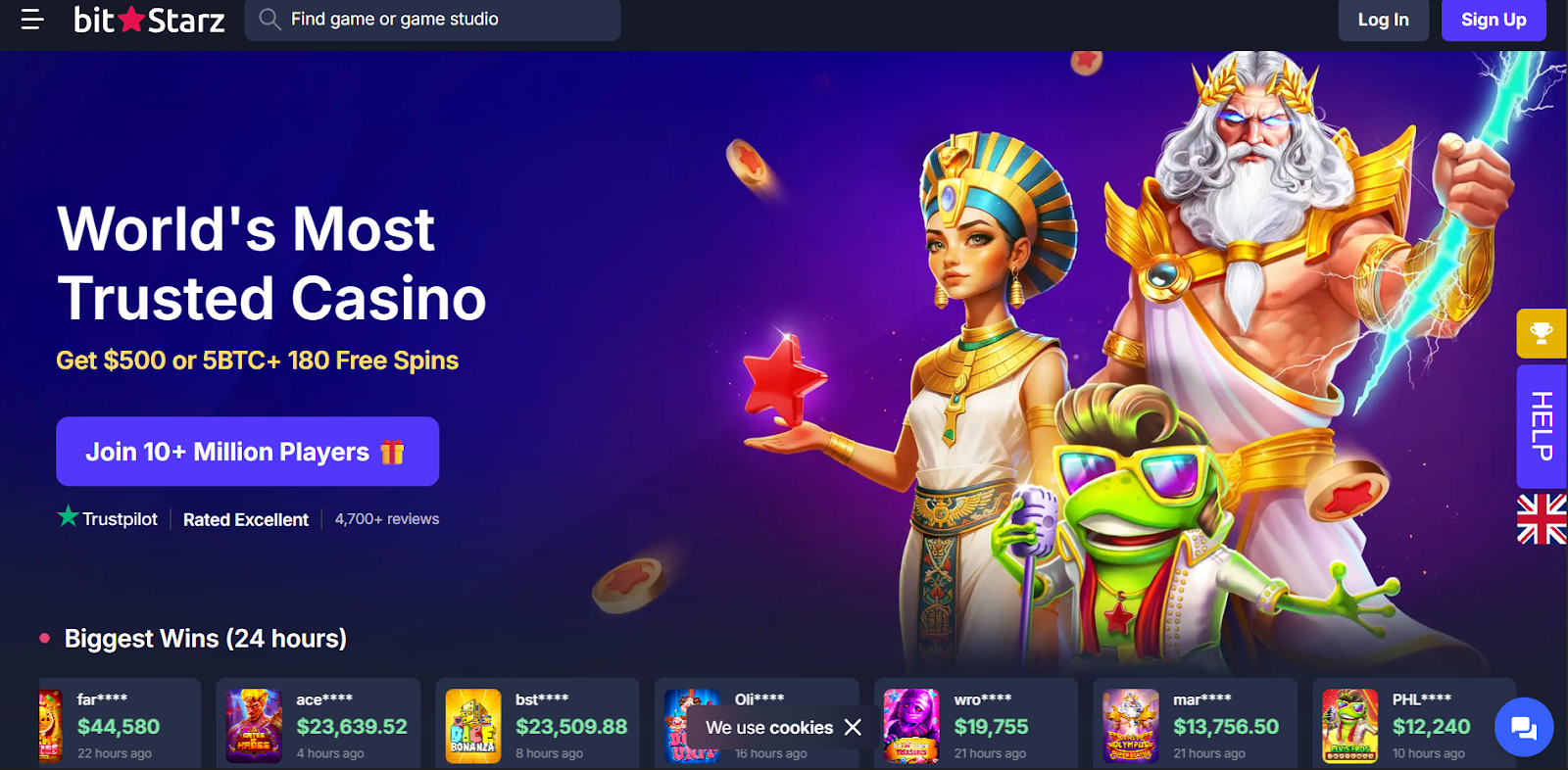
BitStarz - Best Cardano CasinosBitStarz - Best Cardano Casinos

BitStarz is among the best ADA casinos in the crypto gambling space with a welcome bonus of up to 5 BTC + 180 free spins. It’s been around since 2014 and has refined its offerings to serve both casual players and high-stakes gamblers. The platform supports Cardano deposits and fast ADA withdrawals, often completing payments within an hour on most transactions. With a proven track record and strong reputation in crypto gaming, BitStarz remains a go-to choice on many Cardano casino sites lists. 

The game selection at BitStarz exceeds 6,500 titles, including slots, table games, live dealer tables, and exclusive fair games backed by cryptographic proof. In particular, slots from top providers like Pragmatic Play and NetEnt sit alongside varied blackjack, roulette, and baccarat tables. Additionally, live dealer sessions provide a real-casino feel, and crash games add modern crypto flair. BitStarz also features some of the largest Cardano casino bonuses available, combining a multi-stage welcome package with frequent free spins offers

Pros:

Extremely fast ADA withdrawalsHuge game library with live and provably fair gamesMulti-stage bonus with free spinsFast ADA withdrawals, often completed within hoursHuge game library with numerous slots and live casino gamesProvably fair games available for added transparency

Cons:

Huge game library with thousands of slots and live dealer gamesProvably fair games available for added transparencyStrong reputation built over many years in crypto gamblingGenerous welcome bonus with free spins

2. Betpanda 
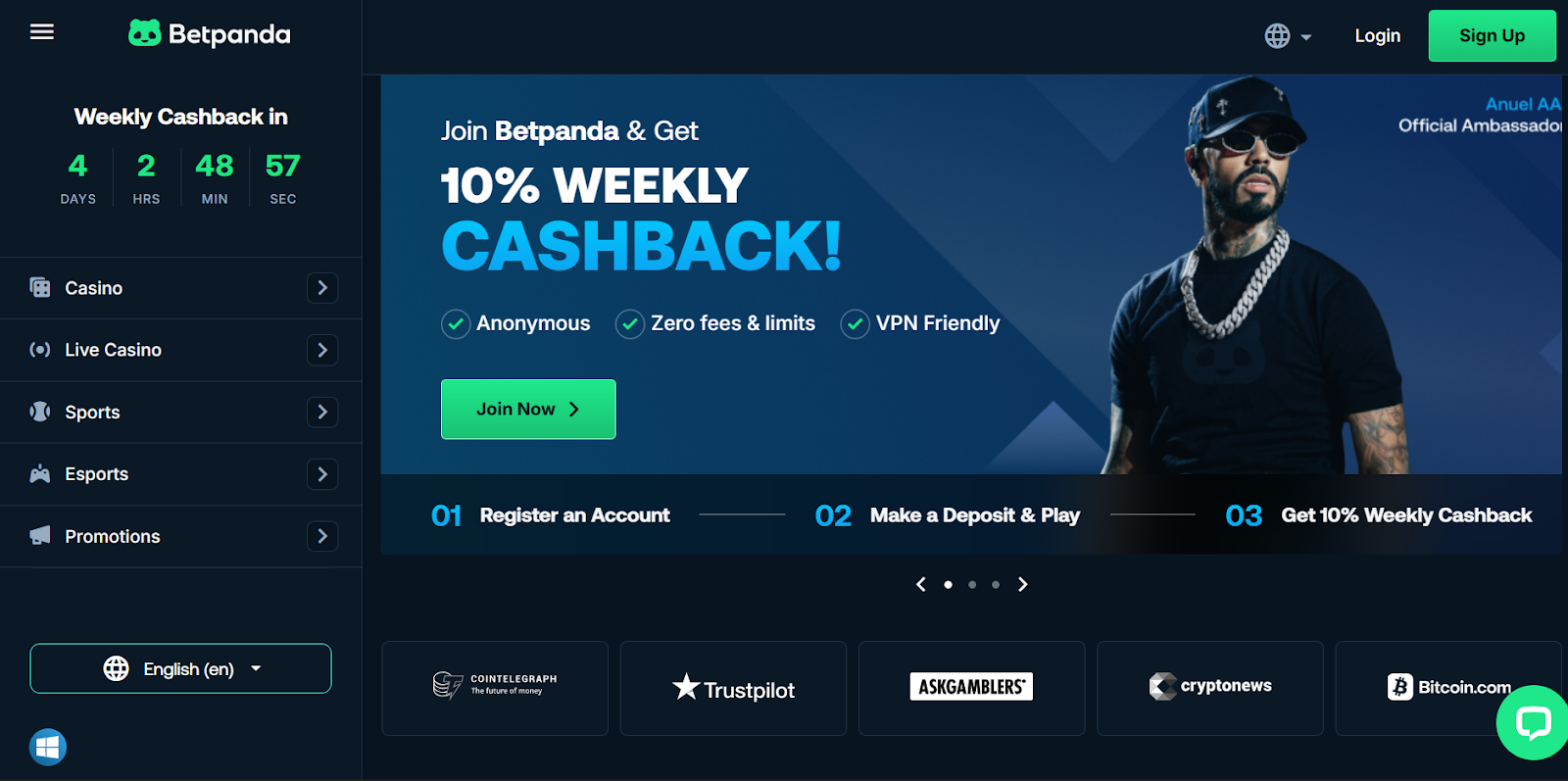
Betpanda - Best Cardano CasinosBetpanda - Best Cardano Casinos

Betpanda is one of the newest additions to ADA casinos, taking advantage of modern software and crypto-first infrastructure. Because it launched recently, the platform avoids outdated design and processing delays common in older crypto casinos. ADA withdrawal and deposits are typically processed within minutes or just hours, which helps boost its appeal for speed-focused players. In addition, Betpanda also offers a straightforward interface that works well for both newcomers and experienced gamblers with upto 50x wagering requirement

There’s no shortage of games at Betpanda, with over 6,000 titles covering slots, table games, jackpots, and tournaments. Video poker and blackjack variations are also well-represented, catering to strategy-oriented players. ADA banking is smooth, with no extra fees for crypto transactions, and the site includes VIP rewards for loyal players. Its combination of game volume and banking ease makes Betpanda one of the best places to blend Cardano gambling with consistent gameplay. 

Pros:

Instant or near-instant ADA deposits and withdrawalsLow minimum deposit suitable for new playersLarge game library with strong blackjack and poker optionsModern interface built for crypto usersVIP rewards and reload bonuses for loyal players

Cons:

High wagering requirements on welcome bonusesLimited promotional variety beyond core offersSmaller sportsbook compared to hybrid platformsStill a relatively new casino brand

3. CoinCasino 
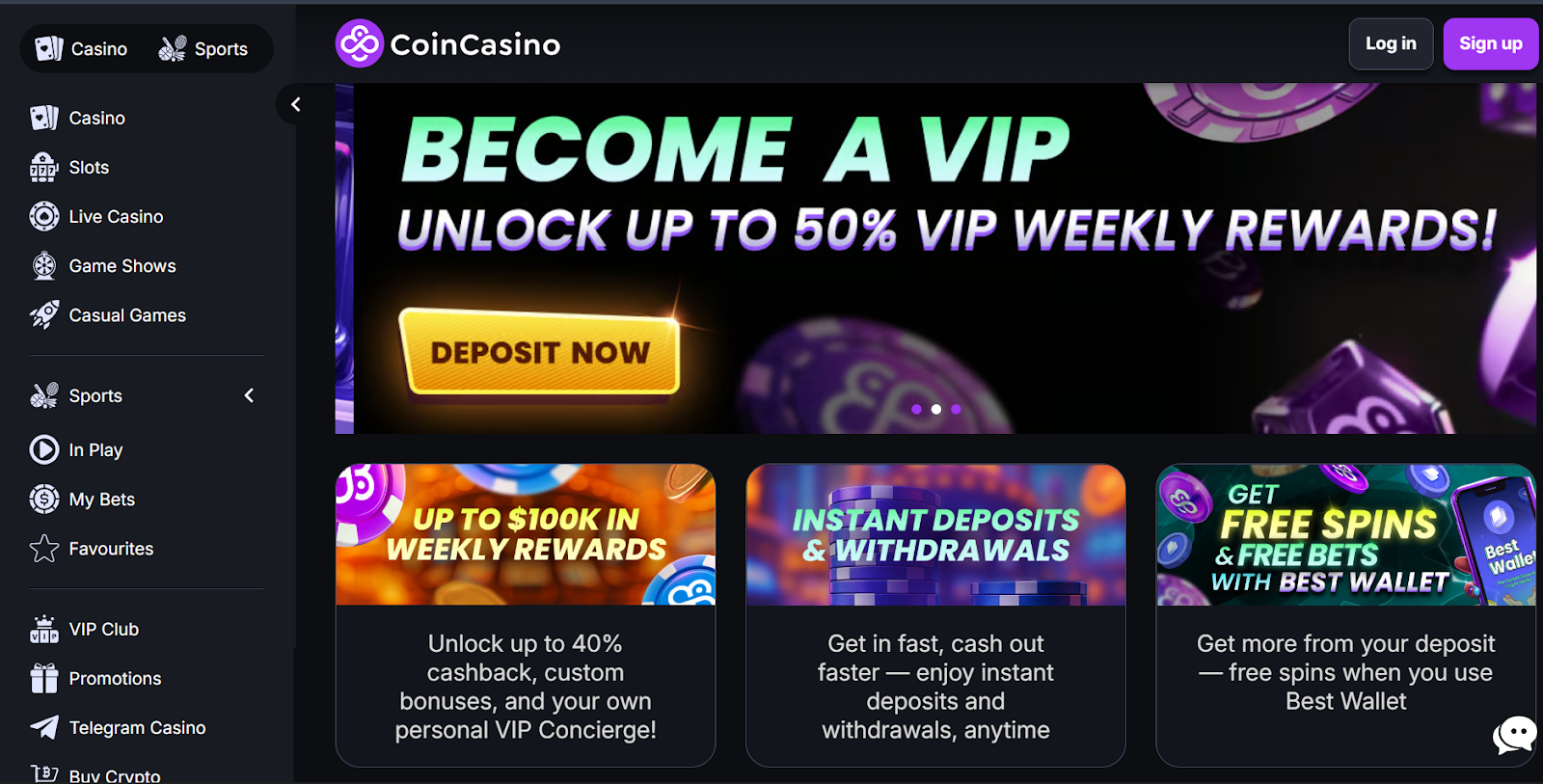
CoinCasino - Best Cardano CasinosCoinCasino - Best Cardano Casinos

CoinCasino is a well-rounded choice for ADA casinos due to its balanced mix of bonuses, games, and crypto support. The platform lets players use Cardano alongside other major cryptos for both deposits and withdrawals. Payouts are consistently quick, with many ADA withdrawals completing in under a few hours. Its long presence in the crypto space also gives players confidence in stability and performance.

The site offers thousands of games, covering slots, live tables, and provably fair titles. Welcome bonuses can reach into the tens of thousands with bonus match and free spins included. CoinCasino stands out because players can often use their bonus funds across multiple game types, not just slots. This flexibility helps players explore more game varieties without feeling restricted by bonus policies. 

Pros:

Very large welcome bonus potentialFlexible bonus usage across multiple game categoriesReliable ADA payment processingClear and transparent bonus termsBalanced mix of casino and live dealer games

Cons:

Bonus conditions vary by promotionInterface feels more functional than modernNot the largest slot collection availableVIP program less developed than competitors

4. Vave 
Vave - Best Cardano CasinosVave - Best Cardano Casinos

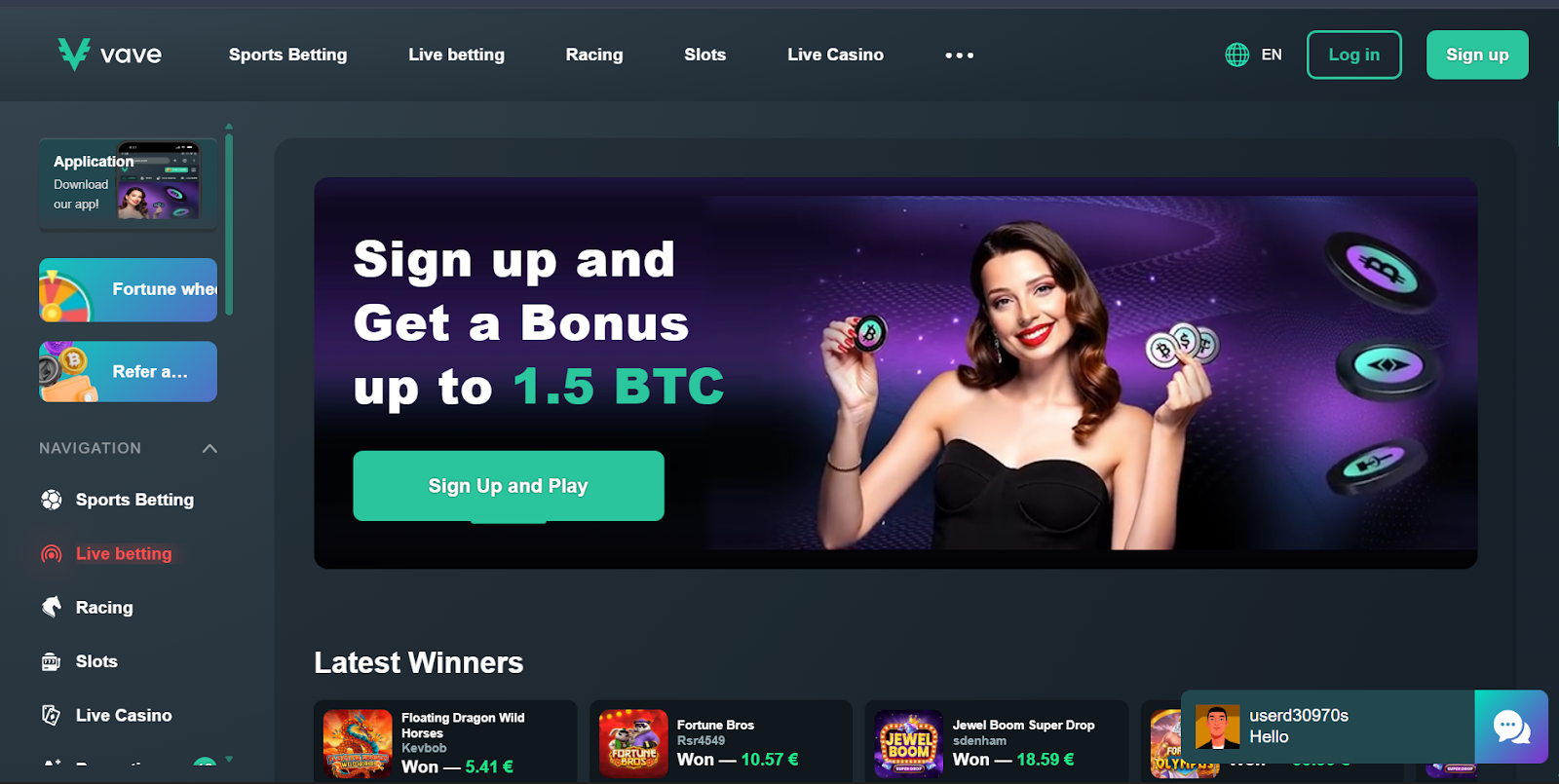
Vave established 20222,  takes a hybrid approach by combining traditional casino gaming with an integrated sports betting platform with a 24-hour payout time. Cardano users can deposit ADA to play casino games or place bets on sports and esports markets. This blend makes Vave especially appealing if you enjoy online casinos and betting under one account. The ADA banking process is smooth and usually completed in under a day, making it competitive among ADA-friendly sites. 

The casino section includes slots, live dealer tables, and crash games, while the sportsbook covers popular events across football, basketball, and competitive gaming. Bonuses often include matches and free spins, appealing to both casino and sports players. Vave’s versatility stands out because it bridges casual gambling and serious sports betting without requiring separate wallets. 

Pros:

Casino and sports betting available in one accountSupports ADA for both casino and betting playCompetitive welcome bonuses with free spinsWide coverage of sports and esports marketsSmooth navigation between casino and sportsbook

Cons:

Casino game library smaller than casino-only sitesSports betting bonus terms vary by regionWagering requirements differ across productsLimited VIP perks for casino players

5. Cryptorino
CryptorinoCryptorino

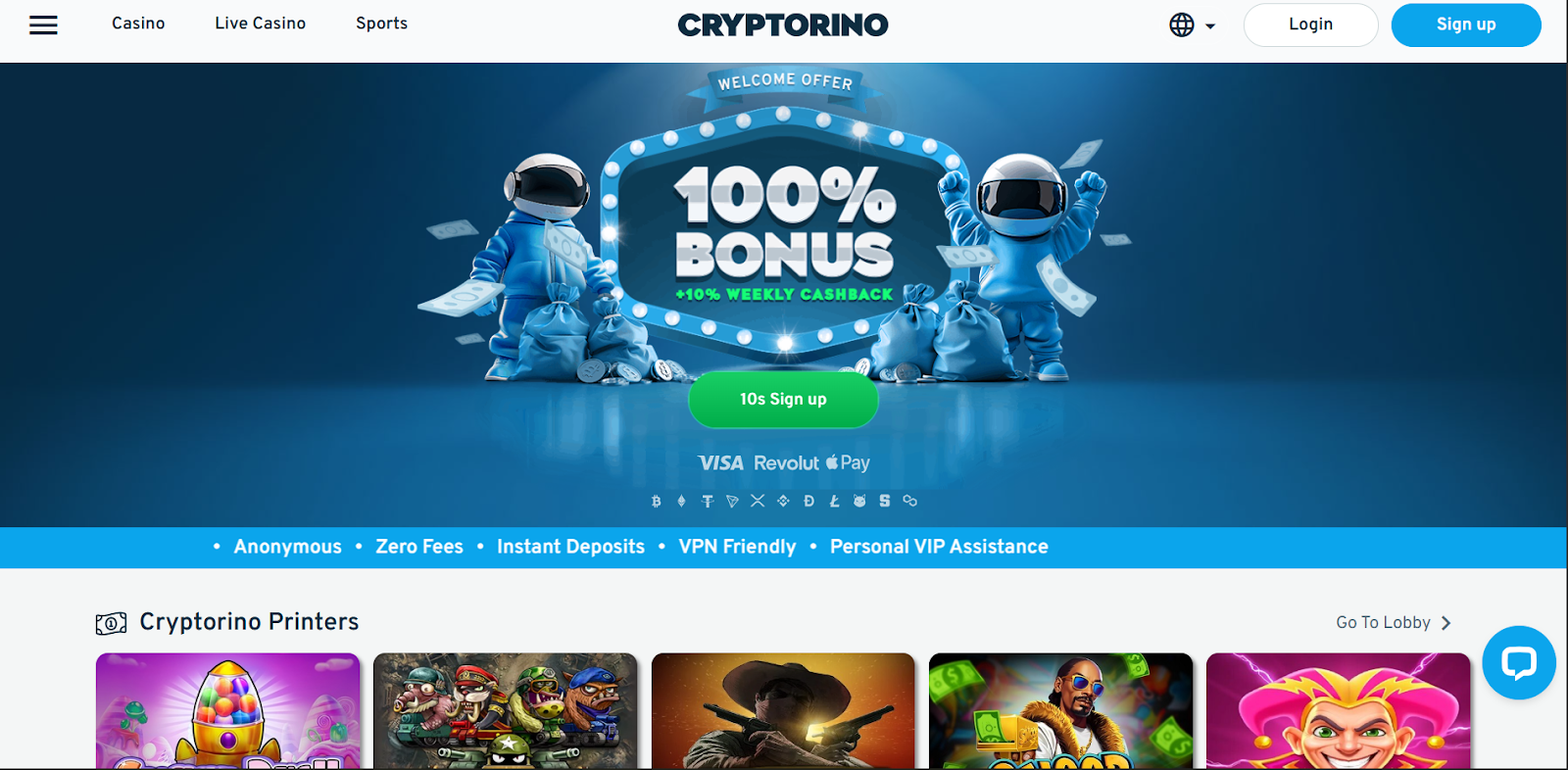
Cryptorino focuses on fast ADA deposits and withdrawals, along with a VIP reward system that includes cashback and ongoing promotions. It’s a strong contender for players who prefer crypto-centric gambling experiences without traditional fiat banking options. ADA transactions are processed quickly, which makes it attractive for players who value speed over complexity.

The casino features thousands of titles, with solid slot coverage and live dealer experiences. Bonuses often include match offers with free spins, and weekly rewards boost ongoing play. Cryptorino also supports a range of other cryptos, giving players flexibility beyond ADA. 

Pros:

Crypto-only platform with fast ADA transactionsStrong focus on privacy and anonymityVIP rewards, cashback, and reload bonusesSimple and uncluttered gambling experienceReliable slot and table game providers

Cons:

Smaller live dealer selection High wagering requirements on some bonuses Limited non-casino featuresNot ideal for casual or low-frequency players

6. Thunderpick
Thunderpick - Best Cardano CasinosThunderpick - Best Cardano Casinos

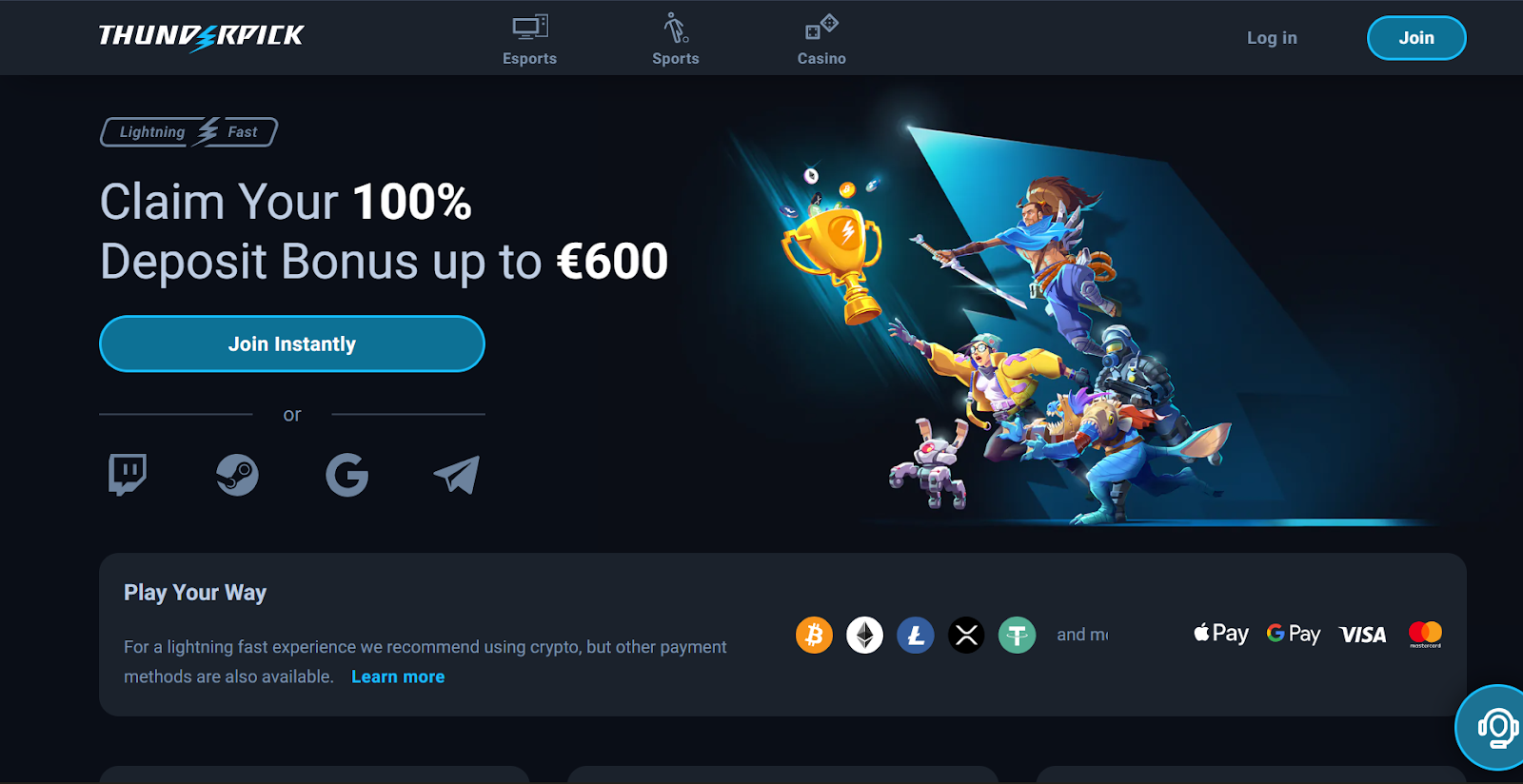
Thunderpick launched in 2017 and has built its reputation primarily around esports betting, while steadily expanding its casino offering. The platform supports ADA deposits and withdrawals, allowing players to use Cardano across both casino games and betting markets. Transactions are typically processed quickly thanks to Thunderpick’s modern infrastructure and crypto-first design. This makes it a strong option for players focused on competitive cardano gambling.

The casino section features hundreds of games, including slots, table games, and a growing number of live dealer titles. On the betting side, Thunderpick covers major esports such as CS2, League of Legends, and Dota 2, alongside traditional sports markets. Community-driven elements like tournaments, challenges, and leaderboards increase engagement. 

Thunderpick’s bonuses usually support both casino play and sports betting, depending on the promotion. Some offers include free spins, while others focus on betting rewards tied to esports events. Wagering requirements are generally moderate compared to similar hybrid platforms. Thunderpick works best for players who enjoy competition and mixed betting formats.

Pros:

Strong esports and sports betting integrationFast and reliable ADA deposits and withdrawalsModern platform with community featuresCompetitive betting oddGood mix of casino and betting bonuses

Cons:

Casino section smaller than major competitorsBonuses often favor betting over casino playLimited live dealer optionsNot focused solely on casino players

7. Winz.io
Winz.io - Best Cardano CasinosWinz.io - Best Cardano Casinos

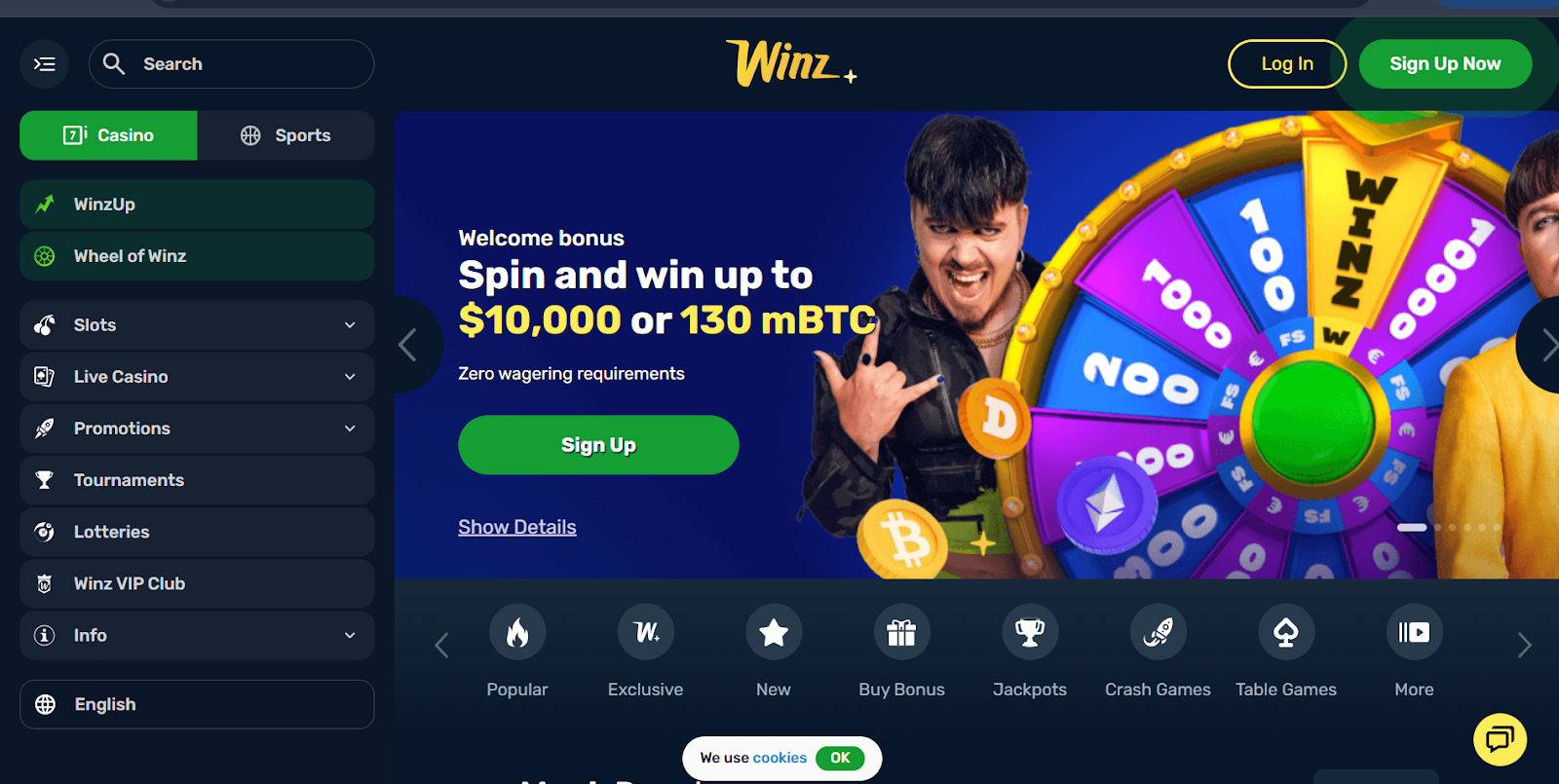
Winz.io has been operating since 2020 and focuses on delivering a streamlined casino experience for crypto players. The platform supports ADA payments with stable and reliable processing, making deposits and withdrawals straightforward. Its clean interface helps players navigate games and bonuses without distraction. This approach appeals to users who prefer simplicity over feature-heavy platforms.

The casino offers several thousand games, covering slots, table games, and live dealer titles from reputable providers. While the library isn’t the largest among ADA casinos, it includes all major game categories needed for consistent play. Winz.io also runs regular promotions and tournaments to keep gameplay fresh. Performance remains smooth across desktop and mobile devices.

The welcome offer typically includes a deposit match paired with free spins, with clearly explained wagering terms. Bonus limits are modest, but conditions are fair and manageable. This makes Winz.io suitable for players who want clarity and predictable gameplay. It’s a solid choice for those new to ADA casino sites.

Pros:

Clean and beginner-friendly interface Reliable ADA banking systemStraightforward bonus termsGood selection of quality slots and table gamesStable performance across desktop and mobile

Cons:

Smaller bonuses compared to top competitorsLimited VIP and loyalty rewardsNo sportsbook integrationSmaller overall game library

8. 7Bit Casino 
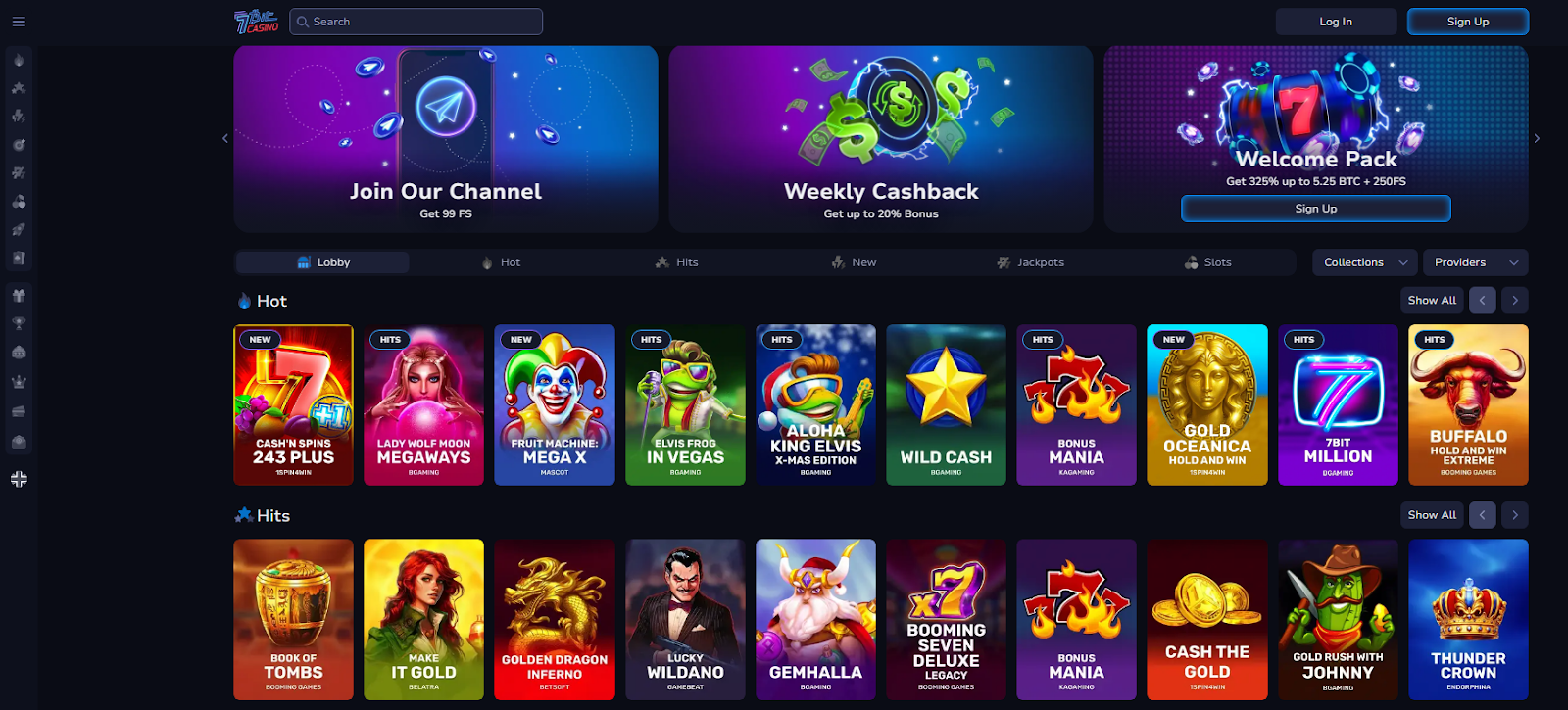
7Bit Casino - Best Cardano Casinos7Bit Casino - Best Cardano Casinos

7Bit Casino launched in 2014 and is one of the more established crypto gambling platforms supporting Cardano. Its long operating history adds credibility, and ADA transactions are handled reliably. The casino frequently runs promotions and tournaments, encouraging regular engagement. This longevity has helped 7Bit remain competitive in the Cardano casino space.

The platform offers 7,000+ games, including slots, table games, live dealer titles, and specialty games. Players who value variety will appreciate the depth of the library and frequent new releases. This extensive selection supports long-term play without repetition. It’s one of the strongest libraries available among best Cardano casinos.

The welcome package usually includes a multi-deposit bonus. Additional reload bonuses and promotions help offset wagering requirements. While bonus terms require attention, frequent offers keep players engaged. 7Bit Casino suits players who enjoy variety and ongoing incentives.

Pros:

Highly trusted platform with long operating historyCombines casino gaming and sports bettingSecure ADA deposits and withdrawalsStrong focus on player protection Quality live dealer and table games

Cons:

 Smaller casino game libraryWelcome bonus terms vary by countryFewer ongoing casino promotions More suited to experienced players

9. BC.Game 
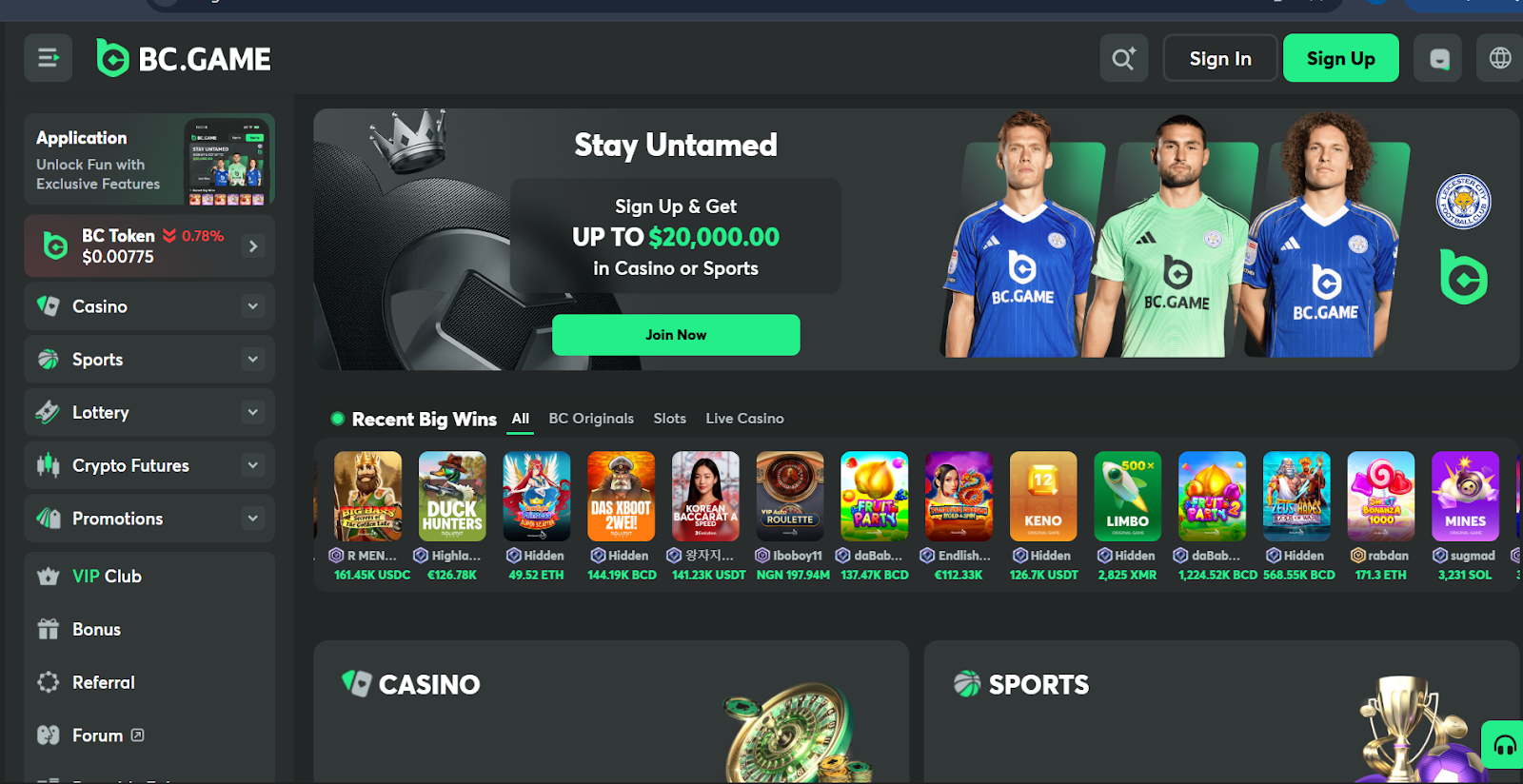
BC.Game - Best Cardano CasinosBC.Game - Best Cardano Casinos

BC.Game has been active since 2017 and has grown into one of the most recognizable names among top crypto casinos. The platform supports ADA alongside dozens of other cryptocurrencies, with deposits and withdrawals often processed quickly. BC.Game emphasizes transparency through provably fair technology. This focus has helped it build trust with crypto-focused players.

The casino includes thousands of games, ranging from slots and table games to live dealer titles and exclusive in-house games. Social features such as chat, leaderboards, and giveaways create a community-driven environment. This makes gameplay feel more interactive than on traditional online casinos. BC.Game is especially popular with active, social players.

Welcome bonuses typically include deposit matches and free spins, along with frequent promotions and daily rewards. Bonus structures vary, but they are designed to encourage regular play rather than one-time use. While the interface can feel busy, it offers strong value for engaged users. BC.Game works best for players who enjoy interaction alongside Cardano gambling.

Pros:

Very fast ADA payouts Strong community and social featuresProvably fair in-house gamesFrequent giveaways and promotions Wide cryptocurrency support

Cons:

Interface can feel crowded VIP benefits vary by regionNot all games suit traditional casino playersCan be overwhelming for beginners

10.  Cloudbet 
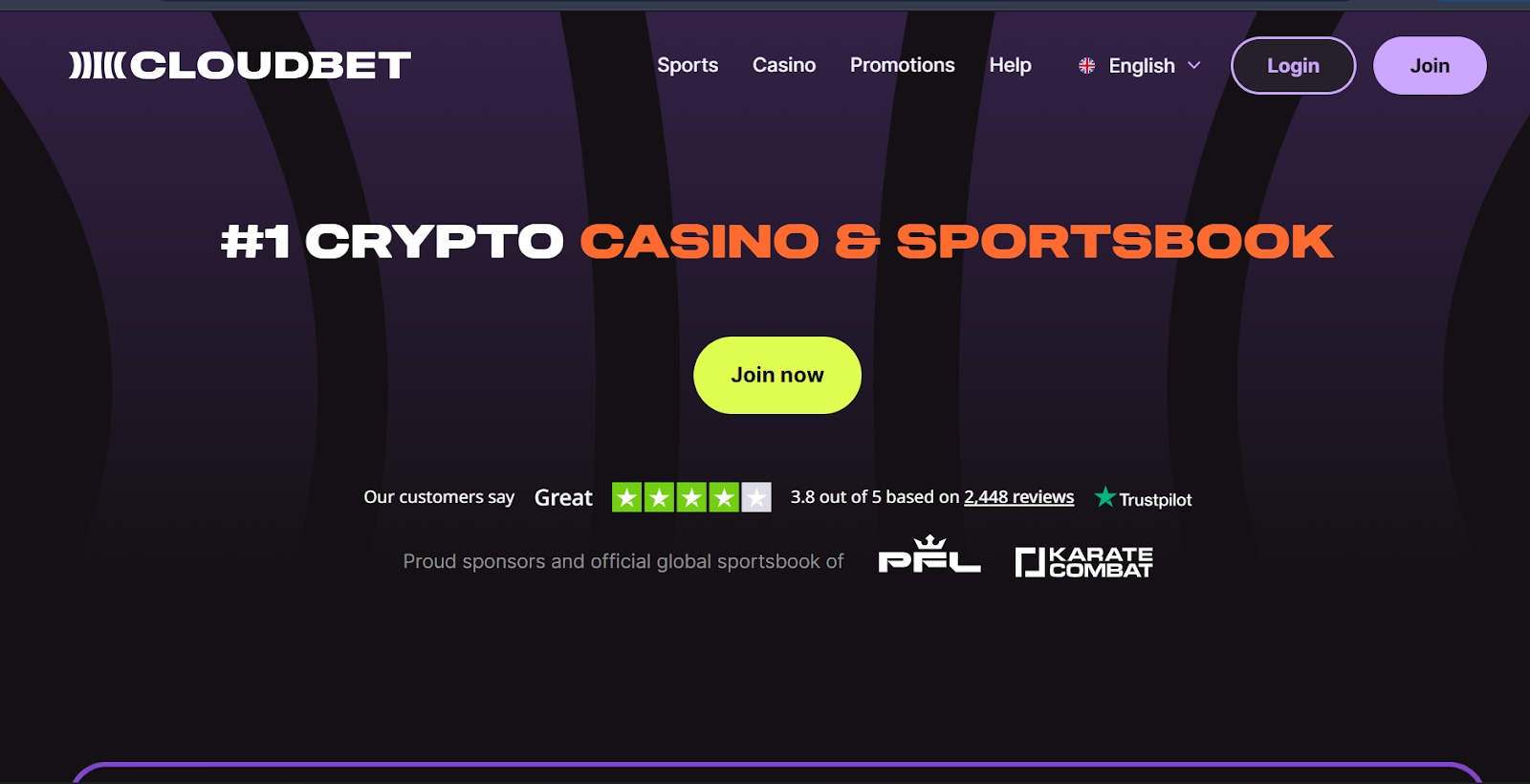
Cloudbet - Best Cardano CasinosCloudbet - Best Cardano Casinos

Cloudbet combines a reliable casino experience with a robust sportsbook, making it a compelling choice for players who enjoy cardano gambling across multiple formats. The platform supports ADA deposits and withdrawals with dependable transaction speeds. Cloudbet places strong emphasis on security and trustworthiness, appealing to serious players.

Its casino library covers slots, table games, and live dealer action, while the sportsbook offers competitive odds on dozens of sports and esports markets. Reload bonuses and ongoing promotions keep regular play rewarding. Cloudbet’s balance of stability, betting variety, and security makes it a go-to option for many ADA enthusiasts. 

Pros:

Highly trusted platform with long operating historyCombines casino gaming and sports bettingSecure ADA deposits and withdrawalsStrong focus on player protectionQuality live dealer and table games

Cons:

Smaller casino game libraryWelcome bonus terms vary by countryFewer ongoing casino promotionsMore suited to experienced players

What is Cardano (ADA) and How Does It Work at Casinos?

Cardano is a blockchain platform launched in 2017 by IOHK (Input Output Hong Kong) with a strong focus on security, scalability, and peer-reviewed research. Its native cryptocurrency, ADA, is used to power transactions on the network and is designed to be efficient, transparent, and energy efficient. Unlike many older blockchains, Cardano uses a proof-of-stake consensus model called Ouroboros, which reduces fees and processing times while maintaining strong security. These features make ADA well suited for use in Cardano casino environments.

At casinos, ADA works as a direct payment method for deposits and withdrawals. When you send ADA to a casino wallet, the transaction is recorded on the Cardano blockchain and usually confirmed within minutes. Because transactions don’t rely on banks or intermediaries, players benefit from lower fees, faster payouts, and fewer geographic restrictions. When comparing Cardano with other blockchains, compared to popular Ethereum gambling sites, Cardano casinos offer faster and cheaper transactions. Ethereum casinos rely on smart contracts and a more congested network, which can lead to higher gas fees and slower processing during peak times.

Pros and Cons of Using Cardano Casinos

As more players explore the best Cardano casinos, it’s important to understand both the advantages and the trade-offs that come with using ADA for gambling. While top Cardano casino sites offer speed, transparency, and lower fees, they also come with limitations that may affect certain players. The following are the cons and pros:

Pros

Fast deposits and withdrawals powered by Cardano’s proof-of-stake blockchainLower transaction fees compared to many traditional payment methodsTransparent and traceable payments recorded on a public blockchainIncreased privacy without relying on banks or third-party processorsGrowing acceptance across leading ADA casinos and online platforms

Cons

Limited adoption compared to older cryptocurrencies like BitcoinNot all online casinos support ADA withdrawalsFewer bonus options at some Cardano casino sitesRequires basic knowledge of crypto wallets and blockchain transfers

Types of Games Available at Cardano Casinos

Once you set up your account and connect your wallet address, the next question is simple; what can you actually play? Most players want variety, smooth gameplay, and games that work well with crypto payments. The following are the types of available at Cardano Casinos:

Cardano Slots

Slots are the most popular games on these platforms, and for good reason. You’ll find classic slots, video slots, and modern titles with bonus rounds and jackpots. Games load fast, rounds are quick, and stakes range from very small to high value. If you want simple gameplay with big win potential, slots are usually where you’ll start.

Table Games (Blackjack, Roulette, Baccarat)

Table games are ideal if you like structure and strategy. Blackjack rewards smart decisions, roulette offers fast-paced betting, and baccarat keeps things simple and elegant. These games work smoothly with crypto deposits and give you clear odds on every round. Many players prefer table games because they feel familiar and easy to control.

Live Dealer Games

Live dealer games bring a real casino feel to your screen. You play against a live host through video streaming while placing bets online. The experience feels social and interactive, which many players enjoy. It’s a good choice if you want realism without visiting a physical casino.

Poker Variants

Poker options usually include popular formats like Texas Hold’em and fast-paced casino poker games. Some platforms also offer peer-to-peer poker rooms. These games suit players who enjoy skill-based play and longer sessions. Stakes vary, so you can play casually or competitively.

Crash and Provably Fair Games

Crash and provably fair games are built for crypto players who want speed and transparency. Timing and risk define crash games, while provably fair games let you verify results using open algorithms. Provably fair means the outcome can be checked to confirm it wasn’t manipulated. These games are quick, modern, and popular with players who like full control.

Cardano Casino Bonuses and Promotions

Bonuses are often the first thing you notice when joining a new casino, but not all offers deliver real value. The goal is to understand what each promotion actually gives you and how easy it is to use. Below, we walk you through the most common bonus types so you know what to expect before you claim anything.

Welcome Bonus

A welcome bonus is usually the first offer you’ll see after signing up. It often matches a percentage of your first deposit and may include extra credits to play with. This bonus gives you more time to explore games without risking too much of your own money. Always check wagering terms before you start playing.

Free Spins

Free spins let you try slot games without using your balance. They’re commonly included with welcome offers or special promotions. Any winnings from free spins usually come with conditions, but they’re still a low-risk way to test new games. Players often use them to explore slots they wouldn’t normally play.

Cashback

Cashback promotions return a percentage of your losses over a set period. This can be daily, weekly, or monthly. Cashback helps soften losing sessions and gives you another chance to play. It’s especially useful if you play often or place higher bets.

No Deposit Bonus

A no deposit bonus gives you a small amount to play with just for signing up. You don’t need to add funds to claim it. These bonuses are rare and usually come with strict limits. Still, they’re a good way to try a casino before committing money.

Reload Bonuses

Reload bonuses reward you for making additional deposits after your first one. They often appear as weekly or special event offers. These bonuses help extend your playtime and keep things fresh. Regular players benefit the most from reload deals.

VIP and Loyalty Programs

VIP and loyalty programs reward consistent play. As you earn points, you unlock perks like higher cashback, faster withdrawals, and personal support. These programs are designed for long-term players. If you plan to stick with one casino, loyalty rewards can add real value.

How We Review the Best Cardano Casino

We review Cardano casinos by focusing on what actually matters to you as a player. That starts with payment reliability, including how fast ADA deposits and withdrawals are processed and whether fees are fair. We also test usability, making sure the platform is easy to navigate, works smoothly on mobile and desktop, and clearly explains its bonus terms. Security, licensing, and overall transparency play a major role in how we rate each casino.

Next, we evaluate the gaming experience itself. We look at game variety, quality of providers, and whether live dealer and modern crypto games are available. Moreover, bonuses are reviewed for real value, not just headline numbers, with attention to wagering requirements and usability. Finally, we consider long-term trust factors like customer support, reputation, and consistency, so the casinos we recommend hold up beyond the first deposit.

Getting Started with Cardano Gambling: Step-by-Step Guide

Getting started with Cardano gambling is simpler than it sounds. Once you understand the basic flow, you can move from setup to playing in a short time. Here’s how we recommend doing it, step by step, without unnecessary complications.

Step 1: Set Up Your Cardano Wallet and Buy ADA

First, you’ll need a Cardano wallet to store and send ADA. Choose a trusted wallet that lets you control your funds and keep your private keys safe — check out this list of best crypto wallets for ADA and other coins to get started. After setup, buy ADA from a reputable exchange and send it to your wallet. As a result, this gives you full ownership of your balance before you start playing.

Step 2: Pick a Trusted Cardano Casino

Next, choose a casino that clearly supports ADA deposits and withdrawals. Look for licensing, clear bonus terms, and a good reputation among players. We always recommend checking game variety and withdrawal policies before signing up. A trusted casino makes everything else smoother.

Step 3: Make Your First Deposit and Claim Bonus

Once registered, head to the deposit section and select Cardano as your payment method. Copy the casino’s wallet address and send ADA from your wallet. After the deposit confirms, you can usually claim a welcome bonus or promotion. Make sure you understand the wagering rules before using it.

Step 4: Begin Playing

With funds available in your casino account, you’re ready to play. Choose games that match your style, whether that’s table games, slots, or live dealer options. Start with smaller bets until you’re comfortable with the platform. This helps you learn how everything works without pressure.

Step 5: Withdraw Your Winnings

When you’re ready to withdraw, head to the withdrawal section and select Cardano. Withdrawals are usually faster than traditional payment methods. Always double-check your wallet details before confirming.

How to Withdraw Using Cardano

Go to the withdrawal section of the casinoSelect Cardano as your withdrawal methodEnter your personal Cardano wallet addressChoose the amount you want to withdrawConfirm the request and wait for blockchain confirmation

Cardano vs Ethereum Casinos: Which is Better for Online Gambling?

FeatureCardano CasinosEthereum CasinosTransaction SpeedFast confirmations, usually within minutesSlow down during network congestionTransaction FeesLow and predictable feesFees can be high due to gas costsNetwork StabilityConsistent performance with less congestionNetwork congestion is common at peak timesEnergy UseEnergy‑efficient proof‑of‑stakeProof‑of‑stake, but higher usage due to volumeCasino AdoptionGrowing but still limitedWidely adopted across many casinosBonus AvailabilityFewer but improving bonus optionsMore frequent and varied bonusesEase of UseSimple for deposits and withdrawalsCan be confusing due to gas fees

The Regulation for Cardano Casinos

Regulation plays a key role in how safe and reliable Cardano casinos are for players. Most platforms that accept ADA operate under international gaming licenses, commonly issued by authorities in jurisdictions such as Curaçao. These licenses require casinos to follow basic rules around fair play, player protection, and responsible gambling, even when crypto is involved. While regulations vary by region, licensed operators provide a higher level of trust than unregulated sites.

Many Cardano casinos also fall into the category of crypto casinos without KYC requirements, meaning they don’t require full identity verification for basic play. Instead, they rely on blockchain transactions to handle deposits and withdrawals securely. This appeals to players who value privacy and faster onboarding.

Responsible Gambling Tips

Set a clear budget before you start playing and stick to itOnly gamble with money you can afford to loseTake regular breaks to avoid chasing lossesUse casino tools like deposit limits or self-exclusion when neededAvoid gambling when stressed, tired, or emotionalTreat gambling as entertainment, not a way to make moneyKnow when to stop and step away if play stops being fun

Conclusion

Cardano casinos offer a fast, cost-effective, and transparent way to enjoy online gambling using ADA. With low fees, quick transactions, and growing support across quality platforms, they continue to attract players who value efficiency and control. While the ecosystem is still expanding compared to older blockchains, the overall experience is improving each year. Choosing a trusted casino and understanding how Cardano works will help you play confidently and responsibly.

FAQs

What’s the best Cardano casino in 2026?

The best Cardano casino in 2026 depends on what you value most, such as fast payouts, game variety, or bonuses. Many players look for licensed platforms that support quick ADA withdrawals, clear bonus terms, and strong reputations. Choosing a casino with consistent performance and transparent policies is key. Reviews and player feedback can help narrow down the top options.

Are online Cardano casino sites safe to use?

Online Cardano casino sites are generally safe to use when they operate under a valid gaming license and use secure blockchain transactions. ADA payments are recorded on a public ledger, which adds transparency. Reputable casinos also use encryption and fair play systems to protect players. Always check licensing and security details before signing up.

How can I deposit Cardano (ADA) at an online casino?

To deposit Cardano at an online casino, you first need an ADA wallet with enough funds. Select Cardano as your deposit method, copy the casino’s wallet address, and send ADA from your wallet.

Can I play at Cardano casinos anonymously?

You can play at many Cardano casinos anonymously, especially at platforms that operate as no KYC casinos. These sites often allow you to deposit, play, and withdraw using ADA without full identity verification.

Why should I use Cardano for online gambling?

Using Cardano for online gambling offers fast transactions, low fees, and increased privacy compared to traditional payment methods. ADA payments don’t rely on banks, which means fewer delays and restrictions. The blockchain also adds transparency to deposits and withdrawals.



Source link

MEXC vs BingX: A 2026 Comparison of Features and Fees

0
MEXC vs BingX: A 2026 Comparison of Features and Fees


If you love crypto trading, you already know the critical role that a crypto exchange plays in this business. Currently, two prominent cryptocurrency exchanges are emerging as notable players: BingX and MEXC.

Both exchanges offer distinct trading features designed to attract users from diverse backgrounds, making it a challenging task to decide between them. This guide compares MEXC and BingX, focusing on user experience, trading fees, and overall reputation.  

MEXC vs BingX: Quick Comparison

FeaturesBingXMEXCYear Founded20182018HeadquartersSingaporeSeychellesBest forBeginnersExpert tradersCryptocurrencies supported10002900Payment methodsCredit/Debit cards, Bank transfers, Apple Pay, Google PayCredit/debit cards, Bank Transfer, Apple payStorage solutionsCold storage options to secure user fundsSecure storage and enhanced features for asset managementMobile appboth mobile and desktop platforms offering seamless trading experienceUser-friendly mobile and desktop platforms with full trading functionalityDeposit and withdrawEfficient deposit and withdrawalDeposits and withdrawals handled efficientlySecurity features2FA, anti-phishing code, withdrawal whitelist, One-Click Protection       2FA authentication, withdrawal whitelist, anti-phishing code

BingX Overview

BingX Overview

BingX is a cryptocurrency exchange specializing in hassle-free trading experience with low trading fees. Founded in 2018, the platform has quickly established a name for itself within the crypto space. BingX is currently FC Chelsea’s cryptocurrency partner, a partnership that has boosted its international standing.

The platform is renowned for offering various products, including spot trading, futures trading, and options. The exchange also provides advanced features, including copy trading that enables replicating the experiences of successful traders. BingX is currently FC Chelsea’s cryptocurrency partner, a partnership that has boosted its international standing. Read our full BingX review for a deep dive into its features, fees, and performance.

BingX is applauded by many experienced traders seeking high-level features, but beginners can also navigate it easily. The exchange also supports a wide range of digital assets, including well-known ones and leading altcoins.  Users find it to be a user-centric platform with a friendly design that is easy to navigate for both experts and novices.

Bingx logoBingx logo

MEXC Overview

MEXC OverviewMEXC Overview

MEXC cryptocurrency exchange boasts a global appeal and offers an easily accessible, user-friendly platform. Since its establishment in 2018, the platform has experienced exponential growth, capable of settling at least 1.4 million transactions per second. Read our full MEXC review to explore its features, fees, and overall performance in depth.

The exchange supports a wide variety of cryptocurrency assets, including Bitcoin, Binance Coin, Ethereum, and many altcoins. Users love MEXC mainly because of its competitive trading fees and an easy-to-use and navigable interface. This makes the platform attractive for both new and experienced crypto traders.

Trading options are the most popular feature among MEXC users. The standout products include futures contracts, spot trading, margin trading, and staking, offering the much-desired diversity for users. Moreover, MEXC offers a responsive mobile app that enables users to trade efficiently on the go.

MEXC_square_logo-removebg-previewMEXC_square_logo-removebg-preview

MEXC vs BingX: Trading Features 

Both BingX vs MEXC support a wide range of trading options such as futures trading and sport trading. However, MEXC stands out for its extensive list of supported cryptocurrencies, which includes the leading altcoins. The platform enables its users to enjoy margin trading, allowing them to trade with leverage.  

The leading trading features offered by MEXC include contract trading, spot trading, and leveraged ETF trading. The exchange offers a wide range of trading pairs, including DeFi coins, creating a versatile market for its users. Moreover, there are other advanced features like TradingView charts offering advanced charting functions including pop-up reminders for security upgrades.

On the other hand, BingX has cut a niche for itself as a leader in options trading and copy trading. Copy trading has become especially popular for enabling novice traders to replicate the moves of experienced traders automatically.

In addition to futures contracts offered by MEXC, BingX includes options trading, another layer of flexibility and complexity for advanced traders.  BingX crypto exchange offers additional trading features, including instant crypto trading, demo trading, and access to many traditional markets. Investors can also take advantage of crypto platforms with leverage options offering up to 125x on standard contracts.

MEXC vs BingX: Fees  

Regarding applicable trading fees, both MEXC and BingX offer competitive fee structures. MEXC operates on a tiered fee system, which varies based on a user’s trading volume, offering discounts for higher trading activity. The platform provides relatively low spot and futures trading fees, which attract traders seeking cost savings. BingX also offers relatively low trading fees on spot and futures trading. Traders opting for copy trading can benefit from significantly discounted fees depending on the expert trader they follow.   

Trading Fees              

Low trading fees are a key feature of the MEXC exchange, making it a popular choice among day traders. The spot market crypto trading fees begin at 0% with futures trading fees starting at 0% for makers and 0.02% for takers. Spot market traders are charged a flat fee of 0.1% for both makers and takers.

For the BingX exchange, maker fees for perpetual futures are 0.02%, and taker fees are 0.05%. The platform offers discounts based on a user’s monthly trade volume, which can reduce the maker fee to 0.0015% and the taker fee to 0.035%.

Deposit and Withdrawal Fees

BingX offers users various methods for managing their funds, including different deposit and withdrawal channels. These include credit cards, bank transfers, and various cryptocurrencies, with crypto speeds varying depending on the specific asset. The deposit fees will vary based on the method used, while withdrawal fees will depend on the selected crypto asset.  

MEXC’s deposit and withdrawal features offer different processing times and fees depending on the method used. Deposits surrounding cryptocurrencies are mostly instant, and while withdrawals are equally swift, network congestion could cause delays. Additionally, depositing fiat currency via third-party service providers is subject to the fees charged by these providers.  

MEXC vs BingX: Products & Services  

While both BingX and MEXC are renowned for offering diverse products and services, they differ in some aspects. That’s because both crypto exchanges target a diverse range of investors interested in staking, NFTs, various trading options, and savings services. BingX stands out for its user-friendly interface, while MEXC is popular for its extensive list of supported cryptocurrencies.

BingX has products targeting a broad audience with choices ranging from copy trading to spot and derivative trading. Moreover, crypto holders can use their idle tokens for crypto staking and access to new cryptocurrencies. The platform offers a wealth management service that allows users to earn money by saving and engaging in grid trading. Moreover, you can also avail of several cryptocurrency loans to boost your trading capital. BingX’s signal trading feature enables novices to participate in high-yield setups, while the BingX card offers services at near-instant speeds.

Crypto exchange MEXC is highly regarded for its high performance in spot, futures, and margin trading. The platform offers a secure and reputable MEXC wallet for managing crypto assets and private keys. Users also have access to crypto conversions and pre-market trading services. The exchange stands out as the go-to platform for trading meme coins and offers early access to new coins. Additionally, users can also use the MEXC Savings and Loans feature to borrow from the exchange.

Both BingX and MEXC offer leveraged trading, but they focus on different products. MEXC lists a large number of perpetual futures contracts that encompass small-cap tokens, which are unavailable elsewhere, with up to 200x leverage. BingX offers more copy trading futures on an easy-to-use interface, which mainly attracts new users.  

MEXC vs BingX: Supported Cryptocurrencies            

MEXC stands out from BingX due to its relatively wide range of cryptocurrencies, with over 2,900 assets listed. The platform also provides a broader variety of trading options, enabling investors to diversify their portfolios with ease. The diversity allows for users to gain experience with known cryptocurrencies and emerging altcoins with great potential. Among the supported assets are BTC, USDT, ETH, XRP, LTC, BCH, and TRX, as well as DeFi tokens such as LINK, SNX, MKR, and others.

BingX has over 1,000 listed cryptocurrencies and at least 30 different crypto trading pairs where traders can use BTC or USDT as collateral. In addition to cryptocurrencies, the exchange also exposes users to traditional markets like indices and commodities. BingX supports leading cryptocurrencies, including BTC, ETH, XRP, SOL, LTC, and DOGE, among others.

MEXC vs BingX: Regulation & Availability 

BingX operates its services with a strong focus on regulatory compliance, ensuring that the platform’s users adhere to local laws. The platform acknowledges the various approaches to cryptocurrencies by regulatory bodies, which generally classify them as an alternative asset class. Moreover, the exchange cooperates with low-enforcement jurisdictions in which it operates and helps to flag fraudulent activities.

In its terms and conditions, BingX clearly outlines the different risks associated with crypto trading, including the potential for financial losses. The exchange is available in most regions globally. However, some features may be found in some jurisdictions due to diverse regulatory and licensing requirements. The platform also prohibits certain unlawful activities, including fraudulent trading and market manipulation. BingX restricts access to the United States, United Kingdom, Netherlands, Singapore, China, Iran, Iraq, and South Korea, among other countries.

Cryptocurrency exchange MEXC takes regulatory issues seriously in the jurisdictions where it operates. While the exchange operates in many countries, you may not be able to access all products and services in every location. That’s because different countries operate diverse laws regarding cryptocurrencies. Additionally, MEXC states on its website that it reserves the right to impose restrictions as it may deem fit on accessing the platform. The platform also states that it cooperates with regulatory and governmental bodies in the countries where it operates.  MEXC restricts users from Canada, Cuba, Hong Kong, Iran, Mainland China, North Korea, and Russia-controlled areas of Ukraine, Singapore, Sudan, and the United States

MEXC vs BingX: Security

When it comes to security features, BingX and MEXC take matters seriously by employing different measures to protect user assets. Whether it’s cold-storage, multi-layered security, or proof of reserve, here is a comparison of MEXC vs. BingX:

MEXC utilizes two-factor authentication (2FA) and the highest standard encryption to protect data and user funds. The platform also utilizes cold storage to store the majority of its assets, ensuring they are secure from online hacking attempts. To further safeguard user funds amounting to over $500 million in deposits, the exchange supervises transactions in real-time. MECX proudly maintains a solid security record with no past incidents, handling any security threats professionally and thereby maintaining user trust.  

BingX also utilizes two-factor authentication and advanced encryption technologies to protect user funds. Moreover, the exchange implements an internal insurance fund for specific selected cryptocurrencies as an added protection layer. BingX claims on its website that it has never experienced a security breach of any kind. The use of cold storage plays a significant role in ensuring that cybercriminals don’t have access to user data and funds.  

Apart from conducting regular security audits to ensure compliance, both exchanges operate proof-of-reserves. This refers to maintaining 100% reserves to ensure they have sufficient funds for withdrawals. Moreover, MEXC continually monitors user asset risks and offers compensation for any losses resulting from the platform’s negligence. BingX, on the other hand, operates advanced firewalls and a dedicated insurance coverage.  

MEXC vs BingX: Trading Volume and Liquidity

In comparing MEXC vs BingX, you will discover that both platforms present different trade volumes. This has a direct impact on the trading experience, affecting factors such as execution, efficiency, and potential for price slippage.

BingX offers significant liquidity and trading, ensuring that users can execute trades quickly and at predictable prices. The existence of high liquidity has ensured that traders can rely on the platform, knowing the pricing can be stable. The exchange is also capable of handling large-volume trades quickly and efficiently. Trading fees are determined via 30-day trading volume tiers, where Level 1 traders with a volume of under $50,000 pay a fee of 0.10%.

MEXC also boasts a relatively high trade volume and liquidity, which is evidence of a supportive and active user base. The high liquidity levels ensure that users can execute their trades quickly and at the market prices. The platform is known for charging zero spot trading fees. The supported higher maximum leverage of 200 x aptly contributes to the high trading volumes.

BingX vs MEXC: KYC Requirement

MEXC and BingX both have different Know Your Customer (KYC) and Anti-Money Laundering (AML) requirements. It’s essential to understand what each platform stands for so you can make an informed decision.

BingX doesn’t enforce a strict KYC standard, meaning you can start trading immediately after registration without undergoing identity verification. Users can withdraw up to $ 50,000 daily without verification. However, you may need to undertake the process to access higher limits and some advanced trading features.   

MEXC, on the other hand, allows an anonymous withdrawal limit of up to 30 Bitcoins per day. However, you must undergo KYC verification to enjoy higher limits and a broader suite of advanced features. You will be required to provide official identification documents, facial recognition scans, or proof of address depending on your location.

BingX vs MEXC: Mobile App  

Both MEXC and BingX offer mobile apps that enable crypto trading on the go, featuring distinct functionalities and varying levels of accessibility.

The BingX mobile app supports both iOS and Android devices, enabling users to trade cryptocurrencies from anywhere. Users can also use it to access various features, including spot, futures, and copy trading. The app features a user-friendly design, making it ideal for both novices and experts, and enables the fast execution of trades. Users can download the app from either Google Play Store or Apple App Store.

MEXC also offers a high-performance mobile app equipped with advanced trading features. The app, available for both Android and iOS devices, can be downloaded from the official MEXC website, as well as from the Apple App Store and Google Play Store. When downloading the app from app stores, ensure you get it from “MEXC Fintech, Inc.” to avoid counterfeits.

BingX vs MEXC: User Experience

Both BingX vs MEXC present very user-friendly interfaces, leading to seamless trading experiences for users. While MEXC primarily appeals to expert traders due to its advanced tools, BingX offers social features that attract new users.  

The MEXC dashboard offers a clean, well-arranged interface that provides customizable features tailored to individual needs. The platform also offers educational resources that are very handy for new users learning aspects of cryptocurrency trading.                 

BingX, on the other hand, features a user interface that significantly simplifies the trading experience, particularly for new users. The dashboard is straightforward, providing access to the most essential trading tools. The design is intuitive, and its integration with the mobile app greatly enhances user experience. Using the copy trading feature enables new users to replicate advanced strategies from successful investors.  

BingX vs MEXC: Customer Support & Service       

According to the BingX website, the platform offers 24/7 customer support and has company representatives available to answer user queries. Users can reach the exchange via email, chat support, and a help center that answers FAQs. User reviews indicate that the platform responds promptly to user queries, offering timely assistance.

MEXC, on the other hand, boasts of a responsive and professional customer care department. The exchange operates a dependable customer support system to address user issues, which is available 24/7. Moreover, the platform has a well-organized FAQ section that addresses many typical trader issues. Users can also reach MEXC through chat support and email.

Both MECX and BingX offer sufficient cryptocurrency educational materials that address common issues affecting crypto traders.

Conclusion: Which is Better? 

In our comparison of BingX vs MEXC, it is clear that both exchanges have unique features targeting different types of traders. MEXC introduces innovative trading features and supports a diverse range of cryptocurrencies. In addition to low trading fees, MEXC also has a well-rounded platform that’s ideal for both experts and beginners.  

BingX offers advanced trading tools, including copy trading and options, that primarily appeal to traders interested in complex strategies. The platform’s easy-to-use interface makes the trading experience seamless in a low-fee environment.  Moreover, users can also benefit from the available educational resources to enhance their experience.

Ultimately, choosing between BingX and MEXC will depend on your specific needs, trading style, and individual preferences. Both MEXC and BingX offer robust security, competitive fees, and a range of strong features. Ensure to interrogate them carefully to choose the one that best suits you.

FAQs                                                                                                               

Can I use BingX in the USA?

BingX is not currently available in the USA. The crypto exchange faces regulatory issues in the US due to compliance concerns and securities regulations.

Is BingX a reliable exchange?

BingX has invested heavily in security measures. In addition to enforcing strict compliance, the exchange utilizes advanced security measures and transparent practices. BingX is currently regarded as one of the safest and most reliable cryptocurrency exchanges globally.

Is MEXC a trusted exchange?

MEXC is regarded as one of the safest cryptocurrency exchanges for traders, users, and investors. The exchange utilizes cold storage, multi-factor authentication, and an all-inclusive user fund to safeguard the funds.

Which crypto exchange has lower fees?

Between MEXC and BingX, MEXC, a cryptocurrency exchange, offers relatively low fees compared to BingX. MEXC charges 0% maker fees for users’ limit orders and 0.01% taker fees. BingX, on the other hand, charges 0.02% maker fees and 0.05% taker fees. Additionally, MEXC is renowned for offering some of the lowest fees available for leveraged trading.

How can I choose the best crypto exchange for me?

Several key factors should be considered when selecting the best cryptocurrency exchange. These include the number of cryptocurrencies supported, deposit and withdrawal methods, and trading fees. You should also interrogate the platform’s security features, regulatory compliance, customer support, and whether it has a user-friendly interface.


Source link

What Is Cardano? The Complete 2026 Guide for Traders

0
What Is Cardano? The Complete 2026 Guide for Traders


You may be wondering what Cardano is and how it fits into today’s crypto trading landscape. Cardano is a blockchain project focused on long-term growth, security, and efficiency. Instead of quickly releasing new features, the Cardano network takes a research-first approach to fix issues that earlier blockchains struggled with. For traders, this means a platform designed to scale, adapt, and remain reliable over time. 

In this guide, we break down how Cardano works, what powers it, and where it’s headed. Read on to better understand its role in your trading or investment strategy.

What is Cardano (ADA)?

What is Cardano (ADA)?

Cardano is a Proof-of-Stake blockchain platform built to support secure, transparent, and efficient digital transactions. It was created as an alternative to earlier blockchains that struggled with high fees, slow speeds, and limited flexibility. 

ADA is the native currency of the Cardano network. Investors use ADA to send value, pay transaction fees, and take part in network activities. Many also hold ADA as an investment or stake to earn rewards.

History of Cardano

Cardano’s development began in 2015. The goal was to create a blockchain that could support long-term growth without sacrificing security or reliability. After two years of research and development, the Cardano blockchain officially launched in September 2017

Since its launch, Cardano has continued to grow through planned upgrades. Each stage focuses on improving a specific area, such as security, performance, or usability. This long-term approach reflects Cardano’s focus on building a system that lasts rather than chasing short-term trends.

Who are the founders of Cardano?

Charles Hoskinson is the founder of Cardano and a co-founder of Ethereum. After leaving Ethereum, he set out to build a blockchain focused on careful planning, academic research, and long-term sustainability.

Three organizations actively develop and support the Cardano project. 

Input Output Global (IOG), founded by Hoskinson, leads research and builds the core technology. The Cardano Foundation drives adoption and supports the global community. EMURGO works on real-world business use cases and partnerships. 

This shared structure ensures that Cardano development, governance, and adoption grow together rather than relying on a single centralized organization.

How Does Cardano Work?

The Cardano blockchain works with Proof-of-Stake, smart contracts, and a layered network design. Proof-of-Stake on Cardano lets ADA holders help run the network. Instead of mining, users stake their ADA to validate transactions and maintain the network. This method is energy-efficient and reliable.

Cardano’s smart contracts run on Plutus, a platform built for security and predictability. It helps reduce unexpected contract behavior and exploits. This makes Cardano a safe place for apps like DeFi projects and NFTs. 

Cardano also separates its settlement layer from Cardano computing layer. This means the network can add new features or upgrades without disrupting the entire system. This flexibility supports long-term scalability.

The ADA Token Explained

ADA coin plays a key role across the Cardano network. It functions as both a utility token for daily operations and a governance asset for decision-making.

What is ADA used for?

ADA is used for:

Paying transaction fees: Every transfer, smart contract, or interaction on the Cardano blockchain uses ADA for fees.Staking: Users can stake ADA to help secure the network and earn rewards.Governance decisions: ADA holders can vote on proposals and influence protocol upgrades. Powering smart contracts and dApps: ADA fuels decentralized apps built on Cardano.

Every activity on Cardano relies on ADA, making it essential for network functionality.

ADA Tokenomics and Supply

ADA Tokenomics and SupplyADA Tokenomics and Supply

Cardano has a capped supply of 45 billion ADA. Currently, there are over 36 billion ADA in circulation. The remaining tokens are released gradually from a reserve to reward people who stake ADA or operate stake pools. This fixed supply helps maintain scarcity and supports the token’s long-term value.

Additionally, the rate at which new ADA enters circulation slows over time. This makes rewards predictable while encouraging long-term participation rather than short-term speculation. By keeping its supply fixed and predictable, Cardano avoids creating too many new tokens over time. This helps protect value, much like Bitcoin. 

ADA Staking and Governance

Cardano makes staking easy and accessible for everyone. You don’t need to lock up your ADA or give up control of your tokens. Instead, you can delegate your coins to a staking pool and start earning rewards while maintaining full ownership. Such an approach allows both small and large holders to participate in securing the network and earning passive income.

Cardano’s governance is designed to let the community have a voice. ADA holders can vote on network upgrades, funding proposals, and new projects through on-chain voting. This means the people who use and support Cardano directly influence its future. 

The Cardano Ecosystem and Use Cases

Beyond technology, Cardano has grown into an ecosystem of apps, tools, and communities building real products on the network. These projects focus less on hype and more on long-term usefulness, especially in areas like finance, digital ownership, and real-world services.

Cardano in DeFi and NFTs

Cardano’s growing role in the decentralized finance (DeFi) ecosystem gives users more control over their money. DeFi platforms on Cardano let people lend, borrow, trade tokens, and earn rewards without relying on traditional banks or intermediaries. Popular Cardano DeFi projects include Minswap, Indigo Protocol, and Liqwid Finance. They offer services like yield farming, liquidity provision, and token swaps.

NFTs are also an important part of the Cardano ecosystem. Artists and creators use the network to mint digital art, music, and collectibles. Platforms like JPG Store have made Cardano NFTs more accessible, often with lower fees than Ethereum-based alternatives.

Real-World Use Cases

Cardano is used in several sectors to solve practical problems:

Education: The Atala PRISM solution helps Ethiopia’s education system securely track and verify student credentials.  Voting systems: Cardano supports tamper-resistant digital voting in municipal and organizational elections.Supply chain: In supply chains, pilot projects in Ethiopia have used Cardano to improve transparency and fair payments for coffee farmers.Healthcare: Healthcare initiatives in various regions are testing Cardano for secure patient data management and privacy.

Because Cardano prioritizes reliability and careful development, it appeals to governments, institutions, and organizations that need systems they can trust.

Cardano vs Other Blockchains

Understanding the differences with networks like Bitcoin and Ethereum can give you a clearer picture of Cardano’s unique approach to blockchain technology.

Cardano vs. Bitcoin

Bitcoin prioritizes security and scarcity, while Cardano focuses on flexibility, governance, and programmability.

FeatureCardanoBitcoinConsensusProof-of-StakeProof-of-WorkEnergy useLowHighSmart contractsYesLimitedGovernanceOn-chainOff-chainSupply cap45 billion ADA21 million BTC

Cardano vs. Ethereum

Ethereum is more widely used, but Cardano attracts developers who want a dependable environment to build on. 

FeatureCardanoEthereumConsensusProof-of-StakeProof-of-StakeSmart contractsPlutusSolidityTransaction feesLower on averageOften highDevelopment approachPeer-reviewedRapid iterationUpgrade modelPlanned phasesFrequent updates

How to Buy and Store ADA

Before you buy ADA, it’s essential to understand how to do it safely and store it securely. Follow these steps to buy ADA:

Choose an exchange: Coinbase, Crypto.com, or Binance are among the top exchanges to buy ADA.Verify your identity (KYC): Upload your ID and any required documents to complete verification.Deposit funds: Add money using a bank transfer for lower fees or a credit/debit card for convenience.Purchase ADA: Find the ADA trading pair, such as ADA/USD, enter your preferred amount, and place an order.

Once you buy ADA, you have three main ways to store it safely:

Hardware crypto wallets: Devices like Trezor or Ledger keep your private keys offline, protecting your ADA from online threats and hackers.Software wallets: Cardano wallets such as Yoroi (lightweight) or Daedalus (full-node) let you manage your tokens directly on your phone or computer.Exchange wallets: You can also hold ADA on the exchange for convenience and easy trading. However, this comes with a higher risk since the platform controls the keys.

Regardless of which option you choose, always enable two-factor authentication (2FA) and store your recovery seed phrase securely offline to protect your ADA from loss or theft.

Future of Cardano

Cardano’s future focuses on growth, innovation, and practical adoption. The network continues to launch upgrades that improve transaction speed, efficiency, and governance. These improvements also strengthen governance and make the platform more reliable for both users and developers.

Developers are also working on projects like Midnight, which aims to support private and regulated transactions. This will open opportunities for Cardano in areas such as Bitcoin DeFi and secure finance applications.

Institutional adoption is another key focus. With regulatory clarity and a growing community treasury, Cardano could attract more large investors, boosting its long-term stability. Native stablecoins, potential ETFs, and partnerships could also drive growth.

At the same time, Cardano faces competition from Ethereum, Solana, and other smart contract platforms. Its success will depend on combining careful, decentralized development with faster, user-friendly applications that people and businesses actually use.

Conclusion: Why Cardano Matters in the Blockchain World

Cardano matters because it shows how blockchain can be both innovative and practical. Its energy-efficient design, smart contract capabilities, and growing ecosystem give it real-world relevance beyond mere speculation. 

With ADA at its core, Cardano empowers transactions, governance, and DeFi apps while supporting projects that impact finance, education, and identity. Its continued evolution suggests it will remain a key player in shaping the future of decentralized technology.

FAQs

What makes Cardano a third-generation blockchain?

Cardano is a third-chain blockchain because it addresses scalability, interoperability, and sustainability, issues that earlier blockchain platforms struggled to solve. Its layered design and Proof-of-Stake consensus improve efficiency and governance. 

Is Cardano better than Bitcoin?

Cardano and Bitcoin serve different purposes. Bitcoin focuses on value storage and censorship resistance. Cardano emphasizes smart contracts, governance, and scalability.

Is Cardano better than Ethereum?

Cardano offers lower fees and a research-driven development model. Ethereum leads in adoption and ecosystem size. Each appeals to different priorities.

How does Cardano support smart contracts?

Cardano supports smart contracts through the Plutus platform. Plutus emphasizes formal verification and predictable execution. This reduces smart contract vulnerabilities. 

Is ADA a good investment for the future?

ADA is a good investment for the future if you favor structured growth over short-term speculation. The token’s long-term potential depends on adoption, development progress, and market conditions.


Source link

Meta Shifts Focus from Metaverse to AI, Cuts 1,500 Jobs – Cryptoflies News

0
Meta Shifts Focus from Metaverse to AI, Cuts 1,500 Jobs – Cryptoflies News


61

Meta, formerly known as Facebook, is stepping back from its metaverse vision — the very idea that prompted the company to rebrand — and is now shifting its focus toward artificial intelligence (AI). As part of this strategic pivot, Meta has announced the layoff of 1,500 employees.

According to The Wall Street Journal, most of those affected work in Meta’s Reality Labs division, which leads the company’s efforts in virtual and augmented reality.

While the layoffs may seem sudden, they’re actually the result of a longer-term reassessment. Meta’s metaverse ambitions have struggled to gain traction since early 2023, marked by mounting financial losses. 

In 2024 alone, Reality Labs reported a $4.5 billion loss in Q2 and a $4.65 billion loss in Q4. The trend continued into 2025, with another $4.97 billion loss — even though the division generated $1.1 billion in sales.

Now, Meta is redirecting its energy toward AI, a market expected to reach $4.8 trillion by 2033. The company plans to further integrate AI into its existing hardware, including Meta Quest headsets and Ray-Ban smart glasses.

In its official statement from the Meta Reports Third Quarter 2025 Results, the company wrote: “We are at an exciting point for our company, where we have continued runway to improve our core services today as well as the opportunity to build new AI-powered experiences and services that will transform how people engage with our products in the future.”

It added, “We expect the set of investments we are making within our ads and organic engagement initiatives next year will enable us to continue to deliver strong revenue growth in 2026, while our progress on AI models and products will position us to capitalize on new revenue opportunities in the years to come.”

Last November, as reported by Reuters, Meta Platforms revealed plans to invest $600 billion over the next three years in U.S. infrastructure and jobs — much of it dedicated to building artificial intelligence data centers.


Source link

How To Mine Bitcoin? Uncover Essential Steps – NFT Plazas

0
How To Mine Bitcoin? Uncover Essential Steps – NFT Plazas


If you’ve been thinking about getting into Bitcoin mining, you’ve come to the right place. Bitcoin (BTC) is the first cryptocurrency, powered by blockchain and distributed ledger technologies. It is designed to facilitate peer-to-peer transactions in an intermediary-free, decentralized environment. Bitcoin mining is the process by which the network validates transactions, adds new blocks, and creates new Bitcoins. It is also known as Bitcoin farming.

In this article, we’ll provide a step-by-step guide on how to mine BTC profitably. We’ll also cover the associated risks and legal implications of Bitcoin mining.

What is Bitcoin Mining?

What is Bitcoin Mining?

The Bitcoin blockchain is a decentralized peer-to-peer network that records Bitcoin transactions in unalterable distributed ledgers. BTC mining involves verifying transactions, minting new Bitcoins, and adding new blocks using a proof-of-work (PoW) consensus algorithm. 

Miners compete with each other to solve complex mathematical equations, thereby maintaining the security and integrity of the Bitcoin network. The mining process also eliminates double-spending, ensuring nobody can transact the same Bitcoin twice. 

To mine Bitcoin, miners use vast amounts of electricity and specialized equipment with immense computational power. The first miner to derive a correct solution can add a proposed block to the blockchain. Successful miners are rewarded with transaction fees and newly created Bitcoins.

As BTC has a fixed supply of 21 million, this reward system will continue only till the last Bitcoin is mined. Afterwards, miners can earn income only from transaction fees.

How Does Bitcoin Mining Work?

The mining process is a network-wide competition among miners to solve cryptographic puzzles. It requires miners to generate a hash equal to or less than the target hash, a 64-digit hexadecimal number set by the network. The difficulty target is adjusted every 2,016 blocks, approximately every two weeks. The greater the number and efficiency of miners in the previous cycle, the higher the mining difficulty.

To generate a winning hash, miners utilize specialized hardware, such as purpose-built application-specific integrated circuits (ASIC) computers. It involves guessing a nonce value and appending it to the hash generated by a mining program.

How Does Bitcoin Mining Work?How Does Bitcoin Mining Work?

When you commence mining, nonce equals zero. Miners run the block header through a SHA-256 generator to create a hash. If this hash value is greater than the target hash, the attempt is unsuccessful. Miners increment the nonce by 1 for every attempt. However, once the nonce value touches about 4.29 billion, they use another counter called ExtraNonce. It is located inside the Coinbase transaction’s scriptSig.

Miners repeat these steps until they produce a hash and nonce combination that meets the required conditions. The first to successfully reach the specified target adds a new block. The proposed block is broadcast to the network and appended to the blockchain only after other nodes also verify it. The winning miner receives the new Bitcoins and associated fees as block rewards.

Is Bitcoin Mining Still Profitable in 2026?

To make profits, your mining income should exceed the high upfront costs involved. While you can use online profitability calculators, consider the following factors to determine potential returns:

Mining equipment: You need specialized ASIC machines to mine Bitcoin. Depending on the model you choose, an ASIC computer can cost anywhere between $1,000 – $17,000. Some models, such as the Bitcoin Miner U3S23H, are priced around $35,000. Usually, devices with higher processing power, power efficiency, advanced cooling, and hash rates cost more.

Apart from mining hardware, you need to install power supply units (PSUs), backup generators, reliable internet connections, temperature trackers, and surge protectors. While most mining software applications are free to download, some, like Awesome Miner, are paid. 

Additionally, you must incur maintenance costs. Besides, hardware becomes obsolete over time and needs to be replaced periodically.

Electricity costs: They constitute about 60-80% of total mining costs. Globally, Bitcoin mining operations consume 175 TWh of energy per year, surpassing the annual electricity consumption of countries like Argentina. The amount of electricity required to process a BTC transaction can power a US household for over 49.52 days. Additionally, BTC mining systems generate enormous heat, requiring potent cooling infrastructure to prevent overheating. Therefore, you’ll incur high electricity bills when you mine Bitcoin. Block rewards: Mining rewards are halved after every 210,000 BTC are mined, which is approximately every 4 years. The last halving event happened on April 20, 2024, decreasing the reward from 6.25 to 3.125 BTC. Bitcoin market price: Bitcoin’s high price volatility makes it challenging to determine whether BTC mining is truly profitable. As of January 20, 2026, Bitcoin is trading at $91,000, a 27.84% decline from its all-time-high of $1,26,080. Pool fees: If you join a mining pool, you must incur a fee. The higher the fees, the lower your potential gains.

Methods of Bitcoin Mining

1. ASIC Mining

Due to the rising complexity of Bitcoin mining, ASIC machines have become the go-to choice for most miners. Many models are exclusively designed for the SHA-256 algorithm and perform trillions of calculations per second. They offer high computational power (hash rate), boosting your chances of winning rewards. However, they’re expensive, especially the models with advanced features and sophisticated cooling mechanisms. Examples of popular ASIC machines include MICROBT WhatsMiner M73, Antiminer S21 XP+ Hydro, and Bitdeer SealMiner A3 Pro Hydro.

2. GPU Mining

While GPUs are predominantly used for rendering 3D graphics for video games, they’re capable of performing complex mathematical calculations. They offer more computational power than CPUs and are cheaper than ASIC machines. Therefore, graphics processing units are ideal for solo miners and small-scale mining operations. You can also utilize GPUs to mine multiple digital currencies.

3. CPU Mining

Before Bitcoin gained traction, miners used simple personal computers and central processing units (CPUs) to solve mathematical problems. As the number of participants and Bitcoin’s value surged, mining difficulty increased manifold. Consequently, CPUs could no longer handle advanced calculations. Their slow processing speed, coupled with ever-increasing energy costs, eventually rendered them obsolete for Bitcoin mining. 

4. Cloud Mining

Users who lack sufficient funds or don’t wish to purchase specialized hardware can mine BTC through cloud mining platforms. These platforms enable you to rent hashing power from remote data centres. However, you need to pay for the mining contract. Based on the algorithm you want to mine, contract prices will vary. 

While cloud mining is a cost-saving method for cryptocurrency mining, it can be a potential scam. Also, most service providers rent resources for specific durations only. Some well-known platforms for Bitcoin mining include Nicehash, ECOS, and Binance.

5. Pool Mining

Mining pools achieve economies of scale by combining the computational power of multiple miners to solve complex mathematical problems. If you join a mining pool, you need to incur only a fraction of the total mining costs. Pool mining also amplifies your winning odds. Whenever a pool successfully mines a block, the rewards are split among participants. Each miner receives rewards proportional to the amount of work and hashing power they contributed. Moreover, the payout per participant is nominal yet consistent.

6. Solo Mining 

When individual miners participate in Bitcoin mining using their own resources, it is known as solo mining. As a solo miner, you need significant resources, including specialized equipment and electricity, and must incur mining expenses fully. However, your computing power may be lower than that of mining pools, reducing processing speed and efficiency. Solo mining also requires in-depth technical knowledge and carries higher risks. The only advantage of solo mining is that you earn the entire block reward upon winning.

What Do You Need to Mine Bitcoin?

1. Mining Hardware

You need a powerful ASIC machine purpose-built for Bitcoin’s SHA256 hashing algorithm. Some top ASIC models are Bitmain Antminer S23 Hyd 3U, MicroBT WhatsMiner M79S, and Bitdeer SealMiner A3 Pro Hydro. Additionally, ASIC miners must buy highly-efficient PSUs that provide at least 20% more wattage than their actual energy consumption.

2. Mining Software

You’ll require mining software to connect your hardware to the Bitcoin blockchain. It monitors your hardware’s hash rate and also enables you to receive/send data to the network. Popular mining software such as Kryptex, CGMiner, and BFGMiner are free to download and compatible with ASIC systems. Among paid software, Awesome Miner and Hive OS are worth exploring.

3. Mining Pool

Bitcoin mining pools are groups of miners who combine their processing power and resources to collectively solve tough mathematical problems. They make crypto mining more potentially profitable as they boost the odds of producing a winning hash. Each participant earns rewards proportional to the hashing power they contribute, and incurs lower electricity and hardware costs. Examples of popular mining pools include Foundry, AntPool, F2Pool, and ViaBTC. 

4. Additional Requirements

As mining systems generate lots of heat, you need long-lasting cooling and temperature monitoring solutions. You also require an internet connection with low latency, surge protectors, and backup generators to conduct operations despite power outages. 

Additionally, you should have a cryptocurrency wallet to participate in BTC mining. A wallet is an encrypted online tool or physical device that enables you to send, receive, and store Bitcoins. Popular Bitcoin wallets include Sparrow, Zengo, and Exodus. Also, it is better to move your Bitcoins into cold wallets like Trezor and Ledger to protect them from online threats.

How to Mine Bitcoin: Step-by-Step Guide

Step 1: Assess Feasibility and Budget

Since Bitcoin mining involves huge upfront investment and maintenance costs, evaluate how much funding and resources you’ve at your disposal. Estimate the amount of money you need to buy/rent additional resources. 

Next, study Bitcoin’s historical price trends, crypto market reports, and expert analysis to predict future price movements. Also, mining rewards will be reduced to 1.5625 BTC by 2028. Based on these factors, determine your potential returns to decide whether BTC mining is feasible in the long run.

If you’re planning to set up a Bitcoin farm with cooling systems to store Bitcoin mining hardware, your initial investment will be higher. You also need to evaluate the operational costs for maintaining air conditioners, liquid coolants, and ventilation systems. Therefore, you must do a detailed cost-benefit analysis and estimate vital financial metrics, especially potential ROI.

Step 2: Acquire Necessary Hardware

Given the current difficulty level of Bitcoin mining, you need high-performance ASIC miners with advanced capabilities. They offer greater hash power, making them suitable for large-scale mining. However, they are tailored to specific algorithms, making them less versatile for mining multiple cryptocurrencies. Contrarily, GPUs can handle complex operations but lack the power-efficiency and speed of ASIC devices. 

If you’re a serious miner, choose ASIC mining machines. If you’re a solo miner and enjoy mining cryptocurrencies as a hobby, GPUs are worthwhile. Most importantly, assess the durability of devices and the reputation of the manufacturing company before making a purchase.

Step 3: Set Up a Secure Bitcoin Wallet 

Whether you want to buy, sell, store, stake, or mine Bitcoin, you need to connect a compatible cryptocurrency wallet. Popular software wallets that are helpful for mining, trading, and preserving BTC are Sparrow, Trust Wallet, Electrum, and Exodus. To ensure your Bitcoins remain safe, move them into cold storage or hardware wallets such as Tangem, Trezor, or Ledger. These wallets store your private keys and seed phrases offline, protecting them from cyber attacks. 

Step 4: Join a Mining Pool

As BTC prices are highly volatile, it is hard to forecast whether potential returns will outweigh the expenses you incur. Moreover, solo mining is risky and ineffective if you lack adequate computing power and the ability to manage exorbitant electricity bills. By joining a mining pool, you’ll bear only a portion of the total costs as participants combine their resources. Pools also have a higher likelihood of generating winning hashes and earning rewards.

Step 5: Install and Configure Mining Software

Choose a mining software that is compatible with your specific hardware and seamlessly connects to your mining pool. Based on your preferences and funds at hand, you can download, install, and configure free or paid software. Examples of popular Bitcoin mining software include BFGMiner, EasyMiner, and CGMiner.

Step 6: Start Mining and Monitoring

Once you’ve set up your mining client, follow the instructions provided by your pool to start mining. Monitor your mining activities and regularly assess the condition of your hardware, PSUs, cooling systems, and other resources. Track their energy consumption, temperature, and performance. Update your software and replace obsolete equipment regularly. Lastly, be abreast of the latest events in the crypto world, including changes in cryptocurrency regulations.

How Much Does It Cost to Mine Bitcoin?

1. Mining Machines

If you join a mining pool, you can mine BTC using desktops or gaming computers. However, you’ll receive only nominal rewards based on the amount of work you contributed. Since the incentives are distributed among all participants, your potential earnings are low, especially if you aren’t using ASIC computers.

ASIC systems are potent, enabling you to mine faster and make more money. The best way to improve your chances of earning stable rewards is to buy many ASIC machines and join pools. 

For each mining rig, you need to make an upfront investment ranging between $1,000 – $8,000. Some advanced models cost over $34,000. Usually, the higher the efficiency and processing power of a machine, the higher its price.

2. Network Infrastructure

While mining doesn’t require a high-speed internet connection or exceptional bandwidth, it certainly requires low latency. The speed at which your mining shares reach the pool reflects your network’s latency. Moreover, mining farms must install multiple internet connections to ensure each rig is connected to the centralized server/router. 

3. Electricity

The mining process requires truckloads of computational power and a 24/7 electricity supply. Mining systems also generate tremendous heat. Therefore, you need air conditioners and sophisticated cooling systems to dissipate heat. Overall, bitcoin mining consumes between 90 – 150 terrawatt-hours of electricity yearly, which is more than the annual consumption of Finland. In essence, miners need to incur substantial electricity costs. 

How to Secure Your Mining Rewards?

Select reputable wallets: Choose well-known crypto wallets with advanced security features like 2FA, insurance fund, and multi-party computation technology to store Bitcoin rewards. If you want trusted third parties to protect your Bitcoins, select custodial wallets. If you desire complete control over your private keys, choose self-custody wallets. Back up your private keys and recovery phrases: To safeguard your cryptocurrencies from theft, store your wallet’s private keys and recovery phrases offline. You can store them in airgapped wallets or engrave them on metal plates. You can even split the phrase and preserve each fragment in a different location. Avoid public Wi-Fi: Never connect to the internet from public/shared networks, as they’re hot targets for bad actors and hackers. You can also generate a separate guest access on an isolated router, preventing others from accessing your mining resources.Download mining software from official websites: Mining software downloaded from unofficial sources could contain viruses and malware that could infect your devices or steal sensitive data.Use Secure Shell (SSH) protocol: It is a network protocol that enables you to send data to other computers over unsecured networks. It harnesses cryptography to validate and encrypt connections between multiple devices. It is also helpful for controlling remote servers, executing commands, and transferring files smoothly.Secure your device: Ensure you keep your mining software, firmware, and operating systems up-to-date by regularly scanning them for viruses or other online threats.Leverage credential management services: If you want to streamline and automate confidential information management, choose services like Hashicorp Vault and Secret Manager. They allow you to store sensitive data, including passwords, user names, SSL certificates, API keys, etc.Buy crypto insurance: If you mine/trade cryptocurrencies across multiple blockchains, insure your digital assets against unforeseen events. Protect physical infrastructure: Set up access controls and 24/7 surveillance systems to secure your mining infrastructure. Install smart cooling systems and live energy consumption trackers to safeguard your physical infrastructure from permanent damage caused by overheating.Join renowned mining pools: Pools may manipulate payouts or close down operations suddenly. Hence, it is essential to choose top mining pools like Poolin, MinerGate, and AntPool.

Challenges and Risks of Bitcoin Mining

Challenges and Risks of Bitcoin MiningChallenges and Risks of Bitcoin Mining

Difficulty of mining: As Bitcoin is a high-value cryptocurrency, a large number of users participate in the BTC mining process. Many mining farms/pools with highly-efficient ASIC devices have also sprung up, intensifying the competition among Bitcoin miners. In November 2025, the difficulty target touched 155.9730T.Significant costs: Mining equipment, including hardware and cooling systems, consumes colossal amounts of energy. The actual mining process that involves decoding PoW puzzles is resource-intensive. If you intend to mine, you need to incur huge upfront costs, especially electricity charges.Market volatility: Bitcoin’s price fluctuates rapidly. Hence, it is difficult to precisely forecast your returns from mining.Environmental hazards: Bitcoin mining produces significant carbon footprints, greenhouse gas emissions, and electronic waste, impacting the environment adversely. Regulatory challenges: Governments are constantly scrutinizing and revising cryptocurrency laws. Moreover, not all countries favor blockchain technology-backed decentralized currencies. They may restrict or ban cryptocurrency mining anytime. Thus, you’re exposed to regulatory risks if you live in locations that aren’t crypto-friendly. Scams: From fake wallets, phishing websites, rug pulls, and hacks, the crypto space is a hotbed of scams and fraud. If you aren’t cautious, your confidential credentials may be stolen, leading to a permanent loss of your crypto assets.

Legal and Regulatory Considerations for Bitcoin Mining

There are no uniform cryptocurrency laws or bitcoin mining regulations across the globe. They vary across countries. For example, China has banned BTC mining as it involves heavy energy usage. The US, Canada, and many European countries have embraced cryptocurrencies and support mining activities. El Salvador is the first country to accept Bitcoin as legal tender. 

If you want to mine Bitcoin, you must adhere to the laws of your country, including local, zonal, and state-level regulations. Your mining setup shouldn’t breach the energy consumption standards and environmental protocols prescribed in your jurisdiction. 

Additionally, mined Bitcoin is treated as taxable income. Moreover, the profits you make from selling BTC are subject to capital gains tax. If you’re running a crypto mining business, you can claim tax exemptions on setup/operational expenses in countries like the US.

Alternatives to Bitcoin Mining

1. Buy and Hold Bitcoin (HODLing)

You can buy Bitcoins on centralized and decentralized exchanges and hold them for a specific period. You can sell them later at a higher price, clocking profits in the process. Many platforms also allow fractional investing, meaning you can purchase a slice of BTC instead of a whole unit. 

2. Staking Other Cryptocurrencies

You can stake your idle crypto for fixed or flexible periods to earn passive income. Additionally, you can also use them as collateral to obtain cryptocurrency loans at competitive interest rates. Another option is depositing Bitcoins alongside another cryptocurrency in liquidity mining pools to receive a high annual percentage yield.  

3. Joining Cloud Mining Platforms

You can rent mining power from third-party cloud mining service providers. This option is particularly useful for beginners who don’t wish to invest in mining rigs or incur high electricity costs. While you must pay a fee to avail of cloud mining services, you don’t need to worry about setting up or maintaining specialized equipment. 

Conclusion

Many miners are gradually gravitating toward renewable energy sources such as hydroelectric, solar, and wind power to reduce carbon emissions. The rise of green mining technologies is further promoting environmentally friendly crypto mining practices. As innovations continue to advance, the Bitcoin mining ecosystem is poised to become more affordable, energy-efficient, and sustainable in the future.

FAQs

How long does it take to mine 1 Bitcoin?

To mine 1 Bitcoin or add a block, it takes approximately 10 minutes. The block time also varies based on the difficulty target.

Can I mine Bitcoin at home?

You can mine Bitcoin at home, provided you have the necessary hardware, software, network infrastructure, and computational resources. Since Bitcoin mining is an energy-intensive process, it entails massive upfront costs. Hence, solo mining at home may not be economically viable for all. If you want to earn a stable income or reduce your total outgo, it is worthwhile to join a mining farm/pool.

Is Bitcoin mining legal?

Whether or not Bitcoin mining is legal depends on your location. Crypto laws, including regulations related to BTC mining, differ from country to country. While some countries like China and Tunisia have prohibited mining, others, such as Ecuador and Morocco, have restricted it. Many nations, like the USA and Canada, support cryptocurrency mining.

Can I mine other cryptocurrencies besides Bitcoin?

Yes. Besides Bitcoin, you can mine other cryptocurrencies like Litecoin, Dogecoin, Monero, and Ravencoin. In general, blockchain networks that follow the proof-of-work consensus mechanism involve crypto mining.

Can I still mine Bitcoin for free?

No. You can’t mine Bitcoin for free. Whether you’re an individual miner or a pool member, you’ve to incur mining costs entirely or partially. If you opt for cloud mining services, you’ve to pay a fee for renting hash power.  However, many of these platforms offer trial periods, task-based rewards, free hash power credits, limited-time bonuses, and referral rewards. They enable you to experiment with Bitcoin mining for a temporary period at zero cost.


Source link

Popular Posts

My Favorites

Kim Kardashian Blasted For Promoting SKIMS Amid LA Wildfire

0
Kim Kardashian is facing backlash for promoting a SKIMS sale during the Los Angeles wildfires, which have destroyed over 1,000 structures.Comedian Meredith Lynch...

Arcanatris Steam Review