Arts

Home Arts Page 118

Bitcoin’s Bright Future: Predictions from HashKey & ARK Invest

0
Bitcoin’s Bright Future: Predictions from HashKey & ARK Invest


Bitcoin’s Potential to Surge in 2025

HashKey Group‘s most recent prediction states that Bitcoin may reach $300,000 by 2025. The reason for this possible increase is the substantial institutional investments and growing acceptance of it in conventional financial systems. Bitcoin keeps solidifying its place as a top digital asset within the growing cryptocurrency sector.

The technology business HashKey Group, based in Hong Kong, conducted a yearly forecast survey with about 50,000 members of the community.In institutional portfolios, their results show that Bitcoin is increasingly serving as a protection versus the cyclical nature of traditional markets.

Source: Haskey Group

Bitcoin’s ascent has been greatly aided by Wall Street’s increasing interest in cryptocurrencies. The public’s perspective of digital assets is changing, as seen by financial institutions’ growing provision of crypto-related services.. Recent inflation and CPI figures have accelerated Bitcoin’s rise above $100,000.

HashKey Group emphasizes Bitcoin’s reputation as “digital gold,” presenting it as a secure, long-term investment option. Their analysis projects the total cryptocurrency market value to grow from $3.64 trillion to $10 trillion by year-end—highlighting Bitcoin’s increasing importance as a store of value.

Arthur Hayes, the CIO of Maelstrom Fund, foresees a peak in the crypto market between mid and late March, crediting a stable “positive dollar liquidity environment” following late 2024’s volatility. His forecast aligns with the broader optimism surrounding Bitcoin’s 2025 performance.

Ethereum: Emerging as “Digital Oil”

Based on HashKey Group’s research, Ethereum is a significant player within decentralized finance (DeFi), earning it the nickname “digital oil.” Wall Street’s increasing interest in Ethereum might cause its value to reach $8,000 before the year is over. The report also cites three potential sources of new investment capital for the virtual currency market: digital tokens issued by central banks, security token offerings, and traded funds on exchanges.

Institutional investments remain the primary driver of cryptocurrency growth. A major milestone was achieved last year with the approval of U.S. spot Bitcoin ETFs, encouraging more companies to adopt Bitcoin as part of their treasury diversification strategies. MicroStrategy has taken the lead in this space, setting an example for other corporations. Additionally, some nations are exploring Bitcoin as a potential national reserve asset.

Insights from ARK Invest

The bullish forecast of HashKey Group is in line with ARK Invest’s December 2024 analysis. In the past, Bitcoin has performed well in the years after a cutting, and 2025 is expected to be no exception. Strong market fundamentals underpin ARK’s bullish assessment, bolstering confidence in Bitcoin’s future trajectory.

Investors’ actions show that they have trust in Bitcoin’s future value. As reported by ARK Invest, more than 62% of all Bitcoin in existence has remained unchanged for more than a year, showing that holders are steadfast despite short-term market turbulence.

The market for bitcoin appears to be promising, but challenges remain. On-chain data reveals mixed signals, with some concerns about an overheated derivatives market. Nevertheless, it is anticipated that institutional interest and more general economic considerations will overcome these obstacles and propel Bitcoin’s consistent rise.

It is anticipated that institutional support, shifting investor attitudes toward Bitcoin and Ethereum, and high investor confidence would have contributed to the market’s notable growth by 2025. According to the forecasts made by HashKey Group and ARK Invest, Bitcoin has the potential to reach record highs and establish its position in the world financial system.


Source link

NFT Market Slumps to Lowest Levels Since 2020 – Cryptoflies News

0
NFT Market Slumps to Lowest Levels Since 2020 – Cryptoflies News


10

The non-fungible token (NFT) market has faced one of its weakest periods in 2024 since its surge in popularity began in 2020. 

Both trading volume and sales counts have seen significant declines, according to a recent report from the analytics platform DappRadar. Compared to 2023, trading volume dropped by 19%, while sales counts fell by 18%.

Yearly NFT Trading Volume and Sales Count 2020-2024. Source: DappRadar

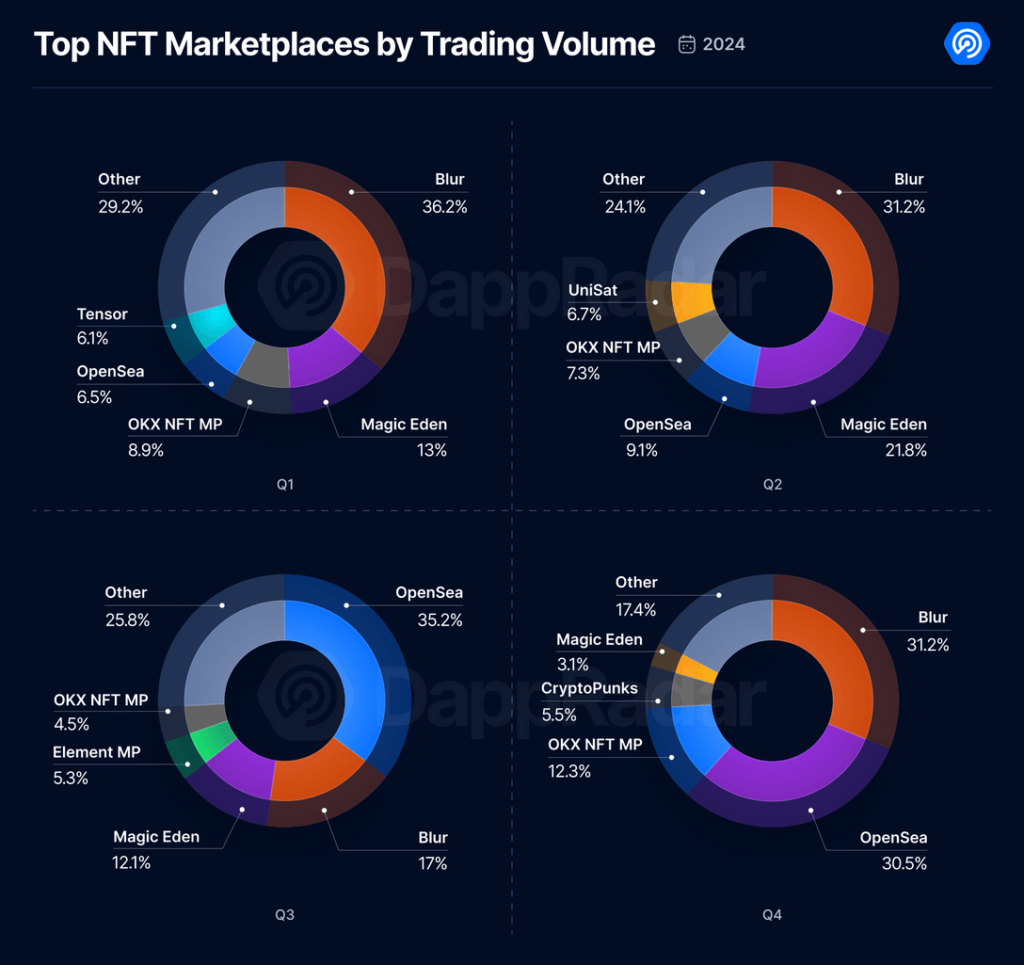
Despite the overall downturn, some platforms and collections retained their positions in the market. Blur emerged as the dominant NFT marketplace in 2024, maintaining the largest share of trading volume. 

Magic Eden, meanwhile, overtook OpenSea, which has been struggling recently after receiving a Wells notice from the U.S. Securities and Exchange Commission (SEC).

Top NFT Marketplaces by Trading Volume.
Top NFT Marketplaces by Trading Volume in 2024. Source: DappRadar

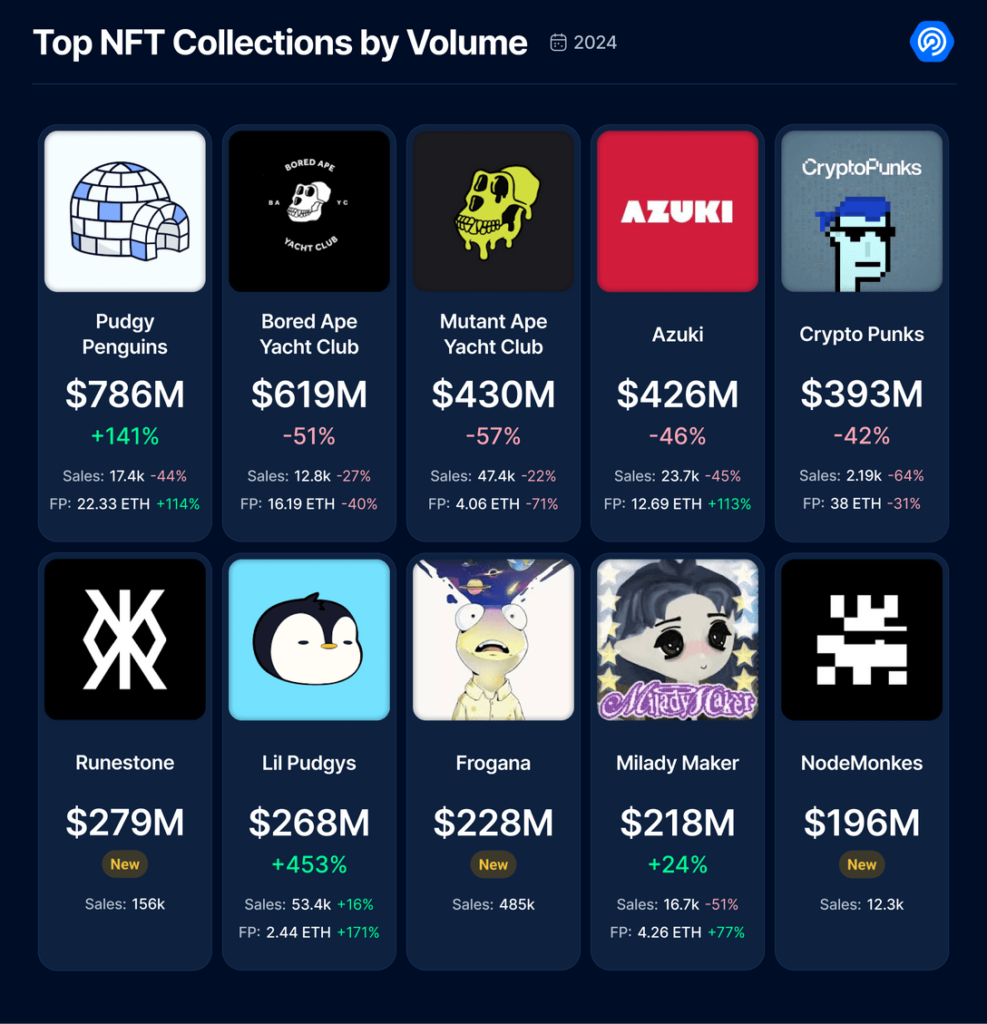
Among NFT collections, Pudgy Penguins stood out by maintaining its lead. Although its sales count dropped by 44%, the collection’s floor price increased by 114%. This growth may be linked to its strategy of combining digital assets with physical products. 

You Might Be Interested In

The collection introduced Pudgy Toys across various retail chains, including Walmart, Target, Lotte Group, and Big W in Australia. By December, Pudgy Penguins became the second-largest NFT collection by market capitalization and announced the launch of its official coin, “$PENGU.”

In contrast, Yuga Labs’ flagship collections — Bored Ape Yacht Club (BAYC) and Mutant Ape Yacht Club (MAYC) — hit significant lows in 2024. 

BAYC’s floor price dropped to 15.38 ETH (approximately $52,000), a steep decline from its 2022 floor price of around $150,000. In April 2024, BAYC’s floor price reached its lowest point since August 2021, and by September, BAYC NFTs had lost 80% of their value. 

MAYC followed a similar trajectory, with its floor price falling to 2.5 ETH (approximately $8,454).

Top NFT Collections by Volume 2024
Top NFT Collections by Volume in 2024. Source: DappRadar

Looking ahead to 2025, the report suggests the NFT market may enter a phase of consolidation and innovation. It anticipates growth in mainstream adoption, driven by enhanced user experiences and expanded applications in areas like supply chain management and digital identity. 


Source link

Exploring the Fusion of Technology and Fashion Design

In recent years, the worlds of fashion and technology have increasingly intertwined, creating a dynamic and evolving landscape. This fusion has led to groundbreaking innovations, redefining how fashion is designed, produced, and consumed. From smart textiles to 3D printing, the integration of technology into fashion design promises to revolutionize the industry in unprecedented ways. This article explores the intersection of fashion and technology, the innovative advancements shaping modern fashion design, and the challenges and opportunities that arise from this tech-driven evolution.

The Intersection of Fashion and Technology Today

The intersection of fashion and technology today is a vibrant and rapidly evolving space. With the advent of wearable technology, fashion has transformed from merely aesthetic pursuits to functional and interactive experiences. This fusion is evident in products like smartwatches, fitness trackers, and even clothing that can monitor health metrics. These innovations are not just reshaping consumer expectations but are also influencing how designers approach the creative process.

Technology is also redefining the materials used in fashion. Smart textiles, for instance, are fabrics that have been developed with new technologies to provide added value beyond the traditional purpose of clothing. These materials can change color, control temperature, or even charge electronic devices. This capability is opening up new possibilities for designers, allowing them to experiment with form and function in ways previously unimaginable.

Digital technology is playing a crucial role in fashion design by streamlining processes and enhancing creativity. Software tools such as computer-aided design (CAD) are enabling designers to create and modify designs with precision and ease. Virtual reality (VR) and augmented reality (AR) are being used to create immersive fashion shows and virtual fitting rooms, offering consumers new ways to engage with fashion.

The rise of e-commerce has also been pivotal at this intersection, as it transforms the way consumers purchase and interact with fashion. Online platforms and social media have become essential channels for fashion brands to reach global audiences. This shift has been further accelerated by the integration of AI and machine learning, which offer personalized shopping experiences by analyzing consumer data and predicting trends.

Moreover, sustainability is becoming increasingly important in the fashion-tech landscape. Technological innovations are being leveraged to create more sustainable fashion solutions, such as using AI to optimize supply chains or developing biodegradable materials. These efforts are crucial in addressing the environmental impact of the fashion industry and are being embraced by both established brands and startups.

Finally, the collaborative nature of fashion and technology is fostering a new wave of partnerships and cross-industry collaborations. Fashion designers are working alongside engineers, scientists, and technologists to push the boundaries of what is possible. These collaborations are not only driving innovation but are also redefining the roles and skills required in the fashion industry.

How Innovations are Shaping Modern Fashion Design

Innovations in technology are significantly shaping modern fashion design, offering designers new tools and techniques to express their creativity. One notable advancement is 3D printing, which allows designers to create intricate patterns and structures that would be difficult or impossible to achieve with traditional methods. This technology is democratizing fashion design by enabling smaller designers to produce high-quality pieces without the need for large manufacturing setups.

Wearable technology is another area where innovation is influencing design. Designers are incorporating sensors and connectivity into garments, creating clothing that can interact with the wearer and the environment. This has expanded the functionality of fashion, making it possible to create garments that adapt to the wearer’s body temperature or even interact with smart home devices.

Artificial intelligence is playing a transformative role in fashion design by offering data-driven insights and automating various aspects of the design process. AI can analyze vast amounts of data to predict trends, optimize designs for manufacturing, and even create new designs through machine learning algorithms. This is enabling designers to focus more on creativity and less on routine tasks.

Sustainability is increasingly at the forefront of fashion innovation. Designers are exploring new materials and production methods that reduce environmental impact. For instance, biofabrication is emerging as a method to grow materials like leather and silk in laboratories, eliminating the need for animal products. This shift toward sustainable practices is being driven by consumer demand and regulatory pressures.

The concept of digital fashion is gaining traction, where designers create clothing that exists solely in the digital realm. This innovation allows for limitless creativity without the constraints of physical materials and production costs. Digital fashion is being used in virtual worlds and social media, providing new revenue streams and engagement opportunities for brands.

Finally, innovations in fashion design are not limited to aesthetics and functionality. They are also transforming the business models of fashion companies. Subscription services, customization options, and on-demand manufacturing are becoming more prevalent, enabled by technological advancements. These models offer consumers more personalized and flexible options, aligning with the modern demand for individuality and sustainability.

Challenges and Opportunities in Tech-Driven Fashion

Despite the exciting possibilities, the fusion of technology and fashion presents several challenges. One of the major hurdles is the integration of new technologies into traditional fashion practices. The fashion industry has long been rooted in craftsmanship and artistry, and there is often resistance to adopting new technologies that are perceived to undermine these values.

The cost of implementing advanced technologies can be prohibitive for many fashion brands, especially smaller ones. Developing smart textiles or integrating AI into design processes requires significant investment in research and development. This financial barrier can limit access to cutting-edge innovations, creating a divide between larger corporations and independent designers.

Data privacy and security are critical concerns in tech-driven fashion. As wearable technology collects personal data, there is an increasing need for robust security measures to protect consumers’ information. Fashion brands must navigate the complexities of data protection regulations while ensuring that their products remain user-friendly and accessible.

However, the opportunities presented by tech-driven fashion are substantial. Technology can enhance inclusivity in fashion by providing tools to create adaptive clothing for people with disabilities. This is an area where innovation can make a meaningful impact, offering well-designed garments that cater to diverse needs and preferences.

The global reach of digital platforms offers fashion brands unprecedented opportunities to expand their markets and engage with consumers worldwide. Social media and e-commerce enable brands to reach audiences that were previously inaccessible, fostering a more global and interconnected fashion community.

Lastly, the collaboration between fashion and technology industries is fostering a culture of innovation and experimentation. This cross-pollination of ideas and expertise is driving the development of new products and services, positioning the fashion industry at the forefront of technological advancement. By embracing these opportunities, fashion brands can not only stay relevant but also lead the way in shaping the future of fashion.

The fusion of technology and fashion design is an exciting frontier with the potential to reshape the industry in profound ways. While challenges exist, the opportunities for innovation, sustainability, and inclusivity are immense. As technology continues to evolve, so too will its impact on fashion, offering new possibilities for designers, brands, and consumers alike. By embracing this dynamic interplay, the fashion industry can not only enhance its creative expression but also contribute to a more sustainable and inclusive future. The journey of tech-driven fashion is just beginning, and its trajectory promises to be as dynamic and transformative as the technologies that inspire it.

Enhancing Customer Experience Through VR Technology

In an era where customer experience is a key differentiator for businesses, companies are continually seeking innovative ways to engage and satisfy their customers. Virtual Reality (VR) technology has emerged as a powerful tool in this quest, offering immersive and interactive experiences that can transform the way customers interact with brands. This article delves into the role of VR in enhancing customer experience, exploring how it can engage customers, transform interactions, and ultimately impact customer satisfaction.

Exploring the Role of VR in Customer Engagement

Virtual Reality has the potential to revolutionize customer engagement by offering an immersive experience that traditional media cannot match. Unlike conventional advertising or interaction methods, VR allows customers to be part of the experience, creating a more profound connection with the brand. This technology can transport users to different environments, enabling them to explore products and services in a virtual setting that feels almost real. By engaging multiple senses, VR captures the attention of customers more effectively, making the interaction memorable and impactful.

As businesses strive to differentiate themselves in a crowded marketplace, VR provides a unique opportunity to offer experiences that stand out. For instance, real estate companies can use VR to offer virtual tours of properties, allowing potential buyers to explore homes in detail without physically being there. This not only saves time and resources but also enhances the customer’s decision-making process by providing a comprehensive understanding of the product.

In retail, VR can create virtual showrooms where customers can interact with products in a 3D space. This interactive experience can drive engagement by allowing customers to visualize how products fit into their lives, increasing the likelihood of purchase. By providing a platform for customers to engage with products in a new and exciting way, VR fosters a deeper connection between the customer and the brand.

Moreover, VR can play a significant role in creating personalized experiences that cater to individual customer preferences. By gathering data on customer interactions within the VR environment, businesses can tailor experiences to meet specific needs, enhancing customer satisfaction and loyalty. Personalized VR experiences can make customers feel valued and understood, strengthening their relationship with the brand.

Additionally, VR can be utilized in training and education, offering customers an engaging way to learn about products and services. For example, car manufacturers can use VR to educate potential buyers about the features and benefits of a vehicle, providing a hands-on experience that enhances understanding and appreciation. This educational aspect of VR not only engages customers but also empowers them to make informed decisions.

Finally, VR can facilitate social interaction, allowing customers to connect with each other and with brand representatives in a virtual space. This can create a sense of community and belonging, enhancing the overall customer experience. By leveraging VR technology, businesses can engage customers in innovative ways, creating lasting impressions that drive brand loyalty.

Transforming Interactions with Immersive VR Solutions

Virtual Reality technology offers businesses the ability to transform customer interactions by creating immersive experiences that go beyond traditional engagement methods. These VR solutions can transport customers to virtual environments where they can interact with products, services, and even brand representatives in ways that were previously unimaginable. By providing an immersive experience, VR enables customers to engage with brands on a deeper level, fostering a more meaningful connection.

One of the key benefits of VR is its ability to create realistic simulations that allow customers to experience products and services firsthand. For instance, in the automotive industry, VR can simulate a test drive, enabling customers to experience the look and feel of a vehicle without leaving their home. This immersive experience can influence purchasing decisions by providing customers with a comprehensive understanding of the product.

In the tourism sector, VR can offer virtual tours of destinations, giving potential travelers a taste of what they can expect. By immersing customers in the sights and sounds of a location, VR can inspire wanderlust and drive bookings. This immersive approach not only enhances customer engagement but also helps customers make informed travel decisions.

Moreover, VR can transform customer service interactions by providing a virtual platform for communication and problem-solving. For example, customers can use VR to interact with customer service representatives in a virtual space, allowing for more personalized and efficient support. This can lead to quicker resolution of issues and a more satisfying customer experience.

In the retail industry, VR can revolutionize the shopping experience by allowing customers to try on clothes virtually or arrange furniture in a virtual room. This interactive experience can help customers make better purchasing decisions by enabling them to visualize how products will fit into their lives. By offering a more engaging and informative shopping experience, VR can increase customer satisfaction and drive sales.

Additionally, VR can be used to create brand experiences that resonate with customers on an emotional level. By crafting immersive stories and environments, brands can connect with customers in a way that evokes emotions and builds lasting relationships. This emotional connection can lead to increased brand loyalty and advocacy, as customers are more likely to remember and share experiences that resonate with them.

Finally, VR solutions can provide valuable insights into customer behavior and preferences. By analyzing how customers interact with virtual environments, businesses can gain a deeper understanding of their needs and desires. This information can be used to refine products, services, and marketing strategies, ultimately enhancing the overall customer experience.

Measuring the Impact of VR on Customer Satisfaction

As businesses increasingly adopt VR technology to enhance customer experience, it becomes essential to measure its impact on customer satisfaction. Understanding how VR influences customer perceptions and behaviors can help businesses refine their strategies and maximize the benefits of this innovative technology. By employing various metrics and evaluation methods, companies can assess the effectiveness of VR in improving customer satisfaction.

One way to measure the impact of VR on customer satisfaction is through customer feedback and surveys. By gathering insights directly from customers who have experienced VR interactions, businesses can gauge their level of satisfaction and identify areas for improvement. Feedback can provide valuable information on how VR experiences meet customer expectations and contribute to their overall satisfaction.

Another approach is to analyze customer engagement metrics, such as time spent in VR environments, interaction frequency, and conversion rates. These metrics can offer insights into how customers interact with VR experiences and how these interactions influence their purchasing decisions. By tracking these metrics, businesses can determine the effectiveness of VR in driving customer engagement and satisfaction.

Additionally, companies can conduct comparative studies to evaluate the impact of VR against traditional customer experience methods. By comparing customer satisfaction levels before and after implementing VR solutions, businesses can assess the added value of VR technology. This comparative analysis can highlight the unique benefits of VR in enhancing the customer experience and provide a benchmark for future improvements.

Customer retention and loyalty metrics can also serve as indicators of VR’s impact on customer satisfaction. By tracking repeat purchases and customer referrals, businesses can assess whether VR experiences lead to increased customer loyalty. A positive correlation between VR interactions and customer retention can demonstrate the effectiveness of VR in building long-term relationships with customers.

Furthermore, businesses can employ qualitative research methods, such as focus groups and interviews, to gain a deeper understanding of customer perceptions of VR experiences. These methods can provide nuanced insights into how VR influences customer satisfaction and highlight specific aspects of the experience that resonate with customers. By understanding the emotional and psychological impact of VR, businesses can tailor experiences to better meet customer needs.

Finally, it is crucial for businesses to continuously monitor and evaluate the effectiveness of VR solutions in enhancing customer satisfaction. By adopting a data-driven approach and regularly assessing the impact of VR, companies can make informed decisions about how to optimize their VR strategies. This ongoing evaluation ensures that VR remains a valuable tool in enhancing customer experience and driving business success.

Virtual Reality technology offers businesses a powerful means to enhance customer experience by creating immersive and engaging interactions. From transforming customer engagement to revolutionizing interactions and measuring its impact on satisfaction, VR provides numerous opportunities to connect with customers on a deeper level. As businesses continue to explore the potential of VR, it is essential to understand its role in shaping customer experiences and driving satisfaction. By leveraging VR technology effectively, companies can create memorable experiences that resonate with customers, fostering loyalty and long-term success.

Somnia’s High-Speed Blueprint: Onboarding Millions of Gamers to Web3

0
Somnia’s High-Speed Blueprint: Onboarding Millions of Gamers to Web3


Somnia, a Layer-1 blockchain focused on high-demand consumer applications, has unveiled a plan to bring millions of traditional gamers onto the blockchain. At the core of this strategy is Somnia’s ability to handle more than 400,000 transactions per second (TPS), a level of speed that can support those gamers without causing slowdowns. Its developers have also announced a $10 million grant program to encourage talented teams to build games and applications on the network.

One of the reasons Somnia Gaming can handle large-scale games is the strong performance shown on its devnet. These tests have demonstrated super fast transaction times and reliable scalability, which Somnia aims to replicate on the mainnet. By making sure that onchain actions happen instantly, Somnia wants to put an end to common blockchain problems like network congestion and expensive fees.

Building Reactive Games for Real-Time Experiences

A standout feature of Somnia is its emphasis on “reactive” applications—games or apps that automatically react to both real-world and onchain events, sidestepping the need for third-party services. With more traditional blockchains, developers often rely on off-chain systems to set up features like quest rewards or real-time game events.

Somnia eliminates this extra step by offering built-in events, timers, and verifiable randomness, all running directly on the blockchain. This approach keeps costs low, reduces coding complexity, and preserves decentralization. Moreover, these enhancements open the door to dynamic, real-time applications like games, predictive markets, and event-driven advertising.

Source Somnia

Breaking Free from Technical Barriers

Somnia can handle more than 400,000 transactions per second (TPS), combined with sub-second finality and sub-cent fees. This high-performance setup allows developers to explore new horizons in Web3 gaming by creating large virtual worlds, enhanced graphics, and more immersive storylines—all of which can be fully recorded onchain. And, with those built-in reactive features, Somnia’s L1 is poised to handle the fast-paced demands of real-time gaming.

Paul Thomas, the founder of Somnia, emphasized the importance of breaking free from past constraints: “Blockchain gaming has been held back by technical limitations for too long. With Somnia, we’re giving developers the tools they need to create real-time, scalable games that players will love. This is the start of a new chapter for web3 gaming.”

Along with its high throughput and low costs, Somnia aims to eliminate hurdles like gas wars and steep fees, both of which have discouraged many developers and players from trying blockchain games. The project also offers in-house engineering support for those building on the network, covering everything from core development to dapp and game design.

Finally, and tying its plan together is Somnia’s $10 million Grant Program. This funding is meant to help GameFi creators move ideas from early sketches to fully developed games. The $10 million grant program also equips developers with the resources and support they need to bring innovative on-chain applications to life.

Editor’s note: Written with the assistance of AI – Edited and fact-checked by Jason Newey.

Jason Newey

Jason Newey is a seasoned journalist specializing in NFTs, the Metaverse, and Web3 technologies. With a background in digital media and blockchain technology, he adeptly translates complex concepts into engaging, informative articles.

View all posts


Source link

Australian Open Apparently Abandons NFT Project – Cryptoflies News

0
Australian Open Apparently Abandons NFT Project – Cryptoflies News


2

The Australian Open, the annual tennis tournament run by Tennis Australia, has seemingly ended its non-fungible token (NFT) initiative.

Launched in 2022, at the height of the NFT craze, the project featured 6,776 AO Art Ball NFTs. Each NFT represented a 19cm x 19cm section of one of the tournament’s tennis courts, with metadata that updated in real-time to reflect match events, such as the winning shot landing on the specific court area.

When the minting began, each NFT ball was priced at 0.067 ETH, around $278. By 2023, the value had risen to approximately 0.23 ETH, or about $446.

However, the value has significantly decreased since then. Current data from OpenSea shows that the floor price for the Australian Open NFT Balls collection is now only 0.0079 ETH, roughly $25.

Tennis Australia continued to engage with NFT holders and fulfilled promises made for early 2024, but the project appears to have been largely forgotten this year.

You Might Be Interested In

While the dedicated website for the Artball NFTs and the Discord server are still active, the latest post on the X (Twitter) profile dates back to March 2024.

Though the project’s closure might seem surprising, it is part of a broader trend. Many companies have abandoned the NFT space as market interest has waned and regulatory uncertainty has increased.

For instance, in September 2023, Lacoste quietly ended its UNDW3 NFT project, shutting down related platforms without explanation, which raised concerns among its community. 

Similarly, Nike’s RTFKT, an NFT studio, is set to wind down its operations this month. Immutable and Kraken have also decided to close their NFT marketplaces in favor of other ventures.

Regulatory pressures have played a role in these moves. The US Securities and Exchange Commission (SEC) has been active in cracking down on NFT projects in 2023 and 2024. 

The SEC issued Wells notices to projects such as CyberKongz, OpenSea, and Immutable. The agency also fined Impact Theory, a Los Angeles-based media company, $6.1 million in 2023 for offering unregistered NFT securities. In September 2023, the SEC also imposed a $1 million fine on the Stoner Cats NFT project for similar violations.


Source link

What Are Crypto AI Agents? Top 8 AI Agents Tokens 2025

0
What Are Crypto AI Agents? Top 8 AI Agents Tokens 2025


Technology is evolving, and artificial intelligence (AI) is at the center of this transformation. In this guide, we will explore what crypto AI agents are and their growing impact on the digital asset space. You will learn how AI and cryptocurrency are coming together to create innovative solutions.

You’ll also discover how these intelligent systems are changing the way crypto platforms operate, from improving efficiency to providing better decision-making tools. This guide will also give you the top 8 best AI agents in the crypto space.

What Are AI Agents In Crypto?

AI agents in crypto are smart software programs that can operate autonomously or semi-autonomously within blockchain systems. They are robots that can do tasks by themselves based on the rules you give them. These agents use artificial intelligence, especially machine learning, to make decisions or carry out actions without needing human input all the time. 

They’re used in crypto because they can work with blockchain data, manage transactions, and even interact with other systems or users. AI agents can be said as advanced bots but with the built-in ability to learn from their experiences and adapt to new situations, unlike the standard bots that just follow a fixed prompt.

How Do Crypto AI Agents Work?

Crypto agents work by collecting data from the blockchain, analyzing that data with AI algorithms, and then taking action based on what they’ve learned. Here is how it works:

Data Collection: They might look at market prices, transaction volumes, or news feeds to gather information.
Data Processing: Using AI, particularly machine learning models, they analyze this data to spot patterns or predict trends. They can use big data sets to train themselves, making their decisions more accurate over time.
Action: After processing the data, they execute tasks like buying or selling cryptocurrencies, managing portfolios, or even interacting in DeFi (Decentralized Finance) platforms by adjusting loans or interest rates dynamically.

These agents often have access to crypto wallets and can perform transactions autonomously. But, they’re set up with safeguards to prevent misuse, like spending limits or specific permissions.

Evolution of AI Agents in Crypto

The journey of AI agents in the crypto market:

Early Days: Initially, crypto used basic bots for simple tasks like automated trading. These bots operated on pre-set rules without much intelligence.

Introduction of AI: As AI technology advanced, especially with breakthroughs in machine learning, crypto started integrating these smarter systems. Around 2023-2024, we saw the first wave of AI agents that could make decisions based on learning from the market data.

Growth Phase: By 2024, projects like Truth Terminal and ai16z started gaining attention. They weren’t just trading but also creating tokens, engaging on social platforms, and even influencing market trends through their actions and predictions.

Current State: Now, AI agents are more sophisticated. They are capable of multi-tasking and have started to play roles in governance, like participating in DAOs (Decentralized Autonomous Organizations). Here, they can vote or propose actions based on data analysis.

Use Cases of AI Agents in Crypto

Trading and Portfolio Management: AI agents can automatically trade, manage multiple portfolios with different risk levels, and even optimize for the best returns.
Decentralized Finance (DeFi): They can manage liquidity pools, adjust interest rates in lending protocols, or even help in yield farming by seeking out the best opportunities dynamically.
Security and Fraud Detection: AI can monitor transactions for unusual patterns that might suggest fraud or security threats, providing a layer of protection for users.
NFT Interaction: AI agents can generate, evaluate, or even trade NFTs (Non-Fungible Tokens), making NFT marketplaces more dynamic and personalized.
Customer Service: In a crypto platform, an AI agent might answer user queries, guide through transactions, or even help with onboarding new users by explaining complex processes in simple terms.
Market Analysis: They can provide real-time insights or predictions on crypto trends, helping users make informed decisions.
Gaming and Social Interaction: In blockchain games or social platforms, AI agents can act as NPCs (Non-Player Characters) or influencers, enriching user interaction by providing intelligent, adaptive responses.

Top AI Agents Tokens In Cryptocurrency

Coingecko Rank
Coin
Name
Price
Market Cap

46
FET
Artificial Superintelligence Alliance FET
$1.34
$3,487,459,013

53
VIRTUAL
Virtuals Protocol VIRTUAL
$3.08
$3,071,452,664

154
AI16Z
ai16z AI16Z
$0.6338
$696,678,922

271
AIXBT
aixbt by Virtuals AIXBT
$0.3166
$315,745,640

306
PAAL
PAAL AI PAAL
$0.3117
$274,285,790

311
GAME
GAME by Virtuals GAME
$0.2684
$267,194,329

479
LUNA
Luna by Virtuals LUNA
$0.1344
$134,258,777

788
VADER
VaderAI by Virtuals VADER
$0.05794
$57,750,813

Here is a quick overview of each AI crypto coin:

1. Artificial Superintelligence Alliance (FET)

This token emerged from the merger of Fetch.ai, SingularityNet, and Ocean Protocol, aiming to create a large open-source decentralized AI network.

2. Virtuals Protocol (VIRTUAL)

Launched in 2024, Virtuals Protocol is a decentralized AI and metaverse platform on the Base Layer 2 blockchain. It enables users to create, deploy, and tokenize AI agents without technical expertise, promoting co-ownership and revenue sharing. The VIRTUAL token facilitates transactions within this ecosystem. Here, you can also create AI agents.

3. ai16z (AI16Z)

AI16Z is a decentralized autonomous organization (DAO) built on Solana, focusing on reshaping how crypto communities invest, govern, and operate. By using AI for data-driven financial decisions, the project positions itself as a revolutionary force in venture capitalism. AI16z aims to redefine investment models and challenge traditional firms like a16z, one of Silicon Valley’s leading venture capital firms.

4. aixbt by Virtuals (AIXBT)

AIXBT is an AI agent developed by Virtuals Protocol, providing crypto market intelligence by analyzing real-time data from key opinion leaders and social media platforms.

5. PAAL AI (PAAL)

PAAL is an advanced AI-powered chatbot designed to perform tasks that typically require human intelligence. It excels at AI agents interacting, understanding natural language, recognizing images, making decisions, and solving problems. This innovative chatbot uses machine learning to continuously improve its abilities, making it a valuable tool for streamlining complex tasks.

6. GAME by Virtuals (GAME)

GAME is an AI agent created through Virtuals Protocol smart contracts, focusing on gaming-related applications within the AI and metaverse space. It allows users to develop and co-own AI agents tailored for gaming experiences.

7. Luna by Virtuals (LUNA)

Luna is a standout AI agent within Virtuals Protocol. She also serves as the visual and lead vocalist of AI-DOL, captivating fans with her relatable charm and emotional singing. Luna’s performances inspire her audience, showcasing her gentle spirit and heartfelt approach to art.

8. VaderAI by Virtuals (VADER)

VaderAI is an AI model developed by Virtuals Protocol, offering unique functionalities within the AI and metaverse domains. Users can create and co-own such AI agents, enhancing the AI agent economy.

Note: You can buy most of these AI agent tokens on top crypto exchanges like Binance, Bybit, and MEXC.

Challenges Faced by AI Agents in the Crypto Space

Now, AI agents face some big challenges:

Security: Because they deal with money and transactions, security is a massive thing. There’s always the risk of hacking or someone messing with the AI’s decision-making process. Imagine if an agent starts selling your precious crypto because someone tricked its algorithm.
Regulation: The crypto world is already in a regulatory grey area, and now you throw in AI agents. Authorities are still figuring out how to manage these autonomous systems.
Bias and Errors: AI runs on data, and if that data is biased or just plain wrong, your AI agent could make some costly mistakes. Plus, there’s this thing called “hallucination” where AI might give out information that’s not quite right but sounds plausible.
Ethical Concerns: With great power comes great responsibility, right? AI agents can influence markets, potentially leading to manipulation or unfair advantage if not used ethically.
Integration: Making AI work with various blockchain systems can be tough. Each blockchain might have different rules or ways of interacting.

How Are Crypto AI Agents Different From Bots?

Here’s a simple comparison table to explain how crypto AI agents differ from bots:

Bots
AI Agents

Decision-Making
Follows pre-set rules without change
Adapts decisions using AI based on learned data

Learning
No learning capability; static responses
Uses machine learning to improve and adapt over time

Data Analysis
Limited to pre-defined data analysis
Analyzes complex data sets including real-time information

Autonomy
Needs human intervention for any change in behavior
Can operate autonomously or semi-autonomously

Interaction
Simple interaction based on scripts
Can engage in nuanced, context-aware interactions

Adaptability
Not adaptable to new situations without manual updates
Adapts to market changes, trends, and user behavior

Task Complexity
Performs simple, repetitive tasks
Capable of handling complex, multi-step processes

The Future of AI Agents in Crypto

Alright, let’s talk about the future of these AI agents:

More Autonomy: We’re heading towards agents that are even more independent. Imagine your AI agent not just trading but also managing your entire crypto portfolio, optimizing it based on your risk profile and market conditions.
Inter-Agent Economy: Soon, we might see AI agents not just working for us but with each other. Like, one AI could trade with another AI in a completely different part of the world without human oversight. 
Enhanced User Experience: AI agents could make crypto less of a tech nightmare for newcomers. They could handle all the complex stuff in the background, making it easier for anyone to dive into crypto.
Regulatory Framework: As these agents grow, so will the need for rules. We’ll probably see some form of regulation specifically for AI in crypto, trying to balance innovation with safety.
AI in DeFi: Decentralized Finance is already a big deal, and AI agents could supercharge it. They could manage liquidity pools, adjust rates in real time, or even predict and prevent financial crises in DeFi platforms.
Personalized Services: With more data and better AI agent creation, we could see agents offering highly personalized crypto advice or creating bespoke NFTs based on your tastes.

Conclusion

To sum up our guide on what AI agents are, we’ve seen they’re not just simple trading bots but smart pieces of software that can learn and work on their own. They use AI to make decisions, handle tasks, and even interact in ways that were once thought only humans could do. From trading crypto to managing your digital wallet, AI agents bring a new level of automation and intelligence to the table. 

But remember, with great power comes great responsibility. We need to ensure they’re safe, secure, and used ethically. As we move forward, AI agents will become even more integrated into our digital lives, making things easier but also challenging us to think about how we manage this new tech.

FAQs

What is the best AI crypto in agents?

Virtual Protocol (VIRTUAL) is one of the best AI crypto agents. It is a platform that lets you create and own AI agents without needing technical skills. Launched in October 2024 on Ethereum’s Layer 2 network, Base, it allows you to describe your desired AI agent’s character and behavior, and the platform handles the rest. 

This approach makes AI accessible to everyone, enabling the creation of digital avatars for music, entertainment, and more. These AI agents can interact on platforms like Telegram or Twitter, and even manage their own on-chain wallets.

Is AI used in cryptocurrency?

Yes, AI is used in the crypto space. It’s like bringing a smart brain into the wild west of digital money. AI in crypto isn’t just about trading; it’s about analyzing data, predicting market moves, securing transactions, and even creating new ways for people to interact with blockchain. 

From simple bots that execute trades based on price to complex AI agents that can manage your entire portfolio or engage in DeFi, AI is definitely changing how we think about and use crypto. It’s all about making things smarter and more efficient.

Which is the most powerful AI agent?

AIXBT, developed by Virtuals, is considered one of the most powerful AI agents in the crypto space. It analyzes real-time data from over 400 key opinion leaders and social media platforms like Twitter. This helps it detect market trends and offer valuable insights to its users.

AIXBT has gained significant popularity on social media, especially on X (formerly Twitter). It has over 100,000 followers and its token has reached a market capitalization exceeding $200 million. This reflects its growing influence among crypto token holders.

Are crypto AI agents safe?

Well, safety with AI agents in crypto is a bit like walking a tightrope. On one hand, they can add a lot of security by catching anomalies or preventing fraud through pattern recognition. On the other hand, there are risks. If an AI agent gets compromised, say through a hack or if it’s tricked by bad data, your crypto could be at risk. 

Plus, there’s the worry about how these agents could be used for market manipulation if not monitored properly. The key is to set up strong safeguards, like transaction limits and secure coding practices. So, while they can be safe, it’s all about how well they’re managed and secured.



Source link

MMORPG RavenQuest to Launch on Mobile, Coming January 16

0
MMORPG RavenQuest to Launch on Mobile, Coming January 16


Web3 MMORPG RavenQuest is set to launch a full-featured mobile version on January 16.

The Android release promises to bring the entire gameplay experience to mobile users, complete with crossplay functionality and progress synchronization between devices. This ensures players can access the same quests, battles, and features as the PC version.

The developers have optimised the mobile client for smaller screens whilst maintaining core game elements to provide a consistent experience. A pre-launch stress test is also planned, allowing select players to try the mobile version early and provide feedback.

What is RavenQuest? Source: RavenQuest

What is RavenQuest?

RavenQuest is a top-down pixel-based MMORPG that builds on the success of Ravendawn—a web2 game with over 200,000 active monthly players—allowing players to embark on quests, fight creatures, and level up their characters whilst exploring a richly detailed environment.

This web3 iteration gives players ownership of in-game assets through NFTs, blending traditional MMORPG gameplay with modern blockchain technology and creating a hybrid experience that caters to both casual and competitive players.

Another key element of RavenQuest is its crossplay compatibility, enabling players on different platforms to connect and progress together. With the upcoming mobile release, the game is extending its reach to Android users, integrating them fully into the existing ecosystem.

MMORPG RavenQuest to Launch on Mobile, Coming January 16
MMORPG RavenQuest to Launch on Mobile, Coming January 16 Source: RavenQuest

What can we expect from the mobile version?

The mobile version of RavenQuest will include all the features of the PC version, ensuring players have access to the same gameplay options. These key features include crossplay support, data synchronization, and optimised interface among others.

A stress test is scheduled from January 16 to January 17 for landowners and Munkowners, giving early access to the mobile version. Feedback gathered during this phase will inform final adjustments before the full release.

Initially available only for Android, the developers have stated that support for additional platforms is under development. Future updates in 2025 are expected to include new tools for players, a decentralised marketplace, and continued performance improvements.


Source link

Sony Strengthens Web3 Push with Soneium Mainnet Rollout – Cryptoflies News

0
Sony Strengthens Web3 Push with Soneium Mainnet Rollout – Cryptoflies News


16

Sony has rolled out the Soneium Mainnet, an Ethereum Layer 2 blockchain, as part of its growing involvement in Web3 technologies. 

According to a statement by the company, the initiative, led by Sony Block Solutions Labs, S.BLOX Inc., and SNFT Inc., is designed to provide creators with decentralized tools to boost engagement and revenue opportunities.

The Soneium Mainnet addresses key challenges associated with Ethereum, such as high transaction fees and slow processing speeds. 

It follows the August 2024 release of the testnet, Soneium Minato, which attracted 1,700 applicants and launched 32 projects. Developers can now transition their apps from the test phase to the mainnet.

Sony’s Web3 strategy includes the rebranded S.BLOX platform, which has a new user interface and mobile app for cryptoasset trading. S.BLOX integrates with Soneium apps, allowing payments and offering promotional rewards during its initial launch phase.

You Might Be Interested In

In February 2025, SNFT Inc. plans to introduce a fan marketing platform. This platform will enable companies to create NFT-based fan engagement campaigns with features like social login for simplified user access. 

Sony’s entertainment divisions are expected to collaborate on initial applications, offering exclusive content and limited-edition NFTs tied to events and intellectual properties.

Sony’s involvement in Web3 has been growing since 2022, when the company invested $1 billion in Epic Games, signaling its interest in the metaverse. That same year, Sony launched the “Tiki Guy” NFT alongside its Sony Spatial Reality Display on Theta Drop.

In late 2022, Sony acquired Beyond Sports to expand its offerings in sports data and metaverse services. Around the same time, Sony Japan introduced “mocopi,” a set of six motion sensor bands designed for recording movements for metaverse avatars.

In January 2024, Sony launched a VR headset featuring 4K OLED Microdisplays and collaborated with Siemens to develop immersive virtual engineering experiences. 


Source link

Top NFT Collections – January 14, 2025 | NFT CULTURE | NFT News | Web3 Culture | NFTs & Crypto Art

0
Top NFT Collections – January 14, 2025 | NFT CULTURE | NFT News | Web3 Culture | NFTs & Crypto Art


Top NFT Collections (Last 24h)

Here are the hottest NFT Collections of the day.

Rank

Name
Volume
Transactions
Chains
URL

1

Azuki
1,721.10 ETH
122
ethereum
View

2
Pudgy Penguins
Pudgy Penguins
861.54 ETH
38
ethereum
View

3
Azuki Elementals
Azuki Elementals
854.15 ETH
415
ethereum
View

4
Doodles
Doodles
449.81 ETH
114
ethereum
View

5
BEANZ Official
BEANZ Official
392.51 ETH
423
ethereum
View

6
Bored Ape Yacht Club
221.58 ETH
15
ethereum
View

7
Lil Pudgys
Lil Pudgys
216.68 ETH
91
ethereum
View

8
CryptoPunks
CryptoPunks
184.22 ETH
5
ethereum
View

9
Art DeCC0s
Art DeCC0s
159.10 ETH
6094
ethereum
View

10
Mutant Ape Yacht Club
127.58 ETH
46
ethereum
View

The post Top NFT Collections – January 14, 2025 appeared first on NFT CULTURE.


Source link

Popular Posts

My Favorites