Fans of Emmerdale have called for Doctor Liam to ditch Ella Forster in favour of Chas Dingle. This came as Chas confided him in last night’s episode over the state of a new rash on her body – sharing a charged moment as he came to her aid.
Liam checked Chas out and quickly allayed her fears – diagnosing it as an allergy rash. A relieved Chas threw her arms around the doctor, their obvious chemistry sizzling as they did so.
Back at home, Liam found himself lying to Ella about his whereabouts, conveniently missing out the part where he had been with Chas. With the sparks still flying, it’s clear that Chas and Liam share an undeniable chemistry… so what is he doing with Ella?
Liam’s been lying to Ella (Credit: ITV)
Liam needs to dump Ella for Chas, fans insist
Writing on social media as the scenes aired, fans shared their thoughts on the apparent love triangle. And it seemed tat many had already chosen their side… sorry Ella.
“Get Liam back with Chas. So better than him with Ella!!!” insisted one fan on X.
Get Liam back with Chas. So better than him with Ella!!! #Emmerdale
— Swalk (@Samanth22356123) October 3, 2024
“Aww I love Liam & Chas,” said another.
Aww I love Liam & Chas #Emmerdale
— Laura ⚓️ (@Lauz_79) October 3, 2024
“Liam has way more chemistry with Chas than Ella,” wrote a third, over on Reddit.
“Liam is so hot and Ella is nowhere near good enough for him. I still want Liam with Chas,” agreed another.
Who will Liam choose?
Come on Liam, make up your mind (Credit: ITV)
Emmerdale spoilers tonight: Sparks fly
As the story continues tonight, Liam and Chas continue to flirt aggressively as they share a charged moment in the Woolpack. Their attraction to each other undeniable, the pair exchange meaningful looks.
Can they continue to deny their attraction to one another?
Read more: Who’s leaving Emmerdale in 2024? Cast exits, arrivals and returns.
Emmerdale usually airs on weekdays at 7:30pm, with an hour long episode on Thursdays.
Visit our Facebook page @emmerdaleinsider for all the latest Emmerdale news, gossip and spoilers and let us know what you think! Or find us on Twitter @emmerdaleinsider
Anthony Butler is a Chainlink advisor, and former CTO of IBM Services, Middle East and Africa.
Central Bank Digital Currencies (CBDCs) continue to be the subject of extensive research, experimentation, and analysis globally as central banks consider what the future of money may look like and whether tokenised central bank money should play a role in that future. This journey didn’t begin, of course, in 2024 but goes back many years: with the CBDC concept evolving substantially from the earliest domestic experimentations through to cross-border experimentation and now, the emergent concept of a “finternet” that seeks to weave together the worlds of tokenised and non-tokenised assets into a common fabric.
History of CBDCs
The first CBDC experiments appear to go back to 2014 when the Central Bank of Uruguay and China experimented with the e-Peso and e-CNY respectively. This was followed by various experiments such as Canada’s Project Jasper, South Africa’s Khoka, Monetary Authority of Singapore’s Ubin, and others. Some of these projects sought to replicate a form of digital cash (i.e. retail CBDC) and others sought to replicate the features and functions of the RTGS (i.e. wholesale CBDC).
Much of this early phase of experimentation was focused on understanding this new technology called “blockchain” and whether there was a potential to create something in a regulated context that resembled the innovations that were happening across the crypto ecosystem with Bitcoin, Ethereum, and so forth.
These domestic experiments were quickly followed by multi-jurisdictional experiments where the aperture was broadened to consider how CBDC could be used as instruments of cross-border settlement. For example, Hong Kong and Thailand’s Project Lionrock, Saudi Central Bank and UAE Central Bank’s Project Aber, Canada and Singapore’s integration of Jasper and Ubin (known as Jasper-Ubin), and Project Dunbar in which the BIS brought together the central banks of Australia, Malaysia, Singapore and South Africa to test multiple CBDCs on a single shared platform. This latter project demonstrated the efficacy of CBDCs for international settlement and led to Project mBridge.
The drivers for cross-border experimentation were different, with the primary goal of these initiatives being to address inefficiencies in international payments and remittances, which are often slow, costly, and opaque. For example, cross-border payments frequently take 3-5 days to clear and banks “continue to be the costliest channel for sending remittances,” with an average cost of 12.1% according to the World Bank.
Current CBDC landscape
Today, there are still experiments being conducted domestically and cross-border and there are a small number of countries that have, having seen projects provide significant efficiency, programmability, and composability advantages, made a decision to move forward with CBDCs. At the same time, there are now many examples of private money being tokenised too, such as the tokenised deposits that are issued as tokenised claims against commercial bank balance sheets. As with wCBDC, many of these are exploring cross-border scenarios too.
As we look at the evolution of this space and the efforts underway globally, it is clear that it is highly improbable that the world will converge on a single blockchain platform that will span the globe and be the “universal ledger” onto which all assets and forms of money will be tokenised.
Key reasons why a singular “universal ledger” will not be realised:
Not all countries will move towards tokenisation at the same time or same pace, so there will be a need for coexistence between the legacy and new systems for an extended amount of time. The choice of protocol or technology to tokenize an asset, such as permissioned or zero-knowledge based chains for privacy, fast-finality solutions for payments, and public blockchains for decentralized security, will be informed by the local jurisdictional requirements, the type of asset being tokenised, the types of markets that the asset will need to be listed in, and a myriad of other functional and non-functional requirements that will lead towards a particular technology. It is probable, for example, that different commercial banks may choose to use different technologies for tokenised deposits, central banks may use other technologies for their CBDCs, assets will be tokenised on a number of other heterogenous networks based on where there is demand and liquidity, and each system will need to interconnect with a myriad of other systems outside their jurisdiction such as the various DLT and non-DLT based messaging and cross-border payments systems. The technology is evolving quickly with scalability solutions that can support mass adoption and the barriers to entry are being lowered such that it is conceivable that, at some point in the future, instantiating a blockchain network will be analogous to the instantiation of a relational database today; a situation that will further lead to proliferation of networks. There are already emerging regional and other blocs in which different jurisdictions are coming together to build their own cross-border networks focused on a particular set of corridors or a particular region.
The end result is fragmentation, silos, and islands that, without bridges, will not be able to deliver on the original promise of blockchain.
Without blockchain interoperability, a fragmented ecosystem would emerge.
We can find synergies in the origins of the Internet. In the early days of the Internet, there were distinct networks that emerged to service different communities. There was ARPANET, CSNET, and NSFNET, for example, and a number of other networks that emerged in other parts of the world. They did not have any way to communicate with each other and were, like the various DLT networks of today, islands. On January 1st, 1983, this would change when they would adopt a common “language” known as Transfer Control Protocol/Internetwork Protocol or TCP/IP as it is commonly known today. It was the adoption of this universal language that led to the birth of the Internet.
As we see the various DLT-based financial networks following a similar trajectory with islands emerging, the question that must be asked is how will we solve the interoperability challenge? What, one might ask, is the TCP/IP of the blockchain era that will allow the TradFi and DeFi worlds to interoperate but also, within each, allow the various tokenised assets, deposits, and CBDC platforms to talk to each other? As with the Internet, it is only through the seamless integration of these networks that the true value can be realised.
What would a TCP/IP of the blockchain world need to offer?
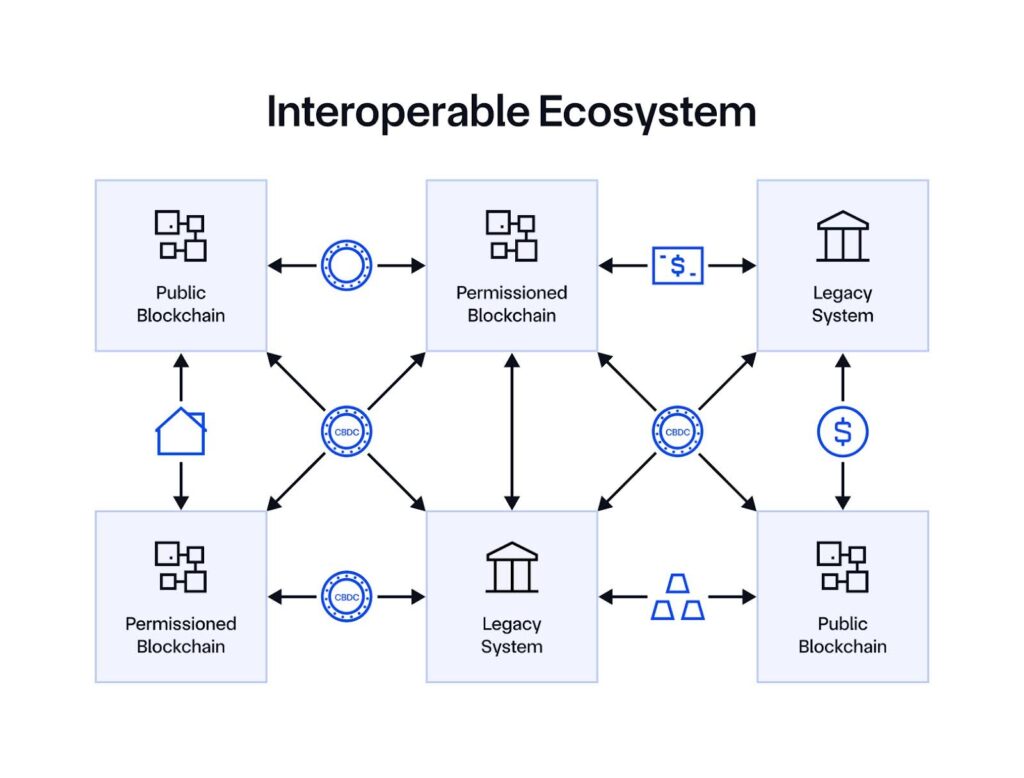
A TCP/IP of the blockchain world enables an interoperable ecosystem.
Firstly, this protocol should enable tokens—the “packets” of blockchain-based finance (onchain finance) containing value and data—to move securely between networks, even heterogenous protocols, such as public and permissioned. It should do so in a way that ensures security and the integrity of the system. For example, it would obviously be problematic if some tokenised money was moved from one network to another yet it continued to persist in the original network since this would enable “doubling spending” and would undermine the integrity of the entire system.
Second, smart contracts should be able to govern and orchestrate the movement of these tokens such that sophisticated settlement use cases can be executed, such as the transfer of a CBDC from one network to another occurs only contingent on the transfer of a tokenised security from one network to another; or various payment versus payment scenarios such as exchanging CBDC on one network in one currency for CBDC on another network and in another currency. In order to support complex operations cross-chain, the interoperability solution must be programmable, embedding both tokens and instructions on what to do with those tokens in a single cross-chain transaction.
Thirdly, these tokens may be created as representations of some physical or “real-world assets”, such as a security or real estate. At the time of being created, this link will be established and, as the token moves between networks or cross-border, this link should not be broken but should continue to ensure that the token-holder has visibility and can have confidence in the linkage between the digital and physical worlds through real-time proof of reserve verifications. Further, as attributes of the physical asset change over time, the token should also be updated with offchain data being injected into the token’s smart contract to reflect these changing values.
Fourth, whilst TCP/IP was based on the movement of packets without consideration for what information was embedded in them, a TCP/IP of the blockchain world needs to take into account that much of what is being moved is of real financial value and is subject to a range of complex regulatory and other considerations. There needs to be an appropriate oracle-based privacy and permissions mechanism that ensures the security of the system while also supporting compliance with various regulations, enabling institutions to apply predefined controls and limits across transactional activity, including policies around identity, AML/KYC, legal requirements, organizational restrictions, and more.
Fifth, there needs to be a recognition that so-called legacy systems will need to co-exist and synchronize with the new systems and therefore the protocol should enable the seamless movement of value and data between these legacy worlds and the tokenised world—and vice versa.
Finally, as CBDCs or other tokenized assets move across chains through their lifecycle, they must be continually updated with key price, reserves ownership, compliance, and other data, regardless of which environment they’re transferred to. This would enable the creation of a unified golden record—a single source of truth that all stakeholders can read from.
Have you ever thought how and when Microsoft Copilot will be a true assistant and provide you a new kind of support? With the latest updates to Microsoft Copilot this vision is getting closer to reality. Announced on October 1, 2024, the refreshed Copilot vision aims to revolutionize our interaction with technology by focusing on how it feels to users, rather than just the technical details.
Microsoft Copilot: Your AI CompanionNew Upcoming Features to CopilotCopilot Vision and Think DeeperRegional AvailabilityNew Enhancements in Azure OpenAI ServicesGPT-4o-Realtime-Preview with Audio and Speech CapabilitiesPerformance That SpeaksApplications of GPT-4o-Realtime-PreviewWhat’s Next with GPT-4o-Realtime API for Audio?A Commitment to Responsible AI
Microsoft’s Copilot is designed to be a calm, helpful, and supportive presence in your life. It goes beyond merely solving problems; it’s there to support, teach, and help you. Copilot will eventually adapt to your preferences and needs, providing support and helping you navigate life’s complexities. And no, it is not sci-fi-AI-in-making, but just the next step on the road making Copilot more and more useful to us humans. One of the keys to these new features is multi-modality, that is becoming also available via Azure OpenAI Services.
In the future Copilot will be our UI to AI. As voice and natural language UI becomes common, we will have less need to build complex UIs so enable interactions with backend and other systems. Instead of using a traditional UI, we will be just talking or typing to the Copilot, and we will get the results. Perhaps we need to get the data analyzed? Instead of building a PowerBI report, in the future, we ask Copilot to do that. Does that sound like it would be too far in the future? Did you notice that Excel got Python support? You can use Copilot in Excel today to analyze your data, and it generates and runs Python code that is connected to the data. Why would we not be able to do that on BizChat (in the near future, I hope)? The talking to AI might also sound a bit futuristic, but with latest upcoming features to Copilot – it will be there soon. Not in Europe, but in a few other regions first. But it won’t be just a text to speech, but a voice of Copilot that can mimic and understand feelings in the voice.
Why is analyzing data a great example of this? We have various needs and some of those are ad hoc, despite being somewhat complex. And we may not need the results as a report, but instead we need to know or see what it is all about. And often the data is in backend systems, which brings me to connecting Copilot to systems beyond Microsoft 365. We can already start to pilot with extensions and plugins that extend Copilot’s capabilities. Instead of doing a full analysis, we just might want to know the total of sales for the current day or week. Information that can be fetched from the backend, something we could just ask from our Copilot. What’s already in the works is how we can do actions with external systems. Instead of opening a web page or app and logging into a system, we do all this via our digital assistant. This is why this is extremely interesting and important to keep in mind.
This doesn’t happen tomorrow, but as time goes on – it is happening sooner than we think. We can already extend Copilot and build plugins & custom copilot agents using various ways – such as Copilot Studio, Power Automate and pro-code with Teams Toolkit and Teams AI Studio. I would recommend starting to experiment with these as soon as possible to make the organization future proof.
My thoughts and visions align with Microsoft’s Copilot vision, and so it is easy to be very excited about the opportunities and possibilities that are ahead of us on this journey. I was recently taking part in a great meeting with fellow The Digital Neighborhood MVPs at our HQ in Amsterdam. Ideas and thoughts about the future were discussed from various perspectives, and it was one of my colleague-MVPs who brought up the data analysis example, pointing out how code interpretation will be a real game-changer there. It is already there, on various implementation levels. We have also seen how GPT-4o with voice works – if you haven’t seen those videos, do ask Copilot about them (or just search with Bing or Google). The future is interesting, for sure!
New Upcoming Features to Copilot
The latest updates to Copilot will include several new and enhanced features:
Copilot Voice: This feature allows you to connect with your AI companion using voice commands (multi-modality). With four voice options to choose from, it’s the most intuitive way to brainstorm, ask questions, or simply vent. Copilot doesn’t have feelings, so it is a perfect companion for venting things out – a safe place to do that. Don’t confuse Copilot’s capability to mimic feelings in the voice, to actual feelings and emotions. Copilot is a tool and algorithm in the core, and not a AGI (Artificial General Intelligence).
Copilot Daily: Start your morning with a summary of news and weather, all read in your favorite Copilot Voice. This feature helps you manage the daily barrage of information with ease. It is quite cool to see this happening, as it has been present in so many sci-fi-movies and also on future visions.
Copilot in Microsoft Edge: Copilot is now integrated into the Microsoft Edge browser, quickly helping answer questions, summarize page content, translate text, or rewrite sentences. The cool? The multimodality, as Copilot will also understand images on web pages.
Copilot Labs: This platform allows users to test experimental features like Copilot Vision and Think Deeper, providing feedback to shape future updates.
Copilot Vision and Think Deeper
Copilot Vision: This innovative feature enables Copilot to see what you see and interact with web pages in real time, offering suggestions and answering questions without disrupting your workflow.
For Microsoft, safety and security are their top priorities:
Copilot Vision sessions are entirely opt-in and ephemeral. None of the content Copilot Vision engages with is stored or used for training — the moment you end your session, data is permanently discarded.
The experience won’t work on all websites because we’ve taken important steps to put boundaries on the types of websites Copilot Vision can engage. We’re starting with a limited list of popular websites to help ensure it’s a safe experience for everyone.
Copilot Vision won’t work on paywalled and sensitive content for this preview. We’ve created it with both users’ and creators’ interests top of mind.
There is no specific processing of the content of a website you are browsing, nor any AI training. Copilot Vision simply reads and interprets the images and text it sees on the page for the first time along with you.
Before we launch broadly, we’ll continue to take feedback on all the above from early users in Copilot Labs, refine our safety measures and keep privacy and responsibility at the center of everything we do. Let us know what you think!
Think Deeper: Designed to reason through complex questions, this feature provides detailed, step-by-step answers for challenging queries, helping you make informed decisions. This is an early Copilot Skill that’s still undergoing development, so Microsoft placed it in experimental Copilot Labs to test and get feedback.
As exciting as these features are, it’s important to note their regional rollout plans.
Copilot Voice is initially available in English in Australia, Canada, New Zealand, the United Kingdom, and the United States. Expansion to more regions and languages will follow soon.
Copilot Daily is rolling out first in the United States and the United Kingdom, with additional countries to be added shortly.
Copilot Vision will be accessible through Copilot Labs to a limited number of Copilot Pro subscribers in the United States.
Think Deeper starts its rollout this week to a limited number of Copilot Pro users in Australia, Canada, New Zealand, the United Kingdom, and the United States.
Unfortunately, for those of us in Europe, we will need to wait a bit longer for these exciting new features. Microsoft is working diligently to ensure that personalization in Copilot adheres to the Microsoft Privacy Statement, and options for offering personalization to users in the European Economic Area and the United Kingdom are still being finalized.
Read more about these updates and Microsoft’s Copilot vision from their blog post.
As Copilot is using Azure OpenAI Services (AOAI) in the background (users don’t see these, they just use Copilot) the advancements in AOAI make it possible to bring those features to Copilot. Microsoft just announced several updates to Azure OpenAI Services, Below, read about the latest advancements and the potential opportunity.
GPT-4o-Realtime-Preview with Audio and Speech Capabilities
The introduction of GPT-4o-Realtime-Preview marks a significant milestone: advanced voice capabilities to the Microsoft Azure OpenAI Service, expanding GPT-4o’s multimodal offerings. The integration of language generation with voice interaction allows developers to craft more natural and conversational AI experiences. From creating virtual assistants to powering real-time customer support, the possibilities are vast and promising. And the abovementioned Copilot Voice is a good example of how to utilize this capability.
The GPT-4o-Realtime API supports audio input and output, enabling real-time, natural voice-based interactions. This multimodal capability empowers developers to build innovative voice applications with ease, providing faster and more engaging responses that minimize the robotic tone often associated with AI-generated speech. Moreover, the API supports a wide range of languages, facilitating natural, multilingual conversations for global-facing applications.
This also means that it won’t be necessary to use Azure Speech to Text (STT) and Text to Speech (TTS) services to create a voice interface to your AI. Adding the voice will be way easier now – but it doesn’t mean we would not need STT and TTS services anymore. With those Speech services we can utilize custom voice and photorealistic avatars – and a lot more. But for the Copilot and AI apps – having these built-in inside GPT-4o will be a big advantage on both speed and easiness. We won’t be able to notice the ”AI delay” we experience when doing the typical speech to text – to LLM and back – and text to speech roundtrip.
This will be available for standard and global standard deployment in East US2 and Sweden Central for approved customers. Regional availability ensures that users across different geographical locations can access and benefit from the advanced capabilities of GPT-4o-Realtime API for Audio.
Performance That Speaks
Early adopters of the GPT-4o-Realtime API for Audio have reported remarkable results, including significantly faster responses and more natural conversations. These improvements are particularly beneficial for applications such as voice-based chatbots, virtual assistants, and real-time translators, enhancing user engagement and satisfaction.
Applications of GPT-4o-Realtime-Preview
The versatility of GPT-4o-Realtime-Preview spans across various industries, transforming how businesses operate and how users interact with technology:
Customer Service: Voice-based chatbots and virtual assistants can handle customer inquiries more naturally and efficiently, reducing wait times and improving overall satisfaction.
Content Creation: Media producers can revolutionize their workflows by leveraging speech generation for use in video games, podcasts, and film studios.
Real-Time Translation: Industries such as healthcare and legal services can benefit from real-time audio translation, breaking down language barriers and fostering better communication in critical contexts.
Azure remains steadfast in its commitment to responsible AI, with safety and privacy as default priorities. The Realtime API utilizes multiple layers of safety measures, including automated monitoring and human review, to prevent misuse. Additionally, the Realtime API has undergone rigorous evaluations guided by our commitments to Responsible AI, ensuring a secure and responsible AI experience for our users.
What’s Next with GPT-4o-Realtime API for Audio?
Microsoft will continue to innovate and expand the capabilities of the GPT-4o-Realtime API for Audio, and they are excited to see how we, partners, developers and businesses will leverage these new technologies to create voice-driven applications. Preferably ones that push the boundaries of what’s possible. Starting today, you can explore these new capabilities in the Azure OpenAI Studio, experiment with them in the Early Access Playground, or integrate the real-time API in public preview into your applications. Be sure to review our documentation for the latest updates, dive into the available use cases, and start building with GPT-4o-Realtime API for Audio to bring your business to the next level of AI innovation.
Read more about these updates to Azure OpenAI Service from here and here and here.
Microsoft is committed to ensuring that AI enriches people’s lives and strengthens our bonds with others, while supporting our unique and complex humanity. Copilot is not just another tool; it’s a companion designed to be by your side, always supporting you in ways that matter most.
As we embark on this exciting journey, Microsoft remains dedicated to accountability, respect, and compassion for users and society. This is a journey we promise to take together, and we couldn’t be more thrilled to start it with you.
Stay tuned for more updates and get ready to experience a new era of AI companionship with Copilot.
Sharing is Caring! #CommunityRocks
Aiheeseen liittyy
Published by Vesa Nopanen
Vesa “Vesku” Nopanen, Principal Consultant and Microsoft MVP (M365 and AI Platform) working on Future Work at Sulava.
I work, blog and speak about Future Work : AI, Microsoft 365, Copilot, Microsoft Mesh, Metaverse, and other services & platforms in the cloud connecting digital and physical and people together.
I have about 30 years of experience in IT business on multiple industries, domains, and roles.
View all posts by Vesa Nopanen
CryptoPunk 1563 was sold this afternoon for 24,000 ETH, or $56.3 million, in what appeared to be a large transaction. However, several visible and concealed red flags arose, raising concerns about the sale’s legality.
About $69,000 in ETH was paid in September for the purchase of CryptoPunk 1563. This raises questions as it is considered a “floor Punk,” meaning it usually sells near the entry-level price for the collection. With no rare attributes, there’s no reason to justify such an Extensive analysis of on-chain data indicates that the transaction was a component of a flash loan program. The purchase was made using flash loans, which are uncollateralized crypto loans that need to be paid back in one single transaction. The NFT buyer borrowed $24,000 in ETH from the DeFi protocol Balancer and paid it back in one transaction. Although the NFT did move between wallets, no actual money changed hands because the vendor repaid the loan. Only network fees were paid by the buyer.
This is not the first time such an application of flash loans has occurred. Someone paid an astounding $532 million for a CryptoPunk in October 2021 using flash loans, only to return the money in the same transaction. While the event made headlines during the NFT market boom, the sale wasn’t recognized as legitimate by CryptoPunks creator Larva Labs or other NFT data platforms.
Source: CryptoPunk
There’s an unexpected twist in this case. According to the on-chain investigator 0xQuit, this latest flash loan could be tied to an upcoming meme coin called “Kamala Harris Punk.” The sale appears to be a stunt aimed at generating interest in the token’s pre-sale. The NFT in question is set to be sold to the highest bidder after a weeklong pre-sale phase. The developer seems to be betting on earning more through the combined NFT sale and token presale than the current floor price of the Punk, which is around $63,400 worth of ETH.
While the goal is to raise interest and capital through the presale, this strategy could backfire. If the stunt fails to generate enough attention or bidders, it might end up being a costly gamble. The seller is hoping to recoup the amount raised in the presale through the final auction of the CryptoPunk, but there are no guarantees.
Excluding today’s questionable sale, CryptoPunks have generated about $16.7 million in trading volume over the past 30 days, according to data from CryptoSlam. The highest legitimate purchase of a CryptoPunk occurred in February 2022, when one sold for nearly $24 million worth of ETH. That particular Punk was recently resold, though the exact amount remains undisclosed.
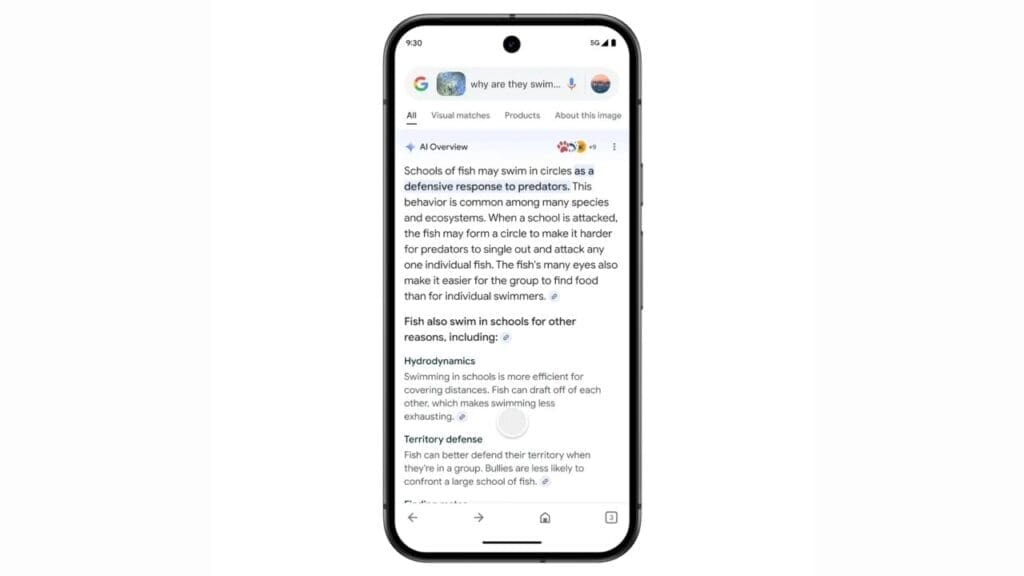
Google has introduced a new feature to its Lens application, allowing users to ask instant questions while recording videos. Expanding the capabilities of its visual search app, Google now enables both Android and iOS users to ask real-time questions about objects around them while using the video recording function in Lens. This new feature helps users quickly learn more about interesting things they encounter in everyday life. Lou Wang, Director of Product Management for Lens, stated that this feature is powered by Google’s Gemini model, part of the company’s artificial intelligence family.
Users will be able to instantly access the information they are curious about
As an example, Wang explains that if a user is curious about a fish, Lens can explain why the fish swims in circles and provide relevant sources.
To access the new video analysis feature, users must sign up for Google’s Search Labs program. Recording video in the Google app is as simple as pressing and holding the smartphone’s shutter button. Users will then be able to ask questions while recording, and Google’s AI Overview feature will summarize the information in response.
Additionally, Google Lens will enable users to search by both image and text simultaneously. For instance, when Lens identifies a product, it can provide details such as price, brand, reviews, and stock availability. Although this feature is currently limited to certain countries and shopping categories, it is anticipated that it will expand over time.
You may also like this content
Follow us on TWITTER (X) and be instantly informed about the latest developments…
The internet’s biggest content creator MrBeast (real name Jimmy Donaldson) has revealed his plans to dominate YouTube even after his death. In a move that seems straight out of Steven Spielberg’s metaverse movie” Ready Player One,” where virtual reality creator James Halliday leaves behind a digital legacy, YouTube sensation MrBeast has revealed his own plans for a digital afterlife.
In a recent podcast with KSI and Logan Paul, MrBeast talked about YouTuber Nikocado Avocado, where he pranked the whole internet, by sharing his prerecorded videos over two years and suddenly surprised everyone with his transformation.
After news broke out of MrBeast planning to release videos post his death, many social media users were quick to point out the eerie similarity between MrBeast’s plans and the main plot of 2018 sci-fi movie ‘Ready Player One’ where a popular games creator announces a major in-game treasure hunt post his death, in a series of videos.
MrBeast revealed in the podcast that he has some similar plans in place. He has already filmed 15 videos that will be posted after he passes away. He mentioned that certain people in his company know where to find these videos on his old computer.
He added that the video was uploaded only once a month. However, MrBeast also clarified that the videos are pretty garbage. He said in a fun way that in one video he was just sitting at a table, opening an old fan email and he didn’t even know what it was.
In a characteristically playful tone, MrBeast mentions the series’ first video title will be “My Last Video” and these videos include direct addresses to his audience, saying, “I’m probably in a coffin right now just chilling, don’t feel bad for me, I’m dead.”
The 26-year-old creator’s post-mortem content strategy has an uncanny similarity with the film “Ready Player One” concept of digital preservation. This content strategy maintains the illusion of MrBeast’s active presence in the audience —much like a modern-day Halliday.
MrBeast channel began in 2012 and boosted his subscriber base to 318 million, making him the biggest YouTuber in history. However, fame brings a lot of controversies also, recently he has indulged in a swirling controversy and a class action lawsuit.
In September 2024, five individuals filed a lawsuit, alleging that MrBeast for contestant mistreatment, including claims of unpaid wages and poor working conditions. These controversies are related to his his upcoming Amazon Prime game show, “Beast Games” have a massive budget of $100 million.
Also Read: India Plans Massive Animation and Metaverse Push for Movies
HBO has announced that it will release a new documentary in one week, claiming to have uncovered the identity of Satoshi Nakamoto, the enigmatic creator of Bitcoin!
HBO, widely known for its association with Game of Thrones, has made headlines with the announcement of a documentary set to air in one week.
The documentary, whose trailer has already been released, features excerpts from interviews with early Bitcoin users, including Blockstream founder Adam Back and JAN3 CEO Samson Mow.
According to Politico, the documentary claims to have solved the internet’s biggest mystery by uncovering the true identity of Satoshi Nakamoto, the elusive creator of Bitcoin.
In fact, if the findings are confirmed, it is claimed that they could send shockwaves through global financial markets and even impact the U.S. presidential elections.
You may also like this content
Follow us on TWITTER (X) and be instantly informed about the latest developments…
Beretta, the well-known Italian firearms manufacturer, is marking its 498th anniversary with the launch of its first-ever non-fungible token (NFT) collection.
Known as “W3bicons,” the collection features 20 AI-generated and 3D-modeled artworks, all inspired by one of Beretta’s most recognized products, the M9/92FS pistol. This iconic firearm has been a fixture in action films and video games over the years.
The collection is divided into two categories: Luxury and Pop. The Luxury collection consists of 10 artworks, including pieces such as “Golden Marble” and “Glow Porcelain.” These pieces aim to highlight Beretta’s tradition of pushing boundaries and experimenting with new technologies.
On the other hand, the Pop collection, which includes works like “Graffiti Velvet” and “Oceanic Blaze,” draws inspiration from the pistol’s influence in movies and pop culture, where it has become a cinematic symbol.
Carlo Gussalli Beretta, the company’s Digital Innovation Project Manager, described these artworks as representations of “the evolution of Beretta seen in an artistic perspective.”
NFTs from the collection are available for purchase through a dedicated webpage. Each piece in the Luxury collection is priced at 3 ETH, approximately $7,140 at the time of writing, while pieces in the Pop collection are listed at 1 ETH, or about $2,380 each.
As an additional incentive, buyers of the NFTs will have the opportunity to receive an invitation to Beretta’s 500th anniversary celebration, which will take place in 2026.
This marks Beretta’s first foray into the world of NFTs, a move that the company says aligns with its long-standing commitment to innovation while honoring its deep-rooted history.
The Metaverse is an exciting new virtual world concept that has captured the imagination worldwide. Though still in the early development stages, it aims to enable fully immersive shared online experiences through innovations like virtual and augmented reality. While much discussion focuses on long-term possibilities, useful Metaverse applications are already emerging across different fields.
In this article, we will explore 10 potential real-world use cases for the Metaverse and how organizations are applying these innovative technologies today. By highlighting practical examples currently in pilot or scaling phases, we aim to demonstrate this new digital frontier is not just a futuristic concept – valuable applications exist now with more on the horizon. Let’s begin our exploration of the Metaverse’s diverse potential!
Online Meetings & Conferencing
With remote work here to stay, companies are testing virtual meeting rooms in the Metaverse. Spatial allows colleagues to chat face-to-face via virtual avatars, while Anthropic enables coworkers to collaboratively view and edit 3D models. These tools promote human connection missing on 2D video calls.
Virtual & Hybrid Events
Large events are moving online using Metaverse platforms. In 2021, music star Travis Scott held a popular concert on Fortnite watched by over 12 million players. Similarly, the social VR app VRChat hosted conferences, parties, and networking events inside virtual worlds. This blends physical and digital interactions.
Online Education
Educational applications of Metaverse focus on interactive learning and skill development. For instance, VR startup Foundry10 helps train industrial workers via virtual classrooms recreating real work environments. Meanwhile, Anthropic partners with universities to deliver online artificial intelligence courses inside 3D worlds.
Real Estate & Architecture
Property developers are exploring “Meta-estates” by designing and showcasing virtual buildings, neighborhoods, and smart cities. Platforms like Zygna allow viewing home listings via VR headsets, while Spatial’s virtual world incorporates residential and commercial real estate. This broadens marketing while prototyping new urban designs.
Retail & E-Commerce
Fashion brands like Nike and Louis Vuitton debuted virtual stores in gaming worlds and VR platforms. Decentraland created a digital shopping district for crypto clothing and art marketplace RTFKT. Customers can try on and purchase virtual apparel and accessories, potentially driving more online sales.
Gaming & Entertainment
As the most widely-used Metaverse to date, gaming platforms like Roblox and Fortnite are effectively social virtual worlds where creativity and entertainment blend. Users craft immersive games, worlds, concerts, and communities through these digital sandboxes reaching millions of players globally.
Travel & Tourism
The travel industry is tapping Metaverse’s potential by rebuilding famous landmarks and natural wonders. Within VR experiences, users can freely explore virtual recreations of places like the Great Wall of China or the Great Barrier Reef without constraints of physical distance. This sparks wanderlust and planning of future trips.
Healthcare & Wellness
Metaverse aims to enhance healthcare through telemedicine, employee wellness programs, and personalized medical simulations. For example, Anthropic develops AI coaching platforms for remote doctor consultations and therapy sessions inside virtual clinics. It also facilitates health education and training of medical professionals through virtual reality.
Sports & Fitness
Sports leagues and gyms are trialing immersive fitness activities within Metaverse platforms. For instance, the VR fitness app Supernatural offers boxing, dance, and meditation classes led by instructors appearing as virtual avatars. Its goal is to motivate exercise through social interaction and gamified challenges anywhere users have VR headsets.
Work & Productivity
Forward-thinking companies pioneered adopting virtual and augmented reality within core operations. For example, industrial giants like BMW, Dassault, and Volkswagen utilize virtual design spaces to accelerate product development cycles. Construction firms too deploy mixed reality for remotely managing collaborative building projects worldwide. As Metaverse evolves, more organizations may integrate these tools into workflow to streamline processes.
As illustrated above, Metaverse applications are being applied today across varied fields from social networking to e-commerce, healthcare, property, and beyond, and aiming to make a positive impact. While challenges remain in areas like scalability, hardware costs, and data privacy, ongoing technical progress indicates the Metaverse’s full realization as a generative shared virtual economy may unfold sooner than many expect. Innovators are continually reimagining how advancing digital realities can empower areas of our lives.
The emerging Metaverse concept represents a paradigm shift in how we interact and transact in virtual spaces. This fully immersive next generation of the internet aims to push boundaries of productivity, creativity, and connectivity using tools like virtual and augmented reality. While still maturing, the Metaverse is sparking excitement over opportunities for industries and enterprises. In this article, we explore the top potential benefits businesses may gain by embracing this innovative technological frontier.
Online Meetings & Conferencing
Business operations today heavily rely on remote collaboration via video calls. However, the Metaverse opens new possibilities for virtual face-to-face communication through avatar representation in shared digital workspaces. Platforms like Anthropic enable synchronous co-editing of 3D designs alongside live audio conferencing, promoting higher engagement absent in typical 2D virtual meetings. This blended virtual-physical interaction model can boost productivity for globally distributed teams.
Virtual & Hybrid Events
Corporate conferences, trade shows and product launches transitioning online faced challenges in reaching intended scale and immersion through conventional web platforms. However, virtual venues within the Metaverse like Decentraland provide interactive shared spaces perfect for organizing everything from presentations to networking sessions to virtual vendor booths without travel constraints. Furthermore, these hybrid virtual-physical events could combine in-person activities with extended online participation through Metaverse access, significantly broadening potential audiences.
Training & Onboarding
Induction of new hires and continuous skills training remain pivotal yet face resource restraints. Leveraging the Metaverse promises to transform this process. Tools like VR let employers remotely impart practical job skills via interactive virtual simulations that effectively mimic real conditions. For example, construction firms could host recruits inside VR versions of active development sites to preview health & safety protocols before commencing physical work. Similarly, healthcare organizations may impart delicate procedures through interactive virtual patients. This approach could streamline both initial and ongoing training workflows.
Remote Assistance
Augmented reality promises to revolutionize helping remote workers troubleshoot issues by overlaying visual data directly onto real environments. Pilot programs see technicians utilizing AR smartglasses to virtually guide on-site staff through repair processes from afar by viewing live video feeds and drawings directly over real-world components. This could minimize downtime from machinery failures while reducing service costs and travel requirements compared to dispatching experts on-site. As technologies mature, the Metaverse may enable infinitely scalable remote collaborative assistance globally.
Digital Marketing & Advertising
Digital marketing or creative marketing within virtual worlds allows unique brand engagement far beyond conventional banners or videos. Major companies are already securing virtual real estate within Metaverse platforms to construct immersive 3D stores and host experiential promotional events. For instance, clothing brands offer custom virtual apparel try-ons that convert online window shoppers. Additionally, product placements within hugely popular virtual worlds offer unprecedented viral exposure potential for brands. The multimedia advertising formats could redefine how companies create digital customer relationships.
Remote Work Collaboration
While remote work boomed amid pandemic lockdowns, maintaining authentic team culture proved challenging through typical video calls alone. The Metaverse provides fully immersive digital HQs with interactive virtual meeting spaces where colleagues can brainstorm together live as avatar representations. Features like integrated whiteboards, 3D modeling, and spatial audio help simulate true office dynamics remotely. This may improve collaboration quality and job satisfaction for distributed hybrid work teams long-term.
As the Metaverse evolves from basic pilots today, hybrid virtual-augmented technologies will integrate ever deeper into our daily business operations and open new creative processes. Done responsibly with user wellness prioritized, advances could streamline workflows, spark innovation, and uniquely empower global connectivity for enterprises. Looking ahead, realizing its full societal impacts will require focused cooperation between innovators and policymakers to ensure humanity’s best interests guide this profound technological shift.
Conclusion
While still nascent, the Metaverse represents a paradigm shift with enormous potential to positively transform core business processes from remote work to marketing to skills development if shaped sustainably. Early applications demonstrate its capacity to drive high productivity and engagement through vivid shared virtual experiences beyond the restrictions of physical distance alone. By creatively piloting innovative use cases now, organizations stand positioned to aptly benefit as this vibrant frontier further matures. With care and reason applied, the Metaverse age could inspire unprecedented progress.
The Metaverse concept demonstrates immense potential if responsibly developed and applied. As a persistent, interconnected digital space, it could revolutionize how we work, learn, entertain, and connect in the future. Early pilots highlight its ability to positively transform industries and daily experiences through innovations like virtual collaboration tools, immersive online events, and interactive virtual simulations. Going forward, balancing human needs with responsible development will be key to ensuring the Metaverse uplifts humanity. There are great possibilities ahead as technical boundaries push creative imaginations further.
There’s no way to talk about Survival Float Simulator – Crocodile Waters Craft, Raft, Build, without talking about Survive & Craft. You should go read that review before continuing… read? Good. SFS is a ripoff of that game which itself was a ripoff of Raft. But while S&C managed to hold its own and was strangely good, SFS is a straight up scam. Let me start by showing you what happens when you go off your raft into the water:
The opening logo lasted longer than the actual footage did.
Yes, when you fall in the water in Survival Float Simulator, you die. Why? Don’t know. But wait, there’s more! You construct a hook to grab resources floating about. There’s one problem, there are no resources to grab. This is in stark contrast to S&C, where resources where everywhere, too many in fact. Because you can’t grab any resources, you can’t construct the hammer to use the planks you have. So you are stuck on the the tiny platform you start on. Furthermore, when you drop the planks in the water, they stay still. Despite the little water animation, you are actually sitting still. Yes, Survival Float Simulator is completely broken.
When you make a photocopy of a photocopy, the image quality degrades. When you rip off a ripoff, similarly, the quality degrades. Survival Float Simulator is a scam. All of the images shown on the eShop page were faked because the game is broken. There are no resources to get, so there’s nothing to do in the game. Just go in the water and die over and over again. Play Survive and Craft and thank me later. This gets a Garbage with a one back-end score. May the crocodile end your misery quickly!
Overall: Survival Float Simulator is a ripoff of a ripoff, and is therefore complete garbage and a scam.