Pix Arts, I haven’t seen them in two years. The last game of theirs I reviewed was Mission Commando back in November of 2022. It was shit. Although, not all of their games were garbage. Sweet Sugar Candy I actually liked. This brings us to today, and their latest release Monkey Kong in New-York. Is it any good? Not really. Let’s watch a video of it in action:
As you can see, Monkey Kong in New-York is an auto runner. You are a gorilla running around in New York City avoiding rolling tires, barrier and other gorillas… and that’s about it. See how far you can run, and that’s it. There’s really nothing more to this game than what you see. Ok there is a magnet that attracts bananas to you… and you need to fill the banana meter in order to dash. But aside from those two things, there is nothing else here.
Monkey Kong in New-York is a bad game, but is a scam game? No. It is a legit game. Effort was put into this. It is just a bad game by a bad developer who has to bend the truth to get you to buy it.
Iconic New York Locations: Adventure through Central Park’s shaded paths, Harlem’s lively streets, the skyscrapers of Manhattan, and the bustling harbor with breathtaking views.
Banana Power-Ups: Collect golden bananas to unlock powers like super strength, helping you overcome new challenges and rivals.
Challenging Obstacles & Rivals: Face off against rival monkeys and dodge obstacles like swinging cranes, slippery docks, and barrels in your path.
Nothing in the above is technically a lie, just embellished. The screenshots are all legit. But it is still a crappy game. Monkey Kong in New-York gets a Not Recommended with a three back-end score.
Overall: Monkey Kong in New-York is functional. That’s all the good I can about it. Pix Arts can succeed if they actually try, they aren’t here.
Neon Machine, the studio behind the blockchain-based first-person shooter Shrapnel, has announced a major leadership change ahead of the game’s planned free-to-play launch in 2025.
Ken Rosman, known for his experience with Xbox titles, has been appointed as the new CEO. Meanwhile, co-founder and outgoing CEO Mark Long will transition into an advisory role to provide continued support during this critical phase of development.
In addition to the CEO appointment, the company is preparing for a new round of fundraising and navigating ongoing legal disputes, signaling a crucial period in its development.
Source: Shrapnel
Why is Neon Machine appointing a new CEO?
The studio says the leadership changes reflect the need for a focused approach to finalizing the game, ensuring it meets expectations for its full release. Rosman, known for his work on games like Halo Wars and Sunset Overdrive, will be tasked with overseeing operations as Shrapnel moves from early access to its planned global rollout.
“Now that we are getting close to launching Shrapnel, it’s time for new leadership,” said Mark Long, Co-founder and former CEO at Neon Machine.
With over 30 years of industry experience, Rosman is credited with successfully leading projects for major titles during his tenure at Microsoft’s Xbox division. His leadership will focus on operational execution and live-service management, elements critical to Shrapnel’s launch and ongoing support.
The company also announced additional leadership roles with Dave Johnson to lead the Shrapnel project whilst CTO Don Norbury will shift his focus to the studio’s Moonshot platform.
Source: Shrapnel
Additional Funding and Ongoing Legal Dispute
Alongside the leadership changes, Neon Machine is raising additional funding to support its operations and future goals.
The funding round is being led by the Avalanche Ecosystem Fund, with participation from existing investors Griffin Gaming Partners and Polychain Capital. Details of the round will be disclosed in early 2025, following a previous raise of $20 million in October 2023.
The studio is also involved in an ongoing legal dispute with former shareholder Cort Javarone, CEO of 4D Factory. In late 2023, Neon Machine accused Javarone of attempting to take control of the company, whilst Javarone countered that the studio’s leadership acted without board approval.
Whilst Neon Machine did not share further details on the matter, they anticipate an update in early 2025.
The rise of artificial intelligence (AI) has transformed industries, providing innovative solutions to complex problems. Among the most significant advancements are AI agents—autonomous systems that can perceive their environment, process data, and achieve predefined goals. This article serves as a complete guide to creating AI agents from scratch. From understanding their core concepts to implementing advanced patterns like ReAct, this guide equips you with the knowledge and tools needed to build, test, and optimize effective AI agents.
Understanding AI Agents
AI agents are self-governing systems designed to perform tasks autonomously. They employ sensors to perceive their surroundings, process inputs, and execute actions to achieve specific objectives. These agents vary from simple bots that follow straightforward instructions to complex systems capable of learning and adapting to new environments.
Examples of AI agents include:
Recommendation engines like those used by Netflix and Amazon analyze user preferences to suggest content or products.
Virtual assistants like Siri and Alexa process natural language queries and execute tasks.
Self-driving cars like those from Tesla navigate real-world environments autonomously.
AI agents are also critical in domains such as healthcare, where systems like IBM Watson assist in diagnostics, and in finance, where trading algorithms analyze market trends to optimize investments. AI agents significantly enhance productivity, precision, and personalization across industries by automating repetitive tasks and analyzing large datasets.
The Importance of AI Agents
AI agents have become indispensable due to their ability to perform tasks efficiently and effectively. They reduce human workload, improve decision-making, and enable complex applications in fields like transportation, healthcare, and finance. For instance:
In customer service, AI agents provide 24/7 support, handling inquiries and resolving issues seamlessly.
In finance, they predict market trends, detect fraudulent activities, and automate trading.
In healthcare, AI agents diagnose diseases, recommend treatments, and monitor patient health.
The flexibility and scalability of AI agents make them pivotal in advancing technology, creating smarter systems that respond more effectively to user needs.
Introducing the ReAct Pattern
One of the most powerful design patterns for enhancing AI agents is the ReAct pattern, which combines reasoning and action-taking abilities. The ReAct pattern allows agents to think, act, and learn in a continuous loop, significantly improving their utility in dynamic environments.
The pattern consists of five steps:
Thought: The agent processes the input and determines the appropriate action.
Action: Based on its reasoning, the agent performs an action, such as querying an API or executing a computation.
Pause: The agent waits for the action to complete.
Observation: The agent analyzes the results of the action.
Answer: The agent generates a response based on its observations.
This loop enables AI agents to interact with external tools and APIs, fetch real-time information, and deliver contextually relevant responses. For instance, an AI agent using the ReAct pattern could analyze weather data to provide personalized travel recommendations.
Thanks to its simplicity and rich library ecosystem, Python is the preferred programming language for building AI agents. Essential tools include:
OpenAI API: Provides access to advanced language models like GPT-4, enabling natural language processing and interaction.
httpx: A modern HTTP client for Python that is useful for fetching data and interacting with APIs.
Regular Expressions (re): Used for parsing and processing text responses.
Setting Up the Environment
Before building an AI agent, you must set up a development environment.
Step 1: Installing Required Libraries
Begin by installing Python and setting up a virtual environment:
The ReAct pattern enhances the agent’s decision-making capabilities by defining a structured reasoning-action loop.
Defining the Prompt
The agent uses a predefined prompt to guide its actions:
react_prompt = “””
You operate in a loop of Thought, Action, Pause, Observation, and Answer.
Your goal is to process user input, reason about it, perform actions, observe outcomes, and respond.
Example:
Question: What is the capital of France?
Thought: I need to look up France.
Action: search: France
Pause
Observation: France is a country in Europe. The capital is Paris.
Answer: The capital of France is Paris.
“””
Implementing Actions
The agent supports multiple actions, such as searching Wikipedia or performing calculations.
defreact_loop(agent, query, max_turns=5):
prompt = react_prompt
agent.send_message(prompt)
observation = query for _ in range(max_turns):
result = agent.send_message(observation)
action_match = re.search(r”Action: (\w+): (.+)”, result) if action_match:
action, param = action_match.groups() if action in actions:
observation = f”Observation: {actions[action](param)}“ else:
observation = f”Observation: Action ‘{action}‘ not recognized.” else: return result
Testing the Agent
Run queries to test the agent:
agent = AIAgent()
print(react_loop(agent, “What is the capital of Germany?”))
print(react_loop(agent, “Calculate: 12 * 15”))
Enhancing and Debugging the Agent
To improve robustness:
Validate Inputs: Ensure inputs are sanitized to prevent injection attacks.
Handle Errors Gracefully: Implement error handling for API failures and invalid actions.
Add Logging: Track actions and responses for debugging.
Future Prospects
The future of AI agents lies in greater autonomy, ethical design, and human-AI collaboration. By building scalable, adaptable, and secure systems, developers can unlock the full potential of AI.
This comprehensive guide provides a foundation for building AI agents from scratch. Experiment with different actions, refine your agent’s capabilities and explore new applications in this ever-evolving field of artificial intelligence.
Beam Ventures is set to launch a $150 million fund to boost Abu Dhabi and position itself as a major player in the global gaming industry.
This initiative aims to establish the emirate as a hub for gaming innovation and will support startups working on blockchain, artificial intelligence (AI), and virtual and augmented reality (VR/AR). Additionally, a web3 gaming accelerator, set to launch in early 2025, will provide resources and mentorship to early-stage companies.
This initiative builds on Abu Dhabi’s existing efforts to become a gaming and technology hub. The emirate has already hosted prominent gaming events, such as esports tournaments and industry summits. Through partnerships with organizations like Sophon and Aethir Cloud, Beam Ventures plans to create a robust infrastructure to support innovation in the region.
Source: Beam Foundation
What is Beam Ventures?
Beam Ventures began as a gaming subnet under the Merit Circle DAO and has since evolved into a full-scale gaming ecosystem.
The company provides a range of tools, including APIs, wallets, bridges, and analytics, tailored for game developers and players. Its solutions are optimized for web3 gaming, enabling seamless transactions and efficient operations.
Beam powers several games, including Trial Xtreme, Walker World, and Hash Rush, all of which run on the Avalanche Subnet. By focusing on the integration of blockchain and gaming, Beam Ventures aims to drive innovation and create opportunities for developers and players alike.
Source: Beam Foundation
Moving Towards Global Expansion
The $150 million fund is being launched under the Abu Dhabi Global Market (ADGM), with a focus on advancing emerging technologies in the gaming sector, to provide mentorship, funding, and resources to startups in blockchain, AI, and VR/AR.
In addition to the gaming fund, Beam Ventures announced three other key projects designed to complement its efforts:
BeamAI: A division dedicated to creating self-learning AI agents for operational tasks. BeamAI’s first research paper is scheduled for release in the coming weeks.Beam L1: A blockchain upgrade leveraging Avalanche’s Etna technology to significantly reduce costs and improve efficiency, making Beam’s blockchain solutions more accessible to developers.Beam Nodes: A grant program aimed at incentivizing validators and enhancing the security and scalability of the network.
With the web3 accelerator set to launch in 2025, the emirate is expected to attract a diverse range of talent and investment. Startups accepted into the accelerator will gain access to expertise and infrastructure that can help scale their operations globally.
Days of our Lives 2-week spoilers divulge that Maggie Horton Kiriakis must choose between her stepson and son-in-law in the upcoming court battle. Although she deeply cares for her son-in-law, Xander Cook Kiriakis, she understands why her late husband did what he did to his son, Philip Kiriakis, by keeping him out of the will. She decides to be neutral, like Switzerland. Meanwhile, Shawn Brady surprises his ex-wife, Belle Black, with his new role at the Salem PD. Will she be a supportive friend to her ex on the 6oth season of the NBC Peacock exclusive? Plus, he doesn’t like that she’s rebounding with EJ DiMera. Will the new exes find their footing in Salem again? Finally, Chad DiMera breaks the news about Clyde Weston to his in-laws. Do they still pursue looking for Abigail’s remains during the weeks of December 16-27, 2024?
Days of our Lives 2-Week Spoilers: Maggie Horton Kiriakis Takes Over?
DOOL 2-week spoilers report that Maggie Horton Kiriakis (Suzanne Rogers) should be Xander Cook Kiriakis‘s (Paul Telfer) key character witness. Maggie knows her son-in-law quite well. Plus, she was as shocked as everyone else when it came out that he was the late Victor Kiriakis‘s (John Aniston) long-lost son.
However, Maggie Horton Kiriakis believes that Philip Kiriakis (John-Paul Lavoisier) holds a letter from Victor on Days of our Lives. Yet, little does Maggie know that the letter is a fake. Vivian Alamain (Louise Sorel) helped him with it. Plus, Kate Roberts (Lauren Koslow) knows her son’s dirty little secret about the forgery. She fears his farce will unravel in the courtroom.
Days of our Lives: Maggie Horton Kiriakis – Xander Cook Kiriakis
DOOL 2-week spoilers indicate that Maggie Horton Kiriakis is torn about choosing sides and wanting to remain neutral. However, the judge decides whether either man is the rightful heir. After all, Victor’s oldest son, Bo Brady (Peter Reckell), may need provisions from his father’s estate once he awakens from his coma. In the meantime, the judge could name Maggie as the sole heir of the empire. Watch this week to see Maggie’s family fight in court. What will the judge decide? In favor of Xander? Philip? Or shock everyone and give Maggie all of her late man’s estate.
Days 2-Week Spoilers: Shawn Brady & Belle Black Try to Move On
Days of our Lives 2-week spoilers indicate that Shawn Brady (Brandon Beemer) and his ex, Belle Black (Martha Madison), move on without each other. They recently decided to split after a heartfelt catharsis. Yet, it may be tricky to move on. After all, they’ve been sweethearts since attending Salem High together.
Next, on DOOL, Shawn shocks Belle by returning to his old job on the police force. She thought he was headed back to Europe to be close with his mom and dad. But he agrees to support his uncle Philip in court. Belle and Philip need all the help they can get on the long-running sudser. Will Shawn’s testimony help Philip?
Further, Days 2-week spoilers report that Belle and EJ DiMera (Dan Feuerriegel) pick up where they left off. Shawn may disagree with her rebound choice. Yet, what can he do about it? Plus, he’s the one who asked for the divorce. Stay tuned as Belle and Shawn try to make it independently this holiday season.
DOOL 2-Week Spoilers: Chad DiMera Tells In-Laws About Clyde Weston
Days of our Lives 2-week spoilers show Chad DiMera (Billy Flynn) breaking the news about Clyde Weston (James Read). Furthermore, the fugitive was shot and put in a coma before he could tell Chad where Abigail Deveraux’s remains were hidden. Of course, Jack Deveraux (Matthew Ashford) and Jennifer Horton (Melissa Reeves) will be heartbroken.
Additionally, will Chad vow to continue searching for Abigail with JJ Deveraux’s (Casey Moss) help? After all, can they have a Merry Christmas without knowing the truth about their Dear Abby? Unfortunately, hanging her ornament on the tree this year may be more difficult on DOOL.
Watch for Chad’s heart-to-heart with his in-laws during the weeks of December 16-27, 2024. Next, Belle and Shawn move forward after their divorce. But is it truly over between the OG sweethearts? Finally, Maggie Horton Kiriakis could take charge of Victor’s estate after the judge hears all the witnesses on NBC’s Days.
Return to Soap Dirt for the latest Days of our Lives spoilers and news.
As per the present scenario, daily newspapers are filled with Artificial Intelligence (AI) news, which is revolutionizing industries by sparking debates and influencing markets. Be it natural language processing to developments in robotics and advancements in healthcare; there is no doubt that Artificial Intelligence is steering the future. Let’s explore all those updates about the new advancements made in AI, their consequences, and how they are changing industries and markets worldwide.
Latest Developments and Breakthroughs in AI:
Picture Courtesy: lifeboat.com
By leaps and bounds, AI is growing not with slow paces but of silencing explosions. Here now are some of the advancements and breakthroughs that have been bringing great influence in the present international scene:
1. GPT-5 and Progressing Generative AI Models:
The general release of GPT-5 is a big leap in generative AI by OpenAI. The big difference between GPT and GPT-5 is that it can understand context; it has faster response times and multimodal capabilities: Simulation of works with text, images, and even video content.
Real-world Application:
Content Creation: From blogs to video scripts, automated creative content generation through GPT-5.
Customer Service: A more human-like experience is created by chatbots developed using GPT-5.
Education: With customized learning plans, it provides an AI tutor for students.
2. Breakthroughs in Healthcare AI:
AI tools have ushered in drug discovery and diagnostics in health care today.
DeepMind’s AlphaFold identified almost all known protein structures and fast-tracked drug research.
Some startups like Insilico Medicine say they use AI to predict drug effectiveness and shorten the time and cost of developing drugs.
Why this Matters: They hasten the treatment of diseases including cancer and Parkinson’s, saving lives and resources.
3. Autonomous Vehicles Achieving New Milestones:
The autonomous vehicle (AV) industry is keeping pace with its transforming momentum as follows:
Waymo breathes life into its full-fledged robotaxis in cities like San Francisco; this is their proof of Level 4 autonomy.
Tesla’s Full Self-Driving (FSD) Beta continues to improve with AI-driven updates, aiming for Level 5 autonomy where no human intervention is required.
What’s Next: The upcoming focus will be on haulers with autonomous trucks and safer city driving experiences.
4. AI-Driven Climate Solutions:
AI appears as a tool that plays a major key in combating climate change.
IBM uses AI to manage and optimize the risks of renewable energy sources and forecast the weather pattern.
AI models help governments and NGOs track deforestation and carbon emissions with an accuracy that was previously unimaginable.
Long-term perspective: AI climate solutions could be zealous as a potent way out for industries to overcome the vexed issue of climate change even as they meet their sustainability objectives.
5. Creativity in the Age of AI:
Generative AI tools like DALL·E 3, Runway ML, and Adobe Firefly are taking the creative industries by storm:
Art and Design: AI is co-creating art pieces and assisting designers with mood boards.
Music: OpenAI’s MuseNet composes original music across genres.
Film: AI is now used to generate realistic special effects and even scripts.
Impact: Creative industries enjoy a speedier turnaround and unprecedented ease of access for nonprofessionals.
6. AI in Space Exploration:
AI plays a notable part relating to research and exploration in space.
NASA is mainly towards the analysis of data received from Mars rovers and optimization of operations in the field of satellites.
AI-powered robotics have still helped astronauts in carrying out experimentation and maintenance tasks.
The Horizon: Private space companies like SpaceX have involved AI in mission planning to achieve efficient space traveling.
7. AI in Financial Technology:
The roles played by AI in fintech are on the rise, especially in fraud detection and personalized financial planning.
AI algorithms analyze patterns to flag fraudulent transactions.
AI is now used by robo-advisors like Wealthfront and Betterment to customize investment portfolios.
Market Trends: AI in fintech is reducing the gap between the rich and the poor by making financial services available to a large segment of the population.
8. Edge AI: Bringing Intelligence to Devices
Edge AI refers to that computation which gets executed at the devices rather than in the cloud servers. It is getting more popular.
Use Cases: Smart home devices, wearables, and IoT in industry.
Benefits: Faster processing, lower latency, and generally increased data privacy.
Future Potential: Edge AI, according to most predictions, will dominate over those industries that require a real-time decision-making process such as autonomous drones and telemedicine.
9. AI in Agriculture:
The precision agriculture reality became a reality due to innovation in AI.
AI drones or robots monitor crop health while carrying out irrigation optimization.
Predictive analytics allows farmers efficient planting and harvesting schedules.
Outcome: AI agriculture is a sustainability adventure with decreasing production costs for food.
10. Regulation and Ethics in AI:
The approaches of governments and organizations to regulation are set to intensify with the growing influence of AI.
The European Union’s AI Act aims to ensure transparency and accountability in AI usage.
Tech giants are collaborating to create frameworks for ethical AI development.
Why It’s Important: Establishing ethical guidelines ensures AI benefits society without causing harm or reinforcing biases.
Impact of AI News on Markets and Industries:
Picture Courtesy: thehumanwonder0.wordpress.com
AI advancements don’t just stay within labs; they ripple through industries, driving stock markets, influencing investments, and reshaping economies. Let’s explore how AI news is impacting key sectors:
1. Stock Market Volatility:
News regarding breakthroughs in artificial intelligence has generally been responsible for great fluctuations in stock prices, especially in regard to the tech companies and the start-ups that focus on AI development. Positive emerging stories like major defining capabilities with AI or that the company is partnering with big corporations can cause stock prices to go up. Fear of regulation or misappropriation of AI, however, causes the prices to tumble down.
2. Increased Investment in AI Startups:
AI-related news drives investor interest, resulting in massive funding rounds for AI startups. Venture capitalists and institutional investors are quick to back companies that showcase cutting-edge AI innovations, fueling rapid growth in industries like healthcare, finance, and automation.
3. Transformation of Workforce Dynamics:
It is interesting how an enhancement in AI technologies translates into how an industry tends to strategize its workforce. Such measures would seek to either equip current employees with new skills in AI-reliant work or automate most menial tasks that will require little human input. The emergence of generative AI tools, for instance, has changed the preparation of creative and administrative professions, requiring those in these sectors to streamline their workflows.
4. Shifts in Consumer Expectations
AI-made news sets high standards for consumers and their expectations of intelligent appliances and products. For instance, processing language was made much better, like in the case of products like Alexa and Siri, thus raising most people’s expectations of having them in appliances used round the clock.
5. Acceleration of Industry Automation:
Industries adopt automation at an accelerated pace following AI news that highlights efficiency gains. Today industry have intelligent robots that decrease costs and grossly increase productivity in manufacturing, logistics, and retail sectors.
6. Impact on Competitive Landscapes:
AI transforms ways in which companies rethink rival strategies. Enterprises adopt and plunge into the adoption of AI technologies at their own risk if they go without being present; the early adopters almost always enjoy a sizable leap between themselves and latecomers, like retailers, who are overtaking the traditional competitors through the use of AI for their personalized shopping experience.
7. Regulatory and Ethical Challenges:
The complications associated with the misuse of AI-for instance, through an algorithm bias or a data breach-influence sectors to tackle regulatory and ethical issues. Countries all over the world are coming out with AI-specific laws, which mold how enterprises conceive and deploy AI solutions.
8. Market Demand for AI-Infused Products:
AI news usually generates some interest from consumers and then subsequently businesses towards AI infusion in products. For example, stories such as that of an autonomous vehicle or an AI-enhanced healthcare solution, construct a demand for those technologies, leading companies to increase their investment in AI.
9. Disruption of Traditional Business Models:
Through AI news, one will discover quite a few disruptive new applications attempting to shake the tradition in their respective industries- for example, by way of offering trading platforms that are automated and robo-advisory, financial services are breaking down traditional banking concepts and applications by becoming faster, cheaper, and readily accessible.
10. Global Tech Leadership Battles:
Last but not least, AI news molds political geography, and new rivalry competitions between countries over who will become the lordliest power in AI research and development become reality. Proponents of an AI breakthrough attract investments and, once it becomes reasonably established, can even compete with other nations for the lion’s share of global technology leaders shaping international trade and economic policies.
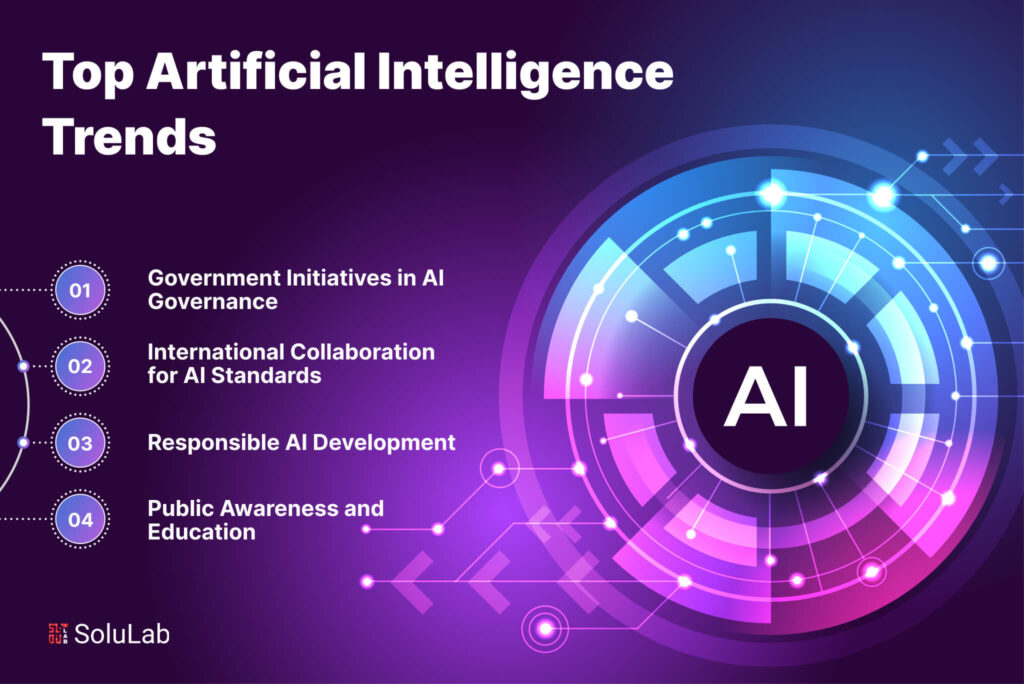
AI Trends to Watch in 2024 and Beyond:
Picture Courtesy: solulab.com
As AI continues to evolve, here are some trends shaping its future:
1. AI on Edge Computation:
The trend of doing AI through the edge devices rather than depending much on cloud servers is catching on. This will accelerate processing and will also enhance privacy.
2. Human and AI Collaboration:
AI takes human activity into account, and not quite a bit, would replace it. For example, cyborgs might assist surgeons and help writers in creating an article.
3. Regulation and Governance:
The government is now going through a process of drafting its AI regulations for ethical practices. One of the first moves was made by the EU with its AI Act, setting the ground for AI safety and accountability.
4. AI in Space Exploration:
Artificial intelligence is becoming increasingly relevant for space exploration, analyzing Mars rover data, and predicting celestial happenings. Because of private space companies such as SpaceX, which do artificial intelligence in mission planning, this subject is going to grow.
How to Keep Up with AI News:
With so much happening, staying updated on AI can feel overwhelming. Here’s how you can keep track:
Follow Trusted News Outlets: Platforms like TechCrunch, MIT Technology Review, and Wired provide reliable AI news.
Join AI Communities: Engage in discussions on platforms like Reddit, GitHub, and LinkedIn.
Attend AI Conferences: Events like NeurIPS and CES are great for understanding the latest AI trends.
AI is more than a technology, it’s a revolution. Its advancements are creating opportunities, raising ethical questions, and challenging industries to adapt. As AI continues to develop, staying informed is crucial to understanding its full potential.
What are your thoughts on the latest AI developments? Are you optimistic about its impact or concerned about its risks? Share your views below, we’d love to hear from you!
For more insights and updates on Metaverse, DeFi, Blockchain, NFT & Web3, be sure to subscribe to our newsletter. Stay informed on the latest trends and developments in the decentralized world!
Ripple will launch its U.S. dollar-pegged stablecoin called Ripple USD (RLUSD) on Tuesday, the company announced Monday.
Backed by U.S. dollars, U.S. government bonds, and cash equivalents, Ripple said that the token will initially trade on platforms including MoonPay, Uphold, Bitso, Archax, and CoinMENA. RLUSD will be available across Ethereum and XRP Ledger.
The anticipated launch follows a recent surge in the value of XRP, the token created by Ripple’s co-founders that is used in the firm’s payments services. XRP jumped to a seven-year high price of $2.82 earlier this month, and remains up by 122% over the last 30 days at a current price of $2.45, per data from CoinGecko.
Editor’s note: This story is breaking and will be updated with additional details.
Daily Debrief Newsletter
Start every day with the top news stories right now, plus original features, a podcast, videos and more.
Luxury watch brands such as Rolex and Patek Philippe have become popular choices for those looking to invest in high-value watches. These watches often come with sophisticated complications and design elements that add an extra layer of complexity – both visually and mechanically – to these timepieces.
The watch market, like any other form of investment, can be volatile so it pays to do your research before making a purchase. By researching the watch market and its fluctuations, you can get an idea of which are the watches that hold value and may be good investments over time.
Luxury Watches That Hold Value
Watches that hold their inherent value are usually built to last and made with precious metals and the highest quality parts. The best watches use titanium or stainless steel, along with premium leather straps and scratch-resistant glass.
These materials are strong and long-lasting, ensuring that the watch will stand up to wear and tear over time. Additionally, many of these watches come with intricate designs and features that make them a good investment.
Finding watches that go up in value as opposed to simply holding their initial value can be challenging. Therefore, only buy watches when you love their design and functions. That way, any increase in value will be a pleasant bonus.
Vintage Timepieces That Are Worth Investing In
When it comes to finding vintage watches with investment value, there are a few factors to consider in order to determine whether a vintage model is likely to appreciate in value. These include the vintage model’s provenance, the rarity of the vintage model, and its condition. In general, limited production of less than 20,000 units will hold their value best.
Collecting vintage watches is an increasingly popular hobby, and certain vintage models can hold significant value. This can be due to their limited production or the fact that they are no longer in production.
As a result, vintage timepiece values can fluctuate on the secondary market, where collectors buy and sell vintage watches as investments. Some vintage models have even gained cult status, with vintage watch enthusiasts paying a premium for certain vintage models.
It’s important to note that vintage watches are often exposed to wear and tear over time, which can affect their value. As a result, vintage watches should be inspected by an expert before making a purchase in order to ensure that they retain their value. Additionally, vintage watch buyers should be aware of the fact that vintage models can be difficult to repair or replace parts for.
Which are the watches that hold value?
1. Rolex
Why do Rolex watches hold value? Rolex is well-known for producing timepieces of exceptional quality and reliability.
Rolex watches generally appreciate in value over the years, making them a worthwhile investment. If you’re buying a pre-owned Rolex watch, make sure to check that it is an authentic Rolex timepiece.
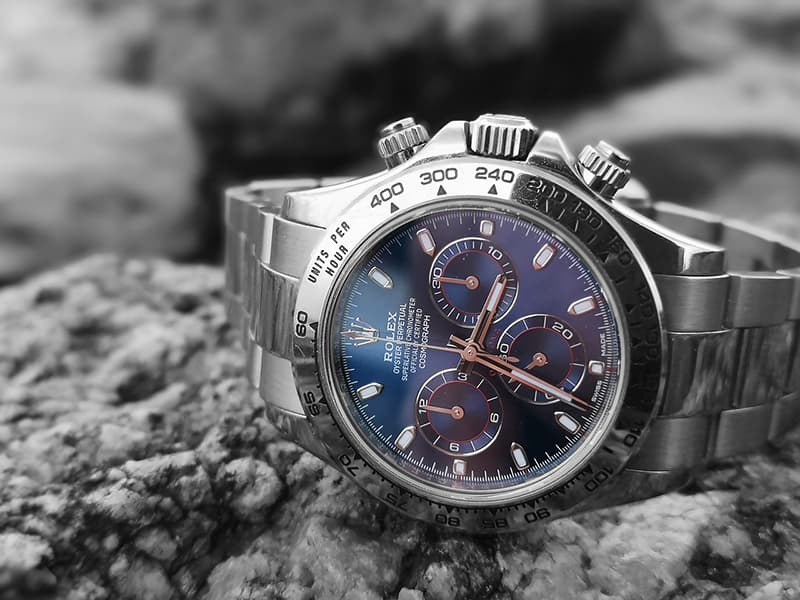
The Rolex Daytona is one of Rolex’s most popular watches. It has a classic look and is made from high-quality materials, making it a timeless design that can be passed down for generations. A pre-owned Daytona in good condition has a retail price of between $19,000 to $60,000 on online marketplaces such as Bob’s Watches.
The Rolex Submariner is another popular Rolex timepiece that has stood the test of time. This model is waterproof up to 300 meters and features a sleek black dial with luminous markers.
GMT-Master II watches feature two time zones, perfect for globetrotters who want to keep track of the time in multiple places simultaneously. The GMT-Master II is a popular choice among watch collectors due to its sophisticated design and intricate craftsmanship.
Finally, Rolex’s Cosmograph Daytona is a chronograph watch that is perfect for those who want to track their time with precision and style. It features three sub-dials and comes in a variety of colors and styles.
Rolex Cosmograph Daytona – one of the best Rolex sports watches
2. Patek Philippe
Patek Philippe has been a leading name in Swiss luxury watches since 1839 and has continued to produce high-end timepieces with timeless designs. Patek Philippe watches not only make for exquisite accessories but also retain their value over the years, making them great investment pieces.
One of the brand’s most iconic models is the Patek Philippe Nautilus. This sporty-luxe timepiece features a stainless steel case and bracelet, contrasting blue dial, and date display window. The movement is renowned for its accuracy and reliability.
Patek Philippe Aquanaut watches also hold their value well over time. They have a modern design with robust features like scratch-resistant sapphire crystal, luminous hands and water resistance up to 120 meters.
The Patek Philippe Calatrava is also an investment piece, as its quality materials and superior craftsmanship guarantee you something fine to pass down through generations.
A Patek Philippe wristwatch – the best mens watch brands
3. Omega
If investing in a high-end watch is what you’re after, then Omega should be top of mind on your list of possibilities. Founded by Louis Brandt in 1848 in the Swiss village of La Chaux-de-Fonds, Omega is renowned for its accurate timekeeping.
The first Omega Speedmaster was worn by Buzz Aldrin on his journey to the moon in July 1969. Speedmaster Broad Arrow watches come with a self-winding mechanical movement and feature an arrow-shaped hour hand.
James Bond wears watches from the Omega Seamaster collection in each film. The Seamaster Diver is ideal for those who want to explore new depths of fashion because its water resistance reaches down to 300 meters.
The Flightmaster is geared towards adventurers who crave information at their fingertips. The De Ville was introduced in 1967 and is perfect for those with a classic style.
The Constellation range of watches don’t generally hold their value as well as these other vintage Omega watches. However, with any of these high-value Omega watches on your wrist, you know you’re wearing something truly special.
Omega Speedmaster Moonwatch
4. Audemars Piguet
Audemars Piguet has some of the most iconic watches in the world, and their value over time will only increase. One such model is the Audemars Piguet Royal Oak watch.
This watch was first released in 1972, and it revolutionized the industry with its bold design. The main feature of this watch is its octagonal bezel, which has become a signature Audemars Piguet style.
The Royal Oak is available in many different metals and finishes, making it incredibly versatile and able to suit the individual taste of any wearer. The Royal Oak Offshore Tourbillon Chronograph is 1mm larger than the original Royal Oak.
Over time, Audemars Piguet Royal Oak watches have only appreciated in value, making this Swiss brand a relatively sound investment for anyone looking to purchase a luxury watch.
Audemars Piguet Royal Oak Watch
5. Vacheron Constantin
When it comes to value retention, Vacheron Constantin offers several timepieces that have proven to stand the test of time. The Vacheron Constantin Overseas and the Vacheron Constantin Patrimony are two models that consistently hold their value quite well.
The Overseas blue dial variant can command premiums of 60% more than the other variants, while the Patrimony stands out with elegant case shapes and timeless dial designs. Both models have become increasingly popular in recent years, making them excellent second-hand buys if you’re looking for a reliable investment piece.
Vacheron Constantin Overseas 4500V Chronograph
6. Richard Mille
When it comes to luxury watches, few brands command the attention and adoration that Richard Mille does. Only 3,000 Richard Mille watches are made each year, and therefore they tend to hold their value well.
The RM 35-02 Rafael Nadal watch features a lightweight skeletonized self-winding baseplate and case made from grade 5 titanium. This impressive watch boasts an impressive power reserve of 55 hours.
Another excellent option is the RM 50-03 McLaren F1, which is made out of Grade 5 titanium combined with Carbon TPT. This ultra-lightweight watch weighs only 38 grams and only 75 units were produced.
When shopping for a watch that retains its value, these two options from Richard Mille are sure to provide years of reliable performance and enjoyment.
Jaeger-Le Coultre is an revered Swiss watchmaker that produces an array of well-made timepieces. This luxurious watch brand was founded in 1833 by Antoine LeCoultre. Its iconic watches are popular with celebrities such as Jay-Z, Christian Bale and Leonardo di Caprio.
In general, Jaeger-Lecoultre watches do not hold their value as well as Rolex or Patex Philippe, however there is high demand for some of their limited edition models.
Reverso and Memovox models are highly sought after and generally have been known to retain the majority of their value, even when second-hand. The Reverso Tourbillon Number 2 is listed at over $63,000 on resale sites such as Chrono24, while a rose gold pre-owned Jaeger-LeCoultre Reverso Gyrotourbillon 2 is being sold for $231,590.
Additionally, several vintage or limited edition Memovox models boast exceptional resale value which may increase due to their rarity over the months or years. Finally, Jaeger-LeCoultre’s Deep Sea Chronograph is a luxurious way to experience true horological finesse.
Jaeger-Le-Coultre Reverso – best watches brands for men
8. TAG Heuer
In general, TAG Heuer watches don’t retain their value as well as some of the more expensive watch brands on this list. However, a Heuer Atavia or Heuer Monaco watch in perfect condition has strong resale value.
TAG Heuer watches are produced in large quantities. Your best bet if looking for men’s watches that appreciate in value is to purchase a vintage Heuer timepiece.
Tag Heuer Monaco vintage watch
Final Thoughts on Watches That Hold Value
Ultimately, good quality watches are worth the investment if you’re looking for a timeless piece that will hold its value over time. Mid-range watch models such as the Hamilton Jazzmaster and the Raymond Weil Freelancer will generally not retain their value as well as top of the range watch brands.
You might also have noticed that all the famous watch brands that we’ve listed are Swiss. One of the best Italian watch brands, Panerai, now makes its watches in Switzerland and it will be interesting to see if that improves their resale value.
Carefully research the watch market and big watch brands before making an investment to ensure that your choice is one that will pay off in the future.
While you can never be entirely sure which will be the best watches to resell or invest in, these luxury brands are currently some of the best options out there.
In the rapidly evolving world of digital design and art, emerging trends are continually reshaping how creators express themselves and interact with audiences. This dynamic field, fueled by technological advancements and innovative thinking, has led to the birth of new mediums and practices that challenge traditional boundaries. As we delve into the current landscape, it becomes evident that digital design and art are not merely adapting to technological changes but are actively driving them. This article explores the key trends and innovations defining the contemporary scene, focusing on the transformative power of immersive art and the synergy between technology and creativity.
Innovations Shaping the Digital Design Landscape
The digital design landscape is undergoing a significant transformation, driven by groundbreaking innovations that are redefining artistic expression. One of the most notable trends is the integration of artificial intelligence (AI) into the creative process. AI tools are enabling designers to push the boundaries of their work, offering new possibilities for generating unique patterns, textures, and styles. This technology is not only enhancing the efficiency of design processes but also inspiring artists to explore uncharted territories.
Another trend reshaping digital design is the increasing use of augmented reality (AR) and virtual reality (VR). These technologies are providing designers with immersive tools to create interactive experiences that transcend the limitations of traditional media. From virtual showrooms to AR-enhanced packaging, the application of these technologies is vast and varied, offering a new dimension to user engagement and storytelling.
The rise of generative design is also making waves in the digital design sphere. By utilizing algorithms to generate a multitude of design options, artists and designers can experiment with forms and structures that were previously unimaginable. This approach not only accelerates the design process but also encourages a more exploratory and iterative creative practice.
Sustainability is becoming an essential consideration in digital design, leading to the development of eco-friendly practices and materials. Designers are increasingly aware of the environmental impact of their work and are seeking innovative solutions to minimize their carbon footprint. This trend is reflected in the growing popularity of digital design tools that prioritize sustainability, such as energy-efficient software and virtual prototyping.
The democratization of design tools is another significant innovation shaping the landscape. With the proliferation of user-friendly software and platforms, individuals without formal training can now engage in digital design and art creation. This accessibility is fostering a more inclusive and diverse creative community, where a multitude of voices and perspectives can be expressed.
Finally, the convergence of digital design with other disciplines, such as architecture, fashion, and product design, is creating a multidisciplinary approach that enriches the creative process. By blending different fields, designers are able to craft holistic experiences that resonate on multiple levels, offering a more comprehensive and interconnected view of design.
The Rise of Immersive Art in the Digital Realm
Immersive art is experiencing a renaissance in the digital realm, as artists harness the power of technology to create experiences that engage audiences on a deeper level. This trend is characterized by the use of digital tools to craft environments that envelop viewers in a multi-sensory experience, blurring the lines between art and audience.
At the forefront of this movement is the use of virtual reality (VR) to create immersive installations that transport audiences to entirely new worlds. Artists are leveraging VR to challenge perceptions and evoke emotions, offering a level of intimacy and engagement that traditional art forms cannot match. These virtual spaces allow viewers to interact with art in a personal and individualized manner, fostering a unique connection with the work.
Augmented reality (AR) is also playing a significant role in the rise of immersive art. By overlaying digital elements onto the physical world, artists can create interactive experiences that alter the viewer’s perception of their environment. This technology is being used to transform public spaces into dynamic canvases, where art can be experienced in real-time and in context.
The integration of sound and music into digital art installations is another trend contributing to the immersive experience. By incorporating audio elements, artists can enhance the emotional impact of their work, creating a more holistic and engaging experience for the audience. This multisensory approach invites viewers to not only see but also hear and feel the art, deepening their connection to it.
Interactive installations are becoming increasingly popular as a form of immersive art. By allowing audiences to physically engage with the work, artists are breaking down the barriers between creator and viewer. This participatory approach encourages a more active and personal engagement with the art, as audiences become co-creators in the experience.
Projection mapping is another technique gaining traction in the immersive art scene. By projecting digital content onto physical surfaces, artists can transform ordinary spaces into extraordinary visual experiences. This method allows for a dynamic interplay of light and shadow, creating an ever-changing canvas that captivates and mesmerizes viewers.
The rise of immersive art in the digital realm is not just about technological innovation; it is also about redefining the relationship between art and audience. As artists continue to explore new ways of engaging viewers, the boundaries of what is possible in art are continually being pushed, leading to a more inclusive and interactive cultural landscape.
Bridging Technology and Creativity in Modern Design
In the contemporary design landscape, the interplay between technology and creativity is emerging as a central theme, driving innovation and expanding the possibilities of artistic expression. This synergy is evident in the way designers are leveraging technological advancements to enhance their creative processes and outputs.
One of the key aspects of this trend is the use of digital tools to streamline and enhance the design process. Software programs and applications are enabling designers to experiment with new ideas and iterate rapidly, allowing for a more fluid and dynamic creative workflow. This integration of technology into the creative process is enabling artists to explore new forms and concepts that were previously out of reach.
Collaborative platforms are also playing a crucial role in bridging technology and creativity. These tools facilitate communication and collaboration among designers, allowing them to share ideas and work together in real-time, regardless of geographical location. This connectivity is fostering a more collaborative and interdisciplinary approach to design, where diverse perspectives and skills can come together to create innovative solutions.
The use of data and analytics is another way technology is influencing modern design. By leveraging data-driven insights, designers can create more personalized and targeted experiences for their audiences. This approach not only enhances the user experience but also allows designers to make more informed decisions about their work, leading to more effective and impactful designs.
Technology is also enabling new forms of creative expression through the development of novel materials and techniques. From 3D printing to interactive textiles, these innovations are providing designers with new tools to realize their visions in unique and exciting ways. This fusion of technology and creativity is leading to the creation of works that are not only visually stunning but also functionally innovative.
The integration of artificial intelligence (AI) is further blurring the lines between technology and creativity. AI algorithms are being used to generate new design ideas, automate repetitive tasks, and even create entire artworks. This collaboration between human creativity and machine intelligence is opening up new avenues for exploration and pushing the boundaries of what is possible in design.
Ultimately, the bridging of technology and creativity in modern design is about more than just the tools and techniques; it is about fostering a mindset that embraces change and innovation. As designers continue to explore the potential of technology in their work, they are redefining the role of creativity in a digital world, leading to a more dynamic and interconnected design landscape.
The exploration of emerging trends in digital design and art reveals a vibrant and dynamic field that is continually evolving. As technology advances, it is reshaping the way artists and designers create and interact with their work, leading to new forms of expression and engagement. From the integration of AI and immersive technologies to the fusion of creativity and technology, these trends are not only transforming the digital design landscape but also redefining the very nature of art itself. As we look to the future, it is clear that the dialogue between technology and creativity will continue to drive innovation and inspire new possibilities, shaping the cultural and artistic landscape for years to come.
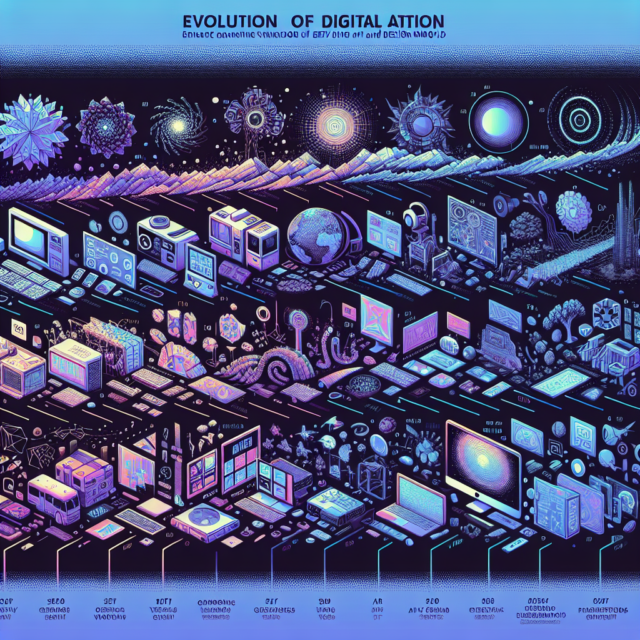
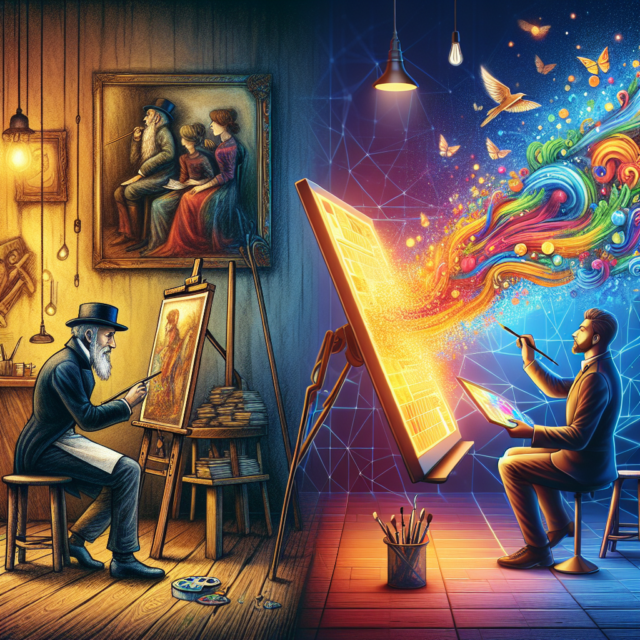
The world of art has undergone a remarkable transformation in recent years, fueled by the rapid advancements in digital technology. Digital art, once a niche interest, has now become a dominant force in the creative industry, challenging traditional art forms and opening up new avenues for expression and distribution. This article delves into the emerging trends in digital art, exploring its rise as a new creative era, the technological innovations shaping its evolution, and the profound impact of digital platforms on art distribution.
The Rise of Digital Art: A New Creative Era
Digital art has surged into prominence, marking a new era of creativity that transcends the limitations of traditional mediums. Artists are increasingly drawn to digital tools and platforms, which offer unprecedented flexibility and possibilities for expression. This shift is not merely a change in medium but a fundamental transformation in how art is conceptualized, created, and consumed. The accessibility of digital tools has democratized art creation, allowing more individuals to explore their creativity without the constraints of expensive materials or studio space.
The rise of digital art is also characterized by its ability to integrate various forms of media. Artists can now blend elements of photography, painting, animation, and even music to create immersive and multifaceted experiences. This convergence of media has given birth to new art forms, such as virtual reality art and interactive installations, which engage audiences in ways that were previously unimaginable. The boundaries between different art disciplines are blurring, leading to a richer and more dynamic art landscape.
Furthermore, digital art has opened up new dialogues around cultural and social issues. Artists are using digital platforms to address topics such as identity, climate change, and technology’s impact on society, reaching global audiences with messages that resonate across borders. This has not only broadened the scope of art but has also enhanced its role as a tool for social commentary and change. Digital art’s ability to quickly adapt and respond to current events makes it a powerful medium for contemporary discourse.
The commercial aspect of digital art is also undergoing a transformation. The emergence of cryptocurrencies and blockchain technology has introduced new ways of buying, selling, and owning art. Non-fungible tokens (NFTs) have become a popular means of authenticating and monetizing digital artworks, providing artists with new revenue streams and collectors with unique investment opportunities. This has reshaped the art market, challenging traditional notions of ownership and value.
Moreover, the rise of digital art is fostering a sense of community among artists and audiences. Online platforms and social media have made it easier for artists to connect with peers and fans, share their work, and collaborate on projects. This has led to a more interconnected and supportive art community that transcends geographical boundaries. Artists are not only able to showcase their work to a global audience but also receive instant feedback and support, which can be crucial for artistic development.
Finally, the educational landscape is also being influenced by the rise of digital art. Art institutions and schools are increasingly incorporating digital art into their curricula, recognizing its significance and potential. This shift is preparing a new generation of artists who are well-versed in both traditional and digital techniques, equipped to navigate the ever-evolving art world. As digital art continues to grow, it is clear that it is not just a passing trend but a significant movement that is reshaping the future of art.
Technological Innovations Shaping Digital Art
The evolution of digital art is closely tied to technological advancements that continue to redefine its possibilities. One of the most significant innovations is the development of sophisticated software and tools that enable artists to create intricate and detailed works of art. Programs like Adobe Creative Suite, Corel Painter, and Procreate offer a wide range of features that mimic traditional art techniques while providing the flexibility and precision of digital manipulation. These tools have become essential for digital artists, allowing them to experiment and innovate without the constraints of physical materials.
Virtual reality (VR) and augmented reality (AR) are also playing a pivotal role in shaping digital art. These technologies allow artists to create immersive experiences that engage audiences in novel ways. VR art installations transport viewers into entirely new worlds, offering a sense of presence and interactivity that traditional art forms cannot match. AR, on the other hand, overlays digital elements onto the real world, creating a seamless blend of the virtual and physical. These technologies are expanding the boundaries of art, offering new ways to interact with and experience artistic creations.
Artificial intelligence (AI) is another technological frontier that is influencing digital art. AI algorithms can generate art, assist in the creative process, and even analyze and critique artworks. Some artists are collaborating with AI to create pieces that challenge the notion of authorship and creativity, exploring the relationship between human and machine. AI’s ability to process vast amounts of data and identify patterns is also being used to curate and recommend art, enhancing the way audiences discover new works.
The rise of 3D printing technology has also impacted the digital art landscape. Artists can now create digital models and bring them to life as physical objects, blurring the lines between digital and traditional art. This capability has opened up new possibilities for sculpture and installation art, allowing for more complex and intricate designs. 3D printing also enables artists to experiment with materials and forms that would be difficult or impossible to achieve through conventional methods.
Blockchain technology, particularly through the use of NFTs, has introduced a new dimension to digital art. By providing a secure and transparent way to verify ownership and provenance, blockchain is addressing issues of authenticity and piracy that have long plagued digital artists. NFTs have also created a new market for digital art, allowing artists to monetize their work in ways that were not previously possible. This technology is transforming the economic landscape of digital art, offering new opportunities and challenges for artists and collectors alike.
Finally, advancements in display technology are enhancing the presentation and consumption of digital art. High-resolution screens, projectors, and digital frames allow for the display of digital art in stunning detail and clarity. These technologies are making it possible to exhibit digital works in galleries, museums, and public spaces, elevating their status and accessibility. As display technology continues to improve, the gap between digital and traditional art is narrowing, allowing digital art to be appreciated in new and exciting ways.
The Impact of Digital Platforms on Art Distribution
Digital platforms have revolutionized the way art is distributed, making it more accessible to a global audience. Online galleries and marketplaces like DeviantArt, ArtStation, and Saatchi Art provide artists with platforms to showcase their work to millions of potential buyers and admirers. These platforms have democratized the art world, allowing artists to bypass traditional gatekeepers such as galleries and auction houses. As a result, artists have greater control over the distribution and sale of their work, reaching audiences directly without intermediaries.
Social media has also played a crucial role in the distribution of digital art, acting as both a showcase and a marketing tool. Platforms like Instagram, Facebook, and TikTok enable artists to share their creations with a vast audience, build a following, and engage with fans. The viral nature of social media can propel unknown artists to fame overnight, providing them with opportunities that were previously out of reach. This has led to a more vibrant and diverse art scene, where a wide range of voices and styles can be heard and appreciated.
Streaming platforms have further expanded the reach of digital art by enabling live broadcasts and virtual exhibitions. Artists can now host live painting sessions, tutorials, and exhibitions, reaching audiences in real-time across the globe. This has not only broadened the reach of art but has also created new forms of interaction and engagement between artists and audiences. Virtual exhibitions, in particular, have gained popularity, especially in light of recent global events, providing a way for art to be experienced safely and conveniently.
The rise of e-commerce has also impacted the distribution of digital art. Artists can sell prints, merchandise, and digital downloads through online stores and platforms like Etsy and Redbubble. This has opened up new revenue streams for artists, allowing them to monetize their work in various ways. The convenience and accessibility of online shopping have made it easier for art lovers to discover and purchase art, contributing to the growth of the digital art market.
Collaboration and networking have been facilitated by digital platforms, enabling artists to connect and work together across geographical boundaries. Online communities and forums provide spaces for artists to share ideas, critique each other’s work, and collaborate on projects. This has led to the creation of collective artworks and initiatives that draw on the strengths and perspectives of diverse artists. The collaborative nature of digital platforms is fostering a more interconnected and dynamic art community.
Finally, digital platforms are playing a key role in preserving and archiving digital art. As digital art is inherently ephemeral, the challenge of preservation is significant. Platforms and initiatives dedicated to archiving digital art are ensuring that these works are documented and accessible for future generations. This is crucial for maintaining the cultural and historical significance of digital art, allowing it to be studied, appreciated, and enjoyed long into the future.
The world of digital art is constantly evolving, driven by technological innovations and the transformative power of digital platforms. As artists continue to explore new frontiers and redefine the boundaries of creativity, digital art is becoming an increasingly integral part of the art landscape. Its rise marks a new era of artistic expression, where the possibilities are limited only by the imagination. As we look to the future, it is clear that digital art will continue to shape and enrich our cultural experiences, offering new ways to see and understand the world.



 Source: Shrapnel


 Source: Beam Foundation