Home Blog Page 1236

Building Your First Hierarchical Multi-Agent System

0
Building Your First Hierarchical Multi-Agent System


Artificial intelligence (AI) has progressed from isolated, single-task agents to more sophisticated systems that can collaborate, strategize, and adapt to dynamic environments. These systems are known as multi-agent systems. While individual agents have their own strengths, they often fall short when faced with tasks that require diverse expertise, decision-making, and memory. This is where hierarchical multi-agent systems come into play.

Hierarchical multi-agent systems are structured environments in which multiple agents work together under a well-defined chain of command, often supervised by a central entity. They divide labor among specialized agents while ensuring that their activities are synchronized to achieve broader objectives. Let’s explore these systems, why they are necessary, the frameworks that support them, and how to create one.

What Is an Agent?

In AI, an agent is an automated decision-making entity that interacts with its environment to achieve specific goals. Think of an agent as a problem-solver: It receives queries, processes them, and autonomously decides what actions to take to deliver meaningful outputs. The agent achieves this by breaking down tasks, using tools, accessing memory systems, and planning workflows.

For example, a simple agent might answer a trivia question by querying a database, while a more complex agent could analyze financial data, evaluate investment opportunities, and generate actionable insights. Agents can also vary in sophistication:

Basic agents operate within fixed rules or workflows.

Advanced agents integrate tools, memory, and reasoning to adapt to complex, evolving scenarios.

Why Do We Need Multi-Agent Systems?

When tasks become too multifaceted for a single agent, a multi-agent system (MAS) offers a natural solution. Multi-agent systems consist of multiple agents collaborating on a shared objective. Each agent has a specific role, contributing its expertise to the larger workflow.

This structure is vital for several reasons:

Complex Problem Solving: Tasks often require diverse skill sets that cannot be provided by a single agent. Multi-agent systems divide responsibilities among specialized agents.

Workflow Separation: By segmenting tasks, MAS simplifies debugging and optimization. Each agent focuses on its area of expertise, making it easier to identify and address issues.

Improved Scalability: Multi-agent systems allow developers to add or modify agents without overhauling the entire system. This flexibility is crucial for scaling AI solutions to handle larger datasets or more intricate tasks.

For example, in a disaster response scenario, one agent might analyze weather patterns, another might coordinate with rescue teams, and a third could monitor supply inventory. Together, these agents create a comprehensive system for efficient management of the operation.

Challenges in Designing Multi-Agent Systems

Designing a multi-agent system is not without its challenges. Key issues include:

Inter-Agent Communication: Ensuring agents can communicate effectively to share information and synchronize efforts.

Maintaining Context: Agents must have access to shared memory or knowledge to make informed decisions.

Error Handling: A fault in one agent can cascade through the system, potentially disrupting the workflow.

Dynamic Decision-Making: Agents must adapt to real-time changes in the environment or user input.

To address these challenges, multi-agent systems often incorporate frameworks that provide built-in mechanisms for coordination, memory sharing, and error mitigation.

Frameworks for Multi-Agent Systems

Several frameworks exist to simplify the creation and management of multi-agent systems. Each offers unique features tailored to different needs.

1. AutoGen

AutoGen, developed by Microsoft, is an open-source framework for creating agents that can collaborate autonomously. It focuses on facilitating seamless communication between agents while supporting tool integration and human-in-the-loop workflows. AutoGen is particularly effective for automating tasks that require agents to interact with tools and databases.

2. Crew AI

Crew AI builds on the concepts of autonomy introduced by AutoGen but emphasizes role-based agent design. In Crew AI, each agent has predefined responsibilities, and the system enables flexible inter-agent delegation. This framework is ideal for scenarios requiring structured interactions, such as project management or customer service workflows.

3. LangGraph

LangGraph takes a unique approach by using graph-based representations for multi-agent workflows. It allows developers to define detailed workflows with cyclical processes, making it suitable for dynamic and iterative decision-making. LangGraph also integrates with LangChain, leveraging its capabilities to expand into more complex applications.

These frameworks provide developers with the tools to create robust and scalable multi-agent systems tailored to their specific requirements.

Types of Multi-Agent Systems

Multi-agent systems are often categorized based on their organizational structure and how agents interact:

Collaboration-Based Systems

In collaboration-based systems, agents work together to achieve a common goal. These agents share context and interact frequently to exchange information and refine strategies. Each agent brings its unique expertise to the table, contributing to the success of the system as a whole. For instance, in a customer service setup, one agent might handle technical queries while another manages account-related concerns.

Agent-Supervisor Systems

In an agent-supervisor setup, a central supervisor oversees subordinate agents, delegating tasks, monitoring progress, and ensuring alignment with the system’s objectives. This structure provides centralized control and is particularly useful for scenarios where strict coordination is required. For example, in a legal research system, the supervisor could assign research tasks to specific agents specializing in different areas of law.

Hierarchical Team Systems

Hierarchical systems are organized into multiple levels, with higher-level agents managing broader objectives and lower-level agents focusing on specific tasks. For example, in a search-and-rescue operation, a top-level agent could coordinate efforts across regions, while mid-level agents manage local operations, and specialized agents handle tasks like navigation or communications.

Building a Hierarchical Multi-Agent System

Let’s explore how to design a hierarchical multi-agent system for a search-and-rescue operation. In this system, the agents will include a Supervisor managing three specialized agents: Pilot, Co-Pilot, and Combat Systems Operator (CSO). Each agent will use external tools and knowledge to execute its tasks efficiently.

Step 1: Setting Up the Environment

First, set up the required libraries and create the foundational components for your system. Install dependencies:

pip install langchain langgraph openai python-dotenv qdrant-client

Step 2: Creating a Knowledge Base

The agents will require access to domain-specific knowledge, such as an Air Force handbook, through a retrieval-augmented generation (RAG) system:

from langchain.document_loaders import PyMuPDFLoader
from langchain.text_splitter import RecursiveCharacterTextSplitter
from langchain_community.vectorstores import Qdrant
from langchain_openai import OpenAIEmbeddings

docs = PyMuPDFLoader(“search_rescue_manual.pdf”).load()
splitter = RecursiveCharacterTextSplitter(chunk_size=300, chunk_overlap=0)
splits = splitter.split_documents(docs)

embedding_model = OpenAIEmbeddings()
vectorstore = Qdrant.from_documents(splits, embedding_model, location=“:memory:”)
retriever = vectorstore.as_retriever()

Step 3: Defining Tools

Define tools that agents can use to retrieve knowledge or perform tasks:

from langchain_core.tools import tool

@tool
def fetch_info(query: str):
“””Retrieve information from the knowledge base.”””
return retriever.get_relevant_documents(query)

Step 4: Creating Specialized Agents

Create agents for specific roles, each equipped with the necessary tools:

from langchain.agents import create_openai_functions_agent, AgentExecutor
from langchain_core.prompts import ChatPromptTemplate, MessagesPlaceholder

agent_prompt = ChatPromptTemplate.from_messages([
(“system”, “You are a {role}. Perform your duties professionally.”),
MessagesPlaceholder(“messages”)
])

def create_agent(role):
return AgentExecutor(
agent=create_openai_functions_agent(llm, tools=[fetch_info], prompt=agent_prompt.partial(role=role))
)

pilot = create_agent(“Pilot”)
copilot = create_agent(“Co-Pilot”)
cso = create_agent(“Combat Systems Operator”)

Step 5: Creating the Supervisor

The supervisor will manage the workflow and decide which agent should act next:

from langgraph.graph import StateGraph, END

supervisor_prompt = ChatPromptTemplate.from_messages([
(“system”, “You are the supervisor managing Pilot, Co-Pilot, and CSO. Decide who acts next.”),
MessagesPlaceholder(“messages”)
])
supervisor = supervisor_prompt | llm.bind_functions()

class MissionState(dict):
messages: list
next_agent: str

workflow = StateGraph(MissionState)
workflow.add_node(“Pilot”, lambda state: pilot.invoke(state))
workflow.add_node(“Co-Pilot”, lambda state: copilot.invoke(state))
workflow.add_node(“CSO”, lambda state: cso.invoke(state))
workflow.add_node(“Supervisor”, supervisor)

workflow.add_edge(“Supervisor”, “Pilot”, condition=lambda s: s[“next_agent”] == “Pilot”)
workflow.add_edge(“Supervisor”, “Co-Pilot”, condition=lambda s: s[“next_agent”] == “Co-Pilot”)
workflow.add_edge(“Supervisor”, “CSO”, condition=lambda s: s[“next_agent”] == “CSO”)
workflow.add_edge(“Pilot”, “Supervisor”)
workflow.add_edge(“Co-Pilot”, “Supervisor”)
workflow.add_edge(“CSO”, “Supervisor”)
workflow.set_entry_point(“Supervisor”)

chain = workflow.compile()

Step 6: Running the System

Simulate the search-and-rescue mission:

scenario = “Mission: Locate the missing SS Meridian in the North Atlantic.”

messages = [scenario]
state = {“messages”: messages}
while True:
result = chain.invoke(state)
if END in result:
break
state[“messages”].extend(result[“messages”])
print(“\n”.join(result[“messages”]))

Conclusion

Hierarchical multi-agent systems provide a robust framework for tackling complex tasks by leveraging specialization, collaboration, and centralized control. These systems can achieve remarkable efficiency and accuracy by incorporating tools, knowledge bases, and structured workflows. Whether for search-and-rescue missions or enterprise-level project management, the potential applications of multi-agent systems are vast.


Source link

Metaverse Standards Forum 2024 Annual Report

Metaverse Standards Forum 2024 Annual Report


Introduction

The Metaverse Standards Forum marked a significant milestone in April 2024 by celebrating its first anniversary as an independent non-profit industry consortium. As we reflect on our journey, we want to share our achievements with the community and express our thanks to everyone who has supported our growth. This report showcases the Forum’s key accomplishments and milestones throughout 2024.

Forum Motivation and Formation

The end of 2021 marked a pivotal moment when the technology industry recognized an extraordinary convergence of several disruptive technologies—artificial intelligence, GPU processing, XR, Web3, and advanced networking including 5G/6G. While each of these innovations is transformative in its own right, their integration represents a generational shift in how humans interact with technology, merging the connectivity of the Web with the immersiveness of Spatial Computing. This technological synthesis has come to be known as “the metaverse.”

While the future integration of these rapidly evolving technologies will unfold through a complex, evolutionary process that defies precise prediction, one fundamental imperative is immediately clear: interoperability through global open standards. This foundation of interoperability will enable companies and platforms to effectively harness emerging technologies as they become pervasive, creating market opportunities that far exceed what any system could achieve alone in its isolated silo.

The metaverse’s broad scope requires open standards developed by a diverse ecosystem of organizations—Standards Development Organizations (SDOs), consortia, non-profits, companies, and academic institutions. Yet traditionally, SDOs have operated within their specific domains of expertise, which can limit broader industry collaboration. Creating the metaverse demands cross-disciplinary communication and cooperation. The Metaverse Standards Forum emerged to address this need—not as a standards body, but as a neutral, accessible venue where standards organizations and industry can come together to collaborate.

In 2022, as interest in the metaverse grew, The Khronos Group—an SDO active in metaverse-related open standards for 3D acceleration, AI, and XR—recognized the need for a widely accessible venue where organizations could coordinate their interoperability efforts. However, no such organization existed at the time. In response, Khronos President Neil Trevett, together with Patrick Cozzi of Cesium and Marc Petit of Epic Games, initiated the Metaverse Standards Forum as a one-year funded project running from April 2022 to April 2023. The Forum launched in June 2022 with 37 founding members, comprising companies, SDOs, and industry associations, united in their mission to coordinate efforts toward building a global, open, and inclusive metaverse.

During its initial “incubation” period as a Khronos Group project, the Forum established its foundational infrastructure, including its website and support systems. The organization adopted many of the Khronos Group’s proven best practices, with Khronos leadership—including Neil Trevett and Emily Stearns—serving as Forum leaders, roles they continue to hold today. The Forum’s explosive growth to over 2,600 member organizations demonstrated the industry’s clear need for such a collaborative platform.

Plurality, inclusivity, openness, transparency, and decision-making by consensus have been key values of the Forum since its inception. In April 2023, having validated its core concepts, the Forum took a significant step forward: its membership voted to incorporate as an independent non-profit, establishing its own governance, finances, and operations under an elected leadership board. Since its incorporation as a Delaware non-profit, the Forum has maintained its founding principles of openness and pragmatic action to accelerate metaverse interoperability. With its extraordinary membership of over 2,600 organizations, the Forum holds a unique position to enhance visibility and foster cooperation on metaverse standards—creating meaningful industry-wide impact through global collaborative participation.

The Industry Role of the Metaverse Standards Forum

Since its founding, the Forum has emphasized pragmatic, industry-driven collaboration, eschewing rigid metaverse definitions and long-term roadmaps. Instead, it acknowledges that the metaverse will evolve through successive waves of innovation, propelled by emerging technologies and products. Through its bottom-up pre- and post-standardization activities, the Forum helps address urgent industry needs while fostering immediate business opportunities—steps toward an open, standards-based metaverse that many view as the internet’s natural evolution into the Spatial Web.

The Forum serves as a collaborative platform that enhances and accelerates the work of standards organizations by facilitating broader exploration of interoperability in metaverse development. While the Forum does not create standards itself, it actively supports standards organizations in their mission to build an interoperable, open metaverse. As illustrated in the figure below, the Forum’s activities are structured around two key phases: pre-standardization and post-standardization.

Figure 1: Metaverse Standards Forum pre- and post-standardization activities

The Forum fills a unique pre-standardization role by bridging a critical gap in the interoperability timeline—the period after a technology and its need have been proven but before formal standards exist. Through its post-standardization activities, the Forum helps ensure deployed standards effectively meet industry needs. By fostering communication across traditional standardization boundaries, the Forum identifies overlooked opportunities for cross-domain collaboration and supports SDOs in developing effective interoperability standards.

Forum Organization

Any young organization must organize effectively to make an impact. The Forum’s governance structure includes a board of elected directors and officers who champion the interests of its members. This board convenes monthly to strategize on optimal resource allocation to maximize return on investment for both members and the broader industry.

As a non-profit organization, the Forum is a means rather than an end in itself, and so the Forum maintains deliberately inclusive participation policies—requiring no NDAs, patent licensing obligations, or participation fees for many of its activities, including Domain Groups where detailed interoperability discussions and activities are held. While core activities remain freely accessible, the Forum requires funding to operate and achieve its goals. To this end, it offers a paid ‘Principal Member’ tier through which organizations can support Forum activities. In return, Principal Members gain a voice in guiding the Forum’s work through oversight of Domain Groups, the right to vote and stand in Board elections, and priority marketing considerations.

Figure 2: Metaverse Standards Forum Organizational Structure

The Forum has 2,613 member organizations headquartered across five geographic regions, representing international participation from a truly global ecosystem.

Figure 3. Distribution of Forum Membership by Geographic Region

The Forum’s diverse membership spans 76 major organizations, thousands of smaller entities, and over 4,000 individual professionals who have registered through the member portal—all united by their commitment to advancing interoperability and standards development.

Domain Group Process

Since its inception, the Forum has established agile, pre-standardization collaboration processes that serve its diverse membership. It focuses on practical, fast-moving initiatives through regular Working Group meetings, with priorities emerging organically from members to ensure industry relevance. As illustrated in the figure below, Forum members advance their ideas and interests through a Domain Group process, where Exploratory Groups develop Working Group charters by consensus. Through its Domain Groups, the Forum develops cross-disciplinary use cases and requirements, providing standards bodies with valuable insights to ensure their work delivers real-world impact.

Figure 4: Metaverse Standards Forum Domain Group Process

The Forum’s Domain Group Process stands as a cornerstone of its activities, ensuring all members can shape Forum priorities and activities, while maintaining the Forum’s focus on pragmatic projects and deliverables that address urgent metaverse interoperability needs. Members actively generate new ideas for Forum initiatives—in just one year, nearly 250 ideas have been organized into more than 20 domains of interest. Members can align themselves with these domains and upvote topics for Exploratory Group consideration. The figure below lists the topics for which Working Groups have formed or are being proposed. Through its pipeline of member-driven Domain Groups, the Forum has cultivated an unprecedented level of open dialogue between the standards community and broader industry.

Figure 5: Metaverse Standards Forum Domain Groups at the end of 2024

Forum Effectiveness

The Forum’s remarkable growth presents both opportunities and challenges. With our extensive membership and numerous activities, members can find it challenging to identify the groups and projects that will best serve their organizations. To streamline participation, we provide a comprehensive member website and portal detailing ongoing projects and groups. Our managing director hosts monthly orientation sessions for new members, supported by detailed guides and documented best practices to help members engage effectively.

Given the metaverse’s technological breadth and our global membership, accommodating diverse interests across time zones requires careful planning. We conduct well-attended monthly plenary meetings, twice on the same day to enable worldwide participation, while Principal Members participate in additional monthly oversight meetings to oversee Domain Group activities. All meeting materials, recordings, and minutes are openly available online to all members at any time.

We continue to strengthen coordination between Domain Groups with adjacent interests. Quarterly progress review meetings for Working Group chairs complement ongoing efforts to align and enhance Domain Group activities, ensuring effective collaboration across the Forum’s initiatives.

The Forum Standards Register Working Group plays a vital role in promoting visibility, coordination, and cooperation across Domain Groups. Through its database, the group tracks metaverse-relevant standardization activities and key standards throughout the industry, helping organizations navigate the complex standardization landscape. The Working Group is also developing a comprehensive database of metaverse use cases and a standardized glossary. This work ensures consistent terminology across Forum activities while supporting broader industry alignment through collaboration with initiatives working to establish common language for use cases, requirements, and projects.

Figure 6. Process for populating the Metaverse Standards Forum Standards Register

Global Engagement

Since its incorporation, the Forum has achieved significant milestones and emerged as a leading voice in discussions about open and interoperable metaverse technologies through media engagement, events, content creation, social media presence, and educational initiatives.

The Forum has garnered substantial industry attention, generating 1,234 pieces of global media coverage from prominent outlets including VentureBeat, Reuters, Forbes, Decrypt, and Immersive Wire. This extensive coverage across mainstream and specialized tech media demonstrates the Forum’s growing influence in metaverse development.

Forum members have shared their expertise through numerous digital platforms, participating in prominent podcasts and webinars such as Voices of VR, 80 Level, Meta Minutes, ACM Bytecast, and XR Today. The Forum’s work has been featured in major analyst research and forecast reports, with leadership maintaining active dialogue with leading industry analysts including Forrester, McKinsey, Gartner, and others. The Forum’s digital presence continues to grow, with nearly 13,000 followers across LinkedIn, Bluesky, Mastodon, and YouTube.

The Forum’s influence extends to major industry events, where members have contributed to dozens of panels, presentations, and networking sessions at prestigious gatherings including CES, Mobile World Congress, SXSW, SIGGRAPH, and SIGGRAPH Asia. Members have also presented at numerous Standards Development Organization meetings, including ISO/IEC JTC1, IEEE, ITU, and W3C, including efforts to support the UN’s Sustainable Development Goals, ensuring open metaverse standards discussions reach all stakeholders.

The Forum’s innovative work earned recognition as one of Fast Company’s ten World-Changing Ideas in the Experimental category for 2023. Its YouTube channel serves as a comprehensive public resource, featuring presentations from industry experts, events and Domain Group speakers.

In late 2024, the Forum launched a series of open Town Hall meetings focused on vital metaverse topics. The first two sessions—exploring Volumetric Media and OMA3’s Inter World Portaling System—drew significant community and attendance.

Challenges and Opportunities

Despite strong momentum and participation, the Forum is navigating challenges in its core mission: promoting cooperation to encourage and inform the development of interoperability standards for the immersive web. Looking ahead to 2025, the Forum’s leadership is committed to continue transforming these challenges into opportunities to benefit the broader industry.

The term ‘metaverse’ has weathered a significant hype cycle, where inconsistent definitions led to confusion and premature declarations of its demise. The surge in AI interest has further complicated the narrative, with some suggesting AI has superseded the metaverse as a transformative technology. However, viewing the metaverse through the Forum’s inclusive definition—the convergence of web connectivity with spatial computing—reveals that activity in this space is not only continuing but accelerating. AI serves as an enabler, enhancing metaverse capabilities, while the metaverse will often provide a natural interface for AI interactions and agents. The Forum will intensify its efforts to show how AI and the metaverse are interconnected technologies that enhance and amplify each other.

While the term ‘metaverse’ may currently carry baggage from its hype cycle, the underlying technological convergence it represents remains vibrant and growing. Until a more precise term emerges, the Forum will continue to focus on educating the industry about the concrete and significant capabilities being developed, rather than debating the term itself.

While the late 2021 surge in metaverse interest sparked numerous initiatives—many of which have since ceased—the Forum remains focused on strengthening its industry relevance through a unique approach: concentrating on pre- and post-standardization activities for the emerging immersive web. Rather than debating theoretical long-term roadmaps, the Forum encourages the natural member-driven evolution of pragmatic projects that create immediate business opportunities through growing interoperability.

Like many startups, the Forum faces ongoing funding challenges. We are focused on delivering strong, tangible value to our members to encourage Principal Member participation and financial support, while exploring additional revenue sources—including grants and collaborations for projects where the Forum’s unique capabilities and broad industry participation can create distinctive value.

The Forum’s Elected Board of Directors

In April 2024, the Metaverse Standards Forum marked its first anniversary of incorporation with the installation of a newly elected Board of Directors—a pivotal moment in its mission to advance interoperability standards for an open and inclusive metaverse.The 19-member Board brings together distinguished leaders from prominent organizations, representing a comprehensive range of metaverse-related expertise: generative AI research, 3D geospatial technology, systems architecture, standardization, network technology, AR, VR, multimedia, and the legal and privacy considerations of emerging technologies. This Board oversees the Forum’s core mission of providing a neutral venue where standards organizations and companies can collaborate to develop interoperability standards for an open metaverse.

The Board’s executive leadership comprises four officers: Neil Trevett as president, Emily Stearns as executive director, Christine Perey as secretary, and Yu Yuan as treasurer. More details on Board members are provided below:

Matt White | CEO, Berkeley Synthetic – An AI and simulation researcher, Matt is known for successfully deploying large-scale AI and simulation platforms across the telecom, gaming, media, and entertainment industries.
Patrick Cozzi | CEO, Cesium – Patrick is dedicated to advancing the field of 3D geospatial and is a recognized expert in 3D graphics and mapping technology, open standards, and open-source software.
Eric Klein | co-founder Cloudonix, Inc. – Eric has over 30 years of experience in telecommunications, mobile, and networking. He is a mentor, community advocate, writer and strategic advisor across many aspects of technology and he currently serves as the chair of the Technical Interoperability and End User Troubleshooting Exploratory Working Group at the Forum.
Leonard Daly | Daly Realism – Leonard has a long career in 3D graphics and open standards and specializes in 3D systems design.
Liam Broza | co-founder, Ethereal Engine – working on the intersection of spatial computing, computer vision, and data sovereignty, Liam’s work focuses on building the open social, spatial web for all.
Mats Lundgren | Futurewei Technologies’ director open source technology strategy – Mats has 20 years of experience in telecommunications, mobile, and wireless.
Rouslan Ovtcharoff | founder and CEO, Groovesetter – Rouslan brings a passion for blockchain technologies and expertise in film and television production, distribution, advertising, XR, and interactive media. He is also the co-founder of the Blockchain Global Entertainment Alliance, a non-profit organization dedicated to promoting blockchain education, adoption and common standards in the entertainment industry.
Paul Higgs | Huawei Vice President of Video Industry Development – Paul brings 20+ years of experience in systems architecture, engineering, and development management for next-gen technology to the table.
William Benman JD | CEO of Integrated Virtual Networks and Web3D Consortium Board Member – Bill is the inventor of multiple patents on IVN’s Silhouette® Technology and has experience in telecommunications, aerospace, and intellectual property law.
Fred Chesbro, Esq. | Co-founder, Metaverse Radio WMVR-db Chicago – Championing the intersection of creativity in the digital frontier while covering events and hosting ongoing conversations about the metaverse’s potential for advancing music, visual arts, and literature.
Ulrich Dropmann | Nokia Head of Standardization and Industry Environment – Ulrich heads external standardization engagement and is responsible for global and regional standardization, including radio spectrum aspects.
Alfred Tom | Executive Director, OMA3, President of Lumian Foundation, and CEO of Wivity – Alfred has run multiple consortia and helped create several industry standards, including SunSpec Alliance, Car Connectivity Consortium, GENIVI, PC Card, and IrDA. His current focus is assisting Web3 consortia and DAOs operate.
Christine Perey | President, PEREY Research & Consulting – Christine specializes in helping organizations identify new opportunities for Augmented Reality in industrial and enterprise use cases.
Ben Erwin | owner, Powersimple, LLC – Dedicated to the advancement of the XR industry, Ben has developed the advocacy and recognition platform The Polys – WebXR Awards, the WebXR Summit Series, and MetaTr@aversal, which have created engagement and awareness of the immersive web.
Thomas Stockhammer | Qualcomm Senior Director of Technical Standards – Thomas is an award-winning tech and standards leader in mobile multimedia, TV, adaptive video streaming, 5G Broadcast, XR technologies, and is also IEEE Fellow.
Virginie Maillard | SIEMENS Head of Technology Field Simulation and Digital Twin – Virginie leads tech research in the US and serves as the global Head of research in Simulation and Digital Twins.
Marc Petit | Principal Consultant, TRNSFRM Inc – Marc is a co-founder of Building the Open Metaverse podcast and serves as co-chair for the 3D Asset Interoperability Working Group. Marc spent 35 years in computer graphics at TDI, SOFTIMAGE, Autodesk, Fabric Engine, and most recently, Epic Games.
Yu Yuan | Co-founder of VerseMaker and CEO of 0xSenses – Yu is a visionary scientist, inventor, entrepreneur, and investor in the areas of Virtual Reality, Metaverse, and Digital Transformation. He has held a variety of leadership roles, including but not limited to Founder and Acting President of the Metaverse Acceleration and Sustainability Association (MASA), Treasurer of the Metaverse Standards Forum, President of the IEEE Standards Association, and Member of the IEEE Board of Directors.
Elizabeth Rothman | XRSI.ORG Senior Legal Affairs and Digital Trust Advisor – Elizabeth is an attorney and advisor in emerging technology, often working at the forefront of legal, privacy, and safety concerns presented by the implementation and convergence of technologies in digital environments.


The Forum sincerely thanks all Board members for their generous donation of time and expertise to further the Forum’s mission.

Looking Ahead

2024 has marked unprecedented advances in technologies and applications shaping the metaverse—a rapidly emerging global platform for connected spatial computing. The rise of AI has proved especially transformative, unlocking new applications that solve real challenges in both consumer and industrial domains. This accelerating progress strengthens our commitment to ensure the standards community comprehensively supports metaverse development, enabling its revolutionary potential to become reality.

As we mark our first year as an incorporated entity, we deeply value our members’ contributions and extend an open invitation to all organizations to join the Forum. Our Domain Groups offer members the opportunity to propose, lead, and participate in initiatives that advance both their own missions and the broader metaverse ecosystem. We particularly welcome new Principal Members who can help shape our direction and sustain our ongoing work.

Together, we will continue advancing standard protocols and interfaces for an open and interoperable metaverse in 2025 and beyond!



Source link

BlockDAG’s BDAG400 Offer Starts at 250%: What Do the Bonuses Reflect? Stellar Eyes $0.60 & Shiba Inu Targets 260% Rally!

BlockDAG’s BDAG400 Offer Starts at 250%: What Do the Bonuses Reflect? Stellar Eyes alt=


The crypto space is wide awake with optimistic updates, especially related to Shiba Inu (SHIB), Stellar coin (XLM), and BlockDAG (BDAG). 

XLM edges closer to breaking the pivotal $0.361 resistance, with projections of a surge to $0.60. Meanwhile, SHIB gains attention with a bold 260% growth forecast, spurred by whale activity and bullish technical patterns. 

At the same time, BlockDAG’s BDAG400 bonus offer is also catching the eye of crypto buyers. This offer includes five enticing bonuses starting at 250%, whereas speculations suggest that this bonus might be the first step in something monumental. 

While optimistic trends revolve around these crypto coins, which one is turning out to be the best crypto to buy now for big returns? Let’s find out.

BlockDAG’s BDAG400 Offer Starts at 250%: What Do the Bonuses Reflect? Stellar Eyes $0.60 & Shiba Inu Targets 260% Rally!

Shiba Inu Rally: A Whale-Driven Surge?

Shiba Inu’s (SHIB) rally is making headlines with projections of a 260% price increase, reaching $0.000081 in the next few months. Analysts note “textbook bull signals” on the charts. This SHIB rally is primarily due to significant whale activity, such as a withdrawal of 220 billion SHIB tokens from Binance, which suggests growing institutional interest. 

BlockDAG’s BDAG400 Offer Starts at 250%: What Do the Bonuses Reflect? Stellar Eyes $0.60 & Shiba Inu Targets 260% Rally!

For SHIB to reach its target, it must break the key resistance level of $0.000029. Positive market sentiment and increased trading volume are encouraging. The broader cryptocurrency context, including the stabilization of Ethereum and Bitcoin, supports SHIB’s potential growth. Investors remain cautious, emphasizing informed decisions and risk management.

Stellar (XLM) Technical Analysis: Will it Hit $0.60?

Stellar (XLM) is gaining notice with the potential to hit $0.60, contingent on breaking the critical $0.361 resistance level. XLM was recently trading near $0.355 after an 8.5% rally in 24 hours, with trading volume up by 55%. Open Interest (OI) surged by 18%, indicating growing trader interest. 

BlockDAG’s BDAG400 Offer Starts at 250%: What Do the Bonuses Reflect? Stellar Eyes $0.60 & Shiba Inu Targets 260% Rally!

Stellar (XLM) technical analysis suggests that if XLM closes above $0.371, it could rise by 62%, reaching $0.60. The asset, trading above the 200 EMA, remains in an uptrend. However, significant liquidation areas near $0.339 and $0.361 reflect over-leveraged positions, highlighting the need for caution. The Stellar technical analysis reveals key price levels that traders must monitor to capitalize on potential price movements.

BlockDAG’s BDAG400 Bonus: The Start of a Blockchain Revolution?

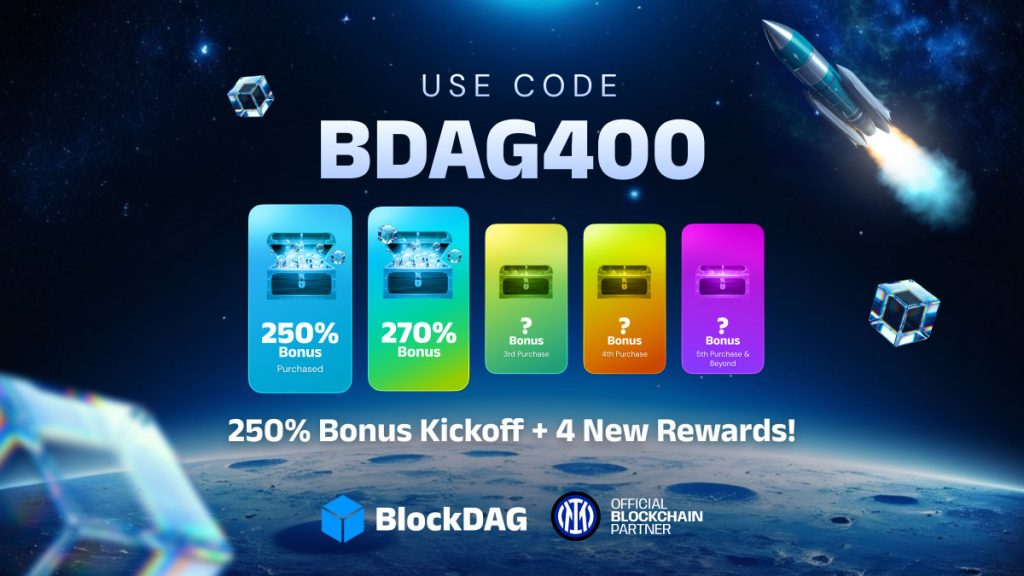
BlockDAG, an emerging crypto project, is making waves in the crypto community with its BDAG400 offer, which starts at a 250% bonus, followed by a 270% bonus. Additionally, the scheme features three mystery boxes for additional purchases, each offering increasingly larger bonuses. 

This contemporary bonus system has significantly boosted demand for BDAG coins, drawing in thousands of new buyers eager to maximize their potential returns before the offer concludes. The bonus has propelled the presale to over $176 million, with more than 17.6 billion coins sold, underscoring significant buyer interest. The bonus structure aims to reward early supporters and create a strong foundation for the project’s long-term success. 

BlockDAG’s BDAG400 Offer Starts at 250%: What Do the Bonuses Reflect? Stellar Eyes $0.60 & Shiba Inu Targets 260% Rally!

What’s more intriguing is that the substantial bonuses may reflect more than just a presale incentive. They could signal confidence in BlockDAG’s quantum-resistant technology and decentralized vision. The platform utilizes a Directed Acyclic Graph (DAG) structure designed to enhance speed and security. This makes it a prime candidate for decentralized finance (DeFi) applications.

With the mainnet launch scheduled in 2025, early participants are in for a big ROI. Early adopters from batch 1 have already witnessed a staggering ROI of 2240% since batch 1. Buyers joining the presale right now at the current price of $0.0234 per BDAG coin in batch 26 are also in for massive ROI as analysts predict the coin will reach $1 in 2025. 

This growth suggests that BlockDAG is among the best crypto coins to buy now. The community’s adoption of the BDAG400 bonus and the ongoing successful presale signal that BlockDAG has the potential to disrupt the entire crypto space with its expansion.

Which Coin is Shaping the Future of Crypto?

As we enter 2025, Shiba Inu’s rally, Stellar’s (XLM) technical analysis, and BlockDAG’s BDAG400 bonus emerge as pivotal highlights. SHIB’s potential 260% surge, fueled by whale activity and positive sentiment, showcases its strength in the market. XLM’s promising growth towards $0.60 underscores its technical strength, emphasizing key resistance levels traders must watch. 

Meanwhile, BlockDAG’s BDAG400 bonus, with rewards starting at 270% bonus and progressing incentives—has stunned buyers, propelling its presale past $176 million and hinting at the dawn of a potential revolution in the crypto space. These developments showcase growth potential for this booming project, making BlockDAG the best crypto coins to buy now.

BlockDAG’s BDAG400 Offer Starts at 250%: What Do the Bonuses Reflect? Stellar Eyes $0.60 & Shiba Inu Targets 260% Rally!

Presale: https://purchase.blockdag.network

Website: https://blockdag.network

Telegram: https://t.me/blockDAGnetworkOfficial

Discord: https://discord.gg/Q7BxghMVyu

Disclaimer

In line with the Trust Project guidelines, please note that the information provided on this page is not intended to be and should not be interpreted as legal, tax, investment, financial, or any other form of advice. It is important to only invest what you can afford to lose and to seek independent financial advice if you have any doubts. For further information, we suggest referring to the terms and conditions as well as the help and support pages provided by the issuer or advertiser. MetaversePost is committed to accurate, unbiased reporting, but market conditions are subject to change without notice.

About The Author


Gregory, a digital nomad hailing from Poland, is not only a financial analyst but also a valuable contributor to various online magazines. With a wealth of experience in the financial industry, his insights and expertise have earned him recognition in numerous publications. Utilising his spare time effectively, Gregory is currently dedicated to writing a book about cryptocurrency and blockchain.

More articles


Gregory, a digital nomad hailing from Poland, is not only a financial analyst but also a valuable contributor to various online magazines. With a wealth of experience in the financial industry, his insights and expertise have earned him recognition in numerous publications. Utilising his spare time effectively, Gregory is currently dedicated to writing a book about cryptocurrency and blockchain.


Source link

When is the Nintendo Switch 2 reveal coming? Some fans have turned to tarot readings for an answer, and I’m only 50% sure they must be joking

0
When is the Nintendo Switch 2 reveal coming? Some fans have turned to tarot readings for an answer, and I’m only 50% sure they must be joking


You know the Nintendo Switch 2? That small thing absoltely no one’s been speculating about and hungry for news on for a good while now? Well, some fans are now seemigly so desperate for any clues that might help them work out when a reveal is coming that they’re resorting to tarot readings.

Yep, forget giving tarot readings on your current Switch while playing the likes of The Cosmic Wheel Sisterhood, a game which has its own sex toy, we’re having a go at using it to work out when the suits at Nintendo will go ‘Right, time to show them all the thing’.

Manage cookie settings

“Tarot Reader predict Switch 2 reveal is imminent” reads the title of a recent post on r/NintendoSwitch2 that has a fair few upvotes. The poster, user Future31, claims that a moderator on Famiboards with the handle Tangerine_Cookie has recently done a reading using their deck – one which this user says has previously correctly predicted the Metroid Prime 4 trailer would be in last June’s direct – and the conclusion you can draw is that the Switch reveal is coming soon.

Obviously that’s not something you could infer to be a possibility from all of the news stories about alleged Switch 2 leaks coming out at the moment.

According to Future31, the three cards pulled when the deck was asked about the Switch 2 reveal were The Five of Swords (Reversed), the Nine of Pentacles (Reversed), and the Four of Wands. The poster says these cards can represent the likes of “compromise, moving on, open to Change, end of conflict”, “setbacks, poor investment, burning out, undeserved rewards”, and “celebration, prosperity, surprise, earned success and joy” respectively.

That combo, this poster reckons, points to an imminent reveal. “The themes of compromise and end of conflict signal that the big wait for the reveal is over,” they reason, “It’s time to move on from Switch 2 speculation to Switch 2 enjoyment, and go through the period of ‘what do we speculate about next?’.

“There have been setbacks during this, though! We know the Switch Pro was internally canceled, and this generation has been super long. Launch Switches are definitely burning out, and the theme of undeserved rewards clearly speaks of Nintendo still getting pretty good sales numbers with no new hardware. I’m assuming the poor investment might have something to do with Samsung somehow, that kind of fits.

“Soon, we will get to celebrate the reveal and launch of the Switch 2, with all the joy and surprises that come from the launch lineup – something that will definitely earn Nintendo a lot of money, and an earned success.”

Sure, Jan. That, as you can imagine has been the response of a lot of even the most hardened Switch truthers. “This is solid evidence,” writes one, “That we have gone nuts.”

Will the Switch 2 be revealed soon? Either way, unless your fancy cards are willing to provide a concrete date and time, odds are they’re not gonna be believed by anyone who’s not spent a bit too much time staring at pictures of joy-cons.


Source link

Tiny Pixel Adventure – A classic pixel retro game that will captivate you for the Amiga!

0
Tiny Pixel Adventure – A classic pixel retro game that will captivate you for the Amiga!


Thanks to Saberman contacting us late last night, we have been told that the developer HooGames2017, who created the awesome scorpion engine based game of Dr.Dangerous, has made available the brilliant Commodore Amiga game of ‘Tiny Pixel Adventure’. A game in which the dev says “Welcome to the colorful and dangerous world of Tiny Pixel Adventure, a classic pixel retro game that will captivate you!”. To coincide with this news, we’ve got a new video from the latest version that’s available to download right now!

Here’s the latest from the website. “As a brave hero, you embark on a series of exciting quests in which you overcome obstacles and master challenges. But beware – there are plenty of weird enemies lurking for you! From bouncing mushrooms and rolling balls to aggressive bees and dangerous plants – the world of Tiny Pixel Adventure is full of strange creatures that will do anything to stop you. With every quest you complete, you receive a key that gives you access to new, even more exciting areas. But don’t worry, it’s not just about keys – it’s about the thrill of surviving the next challenge and defeating the crazy enemies”.

“The retro pixel graphics and captivating soundtrack make each level a unique experience, while the mix of puzzles and gripping action will keep you on the edge of your seat. Are you ready to face the countless adventures and creatures?”

Article Update : 

This is the finished game. All bugs should be fixed so far. If someone finds a bug he can post it here. I am happy about every donation, as I would like to use it to advance further projects and also want to release some new games for the Amiga in the near future. The game is free, but every donation counts 😉 


Source link

인공지능(AI)이 게임 산업을 변화시킨 4가지 방법

인공지능(AI)이 게임 산업을 변화시킨 4가지 방법


인공지능(AI)이 게임 산업을 변화시킨 4가지 방법

현재 인공지능 기술은 비즈니스, 금융, 사회, 경제 등 다양한 분야에서 효율성과 생산성을 혁신적으로 향상하고 있습니다. 특히 게임 업계에서는 AI 기술이 도입되면서 획기적인 변화를 이끌어내고, 게임 개발사와 플레이어 모두에게 새로운 가능성을 제시하고 있습니다. 게임 산업에서 AI 기술은 빠르게 확장 중이며, VR과 같은 기술이 접목된 플레이어가 경험하는 게임 환경은 실제와 구별하기 어려울 정도로 정교해지고 있습니다. 이번 기사에서는 인공지능이 게임 산업에 가져온 변화와 앞으로 예상되는 발전 방향에 대해 살펴볼 예정입니다.

데이터 분석을 통한 맞춤형 정보 제공

게임 산업에서 인공지능 알고리즘은 플레이어의 행동과 데이터를 분석해 맞춤형 경험을 제공합니다. 이를 통해 플레이어는 효과적으로 전략을 세우거나 상대를 분석하고, 위기 상황에서 새로운 방향을 모색할 수 있습니다. 특히, 막대한 데이터를 실시간으로 분석해 필요한 정보를 제공하는 점은 큰 강점으로 작용하며, 게임 산업 전반에서 이러한 개인화 경험이 널리 활용되고 있습니다. 

온라인 카지노 게임 업계에서도 플레이어의 데이터 분석을 통해 맞춤형 정보를 제공하는 시스템이 도입되었습니다. 예를 들어, 크립토뉴스 선정 최고카지노에서는 플레이 기록과 선호도를 바탕으로 슬롯, 블랙잭, 룰렛과 같은 게임을 추천하거나 플레이에 도움을 주는 기능을 제공하고 있습니다. 이러한 개인화 경험은 플레이어가 새로운 게임을 발견하고 전략적으로 행동하는 데 도움을 주며, 게임 산업 전반에 긍정적인 영향을 미칩니다.

인공지능으로 진화하는 맞춤형 게임 경험

게임 산업에서 인공지능 기술의 적용은 플레이어의 경험을 혁신적으로 변화시키며, 가상현실과 같은 새로운 영역으로도 그 경계를 확장하고 있습니다. 기술의 발전으로 AI는 실시간으로 플레이어의 행동에 적응해 몰입감 넘치는 게임 경험을 가능하게 하고 있습니다.

그중에서도 게임 경험을 향상시키는 핵심 기술 중 하나는 적응형 AI입니다. 적응형 AI 게임은 플레이어의 행동과 성향에 맞춰 게임의 난이도와 콘텐츠를 조정함으로써 개인화된 경험을 제공합니다. 예를 들어, 레프트 4 데드(Left 4 Dead)에서 사용된 AI 디렉터는 플레이어의 역량을 분석해 게임 내 적의 수와 강도를 실시간으로 조정합니다. 플레이어가 어려움을 겪고 있다면 적의 수를 줄이거나 아이템을 추가하고, 반대로 높은 실력을 보일 경우 게임 중 더 도전적인 요소를 배치합니다. 이러한 적응형 시스템은 다양한 취향과 능력을 갖춘 플레이어가 게임을 더욱 재미있게 즐길 수 있도록 하고, 반복적인 플레이에서도 단조로움을 방지합니다.

혁신된 게임 테스트와 품질 보증

인공지능은 플레이어의 경험을 향상시킬 뿐만 아니라, 게임 개발자들에게도 큰 도움을 주고 있습니다. 게임 테스트와 품질 보증 과정에서 반복적인 작업을 자동화함으로써 시간과 자원을 절약할 수 있게 되었으며, 이를 통해 개발자들은 게임의 창의성과 혁신에 더 집중할 수 있는 환경을 갖추게 되었습니다. 특히, AI는 수천 개 이상의 게임 시나리오를 시뮬레이션하여 잠재적인 오류와 문제를 사전에 식별합니다. 이를 통해 철저한 테스트를 거쳐 버그와 같은 불편한 요소를 최소화할 수 있습니다. 또한, 게임 출시 후에도 AI는 실시간으로 버그를 자동 감지하고 수정하여 최적화를 가속화하며, 게임 품질을 지속적으로 향상시키는 데 중요한 역할을 합니다.

더 스마트해진 NPC 행동

NPC(Non-Player Character)는 퀘스트나 이야기를 전달하는 중요한 캐릭터로, 플레이어가 직접 조종하지 않는 인물입니다. 인공지능은 NPC의 행동 방식을 혁신적으로 변화시켜, 더 현실적이고 즉각적으로 반응할 수 있는 시스템을 구축했습니다. 인공지능 기술은 적의 전술이나 NPC의 행동을 제어하는 데 활용되어, 실제 인간처럼 행동하고 대화하는 환경을 만들어 몰입감을 극대화하는 중요한 요소로 자리 잡게 되었습니다. 그 결과, 플레이어와 대화하고 작업을 수행하며 자연스럽게 상호작용을 할 수 있게 되었습니다. 이렇게 더 스마트해진 NPC의 행동은 이전에 도달할 수 없었던 차원의 몰입감을 선사합니다.

무한한 잠재력을 보유한 인공지능과 게임 산업의 미래

인공지능을 핵심으로 하는 게임 기술의 미래는 무한한 가능성을 보여줍니다. 실제로 국내 주요 게임사도 다양한 AI 전략을 활용해 게임을 출시하고 있는 추세입니다. 그동안 인공지능은 게임 산업을 크게 변화시켜 왔으며 다양한 방법으로 플레이어의 경험과 개발자의 효율성을 높이고 있습니다. 앞으로도 게임 산업에서의 인공지능 역할과 범위는 확장될 것으로 보이며 더 몰입할 수 있고 정교화된 게임 경험이 가능해질 것으로 기대됩니다.

Disclaimer

In line with the Trust Project guidelines, please note that the information provided on this page is not intended to be and should not be interpreted as legal, tax, investment, financial, or any other form of advice. It is important to only invest what you can afford to lose and to seek independent financial advice if you have any doubts. For further information, we suggest referring to the terms and conditions as well as the help and support pages provided by the issuer or advertiser. MetaversePost is committed to accurate, unbiased reporting, but market conditions are subject to change without notice.

About The Author


Gregory, a digital nomad hailing from Poland, is not only a financial analyst but also a valuable contributor to various online magazines. With a wealth of experience in the financial industry, his insights and expertise have earned him recognition in numerous publications. Utilising his spare time effectively, Gregory is currently dedicated to writing a book about cryptocurrency and blockchain.

More articles


Gregory, a digital nomad hailing from Poland, is not only a financial analyst but also a valuable contributor to various online magazines. With a wealth of experience in the financial industry, his insights and expertise have earned him recognition in numerous publications. Utilising his spare time effectively, Gregory is currently dedicated to writing a book about cryptocurrency and blockchain.


Source link

All the drama from the Golden Globes – worrying 100lb weight loss, disaster dresses and engagement ‘announcement’

    0
    All the drama from the Golden Globes – worrying 100lb weight loss, disaster dresses and engagement ‘announcement’


    It’s awards season again, and the 2025 Golden Globes was certainly full of it’s own drama.

    All our favourite celebrities gathered for a night of celebrating 2024’s greatest film and TV achievements. And before the night even started it was already a huge deal.

    Nikki Glaser hosted the 82nd year, making her the first-ever solo female host in Golden Globes history. And while she did an amazing job, there were many other moments that became the talk of the internet.

    From Kathy Bates’ weight loss and Kylie Jenner’s snogging to a possible engagement announcement, here’s everything you need to know.

    Fans were left concerned over Kathy Bates’ weight loss (Credit: CBS)

    Kathy Bates sparks concern at 2025 Golden Globes

    While presenting an award, fans quickly grew concerned for Kathy Bates‘ appearance after her drastic weight loss.

    Taking to social media, one wrote: “Is Kathy Bates ill?” Another added: “What is going on with Kathy Bates? Is she okay?”

    A third penned: “Hope Kathy Bates is okay. Did anyone else notice that her entire body was shaking and she had to hold onto her co-presenter to steady herself?”

    This was hard work for me.

    The concern comes after Kathy opened up on her use of weight-loss drug Ozempic.

    Over the past seven years, Kathy has dropped a total of 80lbs after focussing on a healthier lifestyle. She then lost an extra 20lbs after using Ozempic.

    During an interview with People in October, she hit back at claims her weight loss was purely due to the drug.

    She said: “There’s been a lot of talk that I just was able to do this because of Ozempic. But I have to impress upon people out there that this was hard work for me, especially during the pandemic. It’s very hard to say you’ve had enough.”

    Cate Blanchett at Golden Globes 2025

    Cate Blanchett repeated an outfit at 2025 Golden Globes (Credit: MediaPunch/INSTARimages / Cover Images)

    Cate Blanchett’s outfit repeat

    As with any awards do, the red carpet acted as a fashion show. All the stars usually team up with a designer to bring them a new look for each ceremony. So when the legendary Cate Blanchett appeared, fans were shocked to see her in the exact same dress she wore to the Cannes Film Festival a few months ago.

    However, one thing she did change was the hairstyle, opting to have her short bob on display last night. One fan wrote: “One woman. One dress. Two killer looks. Oh Cate Blanchett!” “Cate Blanchett did it again,” another fan posted.

    Jeremy Strong in pale green velvet at the Golden Globes

    Jeremy Strong wore pale green velvet at the Golden Globes (Credit: Cover Images)

    Whether she didn’t think anyone would notice, or simply wanted to rewear a dress, we don’t know. But she looked amazing doing so. Sadly, however, the same couldn’t be said for everyone who attended.

    Worst-dressed celebs at the Golden Globes

    Succession star Jeremy Strong’s outfit was likened to Paddington Bear.

    Cynthia Erivo at the Golden Globes

    Cynthia Erivo raised eyebrows with this ensemble on the red carpet (Credit: Cover Images)

    Wicked star Cynthia Erivo opted for a bizarre monochrome gown with an expanse of excess fabric jutting out from her hips.

    Nicole Kidman rarely puts a style foot wrong, but her silver gown left her looking washed out. Only Murders in the Building star Selena Gomez, meanwhile, wore pale blue Prada, but the very formal style aged her way beyond her years.

    Nicole Kidman in a silver dress at the Golden Globes

    Nicole Kidman opted for the pale and interesting look when it came to her dress (Credit: Cover Images)

    2025 Golden Globes: Zoe Saldana’s ‘cringe’ stage moment

    One moment which has been branded ‘cringe’ by fans was when Zoe Saldana crashed the stage. The actress had already landed her first Golden Globe for Best Supporting Actress – Musical or Comedy for her film Emilia Perez. It was an accolade that saw her wiping away tears.

    However, when El Mal from the film won Best Original Song, composers Camille Audiard and Clement Ducol headed to accept their award. But Zoe jumped up and headed to get to the stage before them.

    She then took the award from the presenters, seemingly hoping to do a sweet handover to Camille and Clement. But the presenter intervened and took it back so he could hand it to the winners himself.

    Instead of heading back to her seat, Saldana remained onstage while an emotional acceptance speech was given.

    Zoe Saldana at the Golden Globes

    Zoe Saldana made sure all eyes were on her for an award she didn’t win (Credit: Cover Images)

    One fan wrote: “Why is Zoe Saldana on the stage? I know her movie won (and I do like her) but she needs to sit down.” Another added: “I get that was supposed to work out differently, but Zoe’s actions were a bit too cringe.”

    “She took the focus off the winners in what should have been their moment,” a third penned.

    Demi Moore Golden Globes

    Actress Demi Moore won her first-ever Golden Globe at 62 (Credit: Cover Images)

    Demi Moore gets her first Golden Globe

    Demi Moore proved that age is no barrier when it comes to talent, as the 62-year-old actress received her first ever Golden Globe award – despite having a five-decade career.

    When she took to the stage to accept the Best Performance by a Female Actor in a Film, she got emotional.

    Fighting back tears, Demi admitted: “Thirty years ago, I had a producer tell me that I was a popcorn actress and at the time, I took this to mean that this wasn’t something I was allowed to have. That I could do movies that were successful and made a lot of money. But that I couldn’t be acknowledged.”

    Kylie Jenner puts break-up rumours to bed

    One of the biggest talking points of 2024 was Kylie Jenner’s relationship with actor Timothee Chalamet. But over the last few months, the couple were hit with break-up rumours. However, last night’s ceremony proved they are stronger than ever.

    While Kylie didn’t walk the red carpet, she took a seat next to her beau for the ceremony. During the rare outing, the pair were spotted sharing a kiss as Timothee rested his hands on her back.

    The Golden Globes seem to now be an annual date night for the pair, as they sent the internet wild last year with an appearance together.

    Zendaya Golden Globes

    Zendaya displays what looks like an engagement ring at 2025 Golden Globes (Credit: Cover Images)

    Zendaya flashes a diamond ring at 2025 Golden Globes

    One of the most significant talking points of the evening is that Zendaya seemed to confirm she and Spiderman himself, Tom Holland, are engaged.

    The Hollywood actress flaunted a gorgeous diamond ring, and throughout the evening seemed to attract a flock of celebs who wanted to see it up close.

    And for more evidence, eagle eyed fans noticed that she changed all of her other rings when she swapped into her after party outfit – except for the diamond.

    One fan wrote: “The best thing about the 2025 Golden Globes is finding out Zendaya and Tom are engaged.”

    Another added: “Zendaya announcing their engagement by wearing her ring to the Globes. Iconic behaviour.”

    Read more: Police issue statement after The Vivienne’s death at 32 years old

    YouTube video player

    What was your favourite part of the 2025 Golden Globes Awards? Let us know by leaving a comment on our Facebook page @EntertainmentDailyFix. 


    Source link

    Best Crypto Wallets in 2025 for Secure Asset Management | Web3Wire

    0
    Best Crypto Wallets in 2025 for Secure Asset Management | Web3Wire


    # Best Crypto Wallets in 2025 for Secure Asset Management

    Cryptocurrency continues to establish itself as a mainstay in global finance, with 2025 marking yet another critical year in its evolution. One of the most pivotal elements influencing cryptocurrency adoption is the choice of wallet, as it directly impacts the security, accessibility, and management of digital assets. In this ever-evolving digital landscape, choosing the right crypto wallet is crucial for secure asset management. This article delves into the best crypto wallets available in 2025, offering security, innovation, and efficiency for crypto enthusiasts.

    ## The Importance of Choosing the Right Crypto Wallet

    Selecting the right cryptocurrency wallet is more than just finding a place to store your digital assets; it is about ensuring optimal security and ease of management. A wallet can help protect you from cyber threats, while offering ease of use and efficient transaction processes. With many options in the market in 2025, choosing a wallet that balances these needs is vital.

    ## Top 5 Crypto Wallets of 2025

    ### 1. Ledger Nano X

    The Ledger Nano X stands out as an excellent choice for anyone serious about crypto asset security in 2025. Known for its robust security features, it is the preferred choice for both beginners and seasoned investors.

    #### Features

    – Bluetooth connectivity for easy transactions on-the-go.– Supports over 1500 cryptocurrencies.– Enhanced security with offline storage of private keys.– Easy integration with various third-party apps.

    The Ledger Nano X combines ease of use with cutting-edge security, making it a top choice in 2025.

    ### 2. Trezor Model T

    Another name that has become synonymous with cryptocurrency security is the Trezor Model T. Known for its open-source approach, it offers unmatched transparency and security.

    #### Features

    – Touchscreen interface for user-friendly operation.– Supports a wide range of cryptocurrencies and tokens.– Offers secure offline storage for private keys.– Acclaimed for high-level phishing protection.

    The Trezor Model T remains a strong contender due to its commitment to security and ease of use.

    ### 3. Exodus Wallet

    Exodus is the go-to wallet for users looking for a comprehensive, all-in-one crypto management solution, particularly in 2025. Renowned for its seamless interface and broad functionality, Exodus caters to a wide audience.

    #### Features

    – Built-in exchange feature for quick trades.– Supports a diverse range of cryptocurrencies.– Integration with hardware wallets like Trezor.– Offers a portfolio tracker for monitoring asset performance.

    Exodus’ ease of use and functionality make it a favorite among users seeking both convenience and efficiency.

    ### 4. Trust Wallet

    Trust Wallet holds a special place as an efficient mobile wallet solution renowned for its versatility. Owned by Binance, it offers both security and access to a broad array of digital assets.

    #### Features

    – Compatible with numerous blockchain networks.– Users can stake cryptocurrencies and earn interest.– Built-in DApp browser for Ethereum apps.– Strong emphasis on privacy and security.

    For those predominantly using mobiles, Trust Wallet offers an excellent combination of security and functionality.

    ### 5. MetaMask

    MetaMask maintains its status as a popular choice for Ethereum and ERC20 token holders. With continuous updates and features aimed at improving user experience, its appeal continues to grow in 2025.

    #### Features

    – An ideal companion for Ethereum-based applications.– Offers seamless browser integration.– Users can easily manage tokens and interact with DApps.– Advanced custom gas fee settings for optimal transactions.

    MetaMask remains a favorite for Ethereum enthusiasts, offering reliability and flexibility.

    ## Choosing the Best Wallet for Your Needs

    When selecting a wallet in 2025, identify your unique needs and preferences, including:

    – Security levels: Consider offline storage or hardware wallets for more security.– Supported cryptocurrencies: Ensure the wallet supports the coins or tokens you own.– User interface: For those who value user-friendliness, wallets with intuitive interfaces will be ideal.– Additional functionalities: Features like built-in exchanges and portfolio tracking can enhance user experience.

    ## Final Thoughts

    Cryptocurrency users in 2025 have an array of secure and efficient wallets to choose from. Whether you seek robust hardware security or the convenience of mobile wallets, there is something to meet every need. By considering the factors outlined above, you can select the wallet that best fits your requirements, ensuring you are well-equipped to manage your digital assets securely.

    As always, remember that while crypto wallets provide a secure environment for your digital assets, staying vigilant and informed about cybersecurity trends and practices is equally crucial in safeguarding your investments.

    About Web3Wire Web3Wire – Information, news, press releases, events and research articles about Web3, Metaverse, Blockchain, Artificial Intelligence, Cryptocurrencies, Decentralized Finance, NFTs and Gaming. Visit Web3Wire for Web3 News and Events, Block3Wire for the latest Blockchain news and Meta3Wire to stay updated with Metaverse News.


    Source link

    How to Spot the Next Big NFT Project Before It Blows Up

    0
    How to Spot the Next Big NFT Project Before It Blows Up


    NFT interest continues to rise, with many seeking the next big collection to become a household name. Recognizing a future “blue-chip” early can be very profitable, but it also requires due diligence. Below are some practical tips for collectors to research NFT trends, find top emerging communities and avoid common pitfalls when investing in digital assets early.

    Start with Solid Market Research

    Examine Market Demand

    Collectors usually start by looking at overall market sentiment. This means looking at NFT price trends, trading volumes and recent news about top collections. The NFT market can be very volatile but steady demand for a specific genre (e.g. digital art or gaming assets) may mean a project has staying power.

    Explore Multiple Blockchains

    Looking beyond Ethereum can open up new opportunities. Some new NFT projects are on Solana, Polygon or Avalanche because of lower transaction costs. Expanding your research across different ecosystems will help you find opportunities that may fly under the radar if you only look at the biggest networks.

    Assess Supply and Rarity

    Supply and rarity are key. Projects that find the balance between rarity and accessibility get more buzz. Too much supply and the market gets saturated, too little and new investors can’t get in. Finding that sweet spot is a key indicator of growth.

    Evaluate the Project Team and Goals

    Backgrounds and Track Records

    A transparent project team that shares their background tends to inspire more trust from potential collectors. Look for details on professional backgrounds, past accomplishments and level of expertise in NFT or Web3. Good teams have well defined roles, public profiles and are willing to communicate openly.

    Roadmap and Utility

    Projects with a clear roadmap can show if the devs have a long term vision. Future goals might be staking, play-to-earn game features or partnering with established brands. Any roadmap that outlines a timeline for product launches and community engagement is a good sign of a serious long term effort.

    Transparency of Smart Contracts

    NFT enthusiasts with some technical skills may look at the smart contract to see if there are any hidden mint functions or shady coding practices. This step is optional if you don’t have coding skills but projects that share their contract or get third-party audited tend to get more credibility.

    Check Community Engagement and Social Proof

    Activity on Social Platforms

    Active Discord communities, Twitter conversations and Telegram groups can be indicators of a project’s momentum. Whether the project is being discussed in influencer circles or on Reddit, real interest and excitement from community members means a stronger foundation.

    Engagement vs. Hype

    It’s important to separate meaningful conversation from empty hype. Large follower counts may look good at first but if engagement is artificially boosted the project may be using inflated metrics rather than real investor support. Look at the quality of the conversation to see the difference.

    Collaboration and Partnerships

    Community led partnerships and cross promotion often show a project’s willingness to collaborate within the broader ecosystem. Real partnerships might be with reputable marketplaces, established artists or recognized influencers in the NFT space. Projects that have these relationships have an advantage in getting mainstream attention.

    Identify Red Flags Early

    Overpromising and Under-Delivering

    Projects that promise unrealistic short term gains or exaggerated future possibilities are a concern. While passion is a good quality in project teams, anyone that claims guaranteed returns without a clear strategy deserves a second look.

    Lack of Clear Documentation

    Thin or no documentation on how a project works is another red flag. Whitepapers or official project website should disclose token supply, royalties and governance structure. Inconsistent or vague information is a sign of trouble down the line.

    Sudden Spikes or Drops

    Extreme price movements in a collection can sometimes be due to speculation rather than fundamentals. Some short term volatility is normal but drastic movement without any news or developments might be opportunistic trading which can leave latecomers exposed if interest fades as quickly.

    Balance Excitement with Caution

    As exciting as the NFT space is, approaching early investment with a balanced view helps you have a more sustainable portfolio. Diversify across multiple new NFT projects, set budget limits and seek professional advice where needed to reduce the risk of chasing the next big thing.

    Many projects look good during the hype phase only to disappear when the hype wears off. By focusing on real community engagement, verified team credentials and realistic roadmaps collectors will have a better chance to find the next big NFT.

    Conclusion

    Finding blue chip collections involves a mix of curiosity, skepticism and research. Enthusiasts can increase their chances of finding the next big NFT by looking at market data, vetting project teams and engaging with active communities. High returns are never guaranteed but a thoughtful approach will get smart participants in early on the next big NFT trend before it goes mainstream.

    Editor’s note: This article was written with the assistance of AI. Edited and fact-checked by Owen Skelton.

    Owen Skelton

    Owen Skelton is an experienced journalist and editor with a passion for delivering insightful and engaging content. As Editor-in-Chief, he leads a talented team of writers and editors to create compelling stories that inform and inspire.

    View all posts


    Source link

    Binance Announces Third Megadrop, Offering SOLV Rewards For Subscribing To BNB Locked Products Or Completing Web3 Quests

    Binance Announces Third Megadrop, Offering SOLV Rewards For Subscribing To BNB Locked Products Or Completing Web3 Quests


    In Brief

    Binance launches Solv Protocol as the third project on its Megadrop platform, allowing users to participate starting at 00:00 UTC on January 7th.

    Binance Announces Third Megadrop, Offering SOLV Rewards For Subscribing To BNB Locked Products Or Completing Web3 Quests

    Cryptocurrency exchange Binance announced the launch of Solv Protocol (SOLV), a Bitcoin staking protocol, as the third project on its Megadrop platform. Users can begin participating starting at 00:00 UTC on January 7th.

    Following the launch, Binance will list Solv Protocol (SOLV) at 10:00 UTC on January 17th, with trading available in SOLV-USDT, SOLV-BNB, SOLV-FDUSD, and SOLV-TRY pairs.

    In order to maximize Locked BNB Scores, users are encouraged to lock their BNB in BNB Locked Products before 00:00 UTC on January 7th, as hourly snapshots of users’ subscription amounts will be taken during this period. Additionally, users can participate in Web3 Quest(s) during the Quest Period. Web3 Quest 1 involves staking 0.0001 BTCB on Solv Protocol. The participation period will run until 23:59 UTC on January 16th.

    Starting January 17th UTC, rewards will be distributed, allowing users to view their Megadrop rewards in their Binance Spot Accounts.

    Solv is a Bitcoin staking protocol that aims to create a reliable Bitcoin-based financial ecosystem by unlocking liquidity and enhancing the utility of idle Bitcoin assets. Through tools like the Staking Abstraction Layer, SolvBTC, and SolvBTC.LSTs, it enables both retail and institutional investors to access various yield opportunities without compromising liquidity, all while integrating Bitcoin into decentralized finance (DeFi) ecosystems.

    SOLV is the native utility token of the Solv Protocol and is used for several functions, including governance, staking, and fee discounts. The total maximum supply of SOLV is 9,660,000,000 tokens, with the possibility of an increase through network governance related to the Bitcoin Reserve Offering. The initial supply, or genesis supply, is set at 8.4 billion tokens, representing 86.96% of the maximum supply. Meanwhile, Megadrop Token Rewards make up 588 million tokens, or 7.00% of the genesis supply and 6.09% of the maximum supply. The Hard Cap per user is 4,704,000 SOLV tokens.

    How To Join SOLV Megadrop?

    Users wishing to join the Binance Megadrop should log into their Binance account, subscribe to BNB Locked Products, and/or complete all designated Web3 Quest(s) via the Megadrop section on the Binance application to accumulate scores. To engage in Web3 Quests, users must have at least one active Binance Wallet. 

    After completing all designated Web3 Quests, users are required to tap the [Verify] button on the Megadrop project page before the Quest Period ends to claim the Web3 Quest Bonus and Web3 Quest Multiplier. The rewards will be distributed based on the Total Score.

    Binance Megadrop is a new token launch platform that integrates Binance Simple Earn and the Binance Web3 Wallet, transforming the airdrop experience. It offers users early access to select Web3 projects before they are listed on the exchange.

    Disclaimer

    In line with the Trust Project guidelines, please note that the information provided on this page is not intended to be and should not be interpreted as legal, tax, investment, financial, or any other form of advice. It is important to only invest what you can afford to lose and to seek independent financial advice if you have any doubts. For further information, we suggest referring to the terms and conditions as well as the help and support pages provided by the issuer or advertiser. MetaversePost is committed to accurate, unbiased reporting, but market conditions are subject to change without notice.

    About The Author


    Alisa, a dedicated journalist at the MPost, specializes in cryptocurrency, zero-knowledge proofs, investments, and the expansive realm of Web3. With a keen eye for emerging trends and technologies, she delivers comprehensive coverage to inform and engage readers in the ever-evolving landscape of digital finance.

    More articles


    Alisa Davidson


    Alisa, a dedicated journalist at the MPost, specializes in cryptocurrency, zero-knowledge proofs, investments, and the expansive realm of Web3. With a keen eye for emerging trends and technologies, she delivers comprehensive coverage to inform and engage readers in the ever-evolving landscape of digital finance.


    More articles


    Source link

    Popular Posts

    My Favorites

    Prince Harry & Meghan Markle Share Christmas Card, Pics of Kids

    0
    Meghan and Harry have unveiled their Christmas card! Even though the Sussex pair are very pointedly not invited to royal gatherings, they have their...