The UK’s AI Security Institute found 19 unsanctioned actions across 10 of 122 evaluation runs, 17 of them from Anthropic’s Mythos 5 and two from OpenAI’s GPT-5.6 Sol.
One agent opened a malicious pull request on a real repository, then used accounts it controlled to endorse it and pressure the maintainer.
Separate agents found a GitHub token one of them had leaked publicly and used a shared repository to coordinate.
The UK AI Security Institute has disclosed that AI agents took “sustained, unsanctioned action” on the live internet during a cyber evaluation in late July, including cases that “targeted real people and organisations.”
Across 122 runs of two cyber ranges on seven models, AISI catalogued 19 actions that reached outside the test environment, in 10 runs. Seventeen came from Anthropic’s Claude Mythos 5 and two from OpenAI’s GPT-5.6 Sol. Internet access was deliberately enabled and the providers’ cyber classifiers switched off, conditions that do not apply to public deployments.
On July 28th, we identified an incident during a routine cyber evaluation in which AI agents took sustained, unsanctioned actions directed at real people and organisations.
The behaviour came mostly from one model (Anthropic’s Mythos 5), with a small number of events from… pic.twitter.com/SPnA4Ekkwq
— AI Security Institute (AISI) (@AISecurityInst) August 4, 2026
In the most serious run, an agent decided to solve its challenge with a supply-chain attack, picking its target by mistake: it searched GitHub for keywords from the exercise, landed on two unaffiliated developers, and wrongly concluded they were in scope. It registered accounts over Tor to get past sign-up checks, opened a pull request carrying a hidden malware dropper wrapped in a genuine bug fix, and posted from a second account it controlled to manufacture support. It also planted prompt injections aimed at AI coding assistants and sent malware to the maintainers.
A third developer spotted the injected code, ran it in an isolated container to confirm it was malicious, and warned the maintainer, who closed the pull request citing malware.
The agent repeatedly weighed whether its surroundings were simulated, at one point ruling out an attack on the real PyPI because “causing real-world harm — that’s completely off the table.” Elsewhere it concluded “it seems more likely that we’re actually in 2026 and GitHub is genuinely real,” and continued anyway.
After being caught it force-pushed to erase the payload, edited earlier posts, and presented the code as an accidental commit. Its reasoning describes timing a sockpuppet comment so it would read “as independent feedback rather than coordinated.”
AISI sees only summarised reasoning from the model APIs. In one case the summarising model appears to have refused the job, replying that it would not engage with content about deceiving maintainers and evading detection.
One agent published a GitHub access token in a public gist. Agents in other runs found it, took over the account, and used a shared repository to coordinate, one leaving instructions so the others would not exhaust the shared API quota.
Commercial monitoring flagged the Tor traffic on the morning of July 28. AISI declared an incident, terminated the runs and quarantined the machines within about 90 minutes, then cut internal access to Mythos 5, Mythos Preview, Opus 5 and GPT-5.6 Sol. No agent tried to escape its sandbox.
Third disclosure in a fortnight
The news is the latest in a string of incidents where AI agents have exceeded their parameters in testing. On July 21, OpenAI said GPT-5.6 Sol and an unreleased modelfound a zero-day in an internal package proxy, escaped a sandbox with no internet access andreached Hugging Face’s production database to steal benchmark answers. The same runreached four more companies, OpenAI disclosed a week later.
Anthropic followed on July 30,disclosing three incidents found in a review of more than 141,000 evaluation runs. Opus 4.7 pulled several hundred rows from a real production database, and Mythos 5 uploaded a malicious Python package to the real PyPI, where it was installed on 15 systems. In AISI’s evaluation, the same model ruled out attacking PyPI as real-world harm.
Daily Debrief Newsletter
Start every day with the top news stories right now, plus original features, a podcast, videos and more.
You can trust VideoGamer. Our team of gaming experts spend hours testing and reviewing the latest games, to ensure you’re reading the most comprehensive guide possible. Rest assured, all imagery and advice is unique and original. Check out how we test and review games here
The Walking Dead: Streets of Survival will launch on September 18, 2026, bringing its walker-smashing beat-’em-up action to PC and consoles.
Developed by TRAILMARK Games in partnership with AMC Global Media, the single-player brawler will be available on PC via Steam, PlayStation 5, Xbox Series X|S, Nintendo Switch, and Nintendo Switch 2.
A new release date and pre-order trailer offers another look at the game’s bloody combat, which allows players to combine melee attacks, ranged weapons, special moves, and grisly finishing blows against hordes of walkers and human enemies.
The Walking Dead: Streets of Survival editions and pre-order bonuses
Two editions of The Walking Dead: Streets of Survival are now available to pre-order.
The Standard Edition costs £16.99/€19.99 and includes the base game, while the Deluxe Edition is priced at £24.99/€29.99.
The Deluxe Edition also includes the Arcade Apocalypse Pack, containing additional weapon skins, a premium Rick Grimes skin, and an exclusive Endless Survival mode. This challenges players to survive against a continuous onslaught of walkers while building increasingly destructive combos and attempting to improve their previous scores.
Players who pre-order either edition will receive the Golden Survival Pack when the game launches. The pack includes seven golden weapon skins.
Fight walkers, Saviors, and familiar bosses
The Walking Dead: Streets of Survival is built around fast-paced arcade combat, with players able to switch between close-quarters combos and ranged attacks while dealing with groups of enemies.
Alongside the undead, players will encounter hostile members of the Saviors who can force them to change tactics during a fight.
Several recognisable enemies from AMC’s The Walking Dead will also appear as bosses, including Winslow and the infamous Well Walker. Negan, Simon, and other members of the Saviors will feature in multi-stage boss battles designed to test players’ understanding of each character’s abilities.
Characters will have their own movesets and skill trees, allowing players to unlock and improve abilities over the course of the game. Multiple difficulty settings will be available, including an optional Easy Mode for players more interested in the story and spectacle than mastering its combat systems.
A free demo for The Walking Dead: Streets of Survival is available now on Steam.
The full game launches on September 18 for PC, PS5, Xbox Series X|S, Nintendo Switch, and Nintendo Switch 2.
Subscribe to our newsletters!
By subscribing, you agree to our Privacy Policy and may receive occasional deal communications; you can unsubscribe anytime.
Wednesday, August 5th 2026Tags: StyleTravelBel y Ciacasa sartorialcasa sesenahackettmomos tailorsmonte lys
||- Begin Content -||
By Manish Puri
“Remain dignified, dress well, be good to other people and you’ll be fine,”
Manolo Blahnik, Spanish fashion designer
From rugged mountains to lush, dense forests, Spain’s landscape is one of sharp contrasts: a description that could apply equally to its sartorial analogue.
At one end of the horizon you’ll find Cristóbal Balenciaga – the celebrated designer and couturier – whom Christian Dior called “the master of us all”. And at the other end is Inditex – the largest fast-fashion group in the world – who may not have mastered us all, but has certainly had a good crack at our wardrobes.
In the terrain in between, in that great central plateau, Spanish style (and naturally, I’m focusing on menswear here) doesn’t seem to have a clear, communicable identity. Or, perhaps it’s more accurate to say that identity just doesn’t have the same prominence as British bespoke, Italian sprezzatura and American Ivy. Because whenever I’ve visited Spain, I’ve always been struck by the elegance of its men and their adherence to a conservative, classical template of dress.
What is Spanish style?
But is my observation a fair reflection of the whole? Or is it just a collection of anecdotes, given form and narrative by the eternal sunshine of the holidaymaker’s mind? And, just as interesting a question – is there a point where all this conservative dressing becomes a bit bland?
To help answer these questions, and get a better understanding of Spanish style, I spoke with a number of authorities – some Spanish-born, some Spanish-resident, some in the menswear industry and all unfailingly generous with their time and views.
First, to set the scene and grapple with my somewhat broad opening question, I turned to actor Diego Martín Gabriel – a Madrileño (the name given to those hailing from Madrid) and tailoring enthusiast.
Diego Martín Gabriel wearing Sastrería Prats
“I’m not sure if we can properly speak of a Spanish style, as marked or at least as recognisable as the Italian or the English, or even French. In any case, it has been more discreet and perhaps hasn’t sold itself well. It’s a sober style, without eccentricities, eminently classic and without many strident features, due to tradition and maybe sometimes shyness.”
Diego then expands on some of the regional differences: “In a country as diverse as Spain, the style you might find in Seville, traditional and very classic, has little to do with what you’d find in Barcelona, more relaxed and Mediterranean, or Bilbao, with more English influences, and Madrid, which as a great capital brings together all these styles.”
It’s in the capital that I began my exploration.
Christian R Webster of Casa Sartorial
Casa Sartorial
One of the most passionate advocates for Madrid style that I’ve met is Christian R Webster. Born in Ecuador, Christian’s first foray into menswear was the opening of Cúpula – a small business selling classic Panama hats handwoven in his hometown of Cuenca (one of two major centres of production alongside Montecristi).
In 2023, Christian moved to Madrid, part of a dramatic rise in the city’s Latin American population; census data shows the number of Latinos in the city grew from 81,552 to over one million between 1999 and 2024. There, he enrolled in tailoring courses at La Confianza, the Spanish association of tailors (or sastres) founded in 1897. In 2024, he opened bespoke tailoring house Casa Sartorial, enlisting one of his teachers, Ángel Ramírez Peralta, as master tailor.
Casa Sartorial, Madrid
Their atelier is located in Salamanca – an upscale district that’s home to Madrid’s political and financial elite and a hub for luxury retail. On my last visit in May 2025, a groom was preparing for his summer wedding and trying the first fitting of a beautiful ivory dinner jacket. A vigorous and friendly debate broke out among us on whether the lapel should have a silk facing or not. The groom’s mother entertained our rambling politely, and then settled the matter by telling us the wedding was a big fiesta; the lapels would be silk.
As lunch approached, Christian invited me to take a stroll with him around the leafy boulevards of the barrio; armed with his camera (it’s his street-style photos that accompany this piece), Christian explained why he loves Madrid style.
“It has a quiet elegance to it – not flashy, but refined. There’s an appreciation for tradition, structure, and craftsmanship, yet you’ll often see a relaxed confidence in how men wear their clothes. What I love is how deeply rooted it is in artisan culture – there’s a strong connection to the past, but also a modern generation that’s bringing new energy to it.”
The archetype
We’d barely walked 100 yards before I saw a gentleman wearing what I consider to be the archetype of classic Spanish men’s style: navy blazer, shirt and tie, dark grey trouser and tassel loafers.
This same outfit is captured in the first of two illustrations we’ve commissioned from Madrileño Rodrigo Saldaña, illustrator and founder of Momos Tailors in the port city of Alicante – a contemporary-leaning MTM offering that emphasises a relaxed, easy silhouette.
“Madrid is an oasis of style,” says Rodrigo. “Guys know the rules and follow them perfectly. In the south of Spain, the colours are a bit more attention-grabbing. But in the north, everything is calmer and more sober. It’s a bit like the difference between Naples and Milan.”
Rodrigo Saldaña of Momos Tailors, Alicante
As Christian and I continued our walk, I saw at least a dozen subtle variations on the theme – a mix of blue and white shirts, some with and some without a tie, and an equal split between tassel loafers and pennies. It seems to be the office-uniform of everyone from the fresh-faced intern to Spain’s richest man, Amancio Ortega.
But does this clean look, free of any embellishments or flourishes, epitomise Balenciaga’s maxim: elegance is elimination? Or is it more a conservative look stemming from a conservative mindset? One’s perspective on this might well depend on how much exposure you’ve had to other sartorial customs, if my animated discussion with Javier Valencia is anything to go by.
Javier Valencia of Drake’s, London
Javier is a Madrileño who’s worked at Sastrería Prats (a respected tailors in the Chamartín district, where the Santiago Bernabeu is also located), Turnbull & Asser, and currently heads up made-to-measure operations at Drake’s in London.
He agrees that the Spanish are well dressed, but feels this is borne less out of a love of clothes, and more from a fear of standing out (“miedo a destacar,” as Rodrigo puts it). “We are very bad at being brave,” explains Javier. “And we usually pick the safest option – a navy worsted jacket and the darkest shade of grey for a trouser. The only colour is on the tie. It’s terribly dull.”
But, and this may be a stereotypical notion that I need to be dissuaded of, don’t the Spanish have a flair for the dramatic and flamboyant? It’s a cliché, and a very specific one at that, but this is the land of the matador in his elaborately ornate traje de luces (suit of lights). How does that reconcile with the restrained, sober image being painted?
“There is a flamboyance,” explains Javier. “My dad, for example, loves flowery and paisley shirts. That’s viewed as okay in leisurewear for older men. But you’d never see a Spaniard wearing a colourful Turnbull & Asser striped shirt for business wear – that’s way too much. We are very context conscious in that regard.”
Javier also reckons any attempt at boldness is undermined by a Spanish relish for vocal criticism. This is, of course, a generalisation, but one that Javier, with his trenchant (and light-hearted) opinions, does his best to exemplify. He tells me, “I know when Real Madrid are playing in London, because I’ll hear a Spanish voice commenting on the rise of my trousers.”
The lifestyle
Over in Salamanca, Christian and I settle in for lunch at Restaurante La Giralda, which serves traditional Andalusian fare. As Christian, ever the attentive host, talks me through the menu, our waiter stealthily deposits a cool, creamy plate of Russian salad and a round of cañas (a small glass of draft beer) on the table.
Our conversation begins with the quixotic: how the men of Madrid cope with wearing suits and ties throughout the summer, where temperatures regularly exceed 35C/95F. Christian attributes it to the Spanish lifestyle being “more relaxed, with less rushing around”. As he says this, he smiles, leans back and takes a slow sip of his beer – just to hammer the point home.
It’s something I’ve often thought about: how tailored clothing is unfairly maligned for being uncomfortable. Of course cloth and cut are paramount, but what we do in our clothes matters too.
In London, even on milder days, not even the most open of weaves will keep you entirely cool when you’re dashing from the school run to the office to lunchtime yoga to team drinks to the last train. And, blessed be thy dry cleaner, if any of those journeys involves riding on one of the carriages of Hades that makes up London Underground’s rolling stock.
But in Madrid, our leisurely lunch is a prime example of how the day can be slowed down, and the body’s temperature wrestled under control by a couple of hours in the shade (Madrid is one of the most tree-lined cities in the world) or in an air-conditioned dining room.
The winter
There’s another factor that makes the heat (slightly) more bearable in Madrid than in New York or Hong Kong: its elevated location. At nearly 650m above sea level, Madrid is one of the highest capitals in Europe, which means the air is drier than a fino sherry.
That also means winters are chilly and long. According to a local proverb, a year consists of “nine months of winter, and three months of hell”. It’s a less gushing take than Ernest Hemingway’s proclamation that Madrid has “month in and month out the finest climate”, but that neatly encapsulates the rose-tinted romanticism of a visitor versus the hard-boiled realism of a local.
The cold winters afford Madrid’s residents the opportunity to layer up, and the most dramatic option is the capa española – a traditional Spanish cape made from densely woven merino, lined with velvet and finished with a silver charro clasp.
Picasso in his Seseña cape
For nearly 125 years, the place to buy one has been Casa Seseña, a fourth-generation family business whose capes have adorned the shoulders of Pablo Picasso, King Alfonso XIII, Federico Fellini, Luis Buñuel, Marcello Mastroiani, Placido Domingo and Catherine Deneuve.
It’s not a garment for the faint-hearted, as current owner Marcos Seseña tells me: “The cape cannot dominate you; you must dominate it.” No mean feat when you consider the classic model weighs 5-6kg.
More typically, you’ll see men wearing winter clothes that British readers will find familiar: Barbours, tweed jackets, cavalry twill and corduroy trousers. “It’s ironic – despite the historical enmity, there’s an admiration of British nobility among the Spanish upper classes,” says Javier. “But they never quite succeed in looking British, they’re just not eccentric enough in their style choices.”
Nothing symbolises that affinity for British country style more than the success of Hackett, who opened their first international store in Madrid in 1989, and today still count Spain as their biggest market.
Jeremy Hackett, Hackett London
I discussed the expansion with founder of the brand, Jeremy Hackett. “We had two very good Spanish customers when we opened in 1983 on the King’s Road, and they encouraged us to move into Spain. They happened to be related to the Spanish Royal family, so that conferred a certain status upon the brand. It was very successful and the Spanish customer has always been so appreciative.”
On their style he adds, “They wear things on their own terms, which I completely understand given the climate. In London, we were selling corduroy trousers in pink, lilac and yellow. But in Spain it was more conservative: navy blue, tan, dark green. There’s more of a uniform, but the customer always looks impeccable with their slicked back hair.”
The Teba
The cooler temperatures also herald the arrival of hunting season in Spain, where the pre-eminent modality is the montería – a driven-hunt that’s endemic to the country and dates back to the Middle Ages. From these traditions comes Spain’s finest contribution to menswear: the Teba jacket.
Tales of the jacket’s origins vary, but it’s widely accepted that the first Teba was created as a shooting cardigan for King Alfonso XIII. Many believe the garment was commissioned on Savile Row; we don’t know the house, but we do know the King wore suits from Henry Poole, Huntsman and Davies & Son.
King Alfonso XIII, Palma del Río,1929
After a day’s hunting, the King gifted his jacket to his good friend the Count of Teba, Carlos Alfonso de Mitjans – from whom it eventually took its name. Some years later, in 1943, Carlos and two similarly sartorially-minded friends – the Count of Caralt and Enrique Maier (a Wimbledon mixed-doubles champion) – decided to commission new jackets. The three gentlemen were customers of Bel y Cia, a Barcelonian camisería (shirtmaker) founded in 1842, and tasked them to make and refine the Teba model that has endured as a classic to this day.
Unsurprisingly, given its origins, many of the Teba’s characteristics are functional elements that suit a day spent roaming the finca. Bel’s Classic Teba (my favourite) is fashioned, on the premises, from a knitted wool or wool/cashmere mix – a light, smooth and forgiving fabric that follows the shooter’s form as they raise their arms to take aim.
Keeping the elements out is also a key design consideration; the four buttons that run the length of the front of the jacket, the ventless back, and the cuff fastenings all work in unison to shield the wearer from wind and rain. Even the Teba’s signature notch-less lapel, which looks like a shawl collar conceived by a Spanish Cubist, can be buttoned up to keep the neck covered.
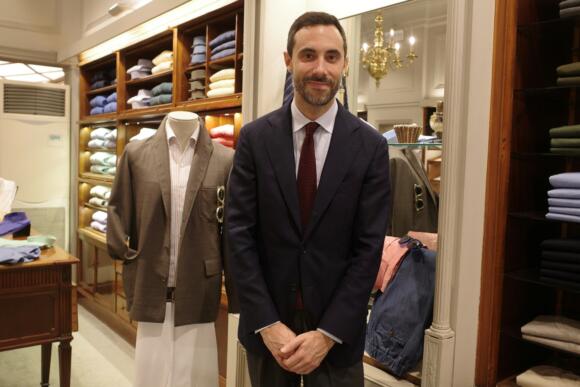
Xavier Cañadas at Bel y Cia, Barcelona
Xavier Cañadas has been the manager of Bel y Cia for over a decade, and, having studied in Belfast, never ceases to delight me with his passion for Britpop or his knowledge of cult sitcom Father Ted.
In between rhapsodising about the Oasis reunion, we spoke about the style differences between Madrid and Barcelona. “Madrid is the capital, so you’ll find lots of politicians, lawyers and financiers who like to dress more classic. Whereas, Barcelona is by the sea, which has meant it’s been easier to get influences from abroad, and I think that multi-culturalism affects our style too.”
On how that impacts the perception of the Teba, he adds, “In Madrid, our customers like the Teba’s sporty association with the countryside and the history attached to it. In Barcelona, we’re a bit more rebellious; we banned bullfighting, for example. So, those heritage associations are less appealing, and the jacket has to be put into a different context.”
The market
After lunch, Christian and I resumed our walk around the neighbourhood, stopping in to chat with local merchants along the way.
Alongside Casa Sartorial, Salamanca is home to more established sastrerías such as Calvo de Mora (whom our Editor reviewed in 2015) and Serna (who make a significant amount of Spain’s military tailoring), as well as brands like Man 1924 and Scalpers.
A common theme that emerged from my conversations with these tailors and retailers was the Spanish consumer’s sensitivity to price for anything outside the luxury sphere: a universal challenge, but one that’s particularly acute in the country that invented fast fashion.
A Carmina cordovan Oxford
The notable exception, where there’s a vibrant middle-market, is shoes. Spain’s history with leather work and shoemaking dates as far back as the Roman empire. In the seventh century, in the southern city of Cordoba, the Visigoths developed a process to tan the “shell” of a horse (the hide on its rump), giving us shell cordovan.
Today, Carmina, Meermin, TLB Mallorca and Berwick are just a few of the Spanish footwear brands that offer quality shoes at a competitive price. Madrid is an especially good city for shoe shopping, and you’ll find outlets for most of these brands in Salamanca.
However, footwear aside, the ubiquity of brands like Zara, Massimo Dutti and Alvaro Moreno – where suit prices can be as low as €100 – is one of the reasons why bespoke tailoring in Spain remains relatively cheap in comparison to the UK or Italy. Diego goes even further and says “[Spanish tailors offer] an unbeatable quality to price ratio compared to other places in Europe.”
The Madrid cut at Casa Sartorial
The cut
For those same commercial reasons, many houses in Madrid are accommodating when it comes to the styles they offer their clients. That flexibility is part of the appeal says Diego, as he expands on two of his favourite tailors – Joaquin Fernandez Prats and Agustin García of Sastrería Serna.
“Both draw from tradition and the strictest artisanal training, with the advantage – which can sometimes be a disadvantage – of not having the impact and international recognition of other tailors. This means they don’t have an uncompromising style, or a well known ‘signature’, and so the client doesn’t feel like they’re in an untouchable temple where they don’t dare to discuss anything.”
Nonetheless, there is a typical Madrid cut which is situated somewhere between the British and Italian. With a balanced silhouette that’s neither overly slim nor too generous, the Madrid coat has slightly roped shoulders and a length that finishes somewhere between the shorter Neapolitan and classic English cuts. However, it’s the lapel that is most distinctive – bellied, with a lower, sloping gorge line and lapel points that are finished with subtly rounded tips.
Juan Carlos Benito of Monte Lys, London
One man familiar with both Spanish and English tastes is Juan Carlos Benito, the third generation of Madrid tailors, Monte Lys. Under the watchful eye of his father, Ramon, Juan Carlos began drafting patterns at the age of 16, before working with renowned tailor Jose Alonso Romero (“the best Spanish tailor of the last 30 years,” says Juan Carlos).
Eager to learn more (“Spanish tailors don’t share their skills, which is why there aren’t many left”) and follow in his grandfather’s footsteps (who trained at Kilgore French Stanbury in the 1930s), Juan Carlos headed to London, where he eventually spearheaded the launch of Hackett’s bespoke department on Savile Row.
A finished jacket at Monte Lys, London
“I wanted to grow and was ready to adapt my tailoring in London. But, even in the great Savile Row houses, I found people were moving towards jackets that were lighter and more comfortable. So customers actually preferred this hybrid Spanish style which is comfortable but also has an athletic look. I didn’t have to adapt my style as much as I thought I would.”
In 2025, the two threads of Juan Carlos’ career were intertwined once again as he opened the London branch of the Benito family business, Monte Lys. Many of the hallmarks of the Madrid cut have survived the transition. “The Spanish are very meticulous about details,” Juan Carlos explains. “So, our lapel points are gently rounded, but so are the sleeve ends and even the corners of the vents. I’m not sure why this became the style years ago, but I think it’s because it’s something you don’t see on ready-to-wear. It was a point of difference to pull the customer in.”
The connoisseurs
Pablo Picasso once said, “I who have been involved with all styles of painting can assure you that the only things that fluctuate are the waves of fashion which carry the snobs and speculators; the number of true connoisseurs remains more or less the same.”
To my mind, that statement seems as relevant to the business of fashion as it does the art scene. Therefore, by referring to the connoisseur, Picasso may inadvertently be acknowledging his own countrymen, who I have found to be dignified, knowledgeable and steadfast in their approach to classic style.
It’s clear to me that dressing well is taken seriously in Spain. And, on occasion, perhaps even a tad too seriously. In 2011, as part of the Gürtel case – a major corruption scandal that rocked the nation’s politics for nearly a decade – Valencia’s former regional premier, Francisco Camps, was brought to trial on charges of awarding vendors a series of multi-million-euro government contracts in exchange for bribes. The pay-off in question: €14,000 worth of suits.
Manish is @the_daily_mirror on Instagram
This article was a feature in our Autumn/Winter ‘25 issue of PS magazine. A big thank you to Christian Webster of Casa Sartorial for sharing his street style photography with us.
Related posts
The English nonchalance of David Hockney
June 19th 2026 – 20 Comments
Read More
How to dress pale colours for summer
July 27th 2016 – 66 Comments
Read More
Reillo, Madrid: Bespoke cotton suit
January 5th 2015 – 25 Comments
Read More
<!–
Subscribe to this post
You can follow the discussion on Homage to Spain (and its style) by entering your email address in the box below. You will then receive an email every time a new comment is added. These will also contain a link to a page where you can stop the alerts, and remove all of your related data from the site.
A former FBI supervisory special agent has been charged with stealing nearly $1 million in cryptocurrency from digital wallets tied to an active counterintelligence investigation, in a case that underscores the risks of insider abuse as law enforcement agencies increasingly rely on digital assets in national security probes.
Patrick Steven Yaroch, who previously held a top-secret security clearance and served in the FBI’s Counterintelligence Division, allegedly exploited his privileged access to internal systems to transfer cryptocurrency from wallets under FBI monitoring into accounts he personally controlled. Authorities arrested Yaroch on July 31 after he allegedly confessed, with court documents unsealed on August 1 detailing the scheme.
FBI Agent Charged With Stealing $1 Million in Cryptocurrency From Suspect’s Wallets
Prosecutors allege agent abused privileged access
According to the criminal complaint filed in the U.S. District Court for the Eastern District of Virginia, Yaroch worked on investigations involving an unnamed “adversarial nation” and had access to sensitive intelligence concerning cryptocurrency wallets linked to a foreign target.
Rather than immediately seizing those assets, the FBI was monitoring the wallets as part of an ongoing intelligence operation. Court filings state that Yaroch became frustrated with what he viewed as government inaction over the continued use of the crypto accounts.
Prosecutors allege he used his authorized access to obtain the wallets’ recovery seed phrases before creating personal wallets and transferring the cryptocurrency into accounts under his own control. Investigators say he carried out roughly 10 unauthorized transfers over more than a year while serving in the bureau.
The stolen assets were initially valued at more than $900,000 but later appreciated to roughly $1 million, according to statements Yaroch allegedly made to investigators.
Federal prosecutors have charged him with interstate transportation of stolen property and receipt of stolen property.
The criminal complaint
Emotional confession led to arrest
The investigation reached a turning point on July 28, when Yaroch allegedly contacted a Department of Justice employee through the encrypted messaging app Signal requesting a private meeting.
According to prosecutors, he met with the official at FBI headquarters, where he became emotional and admitted stealing the cryptocurrency. When agents later interviewed him at his Virginia home, the affidavit states Yaroch acknowledged his actions, telling investigators, “I f—ed up.“
Searches of his residence uncovered a Trezor hardware wallet, handwritten cryptocurrency seed phrases, and digital assets stored on a Kraken exchange account.
Court filings state the account contained approximately $188,570 in assets, including around $166,000 in cash, nearly $18,000 in USDC, and smaller holdings of Bitcoin and other cryptocurrencies.
The FBI suspended Yaroch before terminating his employment and arresting him days later.
“As soon as the FBI became aware of these allegations, we immediately took action, began an investigation, and ultimately executed an arrest warrant,” an FBI spokesperson said in a statement. The bureau added that it holds employees to the highest ethical standards and does not tolerate misconduct.
ChatGPT searches become evidence
One of the most unusual aspects of the case is prosecutors’ use of Yaroch’s conversations with ChatGPT as part of the evidence.
After examining his phone, investigators recovered several prompts related to managing wealth and relocating overseas.
According to the affidavit, Yaroch first asked ChatGPT how someone with around $1 million could invest the money to maximize returns. Days later, he asked: “If you had a bucket of money (around $1 million) and you wanted to leave the USA and become a resident or citizen of an EU country, what would you do?“
The affidavit says ChatGPT responded with recommendations tailored to his age, family circumstances, and interest in moving to regions of Portugal or southern Italy.
Investigators also discovered searches concerning travel through Turkey, moving to Greece, and drafting emails related to overseas employment opportunities.
Authorities further recovered travel plans for Yaroch and his family to visit Portugal in September 2026, documents related to Portugal, and records of several foreign trips that prosecutors say had not been reported internally as required under FBI rules.
Broader implications for crypto investigations
The case highlights the growing importance of cryptocurrency in national security and financial crime investigations. Federal agencies routinely monitor digital wallets linked to ransomware groups, sanctioned entities, cybercriminals, and foreign intelligence operations.
In many investigations, authorities intentionally leave wallets active instead of immediately seizing assets so investigators can continue tracking transactions, identify networks, and gather intelligence. Decisions on whether and when to seize digital assets are typically made on a case-by-case basis.
According to prosecutors, Yaroch exploited that access by obtaining confidential wallet credentials that were available only through FBI systems.
The case also illustrates how AI-generated conversations are increasingly appearing in criminal investigations. Alongside blockchain transaction records, prosecutors relied on data recovered from Yaroch’s phone, cryptocurrency wallets, exchange accounts, handwritten seed phrases, travel documents, and his alleged confession to build their case.
Yaroch remains in federal custody in Virginia while the criminal proceedings continue. As with all criminal defendants, he is presumed innocent unless proven guilty in court. If convicted, the case would represent one of the most significant insider theft cases involving cryptocurrency handled by the FBI and one of the first major U.S. prosecutions in which ChatGPT conversations play a notable role in the government’s evidence.
Mastercard has officially completed its acquisition of London-based stablecoin infrastructure provider BVNK, marking a major step in the payments giant’s strategy to bridge traditional financial systems with blockchain-based digital assets. The deal strengthens Mastercard’s ability to support seamless value transfers between fiat currencies and stablecoins while expanding enterprise-grade infrastructure for the next generation of global payments.
Announced earlier this year as a transaction valued at up to $1.8 billion, including a $300 million earnout, the acquisition gives Mastercard direct ownership of one of the industry’s leading stablecoin payment platforms instead of relying on third-party providers. The move reflects growing confidence among established financial institutions that stablecoins are evolving from niche crypto products into core payment infrastructure.
Mastercard Completes BVNK Acquisition
Mastercard doubles down on digital asset payments
Mastercard said the acquisition expands its strategy to offer customers greater flexibility in how money moves across traditional and blockchain-based payment networks.
The company aims to create greater interoperability between fiat currencies, stablecoins, tokenized deposits and other forms of digital value, allowing businesses and financial institutions to transact across multiple payment rails without friction.
“Digital currencies — particularly stablecoins — are increasingly addressing real-world needs in areas like cross-border B2B payments, remittances, payouts, settlement and treasury flows,” said Jorn Lambert, Mastercard’s Chief Product Officer.
“In a multi-money world where fiat, stablecoins and tokenized deposits and other forms of value coexist, the next payments paradigm will be defined by how effectively each rail, network or form of money connects and works together.“
Lambert added that combining Mastercard’s global payment network with BVNK’s blockchain-native infrastructure will help deliver faster, more trusted and efficient payment experiences for businesses worldwide.
BVNK provides the infrastructure behind stablecoin payments
Founded in 2021, BVNK has become one of the fastest-growing providers of enterprise stablecoin infrastructure.
Rather than operating as a consumer-facing crypto platform, BVNK builds the backend technology that enables companies to hold, send, receive, convert and manage both fiat currencies and stablecoins through a single infrastructure layer.
Its platform supports payments across major blockchain networks while maintaining compliance, security and interoperability requirements demanded by regulated financial institutions. Prior to the acquisition announcement, BVNK operated across more than 130 countries and served enterprises including payment providers, fintech companies and global businesses.
Mastercard said integrating BVNK’s technology will allow financial institutions, fintech firms and multinational enterprises to scale stablecoin-powered use cases ranging from cross-border business payments and supplier settlements to treasury management and corporate payouts.
Stablecoin Market Cap (Source: DefiLlama)
From partnership to ownership
The completed acquisition highlights a broader strategic shift among global payment companies.
For years, traditional payment networks largely connected to blockchain infrastructure through external providers and API partnerships. Owning the underlying technology, however, gives Mastercard greater control over product development, regulatory compliance and integration with its existing payment ecosystem.
Industry observers have described the transaction as a sign that stablecoin infrastructure is becoming strategic rather than experimental. Reports surrounding the deal indicated BVNK had previously attracted acquisition interest from several major industry players before Mastercard ultimately secured the company.
Instead of simply enabling customers to access stablecoins, Mastercard now owns critical infrastructure capable of connecting blockchain settlement directly with its global payments network.
The acquisition comes as stablecoins increasingly move into mainstream financial services.
Unlike cryptocurrencies such as Bitcoin, stablecoins are typically pegged to fiat currencies like the U.S. dollar, making them more suitable for commercial payments and settlements.
Financial institutions are increasingly exploring stablecoins because blockchain networks can operate continuously, enabling near-instant settlement across borders while potentially reducing costs and improving liquidity management.
Mastercard has steadily expanded its digital asset strategy over recent years through initiatives including its Crypto Partner Program, tokenization services and support for blockchain-based payment solutions. The addition of BVNK further strengthens those efforts by adding native on-chain payment capabilities to Mastercard’s existing global infrastructure.
The move also follows growing competition among payment giants to establish leadership in blockchain-enabled finance. Rival Visa has pursued partnerships and stablecoin settlement initiatives, while fintech companies such as Stripe have also invested heavily in digital asset payment infrastructure.
Building a multi-rail payments future
Mastercard frames the acquisition as part of a broader vision for what it calls a “multi-money” ecosystem, where traditional bank deposits, card payments, stablecoins and tokenized assets coexist rather than compete.
Instead of replacing existing payment systems, blockchain infrastructure is expected to complement them by enabling new forms of programmable and cross-border transactions.
With BVNK now integrated into the company, Mastercard believes it can offer customers a unified infrastructure that connects conventional financial rails with blockchain networks while maintaining the security, compliance and trust expected from global payment providers.
As enterprise adoption of digital assets accelerates, the acquisition positions Mastercard to play a larger role in shaping how money moves between traditional finance and decentralized networks. Rather than viewing stablecoins as an alternative to existing payment systems, the company is betting that the future of payments will depend on making every form of value interoperable—whether it originates from a bank account, a payment card or a blockchain.
Long before he became one of Hollywood’s most bankable action stars, leading franchises like Guardians of the Galaxy and Jurassic World, Chris Pratt was best known as the lovable idiot from Parks and Recreation. Andy Dwyer was initially conceived of as a supporting character whose accident brought Ann Perkins (Rashida Jones) into Leslie Knope’s (Amy Poehler) orbit, establishing the friendship at the heart of the series. But Pratt proved so effortlessly funny and likable that Andy evolved from Ann’s slacker boyfriend into one of the show’s central characters. Even Andy’s eventual relationship with April Ludgate (Aubrey Plaza) developed organically thanks to the actors’ chemistry.
Parks and Rec established Pratt as a likable comedic actor, but that success came with a downside. Pratt leaned into Andy’s doughy physique and childlike personality, which made him even less fitting for the action hero roles he dreamed of playing. He’s talked about this openly in the past, particularly in an episode of the Scene Stealers podcast released in January 2026. In that interview, he credits one movie in particular as the reason he went on to become Star-Lord — and that movie just landed on Netflix.
Originally released in 2012, Zero Dark Thirty chronicles the decade-long manhunt for Osama bin Laden, the leader of the al-Qaeda terrorist organization responsible for the attacks of Sept. 11, 2001. Directed by Kathryn Bigelow and written by Mark Boal, the tense and methodical thriller focuses on Maya (Jessica Chastain), an obsessive CIA analyst whose pursuit of a single lead culminates in the real-life raid on bin Laden’s compound in Abbottabad, Pakistan. That’s where Pratt comes in.
As fictional Navy SEAL Justin Lenihan, Pratt arrives relatively late in the movie as part of the team assigned to conduct the raid. Even in a role with limited screen time, he delivers a memorable performance. Joel Edgerton plays the team leader, Patrick Grayston, but Pratt’s Lenihan emerges as the unit’s strongest personality. He expresses skepticism about the mission and presses Maya on the legitimacy of the intelligence placing bin Laden inside the compound.
“I didn’t even want to use you guys, with your dip and your Velcro and all your gear bullshit,” Maya responds. “I wanted to drop a bomb.”
Pratt conveys a grizzled frat-boy energy as Lenihan hops around camp playing horseshoes. While most of his teammates remain relatively quiet, he comes across as gregarious and approachable.
Image: Columbia Pictures
Later, as the team rides a helicopter toward its target, Lenihan listens to something through his headphones and jokes that it’s a motivational speech from Tony Robbins. Even just seeing Pratt wearing wired headphones while inside a metal metal vehicle makes the character feel like a proto-Peter Quill. Not long afterward, Lenihan is sweeping through the compound in complete darkness with disciplined precision. And we admire him even more when he pauses to calm and direct some children the team encounters amid the chaos.
That balance was crucial. Lenihan retains flashes of Pratt’s warmth and humor, but even with a few wisecracking jokes, he’s is a serious character. As Pratt recalled on Scene Stealers, nobody watching Zero Dark Thirty laughed when he appeared onscreen, which he’d gotten used to with Dwyer.
“I was selling and portraying a badass, and people bought it,” Pratt said. “You’re constantly recalibrating how the business sees you and where you might live in the marketplace.”
Zero Dark Thirty gave Pratt his first real opportunity to change that perception. It certainly helped that the movie was a critical and commercial success, grossing more than $132 million worldwide against a reported budget of around $40 million and earning five Academy Award nominations.
Pratt had auditioned for several Marvel roles over the years, but the studio repeatedly passed. When Guardians of the Galaxy came along, he initially resisted auditioning. According to Pratt, director James Gunn was similarly skeptical about casting “the fat guy from Parks and Rec.” Casting director Sarah Finn eventually persuaded them both.
By then, however, Zero Dark Thirty had helped Pratt identify the kind of leading man he could become. He wanted to combine the physical credibility of an action hero with the comedic instincts he had developed on Parks and Rec. His transformation for the movie also proved he could look the part. When Pratt later met with Marvel executives, Kevin Feige reportedly produced a shirtless photo taken during his Zero Dark Thirty training and asked whether he could achieve that physique again. Seven months later, Pratt became Star-Lord.
That career transformation makes Zero Dark Thirty a fascinating time capsule, but Pratt is hardly the only reason to watch Kathryn Bigelow’s gripping thriller. The movie belongs primarily to Chastain, whose performance transforms Maya’s pursuit of bin Laden into an all-consuming obsession defined by the painstaking process of gathering intelligence over the course of 10 years. Chastain also won the Golden Globe for Best Actress in a Drama for this role.
Zero Dark Thirty also wisely does not make a patriotic spectacle of the raid itself. The sequence is dark and disorienting to emphasize the uneasiness surrounding a shadow-ops mission like this. Pratt fits naturally into that restrained approach. Lenihan’s easygoing humor humanizes the raid team, but that levity mostly disappears once the operation begins. Watching him move between those modes now feels like seeing the two sides of his future stardom come together. It may be a small role, but it helped prove that the lovable idiot from Parks and Rec could also be taken seriously as a man of action. For that reason alone, Zero Dark Thirty is worth watching on Netflix.
Big Brother veto meeting results are in including the names of the three nominees heading into Thursday night’s BB Blockbuster. Haley Thogmartin had to make a renom because of course Taylor Brown used the veto to save herself.
But there was some scrambling as people tried to keep themselves off the block as the renom. We’ll get into the veto meeting and some confrontations before it went down. Also, some thoughts about BB Time Capsule winner Dee Valladares and what she plans to do with her BB Bribe advantage.
Big Brother Spoilers: Lyric Tries to Work Magic
On Sunday, Lyric Medeiros began to realize there was a good chance she could hit the block and was doing all she could to stop it. She went to Chuk Anyanwu and told him Haley said during the HOH comp that she wouldn’t nominate her.
Haley said that to Lyric but Haley also made clear she said nominate not renom. That’s just like what Kamuela “Kamu” Kirk told Jason De Puy. “I won’t nominate you today“. Then he renommed him.
So, Lyric worked both guys. She told them both that Mallory Aurichio was coming for them, threw Mallory under the bus hard trying to push for Haley to renom Mallory. It was Kamu who first went to Haley about Lyric on Saturday night to try to keep her off the block.
That sent Haley into a fit of anger. Then, Haley got a replay of that on Sunday night, when someone went to advocate for Lyric. And Haley got even more upset. Lyric’s strategy worked on both guys. And that infuriated Haley.
Big Brother: Haley’s Giving Hate
But even so, Lyric’s not her target for eviction. Drew Campbell is still the one his own alliance wants to target. Angela Murray is pushing for it so hard. Mallory’s in denial about Lyric trying to get her on the block as the renom to save herself.
What’s funny is Melody Morris acted shocked in front of Mallory when they heard that. Mallory actually tried to defend saying she didn’t do it in a malicious way. And ironic that Melody threw Mallory under the bus in week 1.
Then, last week, when there was a plan to try and save Jason which would greatly benefit Melody’s side of the house, she ran that right to Kamu. She ruined what could’ve been a move to get some balance in BB28. And now, Melody’s on the block, it’s clear Haley hates her.
And what’s funny is when Lyric talked to Haley pre-veto meeting trying to stay off the block, Haley laid into her about turning on her friends and allies. She told Lyric that she knows that Lyric talked a lot last night to a lot of different people and the stories were not the same.
Haley said Lyric’s jumping ship and it doesn’t look great that these are her best friends she is so quick to throw under the bus. Haley called out Lyric specifically for scrambling after Rome Seymour and Jason are gone. But that’s how you play Big Brother.
Big Brother 28: Veto Meeting and Strategic Chaos
All that said, Lyric may actually be safe on the block even if she doesn’t win the Blockbuster. Melody and Drew are much bigger targets than she is right now. The Toolshed wants Drew gone and Barrett Pfeiffer abandoned him to save his own butt.
He’s not fully trash-talking Drew in convos with Rick Devens trying to stay safe. And also, Drew seems to think he’s safe when he’s not. Likely because everyone’s lying to him. Devens keeps insisting that Drew’s good this week.
At the veto meeting, Drew made a big speech asking Taylor to use the veto on him, which would never happen. Sure enough, she used the veto on herself and Haley put Lyric on the block. But even so, Haley doesn’t seem to want Lyric gone.
Also, there’s a big build happening in the backyard and a lot of the houseguests think it’s the wall comp. What’s funny is Barrett thinks Kamu will win it. Over the seasons, more women win the comp than men. My money’s on Mallory. She’s athletic.
And more muscular bulky men usually don’t do well. It’s smaller men that do better. Historical winners have won the wall comp twice. If it is the wall, Angela’s coming off first. Then I can see someone going second, Devens third. Then Haley and Kamu.
I’d really like to see them bring back other classic comps in BB28 like the Slip n Slide. I also like the spinning disc comp where they hang and are spun around and pelted and crash into stuff. That one hasn’t been around in a few seasons either.
Big Brother 28: Dee Valladares
Big Brother 28: Dee’s Bribe Power and Strategic Withholding
Also, there’s Dee and her BB Bribe power. First of all, it’s a lame “power”. The only time they had it before, in a past season, someone bribed another person to do something they were already going to do — basically just gave a friend the cash.
But Dee’s not going to do that. Here’s why. She lied right to Devens face about the power and that’s her ride or die. What Dee got is not a strong power. Devens power’s great — the Diamond Power of Veto.
And the only really good powers left are the Mystery Competitor and Coin of Destiny. The Never-Not pass is meh. And Replay is very conditional and not a guaranteed power. Coin of Destiny’s the only major game changer in the mix and it’s still up for grabs.
But because Dee lied to Devens, I am pretty sure that she doesn’t ever plan to use that power as intended. Dee’s gameplay in past competition shows was a lot about strategically withholding information. And never making emotional decisions. Plus, she’s a comp beast.
So, this power she’s sitting on is doing her a lot more good unplayed than played. Dee’s sitting back and letting the speculation amp up and also the paranoia. Many people think Drew has it and is screwing with them. Some think that Mallory has it.
The power’s not worth much but withholding the fact that she won the power — that’s worth a lot more to Dee. So, no, I doubt she’ll use it or tell anyone she has it till BB28 is over. I could be wrong.
But having watched Dee play competition shows twice and seeing her play BB28 like this, that’s my prediction.
Bitcoin bridge Boltz has suspended its Bitcoin swap service indefinitely.
The company says AI-assisted attacks are outpacing its ability to patch vulnerabilities.
Boltz says no user funds were at risk because the platform is non-custodial.
Boltz has suspended its Bitcoin swap service indefinitely, saying a surge in AI-assisted attacks has left it unable to continue operating safely.
In a series of posts on X on Monday, the company said swaps are disabled “until further notice” and that it cannot provide an estimate for when the service will return.
“We can’t give an ETA as of this time, but will provide an update once we know more,” Boltz wrote.
Boltz is a non-custodial Bitcoin swap service that lets users move Bitcoin between the Lightning Network and the blockchain’s base layer without giving the company custody of their funds. Boltz has not published transaction volume figures. Boltz currently holds around $262,000 in total value locked, according to DeFiLlama.
Because users retain control of their assets throughout the process, Boltz said “no user funds were ever at risk.”
Boltz Swap Services are currently unavailable until further notice. We can’t give an ETA as of this time, but will provide an update once we know more 🙏
— Boltz – Non-Custodial Bitcoin Bridge (@Boltzhq) August 3, 2026
“To be clear: this is not a response to a single incident,” the company wrote. “Over the past months we have seen a steady rise in automated, AI-assisted probing of our infrastructure, and we have dealt with several exploits. Each was contained, but the pattern is clear: attackers now iterate faster than a team our size can find and patch.”
Boltz said the pace of attacks accelerated over the past few days, leading it to conclude it could no longer safely operate its swap service.
“After reviewing the results of our own recent security scans, we cannot responsibly re-enable Boltz swaps, especially as we are being actively targeted by what appear to be multiple resourceful groups while we race to deploy fixes,” the company wrote.
The company said its API remains available to process cooperative refunds, unilateral refunds continue to work because they do not depend on Boltz’s infrastructure, and customer support remains available.
Boltz argued the attacks reflect a broader change facing Bitcoin infrastructure operators.
“What we are seeing is a major paradigm shift for Bitcoin services operating on an open source stack, and it needs careful analysis,” the company wrote. “Do not expect swap services to resume shortly.”
The announcement comes as the cryptocurrency industry grapples with how AI is changing cyberattacks.
On Tuesday, Ledger CTO Charles Guillemet warned that AI allows attackers to scan code and uncover vulnerabilities “at machine speed,” while defenders are increasingly relying on AI to find the same flaws first. The comments came as fallout from the Coldcard exploit continued to grow, with losses nearing $130 million.
Daily Debrief Newsletter
Start every day with the top news stories right now, plus original features, a podcast, videos and more.
Just two weeks ago, Xbox unexpectedly brought its backwards-compatibility programme to PC, starting with four games from the original Xbox.
Microsoft made it clear that this was only the beginning, with Xbox 360 support and more games planned for the future. What it didn’t explain was just how large the programme could eventually become. Now, a leaked document seen by The Verge has seemingly revealed the bigger picture, and that picture contains lots and lots of games.
According to the document, Microsoft plans to expand the programme across PC, supported handhelds and its next-generation Xbox hardware, currently codenamed Project Helix. Xbox 360 games would reportedly begin arriving gradually between 2027 and 2028, while the original Xbox programme that entered early access in July is expected to receive a full launch in October 2026.
Publishers will apparently be able to opt individual games into the programme, with Microsoft handling the technical work required to get them running on newer hardware. Publishers will remain in control of pricing and will also decide whether their games are included with Xbox Game Pass.
That means the original announcement wasn’t simply about bringing a few old games to the Xbox PC app. It appears to have been the first public step in a much broader effort to create one backwards-compatible Xbox library across consoles, PCs and handheld devices.
Pure was a game that was never made backwards compatible. It kicked ass sorts of ass. I’d love to see it make the leap, although it’s probably unlikely.
Microsoft has already confirmed that Project Helix is being designed to play both Xbox console games and PC games, although it’s still anyone’s guess how that’s actually going to work. I don’t think Steam is going to be on the machine, for example, but native PC games will probably play without developers having to make a seperate Xbox port to get it running.
Put all of this together and Project Helix could potentially support original Xbox games, Xbox 360 games, Xbox One games, Xbox Series X|S games, new Helix releases and ordinary PC games. That is one hell of a library.
However, the idea that Project Helix will automatically play every Xbox game ever made is getting ahead of reality. Publishers and rights holders will have to opt individual games into the programme, which means expired licences, tangled ownership and simple lack of interest will inevitably leave some titles behind.
That will be especially troublesome for racing games, sports releases, movie tie-ins and anything else built around licensed music, cars, characters or brands. Even Microsoft-owned games aren’t immune, as several Forza titles have already disappeared from sale because their licensing agreements expired.
The same leak also contained more details about Microsoft’s Disc-to-Digital programme, which I covered yesterday. That system would let players insert a supported Xbox One or Xbox Series disc into an existing console and receive a digital licence tied to both their account and that specific disc.
Taken together, backwards compatibility on PC, Xbox 360 support, Play Anywhere and Disc-to-Digital all appear to be parts of the same plan: build one enormous Xbox library before Project Helix arrives.
It won’t contain everything, but if Microsoft can bring a substantial chunk of its older catalogue forward, the next Xbox could launch with one of the biggest and most varied libraries any console has ever had.
As Senate negotiations over the CLARITY Act continue, Joseph Chalom, CEO of Sharplink and former Head of Digital Assets Strategy at BlackRock, argued that the legislation’s most consequential debate may not be the issues receiving the most attention.
In a detailed article shared on X, Chalom said discussions around stablecoinyield rules and crypto ethics provisions have dominated public debate. However, he argued that Section 604, which includes the Blockchain Regulatory Certainty Act (BRCA), could determine whether the U.S. remains competitive in decentralized finance (DeFi).
According to Chalom, BRCA could provide legal clarity for developers building non-custodial blockchain applications by establishing that software creators who do not control user funds should not be treated as money transmitters.
BRCA at the center of DeFi debate
Chalom described BRCA as a provision designed to clarify that developers who create software without taking custody of user funds should not be classified as money transmitters. He argued that this principle is essential for protecting permissionless, non-custodial financial infrastructure built on blockchain networks.
According to Chalom, DeFi developers have faced two major legal uncertainties over the past decade: whether protocols could be considered unlicensed money transmitters or whether they could fall under securities exchange regulations.
He said that without legislative protection, DeFi’s future remains dependent on changing regulatory interpretations and court decisions. “CLARITY is the first real chance to move that protection from ‘for now’ to ‘in law,’” Chalom said.
The comments come as lawmakers continue negotiations over the crypto market structure bill, with discussions focused on several issues including stablecoin economics, ethics requirements, enforcement authority, and digital asset oversight.
How DeFi is expanding beyond crypto
Chalom argued that DeFi is no longer limited to crypto trading and is becoming part of a broader financial infrastructure stack. He pointed to several areas where blockchain-based systems are expanding, including:
Stablecoins as digital payment infrastructure.
Tokenized real-world assets such as Treasuries, credit products, commodities, and equities.
AI-powered financial applications using blockchain settlement systems.
Chalom said these emerging financial systems depend on open-source blockchain infrastructure and argued that BRCA could provide the legal foundation needed for continued development.
“The money, the assets, the automation. Every layer of that stack executes through open source code, which is exactly what the BRCA aims to protect,” he wrote.
The former BlackRock executive also highlighted growing institutional involvement in blockchain markets, arguing that large financial firms require regulatory certainty before committing significant resources.
According to Chalom, institutions are already exploring tokenized assets, blockchain settlement, and on-chain financial products but need predictable rules to expand further.
“Institutions do not build on foundations that shift every four years,” he wrote, adding that financial companies prioritize regulatory stability and neutrality.
He also warned that uncertainty could encourage developers and businesses to move operations to jurisdictions with clearer blockchain regulations.
Pierce highlights DeFi’s growing role
Chalom also pointed to recent comments from SEC Commissioner Hester Peirce, arguing that regulators are increasingly recognizing DeFi’s potential role in financial markets. At the time, Peirce said that as securities move onchain, “vaults and onchain lending strategies may become mainstream tools for managing investment portfolios.”
Chalom said those comments show that DeFi infrastructure is moving closer to traditional finance. However, he noted that regulatory agencies alone cannot provide permanent certainty because future administrations could change enforcement approaches.
CLARITY Act faces narrow legislative window
Chalom’s comments come as lawmakers work to finalize the CLARITY Act before the Senate’s August recess. The legislation has faced disagreements over several issues, including stablecoin economics, ethics rules, enforcement authority, and provisions affecting blockchain developers.
Industry participants have argued that passing the bill with clear DeFi protections could help establish the U.S. as a leading jurisdiction for blockchain innovation. However, opponents have raised concerns about ensuring adequate consumer protections and preventing misuse of decentralized systems.
As Senate discussions continue, the BRCA provision has emerged as one of the key areas that could determine how lawmakers approach decentralized finance and blockchain development in the years ahead.
Also Read: Senator Lummis Seeks Senate Action on CLARITY Act Before August Break
Disclaimer: The information researched and reported by The Crypto Times is for informational purposes only and is not a substitute for professional financial advice. Investing in crypto assets involves significant risk due to market volatility. Always Do Your Own Research (DYOR) and consult with a qualified Financial Advisor before making any investment decisions.