By Manish Puri
“Remain dignified, dress well, be good to other people and you’ll be fine,”
Manolo Blahnik, Spanish fashion designer
From rugged mountains to lush, dense forests, Spain’s landscape is one of sharp contrasts: a description that could apply equally to its sartorial analogue.
At one end of the horizon you’ll find Cristóbal Balenciaga – the celebrated designer and couturier – whom Christian Dior called “the master of us all”. And at the other end is Inditex – the largest fast-fashion group in the world – who may not have mastered us all, but has certainly had a good crack at our wardrobes.
In the terrain in between, in that great central plateau, Spanish style (and naturally, I’m focusing on menswear here) doesn’t seem to have a clear, communicable identity. Or, perhaps it’s more accurate to say that identity just doesn’t have the same prominence as British bespoke, Italian sprezzatura and American Ivy. Because whenever I’ve visited Spain, I’ve always been struck by the elegance of its men and their adherence to a conservative, classical template of dress.
What is Spanish style?
But is my observation a fair reflection of the whole? Or is it just a collection of anecdotes, given form and narrative by the eternal sunshine of the holidaymaker’s mind? And, just as interesting a question – is there a point where all this conservative dressing becomes a bit bland?
To help answer these questions, and get a better understanding of Spanish style, I spoke with a number of authorities – some Spanish-born, some Spanish-resident, some in the menswear industry and all unfailingly generous with their time and views.
First, to set the scene and grapple with my somewhat broad opening question, I turned to actor Diego Martín Gabriel – a Madrileño (the name given to those hailing from Madrid) and tailoring enthusiast.

“I’m not sure if we can properly speak of a Spanish style, as marked or at least as recognisable as the Italian or the English, or even French. In any case, it has been more discreet and perhaps hasn’t sold itself well. It’s a sober style, without eccentricities, eminently classic and without many strident features, due to tradition and maybe sometimes shyness.”
Diego then expands on some of the regional differences: “In a country as diverse as Spain, the style you might find in Seville, traditional and very classic, has little to do with what you’d find in Barcelona, more relaxed and Mediterranean, or Bilbao, with more English influences, and Madrid, which as a great capital brings together all these styles.”
It’s in the capital that I began my exploration.

Casa Sartorial
One of the most passionate advocates for Madrid style that I’ve met is Christian R Webster. Born in Ecuador, Christian’s first foray into menswear was the opening of Cúpula – a small business selling classic Panama hats handwoven in his hometown of Cuenca (one of two major centres of production alongside Montecristi).
In 2023, Christian moved to Madrid, part of a dramatic rise in the city’s Latin American population; census data shows the number of Latinos in the city grew from 81,552 to over one million between 1999 and 2024. There, he enrolled in tailoring courses at La Confianza, the Spanish association of tailors (or sastres) founded in 1897. In 2024, he opened bespoke tailoring house Casa Sartorial, enlisting one of his teachers, Ángel Ramírez Peralta, as master tailor.

Their atelier is located in Salamanca – an upscale district that’s home to Madrid’s political and financial elite and a hub for luxury retail. On my last visit in May 2025, a groom was preparing for his summer wedding and trying the first fitting of a beautiful ivory dinner jacket. A vigorous and friendly debate broke out among us on whether the lapel should have a silk facing or not. The groom’s mother entertained our rambling politely, and then settled the matter by telling us the wedding was a big fiesta; the lapels would be silk.
As lunch approached, Christian invited me to take a stroll with him around the leafy boulevards of the barrio; armed with his camera (it’s his street-style photos that accompany this piece), Christian explained why he loves Madrid style.
“It has a quiet elegance to it – not flashy, but refined. There’s an appreciation for tradition, structure, and craftsmanship, yet you’ll often see a relaxed confidence in how men wear their clothes. What I love is how deeply rooted it is in artisan culture – there’s a strong connection to the past, but also a modern generation that’s bringing new energy to it.”

The archetype
We’d barely walked 100 yards before I saw a gentleman wearing what I consider to be the archetype of classic Spanish men’s style: navy blazer, shirt and tie, dark grey trouser and tassel loafers.
This same outfit is captured in the first of two illustrations we’ve commissioned from Madrileño Rodrigo Saldaña, illustrator and founder of Momos Tailors in the port city of Alicante – a contemporary-leaning MTM offering that emphasises a relaxed, easy silhouette.
“Madrid is an oasis of style,” says Rodrigo. “Guys know the rules and follow them perfectly. In the south of Spain, the colours are a bit more attention-grabbing. But in the north, everything is calmer and more sober. It’s a bit like the difference between Naples and Milan.”


As Christian and I continued our walk, I saw at least a dozen subtle variations on the theme – a mix of blue and white shirts, some with and some without a tie, and an equal split between tassel loafers and pennies. It seems to be the office-uniform of everyone from the fresh-faced intern to Spain’s richest man, Amancio Ortega.
But does this clean look, free of any embellishments or flourishes, epitomise Balenciaga’s maxim: elegance is elimination? Or is it more a conservative look stemming from a conservative mindset? One’s perspective on this might well depend on how much exposure you’ve had to other sartorial customs, if my animated discussion with Javier Valencia is anything to go by.

Javier is a Madrileño who’s worked at Sastrería Prats (a respected tailors in the Chamartín district, where the Santiago Bernabeu is also located), Turnbull & Asser, and currently heads up made-to-measure operations at Drake’s in London.
He agrees that the Spanish are well dressed, but feels this is borne less out of a love of clothes, and more from a fear of standing out (“miedo a destacar,” as Rodrigo puts it). “We are very bad at being brave,” explains Javier. “And we usually pick the safest option – a navy worsted jacket and the darkest shade of grey for a trouser. The only colour is on the tie. It’s terribly dull.”

But, and this may be a stereotypical notion that I need to be dissuaded of, don’t the Spanish have a flair for the dramatic and flamboyant? It’s a cliché, and a very specific one at that, but this is the land of the matador in his elaborately ornate traje de luces (suit of lights). How does that reconcile with the restrained, sober image being painted?
“There is a flamboyance,” explains Javier. “My dad, for example, loves flowery and paisley shirts. That’s viewed as okay in leisurewear for older men. But you’d never see a Spaniard wearing a colourful Turnbull & Asser striped shirt for business wear – that’s way too much. We are very context conscious in that regard.”
Javier also reckons any attempt at boldness is undermined by a Spanish relish for vocal criticism. This is, of course, a generalisation, but one that Javier, with his trenchant (and light-hearted) opinions, does his best to exemplify. He tells me, “I know when Real Madrid are playing in London, because I’ll hear a Spanish voice commenting on the rise of my trousers.”

The lifestyle
Over in Salamanca, Christian and I settle in for lunch at Restaurante La Giralda, which serves traditional Andalusian fare. As Christian, ever the attentive host, talks me through the menu, our waiter stealthily deposits a cool, creamy plate of Russian salad and a round of cañas (a small glass of draft beer) on the table.
Our conversation begins with the quixotic: how the men of Madrid cope with wearing suits and ties throughout the summer, where temperatures regularly exceed 35C/95F. Christian attributes it to the Spanish lifestyle being “more relaxed, with less rushing around”. As he says this, he smiles, leans back and takes a slow sip of his beer – just to hammer the point home.

It’s something I’ve often thought about: how tailored clothing is unfairly maligned for being uncomfortable. Of course cloth and cut are paramount, but what we do in our clothes matters too.
In London, even on milder days, not even the most open of weaves will keep you entirely cool when you’re dashing from the school run to the office to lunchtime yoga to team drinks to the last train. And, blessed be thy dry cleaner, if any of those journeys involves riding on one of the carriages of Hades that makes up London Underground’s rolling stock.
But in Madrid, our leisurely lunch is a prime example of how the day can be slowed down, and the body’s temperature wrestled under control by a couple of hours in the shade (Madrid is one of the most tree-lined cities in the world) or in an air-conditioned dining room.

The winter
There’s another factor that makes the heat (slightly) more bearable in Madrid than in New York or Hong Kong: its elevated location. At nearly 650m above sea level, Madrid is one of the highest capitals in Europe, which means the air is drier than a fino sherry.
That also means winters are chilly and long. According to a local proverb, a year consists of “nine months of winter, and three months of hell”. It’s a less gushing take than Ernest Hemingway’s proclamation that Madrid has “month in and month out the finest climate”, but that neatly encapsulates the rose-tinted romanticism of a visitor versus the hard-boiled realism of a local.
The cold winters afford Madrid’s residents the opportunity to layer up, and the most dramatic option is the capa española – a traditional Spanish cape made from densely woven merino, lined with velvet and finished with a silver charro clasp.
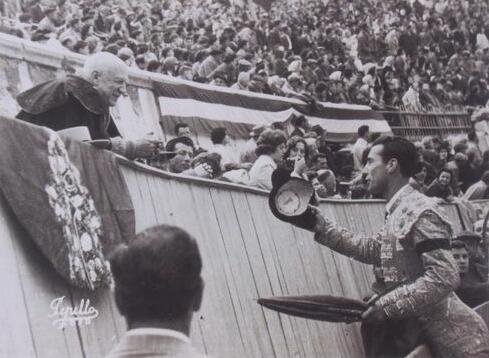
For nearly 125 years, the place to buy one has been Casa Seseña, a fourth-generation family business whose capes have adorned the shoulders of Pablo Picasso, King Alfonso XIII, Federico Fellini, Luis Buñuel, Marcello Mastroiani, Placido Domingo and Catherine Deneuve.
It’s not a garment for the faint-hearted, as current owner Marcos Seseña tells me: “The cape cannot dominate you; you must dominate it.” No mean feat when you consider the classic model weighs 5-6kg.

More typically, you’ll see men wearing winter clothes that British readers will find familiar: Barbours, tweed jackets, cavalry twill and corduroy trousers. “It’s ironic – despite the historical enmity, there’s an admiration of British nobility among the Spanish upper classes,” says Javier. “But they never quite succeed in looking British, they’re just not eccentric enough in their style choices.”
Nothing symbolises that affinity for British country style more than the success of Hackett, who opened their first international store in Madrid in 1989, and today still count Spain as their biggest market.

I discussed the expansion with founder of the brand, Jeremy Hackett. “We had two very good Spanish customers when we opened in 1983 on the King’s Road, and they encouraged us to move into Spain. They happened to be related to the Spanish Royal family, so that conferred a certain status upon the brand. It was very successful and the Spanish customer has always been so appreciative.”
On their style he adds, “They wear things on their own terms, which I completely understand given the climate. In London, we were selling corduroy trousers in pink, lilac and yellow. But in Spain it was more conservative: navy blue, tan, dark green. There’s more of a uniform, but the customer always looks impeccable with their slicked back hair.”

The Teba
The cooler temperatures also herald the arrival of hunting season in Spain, where the pre-eminent modality is the montería – a driven-hunt that’s endemic to the country and dates back to the Middle Ages. From these traditions comes Spain’s finest contribution to menswear: the Teba jacket.
Tales of the jacket’s origins vary, but it’s widely accepted that the first Teba was created as a shooting cardigan for King Alfonso XIII. Many believe the garment was commissioned on Savile Row; we don’t know the house, but we do know the King wore suits from Henry Poole, Huntsman and Davies & Son.
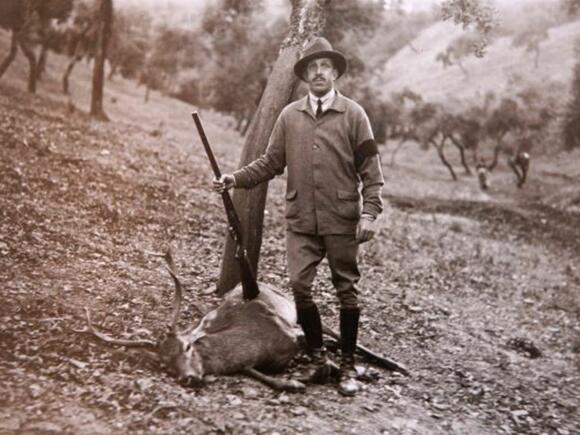
After a day’s hunting, the King gifted his jacket to his good friend the Count of Teba, Carlos Alfonso de Mitjans – from whom it eventually took its name. Some years later, in 1943, Carlos and two similarly sartorially-minded friends – the Count of Caralt and Enrique Maier (a Wimbledon mixed-doubles champion) – decided to commission new jackets. The three gentlemen were customers of Bel y Cia, a Barcelonian camisería (shirtmaker) founded in 1842, and tasked them to make and refine the Teba model that has endured as a classic to this day.
Unsurprisingly, given its origins, many of the Teba’s characteristics are functional elements that suit a day spent roaming the finca. Bel’s Classic Teba (my favourite) is fashioned, on the premises, from a knitted wool or wool/cashmere mix – a light, smooth and forgiving fabric that follows the shooter’s form as they raise their arms to take aim.
Keeping the elements out is also a key design consideration; the four buttons that run the length of the front of the jacket, the ventless back, and the cuff fastenings all work in unison to shield the wearer from wind and rain. Even the Teba’s signature notch-less lapel, which looks like a shawl collar conceived by a Spanish Cubist, can be buttoned up to keep the neck covered.
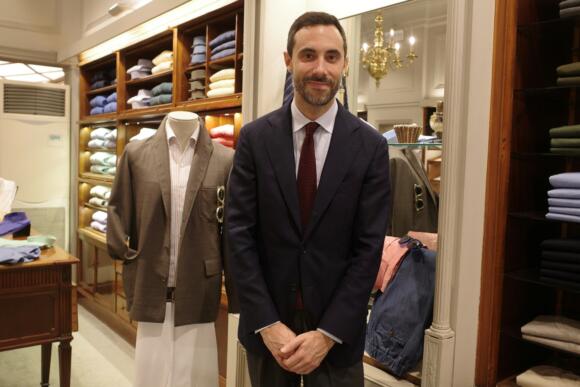
Xavier Cañadas has been the manager of Bel y Cia for over a decade, and, having studied in Belfast, never ceases to delight me with his passion for Britpop or his knowledge of cult sitcom Father Ted.
In between rhapsodising about the Oasis reunion, we spoke about the style differences between Madrid and Barcelona. “Madrid is the capital, so you’ll find lots of politicians, lawyers and financiers who like to dress more classic. Whereas, Barcelona is by the sea, which has meant it’s been easier to get influences from abroad, and I think that multi-culturalism affects our style too.”
On how that impacts the perception of the Teba, he adds, “In Madrid, our customers like the Teba’s sporty association with the countryside and the history attached to it. In Barcelona, we’re a bit more rebellious; we banned bullfighting, for example. So, those heritage associations are less appealing, and the jacket has to be put into a different context.”

The market
After lunch, Christian and I resumed our walk around the neighbourhood, stopping in to chat with local merchants along the way.
Alongside Casa Sartorial, Salamanca is home to more established sastrerías such as Calvo de Mora (whom our Editor reviewed in 2015) and Serna (who make a significant amount of Spain’s military tailoring), as well as brands like Man 1924 and Scalpers.
A common theme that emerged from my conversations with these tailors and retailers was the Spanish consumer’s sensitivity to price for anything outside the luxury sphere: a universal challenge, but one that’s particularly acute in the country that invented fast fashion.

The notable exception, where there’s a vibrant middle-market, is shoes. Spain’s history with leather work and shoemaking dates as far back as the Roman empire. In the seventh century, in the southern city of Cordoba, the Visigoths developed a process to tan the “shell” of a horse (the hide on its rump), giving us shell cordovan.
Today, Carmina, Meermin, TLB Mallorca and Berwick are just a few of the Spanish footwear brands that offer quality shoes at a competitive price. Madrid is an especially good city for shoe shopping, and you’ll find outlets for most of these brands in Salamanca.
However, footwear aside, the ubiquity of brands like Zara, Massimo Dutti and Alvaro Moreno – where suit prices can be as low as €100 – is one of the reasons why bespoke tailoring in Spain remains relatively cheap in comparison to the UK or Italy. Diego goes even further and says “[Spanish tailors offer] an unbeatable quality to price ratio compared to other places in Europe.”

The cut
For those same commercial reasons, many houses in Madrid are accommodating when it comes to the styles they offer their clients. That flexibility is part of the appeal says Diego, as he expands on two of his favourite tailors – Joaquin Fernandez Prats and Agustin García of Sastrería Serna.
“Both draw from tradition and the strictest artisanal training, with the advantage – which can sometimes be a disadvantage – of not having the impact and international recognition of other tailors. This means they don’t have an uncompromising style, or a well known ‘signature’, and so the client doesn’t feel like they’re in an untouchable temple where they don’t dare to discuss anything.”
Nonetheless, there is a typical Madrid cut which is situated somewhere between the British and Italian. With a balanced silhouette that’s neither overly slim nor too generous, the Madrid coat has slightly roped shoulders and a length that finishes somewhere between the shorter Neapolitan and classic English cuts. However, it’s the lapel that is most distinctive – bellied, with a lower, sloping gorge line and lapel points that are finished with subtly rounded tips.

One man familiar with both Spanish and English tastes is Juan Carlos Benito, the third generation of Madrid tailors, Monte Lys. Under the watchful eye of his father, Ramon, Juan Carlos began drafting patterns at the age of 16, before working with renowned tailor Jose Alonso Romero (“the best Spanish tailor of the last 30 years,” says Juan Carlos).
Eager to learn more (“Spanish tailors don’t share their skills, which is why there aren’t many left”) and follow in his grandfather’s footsteps (who trained at Kilgore French Stanbury in the 1930s), Juan Carlos headed to London, where he eventually spearheaded the launch of Hackett’s bespoke department on Savile Row.

“I wanted to grow and was ready to adapt my tailoring in London. But, even in the great Savile Row houses, I found people were moving towards jackets that were lighter and more comfortable. So customers actually preferred this hybrid Spanish style which is comfortable but also has an athletic look. I didn’t have to adapt my style as much as I thought I would.”
In 2025, the two threads of Juan Carlos’ career were intertwined once again as he opened the London branch of the Benito family business, Monte Lys. Many of the hallmarks of the Madrid cut have survived the transition. “The Spanish are very meticulous about details,” Juan Carlos explains. “So, our lapel points are gently rounded, but so are the sleeve ends and even the corners of the vents. I’m not sure why this became the style years ago, but I think it’s because it’s something you don’t see on ready-to-wear. It was a point of difference to pull the customer in.”

The connoisseurs
Pablo Picasso once said, “I who have been involved with all styles of painting can assure you that the only things that fluctuate are the waves of fashion which carry the snobs and speculators; the number of true connoisseurs remains more or less the same.”
To my mind, that statement seems as relevant to the business of fashion as it does the art scene. Therefore, by referring to the connoisseur, Picasso may inadvertently be acknowledging his own countrymen, who I have found to be dignified, knowledgeable and steadfast in their approach to classic style.
It’s clear to me that dressing well is taken seriously in Spain. And, on occasion, perhaps even a tad too seriously. In 2011, as part of the Gürtel case – a major corruption scandal that rocked the nation’s politics for nearly a decade – Valencia’s former regional premier, Francisco Camps, was brought to trial on charges of awarding vendors a series of multi-million-euro government contracts in exchange for bribes. The pay-off in question: €14,000 worth of suits.
Manish is @the_daily_mirror on Instagram
This article was a feature in our Autumn/Winter ‘25 issue of PS magazine. A big thank you to Christian Webster of Casa Sartorial for sharing his street style photography with us.