Experts report a sharp rise in bearish Ethereum options activity, indicating trader caution about a potential price drop.
This pessimism conflicts with massive institutional investment flowing into new spot Ethereum ETFs.
The market is divided between short-term hedging strategies and long-term bullish accumulation.
Experts highlight a stark divergence between Ethereum’s bearish options activity and bullish institutional inflows.
The second-largest crypto by market capitalization has seen perpetual open interest decline by 2% from $24.6 billion to $24.1 billion since September 1, according to Coinanlyze. Bitcoin’s bullish outlook in the same period, however, is bullish, accompanied by growing open interest.
Ethereum’s bearish positioning is evident in Deribit’s data, which shows “a large increase in open interest of puts since the end of August,” Andrew Melville, head of research at crypto derivatives analytics platform Block Scholes, told Decrypt.
This rush to buy protection is noticeably changing the market and has caused the price of bearish bets to become more expensive than bullish ones, Melville explained. This trend, which started with Bitcoin, has now extended to Ethereum, indicating that Ethereum investors are becoming increasingly cautious.
Sean Dawson, head of research at Derive, told Decrypt the bearish hedging is concentrated on specific price targets and timeframes.
“For ETH on the September 12 expiry, we see almost 10% of volume in the last 48 hours on the $3600, $3800 puts as traders brace for a sharp pullback,” he said.
Looking further out, Dawson observed a put volume clustering around the $4,000 and $5,000 strikes for the Sept. 26 expiry, indicating an expectation for a more moderate correction by month’s end.
“Broadly, Ethereum posturing is bearish and signalling for a mild correction by the end of the month,” Dawson said, a stance he contrasts with a moderately bullish outlook for Bitcoin, according to Decrypt’s previous report.
Ethereum netflow declined to 183 ETH after witnessing an inflow of 348,236 ETH on August 25th, per Dune data. The slump indicates that investors have unstaked their assets as Ethereum retreated from its August 24 new all-time high of $4,955, signaling potential profit-taking activity coinciding with Ethereum’s 12% drop since then.
The second-largest cryptocurrency is currently trading at $4,368, according to CoinGecko data.
Comparing the defensive positioning in options markets and unstaking spree to the bullish ETF inflows highlights a growing divide.
Exchange-traded fund (ETF) inflows for Ethereum display confidence, with August flows hitting $3.87 billion and an additional $1.08 billion arriving in the last week alone, SoSoValue data shows.
In contrast, this performance dramatically outpaces Bitcoin ETFs, which saw net outflows of $751.12 million for August despite a positive $440.71 million last week.
Daily Debrief Newsletter
Start every day with the top news stories right now, plus original features, a podcast, videos and more.
Bitcoin has gained 3% in two days to about $110,000 as derivatives traders positioned ahead of U.S. jobs data.
Options markets show bullish bets for late September, but hedging signals caution on downside risk.
Implied volatility remains low, though some traders are preparing for potential declines.
Derivatives traders are expecting a slightly more optimistic outlook for Bitcoin in September despite macroeconomic uncertainty and seasonality odds, with experts indicating muted downside volatility.
In response, Bitcoin has bounced 3% over the last two days, showing a slight bullish skew and currently trades around $110,000, CoinGecko data shows.
The uptick, however, occurs amid flat cumulative volume deltas, with a noticeable increase in passive bids at a 10% order book depth, according to CoinGlass data.
In other words, the slight price bump is not being driven by aggressive buying. Instead, the move coincides with more passive buying.
It comes as open interest on perpetuals has spiked 2.35% to $30 billion in the last two days, as traders begin to position ahead of this week’s employment figures.
The historical drag of September’s bearish seasonality, meanwhile, is forcing U.S. investors to reassess their positions ahead, as they look toward the end of the financial year on September 30.
The Bitcoin options market, meanwhile, tells a different story.
Sean Dawson, head of research at on-chain options platform Dervie, told Decrypt that options traders are making bullish bets for the September 26 expiry, evidenced by a build-up of open interest at the $120,000, $130,000, and $140,000 strikes.
“Since market makers are net long gamma,” an increase in Bitcoin’s price will most likely be dampened by hedge selling, Dawson said. Similarly, price drops will also be minimized as dealers would be forced to buy to hedge their positions.
Bitcoin’s implied volatility over the next 30 days is holding near 30%, underscoring the recent stretch of subdued price moves.
Still, traders aren’t entirely calm. A key options gauge—the one-week 25 delta skew, which reflects demand for downside protection—jumped from 6.75 to 12 overnight.
The shift shows that while investors expect the market to remain contained, they are hedging against the risk of a sudden drop.
The immediate-term direction now hinges on Friday’s upcoming Non-farm Payrolls report. A bullish jobs report would most likely just limit the “red September” damage, according to Dawson, rather than spark a major rally.
He adds that while a 25 basis-point rate cut by the Federal Reserve is priced in as highly likely, “failure to see a cut at the next FOMC will make September a lot more painful.”
Daily Debrief Newsletter
Start every day with the top news stories right now, plus original features, a podcast, videos and more.
A feature film called “Killing Satoshi” is being directed by Doug Liman (“The Bourne Identity”).
Set to release in 2026, the movie will star Casey Affleck and Pete Davidson.
The thriller will focus on the creation of Bitcoin and the identity of its mysterious creator.
Documentaries have so far failed to identify Bitcoin’s pseudonymous creator, Satoshi Nakamoto, convincingly.
Now, an upcoming feature film from notable Hollywood creatives aims to put a dramatic spin on the crypto’s creation and impact.
Hollywood is turning its lens towards crypto with “Killing Satoshi,” a conspiracy thriller that will explore the secret identity of Satoshi Nakamoto.
Director Doug Liman, known for “The Bourne Identity,” “Mr. & Mrs. Smith,” and “Swingers,” will helm the project starring Oscar winner Casey Affleck and Pete Davidson, according to a report from Variety.
The film’s screenplay, written by Nick Schenk—who previously collaborated with Clint Eastwood on “Gran Torino” and “The Mule”—traces what’s described as an elite cabal’s efforts to prevent the truth from surfacing.
“I love David and Goliath stories,” Liman told Variety. “‘Killing Satoshi’ follows unlikely antiheroes taking on the most powerful people on the planet in an epic battle that strikes at the core of what is money and who controls it.”
The film is being produced by Ryan Kavanaugh, the former Relativity Media CEO who financed films including “The Social Network” and “The Fighter” before his studio filed for bankruptcy in 2015.
Kavanaugh, who once planned to launch a token called Proxicoin to help fund film projects, is producing the film alongside Lawrence Grey and Shane Valdez.
“This is not just a movie about Bitcoin and its elusive and mysterious origins, but really about what it stands for,” Kavanaugh told Variety. “We look at this film much the same way as we did with ‘Social Network’ and its examination of Facebook.”
The film is set to begin production in October in London, with an expected 2026 release date.
Satoshi Nakamoto’s creation, which launched in 2009, birthed the nearly $4 trillion crypto industry, though the Bitcoin founder disappeared from the internet in 2011.
He’s potentially sitting on a massive trove of Bitcoin. Wallets connected to Satoshi hold about 1.1 million BTC, or approximately $122 billion, in today’s prices.
Daily Debrief Newsletter
Start every day with the top news stories right now, plus original features, a podcast, videos and more.
BitMine Immersion Technologies recently purchased 153,000 Ethereum.
It now owns roughly 1.5% of the asset’s supply, with its stash valued above $8 billion.
Ethereum is having a “1971 moment,” Tom Lee said.
BitMine Immersion Technologies recently purchased 153,000 Ethereum, taking a $655 million step toward its goal of owning 5% of the asset’s supply, according to a press release.
The Las Vegas-based firm now owns roughly 1.86 million Ethereum worth $8.1 billion. The company, which initiated its Ethereum treasury strategy in late June, currently owns 1.5% of the 120.7 million Ethereum in existence, according to crypto data provider CoinGecko.
BitMine is the largest corporate holder of Ethereum, according to Strategic Ethereum Reserve. The firm owns more Ethereum than the combined holdings of Ethereum treasury firms SharpLink Gaming and The Ether Machine, as well as the non-profit Ethereum Foundation.
In a video shared on Monday, Fundstrat co-founder Tom Lee, who serves as chair of BitMine’s board, said Ethereum is in the midst of having a “1971 moment.” That year, the U.S. government moved away from the gold standard, making the greenback “synthetic,” he said.
Innovation in financial services boomed after the gold standard was abandoned, with the advent of money market funds and debit cards presenting notable examples, Lee said.
The next decade could be marked by the adoption of stablecoins and tokenized equities, he added, with this summer’s passage of the stablecoin-focused GENIUS Act driving adoption on-chain. As artificial intelligence systems become more sophisticated, AI could build on the blockchain, too, Lee posited.
“In 2025, as the real word becomes digital, it’s going to be natural to say, ‘I want to find a digital store of value,’ and that’s Bitcoin,” Lee said. “But it’s going to create a market for digital assets, and we think the winner there is Ethereum. In fact, Wall Street is building here.”
BitMine owns some Bitcoin, in addition to the second-largest cryptocurrency by market capitalization. As of Monday, BitMine owned 192 Bitcoin worth $21 million.
BitMine’s stock price fell 3.5% to $42.11 on Monday, according to Yahoo Finance. Ethereum meanwhile dipped to $4,300, showing a 0.5% decline over the same period. ETH is down about 13% since hitting an all-time high price just under $5,000 late last month.
Bitcoin has outperformed Ethereum for years, but during the pandemic-era crypto boom, both cryptocurrencies were widely popular. On Ethereum’s best day relative to Bitcoin in November, 2021, 1 Ethereum could be exchanged for roughly 0.085 Bitcoin, according to TradingView.
So far, that ratio has recovered from a multi-year low of 0.018 in April. The ratio stood at 0.038 on Monday, which is still below an 8-year average of 0.047, Lee said. Assuming Bitcoin’s price reaches $250,000, Ethereum would be worth $12,000, if that 8-year average holds true.
“Not only should Ethereum recover to the long-term average, it should probably get to the all-time high ratio, and arguably exceed it, as we start talking about Ethereum as the chain for both Wall Street to build its financial rails and the financial system, as well as AI,” Lee said.
Daily Debrief Newsletter
Start every day with the top news stories right now, plus original features, a podcast, videos and more.
A Binance Smart Chain user fell victim to a phishing scam and lost $27 million worth of tokens on Tuesday.
Early reports suggested that BNB lending platform Venus Protocol had been hacked, but blockchain security firms subsequently confirmed that this was not the case.
Venus Protocol and security firm PeckShield are in contact with the victim and are attempting to recover the funds that still sit in the attacker’s wallet.
A user on the Binance Smart Chain has lost $27 million to a phishing scam, according to security experts and those who have spoken with the victim. Several groups are now working with the victim and are attempting to recover the funds.
Early reports indicated that BNB lending protocol Venus Protocol had been hacked, due to the funds being held in Venus wrapper tokens for USDT and USDC. However, blockchain security firm Cyvers and Venus Protocol confirmed to Decrypt that the lending platform is not compromised—meaning the assets of other Venus users are safe.
PeckShield, another security company, also confirmed to Decrypt that it was a phishing scam, that the firm is in contact with the victim, and is working to recover the funds.
Venus Protocol community delegate Danny Cooper dismissed reports that the lending protocol had been hacked as “fake news,” telling Decrypt that, “A user falling victim to a phishing attack does not mean the protocol was drained. It was the user’s wallet that got compromised, not Venus.”
Cooper added that initial analysis from security firm ZeroShadow suggests that the “attack fingerprint” strongly points to the attackers being from the Democratic People’s Republic of Korea.
North Korean scammers are rife in crypto, with centralized exchange Binance claiming it fends off phishing attempts from the region every single day. Lazarus Group, one of the most notorious hacker outfits in the world, is located in North Korea. According to the FBI, the group was responsible for the infamous $1.4 billion Bybit hack in March—the largest hack in crypto history.
How phishing scams work
Phishing scams involve tricking users into approving malicious transactions by imitating trusted platforms. “They succeed because they exploit human trust and urgency,” Hakan Unal, Senior Security Operations Center Lead at Cyvers, told Decrypt, adding that they usually take place during airdrops and token launches.
According to Cyvers, the attack likely came at the hands of a website that looked like a trusted site, with minor changes in the domain. The victim then approved a malicious transaction, which resulted in their funds being drained from their wallet.
Following the suspicious transfer, Cooper said, Venus Protocol’s security mechanism was triggered, and the protocol was paused. He said this appears to have prevented the attacker from moving the Venus wrapped tokens from their wallet.
Venus Protocol is also in contact with the victim and is working with several security partners, including Binance Security, HexaGate, ChaosLabs, and ZeroShadow, to help recover the funds. However, Cooper explained, the team isn’t 100% certain that recovery will be possible at this moment.
Daily Debrief Newsletter
Start every day with the top news stories right now, plus original features, a podcast, videos and more.
BofA’s risk-love indicator hit 1.4, its highest in 13 months, signaling bullish extremes.
Bitcoin and Ethereum remain flat over the past week despite recent equity gains.
September seasonality and jobs data are keeping traders cautious.
U.S. stocks are flashing signs of euphoria, contrasting with a muted crypto market as traders look to divine clues on what’s next.
The Bank of America’s Global Equity Risk-Love indicator, which provides a gauge of investor sentiment, suggests that investor positioning, volatility, and technicals in the stock market are becoming dangerously bullish.
“BofA’s Global Equity Risk-Love indicator jumped to 1.4, its highest in 13 months,” The Kobeissi Letter wrote in a tweet on Monday. “This metric has surged from panic levels to euphoria in just 4 months. Since 1987, sentiment has only been higher 7% of the time.”
Since April, both the U.S. stock market and crypto have experienced rapid growth, buoyed by dovish economic data and ETF flows.
Two of crypto’s largest coins by market capitalization have remained flat over the last seven days, clocking in less than a percent for Bitcoin and a negative 0.4% return for Ethereum, CoinGecko data shows.
If investor sentiment tips into excess, a risk-off turn could spark a pullback in equities that would likely spill into digital assets, deepening Bitcoin’s recent slide.
The question is whether the optimism has truly reached that point.
The bank acknowledged in its August report that the recent surge in the S&P 500 index and meme stocks “has been enough to raise some eyebrows.”
Still, it clarified that despite this “disconnect between investor enthusiasm and fundamentals, it is not a risk that we’re overly concerned about for now.”
Individual investors are taking a cautious stance, according to a recent sentiment survey from the American Association of Individual Investors.
The survey showed that only 15.5% of respondents remained bullish, indicating “euphoria” is missing among retail and short-term traders.
Crypto’s Fear and Greed Index also shows a similar outlook, with “fear” being the dominant narrative.
The crypto market outlook remains skewed in favor of bears in the short term due to September’s seasonality, which has yielded an average return of 3.34% over the past 12 years, Decrypt previously reported.
The September 5 jobs data release may allow investors to position themselves ahead of the September 17 rate cut decision, but for now, traders are taking a defensive stance.
Daily Debrief Newsletter
Start every day with the top news stories right now, plus original features, a podcast, videos and more.
California governor Gavin Newsom has been trolling President Donald Trump in an ongoing campaign.
In his latest idea to poke fun at the crypto-friendly president, Newsom said he will release his own meme coin.
Democrats have criticized President Trump’s crypto ventures, particularly his meme coin, Official Trump.
California governor Gavin Newsom has said he will release his own meme coin in the Democratic politician’s latest dig at President Donald Trump.
Newsom said Friday on the Pivot with Kara Swisher and Scott Galloway podcast that he’d step up his campaign to mock President Trump by releasing “Trump Corruption Coin.”
The California governor joked that the upcoming cryptocurrency would do better than the digital token President Trump released in January, the Solana-based cryptocurrency that trades as Official Trump.
“We’re about to put a meme coin out and you know what, Donald Trump? We’ll see how well your coin does versus our coin,” Newsom said.
He added that “Trump Corruption Coin” would be the best name for the asset. Turning serious, Newsom then said: “This is one of the great grifters of our time,” referring to President Trump. “This is just jaw-dropping.”
Newsom has been mocking the U.S. president by posting on X in Trump’s signature style, and copying his language and famous phrases.
Decrypt was unable to reach Gavin Newsom’s office.
President Trump ahead of his January inauguration released Official Trump—or TRUMP—a meme coin that runs on the Solana network.
The token shot up in value before quickly crashing—as meme coins tend to do—and Democrats have since criticized the commander-in-chief for cashing in on this and various other crypto ventures.
TRUMP is the 77th biggest cryptocurrency with a market cap of nearly $1.7 billion. It was recently trading for $8.42, according to CoinGecko, well below the all-time high of $73.43 it hit following its January debut.
Meme coins are cryptocurrencies based on Internet culture, often celebrities or online jokes. They are known for their extreme volatility and relatively short shelf lives.
President Trump campaigned to help the cryptocurrency industry, promising to ease regulations as president, create a national Strategic Bitcoin Reserve and going so far as to say all future Bitcoin would be mined by U.S. companies. He received significant backing from the industry during his campaign as a result.
But opposition politicians have said the president is lining his pockets with his crypto ventures, and have criticized Trump for his apparent conflicts of interest.
On Monday, a crypto project backed by President Trump, his sons, and the White House’s special envoy to the Middle East, Steve Witkoff, debuted its token on major exchanges.
WLFI, which is the governance token of Ethereum-based World Liberty Financial, gave the project a valuation of over $26 billion following its debut on exchanges like Coinbase and Kraken. The Trump family owns a significant portion of the WLFI token supply, their share valued today at nearly $6 billion.
Daily Debrief Newsletter
Start every day with the top news stories right now, plus original features, a podcast, videos and more.
Bitcoin, Ethereum and XRP prices are holding relatively steady as the market rolls into Red September.
September is historically the worst month of the year for markets, with BTC on average dropping 3.77%.
Despite the sideways action, technical indicators suggest traders could be positioning for history to repeat.
The cryptocurrency market is attempting to shake off the weekend blues as September begins, but history suggests this could be just the calm before the storm.
Market sentiment has plummeted, according to the Crypto Fear and Greed Index. Sentiment has exited neutral territory and dropped into the “fear” zone, falling from 75 out of 100 in mid-August to 46 today—the worst score since mid-June.
This shift in sentiment comes as traders brace for what’s historically been crypto’s cruelest month: “Red Septmber.” Bitcoin has dropped an average of 3.77% in price each September since 2013.
The broader macroeconomic picture adds another layer of complexity. The Federal Reserve’s September 16-17 policy meeting may well be one of the most contentious in years. With markets implying an 87% chance of a 0.25% cut, the crypto market finds itself at a crossroads between seasonal weakness and potential monetary policy relief.
Meanwhile, traditional markets are showing mixed signals, with the S&P 500 futures pointing to a positive open on Tuesday after Friday’s volatility, while inflation remains above the Fed’s target with core CPI at 3.1%.
But while the stock market is on holiday in the United States, crypto—of course—never rests. Here’s what the Bitcoin charts are showing today:
Bitcoin (BTC) price: Testing critical support
Bitcoin is showing resilience with a modest 0.53% gain to $108,842, recovering from an intraday low of $107,270. The flagship cryptocurrency has been bounced around into its current range (the white dotted line in the chart below), suggesting buyers are defending the psychologically important $108,000 level.
Bitcoin price data. Image: Tradingview
Bitcoin’s Average Directional Index, or ADX, currently stands at 20, indicating no clear trend at the comment. ADX measures trend strength on a scale from 0-100, where readings below 25 suggest choppy, directionless tradings.
In this case, Bitcoin’s score of 20 suggests its inability to move further up to new all-time highs or further down towards a death cross for now. For traders, this means Bitcoin is currently in a consolidation phase where range-trading strategies might outperform trend-following approaches.
The Relative Strength Index at 40 points shows that the Red September effect is real: Traders are starting to sell their coins faster than usual. The Relative Strength Index, or RSI, measures market momentum on a scale from 0 to 100, where readings above 70 indicate overbought conditions and under 30 suggest oversold.
Right now Bitcoin is approaching oversold territory, with more people interested in getting rid of their coins than in buying them.
The Squeeze Momentum Indicator shows “off” status, signaling that volatility has already been released rather than building up. This indicator identifies when markets compress before explosive moves. When it’s “off,” it suggests the recent price action has already exhausted near-term volatility. The reading shows there is bearish movement, and that selling pressure remains dominant despite today’s modest recovery.
Exponential moving averages, or EMAs, provide traders with a glimpse of price resistances and supports by taking the average price of an asset over short and longer time frames. Bitcoin’s EMA configuration remains bullish, with the 50-day EMA above the 200-day EMA
But current price action hovering near these averages suggests a battle between bulls and bears. It’s also worth noting that the gap between the two EMAs is starting to close. That’s not a good sign as it shows a deceleration of the bullish trend and could potentially lead the coin into a death cross configuration which, for traders, would confirm a solid bearish trend instead of just a correction.
On Myriad, a prediction market developed by Decrypt’s parent company Dastan, traders are feeling the bearish vibes. Myriad users now give Bitcoin a 75% chance of dropping to $105,000 sooner than later. A little over two weeks ago, the Myriad market had placed the odds of Bitcoin soaring to $125,000 at over 90%.
Key Levels:
Immediate support: $105,000 (psychological level and potential September target)
Immediate resistance: $113,000 (previous consolidation zone and EMA50 price line)
Ethereum (ETH) price: Bulls struggle against resistance
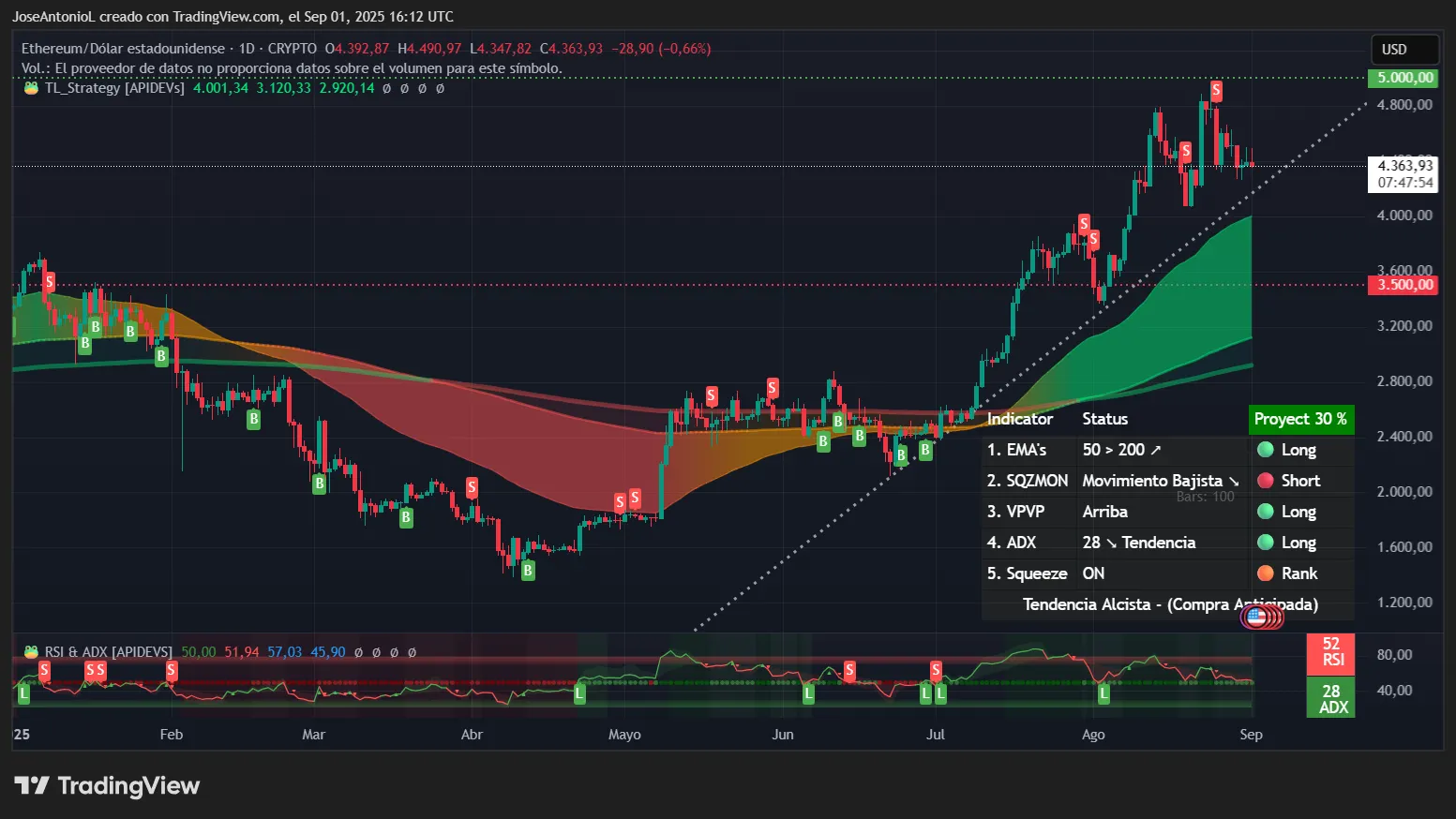
Ethereum is currently underperforming with a -0.66% decline to $4,363, despite opening just a bit higher at $4,392.87. The second-largest cryptocurrency briefly spiked to $4,490.97—a move of 2.2% from the open—but failed to hold gains, signaling rejection at the $4,500 resistance level.
Ethereum price data. Image: Tradingview
Ethereum’s ADX at 28 tells a more bullish story than Bitcoin’s, crossing above the crucial 25 threshold that confirms trend establishment. This reading suggests Ethereum’s recent price action represents genuine trending behavior rather than random volatility. Traders typically view ADX above 25 as validation for trend-following strategies, though the current price weakness contradicts this bullish signal—a divergence that often precedes sharp moves.
On the other hand, ETH’s ADX score has been decreasing over time, which may point to a weakening trend in the near future.
The Squeeze Momentum Indicator suggests volatility is building after a compression phase, typically preceding breakout moves. This is probably one small consequence of the September Effect, with short-term traders trying to sell their coins fast and long-term traders buying for what they expect to be the bounce ahead.
Ethereum’s RSI at 57 is also in what traders would consider bullish territory. It’s been higher recently, which suggests the market is calming down. Position traders may be holding and waiting for explosive movements before making judgements.
The bullish EMA alignment (with the 50-day average above the 200-day average) provides structural support, but the failure to maintain above $4,400 raises concerns. The current setup shows Ethereum is still very bullish—way above the average price of the past 50 days and coiling for a significant move as it breaks a weak, short symmetrical triangle pattern.
Myriad traders are holding the bullish Ethereum line as well. Predictors on the platform place the odds at 77% that ETH continues its upward trajectory and hits $5,000 before the end of the year.
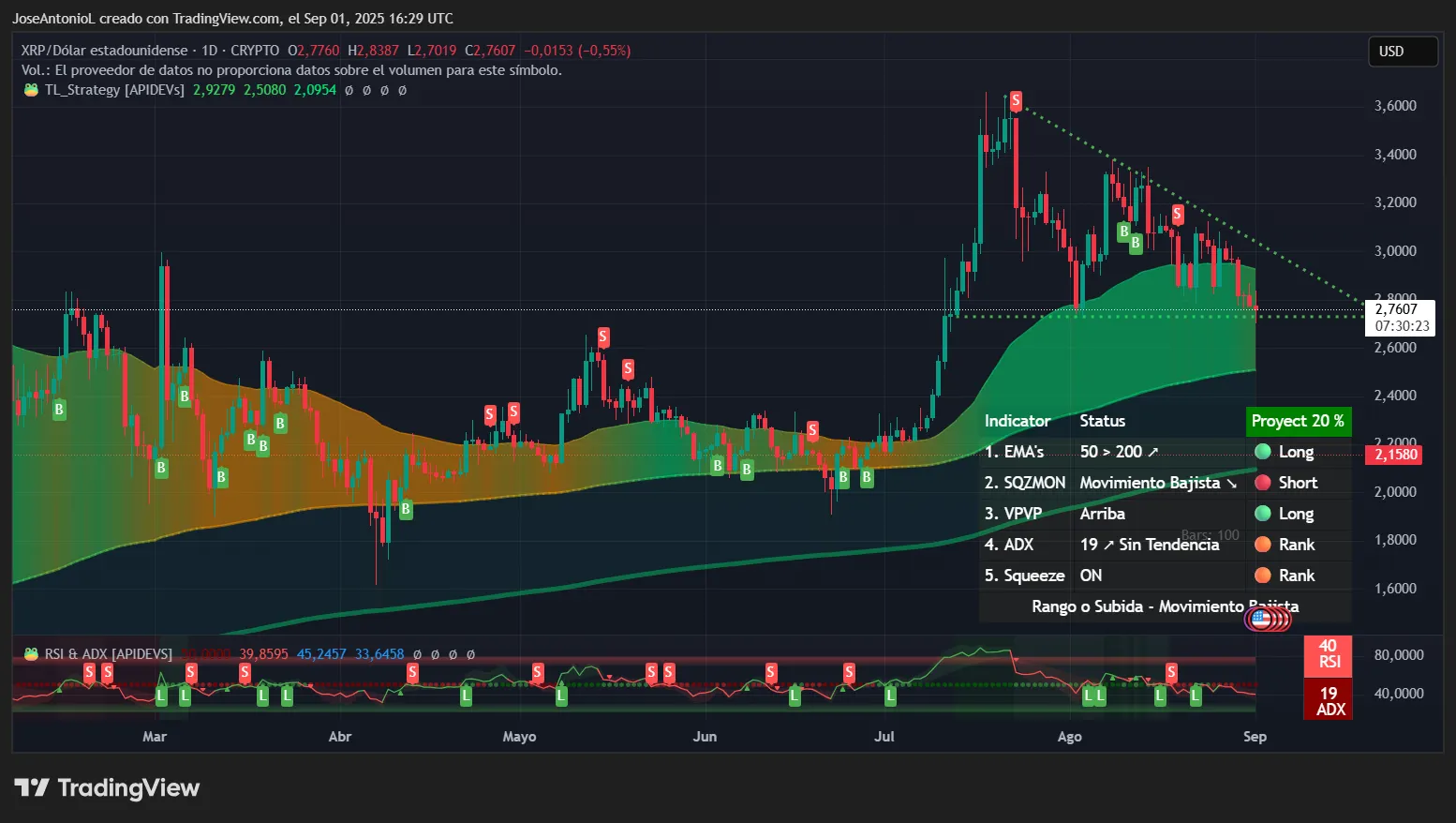
XRP rounds out the major cryptocurrencies with a -0.5% decline to $2.76, showing relative weakness. The Ripple-linked token briefly touched $2.8387—a 2.3% intraday move—before sellers took control, pushing it down to $2.70.
XRP price data. Image: Tradingview
The ADX at 19 is the weakest among the three top cryptocurrencies, firmly below the 25 trend threshold. This reading indicates XRP is stuck in a range-bound market with no clear directional bias. For traders, ADX below 20 typically suggest they should avoid trend-following strategies and instead focus on support and resistance levels for range trading. A low reading like this after recent volatility often marks accumulation phases before the next trending move.
Despite the Squeeze Momentum being “on,” XRP’s inability to hold gains above $2.80 suggests bears remain in control. The indicator’s activation combined with weak ADX creates what technical analysts call a “coiled spring” scenario. Extended periods of low ADX often lead to violent breakouts when they finally occur, though direction remains uncertain.
The price action shows a potential descending triangle pattern that might end in a bearish breakout, potentially testing the 200-day EMA support or even lower. It’s especially worth noting that XRP has now broken below the 50-day EMA support, which means bears are in control—at least in the short term.
The RSI at 40 points confirms the coin is heading into oversold territory, with sellers in control, though still not in full panic mode.
Myriad traders believe XRP drops to $2.50 before it ever reaches $4 per coin, placing those odds at 78% now.
Key Levels:
Immediate support: $2.70 (today’s low, psychological level, and the actual support of the descending triangle)
Strong support: $2.50 (previous consolidation base and EMA200 price zone)
Immediate resistance: $2.85 (EMA50)
Strong resistance: $3.00 (major psychological barrier and resistance set by the descending triangle)
Disclaimer
The views and opinions expressed by the author are for informational purposes only and do not constitute financial, investment, or other advice.
Daily Debrief Newsletter
Start every day with the top news stories right now, plus original features, a podcast, videos and more.
Prediction market protocol Myriad has passed $10 million in USDC trading volume with over half a million users, as it builds on its mission to make information itself a tradable asset class.
The protocol’s rapid expansion is “building the rails for prediction markets to evolve beyond a niche crypto product and become an entirely new segment of DeFi,” Loxley Fernandes, co-founder and CEO of Myriad, said in a statement shared with Decrypt.
“Financial markets have always been about speculation, but Myriad is turning speculation into a product,” Fernandes said, adding that Myriad’s success demonstrates that “trading ideas and forecasts is not only possible, it’s the next frontier for capital markets.”
Created by Decrypt and Rug Radio’s parent company DASTAN, Myriad launched its USDC markets in March 2025. In July, Myriad expanded to Ethereum Layer-2 network Linea, marking a key stage in its evolution into a multichain prediction markets protocol designed to power a “new class of DeFi products.”
To date, Myriad users have installed its browser extension over 60,000 times and made more than 5.4 million predictions across categories including sport, politics, culture and crypto—taking in everything from Nvidia’s market cap to how many birds would fly over Texas on a given night.
Myriad continues to develop both its consumer platform and a B2B protocol for other prediction applications. Its future roadmap includes integrations with EigenLayer and EigenCloud, as well as plans for introducing blended oracles and a framework for ERC-PRED, a new asset class designed for prediction markets.
With prediction markets expected to surpass the stock market in the next decade and a half, Myriad is preparing to make prediction markets a pillar of global DeFi. Ultimately, its aim is to do for financial derivatives and predictions what Robinhood did for stocks and securities, Fernandes said—building a protocol that enables users to “tokenize your opinions with just three taps of your finger.”
Daily Debrief Newsletter
Start every day with the top news stories right now, plus original features, a podcast, videos and more.
Nike and StockX have ended their legal battle over trademark misuse.
A judge ruled in March 2025 that StockX sold counterfeit Nike sneakers.
Analysts told Decrypt the deal signals less room for gray-area resale platforms and more focus on brand-approved NFTs.
Nike Inc. and StockX, a Detroit-based online marketplace, settled a three-year case in New York federal court last Friday over sneaker-linked NFTs and trademark misuse, over half a year after a judge ruled the resale platform sold counterfeit sneakers.
The settlement immediately takes a jury trial scheduled for October off the calendar, dismissing all claims with prejudice. It spares StockX the risk of a damaging verdict, while allowing Nike to avoid the uncertainty of putting its brand protection strategy before a jury.
The case began in the Southern District of New York in February 2022, when Nike accused StockX of trademark infringement and dilution, alleging its “Vault” NFTs used Nike sneaker images without authorization to sell tokens tied to physical shoes.
At the time, Nike argued the NFTs “are likely to confuse consumers, create a false association between those products,” and dilute its trademarks.
A month later, StockX countered in that its Vault NFTs were designed “to track ownership of frequently traded physical products,” not to mislead consumers, arguing that Nike’s suit reflected “a fundamental misunderstanding of the various functions NFTs can serve.”
By May of the same year, Nike had amended its complaint to allege that StockX was also selling counterfeit sneakers, saying pairs it purchased from the platform failed authentication and further supported its trademark claims.
Those allegations were later addressed earlier in March this year, with Judge Valerie Caproni granting Nike partial summary judgment after finding StockX liable for distributing counterfeit goods tied to four pairs of shoes sold to Nike’s investigators and 33 pairs sold to a customer named Roy Kim.
Unlaced in court
The ruling left other claims unresolved and set the case for trial, but the settlement reached in late August cut those plans short.
Now, observers point to the abrupt resolution as a key moment for how markets could view tokenized goods.
The Nike–StockX settlement “brings relief to the sneaker NFT market by removing the risk of a disruptive jury trial, but the real signal for the industry came earlier: when RTFKT shut down in December,” Dan Dadybayo, research and strategy lead at Unstoppable Wallet, told Decrypt.
“RTFKT was the most influential phygital studio, blending Nike Cryptokicks, Clone X with Murakami, and experimental sneaker drops,” Dadybayo explained.
The closure of RTFKT “showed how fragile hybrid models are when brand control and IP compliance aren’t crystal clear.”
The settlement reinforces how “NFTs functioning as receipts for physical goods will survive, but tokens drifting into standalone collectibles without brand approval will face legal pressure,” he said, adding that “less tolerance for gray-area resale platforms” could be expected.
Aligning with Dadybayo’s point, Hank Huang, CEO of Kronos Research, told Decrypt that NFTs “are no longer a legal gray area,” noting how trademark rights have become “essential for building credible, compliant platforms” as the tokenized collectible market “enters a more disciplined phase.”
Daily Debrief Newsletter
Start every day with the top news stories right now, plus original features, a podcast, videos and more.