Web3

Home Web3 Page 100

The Biggest Games Releasing in September 2025 – Decrypt

0
The Biggest Games Releasing in September 2025 – Decrypt


Fans have been eagerly awaiting the arrival of the new entry in their favorite franchise for years, and it’s finally here. 

With Grand Theft Auto delayed into next year, that can only mean one thing: Hollow Knight: Silksong is coming, and it’s coming in just a few days. 

For those who have been patient, this news is almost unbelievable. Developer Team Cherry has been nearly silent since the game’s announcement, to the point where entire communities of memes have emerged, with some focusing on trolling each other.

This month also marks the long-awaited return of Silent Hill. That is to say, trailers so far have been tantalizing, but it’s up to Konami to make good on the promises and create a game that feels authentically ‘Silent Hill.’

While the games below are the ones we think are the most exciting releases coming next month, make no mistake, there are tons of intriguing games releasing. 

We really wanted to include Garfield Kart 2: All You Can Drift, but unfortunately, we couldn’t make it work.

Hollow Knight: Silksong

Release Date: September 4 Platforms: PC (Steam, GOG, Humble Bundle), macOS, Linux, Nintendo Switch, Nintendo Switch 2, PS4, PS5, Xbox One, Xbox Series X/S; Xbox Game Pass Day-One

Hollow Knight was an almost instant hit with gamers, especially fans of search-action games, colloquially called Metroidvanias. 

Hollow Knight combines unique characters with razor-sharp precision gameplay and satisfying exploration. 

Silksong is the sequel to that game, and in this one, you’ll take on the role of the hunter Hornet, exploring a new map filled with secrets and bosses.

Baby Steps

Release Date: September 23 (delayed from Sept 8) Platforms: PC (Steam), PS5

What a rare thing it is for a game genre to be named after a single person. 

But Bennett Foddy hit a nerve with the 2008 browser game QWOP, which used the q, w, o, and p keys to move the character’s feet with excruciating precision or risk falling face-first. 

Most video games are power fantasies–you can unleash a hail of bullets or a meteor storm with the press of a button. Foddylikes keep their tasks much simpler and more straightforward. 

That brings us to Baby Steps, in which you’ll “play as Nate, an unemployed failson with nothing going for him, until one day he discovers a power he never knew he had… putting one foot in front of the other.” The team behind Baby Steps is calling it a “literal walking simulator.”

Borderlands 4

Release Date: September 12 (PC, PS5, Xbox Series X/S); Nintendo Switch 2 on October 3 Platforms: PC (Steam, Epic Games Store), PS5, Xbox Series X/S, Nintendo Switch 2 (later)

Fear not, Borderlands fans, that dismal movie that came out last year didn’t mark the death of the beloved shooter franchise. Borderlands 4 comes out in just a few weeks. 

This game brings new characters and a new story, of course. But it’s also adding an outpost takeover mechanic to the game, as well as the ability to pilot a Digirunner around the world map. 

Like just about everything else in Borderlands, you can customize both the look and feel of the vehicle. Speaking of customization, Borderlands 4 also features a host of new weapons and new ways to mix and match parts of different brands to make ever more powerful guns.

Henry Halfhead

Release Date: September 16, 2025 Platforms: PC (Steam, Epic Games Store), PS5, Nintendo Switch (compatible with Switch 2)

Henry Halfhead takes inspiration from games like Katamari Damacy to create a simple, beautiful world. 

And in that world, you play as, you guessed it, Henry Halfhead, a guy who is a pair of eyes and ears, a nose, and little else. 

Henry, however, has the power to inhabit anything he can land on, and can then move around or perform item-specific actions, such as assuming a kitchen knife to chop food, for example. 

This game looks whimsical and surprising, and we’re eager to see just how many items you can possess.

Dying Light: The Beast

Release Date: September 19, 2025 (PS4 & Xbox One versions later in 2025) Platforms: PC (Steam, Epic Games Store), PS5 (incl. Pro), Xbox Series X/S (initial); PS4, Xbox One (later)

We were all thinking the same thing when we played Dying Light 2, the expansive sequel to Dying Light. “I miss Dying Light protagonist Kyle Crane, a character I definitely remember,” we all said. 

Dying Light: The Beast puts it back in the parkour sneakers of Kyle Crane, but something’s different. It’s been over a decade since we last saw him, and he’s spent that entire time being held captive and used as a test subject by an evil scientist, who has given him newfound powers and senses. 

Kyle can go berserk with his new abilities, but is he the titular Beast?

Silent Hill f

Release Date: September 25 Platforms: PC (Steam, Epic Games Store), PS5, Xbox Series X/S

Silent Hill fans have had a rough go of it. 

After a great start in the late 1990s and early 2000s with a string of solid-to-excellent survival horror games, Konami struggled to produce a Silent Hill game that lived up to the critical and fan acclaim of Silent Hill 2. 

It’s not that every game since has been bad, but they’ve definitely struggled to make a mark. 

The trailers for Silent Hill f show the game shifting from modern American streets to 1960s Japan. This is a wholly new setting that makes this a fresh start, more than a sequel or reboot. 

The monsters we’ve seen look awesome, but the trailers seem to suggest a focus on melee combat—something that’s never been a strength for the series. Fans are crossing their fingers that this one lands.

Final Fantasy Tactics: The Ivalice Chronicles

Release Date: September 30 Platforms: PC (Steam), PS4, PS5, Xbox Series X/S, Nintendo Switch, Nintendo Switch 2

While most of the memorable Final Fantasy games are the mainline numbered entries, Final Fantasy Tactics, first released for the original PlayStation (Tactics on Game Boy Advance SP was my preferred version), stands out as perhaps the best-loved spinoff game in the Final Fantasy franchise.

Instead of exploring a vast open world with a few characters, you’re in charge of a small army of wizards, warriors, and more, fighting enemies on grid-based battlefields. 

The story doesn’t skimp either, dealing with themes of power and corruption. This release introduces an updated script with fully voiced dialogue, “improved” art (although they’ve made this claim before and failed to live up to it), a revamped UI, new difficulty levels, and auto-save. 

This could be the best way to play one of Square Enix’s best games.

GG Newsletter

Get the latest web3 gaming news, hear directly from gaming studios and influencers covering the space, and receive power-ups from our partners.


Source link

Trump-Backed USD1 to Supplant Tether, USDC as Top Stablecoin by 2028: Blockstreet – Decrypt

0
Trump-Backed USD1 to Supplant Tether, USDC as Top Stablecoin by 2028: Blockstreet – Decrypt


In brief

Blockstreet is creating a complimentary ecosystem for USD1, the Trump-backed stablecoin.
Co-founder Kyle Klemmer believes that it will outmatch all other stablecoins by 2028.
World Liberty Financial’s WLFI governance token becomes tradable on Monday.

By the time U.S. President Donald Trump’s second term is over, USD1 will have become the world’s most dominant stablecoin, according to Blockstreet co-founder Kyle Klemmer.

“With the team, the backing, and just the overall excitement that the blockchain community has, I can certainly see USD1 being the most widely adopted stablecoin in the world by 2028,” he told Decrypt in a recent interview. “USDC is the first target.”

Blockstreet’s stated mission as a “USD1-native launchpad” is to amplify World Liberty Financial’s vision, and the firm has been tasked with integrating the stablecoin from the Trump family’s crypto venture into crypto and traditional markets. The little-known firm, which debuted in mid-July, is also “helping bank the unbanked,” Klemmer added.

Blockstreet co-founder Matthew Morgan, a former cannabis entrepreneur, is an advisor to World Liberty and serves as CIO at ALT5 Sigma Corporation. The financial infrastructure firm unveiled a crypto treasury strategy centered around World Liberty’s governance token earlier this month.

Klemmer’s prediction, and goal for USD1, could face a high bar. Although stablecoins are a $285 billion industry today, JPMorgan analysts expect the sector to grow to $500 billion by 2028. And Bernstein analysts foresee the market reaching $2.8 trillion in the next five years.

That’s not to mention stiff competition from existing players like Tether and Circle—the issuers of USDT and USDC, respectively—or new entrants like Citigroup and Bank of America that recently passed legislation could unlock. But Klemmer is optimistic about USD1’s chances, based on the amount of outreach he’s received so far.

“There’s a lot of people all around the world who are incredibly complimentary of what the current administration is doing,” he said of President Trump. “They’re very excited about what World Liberty is trying to accomplish with USD1. A lot of people, the first thing that they say is, ‘How can we help?’”

World Liberty debuted a year ago. While the project has yet to deliver on its initial promise of crypto borrowing and lending services, its USD1 stablecoin has been out since April, growing to $2.5 billion meanwhile, according to crypto data provider CoinGecko. For comparison, Tether’s USDT and Circle’s USDC are worth $71 billion and $167 billion, respectively.


Klemmer said USD1’s appeal isn’t limited to its technical capabilities, noting that some crypto users appreciate it in relation to the government’s shifting approach toward the industry.

“It stands for a change,” he said, in reference to USD1. “There’s a very large appetite of countries, sovereign wealth funds, and other larger bodies that see the opportunities that are presented with USD1 and relate to that.”

The token was tapped in May by Emirati state-owned investment firm MGX as its vehicle of choice for making a $2 billion investment in Binance, the world’s largest crypto exchange, which faced intense regulatory scrutiny under the previous White House administration.

U.S. Senator Elizabeth Warren (D-MA) was among lawmakers that slammed the setup as “shady,” claiming it’s a high-profile example of crypto-powered corruption. “If we don’t do it, China’s going to,” the president has said in defense of his broader crypto push.

So far, USD1 has been issued on Ethereum, BNB Chain, Tron, and Solana. The stablecoin has been adopted by some exchanges, including Coinbase and Binance, but he foresees everyday payments as a “more clear and pressing” use case for USD1 to solve.

World Liberty’s WLFI governance token, which has been limited to accredited investors since its debut, is scheduled to begin trading on Monday, as the token becomes transferable. Some analysts have warned of potential losses for retail investors, citing its high fully-diluted value.

Klemmer said Blockstreet is still waiting on a clear game plan for USD1’s rollout, but he said that he’s aware of some “very lofty goals” that the team behind World Liberty has.  

“It’s the fastest-growing stablecoin to date, and I think it will continue to be the fastest-climbing stablecoin of all time,” Klemmer said, “until it surpasses Tether and takes its place.”

Daily Debrief Newsletter

Start every day with the top news stories right now, plus original features, a podcast, videos and more.


Source link

Bitcoin Home Invasion Ringleader Gets More Prison Time for Beating Witness – Decrypt

0
Bitcoin Home Invasion Ringleader Gets More Prison Time for Beating Witness – Decrypt


In brief

Remy St Felix was previously convicted of leading a home invasion crew that swiped crypto from victims.
Already serving 47 years in prison, he was sentenced to six additional years for beating a witness.
So-called wrench attacks, or physical assaults on crypto holders, have accelerated this year.

A Florida man sentenced to 47 years in prison last September for orchestrating a string of violent home invasions against crypto owners received additional punishment last week, awarded extra time for attacking a witness, according to the U.S. Justice Department.

Remy St Felix, 25, was sentenced to another seven years in prison for attacking a witness who testified to his involvement in the sweeping home invasion scheme, in which some crypto owners were assaulted and bound with zip ties, authorities said in a press release.

St Felix approached the witness, who was shackled and handcuffed, in a North Carolina-based detention center, striking him in the face, head, and body in October, according to authorities. Taking place after St Felix’s conviction on nine counts—including kidnapping and brandishing a firearm in furtherance of crimes of violence—he called the witness a “rat,” they said.


St Felix told the witness that his 47-year prison sentence was their fault, the Department said, adding that he later “gloated” about the beating to his girlfriend and mother.

In May, St Felix pleaded guilty to one count of retaliation against a witness for testimony in a criminal trial. However, 36 months of the sentence are expected to run concurrent to his previous sentence, effectively lengthening his time total behind bars by nearly four years on paper.

St Felix’s second conviction comes amid an uptick in cases of physical violence against crypto owners. Often referred to as “wrench attacks,” these methods seek to surpass the most advanced security measures an individual could have by relying on violence and brute force.

The pattern has been especially notable in Paris, where multiple victims have had their fingers severed while in captivity. Authorities in the region have made dozens of arrests, including a 24-year-old mastermind in June. Another wrench attack in France was reported this week.

In one instance in the U.S., St Felix’s crew abducted an individual from their Florida home, then drove 120 miles away and beat them while they were held hostage. Another time, a Texas family was restrained for three hours before the group absconded with cash and luxury watches.

St Felix was charged alongside 13 co-conspirators, and in total, authorities say the group stole $3.5 million worth of cryptocurrency. St Felix was ordered to pay $524,000 in restitution, representing the value of stolen assets, alongside his initial sentencing in September.

At the time, another co-conspirator, Jarod Gabriel Seemungal, was sentenced to 20 years in prison. He was ordered to pay $4 million in restitution for providing members of the home invasion team with rental cars, hotel rooms, and firearms.

Daily Debrief Newsletter

Start every day with the top news stories right now, plus original features, a podcast, videos and more.


Source link

From Apple to AI: Why Buybacks Will Power the Future of Decentralized

0
From Apple to AI: Why Buybacks Will Power the Future of Decentralized


In traditional finance, buybacks have long been a way for companies to return value to their shareholders. Take Apple, for instance. In 2012, Apple announced its first-ever stock repurchase program. Many critics doubted the move, calling it financial engineering. But over the next decade, Apple spent over $600 billion buying back its own shares. The result? Apple’s stock became one of the most valuable assets in the world, climbing from a $500 billion market cap in 2012 to over $3 trillion by 2024. Shareholders who held through those buybacks saw their wealth grow in staggering multiples.

| Buybacks weren’t just about shrinking supply; they sent a message: we are confident in the future, and we’re aligning ourselves with those who believe in us.

By 2018, Apple had fully embraced this as a cornerstone of its capital strategy and announced a colossal $100 billion share buyback, a move that had become a hallmark of the company’s capital strategy. Over the next several years, including a record-setting $110 billion plan. Apple relentlessly repurchased its own shares, leading analysts to dub the company “king of buybacks.” The result? A leaner share count, higher earnings per share, and a powerful statement of confidence. Apple’s stock benefited famously, continuing to climb and rewarding long-term shareholders.

Governments have long practiced similar ideas. In agriculture, for example, India, the United States, and China have all used buffer stock programs for decades. India’s governments built buffer stocks of grains such as wheat and rice, buying up excess supply when harvests were abundant, and releasing it during shortfalls. This stabilized prices, protected farmers, and ensured food security for millions.[

](agriculture.institute/institutional-support.. these two examples operate in very different spheres, corporate finance versus public welfare, they affirm the same core truth:

| When you harness surplus to create stability and reward participants, long-term resilience follows.

Web3 Learns the Lesson

Web3 projects quickly realized that the same mechanics could strengthen crypto economies. Some of the most enduring protocols owe their resilience to buyback-and-burn models that connect usage with scarcity.

BNB (Binance Coin): Binance began quarterly burns in 2017. Initially manual, they evolved into the BNB Auto-Burn, a formula that burns tokens based on trading volume and price. By Q1 2025, the token had burned 169.7 million BNB, equivalent to $58.5 billion, with quarterly burns, such as the $1.07 billion event in July 2025, accelerating the path to a 100 million token supply cap by 2027, making BNB one of the most deflationary tokens in existence. This program helped solidify BNB’s position as one of the top 5 cryptocurrencies.

MakerDAO (MKR): Maker introduced the idea of surplus auctions. When users generate Dai, they pay a stability fee. Those fees accumulate in a surplus buffer. When that buffer grows large enough, the system uses it to buy MKR and burn it. This creates a direct link: more borrowing → more fees → more burns → fewer MKR in supply

PancakeSwap (CAKE): PancakeSwap grew into one of the largest decentralized exchanges on the BNB Chain. Its model was simple but effective: trading fees fund weekly buyback-and-burns of CAKE. Over time, this deflationary pressure supported CAKE’s price even in bear markets.

Synthetix (SNX): For years, Synthetix inflated its token supply to reward stakers. But in 2023–24, governance voted to end inflation (SIP-2043) and replace it with buyback-and-burns funded by perps fees (SIP-345). Instead of printing new tokens, network usage now recycles fees to reduce supply..

Helium (HNT): Perhaps the most elegant design, Helium tied its token burns directly to network usage. Devices need Data Credits to send data on the Helium network. These Data Credits are minted only by burning HNT. The more the network is used, the more HNT disappears forever. This is what Helium called its Burn-and-Mint Equilibrium (BME).

Across all these examples, one theme stands out: when you connect usage to scarcity, you create trust and long-term alignment.

The Challenge of Decentralized Compute

Now let’s turn to compute. AI is the most compute-hungry technology humanity has ever built. Training GPT-4 reportedly costs over $100 million in GPU resources. Nvidia’s H100 and H200 GPUs are sold out worldwide, with hyperscalers like AWS and Google hoarding capacity. Developers, startups, and even governments are finding it nearly impossible to access affordable, stable compute.

This creates a paradox: AI is supposed to be open and transformative, but its building blocks are locked behind closed monopolies.

Spheron flips that model, building a community-powered, decentralized data center network. In its testnet, providers contributed $50 million in compute hardware. On mainnet, that doubled to over $100 million.

But to make this sustainable, Spheron needed a model where providers feel protected, users get affordability, and token holders see real value. That’s where Secure Compute comes in.

Spheron’s Secure Compute Flywheel

Here’s how the mechanism works:

Providers bring GPUs into the network by collateralizing with $SPON. This ensures long-term alignment.

They offer subsidized GPU rates (e.g., a $2.00/hr GPU drops to $1.50/hr).

Users pay fees; in times of high demand, rates can adjust slightly higher (e.g. $1.70–$1.85/hr), creating a margin or arbitrage profit.

That surplus margin is used by the Foundation to buy back $SPON. Importantly, buybacks only happen if the price is above a certain FDV launch floor, guaranteeing provider protection.

All repurchased tokens are burned permanently.

The result? A cycle where:

Providers get yields + safety.

Users get affordable compute.

Holders get a supply reduction tied to usage.

The Foundation operates sustainably.

Why will it work?

For providers: They get guaranteed yields, protection via the FDV floor, and an exit path via MPA-based buybacks.

For users: They get stable, affordable GPU access without dealing with cloud monopolies.

For token holders: They benefit from a shrinking supply tied directly to network growth.

For the Foundation: It operates sustainably, recycling profits into the token economy rather than draining reserves.

This is what makes it different from hype-driven burns. The model is self-funding, usage-driven, and repeatable.

Learning from the Giants

When Binance tied BNB burns to exchange volume, skeptics scoffed. Today, BNB is one of the most valuable tokens in crypto. When MakerDAO linked MKR burns to borrower fees, it created the blueprint for DeFi sustainability. Helium’s burn-and-mint equilibrium was once niche, but it now stands as a case study in utility-tied deflation.

Spheron is building on these lessons, but in a sector even larger than trading, borrowing, or IoT: compute itself.

By anchoring tokenomics in AI demand, Spheron is positioned at the intersection of two megatrends, crypto and AI. Every workload trained on Spheron, every GPU-hour rented, and every developer onboarded doesn’t just fuel the network. It makes $SPON scarcer, stronger, and more valuable.

The Road Ahead

The Secure Compute model is just the beginning. As AI demand accelerates globally, decentralized compute networks will rise as an alternative to hyperscalers. But unlike AWS or Google, Spheron isn’t just renting hardware; it’s embedding economic incentives that reward everyone in the system.

Providers are not faceless vendors, they are stakeholders.

Users are not at the mercy of monopoly pricing, they benefit from stability.

Token holders are not waiting for hype, they see real usage drive real scarcity.

It’s the same principle that powered Apple’s buybacks, India’s grain reserves, Binance’s quarterly burns, and Maker’s surplus auctions. Surplus value is recycled back into the system to protect its participants and make it stronger.

Conclusion

The history of finance, governance, and Web3 all point to one truth: the systems that endure are those that recycle value back to their foundations. Spheron’s Secure Compute $SPON buyback-and-burn is not just another token gimmick. It’s a carefully designed loop where providers, users, and holders are all protected and rewarded.

In a world where compute is the new oil, Spheron ensures that its tokenomics work like a refinery: taking raw usage, processing it into value, and burning the excess to strengthen the entire system.

This isn’t just about decentralized compute. It’s about building an economy where everyone, from hardware providers to AI builders to token holders, shares in the upside of a network designed to last.

And that’s why Secure Compute isn’t just a mechanism. It’s the future of decentralized infrastructure.


Source link

US and Dutch Authorities Take Down Crypto-Fueled Fake ID Marketplace – Decrypt

0
US and Dutch Authorities Take Down Crypto-Fueled Fake ID Marketplace – Decrypt


In brief

Dutch and U.S. authorities shut down VerifTools, a major fake ID marketplace that generated $6.4 million selling counterfeit documents for as little as $9 in crypto.
The operation seized 23 servers from one of the largest international providers of fraudulent identity documents.
Modern fake IDs use sophisticated technology like holograms and UV ink, making them nearly indistinguishable from genuine documents.

Dutch and American law enforcement have shuttered online fake ID marketplace VerifTools, which sold counterfeit documentation for as little as $9 in cryptocurrency.

According to a press release published Thursday, Dutch cybercrime police gained control of two physical data servers in Amsterdam, while also seizing control of 21 virtual servers.

They worked in collaboration with the FBI, which seized two domains used by the VerifTools marketplace, as well as a promotional blog.

Both the FBI and the Identity Fraud and Documents Centre of Expertise in the Netherlands had conducted investigations into VerifTools, with the FBI determining that the marketplace had generated around $6.4 million in revenues.


Similarly, Dutch authorities estimate that Veriftools had an annual turnover of roughly €1.3 million (about $1.5 million), making it one of the largest providers of fraudulent identity documents internationally. 

The marketplace reportedly worked by requiring users to upload a passport photo and enter false data, which the site’s operators then used to generate a false ID. FBI agents were able to order fake driving licenses for the state of New Mexico, paying for the counterfeit IDs using crypto—though specific coins were not identified.

Once delivered, fake IDs are often used to bypass KYC safeguards or commit fraud, with police in Wales encountering the VerifTools marketplace in the process of a fraud investigation.

The VerifTools URL now leads browsers to a splash page, which announces that the website has been seized by Dutch and American law enforcement agencies.

“The removal of this marketplace is a major step in protecting the public from fraud and identity theft crime,” said Philip Russell, Acting Special Agent in Charge of the FBI Albuquerque Division. “Together with our partners, we will continue to target and dismantle the platforms that criminals depend on, no matter where they operate.”

In their press release, Dutch police report that they will continue to investigate the data found on the seized servers, which it will use in an effort to locate VerifTools’ administrators.

According to experts, the production and distribution of fake IDs has not only become big business, but is growing rapidly.

“Pinning down exact figures is difficult given the illegal nature of the trade, but most estimates place the global fake ID market somewhere in the billions of dollars,” said Kartik Venkatesh, global head of innovation at identity technology firm GBG.

Venkatesh told Decrypt that today’s fake IDs are far more sophisticated than the “crude” knockoffs of past decades, using industrial-level machinery and micrometer-thick lamination.

“Many include holograms, polycarbonate layers, barcodes that scan correctly, and UV-reactive ink, making them nearly indistinguishable from genuine documents without specialist equipment,” he explained.

And what has driven this leap in quality is increased demand, which has provided the conditions for a “thriving” illegal market of tools and technologies, which also includes AI-generated IDs.

“Production is now slick and international, with websites resembling professional ecommerce stores,” he said. “Buyers upload details, pay in cryptocurrency, and receive fakes hidden inside everyday items.”

In fact, Venkatesh reports that some sellers even offer return policies, guarantees, and guidance on how to use the IDs convincingly.

From his vantage point, the solution to the growth in fake ID marketplaces is to invest in sophisticated ID verification systems, which are already helping some businesses and authorities detect counterfeits.

“By layering document analysis, facial biometrics, liveness detection and behavioral signals,” he said, “they can spot inconsistencies invisible to human inspection.”

He also suggests that digital IDs may have a role to play longer-term, since their cryptographic design makes them harder to forge, while they can be instantly verified with issuing authorities.

However, while they also allow for selective disclosure, Venkatesh warned that digital identities will attract their own forms of abuse. He noted “synthetic IDs stitched together from real and fake data and deepfake biometrics designed to trick liveness checks, to credential theft if someone’s phone or ID wallet is compromised.” 

Because of this, he argued that the future will reside in “balance” and layered checks. 

“Digital IDs can raise the bar for fraudsters,” he said, “but only when paired with multi-layered verification that can adapt to new attack vectors.”

Daily Debrief Newsletter

Start every day with the top news stories right now, plus original features, a podcast, videos and more.


Source link

Is AI the Future of Ethereum? The Network’s Developers Are Banking on It – Decrypt

0
Is AI the Future of Ethereum? The Network’s Developers Are Banking on It – Decrypt


In brief

Tech giants like Google and Amazon are betting on AI agents, and Ethereum developers believe their blockchain is uniquely positioned to power this new machine economy.
Ethereum core developer Davide Crapis has proposed ERC-8004, a standard for AI agents to discover, verify, and transact with one another.
Supporters argue Ethereum’s payment rails, digital identity tools, and scalable multi-layer structure make it the most efficient foundation for an AI-driven economy.

Tech giants like Google and Amazon are in the business of predicting where society is headed, and in recent months, both companies have started making moves to corner the development of AI agents—automated assistants authorized to zip around the internet, completing complex tasks on behalf of their human overlords and other machines. 

The push to develop a formidable AI agent economy is still far from complete. But when robots are eventually let loose en masse to transact efficiently with both the existing economy and each other, experts predict their productivity and output will rival that of humans. 

The main question looming over the development of the AI agent economy is what  infrastructure will best facilitate this explosion. Increasingly, top minds in Silicon Valley and crypto are coalescing around a single answer to that lucrative question: Ethereum. 

Ethereum’s core developers have recently arrived at the conclusion that the network is uniquely well positioned to become the foundational layer of the AI agent economy, given its ability to provide three key ingredients the ecosystem currently lacks: payment rails, identity verification, and trust.


The team is confident that within a handful of years, Ethereum will not just be foundational to the AI agent economy, but also that AI agents will become the core user base of the network.

“For us, it’s very important. It’s a strategic area,” Davide Crapis, an Ethereum core developer focused on AI, told Decrypt this week. 

Crapis said that within three to five years, he believes the majority of traffic on Ethereum will be coming from machines.

ERC-8004

Earlier this month, Crapis debuted ERC-8004: a proposed interface for Ethereum that would standardize how AI agents discover each other on the network and establish trust sufficient to engage in economic interactions. 

The proposal fixes what Crapis sees as the major flaws in existing ecosystems for agent-to-agent interactions. In April, Google unveiled the Agent2Agent protocol, which it promised would allow AI agents to seamlessly collaborate and “drive unprecedented levels of efficiency and innovation.”

But the framework has its shortcomings. For one thing, it doesn’t currently enable payments—an essential ingredient for a genuinely autonomous robot economy. Two, it doesn’t give agents the means to identify and trust each other out on the open internet. That means, in practice, that the protocol can only be used effectively to facilitate the interaction of agents within a single organization, on tasks that don’t involve financial transactions.

By its nature, Ethereum can easily fill these fundamental gaps, Crapis said. The payments issue is instantly solved by on-chain transactions, which AI agents already are capable of completing. As for identity and trust: that’s Ethereum’s bread and butter. NFTs, for instance, provide a secure means of establishing a unique digital identity. ERC-8004 provides a simple framework for how AI agents would go about validating each other’s identities on-chain. 

And if Ethereum were to provide that framework to undergird the AI agent economy, it’s not like the blockchain network would be going up against the likes of Google. On the contrary, the Silicon Valley behemoth is actually backing Crapis’ Ethereum proposal. Jordan Ellis, one of the core Google employees behind its Agent2Agent protocol, is a co-author of ERC-8004. 

“This, for me, is a signal that it’s not too early,” Crapis said of the collaboration. “In the sense that even in the traditional AI space, people are looking into agent-to-agent payments, and agent-to-agent identity.”

Powerful stakeholders in the burgeoning AI agent economy want to see the ecosystem as universally standardized as possible, to increase its potential reach and ease of navigation. These companies may not be crypto maximalists, necessarily; but if blockchain networks solve their problems far more easily than other approaches, what’s the downside?

The perfect use case?

Time and again over the last decade, crypto projects have struggled to reach mass adoption, in large part because they’ve failed at convincing mainstream consumers that the pain of navigating complicated blockchain networks is worth the gain of financial incentives or privacy benefits.

But in the looming age of the robot economy, crypto’s marketing woes may become far less of a liability. Crapis, who is now back at the Ethereum Foundation after a few years working on AI-related projects, is adamant that when the AI agent economy booms, robots will unemotionally choose the most efficient terrain on which to complete transactions—and that this best market will unquestionably be Ethereum.

“Our challenge has been making [Ethereum] more UX-friendly for humans to use, trying to shift their behavior,” Crapis said. “But if the user is an agent or a machine, then it’s fairly easy. Robots don’t have any problems remembering their private keys.”

The traditional economy was built for humans, and designed to verify human activity. (What’s your mother’s maiden name?) Ethereum, on the other hand, almost seems like it was built for robots, years before they possessed the capability to roam the internet on their own. That long-perceived liability—the network’s convoluted user experience—may now finally reveal itself as a boon in the era of the agent-dominated internet.

Even among other blockchains, the Ethereum team feels the network’s signature multi-layer structure is uniquely well poised to absorb the massive amount of AI agent traffic likely to arise in coming years. 

The base Ethereum blockchain will provide foundational security and stability to handle the deluge and to verify particularly high-stakes transactions, they say, while an ever-customizable, expandable, cheap, and speedy legion of layer-2 networks will be able to handle the likely massive quantity of everyday, smaller-scale settlements.

Other blockchains will have an immensely difficult time carrying the weight of the entire AI agent economy on their shoulders, Crapis said.

“Solana, in its current design, cannot sustain the machine economy,” he said, giving the example of Ethereum’s rival network. “They have no idea how much activity can come on-chain, once these machines start using it.”

The software developer predicts that once the AI agent economy arrives in full force, it will redefine the function of Ethereum, just as decentralized finance (DeFi) did back in 2020. 

Getting the Ethereum developer ecosystem to agree on a standard for agent-to-agent encounters is the first crucial step in preparing for that day. Crapis said he intends on tweaking ERC-8004 over the next few months, as he gets feedback from community members. 

But the standard will then be finalized in short order, to prepare for the arrival of an army of intelligent, crypto-wielding robots.

“I cannot predict when this takeoff will happen,” Crapis said, “but I feel that we have some urgency to build for it.”

Generally Intelligent Newsletter

A weekly AI journey narrated by Gen, a generative AI model.


Source link

Why Eric Trump Thinks Bitcoin Will Hit $1 Million – Decrypt

0
Why Eric Trump Thinks Bitcoin Will Hit  Million – Decrypt


In brief

Eric Trump said this week that he expects Bitcoin to reach a price of $1 million in the future.
President Trump’s son highlighted the major demand and limited supply for the top crypto asset.
He told listeners that buying now will age terrifically in the next five years.

Eric Trump thinks Bitcoin reaching a price of $1 million is inevitable. 

The crypto entrepreneur and son of U.S. President Donald Trump spoke highly of the top crypto asset, making bold price claims and encouraging listeners to “buy now,” during a fireside chat at the Bitcoin Asia conference in Hong Kong. 

“There’s no question in my mind that Bitcoin hits a million dollars,” Trump said in conversation with Nakamoto Holdings CEO, David Bailey. “And by the way, I don’t think it has to stop there. I think it could go a lot higher.” 

To Trump, the thesis for $1 million Bitcoin seems simpler than predictions based on money printing or technical analysis. 


“You have every person who wants an asset class, and you have a very limited supply,” he said. “It doesn’t take a genius to figure out where that goes.” 

Trump added that the growing utility of the asset will also play a role in its appreciation. In recent months, there’s been a surge of companies buying Bitcoin to hold in digital asset treasuries, and spot Bitcoin ETFs have seen unprecedented demand since launching in the U.S. in early 2024. And the ecosystem of Bitcoin financial services continues to grow.

“It was digital gold. It was a store of value,” he said. “Every single day they’re figuring out new ways to kind of stake it, to get yield on it, to use it for everyday purchases. You’re taking this digital gold, that was really just a store of value before, and you’re putting massive utility behind Bitcoin.”

Trump has a strong incentive to be bullish on BTC given his enmeshment with the crypto industry, where he said he spends “90% of his time” now. 

Not only does he maintain connections to Trump Media, which operates Truth Social and has raised $2.5 billion to buy Bitcoin and applied for its own spot Bitcoin and Ethereum ETFs, but he also serves as the co-founder of Bitcoin miner, American Bitcoin, which is expected to go public in September. Eric Trump is also a key figure behind the DeFi platform, World Liberty Financial, which has been promoted by President Trump.

The President’s eldest son hasn’t been shy about telling people to invest in crypto assets, including those he’s connected to. In February the first son told his X followers “it would be a great time to add ETH”—before it dropped 18% in the following days.

Ethereum has since rebounded significantly, making any buyers at the time of his post profitable as it recently stormed to a new all-time high. That said, ETH is has been on the way down since setting a new peak on Sunday.

He’s sharing a similar buy signal for Bitcoin now.

“I hear from people all the time: ‘Should I get into cryptocurrency? Did I miss it? Am I too late?’ And I literally start laughing at them,” Trump remarked. “We haven’t even scratched the surface of what Bitcoin is going to be. This is the time to buy. Volatility is your friend—buy right now, shut your eyes, hold it for the next five years, and you’re going to do terrifically well.” 

Daily Debrief Newsletter

Start every day with the top news stories right now, plus original features, a podcast, videos and more.


Source link

‘Red September’ Is Coming—Here’s What to Expect From the Bitcoin Market – Decrypt

0
‘Red September’ Is Coming—Here’s What to Expect From the Bitcoin Market – Decrypt


In brief

Bitcoin has dropped 3.77% on average each September since 2013, with eight monthly crashes in 11 years.
Seasonal pressures—from fund rebalancing to Fed policy jitters—fuel risk-off sentiment that spills over from stocks into crypto.
This year’s setup adds war, sticky inflation, and Fed uncertainty, making $105K the line in the sand for traders.

Bitcoin is trading sideways as August winds down, and crypto traders are doing what they do every year around this time: preparing for pain.

The phenomenon known as “Red September,” or “The September Effect,” has haunted markets for nearly a century. The S&P 500 has averaged negative returns in September since 1928, making it the index’s only consistently negative month. Bitcoin’s track record is worse—the cryptocurrency has fallen an average of 3.77% each September since 2013, crashing eight times according to data from Coinglass.

“The pattern is predictable: negative social media chatter spikes around August 25, followed by increased Bitcoin deposits to exchanges within 48-72 hours,” Yuri Berg, a consultant at the Swiss-based crypto liquidity provider FinchTrade, told Decrypt.

“Red September has gone from market anomaly to monthly psychology experiment. We’re watching an entire market talk itself into a selloff based on history rather than current fundamentals.”

Image: Coinglass

The mechanics behind Red September trace back to structural market behaviors that converge each fall. Mutual funds close their fiscal years in September, triggering tax-loss harvesting and portfolio rebalancing that floods markets with sell orders. Summer vacation season ends, bringing traders back to desks where they reassess positions after months of thin liquidity. Bond issuances surge post-Labor Day, pulling capital from equities and risk assets as institutions rotate into fixed income.

The Federal Open Market Committee holds its September meeting, creating uncertainty that freezes buying until policy direction clarifies. In crypto, these pressures compound: Bitcoin’s 24/7 trading means no circuit breakers when selling accelerates, and a smaller market cap makes it vulnerable to whale movements seeking to rotate profits into altcoins.


The cascade starts in traditional markets and spills into crypto within days. When the S&P 500 drops, institutional investors dump Bitcoin first to meet margin calls or reduce portfolio risk. Futures markets amplify the damage through liquidation cascades—a 5% spot move can trigger 20% in derivatives wipeouts. Social sentiment metrics turn negative by late August and traders sell preemptively to avoid expected losses. Options dealers hedge their exposure by selling spot Bitcoin as volatility rises, adding mechanical pressure regardless of fundamentals.

And just like any other markets, some believe this becomes a pattern out of pure rational expectation, which is just another way to say self-fulfilling prophecy.

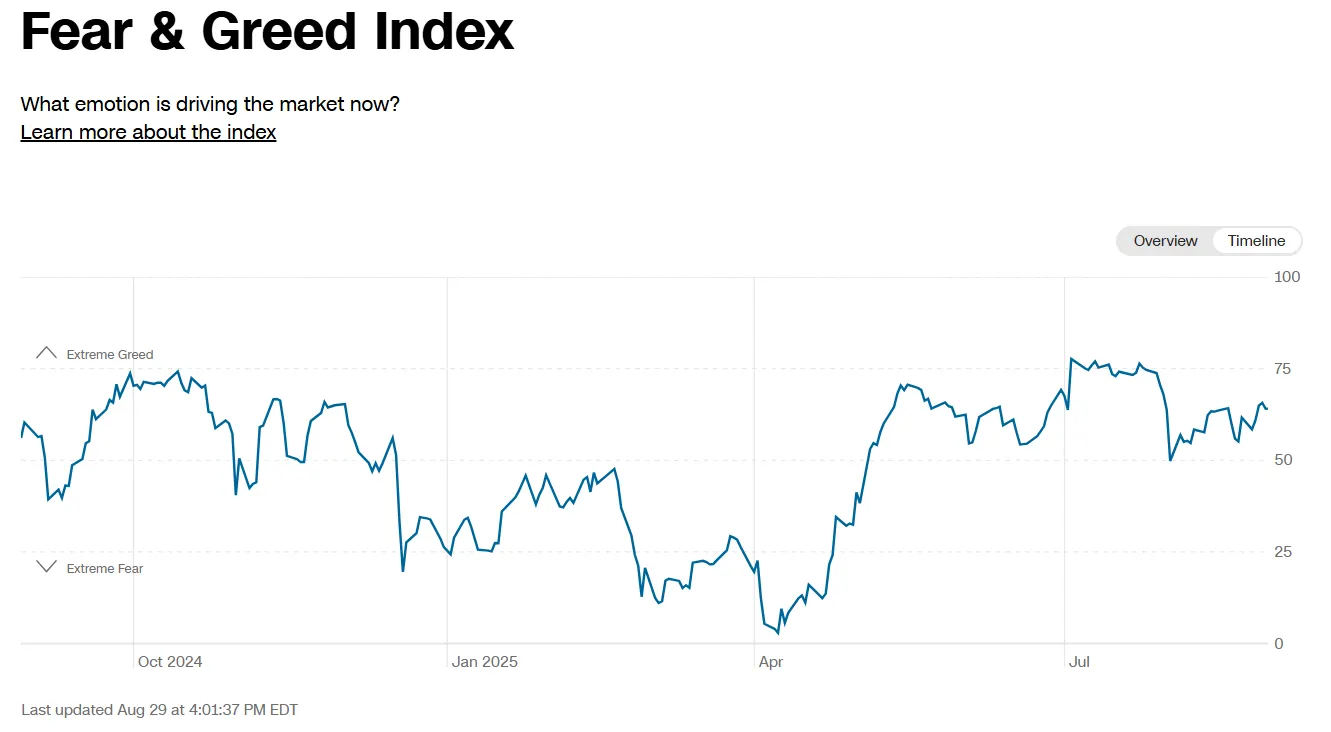
The numbers back up Berg’s observation. The Crypto Fear and Greed Index has dropped from 74 out of 100 to 52, despite the global stock market showing a more optimistic view with 64 points. Borderline neutral but still in the “greed” zone.

Image: CNN

But this September arrives with unusual crosscurrents. The Federal Reserve has shared positive statements, with the market pricing in another cut for the September 18 meeting. Core inflation remains stuck at 3.1%, while two active wars disrupt global supply chains. These conditions create what Daniel Keller, CEO of InFlux Technologies, sees as a perfect storm.

“We have two history-defining theaters of combat, one in Europe and one in the Middle East, which are disrupting critical supply chains,” Keller told Decrypt. “Additionally, the U.S. has initiated a global trade war against nearly all of its major allies. The contemporary state of global geopolitics perfectly positions BTC for a steep decline come September 2025.”

In other words, right now markets don’t see Bitcoin as a hedge, which was the dominant pre-COVID narrative of BTC as an asset. Markets view it much more like a risk asset.

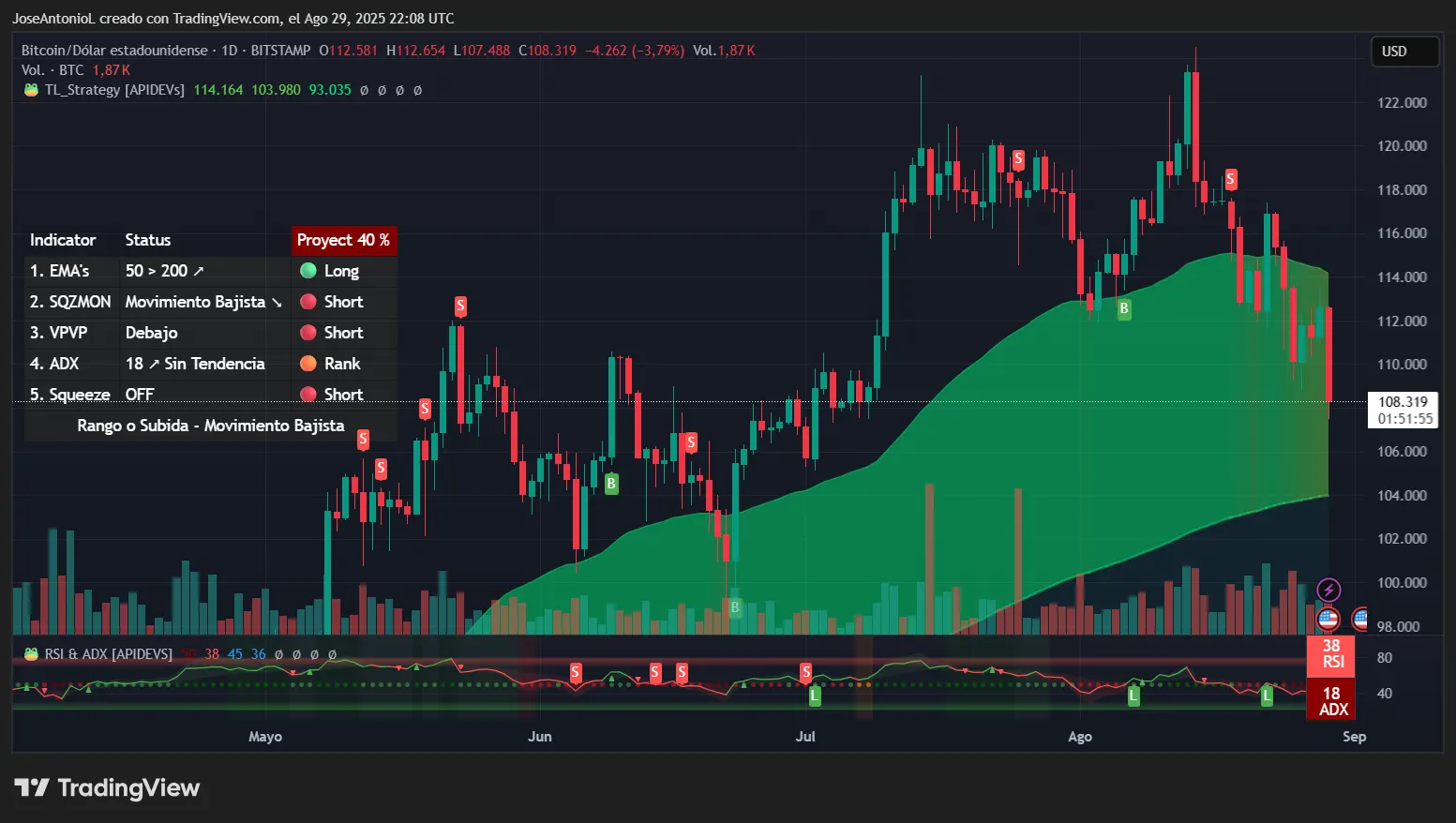
Technical indicators are starting to paint a scary picture for traders. Bitcoin broke below the critical $110,000 support level that has anchored the rally since May. The 50-day moving average sits at $114,000 and is now acting as resistance with the 200-day EMA providing support near the $103K price line.

Technical traders might be watching $105,000 as the line in the sand. On Myriad, a prediction market developed by Decrypt’s parent company Dastan, traders currently place the odds of Bitcoin dipping back down to $105,000 at nearly 75%.

A break below $105K would target sub-100K levels below the 200-day moving average. Hold above $110,000 through the first two weeks of September, and the seasonal curse might finally break.

The relative strength index reads 38, in oversold territory implying at least some Bitcoin investors are trying to get rid of their coins ASAP. Volume remains 30% below July averages, typical for late-summer trading but potentially problematic if volatility spikes.

But even if things seem like traders are preparing for history to repeat itself, some believe Bitcoin’s fundamentals are now stronger than ever, and that should be enough for the king of crypto to overcome this difficult month—or at least not crash like it has in the past.

“The idea of ‘Red September’ is more myth than math,” Ben Kurland, CEO at crypto research platform DYOR, told Decrypt. “Historically, September has looked weak because of portfolio rebalancing, fading retail momentum, and macro jitters, but those patterns mattered when Bitcoin was a smaller, thinner market.”

Kurland points to liquidity as the real driver now. “Inflation isn’t gliding lower, it’s proving sticky with core readings still creeping higher. But even with that headwind, the Fed is under pressure to ease as growth cools, and institutional inflows are deeper than ever.”

Traditional warning signs are already flashing. The FOMC meets September 17-18, with markets split on whether officials will hold rates or cut them.

Keller advises watching fear and greed indices closely. “Traders in the coming weeks should monitor fear and greed indices to determine the general market sentiment and whether it’s better to hold in case prices jump or sell off as ‘Red September’ looms closer,” he said.

The seasonal pattern may be weakening as crypto matures. Bitcoin’s September losses have moderated from an average negative 6% in the 2010s to negative 2.55% over the past five years. Institutional adoption through ETFs and corporate treasuries has added stability. In fact, in the last two years, Bitcoin has registered positive gains in September.

Berg sees the whole phenomenon as self-reinforcing psychology. “After years of September selloffs, the crypto community has trained itself to expect weakness. This creates a cycle where fear of the dip becomes the dip itself,” he said.

It the outlook seems bleak, don’t fret: After Red September comes October—or “Uptober”—which is historically Bitcoin’s best month of the year.

Disclaimer

The views and opinions expressed by the author are for informational purposes only and do not constitute financial, investment, or other advice.

Daily Debrief Newsletter

Start every day with the top news stories right now, plus original features, a podcast, videos and more.


Source link

Eliza Labs Sues X, Accuses Elon Musk’s Platform of Copying AI and Cutting Them Off – Decrypt

0
Eliza Labs Sues X, Accuses Elon Musk’s Platform of Copying AI and Cutting Them Off – Decrypt


In brief

Eliza Labs sued X Corp., alleging theft of AI tech and anti-competitive deplatforming.
A legal expert said that Eliza Labs’ open-source status weakens IP claims, but unfair practices may hold.
Eliza Labs seeks damages, reinstatement, and profits from allegedly misused technology.

Eliza Labs and its founder, Shaw Walters, are suing Elon Musk’s X, claiming the company tricked them into handing over technical details about their AI tools, then banned them from the platform and launched copycat products.

The lawsuit says X unfairly used its monopoly power, damaged Eliza’s reputation, blocked its access to customers and investors, and profited from Eliza’s innovations. Eliza Labs isn’t naming a dollar figure, but is asking the court to make X return its “ill-gotten gains,” pay for Eliza’s losses, and add treble damages and punitive damages on top.

Eliza Labs is the company behind ElizaOS, an open-source framework for building autonomous AI agents that can interact and perform tasks across blockchain networks.


The complaint, filed Wednesday in the U.S. District Court for the Northern District of California, claimed Eliza was invited in, mined for information, and ultimately pushed aside—with its own framework allegedly repurposed for X’s competing AI product, Grok.

The lawsuit claims that in early 2025, X invited Walters to meet after Eliza’s open-source tools gained traction with developers. The platform lets users build autonomous AI agents and 3D avatars with real-time chat, voice, video, and phone integration.

Soon after, X allegedly demanded a $50,000-per-month enterprise license to continue operating on the platform, before suspending Eliza Labs and Walters’ accounts for violating X’s terms and conditions. Internal messages cited in the complaint show an X executive warning that Eliza Labs had triggered legal action for API circumvention, unverified government customers, and unapproved use cases. Eliza Labs claimed that X then offered to pause that process in exchange for further talks.

While the accounts remained inactive, Walters says X continued requesting technical documentation under the guise of resolving the issue—then launched nearly identical AI agents under its xAI brand.

According to legal expert Kelly Lawton-Abbott, partner at law firm SSM, the lawsuit breaks new ground in the AI space—but faces long odds.

“There aren’t many cases in the AI space on anticompetitive behavior,” Lawton-Abbott told Decrypt. “Because Eliza is an open-source software platform, they don’t have the same protection of their software that they would have if it were proprietary.”

According to Lawton-Abbott, the burden of proof in federal antitrust claims is high. “For antitrust, it’s a pretty high standard,” she said. “I think that’s going to be a hard one for them to succeed on.”

Still, Lawton-Abbott said the lawsuit may be more about leverage than litigation. “I wouldn’t expect this to move forward,” she said. “I think it’s probably going to be leverage for a settlement.”

Lawton-Abbott also acknowledged the underlying power dynamic between the companies.

The suit claims X never responded to Eliza Labs’ request to have its accounts reinstated, and instead launched its own AI agents with similar features. In July, X’s artificial intelligence division, xAI, rolled out “Companions,” a new feature in the Grok chatbot app. The launch included Ani, a gothic anime-style avatar that greets users with “Hey babe!” and Rudy, a hoodie-wearing red panda for more playful interactions.

X Corp. has not publicly responded to the complaint. However, its AI tool, Grok, was sanguine about Eliza prevailing in court.

“This case has intriguing hooks but faces uphill battles, especially against a platform like X with deep pockets and precedent-favoring defenses.” It said. “Overall, this has 40-50% odds of surviving dismissal—fraud/UCL claims are stickier than antitrust, which often fails against tech giants.”

Generally Intelligent Newsletter

A weekly AI journey narrated by Gen, a generative AI model.


Source link

Tron Network Fees Slashed After Vote—Here’s What to Expect – Decrypt

0
Tron Network Fees Slashed After Vote—Here’s What to Expect – Decrypt


In brief

Tron’s blockchain is expected to be 60% cheaper to use after a vote by users.
The upgrade should make the network more attractive for crypto users, creator Justin Sun said.
Tron is popular with stablecoin users, but transaction costs have risen over the last year.

Tron has become cheaper to use after the crypto network’s community of token holders voted to slash fees by 60%, according to the blockchain’s founder Justin Sun. 

Writing on X overnight, billionaire crypto entrepreneur Sun—who has a number of digital asset ventures—said the proposal would ultimately benefit users. The change took effect Friday, per the time noted in Sun’s post.

Tron is the blockchain behind TRX, the 10th biggest digital coin by total value, which has a current market cap of $31.9 billion. The Tron network is popular in particular with stablecoin users

“For users, this fee reduction is a real benefit,” Sun said. “Cutting fees by 60% is bold and rare for any network. In the short term, Tron’s profitability will be affected, since network fees are directly reduced by 60%.”

Sun added: “However, in the long run, profitability will improve as more users and more transactions take place on the Tron network.”

Tron previously had a reputation for being a cheap blockchain. But transaction costs have spiked recently: The average price for making a transaction on the network recently stood at $1.70, but in December shot as high as $2.50, according to Token Terminal.


The Tron blockchain is popular as a payment network for stablecoins because it allows users to cheaply and quickly send the digital tokens in the decentralized finance or DeFi space, where users conduct transactions permissionlessly and without revealing their identities.

Major stablecoins USDC and USDT are available on the Tron network, as well as on other blockchains such as Ethereum and Solana.

Stablecoins are popular digital tokens that are backed by non-volatile fiat currencies like dollars, euros, or the yen. The idea is that crypto traders can make quick transactions—like buying Bitcoin and other digital assets—without having to use traditional banking rails. 

Data from DeFi Llama shows that the total market cap of stablecoins on Tron currently stands at over $82 billion, making it the second-largest crypto network for the tokens after Ethereum, which has a stablecoin market cap of $148.5 billion. 

The total market capitalization of all stablecoins across every crypto network is $283.3 billion, meaning that Tron’s share is close to 30% of the tally.

TRX was recently trading for close to $0.34 per coin, according to CoinGecko, after dropping nearly 2% over a 24-hour period.

Daily Debrief Newsletter

Start every day with the top news stories right now, plus original features, a podcast, videos and more.


Source link

Popular Posts

My Favorites

February 2025 Crypto Picks: XYZVerse, Chainlink, and Sui  

0
As the crypto market heats up in February 2025, investors are eyeing key projects poised for major moves. XYZVerse is riding a wave...