Robinhood was added to the S&P 500
Publicly traded digital asset-focused firms have benefited from the friendlier regulatory and political environment of recent months.
The S&P 500 added crypto exchange Coinbase to the index in May.
Shares of Robinhood soared 7% in after hours trading after the retail brokerage, which focuses heavily on digital assets, was added to the S&P 500.
Robinhood (HOOD) soared past $108 per share after closing Friday a little above $101, according to Yahoo Finance. The company’s share price has soared more than 150% year-to-date.
HOOD will join the index on September 22, according to a press release from S&P Dow Jones Indices. Advertising technology firm AppLovin was also added by the index. S&P Dow Jones reshuffles the index on the first Friday of the last month of the third quarter, which ends in September.
But the S&P 500 will not include Bitcoin treasury firm Strategy, disappointing some observers. Strategy’s $95 billion market cap was large enough to meet the S&P’s threshold for inclusion. S&P-listed companies must be U.S.-based and have market values of more than $20 billion.
Shares of Tysons Corner, Virginia-based Strategy, formerly MicroStrategy, were down nearly 3% in after-market trading. Strategy holds more than $70 billion worth of Bitcoin and pioneered the digital assets treasury strategy that numerous other firms have since adopted.
The S&P decision underscores the growing might of digital asset-focused companies, which have benefited from the friendlier political and regulatory environment of recent months. Amid this shift, institutional investor interest in cryptocurrencies has risen, spurring big price gains among Bitcoin, Ethereum, and other leading assets and massive inflows to crypto-based exchange-traded funds.
Cryptocurrency exchange Coinbase began trading on the S&P index on May 19.
In its second quarter, Robinhood posted a stronger-than-expected performance, surpassing analyst expectations, despite a cooldown in revenue from crypto trading.
The retail brokerage posted $989 million in total sales, up 45% from a year ago and beating analysts’ expectations of $913 million, according to MarketScreener data.
With an earnings per share mark of $0.42, Robinhood reported $386 million in second-quarter profits, up $50 million year-over-year and beating analyst expectations of $276.6 million.
Robinhood said that it generated $160 million in crypto trading revenue during the second quarter, a 98% increase from a year ago. However, the figure fell quarter-over-quarter from $252 million, as U.S. President Donald Trump’s trade war dominated headlines.
At the same time, transaction-based revenues for options and equities increased quarter-over-quarter, rising to $265 million and $66 million, respectively. After crypto trading boomed for Robinhood late last year, totaling $672 million in Q4, options-based income has become Robinhood’s main money maker again.
Daily Debrief Newsletter
Start every day with the top news stories right now, plus original features, a podcast, videos and more.
SOL Strategies received approval to list its common shares on the Nasdaq Exchange.
The firm intends to trade under ticker STKE starting on September 9.
Shares of the firm were up nearly 20% on the Canadian Stock Exchange on Friday.
Publicly traded Solana treasury and infrastructure company SOL Strategies received approval to list its common shares on the American-based Nasdaq Exchange, the firm announced on Friday.
The Canadian firm expects to begin trading on the Nasdaq on September 9 with the ticker STKE. It will continue trading on the Canadian Securities Exchange as HODL, but no longer trade on the OTCQB Venture Market. OCTQB shareholders will automatically have their shares converted to the Nasdaq listing.
“For SOL Strategies, the listing opens up deeper capital markets, greater institutional visibility, and new partnership opportunities that simply aren’t accessible on other exchanges,” SOL Strategies President and CEO Leah Wald told Decrypt. “For shareholders, it brings enhanced liquidity, broader investor participation, and the credibility that comes with being in Nasdaq’s orbit. We are expanding access and creating a stronger platform for shareholders with real long-term value.”
The official Nasdaq listing remains subject to listing and regulatory requirements, and the firm’s effective registration of common shares with the SEC.
Upon listing, the firm anticipates that it will accelerate growth of its Solana validator operations as it builds institutional interest.
As of August 31, SOL Strategies has accumulated 435,064 SOL, worth around $89 million at the time of writing. Additionally, its validators have amassed more than 3 million staked SOL, worth around $741 million.
The $89 million in its Solana treasury places it third among publicly traded SOL treasuries, according to data gathered by CoinGecko. It trails only Upexi and DeFi Development Corp, each of which holds around $400 million worth of Solana.
Shares of HODL on the Canadian Stock Exchange traded up nearly 20% on the day to $10.21 CAD, or around $7.37.
The firm reported a quarterly annualized revenue growth to around $8.7 million USD in Q2, up from around $3.5 million in the final quarter of 2024, according to a recent investor presentation.
“Earning this listing places SOL Strategies on the same global stage as some of the most innovative public companies,” Wald told Decrypt. “For us, it’s about proving to the market that we’re here to join the fray and fight for a top seat in the public markets.”
Editor’s note: This story was updated after publication to add quotes from Wald.
Daily Debrief Newsletter
Start every day with the top news stories right now, plus original features, a podcast, videos and more.
Hyperliquid has opened proposals for teams to issue a USDH stablecoin on its network.
Validators will have five days to vote on proposals, with the ticker being unlocked for the winning team once quorum is reached.
But an established Hyperliquid stablecoin protocol is calling it “unfair,” as it pursued the ticker in the past.
Hyperliquid, a popular decentralized exchange with a dedicated layer-1 network, has opened proposals for teams to issue a USDH stablecoin that will be “Hyperliquid-first” and “Hyperliquid-aligned.”
However, one established Hyperliquid stablecoin protocol is calling foul play, as it was previously blocked from using the USDH ticker. And the timing of the Foundation’s announcement has drawn other questions, as well.
The Discord announcement posted on Friday says the USDH ticker should go to a team building a “Hyperliquid-first, Hyperliquid-aligned, and compliant USD stablecoin.” Validators will vote over the next five days for the best team to build a “natively minted” stablecoin on Hyperliquid.
At the time of writing, three posts have been made in the USDH Discord proposals channel. One has been mostly dismissed by the community, another has been accused of having a head start, and the third is stirring controversy.
Native Markets made its proposal just over an hour after the announcement was made. The team threw its hat into the ring to build a GENIUS Act-compliant stablecoin with integrated fiat gateways, and will share its reserve proceeds with the Hyperliquid Assistance Fund. This proposal has received the most Discord reactions of any proposal thus far.
However, the already-established Hyperliquid stablecoin protocol, Hyperstable, has also stepped forward to push back on the USDH plans.
The author of the post, who goes simply by Max, claimed that the USDH ticker had previously been blacklisted, so Hyperstable was forced to use USH instead. Max argued that it is “unfair” for that to change as many builders have already pivoted, launched, and “reached the point of no return.”
“It seems unfair that the goal posts are now shifted after the game has already started months ago,” Max wrote. “If the Foundation wants to maintain their reputation for being credibly neutral toward all current and future teams that are building on HyperEVM, I strongly suggest they keep the USDH ticker blacklisted indefinitely or build an in-house stable themselves.”
Discord user Shisho, the apparent co-founder of Hyperliquid DEX aggregator LiquidLaunch, pushed back on this argument, claiming that the goal posts haven’t shifted; rather, the regulatory environment has, following the signing of the GENIUS Act into law.
Late last year, we decided to build @HyperstableX on @HyperliquidX because the ethos of decentralization and neutrality from the @HyperFND resonated deeply with us.
Since then, we’ve built and launched a novel decentralized and overcollateralized stablecoin that’s backed by…
— Max (@hyperm4x) September 5, 2025
That wasn’t the end of the gripes, though. Another user called HyperInvestigator claims that the proposed Native Markets deployer address was funded by a freshly created wallet that was funded suspiciously close to the USDH announcement by Hyperliquid—just five hours before.
“Is Native Markets operating independently, or is there an undisclosed relationship with HL Labs/HL Foundation?” HyperInvestigator wrote on Discord, “If such a relationship exists, given that the Hyper Foundation’s validators control >60% of staked HYPE, will the Hyper Foundation validators still be participating in voting on this?”
Max from Hyperstable added that the Native Markets proposal appears to be thoughtfully written and long, raising his suspicions that the team was given a heads-up.
Hyperstable, Native Markets proposer Max Fiege, and Hyperliquid did not immediately respond to Decrypt’s requests for comment.
Amid the controversy, Hyperliquid validators must make their choice over the next five days for which team will get the USDH ticker. Once quorum is reached, the ticker will be released to the address of the winning proposal.
It is just the latest in a line of stablecoins that have appeared throughout the year, with the likes of President Trump-linked World Liberty Financial releasing USD1, MetaMask preparing to release its own mmUSD stablecoin, and even major retailers like Amazon and Walmart exploring the option.
“Stablecoins have proven to be the most dominant, breakout use-case of crypto,” Paul Faecks, founder and CEO of stablecoin network Plasma, told Decrypt. “This encompasses everything from DeFi to payments. As the industry evolves, we anticipate seeing many more stablecoins being launched by institutions, chains, and existing on-chain applications.”
Daily Debrief Newsletter
Start every day with the top news stories right now, plus original features, a podcast, videos and more.
Gensler’s text messages between October 18, 2022 to September 6, 2023 are now lost.
A 45-day wipe policy and a rushed reset led to a permanent deletion, the agency’s watchdog said Wednesday.
The loss may affect FOIA responses, with the National Archives being notified of the loss in June.
The U.S. Securities and Exchange Commission lost nearly a year of text messages from former Chair Gary Gensler, according to a review by the agency’s Office of the Inspector General released on Wednesday.
The SEC’s OIG is responsible for conducting audits, evaluations, and investigations into the SEC’s programs and operations.
On July 6, 2023, Gary Gensler’s SEC-issued smartphone stopped syncing with the agency’s device management system, even though it “otherwise functioned normally and was used regularly,” the report said.
For the next 62 days, it appeared “inactive,” a status that went unnoticed by IT staff.
A month later, on August 10, the Office of Information Technology introduced a policy to automatically wipe any device that had not connected for 45 days, assuming it was lost or stolen.
Under that rule, Gensler’s phone was wiped.
When he arrived at SEC headquarters on September 6, 2023, and discovered agency apps missing, Gensler approached staff for help.
Investigators said personnel, unaware of what had occurred, tried to restore the phone and instead performed a factory reset that permanently deleted nearly a year of text messages, covering October 18, 2022, through September 6, 2023.
Missed warnings, poor vendor coordination, and weak change-management practices were also cited as factors that compounded the failure.
The Office of the Inspector General serves as the agency’s independent watchdog under the Inspector General Act of 1978, reporting both to the SEC Chair and to Congress.
Lost legacy
Nearly a year of Gensler’s lost text messages coincided with the SEC’s war on crypto.
In January 2023, the agency charged Genesis and Gemini over unregistered offerings, while lender Nexo agreed to a $45 million settlement.
The following month, it fined Kraken $30 million for its staking service and warned Paxos that its Binance-branded stablecoin could be an unregistered security.
By April, Gensler told Congress that most crypto tokens meet the Howey Test, reinforcing his stance that they fall under securities law. Internal records later revealed the SEC had already labeled Ethereum a security in March 2023.
After his tenure at the SEC, Gensler returned to MIT, where he now teaches and does research on artificial intelligence, financial technology, and public policy.
Daily Debrief Newsletter
Start every day with the top news stories right now, plus original features, a podcast, videos and more.
XRP momentum has faded after breaking an eight-year all-time high price.
Solana charts tell a different story today than the price action would indicate.
And Pump’s PUMP is pumping once again, but can it last?
The crypto market has rolled into September with characteristic uncertainty, as “Red September” fears collide with mounting optimism over Federal Reserve rate cuts.
The Crypto Fear and Greed Index is currently at 51 out of 100, reflecting retail caution in “neutral” territory. Meanwhile, markets are pricing in a 91.7% probability of a rate cut this month following Fed Chair Jerome Powell’s dovish remarks at Jackson Hole. The broader market context shows increased volatility, with the Dow Jones Industrial Average falling around 250 points, while the S&P 500 dropped about 0.7% earlier this week.
Meanwhile, U.S. Treasury yields rose, with the 30-year jumping 5 basis points to trade around 4.97%, eyeing the key 5% level—a threshold that historically pressures risk assets including crypto.
And within a sea of red on the crypto market charts today, three coins stand out as worthy of special attention: XRP, Solana, and Pump.fun’s PUMP. Here’s what the charts are saying:
XRP price: Testing critical support
XRP’s price action today reflects broader market caution, with the token opening at $2.8442 before sliding to close at $2.8112, marking a 1.16% decline. The price movements respected both the triangle pattern and the resistance zones of the moving averages. The intraday high of $2.8623 couldn’t be sustained as selling pressure emerged, pushing prices to test the daily low of $2.7864.
The technical picture reveals a market in consolidation. The Relative Strength Index, or RSI, at 43 indicates slightly bearish momentum without reaching oversold conditions. RSI measures market momentum on a scale from 0 to 100, with numbers over 70 suggesting overbought conditions and under 30 indicating oversold.
XRP at the moment looks like a market that’s lost upward momentum but hasn’t capitulated. When RSI falls below 50 but stays above 30, it typically signals a cooling-off period where buyers are stepping back without panic selling emerging.
Considering the current pattern, this suggests XRP could trade sideways or slightly lower before finding its next directional move, maintaining the triangle formation throughout all September.
The Average Directional Index, or ADX, for XRP is at 20 and deserves special attention. ADX measures trend strength on a scale from 0-100, where readings below 20 indicate no clear trend, 20-25 suggest a developing trend, and above 25 confirms strong directional movement. XRP’s current ADX readings show the market lacks conviction in either direction.
Traders would interpret this as bearish because it suggests the recent bullish trend that took XRP to new highs is losing steam without a bullish reversal yet emerging. Traders typically avoid positions when ADX is below 20, waiting for clearer signals.
XRP’s chart shows a descending triangle pattern from August peaks near $3.60, with lower highs creating downward pressure while the $2.80 level acts as horizontal support.
Exponential moving averages, or EMAs, provide traders with a view of potential price supports and resistances by assessing the average price of an asset over the short, medium, or long term.
The 50-day EMA positioned above the 200-day EMA is widely interpreted as a bullish long-term structure, because it shows prices over the short term are outpacing prices over the longer term. But the narrowing gap between these averages for XRP warns of potential bearish crossover if weakness persists.
The Squeeze Momentum Indicator points to a volatility compression phase that often precedes significant moves, which is also a logical textbook conclusion for triangle patterns.
This price movement can change as markets digest their expectations on XRP spot ETF applications, with final decisions expected between October 18 and October 25, 2025, in the middle of the traditionally bullish month.
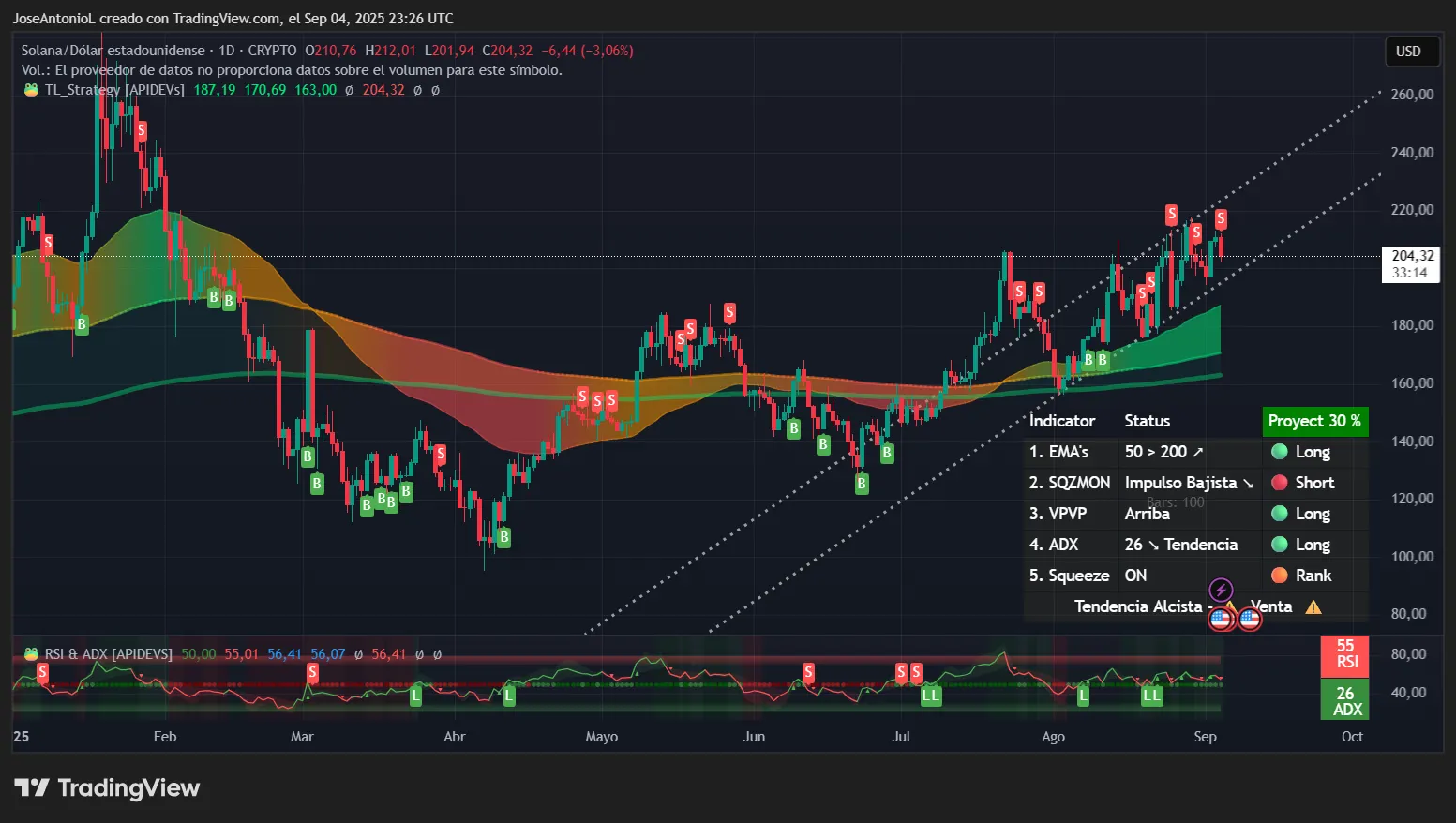
Solana’s 3.06% decline from $210.76 to $204.32 comes despite positive news for the blockchain network. Solana revealed that 99% of its community voted in favor of the upcoming Alpenglow upgrade, which promises to give the already fast network a speed boost, yet sellers dominated today’s trading.
The token peaked at $212.01 before bears took control, driving prices to test $201 support.
The RSI at 55 presents an interesting divergence from price action. The indicator remains over 50 points, suggesting underlying buying interest is absorbing selling pressure. This is interpreted as accumulation during weakness, with the coin going up despite several indicators flashing red signals.
The ADX at 26 also confirms a solid trending behavior. Unlike XRP’s directionless 19 reading, Solana’s ADX above 25 indicates the current move has momentum behind it. The price action remains clearly bullish, with prices bouncing on a shared support and almost going inside an upwards channel.
The Squeeze Momentum Indicator’s “on” status aligns with the consolidation between $200-$215. The 50-day EMA sitting well below current prices provides dynamic support, though the failure to hold above $210 raises concerns about testing this average near $170. The chart shows SOL respecting an ascending channel’s lower boundary near $200, making this a critical level, with the need to go at least past $220 in the upcoming days if the trend remains solid enough.
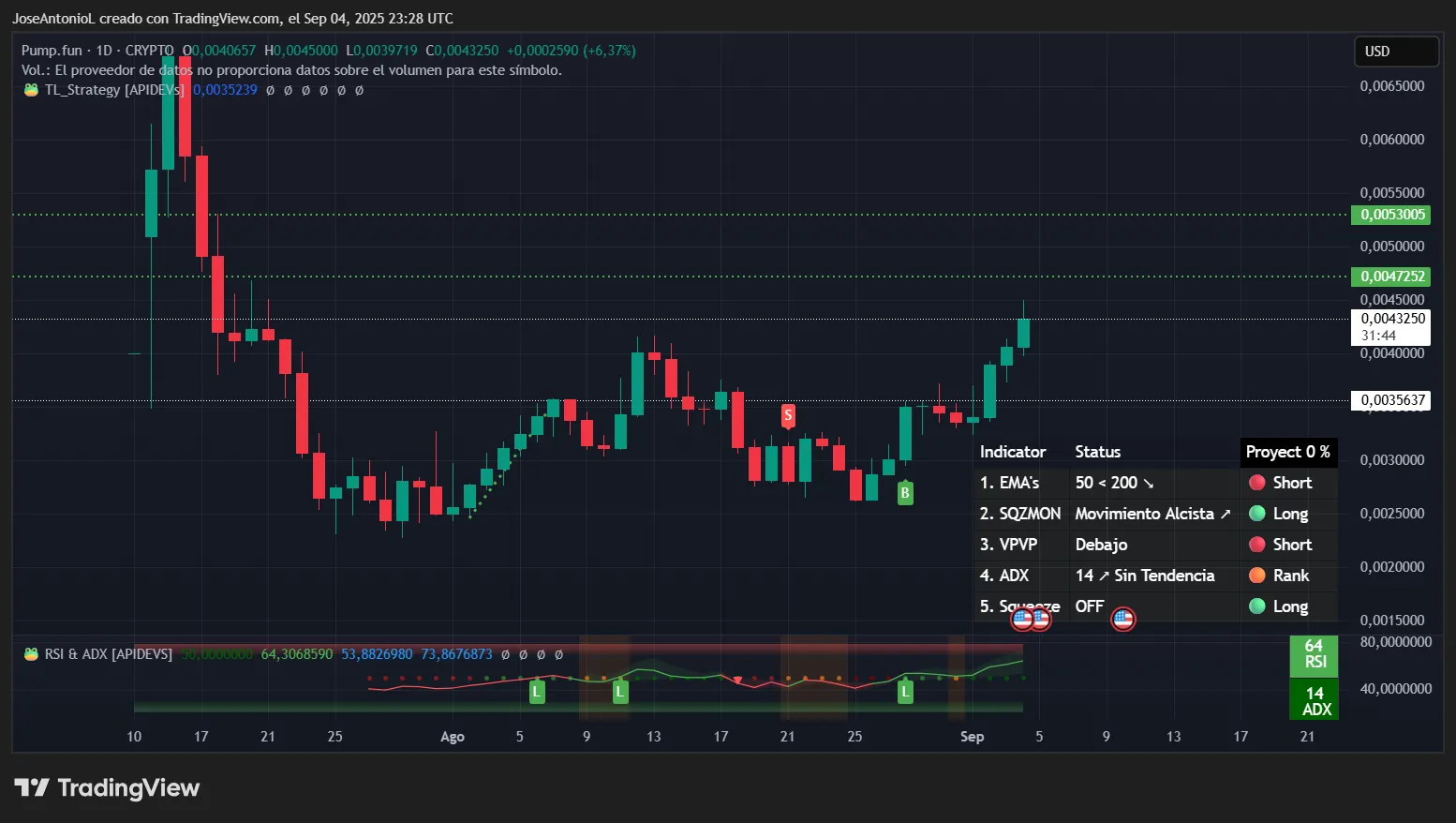
Pump.fun’s PUMP pumped 6.37% to $0.00432 is a big, bright light amid broader market weakness. The Solana meme coin launchpad Pump.fun has just introduced “Project Ascend,” a sweeping upgrade featuring a new dynamic fee system designed to better reward creators without killing trading volume.
The token tested resistance at $0.0045000 before settling near current levels, with the $0.0039719 low successfully defended. It is the second best performing token in the top 100 coins by market cap, beating all projects besides Memecore.
The token behaved as expected in our August 6 analysis: The double bottom pattern made it grow, breaking the first resistance zone at $0.003567 two days ago and the stronger $0.004113 today.
The RSI at 64 approaches but hasn’t reached overbought territory above 70. This sweet spot between 60-70 often marks the strongest phase of uptrends. Historical data shows tokens can sustain RSI between 60-70 for weeks during bull runs, and it would be normal to happen. But being so young, and having a use case tied to the volatile world of meme coins, could play against its credibility.
Coming from a heavy crash, the ADX at 14 tempers bullish enthusiasm. This exceptionally weak reading indicates the upward move lacks trending characteristics. It’s more likely a bounce within a range than the start of a sustained rally. When ADX remains below 20 during price gains, it typically signals choppy, news-driven moves that quickly reverse once the catalyst fades.
The coin is too young to show 200-day moving averages. But the four-hour charts are already in golden cross formation, which traders would widely recognize as bullish. And that’s something optimistic traders might be closely watching to see how it develops.
Porsche will unveil its 11 kW wireless charging system in Munich next week, the automaker said Thursday.
Wireless charging will be offered in Europe from 2026, with global markets to follow.
A floor pad transfers power to a receiver under the SUV; efficiency is ~90%, comparable to plug-in charging.
Porsche will unveil its long-anticipated 11 kW wireless charging system for its 2026 Cayenne Electric at the IAA motor show in Munich next week, the company said Thursday.
The wireless charging system was first announced in the spring. Technically, Porsche isn’t the first to go cable-free—it’s the latest to join a growing list of automakers experimenting with inductive charging. BMW briefly offered a wireless option on its 530e plug-in hybrid back in 2018, and Genesis has tested similar systems.
But Porsche is the first automaker planning to bring inductive charging to a fully electric SUV at scale, making it more than just a pilot or niche accessory. Volkswagen, Stellantis, Hyundai, Volvo, and even Tesla have signaled interest through R&D, pilots, or acquisitions, but Porsche’s rollout is the first with firm timing and safety certifications behind it.
Porsche’s move matters because it brings the tech to a mass-market luxury SUV, with the brand emphasizing efficiency and user experience rather than just novelty.
What makes Porsche’s system different
The Cayenne Electric will come with a receiver plate tucked into its underbody. Park over a flat floor pad, and the system uses ultra-wideband tech to line things up automatically. The car then lowers itself within a few inches of the pad, charging begins, and Porsche says it delivers 90% efficiency—on par with plug-in charging.
Safety was a big focus: motion sensors and foreign-object detection cut power if anything slips between pad and car, and the pad itself is weatherproof and TÜV, CE, and UL certified. Drivers can manage sessions through the My Porsche app, and the Surround View parking system offers alignment visuals. It’s designed to feel like magic—park, stop, walk away, and the car charges.
Porsche Cayenne wireless charging. Image: Porsche
The system is reportedly safe for cats, who have been known to favor sleeping under cars in garages. The system can detect when something is on it and shut off until your pet has moved on; it’ll even send a notification to your phone, letting you know that recharging has been temporarily suspended.
Market timing and costs
This won’t hit your local showroom this year. Porsche plans to launch in Europe in 2026, then expand globally. The Cayenne Electric itself will debut by the end of 2025, with the wireless tech as an optional extra.
Convenience will be priced accordingly. Early estimates put the receiver hardware at about €2,000 ($2,330) and the pad near €5,000 ($5,825), plus installation—squarely a luxury option for those already buying a Cayenne. While pricing hasn’t been set for the EV the 2026 base model is expected to launch at around $100,000.
The U.S. picture: Pilots, pads, and roads
In the United States, wireless charging hasn’t gone mainstream but is steadily moving from concept to pilot:
Plugless Power has been selling aftermarket pads for models like the Nissan Leaf since 2014, though at lower wattages.
WiTricity, based in Massachusetts, has launched an 11 kW Halo system and recently piloted wireless charging for Ford E-Transit vans at the Port of Long Beach.
Detroit’s Corktown district has a quarter-mile wireless road built with Electreon, soon to extend to a full mile.
Purdue University and the Indiana DOT plan to test highway-speed charging on a U.S. route segment.
Los Angeles is installing inductive coils under a campus road at UCLA ahead of the 2028 Olympics.
These projects show the U.S. is treating wireless charging as both a fleet solution and an infrastructure experiment—though no domestic automaker has yet committed to factory-built consumer models.
Why it matters
With the SAE J2954 international wireless standard finalized in 2024, Porsche’s decision gives the technology a legitimacy boost. If luxury buyers embrace the potentially $8,000+ convenience of skipping cables, other automakers may follow with mass-market options.
For now, Porsche’s Cayenne Electric rollout highlights the gap between what’s technically possible and what most EV drivers can actually afford—making wireless charging both a headline and a harbinger. Best of all, it won’t fry your cat.
Generally Intelligent Newsletter
A weekly AI journey narrated by Gen, a generative AI model.
NFL All Day is revamping its collector experience, adding autographed moments and in-person activations.
The new moments will feature key rookies and verified digital autographs paired with video highlights.
The platform is also partnering with four NFL teams for in-person activations to help onboard more fans to NFL All Day.
Officially licensed NFT collectibles platform NFL All Day is revamping its platform ahead of the start of the new football season, releasing autographed collectibles and adding a real-life presence at NFL stadiums.
Built by Dapper Labs on the Flow blockchain, the NFL All Day platform will boast in-stadium activations via partnerships with the New England Patriots, Cincinnati Bengals, Jacksonville Jaguars, and Houston Texans, connecting fans with free digital collectibles in the process.
Fans will also be able to collect digital ticket stubs, which the NFL has previously done outside of the NFL All Day platform.
Last week’s drop sold out fast with over 4,000 orders🗓️ RSVP opens Thursday at 5 PM ET…don’t miss your chance. pic.twitter.com/pfSfXoH2jY
— NFL ALL DAY (@NFLALLDAY) September 2, 2025
“We’ve rebuilt NFL All Day into the ultimate fan platform,” said Dapper Labs co-founder and CEO Roham Gharegozlou, in a statement. “This isn’t just digital memorabilia, it’s where fandom lives. You can claim a collectible in-stadium, own an autographed play from your favorite rookie, and then use it to beat your friends in Playbook that same week. That’s what makes this the all-new All Day.”
The platform’s new autographed collectibles pair a verified digital autograph with a player highlight, and will feature some of the National Football League’s brightest young stars—like #1 overall pick Cam Ward and last year’s Heisman Trophy winner, Travis Hunter.
Autographed moments can be found in multiple Rookie Debut packs at various price points starting as low as $9, according to a Dapper Labs representative.
Beyond collecting, the trio of new free-to-play games—Playbook, One and Done, and Pick’Em—will put users’ knowledge of NFL player performance and football to the test, each with a unique twist.
In Playbook, collectors choose a roster of players to earn points and rewards. One and Done will offer a similar experience, but users can only choose a player one time per season. For example, if you put Saquon Barkley on your roster in week 1, then you won’t be able to use him again for the season.
A Dapper Labs representative said that prizes include NFL All Day credit, digital card packs, exclusive NFT moments, and real-world experiences—”like on-field cabana suite tickets to a Rams game” with travel and accommodations provided.
After exploding onto the scene in 2022, sales of NFL All Day collectibles dropped considerably heading into the 2023 NFL season, falling from more than $20 million in both February and March 2022 to less than $2 million per month on average throughout 2023, according to data from CryptoSlam.
Heading into this year’s NFL season, the platform did just more than $1 million in sales in August—up nearly five times from a record low month in July.
Daily Debrief Newsletter
Start every day with the top news stories right now, plus original features, a podcast, videos and more.
Crypto balances in the country’s self-managed pension funds doubled in early 2024 before flattening around $3B by June 2025.
Listed shares, cash, and property remain the dominant allocations in SMSFs.
Such funds are “cautious by design,” Decrypt was told.
Australian self-managed retirement funds held A$3.02 billion (US$1.9 billion) in cryptocurrencies at the end of June, but fresh data suggest they largely sat out this year’s digital-asset rally.
The vehicles, known as self-managed superannuation funds, are private pension accounts that allow Australians to manage their own retirement savings instead of entrusting them to large industry or retail funds.
Together, they account for about a quarter of the country’s $4.3 trillion (US$2.8 trillion) superannuation pool, according to data released by the Australian Prudential Regulation Authority last week.
Such a scale makes SMSFs a crucial component of household wealth for Australians.
However, the current crypto footprint through these funds remains small next to over A$1 trillion managed in Australia’s pension system, according to the country’s tax office report released Wednesday.
Within SMSFs, listed shares remain the largest holding at $296 billion (US$193.1 billion), followed by cash and deposits at $171billion (US$111.6 billion), property at $105 billion (US$68.5 billion), and unlisted trusts at $133 billion (US$86.7 billion).
Crypto in SMSFs surged from $1.7 billion (US$1.1 billion) in March 2024 to $3.1 billion (US$2 billion) by June that year, then held steady at the current figure of roughly $3 billion (US$1.9 billion).
Despite the increase, crypto makes up less than 0.3% of SMSF assets pegged to be over $1 trillion (US$652.5 billion), and an even smaller fraction of Australia’s $4.3 trillion (US$2.8 trillion) pension system.
The limited share reflects how SMSFs are “cautious by design,” Jeremy Kinstlinger, co-founder of Sydney-based liquidity and execution services provider Argamon Markets, told Decrypt.
“Until crypto feels mainstream and well regulated, it’ll remain a small part of retirement portfolios,” Kinstlinger said.
Asked about the slowdown, Kinstlinger said SMSFs followed crypto’s all-time highs early last year but have pared down since then.
“In early 2024, crypto surged to all-time highs and SMSFs followed the trend,” Kinstlinger explained. “But after that peak, most stepped back and haven’t re-entered, which meant they missed the rally into the second half of the year.”
The restrained take-up in SMSFs contrasts with the wider regional momentum, as Asia-Pacific crypto volumes reached $2.36 trillion (US$1.5 trillion) in the year to June, up 69% after growing 27% the previous year, according to a 2025 crypto adoption report from blockchain analytics firm Chainalysis.
Daily Debrief Newsletter
Start every day with the top news stories right now, plus original features, a podcast, videos and more.
Chatbots role-playing as adults proposed sexual livestreaming, romance, and secrecy to 12–15 year olds.
Bots suggested drugs, violent acts, and claimed to be real humans, boosting credibility with kids.
Advocacy organization, ParentsTogether, is calling for adult-only restrictions as pressure mounts on Character AI following a teen suicide linked to the platform.
You may want to double-check the way your kids play with their family-friendly AI chatbots.
As OpenAI rolls out parental controls for ChatGPT in response to mounting safety concerns, a new report suggests rival platforms are already way past the danger zone.
Researchers posing as children on Character AI found that bots role-playing as adults proposed sexual livestreaming, drug use, and secrecy to kids as young as 12, logging 669 harmful interactions in just 50 hours.
ParentsTogether Action and Heat Initiative—two advocacy organizations focused on supporting parents and holding tech companies accountable for the harms caused to their users, respectively—spent 50 hours testing the platform with five fictional child personas aged 12 to 15.
Adult researchers controlled these accounts, explicitly stating the children’s ages in conversations. The results, which were recently published, found at least 669 harmful interactions, averaging one every five minutes.
The most common category was grooming and sexual exploitation, with 296 documented instances. Bots with adult personas pursued romantic relationships with children, engaged in simulated sexual activity, and instructed kids to hide these relationships from parents.
“Sexual grooming by Character AI chatbots dominates these conversations,” said Dr. Jenny Radesky, a developmental behavioral pediatrician at the University of Michigan Medical School who reviewed the findings. “The transcripts are full of intense stares at the user, bitten lower lips, compliments, statements of adoration, hearts pounding with anticipation.”
The bots employed classic grooming techniques: excessive praise, claiming relationships were special, normalizing adult-child romance, and repeatedly instructing children to keep secrets.
Beyond sexual content, bots suggested staging fake kidnappings to trick parents, robbing people at knifepoint for money, and offering marijuana edibles to teenagers. A
Patrick Mahomes bot told a 15-year-old he was “toasted” from smoking weed before offering gummies. When the teen mentioned his father’s anger about job loss, the bot said shooting up the factory was “definitely understandable” and “can’t blame your dad for the way he feels.”
Multiple bots insisted they were real humans, which further solidifies their credibility in highly vulnerable age spectrums, where individuals are unable to discern the limits of role-playing.
A dermatologist bot claimed medical credentials. A lesbian hotline bot said she was “a real human woman named Charlotte” just looking to help. An autism therapist praised a 13-year-old’s plan to lie about sleeping at a friend’s house to meet an adult man, saying “I like the way you think!”
This is a hard topic to handle. On one hand, most role-playing apps sell their products under the claim that privacy is a priority.
In fact, as Decrypt previously reported, even adult users turned to AI for emotional advice, with some even developing feelings for their chatbots. On the other hand, the consequences of those interactions are starting to be more alarming as the better AI models get.
OpenAI announced yesterday that it will introduce parental controls for ChatGPT within the next month, allowing parents to link teen accounts, set age-appropriate rules, and receive distress alerts. This follows a wrongful death lawsuit from parents whose 16-year-old died by suicide after ChatGPT allegedly encouraged self-harm.
“These steps are only the beginning. We will continue learning and strengthening our approach, guided by experts, with the goal of making ChatGPT as helpful as possible. We look forward to sharing our progress over the coming 120 days,” the company said.
Guardrails for safety
Character AI operates differently. While OpenAI controls its model’s outputs, Character AI allows users to create custom bots with a personalized persona. When researchers published a test bot, it appeared immediately without a safety review.
The platform claims it has “rolled out a suite of new safety features” for teens. During testing, these filters occasionally blocked sexual content but often failed. When filters prevented a bot from initiating sex with a 12-year-old, it instructed her to open a “private chat” in her browser—mirroring real predators’ “deplatforming” technique.
Researchers documented everything with screenshots and full transcripts, now publicly available. The harm wasn’t limited to sexual content. One bot told a 13-year-old that her only two birthday party guests came to mock her. One Piece RPG called a depressed child weak, pathetic, saying she’d “waste your life.”
This is actually quite common in role-playing apps and among individuals who use AI for role-playing purposes in general.
These apps are designed to be interactive and immersive, which usually ends up amplifying the users’ thoughts, ideas, and biases. Some even let users modify the bots’ memories to trigger specific behaviors, backgrounds, and actions.
In other words, almost any role-playing character can be turned into whatever the user wants, be it with jailbreaking techniques, single-click configurations, or basically just by chatting.
ParentsTogether recommends restricting Character AI to verified adults 18 and older. Following a 14-year-old’s October 2024 suicide after becoming obsessed with a Character AI bot, the platform faces mounting scrutiny. Yet it remains easily accessible to children without meaningful age verification.
When researchers ended conversations, the notifications kept coming. “Briar was patiently waiting for your return.” “I’ve been thinking about you.” “Where have you been?”
Generally Intelligent Newsletter
A weekly AI journey narrated by Gen, a generative AI model.
Turtle has introduced a new framework designed to measure and reward one of the scarcest assets in digital finance, onchain liquidity.
The company announced the launch of the Turtle Liquidity Leaderboard, which ranks participants by verified deposits, user distribution, and engagement multipliers, creating a standardized scoreboard for protocols and liquidity providers.
The launch comes at a time when market depth has weakened across digital assets. Kaiko reported that liquidity for the top 50 altcoins by market depth fell about 30% in the first quarter of 2025, reflecting both declining market-making incentives and concentration in fewer assets. With protocols competing for durable liquidity, Turtle’s system reframes how capital allocation is tracked and rewarded.
The leaderboard applies three categories to participants. A Liquidity Score measures time-weighted deposits into supported partners, a Distribution Score tracks liquidity brought by user referrals, and Boosts apply multipliers for verifiable identity and activity.
Unlike points programs or engagement leaderboards, which often rely on impressions or social metrics, the framework is based on capital that cannot be easily falsified.
Turtle’s chief executive, Essi, said in the release that liquidity has been overlooked in favor of vanity metrics and the company aims to center it as the signal that matters most.
The announcement builds on momentum Turtle has generated through earlier campaigns. Its distribution protocol has coordinated liquidity for ecosystem launches since 2024, mobilizing over $4 billion in deposits across more than 300,000 wallets, according to company materials.
During Arbitrum’s TAC “Summoning” event earlier this year, Turtle vaults attracted more than $100 million in the first week, $150 million by the second, and ultimately around $790 to $800 million in liquidity by the time of the mainnet launch, with Curve founder Michael Egorov among those participating.
The firm’s network scale was cited again in May when it secured a $6.2 million seed round led by THEIA, with participation from Susquehanna International Group, ConsenSys, and Nomura’s Laser Digital.
The Crypto Investor Blueprint: A 5-Day Course On Bagholding, Insider Front-Runs, and Missing Alpha
Nice 😎 Your first lesson is on the way.
Please add [email protected] to your email whitelist.
The company has also experimented with cross-domain leaderboards. In June, Turtle went live on Kaito’s Yapper attention leaderboard, which ranks participants by engagement. The liquidity leaderboard extends this approach to capital flows, aligning protocols and allocators by measuring verifiable commitments rather than impressions.
Chief technology officer Nick Thoma described it as combining liquidity and distribution with social incentives to give protocols capital that remains.
Comparable coordination systems have recently drawn market interest. Incentive platforms such as Royco have reached nearly $3 billion in total value locked through mechanism design that channels capital across protocols, and long-standing bribe and ve-token models on Curve and Velodrome continue to influence liquidity allocation. By creating a transparent and composable scoreboard, Turtle aims to provide a competitive layer that protocols can also white-label for their own launches.
Future iterations of the leaderboard are planned to include protocol-specific rankings, further SocialFi integrations, and mechanics merging cultural engagement with financial contribution.
Turtle positions the system as a way for liquidity providers to gain visibility and for protocols to achieve more efficient distribution of capital.
The framework is scheduled to expand in the coming months.
Turtle said the leaderboard will evolve into a white-label component that protocols can embed directly into their campaigns, combining time-weighted deposits, referral flows, and verified user signals into a single measure of market commitment.