Web3

Home Web3 Page 89

Telegram Founder Alleges French Role in Moldova Vote Censorship – Decrypt

0
Telegram Founder Alleges French Role in Moldova Vote Censorship – Decrypt


In brief

Telegram founder Pavel Durov said French intelligence sought the removal of opposition channels ahead of Moldova’s 2024 election.
His allegations come as Moldova’s pro-European party leads in a new parliamentary vote marked by claims of Russian interference.
The dispute underscores rising state pressure on digital privacy platforms, from messaging apps to crypto networks.

Telegram founder Pavel Durov has accused French intelligence of previously exploiting his legal troubles to censor opposition voices in Moldova’s presidential elections last year, pointing to a broader action by governments on digital privacy.

In a Sunday statement posted to Telegram and X, Durov said French intelligence had contacted him through an intermediary while he was being detailed in Paris roughly a year ago, requesting that he remove specific Telegram channels ahead of Moldova’s presidential elections in 2024.

Durov said that after Telegram removed channels violating its rules, an intermediary informed him that French intelligence would favorably address the judge overseeing his August arrest if he cooperated.

His allegations come as Moldova’s pro-European Party of Action and Solidarity, backed by President Maia Sandu, holds a commanding lead amid a fresh election that will decide the future of the country’s parliament, with over 50% of votes counted as of Sunday. 

Both elections have been marked by claims of Russian meddling, with Sandu warning Sunday that Russia had “massively interfered” in its democratic process, according to an Al Jazeera report.

Pro-Russian opposition leader Igor Dodon, meanwhile, has called for protests outside parliament, with reported plans to annul the vote.


In his post on Sunday, Durov further alleged that authorities later provided a second list of channels last year that were not “legitimate and fully compliant with our rules,” whose only commonality was voicing “political positions disliked by the French and Moldovan governments.”

“We refused to act on this request,” he said. “Telegram is committed to freedom of speech and will not remove content for political reasons.”

He claimed authorities were exploiting his legal situation to influence political developments in Eastern Europe, a pattern he said was also “observed in Romania.”

Even Alex Chandra, partner at IGNOS Law Alliance, told Decrypt that platforms must clearly separate violations of their own standards from politically sensitive but compliant content. 

“Rule-based governance is non-negotiable,” Chandra said. “Platforms that clearly separate violations of their own standards from politically sensitive but compliant content can preserve credibility in front of regulators, investors, and users.”

“Legal exposure is becoming leverage,” he added. “As seen in the Telegram case, state actors may use executives’ judicial vulnerabilities to extract concessions.”

The fight for privacy

Durov’s allegations resonate with ongoing battles in crypto, where governments are clamping down on privacy tools. 

Recent convictions of Tornado Cash developer Roman Storm for operating an unlicensed money transmitter and guilty pleas from the founders of Samourai Wallet point to a pattern of pressure on privacy-focused platforms.

“Both communications platforms and crypto networks face parallel tactics of state interference,” Chandra said. “Multinational firms should anticipate that once a regulatory playbook proves effective in one vertical, it may be replicated across others.”

Mohith Agadi, founder of Fact Protocol, told Decrypt the situation reflects “a broader tension between state interests and digital freedoms.”

“The challenge arises when these two priorities collide, particularly in politically sensitive moments,” Agadi said. “What’s needed is greater transparency, clear standards, and independent oversight mechanisms.”

The French Ministry for Europe and Foreign Affairs responded to Durov’s claims, retweeting a post saying the Telegram founder “likes making accusations while elections are ongoing.”

Durov remains under judicial supervision in France following his arrest and is required to report to authorities every 14 days with “no appeal date in sight.” 

The Open Network’s Toncoin, closely associated with Telegram, tanked in the immediate aftermath of his detention. The token now trades at $2.71, down 67% from its all-time high of $8.25, as per CoinGecko.

Daily Debrief Newsletter

Start every day with the top news stories right now, plus original features, a podcast, videos and more.


Source link

Researchers Build Microscopic Gears Powered by Light in Milestone for Nano-Scale Machines – Decrypt

0
Researchers Build Microscopic Gears Powered by Light in Milestone for Nano-Scale Machines – Decrypt


In brief

Scientists etched working gear trains on a chip, driven solely by photon momentum.
The devices could someday power microfluidic pumps, reconfigurable optics, and tiny surgical tools.
Efficiency remains extremely low, making the work an elegant proof-of-concept, not a product.

Researchers have built microscopic machines—complete with working gears, racks, and pinions—that run entirely on light.

The study, published recently in Nature, marks the first time engineers have assembled functional “gear trains” at micrometer scales, harnessing photons rather than motors or wires to drive motion.

If the technology matures, then its future could look surprisingly practical. Light-driven micromotors could pump reagents in postage-stamp-sized diagnostic labs, steer mirrors inside ultra-compact cameras, or open and close valves in drug-delivery implants—no batteries or wiring required.

In data centers, swarms of these gear systems might reconfigure optical circuits on the fly, helping direct laser signals between chips. And in biomedical research, tiny optomechanical arms could one day manipulate single cells or proteins with pinpoint control, performing tasks now reserved for bulky, expensive instruments.

Tiny gears, big ambitions

The achievement, led by a team of physicists and engineers using standard semiconductor fabrication tools, demonstrates a long-sought bridge between photonics and mechanics: miniature machines powered and controlled by beams of light.

Each “metamachine,” as the authors call them, is etched onto a chip using lithography similar to that used for computer chips. When illuminated, the patterned metasurfaces redirect photons in such a way that their momentum—tiny though it is—translates into torque, setting the gears spinning.

The devices aren’t merely rotating discs. They include entire assemblies of interconnected parts, like trains of gears that transmit force, and rack-and-pinion systems that convert rotation into linear motion. By changing the polarization of the light or tweaking the metasurface geometry, the researchers can reverse direction or modulate speed.

They even coupled these microscopic engines to mirrors, demonstrating how mechanical movement could alter optical signals on demand—a tantalizing glimpse at reconfigurable optical circuits.

Yet, as with many dazzling breakthroughs, the results come with caveats that cast them more as proof-of-concept than practical prototype. The conversion efficiency is vanishingly small, around one ten-trillionth of the light’s energy.


In other words, these machines operate—but barely. The torque they generate is minuscule, the rotations slow, and the operation precariously dependent on precise illumination and stable environments. Thermal effects from absorbed light can introduce drift or damage, and the machines themselves face the timeless foes of mechanics: friction, wear, and contamination.

From lab curiosity to future tools

Still, the demonstration matters. For decades, researchers have tried to integrate moving mechanical components with optical and electronic systems at micron scales, only to hit engineering dead ends. Electrical micro-actuators demand wiring and contacts that become unmanageable at such dimensions. Chemical and magnetic drives bring complexity and incompatibility with chip manufacturing.

Light offers a non-contact alternative—if it can be tamed to do useful work. By embedding optical metasurfaces directly into the gear structures, the team has shown that photons can indeed serve as a power source, however inefficient, for linked mechanical motion.

The potential applications are wide-ranging, if distant. In microfluidics, light-driven pumps or valves might one day move molecules without electrodes or tubing. In sensing and optics, miniature mirrors and shutters could dynamically steer or filter light, building blocks for agile photonic circuits.

Biologists dream of micromechanical tools that can operate inside cells or manipulate microscopic organisms without wires or magnets. Even fundamental science could benefit: arrays of these tiny gears could help researchers study friction, adhesion, and wear at scales where surface forces dominate.

How it works, in miniature

What makes the approach particularly appealing is its compatibility with established chipmaking processes. The metamachines are fabricated from common materials using lithographic steps already routine in semiconductor foundries. That means, in theory, entire fields of microdevices—optical, mechanical, or even biological—could someday incorporate these structures as easily as adding a new layer of circuitry.

But realizing that promise will require solving a formidable list of problems. Light is an elegant power source, but a weak one; each photon carries only a wisp of momentum. Scaling up output may demand lasers so intense they introduce destructive heating. The gears’ tiny teeth must mesh with atomic precision, making them vulnerable to defects and dust. And while the study shows operation over hours, questions linger about longevity, repeatability, and control in realistic environments.

For now, the metamachines are best viewed as exquisite demonstrations of what’s possible rather than as ready-to-use components. But in a field where progress has long been measured in nanometers, even small steps can feel revolutionary. The vision of microscopic factories, weaving motion from beams of light, remains distant—but suddenly, it’s no longer imaginary.

Generally Intelligent Newsletter

A weekly AI journey narrated by Gen, a generative AI model.


Source link

The AI Boom and the New Resource Race

0
The AI Boom and the New Resource Race


Artificial intelligence is no longer a futuristic promise; it is here, embedded in nearly every industry. From drug discovery to financial modeling, from autonomous vehicles to robotics, AI has moved from experimental labs to boardroom agendas. But this progress runs on a very specific fuel: high-performance GPU compute. Just as oil powered the global economy in the 20th century, compute is rapidly becoming the essential resource of the 21st century. Those who control it will dictate the pace of innovation, economic growth, and even geopolitical power.

The Surge in AI Adoption and the Demand for Compute

The adoption curve for AI has been nothing short of explosive. Stanford’s 2025 AI Index Report reveals that 78% of organizations now use AI in at least one business function (up from 55% the year before). This sharp rise reflects not only the popularity of generative AI applications but also the mainstreaming of machine learning in operations, supply chain management, customer engagement, and decision-making.

Alongside this adoption, investment in AI infrastructure has surged. Since 2020, AI-related infrastructure spending has outpaced traditional IT spending by six times. McKinsey projects that by 2030, enterprises and governments will pour more than $5.2 trillion into AI-related data centers alone (with a total ~$6.7 trillion in required data center investment across all IT workloads). To put this in perspective, that figure rivals Japan’s entire GDP, underscoring that compute is no longer a back-office IT line item, it is a strategic asset at the heart of economic power.

The Harsh Reality of GPU Scarcity

The rapid rise in demand has collided with hard supply limits. GPUs, the engines of AI, are in unprecedented shortage. In the first quarter of 2025, NVIDIA allocated nearly 60% of its production to enterprise clients, sidelining startups and smaller players. Adding to the crisis, a devastating earthquake in Taiwan destroyed over 30,000 wafers at TSMC, further tightening supply.

These shortages have led to skyrocketing costs. The highly sought-after H100 GPU is being resold at 30–50% above MSRP, with wait times stretching up to a year in some markets. For enterprises trying to maintain competitive timelines, these delays are crippling. Startups, often the drivers of breakthrough innovation, are being priced out of the AI race, not because of a lack of ideas, but because of a lack of compute.

Why Centralized Cloud Models Are Breaking

The traditional hyperscaler cloud model, built for scaling web apps, not training AI models, is buckling under pressure. Capacity constraints have stretched procurement timelines to 20–32 weeks, a delay that can erase competitive advantages in fast-moving markets. Vendor lock-in compounds the issue. Companies tied to one or two providers are left vulnerable to price hikes, restricted quotas, and opaque policies.

The consequences are measurable. Research shows that enterprises deploying AI infrastructure 40% faster than peers achieve 2.3× higher revenue growth and capture 60% more market share. In this environment, speed isn’t just a benefit; it is survival. But with centralized providers unable to keep up, innovation bottlenecks are inevitable.

The Strategic Compute Reserve, Treating Compute as an Asset

Enter the concept of the Strategic Compute Reserve (SCR). Much like airlines hedge against volatile fuel costs or manufacturers secure raw materials through long-term contracts, enterprises must now treat compute as a strategic reserve rather than an operating expense.

A Strategic Compute Reserve ensures predictable, resilient, and flexible access to GPU capacity. It safeguards against supply shocks, shields businesses from price volatility, and guarantees R&D teams the freedom to experiment and scale. Beyond protecting continuity, it provides the speed and reliability needed to accelerate time-to-market, ensuring that innovation pipelines remain open.

How Spheron Powers the Strategic Compute Reserve

Spheron is redefining compute access for the AI era. Unlike hyperscalers, where provisioning can take up to eight months, Spheron reduces deployment cycles by 90%. Enterprises can progress from planning to production-ready AI infrastructure in a few hours.

Spheron delivers enterprise-grade GH200 GPUs at $1.84 per hour, or about $1324 per month for uninterrupted access. This pricing is up to 90% cheaper than incumbents such as AWS or GCP. Importantly, Spheron’s transparent model includes bandwidth and storage with no hidden egress fees, a stark contrast to the opaque pricing structures of centralized providers.

Spanning 176 countries and backed by more than 44,000 nodes, Spheron’s infrastructure allows companies to deploy AI workloads close to their users. This global footprint reduces latency and ensures compliance with regional data residency laws. For industries like healthcare and finance, where compliance is mission-critical, this local-first architecture is invaluable.

By compressing setup into a few-hour cycle, Spheron eliminates the bottlenecks that plague traditional clouds. This speed empowers enterprises to launch, iterate, and scale without losing ground to competitors.

Offering bare-metal access without virtualization overhead and advanced networking fabrics such as InfiniBand, Spheron allows enterprises to fully customize their compute stack. From distributed training to high-throughput communications, Spheron provides the flexibility to optimize for the most demanding AI workloads.

Compute as a Geopolitical Resource

The battle for computing extends beyond corporate boardrooms; it has become a matter of national strategy. Governments are increasingly treating compute as a sovereign resource. The U.S. has imposed restrictions on GPU exports to rival nations, the EU is investing billions in sovereign AI infrastructure, and Middle Eastern sovereign wealth funds are making record GPU cluster investments.

This geopolitical lens reinforces the urgency for enterprises. Compute scarcity isn’t a temporary bottleneck; it is a long-term structural reality. Those who secure their reserves today will control their destiny in tomorrow’s AI economy.

Why Spheron is More Than a Cloud Provider

Spheron represents a paradigm shift. It is not merely a cloud service; it is a community-powered compute stack designed for resilience and accessibility. By decentralizing supply, Spheron mitigates the risks of centralization and democratizes access. Its tokenized incentive model ensures sustainable alignment of supply and demand, creating an ecosystem where compute remains both affordable and accessible.

The results are already tangible. Spheron has delivered over $100 million worth of compute, achieved $15 million in annual recurring revenue, and cultivated a thriving ecosystem of startups, enterprises, and Web3 builders. This track record demonstrates that Spheron is not a vision for the future; it is already powering the present.

Conclusion: Fueling the Future with Spheron

The AI revolution is a compute revolution. Enterprises that continue treating compute as a utility will find themselves stalled by scarcity, spiraling costs, and innovation delays. Those who treat computing as a strategic asset will gain the resilience, speed, and flexibility required to dominate in the AI-driven economy.

The question is no longer whether you need AI, but whether you have the compute to fuel it. Spheron provides the infrastructure to transform compute from a bottleneck into a competitive advantage. With unmatched cost savings, global reach, rapid deployment, and architectural control, Spheron is the backbone enterprises need for the AI era.

Ready to secure your Strategic Compute Reserve? Discover how Spheron can transform your AI strategy by visiting Spheron AI or contacting the Spheron team to discuss your compute requirements.


Source link

Caltech Builds World’s Largest Neutral-Atom Quantum Computer – Decrypt

0
Caltech Builds World’s Largest Neutral-Atom Quantum Computer – Decrypt


In brief

Caltech trapped 6,100 cesium atoms as qubits, the largest neutral-atom quantum system to date.
Qubits stayed coherent for 13 seconds with 99.98% operational accuracy, defying scaling trade-offs.
The team moved atoms across the array while keeping them in superposition.

Caltech physicists have created the largest neutral-atom quantum computer to date, trapping 6,100 cesium atoms as qubits in a single array. The result, published in Nature on Thursday, represents a significant increase over previous arrays, which contained only hundreds of qubits.

Researchers scaled their system from the hundreds of qubits typical in past experiments to more than 6,000, while maintaining stability and precision at levels needed for practical machines.

The team said it achieved coherence times of about 13 seconds—nearly 10 times longer than past experiments—while performing single-qubit operations with 99.98% accuracy.

A qubit, or quantum bit, is the fundamental unit of information in a quantum computer. Unlike a classical bit—which can be either a 0 or 1—a qubit can exist in a superposition of both states at once, allowing it to perform many calculations in parallel. The challenge is keeping that delicate state stable long enough to run computations.

That stability is called “coherence,” and it’s constantly threatened by noise, heat, or stray electromagnetic fields. The longer a qubit remains coherent, the more complex and reliable the operations a quantum processor can perform before errors creep in.

“This is an exciting moment for neutral-atom quantum computing,” Caltech professor of physics and principal investigator on the project, Manuel Endres, said in a statement. “We can now see a pathway to large error-corrected quantum computers. The building blocks are in place.”


However, according to Caltech graduate student Elie Bataille, who worked on the project, the amount of time is only one factor in the quantum process.

“What you need is a very long coherence time compared to the duration of your operations,” Bataille told Decrypt. “If your operations are one microsecond and you have a second of coherence time, that means you can do about a million operations.”

Scaling without sacrificing fidelity

The researchers used “optical tweezers,” which are highly focused beams of light, to grab and position individual atoms. By splitting a single laser into 12,000 of these tiny light traps, they were able to hold 6,100 atoms steady inside a vacuum chamber.

“If you use a laser at the right wavelength, you can make the light attractive for the atom, creating a trap,” Bataille said. “If you confine your beam of light to a very small dot, about a micrometer, you can attract and trap many atoms.”

The team showed they could move atoms around within the array without breaking their fragile quantum state, known as superposition. That ability to shift qubits while keeping them stable could make it easier to correct errors in future quantum computers.

Neutral-atom quantum systems are gaining attention as viable competitors to superconducting circuits and trapped-ion platforms. One of their unique advantages is physical reconfigurability: atoms can be rearranged during a computation using mobile optical traps, which gives dynamic connectivity that rigid hardware topologies struggle to match. So far, most neutral‐atom arrays have contained only hundreds of qubits, making Caltech’s 6,100-qubit milestone a major step forward.

A global race

The result arrives as companies and labs worldwide scale up quantum machines. IBM has pledged a 100,000-qubit superconducting computer by 2033, while firms like IonQ and QuEra are developing ion-trap and neutral-atom approaches. Colorado-based Quantinuum aims to deliver a fully fault-tolerant quantum computer by 2029.

The next milestone is demonstrating error correction at scale, which will require encoding logical qubits from thousands of physical ones. That is critical if quantum computers are to solve practical problems in chemistry, materials, and beyond.

“A traditional computer makes one error every 10 to 17 operations,” Bataille said. “A quantum computer is nowhere near that accurate, and we don’t expect to reach that level with hardware only.”

The Caltech team plans to link qubits through entanglement, a necessary step for running full-scale quantum computations.

While Caltech’s 6,100-qubit array does not yet deliver a practical quantum computer, by combining scale, accuracy, and coherence in one system, it sets a new benchmark and strengthens the case for neutral atoms as a leading platform in quantum computing.

Generally Intelligent Newsletter

A weekly AI journey narrated by Gen, a generative AI model.


Source link

Beyond U.S. Dollar Dominance, Compute as the New Sovereign Power

0
Beyond U.S. Dollar Dominance, Compute as the New Sovereign Power


As of September 27, 2025, the total market capitalization of the stablecoin sector has reached an unprecedented $293 billion, marking 24 consecutive months of growth and representing a 3.44% monthly increase. Within this market, U.S. dollar-backed stablecoins continue their overwhelming dominance, accounting for over 96% of the total value. USDT, issued by Tether, leads with $172 billion in circulation (58.8% market share), followed by USDC, issued by Circle, with approximately $74 billion (25.2%). These figures convey a clear message: the U.S. dollar remains the monetary anchor of the stablecoin world due to its unparalleled sovereign credibility, serving as the dominant global reserve currency for commodity pricing, international trade settlement, and foreign exchange reserves held by global central banks.

However, the credibility of the U.S. dollar faces mounting challenges. With the federal government’s cumulative debt reaching $37.43 trillion as of September 2025, equivalent to 123% of GDP, and concerns over long-term fiscal sustainability mounting, what new type of asset holds unparalleled potential in today’s AI era and could serve as the monetary foundation for stablecoins or synthetic dollars? The answer is Compute. In this comprehensive analysis, we examine the link between U.S. national sovereignty and USD-backed stablecoins, explore why compute assets are poised to become the new sovereign power, and explain how Spheron Network is building an economic layer for compute assets.

The Foundation of Dollar Dominance

U.S. exceptionalism has long underpinned global investment flows, driven by sustained economic growth and technological dominance. The U.S. dollar derives its strength from being backed by the world’s largest economy, with a nominal GDP of $29.18 trillion in 2024. As of Q4 2024, the U.S. dollar accounted for 58% of global foreign exchange reserves, compared to 20% for the euro and just 2% for the Chinese Renminbi. More broadly, the dollar’s dominance manifests through:

88% of global foreign exchange transactions

58% of global foreign exchange reserves

54% of global trade invoicing

65.5% of international debt is denominated in dollars

U.S. Treasury as Global Safe Haven

On the asset side, U.S. Treasuries are considered among the safest investable products globally. With unmatched liquidity, sovereign backing, and central bank demand, they remain the primary assets in the balance sheets of global central banks. As of 2025, Japan remains the largest debt holder with over $1 trillion in holdings, followed by the UK and China.

However, the U.S. fiscal outlook is increasingly concerning. The federal government’s debt trajectory shows alarming acceleration:

Total debt: $37.43 trillion as of September 2025.

Debt-to-GDP ratio: 123%.

Daily debt increase: $5.72 billion per day or $66,156 per second.
Per household burden: $283,098.

The role of the dollar is now being challenged on multiple fronts:

Credit Rating Degradation: The downgrade of U.S. Treasury credit ratings has raised questions about the long-term credibility of U.S. government debt. Since purchasing Treasuries requires U.S. dollars, declining demand for Treasuries implies reduced demand for the dollar itself. Growing concerns over expanding national debt may lead to increased selling pressure on Treasuries, injecting excess dollar liquidity into the market and further weakening the dollar’s value.

Economic and Political Uncertainty: Economic uncertainty has been fueled by protectionist trade policies and significantly raised tariff rates. These measures risk escalating geopolitical tensions, reducing international trade, and lowering export revenues while driving up domestic price levels. The recently approved tax-cut legislation has further intensified inflationary pressures.

Monetary Policy Impacts: The Federal Reserve’s September 2025 rate cut to 4.00%-4.25% delivered a significant blow to stablecoin issuer revenues, with the top five fiat-backed stablecoins facing approximately $500 million in lost annualized revenue. USDT potentially faces $325 million in lost revenue, while USDC faces $160 million.

GENIUS Act and Renewed Dollar Demand

On July 18, 2025, President Trump signed the GENIUS Act (Guiding and Establishing National Innovation for U.S. Stablecoins Act) into law, providing the first comprehensive federal regulatory framework for stablecoins. The act requires all payment stablecoins to be backed 1:1 by reserves in U.S. currency, Treasury bills, notes, or bonds.

The GENIUS Act establishes several key provisions:

Issuer restrictions: Limits stablecoin issuers to insured depository institutions and approved nonbank financial institutions

Reserve requirements: Mandates 1:1 reserve backing with low-risk assets approved by regulators

Transparency mandates: Requires regular audits and reserve composition reporting

Compliance frameworks: Implements anti-money laundering and consumer protection measures

The regulatory clarity has provided strong institutional support for dollar-denominated stablecoins. In June 2025, Circle, issuer of USDC, completed its IPO on the New York Stock Exchange, raising over $1 billion and demonstrating strong institutional interest in regulated stablecoin infrastructure. The combination of regulatory clarity and institutional adoption has provided temporary support for dollar dominance in the stablecoin ecosystem.

Citi Institute projects that stablecoin issuance could reach $1.9 trillion in their base case scenario (previously $1.6 trillion) and $4.0 trillion in their bull case scenario by 2030, driven by strong market growth and widespread project announcements.

AI Compute: The Next Sovereign Asset

In the AI era, compute is the new sovereignty. The ability to train, deploy, and commercialize AI models depends fundamentally on access to high-performance computing infrastructure, GPUs. Just as oil powered the industrial economy, compute powers the intelligence economy. Whoever controls compute controls the flow of digital productivity, from autonomous agents to AI-native cloud services.

The concept of “AI compute sovereignty” has become a focal point in government and industry discussions. This encompasses three critical levels:

Territorial compute capacity: How much AI compute a country has on its territory

Ownership sovereignty: The nationality of companies that own the AI compute data centers

Hardware sovereignty: The nationality of accelerator vendors whose chips power the infrastructure

Nations are increasingly categorized as:

Compute North: Able to train advanced models

Compute South: Limited to deploying them

Compute Desert: No local infrastructure

The Economics of Compute Infrastructure

Beyond fiat currency assets, compute assets generate real economic yield, positioning them as a new sovereign power. The global AI infrastructure market is experiencing explosive growth.

Market Size and Growth Projections:
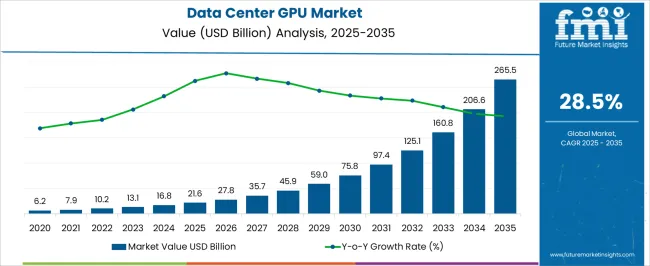
Data Center Gpu Market Market Value Analysis

Power Consumption Dynamics:

AI training facilities can exceed 1 gigawatt of power demand, equivalent to 800,000 U.S. homes.

Next-generation GPUs are pushing rack densities to 250 kW, up from less than 10 kW in 2023.

AI represents 20% of global data center capacity utilization and is expected to drive 35% of total market demand by 2028.

Regional Growth Patterns:

Spheron Network: Building the Economic Layer for AI Compute

Spheron Network is pioneering the transformation of decentralized physical infrastructure networks (DePIN) by building the world’s first community-powered data center. As a decentralized compute platform, Spheron pools idle GPU and CPU resources from a global community of users, creating a vast reservoir of computing power that provides a powerful, cost-effective, and censorship-resistant alternative to traditional cloud providers.

Spheron’s Comprehensive Infrastructure Approach

Unlike traditional centralized cloud providers that present significant barriers to truly autonomous operations, Spheron breaks dependency chains through its novel smart contract-based leasing system. This enables:x

Direct blockchain-based compute resource allocation: AI agents and developers can autonomously lease computational resources without human intervention.

Smart contract payments: Eliminating the need for API keys, KYC processes, or traditional payment systems.

True operational autonomy: Maintaining censorship-resistant access to infrastructure when and where needed.

Significant cost savings: Up to 80% reduction in compute costs compared to traditional providers.

Technological Advantages and Competitive Positioning

The platform offers several key competitive advantages over centralized providers:

Geographic Distribution: A diverse provider base enables better geographic coverage and reduced latency, addressing the critical infrastructure clustering issues that plague traditional cloud providers.

Natural Scaling Mechanisms: The ability to onboard any qualified provider means the network can grow organically with demand, unlike traditional data centers that require massive capital expenditure and long deployment timelines.

Hybrid Resource Access: Developers can access both data center-grade and retail GPUs, allowing testing on low-cost machines and seamless scaling as requirements grow.

Community-Driven Model: Fueled by everyday contributors, developers, gamers, miners, who share idle compute from homes, labs, and local data centers, creating a more resilient and democratized infrastructure model.

Market Size and Growth Trajectory

The decentralized physical infrastructure network (DePIN) movement represents a paradigm shift toward community-owned and operated infrastructure. The sector has experienced remarkable growth:

Market Capitalization: The DePIN ecosystem has reached $50+ billion in market cap as of 2025, comprising more than 1,561 projects worldwide. This represents massive growth potential, considering it remains less than 0.1% of the $1 trillion global infrastructure market.

Projected Growth: The World Economic Forum projects the DePIN market to reach $3.5 trillion by 2028, driven by the growing convergence of crypto and AI. Messari also supports this projection, indicating an over $1.3 trillion increase from the current addressable market of $2.2 trillion.

Key Market Dynamics

Supply-Demand Imbalances: Traditional cloud infrastructure faces scalability limitations and high costs, particularly for AI workloads requiring specialized GPU resources. Decentralized networks address these bottlenecks by aggregating distributed resources that would otherwise remain idle or underutilized.

Economic Democratization: DePIN networks enable individuals and smaller operators to participate in infrastructure provision and monetization, creating new economic opportunities while reducing barriers to accessing high-performance computing resources.

Technological Innovation: Smart contract-based resource allocation, automated marketplace mechanisms, and cryptographic verification systems enable trustless coordination of distributed resources at a global scale.

Active Yield Generation

The emergence of compute as a sovereign asset class represents a fundamental shift in how we conceptualize value storage and monetary backing. Unlike traditional reserve assets, compute infrastructure generates active economic yield through several mechanisms:

Direct Revenue Streams: GPU and CPU resources generate predictable income streams through enterprise rental agreements. Market data shows yields from tokenized AI infrastructure can exceed 35.31% per annum based on active enterprise GPU rental agreements. Companies are pioneering the fractionalization of industrial-grade NVIDIA H200 GPUs, which retail at around $30,000 per unit, making them accessible to individual investors.

Yield Sustainability and Economic Model

Unlike passive collateral assets, compute infrastructure generates ongoing revenue that can support stability mechanisms and provide yield to token holders. This creates a self-reinforcing economic model where the underlying asset contributes to the stability and growth of the monetary instrument. Compute resources represent tangible economic utility directly tied to the fastest-growing sector of the global economy, artificial intelligence and machine learning. This provides more robust fundamental value compared to purely algorithmic or crypto-collateralized approaches.

Compute-backed synthetic dollars can leverage the distributed nature of decentralized infrastructure networks, reducing single points of failure and enhancing censorship resistance compared to centralized alternatives.

Beyond Traditional Stablecoin Models

The evolution toward compute-backed monetary instruments represents the next logical step beyond traditional fiat-backed stablecoins. While current synthetic dollar implementations primarily use crypto-collateralization or derivative strategies, the integration of real-world compute assets offers several advantages:

Enhanced Yield Mechanisms: Recent innovations demonstrate the viability of using real-world compute capacity as collateral for digital monetary instruments. Projects are tokenizing AI infrastructure to create yield-bearing assets, showing how compute resources can serve as productive backing for synthetic dollars.

Market Validation: The emergence of platforms that fractionalize GPU assets and generate yields of 30%+ annually demonstrates strong market demand for compute-backed financial instruments. This validates the economic model for using compute as monetary backing.

Regulatory Positioning: Compute-backed assets may operate outside traditional stablecoin regulatory frameworks while providing similar stability mechanisms through real economic activity rather than purely financial reserves.

Power Grid Integration Challenges

The rapid expansion of AI compute infrastructure presents significant energy challenges that must be addressed for sustainable growth:

Grid Stability Concerns: A September 2025 study found that “the rapid expansion of large-scale AI data centers is imposing unprecedented demands on electric power grids. With immense electricity consumption subject to large and fast fluctuations, these facilities introduce emerging impacts and operational challenges for power grids”.

Cooling Infrastructure: Next-generation GPUs requiring up to 250 kW per rack necessitate a shift from air cooling to advanced liquid cooling systems. This infrastructure requirement creates additional costs and technical complexity that must be factored into economic models.

Regional Clustering: The concentration of compute infrastructure in specific geographic regions creates bottlenecks and vulnerabilities that distributed networks like Spheron can help address.

Sustainable Growth Models

Distributed Architecture Benefits: Spheron’s distributed model helps address power grid stress by distributing compute load across multiple locations and smaller installations rather than concentrating it in massive data centers.

Efficiency Optimization: Utilizing idle resources through DePIN networks maximizes the efficiency of existing hardware rather than requiring additional manufacturing and deployment of new infrastructure.

Renewable Integration: Distributed compute networks can more easily integrate with renewable energy sources at the local level, supporting grid stability and sustainability goals.

Market Evolution and Future Projections

Regulatory Maturation: The GENIUS Act provides a framework for traditional stablecoins, while compute-backed alternatives may develop under different regulatory frameworks.

Infrastructure Scaling: Continued rapid growth in AI compute demand will drive adoption of distributed solutions like Spheron as traditional cloud providers face capacity constraints.

Yield Optimization: As compute yields remain elevated compared to traditional financial assets, investor interest in compute-backed financial instruments will likely increase.

Medium-Term Evolution (2027-2030)

Market Integration: Greater integration between traditional financial markets and tokenized compute assets as institutional adoption increases.

Technical Standardization: Development of industry standards for compute asset tokenization and synthetic dollar implementation.

Geographic Expansion: Broader global adoption of DePIN networks as countries seek to build domestic compute capabilities.

Long-Term Transformation (2030+)

Monetary System Evolution: Potential emergence of compute-backed currencies as viable alternatives to traditional fiat-backed systems, particularly in AI-driven economic sectors.

Economic Model Maturation: Full realization of the economic potential of tokenized compute infrastructure as a new asset class with established risk-return profiles.

Global Infrastructure: Development of truly global, decentralized compute networks that rival or complement traditional cloud infrastructure in scale and capability.

The Weakening Dollar Foundation

While the U.S. dollar will likely remain dominant in the near term, its foundation is weakening both fiscally and geopolitically. The GENIUS Act and institutional adoption may provide temporary support, but long-term sustainability requires new forms of sovereign credibility.

The unique characteristics that make compute attractive as monetary backing include:

Universal Demand: AI computation requirements span all industries and geographies, creating consistent global demand for compute resources. Unlike regional commodities or currencies, compute demand is truly global and growing exponentially.

Productive Yield: Unlike gold or traditional reserves, compute infrastructure generates active economic returns through utilization, providing inherent yield to backing assets. This yield generation capability makes compute-backed instruments potentially superior to passive reserve assets.

Technological Necessity: As digital transformation accelerates, access to compute becomes as fundamental as access to energy or water, creating long-term value stability. The increasing digitalization of all economic sectors ensures sustained demand growth.

Decentralized Control: Distributed compute networks reduce single points of failure and geographic concentration risks associated with traditional infrastructure. This distributes sovereignty across many participants rather than concentrating it in specific institutions or countries.

The Path Forward

Spheron Network, as a pioneer in this transformation, is not just building another cloud alternative. It is creating the foundational infrastructure for a new monetary paradigm where economic value is directly tied to productive computational capacity rather than government promises or speculative assets.

The transition toward compute-backed monetary instruments represents a fundamental evolution in how we conceptualize money, value storage, and economic sovereignty. While traditional dollar-backed stablecoins will continue to play important roles in global finance, the emergence of compute as a sovereign asset class offers compelling alternatives that align with the digital economy’s growth trajectory.

Conclusion: The Dawn of the Compute Era

As the AI revolution continues to reshape global economic structures, compute sovereignty will become increasingly important for nations, organizations, and individuals seeking independence from traditional financial infrastructure. The convergence of several trends, declining dollar credibility, explosive AI growth, technological maturation of decentralized networks, and regulatory clarity, creates a perfect storm for the emergence of compute-backed monetary systems.

The data speaks compellingly: with AI infrastructure markets growing at 30%+ CAGR, energy consumption doubling by 2030, and distributed networks offering 80-90% cost savings, the economic fundamentals strongly favor compute-based solutions. Spheron Network’s approach of building community-powered data centers and enabling direct blockchain-based resource allocation provides a glimpse into this future.

By democratizing access to AI infrastructure and creating economic opportunities for compute resource providers, platforms like Spheron are laying the groundwork for more resilient, productive, and globally accessible monetary systems. The question is not whether this transformation will occur, but how quickly existing systems will adapt to embrace the productive power of decentralized compute as a new foundation for monetary stability and economic growth.

The future of money may well be written in code that runs on the distributed computational infrastructure of tomorrow, infrastructure that Spheron Network is building today. As we stand at the threshold of this new era, compute sovereignty represents not just a technological advancement, but a fundamental reimagining of economic power, monetary backing, and financial sovereignty in the age of artificial intelligence.

The next decade will determine whether traditional monetary systems can adapt to this new reality or whether compute-native alternatives will establish themselves as the dominant form of economic value storage and exchange. With stablecoin markets approaching $300 billion and compute infrastructure markets racing toward $350 billion by 2035, the scale and opportunity for this transformation are becoming undeniably clear.



Source link

Google’s Robots Can Now Think, Search the Web and Teach Themselves New Tricks – Decrypt

0
Google’s Robots Can Now Think, Search the Web and Teach Themselves New Tricks – Decrypt


In brief

DeepMind’s Gemini Robotics models gave machines the ability to plan, reason, and even look up recycling rules online before acting.
Instead of following scripts, Google’s new AI lets robots adapt, problem-solve, and pass skills between each other.
From packing suitcases to sorting trash, robots powered by Gemini-ER 1.5 showed early steps toward general-purpose intelligence.

Google DeepMind rolled out two AI models this week that aim to make robots smarter than ever. Instead of focusing on following comments, the updated Gemini Robotics 1.5 and its companion Gemini Robotics-ER 1.5 make the robots think through problems, search the internet for information, and pass skills between different robot agents.

According to Google, these models mark a “foundational step that can navigate the complexities of the physical world with intelligence and dexterity”

“Gemini Robotics 1.5 marks an important milestone toward solving AGI in the physical world,” Google said in the announcement. “By introducing agentic capabilities, we’re moving beyond models that react to commands and creating systems that can truly reason, plan, actively use tools, and generalize.”

And this term “generalization” is important because models struggle with it.


The robots powered by these models can now handle tasks like sorting laundry by color, packing a suitcase based on weather forecasts they find online, or checking local recycling rules to throw away trash correctly. Now, as a human, you may say, “Duh, so what?” But to do this, machines require a skill called generalization—the ability to apply knowledge to new situations.

Robots—and algorithms in general—usually struggle with this. For example, if you teach a model to fold a pair of pants, it will not be able to fold a t-shirt unless engineers programmed every step in advance.

The new models change that. They can pick up on cues, read the environment, make reasonable assumptions, and carry out multi-step tasks that used to be out of reach—or at least extremely hard—for machines.

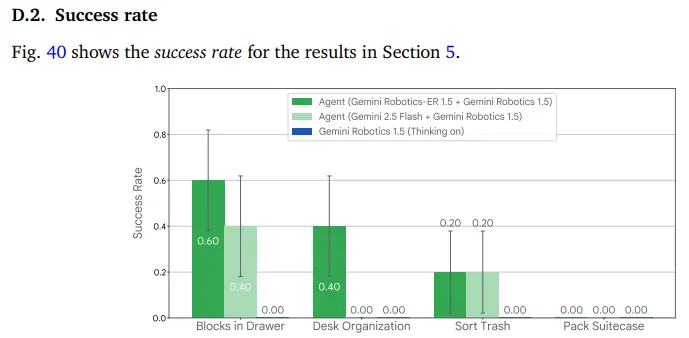
But better doesn’t mean perfect. For example, in one of the experiments, the team showed the robots a set of objects and asked them to send them into the correct trash. The robots used their camera to visually identify each item, pull up San Francisco’s latest recycling guidelines online, and then place them where they should ideally go, all on its own, just as a local human would.

This process combines online search, visual perception, and step-by-step planning—making context-aware decisions that go beyond what older robots could achieve. The registered success rate was between 20% to 40% of the time; not ideal, but surprising for a model that was not able to understand those nuances ever before.

How Google turn robots into super-robots

The two models split the work. Gemini Robotics-ER 1.5 acts like the brain, figuring out what needs to happen and creating a step-by-step plan. It can call up Google Search when it needs information. Once it has a plan, it passes natural language instructions to Gemini Robotics 1.5, which handles the actual physical movements.

More technically speaking, the new Gemini Robotics 1.5 is a vision-language-action (VLA) model that turns visual information and instructions into motor commands, while the new Gemini Robotics-ER 1.5 is a vision-language model (VLM) that creates multistep plans to complete a mission.

When a robot sorts laundry, for instance, it internally reasons through the task using a chain of thought: understanding that “sort by color” means whites go in one bin and colors in another, then breaking down the specific motions needed to pick up each piece of clothing. The robot can explain its reasoning in plain English, making its decisions less of a black box.

Google CEO Sundar Pichai chimed in on X, noting that the new models will enable robots to better reason, plan ahead, use digital tools like search, and transfer learning from one kind of robot to another. He called it Google’s “next big step towards general-purpose robots that are truly helpful.”

The release puts Google in a spotlight shared with developers like Tesla, Figure AI and Boston Dynamics, though each company is taking different approaches. Tesla focuses on mass production for its factories, with Elon Musk promising thousands of units by 2026. Boston Dynamics continues pushing the boundaries of robot athleticism with its backflipping Atlas. Google, meanwhile, bets on AI that makes robots adaptable to any situation without specific programming.

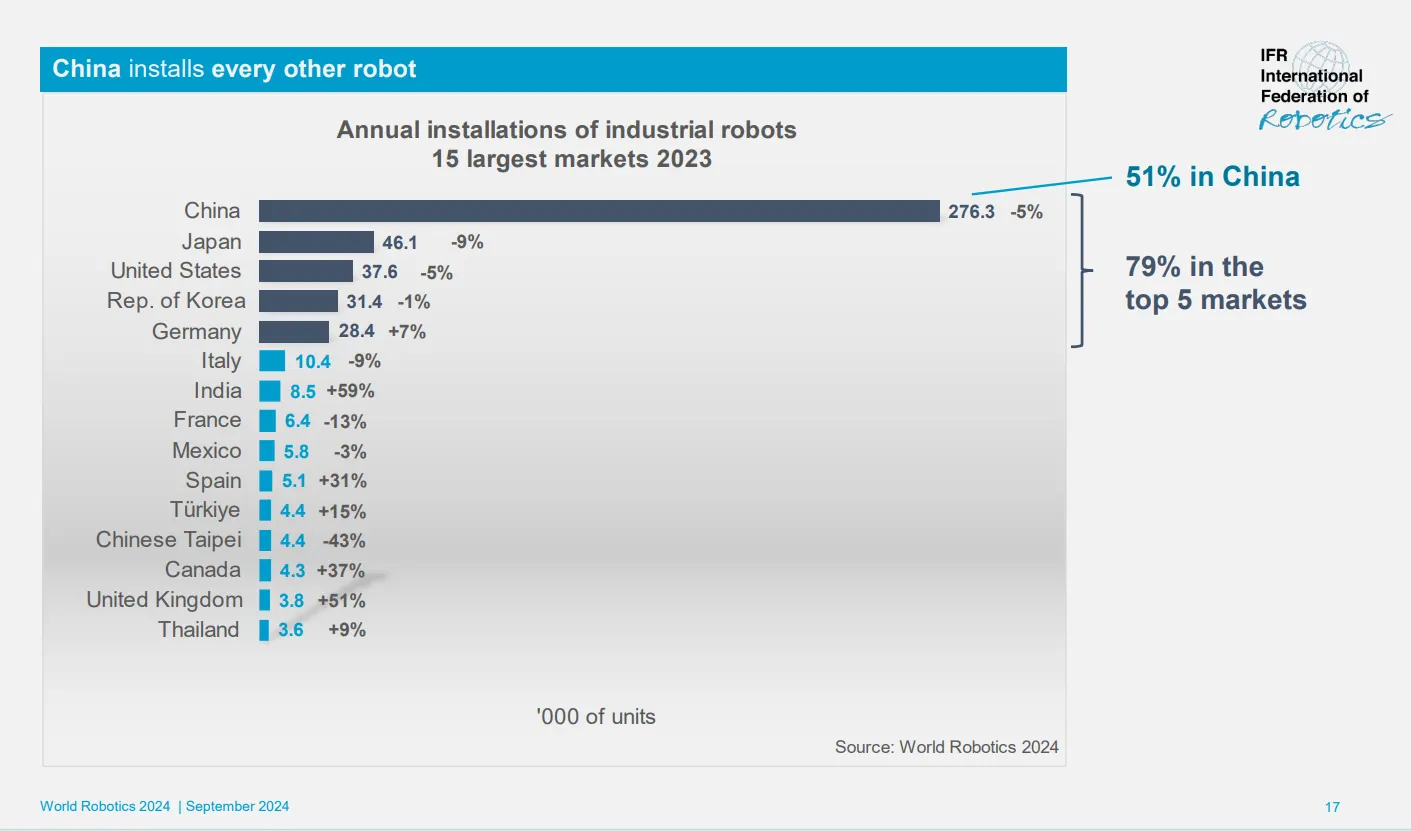
The timing matters. American robotics companies are pushing for a national robotics strategy, including establishing a federal office focused on promoting the industry at a time when China is making AI and intelligent robots a national priority. China is the world’s largest market for robots that work in factories and other industrial environments, with about 1.8 million robots operating in 2023, according to the Germany-based International Federation of Robotics.

DeepMind’s approach differs from traditional robotics programming, where engineers meticulously code every movement. Instead, these models learn from demonstration and can adapt on the fly. If an object slips from a robot’s grasp or someone moves something mid-task, the robot adjusts without missing a beat.

The models build on DeepMind’s earlier work from March, when robots could only handle single tasks like unzipping a bag or folding paper. Now they’re tackling sequences that would challenge many humans—like packing appropriately for a trip after checking the weather forecast.

For developers wanting to experiment, there’s a split approach to availability. Gemini Robotics-ER 1.5 launched Thursday through the Gemini API in Google AI Studio, meaning any developer can start building with the reasoning model. The action model, Gemini Robotics 1.5, remains exclusive to “select” (meaning “rich,” probably) partners.

Generally Intelligent Newsletter

A weekly AI journey narrated by Gen, a generative AI model.


Source link

What Will the Slowing Growth of Bitcoin, Ethereum Treasury Buys Mean for Markets? – Decrypt

0
What Will the Slowing Growth of Bitcoin, Ethereum Treasury Buys Mean for Markets? – Decrypt


In brief

Purchases at Bitcoin and other treasury companies have slowed dramatically over the past two months.
The declines played a big role in declining markets that were already jittery about macroeconomic uncertainties.
Three market observers say that the waning treasury activity could continue to weigh on markets.

The rise in Bitcoin, Ethereum, and other corporate crypto treasuries helped fuel the summer’s massive market gains. Now their slowing growth has played a large role in sapping prices already sensitive to inflation and other macroeconomic uncertainties.

The treasuries’ waning activity could continue to weigh on markets with volatility likely to remain heightened in the near-term, three market observers told Decrypt.

“When treasuries stop buying, it removes an important demand floor and undermines confidence in the balance-sheet-as-strategy narrative,” Joe DiPasquale, CEO of crypto fund manager BitBull Capital, wrote in a text to Decrypt. “At the same time, forced liquidations in derivatives and broader risk-off sentiment have accelerated the decline, creating a feedback loop that pressures both crypto assets and the equities tied to them.”


Bitcoin was recently trading at about $109,400, off more than 5% over the past week, according to crypto markets data provider CoinGecko. At one point Friday, the largest cryptocurrency by market value dropped below $109,000 for the first time since September 1. Ethereum and other major altcoins have also fallen deeply into negative territory.

Those latest declines have come as Bitcoin treasury buys have plummeted to just 12,600 BTC in August, and 15,500 so far this month—a combined total that is less than half the amount that firms acquired in July, according to data analytics provider CryptoQuant.

“We’ve seen treasury accumulations cool off compared to the summer, when companies were buying at a record pace,” Michael McCluskey, CEO of Sologenic—which offers a decentralized exchange and related services—told Decrypt. “That slowdown has coincided with softer prices in Bitcoin and other major cryptocurrencies, which makes sense given how much corporate demand was propping up the market.”

McCluskey added: “In the short term, the absence of steady buying leaves the market more exposed to volatility.”

A number of treasury firms’ share prices have plunged along the way, with Solana treasury Helius Medical Technologies falling 38% over the past week and Ethereum-focused BitMine Immersion sinking more than 13% over the same period.

Bitcoin-minded Strategy—the originator of the pivot-to-crypto accumulation move—and Metaplanet each fell about 9%, the latter coming despite the Japan-based firm’s latest purchase of more than 5,400 BTC on Monday and a favorable analyst rating a day later. Helius and several other companies that raised money through private placement in public equity (PIPE) deals are changing hands well off their issue prices.

Going forward, some treasuries may encounter additional challenges, with The Wall Street Journal reporting on Thursday that financial regulators are now exploring unusually high trading volumes and dramatic share price increases among among them.

Still, in a text to Decrypt, Gerry O’Shea—head of global market insights at crypto asset manager Hashdex—wrote that Bitcoin could hit $140,000 or higher by year’s end, with corporate treasuries helping to spark a rally.

“Corporate treasury adoption will remain a big part of this demand, even as many of these publicly traded companies face near-term headwinds from volatility and scrutiny from investors regarding their specific strategies,” he wrote.

Daily Debrief Newsletter

Start every day with the top news stories right now, plus original features, a podcast, videos and more.


Source link

What Is Hyperliquid? The Decentralized Exchange With Its Own Blockchain – Decrypt

0
What Is Hyperliquid? The Decentralized Exchange With Its Own Blockchain – Decrypt


Decentralized perpetual futures exchange Hyperliquid has gone from being a market maker to one of the biggest crypto projects in the world.

Hyperliquid has processed trillions of dollars in volume in its lifespan and is now the third-largest decentralized exchange in crypto—trailing only industry veterans PancakeSwap and Uniswap.

It has been the talk of the town in 2025, but what exactly is Hyperliquid? Why do people care so much about it? And how did it grow to be one of the biggest projects in crypto?

What is Hyperliquid?

Hyperliquid is a decentralized exchange specializing in perpetual futures trading, built atop its own dedicated layer-1 network.

Its native token HYPE has been a roaring success, rising to become a top 20 cryptocurrency by market capitalization less than a year after launching.

Why do people care about Hyperliquid?

Put simply, Hyperliquid makes it easier for traders to speculate on the price fluctuations of cryptocurrencies, thanks to low fees, a large amount of available assets—and, of course, degenerate levels of leverage.

Fees on Hyperliquid range from 0.07% for low-volume taker spot trades, all the way down to 0% for high-volume perp maker fees, per the Hyperliquid docs. Taker traders are when liquidity is removed from the market, while makers add liquidity to the market. For comparison, Uniswap applies a 0.3% fee on trades.


Much like a centralized exchange, users can place trades on most of the major coins regardless of what chain they are on. Bitcoin, Ethereum, Dogecoin, TRUMP—all tradable in one place. Hyperliquid allows traders to use leverage of up to 40x. For comparison, the maximum leverage that Binance offers is 20x, and you have to meet certain requirements to access this tier.

As a result, it has become a battleground for degenerate wars between whales and the crypto community.

Notably, in March 2025, a whale opened a 40x leveraged short position worth $521 million against Bitcoin, which led to everyday traders teaming up in an attempt to liquidate the whale. Spectators were able to watch every movement on the Hyperliquid block explorer, which openly shows a wallet’s held positions, whether it’s in profit, and its liquidation price. The whale won in this instance, dumping the position for a $3.9 million profit.

All of these factors combined have led to Hyperliquid attracting over 700,000 total users since its 2023 launch and amassing a total volume of $2.7 trillion, according to its statistics dashboard.

Hyperliquid’s origin story

Hyperliquid was entirely self-funded and was built by a team of just 11 people, founder Jeff Yan told WuBlockchain in August 2025. He said the project rejected venture capital funding because it gives a fake sense of progression; instead, the team wanted to focus on “real progress” by giving value to users—not investors.

In 2020, Yan started to trade crypto and founded a market-making company, the earliest form of Hyperliquid. Two years later, he told the When Shift Happens podcast, its high-frequency market-making offering had effectively “capped out,” as he looked to grow the project.

That’s when Sam Bankman-Fried’s centralized exchange FTX imploded by using customer funds to cover losses at his trading firm Alameda Research. When a critical mass of users sought to withdraw their funds, their money wasn’t there, and the exchange was caught with its pants down. Bankman-Fried was found guilty on seven counts of fraud, money laundering, and conspiracy, resulting in a 25-year prison sentence.

“All of a sudden, people had a real reason not to trust centralized exchanges—and it wasn’t just mumbo jumbo intellectual stuff, they literally lost all this money, and it was because of centralized exchanges,” Yan told the podcast, calling it a “light bulb moment” indicating that the world was ready for decentralized finance.

The collapse of FTX, Yan said, was the catalyst that made Hyperliquid “go all in” on building a decentralized exchange.

In February 2023, Hyperliquid’s mainnet closed alpha went live. In its first five months, it claimed to have attracted 4,000 users, with 28 different assets available to trade. It hit full mainnet in August of that same year.

Hyperliquid experienced explosive growth following its $1.6 billion airdrop in November 2024—one of the biggest crypto airdrops of all time. Armed with goodwill among traders, Hyperliquid became the talk of the town going into 2025.

It hasn’t all been smooth sailing for the platform. In December 2024, Hyperliquid attracted unwanted attention from North Korean hackers snooping for vulnerabilities. A few months later, it faced a liquidation crisis and was forced to delist a Solana meme coin when a trader made a bet so bad that the Hyperliquid Foundation would’ve been forced to cover some losses.

The incident raised concerns around how the exchange handled heavily leveraged positions—with Gracy Chen, CEO of centralized exchange Bitget, claiming it could become “FTX 2.0.”

The future of Hyperliquid

Hyperliquid has proven to be relatively drama-free since these early growing pains, and has quickly established itself as a player in the crypto space.

As of this writing, according to DefiLlama, it has the eighth largest DeFi total value locked of any layer-1 network—ahead of chains like Aptos, Avalanche, and Linea. It also processes the third-highest monthly trading volume of any decentralized exchange, per DefiLlama.

With stablecoins becoming one of the dominant narratives in 2025, the question of whether Hyperliquid would issue its own stablecoin has inevitably been the subject of intense speculation.

Hyperliquid founder Yan said in the WuBlockchain interview that the Hyperliquid Foundation, the entity that supports the development of the Hyperliquid blockchain and its ecosystem, wouldn’t issue its own stablecoin.

However, in September 2025, the foundation opened submissions for teams to issue a “Hyperliquid-aligned” stablecoin, USDH. It attracted proposals from big-name players like Ethena, Paxos, and Sky, but ultimately went to a newly formed company in Native Markets. With USDH now live and trading, Hyperliquid now has a stablecoin that has dedicated half of its revenues to a protocol-driven buy back scheme.

Now, Hyperliquid faces direct competition from the emerging Aster decentralized exchange, which is offering higher levels of leverage and has the backing of Binance co-founder Changpeng “CZ” Zhao.

At the time of publication, Hyperliquid is ahead in terms of token valuation and trading volume—but how long will that last?

Daily Debrief Newsletter

Start every day with the top news stories right now, plus original features, a podcast, videos and more.


Source link

Meme Coin Modeled on Baby Shark Creator Collapses – Decrypt

0
Meme Coin Modeled on Baby Shark Creator Collapses – Decrypt


In brief

A meme coin modeled on Baby Shark’s creator collapsed.
Pinkfong said the token created using Story Protocol was unaffiliated.
Story Protocol deleted posts, but sleuth ZachXBT saved some receipts.

A meme coin touting Pinkfong’s name collapsed on Thursday after the entertainment company behind YouTube hit Baby Shark said that it was unaffiliated with the token.

The meme coin, which was created using Story Protocol’s network for managing intellectual property rights and creating derivative works, was issued “without authorization,” Pinkfong said in a post on X, promising “grave legal consequences” for those violating the law.

Although Story Protocol is designed to remove rent-seeking intermediaries from the IP industry, it appears that a purported misunderstanding between two of its users has potentially created more work for lawyers than projects that secured the rights to Pinkfong’s IP traditionally.

Pinkfong is more than just a pink fox: The South Korean firm, which has generated more than 140 billion cumulative views across its YouTube channels, is responsible for the most popular video on YouTube, featuring iconic lyrics like “Baby shark, doo doo doo doo doo doo.”


In a now-deleted post on X, Story Protocol said that users could “remix and expand” the IP behind Pinkfong’s furry mascot following its tokenization, according to screenshots shared by pseudonymous blockchain sleuth ZachXBT on Thursday.

“Fascinated to see how this collaboration unfolds,” Story Protocol co-founder and CEO S.Y. Lee said in a now-deleted post.

Decrypt has reached out to Story Protocol for comment.

The meme coin debuted on Story Protocol’s network had a market capitalization of $6.32 million on Friday, according to DEX Screener. A few hours after its kickoff on Tuesday, the token rocketed to a market capitalization of $519 million.

Bubblemaps, a popular on-chain visualization tool and crypto sleuthing firm, said on X that it found insider activity around the meme coin. It found no evidence that the activity was linked to Story Protocol, but around 7% of the token’s supply was scooped up immediately.

The price of Story’s native token, which serves as the platform’s underlying medium of exchange, has been volatile, meanwhile. Since Tuesday, Story’s price has fallen from $12.91 to $7.24, while settling around $9.35, according to crypto data provider CoinGecko.

Pinkfong has endorsed two meme coins that exist on Solana and BNB Chain. As mentioned before, the unofficial one exists on Story’s network. It debuted through a platform called IP World, which says that it is “built for degens, by degens.”

The project said that it had been working with a licensed partner of Pinkfong’s, but it learned that the company’s license wasn’t valid, based on agreement that it had with another licensee. Nobody was prevented from engaging with the IP until that was verified.

IP World said that the incident, while frustrating, showcased some of its safeguards. Because the IP wasn’t verified on IP World, “creator fees remain locked on the protocol and cannot be claimed until the rightful IP owner is confirmed.”

The collapse of the unofficial Pinkfong meme coin has provoked scrutiny toward Story Protocol among some industry onlookers, but IP World made it clear on Thursday that the network underpinning its service had little to do with the actual problem.

“Story Protocol, the blockchain on which IP World operates, was never a party to this agreement nor was it in any way involved in these licensing matters,” the project said in a post on X on Thursday. “We are deeply sorry for the uncertainty and confusion this has caused.”

Daily Debrief Newsletter

Start every day with the top news stories right now, plus original features, a podcast, videos and more.


Source link

Will Bitcoin Finish the Month Above $105K? Traders Are Losing Faith – Decrypt

0
Will Bitcoin Finish the Month Above 5K? Traders Are Losing Faith – Decrypt


In brief

Predictors on Myriad now think Bitcoin will hit $105,000 before $125,000.
Odds have flipped more than 20% in the last two days, as BTC continues its weekly slide.
The asset now sits only about 4% above the $105,000 mark.

The recent weakness in Bitcoin’s price has predictors on Myriad feeling bearish about the asset’s next major price milestone—now predicting a dip to $105,000 before it makes a new all-time high at $125,000. 

Odds of the next stop being $105,000 have increased to 68% in the last week, a gain of more than 25% in that timeframe. The bulk of that move has taken place in the last two days, with odds swinging more than 20% in favor of $105,000 since Wednesday night. 

Myriad is a unit of Dastan, the parent company of an edtorially independent Decrypt.

The market’s volatility has been aided by Bitcoin’s gradual decline, now down 5% in the last week and changing hands below $110,000 for the first time since September 2. 

The top crypto asset is flat in the last 24 hours amid news that U.S. core inflation held at 2.9% in August. 

In addition to inflation data, markets are now also contending with new tariff headlines courtesy of President Donald Trump, leaving risk assets “under pressure” and “capital flows cautious,” according to Bitunix analyst Dean Chen. 

“The recently announced high tariffs remain an uncertain factor that could deliver one-off inflationary pressure while weighing on growth,” Chen told Decrypt on Friday. 

More than $162 billion in crypto valuations has been wiped out this week as Bitcoin just barely hangs on to a percentage point gain since September began. The month typically signifies a brutal stretch for Bitcoin, which has dropped 3.77% on average during the month in each year since 2013. 

It will need a major turnaround to climb back towards its all-time high of $124,118. At its current price, BTC sits just 4% above the $105,000 mark that will bring resolution to the Myriad market which has attracted more than $300,000 in trading volume. It would need to gain 14% to resolve the other way. 

Daily Debrief Newsletter

Start every day with the top news stories right now, plus original features, a podcast, videos and more.


Source link

Popular Posts

My Favorites

Perrie Edwards Calls Zayn Malik Romance a ‘Bit Toxic’

0
Perrie Edwards’ relationship with Zayn Malik made headlines in the mid-2000s — but a decade later, she admits the relationship wasn’t completely healthy. “It...