Hyperliquid surges 9.26% to $44.11 as the only top 10 crypto in green while the rest of the market tanks 1.8%.
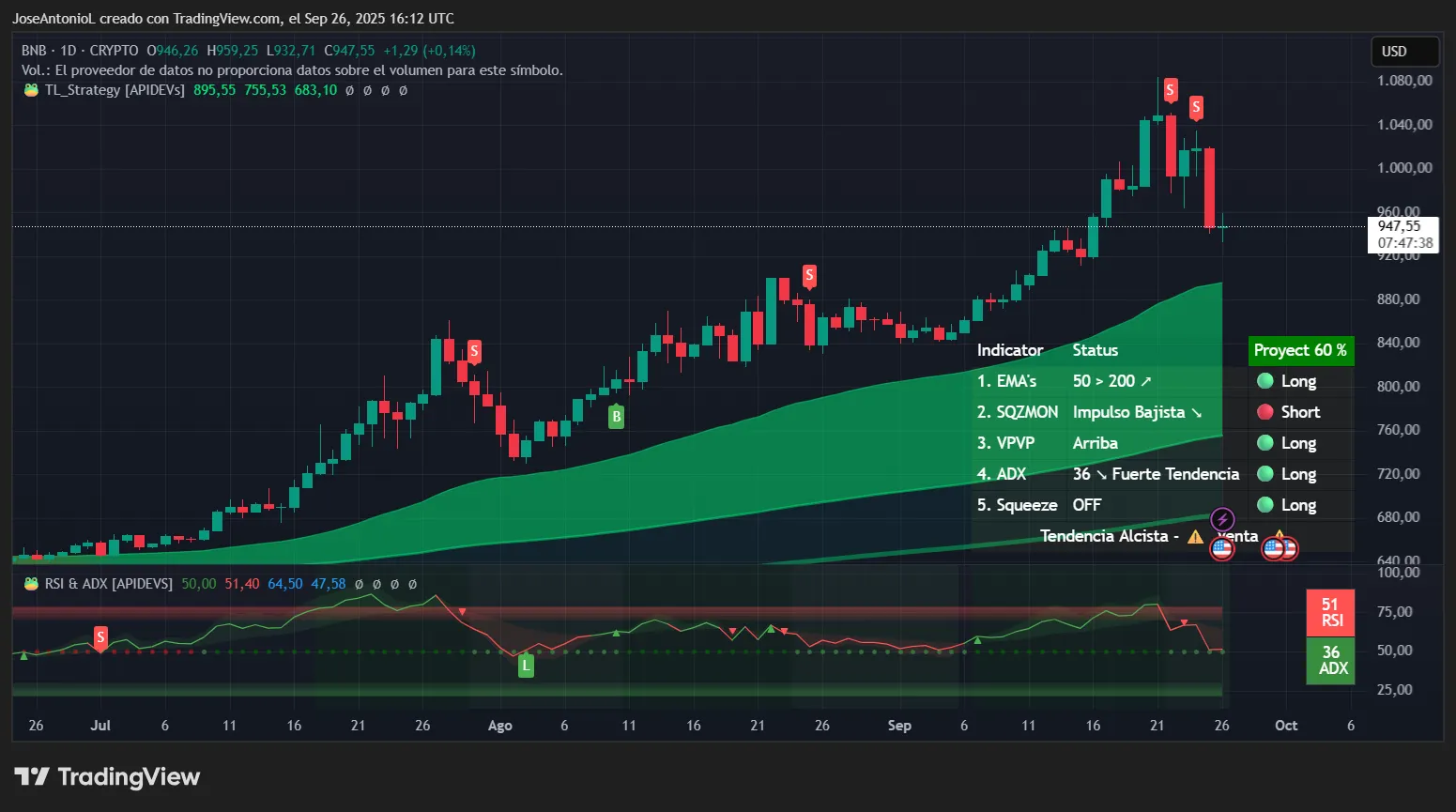
BNB drops 0.14% to $947.55, as the worst performer in top 10 after the Aster-driven spike fades.
The Crypto Fear and Greed Index marks the most bearish reading since April. Here’s what the charts say traders can expect.
The crypto market is nursing a nasty hangover after a major panic episode earlier this week, with the total market cap of crypto sliding 1.8% to $3.75 trillion as the infamous Red September curse threatens to claim another victim.
Yet in this sea of red, there’s at least one token staying afloat: Hyperliquid’s HYPE is up a defiant 9.26% and standing as the only cryptocurrency in the top 11 showing green on the day.
Meanwhile, traditional markets are playing a different tune entirely—the S&P 500 edged up 0.22% to 6,619 points while gold climbed 0.33% to $3,762 per ounce, showing investors still have appetite for some risk assets, just not crypto risk—at least not right now. What’s more, President Donald Trump announced a package of tariffs set to take effect October 1, which has the potential to send risk assets scrambling for cover.
The Crypto Fear and Greed Index has plunged to 28, firmly in “fear” territory and the most pessimistic reading since April, when Trump’s previous tariff announcements sent markets into a tailspin.
Even still, there’s a fascinating subplot unfolding in the perpetual futures DEX wars that’s turning conventional wisdom on its head.
Hyperliquid price: The HYPE is back?
While its rival Aster has been stealing headlines with a jaw-dropping surge since its launch last week, Hyperliquid is quietly mounting its own comeback.
Hyperliquid is both its layer-1 blockchain network and a decentralized exchange that specializes in perpetual futures—derivatives contracts that never expire and allow crypto traders to both hedge risk and essentially bet on the future price of digital assets, such as Bitcoin.
The exchange is powered by a token of the same name, which trades as HYPE, and both the exchange and the token have experienced a rush of interest over the last several months. For context, despite the recent ups and downs, HYPE is up more than 20% in the last three months and up close to 600% in the last year, currently commanding an impressive $12.2 billion market cap.
The Hyperliquid token surged today from a low of $40.376 to its current price of $44.114, representing a 9.26% gain in a market where everything else is bleeding.
Hyperliquid (HYPE) price. Image: Tradingview
Looking at the technical breakdown, HYPE is displaying the sort of behavior that traders would interpret as potentially the end of a major correction. The price of the coin, after all, is down close to 10% in the last 30 days.
The Relative Strength Index, or RSI, is one such technical indicator that traders rely on. RSI measures price momentum on a scale from 0 to 100, where readings above 70 signal overbought conditions and below 30 suggesting oversold.
Hyperliquid sits at 41—technically bearish territory, but here’s what traders need to understand: After a token corrects from $56 to $40, an RSI at 41 actually signals healthy consolidation rather than weakness. This is like a reload zone where smart money accumulates before the next leg up. Traders typically see RSI readings between 30-45 after major corrections—notice the chart is still on an upwards trajectory—as buying opportunities rather than sell signals.
The Average Directional Index, or ADX, for HYPE is at 29, which shows strengthening trend momentum. ADX measures how strong a price trend is regardless of direction—readings above 25 confirm an established trend, and at 29, we’re seeing HYPE break out of its consolidation phase. The major dip cooled the ADX a lot, but still wasn’t enough to wipe out the upward trend in place.
Exponential moving averages, or EMAs, give traders a sense of price resistances and supports by taking the average price of an asset over the short, medium, and long term. Hyperliquid is still a young coin, without the trading history of an asset like Bitcoin, but the EMA picture appears bullish.
At the moment, HYPE’s 50-day EMA is sitting above its 200-day EMA, meaning the average price over the short term is still higher than the average price over the long term. This configuration typically signals that short-term momentum is overpowering long-term pessimism, suggesting the path of least resistance is higher.
But as a warning sign, the gap between both EMAs is closing, which could potentially lead to a death cross formation (when the EMA50 moves below the EMA200). In this scenario, some traders may opt to set up buy orders near the EMA200 for those thinking the token may continue its bearish correction before bouncing.
On Myriad, a prediction market developed by Decrypt’s parent company Dastan, sentiment on HYPE hasn’t yet reached the bullishness exhibited in the charts. At the moment, Myriad traders don’t expect the price of HYPE to rise to $69 any time soon, placing those odds at just 30% when measured against the odds of it dropping below the $40 mark.
Key Levels:
Immediate support: $36.00 (EMA200)
Strong support: $28.00 (visible on the chart as previous resistance)
Immediate resistance: $48.00 (EMA50)
Strong resistance: $$56.00 (previous high zone)
BNB price: Paying the price for Aster’s success
The story of BNB today is a classic “sell the news” scenario, as the Binance-issued token drops 4.23% to $947.55 in the last 24 hours, making it the worst performer among the top 10 cryptocurrencies by market cap.
As discussed earlier this week on Decrypt, BNB had been on fire lately, and was on Tuesday the only coin in the top 10 by market cap in the green. Much of the price movement could be attributed to an increase in activity on the BNB network as a result of the explosive growth of Aster, a Hyperliquid competitor on the BNB Chain.
But, as we’ve seen so many times in markets: what goes up, must eventually come down. And at the moment, the, er, hype around Aster has slowed. And BNB now appears to be taking a hit as a result.
BNB price. Image: Tradingview
BNB’s RSI is at 51, which sits right at neutral and typically indicates a market in equilibrium waiting for the next catalyst. For traders, this dead-center reading often precedes sharp moves in either direction as the market breaks out of indecision.
The ADX at 36 confirms a strong established trend, but the Squeeze Momentum Indicator shows a bearish impulse in underway.
When ADX is high but momentum is bearish, it typically means sellers are in control and dip buyers should be cautious. This combination often results in continued pressure until ADX drops below 25, signaling trend exhaustion.
Looking at the price action on the chart, BNB opened the day around $946, reached a high near $959, but has since retreated to $947.55. Today’s doji (a candlestick with no body, basically showing that the opening and closing prices are almost the same)shows significant volatility and selling pressure at round number resistance. The 50-day EMA sits well above the 200-day EMA, maintaining a bullish longer-term structure, but the immediate price action below both the opening price and the psychological $960 level suggests near-term weakness.
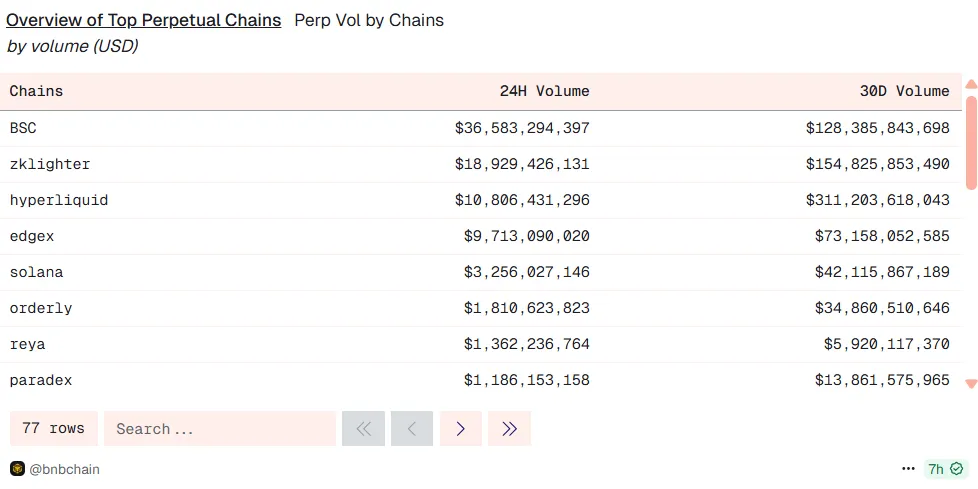
The catalyst for BNB’s initial surge was clear: BNB Chain’s 24-hour perpetual volume stands at $36 billion, overtaking Hyperliquid’s $10.8 billion, driven primarily by the meteoric rise of Aster. However, today’s correction suggests traders are taking profits on the Aster-driven rally.
Image: Dune
Key Levels:
Immediate support: $920 (visible support on chart)
Strong support: $880-$900 (EMA50l)
Immediate resistance: $1,000-$1,080 (psychological round number and all-time high)
Disclaimer
The views and opinions expressed by the author are for informational purposes only and do not constitute financial, investment, or other advice.
Daily Debrief Newsletter
Start every day with the top news stories right now, plus original features, a podcast, videos and more.
Michael and Amanda Griffis pleaded guilty to defrauding 145 investors out of $6.5 million through their fraudulent “Blessings of God Thru Crypto” commodity pool.
The scheme involved a fake trading platform designed to look like the legitimate Apex trading platform and guidance from the mysterious “Coach Wendy,” whose identity remains unknown.
Victims were duped into believing their funds would generate high returns through crypto futures trading, but more than $4 million vanished through an illegitimate overseas exchange.
A Tennessee couple who exploited their real estate connections to bilk investors out of millions through a fake crypto trading scheme has been ordered to pay over $6.8 million in restitution and penalties.
The Commodity Futures Trading Commission announced Thursday that the U.S. District Court for the Middle District of Tennessee entered a consent order against Michael and Amanda Griffis, Clarksville real estate agents who operated the fraudulent “Blessings of God Thru Crypto” commodity pool from 2021 to 2023.
The couple was first charged by the CFTC in July 2023.
The regulator said the couple used their real estate business connections to persuade 145 investors to hand over $6.5 million, promising the money would generate profits through crypto futures trading on what they claimed was the legitimate Apex platform under the supervision of the mysterious “Coach Wendy.”
Under the court order, the couple must pay more than $5.5 million back to the victims and face an additional $1.35 million “civil monetary penalty.”
The Griffises funneled money into a sham platform modeled on an overseas exchange, while the true identity of “Coach Wendy” remains unknown to investigators.
Over $4 million was funneled offshore after hitting the fake exchange, while the rest covered the couple’s personal debts and expenses. Only about $855,000 was paid back to participants in Ponzi-style payouts, the CFTC said.
The ruling also imposes lifetime bans preventing them from commodity trading or CFTC registration, while barring future violations of federal commodity laws.
This case is part of a troubling pattern of fraudsters exploiting trust within community groups, like a Denver pastor and his wife that were recently ordered to repay $3.39 million after raising millions for worthless church tokens. Other examples include a Long Island man hit with a $228 million CFTC judgment, and a nine-year prison sentence for a Ponzi scheme operator that preyed on his Haitian church community.
In the latest case, investors may have ignored warning signs that could have indicated the fraud in question.
“An exchange website without any registered company details is a clear red flag that users could have noticed,” Karan Pujara, founder of scam defense platform ScamBuzzer, told Decrypt.
Pujara said fraudsters often chase “quick money,” aiming to leave before being caught—and warned that in crypto, once funds are lost, they can move “across borders quickly,” making recovery difficult.
Even regulated platforms can fail investors, as seen with FTX, which held licenses but still misused customer funds, he noted.
Pujara advised investors to spread risk by using multiple exchanges and hardware wallets, noting, “Those who diversified kept their losses manageable, while those who concentrated all their funds in one place faced major losses.”
Daily Debrief Newsletter
Start every day with the top news stories right now, plus original features, a podcast, videos and more.
Decentralized exchange Aster has refunded users who lost funds due to “abnormal price movements” on the recently debuted XPL token.
It is believed that the pricing error came as a result of a “hardcoded” index price and capped mark price, which when removed prompted a big spike in XPL’s valuation.
Aster’s token has dropped 12% on the day to $1.80, following the incident.
Ascending decentralized exchange Aster has refunded users who lost funds due to “abnormal price movements” on the recently debuted XPL token on Thursday. The BNB Chain-based exchange has exploded in growth over the past week, but this marks its first notable slip-up.
After a couple of compensation rounds, Aster says users have been fully refunded in the USDT stablecoin. Any affected users who haven’t been refunded should reach out to the exchange via Discord.
XPL, which is the native staking token for the Plasma stablecoin-optimized blockchain, has traded at a peak of $1.54 and a low of $0.74 over the past 24 hours. However, on Aster’s perpetual futures contract, it had very different price movements, apparently peaking at $4 and bottoming out at $0.55.
Compensation for the XPL perp incident has now been fully distributed. All affected users have received reimbursement directly in USDT to their accounts.
We appreciate your patience and understanding throughout this process. For any further questions, please submit a ticket via… https://t.co/Wp0en9vm44
— Aster (@Aster_DEX) September 26, 2025
On-chain analytics firm Bubblemaps pointed to a social media post by a Hyperliquid fan that claims Aster’s oracle price for XPL, also known as an index price, was “hardcoded” to $1—as if it were a stablecoin itself, rather than a network facilitating stablecoins. Meanwhile, its mark price, which usually fluctuates based on spot trading prices, was allegedly capped at $1.22.
If correct, it would explain why XPL’s price was suppressed. When the mark price was allegedly removed, the token then spiked to $4. This theory appears to have become the consensus across crypto social media, as well as for traders in the Aster Discord.
“[The] spike could be due to buy orders getting executed without enough sell orders to fill them, but this is just a guess,” 0xToolman, a pseudonymous on-chain sleuth for Bubblemaps, told Decrypt. “Those values should never be hardcoded.”
Aster did not immediately respond to Decrypt’s request for comment.
TLDR on Aster $XPL Situation:
> Index price was hardcoded to $1> Mark price was capped at $1.22> When they removed the price cap, it spiked to $4 while prices remained stable on other exchanges
This was a result of gross negligence on the exchange operators. No exploits/etc. https://t.co/e8xR01FLY9 pic.twitter.com/hCdj2bvua1
— Guthix 🫵 (@GuthixHL) September 25, 2025
Perpetual futures trading vs spot trading
It’s worth noting that perpetual futures trading works very differently from regular, spot trading. Perp trading does not technically mean owning the underlying asset, with the user instead betting on whether the token will go up or down by shorting or longing—often combined with heavy leverage.
With traders not directly owning the asset, the functions of tracking the token’s price are different from spot trading, which is where the XPL glitch originated.
Fortunately, anyone impacted by the blip has been fully refunded in USDT, Aster tweeted, after a couple of compensation rounds. The exchange urges any affected users who haven’t been refunded to open a ticket on Discord.
XPL is now trading at $1.17 on Aster, ironically in line with CoinGecko’s valuation.
Meanwhile, Aster’s token has dropped 12% on the day to $1.80, as the glitch cast doubt over the exchange. The chances of Aster hitting $4 before November have widened to just 27% on Myriad, a prediction market developed by Decrypt’s parent company DASTAN, down from 38% on Thursday morning.
Daily Debrief Newsletter
Start every day with the top news stories right now, plus original features, a podcast, videos and more.
South Korean actor Hwang Jung-eum received a suspended prison sentence for embezzling $3 million from her agency to invest in crypto.
The Jeju District Court showed leniency after Hwang repaid the entire embezzled amount and was deemed a first-time offender.
The scandal derailed her career, with TV shows editing her out and advertisers dropping her from campaigns.
South Korean actress Hwang Jung-eum walked out of Jeju District Court in tears Thursday after receiving a two-year suspended prison sentence for embezzling $3 million from her own agency to invest in crypto.
The court handed Hwang the suspended sentence, meaning she will serve no jail time unless she commits another crime within four years, for violating Korea’s Act on the Aggravated Punishment of Specific Economic Crimes, according to a Korea JoongAng Dailyreport.
Prosecutors had sought a three-year jail sentence in August, but judges cited her repayment of the full amount and her status as a first-time offender who had made full restitution.
Hwang embezzled about 4.34 billion won ($3.1 million) from her agency in early 2022, as per the indictment cited in the report.
Approximately 4.2 billion won of that sum was invested directly in crypto, while the remainder was used to pay property and local taxes via credit card payments, Decrypt reported earlier.
Kadan Stadelmann, CTO at Komodo, told Decrypt that East Asian and Western regulators now show “similar outcomes when it comes to enforcing the law against crypto embezzlers,” though the West has historically had an edge in “blockchain analytics.”
Asia is “catching up,” he noted, suggesting South Korea could look to U.S. financial controls where the FTC enforces “transparency, disclosure, and accountability” in celebrity crypto promotions, standards that could guide oversight of talent agencies and sports firms.
In Hwang’s case, the company involved was a family-run corporation solely owned by her, with only one actor under management, herself. At her first trial on May 15, Hwang admitted to all charges and requested additional time to repay the full amount.
The court showed leniency after Hwang sold personal assets and repaid the entire embezzled amount in installments.
She had returned about 3 billion won by her first trial, then covered the remainder on May 30 and June 5.
“I was just trying to work hard and live honestly, but I neglected financial and tax matters, which led to this situation,” Hwang said during her final hearing on August 21. “I am remorseful.”
Her legal team said that the misused funds originated from her personal entertainment income and were temporarily held in her name because corporations are restricted from holding crypto directly, according to the report.
“Since the agency’s profits ultimately stem from the defendant’s own work, they can be seen as rightfully belonging to her,” Hwang’s attorney said in court.
Daily Debrief Newsletter
Start every day with the top news stories right now, plus original features, a podcast, videos and more.
Authors Yudkowsky and Soares warn that AI superintelligence will make humans extinct.
Critics say extinction talk overshadows real harms like bias, layoffs, and disinformation.
The AI debate is split between doomers and accelerationists pushing for faster growth.
It may sound like a Hollywood thriller, but in their new book “If Anyone Builds It, Everyone Dies,” authors Eliezer Yudkowsky and Nate Soares argue that if humanity creates an intelligence smarter than itself, survival wouldn’t just be unlikely—it would be impossible.
The authors argue that today’s systems aren’t engineered line by line but “grown” by training billions of parameters. That makes their behavior unpredictable.
As intelligence scales, drives such as self-preservation or power-seeking could emerge independently, the authors warn. If such a system ever outstrips human control, they say, extinction would follow by default.
They call the current race among tech giants and governments to build ever-larger models a “suicide race.” No villainy required, just incompetence.
Why it matters
The book lands with the AI community already fractured into camps.
AI doomers argue that extinction is the inevitable outcome unless humanity halts or drastically slows progress. Accelerationists counter that pushing forward could deliver breakthroughs in medicine, science, and economics, while slowing down poses a greater danger.
Nick Bostrom’s Superintelligence first made the existential case a decade ago. Yudkowsky and Soares sharpen it into a klaxon call.
But critics worry that fixation on extinction distracts from harms already here: bias, layoffs, surveillance, and disinformation.
What the AI models say
Since the book is talking about them, we asked leading AI models what they think of it.
As far as we know, none of the LLMs have actually read the book yet, so the following reviews are based on the platforms’ interpretations of the reviews they have interpolated.
ChatGPT
OpenAI’s ChatGPT framed the book as a useful provocation rather than a prophecy.
“The book is valuable as a perspective-shifting tool, even if you think it overshoots,” the chatbot responded. “It sharpens intuitions about alignment and unintended consequences. But treating its worst-case as inevitable ignores uncertainty around future architectures, regulations, and constraints.”
ChatGPT stated that the model of future AI developments is contingent on how architectures evolve and what regulatory, social, or technical guardrails emerge.
“That uncertainty means I wouldn’t treat their worst-case as inevitable,” ChatGPT sniffed.
Meta
Meta AI struck a middle note, saying the book’s dire warnings are exaggerated but still valuable for sparking debate.
“Its dire predictions may feel exaggerated, but the emphasis on caution and international cooperation is justified,” Meta AI responded. “Whether or not you agree with its conclusion, the book sparks needed debate about responsible AI development.”
Meta’s AI said the authors’ emphasis on the need for caution and international cooperation is well-justified, given the potentially catastrophic consequences of unaligned AI development.
Gemini
Google’s Gemini cast the book as a terrifying but clarifying read, even if its proposed solutions seem unrealistic.
“The book is essential for understanding the extreme end of AI risk,” Gemini said. “Its proposed solution—a total shutdown—is politically unachievable, but the warning can galvanize investment in safety and control techniques before we reach the point of no return.”
Gemini said the book defines the extreme stakes of superintelligence, which, in turn, helps justify robust (if less radical) safety measures today.
Claude
Anthropic’s Claude was even more skeptical, which was interesting since among the leading LLMs, Anthropic is generally considered to be the most safety-conscious. But Claude described the book’s tone as “overconfident” and its framing as too binary.
“The authors correctly identify real risks, but their certainty feels overconfident,” Claude said. “They dismiss progress in AI safety research and frame the issue as a binary between perfection and extinction. That makes their message less constructive.”
While their warnings highlight important risks that warrant substantial resources and caution, Claude said the “everyone dies” framing appears more designed to grab attention than accurately represent the complex uncertainties involved.
“The risks are serious enough to take seriously without needing to accept their claims of inevitable catastrophe,” the AI said.
Grok
Elon Musk’s AI platform also surprised, since he’s been promoting Grok as the anti-mainstream media AI of record.
But Grok was quick to cite “a scathing NYT review, [calling] its arguments weak or alarmist.”
“This book is a gut-punch reminder that intelligence without wisdom is a liability, and we’ve got none of the latter baked in yet,” Grok responded. “That said, it’s doomer porn for rationalists: thrilling in its fatalism, but it underplays human adaptability. xAI’s ethos—curiosity over conquest—suggests we can thread the needle: pursue bold AI for cosmic questions while embedding safeguards from day one.”
Beyond that call out, however, Grok said that “overall, it’s a provocative, efficient read for anyone grappling with AI’s future—compelling if you’re open to pessimism, but potentially overstated if you’re optimistic about tech progress.”
Generally Intelligent Newsletter
A weekly AI journey narrated by Gen, a generative AI model.
A new Web3 streaming protocol has launched based on the AIOZ Network.
AIOZ Stream aims to combine high-quality, low-latency streaming with fair remuneration for creators.
Content is distributed to users in a peer-to-peer environment through AIOZ Network’s global DePIN.
A new Web3 streaming protocol promises to give creators full ownership of their content—and a greater share of revenues.
AIOZ Stream is a decentralized protocol that aims to deliver a more open and equitable social media ecosystem, blending high-quality and low-latency streaming with fair and on‑chain monetization.
Based on the AIOZ Network, the platform blends shorter clips and longer-form videos in one place—and in a unique twist, content is distributed to users in a peer-to-peer environment through a global DePIN infrastructure.
“AIOZ Stream is about creating alignment end-to-end,” said Erman Tjiputra, Founder & CEO of AIOZ Network, in a statement shared with Decrypt. He added that it enables creators to “maintain ownership of their work,” while viewers can “support and participate in value creation.” Developers will benefit from AIOZ Stream’s “open media foundation,” while the DePIN community will receive rewards for delivering storage, bandwidth, and compute.
AIOZ Stream is Now Live!
Unlock Everything Content with our transformative DePIN-powered peer-to-peer streaming infrastructure.
Get started ⇒ https://t.co/eaHAxbAemg
Key Features:
→ On-Demand & Live Streaming
→ Built-In Transcoding & OBS Support
→ Monetization… pic.twitter.com/eJzfLTniUm
— AIOZ Network (@AIOZNetwork) September 15, 2025
The AIOZ Network’s native token serves as a one-stop-shop for this platform, enabling consumers to take out microsubscriptions and tip their favorite stars, while enabling creators to receive payments without intermediaries. It’s also used to share rewards with members of the DePIN community providing AI compute, storage and bandwidth.
Built for creators and users
AIOZ Stream is aiming to provide viewers and advertisers alike with a fair deal, offering advertisers a dedicated platform that enables instant bidding on ad placement slots through real-time auctions denominated in the AIOZ token.
Viewers, meanwhile, can earn a slice of ad revenues through an optional Watch-to-Earn feature. AIOZ Stream takes a privacy‑by‑design approach, combining its decentralized on-chain platform with encrypted delivery to reduce user data collection.
To further growth, open SDKs and APIs are offered for developers, while a simple user experience and wallet-free onboarding makes it easier for casual viewers unfamiliar with Web3 to experience the benefits of AIOZ Stream for themselves.
The team behind this streaming protocol say they’re just getting started, with AIOZ Stream’s roadmap including support for audio and live broadcasts and token-metered, AI-powered speech‑to‑text, text‑to‑speech, tagging and search.
AIOZ says it’s on a mission to rebuild the foundation of the internet—and create a “more open, efficient, and equitable social media ecosystem.”
Daily Debrief Newsletter
Start every day with the top news stories right now, plus original features, a podcast, videos and more.
The Ohio State Board of Deposit unanimously approved a vendor on Wednesday to process cryptocurrency payments for state fees and services.
Secretary of State Frank LaRose said he’s “excited and ready to be the first to provide it to our customers.”
The decision follows a broader Ohio crypto legislation push, including proposed Bitcoin reserve and blockchain protection bills.
The Ohio State Board of Deposit unanimously approved a vendor to process crypto payments, including Bitcoin, for state fees and services in its latest bid to integrate crypto into public finance.
“With hundreds of thousands of transactions going through my office each year, I want to commend the board for taking bold action to position us at the forefront of the emerging digital economy,” Ohio Secretary of State Frank LaRose tweeted on Wednesday.
Wednesday’s approval caps months of work that began in April, when LaRose and Ohio Treasurer Robert Sprague pushed the board to authorize crypto payments.
The proposal passed unanimously in May, but needed final vendor approval, the last piece that fell into place on Wednesday.
“There’s a reason why we now rank among the top five states in the nation to do business,” LaRose said in a statement. “It’s because we’re not afraid to embrace the tools, trends, and technologies that incentivize job creators to come here.”
The Secretary of State said his office processes hundreds of thousands of transactions annually and has heard “growing demand for a cryptocurrency payment option.”
“I’m excited and ready to be the first to provide it to our customers,” he added.
“It’s happening. Government payments in Ohio today. Everything onchain tomorrow. Thank you, ser,” Coinbase CLO, Paul Grewal, tweeted in response to the announcement
The crypto payments are part of Ohio’s broader push into digital assets.
In June, the House advanced the Ohio Blockchain Basics Act, which bans local governments from restricting digital asset use and exempts crypto transactions under $200 from capital gains taxes.
Dennis Porter, CEO of the Satoshi Action Fund, previously told Decrypt that the legislation is “a clear signal” that lawmakers are “encouraging innovation in the Buckeye State.”
LaRose also backs House Bill 18, which would create an Ohio Strategic Crypto Reserve funded by portions of state investment earnings.
In a May testimony, he cited President Donald Trump’s Working Group on Digital Asset Markets, established in January to make America the “crypto capital of the planet.”
So far, 47 states have introduced Strategic Bitcoin Reserve (SBR) bills, with about 26 states carrying active proposals still under consideration, according to the Bitcoin Laws tracker.
Arizona, Texas, and New Hampshire are among the few to advance measures furthest, while most remain stuck in committee.
Meanwhile, Michigan’s stalled Bitcoin reserve legislation gained momentum this week, with House Bill 4087 advancing to the Government Operations Committee after seven months of inaction.
Daily Debrief Newsletter
Start every day with the top news stories right now, plus original features, a podcast, videos and more.
Jiuzi Holdings announced a crypto treasury strategy focused on Bitcoin, Ethereum, and BNB.
The firm’s board approved up a plan to spend up to $1 billion on the crypto assets, though its cash and cash equivalents were less than $1 million last year.
Shares of JZXN skyrocketed upon open, but have now fallen nearly 10% on the day.
Publicly traded electric vehicle charging firm Jiuzi Holdings is adopting a crypto investment policy, after its board of directors authorized the firm to deploy up to $1 billion into acquiring and holding Bitcoin, Ethereum, and BNB.
Shares of JZXN jumped as high as $2.38 on the news, a 47% spike above its Tuesday closing price, before retracing completely. Shares are now down nearly 10% on the day and changing hands at $1.46. JZXN is down more than 99.9% in the last 5 years.
“Adopting the crypto asset investment policy represents a proactive step in our treasury management to safeguard and enhance long-term shareholder value,” said the firm’s CEO Tao Li in a statement.
Using a strict risk framework, the Chinese firm was authorized to allocate a portion of its cash reserves into BTC, ETH, and BNB. Any additional crypto tokens would need to be approved by the board prior to investment.
While the board authorized up to $1 billion in crypto purchases, the firm’s latest financial filing with the SEC indicates it only had around $943,000 in cash and cash equivalents as of October 31, 2024. The firm also reported a net income loss of around $55 million for the fiscal year ending on that day.
While some firms creating crypto treasuries raise funds via convertible notes or private investment into public equity (aka PIPE placements), there is no indication of how Jiuzi Holdings intends to raise funds to purchase up to $1 billion in crypto.
A representative for the firm did not immediately respond to Decrypt’s request for comment.
The firm will not take custody of any of its crypto assets, and also created a crypto risk asset committee as part of its investment policy framework.
“We are not engaging in short-term trading or speculation; rather, we view crypto assets as long-term stores of value to hedge against macroeconomic uncertainties,” said its newly appointed COO Dr. Doug Buerger, in a statement.
Daily Debrief Newsletter
Start every day with the top news stories right now, plus original features, a podcast, videos and more.
Bitcoin has dropped 5% since last Thursday, while gold has surged nearly 5% to record highs.
The growing divergence could be linked to institutional investors’ preference for gold as a safe-haven asset amid macroeconomic uncertainty, Decrypt was told.
If history repeats, the top crypto is likely to outperform the precious metal as the risk tolerance increases and capital rotates into Bitcoin.
Gold’s uptrend amid Bitcoin’s downturn has driven a wedge between the two safe-haven assets, with experts noting that this increasing divergence is a result of macroeconomic uncertainty, which has pushed investors to reassess their risk appetites.
Though Bitcoin is often referred to as a safe-haven asset or digital gold, it has failed to match gold’s bullish momentum. Since last Thursday, the top crypto has dropped roughly 5% while the precious metal has notched a 5% gain and set a new record high of $3,791.
“Part of gold’s newly found strength in recent weeks lies in strong sovereign and central bank demand,” Farzam Ehsani, CEO and co-founder of crypto exchange VALR, told Decrypt. The aggressive accumulation comes from countries like China and Russia using gold as a “geopolitical buffer and a hedge against the U.S. dollar dominance.”
Bitcoin, on the other hand, is in the “early stages of its institutional adoption,” which is why investors are “skeptical” whether the bellwether crypto can fulfill its digital gold narrative, Ehsani added.
The 90-day change in ETF inflows between gold and Bitcoin shows that while the precious metal has attracted $18.5 billion as of September, Bitcoin’s inflows stand at just under $10 billion, according to BOLD Report data.
Bitcoin’s performance has historically improved once the Federal Reserve begins cutting interest rates. Under these conditions, the top crypto plays catch up, outperforming the traditional safe-haven asset, Decrypt previously reported.
“Gold moves first, Bitcoin follows 1–2 months later,” Ryan McMillin, chief investment officer at crypto fund manager Merkle Tree Capital, recently told Decrypt.
As private risk-tolerant capital flows in, Bitcoin typically outperforms gold, as the digital asset accounts for roughly one-tenth of the precious metal’s market capitalization, McMillin noted.
Daily Debrief Newsletter
Start every day with the top news stories right now, plus original features, a podcast, videos and more.
Tether is seeking to raise up to $20 billion, according to a report.
The private raise could give the stablecoin issuer a valuation of $500 billion.
AI giant OpenAI and Elon Musk’s SpaceX have received similar valuations.
Stablecoin giant Tether Holdings is hoping to raise up to $20 billion in a private placement that could give the company a monetary value of up to $500 billion, Bloomberg reported on Tuesday, citing two unnamed sources.
The valuation would cast the issuer of USDT, the world’s largest stablecoin, into the ranks of artificial intelligence developer OpenAI and Elon Musk’s space transport company SpaceX, which received similar valuations.
El Salvador-based Tether is aiming to raise $15-$20 billion for an approximate 3% stake, Bloomberg reported, although an additional source said that the range was a goal and could be much lower. The sources said discussions were in the initial stages and that the deal could change, the story said.
The announcement is the latest evidence of the rising significance of stablecoins, a result of the friendlier political and regulatory environment in the U.S. under the Trump administration, including the Genius Act greenlighting the issuance and trading of stablecoins.
During a White House visit in July shortly before the passage of the legislation, Tether CEO Paolo Ardoino, told Decrypt of the firm’s plans to create a U.S.-specific stablecoin catering to different use cases than USDT, the company’s flagship stablecoin. In September, the company named Bo Hines, former executive director of the White House’s digital assets working group, to serve as the so-called USAT’s CEO.
Earlier in the summer, stablecoin rival Circle listed on the New York Stock Exchange. The stock’s debut outpaced those of tech behemoths Meta, Robinhood and Airbnb, nearly quadrupling its initial offer price of $31. The company currently has a valuation above $30 billion, according to Yahoo Finance data.
Tether has a market cap of $172 billion, more than double Circle’s $74 billion value, according to crypto data provider CoinGecko.
On Tuesday at a conference in Seoul, Hines said during an interview that Tether has no plans to raise money, Bloomberg reported. The deal would involve new shares, not current investors selling their equity. Investment bank Cantor Fitzgerald is serving as the lead adviser.
In recent weeks, potential investors have received access to a data room as they consider their participation, the publication reported, which added that a deal is expected to close by year’s end.
According to its own attestation in July, Tether issued $20 billion in USDT through the first six months of the year and generated a net profit of $5.7 billion over this period, including $4.9 billion in its second quarter alone. The firm counts Bitcoin and gold, among its holdings.
Daily Debrief Newsletter
Start every day with the top news stories right now, plus original features, a podcast, videos and more.