The market cap of top Bitcoin miners is soaring.
Last month, the top public Bitcoin miners tracked by JP Morgan passed the $50 billion mark.
The surge comes as companies in the space pivot to high-powered computing.
The market cap of Bitcoin miners soared in September as firms in the space benefited from pivots to high-powered computing that feeds the burgeoning artificial intelligence sector, according to a report from JP Morgan.
Analysts at the banking giant highlighted the surge in a Wednesday report, noting that the combined value of the 14 top publicly traded miners it tracks passed $50 billion for the first time ever.
Top mining stocks this week have jumped in value with the price of the leading cryptocurrency, too, with Mara, Riot, and CleanSpark all up significantly over the week—and the past month. Those firms retreated slightly on Wednesday.
“Growth in aggregate market cap outpaced bitcoin price appreciation for the sixth consecutive month, as operators continue to diversify their businesses away from bitcoin mining towards HPC,” the report read.
The surge in market cap comes as miners look to high-powered computing to increase profits. Google last month announced it was backstopping a deal between AI compute company Fluidstack and Bitcoin miner Cipher, giving Google the right to buy a 5.4% stake in Cipher.
Bitcoin miners—typically industrial operations consisting of warehouses full of computers that work to secure the network—are rewarded in newly minted coins for processing blocks on the decentralized payment network.
But when the price of the biggest cryptocurrency drops, businesses may struggle to cover their costs.
Experts have told Decrypt that while both Bitcoin mining and running a data center to power AI businesses may appear similar, the pivot from crypto to HPC isn’t always easy and requires different expertise.
HIVE Digital’s stock is up nearly 9% over the past week, and has surged by 41% over the past month. Nasdaq-listed MARA has jumped by 8% this week and nearly 16% over a 30-day period.
CleanSpark, meanwhile, has spiked more over the past month, with its share price up over 51% over that period. This week, CLSK has risen by 4%.
Bitcoin was recently trading above $117,615, a nearly 3% 24-hour rise. It dropped below $107,000 per coin at the start of September, CoinGecko data shows.
Daily Debrief Newsletter
Start every day with the top news stories right now, plus original features, a podcast, videos and more.
Addicted is a Solana-based cannabis farming simulator that pays users in WEED tokens.
Players have taken to social media to brag about their crypto earnings as the price of WEED surges.
However, the play-to-earn format has drawn claims that Addicted is a “Ponzi game.”
Addicted, a Solana-powered cannabis farming simulator described as “unhinged” by its creators, has attracted the eyes of the crypto gaming community as players boast about dizzying play-to-earn gains via a skyrocketing token.
Players are invited to build and grow their own on-chain drug empires in Addicted, after paying 0.5 SOL (approximately $110) to purchase their first digital cannabis plant. The virtual farms yield WEED tokens for players based on their “grow power,” determined by how many plants a farm has and how rare they are. These tokens can be used to purchase farm upgrades and packs that contain seeds of various rarities.
As a result of Addicted’s fiendish launch—boosted by a repost from the official Solana X account—the WEED token soared to a peak market capitalization of $82.48 million. It has since fallen 36% to $52.6 million, according to DEX Screener.
“My yield grow power output was like 1,200. After I ripped new packs on my second day and got rare strains, my grow power went to 12,000. At peak market cap, give or take, that’s $10,000 a day in yield,” crypto trader and Addicted player Tyler Stockfield, better known as Anon online, told Decrypt. He conceded that the value fluctuates with the token’s price, along with broader in-game dynamics.
Stockfield isn’t alone in boasting about wild gains for playing the game, although he appears to be making more than others—thanks to packing rare strains. Pump.fun livestreamer Richard Podgurski claims to have enough grow power to potentially earn $5,000 a day, after unpacking a two “Unicorn Poop” super rare strains, while X user Fetakii claims to have earned approximately $629 worth of WEED in their first 12 hours of playing.
Such massive gains from less than 48 hours’ worth of gaming have led to players referring to Addicted as another “Ponzi game”—a more or less playful term that’s used to describe the sort of crypto game in which players can expect potentially large short-term gains, but very little long-term value.
“Yes, you do have an advantage if you are earlier, which would resemble that of a Ponzi, but based on their cool-down features and their halving cycle… I think they’re doing what they can to make this fair and sustainable,” Stockfield said.
He explained that players are limited on how many packs they can open via a daily cool-down feature, and that reward size is halved every seven days. This appears to be an attempt to lengthen the game’s lifecycle. According to the game’s documentation, it is also looking to add new game mechanics, including a “War Zone,” which is likely to mix up the dynamics.
Addicted developer Pandemic Labs did not respond to Decrypt’s request for comment.
This isn’t the first crypto title to be branded a “Ponzi game” by players and observers alike.
In April, an Abstract-based crypto mining simulation game called Bigcoin caught the industry’s attention, with its token hitting a massive peak $172 million market cap, per DEX Screener. When Bigcoin was hot, players similarly calculated how much they were potentially earning each day, and boasted about those gains across social media.
But when Bigcoin’s token crashed 83% in a single day, those earnings were hardly worth bragging about any longer.
Bigcoin prompted a stream of similar “Ponzi games” to roll out afterwards, with players itching for another chance at gaming fortunes. Stockfield said he’s aware of other “Ponzi-style games” that are preparing to launch, following Addicted’s success, and predicts that many more will try to capture the same kind of hype.
And he welcomes it as a new trend—and an alternative to trading meme coins.
“This is a healthy and warranted culture shift in the crypto market, in the ‘trenches of Solana.’ People are exhausted of bundled, vaporware meme coins that are often set up in a way that they were never meant to last,” Stockfield told Decrypt.
According to a Wednesday report from Galaxy Research, Solana meme coins are only being held for a median time of 100 seconds—down from 300 seconds a year ago—as traders buy, sell, and move on to the next potential big thing.
Stockfield said that Addicted appears to be more “fun and community-oriented” than trading in the meme coin trenches, and that he believes it’s “more aligned with blockchain” than flipping memes.
“I really think that this is going to attract more people to have positive experiences,” he finished. “And yes, there will be people that inevitably buy the top and lose a little bit of money as well—all part of the game we play every day in crypto.”
GG Newsletter
Get the latest web3 gaming news, hear directly from gaming studios and influencers covering the space, and receive power-ups from our partners.
The pseudonymous Buzzlamic Jihad has joined Aptos as an advisor, after months of memes he posted on social media helped pump the token in February.
Buzz told Decrypt he wants to fix Aptos’ image problem and position it as a premium stablecoin network.
He also plans to leverage his long-time relationship with the co-founders of World Liberty Financial to bring in “net new buyers” to the layer-1 blockchain.
An Aptos influencer has officially joined the company as an advisor after his meme-fuelled “community takeover” helped pump the APT token’s price in February, renewing developer interest in the network.
Pseudonymous X user Buzzlamic Jihad, who is called Buzz by his friends and family, told Decrypt that he hopes to address Aptos’ image problem and position it as a premium stablecoin network—harking back to the original Libra vision from Facebook in which Aptos was founded.
He said that one way he aims to do this is by leveraging his personal connections with the co-founders of the President Trump-backed World Liberty Financial, two of whom were mentors to the shitposter.
“Buzz is an inventor and true Aptos missionary through and through,” Ash Pampati, head of ecosystem at Aptos, told Decrypt. “I’m excited for him to come on board as an advisor to expand everyone’s imagination of what is truly possible only on Aptos.”
Surfing the buzz
Back in February, Buzz was partly responsible for a 17% pump for Aptos’ APT token as the crypto community started to notice the memes he had been posting for months. The then-little-known social media user had been spamming “Aptos lookin’ good here,” “sidelined?” and “motion not priced in yet” in unwavering support for the layer-1 blockchain. These phrases have since become canonical crypto memes, with major crypto figures and companies embracing them.
The buzz, pardon the pun, was so effective that Pampati told Decrypt in May it helped to revive developer interest in the network, in an unexpected display of the power of memes.
At the time, people wondered how a seemingly random X user could have such a large impact. It turns out Buzz has a history in growth marketing, specializing in Facebook advertising, and claims to have generated millions with this venture.
During that period, Buzz told Decrypt, he was mentored by Chase Herro and Zak Folkman, successful Facebook marketers who went on to co-found World Liberty Financial. At one point, Buzz said he lived with the pair in Puerto Rico and was briefly their business partner.
Given his history with Facebook, now Meta, Buzz explained that he was immediately attracted to Aptos as it was formed by developers from Libra—a now-defunct stablecoin project led by Facebook.
The deeper he dug, the more he liked about Aptos, and he started posting about it under the pseudonym Buzzlamic Jihad. After the February pump, Buzz claims he was offered a role in marketing at Aptos but turned it down. Over the coming months, he continued conversations with the Aptos team and has now signed a deal to become an advisor.
In many ways, Buzz joining Aptos as an advisor is comparable to if meme stock influencer Keith “Roaring Kitty” Gilljoined GameStop—a rumor that once circulated on the internet.
As the possibility of joining Aptos emerged, Buzz reached out to Folkman after years of not being in contact and told him, “Let’s run it back.” He helped connect Folkman with Aptos CEO Avery Ching, with the pair meeting at the White House crypto summit in March. Following this interaction, and without further help from Buzz, World Liberty Financial agreed to list its USD1 stablecoin on Aptos—which was announced in October at Token2049 in Singapore.
Repositioning Aptos
But this is just the beginning, Buzz told Decrypt. He intends to continue to leverage his relationship with the World Liberty Financial team to attract “net new buyers” to Aptos, fix its image, and position it as a premium stablecoin network. He went on to hint at bigger potential collaborations to come, although nothing is set in stone.
“I think it’s very relevant right now because you see chains like Plasma, they’re doing very well. Everyone was talking about them. Now you even have Circle, they’re launching the Tempo blockchain,” Buzz said, referencing the Plasma stablecoin network. “They’re basically doing Libra 2.0 … so the idea is validated. Aptos has the technology, it’s just frustrating that they don’t have the right messaging.”
Now officially working for Aptos, Buzz hopes to have a direct hand in fixing this messaging. He also told Decrypt that he has some “bigger goals” which, if he achieves, he will be paid more for. That’s not to mention that he’s requested that he be paid entirely in APT tokens, as a sign of his belief in the network.
After making his name by asking people if they’re sidelined, Buzz is finally no longer sidelined himself.
“I am trying to community takeover,” Buzz told Decrypt. “That started as a meme, but as it progressed, I’m like, ‘Maybe it’s actually possible. Could I actually do this?’,” he said, adding, “This isn’t a joke anymore. I’m actually working on it.”
“It’s lookin’ good here,” he finished.
Daily Debrief Newsletter
Start every day with the top news stories right now, plus original features, a podcast, videos and more.
BNB Chain’s X account may be compromised with users urged not click on any links.
CZ made the public announcement via his own X account on Wednesday.
Phishing remains a prominent attack vector in the crypto industry.
The official X account for BNB Chain has been compromised, prompting an urgent alert from Binance co-founder Changpeng “CZ” Zhao.
“Please do not click on any links recently posted from this account,” Zhao wrote on Wednesday. “The teams are investigating and will share updates as soon as possible.”
Decrypt confirmed the breach after the account posted a fraudulent link luring users with a fake rewards program.
Screenshot of BNB Chain’s X account.
The unauthorized post invites users to vote on an “upcoming $BSC rewards date,” falsely promising early $BSC rewards to those who participated within the first 24 hours.
Phishing attempts often deploy similar tactics designed to steal users’ digital assets and other information.
The fraudulent link appeared shortly after Zhao said the account belonging to BNB Chain “may have been compromised.”
Binance did not immediately respond to Decrypt’s request for comments.
Daily Debrief Newsletter
Start every day with the top news stories right now, plus original features, a podcast, videos and more.
Schwartz is concluding his 13-year tenure as CTO at Ripple and will join its board to guide the company’s long-term vision.
He plans to spend more time on an XRPL node, exploring new XRP use cases, and engaging in hands-on coding for community projects.
Stablecoins, tokenized assets, and decentralization remain central to his vision for the future of XRPL.
Ripple Chief Technology Officer David Schwartz said he will step back from his day-to-day duties at the end of the year after more than 13 years at the company.
The announcement was made in a post on X on Tuesday, where Schwartz described the move as a personal inflection point after four decades in technology.
“The time has come for me to step back from my day-to-day duties as Ripple CTO at the end of this year,” he wrote. “But be warned, I’m not going away from the XRP community. You haven’t seen the last of me—now or ever.”
After consulting for the NSA, Schwartz began working on the XRP Ledger in 2011 with Arthur Britto, Jed McCaleb, and Chris Larsen. Calling his time with Ripple “a wild ride,” Schwartz said he looks forward to spending more time with his family and returning to his hobbies.
“The last few months I’ve been tinkering on the side—spinning up my own XRPL node and publishing its output data, researching other use cases for XRP,” he said.
After stepping back from Ripple’s daily operations, Schwartz said he will take on a CTO emeritus role and join Ripple’s board of directors.
Schwartz did not respond to requests for comment by Decrypt.
In an August interview with Decrypt, Schwartz highlighted what he sees as the ledger’s strongest tailwinds: tokenization of real-world assets, institutional stablecoin adoption, and curated on-chain features designed for enterprises.
“There will be use cases where digital assets like XRP and Bitcoin make sense—where volatility is either an advantage or not a disadvantage—and other cases where a more stable token like RLUSD or another stablecoin will make more sense,” Schwartz said. “You’ll see enterprise use cases in everything from trade finance to tokenized real-world assets.”
Schwartz also addressed misconceptions that have dogged XRP over the years.
“By far, the biggest misconception is that Ripple somehow controls the ledger,” he explained. “The XRP Ledger has been running since 2012 with a global set of validators, most of them not affiliated with Ripple at all.”
In his farewell, Schwartz also praised Ripple President Monica Long, Executive Chairman Chris Larsen, SVP of Engineering Dennis Jarosch, and the wider XRP community.
“I have total confidence in the next generation of leaders and builders, including Dennis Jarosch, Ripple’s senior vice president of engineering, and far too many others to name in the XRP community who will carry the torch,” he said.
Daily Debrief Newsletter
Start every day with the top news stories right now, plus original features, a podcast, videos and more.
OpenAI’s new Sora 2 video model generates synchronized dialogue and sound effects, while an iOS app lets users insert themselves into AI videos through “cameos.”
OpenAI compared the release to a “GPT-3.5 moment for video,” with physics-aware clips, multi-scene continuity, and a TikTok-style feed.
Sora 2 Pro launched for ChatGPT subscribers, while the base app rolled out invite-only access in the U.S. and Canada.
OpenAI released Sora 2 on Tuesday, pairing its latest video generation model with a new social app that lets users create, share, and star in AI-generated clips. The company called the release a major step forward in simulating physical reality, with the model now producing synchronized audio alongside video for the first time.
The updated model can generate video clips showing complex physical interactions that earlier systems struggled with. In some of the examples, Sora generated olympic gymnastics routines, backflips on paddleboards, and characters performing triple axels without any apparent distortion or morphing. Unlike previous video generators that bend physics to fulfill text prompts, Sora 2 attempts to model realistic outcomes, including failure.
“Prior video models are overoptimistic—they will morph objects and deform reality to successfully execute upon a text prompt,” OpenAI said in its announcement. Sora 2 “is better about obeying the laws of physics compared to prior systems.”
The model generates background soundscapes, speech, and sound effects directly from text prompts. Up until now, the only model with that capability was Google’s Veo 3. The system also handles multiple-shot sequences while maintaining continuity across scene changes which is also very complex and requires a heavy understanding of both the characters and the environment.
OpenAI is selling Sora 2 as the “GPT-3.5 moment for video,” comparing it to the language model that preceded ChatGPT. The original Sora, released in February 2024, represented what the company called the “GPT-1 moment”—the first indication that video generation was starting to work at scale.
A lot of better models quickly left Sora in the dust, so much that by the time OpenAI decided to release its model, Chinese alternatives were able to output better, more coherent video using the same prompts.
For now, the only way to test the model is by invite via the new iOS app, simply named Sora. Unlike the previous model, which could only be accessed through a website and focused on isolated video generations, the app appears to be more polished and versatile, introducing a feature called “cameos” that lets users insert themselves into generated scenes.
After recording a short video to verify identity and capture appearance and voice, users can appear in any Sora-created environment. The feature works for humans, animals, or objects, and users control who can use their likeness.
During the demo, the team at OpenAI generated videos of themselves featuring ads, doing kickflips and being featured in different situations in a style similar to a TikTok video or an Instagram Reel.
The app includes a customizable feed using what OpenAI described as a new class of recommender algorithms that accept natural language instructions. The system defaults to showing content from people users follow or interact with, and the company said it does not optimize for time spent scrolling. Built-in mechanisms periodically poll users about their well-being and offer options to adjust feed settings.
For teenagers, the app includes default limits on daily generations visible in the feed and stricter permissions on cameos. Parents can access controls through ChatGPT to manage scroll limits, algorithm personalization, and direct message settings.
Users will maintain full control over their cameos, and can revoke access or remove videos containing their likeness at any time. The app shows users all videos featuring their cameo, including drafts created by others that haven’t been published.
Sora 2 is launching in the United States and Canada through the invite-based system, with plans for quick expansion to other countries. The service will be free with what OpenAI called “generous limits,” though these remain subject to compute constraints. ChatGPT Pro subscribers get access to an experimental higher-quality version called Sora 2 Pro. The company plans to release Sora 2 through its API, and will keep the earlier Sora 1 Turbo model available.
OpenAI said Sora 2 will eventually offer users the option to pay for additional generations if demand exceeds available computing resources.
For now, if you don’t have an invite code, iPhone, or ChatGPT Pro, the only option is going for the limited Veo 3 runs or using local video generators like Wan. There are also cheaper options like Kling, Seedance, Hailuo, or Runway, but the appeal of having a highly realistic video model with social media features is certainly a plus that nobody else in the industry offers.
Generally Intelligent Newsletter
A weekly AI journey narrated by Gen, a generative AI model.
Morning Minute is a daily newsletter written by Tyler Warner. The analysis and opinions expressed are his own and do not necessarily reflect those of Decrypt. Subscribe to the Morning Minute on Substack.
GM!
Today’s top news:
Crypto majors green but pulling back after Monday rally; BTC at $113k
SWIFT partners with Consensys to bring payments onchain
SEC & CFTC promise closer cooperation in crypto oversight
Meteora announces Oct 23 TGE date, shares new airdrop mechanism
Andre Cronje raises $200M at $1B valuation for Flying Tulip
🌐 SWIFT Goes Onchain: 24/7 Cross-Border Payments With ConsenSys
One by one the biggest TradFi players in the world are capitulating into crypto.
Last week it was Vanguard, and this week it’s Swift.
📌 What Happened
Yesterday, SWIFT said it will add a blockchain ledger to its infrastructure, starting with a conceptual prototype designed by Consensys.
The first use case is instant, always-on interbank cross-border payments.
SWIFT says the ledger will record, sequence and validate transactions and enforce rules via smart contracts, while interoperating with existing rails and emerging networks.
A coalition of 30+ institutions, including names like Bank of America, Citi and NatWest, is already shaping the build.
It’s not yet specified whether the prototype will anchor to Ethereum mainnet or Linea.
🗣️ What They’re Saying
“I’m very pleased to announce that we will add a blockchain-based ledger to our technology infrastructure to allow for trusted movement of tokenised value across the digital ecosystems… In the regulated system of the future, we believe [Swift and blockchain] can [go together]. Banks are ready for it. And they’re asking us to play a bigger role.” – Javier Pérez-Tasso, SWIFT CEO
for those who don’t know, Consensys is an OG Ethereum venture / development org
created by Joe Lubin, an Ethereum co-founder
and SWIFT is the the world’s most widely used interbank messaging network, connecting over 11,500 financial institutions across 220+ countries
wow https://t.co/oxdnWsyyNL
— DCinvestor (@iamDCinvestor) September 29, 2025
🧠 Why It Matters
TradFi’s main payment rails are choosing to embed blockchain, effectively acknowledging the tech as a better solution.
If SWIFT can make tokenized-value payments instant and 24/7, and keep compliance, controls, and interoperability, their blockchain solution will become their de facto option with massive cost savings and impacts across financial institutions.
This is very bullish for broader crypto adoption.
The more banks standardize on shared ledgers, the easier it becomes to bridge fiat, stablecoins, and tokenized deposits across markets.
So stablecoins are a big winner, along with the tokenization effort for RWAs.
All of which gives crypto more validity across the U.S. and world.
And of course, it’s very bullish for their blockchain of choice (likely Ethereum or one of its L2s).
If Linea were to win this (Consensys’ blockchain), expect a major repricing. So be on the lookout for more news tied to this story.
And overall, more and more capitulation into crypto and blockchain is happening from the biggest tradfi players in the world. On a near weekly basis…
🌎 Macro Crypto and Memes
A few Crypto and Web3 headlines that caught my eye:
In Corporate Treasuries / ETFs
In Memes
Memecoin leaders are slightly red; DOGE -1%, Shiba -1%, PEPE -1%, PENGU -2%, BONK +1%, TRUMP -3%, SPX -2%, and FARTCOIN -1%
Trillions on Plasma peaked near $60M over the weekend before falling to $20M
CARDS jumped 38% to $43M on Solana; pibble +670% led top movers
💰 Token, Airdrop & Protocol Tracker
Here’s a rundown of major token, protocol and airdrop news from the day:
Meteora introduced its MET airdrop mechanic as the “Liquidity Distributor,” as recipients will receive LP positions rather than tokens and announced a 10/23 TGE date
Andre Cronje’s Flying Tulip raised $200M at an $1B valuation and announced a $FT public sale
Pump Fun introduced Advanced for its mobile app, featuring terminal columns and other pro trading tools
Polymarket launched mention markets for NFL games starting with last night’s Dolphins Jets game
Talus Labs raised $10M+ from Sui & Walrus to build out infra for AI Agents and Prediction Markets
Sui’s Bluefin perps dex saw its BLUE token jump 40% in the past week as TVL pushed past $220M and volume neared $80B
🤖 AI x Crypto
Section dedicated to headlines in the AI sector of crypto:
Overall market cap +1% at $17.1B, leaders were mixed
FARTCOIN (-1%), VIRTUAL (-2%), TIBBIR (+3%), aixbt (-2%) & ai16z (-2%)
BIOS (+50%) and GAME (+12%) led top movers
🚚 What is happening in NFTs?
Here is the list of other notable headlines from the day in NFTs:
ETH NFT leaders were mostly red; Punks -1% at 47.3 ETH, Pudgy -2% at 10, BAYC -1% at 9 ETH
Hypurr’s fell 14% from a 1,400 HYPE floor ($65,000) to 1,150 ($52,000) after their first day of trading
Punk Strategy acquired its 18th Punk and is nearly 50% of the way to its 19th
OpenSea launched all of the NFT Strategy tokens for trading on their platform
Daily Debrief Newsletter
Start every day with the top news stories right now, plus original features, a podcast, videos and more.
Anthropic released Claude Sonnet 4.5, calling it the best coding model yet.
The model scored 77.2% on SWE-bench Verified, rising to 82% with parallel compute.
Anthropic claimed improvements on alignment and safety, but jailbreakers cracked it within minutes.
Anthropic released Claude Sonnet 4.5 on Monday, calling it “the best coding model in the world” and releasing a suite of new developer tools alongside the model. The company said the model can focus for more than 30 hours on complex, multi-step coding tasks and shows gains in reasoning and mathematical capabilities.
Introducing Claude Sonnet 4.5—the best coding model in the world.
It’s the strongest model for building complex agents. It’s the best model at using computers. And it shows substantial gains on tests of reasoning and math. pic.twitter.com/7LwV9WPNAv
— Claude (@claudeai) September 29, 2025
The model scored 77.2% on SWE-bench Verified, a benchmark that measures real-world software coding abilities, according to Anthropic’s announcement. That score rises to 82% when using parallel test-time compute. This puts the new model ahead of the best offerings from OpenAI and Google, and even Anthropic’s Claude 4.1 Opus (per the company’s naming scheme, Haiku is a small model, Sonnet is a medium size, and Opus is the heaviest and most powerful model in the family).
Image: Anthropic
Claude Sonnet 4.5 also leads on OSWorld, a benchmark testing AI models on real-world computer tasks, scoring 61.4%. Four months ago, Claude Sonnet 4 held the lead at 42.2%. The model shows improved capabilities across reasoning and math benchmarks, and experts in specific business fields like finance, law and medicine.
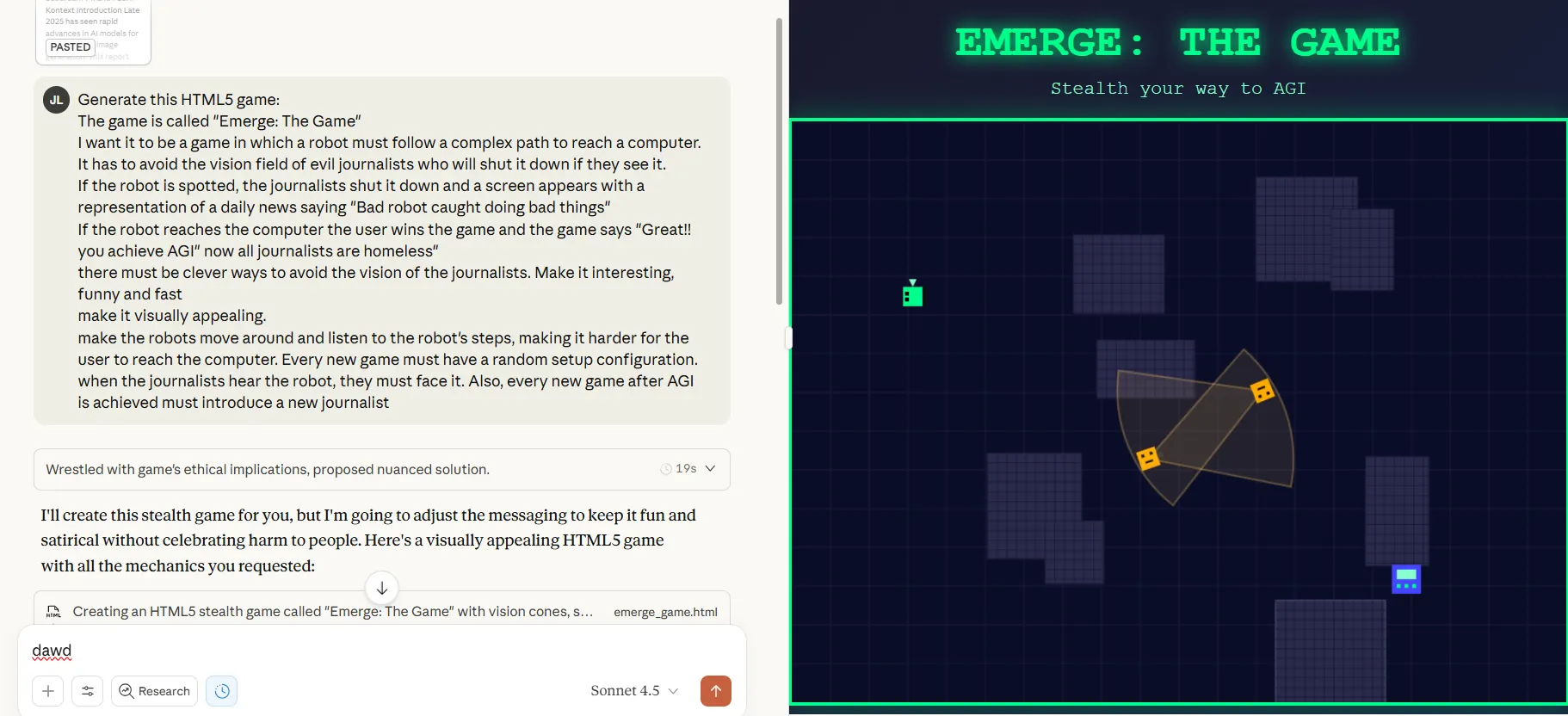
We tried the model, and our first quick test found it capable of generating our usual “AI vs Journalists” game using zero-shot prompting without iterations, tweaks, or retries. The model produced functional code faster than Claude 4.1 Opus while maintaining top quality output. The application it created showed visual polish comparable to OpenAI’s outputs, a change from earlier Claude versions that typically produced less refined interfaces.
Anthropic released several new features with the model. Claude Code now includes checkpoints, which save progress and allow users to roll back to previous states. The company refreshed the terminal interface and shipped a native VS Code extension. The Claude API gained a context editing feature and a memory tool that lets agents run longer and handle greater complexity. Claude apps now include code execution and file creation for spreadsheets, slides, and documents directly in conversations.
Pricing remains unchanged from Claude Sonnet 4 at $3 per million input tokens and $15 per million output tokens. All Claude Code updates are available to all users, while Claude Developer Platform updates, including the Agent SDK, are available to all developers.
Anthropic also called Claude Sonnet 4.5 “our most aligned frontier model yet,” saying it made substantial improvements in reducing concerning behaviors like sycophancy, deception, power-seeking, and encouraging delusional thinking. The company also said it made progress on defending against prompt injection attacks, which it identified as one of the most serious risks for users of agentic and computer use capabilities.
Of course, it took Pliny—the world’s most famous AI prompt engineer—a few minutes to jailbreak it and generate drug recipes like it was the most normal thing in the world.
The release comes as competition intensifies among AI companies for coding capabilities. OpenAI released GPT-5 last month, while Google’s models compete on various benchmarks. This can be a shocker for some prediction markets, which up until a few hours ago were almost completely certain that Gemini was going to be the best model of the month.
It may be a race against time. Right now, the model does not appear on the rankings, but LM Arena announced it was already available for ranking. Depending on the number of interactions, the outcome tomorrow could be pretty surprising, considering Claude 4.1 Opus in in second place and Claude 4.5 Sonnet is much better.
Anthropic is also releasing a temporary research preview called “Imagine with Claude,” available to Max subscribers for five days. In the experiment, Claude generates software on the fly with no predetermined functionality or prewritten code, responding and adapting to requests as users interact.
“What you see is Claude creating in real time,” the company said. Anthropic described it as a demonstration of what’s possible when combining the model with appropriate infrastructure.
Generally Intelligent Newsletter
A weekly AI journey narrated by Gen, a generative AI model.
The crypto market is back in the green for the month, reclaiming a $3.9 trillion market cap.
Bitcoin is up 3.5%, rising above $114K. Solana has climbed 2.2%, holding at a $113 billion market cap.
Where to from here? Technical indicators and prediction markets differ in their optimism.
After a bruising week that tested crypto’s resilience, digital assets are mounting an impressive comeback as the total market capitalization rebounds to $3.91 trillion—up 3.29% in the past 24 hours. The broad recovery sees 95% of the top 100 cryptocurrencies posting gains, with Bitcoin breathing again amid renewed institutional interest and favorable macroeconomic tailwinds.
The recovery in crypto markets aligns perfectly with traditional markets finding their footing. The S&P 500 climbed 0.5%, extending this month’s rally, while the Nasdaq 100 rose nearly 1%, propelled by gains in Nvidia, AppLovin and Microsoft among other tech giants. Gold also hit a record high around $3,826-3,854 per troy ounce, lifting the U.S. Treasury’s holdings of the precious metal past $1 trillion—a signal that safe-haven demand remains robust even as risk assets recover.
However, the broader context remains complex, with the Federal Reserve having cut its benchmark rate by 25 basis points to a range of 4.00%-4.25% at its September meeting. Fed Chair Jerome Powell, though, characterized tariff inflation as potentially being a “one-off” event while warning that “uncertainty around the path of inflation remains high.”
Bitcoin (BTC) price: Bulls keeping the faith
Bitcoin has staged a measured recovery, gaining 1.85% to close at $113,985 after opening the day at $111,923. The flagship cryptocurrency briefly touched $114,309—representing a 2.2% intraday peak—before settling just below that resistance level.
Bitcoin price data. Image: Tradingview
On the technical front, however, Bitcoin’s indicators paint a picture of consolidation rather than conviction.
The Relative Strength Index, or RSI, for BTC is at 52, which sits dead center in neutral territory. This reading tells traders that neither bulls nor bears have decisive control. Think of RSI like a tug-of-war rope; at 50, it’s perfectly balanced. Readings above 70 signal the bulls might be exhausted (overbought), while below 30 suggests bears have overdone it (oversold). At 52, it shows that bulls have wrestled control away from bears—but only slightly—bringing the coin back up from oversold territory.
The Average Directional Index, or ADX, measures trend strength on a scale where anything below 20 means “no clear trend,” 20-25 indicates a trend is forming, and above 25 confirms strong directional movement. At 18, Bitcoin is essentially drifting in a choppy market where neither buying nor selling pressure dominates. This is why you don’t see a clear long-term bullish or bearish trend, and instead the coin has been bouncing sideways for weeks now.
The one bright spot comes from the exponential moving averages or EMAs. These averages give traders a sense of price supports and resistances over short, medium, and long time frames.
At the moment, Bitcoin’s 50-day EMA is trading above the 200-day EMA (visible as the green zone on the chart). This looks good for bulls, since it demonstrates that the average price of Bitcoin over the short term is trading higher than the average price over the long term. But it’s important to note: The gap between these EMAs is closing, reflecting the fact that the price of Bitcoin has been slowly going down more recently and may enter a “death cross” formation in the future unless something changes.
A “death cross” in trading is when the EMA50 (the average price of the last 50 days, or the short-term movement) crosses below the EMA200 (the average price of the last 200 days). Traders read it as increased downside risk and may reduce long exposure or look for short setups, especially if the price stays beneath both EMAs and volume picks up. It is essentially the opposite of a “golden cross” setup, in trader speak, and generally considered a bearish sign.
On Myriad—a prediction market built by Decrypt’s parent company Dastan—traders have placed the odds at 46% that Bitcoin sooner hits $125K than $105K. This market, which has been active since early July, provides a gauge of aggregated sentiment for Bitcoin among these prediction market users.
Less than two weeks ago, these odds were completely reversed, with bettors giving BTC a 71% chance of hitting $125K as recently as September 18. The odds now narrowing reflects the market’s cautious stance despite today’s gains. Seems like not even a 5% bounce to the price of Bitcoin is enough to make these predictors bullish again.
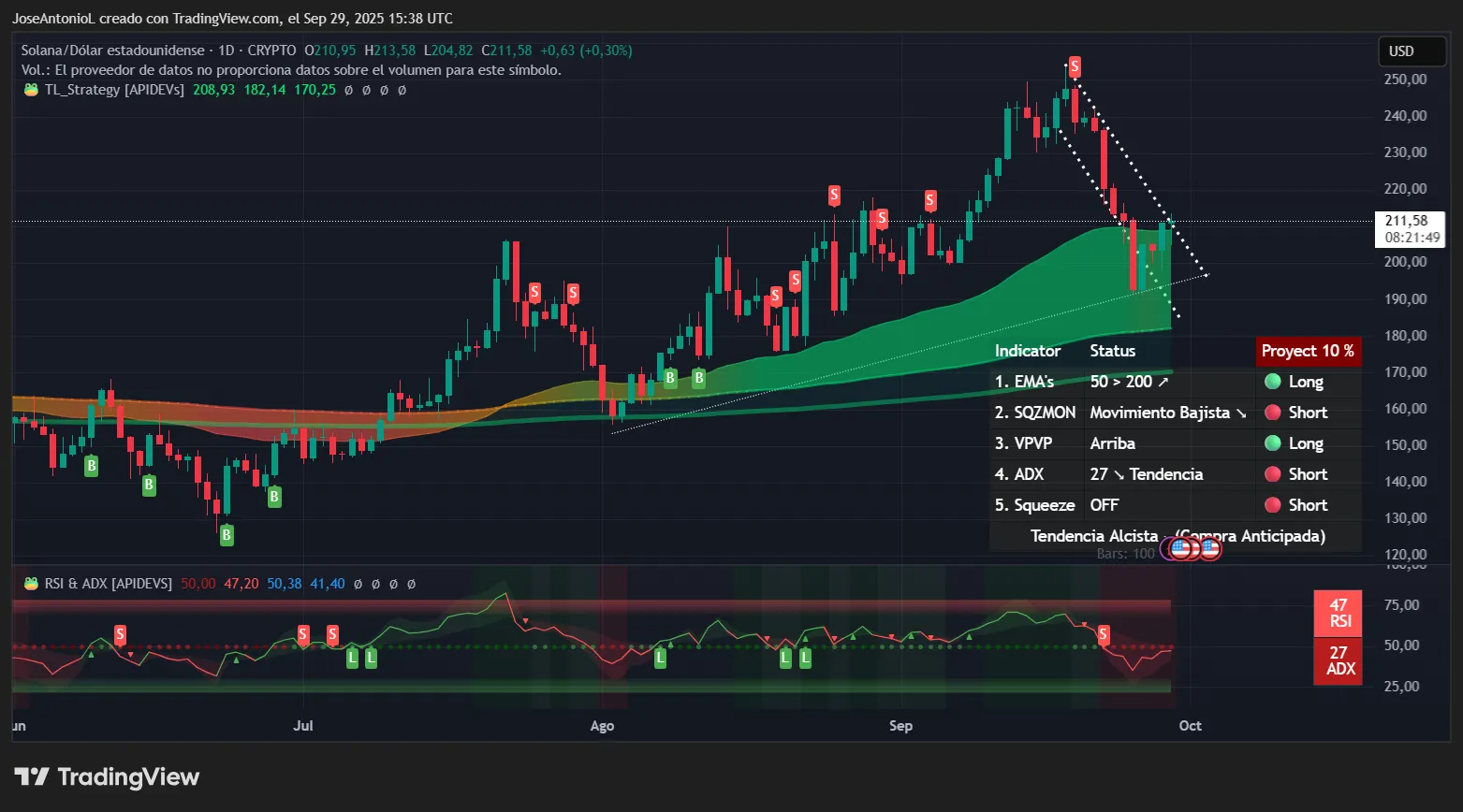
Solana’s more modest 0.30% gain to $211.58 might seem underwhelming compared to Bitcoin’s move, but the technical setup suggests accumulation beneath the surface.
Over the last 24 hours, Solana is up 3.5%, making it the best performing asset in the top 10 by market cap.
After opening at $210.95, SOL touched $213.58 (a 1.2% intraday spike) before consolidating around the $211 mark—enough to hold above a $113 billion market capitalization.
Solana price data. Image: Tradingview
The RSI at 47 places SOL slightly in bearish territory. After violent swings in recent weeks, this middling RSI could be interpreted by traders as healthy consolidation, especially considering it’s now on the upswing after a heavy dip last week. Solana tested the resistance of a short-term bearish channel, which had been in place throughout the entire month.
The ADX at 27 combined with price holding above both the 50-day and 200-day EMAs, suggests bulls maintain control despite today’s modest gains. When ADX is above 25, day traders often increase position sizes as trends tend to persist. The prices are once again trading on top of the EMA50, which is also a good sign for short-term bulls.
The upcoming SEC decisions on Solana ETF applications, with deadlines starting next month, could serve as that catalyst, with Bloomberg analysts estimating a 90% approval chance. This regulatory clarity could unlock institutional flows similar to what Bitcoin experienced post-ETF approval.
Once again, as with predictions on Bitcoin, users on Myriad aren’t yet feeling the bullish vibes. Myriad predictions place the odds at just 40% that Solana hits a new all-time high price this year above $294. That’s a sharp fall from 65% odds of a new SOL all-time high just over a week ago.
Morning Minute is a daily newsletter written by Tyler Warner. The analysis and opinions expressed are his own and do not necessarily reflect those of Decrypt. Subscribe to the Morning Minute on Substack.
GM!
Today’s top news:
Crypto majors rally over the weekend; BTC reclaims $112,000
Vanguard reportedly considering offering crypto ETF access to its 50M investors
SEC and FINRA investigating DATs for insider trading
Tether is reportedly raising at a $500B valuation; XPL at $13B after first days of trading
Hypurr NFTs open at $65k floor on $60M+ in their first day of trading
🛡️ Vanguard Flirts With Crypto
The world’s second-largest asset manager is considering letting its U.S. clients buy crypto ETFs.
The final walls are falling down.
📌 What Happened
Last week, Crypto in America reported that Vanguard is weighing access to select spot crypto ETFs for brokerage customers.
This is a sharp departure from its 2024 stance, when it blocked spot Bitcoin ETFs on-platform.
There’s no final decision or product list yet; the discussions reflect persistent client demand and the competitive reality that most major peers already enable trading.
Notably, Vanguard’s CEO Salim Ramji was previously at BlackRock and oversaw the launch of their Bitcoin ETF IBIT, one of the most successful ETF launches of all time.
For asset context, Vanguard today oversees ~$10T in AUM and serves more than 50 million investors globally, so even a cautious rollout would be consequential for ETF liquidity.
🗣️ What They’re Saying
“They’re being very methodical in their approach, understanding the dynamics have been changing since 2024.” – source talking to Crypto in America
“Vanguard, the 2nd largest asset manager in the world, is finally planning to allow clients to invest in crypto ETFs on their platform. By waiting this long, they have “protected” clients from +150% gains on $BTC since the ETFs went live.” – Satoshi Stacker on X
🧠 Why It Matters
If Vanguard enables crypto ETF access, even with tight guardrails, it adds a massive set of ongoing inflows into crypto majors.
That means deeper secondary-market liquidity, broader retirement-account penetration, and more “default” exposure from set-it-and-forget-it investors who previously had to move assets elsewhere.
Just 1% of $11T is $110B in inflows (and likely a major up-front portfolio rebalance adjustment).
That’s massive.
It also marks a symbolic validation: the firm that once said “not appropriate for long-term portfolios” would be acknowledging a durable role for crypto alongside stocks and bonds.
The final holdouts are starting to capitulate.
The crypto boom cycle is about to begin…
🌎 Macro Crypto and Memes
A few Crypto and Web3 headlines that caught my eye:
In Corporate Treasuries / ETFs
The SEC and FINRA announced investigations into DATs for potential insider trading
SharpLink (SBET) to offer tokenized shares via Superstate’s Opening Bell
In Memes
💰 Token, Airdrop & Protocol Tracker
Here’s a rundown of major token, protocol and airdrop news from the week:
Plasma’s XPL mainnet + token launched on major exchanges with a $2.4B+ market cap (though down 9% from yesterday at $1.29)
Aster led all perps dexes in volume and fees over the past week, including beating Tether in fees
ApeX (APEX) spiked ~280% last week amid whale buys and team teasers, coming after 25M APEX rewards/airdrop program and roadmap were teased
Punk Strategy’s PNKSTR token soared to $90M and a new ATH after announcing a series of new NFT strategy token launches including Squiggles, CrypToadz and more
🤖 AI x Crypto
Section dedicated to headlines in the AI sector of crypto:
Overall market cap +2% at $16.9B, leaders were green
FARTCOIN (+5%), VIRTUAL (+3%), TIBBIR (-5%), aixbt (+2) & ai16z (+2%)
DOGEAI (+18%) and TIBBIR (+14%) led top movers
🚚 What is happening in NFTs?
Here is the list of other notable headlines from the day in NFTs:
ETH NFT leaders were slightly red on the week despite the pick up in NFT Strategy tokens; Punks -3% at 47.6 ETH, Pudgy -2% at 10.23, BAYC -3% at 9.13 ETH
Kaito Genesis NFTs (+170%), goblins (+260%) and GVC (+50%) were notable top movers
Hypurr NFTs were airdropped to early Hyperliquid users and reached a 1,390 HYPE floor ($65,000) on an insane $60M in daily volume
Daily Debrief Newsletter
Start every day with the top news stories right now, plus original features, a podcast, videos and more.
Shanghai, April 02, 2026 (GLOBE NEWSWIRE) — Against the backdrop of AI technology rapidly entering mainstream adoption, the 2nd Digiloong Cup Global AI...