The UK government is seeking to keep most of the 61,000 BTC it seized in 2018, amid civil recovery proceedings.
Some figures within the British crypto industry believe any retained BTC should be kept in a strategic reserve, while others argue that the long-term holding of seized assets is at odds with UK law.
Yet all groups suggest that a Bitcoin reserve would be a big boost to the UK crypto industry, with some calling for feasibility studies and pilots to be undertaken.
Trade associations representing the British crypto industry have mixed views on whether the UK Government should use $7 billion in seized Bitcoin as the basis of a strategic reserve.
The UK Government is reportedly aiming to keep most of the 61,000 BTC it seized in 2018, with civil recovery proceedings currently determining how much should be returned to victims of a large-scale Chinese investment fraud.
The legal question of how much victims should be compensated comes at a time when the UK Government is looking for ways to fill a hole in public finances worth up to $67 billion.
However, some crypto industry representatives are skeptical that the Government will hold the frozen Bitcoin for the long term, assuming that civil proceedings determine its right to retain most of the seizure.
Speaking to Decrypt, British Blockchain Association President Prof. Naseem Naqvi MBE said that the UK’s approach to criminal assets is ultimately set by the Proceeds of Crime Act (POCA), meaning that the objective of British policy in this area is the recovery of criminal proceeds, and not long-term investment or holding.
“Recent ministerial answers have reaffirmed that seized assets are managed and realised under POCA, and that the UK’s official reserves policy does not contemplate adding Bitcoin; there are no plans to change this or to consider BTC as a reserve asset,” he explained.
Not only does UK law point away from the long-term holding of the frozen BTC, but Naqvi suggests that such holding would also contradict current UK fiscal policy.
He said, “From a public-finance perspective, taking on price-volatility risk with confiscated assets would run counter to established UK Treasury and Bank of England reserve management principles and could set a precedent that blurs the line between asset recovery and investment policy.”
These views aren’t shared by the British crypto industry as a whole, however, with a spokesperson for CryptoUK—which counts the likes of Gemini, OKX, InputOut, Bitwise, Socios.com and Nexo as members—arguing that plans to immediately sell the frozen Bitcoin “would run contrary” to the UK Government’s recent moves to boost the industry.
They said, “We would urge the government to take a long-term view on the holding of crypto and deeply consider what message offloading these digital assets would send to the UK’s crypto industry.”
The CryptoUK spokesperson also highlighted the fact that other jurisdictions are taking steps towards maintaining strategic cryptocurrency reserves, as are a growing number of publicly listed companies.
Despite highlighting legal arguments that could or will prevent the UK Government from holding the 61,000 BTC for the longer term, Professor Naqvi acknowledged that the establishment of a British Bitcoin reserve would be a powerful signal for the industry.
“It would be symbolically potent but policy-inconsistent in this context,” he said. “A government wallet visibly ‘HODLing’ could be read by markets as a vote of confidence and might be welcomed by some industry voices.”
But because long-term holding would “conflict with POCA’s victim-focused recovery aims” (and with recent affirmations that the UK Government is not planning a crypto reserve), Naqvi proposed a more practical, realistic option.
He explained, “If courts order forfeiture, the government could choose a phased and transparent disposal (e.g., auction windows) to reduce market impact, consistent with international practice, while keeping within POCA’s purpose.”
And in such a context, Naqvi affirmed that the UK should concentrate on providing leadership to the British crypto industry by “finalising high-quality, evidence-based crypto regimes” and ensuring consistent enforcement.
Selling off the frozen Bitcoin as quickly as realistically possible may carry the risk of repeating one of the most controversial fiscal acts in recent British history, namely the sale of 401 tonnes of gold (more than half of British reserves) between 1999 and 2002.
The gold sales raised $3.5 billion for the UK Treasury, yet they occurred at a time when the average gold price was $275 an ounce, with the price of the precious metal having risen over the years to its current level of $3,850 an ounce.
However, Naqvi and the British Blockchain Association do advocate for the UK Government to consider studying the feasibility of Bitcoin and crypto reserves, while even undertaking a pilot allocation equal to between 0.1% and 0.5% of total assets.
“From the BBA’s perspective, the UK should not hold confiscated BTC as a de facto reserve,” he said. “But it should explore, through research, pilots, and international dialogue, whether Bitcoin could play a measured, strategic role in the UK’s future reserve policy.”
Daily Debrief Newsletter
Start every day with the top news stories right now, plus original features, a podcast, videos and more.
The DOJ under Pam Bondi demanded Apple take down ICEBlock, while Google pulled down Red Dot citing safety.
ICEBlock creator Joshua Aaron called the removal a violation of First Amendment rights.
Aaron warned that constitutional rights are “being stripped away” and vowed a legal fight.
Bowing to federal pressure, Google and Apple yanked two popular apps, ICEBlock and Red Dot, that let users crowdsource reports of U.S. Immigration and Customs Enforcement activity, citing officer safety after a deadly sniper attack at an ICE field office in Texas.
On Thursday, Google and Apple both removed the Red Dot app. Apple also pulled the iOS-specific ICEBlock app after the U.S. Department of Justice under Attorney General Pam Bondi formally demanded its removal. Bondi said in a statement to Fox News that the app “is designed to put ICE agents at risk just for doing their jobs,” and vowed to protect federal law-enforcement officers.
Joshua Aaron, creator of ICEBlock, said Apple’s removal blindsided him.
“The app was thoroughly vetted for three weeks by Apple’s legal and senior officials before approval,” he told Decrypt. “It’s been fine all this time. For them to do it now, that’s why I say I’m so disappointed.”
Aaron, a software developer and the lead singer of the rock band Stealing Heather, released ICEBlock in April. In July, as ICE operations ramped up across the United States, ICEBlock went viral after being called out by Bondi, who called it a tool for “signaling to criminals where our federal officers are.”
Aaron said Apple has not reached out to him or given him a chance to appeal the decision.
“Apple has not called me, even though we were number one in the App Store for weeks and had 1.14 million users that counted on this every single minute of their day,” he said. “They just gave me a letter that said we received information from law enforcement that your app is targeting or harming law enforcement officials.”
Aaron compared ICEBlock to mainstream navigation tools like Apple Maps, Google Maps, and Waze.
“To somehow say that ICEBlock is doing anything different than that is ridiculous,” he said.
Federal pressure intensifies
Apple’s removal came after Bondi’s DOJ formally asked for the app to be pulled, citing officer safety.
“We created the App Store to be a safe and trusted place to discover apps. Based on information we’ve received from law enforcement about the safety risks associated with ICEBlock, we have removed it and similar apps from the App Store,” Apple told Fox News.
Google echoed that sentiment with its removal of Red Dot, going so far as to suggest to 404 Media that ICE agents are a “vulnerable group.”
“ICEBlock was never available on Google Play, but we removed similar apps for violations of our policies,” a Google spokesperson told Decrypt. The spokesperson, who said that the federal government did not reach out to the search giant, said the Red Dot app was removed due to “high risk of abuse” and rules around user-generated content.
On September 24, a sniper attack at an ICE facility in Dallas killed one detainee and injured two others. Authorities said the suspect was aiming for ICE officers and had searched his phone for tracking apps, including ICEBlock, before opening fire.
Aaron called the takedown a “First Amendment violation,” and said he plans to fight it in court and in the media.
“This is not some app taken down from the App Store; this is a tech company removing something that is clearly a First Amendment-protected app,” he said. “There’s nothing illegal about developing it. There’s nothing illegal about using it. They are now deciding what you can and cannot use on a device that you own.”
He also rejected Google’s description of ICE agents as a “vulnerable group.”
“They gave $170 billion to create their own paramilitary force in this country,” he said. “To say they’re in danger is laughable at best.”
Apple did not immediately respond to requests for comment by Decrypt.
Generally Intelligent Newsletter
A weekly AI journey narrated by Gen, a generative AI model.
The crypto market is riding high as “Uptober” delivers on its historical promise. Bitcoin hovers near a new all-time high, Ethereum pushes toward $4,500, and altcoins are catching fire.
But one token stands out: BNB, formerly known as Binance Coin, is up 24% in the past month and flashing technical signals that suggest either a moonshot to $2,000 or a face-melting correction is imminent.
BNB opened today at $1,090.97 and closed at $1,157.05, marking a solid 6.06% daily gain after hitting a new all-time high. The intraday high of $1,168.39 shows bulls are in complete control, with the token breaking through resistance levels like they’re made of paper.
Adding fuel to the rally, Kazakhstan’s newly launched Alem Crypto Fund made BNB its first national reserve asset this week, providing institutional legitimacy at the nation-state level. Meanwhile, BNB Chain posted record Q3 growth with DEX volume surging 185% to $37.1 billion, driven by the Aster DEX generating over $29 million in daily fees.
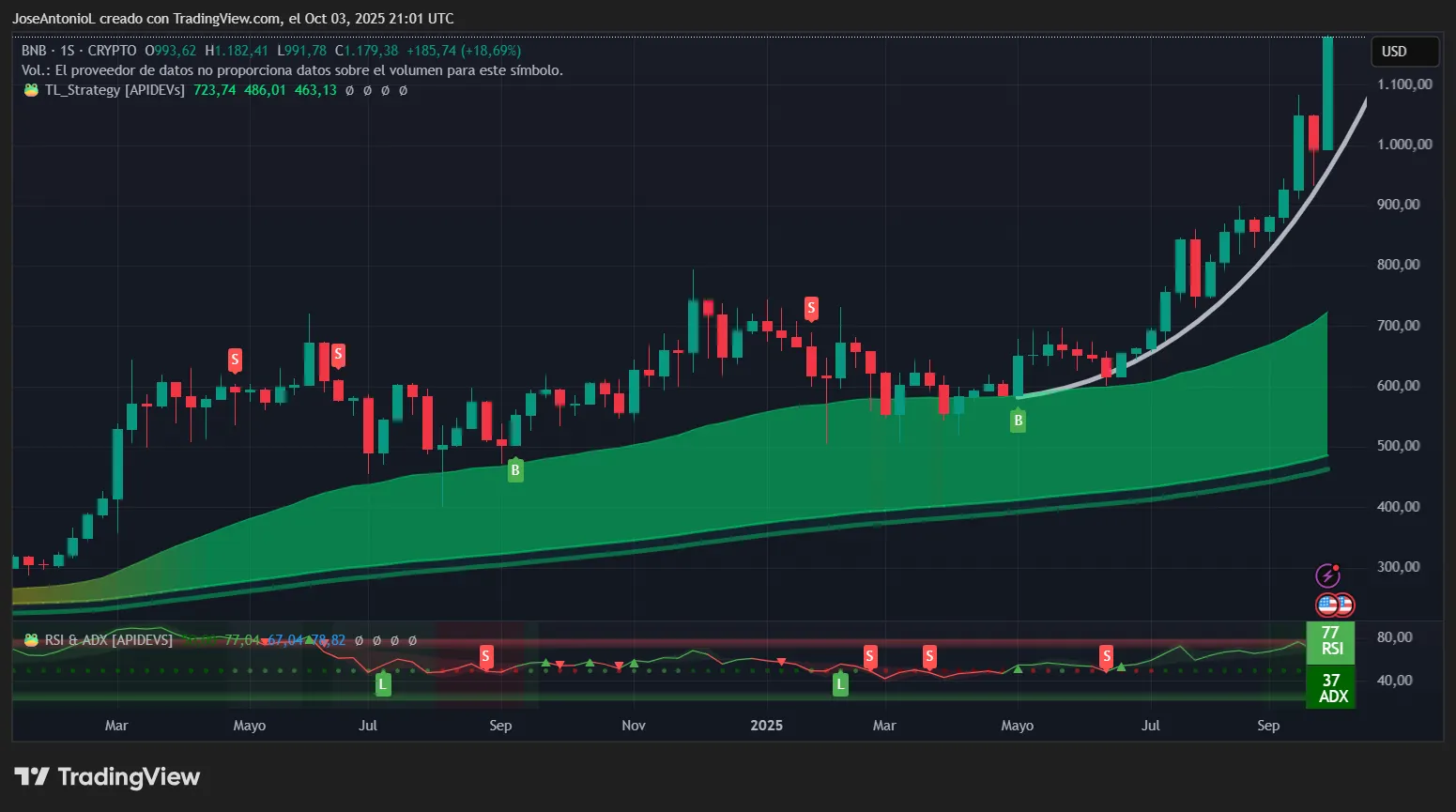
But here’s where things get interesting: BNB has been riding a powerful parabolic support line since mid-year. The chart shows a clear parabolic advance—the kind that can deliver explosive gains but also tends to end with equally explosive corrections. Looking at the projection, if this trajectory continues uninterrupted, BNB could be trading near $2,000 by December 31, potentially delivering another 67% gain from current levels over the next 89 days.
BNB price data. Image: Tradingview
That is, of course, if you trust that the planets will align and the trend will remain valid until new year’s eve.
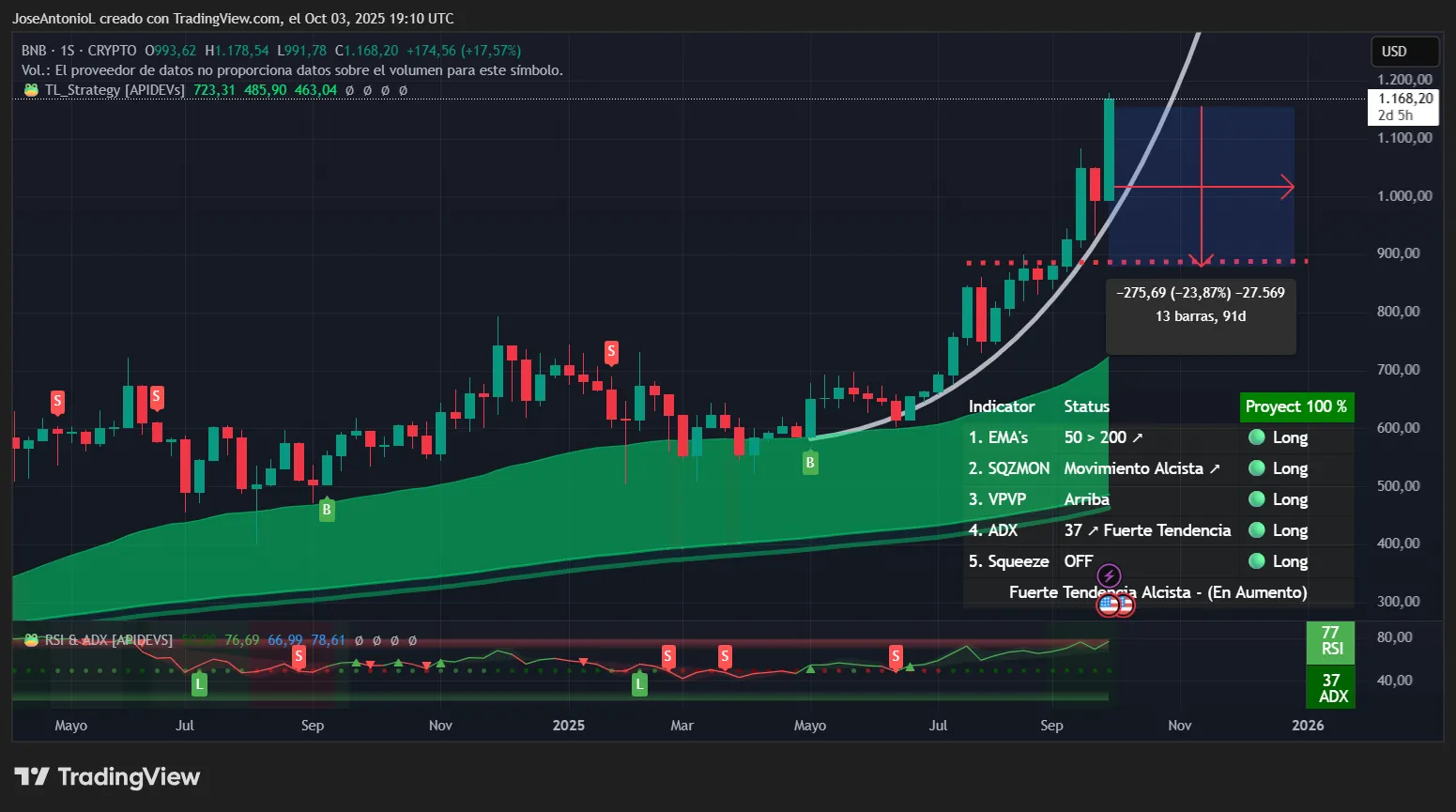
The Average Directional Index, or ADX, sits at 33, well above the critical 25 threshold that confirms a strong trending market. Think of ADX as your “trend strength meter”—it doesn’t care about direction, just whether a real trend exists. Below 20, you’re in choppy waters where false breakouts are common. Above 25, you’ve got momentum. At 33, BNB is firmly in trending territory, meaning institutions and retail are moving in the same direction, creating sustained buying pressure that can carry prices significantly higher.
However—and this is crucial—ADX measures strength, not sustainability. A strong reading can persist right until the moment a trend exhausts and reverses, some random whale dumps the coin, or a FUD episode triggers a flash crash. It’s like a speedometer showing you’re going fast without telling you how much fuel remains.
The exponential moving averages, or EMAs, paint an even prettier picture. These weighted averages give more importance to recent price action, helping identify dynamic support and resistance. For BNB, the setup is textbook: the 50-day EMA rises beneath current price around $1,050-$1,070, providing a cushion for pullbacks. The 200-day EMA sits lower still, confirming the longer-term uptrend.
When shorter-term EMAs trade above longer-term ones like this, traders see it as a good sign. This configuration suggests money is positioned bullishly across multiple timeframes, from swing traders watching the 50-day to long-term holders focusing on the 200-day. Watch the candlesticks on weekly timeframes, and the gap between both averages is also bullish, and increasing over time.
BNB price data. Image: Tradingview
Now the semaphore’s yellow light:
The Relative Strength Index measures momentum on a 0-100 scale, with readings above 70 considered “overbought.” At 76, BNB is at the edge of that danger zone. One or two more strong days push it above 80, where algorithmic systems typically trigger sell orders and profit-taking historically accelerates.
This matters because markets don’t move in straight lines. BNB’s 6% daily gain and 21% weekly surge attract short-term traders looking for quick flips. Once momentum stalls—and it always stalls eventually—those traders rush for exits simultaneously, creating violent corrections that wipe out leveraged positions in minutes.
Also, the candlesticks have started to show signs of extreme FOMO. A parabolic chart is already hyperbullish, but a parabolic chart in which the bodies of the latest candlesticks are moving faster than the support, is probably too good to be true. Common sense says there must be a correction for markets to find some balance.
The Two scenarios: Moonshot vs. meltdown
The bullish case is straightforward: If BNB holds its parabolic support line through year-end, the chart projection suggests a path to around $2,000. That’s a 67% gain over 89 days—ambitious but not impossible given current momentum.
For this to play out, BNB needs:
Continued BNB Chain growth and real-life applications that boost the economic value of the BNB token (like what Aster, the Hyperliquid competitor, and other protocols are doing);
More institutional adoption to inject liquidity (like what Kazakhstan is doing);
Bitcoin holding above $115,000 and ideally pushing toward a new all-time high (because altcoins always follow Bitcoin’s lead); and
Zero major regulatory curveballs from Binance or broader crypto regulation.
The path higher would see BNB break above today’s $1,168 high, consolidate briefly around $1,200, then push toward $1,250-$1,300. That zone becomes the launching pad for $1,500 and ultimately $2,000. Volume would need to confirm each breakout—if BNB tries breaking $1,250 on light volume, it’s probably a false move.
Scenario 2: The correction reality check
Now for the cold shower. Parabolic advances are beautiful until they’re not. They require ever-increasing buying pressure to maintain trajectory, and when that pressure falters, gravity takes over with a vengeance.
At 77, BNB’s RSI is one strong week from breaching 80, where corrections typically trigger. The parabolic structure itself is inherently fragile—if BNB breaks below its rising support line even briefly, it could cascade into a 20-30% correction as stop-losses trigger and profit-takers flood exits.
In fact, even with such a sharp correction, the overall trend could still be considered long-term bullish, with prices still trading above the 50-day EMA.
Traders would consider this correction healthy, allowing the token to consolidate gains and work off overbought conditions, bringing RSI back to neutral 50-60 territory. If $1,050 holds, bulls maintain control and the uptrend stays intact for another leg higher.
In this scenario, BNB would trade sideways for weeks before attempting another leg higher. The conservative year-end target becomes $900-1000 rather than $2,000—still excellent 200% yearly returns.
Choose your risk tolerance
For the BNB bull, the path to $2,000 exists. Record BNB Chain usage, political endorsement, technical momentum, and favorable macro conditions from the U.S. government shutdown creating Fed rate cut expectations—all create a plausible moonshot scenario.
For the bear, here’s the but: The setup is more overbought than sustainable. The parabolic structure is fragile. RSI flirts with danger. And crypto markets are notorious for violent reversals.
What might traders do given these conditions? If holding from lower levels, traders may consider scaling take-profit triggers up according to the price movement (from $1,200, $1,250, and $1,300) while letting the rest ride with a trailing stop. Fresh capital? Traders may wait for a pullback before committing, being mindful of not chasing parabolic moves at all-time highs.
More advanced traders may be inclined to consider selling covered calls. Covered calls benefit from overbought, parabolic rallies—if the rally stalls, you keep the premium; if price indeed explodes, your gains are capped but protected from a sudden selloff.
And for the casual observer: Enjoy the ride. Parabolic rallies are beautiful until they’re not, and in crypto, the transition from “beautiful” to “brutal” can happen in hours.
Key levels to watch:
Resistance:
BNB is in price discovery, so targets are just based on speculation, not past data
$1,250 (next technical target and key breakout level)
$1,400 (gateway to $2,000 moonshot in the most bullish scenario)
Support:
$1,000 (major psychological support and parabola support)
$900 (consolidation zone between June and September)
Disclaimer
The views and opinions expressed by the author are for informational purposes only and do not constitute financial, investment, or other advice.
Daily Debrief Newsletter
Start every day with the top news stories right now, plus original features, a podcast, videos and more.
Steakhouse, a curator on Morpho, is sharing performance fees with Coinbase.
The fees are derived from user repayments toward Bitcoin-backed loans.
People are tapping the product to pay for cars and home improvements.
Coinbase’s newest lending product is generating profits for the crypto exchange in several ways, but not all are reflected clearly on-chain.
As the firm lets customers deposit wrappedBitcoin and Circle’s USDC into “vaults” on decentralized finance protocol Morpho, it’s earning cash from stablecoin reserves and transaction fees indirectly. It’s also taking a cut of performance fees that are designed to incentivize risk managers on the platform, Coinbase has confirmed to Decrypt.
DeFi offers the promise of a more transparent financial system, but it’s unclear whether the arrangement poses conflicts of interest or could potentially put user funds at greater risk. Coinbase says that the initiative is addressing investors’ growing appetite for ways to use digital assets, unlocking financial empowerment.
In a statement to Decrypt, a Coinbase spokesperson said that the company “is committed to the sustainable success of its products.”
“We firmly maintain this philosophy when searching for collaborators that can help us bring simple, secure on-chain financial products to our users.”
The specifics of Coinbase’s arrangement with a so-called curator on Morpho named Steakhouse, through which users are effectively paying the exchange, are not referenced in an FAQ for its product. The FAQ does say that “there are no Coinbase fees,” and interest rates are set by “open lending markets.”
Vaults on Morpho allow Coinbase users to do two things: They can post Bitcoin as collateral for loans, or they can deposit USDC to earn yield. In essence, it resembles a circular market, which crossed $1 billion in originations on Tuesday.
As users make payments toward loans, a percentage of the yield that vaults generate is directed to “curators,” who serve as chief risk officers and strategists, according to Morpho’s documentation. It’s called a performance fee, and it’s customizable vault-to-vault.
The vault with the most deposits on Morpho is curated by a DeFi project called Spark. It is providing liquidity for Bitcoin-backed loans on Morpho, while taking a 10% slice of the 6% APY (annual percentage yield) that around $700 million in USDC deposits is currently generating.
Steakhouse, meanwhile, is curating a vault that currently lets Coinbase users earn 5.6% APY on USDC. Most of those funds are going toward providing liquidity for Bitcoin-backed loans as well, but the vault collects a 25% performance fee, among the highest on Morpho.
Steakhouse and Coinbase “share” the fee, the Coinbase spokesperson confirmed to Decrypt.
“Steakhouse USDC was selected as a starting vault on account of its collateral exposure being generally very liquid crypto assets which—along with the overcollateralization of the loan positions—creates an additional buffer for lenders,” they added, while highlighting an overview of Steakhouse’s risk management framework.
Decrypt has reached out to Steakhouse for comment.
‘Scale Infinitely’
As firms across the U.S. are integrating DeFi into their businesses, some onlookers are comparing the trend to mullets—centralized in the front, yet permissionless in the back. Morpho itself made the comparison on X on Thursday.
From Coinbase’s perspective, it’s acting as a “technology provider,” enabling users to access decentralized protocols like Morpho, Max Branzburg, head of consumer products at Coinbase, told Decrypt.
“Coinbase is not lending to users. Coinbase is not facilitating the financing itself,” Branzburg said. “This is really about connecting users as a technology platform with DeFi.”
Branzburg compared the initiative to Coinbase’s recent support of trading on decentralized exchanges, allowing users to natively access more than 40,000 assets through its mobile app, beyond the 330 currently listed on its platform.
With borrowed funds, Branzburg said that Coinbase is seeing people fund large purchases like cars or home renovations, without needing to sell their Bitcoin, “empowering people to help grow their wealth in ways that they couldn’t otherwise.”
The product is far different from a centralized lending service that Coinbase previously offered, which required a patchwork of state licenses. (Coinbase stopped issuing Bitcoin-backed loans in 2023 amid industry-wide, regulatory scrutiny.)
“If we’re trying to lend off our balance sheet, for example, or build some centralized financing product, it just has inherent limitations,” he said. “A technology platform to connect people with decentralized protocols can scale infinitely.”
Boosted
Crypto firms servicing users as technology providers is commonplace. Companies that offer self-custodial wallets, for example, fit the description. They are not considered intermediaries in the U.S. because users are solely responsible for controlling and securing their assets.
Although Coinbase’s newest lending product has been tapped by more than 14,200 wallets since its introduction in January, that still equates to less than 1% of the firm’s users, Branzburg said. The average loan size that users are taking out is around $50,000, he added.
User activity is taking place on Base, Coinbase’s Ethereumlayer-2 network, so the exchange is earning fees indirectly through the network’s centralized sequencer, which orders transactions before they are passed on to the underlying network.
Coinbase’s newest lending product uses cbBTC, a version of wrapped Bitcoin offered by the exchange, and Circle’s USDC, which earns Coinbase income. Earlier this year, Circle’s public debut revealed that Coinbase earns 50% of the “residual payment base” generated by USDC’s backing.
Last month, Branzburg said that USDC lending rates for Coinbase users were temporarily “boosted” by Morpho. That means Morpho’s platform doesn’t entirely reflect what Coinbase users are receiving either.
In 2022, former SEC Chair and crypto skeptic Gary Gensler cautioned investors that some yields in the cryptosphere appeared “too good to be true.” He also said the public benefits from “full and fair disclosure.”
This year, crypto lending is rallying in the U.S. against a more supportive regulatory backdrop. Coinbase plans to raise loan limits for users to $5 million from $1 million, potentially unlocking what Branzburg described as billions in assets.
“We’re always thinking about the regulatory environment that we’re building in,” he said. “It’s been great to see an environment that is leaning into crypto and believes in the power of Bitcoin, DeFi, and self-custody.”
Daily Debrief Newsletter
Start every day with the top news stories right now, plus original features, a podcast, videos and more.
Ethereum hit a two-week high of $4,500, defying recent bearish sentiment in traditional markets.
Options data show a short-term bullish shift for October, but longer-term sentiment remains cautious.
Analysts anticipate a bullish breakout in the fourth quarter if institutional treasuries resume their buying spree.
Ethereum briefly climbed to a two-week high of $4,500 on Thursday, extending a strong quarterly performance even as traditional markets navigated significant volatility.
The world’s second-largest cryptocurrency by market capitalization is up 1.6% over the last 24 hours, per CoinGecko data. Despite it being considered one of the most bearish quarters, Ethereum closed Q3 with an outsized return of 74%, according to CoinGlass data, while posting a 34% gain for the year.
Unlike U.S. equities & gold, the broader crypto market is experiencing a sharp uptick in buying pressure amid the U.S. government shutdown, resulting in nearly 6% and 8% uptrends for the top two cryptocurrencies.
On prediction market Myriad, launched by Decrypt’s parent company DASTAN, users are growing increasingly bullish about Ethereum’s prospects. Some 72% now expect Ethereum to surge to $5,000 rather than drop to $3,500, up from 66% on Thursday.
Ethereum’s tailwinds
A shift in trader sentiment is providing tailwinds for Ethereum, experts told Decrypt.
“Bearish options market positioning in September has switched at the beginning of October,” Thahbib Rahman, research analyst at options data analytics platform Block Scholes, told Decrypt. “Options expiring in the next couple of weeks now express a higher relative demand for calls than puts.” Rahman cautioned that this newfound optimism may be short-lived, as the positive sentiment is limited to October only, and that “longer-term put options still carry a premium.”
Echoing a positive near-term view, Czhang Lin, head of LBank Labs, told Decrypt that, “Ethereum looks solid heading into the fourth quarter.”
“October tends to be a strong month for crypto,” he added, noting that, “Ethereum has held up better than many assets even with equities under pressure.”
Lin expects some short-term choppiness but believes the overall momentum will remain positive.
Analysts are closely watching whether digital asset treasuries (DATs) will resume accumulating Ethereum, a key source of institutional demand that has recently paused.
“ETH DATs have paused with equities under pressure, but I see it as a pause, not a pullback,” Ryan Lee, chief analyst at Bitget, told Decrypt.
Lin echoed a similar sentiment, adding that if these institutional buyers resumed their purchases, “it would be an important boost,” considering the uptick in total Ethereum staked.
“This confluence could push the Ethereum prices higher faster,” he added, with Lee suggesting such a development would add “real conviction to a fourth quarter breakout scenario.”
Daily Debrief Newsletter
Start every day with the top news stories right now, plus original features, a podcast, videos and more.
Trump Jr. described his experience with mainstream media as “a disaster,” likening their exclusion from coverage to being debanked.
He said independent outlets, podcasts, and long-form formats fill gaps left by traditional press.
Observers told Decrypt that credibility depends on transparency and accountability, regardless of the outlet.
Donald Trump Jr. told a jam-packed conference room at Token 2049 in Singapore how the media’s unfair treatment of his family had spurred them to create alternative forms of channeling attention and engagement.
Trump, the son of U.S. President Donald Trump and co-founder of World Liberty Financial, said that the crypto project resulted from the First Family’s efforts to foster friendlier coverage.
“I think my overall experience with the media has been, let’s call it, a disaster,” Trump Jr. said. “Where we’re starting to get a fair shake is that the media has discredited themselves so often and so much that the media, like finance, is shifting to alternate forms.”
Trump Jr. and his family have been increasingly active in the digital asset space through multiple projects that seem to have generated massive gains for them, but also drawn blowback from critics who believe the Trumps have been advancing their own interests.
Trump Jr. called “the independent journalism route, the podcasts, people who are talking long-form,” as part of a trend where communication can be construed as “not just delivering a sound bite for whatever corporate powers would have them be doing.”
He said these formats would enable “real” conversations, and offered an opportunity for people outside traditional media to fill a “void.” including his family.
“We got into crypto because—out of necessity—we were debanked, so we came up with a solution,” Trump Jr. said, pointing to how, in the same manner as the media, they were deplatformed, shut down, and thrown off “every platform imaginable.”
Trump Jr. and his brother, Eric Trump, have frequently spoken about facing challenges in the banking industry, with Eric saying earlier this year that “some of the biggest banks in the world” canceled their accounts after President Trump’s first term. Eric Trump further blamed “woke cancel culture” for the trend.
Trump’s comments drew largely favorable reviews from crypto industry observers.
In an interview with Decrypt, Tory Green, co-founder and chairman of decentralized GPU platform io.net, highlighted the importance of “transparency and accountability,” and said that mainstream media often overlooks important details about crypto, for example, which is “why independent outlets matter.”
Alluding to the president’s removal from social media platforms following the January 6 U.S. Capitol attack in 2021, Coin Bureau founder and CEO Nic Puckrin told Decrypt that “deplatforming” was wrong.
“You should have an opinion. You should be able to share it, right?” Puckrin said. “No matter what people think about it, you should be able to [opine], so deplatforming is bad,” although he added that Trump Jr.’s story was “a bit of a spin, of course.”
Cecilia Hsueh, chief strategy officer at MEXC, said that alternative media often did a better job of covering the crypto industry itself than mainstream outlets that miss the industry’s culture and pace.
“Crypto is very unique,” she said. “The way we do things, degen culture—it’s fast, it switches rapidly.”
She added: “Traditional media has “this perception [on crypto] that it’s a speculation first, and then they use that perception to look into what we are doing: all the initiatives, the creative ideas,” although she noted positive changes as “Bitcoin has become a mainstream asset.”
Decrypt reached out to World Liberty Finance and Donald Trump Jr. for additional comment, but did not immediately receive a response.
Daily Debrief Newsletter
Start every day with the top news stories right now, plus original features, a podcast, videos and more.
New York lawmakers have introduced a bill aiming to tax Bitcoin miners.
Democratic Senator Liz Krueger and Assemblymember Anna Kelles argue that mining operations use too much electricity.
If passed, the money would be passed to lower income households in the state.
New York lawmakers are trying to tax Bitcoin miners, citing excessive electricity use driving up bills for ordinary citizens as the reason for a new bill.
Democratic Senator Liz Krueger and Assemblymember Anna Kelles introduced a bill Wednesday trying to impose an excise tax on proof-of-work crypto miners.
The proposed law, Senate Bill S8518, wants mining companies to pay—depending on how much energy they consume—to New York’s Energy Affordability Programs, which provide critical assistance to low to moderate income households across the state.
“The bill ensures that the companies driving up New Yorkers’ electricity rates pay their fair share, while providing direct relief to families struggling with rising utility costs,” Senator Krueger said in a statement.
The statement added that research has shown that the arrival of cryptomining facilities “drives up electricity bills statewide, adding an estimated $79 million annually in costs for individuals and $165 million for small businesses.”
Senate Bill S8518 says that miners consuming between 2.25 and 5 million kilowatt-hours would be taxed at 2 cents per kwH. Operations using between five and 10 million kWh would pay 3 cents, and miners using 10 and 20 million kWh would get hit with 4 cents per kwH. Consumption above 20 million kWh would face a rate of 5 cents per kWh.
Mining operations using sustainable energy would be exempt from a tax, the bill said, in a bid to “innovation and sustainability within the digital asset sector.”
To process transactions on proof-of-work cryptocurrencies like Bitcoin and Dogecoin, private companies typically run data centers full of expensive computers that use lots of electricity. Crypto critics have frequently spoken about how damaging digital coins can be to the environment.
Still, the industry of artificial intelligence and high-powered computing uses more energy than Bitcoin mining. The new bill did not mention AI data centers but a press release acknowledged that the industry was growing and using more electricity.
Decrypt reached out to Senator Krueger’s office for further comment.
New York State has historically had tougher regulations on the crypto space, prompting a number of crypto startups in the past to move to other parts of the U.S.
Daily Debrief Newsletter
Start every day with the top news stories right now, plus original features, a podcast, videos and more.
Ethereum NFT project Moonbirds revealed plans to launch a Solana token, BIRB.
The IP has seen a resurgence of activity and interest after being acquired by Orange Cap Games earlier this year.
The original Moonbirds NFTs have surged in price in recent months, and again on Thursday.
Recently resurgent Ethereum NFT project Moonbirds has unveiled its next major step: the launch of BIRB, an ecosystem token set to debut on Solana.
The plans were announced at the Moonbirds Birbhalla side event alongside Token 2049 in Singapore, where O.G. supporters and new holders gathered. A teaser post on X suggests the token will launch “soon(ish).”
The pixelated owl collection has been through multiple hands of ownership since launching in 2022. Originally created by Kevin Rose’s Proof Collective in 2022, the collection soared at launch, generating $280 million worth of trading volume in just two days—but crashed due to community backlash as broader NFT hype collapsed.
Yuga Labs, the parent company of the Bored Ape Yacht Club, acquired Proof and the Moonbirds brand in February 2024, but left the IP largely dormant. Renewed optimism followed this May when Orange Cap Games—a gaming and IP development studio led by Spencer Gordon-Sand—acquired the collection.
The acquisition and new updates appear designed to inject new life into the project, especially by tying it into Solana’s popular meme coin ecosystem.
The move reflects a broader trend of so-called “culture coins,” or tokens issued by major NFT communities over the past several months to deepen engagement and unlock new utility. Some collections that peaked during the 2021-22 NFT bull run and were later dismissed have managed to revive interest through token launches.
From PENGU tied to Pudgy Penguins, ANIME from Azuki, DOOD from Doodles, to MOG and MILADY tied to internet-native meme movements, culture coins have become a way for communities to both gamify participation and create liquid, tradable extensions of their brand identity.
Market reaction to the Moonbirds announcement has so far been positive. Secondary market NFT sales spiked after news broke, pushing the collection’s floor price up to 4 ETH, and currently 3.45 ETH at the time of writing—about $15,450 worth.
The NFTs were trading for less than $1,000 worth of ETH earlier this year, before the Orange Cap acquisition. Moonbirds NFTs peaked at a floor price—that is, the cheapest listed asset on a marketplace—of almost $86,000 worth of ETH back in 2022 after the initial mint.
Traders appear to be betting that BIRB, if designed with clear utility, could cement Moonbirds’ relevance following the recent resurgence. In terms of long-term plans for the token, nothing has been announced, but Gordon-Sand cryptically wrote on X, “Timing is everything.”
In a previous interview with Decrypt, he said, “We have a lot of cool stuff we are working on, but we have [never] made specific commitments about it in public, and that’s very much on purpose.”
Even so, don’t expect a surprise token drop—the official Moonbirds account on X noted that there will be “ample time given in the lead up to the launch with more details communicated ahead of time.”
Daily Debrief Newsletter
Start every day with the top news stories right now, plus original features, a podcast, videos and more.
U.S. spot Bitcoin ETFs saw inflows of $675.8 million Wednesday, their highest level since September 12.
Bitcoin’s upward price momentum continued through Thursday morning, with the price of BTC topping $119,000
Analysts linked increased Bitcoin ETF inflows over the past week to predictions of looming U.S. interest rate cuts, among other “macro and market-specific factors.”
Bitcoin ETFs have recorded their highest single day of inflows since mid-September, as the price of Bitcoin topped $119,000 Thursday morning.
According to data from Farside Investors, Bitcoin ETFs attracted $675.8 million worth of inflows Wednesday. BlackRock’s IBIT fund, currently the world’s largest Bitcoin fund, led the charge with $405.5 million of inflows. Meanwhile, Fidelity’s FBTC fund attracted $179.3 million, while Bitwise’s BITB fund attracted $59.4 million.
Yesterday’s gains mark a three-day streak of $100 million-plus inflows since the start of the week, with Bitcoin ETFs attracting $518 million on Monday, September 29, and $429.9 million on Tuesday, September 30.
Wednesday’s inflows also revealed a stark change of fortunes since the end of last week. A total of $418.3 million left Bitcoin ETFs on September 26, with Fidelity’s FBTC losing $300.4 million.
Ethereum ETFs are performing well in terms of attracting investors. ETH funds attracted $80.9 million on Wednesday, following gains of $127.5 million on Tuesday and $546.9 million on Monday.
What is driving crypto ETF inflows?
Illia Otychenko, Lead Analyst at exchange CEX.IO, chalked up the increased inflows over the past week to “a mix of macro and market-specific factors,” including predictions of looming cuts in interest rates in the US.
“The chance of a rate cut in October jumped to nearly 100% over the past week. Wednesday’s ADP private payrolls report pointed to weakness in the labor market, reinforcing expectations for further Fed cuts,” Otychenko noted.
On prediction market Myriad, launched by Decrypt’s parent company DASTAN, users place a 75% chance on exactly two Fed rate changes by the end of the year.
Otychenko told Decrypt that if the ADP report “proves to be a leading signal and Friday’s NFP report is delayed due to the shutdown, this could support another 0.25% this month.”
The ADP and NFP are regular reports containing data on US overall employment, and are commonly looked at by speculators in financial markets. Otychenko told Decrypt that weaker U.S. macro data may increase risk aversion and fuel demand for safe-haven assets.
Bitcoin is currently trading at $119,288, up 2.3% on the day, per CoinGecko data.
Analysts chalked up its recent strong performance to investors perceiving Bitcoin as a store-of-value akin to gold, amid ongoing risks including dollar debasement under current U.S. fiscal policy and de-dollarization in countries like Russia and China.
Dovile Silenskyte, Director of Digital Assets Research at investment firm WisdomTree, noted that, “Bitcoin captures both store-of-value flows (like gold) and growth-asset upside (like technology and artificial intelligence),” adding that, “Few assets straddle both narratives as effectively.”
Daily Debrief Newsletter
Start every day with the top news stories right now, plus original features, a podcast, videos and more.
Litecoin surged 10% to $118, while Stellar gained 9% to $0.40.
Short liquidations topped $480 million in 24 hours, as sentiment flips sentiment from fear to greed.
Traders are rotating into older coins with Bitcoin rising more than 8% since September 28.
The “Uptober” effect is in full swing.
Kicking off what has historically been Bitcoin’s strongest month, the original crypto has sparked a broad market rally, with capital rotating into older altcoins.
The forceful move has caught many traders off guard, triggering a massive wave of short liquidations and flipping overall market sentiment from fear to greed in a matter of days.
Litecoin has taken the lead among the top cryptocurrencies, surging 10% over the last 24 hours to trade at $118.
Litecoin’s outsized gains come amid hopes of a spot ETF approval, with the Canary Litecoin ETF facing its final Securities and Exchange Commission decision deadline on October 2.
While a U.S. government shutdown continues to weigh on investors’ minds, particularly as delays at the regulator have been put on hold, some are optimistic the issue will be resolved swiftly.
Stellar has followed closely with a 9% gain, reaching $0.40.
“Macroeconomic factors such as the U.S. government shutdown concerns and a drop in private sector employment are pushing investors toward safe-haven assets like Bitcoin and Gold.” Balaji Srihari, Vice President at CoinSwitch, told Decrypt.
As a result, capital is rotating into “dino coins,” Srihari said, referring to the 2017-launched Layer 1 tokens.
That surge has led to short liquidations exceeding $480 million in a 24-hour period, according to CoinGlass data. Compared to just $110 million in long liquidations, the disproportionate culling of bears hints at the magnitude of outsized buying pressure.
As a result, the Crypto Fear and Greed Index has shifted from fear to greed in less than a week, rising 15 points to reach a six-week high by some measures.
The seasonal uplift is what investors have dubbed “Uptober,” a trend in which Bitcoin and the broader market have historically triggered an uptrend after a typically bearish September.
“‘Uptober’ refers to October’s historical trend as Bitcoin’s strongest month,” explained Srihari. “Seasonality typically favors quarter four, and unlike the usual September weakness, this year Bitcoin ended September in the green, setting a higher base for October gains.”
The world’s largest crypto is up more than 3.5% over the last 24 hours and a further 8% since September 28 after rallying from $109,000 to $118,600 in quick succession.
If Bitcoin continues on this path, “we could see it hitting $140,000 soon,” he said, which could catalyze capital rotation into altcoins, sustaining the market breadth and serving as a tailwind to the ongoing rally.
Daily Debrief Newsletter
Start every day with the top news stories right now, plus original features, a podcast, videos and more.