Web3

Home Web3 Page 78

Bitcoin Reclaims $115,000 as US–China Trade Hopes Lift Markets – Decrypt

0
Bitcoin Reclaims 5,000 as US–China Trade Hopes Lift Markets – Decrypt


In brief

Bitcoin rose 3.5% over the weekend to $115,400 as optimism grew over easing U.S.–China trade tensions.
Officials from both countries reached a preliminary framework in Malaysia, boosting risk appetite across global markets.
Market sentiment on Myriad skewed toward “greed,” while analysts cautioned that on-chain activity hasn’t yet confirmed the rally.

Bitcoin and the broader crypto market surged over the weekend, fueled by potential de-escalation in the U.S.-China trade war.

Bitcoin gained 3.5% on Sunday, rising from $110,960 to $115,400, before cooling slightly. The asset is currently trading at $115,235, per CoinGecko data. Bitcoin is still down about 6.5% from its October 6 all-time high $126,000.

The renewed rally comes amid easing trade tensions between the world’s two largest economies.


The U.S. and Chinese officials met in Malaysia over the weekend, resulting in a preliminary framework agreement described by both sides as a constructive step toward cooling the trade war.

“Bitcoin’s weekend rally underscores how macro sentiment continues to steer digital assets,” Daniel Liu, CEO of Republic Technologies, told Decrypt. “The renewed optimism around U.S.-China trade talks has temporarily lifted risk appetite across markets, and Bitcoin, increasingly viewed as a high-beta macro asset, followed suit.”

The reaction reveals more about liquidity psychology than trade fundamentals, Liu highlighted, suggesting there is no direct link between tariff negotiations and crypto demand. 

“What we’re really seeing is a reflexive move of traders pricing in a softer macro environment and looser financial conditions, not a structural shift in the U.S.–China dynamic,” Liu added.

Users on the prediction platform Myriad, owned by Decrypt’s parent company Dastan, leaned toward market greed on Sunday, with sentiment spiking to 60% earlier in the day before easing to 57.4% versus 42.6% for fear.

“Trump’s renewed U.S.-China dialogue has positively influenced Bitcoin alongside other risk assets,” Daniel Kim, CEO of Tiger Research, told Decrypt. “This week’s APEC summit will likely add to short-term volatility.”

Although the U.S.-China trade war has lifted sentiment, on-chain metrics revealed vulnerability with key indicators like transaction count and active users not yet confirming the price rebound, leaving the near-term trajectory uncertain, according to Tiger Research’s Thursday report.

Still, the report maintained a bullish view for the fourth quarter, with Tiger Research analysts forecasting a $200,000 target for Bitcoin, driven by global liquidity expansion, continued institutional inflows, and the Fed’s rate-cutting stance.

Daily Debrief Newsletter

Start every day with the top news stories right now, plus original features, a podcast, videos and more.


Source link

CTV 1 20 Anavrchery: The Future of Precision Archery and Smart Shooting Technology | Web3Wire

0
CTV 1 20 Anavrchery: The Future of Precision Archery and Smart Shooting Technology | Web3Wire


CTV 1 20 Anavrchery

Introduction

Archery has evolved far beyond the simple bow and arrow. In today’s world, smart technology meets traditional precision, giving rise to innovations like ctv 1 20 anavrchery. This system isn’t just a gadget – it’s a revolutionary leap for archers who crave accuracy and consistency.

Whether you’re a professional or a beginner, this technology reshapes how you see archery. With built-in sensors, digital calibration, and AI-driven adjustments, the ctv 1 20 anavrchery brings futuristic precision into the hands of modern shooters.

Smart Archery Evolution and Digital Integration

As archery moved from instinctive aiming to mechanical sights, smart technology became the next frontier. Devices like ctv 1 20 anavrchery combine the essence of tradition with the innovation of data-driven performance.

The rise of digital archery tools has made accuracy measurable. With every shot, users can track trajectory, wind impact, and form correction – features once limited to professional ranges.

How Technology Enhances Traditional Skills

Imagine a bow that learns from your shooting style. That’s what smart systems such as ctv 1 20 anavrchery offer. Through sensors and AI analytics, the device helps you adjust in real time, ensuring consistent accuracy regardless of external conditions.

Read More About: https://fiebrigen.com/ctv-1-20-anavrchery/The Role of Artificial Intelligence in Archery Devices

AI now powers the precision world of archery. The ctv 1 20 anavrchery integrates smart algorithms that analyze your release, aim stability, and grip angle. These data points are translated into actionable insights.

By using artificial intelligence, archers no longer rely solely on experience or instinct. Instead, they receive feedback that makes each session a learning opportunity and each shot a calculated success.

CTV 1 20 Anavrchery in the AI Revolution

This device uses AI to auto-calibrate its digital scope, adjusting for target distance and weather variables. Ctv 1 20 anavrchery transforms archery into a balance between human skill and machine precision.

Key Features That Redefine Archery

Modern shooters demand precision, and that’s where ctv 1 20 anavrchery shines. Its sleek build and advanced targeting interface make it stand out in the global market.

It includes features like wind sensors, gyro stabilization, and real-time shot feedback, all designed to perfect your form and accuracy without complicating the experience.

The Technology Behind Its Accuracy

The ctv 1 20 anavrchery employs laser-guided alignment paired with digital range measurement. This ensures your aim stays true even during rapid environmental shifts. It’s archery, reimagined for the digital era.

Comparing Traditional vs Smart Archery Systems

FeatureTraditional ArcheryCTV 1 20 Anavrchery (Smart System)Aiming SystemManual sight or instinctDigital targeting with AI feedbackCalibrationUser-dependentAuto-calibrated via sensorsWeather AdaptationNoneBuilt-in wind and humidity sensorsAccuracy TrackingNot availableReal-time accuracy dataLearning CurveSteepBeginner-friendly guidance

Why Archers Are Switching to CTV 1 20 Anavrchery

The growing community of digital archers isn’t a coincidence. Systems like ctv 1 20 anavrchery simplify complex shooting mechanics through intuitive interfaces. It turns training into a blend of sport and science.

Archers also love how this technology adapts to both competitive and casual use. Its flexibility and precision have made it a favorite among professional athletes.

Real-World Application in Training

Using ctv 1 20 anavrchery, trainers can assess students’ progress with accuracy metrics instead of guesswork. It bridges the gap between human intuition and digital perfection.

Integration with Smart Devices and Apps

The power of ctv 1 20 anavrchery extends beyond the bow. Its companion mobile app syncs data, offering performance tracking, video playback, and target history.

This integration ensures your shooting stats remain accessible anytime. Whether indoors or outdoors, the device connects seamlessly via Bluetooth and Wi-Fi, enabling advanced analysis.

Archery in the Cloud

Through cloud integration, ctv 1 20 anavrchery stores shot patterns securely online. This allows users to compare progress, share results, and receive AI-based coaching insights remotely.

How CTV 1 20 Anavrchery Benefits Competitive Archers

Professional tournaments demand consistency. The ctv 1 20 anavrchery levels the playing field by offering digital tracking, speed measurement, and biomechanical correction.

For athletes, it means fewer guess-based errors and more predictable performance under pressure. The system supports both recurve and compound setups, making it versatile across archery disciplines.

Precision Meets Pressure

Even under competitive tension, ctv 1 20 anavrchery stabilizes your aim using gyroscopic sensors. It’s like having a digital coach ensuring every movement counts.

Sustainability and Battery Efficiency

Eco-conscious design is another hallmark of ctv 1 20 anavrchery. The device is built with low-energy components and recyclable materials.

Its long-lasting battery offers hours of use with minimal charging. Solar-assist options further enhance its sustainability for outdoor shooters.

Balancing Technology with Nature

Archery has always been about harmony between archer and environment. Ctv 1 20 anavrchery extends that philosophy through clean energy use, combining tech innovation with respect for nature.

Future of Smart Shooting and Precision Gear

The future of archery points toward digital precision and data-based evolution. With devices like ctv 1 20 anavrchery, the sport becomes more inclusive and high-tech.

Soon, virtual reality and AI-driven simulations may join the mix, offering immersive training environments. This evolution turns archery into a connected, adaptive sport.

What’s Next for Archery Enthusiasts

Manufacturers continue exploring smart bow integration and modular AI add-ons. The ctv 1 20 anavrchery leads this movement – where data meets instinct, and skill meets innovation.

Conclusion

Technology doesn’t replace skill – it refines it. The ctv 1 20 anavrchery redefines how archers aim, learn, and perfect their craft. https://fiebrigen.com, By merging AI, digital sensors, and ergonomic design, it ensures accuracy that feels almost effortless.

From beginners discovering balance to professionals mastering precision, ctv 1 20 anavrchery stands as a milestone in archery’s smart future.

FAQs

1. What is CTV 1 20 Anavrchery?CTV 1 20 Anavrchery is a smart archery system combining digital sensors, AI feedback, and real-time shot tracking for enhanced accuracy.

2. Is CTV 1 20 Anavrchery suitable for beginners?Yes, it’s user-friendly and designed for both newcomers and professionals who want to improve consistency.

3. How does it differ from traditional bows?Unlike traditional bows, it includes AI calibration, digital targeting, and live performance analysis.

4. Can CTV 1 20 Anavrchery connect to smartphones?Yes, it syncs through a dedicated app for tracking stats, video analysis, and cloud storage.

5. What power source does it use?It uses rechargeable batteries with optional solar charging for longer sessions outdoors.

6. Is the data stored securely?All user data is encrypted and stored safely through cloud servers.

7. Does it help improve accuracy over time?Absolutely. The system tracks and adjusts based on user performance, enhancing precision with practice.

8. Is it allowed in tournaments?Some events now include smart equipment categories; check your local or global archery federation rules.

9. Can it withstand outdoor conditions?Yes, it’s built with weather-resistant materials suitable for all terrains.

10. Where can I learn more about this technology?You can read more and explore advanced insights on tech innovation platforms.

Meta Description

Discover how CTV 1 20 Anavrchery is transforming modern archery with smart shooting technology. Explore its features, benefits, and why it’s the future of precision aiming.

P.O Bagarji Town Bagarji Village Ghumra Thesil New Sukkur District Sukkur Province Sindh Pakistan 65200.

Wiki Blogs News always keeps careful online users to provide purposeful information and to keep belief to provide solution based information.

This release was published on openPR.

About Web3Wire Web3Wire – Information, news, press releases, events and research articles about Web3, Metaverse, Blockchain, Artificial Intelligence, Cryptocurrencies, Decentralized Finance, NFTs and Gaming. Visit Web3Wire for Web3 News and Events, Block3Wire for the latest Blockchain news and Meta3Wire to stay updated with Metaverse News.


Source link

Alibaba’s Qwen Deep Research Creates Live Webpages, Podcasts in Seconds – Decrypt

0
Alibaba’s Qwen Deep Research Creates Live Webpages, Podcasts in Seconds – Decrypt


In brief

Alibaba upgraded Qwen Deep Research with one-click webpage and podcast generation.
In testing, Qwen and Gemini tied for accuracy, both outperforming ChatGPT and Grok
Overall, Qwen won for research depth and shareable web output, while Gemini led multimedia quality

Qwen, the dedicated AI research group within the Chinese tech giant Alibaba, released a significant upgrade to its AI chatbot last week, enabling users to generate comprehensive research documents on any topic.

You can then easily convert those documents into clean webpages or multi-speaker podcasts with just a few clicks.

Qwen Chat is similar to ChatGPT, DeepSeek, or Claude in terms of UI and is available worldwide for free.

The new functionality runs on three open-source models working in concert: Qwen3-Coder handles web structure, Qwen-Image generates inline graphics, and Qwen3-TTS powers dynamic audio narration.

Despite relying on open-source models, the end-to-end experience—including research execution, web deployment, and audio generation—is hosted and operated by Qwen as a managed service.

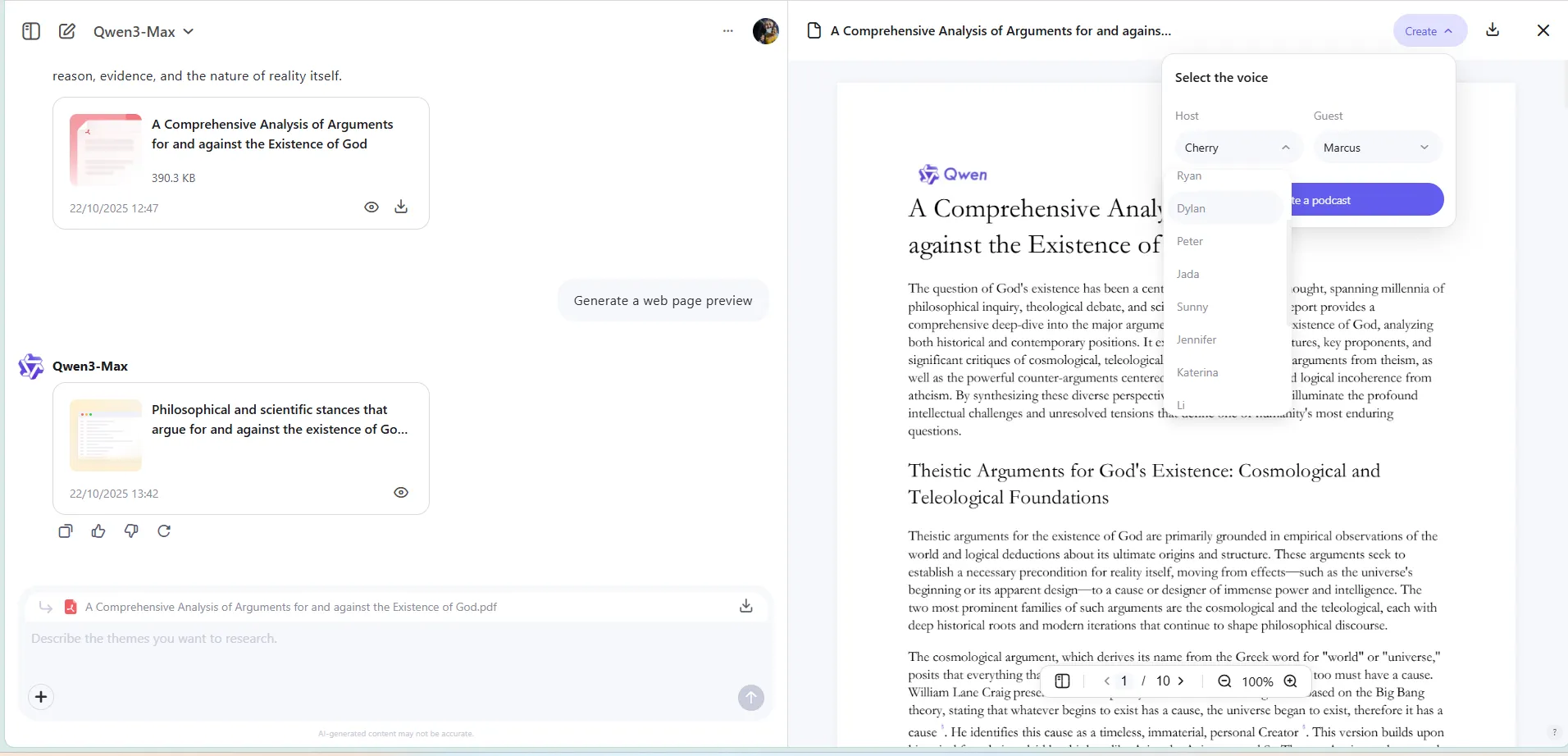
The workflow starts inside Qwen Chat, where users pose research questions. The AI conducts web searches after some clarifications, analyzes data from public sources, and generates a comprehensive report with citations.

From there, two new options appear: “Web Dev” produces a live, professional-grade webpage automatically deployed and hosted by Qwen, complete with inline graphics.

“Podcast,” meanwhile, offers an audio discussion featuring dynamic multi-speaker narration, with 17 host voices and seven co-host options.

Testing the models

To assess how Qwen stacked up as a research tool, we ran the same complex research query across it, Gemini, ChatGPT, and Grok. The task, which can be reviewed on our GitHub repo, was to analyze philosophical and scientific arguments for and against God’s existence. Each model generated a full research report. The evaluation involved five criteria: accuracy of claims and citations, information provided, clarity of explanation, intellectual richness, and overall quality.

TL;DR: Qwen Deep Research wins for analytical depth, citation, and its unique auto-generated webpages, making it ideal for academics and creators. It’s also the best all-in-one free alternative for researchers. But Gemini still leads in audio and video quality, while ChatGPT and Grok remain fine for casual use but lack Qwen’s reach and Google’s polish.

Here’s a more in-depth review:

Accuracy: Were philosophical positions and scientific claims represented correctly, with proper source attribution?

Qwen nailed the details. When discussing the cosmological argument, it properly cited academic sources like Bertrand Russell’s “Why I am not a Christian” and the debate between William Lane Craig and Peter Atkins, with specific references. Unlike other AI researchers like Perplexity’s or Grok, the majority of sources are reputable and academic, sometimes even the Original Source. It included links from Stanford, Princeton, Oxford, Drew, but added pertinent analysis from Quora and Facebook when relevant.


Gemini matched this precision with 94 numbered citations, some of which were duplicated when referenced in different parts of the report.

It correctly distinguished between concepts. Both avoided sloppy errors, such as conflating biblical literalism with general theism.

ChatGPT relied heavily on the Stanford Encyclopedia of Philosophy, but sometimes oversimplified. Grok gave accurate summaries but with vaguer attribution—saying things like “traced to Plato, Aristotle” without specific works.

Result: Qwen and Gemini were the best.

Information Provided: How thorough was the research?

Qwen was the only model to include a section called “Critiques of Atheism: The Burden of Proof and the Nature of Evidence.” This section examined a type of debate none of the others touched. It distinguished between “weak atheism” (skepticism toward God claims) and “gnostic atheism” (positive assertion God doesn’t exist), and cited specific atheist thinkers like Gary Whittenberger’s “beyond a reasonable doubt” standard.

Here’s an example passage from Qwen: “One of the most contentious issues is the burden of proof. Bertrand Russell famously illustrated this with his teapot analogy: just as he could not prove that a tiny teapot does not orbit the sun between Earth and Mars, he argued that theists could not prove that God does exist.”

No other model went this deep into burden-of-proof debates because it probably was not central to the topic. Gemini came close with strong coverage of consciousness arguments and the “God-of-the-gaps” critique. ChatGPT included pragmatic arguments like Pascal’s Wager and explored real-world implications for ethics and policy. Grok kept it concise—about one-third the length of Qwen’s report—but added a helpful summary table.

Result: Qwen was the most exhaustive.

Clarity: How was the research expressed?

Grok used a clean table to organize arguments by type (Philosophical vs. Scientific, For vs. Against). Its section breaks were explicit: “Philosophical Arguments,” “Scientific Arguments,” “Unexpected Detail.” Anyone could scan it quickly.

ChatGPT used tons of parenthetical clarifications, making complex ideas more digestible. Example: “if God’s existence is even possible (i.e., logically coherent), then God exists necessarily.” The “(i.e., logically coherent)” helps readers who aren’t philosophy majors.

Qwen and Gemini, on the other hand, were more academic in their style. Qwen organized the content under formal headings like “Theistic Arguments for God’s Existence: Cosmological and Teleological Foundations,” which made the whole reading feel very dense, despite its accuracy. Gemini used Roman numerals (I. Introduction, II. Philosophical Arguments), which looked structured but required closer reading.

Both Qwen and Gemini target researchers doing serious work. ChatGPT and Grok target broader audiences.

Result: ChatGPT presented information the most clearly, followed by Grok.

Diversity of sources: Does the research draw from varied traditions, disciplines, and perspectives?

Qwen integrated technical philosophy (kalām, PSR, modal S5 logic) with live scientific debates (Big Bang singularities, quantum fluctuations, DNA functionality). It explained things, making sure to be specific and give background examples on positions and arguments.

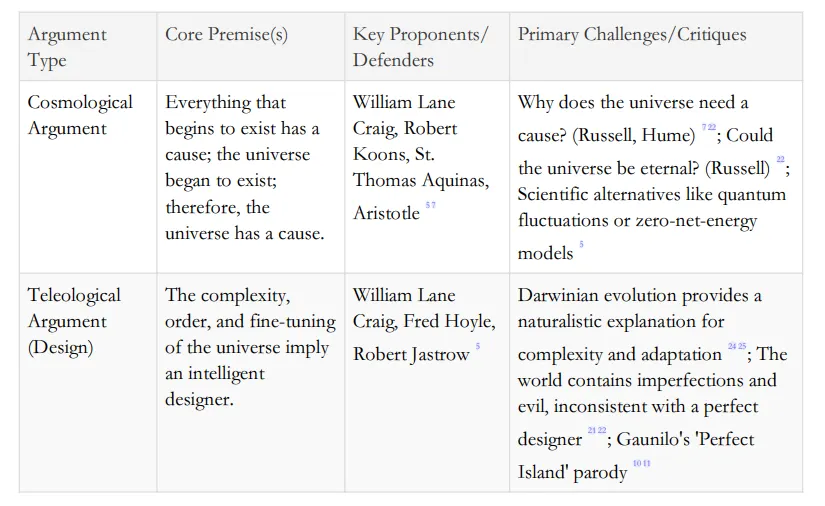
For instance, when explaining theistic arguments for God’s existence, Qwen built a table to make it easier to understand the premises, critiques, and proponents of the most relevant arguments.

Gemini matched this by covering consciousness arguments that most models ignored. It also warned against “God-of-the-gaps” reasoning more explicitly than competitors.

ChatGPT brought unique value with its massive “Implications” section, exploring how the debate shapes science education policy, bioethics laws, and personal attitudes toward death. This was less academic and more pragmatic, but still relevant to comprehend the nature of the investigation.

Grok covered the major arguments but with less detail. It mentioned fine-tuning and the anthropic principle, but didn’t cite specific values or discuss things too deeply.

Result: Qwen and Gemini were the best.

Quality: Taking all together—rigor, coherence, scholarly value—which research would you want to cite?

Both Qwen and Gemini produced reports you could submit to your professor. Qwen’s unique strength was balancing depth on both theistic lines and atheistic critiques, including that burden-of-proof section. Gemini’s strength was integrating scientific frontiers (consciousness, evolution, cosmology) with philosophical arguments.

ChatGPT delivered substantial pedagogical value—great for teaching or understanding implications. Grok worked as a reliable primer or quick reference.

In other words, ChatGPT and Grok are probably the ones you would use if you just want to know something quickly for a conversation, to impress your nerd date, or refresh your knowledge before a presentation on something you already know

Final Scores:

Qwen: 9/10
Gemini: 9/10
ChatGPT: 8/10
Grok: 6/10

The podcast battle: Qwen vs Gemini

Qwen’s podcast feature puts it head-to-head with Google’s NotebookLM and Gemini, which pioneered AI-generated Audio Overviews.

Unlike Gemini, Qwen offers a large variety of host voices to choose from. The structure is solid: two AI hosts have an actual conversation about your research, not just a text-to-speech read-through.

That said, the voice quality is inconsistent. Some voices are natural, but most of them sound robotic with weird accents. During testing, one of the male hosts kept saying “oh oh oh” repeatedly, because he was impressed. My wife passed by and asked if I was watching porn.

With some trial and error, you can find a decent voice that works smoothly, and the quality increases considerably.

But Gemini and NotebookLM crush Qwen here. Google’s Audio Overviews feature—introduced in NotebookLM in September 2024, expanded to Gemini in March 2025—sounds remarkably human. The speech patterns are natural, with back-and-forth banter and even humor.

Gemini’s podcasts feel human and more engaging.

Gemini also offers video generation, which is a significant advantage for those who prefer an audiovisual approach to understanding a topic rather than reading long chunks of text.

Qwen cannot do this—in fact, no other model can.

If you want full multimedia, including audio, video, and web, Gemini is the most complete package.

The webpage advantage

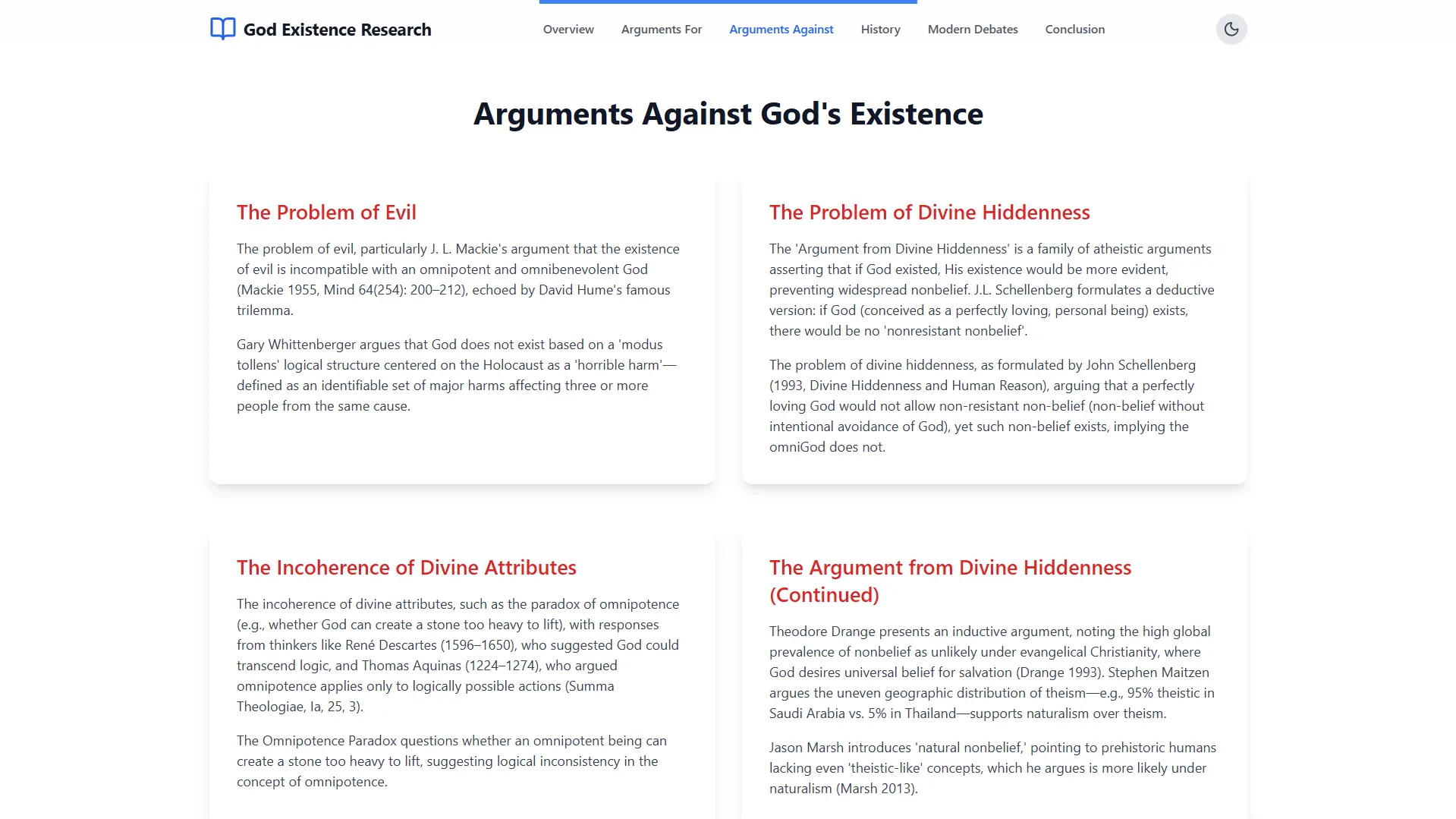
Beyond research quality, Qwen’s killer feature is the auto-generated webpage. No other model does this.

After your research finishes, you can turn it into a live, hosted website. Not a PDF or a Google Doc—a real webpage with headers, formatted tables, embedded citations as hyperlinks.

The UI looks like Kimi; it features clean typography, responsive design and is instantly shareable.

ChatGPT users have to copy and paste into website builders.

Gemini keeps everything in Docs. Grok spits out text. Only Qwen automatically generates web-ready output.

That workflow advantage is nice to have.

Generally Intelligent Newsletter

A weekly AI journey narrated by Gen, a generative AI model.


Source link

FLAMGP Launches AI Computing Engine to Deliver Stable Outcomes Amid Crypto Market Volatility | Web3Wire

0
FLAMGP Launches AI Computing Engine to Deliver Stable Outcomes Amid Crypto Market Volatility | Web3Wire


New York City, NY, Oct. 26, 2025 (GLOBE NEWSWIRE) — FLAMGP, a global leader in digital computing and algorithmic resource management, today announced the official launch of its AI Computing Engine, a next-generation solution designed to provide stable, sustainable returns for cryptocurrency participants even during volatile market conditions.Over the past year, cryptocurrency markets have experienced sharp fluctuations in network difficulty, energy prices, and asset valuations, all of which have made consistent profitability a challenge for both retail and institutional participants. FLAMGP’s AI Computing Engine directly addresses these issues through autonomous performance optimization, predictive analytics, and intelligent energy scheduling.“Volatility doesn’t have to mean unpredictability,” said a spokesperson for FLAMGP. “Our AI-driven infrastructure continuously learns from real-time market and energy data, allowing users to maintain steady returns without needing to manually adjust their operations.”

AI-Driven Efficiency and Intelligent AllocationFLAMGP’s computing engine utilizes machine learning algorithms to forecast key variables such as network hash rate, block rewards, and power consumption patterns. Based on these forecasts, the system automatically adjusts computing power across different digital assets, including Bitcoin (BTC), Ethereum (ETH), and Dogecoin (DOGE)  to achieve optimal profitability and minimize downtime.Key technical features include:Predictive Resource Allocation: Dynamically shifts computing resources based on real-time profit simulations.Energy Optimization Module: Reduces unnecessary power usage and improves sustainability.24-Hour Real-Time Settlement: Automatically tracks and settles profits daily.Transparent Output Dashboard: Allows users to monitor performance, energy efficiency, and earnings at any time.

Accessible and User-Friendly PlatformTo make advanced AI computing accessible to all users, FLAMGP offers a $15 trial bonus upon registration. The platform is fully automated, no prior technical expertise is required, and users can participate using major cryptocurrencies such as BTC, ETH, BNB, XRP, USDT, and USDC.

Participants can also take part in:Dynamic APY reward programsTrading competitions with leaderboard prizesCommunity-driven partner events and integration opportunitiesSustainability and Global Expansion

In addition to its technical innovation, FLAMGP is developing partnerships with global energy providers and data centers to improve computing efficiency per kilowatt hour. By integrating green energy initiatives and optimized workload distribution, the company aims to contribute to a more environmentally responsible digital economy.“AI computing is not only about maximizing returns, it’s about minimizing waste,” the spokesperson added. “We’re working toward a future where intelligent algorithms make blockchain operations both profitable and sustainable.”

Future OutlookFLAMGP plans to continue expanding its ecosystem through:

Cross-chain computing solutions for multi-asset managementEnhanced user analytics dashboardsAPI integrations for institutional clients

Educational programs promoting responsible digital asset participationThe company expects its AI computing infrastructure to play a major role in stabilizing the digital asset ecosystem as institutional adoption grows and energy efficiency becomes a central concern in the global computing market.

About FLAMGPFLAMGP is a technology company specializing in AI-based computing optimization and digital asset infrastructure. Through its proprietary algorithms and sustainable energy management models, FLAMGP enables users to achieve consistent performance and transparency across blockchain networks. Its mission is to combine artificial intelligence, automation, and green energy solutions to redefine the future of digital computing.

For more information, visit: https://flamgp.com/Business Inquiries: info@fleetmining.com

Address: 1225 17th St, Denver, CO 80202, United States

FLAMGP Launches AI Computing Engine to Deliver Stable Outcomes Amid Crypto Market Volatility | Web3Wire

About Web3Wire Web3Wire – Information, news, press releases, events and research articles about Web3, Metaverse, Blockchain, Artificial Intelligence, Cryptocurrencies, Decentralized Finance, NFTs and Gaming. Visit Web3Wire for Web3 News and Events, Block3Wire for the latest Blockchain news and Meta3Wire to stay updated with Metaverse News.


Source link

OVIOS Unveils the 114-Inch Cloud Sectional Sofa: A Blend of Luxury, Comfort, and Everyday Versatility | Web3Wire

0
OVIOS Unveils the 114-Inch Cloud Sectional Sofa: A Blend of Luxury, Comfort, and Everyday Versatility | Web3Wire


LOS ANGELES, Oct. 25, 2025 (GLOBE NEWSWIRE) — In an era when homes have become the center of both work and leisure, furniture must do more than fill a room—it must adapt, inspire, and elevate daily life. OVIOS, the global furniture brand known for blending fashion, elegance, and affordable luxury, introduces its newest innovation: the 114-inch Cloud Sectional Sofa. Designed with premium materials, versatile configurations, and indulgent comfort, the Cloud Sectional redefines what it means to live—and lounge—in style.

A Sophisticated Look with Practical AppealAt the heart of the Cloud’s appeal is its faux leather upholstery, carefully chosen to bring a sense of elevated sophistication to any home. The smooth, supple texture mimics the timeless allure of genuine leather, while offering the durability and easy-care practicality modern families demand. Spill a drink during game night or host kids’ movie marathons—cleanup remains effortless, and the sofa retains its polished look. This thoughtful material choice ensures that homeowners can enjoy a high-end aesthetic without the maintenance worries that often accompany natural leather.

OVIOS

The Cloud’s sleek lines and oversized silhouette make an architectural statement in the living room. With its low, structured profile and broad armrests, the design balances modern minimalism with inviting warmth. It is not just a place to sit, but a centerpiece that anchors the space with quiet confidence.

Comfort Engineered for Real LivingStep into the Cloud, and its name suddenly makes sense. Beneath the elegant exterior lies a meticulously designed comfort system. The seating is crafted with high-resilience sponge and individual pocket springs, creating the perfect harmony between plush softness and reliable support. Unlike sofas that sag over time, the Cloud maintains its structure, ensuring every moment—whether upright conversations or lazy weekend lounging—feels consistently indulgent.

Wide, deep seats (with a chaise measuring an impressive 56 inches in length) invite you to stretch out fully. For some, it’s the ideal place to catch up on reading or take a restorative afternoon nap. For others, it becomes a makeshift guest bed, offering visiting friends a sleep experience that rivals a real mattress. With the Cloud, comfort adapts to every lifestyle scenario.

Versatility that Fits Every HomeHomes today demand flexibility, and the Cloud delivers. Its L-shaped sectional design can be arranged as left- or right-facing, making it adaptable to different room layouts and design preferences. Whether you’re designing an open-concept living area or fitting into a cozy apartment, the Cloud can be configured to suit the space perfectly.

The sofa also transitions seamlessly between uses. By day, it’s a spacious hub for family activities. By evening, it doubles as a lounge-ready bed for binge-watching or sleeping overnight guests. Its multi-functional nature makes it more than furniture—it becomes a lifestyle solution for modern living.

A Statement in Size and FunctionGenerous in every dimension, the Cloud measures 114 inches wide, providing ample seating for family gatherings, social events, or quiet evenings in. Its expansive design means no one is left without space; children can sprawl with toys, friends can gather for game day, and couples can share quiet time without feeling crowded.

Yet, the size does not come at the expense of practicality. Wide armrests aren’t just design features—they serve as functional surfaces for balancing laptops, morning coffee, or a tray of snacks. Every detail reflects OVIOS’s belief that furniture should serve both form and function with equal dedication.

Effortless Convenience: No Assembly RequiredIn a market where most furniture demands hours of assembly, the Cloud Sectional distinguishes itself with an assembly-free design. Shipped in multiple boxes for easier handling, it arrives ready to use. Consumers can skip the frustration of tools and instructions, enjoying the sofa within minutes of delivery. It’s convenience without compromise—another hallmark of the OVIOS brand.

Designed for the Way We Live TodayAs homes evolve into multi-purpose environments, the furniture within them must rise to meet the challenge. The Cloud Sectional reflects this evolution. With its faux leather sophistication, comfort-engineered filling, versatile configuration, expansive size, and effortless setup, it is built to adapt seamlessly to the rhythms of modern life.

“With the Cloud Sectional, we wanted to design more than just a sofa—we wanted to design an experience,” said a spokesperson for OVIOS. “Our mission has always been to make affordable luxury accessible. This piece embodies that philosophy by combining high-end aesthetics, practical convenience, and comfort engineered for real families.”

The Cloud is not simply a piece of furniture—it is a testament to how design and function can come together to enhance daily living. For homeowners seeking both a centerpiece and a sanctuary, the Cloud Sectional offers a lifestyle as expansive and inviting as its design.

About OVIOSOVIOS is a global furniture brand committed to creating products that merge fashion, elegance, and affordable luxury. With a dedication to quality craftsmanship, practical design, and sustainability, OVIOS delivers furniture that transforms houses into homes. From modern sectionals to ergonomic office chairs, OVIOS designs each piece to offer beauty, comfort, and functionality—making premium living accessible to more families worldwide.

Website:https://www.ovios-home.com/Facebook:https://www.facebook.com/OviosOfficialInstagram:https://www.instagram.com/oviosfurnitureYouTube:https://www.youtube.com/@oviosfurniture

Contact: Roey Pan, RoeyPan@cnovios.com 

About Web3Wire Web3Wire – Information, news, press releases, events and research articles about Web3, Metaverse, Blockchain, Artificial Intelligence, Cryptocurrencies, Decentralized Finance, NFTs and Gaming. Visit Web3Wire for Web3 News and Events, Block3Wire for the latest Blockchain news and Meta3Wire to stay updated with Metaverse News.


Source link

AI Biodefense Startup Valthos Launches With $30 Million, OpenAI Backing – Decrypt

0
AI Biodefense Startup Valthos Launches With  Million, OpenAI Backing – Decrypt


In brief

Valthos launched with $30 million from the OpenAI Startup Fund, Lux Capital, and Founders Fund.
Its AI tools aim to detect and neutralize biological threats faster than traditional biodefense systems.
The launch follows RAND’s warning that governments are unprepared for fast-moving AI-driven crises.

Biodefense startup Valthos emerged from stealth on Friday with $30 million in funding backed by ChatGPT creator OpenAI to develop and use artificial intelligence to detect and counter biological threats in real time.

The company develops AI systems that update medical countermeasures to match the speed of the biological threats, allowing researchers and government agencies to identify and respond to pathogens as fast as they emerge.

“Of all AI applications, biotechnology has the highest upside and most catastrophic downside,” the company wrote on X.

Founded in New York last November, Valthos is led by Kathleen McMahon, formerly Head of Life Science at Palantir Technologies; Tess van Stekelenburg, a former researcher of computational neuroscience at the University of Oxford; and Victor Mao, a founding AI engineer who previously worked as a research engineer at Google DeepMind.


“In this new world, the only way forward is to be faster. So we set out to build the tech stack for biodefense,” they wrote. “Our team of computational biologists and software engineers applies frontier AI to identify biological threats and update medical countermeasures in real-time.”

Joining the OpenAI Startup Fund in the $30 million investment are Lux Capital and Founders Fund. The company said it is hiring engineers and researchers to expand its platform for government and life sciences partners.

“Technology is moving fast. One of the best ways to keep up is with more technology, more research, more startups and more entrepreneurship,” Jason Kwon, OpenAI’s chief strategy officer, said on X. “An industrial ecosystem of builders, companies and solutions further democratizes AI to provide broad resilience, and ensures the U.S. continues to lead as AI increasingly powers everything around us. As AI and biotech rapidly advance, biodefense is one of those verticals.”

Understanding biodefense

Biodefense refers to technologies and systems built to protect populations from biological threats—ranging from naturally occurring diseases to lab accidents or deliberately engineered pathogens. Traditional defense measures rely on vaccines, detection networks, and drug stockpiles, but those are often too slow for a world where synthetic biology can rapidly create new or modified organisms.

Valthos said its platform will use AI to analyze biological sequences and adapt existing medicines or treatments in response—technology the company claims could shrink the time between identifying a new threat and developing a response from months to hours.

Researchers are increasingly using AI to forecast disease risk before symptoms appear. A model called Delphi-2M, trained on UK Biobank data, can predict more than 1,000 conditions up to 20 years in advance, showing how AI could shift medicine from reaction to prevention, and in biodefense, help detect emerging outbreaks before they spread.

The Valthos announcement follows a RAND Corporation report this week warning that governments are unprepared to handle AI-driven cyber crises.

“Today, it’s faster to weaponize biology than to advance new cures,” Valthos said in a statement. “Our future hangs in the balance.”

Neither OpenAI nor Valthos responded to requests for comment by Decrypt.

Generally Intelligent Newsletter

A weekly AI journey narrated by Gen, a generative AI model.


Source link

The 5 unbelievable crypto comeback stories that changed the world forever

0
The 5 unbelievable crypto comeback stories that changed the world forever


Crypto is nothing if not cyclical. Every cycle births icons, wrecks them, and sometimes resurrects them.

What was once written off as dead can roar back to life with a vengeance, reshaped by regulation, technology, or sheer market gravity.

From courtrooms to codebases, from bankrupt exchanges to blockchains that refused to quit, the industry’s best comeback stories reveal something deeper than price action, they show crypto’s strange, relentless capacity to rebuild itself.

These are the five most extraordinary revivals in crypto history, plus a few spectacular failures that never made it back.

No. 5: XRP

The fall. After 2017’s mania, XRP became a regulatory pariah. Major U.S. exchanges delisted it as the SEC’s lawsuit dragged through years of uncertainty, crushing liquidity and sentiment.

The turn. Judge Analisa Torres’ July 2023 ruling that programmatic XRP sales weren’t securities reopened the U.S. market. Coinbase, Kraken, and others relisted the token, while 2025 brought closure, final civil penalties and no meaningful appeal path left. The legal fog that defined XRP’s lost years finally lifted.

Where it stands today. XRP trades around $2.40 and ranks #5 by market cap, rejoining the upper echelon of crypto assets after half a decade in exile. The comeback isn’t just about price; it’s about legitimacy regained.

Forward outlook.

Base case (6–12 mo): XRP holds its top-five slot if on-chain liquidity deepens and XRPL’s AMM/DEX rails see real cross-border volume. Range: $1.60–$3.40, tracking ETF-driven crypto beta.Bull case: U.S. payment-policy clarity and an XRP ETP or ETN listing push it to $3.50–$5.00, with capital rotating from memecoins to utility assets.Bear case: If stablecoins dominate payment rails, XRP could lag majors, retracing to the $1.40–$1.80 zone.

What to watch: XRPL volumes vs. stablecoin settlement growth, upcoming ETP approvals in the U.S. or EU, and on-exchange depth and basis spreads versus ETH and SOL.

A courtroom comeback matured into a market-cap comeback. XRP is a top-five coin again, this time anchored less by hype than by the vacuum left as regulators inch toward rules for tokenized payments.

No. 4: Binance Exchange

The fall. In November 2023, Binance’s years-long regulatory standoff climaxed in a $4.3 billion settlement with the DOJ, FinCEN, OFAC, and CFTC. Founder Changpeng Zhao pled guilty to a single BSA violation and resigned, closing one of the most consequential enforcement cases in crypto history.

The turn. Two optics shifts defined 2025. First, Binance proved structurally resilient, after ceding BTC-futures volume leadership to CME in 2024, it regained market share across spot and derivatives through mid-2025. Second, Trump’s October 2025 pardon of CZ softened the exchange’s U.S. stigma, hinting at eventual regulatory thawing even as licensing remains complex.

Where it stands today. BNB broke through $1,000 on September 18, 2025, setting a new all-time high and delivering a clean, visual narrative of redemption, from legal nadir to renewed dominance.

Forward outlook.

Base case (6–12 mo): BNB trades between $800–$1,200 amid crypto beta and continued quarterly burns as compliance monitors approach sunset.Bull case: Progress toward U.S. licensing and real-world asset or consumer integrations on BNB Chain could lift BNB to $1,250–$1,600.Bear case: A relapse into enforcement pressure or further futures-share erosion to CME or Bybit could send BNB back to $650–$850.

What to watch: Kaiko market-share data, monitor wind-down timelines, court filings on U.S. operations, and quarterly BNB burns.

Regulatory winter melted into political spring, the coin of crypto’s most embattled exchange just printed four digits.

No. 3: Solana

The fall. In 2021–22, Solana went from darling to damaged. Outages, congestion, and the FTX collapse left its reputation in tatters. “Ethereum killer” became a punchline as downtime and venture overexposure crushed sentiment.

The turn. Fast forward to 2024–25: uptime has gone spotless, and usage has gone parabolic. The network has logged 100% reliability over the past 60 days, with multi-month streaks signaling true technical maturity. Memecoins turned Solana into the epicenter of retail speculation, while tokenized assets (Backed’s equities, Ondo’s USDY) signaled a new institutional chapter. The same chain that once crashed under load now clears billions in daily volume without breaking stride.

Where it stands today. Solana’s DEX volume has regularly matched or topped Ethereum’s throughout 2025, with memecoin bursts acting as its native volatility engine. SOL trades near multi-year highs, backed by liquidity depth and a visibly sticky developer base.

Forward outlook.

Base case (6–12 mo): A “barbell” dynamic, memes on one side, RWAs on the other, keeps throughput and fees humming. Range: $150–$280 with beta.Bull case: Firedancer adoption plus institutional RWA inflows from Backed, Superstate, or Maple push $300–$420.Bear case: A serious outage or liquidity migration back to ETH L2s drags SOL to $120–$180.

What to watch: status.solana.com uptime metrics, Firedancer mainnet progress, RWA TVL and issuance, DEX share versus ETH/Base, and total stablecoin float on Solana.

First came the memes; now come the treasuries. Solana’s comeback is morphing from speculative to structural.

No. 2: Ethereum

The fall. The 2016 DAO hack fractured Ethereum into ETH and ETC, a philosophical schism that could have killed the project.

The turn. The Merge in September 2022 cemented Ethereum’s shift to proof-of-stake. Dencun and EIP-4844 brought cheap data availability for rollups, unlocking explosive L2 growth. Then came the 2024–25 wave of U.S. spot ETH ETF approvals, pulling the asset into the same regulated orbit as Bitcoin. By 2025, Layer 2 adoption had become the backbone of daily Ethereum usage.

Where it stands today. ETH reclaimed the $4,000 level in 2025, with L2s processing roughly 80–90% of ecosystem transactions. Ethereum now operates more as a global settlement and data layer than a single execution environment.

Forward outlook.

Base case (6–12 mo): ETH anchors the settlement layer while L2s scale consumer and DeFi activity. Range: $3,200–$5,000.Bull case: Robust ETF inflows and breakout growth on Base, Optimism, and other rollups lift ETH toward $5,200–$6,500.Bear case: Rollup fragmentation or Solana share gains pull ETH back to $2,600–$3,600.

What to watch: ETH ETF flow dashboards (Farside, CoinShares), L2Beat throughput and TVL, blob fees post-4844, and net staking flows.

From a chain that once rewrote history to survive, Ethereum now writes it, inside brokerage accounts and atop a sprawling L2 economy.

No. 1: Bitcoin

The fall. 2018’s “crypto winter” and the 2020 COVID crash minted literal obituary headlines. Bitcoin was written off as a speculative relic, the bubble that burst twice. Retail volumes vanished, miners capitulated, and mainstream finance moved on. By late 2020, “Bitcoin is dead” had been declared more than 400 times. Yet beneath the despair, hash rate resilience and global developer persistence quietly kept the chain alive.

The turn. After the 2020 halving a speculation filled COVID bubble late in the year and into 2021 saw Bitcoin smash previous all-time highs and reach $69,000. However, the subsequent bear market, made worse by systemic crash fueled by the fall of FTX saw Bitcoin fall below $15,000 once more and obituaries returned.

Down but not out, the U.S. spot Bitcoin ETF approvals in January 2024 rewrote the narrative from fringe speculation to formal asset class. What began as a decade-long lobbying effort by Grayscale, BlackRock, and Fidelity culminated in the single biggest bridge ever built between crypto and traditional finance.

Within weeks, billions flowed into the new ETFs; by mid-2025, BTC had joined the likes of gold and the S&P 500 in brokerage model portfolios. The macro environment, rate cuts, de-dollarization chatter, and renewed safe-haven demand, did the rest.

BTC pierced $100,000 in December 2024 and notched a fresh all-time high near $126,000 in October 2025 as ETF inflows re-accelerated. CME’s open-interest share in Bitcoin futures topped 55%, marking Wall Street’s full arrival.

On-chain, long-term holder supply hit record highs even as ETF issuers led by BlackRock accumulated spot reserves.

Where it stands today. Bitcoin now trades less like a frontier asset and more like macro collateral. It sits in pension fund allocations, Treasury portfolios, and ETF baskets, governed by audited custodians and daily flow data.

The 2024 halving reinforced supply discipline, while ETF creations institutionalized demand. Even skeptics now reference Bitcoin’s implied yield, futures basis, and ETF premium as if it were a fixed-income instrument.

Forward outlook.

Base case (6–12 mo): ETF net buying remains positive with minor drawdowns on pullbacks, miner supply steady post-halving; $95k–$140k range.Bull case: Another wave of pension and sovereign allocations combined with lower real yields lifts BTC toward $150k–$200k.Bear case: A pro-cyclical dollar rebound or sustained ETF outflows could drag BTC back to $80k–$105k.

What to watch: Daily ETF flow dashboards, CME vs. offshore perpetuals basis spreads, aggregate stablecoin market cap as a proxy for global liquidity, and realized volatility versus Nasdaq beta.

Bitcoin’s return marked the moment the world’s first decentralized alternative to fiat became impossible to contain.

Once dismissed as a fringe experiment, it has now infiltrated Wall Street as a Trojan horse for monetary sovereignty: regulated, measurable, and yet utterly beyond control.

With over $2 trillion in value and adoption stretching from retail wallets to pension funds, Bitcoin remains as the only true ‘freedom money.’

Top crypto comebacks ranked

RankComebackTypeDefining Moment1BitcoinInstitutionalizationU.S. spot ETF approvals turned Bitcoin into a mainstream asset class.2EthereumTechnical evolutionThe Merge and rollup explosion reshaped Ethereum into a global settlement layer.3SolanaNetwork resilienceFrom outages to dominance: Solana’s uptime, liquidity, and retail revival defined 2025.4BinanceRegulatory redemptionPost-settlement recovery and CZ’s pardon restored the exchange’s global strength.5XRPLegal vindicationSEC lawsuit resolution reopened U.S. markets and restored XRP’s legitimacy.

Some of crypto’s biggest failures

STEPN, move-to-earn boom and bust.

While seemingly ‘innocent’ compared to the rest of the failures on this list, STEPN’s fall from grace was meteoric.

At one point it seemed that move-to-earn was going to reshape the entire crypto ecosystem with an amazing new use case for NFTs.

Users and revenue surged in early 2022 as STEPN’s move-to-earn model went viral, with daily active users topping 700,000 and SOL network fees spiking from in-app minting and trades.

At its peak, Genesis sneakers sold for thousands of dollars and the project’s GMT token rallied nearly 30x from launch.

But within months, D30 retention cratered as anti-bot updates, GST inflation, and regional bans hit engagement.

By late 2022, DAU and revenue had collapsed more than 90% from their highs, sneaker minting froze, and marketplace activity dwindled.

OneCoin, the ultimate crypto fraud.

Marketed from 2014 to 2017 as a revolutionary digital currency, OneCoin raised over $4 billion from investors worldwide despite lacking any blockchain.

Founder Ruja Ignatova, later dubbed the “Cryptoqueen,” vanished in 2017 after global authorities began investigating the scheme.

Co-founder Karl Sebastian Greenwood was sentenced to 20 years in prison, and Ignatova remains on the FBI’s Most Wanted list.

OneCoin’s collapse became a cautionary tale of unchecked hype, opaque operations, and the dangers of centralized “crypto” without cryptography.

Mt. Gox, resurrection from ruin.

Once handling over 70% of Bitcoin trades, Mt. Gox’s 2014 collapse became crypto’s first major catastrophe, losing 850,000 BTC and destroying public trust.

After years of bankruptcy proceedings and creditor battles, 2024 finally saw repayments begin in Bitcoin and fiat.

The case’s slow resolution marked a milestone in crypto’s legal maturation, with recovered assets exceeding expectations and signaling that even the industry’s darkest chapter could find partial redemption.

Three Arrows Capital failure to relaunch.

The hedge fund’s 2022 implosion wiped out billions in counterparty exposure, triggering cascading liquidations across Celsius, Voyager, and Genesis.

Founders Kyle Davies and Su Zhu resurfaced with OPNX in 2023, an exchange centered on claims trading, but it launched under regulatory headwinds and low volumes.

Dubai VARA fined the team in May 2023, Singapore’s MAS issued prohibition orders that September, and activity remained thin through 2024 and into 2025 versus peers.

Attempts to add derivatives and new listings failed to regain share, with enforcement actions and a punctured trust loop defining the platform’s shallow depth.

Terra / UST / LUNA, structural collapse.

UST lost its dollar peg in May 2022, triggering a rapid unwinding as Anchor withdrawals surged and LUNA’s supply hyperinflated.

The ecosystem’s value evaporated within weeks, and Terra 2.0 with LUNC attempted to reboot without an algorithmic stablecoin.

The revival failed to regain traction, with most Terra projects either shutting down or migrating to Cosmos and other chains.

FTX creating systemic collapse.

Once the epicenter of crypto’s most devastating fraud, FTX’s 2022 implosion vaporized tens of billions in customer assets and shattered institutional confidence.

Yet by 2024, bankruptcy administrators had liquidated vast holdings, recouping nearly all verified creditor claims, an outcome few deemed possible.

While the exchange itself remains defunct, its asset recovery and the criminal accountability of key figures marked an unprecedented legal turnaround, showing crypto’s capacity for both catastrophic failure and structured restitution.

Top crypto failures ranked

RankFailureTypeIndustry Impact1FTXExchange collapse, fraudSystemic / global2Terra / UST / LUNAStablecoin death spiralEcosystem contagion3Three Arrows CapitalFund leverage crisisCounterparty defaults4Mt. GoxExchange hackEarly precedent5OneCoinPonzi schemeRetail-focused6STEPNApp/economy burnoutNiche / limited

Honorable Mentions

WazirX, trust rebuild in India.

Banking rails broke in 2022, then INR deposits restarted in 2024 with a new partner and FIU registration. Spot volumes, INR-pair depth, and on-ramp uptime improved through 2024 with maker rebates on INR-USDT.

The path to a full comeback requires deeper INR books and durable bank connectivity over multiple quarters.

Backpack Exchange, execution versus trust.

The venue opened in late 2023, delivered a SOC 2 Type I in January 2024, launched BTC and ETH perpetuals under a Bermuda license in April, and shipped live proof-of-reserves in June. Spot and perp volumes climbed while spreads tightened, and the status page recorded no sev-1 incidents.

The upgrade trigger is sustained depth within a top-tier cohort, plus enacted licenses in larger jurisdictions.

MANTRA (OM), RWA compliance push.

Tokenized treasuries and real-estate issuance grew from early 2024 into early 2025 with custody attestations and regulator touchpoints, while secondary volumes formed on the project’s venues.

A true comeback would hinge on redemption depth across market stress and a broader licensing footprint.

BIO Protocol, biometric identity rails.

After a 2024 audit and a privacy impact filing, integrations with wallets, exchanges, and dapps increased, attestations climbed, and version 2 added revocation and recovery in February 2025. The remaining watch items are privacy governance and attester decentralization.

BIO added revocation and recovery to its attestations in February 2025 and ended the quarter with more than 1.8 million cumulative proofs issued.

When the dust settles, the market does not clap, it checks. Courts file their orders, clients sync, miners tighten costs, market makers quote the inside, and the tape prints.

The names that made it back are the ones that took the hit, changed the machinery, and kept clearing. The story ends where it always does here, with depth on the screen and blocks in the chain.

Mentioned in this article



Source link

Touchstone Digital Solutions Expands Philanthropic Recognition with Advanced Digital Donor Wall Technology | Web3Wire

0
Touchstone Digital Solutions Expands Philanthropic Recognition with Advanced Digital Donor Wall Technology | Web3Wire


Innovative Platform Transforms Traditional Donor Recognition into Dynamic, Interactive Experiences That Inspire Generosity and Showcase Organizational ImpactImage: https://www.abnewswire.com/upload/2025/10/07609fa6064d213ffd8219e4399b70bf.jpg

October 24, 2025 – Until now, Touchstone Digital Solutions has been among the leaders in digital recognition technology; today, it is announcing the expansion of its award-winning Digital Donor Wall [https://touchstone-ds.com/digital-donor-walls/] solutions to give mission-driven organizations throughout America the unique power to transform donor recognition from static into dynamic stories. These interactive displays of cutting-edge technology redefine an organization’s ability to recognize their contributors and attract waves of philanthropic support.

Overcoming Traditional Limitations

Traditional physical donor walls have been a recognition standard for charitable donors for many years. However, static engraving creates a bottleneck in articulating community dynamism or how the mission’s trajectory evolves.

Touchstone Digital Solutions is able to override those limitations with the innovative digital trophies that fuse technology with narrative to provide immersive recognition experiences.

A Dynamic Storytelling Platform

The Digital Donor Wall performs a much wider array of functions than just a list of names on the wall. Cloud-based systems for display give the benefits of high-def visuals, fluid animations, video content, photo galleries, and interactives to actually show the impact and give recognition to supporters.

Organizations can show donor names, donor levels, custom messages, and impact stories in attractively animated layouts that command attention and provoke an emotional response.

“Giving recognition to donors has changed drastically, and organizations need tools to support their philanthropic communities, which are highly evolved and dynamic,” said a spokesperson. “Our Digital Donor Wall is much more than an aesthetic update for donor recognition; it is an investment in donor engagement and retention over time. Through story-based recognition, nonprofit organizations can communicate impact that fuels donor generosity and charitable giving instead of recurring costs tied to traditional engraving.”

Streamlining Stewardship and Management

The platform addresses critical operational challenges faced by development teams. Through proprietary digital donor wall software featuring an intuitive, secure online dashboard, authorized personnel can update donor information, add new names, initiate campaigns, and modify content in real time without requiring technical expertise. The system scales seamlessly whether accommodating one hundred supporters or one hundred thousand.

Industry Adoption and Proven Impact

Universities, schools, and non-profit organizations have adopted Touchstone Digital Solutions’ technology to set up industry-specific recognition experiences.

In higher education, many donor walls are installed in the alumni centers for the celebration of benefactors. Hospitals and healthcare agencies install these systems in main lobbies, establishing a recognition for donations. Schools use the technology to recognize community partners, thus instilling the culture of philanthropy among students.

“Organizations implementing digital donor recognition solutions report significant improvements in donor engagement metrics and substantial return on investment,” noted a third-party philanthropy industry analyst. “The transition from static recognition to interactive storytelling represents best practice in modern fundraising stewardship. Digital platforms enable institutions to maintain current recognition displays without incurring costs that can exceed fifteen hundred dollars per engraving update, while simultaneously creating compelling visual narratives that inspire increased giving.”

A Collaborative, Full-Service Approach

Touchstone Digital Solutions distinguishes itself among digital donor wall companies through full, turnkey implementation. The collaborative process includes discovery sessions, interfaces with the design-executive spirit of the organization, technical development with sound software integration, hardware deployment, extensive training for staff, and support throughout the life cycle of the platform.

Beyond Aesthetics: A Strategic Fundraising Tool

There are practical advantages beyond aesthetic stimulus that are imparted by the investment in digital donor wall technology. The body benefits from eliminating recurring expenses of engraving, fostering strong fundraising tools for upcoming campaigns, enhancing engagement and retention of donors, and creating flexible platforms that can work with multiple campaigns simultaneously.

In effect, this technology offers a dual service as a recognition platform and an active fundraising instrument through showcasing interactive communities and real-world impacts to prospective donors.

About Touchstone Digital Solutions

The company is a major digital donor wall setup provider in the US, with a focus on the design of one-off, intuitive recognition solutions for mission-driven organizations. It offers complete digital recognition platforms fusing advanced technology with inspired design to turn traditional donor recognition into storytelling experiences. Having specific industry knowledge in higher education, healthcare, education, and non-profit, Touchstone Digital Solutions [https://touchstone-ds.com/] offers turnkey implementation packages including concept development, custom design, software integration, hardware installation, staff training, and support.

Media ContactCompany Name: Touchstone Digital SolutionsContact Person: Gardner GendronEmail:Send Email [https://www.abnewswire.com/email_contact_us.php?pr=touchstone-digital-solutions-expands-philanthropic-recognition-with-advanced-digital-donor-wall-technology]Country: United StatesWebsite: https://touchstone-ds.com

Legal Disclaimer: Information contained on this page is provided by an independent third-party content provider. ABNewswire makes no warranties or responsibility or liability for the accuracy, content, images, videos, licenses, completeness, legality, or reliability of the information contained in this article. If you are affiliated with this article or have any complaints or copyright issues related to this article and would like it to be removed, please contact retract@swscontact.com

This release was published on openPR.

About Web3Wire Web3Wire – Information, news, press releases, events and research articles about Web3, Metaverse, Blockchain, Artificial Intelligence, Cryptocurrencies, Decentralized Finance, NFTs and Gaming. Visit Web3Wire for Web3 News and Events, Block3Wire for the latest Blockchain news and Meta3Wire to stay updated with Metaverse News.


Source link

Elon Musk’s SpaceX Moves $133 Million Worth of Bitcoin – Decrypt

0
Elon Musk’s SpaceX Moves 3 Million Worth of Bitcoin – Decrypt


In brief

SpaceX moved more than 1,200 BTC—or $133 million in funds—on Friday.
The transfers follow similarly sized moves from earlier this week.
Details on the firm’s plans are not yet known.

Elon Musk’s space exploration company, SpaceX, moved more than $133 million in Bitcoin on Friday, according to blockchain analytics firm Arkham Intelligence.  

The firm transferred 1,215 Bitcoin in total to separate addresses, just days after shifting around a similar amount to addresses it controls. 

“SpaceX just moved funds totalling $133.7 million,” the analytics firm posted. “They transferred 300 BTC ($33M) and 915 BTC ($100.7M) to new wallets.” 

Unlike SpaceX’s transfers earlier in the week, the new wallets are not currently labeled as belonging to the Hawthorne, California-based firm. 

Prior to the transfers, the firm held 8,285 BTC worth around $914 million, as Bitcoin recently traded above $110,000. That’s good enough for fourth on the list of privately held companies with Bitcoin treasuries, according to data from BitcoinTreasuries.net

In 2022, addressees labeled as belonging to the aerospace firm held as much as 25,000 BTC, but that number dropped to 8,285 BTC in June of that year. 


After those moves, SpaceX did not register any on-chain activity until earlier this year, when it consolidated some of its Bitcoin holdings in its first on-chain activity in more than three years

It’s not immediately clear why the firm transferred the funds or if it has any intentions to sell some of its Bitcoin holdings. A representative for SpaceX did not immediately respond to Decrypt’s request for comment.

Another of Musk’s companies, Tesla, also maintains a strong connection to Bitcoin. The car and robotics firm currently holds 11,509 BTC, worth more than $1.27 billion, placing it just outside the top 10 publicly traded companies with Bitcoin treasuries.

Earlier this year, Tesla re-valued its holdings based on new accounting rules, leading it to book more than $600 million in quarterly profits as BTC rose following the election of President Donald Trump.

Tesla has no further recorded on-chain activity since it moved around $765 million in BTC to new wallets in October 2024.

Bitcoin is down modestly on the day, falling 0.3% to $110,541—about 12% off its all-time high of $126,080. 

Daily Debrief Newsletter

Start every day with the top news stories right now, plus original features, a podcast, videos and more.


Source link

Trump Picks SEC Crypto Task Force’s Mike Selig to Run CFTC: Report – Decrypt

0
Trump Picks SEC Crypto Task Force’s Mike Selig to Run CFTC: Report – Decrypt


In brief

Trump has tapped SEC Crypto Task Force Chief Counsel Mike Selig to lead the CFTC, signaling closer coordination on pro-crypto regulation, per Bloomberg.
The pick is a victory for Tyler and Cameron Winklevoss, who pushed Trump to drop prior nominee Brian Quintenz after clashes over Gemini’s past CFTC case and other issues.
Selig would oversee policymaking on crypto and prediction markets at a critical time for the understaffed agency.

U.S. President Donald Trump has selected Securities and Exchange official Michael Selig as his latest nominee to lead the CFTC, according to a Friday Bloomberg report. 

Selig currently serves as chief counsel for the SEC’s crypto task force, and has been a key player behind the agency’s aggressively pro-crypto overhaul during the second Trump administration. 

His selection to head the CFTC is the clearest sign yet that the regulator will work in lockstep with the SEC to jointly build a pro-crypto regulatory framework. 

It also marks a key political victory for Tyler and Cameron Winklevoss, the Trump-aligned crypto billionaire twins, who successfully lobbied the president to drop his previous pick to lead the CFTC, Andreessen Horowitz Global Head of Crypto Policy Brian Quintenz. 


Custodia Bank and Vantage Bank Texas have unveiled a live platform for tokenized deposits, expanding their earlier pilot into a nationwide network for U.S. banks.

For months, the Winklevoss brothers doggedly pushed to derail Quintenz’s nomination, partly because of what they perceived as his lack of sufficient outrage about the CFTC’s 2022 lawsuit against their crypto exchange, Gemini. The messy feud, which eventually became public, ultimately led to the White House pulling Quintenz’s nomination. 

The Winklevosses also protested Quintenz’s nomination due to the former CFTC commissioner’s suggestion that the relatively tiny CFTC should increase its budget to better handle the massive new responsibilities involved in principally regulating the crypto market. The twins argued that increasing the agency’s capacities would lead to “regulatory capture.”

As head of the CFTC, Selig would also be responsible for spearheading the agency’s approach to regulating prediction markets—another novel sector that has mushroomed in popularity, and posed thorny legal questions, since emerging in the last year. 

Selig’s nomination comes at one of the most crucial junctures for the CFTC in its 50 year history, given the policies it lays out in the coming years will define the rules for two massive, emergent sectors currently redefining the lucrative worlds of finance and gambling

The agency is also greatly lacking in staffing. Usually comprised of a bipartisan group of five commissioners, the CFTC is currently operating under the leadership of a single Republican commissioner, Acting Chair Caroline Pham.

Daily Debrief Newsletter

Start every day with the top news stories right now, plus original features, a podcast, videos and more.


Source link

Popular Posts

My Favorites

‘Bitcoin Senator’ Cynthia Lummis Will Not Run for Reelection – Decrypt

0
In brief Sen. Cynthia Lummis (R-WY) announced she won’t seek reelection when her Senate term ends next year. Lummis was a central force behind major...