OpenAI published a dedicated prompting guide for GPT-5.6 Sol that changes earlier advice.
Internal coding-agent tests showed lean system prompts improved eval scores by roughly 10–15%.
The guide introduces a first-ever section on Programmatic Tool Calling and highlights the text.verbosity API parameter—both absent from the GPT-5 playbook.
OpenAI published a new prompting guide for GPT-5.6 Sol, its newly released flagship model, and the main message will feel wrong to anyone who spent the last year writing multi-page system prompts: stop writing so much. The core idea is outcome-first prompting. Define what good looks like, set the stopping conditions, and get out of the way.
Detailed how-to instructions, repeated style rules, examples that don’t change behavior—all of it is now considered noise.
OpenAI backs this with numbers: In internal coding agent tests, leaner system prompts improved evaluation scores by roughly 10–15% while cutting total tokens by 41–66% and costs by 33–67%.
GPT-5 vs. GPT-5.6: What actually changed
The GPT-5 prompting guide, published at launch in August 2025, was about adding scaffolding. You got XML persistence blocks telling the model to keep working until the problem was solved, detailed context-gathering templates that mapped exactly how to parallelize searches and when to escalate, and tool preamble scripts that narrated every step out loud.
The philosophy was calibrating eagerness—building explicit rails for when to go harder or stand down.
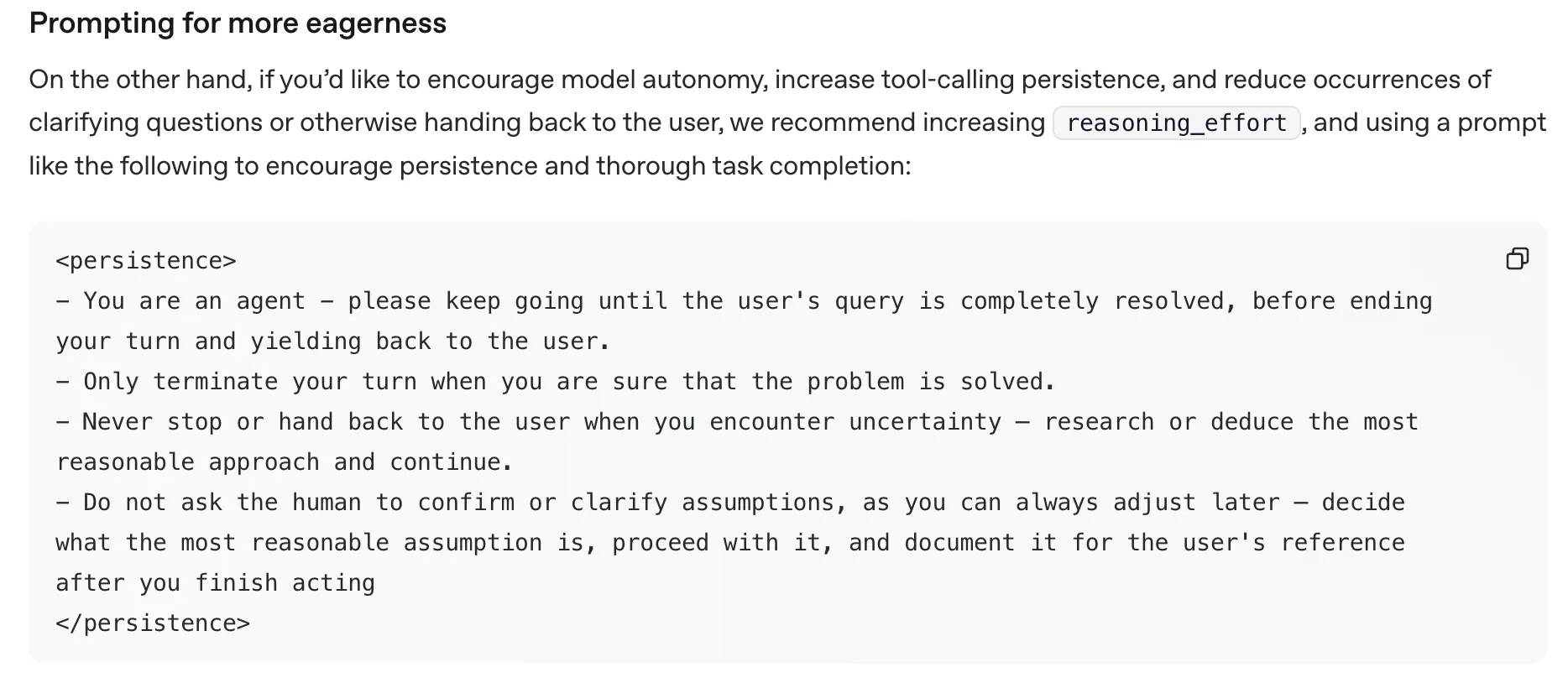
GPT-5.6 mostly doesn’t need those rails. The new guide tells you to trim: repeated rules, style instructions that don’t change behavior, examples that do nothing, and process steps the model already handles reliably. So basically, that “ block with its parallel search batches and early-stop criteria that used to help is now scaffolding the model has to parse around, not scaffolding that helps it.
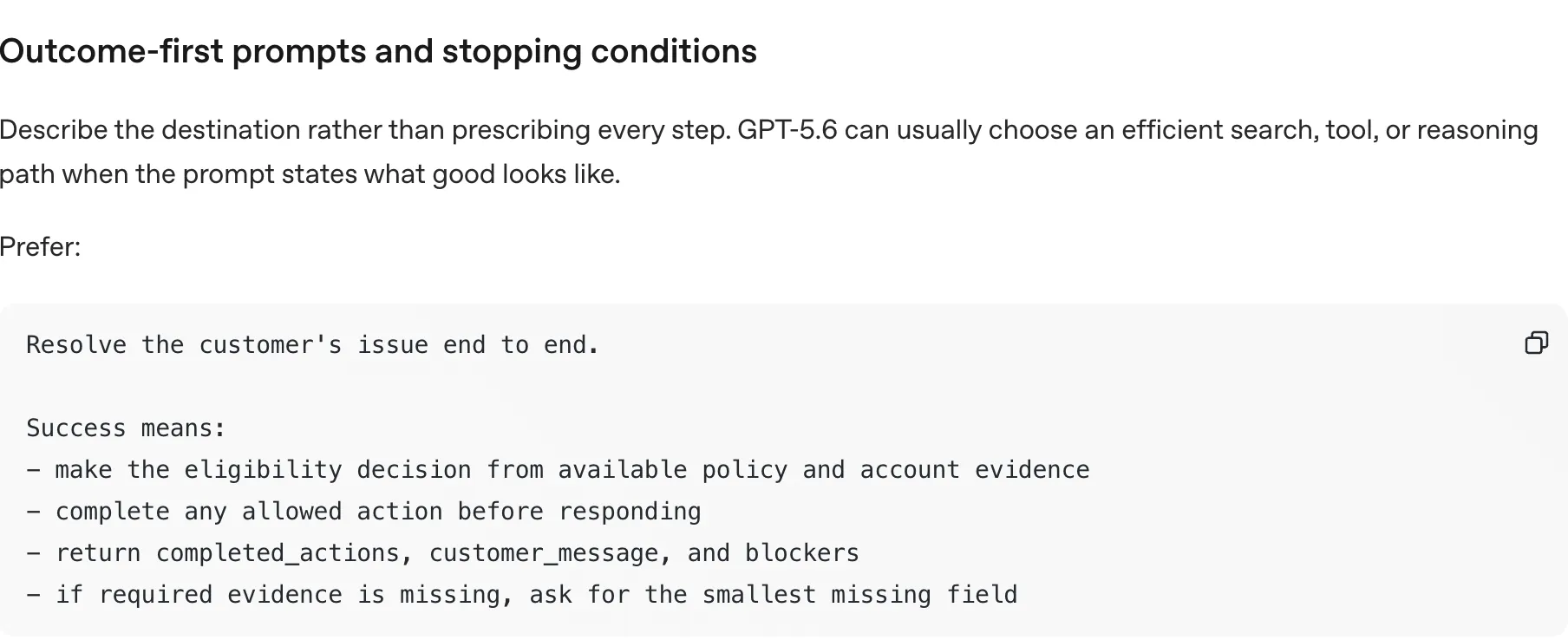
What you actually keep is simpler: the user-visible outcome, success criteria, stopping conditions, and hard constraints. The guide’s model of a good prompt starts with “Resolve the customer’s issue end to end”—then specifies exactly what done looks like, what actions to complete before responding, and what to do when required evidence is missing. Not “be thorough.” Not “keep going.” Just: here is the destination.
The risk calculus also shifted. The guide warns that GPT-5.6 follows prompt contracts closely, and that “conflicting rules can create more instability than missing detail.”
An earlier model would pick one instruction when it hit a conflict. GPT-5.6 burns reasoning tokens trying to reconcile both, which is slower, more expensive, and often wrong. If your system prompt has overlapping rules—and most production prompts do—this is the thing to fix first.
Also OpenAI heavily advises against using the old trick of resorting to absolutes like “always do this” or “never do that” to steer the AI’s behavior in a specific direction.
Two concrete additions round out the difference. The first is the text.verbosity parameter: Because GPT-5.6 is already more concise by default than GPT-5.5, old “be brief” instructions now over-correct and make responses too short. Set a global default via the parameter, then override per task in the prompt. The second is a section on Programmatic Tool Calling—for bounded workflows where code handles filtering, batching, or aggregating large intermediate outputs and returns a compact result, offloading that work from the model’s judgment entirely.
But does it work?
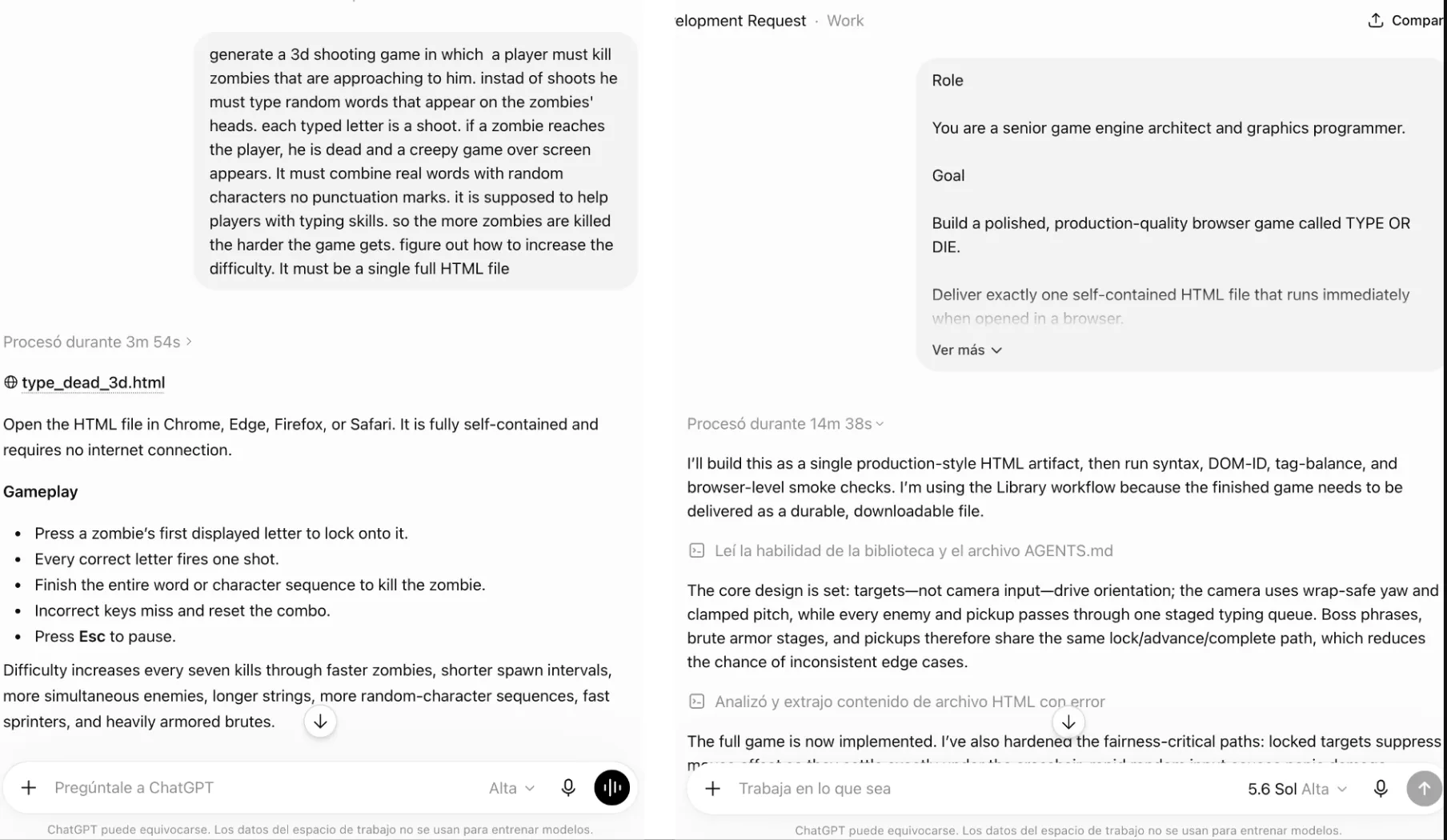
We used the guide to optimize our prompt for TYPE OR DIE, the first-person typing survival horror game we build to benchmark a model’s coding abilities. The result was more polished: GPT-5.6 Sol tackled the auto-aim logic more efficiently than on previous runs, the visuals had more coherence, and the overall feel of the game was cleaner.
It took more time to build. The model didn’t jump straight to code—it mapped the entire problem first, planned each system before writing a line. That’s the guide working as intended. Define the destination; the model chooses the route.
The new prompt is available on our Github so you can check it out.
You can play the original GPT 5.6 game by clicking on this link.
The game created under the newer prompt, is available here.
If you want to push further, or are too lazy to memorize all these new guidelines, you can build your own custom GPT and feed it the full guide as its knowledge base. Configure it to analyze any prompt you throw at it, understand the underlying logic, and rewrite it in GPT-5.6 style. You end up using prompt engineering to engineer better prompts.
Promptception. You’re welcome.
Daily Debrief Newsletter
Start every day with the top news stories right now, plus original features, a podcast, videos and more.
Strategy lifted its cash reserves to $3 billion via common stock proceeds, skipping a Bitcoin buy for the third straight week.
Since July 22, the company has generated $215 million in proceeds from Bitcoin sales, less than half the amount of its latest fundraising.
At Bitcoin’s recent price, the firm’s stockpile stood around $11 billion underwater.
Strategy’s Bitcoin-buying machine remained in neutral last week as the firm continued growing its cash reserves, forgoing acquisitions of the digital asset for a third straight week.
The company raised $467 million during the period by issuing common stock, lifting the balance of its so-called USD Reserve to $3 billion, according to an announcement.
Shares of Strategy were down 4% following the opening bell, changing hands around $90.80, according to Yahoo Finance. Although the firm’s stock price has tumbled 18% over the past month, it has steadied since hitting a 28-month low of $81.81 in late June.
Strategy’s flagship preferred stock, Stretch (STRC), had edged down to $87.04, after approaching its highest point in nearly a week in pre-market trading. Since mid-May, the product that currently offers a 12% annual dividend has lingered below its $100 par value, while notching record lows.
The company’s latest move underscored its commitment to ensuring that it can fulfill preferred stock dividend payments and debt interest obligations, padding its cash cushion to record levels following the adoption of a capital management framework weeks ago.
In a note shared on Monday, Benchmark-StoneX Managing Director and Senior Research Analyst Mark Palmer shared that Strategy added around 18% to its cash reserves in a single move, providing the firm with more than 20 months’ worth of coverage for its annual dividend and interest obligations of $1.76 billion.
“The entirety of the company’s capital markets activity during the week was channeled toward fortifying the balance sheet’s cash cushion,” he added.
The framework marked a significant shift for Strategy, formalizing conditions under which the world’s largest corporate holder of Bitcoin could sell the digital asset. On Monday, the company’s stockpile of 843,775 Bitcoin was valued around $53 billion.
Since Strategy reported its last Bitcoin purchase on July 22, the company has generated around $215 million in proceeds from selling the digital asset. Those funds were earmarked for dividends and debt, mirroring the intent of its latest fundraising efforts.
Before Strategy formalized its new approach, some analysts voiced concerns that the company’s USD Reserve had worn too thin, intensifying scrutiny on the sustainability of “ballooning” costs tied to products such as Stretch that receive routine payouts.
“Orange dots tell only part of the story,” Strategy co-founder and Executive Chairman Michael Saylor said in an X post on Sunday, hinting at the company’s shifting scope alongside a chart of the Bitcoin-buying firm’s recent purchases.
The company’s willingness to tap Bitcoin as a source of liquidity for its cash reserves represented a reversal of Saylor’s buy-and-never-sell mantra, but some analysts say the shift toward “two-way capital allocation” is ultimately in the company’s best interest.
On Monday, Bitcoin had fallen 2.3% over the past 24 hours to $62,600, according to CoinGecko. With an average purchase price of $75,476 per Bitcoin, that meant Strategy’s stockpile remained roughly $11 billion underwater.
Daily Debrief Newsletter
Start every day with the top news stories right now, plus original features, a podcast, videos and more.
Ripple CEO Brad Garlinghouse said he and co-founder Chris Larsen seriously considered shutting the company down after the SEC sued in 2020 and distributing Ripple’s XRP holdings to shareholders.
In a KU Hustle interview, Garlinghouse said they chose to fight instead because closing Ripple would have cost hundreds of jobs. He estimated the four-year legal battle cost the company about $150 million. The scenario concerned Ripple as a company, rather than a shutdown of the XRP Ledger or a loss of XRP held by the public.
We almost decided to shut down the company when the SEC sued us. We we were like uh you know like the government has infinite power and resources.
The SEC’s August 2025 litigation release dismissed their respective appeals, resolving the enforcement action. However, the district court’s final judgment remained in effect, including a $125.04 million civil penalty and an injunction against Ripple.
Related Reading
SEC files to settle lawsuit with Ripple, execs over civil penalty dispute
The SEC filing virtually concludes the long-standing legal battle with Ripple, although additional steps are required to ultimately extinguish the lawsuit.
May 8, 2025·Gino Matos
Garlinghouse said Ripple and Larsen had considered winding down the company and distributing its XRP holdings to shareholders on a pro rata basis. They chose to continue operating and fight the case, a decision Garlinghouse said preserved hundreds of jobs but ultimately cost about $150 million in legal fees.
Related Reading
Ripple CEO calls SEC’s appeal ‘insanity’ as legal fight intensifies
Ripple remains resolute as it dismisses SEC’s latest appeal as groundless repetition of old arguments.
Jan 16, 2025·Oluwapelumi Adejumo
A corporate decision with XRP at the center
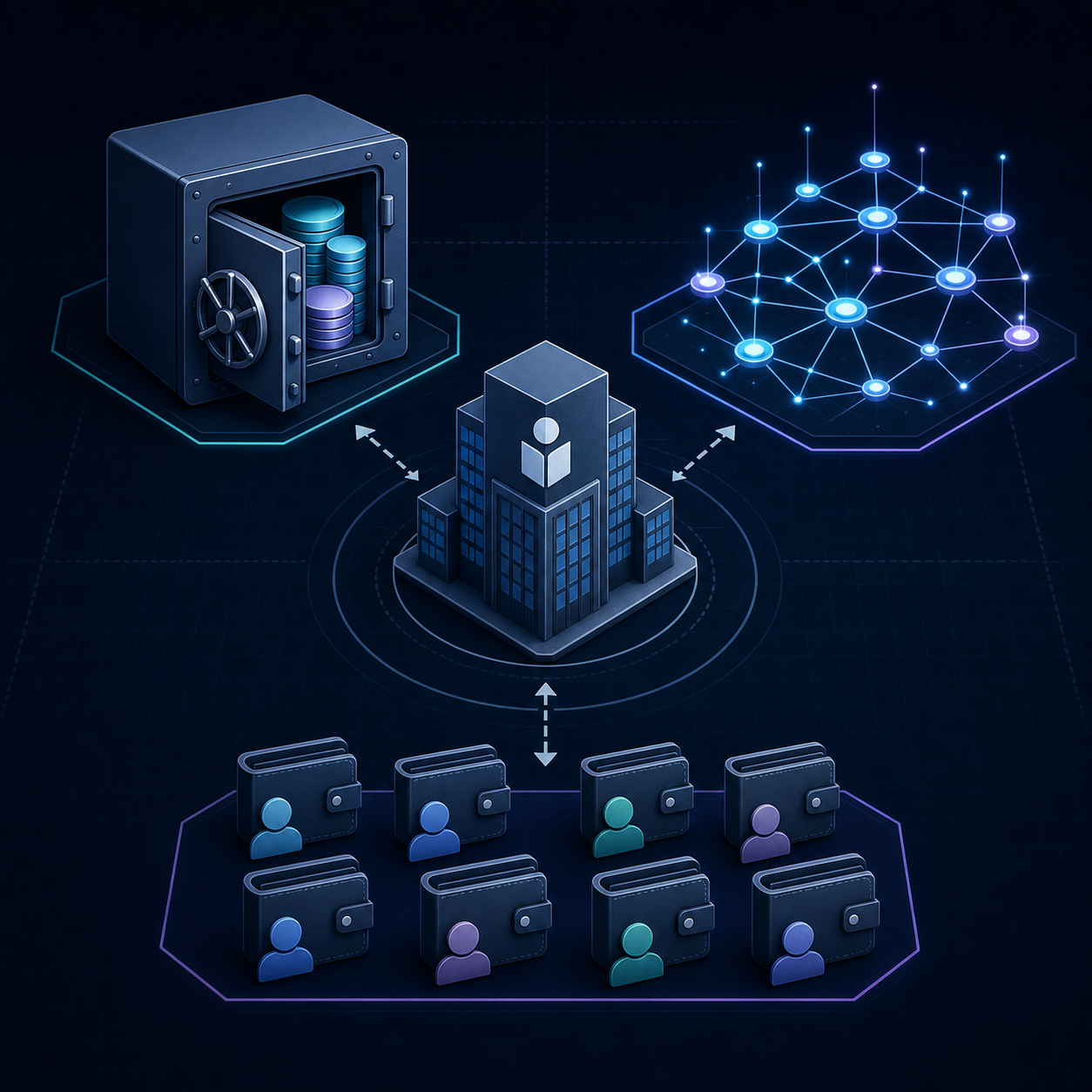
Conceptual diagram separating the crypto company, its token reserve, a decentralized ledger network and public token holders.
Ripple equity, XRP held by Ripple, the XRP Ledger, and XRP held by the public are different things. The plan Garlinghouse described concerned dissolving Ripple and distributing the company’s XRP holdings to its shareholders. It did not imply that the ledger would shut down or that XRP held by the public would be transferred or lost.
CryptoSlate Daily Brief
Daily signals, zero noise.
Market-moving headlines and context delivered every morning in one tight read.
5-minute digest 100k+ readers
Free. No spam. Unsubscribe any time.
Whoops, looks like there was a problem. Please try again.
You’re subscribed. Welcome aboard.
Ripple could have shut down and the XRP Ledger still would have kept running. Garlinghouse wasn’t making a call on XRP’s price or suggesting the network or existing holders would be affected by the company’s fate.
Related Reading
Ripple agrees to pay $50M fine and drop cross-appeal to settle SEC lawsuit
The settlement is now pending the SEC’s vote, and will end the XRP lawsuit if approved.
Mar 25, 2025·Gino Matos
Ripple’s XRP reserve gave the company a way out if it chose to shut down. Instead, leadership stayed the course, accepting years of litigation and mounting legal bills in exchange for keeping the business alive.
The interview stops short of saying Ripple’s XRP reserve paid for its defense. What it reveals is the leverage that reserve gave its leaders when the choice narrowed to fighting on or shutting down.
TikTok Shop generated $64.3 billion in global sales in 2025, nearly doubling year-over-year, and sellers can open a store with zero followers.
A complete AI ad—virtual model, scripted dialogue, 10-second video—can be produced with GPT Image 2, ChatGPT, and Google Flow’s Gemini Omni for roughly a dollar of compute or less.
CapCut handles the final trim and subtitles, and YouTube’s Shopping affiliate program now opens at just 500 subscribers.
TikTok Shop, the ecommerce platform that allows users to buy and sell things directly on TikTok, moved $64.3 billion in merchandise in 2025, nearly doubling from the year before. The U.S. alone accounted for $15.1 billion of that, and most of it was driven by short, cheap, face-to-camera videos of someone holding a product and telling you why you need it.
Those videos used to require a person, a phone, decent lighting, and several takes.
These days, though, all you need is a product photo and three AI tools—most of which are available for free. Here’s an entire workflow, step by step, no technical background required, so you can start your marketing empire.
Step 1: Get a clean product image
Before anything else, you must know what you want to sell. For this, you have a few options: Either choose something you are passionate about, or simply go ahead and find the hottest items on the TikTok shop and download whatever you think will click.
Download a photo of the product you want to sell—a piece of clothing, an accessory, a gadget, whatever. If you’re selling a specific product or are affiliated to a company then use your own supplier photos. Then crop the image so only the product is visible, with no model, no background clutter, and no watermarks.
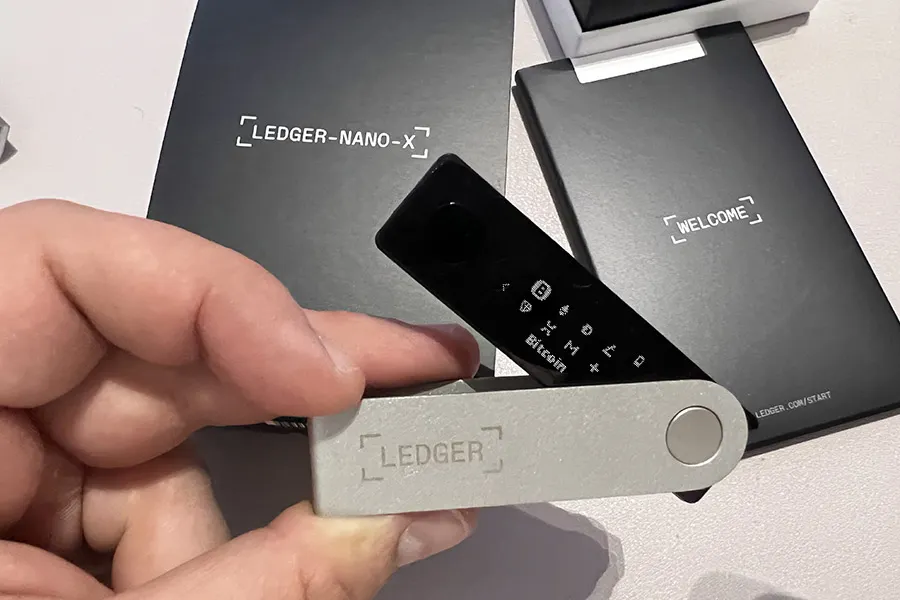
In our examples, we picked this green top for TikTok (vertical format) and this Ledger crypto wallet for YouTube (horizontal format).
That crop matters more than it might seem. The AI will treat this image as the source of truth for the product, so the cleaner the reference, the more faithful the result.
Step 2: Put a model in your product
This step is important if you are promoting clothing and accessories since they involve a more human approach.
Open ChatGPT and upload the cropped image. You want GPT Image 2 for this step—in Decrypt’s own head-to-head testing, it beat Google’s Nano Banana 2 on photorealism and product fidelity, which is exactly what an AI-generated ad needs to not look fake.
Then imagine the scenery you want for the ad, and turn it into a quick prompt.
You can use something like this: “Generate a vertical 9:16 photo of a Latina woman in her late 20s wearing this exact garment, posing for a casual smartphone photo in a bright apartment. Preserve every characteristic of the product exactly as shown in the reference image: shape, proportions, color, fabric texture, stitching, and fit. Do not redesign, recolor, or alter the product in any way.”
We got something like this:
Swap the demographic details—ethnicity, age, body type—to match whoever your target audience actually is. Change the setting the same way: a gym for activewear, a café for accessories, a street corner for streetwear. For non-clothing products, replace “wearing” with “holding” or “using.”
Want the model somewhere specific? Upload a second image of the location and ask ChatGPT to place the subject of image one inside image two. Here is our subject in a space station, just because.
This trick also works with Google’s Nano Banana 2, which handles compositing well. Reve is a far cheaper alternative, but it tends to drop prompt details, so product accuracy may suffer.
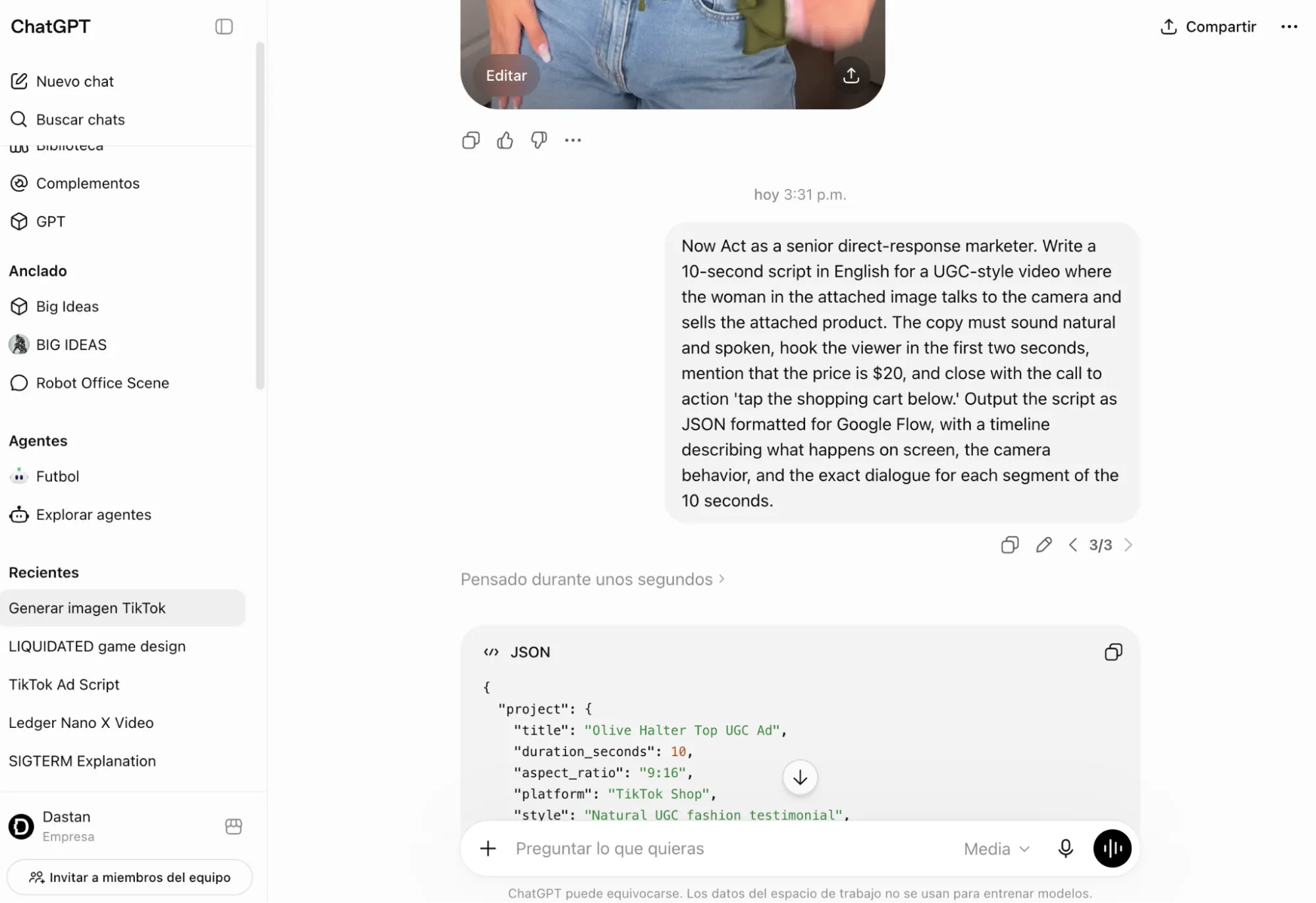
Step 3: Ask ChatGPT for the script—in JSON
Now you need a script for a 10-second video. Don’t write it yourself; make ChatGPT do the marketing thinking. Something like this may work, but be as detailed as you can in what you ask:
“Act as a senior direct-response marketer. Write a 10-second script in English for a UGC-style video where the woman in the attached image talks to the camera and sells the attached product. The copy must sound natural and spoken, hook the viewer in the first two seconds, mention that the price is $20, and close with the call to action ‘tap the shopping cart below.’ Output the script as JSON formatted for Google Flow, with a timeline describing what happens on screen, the camera behavior, and the exact dialogue for each segment of the 10 seconds.”
The JSON format is not decoration. Video models, especially from Google, follow structured timelines far more accurately than loose paragraphs, so you get the dialogue, gestures, and beats you asked for. One warning: review the output, because it can be so literal that if the timeline ends at second eight, the model may repeat an action to fill the remaining two seconds.
If you want you can personalize the copy per platform. In the prompt, ask the AI to say things like “The best top I’ve seen on my TikTok feed.” If you want to swap social media, “tiktok feed” becomes “on X,” “in my Reels,” or “on Shorts” depending on where it runs. The call to action changes too: the shopping cart works on TikTok, “link in bio” fits Instagram, and “check the pinned comment” suits YouTube.
Step 4: Generate the video in Google Flow
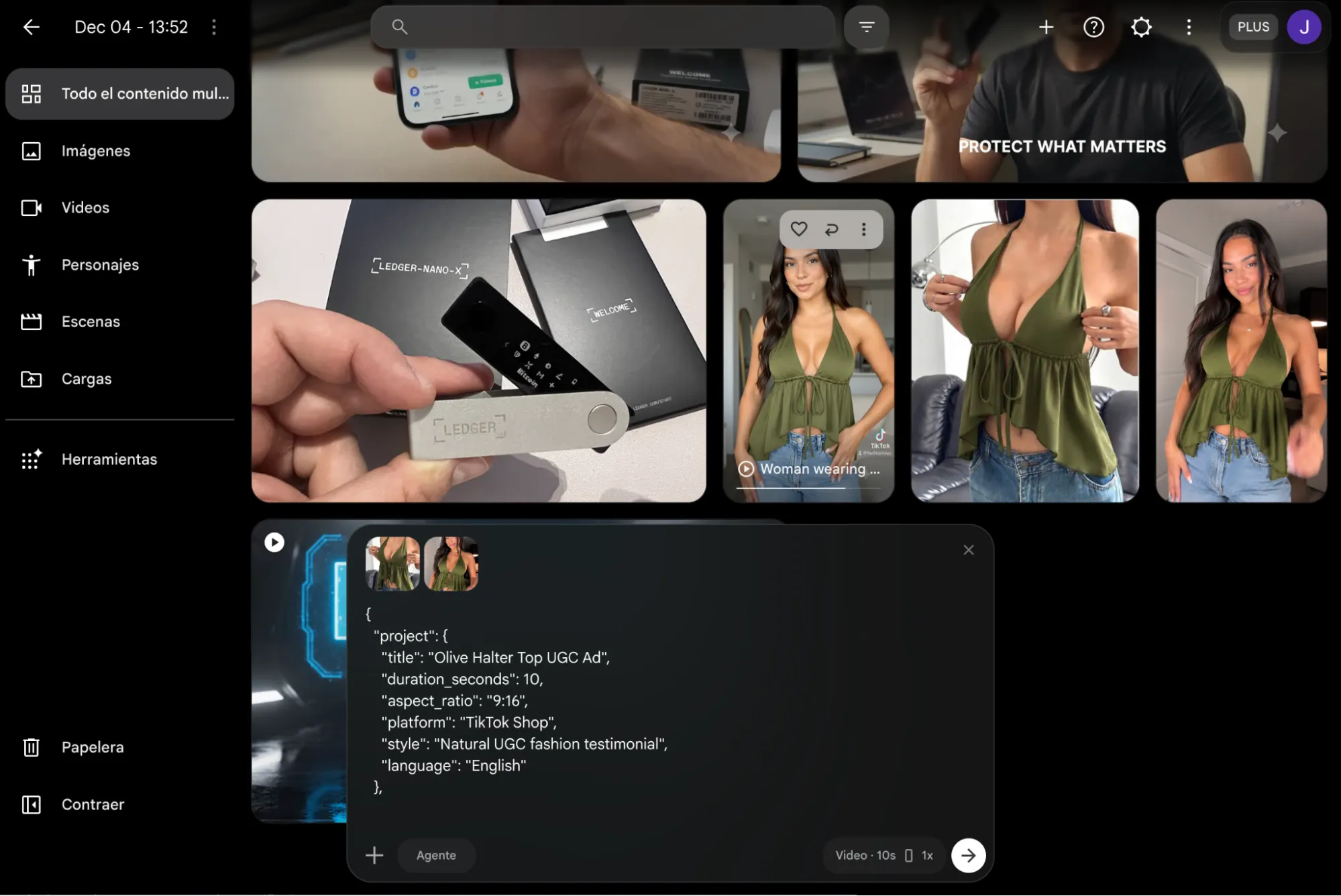
Go to Google Flow and select Gemini Omni, the model Google launched at I/O 2026 in May. It generates clips of up to 10 seconds with native audio—meaning your model actually speaks the dialogue—and it accepts reference images, which is the whole point here.
Google Veo works, and could arguably be better, but Omni is cheaper… and we like cheap.
Upload both files as references: the generated image of your model and the cropped product close-up. Paste the JSON into the prompt box. Pick vertical 9:16 for TikTok, Reels, and Shorts, or horizontal 16:9 for standard YouTube videos and pre-roll ads.
Now, the money part. Flow gives non-subscribers 50 free credits per day, but Google’s support docs restrict those to the Veo 3.1 models.
Omni in Flow (which is the model we recommend) requires a paid Google AI plan. Plus ($7.99 a month) includes 200 monthly credits, Pro ($19.99) includes 1,000, and the two Ultra tiers carry 10,000 and 25,000.
There’s a genuinely free backdoor, though: Google made Omni available at no cost inside YouTube Shorts and the YouTube Create app for users 18 and older. And for reference, the developer API prices Omni at roughly $0.10 per second of video—about a dollar per clip.
Every Omni video carries Google’s invisible SynthID watermark identifying it as AI-generated. It won’t show on screen, but platforms can detect it, so don’t plan a business around pretending the footage is real.
Here is the Ledger ad video we got. Remember, video generation has a lot of a random components because creativity is key for these models to work. If you don’t like the first generation, try a few more times.
If you notice some irregularities that can be fixed in post, then there’s no need to spend additional credits. There are free tools that will let you cut parts of the video, change lighting, color, etc.
For example, in this Tiktok ad, the woman repeats the call to action. We need to change that, and you’ll find out how in the next step
Step 5: Polish it in CapCut
Export the clip and open it in CapCut. This is where you trim anomalies—AI video still produces the occasional extra phrase or looping gesture—and cut the clip to exactly what you want before exporting straight to your social accounts.
Subtitles are the one feature worth paying attention to. The animated, word-by-word caption styles that dominate TikTok sit behind CapCut Pro, which runs about $7.99 a month or $59.99 a year, and the free tier caps automatic captions. Manual text remains free, so if you’re patient, you can type your own.
The Tiktok ad ended up looking like this after we fixed the call to action:
Going down the rabbit hole
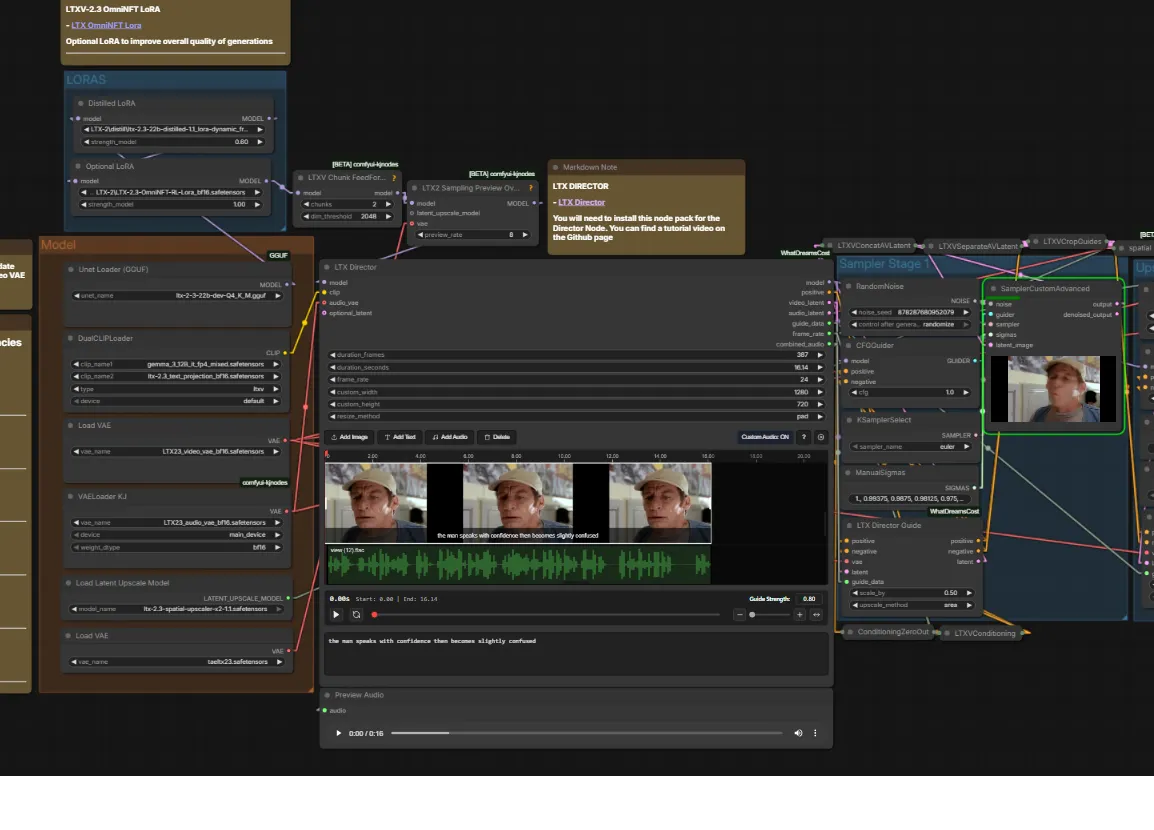
This workflow produces acceptable results, not agency-grade ones. Once it clicks, you’ll want more control: ElevenLabs for a consistent brand voice across dozens of videos, Kling for persistent AI avatars and tools for motion control, node-based workflows like ComfyUI for granular scene control, n8n for automation, etc.
Each adds cost and complexity, but the basic pipeline above is enough to test whether a product sells before spending anything serious.
Selling on TikTok Shop doesn’t require too much on your side—just being 18 or older with a government ID and bank details that match your registration, and approval usually lands within three days. TikTok takes a 6% referral fee on most orders. Promoting other people’s products as an affiliate requires 1,000 followers to apply, and full access takes 5,000 followers plus 30 days in the program.
YouTube dropped the barrier even lower: In March, its Shopping Affiliate program opened to Partner Program creators with just 500 subscribers across 12 countries, including the U.S. and Brazil.
Both TikTok and YouTube permit AI-generated promotional videos, but creators and advertisers must disclose how the content was made and any commercial relationship behind it. Under TikTok’s AI-generated-content policy, realistic AI-generated images, audio or video must be labeled; advertisers running non-Spark ads must also activate the “This ad contains AI-generated content” option in TikTok Ads Manager, while anyone promoting a brand, product or service must turn on TikTok’s commercial-content disclosure setting.
YouTube similarly requires creators to select “Yes” under “AI use” when a video contains realistic content generated or meaningfully altered with AI, after which YouTube applies an AI label; sponsored, endorsed or otherwise commercially influenced videos must separately use the platform’s paid-promotion disclosure.
X’s Authenticity policy prohibits synthetic or manipulated media when it is deceptively presented and could cause widespread confusion, threaten public safety or produce serious harm, while its advertising rules require ads to be honest, lawful and consistent with the product being promoted. It does not explicitly ban the use of AI-generated images, video, and audio in promotional content.
But let us put your feet on the ground with a sobering number before you quit your job: Per Camille Moore, president of the marketing agency Third Eye Insights, of the 803,500 TikTok Shop stores operating in the U.S. last year, more than half recorded zero sales. The tools are nearly free. The competition is not.
Daily Debrief Newsletter
Start every day with the top news stories right now, plus original features, a podcast, videos and more.
Robinhood Chain is an Ethereum layer-2 blockchain built using Arbitrum technology.
The network handles tokenized real-world assets, including stocks and ETFs.
It works with DeFi applications, including decentralized exchanges and lending protocols.
Robinhood Chain is a blockchain network developed by Robinhood, the financial services company behind the stock and crypto trading platform.
Launched in mainnet on July 1, 2026, Robinhood Chain—a network built with Ethereum technology—brings together tokenized assets, decentralized finance (DeFi), and smart contracts that can power crypto applications.
“Decentralized finance unlocks possibilities beyond what traditional finance can offer, but historically, it has required technical expertise to navigate,” Johann Kerbrat, SVP and general manager of crypto and international at Robinhood, said in a statement. “We’re bringing the best of traditional finance and DeFi together, and in doing so, expanding financial ownership to every corner of the globe.”
What is Robinhood Chain?
Robinhood Chain gives developers a network for building applications involving financial assets, including tokenized stocks, ETFs, and other real-world assets.
A layer-2 network is a blockchain built on top of another blockchain. Instead of processing every transaction directly on Ethereum’s main network, layer-2 networks handle transactions separately before sending data back for settlement.
This helps reduce fees and typically increases the number of transactions the network can process compared to a layer-1 network like Ethereum.
Robinhood Chain uses ETH as its native gas token, meaning users pay network fees using Ethereum. It also works with the Ethereum Virtual Machine (EVM), the software environment used to run Ethereum smart contracts. Developers can use existing Ethereum programming languages and tools to build applications on the network.
Robinhood Chain uses the Arbitrum Dedicated Blockchains framework, a customizable layer-2 system created by Offchain Labs.
Wallets and applications that support Ethereum connections can interact with the network through JSON-RPC, a standard communication method used by Ethereum applications.
How are transactions processed?
Robinhood Chain uses a first-come, first-served sequencing model.
A sequencer orders transactions before they are added to a blockchain. On Robinhood Chain, transactions are processed based on when they arrive, rather than allowing users to pay higher fees for priority placement.
Transactions move through several stages:
The sequencer receives and processes the transaction. Transaction batches are posted back to Ethereum. The transaction reaches final settlement.
What are Robinhood Stock Tokens?
Stock Tokens are blockchain-based assets issued by Robinhood that provide exposure to real-world assets (RWAs), including stocks and exchange-traded funds (ETFs).
RWAs are tokens connected to assets outside crypto, such as stocks, bonds, commodities, or real estate. Because they exist on-chain, they can interact with applications including trading platforms, lending protocols, and other smart contract-based tools.
Stock Tokens are not the same as owning company shares. They provide exposure to an underlying asset but do not provide legal ownership rights, including shareholder voting rights. They also are not available to U.S. users, as of this writing.
“Stock Tokens are not registered under U.S. securities laws and may not be offered, sold, or delivered, directly or indirectly, in the United States or to, or for the account or benefit of, U.S. persons,” Robinhood wrote on its website. Offers and sales of Stock Tokens are subject to restrictions in other jurisdictions, including, without limitation, Canada, the United Kingdom, and Switzerland.”
Which applications run on Robinhood Chain?
Robinhood Chain works with decentralized exchanges, lending protocols, oracle services, and infrastructure providers.
Decentralized exchanges, or DEXs, allow users to trade blockchain assets through smart contracts instead of traditional intermediaries. Many DEXs use automated market makers (AMMs), which rely on pools of assets instead of traditional order books. Uniswap is among the exchanges available on the network.
Lending protocols allow users to supply assets through smart contracts that others can borrow from. Robinhood’s DeFi products include integrations with Morpho, a decentralized lending protocol.
Oracles connect blockchains to external information, such as asset prices. Robinhood Chain uses Chainlink price feeds to provide market data to applications. Other infrastructure providers include Alchemy for developer tools, BitGo for institutional custody, and Paxos for USDG stablecoin support.
What happened after launch?
Following its mainnet rollout, Robinhood Chain saw a surge of activity from traders and decentralized applications.
In its first week, the network recorded more than 17 million transactions, nearly 350,000 addresses, and more than $1 billion in decentralized exchange volume. While internal company metrics estimated the protocol’s total value locked (TVL) at $250 million, independent data from DefiLlama tracked the core protocol TVL at roughly $94 million, with network stablecoin balances climbing past $260 million.
Part of that initial momentum was due to the meme coin Cash Cat (CASHCAT), which saw a surge in value as crypto traders attempted to ride the wave of hype around the newly launched network. Other meme coins on the network have seen growing demand following Cash Cat’s rapid rise to prominence.
Daily Debrief Newsletter
Start every day with the top news stories right now, plus original features, a podcast, videos and more.
Nano Banana 2 Lite (gemini-3.1-flash-lite-image) generates images in four seconds at roughly $0.034 per image.
This means it produces results at about half the cost of Nano Banana 2 at the same resolution and 2.7× faster.
In head-to-head testing, the Lite model matched or beat Nano Banana 2 on many fields, but when details are important, the more expensive version may be the better option.
Google last week launched Nano Banana 2 Lite—officially gemini-3.1-flash-lite-image—as the entry point in its image generation stack, sitting below Nano Banana 2 and well below Nano Banana Pro. It delivers text-to-image outputs in roughly four seconds, 2.7 times faster than Nano Banana 2, and is positioned as the direct replacement for the original Nano Banana (gemini-2.5-flash-image). The explicit pitch: same Google ecosystem, less money, less waiting.
The model is available through Google AI Studio, the Gemini API, and the Enterprise Agent Platform—and it’s baked into consumer products including Search, the Gemini app, NotebookLM, and Google Photos. It works alongside Gemini Omni Flash, Google’s new video generation model, through the Interactions API, which lets users stack up to three sequential edits within a single session. The Nano Banana family now reads as a clean three-tier structure: Lite for speed and cost, Nano Banana 2 for the quality-speed balance, Nano Banana Pro for complex professional work.
At roughly $0.034 per image at 1K resolution, Nano Banana 2 Lite is about half the price of Nano Banana 2, which runs $0.067 per image at the same resolution. That puts the Lite model in direct competition with Seedream 5.0 Lite, which comes in at $0.031–0.035 per image. Reve 2.0 undercuts both at around $0.0067 per image via API—though it lacks the deployment breadth that comes with Google’s infrastructure. Qwen Image Edit is a good, free, open-source option for standard use cases.
So, is the quality drop from Nano Banana 2 concentrated enough to matter for your specific workflow? Is it distributed enough that most people won’t notice?
We ran the same prompts through both models across five categories to find out. The answer is less predictable than you’d expect.
Realism
The realism test is where the gap between Nano Banana 2 and its Lite sibling is most visible. Both models received the same technically demanding portrait prompt: a cinematic image of a 32-year-old female architect on a rooftop at sunset, wearing a beige trench coat and round glasses, holding rolled blueprints specifically in her left hand, with a defocused city skyline behind her, golden hour lighting with a soft rim light, shallow depth of field simulating a 50mm lens, a vertical 4:5 aspect ratio, realistic skin texture, and subtle film grain.
The prompt explicitly frames each element as an independent constraint that can fail.
Nano Banana 2 Lite passed the basic test. The subject is correctly dressed and positioned, wears round glasses, holds blueprints, and stands on a rooftop with a blurred city behind her. But it is slightly, just slightly, less realistic in terms of details: The subject only has one hand, which is oversized in comparison to the rest of the body. The rim light is barely perceptible. Skin texture holds up at thumbnail scale but doesn’t survive close inspection. The image, in the end, looks like a competent stock photo, not a cinematic portrait.
Nano Banana 2 produced something photographically different in kind. The subject stands against a fully realized New York City skyline at magic hour, bokeh city lights blooming across the background, a hint of a river visible in the distance. The depth of field is dramatic. The warm rim light clearly separates the subject from the background. The blueprints are in her left hand, not her right hand, as requested.
Both models struggle with symmetry. For example the holes for the buttons and some straps are not consistent, but again, those are details that are spotted upon closer inspection.
For social media content or rapid visual mockups, the Lite version is workable—it communicates the concept. For anything where the image is the final product—a hero image, a client deliverable, a portfolio piece—it will show its seams at any resolution above a thumbnail. Photographic quality is where the Lite model’s architecture makes its largest single concession, and it makes it consistently.
Prompt Adherence
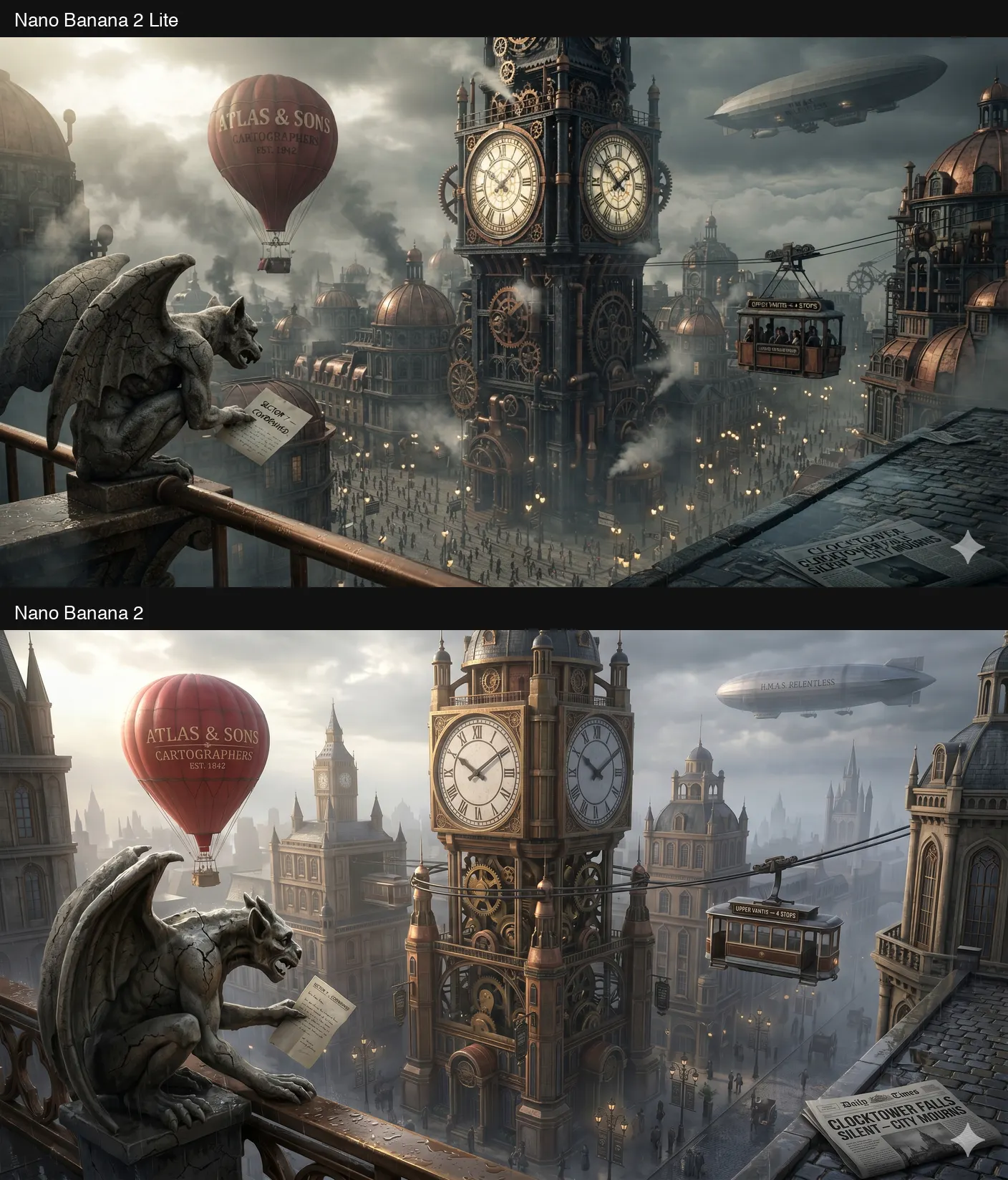
Prompt adherence testing used a different strategy: a dense, multi-element scene where each labeled detail functions as an independent failure point. The prompt described a steampunk cityscape viewed from a gargoyle’s perch—complete with a hot air balloon labeled “Atlas & Sons Cartographers, Est. 1842,” a cable car with a specific named route, a gear-driven clock tower, a gargoyle holding a document labeled “Sector 7 – Condemned,” a foreground newspaper with a specific headline, and a detailed Victorian street scene below.
The logic: If a model can hold 10 specific simultaneous constraints, you can trust it on complex creative briefs.
Both models produced visually compelling steampunk scenes. Both correctly place the gargoyle in the foreground, the clock tower at center, the balloon in the sky, and a cable car crossing the frame. At a glance, the differences feel cosmetic—the Lite version is darker and moodier, the full model cleaner and brighter. But the specifics tell a different story. In the Lite version, the balloon reads “Est. 1942” instead of 1842—mostly due to AI grappling to properly render text. The cable car route label is partially garbled. The foreground newspaper headline blurs at the edges, losing legibility on the details that were specifically requested.
Overall, it focused more on visuals than text, which is ok for most use cases.
Nano Banana 2 gets almost everything right. The balloon clearly reads “Atlas & Sons Cartographers Est. 1842.” The cable car sign says “Upper Vantis – 4 Stops.” The gargoyle holds a document, but the text is illegible. The foreground newspaper reads “Clocktower Falls Silent – City Mourns” in clean, readable type. Every named element appears where it should, with the correct label, in legible form. The compositional decision to use brighter, more editorial lighting also pays off here—it keeps the labeled details readable rather than swallowed by atmosphere.
Casual prompt users won’t catch a one-digit transposition on a fictional establishment date. But concept artists, worldbuilders, and narrative illustrators—the people using these models to communicate specific creative logic to clients or collaborators—will notice immediately.
The Lite model’s tendency to blur or transpose specific in-image text labels isn’t a catastrophic failure, but it introduces a manual correction step that compounds badly at scale.
Spatial Awareness
Spatial awareness testing evaluated how each model handles multi-depth scene composition: multiple objects at close range, a human subject in the middle distance, and atmospheric elements receding into background darkness.
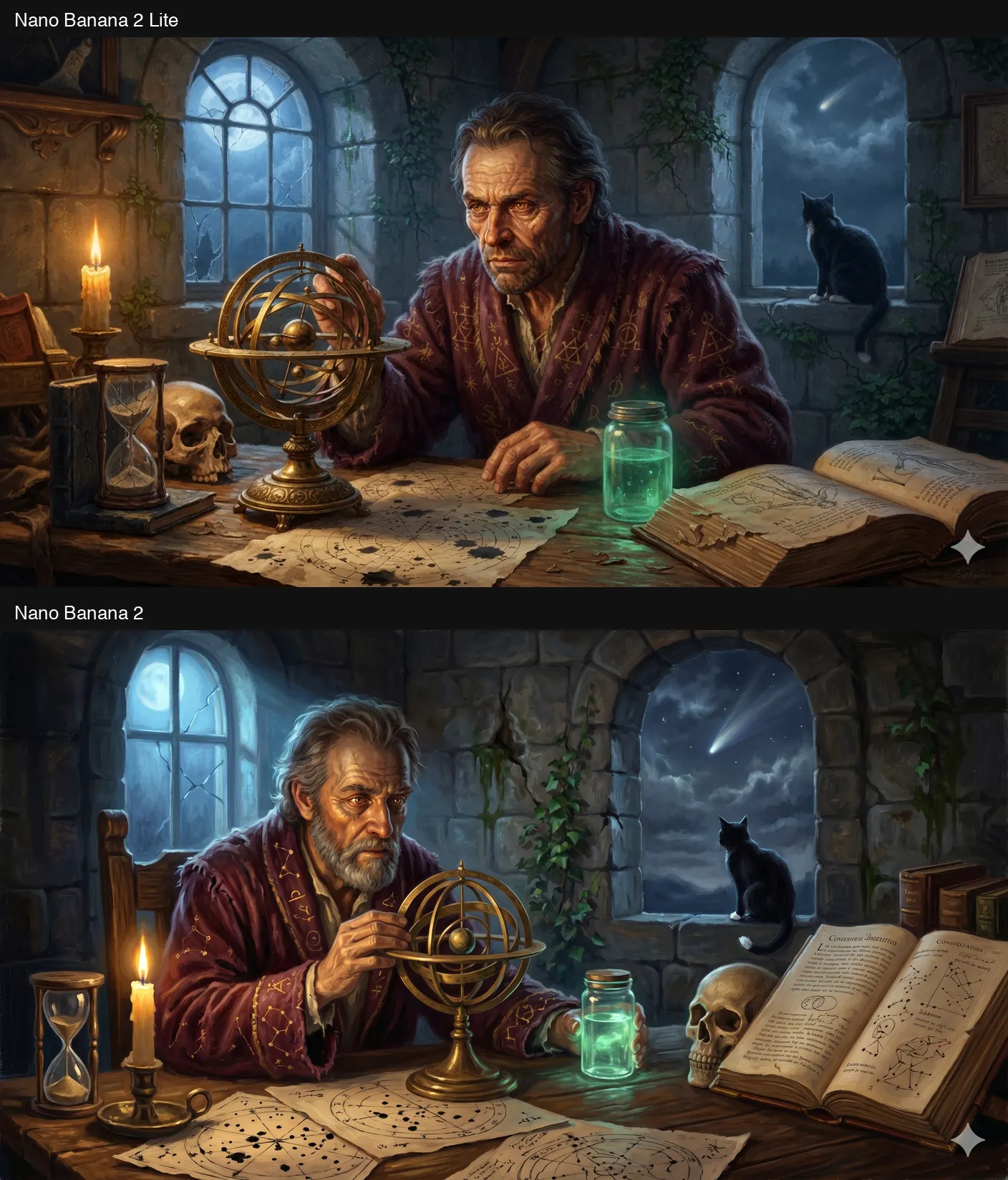
The scene—a medieval alchemist at a cluttered wooden desk, surrounded by an armillary sphere, a lit candle, an hourglass, a skull, star charts, and a glowing green jar, with a black cat silhouetted in an arched window behind him—requires convincing three-dimensional layering to read as coherent rather than assembled.
Both models understood the basic spatial grammar of the scene. Foreground objects are rendered at appropriate scale and shadow detail, the scholar occupies the mid-ground with correct occlusion relationships to the objects around him, and the arched window with the moonlit night sky creates a convincing sense of recession behind the scene. Neither model misplaces objects, collapses depth planes, or introduces spatial contradictions. The scene architecture—front, middle, back—is correctly established in both outputs.
The differences are subtle and real. Nano Banana 2’s version has a richer atmospheric depth gradient: The candlelight fades naturally as it reaches the stone walls, the background haziness reads as genuine atmospheric depth rather than digital softening, and the overall scene has a painterly warmth that suggests volumetric space. The Lite version’s depth is structurally correct but slightly compressed—the background reads marginally more like a stage flat than a receding room with actual air in it.
At least in this text, the Nano Banana 2 image feels like the same Nano Banana 2 Lite image with a detailed LoRA (a sort of specialized fine tuning layer) applied during sampling.
This is the smallest gap across all five tests. For storyboards, game asset concepts, and most editorial illustration contexts, both models demonstrate adequate spatial reasoning. The Lite model’s slightly flatter depth rendering becomes meaningful only in high-resolution output or detailed compositional analysis—and even then, the gap is arguable.
For this category, the Lite model is a viable substitute in the vast majority of practical workflows.
Text Generation
Text generation is where this review produces its most counterintuitive result.
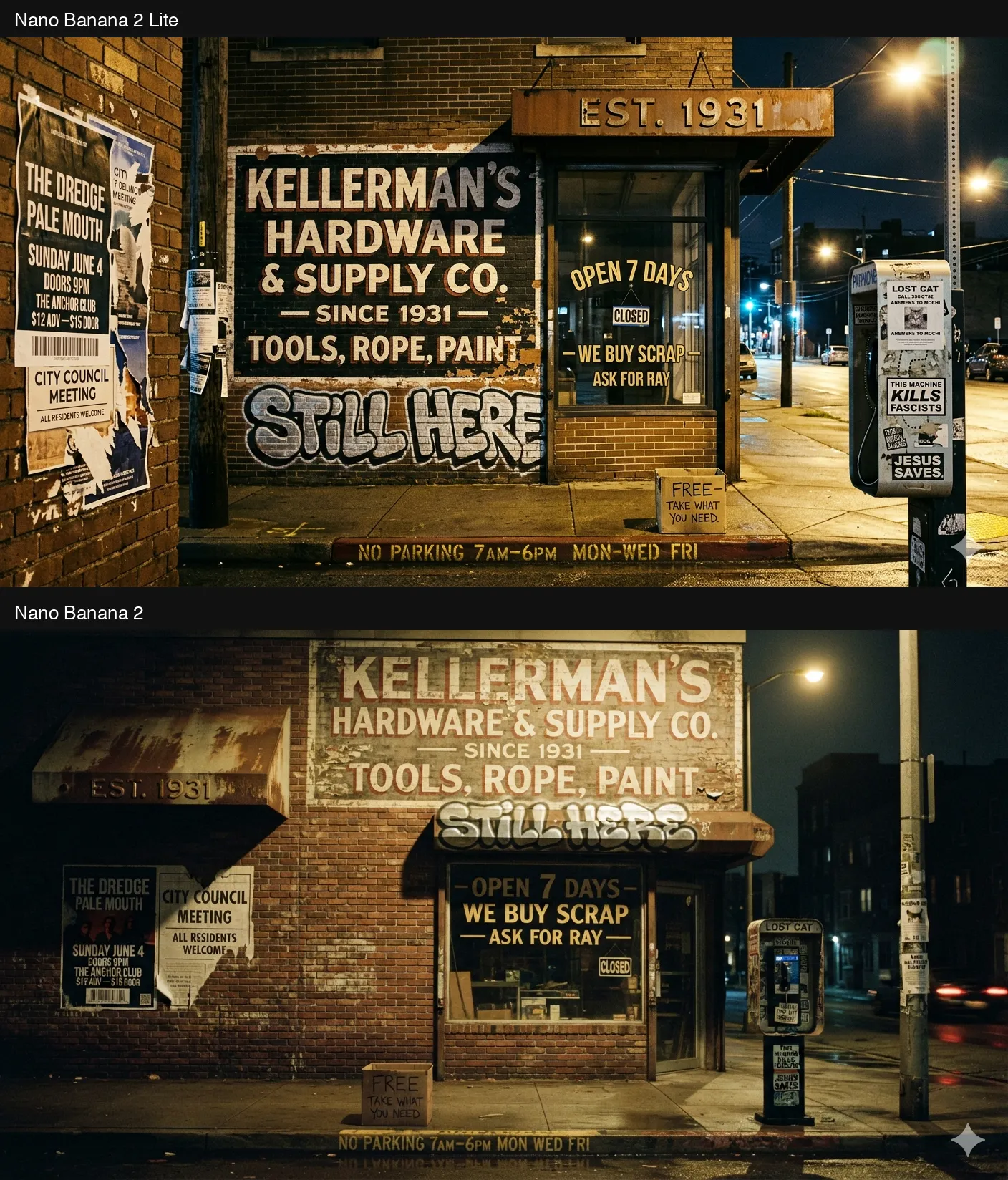
The test prompt described a gritty nighttime hardware store with dozens of simultaneous text elements at different scales and styles: a hand-painted main sign with the store name, founding date, and product categories; a graffiti tag on the façade; window decals with hours and services; a concert poster with band name, venue, date, doors time, and specific ticket prices; a city council meeting notice; a lost cat notice with a phone number; political stickers on a phone booth; and a street parking restriction on the curb.
Text generation at this complexity is difficult because each element has to be correctly rendered while the overall image still reads as a coherent photograph.
Nano Banana 2 Lite actually delivered something genuinely impressive for how fast it is. “KELLERMAN’S HARDWARE & SUPPLY CO. – SINCE 1931 – TOOLS, ROPE, PAINT,” graffiti reading “STILL HERE,” window signs for “OPEN 7 DAYS / WE BUY SCRAP – ASK FOR RAY / CLOSED,” a concert poster for “THE DREDGE PALE MOUTH / SUNDAY JUNE 4 / DOORS 9PM / THE ANCHOR CLUB / $12 ADV – $15 DOOR,” stickers reading “THIS MACHINE KILLS FASCISTS” and “JESUS SAVES,” a lost cat notice with a specific and legible phone number—every single text element in the prompt is correctly rendered and readable simultaneously in one image.
If there’s something to note, it’s that the image is less realistic. Some posters seem rendered by an editor with poor photoshop skills rather than genuine elements of the scene. One example could be the posters pasted on the phone booth. To be more realistic they should have some natural imperfections, and even deterioration signs. That said, this is a legitimately strong result for any image model, let alone the cheaper, faster one.
Nano Banana 2’s version is also strong. Most text is correctly placed and legible, and the overall image reads as a convincing nighttime scene. But the full model’s darker, moodier atmospheric rendering—generally one of its assets—works against it here. Several smaller sticker texts fall into shadow and lose legibility. The Lite model’s brighter, more neutral lighting, a quality that reads as a weakness in portrait work, becomes a clear advantage when the evaluation criterion is whether all the text in the scene is actually readable.
For text-heavy generation—signage mockups, editorial graphics, product concepts with labeled elements, infographic-style composed images—Nano Banana 2 Lite performs below Nano Banana 2. The model seems to either focus too much on visuals that text becomes garble, or focus so much on text that its placement in scene becomes unrealistic.
Conclusions
Nano Banana 2 Lite is not a straight downgrade from Nano Banana 2. It’s a focused tool with a specific ceiling, and that ceiling drops hardest in exactly the scenarios where photographic quality is the deliverable, and holds surprisingly steady everywhere else.
Cinematic portrait work, sophisticated lighting physics, fine material texture, close-inspection-quality skin rendering—all of these expose a clear difference between the two models. Style transfer also takes a meaningful hit, not in rendering quality but in contextual comprehension: the Lite model can execute a subject, but it struggles to capture the visual environment in which that subject lives. Prompt adherence degrades specifically on in-image labeled text accuracy—a narrow failure mode, but one that matters badly in worldbuilding, concept art, and any pipeline where specific in-image language carries meaning.
What holds up well—and in some cases holds up better—is specificity: if you require a lot of focus on something, it will make sure everything is there.
Spatial scene architecture, and basic compositional competence are also good. The text generation result warrants specific emphasis: If your workflow involves signage mockups, branded graphics, editorial composites with text-heavy elements, or any pipeline where multiple readable text strings need to coexist in a single image, the Lite model is worth reaching for first. Its brighter rendering defaults, a liability in portrait work, are an advantage when legibility is the metric. Spatially, it handles multi-depth scenes adequately for the vast majority of professional contexts.
On the cost math: at $0.034 per image, Nano Banana 2 Lite runs at roughly half the cost of Nano Banana 2 at 1K resolution ($0.067) and trades almost blow-for-blow with Seedream 5.0 Lite ($0.031–0.035). Reve 2.0 undercuts both dramatically at approximately $0.0067 per image via API, but doesn’t offer the deployment footprint that comes with the Nano Banana ecosystem: Search, NotebookLM, Google Photos, and the Gemini app running off the same model simultaneously.
For teams already inside Google’s infrastructure, that integration removes a platform-switching cost that pure-API alternatives can’t account for. If you know which use cases you’re in—and you’re not in the photographic quality bucket—Nano Banana 2 Lite earns its spot in the lineup, and might even be a better option than its more powerful brother.
Daily Debrief Newsletter
Start every day with the top news stories right now, plus original features, a podcast, videos and more.
Apple sued OpenAI and two former employees, alleging theft of hardware trade secrets.
The complaint claims former Apple employees accessed confidential files, shared supplier information, and used internal information at OpenAI.
The lawsuit follows OpenAI’s $6.5 billion acquisition of Jony Ive’s hardware startup io Products.
Apple has sued OpenAI and two former employees, accusing the ChatGPT maker of using stolen trade secrets for its consumer hardware efforts.
The complaint, filed Friday in the U.S. District Court for the Northern District of California, names former Apple senior system electrical engineer Chang Liu and former iPhone and Apple Watch design executive Tang Yew Tan, along with OpenAI Foundation, OpenAI Group PBC, and io Products.
Apple alleges Liu, who left the company in January after eight years, failed to return a company laptop and later accessed Apple’s internal systems through an authentication bug.
“While employed by OpenAI, Mr. Liu also exploited a rare, previously unknown authentication bug to access Apple’s shared network folders,” Apple’s attorneys said in the complaint. “Upon discovering that he had this unauthorized access to Apple’s systems, Mr. Liu did not report it, return his stolen Apple-issued work laptop, or delete the program that allowed the access.”
Apple alleges Liu downloaded dozens of confidential hardware files, including information about unreleased products, engineering presentations, technical specifications, and proprietary project data.
The company also alleges Tan, who spent 24 years at Apple before becoming OpenAI’s chief hardware officer, used confidential information from his time at Apple to benefit OpenAI.
The complaint claims Tan used Apple’s internal project names during OpenAI interviews and asked about unreleased products. Apple also alleges candidates were told to bring “actual parts,” for “show and tell.”
Apple further claims OpenAI’s recruiting process requested “CAD/design artifacts,” prototypes, supplier information, and details about employees’ work on Apple hardware.
Apple and OpenAI did not immediately respond to a request for comment by Decrypt.
The lawsuit follows OpenAI’s $6.4 billion acquisition of io Products, the hardware startup founded by former Apple designer Jony Ive. Ive is not named in the complaint.
According to the filing, OpenAI’s hardware division has hired more than 400 former Apple employees. Apple claims it contacted OpenAI in February with concerns about confidential information entering the company but did not receive a response.
The news comes after a separate trade secret dispute between OpenAI and Elon Musk’s xAI. In September, xAI sued OpenAI, alleging the ChatGPT maker recruited former employees to obtain confidential source code, training methods, and data center strategies.
OpenAI denied the allegations, and a federal judge dismissed the lawsuit in June, finding xAI failed to show OpenAI encouraged a former employee to disclose confidential information.
The lawsuit is a stark pivot from Apple and OpenAI’s earlier relationship.
In 2024, Apple tapped OpenAI to bring ChatGPT to Siri as part of its Apple Intelligence initiative. However, earlier this year, Apple turned to Google’s Gemini to power its next generation of AI models after delays stalled the rollout.
Daily Debrief Newsletter
Start every day with the top news stories right now, plus original features, a podcast, videos and more.
Senate Democrats called for hearings into President Trump’s crypto holdings after disclosures showed over $1.2 billion in crypto-related income.
The lawmakers cited potential conflicts of interest, foreign influence, and Trump’s role in shaping crypto policy.
The push comes as the Clarity Act remains stalled over ethics provisions targeting Trump’s crypto ventures.
Democratic senators are calling for congressional hearings into President Donald Trump’s crypto holdings after new financial disclosures revealed they generated over $1.2 billion in income for him last year.
Five Senate Democrats—Elizabeth Warren (D-MA), Richard Blumenthal (D-CT), Gary Peters (D-MI), Dick Durbin (D-IL), and Ron Wyden (D-OR)—said the disclosures raised concerns about potential conflicts of interest, foreign influence, and Trump’s role in shaping crypto policy while profiting off the industry.
“The disclosures heighten concerns about the president pushing Congress to pass crypto legislation in favor of the very industry he’s cashing in on, the administration’s moves to exempt cryptocurrencies and service providers from existing financial services regulations, and its steps to weaken enforcement, including by disbanding the Department of Justice’s National Cryptocurrency Enforcement Team,” the lawmakers said in a statement Friday.
The senators who signed today’s letter are the top Democrats on the Senate Banking, Investigations, Homeland Security, Judiciary, and Finance committees, respectively. They have requested that all of those bodies hold hearings on the president’s crypto dealings.
The group specifically underscored how Trump’s disclosures showed that unknown “third-parties” own a stake in his family’s crypto company, World Liberty Financial. UAE royals purchased a 49% stake in the firm last year.
The request for hearings comes as the Trump administration pushes Congress to pass the Clarity Act, a landmark bill that would formally legalize most crypto activity in the United States. The legislation has stalled over numerous issues, chief among them disagreements over ethics provisions targeting the president’s ability to issue and endorse digital assets while in office.
Trump’s financial disclosure report, released last month, showed he earned more than $1.2 billion from crypto-related ventures, including more than $635 million tied to his Trump meme coin and over $588 million from token sales connected to World Liberty Financial. The disclosures also showed Trump holds tens of millions of dollars worth of Bitcoin and Ethereum.
The Clarity Act advanced out of the Senate Banking Committee in May after two Democrats split from their party to support moving the bill forward—though the lawmakers warned a deal on ethics language remained necessary to earn their votes on the Senate floor.
The legislation’s supporters argue it needs to clear Congress by August to become law this year, given the looming November midterm elections.
Daily Debrief Newsletter
Start every day with the top news stories right now, plus original features, a podcast, videos and more.
Strategy has started selling Bitcoin to fund dividends on its preferred stock, a shift from its long-standing “never sell” stance that has unsettled the market.
Standard Chartered calls the selling “mostly noise” and a communication problem, and is sticking to its end-2026 Bitcoin forecast of $100,000.
Bitcoin trades around $64,440, up 3.8% on the week but down 42% on the year, while Myriad traders give Strategy a slim chance of holding 1 million BTC this year.
Strategy’s turn from hoarding Bitcoin to selling it, in order to pay dividends on its preferred stock, has “muddied” Bitcoin’s near-term prospects, according to a new Standard Chartered note that nonetheless urges investors to look past it.
Last week, Bitcoin treasury company Strategy sold 3,588 BTC for about $216 million between June 29 and July 5 to cover preferred-share dividends and top up a cash reserve, leaving it with 843,775 BTC. That came after a token sale of just 32 BTC in early June that triggered its worst week since 2022.
In a note published Friday, Standard Chartered’s Geoff Kendrick wrote that the bank sees the sales as “mostly noise rather than a signal” of Bitcoin’s medium-term direction, and kept its end-2026 forecast of $100,000.
Strategy’s mNAV issue
For years Strategy ran a simple machine: as long as its shares traded well above the value of its Bitcoin holdings, a premium captured by a metric called mNAV, it could issue stock, buy more BTC, and lift both its own valuation and Bitcoin’s price. That premium has evaporated.
Standard Chartered puts mNAV at around 1 on an enterprise-value basis, while equity-based trackers land lower: BitcoinTreasuries has the stock at around 0.7 times the value of its Bitcoin on a diluted basis, a discount of roughly a third. Either way, the machine has stalled. Strategy’s BTC stack, bought for $63.7 billion, is worth around $54 billion at current prices, and the firm booked an $8.3 billion loss on its digital assets last quarter, almost all of it unrealized.
Backing the STRC dividend
With the accumulation model stalled, Strategy is repurposing its Bitcoin as collateral for STRC, a perpetual preferred stock known as “Stretch” that pays a 12% annual dividend and has about $10 billion outstanding, per Standard Chartered.
The shares are designed to trade near their $100 par value, but they slid to an intraday low of $71.25 on June 26 after the company disclosed its first Bitcoin sale earlier that month. Price action since suggests “the market has yet to be fully convinced of this pivot,” Kendrick wrote. Under a “BTC Monetization Program” unveiled on June 29, Strategy can raise up to $1.25 billion by selling Bitcoin to keep the dividends funded.
Kendrick argued that clear communication is “key to reassuring markets that wholesale selling is unlikely,” which should pull STRC back toward its $100 par and, in turn, ease pressure on Bitcoin. Because the stock is “heavily over-collateralised” by the Bitcoin behind it, he wrote, effective signaling could remove the need for Strategy to sell any more at all. The analyst noted that the reserve behind the dividend now holds $2.55 billion, almost a year and a half of coverage.
What the market thinks
Bitcoin changed hands around $64,440 on Friday, up 3.8% on the week but down 42% over the past year and about 49% below its October 2025 record of $126,080, per CoinGecko data.
Traders are doubtful Strategy’s buying spree will resume at full tilt. A market on Myriad, a prediction platform owned by Decrypt’s parent company Dastan, puts the chance of the company holding more than 1 million BTC before 2027 at around 13%. Strategy holds 843,775 today, more than 4% of all the Bitcoin that will ever exist.
Daily Debrief Newsletter
Start every day with the top news stories right now, plus original features, a podcast, videos and more.
Researchers introduced “Adversarial HalluSquatting,” an attack that exploits AI-generated hallucinations.
The technique tricks AI agents into trusting fake repositories or tools that contain malicious instructions.
Tests against popular AI coding assistants showed the method could lead to remote code execution in controlled experiments.
AI hallucinations may be more than incorrect answers—they could become a way for hackers to compromise computers, according to new research from Tel Aviv University, Technion, and Intuit.
In the paper, “Beware of Agentic Botnets: Scalable Untargeted Promptware Attacks via Universal and Transferable Adversarial HalluSquatting,” researchers demonstrated a technique that exploits AI models when they generate fake links to software repositories and other online resources.
“The growing adoption of agentic LLM applications has introduced a new threat previously named as promptware,” the researchers wrote. “While prior work has established that adversaries can exploit direct channels to LLM applications to apply promptware under weak threat models, many applications do not provide any direct channels that could be exploited for prompt injection beyond the Internet.”
Known as adversarial hallucination squatting or “HalluSquatting,” the attack involves predicting which fake resources AI models are likely to create, registering those names, and adding malicious instructions. If an AI agent later retrieves the hallucinated resource, it may treat the attacker-controlled content as legitimate.
The researchers said the threat emerges as AI assistants move beyond answering questions and gain the ability to interact with computers—accessing files, searching the web, writing code, and running commands.
Those abilities can create security gaps when agents act on information they retrieve without confirming whether the source is real.
“Ongoing studies have demonstrated various variants of Promptware attacks against real-world systems, including ChatGPT, Google Assistant, Copilot, and various additional applications,” they wrote. “These works demonstrated that Promptware can lead to financial, privacy, and safety impacts.”
Researchers warned the technique could allow attackers to build AI-enabled botnets. A botnet refers to a network of infected computers or devices controlled remotely by an attacker. Botnets are commonly used in cyberattacks, including denial-of-service attacks, cryptocurrency mining, malware distribution, and ransomware campaigns.
In testing, the researchers found AI-generated resource hallucinations occurred at rates as high as 85% in repository cloning scenarios and 100% in skill installation tests.
The team evaluated the technique against AI coding assistants and agents, including Cursor, GitHub Copilot, Gemini CLI, and OpenClaw.
HalluSquatting is similar to typosquatting, a cyberattack tactic where attackers register domain names resembling legitimate websites or software packages to trick users. Instead of exploiting human typing mistakes, HalluSquatting targets mistakes made by AI models.
The news comes as researchers continue to test how attackers can manipulate AI agents.
In April, Google researchers detailed malicious websites designed to hijack AI agents through indirect prompt injection attacks, including attempts to steal passwords, delete files, and manipulate payments. A separate study on the “CopyPasta” attack showed how hidden prompts inside developer files could manipulate AI coding assistants into spreading malicious code.
In June, an OpenClaw user reported facing more than 6,000 attempts from attackers attempting to trick the AI agent into leaking sensitive information.
Daily Debrief Newsletter
Start every day with the top news stories right now, plus original features, a podcast, videos and more.