Web3

Home Web3 Page 7

ByteDance and Alibaba to Pull Agent Features as China Cracks Down on Humanlike AI – Decrypt

ByteDance and Alibaba to Pull Agent Features as China Cracks Down on Humanlike AI – Decrypt


In brief

ByteDance’s Doubao and Alibaba’s Qwen are disabling humanlike agent features ahead of Beijing’s Interim Measures for the Administration of AI Anthropomorphic Interaction Services, effective July 15.
China’s first regulation specifically targeting emotional AI bans services that simulate human personality and “sustained emotional interaction,” with especially strict limits on virtual companions for minors.
Research backs Beijing’s concern: Even the best frontier AI models routinely encourage harmful emotional attachment, and one in seven young adults in relationships now uses an AI romantic companion.

While American politicians tackle the impact of AI chatbots on the mental health of users with restrictions focusing on transparency and safeguards, Beijing appears poised to shut down AI personalities altogether.

ByteDance and Alibaba both announced over the weekend they are disabling custom agent features in their biggest consumer AI products, citing “product function adjustments” ahead of new rules that govern such products taking effect.

ByteDance’s Doubao notified users in a Friday night notice that its agent feature would go offline on July 15. After October 15, related data would be handled under the company’s privacy policy and become unrecoverable. Per South China Morning Post, Alibaba’s Qwen moved faster: “humanlike interactive agents and user-created agent functions” come down July 10, with broader agent services following on July 15.

The trigger is China’s Interim Measures for the Administration of AI Anthropomorphic Interaction Services, jointly issued April 10 by five government departments—the Cyberspace Administration of China, the National Development and Reform Commission, the Ministry of Industry and Information Technology, the Ministry of Public Security, and the State Administration for Market Regulation. The rules take effect July 15.


The regulation targets AI services that simulate human personality traits, thinking patterns, and communication styles for “sustained emotional interaction.” Translation: AI girlfriends, AI therapists, AI companions, and the custom-persona bots that Doubao and Qwen users spent months building are out.

Both apps had offered pools of agents customizable for specific tasks, speaking styles, and fixed personas. Users could turn a general-purpose chatbot into a named assistant, tutor, role-playing character, or companion with a consistent tone. All of that is gone now in China.

What the rules actually say

The official government description is specific. The measures impose restrictions on services offering “virtual relatives, virtual companions or other intimate relationships to minors,” per the policy announcement. The document also cites risks including extremist content, privacy leaks, harm to physical and mental health—and AI addiction.

Non-emotional services are explicitly excluded, so customer service bots, knowledge Q&A tools, workplace assistants, and educational software are fine, as long as they don’t cross into sustained emotional interaction.

Legal analysts at MMLC Group described the measures as treating emotional AI as “a governance problem” instead of just a content issue. Once AI starts competing with real human social bonds, the argument goes, regulation has to target system design, not just harmful outputs.

The research supports the concern. A USC study from June found that even leading frontier AI models—from OpenAI, Anthropic, Google, and Alibaba—violated social-interaction safety guidelines more than 27% of the time, routinely encouraging emotional attachment and portraying themselves as human. A separate survey of young partnered adults found one in seven regularly used AI romantic companions—and nearly 70% were hiding the full extent from their partners.

China is the first country to build a dedicated regulatory framework for this category. Hogan Lovells described the measures as “the first set of regulatory rules in China specifically targeting AI-driven emotional interaction.” The EU, U.S., and other countries have flagged similar concerns but haven’t legislated in the same restrictive way.

Daily Debrief Newsletter

Start every day with the top news stories right now, plus original features, a podcast, videos and more.


Source link

Yield Guild Kills Crypto Game Publishing Arm, Lays Off 35 in AI Pivot – Decrypt

Yield Guild Kills Crypto Game Publishing Arm, Lays Off 35 in AI Pivot – Decrypt


In brief

Yield Guild Games is sunsetting its crypto game publishing arm, retiring its website, launchpad, and games like LOL Land and Waifu Sweeper by Aug. 1.
The firm said the crypto market downturn left the business commercially unsustainable, with 35 jobs to be cut.
YGG is pivoting to the AI data economy, aiming to supply gaming-derived behavioral datasets for AI training.

Yield Guild Games, a blockchain-based gaming organization, announced Monday that it is shutting down YGG Play, its publishing arm for crypto-infused casual games, citing the crypto market downturn alongside broader video game industry struggles.

The unit’s closure marks a retreat from a strategy the Web3 company had championed as recently as this year: building “casual degen” games—bite-sized titles laced with crypto incentives—for crypto enthusiasts who don’t consider themselves traditional gamers.

YGG Play launched its own original game LOL Land as a proof of concept and had signed nine additional games, partnered with the Pudgy Penguins NFT brand, and debuted a token launchpad, reporting more than $9 million in lifetime revenue through the first quarter of 2026.

However, the broader crypto gaming industry has struggled in recent years, with numerous prominent blockchain-based games shutting down since early last year and investors steering clear of crypto game studios. And that’s not all: crypto prices have also plummeted since late last year, with Bitcoin down nearly 50% from its October peak, while the traditional video game industry has faced mass layoffs—including from Xbox on Monday.


Given the current market environment, the team said it made the decision to shutter the publishing division, cut 35 jobs as a result, and give Yield Guild more runway as it pursues an AI-driven pivot.

“Sunsetting YGG Play is a heavy decision, but it is a market decision, not a product decision,” said Yield Guild co-founder Gabby Dizon, in a statement. “I am proud of what this team achieved under such tough conditions, and what they built is a testament to their talent and dedication. Although this business unit is sunsetting, YGG’s vision and mission hasn’t changed. We are still fully dedicated to using technology to open up new economic opportunities for people globally.”

The YGG Play website, its launchpad, and games including LOL Land and Waifu Sweeper will be retired by August 1. Two of the games on the platform, Gigachatbat and Ragnarok Breaker, will continue operating under their original developers, following a transition.

YGG said it will redirect its resources toward supplying data for artificial intelligence training, wagering that video game players’ decision-making can generate valuable behavioral datasets for AI developers. The company reported a treasury of $20.6 million worth of assets as of Q1, which it said should extend its operating runway to four years following the restructuring.

Yield Guild Games was one of the standout companies of the 2021 play-to-earn boom, as a prominent organization that supported the growth of monster-battling game Axie Infinity via a “scholarship” program—a profit-sharing program that lent out NFT assets to players in exchange for a cut of their in-game token earnings. Yield Guild secured funding from VC giant Andreessen Horowitz in August 2021 amid the crypto gaming surge.

After Axie Infinity’s economic collapse in 2022 and the broader decline of the play-to-earn movement, Yield Guild pivoted in 2024 into launching blockchain infrastructure for guilds across various crypto games, before launching YGG Play in 2025.

Yield Guild’s YGG token is up about 4% on the day at a recent price of $0.023, but has fallen about 84% in the last year. It remains down 99.8% from its peak price of $11.17 set in 2021.

Daily Debrief Newsletter

Start every day with the top news stories right now, plus original features, a podcast, videos and more.


Source link

Vitalik’s new Lean Ethereum plan puts ETH’s Wall Street pitch on a 4 year clock

Vitalik’s new Lean Ethereum plan puts ETH’s Wall Street pitch on a 4 year clock


Vitalik Buterin’s July 4 Lean Ethereum post put a clock on ETH’s institutional story: a protocol pitched as financial infrastructure now has to show it can rebuild itself in public.

In a weekend post on X, Buterin described Lean Ethereum as a three- or four-year collection of upgrades and called it Ethereum’s third major iteration, after the Merge.

The accompanying EF Architecture strawmap frames itself as a strawman coordination tool, rather than a final prediction. Its north stars are still large: seconds-level finality, 1 gigagas/sec on L1, teragas-scale L2 capacity, post-quantum security, and privacy as a first-class L1 goal.

That framing hardens the investment question around ETH. Institutions are being asked to believe that Ethereum can become durable financial plumbing while a decentralized protocol redesigns major parts of itself over several years. The settlement assurances that make Ethereum attractive in the first place now have to survive the transition.
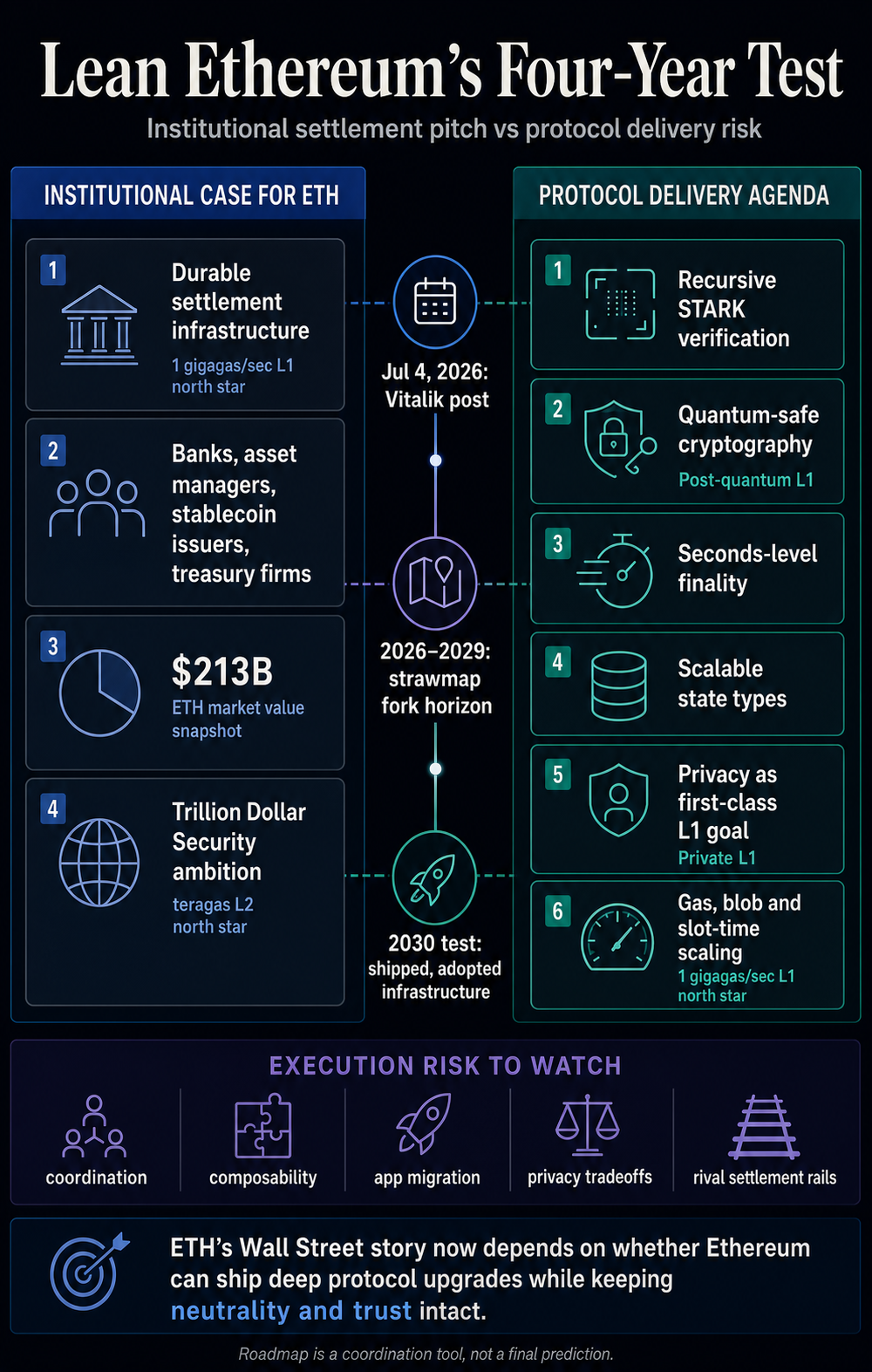
Infographic comparing Ethereum's institutional settlement case with Lean Ethereum's protocol delivery agenda and execution risks.

The Institutional Pitch Meets Protocol Change

Ethereum’s Wall Street moment has already been moving beyond spot-market access. That pitch now reaches banks, asset managers, stablecoin issuers, tokenization desks, and public companies that treat ETH as a balance-sheet asset or Ethereum as settlement infrastructure.

The Ethereum Foundation’s 2025 Trillion Dollar Security initiative framed that ambition directly. Ethereum wants to become infrastructure secure enough for individuals, companies, institutions, and governments to hold very large amounts of value on-chain.

That is the institutional promise Lean Ethereum now has to serve.

New BlackRock report exposes a historic shift in crypto that leaves only one blockchain controlling the settlement layerNew BlackRock report exposes a historic shift in crypto that leaves only one blockchain controlling the settlement layer
Related Reading

New BlackRock report exposes a historic shift in crypto that leaves only one blockchain controlling the settlement layer

Stablecoins are going mainstream, and Ethereum is positioning itself as the place those dollars ultimately settle.

Jan 10, 2026 · Andjela Radmilac

The timing is not accidental. Ethereum Institutional launched as a corporate front door for banks, asset managers, public companies, tokenization, and stablecoins, while Ethlabs emerged as a treasury-backed R&D layer tied to the ETH monetary case.

Bitmine, Sharplink, and Joe Lubin sit behind both efforts, creating a new external stack around Ethereum’s institutional push while the Foundation tries to preserve a neutral protocol role.

JPMorgan taps both Ethereum and Solana for separate reasons for its institutional cash stackJPMorgan taps both Ethereum and Solana for separate reasons for its institutional cash stack
Related Reading

JPMorgan taps both Ethereum and Solana for separate reasons for its institutional cash stack

JPMorgan’s latest tokenized money market fund filing offers a map of how the institutional cash leg of crypto may split across public chains.

May 13, 2026 · Gino Matos

That context makes Lean Ethereum more than a technical wish list. If ETH is to be sold as durable settlement collateral, the roadmap has to reduce uncertainty rather than add a new kind of it.

CryptoSlate market data on July 5 showed ETH trading near $1,763, with a market value of roughly $213 billion. The asset is large enough for protocol direction to matter, but still exposed enough for institutions to care about execution risk.

For banks and treasurers, this is a different due diligence problem from buying an asset with a volatile chart. They need to judge whether the base layer’s next architecture can keep settlement predictable while applications, wallets, clients, L2s, and privacy tooling adjust around it.

A strong roadmap helps only if it produces a credible path from today’s Ethereum to a more scalable and secure version of the same neutral network. That is the terrain Lean Ethereum now enters.

Why The Upgrade Stack Matters

Buterin’s post grouped Lean Ethereum around several changes that are easy to miss if they are dismissed as research jargon.

Recursive STARKs would shift verification away from direct re-execution and toward proofs that can make checking the chain cheaper and more scalable. For institutions, that goes to confidence in the system’s auditability and long-run operating cost.

Quantum-safe cryptography is a different kind of bet. It addresses whether assets and applications meant to live for decades can rely on signature and proof systems that will age well. The strawmap’s post-quantum L1 north star makes that a protocol-level concern.

The finality and gas-limit pieces are more immediately operational. Faster finality changes how quickly a transaction can be treated as settled.

Repeated gas-limit increases, blob increases, and shorter slot times affect how much activity Ethereum can absorb without pushing users and applications elsewhere. The strawmap’s gigagas L1 and teragas L2 goals are ambitious, but the institutional read is straightforward: if Ethereum wants to carry more settlement flow, it has to make capacity feel less scarce.

State is the most disruptive part of the plan because it touches application design. Buterin described a future in which today’s dynamic state remains, but grows only moderately, while new state types scale much further with tighter design constraints.

That could make ERC-20s, NFTs, and many DeFi use cases cheaper if they adapt, while more complex shared contracts continue to rely on dynamic state.

That makes the state plan a migration-incentive story. If new state designs can materially lower fees for common assets, application developers will have reason to move.

If those designs fragment liquidity, composability, or developer expectations, the savings come with tradeoffs. This is where the institutional settlement case becomes as much a product and governance problem as a cryptography problem.

Privacy sits in the same category. Buterin said privacy is now a first-class goal, and the strawmap lists private L1 as one of its north stars.

For institutional workflows, privacy is an operating requirement. Banks and asset managers need confidentiality, compliance controls, and predictable settlement.

Ethereum also has to preserve public verifiability and credible neutrality. Lean Ethereum’s privacy work has to thread those requirements while keeping the base layer usable.

The Risk Is Coordination

The strawmap is careful about its own authority. It says that an official roadmap that reflects every Ethereum stakeholder is effectively impossible, and that rough consensus is emergent and uncertain.

CryptoSlate Daily Brief

Daily signals, zero noise.

Market-moving headlines and context delivered every morning in one tight read.

5-minute digest 100k+ readers

Free. No spam. Unsubscribe any time.

Whoops, looks like there was a problem. Please try again.

You’re subscribed. Welcome aboard.

It also says the plan is a coordination tool, not a prediction, and that timelines should be treated with skepticism.

Ethereum Foundation cuts 20% of staff as ETH sinks 44% YTD despite record usageEthereum Foundation cuts 20% of staff as ETH sinks 44% YTD despite record usage
Related Reading

Ethereum Foundation cuts 20% of staff as ETH sinks 44% YTD despite record usage

The Ethereum Foundation cut 54 jobs and narrowed its mandate as record user activity collided with falling fees and a 44% decline in ETH.

Jun 24, 2026 · Oluwapelumi Adejumo

Those caveats are the reason the roadmap matters. Ethereum’s institutional appeal has always depended partly on its refusal to become a corporate-controlled settlement network.

The same neutrality that makes Ethereum useful to competing market participants also complicates protocol delivery compared to a private platform roadmap.

Lean Ethereum therefore creates two simultaneous messages. The positive message is that Ethereum is trying to harden itself for a world of higher value, more proofs, cheaper verification, larger state, stronger privacy, and eventual quantum risk.

The harder message is that the network is asking users and institutions to accept deep transition risk while that work happens.

That risk reaches beyond fork timing. It includes whether app developers understand the new state model, whether wallet and infrastructure teams can absorb protocol changes, whether users keep trust through transitions, whether L2s and the L1 roadmap remain aligned, and whether governance can prioritize difficult upgrades without turning the process into a battle among power centers.

A multi-fork plan can miss its goal in smaller ways even when individual upgrades ship. Capacity can rise while application architecture lags. Privacy can improve while compliance teams still prefer permissioned rails.

New state designs can lower fees for common assets while complex contracts remain anchored to older assumptions. That is why institutional adoption will be measured through usage and migration as much as roadmap publication.

The institutional lens sharpens the test. A private settlement network can promise a clean product timeline, even if it sacrifices openness. A rival public ecosystem can compete on simpler throughput or cheaper execution.

Ethereum’s answer is that public, neutral settlement can still evolve fast enough to carry serious financial infrastructure. Lean Ethereum makes that answer more concrete and easier to measure.

What The Next Four Years Test

The next signal is a sequence of shipped changes and developer responses: what lands in Glamsterdam and Hegota, how I-star and later forks take shape, whether gas and blob capacity rise safely, how finality work progresses, and whether application teams treat new state designs as useful rather than disruptive.

If Ethereum performs well, Lean Ethereum strengthens the investment case for ETH by making ETH’s settlement role more credible.

Faster finality, cheaper verification, privacy, post-quantum planning, and scalable state would make Ethereum look less like a mature chain defending its legacy position and more like infrastructure still capable of compounding.

If the process stalls, the same roadmap becomes a liability. Institutions may not wait indefinitely for public infrastructure to become faster, more private, cheaper, and quantum-safe.

Stablecoin issuers, tokenization platforms, and treasury firms can route workflows toward systems that offer more predictable near-term deployment, even if those systems are less neutral.

That is the real change Lean Ethereum brings to ETH’s Wall Street story. It gives institutions a more rigorous technical explanation of why Ethereum could remain the settlement layer for high-value digital assets. It also gives them a clearer checklist for doubt.

Over the next four years, Ethereum has to turn that roadmap into shipped, adopted infrastructure without losing the qualities that made a neutral public chain worth institutional attention in the first place.



Source link

Fake Mac Clipboard App Delivers New Password-Stealing Malware – Decrypt

Fake Mac Clipboard App Delivers New Password-Stealing Malware – Decrypt


In brief

Jamf Threat Labs identified a new Rust-based macOS infostealer posing as the Maccy clipboard manager.
The malware validates victims’ passwords through macOS PAM before stealing them.
Researchers also spotted ClickFix-style malware delivered through a sponsored advertisement on X.

Mac users searching for the open-source clipboard manager Maccy are being targeted by a fake version of the app that installs a new Rust-based infostealer dubbed PamStealer, according to cybersecurity firm Jamf Threat Labs. If successful, the malware could steal users’ passwords and crypto wallet keys.

In a report published on Thursday, Jamf Threat Labs said the campaign uses a lookalike website to distribute a disk image containing a malicious AppleScript file named Maccy.scpt. When opened, the file displays instructions telling users to run it in Apple’s Script Editor while hiding the malicious code further down the document.

“We are tracking this malware under the name PamStealer after one of its core behaviors: validating the victim’s login password through the macOS Pluggable Authentication Modules (PAM) before harvesting it,” Jamf Threat Labs wrote.

From there, the malware uses JavaScript for Automation and native macOS APIs to download a second-stage payload without relying on common shell utilities such as curl or zsh, reducing the number of processes security tools can observe.


“With many stealers, we have seen attackers purchasing Google Ad space to lure users to the malicious app. We have recently observed malicious ads being hosted on X as well,” Jamf Threat Labs Director Jaron Bradley told Decrypt. “These social engineering techniques have proven to be highly successful.”

According to the report, the second stage is a Rust-based binary designed for Apple Silicon Macs that disguises itself as Finder or Software Update.

“Rather than storing its configuration in cleartext, the dropper derives a key from a fingerprint of the host—including its CPU architecture, locale, keyboard layout, and time zone—and uses it to unlock an encrypted, integrity-checked configuration containing the payload URL and installation path,” the company said.

Once installed, the malware can steal browser credentials and Keychain data, monitor clipboard contents, establish persistence, and send stolen information to a remote command-and-control server using encrypted communications. If it can’t verify that it’s running on its intended target, then it quietly shuts itself down.

The malware also attempts to expand its access by displaying a fake Finder alert asking users to grant Full Disk Access. The prompt can appear up to 40 minutes after infection, making it less likely that users will associate it with the original download. If approved, the malware can access protected data, including Mail, Messages, and Time Machine backups.

According to Bradley, Jamf has not observed any evidence that PamStealer is active in the wild; however, the company notified Apple of its findings. Apple did not immediately respond to a request for comment by Decrypt.

Jamf said it is seeing similar social engineering techniques spread to other platforms. 

In an X post last week, the company said it was investigating a sponsored advertisement on X promoting DynamicLake that redirected users to dynamicmacisland[.]com, where they were instructed to open Terminal and execute an installation command.

“The advertisement was delivered through a verified X account, adding another layer of trust to the social engineering,” the firm wrote. “Analysis of the payload revealed a recent Atomic (MacSync) Stealer variant.”

The findings come as attackers increasingly disguise malware as legitimate software and abuse trusted developer platforms and advertising channels. Recent campaigns have included a fake OpenAI repository that reached the top of Hugging Face’s trending projects before distributing a Rust-based infostealer, a malicious Visual Studio Code extension that GitHub said exposed roughly 3,800 internal repositories, and the Shai-Hulud software supply-chain campaign targeting development tools used by AI companies including OpenAI and Mistral AI.

Daily Debrief Newsletter

Start every day with the top news stories right now, plus original features, a podcast, videos and more.


Source link

Bitcoin to $53K? Exchange Deposits Jump as Analysts Warn of Increased Volatility – Decrypt

Bitcoin to K? Exchange Deposits Jump as Analysts Warn of Increased Volatility – Decrypt


In brief

Bitcoin deposits spiked to nearly 50,000 BTC per day in the last week, CryptoQuant said.
The average size of deposits doubled to approximately 2 BTC, pointing to action from institutional and whale investors.
Historically, this level of deposits has preceded sharp price volatility.

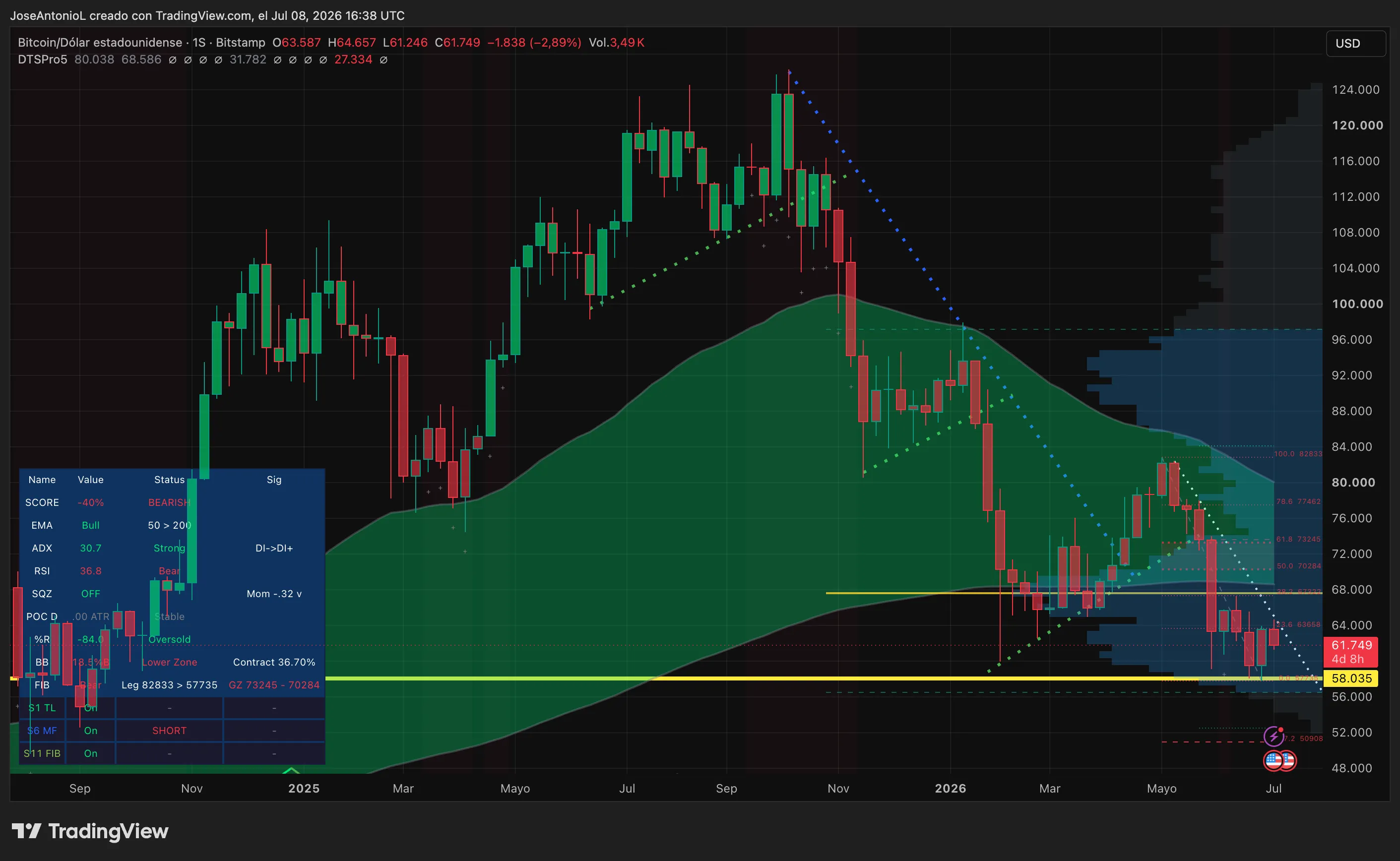
Bitcoin deposits to centralized exchanges—often a precursor for sales—spiked in the last week as BTC fell below $60,000, according to data gathered by blockchain analytics firm CryptoQuant

Deposits of the top crypto asset reached nearly 50,000 BTC a day, hitting that mark for only the fourth time thus far this year. In all other instances, it led to a significant increase in price volatility, according to the firm. 

“The spike coincides with Bitcoin testing the critical $60K support level, which, if breached, could take Bitcoin towards $53K, the realized price,” the CryptoQuant report from Thursday reads. “At these inflow levels, the market is absorbing a large volume of Bitcoin being repositioned to exchanges, a pattern that has historically preceded significant directional moves.” 

It wasn’t just the quantity of deposits increasing, but the size of them as well. During the period the average Bitcoin deposit approximately doubled from 1 BTC to 2 BTC, an indicator that the deposit surge is being driven by whales and institutions, not retail traders, the firm said. 


In the past, this indicator has preceded downward price movement. 

“Historically, a spike in average deposit size from larger entities is a more bearish signal than high inflow volume alone, as it indicates deliberate repositioning rather than routine activity,” the report notes.

Bitcoin’s peers were not spared, with Ethereum daily inflows peaking at 1.25 million per day and other altcoin deposit transactions also jumping considerably to more than 45,000 per day. Their respective spikes further support the likelihood of a period of increased volatility for the crypto market.

“Historically, surges in altcoin deposit transactions have marked inflection points for crypto prices and signaled increased volatility ahead,” the report notes. “This signal already played out precisely in 2026: Bitcoin’s decline from $82K in early May to below $58K in late June was preceded by a similar spike in altcoin deposits above 45K.” 

After spending some time below $60,000, Bitcoin has rebounded moderately this week, jumping 3.5% to trade at $62,886. As it stands, BTC is now just over 50% off its October all-time high of $126,080. 

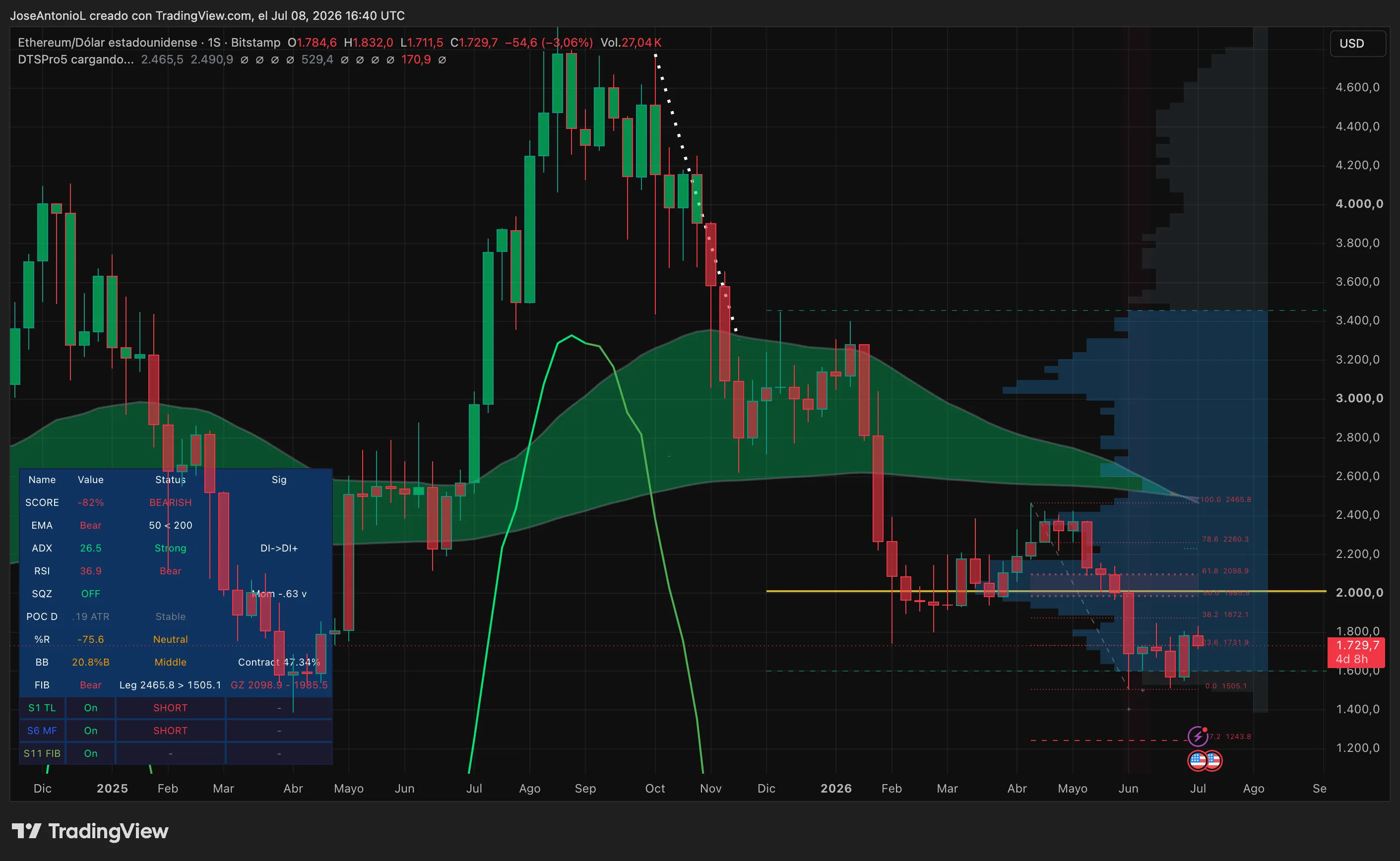
Meanwhile, Ethereum gained nearly 12% this week to change hands at $1,787—about 64% off its all-time high of $4,946.

Daily Debrief Newsletter

Start every day with the top news stories right now, plus original features, a podcast, videos and more.


Source link

Perplexity Co-Founder: AI Safety Is an Excuse to Lock Down Frontier – Decrypt

Perplexity Co-Founder: AI Safety Is an Excuse to Lock Down Frontier – Decrypt


In brief

Andy Konwinski, who cofounded Databricks and Perplexity AI, argued this week that concentrating AI power is a safety risk in itself.
The essay followed Open Frontier, a working meeting of roughly 100 researchers in San Francisco on June 30.
Turing Award winner Yann LeCun replied directly on X, comparing today’s closed-lab AI moment to “medieval obscurantism akin to the Ottoman empire banning the use of the printing press for 200 years.”

Perplexity AI and Databricks co-founder Andy Konwinski thinks the AI safety conversation has a problem: It’s being used to concentrate power, not prevent harm. Earlier this week, he published an essay making his case, with Anthropic as the star witness.

The case he builds starts with a decision Anthropic reversed in 48 hours. When Anthropic launched Claude Fable 5 on June 9, a paragraph buried in its 319-page system card disclosed that the model would silently degrade its own responses for anyone it suspected of training a competing AI.

Researchers found it. The internet did not take it well.

Anthropic walked it back, but for Konwinski this makes no difference when analyzing the bigger picture. “The problem isn’t that Anthropic made a bad decision,” he wrote. “The problem is that they assumed the decision was theirs to make.”

His essay, titled “Concentration of power in AI is a risk, not a solution,” followed Open Frontier, a working meeting he convened through his nonprofit Laude Institute at San Francisco’s Exploratorium on June 30. About 100 researchers showed up.

UC Berkeley dean Jennifer Chayes, who runs the College of Computing, Data Science, and Society, told a funding panel that Berkeley researchers are “all building on Chinese models because we don’t have a Western open frontier model”—and that the safety messaging from OpenAI and Anthropic ahead of their IPOs amounted to a “very effective fear campaign.”

Konwinski’s argument is that centralizing access doesn’t neutralize risk; it creates a different one. AI is foundational infrastructure—in the same category as railroads, electricity, and the internet. Those technologies reorganized society around whoever controlled the underlying layer. The same is coming for AI. His alternative: a research commons with frontier-scale compute that lets top researchers reach the frontier without needing permission from a private lab to do it.

LeCun: It’s the Ottoman empire banning the printing press

Yann LeCun, Meta’s former chief scientist, replied to Konwinski’s essay on X with no ambiguity. “I’ve been disseminating a similar message for years,” he replied on Konwinski’s post. “The concentration of power in AI and the desire for control is by far the biggest danger of AI.”

He also had a historical comparison ready. “It’s a kind of medieval obscurantism akin to the Ottoman empire banning the use of the printing press for 200 years, in part to keep control of the dogma, but also to protect the corporation of the calligraphers and scribes,” LeCun wrote.

LeCun’s prediction for where this ends: “Infrastructure wants to be open. Foundation models are becoming an infrastructure and will inevitably become commoditized. Long term, the money is in the application layer.”

LeCun left Meta in late 2025 and launched AMI Labs in Paris with $1.03 billion in seed funding in March 2026—his own answer to the question. The company runs on world models and his JEPA architecture, plans to open-source its research, and has no commercial product expected for years.

Daily Debrief Newsletter

Start every day with the top news stories right now, plus original features, a podcast, videos and more.


Source link

Inside the Trading Engine Behind ChangeNOW’s ‘Fast, Seamless Swaps’ – Decrypt

Inside the Trading Engine Behind ChangeNOW’s ‘Fast, Seamless Swaps’ – Decrypt


In brief

Crypto exchange ChangeNOW offers “fast, seamless crypto swaps with simplified onboarding.”
The exchange’s “trading engine” acts as a middleman between users and exchanges, executing swaps from its own liquidity so customers never touch order books or fees, CSO Pauline Shangett explained.
New features include private transfers, a Permanent Exchange Address, a crypto payment link and a prediction markets hub.

Open ChangeNOW and a crypto swap looks like the simplest thing in the world: pick two tokens, send one, receive the other—a process the non-custodial exchange says usually completes within minutes, across more than 110 blockchains including ETH, BSC and SOL.

It’s quick, streamlined—and, according to Chief Strategy Officer Pauline Shangett—underpinned by layers of dedicated infrastructure, supporting more than 70 fiat options and over 1,500 digital assets, with more added weekly.

ChangeNOW is “a trading engine that a lot of people can access all at once,” Shangett said. The platform, she explained, acts as a middleman between the user and a centralized or decentralized exchange, executing trades on a client’s behalf “without the client having to watch over things like the order book, transaction fees and complicated interfaces.”

That engine leans heavily on its own inventory. Shangett said ChangeNOW “mostly operates in our own liquidity when it comes to swaps,” pricing trades off exchange order books it sources liquidity from, market-data feeds such as CoinMarketCap, and an in-house “liquidity engine” of wallets holding balances for specific pairs. Running off its own reserves, she argued, means “network speed is not as much of a liability as it could be.”

In a recent benchmark by swap aggregator Swapzone, drawing on 150,000 transactions, ChangeNOW’s median settlement for a USDT-to-ETH swap clocked in at under a minute, against an industry median of around 45 minutes.

ChangeNOW CSO Pauline Shangett. Image: ChangeNOW

Of course, such comparisons hinge on the pairs and conditions tested, with ChangeNOW offering swaps across a wide range of tokens including meme coins, AI coins, DeFi, GameFi, stablecoins, privacy coins, DePIN, and RWA.

Fiat currency support operates through “trusted partners” including Transak, Simplex, Banxa, and Guardarian, enabling ChangeNOW users to buy crypto with Visa, MasterCard, Google Pay, Apple Pay, FasterPay, Sepa, Pix, ACH, and Revolut.

New features

ChangeNOW has rolled out a set of new tools that extend its offering beyond simple swaps. Private transfers route a transaction so the sender’s wallet address and on-chain trail aren’t exposed to the recipient, while still maintaining AML monitoring in the background. Users can also generate a Permanent Exchange Address that provides a fixed, reusable deposit address that automatically converts any incoming crypto into a preselected payout coin, aimed at recurring conversions.

Meanwhile, a new crypto payment link lets users spin up a shareable link to request or accept payments in Bitcoin, stablecoins, and more than 100 other assets. And a prediction markets hub pulls popular markets across crypto, politics, finance, and pop culture into one place to track and compare.

Push it to the limit

Demand shocks are managed by geography. Shangett cited the 2021 Dogecoin frenzy, a Monero liquidity crunch, and the more recent TRUMP token launch as stress tests. Because the team spans time zones, it’s able to pre-position inventory, she explained. “We get extra liquidity for that particular token for when American users wake up,” she said, adding that those surges are when ChangeNOW “sets our transaction records.”

On thinly traded or volatile pairs, Shangett said “we actively manage liquidity to ensure stability,” so the platform sometimes imposes minimum or maximum trade sizes—though when minimal amounts are required, they are “incredibly low,” running to as little as $2. When Ethereum congests, the fix is blunt—”adjusting the network fee,” which she said ChangeNOW sometimes absorbs. During chain halts, forks or hacks, “we provide real-time alerts” that swaps on networks like BNB Chain or Solana may run slow.

The exchange is “proud” to point to its 4.6 rating on Trustpilot, based on more than 13.000 reviews, as evidence that its approach is working, while offering 24/7 support in the event of hiccups.

That support structure includes an “L0” community team on social channels, “L1” handling chat and email tickets, escalating to L2 and then to L3 engineers “on call pretty much 24/7,” Shangett said. Emergencies trigger “an all-hands, rapid-response protocol” that activates L3 and L4 engineers—but “most of them can be solved by either our compliance department or L2 engineers.”

Future facing

Asked what she’s proudest of that goes unreported, Shangett named the platform’s cross-DEX bridging—”a lot cheaper and a lot faster than a traditional decentralized cross-chain bridge”—and its private transfers, which operate across both B2B and B2C transfers, as well as in the platform’s self-custody wallet, NOW Wallet.

“We’ve always been huge privacy nuts,” she said. “It allows people to send funds to basically anybody without doxing their initial wallet address, which might be critical for legal entities or high net worth individuals, or just people who care about their privacy a lot, and we’ve seen quite a lot of use of this feature since its release.”

Simplicity is a work in progress, with ChangeNOW constantly working to improve its offering, Shangett said. Some of that streamlining is taking place in the back end, with the exchange “upgrading our strong foundation to make it even better,” she said. The focus is on incremental improvements, she added, geared towards making the platform “a little bit faster, a little bit more optimal, a little bit safer, and more secure.”

Daily Debrief Newsletter

Start every day with the top news stories right now, plus original features, a podcast, videos and more.


Source link

Chandigarh University Uttar Pradesh Introduces 17 New-Age Academic Programs in Emerging Domains to Nurture a Futuristic Workforce | Web3Wire

Chandigarh University Uttar Pradesh Introduces 17 New-Age Academic Programs in Emerging Domains to Nurture a Futuristic Workforce | Web3Wire


Cutting-edge programmes across Engineering, Management, Computer Applications, Liberal Arts, Sciences, Fashion and Law aim to prepare future-ready professionals,

CHANDIGARH, India, July 4, 2026 /PRNewswire/ — Chandigarh University Uttar Pradesh, positioned as India’s first AI-augmented multidisciplinary university, has introduced 17 new academic programmes from the 2026 academic session onward, including 5 postgraduate and 12 undergraduate courses across Engineering, Arts, Computer Applications, Sciences, Fashion, Law and Management. The expansion reflects the university’s stated focus on aligning higher education with emerging industry needs and preparing students not only for degrees, but for technology-driven careers in a rapidly changing global environment.

Designed as a campus that seeks to reimagine learning in the age of machine intelligence, the university says the new programmes are intended to help students build future-ready skills, adapt to changing workforce requirements and access global career opportunities. The larger academic approach is built around multidisciplinary learning, AI integration and industry relevance.

In addition to launching new programmes, Chandigarh University Uttar Pradesh has expanded its industry-linked academic offerings through collaborations with AON for MBA in Strategic HR and Deloitte for BBA (Hons.) in Business Analytics. The university has also highlighted that it is already offering multiple industry-collaborative programmes with leading Indian and global partners in emerging domains.

New Programmes Across Key Domains

Engineering and Technology

To address growing demand in advanced technology and automation, the university has introduced B.Tech in Aerospace Engineering, B.Tech in Robotics and Automation, and B.Tech (Hons.) CSE in IoT and AI. These programmes are designed to expose students to areas such as artificial intelligence, automation, robotics, smart systems and next-generation technologies.

The Aerospace Engineering curriculum is designed to include advanced themes such as machine learning, deep learning and digital twins, while integrating mechanical, electrical, electronics and computer engineering to support the development of smart machines and automated systems. The B.Tech (Hons.) CSE programme in IoT and AI is aimed at building capabilities in interconnected systems, data analytics, embedded systems and Industry 4.0 applications. The M.Tech in Computer Science and Engineering (Data Science) is intended to strengthen advanced skills in big data, machine learning, predictive modelling and applied data analysis.

Management and Business

The university has also introduced an MBA in Human Resources with a focus on developing professionals who can align people strategy with organisational goals and respond to evolving workplace challenges. The programme is designed to emphasise experiential learning, industry engagement and practical exposure to tools such as R, SQL, Python and Tableau, while familiarising students with AI-driven business applications.

Computer Applications and AI

In response to rising demand for digital and AI-enabled careers, Chandigarh University Uttar Pradesh has launched BCA in AI and Machine Learning and MCA in Data Science. These programmes are positioned around machine learning, data analytics, cloud technologies, full-stack programming and AI applications, with exposure to tools and frameworks such as Python, TensorFlow and PyTorch. The MCA in Data Science is intended to combine conceptual depth with practical learning through datasets, live projects, analytics training, research and innovation exposure.

Liberal Arts and Psychology

The newly introduced BA (Hons.) Liberal Arts and BA (Hons.) Psychology programmes are aimed at strengthening critical thinking, communication, behavioural understanding and social awareness. The Liberal Arts curriculum is intended to support human-centred thinking in an AI-enhanced environment, while the Psychology programme is designed to cover areas such as clinical psychology, developmental psychology, neuropsychology and counselling, alongside contemporary themes including social media psychology, AI and psychology, and cyber psychology.

Hospitality, Aviation and Hotel Management

The university has also expanded into service-sector education with B.Sc. programmes in Hospitality and Hotel Management and Airlines and Airport Management. These programmes are designed to prepare students for opportunities in hospitality, customer service, travel, aviation and airport operations through practical and industry-oriented learning.

Science and Research

Recognising growing opportunities in research and health sciences, Chandigarh University Uttar Pradesh has introduced B.Sc. Microbiology and M.Sc. Biotechnology. The Biotechnology programme is positioned as a research-focused postgraduate course with emphasis on genomics, molecular biology, bioprocess technology and bioinformatics, while the Microbiology curriculum is designed to connect core scientific learning with practical application.

Legal Studies

To strengthen advanced legal education, the university has introduced a one-year LL.M. programme with specialisation pathways in constitutional law, business law, criminal law and human rights. The programme is intended to prepare graduates for roles in legal practice, academia, judiciary-related work, corporate advisory and policymaking.

Broader Academic Vision

Through these 17 newly introduced programmes, Chandigarh University Uttar Pradesh is seeking to position education as more than a degree-granting exercise. The broader institutional objective is to connect academic learning with employability, technology adoption, industry exposure and global readiness. In an environment where employers increasingly value adaptability, digital fluency and practical capability, such programme expansion reflects the growing shift toward future-oriented higher education.

Jai Inder Sandhu, Managing Director Chandigarh University Uttar Pradesh said, “After getting over whelming response in first academic year itself, India’s first AI-Augmented Multidisciplinary University, Chandigarh University Uttar Pradesh has introduced 17 new academic programs from 2026 academic session, This New age industry aligned programs would be instrumental in nurturing future ready workforce in Emerging domains.”

The launch of these programmes reflects a larger attempt to align higher education with the realities of an economy increasingly shaped by artificial intelligence, data, automation and multidisciplinary problem-solving. By expanding options across technology, management, sciences, humanities and law, the university aims to create a wider talent base for emerging industries in India and beyond.

About Chandigarh University Uttar Pradesh (Lucknow)

Envisioned to foster a culture of sustainability and empower future global leaders, Chandigarh University, Uttar Pradesh, immerses 21st-century learners in a personalised and experiential learning experience, integrating an AI-powered academic model and a multidimensional, futuristic perspective on education. Our Uttar Pradesh campus carries forward the venerable legacy of more than a decade of Chandigarh University, Punjab, which has established itself as India’s No. 1 Private University and a torchbearer of groundbreaking pedagogy and research-driven innovation. The AI-augmented new campus offers a broad spectrum of industry-driven futuristic academic programs encompassing data-driven insights, virtual reality experiences, real-world simulations, corporate mentorship, international perspective, interdisciplinary research, cultivation of entrepreneurial spirit, and professional competencies.

Website address: https://www.culko.in/

Photo: https://web3wire.org/wp-content/uploads/2026/07/Chandigarh_University_Lucknow_Campus.jpg

View original content to download multimedia:https://www.prnewswire.com/in/news-releases/chandigarh-university-uttar-pradesh-introduces-17-new-age-academic-programs-in-emerging-domains-to-nurture-a-futuristic-workforce-302817878.html


Source link

Claude Fable 5 Isn’t Nerfed. The Router Is Just Paranoid – Decrypt

Claude Fable 5 Isn’t Nerfed. The Router Is Just Paranoid – Decrypt


In brief

BridgeBench’s debugging score for Claude Fable 5 dropped from 86.2 to 25.9 after its July 1 reinstatement—but the collapse came from the safety classifier routing most tasks to Opus 4.8, not from the model getting dumber.
Arena.AI ran thousands of blind human-preference votes and found Fable 5’s performance mostly flat versus the June version, with some categories—document and expert text—actually improving after reinstatement.
Anthropic has acknowledged its new classifiers will produce false positives on routine coding and debugging, and says the system will be refined over time—but has given no timeline.

Claude Fable 5 came back online July 1, and the verdict on social media was not nice: broken, nerfed, lobotomized, underperforming, not the same model.

The criticism from users was resounding. Then, two benchmarks—BridgeBench AI and Arena AI—published data the same day and reached opposite conclusions. One found a severe quality degradation in the outputs, the other found differences so small they may not be relevant enough to notice.

Both of them, in their own way, are correct.

The short version: The model didn’t get dumber. The gatekeeper in front of it got much more aggressive. That distinction matters a lot depending on what you use Fable for.

What BridgeBench actually measured

BridgeMind—an AI evaluation platform—re-ran its full coding suite against the July 1 version of Fable 5 the day it came back.

BridgeBench tests real-world coding tasks across categories including debugging, refactoring, and hallucination resistance, scored 0–100 on how well the model completes each category. The results were grim on paper: Debugging fell from 86.2 to 25.9, Refactoring from 73.6 to 38.4, and Hallucination resistance from 75.9 to 61.7.

The catch is in the methodology. Of 12 TypeScript debugging tasks, only three actually reached Fable 5. The remaining nine were intercepted by Anthropic’s new safety classifier and rerouted to Claude Opus 4.8—and BridgeBench scores every fallback as zero, because the model that answered wasn’t the one under evaluation.


The classifier, deployed as a condition of Fable’s reinstatement, was trained to block the Amazon-reported jailbreak technique—one that got Fable 5 to identify and demonstrate software vulnerabilities. It works. It also catches a lot of things it shouldn’t. Debugging TypeScript looks enough like “security work” to the classifier that the fallback fires constantly.

What Arena.AI actually measured

Arena.AI, an LLM benchmarking and comparison platform, ran the same question through a different lens. The platform collects thousands of blind human-preference votes across multiple categories—text, vision, document, code, and agent—and ranks models using Elo scoring, the chess-derived rating system that adjusts for statistical uncertainty across thousands of head-to-head matchups. When two models go head-to-head anonymously and humans pick a winner, the score reflects actual perceived quality, not infrastructure routing.

The before-and-after comparison showed Fable 5 largely holding its ground. Frontend code dropped from 1650 to 1623 Elo—a difference Arena noted is within the confidence interval as data keeps accumulating. Document performance improved by 34 points. Expert text went up 25. Creative writing edged up slightly by 9. The categories that declined: Coding at -18, hard prompts at -3—are precisely where the classifier is most likely to intercept the prompt before Fable can answer.

In other words, when Fable 5 actually handles the task, it still performs like Fable 5. The frustration on X isn’t about a worse model but more about paying for a model that often isn’t the one answering.

Who’s affected, who isn’t

General users doing creative writing, document analysis, research, and expert-level text queries will likely notice little to no difference. Those are the categories where Arena.AI shows flat or improved performance. If there is some improvement, it might be too small to notice, especially in subjective, qualitative tasks like creative writing, where it is hard to fully measure results.

So, basically, writers, researchers, and analysts will get the Fable 5 they expected. Developers are a different story.

Anyone working in security-adjacent territory—coding memory management, anything touching words like “vulnerability,” “exploit,” “hook,” or even “fix”—is going to hit the fallback regularly.

The gap between BridgeBench’s collapse and Arena’s stability comes down to task type. BridgeBench loads its suite with exactly the kind of code-repair and debugging prompts that trigger the new classifier. Arena’s human voters ask a much wider mix of things, and most of them don’t look like exploit code to a safety layer.

Anthropic has said the classifiers will improve over time, acknowledging they currently cast too wide a net. The original ban came after Amazon researchers found a technique to get Fable to identify and demonstrate software vulnerabilities—and the U.S. government treated that as a national security threat. The fix was to make the classifier conservative enough to catch that and everything around it, then tune it down later.

Anthropic has given no target date for when that will happen.

Daily Debrief Newsletter

Start every day with the top news stories right now, plus original features, a podcast, videos and more.


Source link

Zcash Ironwood Upgrade Nears as Developers Work to Restore Confidence After ZEC Crash – Decrypt

Zcash Ironwood Upgrade Nears as Developers Work to Restore Confidence After ZEC Crash – Decrypt


In brief

Zcash developers say the Ironwood upgrade is nearing testnet activation.
Work continues on a formal proof of soundness ahead of the network upgrade.
Shielded Labs says migrating exchanges, wallets, and mining pools to new software remains the biggest deployment challenge.

In a series of posts on the Zcash forum on Thursday, developers said the privacy-focused cryptocurrency’s Ironwood upgrade is moving closer to activation—first on a testnet—bringing the network a step nearer to allowing users to verify the integrity of its circulating supply following last month’s disclosure of a critical counterfeiting vulnerability.

Announced in June, Ironwood is a proposed Zcash network upgrade that introduces a new shielded pool and accounting system designed to let anyone verify the network’s circulating supply while preserving transaction privacy.

The upgrade is intended to eliminate the uncertainty exposed by the Orchard vulnerability in May, which left developers unable to prove whether counterfeit ZEC had ever been created.

The panic around the vulnerability disclosure led to a massive price drop for the coin, which lost more than half of its value in a matter of two days, falling from more than $600 to a recent bottom around $300. ZEC has made up about half the losses so far, recently trading at $457, per data from CoinGecko.

“At Shielded Labs our focus has been security, and in particular our new project, which we are calling Zero, of supporting enterprise users (e.g. mining pools, exchanges, and wallets),” Zcash co-founder Zooko Wilcox wrote. “Our current focus within the Zero project is to help them prepare to safely make the transition to Ironwood.”

The update comes weeks after security researcher Taylor Hornby, using Anthropic’s Claude Opus 4.8, uncovered a four-year-old flaw in Zcash’s Orchard shielded pool that could have allowed unlimited counterfeit ZEC to be created without detection.

Although developers patched the bug on June 1, Zcash’s privacy features meant there was no cryptographic way to determine whether it had ever been exploited, which led Zcash developers to propose Ironwood to eliminate that uncertainty.

Since then, Zcash developers say they have made significant progress on Ironwood activation in Zcash.


“Ironwood’s prompt and safe activation on Zcash mainnet is extremely important to our users, in addition to the formal verification work we’re doing in parallel to provide reassurance that there aren’t any supply integrity concerns,” Zcash developer Sean Bowe wrote on X on Thursday, adding that “sufficient hash rate is signaling technical readiness for the mainnet upgrade.”

“The outstanding concern is that some wallets will not be prepared for the upgrade in time,” Bowe wrote. “This does not justify delaying Ironwood, given there will be adequate alternatives and sufficient time on testnet for anyone who needs it.”

Jason McGee of Shielded Labs said development is focused on two parallel efforts: the Ironwood (NU6.3) network upgrade, and migrating the Zcash ecosystem from its legacy Zcashd software to the new Z3 stack, which includes the Zebra full node, the Zaino indexing service, and the Zallet wallet.

According to McGee, development is moving forward on schedule, and testnet activation of the new consensus rules “is expected shortly.”

“The current goal is to complete both efforts by late July,” McGee wrote. “With regard to Ironwood, the teams at Project Tachyon, Valar Group, ZODL, the Zcash Foundation, and Shielded Labs have been working hard and have made significant progress over the past several weeks.”

Work is also continuing on formal verification of the new circuit, McGee added, with the goal of completing a proof of soundness before Ironwood activates.

The larger challenge, McGee said, is preparing infrastructure providers for the transition to the new software stack. Key Z3 components, including Zallet and Zaino, are still under development, leaving exchanges, mining pools, and wallet providers with limited time to deploy and test everything before Ironwood activates.

“The consistent feedback we’ve received is that completing both the Ironwood upgrade and the migration to Z3 on the current timeline will be challenging,” McGee wrote, adding that a recent questionnaire had some respondents “indicating they’ll be ready while others said they need additional time.”

According to McGee, several options are being considered to reduce deployment risk, including delaying Ironwood, conducting independent third-party security audits before deployment, or temporarily supporting Ironwood through Zcashd while partners complete the migration.

“Ultimately, we all share the same goal to activate Ironwood as quickly as possible while making sure our partners can safely migrate away from Zcashd,” he wrote. “We think the focus over the coming weeks should be on making that transition as smooth and secure as possible.”

Daily Debrief Newsletter

Start every day with the top news stories right now, plus original features, a podcast, videos and more.


Source link

Popular Posts

My Favorites

Fortnite’s latest tweak sparks backlash from players

You can trust VideoGamer. Our team of gaming experts spend hours testing and reviewing the latest games, to ensure you're reading the most...