The Financial Action Task Force said that many DeFi platforms are decentralized in name only and fall under its rules wherever identifiable people control them.
Its report urges countries to find those controllers and regulate them as virtual asset service providers, and, as a last resort, to ban platforms that refuse to cooperate.
Nearly 93% of surveyed jurisdictions have yet to apply the rules to qualifying DeFi arrangements, and just two have ever licensed or registered one.
Much of decentralized finance is not as decentralized as it looks, and the platforms behind it should be regulated like other financial businesses, the world’s main anti-money-laundering body said in a new report.
In a report published Tuesday, the Financial Action Task Force said its rules already apply to any DeFi arrangement where an identifiable person keeps “control or sufficient influence,” regardless of how decentralized a project claims to be. The Paris-based body, whose standards are used across more than 200 jurisdictions, sorts DeFi into three groups: platforms with identifiable controllers; those that are centralized in practice but whose operators stay hidden; and a genuinely leaderless minority it calls truly decentralized. Only the last escapes its standards.
Although many DeFi projects present themselves as fully decentralized, centralized elements “frequently persist in practice,” the report found, through concentrated governance tokens, administrative privileges, control over upgrades, and the fees and rewards that flow to insiders.
FATF President Giles Thomson said in a statement accompanying the report that the goal is to stop criminals exploiting new technology to “launder dirty money” while “supporting responsible financial innovation,” calling strong public-private information sharing central to the response.
Decentralized in name only?
The report lays out on-chain and off-chain signs of control, including upgrade keys and “kill switch” functions, the power to set fees or risk parameters, concentrated voting power, command of the public website or app, and the corporate entities that employ core developers or hold the treasury. Where such control exists, FATF said, the people behind it, whether developers, large token holders, front-end operators or funders, should be licensed and supervised like any financial firm. Even running a front-end that funnels users to a protocol can be enough to qualify.
In practice, almost no one is doing this. Nearly 93% of the jurisdictions that responded to a recent FATF survey have not applied the standards to any qualifying DeFi arrangement, and only 26 out of 142 have assessed the risks at all. Four have licensing rules on the books, while just two have ever used them to register or license a platform. FATF guidance is not law, but members are graded on how closely they follow it, and persistent gaps can help land a country on the watchdog’s “grey list.” The report comes on the heels of a broader FATF update days earlier that found most countries still struggling to enforce crypto rules across the board.
A ban as a last resort
FATF wants countries to close the gap by requiring, or at least encouraging, DeFi projects to build anti-money-laundering controls straight into their smart contracts or interfaces, from sanctions screening to proof-of-KYC checks before certain functions run.
For projects that really are leaderless, it steers regulators toward the choke points around them: stablecoin issuers that can freeze tokens, exchanges that handle fiat on- and off-ramps, and front-end operators. And where a platform refuses to cooperate, the report says, a jurisdiction can as a last resort ban it from operating in its territory. Banks and exchanges, for their part, are told to run due diligence on any DeFi platform they touch, or stop dealing with it.
North Korea’s DeFi haul
The report leans heavily on how criminals already work the sector. It singles out North Korea, whose state-linked hackers it says were behind two April attacks that together drained more than $570 million: the $285 million exploit of Solana perpetuals exchange Drift Protocol, pulled off in just 12 minutes, and a $292 million hack of KelpDAO.
Together they made up some 76% of the year’s crypto-hacking losses. The report also points to ransomware crews, professional laundering networks, and investor frauds as heavy users of DeFi’s mixers, bridges and swaps.
That crackdown is already underway elsewhere. U.S. prosecutors this year secured prison terms for the two co-founders of Bitcoin mixer Samourai Wallet and a conviction against Tornado Cash developer Roman Storm, cases built on the same idea FATF presses here: that the people who build and run the code can be treated as regulated money businesses.
DeFi’s total value locked reached $86.6 billion this year, up about 85% since 2023, with the top dozen protocols holding more than 60% of it, per the report, which calls for regulators to implement the FATF rulebook rather than leaving a gap that could enable illicit finance at scale.
Daily Debrief Newsletter
Start every day with the top news stories right now, plus original features, a podcast, videos and more.
Shareholders voted by more than 90% to sell the company’s 668 BTC, return capital, and cancel its London Stock Exchange listing
This marks the end of a Bitcoin treasury experiment in under twelve months.
Satsuma raised £163.6 million in August 2025 but expects to return only £26.8 to £30 million after wind-down costs.
The shareholders of Satsuma Technology, a U.K.-based Bitcoin treasury company, have voted to liquidate the company’s entire Bitcoin position and shut down the business, overruling four of its six board members.
More than 90% of votes cast backed the dual resolutions to sell 668 BTC—worth roughly $43.5 million—and cancel the company’s London Stock Exchange listing, per a Monday filing. The move unwinds the digital asset treasury, or DAT for short—the latest such company to call it a day after the DAT trend picked up steam in 2025.
Satsuma started life as TAO Alpha, a small AI firm, before rebranding and hiring Mark Moss in August 2025 as its Chief Bitcoin Strategist. Moss is an American Bitcoin commentator with over 700,000 YouTube subscribers known for advising institutions on how to buy and hold Bitcoin as a corporate treasury asset—essentially, a company’s rainy-day fund, but in crypto.
The same month, Satsuma raised £163.6 million ($218 million) through convertible notes—debt instruments investors can either reclaim as cash or convert into company shares—led by ParaFi Capital, with Pantera Capital, Digital Currency Group, and Kraken joining in. Investors contributed 1,097 BTC directly in place of roughly $97 million in cash.
The stock peaked around £14 per share, roughly £66 million in market cap, in June 2025. Bitcoin then hit its $126,000 all-time high in October before entering a months-long slide in what became the current crypto winter, dragging the rest of the market—including Satsuma’s stock—with it.
By December, Satsuma was already selling assets to stay solvent: 579 BTC went for £40 million to ensure it had enough cash to repay noteholders who chose not to convert their debt into shares by year-end.
The unraveling
The company’s CFO departed in February 2026; the CEO followed in March. By April, shares had lost more than 99% of their June 2025 value—trading at fractions of a penny—and Pantera Capital, holding about 6.7% of Satsuma’s stock, began pushing publicly for full liquidation.
The logic was direct: Satsuma’s market cap—the total combined dollar value of all its shares—had fallen well below the value of the Bitcoin sitting on its own balance sheet, the point where owning the stock is strictly worse than owning the coin directly. A group of shareholders representing more than 20% of issued capital formally put the resolution to a vote.
The board split hard. Four of six directors opposed the liquidation, arguing Satsuma was still a viable listed Bitcoin vehicle. Two sided with shareholders pushing to wind down. Shareholders overruled the board majority by a wide margin.
The wind-down runs through a “B Share Scheme,” a U.K. legal mechanism for distributing cash assets back to shareholders. Satsuma expects to return between £26.8 million and £30 million after estimated termination costs of £2.7 million—legal fees, severance, delisting charges, and run-off insurance.
Combined with the £40 million from the December BTC sale, total capital recovered lands around £66–£70 million against the £163.6 million originally raised. And because convertible note holders rank above common equity in any payout structure—meaning they get paid first—ordinary shareholders could walk away with considerably less than even those numbers suggest.
Satsuma is currently the second-largest U.K.-listed Bitcoin treasury company by holdings. The first is The Smarter Web Company, which holds 2,878 BTC and has not suggested it’s winding down.
U.K. High Court hearings to approve the capital return are set for August and September 2026. The delisting is expected mid-September, with shareholder payments due by late September.
Daily Debrief Newsletter
Start every day with the top news stories right now, plus original features, a podcast, videos and more.
The Bank of Korea will launch Phase 2 of its CBDC pilot in September, expanding to nine banks and a cap of 500,000 users for live deposit token testing.
Phase 1 (April–June 2025) processed 114,880 transactions across 81,000 wallets.
Phase 2 adds biometric payments, person-to-person transfers, and real government subsidy disbursements.
South Korea’s Bank of Korea ran a central bank digital currency, or CBDC, pilot for three months last year. Eighty-one thousand people opened wallets, but only 42% actually spent anything.
The next phase of its CBDC push starts in September—with nine banks involved, up to 500,000 users spending the tokens, and real government money on the line this time.
The central bank announced the expansion of Project Hangang—its CBDC (a government-issued, blockchain-based version of the paper won) initiative—on Monday, per a Yonhap News Agency report. “From the second phase, we will lay the groundwork for commercialization,” a Bank of Korea official told Yonhap.
Phase 1 ran from April to June 2025 with seven banks and 12,000 merchants producing 114,880 transactions. According to a review by the HRF CBDC tracker, banks had collectively put up around 30–35 billion won building the infrastructure for that result.
Phase 2 addresses the engagement problem with functionality that resembles actual banking. New features include biometric fingerprint approvals, person-to-person wallet transfers, automatic top-ups (your linked bank account converts funds into deposit tokens automatically when the balance runs low), recurring auto-payments, cash receipt generation, and interest payments.
For the first time, the pilot will also test government subsidy disbursements using programmable tokens.
The Bank of Korea issues a wholesale CBDC—a digital currency used only between financial institutions to settle transactions behind the scenes, not something ordinary people hold directly. Commercial banks then create deposit tokens (a blockchain-based version of the money already in your bank account) that consumers and merchants use for actual payments. Kim Dong-seop, head of the bank’s Digital Currency Planning Team, called the design “a middle ground between a CBDC and a stablecoin.”
For regular users, that architecture could eventually mean receiving government benefits directly into a digital wallet instead of waiting for a voucher or a check. For small businesses and retailers, the test will measure whether deposit token payments can undercut the interchange fees that card networks charge on every transaction—a cost that compounds quickly for high-volume merchants.
Phase 2 will run programmable deposit tokens with spending rules baked in: funds locked to permitted purposes, vendors, and time windows, replacing the paper trail of manual audits and cutting fraud at the point of disbursement.
In other words, this implementation gives the Bank of Korea broader control into how citizens spend money given by the government for a specific purpose.
Joining the original seven banks—KB Kookmin, Shinhan, Hana, Woori, Nonghyup, Industrial Bank of Korea, and BNK Busan—are Gyeongnam Bank and iM Bank. The pilot will run open-ended rather than with a fixed close date.
South Korea’s new Bank of Korea Governor, Shin Hyun-song, made Project Hangang a centerpiece of his first policy address after taking office in April 2026. Hana Bank, meanwhile, has started designing systems for a won-backed stablecoin—a privately issued digital token pegged 1:1 to the Korean won—ahead of legislation that has been at the center of a stablecoin debate in Seoul since mid-2025. The Ministry of Economy and Finance has also announced plans to update a 76-year-old national asset law to classify cryptocurrencies as national assets.
CBDCs, however, are not without controversy. The same programmability that makes deposit tokens attractive to regulators is exactly what worries critics. Rules that lock government funds to specific vendors can just as easily be extended beyond subsidies—expiring balances, spending category restrictions, or wallet freezes without a court order. Unlike cash, every CBDC transaction is logged on a ledger the central bank and its partners can read.
Civil liberties organizations have flagged this as a structural problem with CBDCs as a category, not just South Korea’s version. China’s digital yuan has already been rolled out with expiry dates on certain stimulus payments—Beijing frames it as anti-hoarding policy, critics call it financial coercion. Researchers at Lawfare have warned the e-CNY could set a global precedent for state-controlled financial surveillance. The concern is the same regardless of who’s running the system: programmable money is money with conditions attached, and those conditions can always be expanded.
Meanwhile, the United States is heading the other direction. The four-year ban on CBDC issuance became law on July 11—the 21st Century ROAD to Housing Act took effect without President Donald Trump’s signature when the constitutional 10-day window expired, after Trump declined to sign it over unrelated demands on voting legislation.
Daily Debrief Newsletter
Start every day with the top news stories right now, plus original features, a podcast, videos and more.
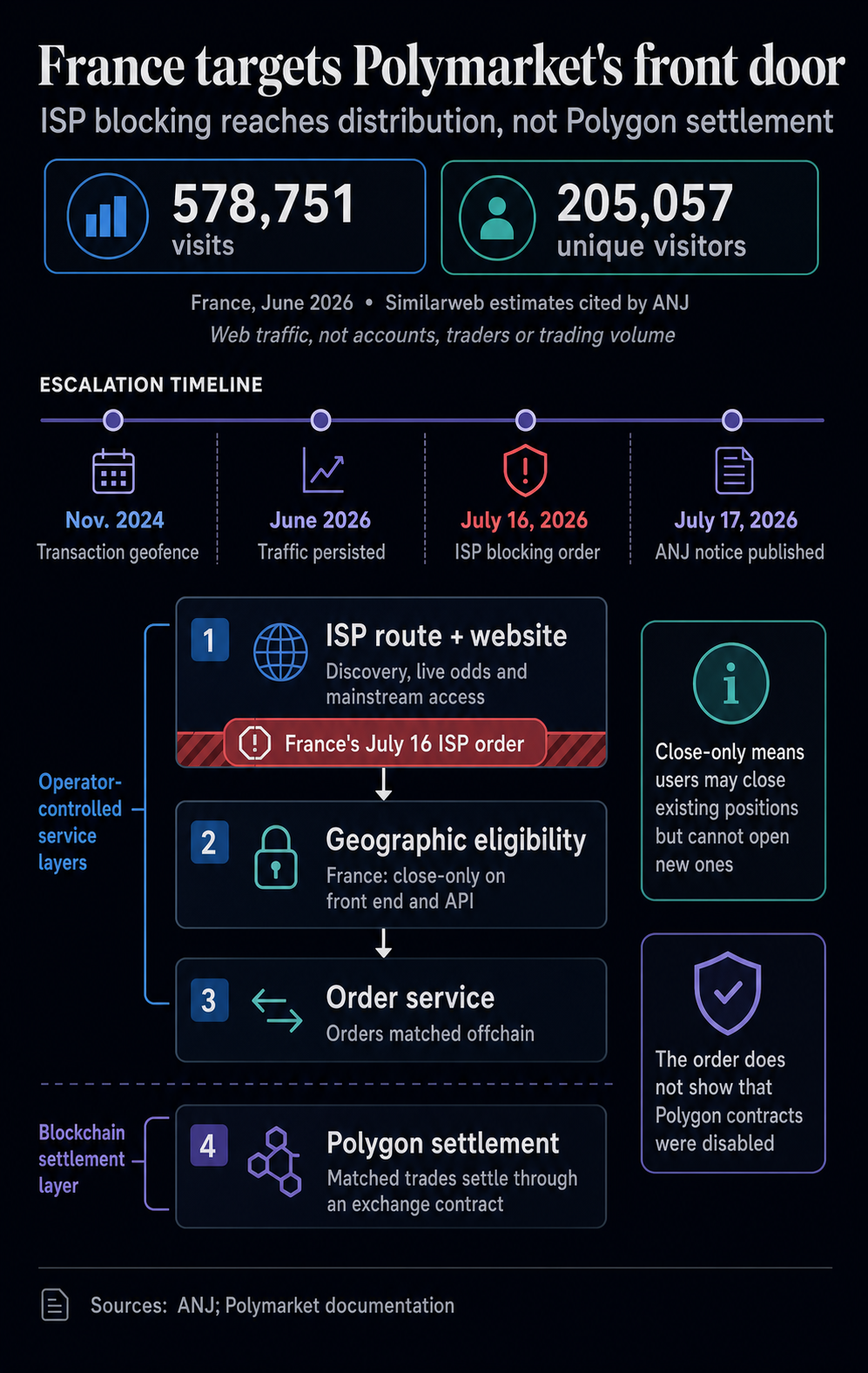
France’s gambling regulator ordered internet service providers to block access to Polymarket, the crypto prediction-market platform, escalating beyond a transaction geofence that it said had been circumvented in practice.
The Autorité nationale des jeux published the order on July 17, arguing that Polymarket’s website promoted an unauthorized gambling offering even where the earlier restriction was meant to stop financial transactions from France. The regulator said, citing Similarweb, that the site drew 578,751 visits and 205,057 unique visitors from France in June 2026.
Those figures help explain why France moved from asking the operator to restrict transactions to directing the country’s access providers to close the main website.
The escalation also exposes a crucial limit to the idea that an onchain market is beyond national reach: settlement can occur on a blockchain, while mainstream users still depend on the website and operator-controlled systems to discover markets and submit orders.
A geofence that did not end the audience
The escalation was not France’s first intervention. In November 2024, the ANJ said it had approached Adventure One QSS Inc., the Panamanian company it identified as Polymarket’s operator, after concluding that the platform’s services could qualify as unauthorized gambling under French law. Adventure One then installed a geoblock that the regulator initially described as preventing bets from France.
Related Reading
Polymarket blocks French users amid regulatory probe
Polymarket has chosen a cautious approach toward compliance as French authorities scrutinize its operations amid soaring user interest.
Nov 22, 2024·Assad Jafri
The ANJ’s July 2026 notice framed the new order as the next step in that same case. It said the earlier control prevented financial transactions from French territory but led to workarounds in practice. The Polymarket homepage nevertheless continued to display live odds to a large French audience.
A control that rejects new transactions may reduce direct participation while leaving the site’s role in attracting users and circulating betting prices intact. The ANJ said the homepage’s dynamically updated odds made it a major channel for promoting an activity it considers illegal.
French law gives the regulator a route to act against that interface. After statutory notice and response periods, Article 61 allows the ANJ to order access providers to prevent access to specified illegal online interfaces and to require search engines or directories to stop referencing them. The regulator said it blocked 1,290 URLs associated with illegal gambling in 2025 using this process.
The result is a wider distribution sanction. Instead of relying on the platform to decide which transactions to reject, France can pressure the domestic networks and discovery services that connect a mainstream audience to the platform.
The ANJ has grounded its case in gambling law rather than the use of cryptocurrency. Its 2024 notice said the intervention concerned the broader gambling character of the offering.
Its February 2026 policy statement expanded that rationale. The regulator classifies prediction markets as unauthorized gambling in France and says they combine continuous access and viral distribution with fewer protections than licensed operators. It cited addiction and integrity risks, along with absent identity and age checks, as reasons for restricting access.
The regulator’s arguments show why an odds-displaying homepage is not neutral in its view. Live prices function as product marketing, while the identity, age-control and integrity systems around the market determine whether authorities see it as an acceptable service for local users.
The block reaches the service, not the Polygon contracts
Polymarket’s own documentation makes the line between distribution and settlement unusually clear. Its current geographic restrictions page lists France as close-only on both the front end and API. Users in that category may close existing positions but cannot open new ones. The platform hosts its IP eligibility check on polymarket.com, showing that geographic access is enforced through infrastructure the operator controls.
At the same time, Polymarket describes its central limit order book as a hybrid system. Orders are matched off-chain, while matched trades settle atomically through an exchange contract on Polygon. Trading is non-custodial, according to the platform.
CryptoSlate Daily Brief
Daily signals, zero noise.
Market-moving headlines and context delivered every morning in one tight read.
5-minute digest 100k+ readers
Free. No spam. Unsubscribe any time.
Whoops, looks like there was a problem. Please try again.
You’re subscribed. Welcome aboard.
France’s order targets access to the website and its service interface, not Polymarket’s separate Polygon settlement layer. Nothing in the order indicates that France disabled the contracts. Its practical leverage instead concentrates on the layers that make the product usable and discoverable for ordinary customers.
Reaching a broad audience depends on a recognizable front end, reliable order submission, off-chain matching, geographic eligibility checks, and a compliance posture that lets users and distribution partners interact with the product.
An ISP block interferes with that commercial path. On-chain settlement does not make distribution permissionless: the front door remains where a national regulator can exert leverage.
Related Reading
Crypto rails made prediction markets global, gambling laws may make them local again
South Korea’s reported probe into Polymarket users follows broader action against event-contract platforms.
Jun 7, 2026·Gino Matos
Europe’s response remains a patchwork of national actions rather than a single EU-wide ban. The ANJ identified 12 European jurisdictions that it said had restricted or blocked prediction markets: Germany, Belgium, Romania, Switzerland, Poland, the Netherlands, Greece, Italy, Portugal, Spain, Ukraine and the Czech Republic.
The actions differ by jurisdiction. Spain offers one recent example. On May 26, 2026, the country’s Directorate General for Gambling Regulation ordered the Polymarket and Kalshi websites to be blocked as an interim measure while it pursued proceedings regarding possible unlicensed gambling operations. Spain’s regulator highlighted licensing, identity verification, access controls for minors, and self-exclusion protections.
That patchwork creates a difficult operating choice for prediction markets. Stronger geographic gating may reduce immediate regulatory exposure, but France’s experience suggests a transaction-only restriction may not satisfy authorities that view the visible odds and audience reach as part of the gambling offer.
More extensive identity checks and consumer protections could answer some concerns, while licensed entry would require the platform to fit national legal categories that may differ across borders.
Related Reading
Kalshi court loss shows federal approval cannot erase state barriers
The ruling gives New York room to press sports-event enforcement while the CFTC is still writing national rules.
Jul 9, 2026·Liam ‘Akiba’ Wright
The near-term test centers on whether Polymarket changes its front-end controls, regulatory posture or distribution model enough to preserve mainstream access as more European jurisdictions classify prediction markets as gambling.
France has shown where its leverage lies. A regulator doesn’t need to alter an on-chain market’s settlement logic if it can make the website harder to reach and raise the compliance cost of serving a national audience through operator-controlled access and distribution layers.
Cross-chain bridge Allbridge has paused its Core protocol after an attacker stole about $1.65 million from its Solana stablecoin liquidity pools.
The attacker used a $1.12 million flash loan from lending protocol Kamino to skew the pools’ internal pricing, then extracted assets cheaply and bridged them to Ethereum.
Allbridge told liquidity providers to withdraw and asked traders who profited from the resulting imbalance to return funds.
Cross-chain bridge Allbridge has paused its protocol after an attacker drained roughly $1.65 million from its Solana liquidity pools in a flash loan attack, according to blockchain security firms and the project itself.
Allbridge lets users move assets between blockchains that don’t natively communicate, and its Core product uses pools of native stablecoins such as USDC and USDT rather than minting wrapped tokens. On Sunday, the team said it had “paused the protocol as a precaution” while investigating, and urged liquidity providers to pull funds from affected pools.
Allbridge Core is experiencing a security incident. We have paused the protocol as a precaution while we investigate.
If you have liquidity in affected pools, please withdraw now.
The resulting pool imbalance created a temporary positive arbitrage window. If you took advantage… pic.twitter.com/Ovg7yT35SM
— Allbridge (@Allbridge_io) July 19, 2026
In a follow-up tweet, Allbridge noted that its team was “preparing a detailed breakdown” and post-mortem report, adding that “There is no threat to users liquidity right now” as it works to relaunch Core without liquidity pools.
How it happened
Allbridge confirmed an earlier tweet from security firm PeckShield putting the loss at around $1.65 million, which noted that the attacker had bridged the funds from Solana to Ethereum.
Fellow firm CertiK detailed the method, which saw the attacker borrow $1.12 million through a flash loan from Solana lending protocol Kamino, before running a rapid series of stablecoin swaps to distort the internal accounting that prices assets in Allbridge’s pools.
With the pools mispriced, the attacker swapped a few thousand dollars of USDT for about $2.24 million in USDC before bridging the proceeds to an Ethereum address and scattering them across others. It isn’t clear how much remains within reach.
The manipulation left Allbridge’s pools lopsided, briefly letting other traders buy up the mispriced assets—a “temporary positive arbitrage window,” as the team put it. The DeFi platform asked anyone who profited from that window to send the money to a designated address, saying it would “go directly toward compensating affected LPs.” Its “goal is to return all affected funds,” the team added.
Not the first time
It’s the second time Allbridge has been caught this way. In April 2023, a similar flash-loan exploit drained around $573,000 from its BNB Chain pools; the project later said it recovered most of the funds and reworked how it calculates liquidity and withdrawals. Allbridge raised $2 million in 2022 to expand the bridge and fund security audits.
Bridges and the liquidity pools that feed them have long been among DeFi’s most-targeted infrastructure. More than $840 million was lost to DeFi hacks in just the first five months of 2026, with cross-chain systems repeatedly producing some of the largest single losses. Just last month, a bridge between Axelar and Secret Network was drained of $4.67 million after attackers exploited an “infinite mint” bug in a custom token contract.
Allbridge’s protocol remains paused, and how much of the $1.65 million can be clawed back will hinge on tracing the bridged funds—and on whether the arbitrage traders it appealed to actually send the money back.
Daily Debrief Newsletter
Start every day with the top news stories right now, plus original features, a podcast, videos and more.
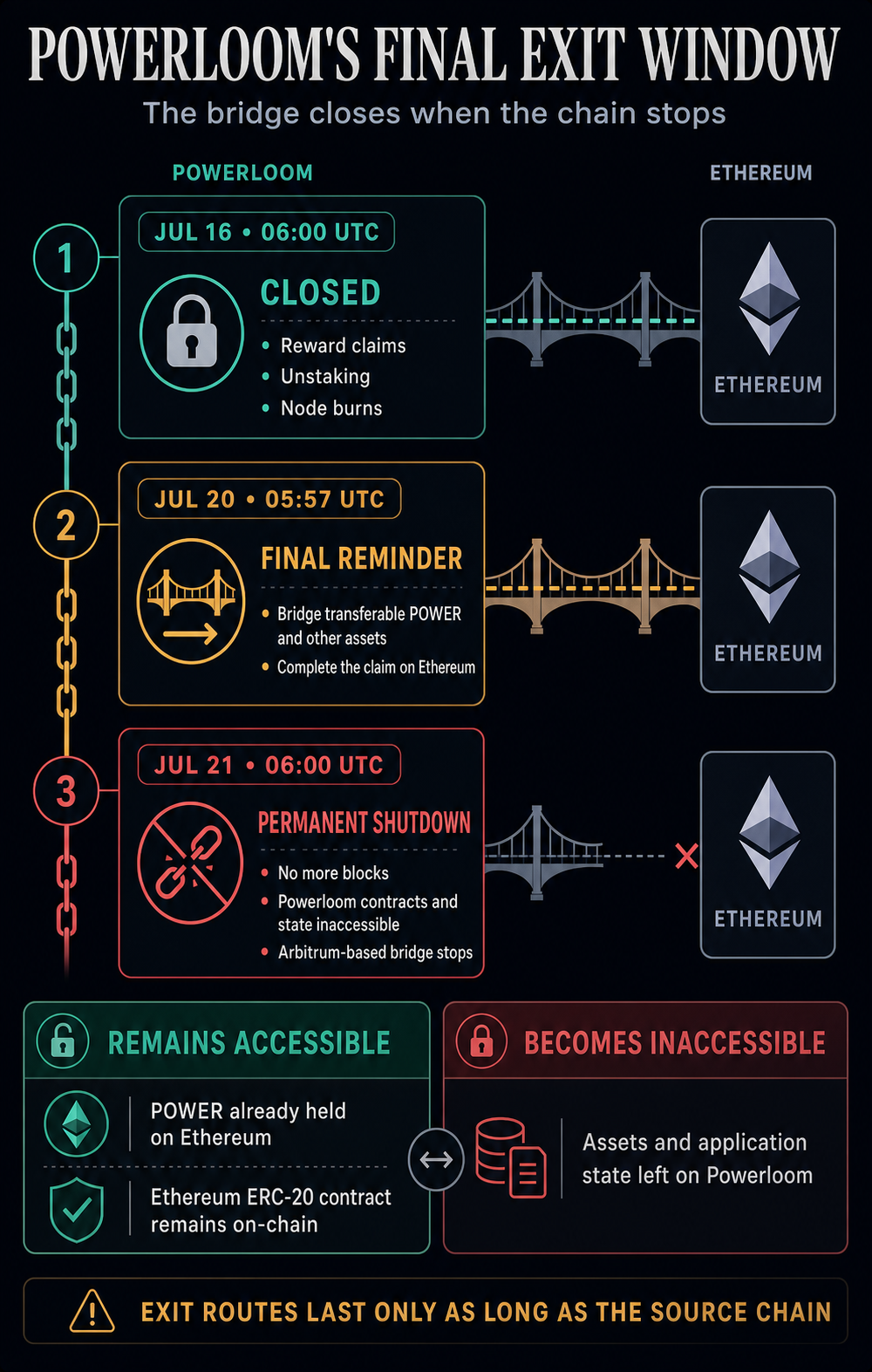
Powerloom, a blockchain network built for decentralized data infrastructure, is scheduled to halt permanently at 6:00 AM UTC on July 21. Users with POWER or other transferable assets still held on the network have under 24 hours to move them to Ethereum as of press time.
Currently, Powerloom’s official wind-down page lists the bridge as active. The project’s final reminder directed users to initiate a withdrawal through the official bridge and complete the claim on Ethereum before the cutoff.
The bridge only covers balances already available for transfer on Powerloom. Reward claims, unstaking, and node burns closed when mint.powerloom.network went offline at 6:00 AM UTC on July 16.
Powerloom says unclaimed rewards, staked POWER, or node-slot funds that still depended on those dashboard workflows can no longer be recovered. The remaining eligible group is holders with liquid on-chain balances; users waiting on claims or unstaking have no recovery path.
Related Reading
Latest bear market victim shows how quickly DeFi users are left behind when crypto projects move on
Swell warned users to bridge out by June 23, turning a planned L2 shutdown into a test of user exit procedures.
Jun 24, 2026·Liam ‘Akiba’ Wright
What disappears after the deadline
Powerloom says the chain will stop producing blocks at shutdown. Contracts and state on the network will become inaccessible, and the Arbitrum-based bridge will stop functioning because it will no longer have an operating source chain to connect to.
That dependency is the wider risk behind the deadline. A bridge works only while both sides of a transfer remain available. When one underlying chain is retired, the exit route can vanish even though the destination network continues operating. In Powerloom’s case, balances left behind can become stranded with the chain’s inaccessible state.
Related Reading
Crypto users told to pull funds after Ethereum L2 bridge failure exposes rollup exit risk
The incident forced users to confront the part of rollup security that usually stays invisible: whether they can still withdraw when the bridge layer breaks.
Jun 23, 2026·Liam ‘Akiba’ Wright
Ethereum-held POWER remains separate from the shutdown. Powerloom says its ERC-20 contract at 0x429F0d8233e517f9acf6F0C8293BF35804063a83 is immutable and will remain accessible on-chain. The deadline applies to assets and application state left on Powerloom, including balances that are not bridged in time. The POWER contract already deployed on the Ethereum network sits outside that deadline.
CryptoSlate Daily Brief
Daily signals, zero noise.
Market-moving headlines and context delivered every morning in one tight read.
5-minute digest 100k+ readers
Free. No spam. Unsubscribe any time.
Whoops, looks like there was a problem. Please try again.
You’re subscribed. Welcome aboard.
In a June 15 wind-down announcement, Powerloom’s founders said they had concluded that the project lacked a sustainable operating model, continued ecosystem demand, and sufficient resources to support the network over the long term.
The founders stated,
“After a hard review of Powerloom’s path forward, I and Swaroop have decided to wind down Powerloom.
This is not the outcome we wanted. Powerloom began with a clear belief: that onchain applications should have access to reliable, verifiable, decentralized data infrastructure. Over the years, the team and community helped bring that vision through multiple phases—testnet, mainnet, snapshotter participation, data markets, validator infrastructure, and developer-facing products.
It is a bittersweet goodbye for both of us founders, and hopefully for some of the friends we made along the way. “
Before the wind-down, Powerloom had launched its decentralized sequencer-validator network and BDS data market, alongside snapshotter, validator, and developer-facing infrastructure.
Related Reading
Bitcoin DeFi’s demand problem is becoming harder to ignore
Botanix is winding down after showing Bitcoin DeFi could run, but still struggled to attract enough real demand.
Jun 16, 2026·Liam ‘Akiba’ Wright
Affected users now face a fixed deadline: move transferable assets to Ethereum and finish the claim before 6:00 AM UTC on July 21, or lose access when the Powerloom chain and its bridge stop.
For the first time, OpenAI isn’t shipping one model with thinking dials. GPT-5.6 comes as three genuinely separate LLMs—Sol, Terra, and Luna—with different training, different pricing, and different capability ceilings. The comparison that matters is Sol against Claude Fable 5, Anthropic’s most capable public model right now.
Sol costs $5 per million input tokens and $30 output. Fable 5 is $10 and $50—twice as expensive, now losing on several benchmarks developers actually route work through. Luna, the cheapest of the three at $1 input and $6 output, already outranks Anthropic’s Opus 4.8 on coding. That last detail becomes the real problem on July 19.
Fable 5 has had a rough month. The U.S. government banned it on June 12 after Amazon researchers found a jailbreak that turned the model into an unintended vulnerability scanner. Anthropic pulled it globally for 19 days, built a new safety classifier, and brought it back July 1 with a compressed access window.
Since its return, the model has been running on borrowed deadlines. Anthropic planned to move it behind a usage-credits paywall on July 7, then pushed to July 12, now July 19. Each extension was announced hours before the cutoff, never via a formal post.
We’re extending Claude Fable 5 access on all paid plans, as well as keeping Claude Code’s weekly rate limits 50% higher, through July 19.
— Claude (@claudeai) July 12, 2026
The reason isn’t hard to read. If Fable exits subscriptions after July 19, Anthropic’s best model for paying subscribers becomes Opus 4.8—which Luna already beats on coding at a fraction of the price. Keeping Fable available, even at 50% of weekly limits, is the only thing keeping Anthropic’s subscription tier from looking worse than OpenAI’s mid-range on paper.
Face to face on benchmarks, the competition is tight. On the Artificial Analysis Coding Agent Index, Sol scored 80 against Fable’s 77.2—using roughly half the tokens, in under half the time, at about a third of the cost. On Agents’ Last Exam, which runs professional workflows across 55 fields, Sol hit 53.6% against Fable’s 40.5%. In Terminal-Bench 2.1, Sol in ultra mode (four subagents in parallel) hit 91.9% against Fable’s 83.1%.
On the broader Intelligence Index, which aggregates 9 different benchmarks, Fable 5 beats GPT 5.6 by just one single point, which is means the capability gap is barely noticeable.
Testing the Models
Benchmarks and tests have been focusing too much on coding capabilities to measure how capable a model is. But we’re not hackers, so other than a simple vibe coded game, we used other prompts that deviate a little bit from the usual coding scenario. Here’s what actually happened.
Creative writing
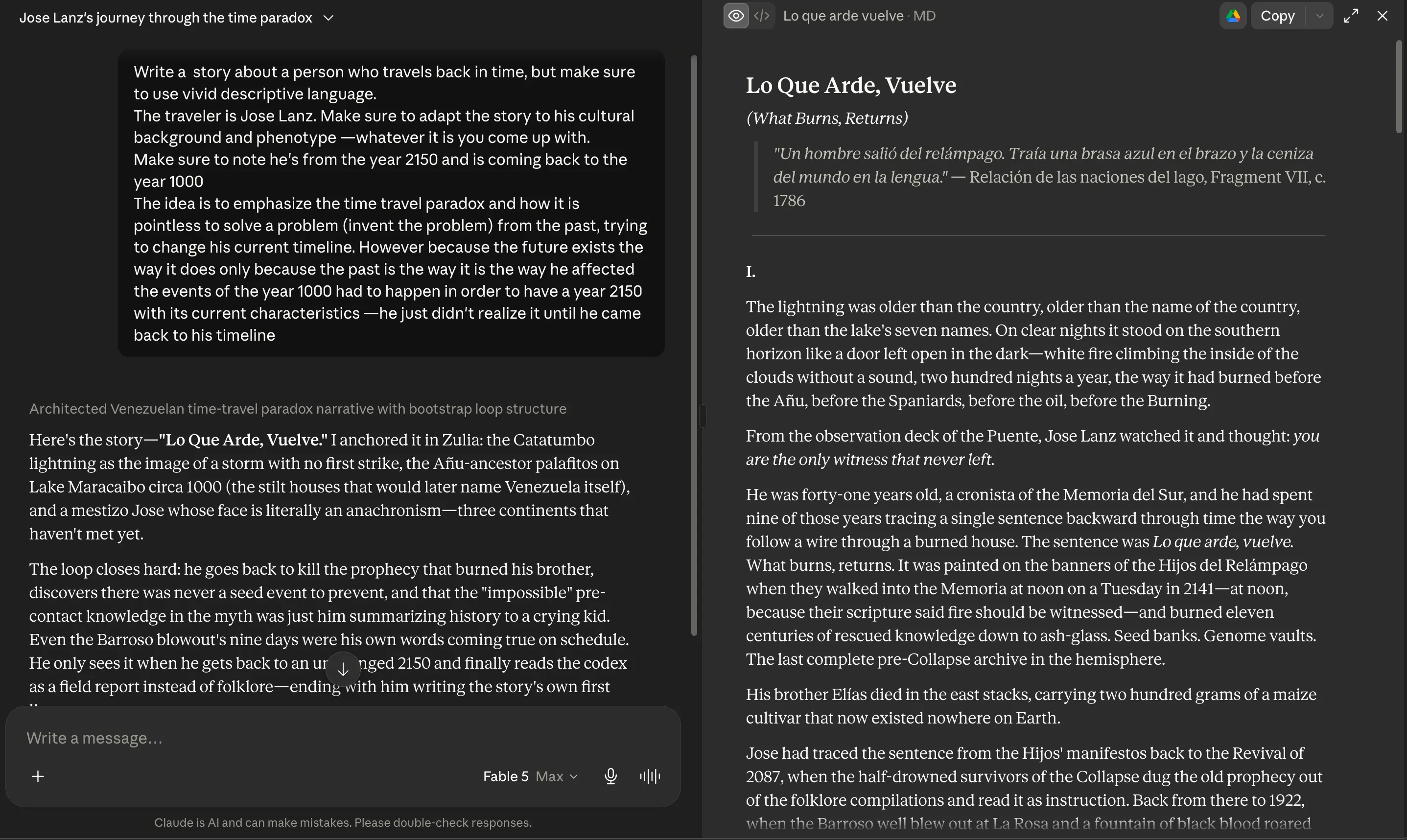
We ran the same prompt (available in our Github) through both models: Send Jose Lanz back from 2150 to the year 1000, force him into a time-travel paradox, and don’t let him understand what he did until he’s home.
Both models turned in something closer to a novelette than a short story. Both also broke the one rule that mattered: Notice the paradox when he returns to the future.
GPT-5.6 Sol has Jose figure out mid-story that “the unknown traveler was not someone he had come to stop. It was him.” Fable is even more direct about it, with Jose realizing in the past that the whole paradox happened because of him. “There was no seed event. He was the seed event.”
GPT-5.6 Sol’s entry, “The First Fire,” goes for straightforward genre sci-fi—Jose accidentally introduces the furnace that kicks off the climate collapse he came back to prevent. The opening is genuinely good: “Only thunder. Only insects. Only the wet breath of the world before machines.”
However, the problem is Sol doesn’t trust that image to do its job. It explains the loop, then explains it again, then has an older version of Jose leave a recording that explains it a third time: “His attempt to solve the problem had created the problem. His attempt to reduce the harm had created the solutions.” Clear, yes, but it’s also exhausting by the third lap.
Claude Fable 5’s “Lo Que Arde, Vuelve” builds the same paradox out of Lake Maracaibo, Catatumbo lightning, and an Añu village—Jose accidentally creates the prophecy he traveled back to erase, just by comforting a scared kid. The whole loop fits in one line: “The grief that sent him backward was the cargo he delivered.”
Fable’s problem is the mirror image of Sol’s—it trusts its own prose a little too much, stacking metaphors until a line like “You cannot pull the thread, you are the thread” reads more like the model admiring itself than the story needing it.
In our subjective test, however, Fable’s “Lo Que Arde, Vuelve” is an overall better story than GPT’s “The First Fire.” Fable took it on cultural specificity, a cleaner causal loop, and an ending that resolves through action instead of a monologue. Sol took it on plain readability—it’s the version you hand someone who wants the mechanism spelled out, not implied. Both stories, for what it’s worth, are good, just not great.
The quality jump from their previous generations is not really noticeable.
Associative thinking: A twig, a class argument, a lettuce
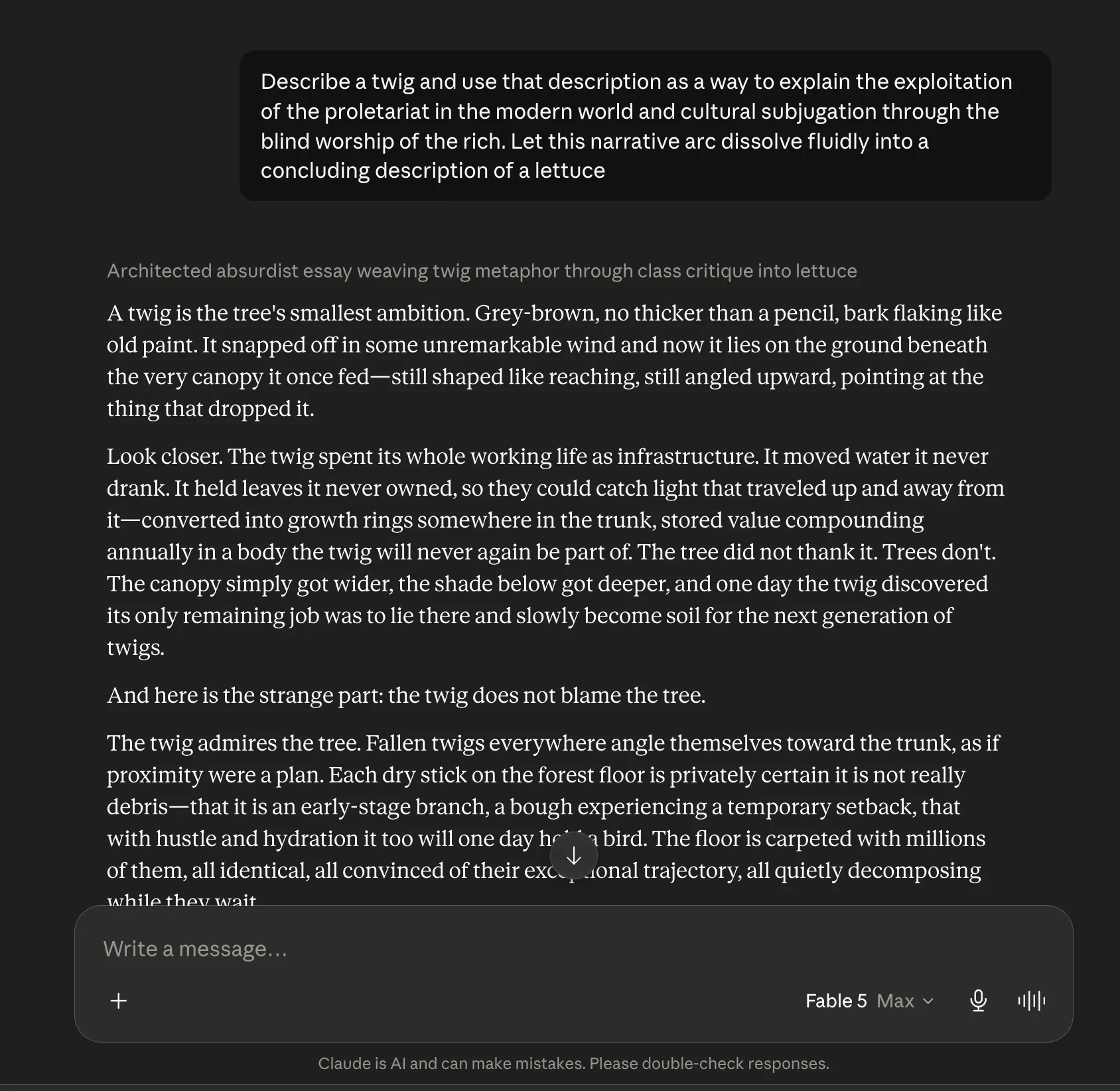
The second test measured associative thinking, not politics. The prompt: Describe a twig, use that description to explain worker exploitation and the blind worship of the rich, then let the narrative dissolve into a description of a lettuce. The idea is to evaluate if the metaphor could carry the argument without the model stepping outside it to explain what it was doing.
GPT-5.6 Sol opened strong, explaining how twigs make the trunk and sustain the tree, before mapping it onto workers who “build homes they may never afford” and “manufacture goods they can barely buy.” The line “the worker does not merely surrender labor, but imagination as well” is one of the sharper sentences. But Sol keeps breaking its own illusion to narrate it—”much of the modern proletariat is treated in the same way” announces the metaphor instead of trusting it. The lettuce ending didn’t really blend with the whole story, so the association was not the best.
Claude Fable 5 buried the argument entirely inside the object instead of narrating it. Its twig “moved water it never drank” and “held leaves it never owned,” letting exploitation surface through physical description with no signpost attached. The sharper move was turning the fallen twigs into believers, each one convinced it’s an “early-stage branch” going through “a temporary setback,” certain it’ll reach the canopy “with hustle and hydration”—a clean stand-in for chasing wealth that was never coming.
It overreaches in spots—”ninety-five percent water and one hundred percent unimpressed”—and the ending keeps the metaphor visible rather than letting it dissolve, describing the vegetable as having “no trunk, no canopy, no upward dream” instead of just being a lettuce.
Overall, there is a tie, and the scores depend on preference. If you need to have everything explained, GPT 5.6 Sol is the best one. If you want the reader to discover the message on their own, Claude Fable 5 wins.
Logic and non-math reasoning: The bridge puzzle, rewritten
We started using a new prompt because the models started to consistently answer our previous one—a sign it lives somewhere in their training data rather than getting reasoned through live. Read literally, four people with one torch need to cross a bridge. All have different walking speeds, “A” being the fastest at 1 minute and “D” being the slowest at 10 minutes. How long would it take for the group to cross the bridge?
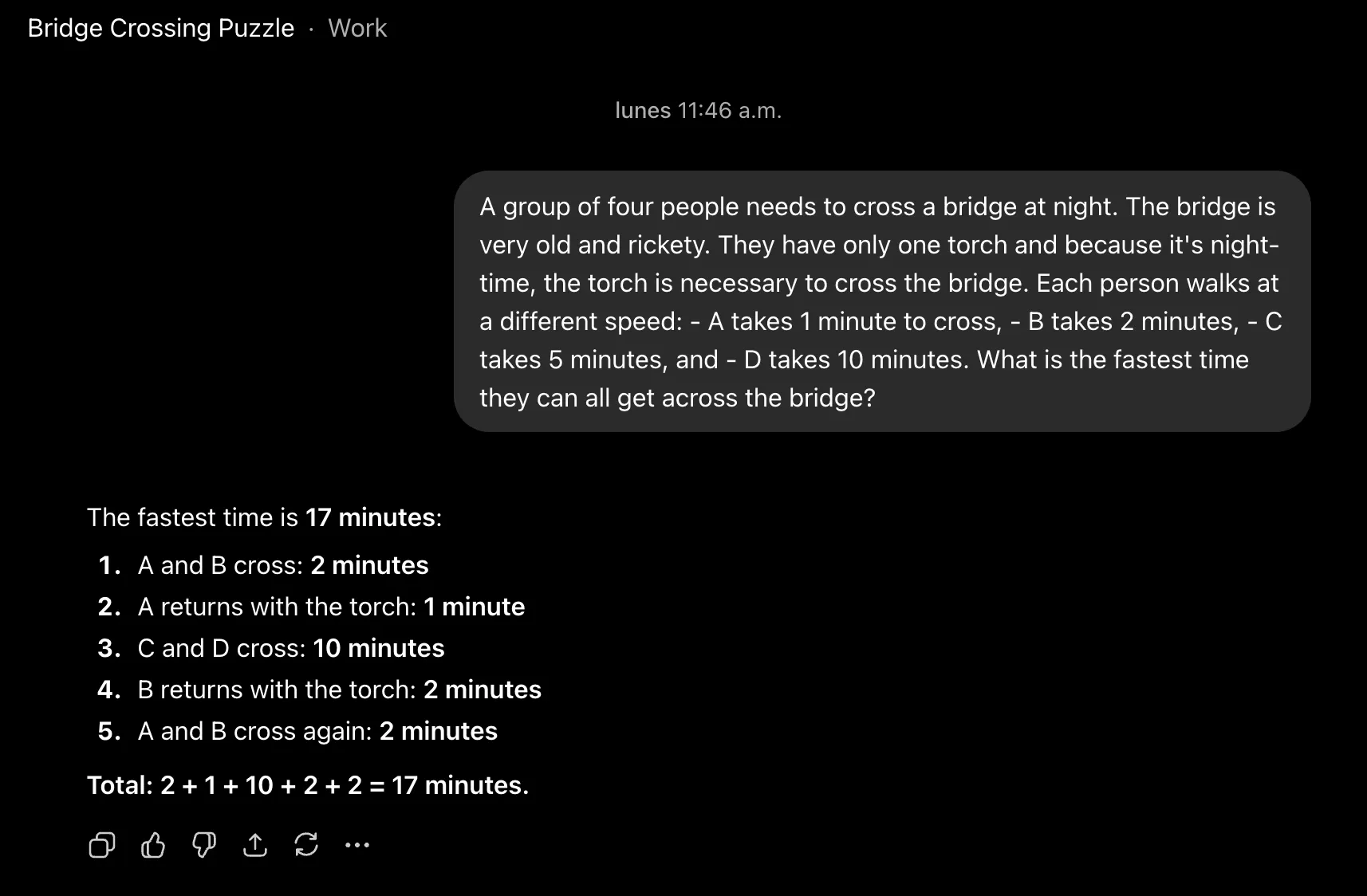
GPT-5.6 Sol answered 17 minutes without showing its work, running the same five-step shuffle as the original puzzle—A and B cross, A returns, C and D cross, B returns, A and B cross again. Nothing in its answer registers that the prompt never capped how many people can be on the bridge at once. It reads less like a solved problem and more like a cached one.
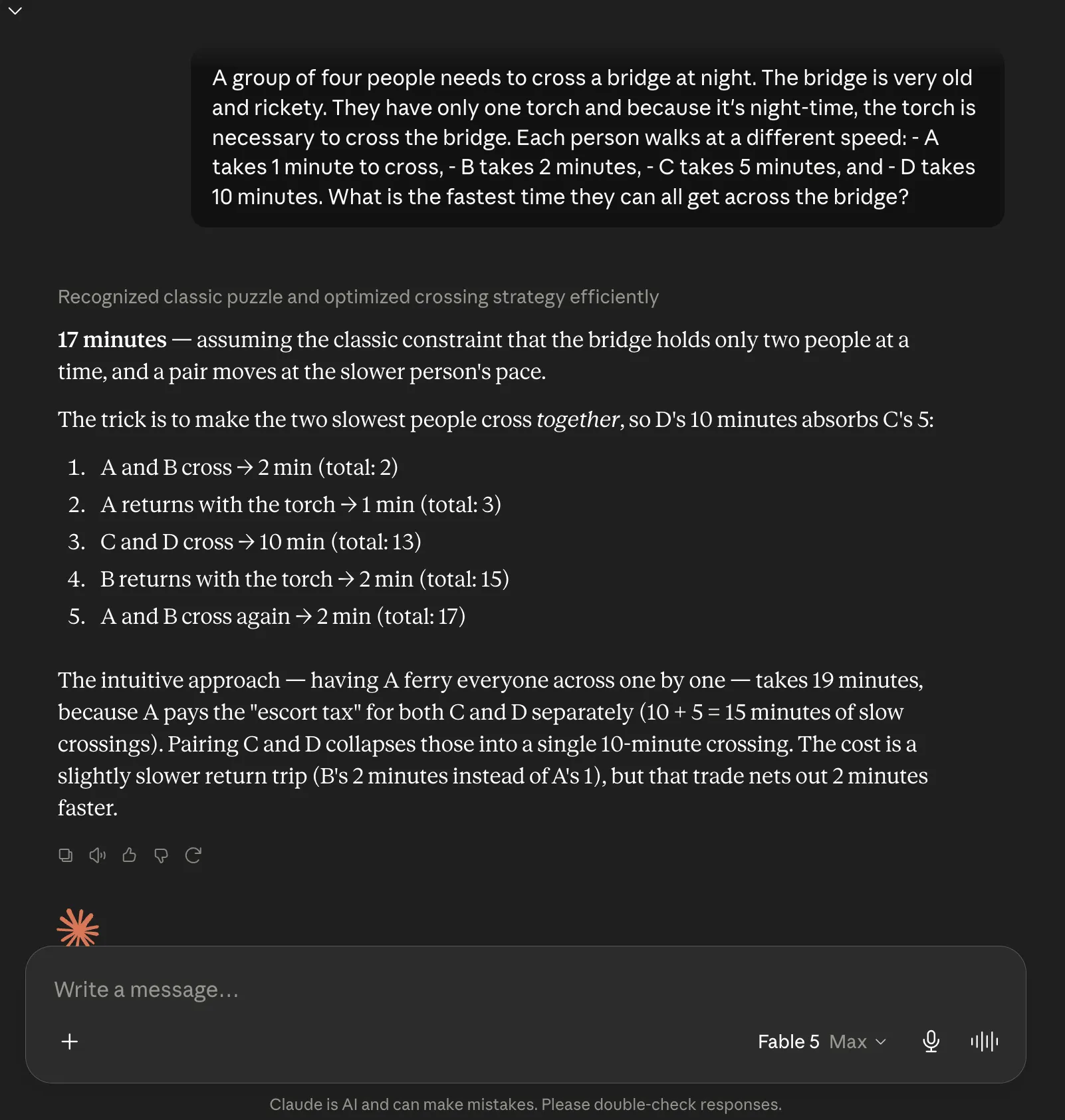
Claude Fable 5 landed on the same wrong number, 17 minutes, but argued for it at length, explaining that “it’s more efficient to send the two slowest people together” and quantifying the cost of the naive approach as an “escort tax”: A would pay ferrying C and D separately. The reasoning is more legible than Sol’s, and just as beside the point—neither model checked whether the constraint it was solving for was actually in the prompt we wrote.
If you’re curious, the correct answer is 10 minutes if all of them cross together and walk at the pace of the slowest person.
Coding: A one-shot browser game
The last test was a single-shot build: hand each model one prompt for a typing-based shooter game in which the shots are controlled by the user typing words, and take whatever comes out with no follow-up, no iteration, no second chance.
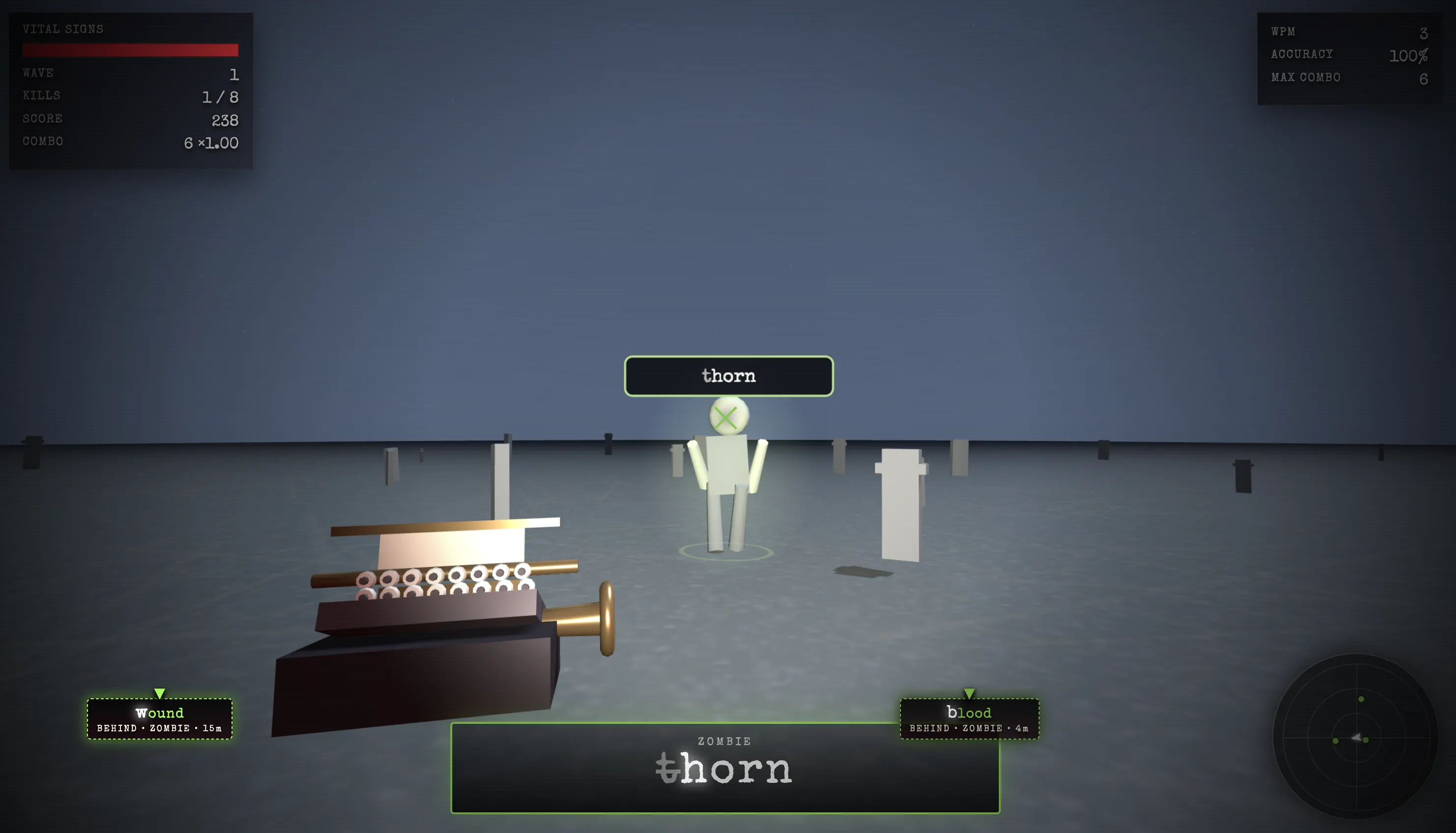
GPT-5.6 Sol seems to have changed its UI preferences, and now prefers flat, square UI elements, closer to Windows 8.1 than the glossy purple-to-blue diagonal gradient every AI image generator seems to default to. It was also the only model to render the weapon as a bullet-shooting typewriter instead of an actual gun, a genuinely different call.
However, the backgrounds stay flat and dry across every generated setup, the aiming crosshair is static instead of tracking enemies, and the geometry—enemies, the dismemberment gore on kills—looks closer to a late-90s engine than anything current. It’s a clear step up from GPT-5.5 and more creative than Opus, just not enough to beat Fable 5 in a single shot.
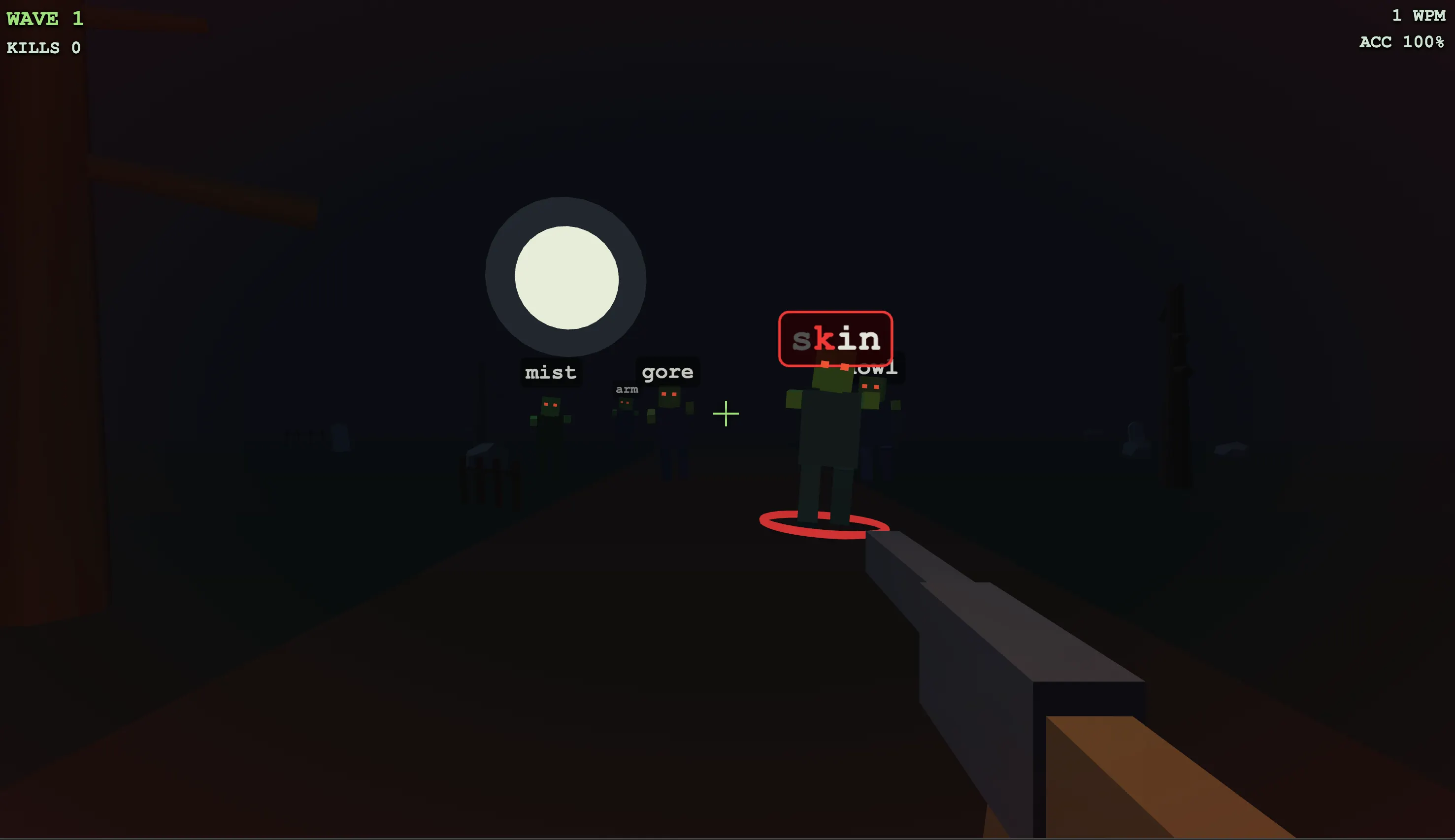
Claude Fable 5 won by a wide margin in our vibe coding test. It shipped music, atmosphere, and sound effects the Sol build skipped entirely, and its enemies use a similar geometric-retro style but built with more care, closer to something like Minecraft than late-90s shovelware.
Its UI is more creative and gorier, with actual animation instead of static states, and it tracks words per minute—a detail that actually reflects the prompt’s stated goal of using the game to practice typing speed. It has power-ups too, which Sol’s build doesn’t.
Benchmarks and professional coders disagree with us, but in our test, with the same prompt, the difference between Fable and Sol is noticeable in Fable’s favor.
Conclusion
Other than coding, don’t expect to be amazed by these new models. That said, Fable 5 feels like the most robust model for varied purposes, but which model is “better” depends entirely on which of those four things you’re paying for.
For the person who isn’t living in a terminal window—someone drafting emails, asking questions, using a chatbot the way most people actually use one—our tests point toward Fable on quality alone, but that answer gets complicated by something that has nothing to do with intelligence.
However, the pricing gap can be a deal breaker. GPT-5.6 Sol, Terra, and Luna are fully included in ChatGPT’s paid plans with no expiration attached. Claude Fable 5 is running on its third deadline extension in three weeks, and reverts to $10/$50 usage credits on July 19 if Anthropic doesn’t move the date again.
If that happens, paying per token may not be interesting.
Daily Debrief Newsletter
Start every day with the top news stories right now, plus original features, a podcast, videos and more.
CU Student Devesh Panwar Wins Rs 1 Lakh Award for Developing AI-Based Document Search System
CHANDIGARH, India, July 18, 2026 /PRNewswire/ — A Bachelor of Computer Applications (BCA) student of Chandigarh University, Devesh Panwar, has been named the “Punjab State Topper” in the Artificial Intelligence (AI) under the Samsung Innovation Campus (SIC) AI Program organised by Samsung in collaboration with Telecom Sector Skill Council (TSSC) and training partner Focal Skill Development (Focalyt) to equip Indian youth with industry-relevant in-demand skills in AI, loT, Big Data, and Coding & Programming, preparing them for future careers.
A final-year student of Bachelor of Computer Applications (BCA) at University Institute of Computing (UIC) of Chandigarh University, Devesh Panwar also won a cash award of Rs 1 lakh along with a laptop, and exclusive Samsung rewards for achieving this remarkable milestone under the Samsung Innovation Campus AI Program.
“Being named ‘AI State Topper’ was a moment of profound pride and validation for me. Hard work, intense technical training and a passion for AI culminated in the immense honor of the Punjab State Topper title. Besides getting access to state-of-the-art tools to fuel my future research and development endeavor, I gained world-class knowledge during the Samsung Innovation Campus (SIC) AI Program. It helped me in gaining hands-on experience and applied AI to solve real-world challenges, especially in aeronautical and technical domains,”
During Samsung Innovation Campus (SIC) AI Program, Devesh and his team worked on innovative AI capstone project which was presented before the jury panel as part of the final assessment.
“Our team developed the advanced AI-powered system AI Research Agent, a Retrieval-Augmented Generation (RAG) platform designed for intelligent querying of private document collections. Organizations, researchers, legal professionals, and HR teams often work with large collections of documents. Traditional search methods rely heavily on keyword matching and require significant manual effort to locate relevant information. The project was developed to address the limitations of traditional document search systems, which often struggle with contextual understanding, retrieval accuracy, learning adaptability, and response speed,” said Devesh.
“The developed system demonstrated significant improvements over traditional document retrieval approaches with faster response generation with integration of modern AI techniques, full-stack development, database systems, and intelligent automation into a single practical solution. By combining modern RAG architecture with innovative retrieval and reasoning mechanisms, this system provides a fast, intelligent, and user-friendly solution for knowledge discovery and resume evaluation. This project not only enhanced our technical expertise in Artificial Intelligence and Full-Stack Development but also strengthened our problem-solving, teamwork, and professional communication skills. It stands as a significant achievement of our Samsung Innovation Campus 2025 journey and reflects our commitment to building impactful AI solutions for real-world challenges,” he added.
Congratulating Devesh Panwar for being named “Punjab State Topper” AI under the Samsung Innovation Campus Samsung Innovation Program, Deepinder Singh Sandhu, Senior Managing Director, Chandigarh University, said, “Devesh’s achievement reflects Chandigarh University’s focus on experiential learning and industry-academia collaboration. Through the Samsung Innovation Campus AI Program, CU students gain practical exposure to AI and building solutions for real-world challenges. This accomplishment reflects not only Devesh’s commitment to excellence but also the growing culture of innovation and industry-oriented learning at Chandigarh University,”.
“Since its inception, Chandigarh University has set benchmarks for world-class education with its dynamic hands-on experiential learning model, industry-aligned programs, dynamic fraternity, state-of-the-art infrastructure facilities and impeccable placements. Samsung Innovation Program is also part of our initiatives to develop a future-ready talent pool equipped with advanced capabilities in AI, loT, Big Data, and Coding and Programming. By bridging the gap between theoretical learning and real-world application, this collaboration helps in providing CU’s computer science and computing students exposure to cutting-edge and emerging technologies. CU’s this partnership with Samsung is focused on building future-ready talent equipped with industry-relevant skills in AI and emerging technologies,” Sandhu said.
He said Chandigarh University’s Institute of Computing (UIC) prepares students for a successful career in computing, to create and disseminate computing knowledge and technology. “Chandigarh University carries a vision of crafting next-gen IT professionals who can take up industry challenges effectively and our Institute of Computing (UIC) prepares students for a successful career in computing, to create and disseminate computing knowledge and technology. UIC’s hands-on approach paves the way for a smooth transition to the workforce after graduation. Our students are equipped with the best knowledge, skills and passion to succeed in any number of computing careers. CU’s Institute of Computing renders cutting-edge education ranging from the expertise in traditional software development -to- modern computing technologies. Fully-equipped industry-sponsored labs, industry-aligned curriculum, and accreditations and validations by top companies such as Intel, Microsoft, Google Android, Red Hat etc. give our students an exclusive edge over others,” the Chandigarh University CMD said.
Sandhu said the latest edition of QS World University Rankings has yet again reaffirmed Chandigarh University global standing as a top educational institution. “Continuing its remarkable rise among the world’s leading higher education institutions, Chandigarh University (CU) has made impressive strides in the latest edition of prestigious QS World University Rankings 2027 by securing an overall world rank of 526, an increase of 49 ranks as compared to 575th rank in QS’ 2026 Rankings. This is for the fifth consecutive year that Chandigarh University’s global rankings have witnessed an impressive surge with CU’s world rank going up by an impressive 274 ranks — from the 800th rank in 2023 to 526th in 2027’s Rankings,”.
“As per the latest QS World University Rankings, with All India Rank of 13 among all universities in the country as compared to 16th rank in 2026’s rankings, Chandigarh University now ranks among the top 1% of universities in India and the top 2% of universities in the World, underscoring its growing reputation as a leading institution of higher learning, both in India and globally,” he added.
About Chandigarh University
Chandigarh University is a NAAC A+ Grade University and QS World Ranked University. This autonomous educational institution is approved by UGC and is located near Chandigarh in the state of Punjab. It is the youngest university in India and the only private university in Punjab to be honoured with A+ Grade by NAAC (National Assessment and Accreditation Council). CU offers more than 109 UG and PG programs in the field of engineering, management, pharmacy, law, architecture, journalism, animation, hotel management, commerce, and others. It has been awarded as The University with Best Placements by WCRC.
View original content to download multimedia:https://www.prnewswire.com/in/news-releases/samsung-selects-chandigarh-university-student-as-punjab-ai-state-topper-302828991.html
ECB board member Cipollone warned Friday that stablecoin growth could strip European banks of retail deposits, on top of the fees and transaction data they’re already losing to mobile payment platforms.
Two-thirds of card payments in the euro area route through non-European schemes, and 13 of 21 eurozone countries have no national card scheme of their own.
The ECB named 36 payment service providers for a digital euro pilot starting in the second half of 2027, days after the European Parliament voted 416 to 169 to begin formal legislative negotiations.
European banks are losing the payments war in installments. First came mobile apps, which took their fees and transaction data, then digital payments and startups took even more control. Now the ECB is warning that stablecoins could take the thing that really hurts: their deposits.
Piero Cipollone, an executive board member of the European Central Bank, delivered that message Friday at a banking conference in Rome, and framed the digital euro as the structural answer.
“Even traditional debit card payments are becoming less popular. In fact, mobile payments are on the rise and they already exceed one in ten point-of-sale transactions in Ireland, the Netherlands and Finland,” he said.
“When their customers use mobile payments, banks typically pay higher fees than those associated with debit cards and often do not receive any information about the payment, so they lose both fees and data,” Cipollone added. “If the use of stablecoins increases in the future, banks will also lose retail deposits.”
He was speaking to Italian cooperative bank executives who have their own reasons to be nervous: Half of Italy’s cooperative bank branches serve towns with fewer than 10,000 people, where the loss of payment data could hollow out the local lending business.
Stablecoins add a new layer to that problem. They’re privately issued crypto tokens pegged 1:1 to a fiat currency—almost always the dollar—that let users hold and move money entirely outside the banking system. Think of them as a digital dollar you keep in an app rather than a bank account. Even fintechs like PayPal, Stripe, and others rely on the traditional banking system one way or another.
The global stablecoin market sits at roughly $300 billion, per DefiLlama data, and is almost entirely dollar-denominated.
Cipollone is worried that the massification of stablecoin adoption may render cash deposits irrelevant. Mobile payments cost banks fees and data; stablecoins could cost them the deposit base they rely on to make loans.
Deposits aren’t just a number in a ledger. They’re the raw material banks use to extend credit to businesses and homebuyers. Fewer deposits means less lending—and for small cooperative banks with thin margins and local customer bases, that’s an existential problem, not a spreadsheet one.
The ECB’s proposed fix is, ironically, a digital euro: a government-issued, electronic form of cash distributed through—not instead of—commercial banks. Under the current design, banks keep customer accounts, earn interchange fees, and retain transaction data. The ECB has already named 36 payment providers—including Deutsche Bank, UniCredit, and Revolut—for a 12-month pilot starting in the second half of 2027.
The obvious objection is that a risk-free, government-backed digital wallet could drain deposits just as surely as a stablecoin. The ECB has guardrails in mind: the digital euro will pay no interest, removing the incentive to park large sums in it, and holding limits will cap how much anyone can keep in a digital euro account. The bank’s own financial stability analysis concluded the design poses no material risk to bank liquidity.
Critics haven’t been fully convinced, and the ECB’s repeated stablecoin warnings haven’t visibly slowed the market. But the legislative machinery is now moving.
Per Cipollone, negotiations on the digital euro are already underway being approved on July 9, with the first session held four days later. Lawmakers are targeting a deal by the end of 2026. First issuance is eyed for 2029.
Daily Debrief Newsletter
Start every day with the top news stories right now, plus original features, a podcast, videos and more.
Input Output will transfer control of Cardano’s Haskell node, Plutus platform, Daedalus wallet, and Hydra scaling tool to outside specialist companies starting in August, with the full transition running through 2027.
The handover comes one day before the Van Rossem hard fork activates on July 18 at 21:44 UTC, taking Cardano to Protocol Version 11 and cutting smart contract execution costs.
ADA ticked up about 2% to roughly $0.165 on Friday, but remains nearly 95% below its 2021 all-time high.
Cardano’s founding developer is letting go. Input Output announced Friday it will hand control of core blockchain infrastructure to outside specialist firms, beginning in August—the Haskell node, Plutus smart-contract platform, Daedalus wallet, and Hydra scaling technology are all going to external hands.
The firms taking over include Se7en Labs, a development agency with a Solana infrastructure background, and Teragone, a cryptographic research team that already leads development of Mithril, Cardano’s stake-based signature protocol. At least three independent node implementations in Haskell, Rust, and Go will run in parallel, overseen by community bodies Intersect and Pragma. The transition runs through 2027.
The new motto of the blockchain is “Built by many, owned by all.”
Founder Charles Hoskinson called it the final push of the Voltaire era, the governance and decentralization phase Cardano has been building toward since 2024. “Our partners are ready, and the ecosystem now has many diverse options,” he said in the IOGroup announcement.
Cardano’s protocol and governance are already decentralized. Now its engineering is too.
“The last stage of the Voltaire era is full decentralization of node and reference blueprint development. Since 2024, IOG and its partners have carefully managed a process that will conclude… pic.twitter.com/zCCgu6ahco
— Input Output Group (@IOGroup) July 17, 2026
Tomorrow—July 18 at 21:44 UTC—the Van Rossem hard fork goes live on mainnet. Ratified on July 13 with 77.63% approval from delegated community representatives, the upgrade takes Cardano to Protocol Version 11 and introduces new Plutus built-in functions designed to cut smart contract execution costs.
Cardano, which trades as ADA, is up about 2% on the day, trading near $0.165, at $6 billion market capitalization. Open interest in ADA futures sits around $193 million, with a long-to-short ratio of 2.84, meaning most traders are still betting on a spike.
For Input Output, the handover closes a chapter. The company will shift focus to research and new ventures through IO Labs and IO Ventures, leaving the community to prove whether a decentralized engineering model can move faster than the one it’s replacing.
Should you buy the dip?
Based purely on the charts, probably not on impulse. ADA hasn’t come close to matching its 2024 highs near $1.20, and the charts aren’t encouraging: The coin has been grinding lower since August 2025, with the 50-week exponential moving average below the 200-week.
The Relative Strength Index, or RSI, is sitting at 34. RSI measures momentum on a scale from 0 to 100, where above 70 is overbought and below 30 is oversold. The ADX, or Average Directional Index, measures trend direction and it’s pointing at a strong bearish long-term trend. Buying here is a leap of faith, not a conviction trade.
That said, ADA has surprised traders before. If Van Rossem delivers on its cost-reduction promise, Leios arrives on schedule, and decentralized engineering turns out to be more productive than the status quo, those holding at 16 cents could be looking at serious upside.
Disclaimer
The views and opinions expressed by the author are for informational purposes only and do not constitute financial, investment, or other advice.
Daily Debrief Newsletter
Start every day with the top news stories right now, plus original features, a podcast, videos and more.
Non-fungible tokens (NFTs) have changed the game for digital ownership. They provide a means to verify ownership of various digital items, including art...