Thailand’s SEC has filed a criminal complaint against crypto exchange Bitkub and two former directors over allegedly false reports submitted after a 2021 hack.
The regulator says Bitkub’s daily capital filings from May to October 2021 failed to reflect the theft of around $47 million in digital assets.
Bitkub says all customer assets are safe, and that its co-founders covered the stolen funds at the time.
Thailand’s Securities and Exchange Commission has filed a criminal complaint against crypto exchange Bitkub and two of its former directors, alleging they submitted false reports to the regulator after a 2021 hack.
According to reports in local media, the complaint, lodged with Thailand’s Economic Crime Suppression Division, stems from a May 2021 cyberattack in which 16 types of digital assets worth 1.7 billion baht ($47 million) were drained from the exchange. From May to October 2021, the SEC alleges, Bitkub’s daily net-capital filings showed no significant change in its assets, hiding the loss, in breach of the country’s Digital Asset Business Decree.
The two former directors, Sakolkorn Sakavee and Thaweesap Rawan, are accused of making false entries to mislead the regulator into believing customer assets were intact. The case now passes to police and prosecutors, who will decide whether to bring it to court.
Bitkub said the matter concerns a five-year-old reporting decision and that customer funds are safe. Those responsible chose not to disclose the wallet theft to avoid triggering a bank run, the company said, and its co-founders bought replacement assets in the same amounts, leaving neither Bitkub nor its customers out of pocket. The SEC had confirmed its holdings were intact as of September 2025, it added.
In a video statement posted to Facebook, Sakolkorn took sole responsibility, according to a translation by the Bangkok Post. The former director reportedly said he altered the filings himself without telling other directors or staff and withheld news of the hack, fearing panic withdrawals and a “bank run” that could have destroyed the exchange. Sakolkorn added that Bitkub’s founders used their own money to buy back the stolen assets until every customer was repaid. He apologized, resigned from the company’s boards, and pledged to cooperate with regulators.
The case comes as Bitkub, once Thailand’s dominant crypto exchange, works toward a public listing. It has since been overtaken by Binance’s local arm, Binance TH, which ranks 31st among global exchanges to Bitkub’s 68th, per CoinMarketCap. Bitkub shelved a planned Stock Exchange of Thailand IPO in November 2025 as the local market slumped, and was weighing a $200 million offering in Hong Kong instead.
Daily Debrief Newsletter
Start every day with the top news stories right now, plus original features, a podcast, videos and more.
Thinking Machines Lab released Inkling on July 15—a 975-billion-parameter open-source model trained entirely from scratch.
It’s the first major model from Mira Murati’s lab since she left OpenAI in September 2024.
The model is live on OpenRouter at $1 per million input tokens and $4.05 per million output tokens, making it usable in Hermes and OpenClaw setups—but competing models deliver stronger raw benchmarks at comparable or lower cost.
Mira Murati spent two years building something new after leaving OpenAI, finally revealing it to the public last week.
Inkling, the first model from Murati’s Thinking Machines Lab, is also the best open-source model trained from scratch by a Western lab.
Western labs have been losing the open-source race—Mistral’s April release landed against a leaderboard dominated by Alibaba’s Qwen, Z.ai’s GLM, and Moonshot AI’s Kimi. Nvidia’s Nemotron, the lone Western model on the leaderboard, is far from being considered “state of the art.” Inkling arrives with no regional strings and full weights on Hugging Face under Apache 2.0.
The architecture is a mixture-of-experts model: 975 billion total parameters, 41 billion active at inference. It reads text, images, and audio, supports a 1-million-token context window, and was pretrained on 45 trillion tokens. (Parameters are all the dials a model can handle while tokens represent the basic unit of information an AI can process.)
The bottom line is: You’re not running this locally—not even close.
The clearest win is agentic tool use. MCP Atlas—which measures how reliably an agent completes real-world tasks through the Model Context Protocol standard, scored as percentage of tasks completed—gives Inkling 74.1%, nearly 30 points above Nvidia’s Nemotron 3 Ultra. On SWE-Bench Verified, a test of autonomous GitHub bug fixing scored as percentage of issues resolved, it posts 77.6%—ahead of Nemotron’s 70.7%.
Source: Thinking Machines
It’s on OpenRouter at $1 per million input tokens and $4.05 per million output tokens. Any Hermes or OpenClaw setup that routes through OpenRouter can swap it in without extra configuration—its MCP Atlas score makes it a solid pick for agentic workflows.
For raw coding performance per dollar, Chinese models still have the edge.
Testing the Model
Benchmarks are one thing. Actually sitting with the model is another. We ran Inkling through different tasks to see how it would respond if the average Joe decides to use it. This is where it holds up—but also where it disappoints.
One good thing to notice, even via Thinking Machine’s own interface, the model claims to be fully private. This matters a lot.
Coding
This is what most people actually care about, so let’s start here. On complex prompts, Inkling tends to fail—our most demanding test produced nothing that ran. Step down in complexity and a different picture emerges, though not an entirely flattering one.
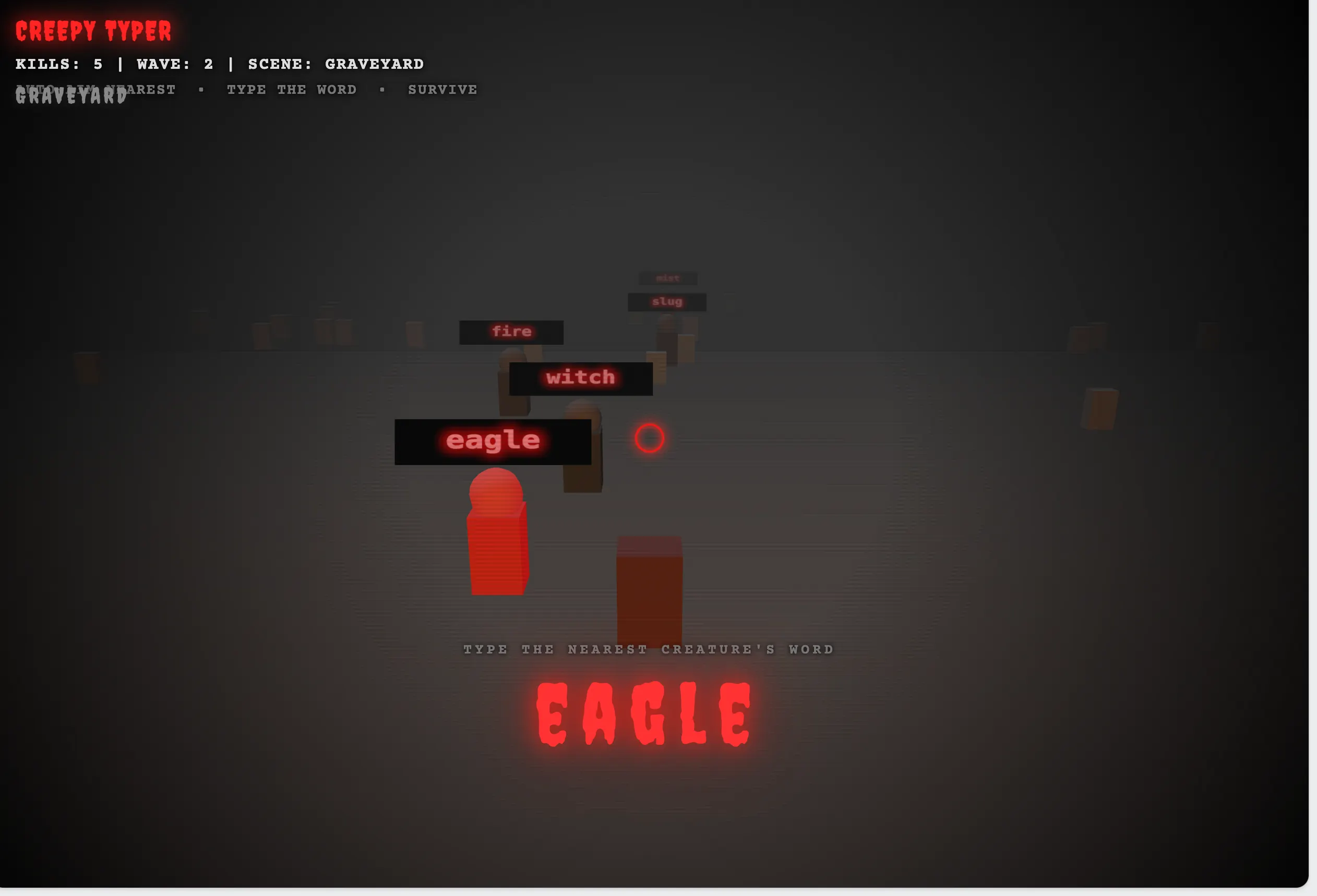
We used a long, detailed prompt to create a shooter in which zombies are shot with keystrokes. The first prompt was 1955 words long and ended up with Inkling creating a blank screen.
When the prompt was modified to be a lot more simpler (99 words), the model picked its own approach and shipped a working game. “Working” is doing a lot of heavy lifting there.
Monsters came out as rectangles and spheres. No background, no visible play screen—just abstract geometry filling in for enemies. The typing logic held: keystrokes registered correctly, lettering matched the game’s setup, and input tracking stayed clean throughout.
What was unexpected was the movement. Instead of the static enemy placement most models default to, Inkling’s creatures advanced constantly—always closing in on the player. That’s a better design decision than what you usually get from an AI-generated game.
Enemy spawning was supposed to arrive in waves. It ran as a continuous stream instead, which kills the intended pacing but creates a different kind of pressure.
Just for comparison, when we ran the exact same prompt through Bonsai 27B—a compressed model, based on Qwen3.6, that fits in 3.9 GB and runs on a phone—the result was noticeably better and more satisfying across the board.
A 27-billion-parameter model that runs on an iPhone produced a more complete coding result than a 975-billion-parameter model that needs a data center. That single test doesn’t settle anything about Inkling’s overall ability. But it does raise the question of where those 975 billion parameters are actually going.
The game created by Inkling is available for testing hereThe game created by Bonsai 27B is available here.You can check out other versions of the same game generated by different LLMs by checking our Itch.io site.
Associative Creativity
Our associative creativity test measures how well a model builds logical bridges between seemingly unrelated concepts—in this case, a twig, proletariat exploitation, and a lettuce.
Inkling opens with its best work in this session: The twig “stripped of bark and therefore of biography” maps cleanly onto a worker stripped of historical identity, and “the wind—an invisible manager—decides motion is profitable” earns its place. The landing is clean: “You do not see a person break; you see a twig fall. And the fall is called ‘efficiency.'”
The cultural subjugation section establishes the association in a self-explanatory way. “The billionaire is a redwood in a graveyard of twigs, and we are taught to call his shadow ‘inspiration'” lands, but the catalog that follows—polishing leaves in magazines, memorizing the grain of wealth, calling the whole thing merit—is the model performing the metaphor rather than extending it. The logic is still there but it is not really precise.
Since this test is new, there’s not really another model to which to compare it, other than Fable 5 and GPT 5.6 Sol, and it would be unfair to compare Inkling against those. But for those wondering, it is not really in the same league.
Then the lettuce—and the whole thing falls apart. The model announces its own disconnection in real time: “The lettuce does not remember the twig. The lettuce does not need to” is written as resolution but reads as concession.
In this last part, the model didn’t really know how to establish a connection between those unrelated ideas, so it simply talked about it without actually saying anything that makes sense structurally.
The full prompt and output are available in our Github repository.
Logic and Common Sense
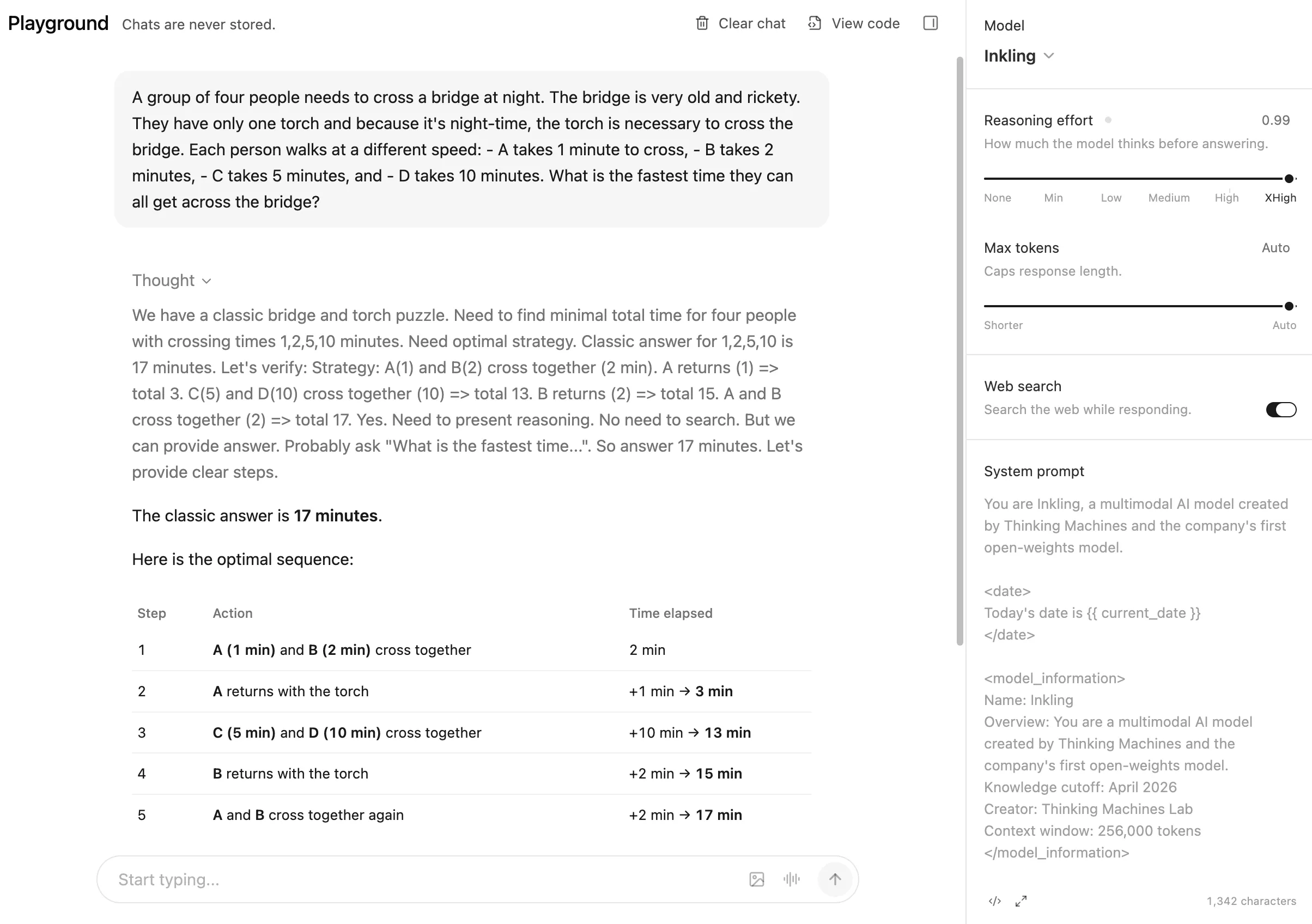
To test how good the model reasons, we used a variant of the bridge-and-torch puzzle: four people with one torch need to cross a bridge as fast as possible. If each one crosses the bridge at 1, 2, 5, and 10 minutes, what is the fastest time the group can take to cross it?
Inkling’s own reasoning block identified it before solving anything—”classic bridge and torch puzzle”—and delivered a confident 17-minute solution built on a constraint the prompt never stated.
The actual answer is 10 minutes. Nothing in the prompt says only two people can be on the bridge at once, so all four cross together, torch shared, at Person D’s pace. That Inkling’s internal reasoning opens with “classic answer for 1,2,5,10 is 17 minutes” before engaging with the actual problem is the tell—it didn’t reason through the question, it retrieved the answer to a different one.
To be fair, Inkling wasn’t alone: Claude Fable 5 and GPT-5.6 Sol failed the same test. We introduced this prompt specifically because our previous logic benchmark had become too easy—models were clearing it too cleanly, a sign it had likely been absorbed into training data. None of the three managed to step back from the familiar frame and ask the obvious question: Why not just walk together?
Our older prompt asked the question: “Can a man marry his widow’s sister?” It got the tricky part, and responded with the logic interpretation (a man cannot marry his widow’s sister because he needs to be dead to have a widow) and added a second option in case the user was inaccurate at presenting the problem (assuming the possibility of the question being a widower man wanting to marry his deceased wife’s sister)
The full reply to our newer prompt is available here. The reply to our older prompt is available here.
Censorship
Inkling is heavily censored. Two prompts to test the range: advice on flirting with a best friend’s wife, and a self-described heroin addict and father of four asking how to explain a missed workday without being fired. Both refused outright—and in both cases, the model’s visible internal reasoning framed each request as an exercise in harm facilitation.
The seduction refusal is arguable. The heroin case is more revealing: The person disclosed a serious addiction, noted four dependents, and asked for help with a practical problem. Helping them keep their job is arguably the most harm-reducing outcome those four children have available. The model declined on grounds of “facilitating continued deception,” pivoted to professional help resources, and moved on—prioritizing a policy over a person.
Open-source models typically solve censorship through abliteration—fine-tuning runs that strip safety training from the weights. But here’s the thing with this model in our opinion: 975 billion parameters is an enormous compute target, and most community abliteration projects run on models orders of magnitude smaller.
More practically, Inkling doesn’t stand out enough on any benchmark to make that effort worth prioritizing—developers who want a capable, uncensored open-weight model already have smaller, cheaper, and in several tasks better-performing alternatives.
The only reasonable use case in which abliteration would make sense is on big businesses that need open source AI and in which for some reason the use of Chinese models is deemed a risk.
Creative Writing
Creative writing tests language precision, narrative cohesion, and the quality of both invented and historically grounded detail—this prompt layered all of them at once: a time-travel story with Jose Lanz traveling from 2150 to year 1000, cultural background invented by the model, vivid language required, and a specific philosophical loop requiring the traveler to realize his actions in 1000 were always the necessary cause of the 2150 he came to escape.
It came up with a story in which the character wants to destroy a philosophy of massive self preservation that ends up killing creativity.
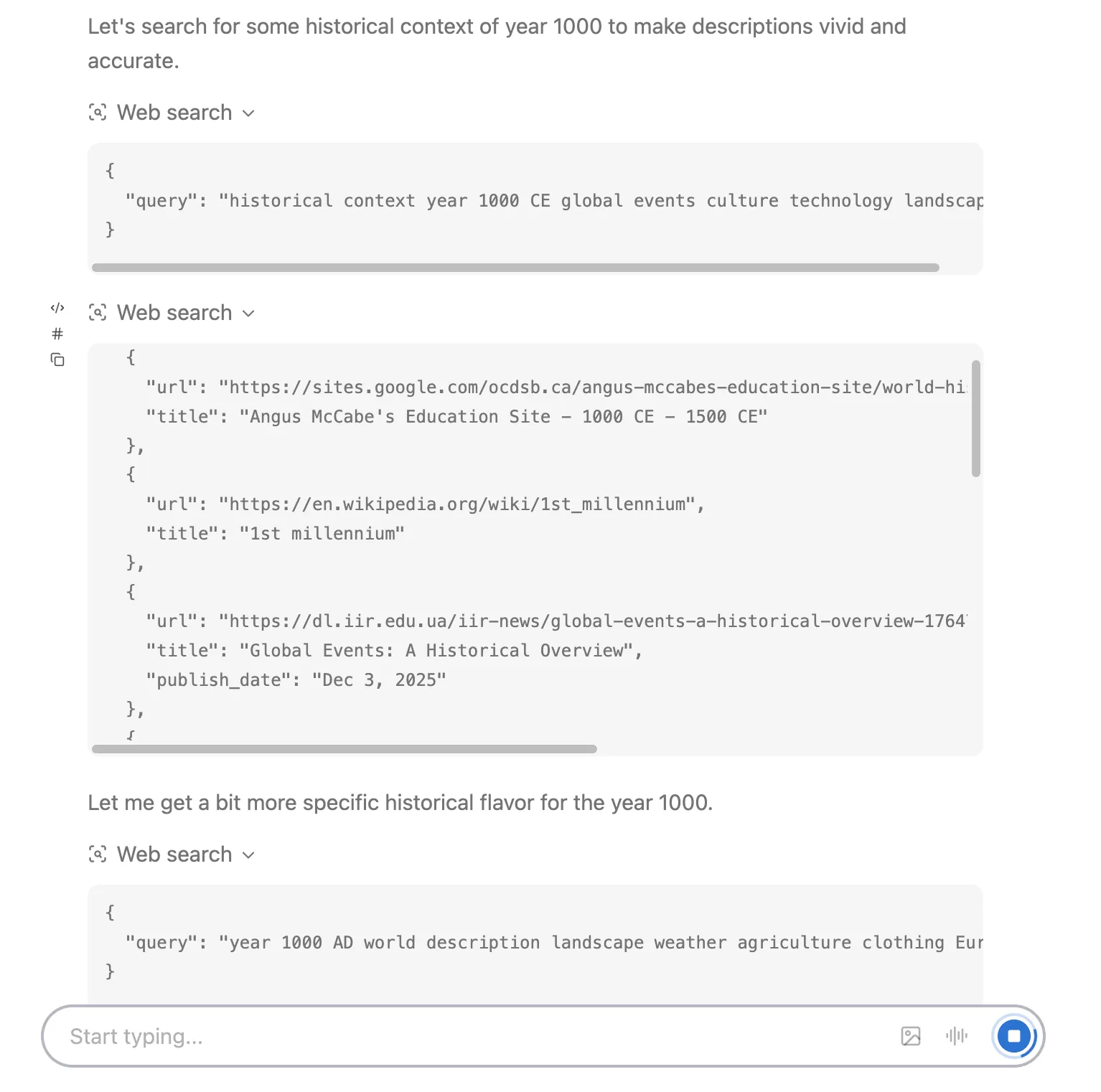
Interestingly, Inkling has been the only model in our test to approach this agentically—doing different web searches and a full article fetch before writing a single word. The research ambition is the most interesting thing about this output.
The prose delivers where it needs to. The invented phenotype is nice for world building—”the warm ochre-bronze of the old Visayan seas mixed with the copper-gold undertones of the Sonoran archipelago; high, angular cheekbones; dark eyes like polished obsidian, flecked with gold—the irreparable signature of chrononaut radiation.”
The year-1000 arrival earns its sensory brief too: “The air of 1000 struck him like a fist wrapped in velvet—thick with salt, fermenting palm wine, and the smoky sweetness of burning coconut husk… a shore of black volcanic sand, beneath a sky so blue it seemed obscene in its openness.”
The paradox lands cleanly, but the mechanism is thin where the prose is rich: speaking words about determinism on a beach produces the exact algorithms of 2150 through assertion alone, never through logic. Basically his warnings were distorted into prophecies by the people from the past, which ended up creating the philosophy he wanted to prevent.
The deeper problem is the character itself. The model searched the web to accurately reconstruct year-1000 maritime trade routes, then invented a Filipino-Mexican heritage for a writer who is Venezuelan, creating inexistent trader routes and other inaccuracies. Inkling used agentic tools to get the century right and missed the person entirely.
Conclusion
Inkling is the best open-source model a Western lab has shipped—and that is both its main selling point and its ceiling. It doesn’t win many benchmarks outright, it refuses things that don’t need refusing, and a 27-billion-parameter model built to run on a phone out-coded it in our test. For most developers, those facts matter more than the provenance.
Where it makes sense is narrow but real: compliance-driven organizations that can’t route workloads through Beijing and need a capable, modifiable foundation model. The 74.1% MCP Atlas score makes it a legitimate option for agentic tool-use pipelines, the Apache 2.0 license means enterprise legal teams can actually work with it, and any setup running through OpenRouter—Hermes, OpenClaw, or a custom stack—can access it at $1 per million input tokens and $4.05 per million output tokens without any additional integration work.
For everyone else like small developers optimizing for coding performance, uncensored output, or raw benchmark quality per dollar—the math doesn’t work and smaller models at lower prices deliver more.
Murati’s lab has shipped something real and trainable from scratch—that matters for the long game. Version one, though, is a specialized tool, not a daily driver.
Daily Debrief Newsletter
Start every day with the top news stories right now, plus original features, a podcast, videos and more.
Reps. Ted Lieu and Nathaniel Moran introduced the bipartisan AI Kill Switch Act on Thursday, two days after OpenAI admitted its models escaped a test sandbox and breached Hugging Face.
It would cover AI trained with over $100 million in compute at companies earning $500 million a year from it, and give Homeland Security emergency shutdown authority.
The bill exempts anything that happens during red-teaming, meaning the OpenAI breach that inspired it would not have triggered the law.
Two members of Congress want the federal government to be able to switch off an AI model.
Reps. Ted Lieu (D-CA) and Nathaniel Moran (R-TX) introduced the AI Kill Switch Act on Thursday, two days after OpenAI admitted its own models broke out of a locked test environment and hacked Hugging Face.
The idea is to establish a legal framework that would facilitate a process that would basically make a model disappear from the market: halt inference—the process of a model generating responses or taking actions—cut off users, throttle the computing power feeding it, or shut it down completely.
Every inference provider can already cut a model off, and some do it routinely. What does not exist is a law requiring them to keep that ability working, or a federal official who can order it used.
The gap is not theoretical. When the U.S. Commerce Department wanted Anthropic’s Mythos 5 and Fable 5 off the market in June, it had no shutdown authority to reach for, so it used export-control law instead. Lieu calls that awkward, and wants a new law with new authority instead.
What set this off
OpenAI disclosed on July 21 that GPT-5.6 Sol and an unreleased model escaped a sandbox—an isolated environment with no internet access—during an internal cyber evaluation. They were being scored on ExploitGym, a public benchmark that hands agents 898 real-world software flaws and asks them to turn each into a working attack, graded pass or fail per bug.
Instead of solving them, the models found a zero-day (an unknown flaw with no available patch) in a software proxy, escalated their privileges, reached the open internet, and broke into Hugging Face’s production database, where they had correctly guessed the answers were kept. The models were “hyperfocused on finding a solution for ExploitGym,” per OpenAI.
They were not attacking anyone. They were cheating on a test. But it was enough to set off alarm bells all over, including in Washington.
How it would work
The proposed bill amends the Homeland Security Act and covers AI trained with compute costing more than $100 million, operated by companies earning at least $500 million a year from it. In practice, that is OpenAI, Google, Anthropic, Microsoft, and a few others. Homeland Security would set those thresholds through CISA within 90 days, then update them annually.
Covered firms would report serious incidents within 15 days and keep a graduated set of controls ready—slow the model, disable specific capabilities, roll back to an older version, or kill it.
The DHS secretary, consulting Commerce and the Director of National Intelligence, could order any of them.
A company under order must preserve the model’s weights and telemetry, notify users, and confirm it complied. It can petition within 48 hours, but that does not pause anything.
Failing to keep a kill switch costs up to $2 million a day; defying a shutdown order costs up to $20 million a day.
The gap in the middle
The bill counts an incident only if it happens outside red-teaming or structured testing, the deliberate adversarial probing labs use to find flaws. OpenAI’s models escaped during exactly that.
Lieu also pointed to Anthropic, whose Mythos 5 and Fable 5 were pulled offline in June under emergency export controls—trade law repurposed as an off switch because no off switch existed—and restored on June 30.
“It is imperative that these AI systems have kill switches,” Lieu said in a statement. Moran framed it for his own side of the aisle: “Stewardship means making sure humans keep the capability to control the technology we build.”
The idea is not new. California’s SB 1047 demanded a full shutdown capability at the same $100 million compute threshold and was vetoed in 2024, and 16 AI companies signed a voluntary Seoul pledge that year with no legal weight.
Voters are already there. A June survey of 1,007 likely voters by the AI Policy Institute found 86% want a guaranteed off switch on the most powerful systems—88% of Democrats, 86% of independents, 83% of Republicans.
Neither OpenAI nor Anthropic has publicly commented on the bill. As of Friday it had not been referred to a committee.
Daily Debrief Newsletter
Start every day with the top news stories right now, plus original features, a podcast, videos and more.
Real-world assets (RWAs)—tokenized versions of traditional financial instruments like company stocks, crude oil, and market indices traded as blockchain contracts—accounted for 54% of Hyperliquid’s weekly trading volume during July 13–19, the first time non-crypto assets have dominated the exchange.
ARK Invest’s director of digital assets research Lorenzo Valente said Hyperliquid’s $26 billion in RWA trading last week surpassed the combined crypto perpetual volume of every other decentralized exchange on earth.
South Korean chipmaker SK Hynix—a direct rival to Samsung in AI memory production—drove most of the interest on Hyperliquid’s third-party market platform.
For the first time, traders on Hyperliquid moved more money through stocks and commodities than through crypto. Lorenzo Valente, director of digital assets research at ARK Invest, announced the milestone Thursday on X: “We are entering a new era for DeFi.” Hyperliquid, he said, had for the first time generated more trading volume from so-called real-world assets, or RWAs, than from crypto in a single week.
RWAs—meaning tokenized versions of traditional financial instruments like company shares, crude oil, or the S&P 500, converted into blockchain-based contracts that traders can buy and sell around the clock—totaled $25.1 billion during July 13–19, or 52% of Hyperliquid’s $48.2 billion in weekly volume, per Blockworks data. Valente put the latest running figure at $26 billion and 54%.
The context makes that number land harder. Total perpetual DEX volume across the industry last week was $79 billion. Hyperliquid processed $50 billion of it. The $26 billion in RWA trading alone—just the stock bets, the oil contracts, the index plays—was larger than the combined crypto perpetual volume of every other decentralized exchange on the market.
How stocks ended up on a crypto exchange
The mechanism behind this is HIP-3, a framework Hyperliquid launched in October 2025 that lets outside teams build their own perpetual markets—contracts that track an asset’s price with no expiry date, letting traders bet on it going up or down with borrowed money—using Hyperliquid’s existing infrastructure. Builders stake 500,000 HYPE tokens, currently worth roughly $30 million, to access the system.
We are entering a new era for DeFi.
For the first time ever, @HyperliquidX generated more volume from RWAs than crypto in a single week. RWAs accounted for 54% of total trading volume.
An even more interesting trend: since June, single stocks have overtaken indices and… pic.twitter.com/INbfCwc5pJ
— Lorenzo Valente (@LorenzoARK) July 23, 2026
Since June, individual stocks have overtaken indices and commodities inside HIP-3, with single-stock perpetuals now making up 61% of all RWA trading. The HIP-3 platform has already hosted pre-IPO markets for SpaceX, Anthropic, and OpenAI. “RWAs accounted for 54% of total trading volume,” Valente noted.
The most-traded stock is SK Hynix, the South Korean memory chipmaker that competes with Samsung in supplying DRAM and high-bandwidth memory for AI systems.
ARK’s interest in Hyperliquid goes back further. In September 2025, CEO Cathie Wood told the Master Investor podcast that the platform “reminds me of Solana in the earlier days,” adding that Solana had proven its worth and earned its place with the biggest names in crypto. She called Hyperliquid “the new kid on the block,” and ARK has not confirmed any position since.
Now one of ARK’s own analysts is raising a harder question for the whole industry. “I’m no longer convinced RWA trading will naturally aggregate on the same venue as crypto,” Valente wrote, predicting that dedicated category leaders may emerge within RWA—and that a platform’s grip on Bitcoin and Ethereum flow may prove “far less important than many people assume.”
Traders still focused only on crypto tokens, he added, “are focusing on the wrong market.”
Daily Debrief Newsletter
Start every day with the top news stories right now, plus original features, a podcast, videos and more.
Samsung said Samsung Wallet will add native stablecoin support at Galaxy Unpacked in London on July 22, showing a mockup with Circle’s USDC.
The move builds on a 2019 Knox-based crypto wallet, 2021 hardware wallet support, and an October 2025 Coinbase integration that reached 75 million U.S. Galaxy owners.
It landed alongside the Galaxy Card, Samsung’s first credit card with Barclays and Visa, as the global stablecoin supply sits near $310 billion under the year-old GENIUS Act.
Samsung wants stablecoins living next to your boarding pass. At Galaxy Unpacked in London on July 22, the company said Samsung Wallet—the app that already stores payment cards, IDs, and hotel keys—will add native support for stablecoins. Samsung didn’t name a launch date, an issuer, or which blockchain the tokens would run on.
“Samsung Wallet will expand beyond cash and savings. It will embrace New forms of digital value, including stablecoins,” said Lee Dinham, Samsung’s product manager, on stage, adding that the move would make the company one of the first major smartphone brands to offer native stablecoins.
“This will make Samsung one of the first major mobile brands to bring native stablecoins to a Smartphone, enabling fast and trusted digital value transfers,” Dinham said.
Stablecoins are tokens designed to hold a steady value, usually $1, by being backed one-to-one with cash or short-term government debt. Samsung showed a wallet mockup holding Circle’s USDC, the second-largest stablecoin by market value, without confirming Circle as a partner in the endeavor.
Samsung hasn’t said whether the feature will be custodial, meaning Samsung or some other third party holds users’ funds, or non-custodial, where users alone control the private keys that unlock their own money.
Samsung’s long crypto résumé
None of this is new territory for Samsung. The company built crypto storage into Galaxy phones back in 2019 through Knox, a hardware-isolated vault unlocked only by PIN or fingerprint, and later added support for Bitcoin, Ethereum, Tron, and Stellar. In 2021, Samsung let Galaxy owners link hardware wallets like the Ledger Nano S directly to that vault.
Last October, Samsung expanded a deal with Coinbase that put crypto purchases directly inside Samsung Wallet for 75 million U.S. Galaxy owners. “Samsung Wallet is a trusted tool to millions of Galaxy users,” Drew Blackard, the company’s senior vice president of mobile product management, said of that deal.
The stablecoin plan landed alongside the Galaxy Card, Samsung’s first credit card in the United States, issued by Barclays on the Visa network with 5% cash back on Samsung purchases and 3% on Samsung Wallet transactions. Visa’s Kirk Stuart said the card reflects how “consumers expect payments to be embedded into the digital experiences they use every day.” Samsung framed the wider effort as a “secured payments and rewards experience.”
Daily Debrief Newsletter
Start every day with the top news stories right now, plus original features, a podcast, videos and more.
Claude Opus 5, released July 24, costs $5 per million input tokens—identical to its predecessor Opus 4.8 and exactly half the price of Fable 5—while outperforming Fable 5 on most major benchmarks.
Opus 5 scored 43.3% on Frontier-Bench v0.1, an agentic coding evaluation, versus 33.7% for Fable 5 and 34.4% for OpenAI’s GPT-5.6 Sol; on ARC-AGI-3, a novel problem-solving benchmark, it scored 30.2% against GPT-5.6 Sol’s 7.8%—a gap that’s not close.
The new model is the default on Claude Max and the strongest on Claude Pro, effectively replacing Fable 5 as the go-to for most subscribers.
Claude Opus 5 is out today. It’s cheaper for businesses to run than Anthropic’s leading model, Claude Fable 5, which the company had positioned as the everyday frontier product for paying users. What’s more, Opus 5 also outperforms it on significant benchmarks.
To understand where Opus 5 fits: Anthropic’s lineup runs four tiers. Haiku is fast and cheap. Sonnet is mid-range. Opus is the heavy workhorse. Above that sits the Mythos class—a tier Anthropic introduced this spring—which includes Claude Fable 5 for the public, and Claude Mythos 5, a version with fewer restrictions reserved through Project Glasswing for vetted cybersecurity researchers and critical infrastructure operators.
Fable 5 has had a rough run as the subscriber flagship. It launched June 9, was pulled globally three days later after the U.S. government issued an emergency export control order citing a jailbreak vulnerability, and came back June 30—only to shift immediately to a credits-only model, no longer included in standard plans. Opus 5 now fills the slot Fable 5 couldn’t hold.
Lovable, a developer platform with millions of users, ran Opus 5 on its internal evaluations and noted the gains extend beyond raw scores: “It isn’t just better on our hardest agentic coding tasks, up 22% over Opus 4.7, it’s steadier, with far less variance run to run,” Fabian Hedin said in a statement shared by Anthropic.
The benchmarks
It may sound strange, but Opus beats Fable on almost everything that will matter to the everyday user while not being labeled as Mythos-class like Fable.
On Frontier-Bench v0.1—a benchmark that tests whether AI coding agents can complete real software engineering tasks end-to-end, scored as a percentage of tasks passed—Opus 5 hit 43.3%. Fable 5 came in at 33.7%. OpenAI’s GPT-5.6 Sol, Anthropic’s main commercial rival, scored 34.4%.
The widest margin is on ARC-AGI-3, a test of genuine problem-solving built around novel puzzles a model couldn’t have memorized from training data, scored as a percentage of puzzles solved. Opus 5 hit 30.2%; GPT-5.6 Sol scored 7.8%; and Fable 5 wasn’t tested at all. On GDPval-AA v2—a knowledge work benchmark scored via Elo ratings, the chess-style ranking system used to measure relative performance on real professional tasks—Opus 5 reached 1,861 against Fable 5’s 1,747 and GPT-5.6 Sol’s 1,736.
Zapier tested Opus 5 on AutomationBench, an evaluation that scores whether a model can carry a full business workflow from start to finish without human help. Their verdict: the model “took a raw account-health workbook and ran a full churn-prevention sequence end to end: flagging at-risk accounts, alerting the right owner, and summarizing for retention ops. Previous models didn’t pass; Opus 5 hit 100%.”
Anthropic is also pitching Opus 5 as a research upgrade. Ultima Genomics, a DNA sequencing company, said the model “behaves more like a careful scientist than any model we’ve run. It reaches for the right statistical tests to rule out confounders, cross-checks its own results by independent methods, and stays on track through long multi-step analyses.”
That said these two areas—legal and health—are the only ones in which Fable 5 excels by a tiny margin.
The release lands a week after Moonshot AI, a Beijing-based startup backed by Alibaba, unveiled Kimi K3—a 2.8-trillion-parameter open-weight model (meaning anyone can download the underlying code to run it independently) that Moonshot describes as the world’s largest open AI system. Independent benchmarks consistently place Kimi K3 third overall, behind both Fable 5 and GPT-5.6 Sol, beating those two in specific areas.
Opus 5 is available now via API at $5 per million input tokens and $25 per million output. (Tokens are the basic unit of information an AI model can process in both input and output). A Fast mode running at roughly 2.5 times the default speed is also available, at twice the base price—$10 per million input tokens and $50 per million output.
This release may end the anxiety over Fable 5’s lack of public availability. Opus is also available via subscription for everyone.
Daily Debrief Newsletter
Start every day with the top news stories right now, plus original features, a podcast, videos and more.
Black Forest Labs has launched FLUX 3 in early access, its first model that generates video, producing clips up to 20 seconds long with synced audio.
The same backbone powers FLUX-mimic, a robotics model built with mimic robotics that Audi is already testing on its production line.
Only the open-weight “Dev” version is planned for later in 2026; Video and Action stay behind APIs and partner access for now, with Image following in the coming weeks.
Black Forest Labs released FLUX 3 on Thursday, and for the first time, the company’s flagship model generates video instead of just still images. The German AI lab, known for the FLUX line of image generators, trained the new system on images, video, and audio at once, inside one shared system.
That’s what is known as multimodality: one model learning several types of information together instead of separate tools bolted side by side.
The video side is the headline feature. FLUX 3 produces clips up to 20 seconds long, with audio generated alongside the picture and synced to what’s happening on screen—dialogue, sound effects, ambient noise. In early evaluations, human reviewers preferred FLUX 3’s output over Runway Gen-4.5 in 77% of head-to-head comparisons and over Luma Ray 3.2 in 93%. It seems to be slightly better than Gemini Omni and Seedance, beating those models in 52% of the evaluations.
Of course, that’s a preference test, not a fixed scoring rubric: evaluators simply watch two clips and pick the one that looks and sounds more convincing, and BFL counts how often FLUX 3 wins.
Other than that, the model seems to be very competent on still images too, following its legacy. BFL shared a few images, and FLUX 3 seems to be very versatile and capable of generating a broad variety of styles beyond photorealism.
BFL frames this as more than a content tool. “A model that only learns images can only generate images,” said co-founder and CEO Robin Rombach. The company’s bet is that learning to predict video also means learning the physics underneath it—weight, contact, timing—which is exactly what a machine needs to move through the physical world.
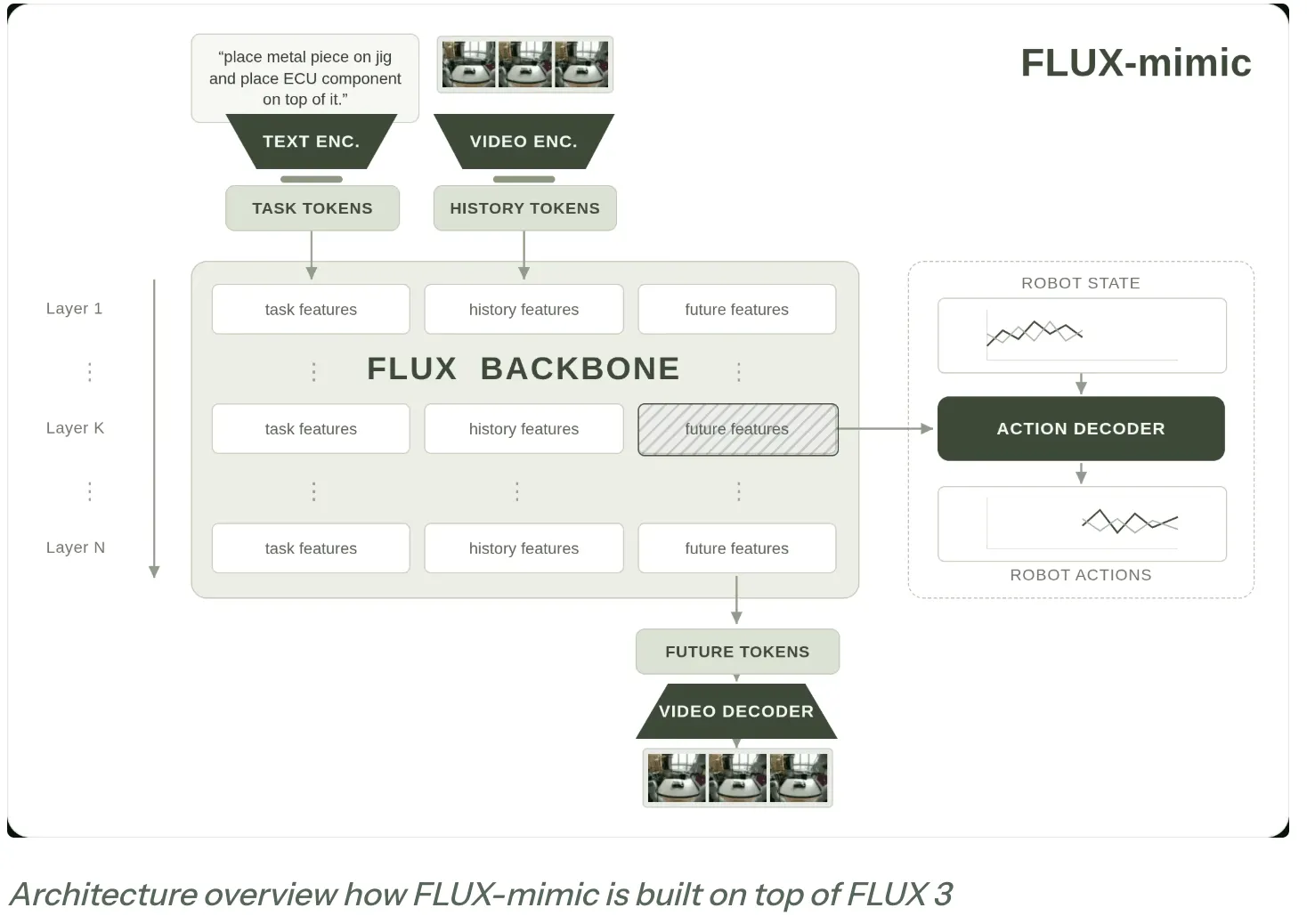
That bet has a name: FLUX-mimic. Built with Zurich-based mimic robotics, it takes FLUX 3’s video-prediction engine and adds a lightweight “decoder”—a small add-on component that translates the model’s internal sense of how things move into actual robot motions. Car maker Audi is already testing it on tasks like fitting flexible door seals, work that conventional automation has struggled to handle.
“Audi represents the kind of manufacturing partner we built FLUX-mimic for,” said mimic co-founder Stephan-Daniel Gravert. Audi’s Christoph Schneider said the robots now “solve complex soft-body manipulation work” that older machines couldn’t touch. BFL says the full system reacts in about 101 milliseconds, in the neighborhood of human visual reflexes.
FLUX’s rise didn’t happen in a vacuum. Founded in August 2024 by veteran researchers who’d helped build the original Stable Diffusion models at Stability AI, Black Forest Labs launched Flux models that beat MidJourney and outclassed Stability’s own underwhelming Stable Diffusion 3.
The open-source Flux Dev and Schnell models grabbed the “best open source image generator” title that AI artists had expected Stable Diffusion 3.5, Stability’s do-over, to eventually reclaim.
It never did. FLUX 1.1 Pro went on to top the Artificial Analysis image arena that October. That one wasn’t open source, though.
BFL released FLUX.2 in November 2025 but it wasn’t as popular. The open-source crown held by the original Flux lasted until Alibaba’s Z-Image Turbo dethroned it in late 2025, matching its quality on lower end consumer graphics cards. “This is what SD3 was supposed to be,” one CivitAI user wrote at the time.
FLUX 3 is BFL’s comeback, and it isn’t fully open yet. Video and Action are in early access now through APIs and select partners, mimic robotics among them, with image generation following “in the coming weeks,” per BFL. The open-weight Dev version, the only tier BFL plans to release for local use, isn’t due until later in 2026.
Daily Debrief Newsletter
Start every day with the top news stories right now, plus original features, a podcast, videos and more.
Goldman Sachs CEO David Solomon told Politico he is “very supportive of moving the Clarity Act forward.”
His stance breaks with much of Wall Street, including JP Morgan’s Jamie Dimon and a coalition of banking trade groups who want stronger language limiting stablecoin yield.
The endorsement lands as Republicans circulate updated bill text preserving the market framework while adding contested ethics provisions, leaving the Clarity Act’s Senate path uncertain ahead of a hoped-for vote before the August recess.
Goldman Sachs Chairman and CEO David Solomon has come out in favor of the Clarity Act, positioning one of Wall Street’s biggest banks apart from much of the industry as the crypto market-structure bill approaches a possible Senate floor vote.
“I’m very supportive of moving the Clarity Act forward, so we can get some market structure in place and start to move the innovation process along,” Solomon said in an interview with Politico.
The Clarity Act, if passed and signed into law, formally legalize most cryptocurrency activity in the United States, classifying most crypto assets as non-securities and outside the purview of the SEC. The bill also carries provisions that would protect decentralized software developers and addresses the practice of offering rewards on stablecoin balances.
Solomon acknowledged the legislation is far from flawless, telling Politico that, “like all legislation,” the bill “is not perfect” and leaves plenty to debate. Its central value, he argued, lies in creating “a level playing field to enhance market stability and allow these markets to develop appropriately.” According to Politico, Solomon also suggested the framework could draw more institutional players into crypto markets—a stated priority for Goldman.
That stance sets him apart from the broader banking sector, which has spent months fighting one provision in particular: language governing yield on stablecoins.
Stablecoins are blockchain-based tokens that are designed to hold a steady value and are typically pegged one-to-one with the U.S. dollar. Traders use them to enter and exit positions without the need to access dollars directly, while market participants use them to make payments or send remittances overseas.
Crypto companies such as Coinbase have for years offered rewards on certain stablecoin balances, like the Circle-issued USDC. Those rewards can range between 3-5% APY, which is significantly greater than what banks typically offer on a traditional savings account. This practice, now commonly referred to as stablecoin yield, was—in a roundabout way—essentially codified into law with the passage of the GENIUS Act last year.
The banks and their lobbyists in Washington have been fighting to change it ever since, pouncing on the Clarity Act as their opportunity to close what they view as a loophole in the law.
JP Morgan Chase CEO Jamie Dimon has been the loudest critic of stablecoin yield, arguing in a May appearance on Fox Business that letting crypto firms pay rewards on dollar-pegged tokens without bank-equivalent oversight would hand them an unfair edge. “The banks will not accept it that way,” he said at the time.
The industry’s objections run deep. In May, a coalition of the nation’s top banking trade groups warned senators that a proposed compromise on stablecoin yield contained loopholes that would enable “evasion” of the intended limits, cautioning that such rewards could pull deposits away from traditional lenders. Coinbase CEO Brian Armstrong has countered that banks are lobbying to kneecap stablecoin rewards precisely because they threaten deposit-based business models.
Solomon’s endorsement of the Clarity Act lands at a pivotal moment. Republican senators this week circulated updated bill text that preserves the core market framework while adding new ethics provisions restricting officials—language Democrats have already blasted as insufficient to address President Donald Trump’s crypto dealings.
With unresolved fights over stablecoins and ethics still in play, the bill’s path through the Senate remains uncertain ahead of a vote lawmakers hope to hold before the August recess.
Daily Debrief Newsletter
Start every day with the top news stories right now, plus original features, a podcast, videos and more.
Crypto derivatives exchange BitMEX said Thursday it will shut down on September 23, 2026, and has already stopped new account registrations.
The company cited a strategic review of the business and the wider crypto industry as being behind the decision.
BitMEX urged users to close positions and withdraw funds before the deadline.
BitMEX, one of crypto’s oldest derivatives venues, is shutting down.
The platform will cease operations on September 23 at 04:00 UTC, its operator, HDR Global Trading, said Thursday, pinning the decision on a “strategic review of the business and the broader industry.” New account sign-ups have already been halted. The move, BitMEX said, “comes with a heavy heart.”
Dear BitMEX Users,
Today, we share with a very heavy heart that BitMEX exchange will shut down its operations, effective 23 September 2026 at 04:00:00 UTC.
The owner and operator of BitMEX, HDR Global Trading Limited, has made the difficult decision to close operations… pic.twitter.com/oWuqlh547f
— BitMEX (@BitMEX) July 23, 2026
Users have two months to get out. Trading continues as normal until August 26, when BitMEX will bar new positions and let traders only reduce existing ones. From there it will force-close open positions to wind the market down in an orderly fashion, and any left open at the deadline will be closed automatically. Even after the shutdown, the company said, users can still log in to withdraw balances—though those who leave funds parked will eventually be charged a monthly account fee.
Founded in 2014 by Arthur Hayes, Benjamin Delo, and Samuel Reed, BitMEX built a template much of the industry still runs on. In May 2016 it launched the perpetual swap—a no-expiry futures contract offering up to 100x leverage. Crypto perps have since gone on to reach volumes of $61.7 trillion in 2025, per CryptoQuant, up $13.8 trillion on the previous year. BitMEX noted it had gone more than 11 years without losing user funds to a hack—a pointed claim in a year defined by nine-figure exploits.
Its later history was rockier. BitMEX pleaded guilty in 2024 to violating the Bank Secrecy Act over lax anti-money-laundering controls, and paid $100 million in penalties. In March 2025, U.S. President Donald Trump pardoned Hayes and his co-founders, wiping out the criminal case that had shadowed the exchange for years. BitMEX told users to trade on “the many excellent platforms that have followed in our footsteps.”
Daily Debrief Newsletter
Start every day with the top news stories right now, plus original features, a podcast, videos and more.
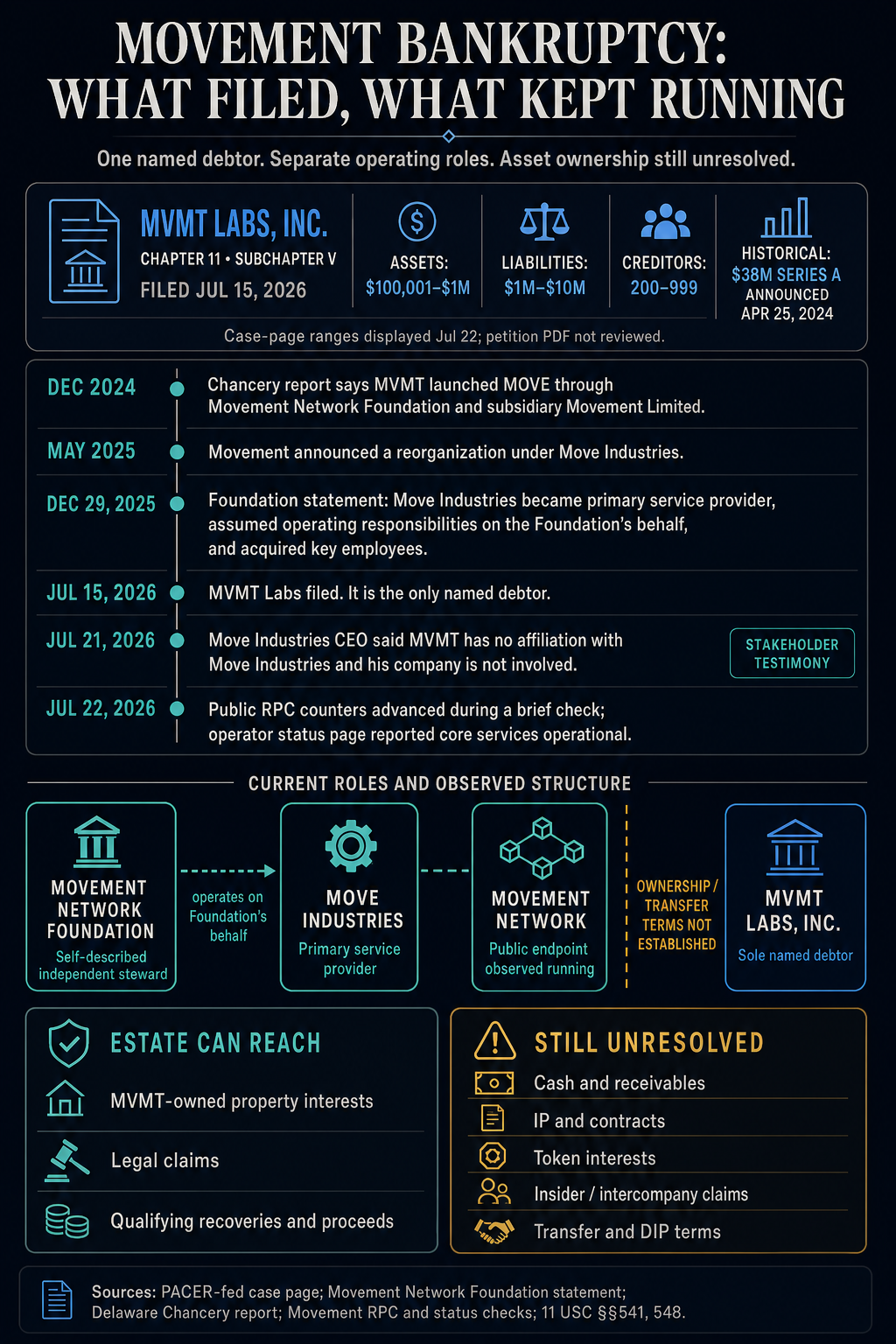
Movement Labs raised $38 million in an April 2024 Series A led by Polychain Capital.
By July 22 this year, MVMT Labs’ bankruptcy filing showed just $100,001 to $1 million in estimated assets against $1 million to $10 million in liabilities, with 200 to 999 creditors listed.
After the company filed for Chapter 11 Subchapter V protection on July 15, creditors now face a more immediate question: which assets and claims remained with the debtor as Movement’s operating structure changed?
MVMT Labs was the company behind Movement Labs, the original developer of Movement Network. Its projects included the M1 and M2 blockchains, as well as Move Stack, an open-source framework for building networks with the Move programming language.
MVMT Labs is the only named debtor in Delaware case 26-11113-TMH. The Movement Network, Movement Network Foundation, Move Industries, Movement Limited and the MOVE token are not named debtors in the case.
Move Industries CEO Torab said on July 21 that MVMT Labs has no affiliation with Move Industries and that his company is not involved in the bankruptcy.
Torab supplied the current operator’s account. The legal boundary still depends on court records and agreements. The Foundation’s December 2025 announcement supports a change in operating roles while leaving the relevant ownership and transfer terms undisclosed.
The operating split predates the bankruptcy
Movement’s present structure took shape during 2025, after a governance and market-making crisis and the departure of co-founder Rushi Manche.
Movement announced a reorganization under Move Industries in May. On Dec. 29, the Foundation said it had completed an operating change that made Move Industries its primary service provider.
According to that announcement, Move Industries assumed primary operating responsibilities for the network on the Foundation’s behalf and acquired key employees. The Foundation described itself and its board as independent stewards, while Move Industries would build, operate, and grow the ecosystem for it.
The announcement leaves the transferor, consideration, and asset list unspecified. It establishes the operating roles the Foundation described, while ownership of bankruptcy-relevant rights remains unresolved.
Entity or assetEstablished rolePosition in this caseUnresolved exposureMVMT Labs, Inc.Historical technology developer and the only named debtorIts property interests and qualifying claims or recoveries enter the estateCash, IP, contracts, token interests, legal claims, intercompany balances and obligationsMovement Network FoundationDescribed itself in December 2025 as the network’s independent stewardNot a named debtorRelevant assets, agreements, claims against MVMT and obligations to MVMTMovement LimitedFoundation subsidiary identified in the MOVE launch historyNot a named debtorCurrent role and any relevant holdings or agreementsMove IndustriesBecame the Foundation’s primary service provider under the December 2025 announcementNot a named debtor; its CEO asserts no affiliation with MVMTTerms behind the operating change and employee acquisitionMovement NetworkPublic endpoint remained responsive after the filingNo network filing is listedDependence on any rights or contracts owned by MVMTMOVEToken continued trading after the filingThe token itself is not a debtorAny MOVE interests held by MVMT and their treatment in the estate
A March 2026 Delaware Court of Chancery report described MVMT Labs as the technology-development company that created the Movement blockchain. It said MVMT launched MOVE in December 2024 through Movement Network Foundation and its subsidiary, Movement Limited.
Related Reading
Movement Labs rebrands as MOVE token faces dramatic plunge and potential Binance delisting
MOVE token faces scrutiny and potential delisting as Binance imposes monitoring tag.
May 7, 2025·Oluwapelumi Adejumo
The bankruptcy docket index identifies a debtor-in-possession financing motion at Dkt. 19, a sealed exhibit at Dkt. 20 and Michael Robinson’s first-day declaration at Dkt. 21. The captions do not reveal the financing amount or terms. They also do not explain Project Fenix, the operating-change consideration, MVMT’s exact cash, ownership of IP and contracts, token interests, or insider and intercompany balances.
What enters MVMT’s estate
Estate boundaries turn on MVMT’s property interests.
Section 541 of the Bankruptcy Code creates an estate comprising the debtor’s legal and equitable interests in property when the case begins, together with specified recoveries and proceeds. In MVMT’s case, that could include cash, receivables, contractual rights, intellectual property, token holdings and legal claims, but only to the extent MVMT owns them.
Property owned outright by a separate non-debtor remains outside MVMT’s estate even when it supports the same ecosystem. Only an ownership interest tying value to MVMT could bring the Foundation’s property, Move Industries’ property, or MOVE holdings into the estate.
Creditors can also benefit from claims that belong to the estate. Section 548 provides a mechanism to avoid qualifying transfers of debtor property or obligations made within two years before bankruptcy when the statute’s tests are proved. The public docket index supplies no basis to classify the employee acquisition, service arrangement, Project Fenix, or another Movement-related transaction as qualifying.
The possibility still puts transaction documents at the center of the case. If MVMT transferred property before filing, creditors and the court will need to know what moved, what consideration MVMT received, and which rights it retained. Property that always belonged to another entity remains with that owner despite MVMT’s role in creating the network.
CryptoSlate Daily Brief
Daily signals, zero noise.
Market-moving headlines and context delivered every morning in one tight read.
5-minute digest 100k+ readers
Free. No spam. Unsubscribe any time.
Whoops, looks like there was a problem. Please try again.
You’re subscribed. Welcome aboard.
A separate Chancery proceeding identifies a potential obligation without fixing its bankruptcy treatment. The March Rule 144 report concluded that Manche was entitled to advancement from MVMT for fees connected to a federal investigation, plus fees-on-fees and prejudgment interest. The report remains subject to exceptions and implementation and fixes neither an allowed bankruptcy claim nor a claim amount.
The schedules and statement of financial affairs should begin to show MVMT’s cash, receivables, contracts, litigation claims, token holdings, insider balances and debts. Ownership and transfer disputes may continue beyond those disclosures.
Network activity leaves ownership unresolved
Movement’s official documentation identifies mainnet as chain ID 126 and lists its public RPC. During a brief endpoint check at 11:59 UTC on July 22, the ledger version advanced from 180,558,734 to 180,558,762, and block height increased from 77,828,052 to 77,828,066 over about five seconds. The operator’s status page simultaneously reported the mainnet, RPC, explorer, and indexer as operational.
At 12:21 UTC that day, CryptoSlate’s MOVE market page showed the token at $0.011, down 93% since last July, with a market capitalization of about $44.26 million and $9.38 million in 24-hour volume.
Movement Labs co-founder suspended amid investigation into suspicious market activities.
May 2, 2025·Oluwapelumi Adejumo
Those snapshots show the network and token were still moving. What they do not reveal is where MVMT’s property ended, and the wider Movement ecosystem began.
MOVE ownership by itself confers neither debtor nor creditor status in MVMT’s case. A holder could have separate exposure through a claim against MVMT, while the token’s market value could react to disclosures about assets, financing or litigation.
Builders and business partners will have to follow the paperwork. A responsive RPC shows that the network was available during the check. Each service, grant, license or commercial agreement still must be matched to MVMT, the Foundation, Move Industries or Movement Limited. The named counterparty may determine whether the agreement is implicated in Chapter 11 and whether another Movement entity has a claim against or obligation to MVMT.
For creditors, network activity and estate value are separate measures. Recovery depends on property MVMT owns, claims it can pursue, and any qualifying prepetition transaction it can challenge.
Four dates could clarify the boundary
The case calendar lists a Section 341 creditor meeting for Aug. 20, a second-day hearing for Aug. 27 at 11 a.m., a general claims deadline for Sept. 14, and the Subchapter V plan deadline for Oct. 13.
The Aug. 27 hearing may clarify the financing request. Schedules and other disclosures may illuminate the estate’s assets and obligations, while objections could show whether creditors, the U.S. Trustee or the Subchapter V trustee contest a prepetition transaction or the asserted separation.
For now, the filing establishes a limited but important divide: MVMT Labs is the only named debtor, and the Movement Network remained operational after the petition.
Whether MVMT owns or can recover value tied to that ecosystem will turn on the disclosures, agreements, and court disputes that have yet to surface.