Rapper Megan Thee Stallion sued Milagro Gramz on Tuesday, alleging the Texas-based internet personality defamed her following a separate court case with Canadian rapper Tory Lanez.
Born Megan Pete, the rapper alleges Gramz (Milagro Cooper) stalked her online, causing emotional distress and spreading AI-generated deepfake pornography featuring her likeness.
In court documents filed in the Southern District Court of Florida, Pete’s attorneys acknowledged that while it’s unknown who created the deepfake video, they argue Cooper published a video on YouTube that addressed an X post related to the explicit content.
“The lengths to which Defendant Cooper goes to harass Ms. Pete knows no bounds, attorneys for Pete wrote. “In June 2024, Defendant Cooper encouraged her 27,000 X followers to view an X post by Bimbella that shared a doctored, artificially created video of Ms. Pete purportedly engaged in sexual acts without Ms. Pete’s knowledge or consent.”
It’s the latest development in the ongoing feud between Lanez and Pete, which began in 2020 when Lanez was charged with shooting Pete in the feet during an altercation in Los Angeles.
Lanez was convicted on three felony counts, including assault with a semiautomatic handgun, according to a report by the New York Times.
The complaint further asserts that Cooper’s alleged harassment was at the behest of Lanez (born Daystar Peterson) and accused Cooper of running an “online rumor mill” that spread false claims about Pete, including questioning the rapper’s mental state and having a “severe drinking problem.”
Taking to X (formerly Twitter), Cooper said she was informed of the lawsuit by Pete’s attorney, Alex Spiro. “Of course, we’ll chat about it,” she wrote. “They threw in the tape, too.” Cooper did not say if she intends to counter-sue.
Attorneys for Pete are seeking compensatory and punitive damages, legal fees, and a court order to prevent future harassment by Cooper.
Pete’s lawsuit is the most recent concerning AI-generated deepfakes of high-profile artists.
Last year, actress Scarlett Johansson filed a lawsuit against image generator Lisa AI, which posted a deepfake of Johansson promoting the platform.
In May, Johansson, who starred as the voice of the AI Samantha in the 2013 film “Her,” took legal action against ChatGPT creator OpenAI after it released a voice-enabled version of the chatbot that sounded eerily similar to the actress.
Representatives for both Cooper and Pete did not immediately respond to Decrypt’s request for comment.
Edited by Sebastian Sinclair
Generally Intelligent Newsletter
A weekly AI journey narrated by Gen, a generative AI model.
The Chainlink Platform is evolving to give developers substantially more power, freedom, and reach than ever before through a highly self-serve, scalable, and programmable architecture. The core functions of oracle networks are becoming reusable modular capabilities that developers can compose in any way into workflows and run via the new Chainlink Runtime Environment (CRE). Developers will be able to seamlessly combine all Chainlink capabilities to create customized apps and unlock use cases not bound by any chain, offchain resource, or product integration. The upgrade of the Chainlink Platform is key to expanding Chainlink to thousands of blockchains and meeting the growing demand from capital markets and Web3.
On the Main Stage at SmartCon 2024 today, we announced a major upgrade to the Chainlink Platform. This upgrade is designed to scale Chainlink across thousands of blockchains, meet the growing demand from financial institutions, and empower developers to build with Chainlink faster, more easily, and with more reach and flexibility than ever before.
Underpinning this initiative is a deep re-architecture of the Chainlink Platform. Drawing inspiration from microservices architecture, the Chainlink node software that manages decentralized oracle networks (DONs) is being broken down into distinct, modular capabilities (e.g., read chain, perform consensus, etc.) that are each secured by independent DONs. Developers can seamlessly combine these capabilities in any number of ways into executable workflows that run via the newly developed Chainlink Runtime Environment (CRE)—the system of DON-based capabilities, DON-to-DON communications, capability orchestration, and code execution on which workflows run with the appropriate consensus model.
The Chainlink Platform architecture will have DONs that each specialize in a capability, as well as empower developers to string together these capabilities to form workflows that the Chainlink Runtime Environment (CRE) DON executes.
The result of this upgrade is developers being able to build substantially quicker, connect their apps seamlessly across all chains connected to the Chainlink Platform, and create more powerful applications, including purpose-built financial apps that interact with capital markets infrastructure, incorporate custom compliance policies, and handle sensitive information in a privacy-preserving manner.
While developers will continue to write core application logic as onchain smart contracts, CRE enables them to deploy code directly on the Chainlink Platform for building and composing capabilities, removing the need to add Chainlink-specific code to their onchain contracts. This allows developers to leverage Chainlink’s capabilities regardless of which blockchains their application is deployed to, leading to unified applications secured end-to-end by consensus computing.
The Evolution Toward a Modular Developer Platform
Existing Platform
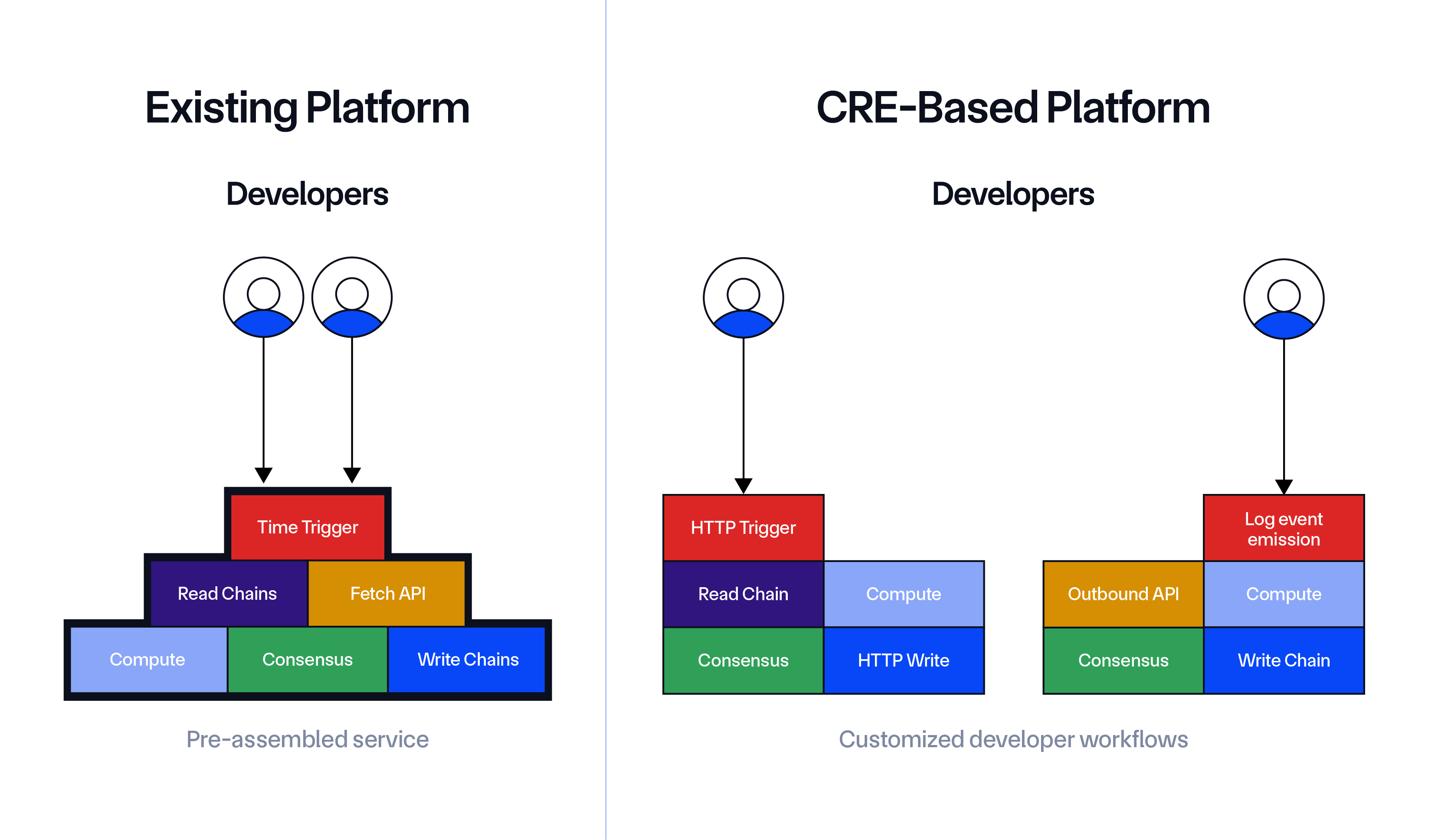
To date, the Chainlink Platform consists of a series of prepackaged services, with each service akin to a set of pre-assembled lego pieces that form a single design pattern (i.e., workflow). For example, Chainlink Automation combines 5-6 separate capabilities into a smart contract automation workflow. Each capability has its own parameters, and capabilities must be executed in order to produce a valid workflow output.
This service-oriented architecture helped scale Chainlink from 0 to 1, and in the process enabled Chainlink to become the most widely used oracle platform, with the most secure and reliable services across data, smart contract automation, verifiable randomness, cross-chain interoperability, and more.
However, to hyperscale Chainlink to thousands of chains, support millions of new developers at faster development speeds, and unlock a wider range of use cases and customizations across DeFi and fast-emerging TradFi adoption, an upgrade to the architecture of the Chainlink Platform is necessary. And since Chainlink is currently enabling trillions of dollars in transaction value, this transition must take place without any disruption to the security and reliability of existing Chainlink services.
CRE-Based Platform
Chainlink has embarked on a multi-phased initiative to re-architect the Chainlink Platform so developers can build their own custom workflows in a self-serve manner. Essential to this vision is distilling the bare essential functions of an oracle network (e.g., chain read, chain write, fetch API, do compute, etc.) into modular capabilities that developers can directly piece together into their own workflows.
Each capability in a workflow is run by a separate DON (i.e., akin to a microservice) as opposed to the previous architecture where the same DON executes all the capabilities of a particular workflow. For example, instead of having a single DON responsible for executing all 5-6 capabilities of Chainlink Automation, there is one DON per capability and all capability DONs are combined to form a workflow.
With DONs purpose-built to perform one capability, they are able to provide highly reliable and predictable services and quickly scale their support to many different users. Furthermore, the platform itself becomes more efficient as already developed capabilities can be reused as opposed to building the same ones from scratch.
The upgraded Chainlink Platform enables developers to compose individual capabilities of the Chainlink Network into workflows rather than only having access to a prepackaged service.
Chainlink Workflows
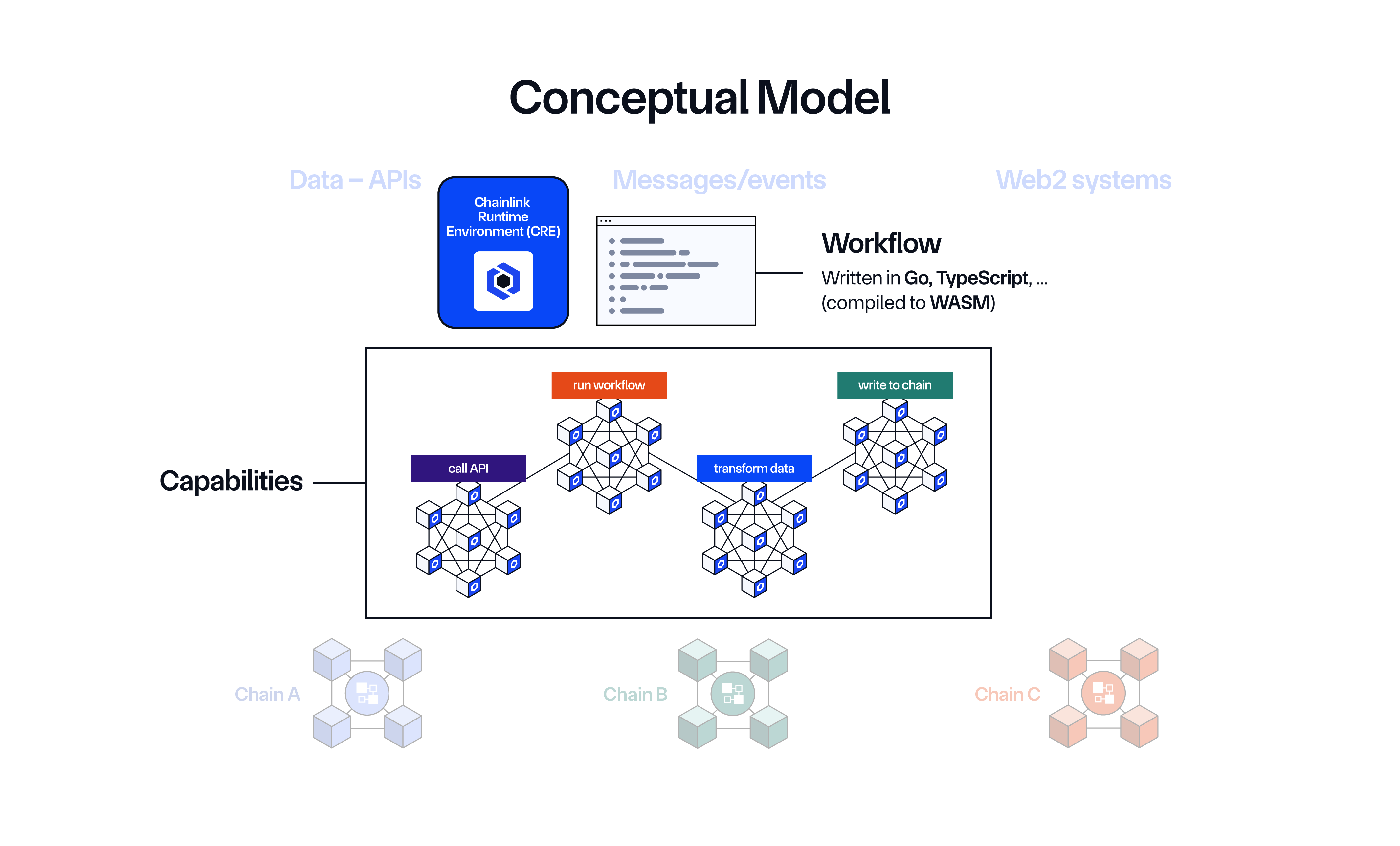
Workflows are the new programs that developers build and run on the Chainlink Platform. Instead of integrating a prepackaged service, developers can build their own workflows using different Chainlink capabilities. Capabilities can be bucketed into two categories: 1) trigger capabilities that start the workflow and 2) execution capabilities that compose and constitute the workflow.
We plan to support workflow development in Go, TypeScript, and other programming languages, which the platform compiles into WASM for execution by Chainlink nodes. Developers can create and manage their workflows using their IDE and the Chainlink SDK and CLI, as well as view and manage them in a UI.
During the initial launch phases, pre-built capabilities will be provided to devs that they can use to create their custom workflows. The longer-term plan is to enable anyone to create and deploy their own capabilities (e.g., custom self-serve chain integrations, connectivity to permissioned systems, etc.).
A Chainlink Workflow that calls an API, performs a consensus computation, and then writes the result onchain for a smart contract to consume.
Chainlink Runtime Environment
The Chainlink Runtime Environment (CRE)—the engine of the Chainlink Platform—executes developers’ workflows in a decentralized manner by interacting with different capability DONs. CRE provides the coordination of the DONs for each of the capabilities invoked in a workflow, as well as combines them with the right consensus overlay.
“The Chainlink Runtime Environment pulls all of the capabilities together by executing the workflows whenever their triggers fire and using DON-to-DON communications to connect the various capability DONs.” —Uri Sarid, Chainlink Labs Chief Architect
*For a deeper understanding of the different technical terms, refer to the References section at the end of this blog.
The Benefits of the Upgraded Chainlink Platform
The upgraded Chainlink Platform powered by CRE unlocks numerous benefits for developers, the Chainlink Platform itself, and the industry as a whole.
Limitless Developer Innovation
Easy to use: Effortlessly create workflows with programming languages you already know via a comprehensive set of SDKs and an intuitive CLI.
Customizable and programmable: Build to fit your bespoke needs with fully programmable workflows.
Seamless integration: Connect with offchain APIs and multiple blockchains within a single workflow using standardized components.
Secure: Safeguard your users by leveraging Chainlink’s proven security, providing consensus guarantees for offchain applications.
In the previous architecture, for example, standing up a single Proof of Reserve (POR) feed required carefully coordinated operational processes across multiple teams and components. This involved complex customization, deployment, and ongoing maintenance. Chainlink’s new architecture removes the complexity of customizing, setting up, and linking disparate components and reduces the required ongoing maintenance. In a few hours, a single developer can express a fully customized POR feed that writes to multiple chains as a workflow and leverages CRE to monitor and reliably execute it. This frees up precious development and maintenance time, so teams can focus more on meeting customer needs.
Next-Generation Platform
Hyper-scaling: Since capabilities can be long-standing and easily reused for new integrations, new chains can be adopted by simply creating a new read chain / write chain capability, which can then be leveraged by all other Chainlink capabilities to interact with those chains. Instead of a new EVM chain integration for multiple Chainlink products taking weeks, developers can compose workflows that use all Chainlink capabilities within a number of days.
Financial market workflows: Banks can connect the Chainlink Platform to their internal private chains and systems and seamlessly interface across other private and public chains. Financial institutions can also create workflows that work in compliance prior to onchain execution, such as building custom policy capabilities into their workflows.
Limitless use cases: Developers’ full creative potential is unlocked as capabilities can be programmed and combined in ways currently not possible to expand to new offchain resources and unlock innovative use cases.
Increased network efficiency: Optimized DON configurations mean less operational overhead for both Chainlink and Node Operators (NOPs). For example, existing DONs can be reused as Chainlink grows rather than the linear DON growth of today. Other efficiencies include more optimized utilization across DON deployments, more economical and efficient products, more sustainable NOP business models, and more efficient provisioning and revenue generation through a compute marketplace.
Overall Industry Growth
With app composability being a main driver in the expansion of DeFi, the composability of offchain services and onchain smart contracts across all blockchains can supercharge a similar expansion in onchain innovation. Every chain stands to benefit, as blockspace becomes more in demand thanks to more users, more transactions, and easier access and deployment to chains.
Making Consensus Computing the Way All Markets Work
The underlying power of Chainlink is greatly expanding the use of consensus computing, with the goal of making it an industry standard throughout financial markets, user applications, and beyond.
Consensus computing is when a decentralized network of nodes must form consensus as part of the network storing and executing code. It’s an evolution in computing because it provides users with unique guarantees such as tamper-resistance, hyper-availability, trust minimization, enhanced composability, and permissionless and universal accessibility.
On the foundation of consensus computing, truly secure and reliable automated services can begin to thrive, opening up major efficiency and utility gains and increasing global connectivity.
Blockchains first introduced consensus computing to store and maintain a permissionless and immutable asset ledger. Blockchain-based consensus computing then expanded to include smart contracts, where ledger transactions could have conditions attached to their execution, making way for decentralized applications (dApps).
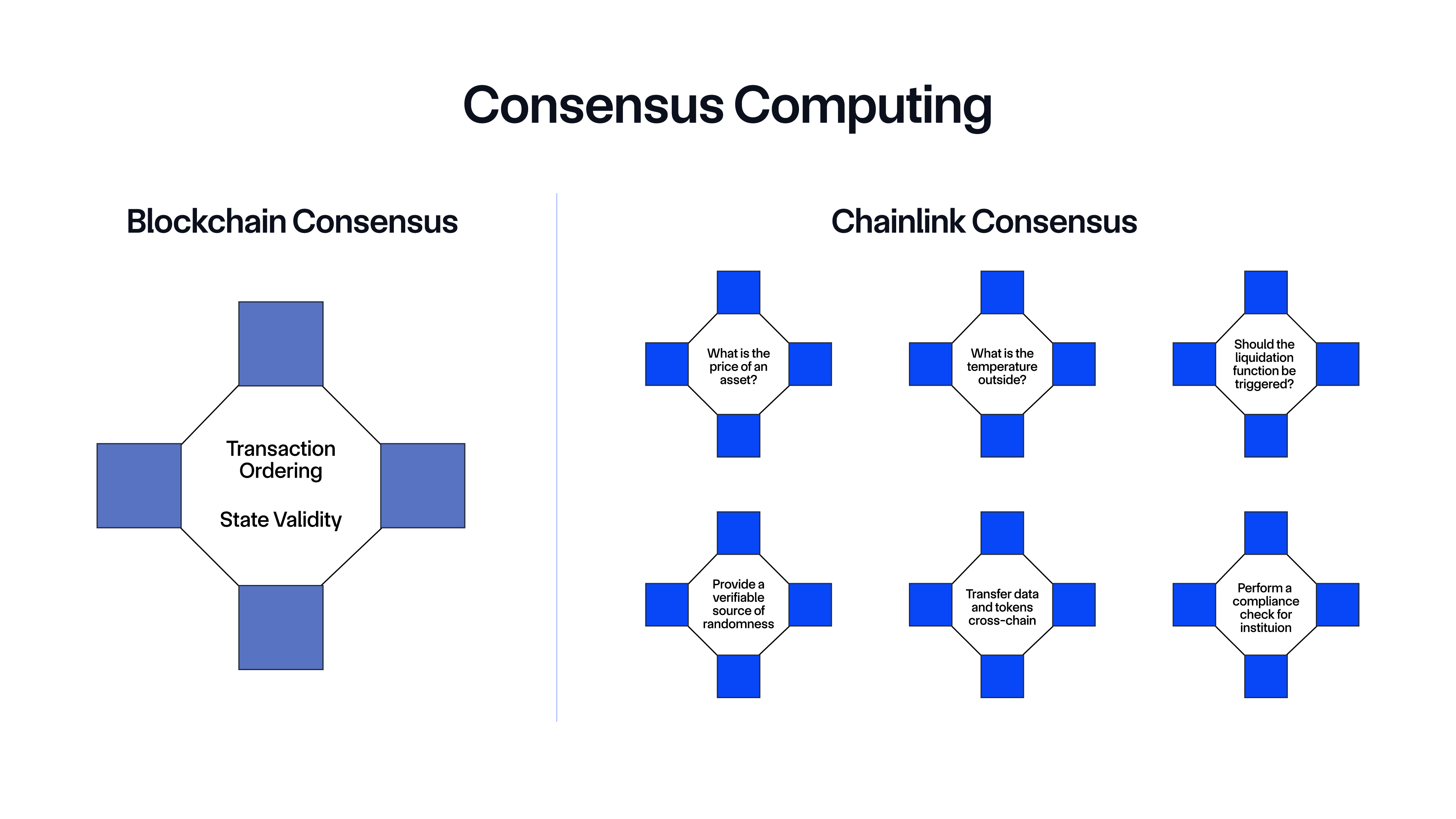
While blockchains will continue to power asset ledgers and dApps, they have limitations. Blockchain-based consensus is only focused on the validity and ordering of transactions, and produce deterministic results, which can be reproduced by anyone based on historical state. However, there is a much broader set of things that consensus could be generated about that blockchains are not applicable for, such as consensus with a median output based on data sources not available onchain (e.g., calculating the current temperature using data from multiple offchain APIs).
Chainlink expands consensus computing to virtually anything and enables the use of any offchain data and offchain computing method. This includes consensus computing on the current price of an asset, transmission of data between disparate networks, triggering smart contracts based on events, and now coordinating consensus across onchain and offchain systems. This expansion enables consensus computing to secure the entire application—such as its offchain data, offchain computation, and interoperability—and not just the state of its onchain code. Through doing so, consensus computing can fulfill a much wider range of use cases while bringing users newfound levels of confidence and verifiability to how the world actually works.
Blockchains use consensus computing to order transactions and validate the state of a ledger, while Chainlink is applying consensus computing to any offchain service.
Rolling Out the Upgraded Chainlink Platform
Similar to how Ethereum uses a phased-upgrade model, the Chainlink Platform upgrade is rolling out in phases to ensure that existing users of Chainlink services are unaffected throughout the transition. This is critical since Chainlink services are currently enabling trillions of dollars in value and securing critical functions for many of the most widely used onchain applications.
The initial phase involves the transition of Chainlink services like CCIP to the upgraded platform architecture. This will help Chainlink scale to chains faster and meet unique and immediate customer requirements. In parallel, the upgraded platform architecture is being implemented into new chain integrations, such as the integration of the Aptos blockchain with Chainlink. Furthermore, the upgraded Chainlink Platform architecture is also being leveraged by financial institutions to seamlessly connect existing infrastructure to blockchains for workflows such as Delivery vs. Payment.
If you are a developer, established application, or financial institution and want to start building and testing workflows using the Chainlink Runtime Environment, sign up for early access.
To learn more about Chainlink, visit chain.link, subscribe to the Chainlink newsletter, and follow Chainlink on Twitter and YouTube.
—
References
Consensus Computing—The broader computing paradigm that requires decentralized consensus as part of executing software and storing information.
Chainlink Platform—The totality of software and node networks that enable development and perform capabilities on Chainlink.
Capabilities—Individual functions of decentralized oracle networks on Chainlink, such as read chain, write chain, call an API, execute compute, apply a policy, etc.
DONs—Decentralized Oracle Networks that execute the capabilities requested by users.
Chainlink Network—All Chainlink nodes and DONs that are currently in operation.
Chainlink Workflows—What developers build in the Chainlink Platform. Developers combine Chainlink capabilities into their own workflows.
Chainlink Runtime Environment (CRE)—The engine of the Chainlink Platform, which executes workflows and provides a programming model on how to program workflows.
—
Disclaimer: This post is for informational purposes only and contains statements about the future, including anticipated product features, development, and timelines for the rollout of these features. These statements are only predictions and reflect current beliefs and expectations with respect to future events; they are based on assumptions and are subject to risk, uncertainties, and changes at any time. There can be no assurance that actual results will not differ materially from those expressed in these statements, although we believe them to be based on reasonable assumptions. All statements are valid only as of the date first posted. These statements may not reflect future developments due to user feedback or later events and we may not update this post in response. Please review the Chainlink Terms of Service, which provides important information and disclosures.
In the rapidly evolving landscape of blockchain technology, Web3 wallets have emerged as indispensable tools for crypto enthusiasts and investors. With the rise of decentralized finance (DeFi) and non-fungible tokens (NFTs), choosing the right crypto wallet is paramount. In 2024, several Web3 wallets have distinguished themselves as leaders in the field, offering users a range of features tailored to their needs. In this article, we delve into the top Web3 wallets of 2024, analyzing their pros and cons to help you make an informed decision.
MetaMask
MetaMask has long been a favorite among crypto users and continues to lead the pack in 2024. Known for its user-friendly design and seamless integration with DeFi applications, MetaMask offers a versatile and secure experience for both beginners and seasoned traders.
Pros of MetaMask
User-Friendly Interface: MetaMask’s intuitive design makes it easy for users to manage their assets and explore decentralized applications (dApps).Wide Compatibility: Compatible with major browsers like Chrome and Firefox, as well as a dedicated mobile app, providing versatile access options.Strong Security Features: Integration with hardware wallets and advanced encryption ensures high-level security for users.Extensive dApp Ecosystem: With access to thousands of dApps, MetaMask provides a gateway to the broader Ethereum ecosystem and beyond.
Cons of MetaMask
Gas Fees: Users may find transaction fees on the Ethereum network to be high at times, affecting cost-efficiency.Limited Multi-Chain Support: While MetaMask supports some blockchains, it’s heavily Ethereum-focused, which may limit users seeking diverse blockchain interactions.
Coinbase Wallet
Coinbase Wallet, an offshoot of the reputable Coinbase exchange, continues to make waves in 2024. It offers users the ability to manage their crypto assets independently of the main Coinbase platform, featuring an intuitive mobile application to support on-the-go management.
Pros of Coinbase Wallet
Integration with Coinbase Exchange: Seamlessly connects with the Coinbase exchange for easy transfers between wallet and trading accounts.Strong Security Protocols: Built on established security measures synonymous with the Coinbase brand.Support for Multiple Cryptocurrencies: Users can manage a broad range of digital assets beyond just Ethereum-based tokens.Direct dApp Access: The wallet includes a built-in dApp browser for direct interaction with various decentralized applications.
Cons of Coinbase Wallet
Custodial Challenges: Some users prefer non-custodial solutions, and while it offers some decentralization, Coinbase Wallet retains some custodial elements.Privacy Concerns: Integrating with a major exchange could present privacy challenges, as data may be shared across connected accounts.
Trust Wallet
Trust Wallet has steadily gained traction due to its reputation for supporting a wide array of cryptocurrencies and ease of use. Acquired by Binance in 2018, it has benefited from ongoing development and innovation.
Pros of Trust Wallet
Multi-Currency Support: Trust Wallet supports a vast array of cryptocurrencies, including those on the Binance Smart Chain, Ethereum, and more.Non-Custodial: Users have full control over their private keys, enhancing the security and autonomy of their crypto holdings.DeFi and NFT-Friendly: With built-in services to interact with DeFi platforms and NFT marketplaces, it’s highly versatile for different use cases.Seamless User Experience: Its intuitive interface and compatibility with various blockchains make it accessible for both new and experienced users.
Cons of Trust Wallet
Mobile-Only Access: Trust Wallet primarily functions as a mobile app, which might limit users who prefer desktop applications.Potential Security Risks: As with all mobile wallets, users must remain vigilant against potential security threats like phishing and malware.
Concluding Thoughts
As we glide through 2024, Web3 wallets like MetaMask, Coinbase Wallet, and Trust Wallet continue to provide robust solutions for storing and managing digital assets. Each wallet has its unique strengths and challenges, catering to different user needs and preferences. When selecting a Web3 wallet, consider your specific requirements such as currency support, ease of use, and security features.
Choosing the best wallet ultimately boils down to personal priorities. Whether you’re an enthusiast diving deep into DeFi and NFTs, or a novice starting your crypto journey, there’s an ideal solution out there for you. Stay informed, assess your options, and enjoy the exciting world of decentralized finance with confidence in 2024.
“`
This blog post is structured to provide an informative and SEO-optimized overview of the top Web3 crypto wallets in 2024, with a focus on their pros and cons, to assist readers in making an informed decision.
About Web3Wire Web3Wire – Information, news, press releases, events and research articles about Web3, Metaverse, Blockchain, Artificial Intelligence, Cryptocurrencies, Decentralized Finance, NFTs and Gaming. Visit Web3Wire for Web3 News and Events, Block3Wire for the latest Blockchain news and Meta3Wire to stay updated with Metaverse News.
Magic Eden may want users to claim a token called TestME Tuesday using its digital wallet—but the NFT marketplace is encouraging degens to sit this one out.
That’s because the TestME token, as the name implies, is intended to be a trial run and precursor to the Magic Eden Foundation’s governance token. That token, rebranded as ME earlier this year, has yet to be assigned a specific release date.
The Magic Eden Foundation will release the bare-bones token on Tuesday as a way for its associated NFT marketplace to flex its technical muscles. Though the company is encouraging users to claim the token if they can, it’s also cautioning users against speculating on what’s intended to be a one-off showcase.
The token won’t serve as the cross-chain NFT marketplace’s governance token, which was initially teased in January. Rather, the endeavor is being billed as a test run for Magic Eden Wallet, which will be used when the governance token is released later.
The cross-chain NFT marketplace has leaned heavily into its digital wallet offering since its release in November. Supporting fungible tokens, the product’s prioritization has coincided with Magic Eden’s push beyond digital collectibles as the market for NFTs moves further away from its frothy days in 2021 and 2022.
Users who want to claim TestME will need the NFT marketplace’s wallet, Magic Eden said in a blog post. U.K. and U.S. residents are excluded from participating in the rollout.
The window for claiming TestME will last two days, allowing users to “get comfortable with the process of claiming tokens,” Magic Eden said. Additionally, those two days will give Magic Eden the chance to vet any technical issues.
Citing the token’s lack of “intrinsic value,” Magic Eden said that it adopted the token purely for testing purposes and “discourages trading of the token.”
Nevertheless, TestME will likely see some activity that mirrors moves similar to those of other projects.
MockJUP, a token released by the decentralized exchange aggregator Jupiter as a test for its launchpad in January, became a pseudo-meme coin for a short amount of time. It wasn’t ultimately supported long-term, but some early traders made money on the Solana token as degens aped in ahead of the anticipated, real-deal JUP airdrop.
Magic Eden said that TestME’s distribution will be limited to those who have engaged with the platform in the past six months. And even though users will need a Magic Eden Wallet to claim TestME, other types of wallets can be linked to it to provide proof that a user has recently engaged with Magic Eden’s services, the company said.
While Magic Eden entered the NFT market on Solana, the company has added support for several other chains, including Bitcoin and Ethereum. Still, the company views Solana as core to its business, with Solana token trading slated for the platform.
Originally, the Magic Eden Foundation’s governance token was set to be called NFT. However, the foundation decided to keep Magic Eden’s branding attached to the asset as the platform expanded to support a version of Bitcoin-based fungible tokens called Runes.
More details about Magic Eden’s governance token, letting holders participate in voting on the platform’s direction, are set to be released following TestME’s rollout. Meanwhile, Magic Eden CEO Jack Lu has shared details about his vision for ME’s ultimate role.
“$ME will […] serve as an incentive layer to continuously help onboard, engage, and reward all Magic Eden users,” he wrote on Twitter (aka X) earlier this month, adding the token’s “integration will also reward the most long term continuous users.”
As the Magic Eden Foundation pushes forward with plans for a governance token, TestME may just be one step in a lengthy technical process. At the same time, the bare-bones tokens could generate some buzz—and eager wallet users—for what’s to come.
Edited by Sebastian Sinclair
Daily Debrief Newsletter
Start every day with the top news stories right now, plus original features, a podcast, videos and more.
Have you wondered, why people are paying huge amounts of cash on digital assets that don’t physically exist? The NFT space has exploded and is indeed being sold for millions of dollars. It seems like the craze is not slowing down anytime soon. In this blog, we’re diving into the world of the most expensive NFTs ever sold, breaking down the reasons behind their jaw-dropping prices, exploring the hype, and predicting where this booming market might go next.
Here’s a list of the top 10 most expensive NFTs ever sold, offering insight into the significance and value of these unique digital pieces.
Top 10 Most Expensive NFTs Ever Sold:
RankNFT NameArtistAmount1The MergePak$91.8 million2Everydays: The First 5000 DaysBeeple$69.3 million3ClockPak and Julian Assange$52.7 million4CryptoPunk #5822Larva Labs$23.7 million5CryptoPunk #7523Larva Labs$11.75 million6TPunk #3442Tron-based (Joker)$10.5 million7CryptoPunk #4156Larva Labs$10.26 million8CryptoPunk #3100Larva Labs$7.67 million9CryptoPunk #7804Larva Labs$7.6 million10Right-click and Save As GuyXCOPY$7 million
1. “The Merge” by Pak – $91.8 million:
The highest-selling NFT to date is Pak’s “The Merge.” This NFT was sold in December 2021 for a record-breaking $91.8 million, but what sets it apart is the fact that it wasn’t a single piece, but a collection of masses purchased by over 28,000 collectors. Pak, known for boundary-pushing digital art, created a dynamic and evolving NFT, which highlighted the potential for interactive digital ownership.
2. “Everydays: The First 5000 Days” by Beeple – $69.3 million:
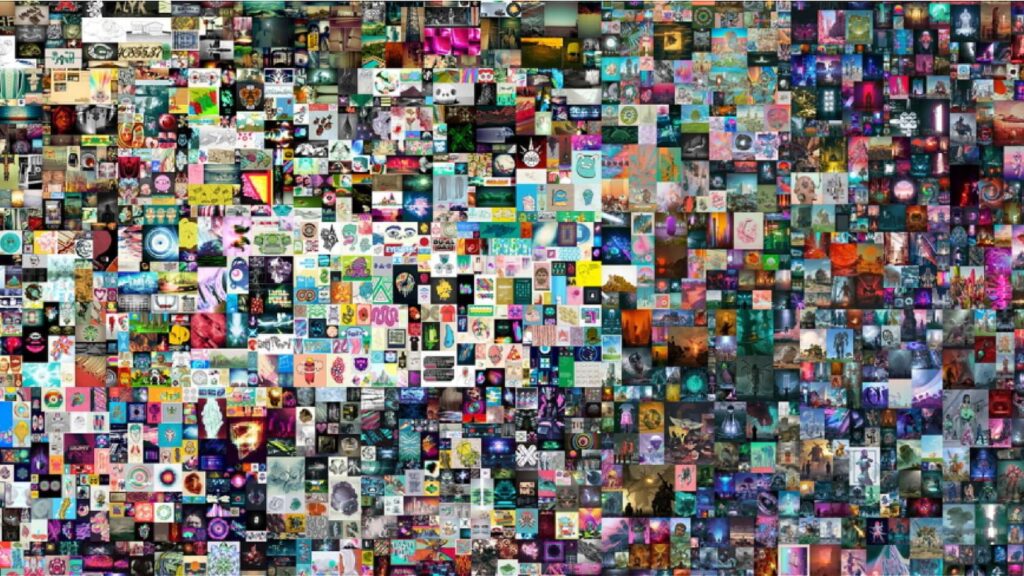
Beeple, a renowned digital artist, made headlines when his “Everydays: The First 5000 Days” was auctioned at Christie’s for $69.3 million in March 2021. This artwork represents a collage of 5,000 digital images Beeple created daily over 13 years, demonstrating the evolution of his artistic journey and the growth of the NFT market. Beeple’s work is credited for helping legitimize NFTs in the traditional art world.
3. “Clock” by Julian Assange and Pak – $52.7 million:
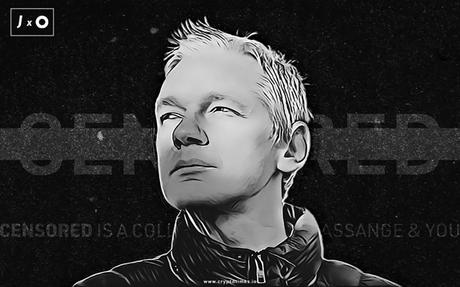
“Clock” is an NFT designed to raise awareness and funds for WikiLeaks founder Julian Assange’s legal defense. Created by Pak in collaboration with Assange, this NFT sold for $52.7 million, positioning itself as one of the most expensive NFTs ever sold. It shows a dynamic countdown of the days Assange has been imprisoned, adding a political and activist dimension to the NFT space.
4. CryptoPunk #5822 – $23.7 million:
CryptoPunk #5822 is part of the iconic CryptoPunks collection and was sold for a staggering $23.7 million in February 2022. This specific Punk, one of only nine alien punks, is distinguished by its blue skin and bandana. Its rarity and the historical significance of the CryptoPunks collection made it highly desirable for collectors.
5. CryptoPunk #7523 – $11.75 million:
Often referred to as “Covid Alien,” CryptoPunk #7523 was sold for $11.75 million in June 2021. This NFT, another from the rare alien series, gained additional significance due to its character’s medical mask, symbolizing the pandemic era. Its combination of cultural relevance and rarity makes it one of the top-selling NFTs.
6. TPunk #3442 – $10.5 million:
TPunk #3442 is from the TPunks collection, which was created on the Tron blockchain and is often seen as the “Tron version” of CryptoPunks. It was sold for $10.5 million to Justin Sun, the founder of Tron, which contributed to its popularity. The NFT’s design, resembling a Joker-like character, further heightened its value and appeal in the NFT space.
7. CryptoPunk #4156 – $10.26 million:
Sold for $10.26 million in December 2021, CryptoPunk #4156 is one of the most valuable pieces in the CryptoPunks collection. This particular NFT stands out with its ape appearance and blue bandana, adding to its rarity. The combination of these factors made it one of the highest-grossing sales.
8. CryptoPunk #3100 – $7.67 million:
CryptoPunk #3100 sold for $7.67 million in March 2021, making it one of the rarest and most expensive CryptoPunks. It features a character with an alien design and a white headband, contributing to its appeal among collectors.
9. CryptoPunk #7804 – $7.6 million:
Another major sale from the CryptoPunks collection, CryptoPunk #7804, sold for $7.6 million in March 2021. Known as the “digital Mona Lisa,” this punk is depicted wearing a cap and sunglasses and smoking a pipe. Its unique combination of attributes, combined with its alien design, made it highly valuable.
10. “Right-Click and Save As Guy” by XCOPY – $7 million:
This NFT was sold to Snoop Dogg for $7 million in December 2021. Created by XCOPY, this piece mocks critics of digital art and NFTs who claimed that NFTs had no value because you could simply “right-click and save” the digital file. Despite its meme-like nature, it became an iconic and valuable digital artwork, highlighting the intersection of culture, satire, and technology in the NFT world.
This NFT is a great example of how NFTs can capture cultural and political moments. The value comes not only from the art but also from the context in which it was created.
Analysis of Value and Appeal: Why Are NFTs Worth So Much?
Now that we’ve seen some of the top sales, the question is What makes these NFTs so valuable? Here are a few key factors driving the high prices:
1. Rarity:
Rarity increases value in a similar way to traditional collectibles. There are only 10,000 CryptoPunks in the world, and some are more sought-after than others due to characteristics like as wearing unusual items or being aliens.
2. Cultural Relevance:
NFTs, such as Beeple’s “Crossroads,” provide a distinct historical context by capturing a political time. When it comes to digital art that speaks to society as a whole, people are prepared to pay top cash.
3. Ownership and Provenance:
NFTs use blockchain technology to provide ownership that can be verified. NFTs have ownership that cannot be disputed since they are connected to the blockchain, unlike real works of art that may be faked or stolen.
4. Flexibility and Utility:
Some NFTs are more than just static pieces of art. An example will be having Beeple’s Human One which can be modified over time and therefore updated. This kind of flexibility adds yet another dimension to the value proposition.
5. Speculation:
Let’s not forget about the speculative nature of NFTs. A majority of buyers are purchasing assets in the form of NFTs with the intention to hold them, hoping that their worth is appreciated in the future, similar to purchasing shares or properties.
Market Trends: Where Are NFTs Headed?
The NFT market has been growing at an astronomical pace, but like any market, it’s bound to experience some shifts. Let’s break down a few key trends we’re seeing:
1. NFT Utility IsEvolving:
The idea of NFTs is moving beyond static visuals, as we’ve seen with dynamic NFTs like Beeple’s “Human One.” More creative uses for NFTs are probably in store, such as digital apparel, concert tickets, and virtual real estate in the metaverse.
2. NFTs in the Gaming Industry:
A growing number of games now support NFTs, letting users purchase, exchange, and sell in-game items for NFTs. This development may change the way we see player ownership and virtual economies.
3. Mainstream Adoption:
Celebrities, musicians, and even large corporations are entering the NFT market. Sports leagues are making NFT trading cards, and Twitter’s Jack Dorsey sold his very first tweet as an NFT for $2.9 million. NFTs are expected to grow in popularity as more mainstream companies join the market.
4. Environmental Issues:
There has been debate over NFTs. The environmental effects of blockchain technology are a common topic of criticism, particularly when considering the energy needed to mint NFTs. Although some platforms are tackling this by implementing more environmentally friendly blockchain technologies, the market will still be concerned about this.
Future Predictions of NFTs:
It’s hard to say where the NFT market will go from here. Some believe it’s a bubble waiting to burst, while others think it’s just the beginning of a digital renaissance. What’s clear is that NFTs have already changed the way we think about ownership, art, and value in the digital age.
On the other hand, NFTs could establish themselves as a mainstay of the digital economy. As additional sectors of the economy, including as entertainment and fashion, adopt NFTs, the industry may experience consistent long-term development.
NFTs may reach new heights as a result of the emergence of the metaverse, or virtual environments where users interact with digital assets. Consider becoming the owner of a virtual mansion or piece of art in an entirely virtual world. This may increase the need for NFTs even further.
NFTs have captured the world’s attention, and while some argue that the market is inflated, there’s no denying that digital ownership is a powerful concept. From rare CryptoPunks to Beeple’s record-breaking artwork, the most expensive NFTs are more than just pixels, they’re status symbols, cultural landmarks, and, in many cases, financial investments.
So, what do you think? Are NFTs just a passing trend, or are they the future of art, ownership, and digital culture? Let me know your thoughts in the comments, who knows, maybe you’ll be the next big NFT collector! For more updates on NFTs and the latest trends in Web3, be sure to subscribe to our newsletter!
As the cryptocurrency landscape continues to evolve, innovative platforms are poised to catalyze remarkable changes in the DeFi ecosystem. Cardano’s integration of Bitcoin smart contracts is a strategic move positioned to tap into the potential of both blockchain technologies, ultimately enhancing the utility and scalability of decentralized finance. This integration promises to carve a new path for DeFi, addressing existing challenges while unlocking new possibilities.
Understanding the Integration
The blockchain industry has seen vast advancements, with Bitcoin and Cardano emerging as pivotal players. While Bitcoin is primarily known for its role as a digital currency, Cardano is lauded for methodological advancements in blockchain technology and smart contract capabilities. By integrating Bitcoin smart contracts within the Cardano platform, a synergy is created that aims to harness the strengths of both blockchains for a more robust DeFi infrastructure.
The Rationale Behind the Integration
This integration is fueled by an intent to combine Bitcoin’s secure and decentralized nature with Cardano’s scalable and flexible environment.
Bitcoin’s Security: Bitcoin stands as the most secure blockchain due to its extensive hash power. By leveraging Bitcoin’s network for smart contracts, Cardano ensures a high level of security for decentralized applications.Cardano’s Scalability: Cardano offers a more scalable platform than Bitcoin. Integrating Bitcoin’s smart contracts allows Cardano to bring scalable smart contract functionality to Bitcoin’s network.
The Impact on Next-Gen DeFi
Decentralized Finance (DeFi) has emerged as a revolutionary application of blockchain technology. The integration of Bitcoin smart contracts represents an evolution in DeFi, promising to overcome existing limitations and introduce new features.
Solving Current DeFi Challenges
Despite its growth, DeFi faces significant challenges such as scalability issues, high transaction fees, and security vulnerabilities. Cardano’s integration of Bitcoin smart contracts addresses these issues by:
Reducing Transaction Costs: Cardano’s efficient consensus mechanism enables low-cost transactions, a substantial improvement over existing networks with high fees.Enhancing Security with Bitcoin’s Network: The integration provides a robust security layer, safeguarding DeFi applications against attacks.Increasing Network Efficiency: The integration allows for a more efficient processing of complex smart contracts, reducing congestion.
New Opportunities for Innovation
This integration heralds an era of innovation within DeFi, paving the way for advanced financial instruments and products:
Cross-chain Interoperability: By bridging Bitcoin and Cardano, decentralized applications can leverage the benefits of both networks, creating seamless interactions.Smart Contract Use Cases: The ability to execute smart contracts on Bitcoin’s blockchain delivers more versatile and complex financial instruments.Enhanced User Experience: With reduced fees and enhanced efficiency, users are likely to experience smoother interactions within the DeFi ecosystem.
The Technical Landscape
The technical underpinnings of this integration involve the use of Bitcoin’s scripting language and Cardano’s Haskell-based Plutus platform.
Bitcoin’s Scripting Capabilities
Bitcoin’s scripting language is restricted compared to fully featured smart contract languages, often focused on basic conditional operations. Yet, **when combined with Cardano’s functionality**, it allows for more complex, scalable solutions.
Cardano’s Plutus Platform
Cardano’s smart contract capabilities, built using Haskell, provide a robust and flexible platform for developers. The modular nature of Cardano’s architecture facilitates easy implementation of Bitcoin’s scripting.
Security and Safety: Haskell offers improved security due to its mathematical foundations, reducing the risk of smart contract vulnerabilities.Scalability: Cardano’s highly scalable architecture supports increased transaction volumes and complex computations efficiently.
The Road Ahead
The integration of Bitcoin smart contracts on Cardano marks a significant leap forward in blockchain technology. This development not only bridges the two prominent chains but also sets a precedent for future cross-chain collaborations.
Potential Challenges
Though promising, the integration journey will face challenges:
Technical Complexity: Bridging two distinct blockchain architectures involves technical intricacy that requires sophisticated coordination.Regulatory Environment: As DeFi grows, it faces increasing scrutiny from regulators, which may impact the deployment of these cross-chain solutions.Adoption and Usability: For widespread adoption, user-friendly interfaces and education will be paramount, ensuring that end-users can seamlessly leverage integrated services.
Future Prospects
This integration serves as a foundational step towards a more interconnected blockchain ecosystem. It has the potential to:
Drive DeFi Adoption: Enhanced efficiencies and features can attract more users to DeFi platforms.Attract Institutional Interest: Improved security and lower risks might appeal to institutional investors, fostering wider acceptance.Inspire Further Innovations: The cross-chain integration model could inspire similar innovations, leading to a more connected blockchain world.
As blockchain technology continues to push forward, initiatives like Cardano’s integration of Bitcoin smart contracts are paving the way for the next era of decentralized finance, promising a world of more inclusive, secure, and efficient financial systems.
“`
About Web3Wire Web3Wire – Information, news, press releases, events and research articles about Web3, Metaverse, Blockchain, Artificial Intelligence, Cryptocurrencies, Decentralized Finance, NFTs and Gaming. Visit Web3Wire for Web3 News and Events, Block3Wire for the latest Blockchain news and Meta3Wire to stay updated with Metaverse News.
In case it wasn’t already obvious, Bitcoin exchange traded-funds (ETFs) are hot—with demand for the products smashing all expectations.
Data from Bloomberg shows that of the 575 ETFs launched this year, 14 of the top 30 products have been either new Bitcoin or Ethereum funds, with the top four spots owned by Bitcoin funds.
And in the past four years, of the 1,800 ETFs that started trading during that span, BlackRock’s iShares Bitcoin Trust is the biggest by far in terms of inflows, the data shows.
575 ETFs have now launched in 2024…
*14 of top 30* by inflows are either spot btc or eth ETFs.
Includes 6 of top 10.
There are also 2 MSTR-related ETFs in top 30.
Crypto appetite from tradfi is real. pic.twitter.com/DmD6f5zJ1P
— Nate Geraci (@NateGeraci) October 23, 2024
ETFs are popular investment vehicles that trade on stock exchanges. They allow investors to buy and sell shares that track the price of anything from the S&P 500 and gold to Bitcoin and real estate firms.
In January, the Securities and Exchange Commission (SEC) approved the Bitcoin products, allowing 10 such funds to start trading on American stock exchanges after a decade of denials.
The investment vehicles have been widely popular, attracting billions of dollars in months in flows. Last week, they collectively crossed the $20 billion mark—smashing expectations by taking just 10 months to do what gold ETFs did over five years.
The reason for the fast money, according to Bloomberg Intelligence ETF research analyst James Seyffart, is partly down to investors who had wanted to invest in Bitcoin for some time, but didn’t have a safe or easy way before the approval of the ETFs. Now that the ETFs are trading, that demand is rapidly entering the market.
“I think it was partly pent-up demand,” he told Decrypt. “But it’s also new demand as people are learning more.”
He added that traditional financial institutions are interested in the products too—including hedge funds involved in futures trading. “That has helped improve flows and demand,” he said, adding that hedge funds have been going long on the ETFs and then selling the futures contracts.
Massive institutions—including Morgan Stanley and Goldman Sachs—now have exposure to Bitcoin via the new products. The price of Bitcoin even hit a new all-time high in March following their approvals.
But the Ethereum counterparts haven’t had as much luck thus far. The SEC approved the ETFs for the second-biggest cryptocurrency—reluctantly, it appeared—in May. They haven’t done nearly as much in terms of inflows since trading began in July.
This is partially because Grayscale’s Grayscale Ethereum Trust (ETHE) previously operated like a closed-end fund rather than an ETF before July. Its subsequent conversion means that investors who previously had cash locked up in the fund have fast been redeeming shares—leading to massive outflows.
So far, $3 billion has left the fund, bringing the total flows for all nine Ethereum ETFs currently trading to negative $472.7 million, Farside data shows.
However, that doesn’t mean demand won’t pick up. Investors have thrown cash at the other products, and that could mean a turnaround is on the horizon.
“It’s just that the outflows from ETHE are overwhelming the inflows to these other [Ethereum] ETFs,” added Seyffart. “For now.”
Edited by Andrew Hayward
Daily Debrief Newsletter
Start every day with the top news stories right now, plus original features, a podcast, videos and more.
The cryptocurrency landscape is constantly evolving, and with it, the fortunes of various digital assets wax and wane. One such asset currently under the microscope is Polygon (POL), which has seen its price tumble to the lows of 2021. As investors and enthusiasts ponder its future, it becomes imperative to examine the factors contributing to this decline and assess what lies ahead for Polygon. In this article, we’ll delve into the history, current challenges, and potential future of Polygon to provide a comprehensive overview of its trajectory.
Understanding Polygon: A Brief History
Polygon, formerly known as Matic Network, has been a significant player in the cryptocurrency ecosystem, offering layer 2 scaling solutions to improve the performance of Ethereum’s decentralized applications (dApps). Since its inception, Polygon has focused on enhancing blockchain interoperability and providing faster, more cost-effective transactions. Its meteoric rise in early 2021 demonstrated its potential, drawing the attention of developers and investors alike.
The Rise of Polygon
Polygon’s initial success can be attributed to several key factors:
Scalability: Polygon’s layer 2 solutions significantly improved Ethereum’s transaction throughput.Cost-Effectiveness: Users experienced reduced gas fees, making it an attractive option for dApp developers.Strong Community: Polygon fostered a vibrant community of developers and users, further driving its adoption.
Current Market Scenario: What’s Happening with POL?
Despite its promising start, Polygon’s price has recently plummeted to its 2021 low, raising questions about its sustainability and future prospects. Multiple factors are contributing to this downturn:
Market Volatility
The cryptocurrency market is inherently volatile, with prices subject to rapid fluctuations. Polygon is no exception, and the recent broader market retracement has undoubtedly impacted its valuation. Increased regulatory scrutiny and global economic uncertainties have further exacerbated these volatile conditions.
Competitive Landscape
The rise of competitors offering alternative layer 2 solutions has intensified competition. Ethereum’s advancements, such as Ethereum 2.0, as well as the emergence of other blockchains, are challenging Polygon’s market positioning.
Technical Challenges
While Polygon has addressed Ethereum’s scalability issues, it still faces technical hurdles that need resolution. Improving network security and maintaining seamless user experiences remain critical tasks for the platform.
Investor Sentiment
The sentiment of cryptocurrency investors plays a vital role in price movements. As excitement wanes and skepticism rises, assets like Polygon experience increased selling pressure, contributing to their decline.
Assessing Polygon’s Future Prospects
Despite these challenges, Polygon has several avenues through which it can revive its fortunes and regain investor confidence.
Innovation and Development
To sustain growth, Polygon must continue to innovate and develop its technology stack. Some strategies include:
Enhancements to Infrastructure: Continued improvements in speed and efficiency will benefit users and dApp developers.Partnerships and Collaborations: Forging alliances with other blockchain projects can bolster Polygon’s ecosystem.Ecosystem Expansion: Encouraging new and existing dApp developers to build on Polygon could drive further adoption.
Engaging the Community
A committed, engaged community can be a project’s greatest asset. Polygon can capitalize on this by:
Hosting Educational Initiatives: Workshops, webinars, and hackathons can educate and empower developers and users.Community Governance: Facilitating community participation in decision-making can foster stronger ties and innovation.
Redefining the Narrative
Polygon needs to actively communicate its value proposition to the broader market. Clarifying its unique offerings and future goals can potentially restore investor interest and trust.
Conclusion: Navigating Uncertain Waters
Polygon is currently at a critical juncture, confronting both opportunities and challenges that could shape its future trajectory. As it navigates these turbulent waters, the focus must remain on innovation, community engagement, and strategic positioning. The journey ahead will not be without difficulty, but with astute management and a renewed focus, Polygon can overcome today’s obstacles and emerge as a stronger entity. For investors and users, staying informed and vigilant will be key in understanding the evolving dynamics of this ever-changing landscape.
“`
About Web3Wire Web3Wire – Information, news, press releases, events and research articles about Web3, Metaverse, Blockchain, Artificial Intelligence, Cryptocurrencies, Decentralized Finance, NFTs and Gaming. Visit Web3Wire for Web3 News and Events, Block3Wire for the latest Blockchain news and Meta3Wire to stay updated with Metaverse News.
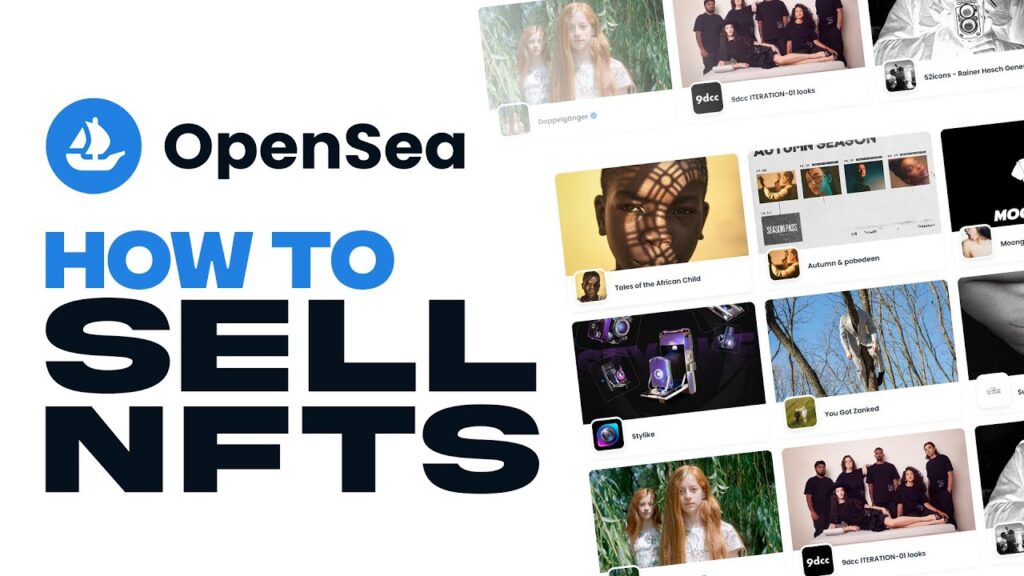
The name “OpenSea” undoubtedly comes to mind when you first hear about NFTs, and for good reason! The largest NFT market in the world, OpenSea allows anybody to create, purchase, and sell non-fungible tokens. If you’ve ever been curious about what OpenSea is, how it works, or if it’s the right platform for you, you are at the right place. In this blog, we will have a solid understanding of OpenSea NFT and how to make the most of it. So, let’s dive in!
OpenSea is a massive marketplace where you can purchase, sell, and even build NFTs. Think of it as the Amazon of the NFT world. OpenSea offers the resources and infrastructure to participate in the NFT ecosystem, whether you’re a creator, a collector, or just an interested bystander. It’s similar to entering a sizable gallery, except everything is digital and entirely one hundred percent unique.
How OpenSea Works?
Now let’s examine how OpenSea functions; it’s actually not as complicated as it might sound.
1. Browse or create NFTs:
There are two options available to you: peruse the millions of NFTs in the current marketplace or start from the beginning and make your own. This covers everything, from virtual real estate to digital music and art.
2. Connect to Your Wallet:
You’ll need a cryptocurrency wallet in order to begin trading or producing NFTs. Consider it to be your online bank account. Though OpenSea supports a number of them, including Coinbase Wallet and Trust Wallet, MetaMask is the most widely used. As soon as your wallet is connected, you can begin using the platform.
3. Buy or Sell NFTs:
Purchasing or selling only requires a click button. You look through NFTs, see how much they’re normally asking for Ethereum, then either make a deal or pay the asking price. Depending on their plan, sellers can either establish a fixed price or put their NFTs up for auction.
4. Gas Fees:
Oh yes, the infamous gas fees! Every time you make a transaction on the Ethereum blockchain, you’ll be paying a fee, often called “gas.”
Let’s get into some practical tips, shall we? Whether you’re looking to buy your first NFT or trying to sell one for a profit, these tricks will help you navigate the marketplace more effectively.
How to Buy NFTs in OpenSea?
Source: nftpay.xyz
1. Do Your Research:
Learn more about the project before investing your hard-earned Ethereum in it. Examine the creator, the exclusivity, and the surrounding community. The NFT’s worth may rise over time if the project is well-known.
2. Examine Transaction History:
You should look over the history of transactions for each NFT. The NFT’s value may be more volatile if it has been resold several times.
3. Establish a Budget and Follow It:
When you’re enthusiastic about a project, it’s simple to get carried away by the excitement and overpay. Determine how much you can afford to spend in advance.
How to Sell NFTs in OpenSea?
1. Build a Narrative Around Your NFT:
Uploading a file isn’t enough if you’re selling. You should write an intriguing narrative that will draw in potential customers. What distinguishes your NFT? What inspired the creation of it? These specifics are important.
2. Price sensibly:
If you’re just getting started, don’t overcharge for your NFT. In the event that demand increases later, you may always raise the price.
3. Promote:
When it comes to promoting NFT, social media is your best buddy. There are active NFT communities on platforms like Discord and Twitter, which may stimulate interest.
How to Create NFTs in OpenSea?
1. Use High-Quality Media:
Make sure your NFT is made using high-quality media, whether it be a picture, video, or song. Collectors are interested in resolution, sound quality, and presentation overall.
2. Metadata is the Key:
The Crucial Metadata Make sure your NFT’s metadata is filled out correctly. Add tags, a detailed description, and even stuff that may be unlocked, such as high-resolution files or exclusive bonuses only available to buyers.
3. Interact with Your Community:
Don’t sit back when your NFT goes live. Talk to prospective customers, respond to their inquiries, and create a community around your business.
Security Best Practices:
The NFT world is exciting but can also be risky. Scams, hacks, and phishing attempts are not uncommon, so here’s how you can protect yourself:
1. Never Give Your Seed Phrase Away:
This is the master key to your money. Anyone who finds out about this can seize control of your money.
2. Turn on Two-Factor Authentication (2FA):
Make sure that both your OpenSea account and wallet have 2FA enabled. This enhances security on top of it.
3. Watch Out for Phishing Sites:
Scammers sometimes create fake sites that look like OpenSea. Double-check URLs before entering any sensitive information.
4. Be Careful with DMs on Discord and Twitter:
Scammers frequently send direct messages purporting to have bargains or requesting your wallet information. Disregard these.
5. Store NFTs in a Cold Wallet:
If you possess precious NFTs, you should think about keeping them in a hardware wallet, also known as a cold wallet.
OpenSea Fees:
Source: 36crypto.com
Let’s talk money. OpenSea’s fee structure is pretty simple, but knowing it ahead of time will help you avoid surprises:
Platform Fee: OpenSea takes a 2.5% cut on every sale. So if you sell an NFT for $100, you’ll receive $97.50.
Creator Royalties: Some creators set a royalty fee on their NFTs, meaning that every time the NFT is resold, they receive a percentage (typically 5-10%).
How to Store NFTs Securely on OpenSea:
Source: cyberscrilla.com
You’ve bought your NFTs, now what? How do you make sure they’re stored safely?
1. Choose a trusted Wallet:
Ledger, Coinbase Wallet, and MetaMask are all trustworthy wallets. Verify that the wallet you’re using has a solid security record and positive user ratings.
2. Maintain the Security of Your Wallet:
Beyond just enabling 2FA, don’t store your private keys in easily accessible places. Consider writing them down and storing them offline.
3. Cold Storage:
Cold storage, which is effectively keeping your NFTs offline in a hardware wallet, is something to think about for high-value NFTs. Hackers will find it far more difficult to assess your valuables as a result.
Pros and Cons of OpenSea:
No platform is perfect, right? Here’s a breakdown of OpenSea’s strengths and weaknesses to help you decide if it’s the best choice for you.
Pros of Using OpenSea:
1. Largest Marketplace:
OpenSea offers a selection that is difficult to match, with millions of NFTs.
2. User-Friendly Interface:
Even for new users, OpenSea is designed to be simple to use.
3. Support for Multiple Wallets:
This feature allows you to link several kinds of wallets, giving it flexibility for various users.
4. Supports Many NFT Categories:
Encourages Numerous NFT Categories Everything from virtual land to music to art, you may discover all kinds of NFT here.
Cons of Using OpenSea:
1. High Gas prices:
OpenSea is built on the Ethereum blockchain, which is notorious for its sometimes-exorbitant gas fees.
2. Fraud & Scams:
Scams can occur in any open marketplace, including OpenSea. You must continue to exercise caution.
3. Centralization Issues:
Although OpenSea operates in the decentralized world of blockchain, the platform itself is centralized, meaning it could theoretically be censored or shut down.
The Future of OpenSea:
Now, this is where things get exciting! OpenSea is continuing to grow rapidly, but what does the future hold?
OpenSea has already included Solana and Polygon, which lowers the cost of Ethereum’s gas. In the future, we expect to see more blockchain integrations. OpenSea is always enhancing its search functions and user experience to make it simpler for consumers to locate NFTs they’ll like. It has been striving to provide creators access to more resources, such as more straightforward methods of managing royalties and promoting their work. More rules are likely to be implemented as the NFT industry develops. Platforms like OpenSea could gain stability and confidence as a result.
So there you have it, a complete guide to OpenSea and how to navigate the world’s largest NFT marketplace. Whether you’re buying, selling, or creating, OpenSea offers a comprehensive and user-friendly platform. However, like any marketplace, it has its pros and cons. High gas fees, potential security risks, and the possibility of scams are worth keeping in mind. Still, if you’re careful and smart about how you engage, OpenSea can be a game-changer in your NFT journey.
But what about you? Have you used OpenSea before, or are you planning to? What’s been your experience, or what are your thoughts on the future of the platform? Let me know in the comments below! I’m curious to hear your take on the world of OpenSea NFTs. And for more updates on the latest in the world of digital art, blockchain, and NFTs, be sure to subscribe to our newsletter, Web3 O’clock. Stay ahead of the curve!
Over $20 million worth of stablecoins and Ethereum was transferred from a wallet containing funds seized by the U.S. government Thursday, shifting assets tied to the 2016 hack of the crypto exchange Bitfinex to a five-day-old address. Some of those funds have now been moved to Binance, an off-shore exchange and the largest crypto trading platform in the world by volume.
Minutes before the transfers took place, the blockchain analytics firm Arkham Intelligence highlighted withdrawals from the lending protocol Aave in a tweet. It was the first time the funds had been touched in eight months, the company said.
According to Arkham’s platform, $1.25 million of the stablecoin Tether was withdrawn from Aave as well as $5.5 million of USDC. Those funds were subsequently sent to a wallet beginning “0x348” alongside $446,000 worth of Ethereum and $13.7 million of aUSDC, an interest-bearing token that represents USDC deposited in an Aave lending market.
The government-controlled wallet received millions of dollars of aUSDC two years ago. On the same day, it also received a hefty sum of the equivalent Aave-based token for Tether.
The pseudonymous blockchain sleuth ZachXBT said the activity appeared “nefarious” on Twitter. Most likely, the funds were flowing as a result of “theft,” the sleuth added.
Bitfinex was hacked in 2016 by a married couple from New York City, who later pleaded guilty to money laundering conspiracies. Taking advantage of a security breach at the exchange, Ilya Lichtenstein and Heather Morgan had $3.6 billion worth of digital assets seized by the authorities, according to a Department of Justice (DOJ) press release from August 2023.
funds are going to instantly exchanges looks nefarious
— ZachXBT (@zachxbt) October 24, 2024
Asked whether the transfers were conducted in relation to law-enforcement activities, the DOJ did not immediately respond to a request for comment from Decrypt.
The wallet that received millions of dollars of government-linked funds Thursday proceeded to use 1inch, an exchange aggregator, to swap stablecoins for Ethereum. It then began shuffling Ethereum in $40,000 chunks to a deposit address for the crypto exchange Binance, which ZachXBT flagged as suspicious behavior.
In total, $320,000 worth of Ethereum had been sent to Binance, as of this writing. At the same time, $80,000 worth of Ethereum had splintered off into other wallets.
When it comes to “0x348,” the wallet made its first transaction less than a week ago. And the wallet that funded it received its first funds two years before from the Australian cryptocurrency exchange CoinSpot, which does not operate in any other jurisdiction.
As of this writing, the government-controlled wallet was virtually empty. All of its assets were gone, aside from $127 worth of a Donald Trump-themed meme coin.
Edited by Andrew Hayward
Daily Debrief Newsletter
Start every day with the top news stories right now, plus original features, a podcast, videos and more.