Web3

Home Web3 Page 238

Checksum Verification for Web3j: Guarding Against Attacks

0
Checksum Verification for Web3j: Guarding Against Attacks


In today’s digital world, where automation and scripting are essential for developers, security remains a paramount concern. One of the simplest ways to install developer tools is through scripts downloaded directly from the internet. However, this convenience also comes with inherent risks, especially when dealing with external sources.

Web3j is a security-focused project. It has taken steps to reduce risks from running installer scripts. This includes protecting against remote code execution (RCE) threats.

The Problem: A Risk in Convenience

Web3j provides installation scripts to make setup easier for developers. Typically, users can run the following commands to install Web3j:


On macOS/Linux:

curl -L get.web3j.io | sh


On Windows:

Set-ExecutionPolicy Bypass -Scope Process -Force; iex ((New-Object System.Net.WebClient).DownloadString(‘https://raw.githubusercontent.com/hyperledger/web3j-installer/main/installer.ps1’))


While these commands make installation quick and effortless, they introduce a serious security vulnerability: if a malicious actor gains access to modify the script at the source, they can inject malicious code. Users who unknowingly run these compromised scripts may expose their machines to Remote Code Execution (RCE). This could allow attackers to take control.

The Solution: Built-in Checksum Verification

To address this vulnerability, we have introduced SHA256 checksum verification into the Web3j installation script itself. This means that users no longer need to manually verify the checksum—the script now checks its own integrity before executing. This built-in verification ensures that the script automatically checks whether it has been modified. This prevents the execution of any potentially malicious code.

Manual Checksum Verification for Extra Security

While the script performs its own verification, we also provide checksum values publicly so that users can independently verify them if they prefer to do so. This double layer of security is crucial for environments where strict verification processes are required.

The checksum values for the installation scripts are stored in the following files:

To verify the checksum manually, you can run the following commands for your respective operating system:


For macOS:

sed ‘/^CHECKSUM_URL=/d’ installer.sh | shasum -a 256 | awk ‘{print $1}’

For Linux:

sed ‘/^CHECKSUM_URL=/d’ installer.sh | sha256sum | awk ‘{print $1}’

For Windows:
Get-Content “installer.ps1” | ForEach-Object { $_ -replace “`r”, “” } | Where-Object { $_ -notmatch ‘^[\s]*\$ChecksumUrl’ } | Out-String

After running the command, compare the output hash with the respective checksum file from the Web3j GitHub repository. If they match, the script is safe to run. If not, avoid running the script and report the issue immediately.

Why Fixing This Issue is Important

Addressing the risk of RCE is critical because it directly impacts the security of the machines that run Web3j scripts. In a compromised scenario, an attacker can execute arbitrary commands on a victim’s machine. This could lead to data breaches, malware installation, or total system compromise.

By implementing checksum verification inside the script and offering a manual verification option, we greatly reduce the risk of executing malicious scripts. This ensures the Web3j community remains safe and secure.

Continuous Updates to Ensure Safety

Web3j remains committed to the security of its users. The checksum values for the installer scripts will be updated if there are any changes to the script in the future. Users are encouraged to always verify the checksum before running the script, especially after downloading a fresh copy.

Conclusion

In conclusion, while installer scripts provide a convenient way to get started with Web3j, they also come with potential risks. With the introduction of checksum verification inside the script and the ability for users to manually verify checksums, we have strengthened the security of the entire Web3j ecosystem. Users can now confidently execute the installation script knowing that it is authentic and free from tampering, protecting their systems from potential attacks.

Stay secure, and always verify!


Source link

How to Create an NFT: The Ultimate Guide for Digital Artists and Creators – Web3oclock

0
How to Create an NFT: The Ultimate Guide for Digital Artists and Creators – Web3oclock


Tools and Platforms for Creating NFTs

Tools and Platforms for Creating NFTs:

MetaMask: MetaMask is a browser server extension that acts as both a wallet and a doorway to the Ethereum applications.

Rarible: Rarible is a platform focused on the community that allows users to create, purchase, and sell NFTs.

Blender or Maya: Blender and Maya are used for creating 3D models or animated characters.

The NFT Creation Process:

The next thing you’ll need is a cryptocurrency, most notably Ethereum, to pay for transaction costs, also referred to as “gas fees”. Depending on the platform, you can purchase Ethereum directly from your wallet or through services like Binance and Coinbase.

Tips for NFT Success:

Feel free to drop a comment or reach out with any questions. I’d love to continue the conversation and help you along your NFT journey! For more updates related to the world of Web3, subscribe to our newsletter!


Source link

Checksum Verification for Web3j Installation Script: Safeguarding Against Malicious Attacks

0
Checksum Verification for Web3j Installation Script: Safeguarding Against Malicious Attacks


In today’s digital world, where automation and scripting are essential for developers, security remains a paramount concern. One of the simplest ways to install developer tools is through scripts downloaded directly from the internet. However, this convenience also comes with inherent risks, especially when dealing with external sources.

Web3j is a security-focused project. It has taken steps to reduce risks from running installer scripts. This includes protecting against remote code execution (RCE) threats.

The Problem: A Risk in Convenience

Web3j provides installation scripts to make setup easier for developers. Typically, users can run the following commands to install Web3j:

On macOS/Linux:

curl -L get.web3j.io | sh

On Windows:

Set-ExecutionPolicy Bypass -Scope Process -Force; iex ((New-Object System.Net.WebClient).DownloadString(‘https://raw.githubusercontent.com/hyperledger/web3j-installer/main/installer.ps1’))

While these commands make installation quick and effortless, they introduce a serious security vulnerability: if a malicious actor gains access to modify the script at the source, they can inject malicious code. Users who unknowingly run these compromised scripts may expose their machines to Remote Code Execution (RCE). This could allow attackers to take control.

The Solution: Built-in Checksum Verification

To address this vulnerability, we have introduced SHA256 checksum verification into the Web3j installation script itself. This means that users no longer need to manually verify the checksum—the script now checks its own integrity before executing. This built-in verification ensures that the script automatically checks whether it has been modified. This prevents the execution of any potentially malicious code.

While the script performs its own verification, we also provide checksum values publicly so that users can independently verify them if they prefer to do so. This double layer of security is crucial for environments where strict verification processes are required.

The checksum values for the installation scripts are stored in the following files:

To verify the checksum manually, you can run the following commands for your respective operating system: 

For macOS:

sed ‘/^CHECKSUM_URL=/d’ installer.sh | shasum -a 256 | awk ‘{print $1}’

For Linux:

sed ‘/^CHECKSUM_URL=/d’ installer.sh | sha256sum | awk ‘{print $1}’

For Windows:

Get-Content “installer.ps1” | ForEach-Object { $_ -replace “`r”, “” } | Where-Object { $_ -notmatch ‘^[\s]*\$ChecksumUrl’ } | Out-String

After running the command, compare the output hash with the respective checksum file from the Web3j GitHub repository. If they match, the script is safe to run. If not, avoid running the script and report the issue immediately.

Why Fixing This Issue is Important

Addressing the risk of RCE is critical because it directly impacts the security of the machines that run Web3j scripts. In a compromised scenario, an attacker can execute arbitrary commands on a victim’s machine. This could lead to data breaches, malware installation, or total system compromise.

By implementing checksum verification inside the script and offering a manual verification option, we greatly reduce the risk of executing malicious scripts. This ensures the Web3j community remains safe and secure.

Continuous Updates to Ensure Safety

Web3j remains committed to the security of its users. The checksum values for the installer scripts will be updated if there are any changes to the script in the future. Users are encouraged to always verify the checksum before running the script, especially after downloading a fresh copy.

Conclusion

In conclusion, while installer scripts provide a convenient way to get started with Web3j, they also come with potential risks. With the introduction of checksum verification inside the script and the ability for users to manually verify checksums, we have strengthened the security of the entire Web3j ecosystem. Users can now confidently execute the installation script knowing that it is authentic and free from tampering, protecting their systems from potential attacks.

Stay secure, and always verify!


Source link

Travel WiFi and SIM Card Market Is Booming So Rapidly | Major Giants GlocalMe, Keepgo, Vodafone | Web3Wire

0
Travel WiFi and SIM Card Market Is Booming So Rapidly | Major Giants GlocalMe, Keepgo, Vodafone | Web3Wire


Travel WiFi and SIM Card Market Is Booming So Rapidly | Major Giants GlocalMe, Keepgo, Vodafone | Web3Wire

Travel WiFi and SIM Card Market

HTF MI recently introduced Global Travel WiFi and SIM Card Market study with 143+ pages in-depth overview, describing about the Product / Industry Scope and elaborates market outlook and status (2024-2032). The market Study is segmented by key regions which is accelerating the marketization. At present, the market is developing its presence. Some key players from the complete study are Skyroam, Tep Wireless, GlocalMe, Keepgo, Travelwifi, Uros, Airalo, Knowroaming, MTX Connect, Flexiroam, Truphone, Holafly, SimOptions, Three UK, Vodafone, China Unicom, GigSky, Roam Mobility, TravelSIM, Surfroam.

Download Sample Report PDF (Including Full TOC, Table & Figures) 👉 https://www.htfmarketreport.com/sample-report/2896383-covid-19-outbreak-global-travel-wifi-and-sim-card-industry-market?utm_source=Akash_OpenPR&utm_id=Akash

According to HTF MI, the Travel WiFi and SIM Card Market have seen a market size of USD $400 Million in 2024 and estimated to reach USD $1.0 Billion by 2032, growth at a CAGR of 14%. Historically, back in 2019 the Travel WiFi and SIM Card market have seen a value of USD $200 Million and since then market have recovered completely and showing robust growth.

The Travel WiFi and SIM Card market is segmented by Types (Portable WiFi Devices, SIM Cards, E-SIM, Mobile Hotspots), Application (Leisure Travel, Business Travel, Tourism, Remote Work) and by Geography (North America, LATAM, West Europe, Central & Eastern Europe, Northern Europe, Southern Europe, East Asia, Southeast Asia, South Asia, Central Asia, Oceania, MEA).

Definition:Travel WiFi and SIM card services provide travelers with internet connectivity across different regions. These products cater to both leisure and business travelers, ensuring seamless internet access through portable devices and SIM cards, offering convenience and cost savings during international trips.

Dominating Region:• Europe

Fastest-Growing Region:• Asia-Pacific

Have a query? Market an enquiry before purchase 👉 https://www.htfmarketreport.com/enquiry-before-buy/2896383-covid-19-outbreak-global-travel-wifi-and-sim-card-industry-market?utm_source=Akash_OpenPR&utm_id=Akash

The titled segments and sub-section of the market are illuminated below:In-depth analysis of Travel WiFi and SIM Card market segments by Types: Portable WiFi Devices, SIM Cards, E-SIM, Mobile HotspotsDetailed analysis of Tank Container Shipping market segments by Applications: Leisure Travel, Business Travel, Tourism, Remote Work

Geographically, the detailed analysis of consumption, revenue, market share, and growth rate of the following regions:• The Middle East and Africa (South Africa, Saudi Arabia, UAE, Israel, Egypt, etc.)• North America (United States, Mexico & Canada)• South America (Brazil, Venezuela, Argentina, Ecuador, Peru, Colombia, etc.)• Europe (Turkey, Spain, Turkey, Netherlands Denmark, Belgium, Switzerland, Germany, Russia UK, Italy, France, etc.)• Asia-Pacific (Taiwan, Hong Kong, Singapore, Vietnam, China, Malaysia, Japan, Philippines, Korea, Thailand, India, Indonesia, and Australia).

Buy Now Latest Edition of Travel WiFi and SIM Card Market Report 👉 https://www.htfmarketreport.com/buy-now?format=1&report=2896383?utm_source=Akash_OpenPR&utm_id=Akash

Travel WiFi and SIM Card Market Research Objectives:– Focuses on the key manufacturers, to define, pronounce and examine the value, sales volume, market share, market competition landscape, SWOT analysis, and development plans in the next few years.– To share comprehensive information about the key factors influencing the growth of the market (opportunities, drivers, growth potential, industry-specific challenges and risks).– To analyze the with respect to individual future prospects, growth trends and their involvement to the total market.– To analyze reasonable developments such as agreements, expansions new product launches, and acquisitions in the market.– To deliberately profile the key players and systematically examine their growth strategies.

FIVE FORCES & PESTLE ANALYSIS:In order to better understand market conditions five forces analysis is conducted that includes the Bargaining power of buyers, Bargaining power of suppliers, Threat of new entrants, Threat of substitutes, and Threat of rivalry.• Political (Political policy and stability as well as trade, fiscal, and taxation policies)• Economical (Interest rates, employment or unemployment rates, raw material costs, and foreign exchange rates)• Social (Changing family demographics, education levels, cultural trends, attitude changes, and changes in lifestyles)• Technological (Changes in digital or mobile technology, automation, research, and development)• Legal (Employment legislation, consumer law, health, and safety, international as well as trade regulation and restrictions)• Environmental (Climate, recycling procedures, carbon footprint, waste disposal, and sustainability)

Get 10-25% Discount on Immediate purchase 👉 https://www.htfmarketreport.com/request-discount/2896383-covid-19-outbreak-global-travel-wifi-and-sim-card-industry-market?utm_source=Akash_OpenPR&utm_id=Akash

Points Covered in Table of Content of Global Travel WiFi and SIM Card Market:Chapter 01 – Travel WiFi and SIM Card Executive SummaryChapter 02 – Market OverviewChapter 03 – Key Success FactorsChapter 04 – Global Travel WiFi and SIM Card Market – Pricing AnalysisChapter 05 – Global Travel WiFi and SIM Card Market Background or HistoryChapter 06 – Global Travel WiFi and SIM Card Market Segmentation (e.g. Type, Application)Chapter 07 – Key and Emerging Countries Analysis Worldwide Travel WiFi and SIM Card MarketChapter 08 – Global Travel WiFi and SIM Card Market Structure & worth AnalysisChapter 09 – Global Travel WiFi and SIM Card Market Competitive Analysis & ChallengesChapter 10 – Assumptions and AcronymsChapter 11 – Travel WiFi and SIM Card Market Research Methodology

Key questions answered• How Global Travel WiFi and SIM Card Market growth & size is changing in next few years?• Who are the Leading players and what are their futuristic plans in the Global Travel WiFi and SIM Card market?• What are the key concerns of the 5-forces analysis of the Global Travel WiFi and SIM Card market?• What are the strengths and weaknesses of the key vendors?• What are the different prospects and threats faced by the dealers in the Global Travel WiFi and SIM Card market?

Thanks for reading this article; you can also get individual chapter-wise sections or region-wise report versions like North America, LATAM, Europe, Japan, Australia or Southeast Asia.

Nidhi Bhawsar (PR & Marketing Manager)HTF Market Intelligence Consulting Private LimitedPhone: +15075562445sales@htfmarketreport.com

About Author:HTF Market Intelligence Consulting is uniquely positioned to empower and inspire with research and consulting services to empower businesses with growth strategies. We offer services with extraordinary depth and breadth of thought leadership, research, tools, events, and experience that assist in decision-making.

This release was published on openPR.

About Web3Wire Web3Wire – Information, news, press releases, events and research articles about Web3, Metaverse, Blockchain, Artificial Intelligence, Cryptocurrencies, Decentralized Finance, NFTs and Gaming. Visit Web3Wire for Web3 News and Events, Block3Wire for the latest Blockchain news and Meta3Wire to stay updated with Metaverse News.


Source link

NFT Art Revolution: How Digital Creators Are Redefining the Art World – Web3oclock

0
NFT Art Revolution: How Digital Creators Are Redefining the Art World – Web3oclock


How NFTs Are Changing Art

Case Studies: Successful NFT Artists

Is NFT Art a Good Investment?

How NFTs Are Changing Art?

1. Democratization of the Art Market:

2. Ownership in the Digital Age:

3. New Avenues for Creativity:

4. Cultural and Financial Accessibility:

5. Blockchain as the New Art Provenance:

Benefits of NFT Art: 

Source: cryptoworldtimes.com

Benefits of NFT Art for Artists:

1. Direct Access to Global Markets:

2. Royalties on Secondary Sales:

3. Ownership of Digital Art:

4. New Forms of Art:

5. Community Engagement:

Benefits of NFT Art for Collectors:

1. Proof of Authenticity:

2. Liquidity:

3. Partial Ownership:

4. High Investment Opportunity:

5. Personal Enjoyment:

Case Studies of NFT Art – Successful NFT Artists:

1. Beeple:

Beeple NFTBeeple NFT

2. Pak:

Pak, another prominent figure in the NFT art world, is known for creating minimalist digital art that plays with form and space. Pak’s “Merge” project sold over $91 million worth of NFTs, with each buyer receiving a unique token representing a piece of the larger artwork. This innovative approach shows how NFTs can challenge the traditional art market by allowing for collective ownership of a single work.

3. Trevor Jones:

4. FEWOCiOUS:

FEWOCiOUS, a young digital artist, has rapidly risen to fame in the NFT world. At just 18 years old, FEWOCiOUS has sold millions worth of NFTs, including a notable auction where three pieces of art sold for over $2 million. This success story illustrates how NFTs are providing young, emerging artists with opportunities to showcase their work and connect with collectors on a global scale.

5. Mad Dog Jones:

Source: opensea.io

Is NFT Art a Good Investment?

The Future of NFT Art:

And if you’re interested in staying updated on the latest trends in NFT art, Web3, emerging technologies, and the world of investing, don’t forget to subscribe to our newsletter!


Source link

Vitalik Buterin outlines how Ethereum’s Verge can bring blockchain nodes to smartwatches

0
Vitalik Buterin outlines how Ethereum’s Verge can bring blockchain nodes to smartwatches


Receive, Manage & Grow Your Crypto Investments With Brighty

Ethereum co-founder Vitalik Buterin has laid out further plans to improve the blockchain’s Proof-of-Stake (PoS) system through a new upgrade called “The Verge.”

In a blog post published on Oct. 23, Buterin explained that while running an Ethereum node is technically possible on a standard laptop, the current system’s data requirements make it impractical for many users.

Operating a node demands hundreds of gigabytes of data to verify blocks, and this data grows by about 30 GB each year. These high storage needs restrict the number of users who can run fully verifying nodes on Ethereum.

Buterin’s proposed Verge update addresses this challenge by introducing “stateless client verification,” which allows devices to validate blockchain data without storing the entire dataset locally.

He explained:

“The Verge is about changing this, and making fully-verifying the chain so computationally affordable that every mobile wallet, browser wallet, and even smart watch is doing it by default.”

The Verge

Initially, “The Verge” focused on adopting Verkle trees, a data structure that facilitates more compact proofs and enables the stateless verification of Ethereum blocks.

However, the scope has since broadened. The update now aims to make Ethereum verification more resource-efficient by combining stateless validation techniques and advanced cryptographic proofs like SNARKs (Succinct Non-Interactive Arguments of Knowledge).

SNARKs allow one party to prove they hold certain information without disclosing the details, making it possible to verify complex transactions swiftly on-chain. Buterin believes this technology could enable Ethereum’s blockchain to be verified on small devices like smartwatches, expanding the potential for widespread participation in the network.

Stateless verification, in particular, eliminates the need for nodes to store all blockchain data. Instead, each block would include a “witness” containing the essential data and cryptographic proofs needed to validate the block.

This shift toward stateless clients is crucial, as it reduces storage demands and accelerates blockchain performance. This would improve the overall user experience while lowering the barriers to running Ethereum nodes, making solo staking much more accessible.

To implement these changes, Buterin proposes replacing Ethereum’s current state structure, known as the Merkle Patricia tree, with either Verkle trees or STARKed binary hash trees. While STARKs serve a similar function to SNARKs, they offer additional benefits in terms of scalability and security, helping Ethereum overcome some of the limitations of its existing proof systems.

Mentioned in this article


Source link

Everything You Need to Know Ahead of the ‘X Empire’ Telegram Game Airdrop – Decrypt

0
Everything You Need to Know Ahead of the ‘X Empire’ Telegram Game Airdrop – Decrypt


The hotly anticipated X Empire token launch and airdrop is fast approaching. Millions of players have been tapping away at the Elon Musk-themed game through its regular cycle and a bonus “Chill Phase,” all because of the promise of an upcoming airdrop.

On October 24 at 12pm UTC, the X token will launch onto The Open Network (TON) alongside an airdrop to a portion of its player base, which topped 50 million players during the final phase.

Those who qualified had their slice of the pie revealed to them on Friday, but players were left without a share—going directly to Mr. Musk himself to complain, despite no official connection to the game. Developers said that about 6 million players were ultimately eligible to claim tokens.

Despite the pushback, eligible users will want to claim their airdrop and know what they can do with their X tokens. If that’s you, then don’t worry, as we’ve collected all the information you need ahead of the big day.

How can I claim the airdrop?

Now that X Empire has officially paused gameplay, all you’ll see now when you open the Telegram mini app is a page detailing the airdrop.

In a large orange box, you will see the amount of X tokens that you have earned through both phases of the game. Underneath this box, you will see an option to donate your tokens to charity, to Telegram founder Pavel Durov, or to the X Empire team—but please remember that any donated tokens will not be airdropped to your wallet.

Below both the orange box and charity option, you will find a number of withdrawal options. This includes a number of centralized exchanges (including OKX, Bybit, and Bitget), an airdrop straight into the Telegram Wallet app, and finally an “on-chain” option for other self-custody wallets.

Image: Decrypt

Withdrawing to an exchange or the Telegram Wallet app won’t come with fees, though you will have to pay a network fee for the “on-chain” option for other wallets. Luckily, the average fee on TON is only about $0.02, so it’s not a huge deal.

Before selecting a centralized exchange option, ensure you have already created an account and completed the know-your-customer (KYC) process. After doing this and selecting your desired exchange on X Empire, you’ll simply be required to enter your ID and deposit address to claim your tokens.

This process will be very similar for the on-chain and Telegram wallet withdrawal options, albeit without KYC.

If you purchased one of the NFTs created for pre-market trading, the X Empire mini app also has an explainer detailing the process for redeeming these NFTs for X tokens.

What can I do with the token?

As with every token, you could sell it—but for how much is still yet to be seen. Pre-market trading on Bitget and KuCoin currently estimates that X will be valued at approximately $0.0002. However, it’s important to note that this is purely speculation, and more often than not the pre-market price doesn’t align with the actual price once the token is generated.

But that’s not all you can do with X, as X Empire is planning a number of new apps and partnerships that will utilize the soon-to-launch token.

The project claims that mini app partners will “very soon” announce an airdrop for X token holders, some of which have already been revealed. For example, TON app Memes Lab and play-to-earn game Staff Only will both allocate 2% of their total token supplies to reward active X holders.

“All these projects are already well-established companies with large audiences and potential, and we will tell you about each one individually,” a Telegram post stated.

Equally, X Empire is working on a collection of “utility apps” that promise to use the X token, including a news feed, language learning app, and sleep tracker. How these apps will specifically benefit X token holders remains to be seen.

What happens after the airdrop?

Besides those apps, X Empire’s flagship tap-to-earn game is likely to continue in some form. Following the airdrop, 25% of the total token supply remains allocated for “new users and phases.” It’s important to note that this initial airdrop covers 75% of the total supply—meaning that the next phase will likely reward players with fewer tokens.

When exactly X Empire will enter its third phase has yet to be announced. Previous Telegram tap-to-earn games have looked to reinvent themselves to keep players interested in what is otherwise a monotonous genre, and we may see the same from X Empire.

Hamster Kombat, for example, revealed its season two overhaul, which will see players build a video game studio and platform rather than running a hamster-operated crypto exchange. This is set for release “at the end of October,” a month after its September airdrop.

How X Empire will keep players interested in its tap-to-earn component has yet to be announced, however, with all eyes currently on Thursday’s big airdrop.

Edited by Andrew Hayward

GG Newsletter

Get the latest web3 gaming news, hear directly from gaming studios and influencers covering the space, and receive power-ups from our partners.


Source link

Japan’s Web3 transformation: How Monex Group is powering the nation’s crypto ecosystem

0
Japan’s Web3 transformation: How Monex Group is powering the nation’s crypto ecosystem


Disclosure: This is a sponsored post. Readers should conduct further research prior to taking any actions. Learn more ›

Japan’s government actively promotes Web3 as a national policy, creating a favorable environment for conducting Web3 businesses there. In an exclusive interview with CryptoSlate, Tsukada from Monex Group explains that this includes “tax reforms for handling digital assets, accounting preparations, the legal positioning of DAOs, recommendations for local governments to enter Web3 and adopt the metaverse, support for exchanges with overseas talents, and Web3 events.”

Additionally, Japan has required the registration of cryptocurrency exchange operators since 2017, ensuring the “safe management of user information, regulated advertising and solicitation, and established an environment where users can utilize services with maximum protection and safety.”

This regulatory clarity has paved the way for further Web3 innovation, as Tsukada notes that in 2023, “it became possible to issue stablecoins backed by legal tender, allowing various companies, including existing financial institutions, to issue stablecoins.”

Major Japanese Corporations are Diving into Web3

The favorable regulatory environment has encouraged large Japanese corporations to enter the Web3 space. As Tsukada explains:

“NTT Docomo, the largest telecommunications company, has started developing its own wallet and is working on creating a user-friendly Web3 environment and rules. In the gaming industry, major companies like Square Enix are developing Web3 games using their IPs.”

The entry of these corporate giants signals the maturing of Japan’s Web3 ecosystem. Tsukada cites the success of Brilliant Crypto, which “conducted an IEO on Coincheck, our subsidiary and the largest CEX in Japan, reached a record high of 33.3 billion yen.”

He says this “is a great example of leveraging Web2 know-how to enter the Web3 gaming space successfully.”

Monex Group: A Diversified Financial Firm Embracing Web3

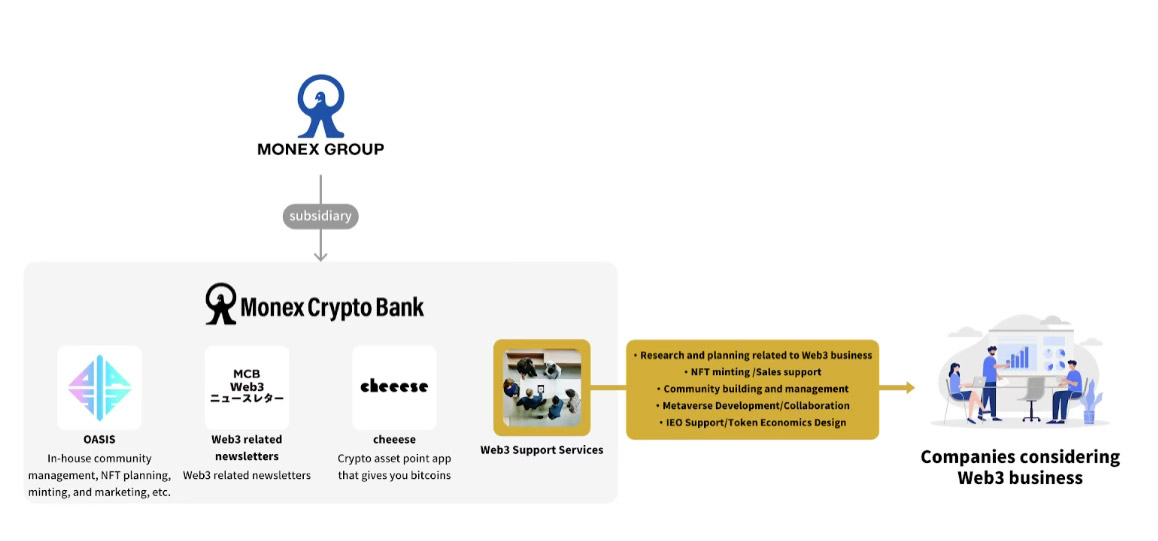
Monex Group, Inc. is a financial holding company with over 20 years of history, encompassing subsidiaries such as the centralized cryptocurrency exchange Coincheck, crypto asset consulting firms, AI startups, and securities companies.

As Tsukada explains:

“Monex Group provides various services related to crypto assets and blockchain, including the ‘MCB Web3 Newsletter’ and ‘MCB Research,’ the NFT project ‘OASIS,’ and the news app ‘Cheeese,’ which rewards users with Bitcoin. Established in December 2017, we have been focusing particularly on Web3 support services since last year, supporting the development of various services and the Japanese market.”

Monex Group’s Web3 Consulting Business: Leveraging In-House Expertise

Recognizing the growing demand for Web3 expertise in Japan, Monex Group has established a Web3 consulting business.  As Tsukada elaborated:

“In the Web3 consulting business, we support companies entering Web3 by leveraging the know-how accumulated by Monex Group. We offer a wide range of support, from NFT community building and operation to NFT planning, issuance, and tokenomics consultation.”

Monex has already supported the “construction and operation of NFT projects for major automotive and Japanese local governments” and is currently “strengthening our support for overseas Web3 projects entering the Japanese market.”

The company’s Web3 consulting services include:

Web3 Business Research and PlanningNFT Planning, Issuance, and SalesCommunity Building/OperationMetaverse Development/CollaborationIEO Support/Tokenomics Design

Tsukada notes that Monex’s strengths in this area include “the reliability of being associated with a listed company,” its ability to “collaborate across the group” in various business developments, and “real-time feedback and insights from our community and metaverse services, used to build Web3 communities and market them.”

The OASIS Project: Monex’s Innovative NFT Community

A key part of Monex’s Web3 expertise comes from its in-house project, OASIS. As Asami explains:

“OASIS is a digital community that started in January 2023 with the concept of creating opportunities for transformation and new encounters. It was built from scratch as part of a listed company group in Japan’s highly regulated Web3 market. It is an innovative and challenging initiative, issuing and selling NFTs with almost no prior examples.”

One unique aspect of OASIS is its “cross-utilization of various metaverses.” Asami said:

“We are developing cities in Web3 metaverses like The Sandbox and Decentraland. We also have worlds in Fortnite and Cluster, Japan’s largest metaverse, and XANA, with further expansion planned.”

This multi-metaverse approach has allowed OASIS to attract a large community of nearly 30,000 members, making it “one of Japan’s largest.” Asami notes that the community “facilitates easy collaboration with many companies and projects” by discussing a “rich variety of themes” such as AI and Japan’s Vtuber culture.

Supporting Companies Entering the Japanese Web3 Market

Monex’s experience with the OASIS project has provided valuable insights that the company is now leveraging to support other organizations entering the Japanese Web3 market.

As Tsukada explains:

“Through the OASIS project, we gained extensive knowledge about community management and handling NFTs. We learned that many companies struggle with Web3 community building through interactions with external organizations and overseas projects. Therefore, we thought we could support companies entering the Web3 space through consulting.”

Monex’s strengths in this area include “the reliability of being associated with a listed company,” its ability to “collaborate across the group,” and access to “real-time feedback and insights from our community and metaverse services, used to build Web3 communities and market them.”

The company has already “started joint Web3 service construction with major domestic automotive” and “collaborated with local governments on regional contributions through Web3.”

Looking Ahead: Monex Group’s Presence at Upcoming Web3 Events

Monex Group actively showcases its Web3 expertise and services at major industry events. The company organized a side event called “Japan Crypto Fusion” at TOKEN2049 in Dubai, which attracted a strong turnout despite a schedule change due to record-breaking rainfall.

Additionally, Monex Group is planning to have a significant presence at the upcoming “NexTeck Week2024” technology festival in Tokyo in November, where the company is seeking partners to exhibit with them.

As the Japanese Web3 market continues to evolve, Monex Group’s diverse financial services and innovative approach to community building and consulting make it a key player in the country’s burgeoning ecosystem. If you have even a slight interest in expanding into the Japanese market, it would be wise to submit an inquiry.

To learn more:

Disclosure: This is a sponsored post. Readers should conduct further research prior to taking any actions. Learn more ›

Mentioned in this article


Source link

Comparing AI Agents and Pipelines: Which is Right for You?

0
Comparing AI Agents and Pipelines: Which is Right for You?


When designing applications powered by large language models (LLMs), it is crucial to decide between using AI agents or a more conventional pipeline approach. While AI agents are flexible, adaptive, and interactive, they’re not always the best fit for every problem. On the other hand, pipelines, which pass the output of one task as the input to the next in a predefined sequence, offer a structured and predictable alternative.

In this article, we’ll explore the differences between AI agents and AI pipelines and identify which approach is better suited for specific types of applications. We’ll also use the CrewAI framework to demonstrate both techniques by building simple apps with different workflows.

What Are AI Agents?

AI agents represent autonomous entities that can make decisions and interact with users dynamically. They are often used for more complex, open-ended applications where decision-making is required based on user input. In this setup, the agent may ask multiple questions, adapt responses, and offer solutions or guidance in real time.

For example, consider a virtual assistant designed to help users troubleshoot their computer issues. If someone says, “My laptop won’t connect to Wi-Fi,” the AI agent would follow up with questions like:

Is the Wi-Fi switch turned on?

Are other devices connecting to the same network?

Have you tried restarting your router?

Based on the answers, the agent can offer more refined advice or ask additional questions until the problem is resolved.

AI Agent Example: Customer Support Chatbot

Let’s take a customer service scenario. A user is trying to solve a problem with their air conditioner. They interact with an AI chatbot, which operates as an intelligent agent, asking questions about the issue’s make, model, and symptoms to troubleshoot it.

Here’s an outline of how an AI agent operates in such a scenario:

Task: Help diagnose air conditioner problems.

Agent Behavior: The agent dynamically asks relevant questions, based on previous user responses, to narrow down the issue and suggest solutions.

Using the CrewAI framework, let’s create a simple example of a chatbot agent that can assist with air conditioner troubleshooting.

from crewai import Agent, Task, Crew

# Define the agent
support_agent = Agent(
role=”Customer Support Agent”,
goal=”Help diagnose and fix air conditioner problems”,
backstory=”You are a seasoned HVAC technician.”,
tools=[],
llm=”gpt-4″
)

# Define the task
task = Task(
description=”My air conditioner isn’t cooling the room.”,
expected_output=”A diagnosis and potential solution to the problem.”,
agent=support_agent
)

# Define the crew
crew = Crew(
agents=[support_agent],
tasks=[task],
verbose=True
)

# Execute the crew
result = crew.kickoff()

print(result.raw)

In this scenario, the AI agent asks questions like “Is the air filter clean?” or “Is the thermostat set to the correct temperature?” The agent continues interacting with the user until it solves the problem or refers them to a human technician.

What Are AI Pipelines?

In contrast to agents, AI pipelines are a sequence of predefined tasks where each task’s output is used as input for the next one. They are especially effective for repetitive and well-defined processes, such as generating reports, performing data transformations, or processing documents.

Pipelines follow a strict order of operations, and each task is focused on a specific, narrow function. For instance, if you need to generate sales reports regularly from a set of spreadsheets, a pipeline can efficiently consolidate the data, generate charts, and create a final report in one linear process.

Pipeline Example: Monthly Sales Report Generator

Let’s say the head of sales for a retail company wants a monthly sales report. The pipeline could include the following steps:

Data Consolidation: Combine sales data from multiple branches.

Analysis: Generate insights based on sales trends.

Chart Generation: Create bar and line charts comparing branch performance.

Report Writing: Summarize the data and charts into a final report.

Here’s how a pipeline app could work in CrewAI to generate such a report:

from crewai import Agent, Task, Crew

# Define the agent for data consolidation
consolidation_agent = Agent(
role=”Data Analyst”,
goal=”Consolidate sales data from various branches”,
backstory=”You specialize in data aggregation.”,
llm=”gpt-4″
)

# Define the agent for chart generation
chart_agent = Agent(
role=”Chart Creator”,
goal=”Generate visual representations of sales data.”,
backstory=”You are an expert in creating graphs and charts.”,
llm=”gpt-4″
)

# Define the agent for report writing
report_agent = Agent(
role=”Report Writer”,
goal=”Summarize sales data and insights into a final report.”,
backstory=”You have experience in crafting business reports.”,
llm=”gpt-4″
)

# Define the tasks
task1 = Task(
description=”Consolidate sales data from branches for August.”,
expected_output=”A single dataset of sales data.”,
agent=consolidation_agent
)

task2 = Task(
description=”Create bar and line charts comparing branch performance.”,
expected_output=”Charts comparing sales performance.”,
agent=chart_agent
)

task3 = Task(
description=”Write a summary report based on the consolidated data and charts.”,
expected_output=”A final sales report.”,
agent=report_agent
)

# Define the crew
crew = Crew(
agents=[consolidation_agent, chart_agent, report_agent],
tasks=[task1, task2, task3],
verbose=True
)

# Execute the crew
result = crew.kickoff()

print(result.raw)

This pipeline consolidates data, analyzes it, and generates the final report, ensuring a repeatable, structured process with minimal need for human intervention.

Comparing AI Agents and AI Pipelines

Advantages of AI Agents:

Interactivity: AI agents can handle complex, open-ended tasks and adapt based on user responses, making them ideal for customer service or personal assistants.

Context Awareness: Agents can remember previous interactions, allowing them to make informed decisions based on past conversations.

Flexibility: Agents are not bound by a strict process, enabling them to dynamically navigate a range of potential scenarios.

Advantages of AI Pipelines:

Predictability: Pipelines follow a strict, deterministic flow, ensuring that results are consistent and repeatable each time.

Modularity: Pipelines can easily scale by adding or removing tasks, making them suitable for complex processes broken down into smaller, manageable steps.

Efficiency: For applications with repetitive tasks, pipelines offer a faster and more reliable approach than agents, which may introduce variability due to their adaptive nature.

Choosing the Right Approach

Use AI Agents when your application requires dynamic decision-making, interaction with users, or the ability to handle open-ended tasks. For example, an AI-powered customer support assistant or a virtual tutor would benefit from an agent’s adaptive, interactive nature.

Use AI Pipelines when: Your application involves predefined tasks that don’t change based on user interaction. Pipeline-based solutions are ideal for tasks like report generation, data processing, or repetitive workflows.

Building a Hybrid System

In some cases, you may want to combine both approaches. For instance, you might use an AI agent to handle user interactions, gather inputs, and then pass the data to a pipeline that processes it and produces a structured output. Hybrid models offer the flexibility of agents with the reliability of pipelines.

Hybrid Example: E-commerce Customer Support + Order Summary

Imagine an e-commerce support system where an AI agent helps users track their orders and passes the information to a pipeline that generates an order summary once the order is located.

Agent Task: The AI agent interacts with the customer, asking for order details (e.g., order number, shipping address).

Pipeline Task: Once the order details are retrieved, a pipeline generates a detailed order summary and sends it to the customer.

Combining the two approaches can create a robust system that offers both interactivity and structure.

Conclusion: Choosing AI Agents or Pipelines

Choosing between AI agents and AI pipelines depends on the nature of the task at hand. AI agents are ideal for complex, interactive scenarios that require flexibility, whereas AI pipelines offer a more structured and predictable approach to repetitive tasks. Understanding the strengths and limitations of each approach will help you design more effective and efficient AI-powered applications.

FAQs

What is the primary difference between AI agents and pipelines?

AI agents are dynamic and interactive, adapting based on user input, whereas pipelines follow a strict, linear process to complete predefined tasks.

Can I use both AI agents and pipelines in the same application?

Yes, hybrid applications can benefit from combining the flexibility of AI agents with the structure of pipelines.

Are pipelines more efficient than agents?

Pipelines are more efficient for repetitive tasks, as they follow a deterministic sequence, making them faster and more predictable than agents.

Which is better for customer support applications: agents or pipelines?

AI agents are better suited for customer support because they can interact with users, ask follow-up questions, and adapt to different scenarios.

Can pipelines handle complex decision-making tasks?

Pipelines are less suited for open-ended or complex decision-making tasks; agents are better equipped to handle such scenarios due to their adaptive capabilities.



Source link

NFTs & Crypto: Discover the Next Big Thing in Digital Ownership – Web3oclock

0
NFTs & Crypto: Discover the Next Big Thing in Digital Ownership – Web3oclock


The Intersection of NFTs and Cryptocurrencies

Use Cases of NFTs in the Crypto World

Future of NFTs and Cryptocurrencies

The Intersection of NFTs and Cryptocurrencies:

Use Cases of NFTs in the Crypto World:

Beeple NFT

Investment Opportunities of NFTs & Crypto:

Challenges and Risks of NFTs & Crypto:

Future of NFTs & Cryptocurrencies:


Source link

Popular Posts

My Favorites

Japan’s Bond Volatility Puts Global Liquidity, Bitcoin Under Pressure – Decrypt

0
In brief Japanese government bond yields surged at a pace not seen since 2022, spilling into U.S. Treasurys and jolting global rates markets. Treasury Secretary...