In a move that left both allies and opponents reeling, President-elect Donald Trump has tapped pro-crypto Florida Congressman Matt Gaetz to serve as the next Attorney General of the United States. It’s a move that suggests he’s doubling down on his pro-crypto agenda.
Known for his staunch advocacy of Bitcoin, Gaetz’s appointment is a clear signal that Trump’s second term will prioritize a pro-crypto agenda, even at the risk of deepening divisions within his own party.
Gaetz would “root out the systemic corruption at DOJ, and return the Department to its true mission of fighting Crime, and upholding our Democracy and Constitution,” Trump wrote on his Truth Social network on Wednesday.
With Bitcoin soaring to a record high of $93,477 following the announcement, the market is already responding positively to the prospect of a more supportive regulatory environment.
Gaetz’s nomination came following the Republican Party’s success in the 2024 elections, where pro-crypto candidates secured majorities in both the House and Senate.
However, the announcement of his nomination was met with gasps during a closed-door meeting of House Republicans, with several members reportedly expressing disbelief, as per an Axios report.
Reportedly, multiple senators expressing skepticism about his readiness for the position due to his confrontational approach and limited legal experience.
Gaetz has previously advocated for deregulating the crypto industry, pushing back against what he views as federal overreach by agencies like the SEC.
In June, Gaetz introduced legislation to allow Americans to pay their federal taxes using Bitcoin. The bill seeks to amend the Internal Revenue Code of 1986, enabling the IRS to accept Bitcoin for tax payments and enter into contracts for related services.
Despite the enthusiasm from the crypto sector, Gaetz faces a tough confirmation battle. His past legal troubles—including a federal investigation into allegations of sex trafficking, which ended without charges—are likely to be scrutinized during Senate hearings.
He was also under an ethics review in the House over allegations related to misconduct and inappropriate use of funds.
On Wednesday, House Speaker Mike Johnson confirmed that Gaetz had stepped down from his congressional seat, effectively halting the ethics probe, as investigations are limited to active members of Congress.
For the crypto industry, however, the mere prospect of having a pro-Bitcoin attorney general is already being seen as a significant win.
While Republicans have a majority, just a few dissenting votes could derail the nomination. Yet, Trump’s allies are pushing for a swift confirmation, saying Gaetz’s reformist agenda is essential for overhauling the DOJ’s approach to crypto regulations.
Edited by Stacy Elliott.
Daily Debrief Newsletter
Start every day with the top news stories right now, plus original features, a podcast, videos and more.
Welcome to the world of Decentralized Finance or DeFi, where the power of finance is shifting from big institutions to the hands of everyday people like you and me. Just imagine a financial world without any middlemen like banks, complex fee structures, and geographical restrictions. DeFi is a rapidly evolving sector where you can take loans, invest, trade, and save money directly between individuals. Sounds futuristic, right? Well, yes, the future is already here with DeFi.
In this blog, we will dive into the world of DeFi, explore what it is, how it works, and why is it capturing the attention of tech enthusiasts and institutions alike. By the end, we will have an idea of how DeFi has transformed its approach toward financial services. Ready? Let’s get started!
What is DeFi?
Picture Courtesy: 101blockchains.com
So, what exactly is DeFi? Decentralized Finance, or DeFi, refers to a collection of financial services and products built on blockchain technology. Unlike traditional finance, which relies on centralized institutions like banks or brokers, DeFi uses smart contracts and blockchains to offer financial services directly to users.
Think of it like this: instead of going to a bank to get a loan or deposit your money, you interact with a decentralized network (often using cryptocurrencies) where smart contracts handle everything automatically. No middlemen, no intermediaries—just you, the protocol, and the community that drives it.
Who Invented DeFi? The History and Evolution:
Let’s go on a quick journey through the history of DeFi. There isn’t a single inventor of DeFi, but there is a point in time from which this all begins: in 2009, Satoshi Nakamoto created Bitcoin. The decentralized nature of Bitcoin provided the technological feasibility that financial services could exist outside a traditional banking system.
However, the idea of DeFi evolved incredibly with the introduction of Ethereum in 2015. Ethereum introduced the world to this phenomenon called a smart contract, self-executing contracts that automatically perform transactions based on predefined rules. This innovation marked a significant pathway to more elaborate financial applications.
The first DeFi project that gained major attention was MakerDAO in 2017, which allowed users to borrow the DAI stablecoin by locking up Ethereum as collateral. And that has also triggered this exponential expansion of the ecosystem. For example, Uniswap, Aave, and Compound are the leaders in decentralized lending, trading, and investment products.
Importance and growth of DeFi in the crypto space:
Here’s an in-depth exploration of the importance and growth of decentralized finance (DeFi) in the crypto space:
A. Democratization of access to finance:
DeFi opens financial services to a global audience not segmented by location, wealth, or access to traditional banks. While centralized financial institutions tend to deny services for credit scores, geography, or political reasons, DeFi stands open to everyone if they have an internet connection.
DeFi enables peer-to-peer saving, borrowing, lending, and investing directly without the need for intermediaries in areas where the infrastructure of banks is scarce. Decentralized infrastructures allow citizens from developing countries to access the global economy for a better life in their respective economies.
The new adoption studies on DeFi indicate that most users are from areas characterized by high inflation and low banking service. This, therefore, highlights the role DeFi plays in bringing economic inclusion.
B. Remove Intermediaries and Cut Costs:
While the existing financial services include banks, brokers, and exchanges, which all rely on intermediaries to carry out a transaction, it allows for an extra cost, inefficiency, and slowing down of a deal. In DeFi protocol, this smart contract automatically conducts transactions, so middlemen are not needed to be involved thereby cutting down some costs of a transaction.
Smart contracts are self-executing agreements coded on the blockchain, thereby automating lending and trading processes with lower fees. Users can then retain a higher percentage of earnings plus simplify complicated processes.
DeFi’s market has grown from leaping bounds. Currently, the value-locked TVL across various platforms has reached more than $50 billion, which reflects the increased demands of customers for cost-efficient alternatives to traditional finance.
C. Yield farming and decentralized lending:
DeFi is unique because it can offer financial incentives in the form of yield farming and decentralized lending. Users can use the provision of liquidity to DeFi protocols and thereby reap rewards in the form of interest rates or governance tokens, thereby augmenting returns on assets.
The importance of lending protocols in DeFi is that, unlike savings accounts, which are low-interest-yielding accounts, it offers nice yields through peer-to-peer lending that motivates people to hold their assets in the ecosystem of DeFi. It accelerates the growth of DeFi.
The increase of yield farming via protocols such as Compound and Aave has drawn millions of crypto investors seeking higher yields, thus bringing massive capital inflows into DeFi.
D. Innovative Financial Products and Tokenization:
DeFi has revolutionized finance by introducing innovative financial products, including decentralized exchanges (DEXs), synthetic assets, and tokenized derivatives. These products provide new ways to trade, invest, and hedge against market risks, offering flexibility unmatched by traditional finance.
Tokenization enables the creation of digital assets that represent real-world assets, such as stocks, real estate, or commodities, making these assets more accessible and tradeable on the blockchain. This democratization of investment expands access and liquidity to new asset classes.
DeFi’s continued product innovation and collaboration with other sectors, like decentralized autonomous organizations (DAOs) and NFT projects, highlight its growth and growing influence in transforming traditional markets.
E. Increased Security and Transparency
DeFi leverages blockchain technology’s inherent transparency and security features. Transactions on decentralized platforms are publicly recorded on a distributed ledger, ensuring traceability and minimizing fraud risk. Users have control over their funds without reliance on centralized custodians.
With transparency, users can verify smart contract operations and financial data. This level of openness builds trust and accountability in DeFi protocols, a significant departure from traditional opaque banking operations. Audits and open-source smart contracts further strengthen security, although they come with their own risks.
As awareness around financial security and data privacy increases, DeFi has grown to represent a key pillar in creating trustless, censorship-resistant financial systems, reflected by increasing institutional interest and billions of dollars in trading volume across DEXs.
2. Core Concepts & Key Features of DeFi:
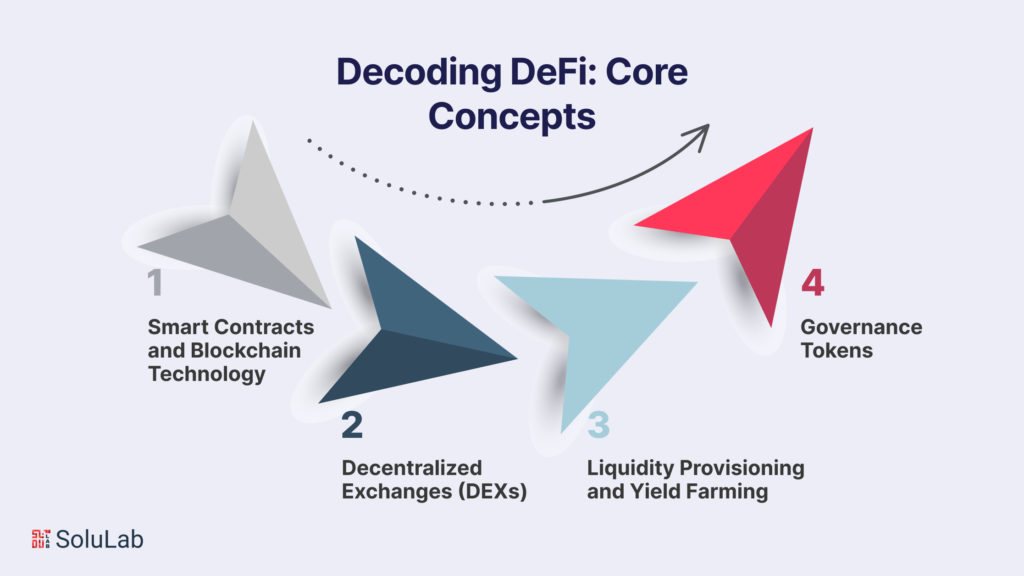
Picture Courtesy: solulab.com
DeFi is an exciting space where decentralization meets innovation, and it’s growing at an exponential rate. Let’s break down the core concepts of DeFi in simple terms to help you understand why it’s so important and how it works.
A. Decentralization:
Decentralization is the core philosophy of DeFi. Banks and financial institutions own money in traditional finance. DeFi, runs directly on the blockchain, like Ethereum, resulting in no central authority for the user’s assets-thus, user control. It is about removing intermediaries and ensuring openness, security, and privacy for everyone.
B. Smart Contracts:
Think of smart contracts as just pieces of code for self-executing agreements on a blockchain with the terms of agreement put in place, and carried out automatically, without interference from a middleman. It’s literally setting up a contract between you and the machine where one never forgets and goes exactly where it was led to by the contract!
C. Decentralized Exchanges (DEXs):
DEXs enable users to trade their cryptocurrencies with one another directly without some intermediary authority, be it Binance or Coinbase. These are run on smart contracts wherein the transactions occur directly on the blockchain. A very popular version of DEXs includes Uniswap and SushiSwap, which are taking the crypto world storm with greater freedom and control of your trades.
D. Yield Farming and Liquidity Pools:
So that’s one of the cool things you can do in DeFi- earn some passive income. The very concept of yield farming is earning some rewards by providing liquidity to DeFi platforms. When you stake your crypto into a liquidity pool, you help make trades and transactions possible; you get interest or tokens in return. It is like putting your money to work for you, without needing you to do anything!
E. Stablecoins:
Stablecoins are cryptocurrencies engineered to keep a stable value, typically pegged to the traditional currency like the US dollar. The best of both worlds – stability offered by traditional currency and blockchain benefits – does promise real meaning in the form of stablecoins. Like USDC and DAI, with lending, borrowing, or even trading, you cannot suffer at the hands of extreme volatility witnessed with some cryptocurrencies such as Bitcoin and Ethereum.
F. Lending and Borrowing:
Imagine being able to borrow money or earn interest on your assets, without going to a bank. Well, that is the power of DeFi lending and borrowing platforms! Services like Aave and Compound allow you to lend your crypto to others in exchange for interest or borrow assets by collateralizing your own. It’s decentralized peer-to-peer finance at its finest, with no banks or credit scores involved.
G. Governance Tokens:
In DeFi most of the platforms use governance tokens which allow users to express opinions about the direction they see the protocol in. You can even vote on proposals about upgrades, changes, and new features by holding such tokens. It is a democratic way of decision-making and therefore demonstrates control of the community over the future platform.
Decentralized Finance Explained: A New Era in Finance
Decentralized finance (DeFi) is transforming the way we think about financial systems. It’s a set of financial services built on blockchain technology, offering alternatives to traditional banks and financial institutions. Instead of relying on central authorities, DeFi operates on smart contracts and decentralized applications (dApps), enabling direct, peer-to-peer transactions without intermediaries.
With DeFi, you can lend, borrow, trade, and invest in digital assets directly from your wallet, enjoying benefits like reduced fees, faster transactions, and increased accessibility. Key concepts include decentralized exchanges (DEXs), yield farming, stablecoins, and governance tokens, all of which empower users with more control over their financial activities.
In essence, Decentralized Finance Explained means financial freedom, security, and innovation, all driven by the blockchain. As DeFi continues to grow, it’s clear that it’s more than just a trend – it’s the future of finance.
3. Major DeFi Platforms and Tools:
Picture Courtesy: kryptochannel.com
The DeFi (Decentralized Finance) ecosystem is thriving, with various platforms and tools empowering users to take control of their financial activities without relying on traditional banks or intermediaries. Here’s an overview of some of the most popular platforms that are driving innovation in this space:
A. Uniswap:
Uniswap is a decentralized exchange (DEX) built on Ethereum that allows users to trade tokens directly from their wallets. It uses an automated market maker (AMM) model, which relies on liquidity pools rather than traditional order books. This means users can trade without intermediaries, directly swapping tokens at prices determined by the pool’s supply and demand.
Primary Use: Token trading and liquidity provision.
B. Aave:
Picture Courtesy: globalhappenings.com
Aave is a decentralized lending and borrowing protocol that allows users to earn interest on deposits and borrow assets against collateral. A key feature of Aave is its flash loans, which enable users to borrow without collateral if the loan is repaid within the same transaction. This opens up unique arbitrage and liquidity opportunities.
Primary Use: Lending, borrowing, and flash loans.
C. Compound:
Compound is another popular DeFi lending platform that enables users to lend and borrow cryptocurrencies. When users lend assets to the platform, they receive cTokens in return, which represent their claim on the assets and any accrued interest. Compound’s protocol automatically adjusts interest rates based on supply and demand for each asset.
Primary Use: Crypto lending and borrowing.
D. Yearn Finance:
Picture Courtesy: cardanolibrary.net
Yearn Finance is a yield aggregator designed to maximize returns on deposited funds by automatically moving assets between various DeFi protocols to optimize yields. It offers “Vaults” where users can deposit assets, and the protocol will deploy those funds across multiple DeFi projects based on a strategy that seeks the highest returns.
Primary Use: Yield farming and yield optimization.
E. Synthetix:
Picture Courtesy: blockchainwelt.de
Synthetix is a protocol for creating and trading synthetic assets that mimic the value of real-world assets like stocks, commodities, and fiat currencies. Using smart contracts, Synthetix enables users to gain exposure to assets without directly owning them, thereby broadening DeFi’s reach beyond cryptocurrencies.
Primary Use: Synthetic asset creation and trading.
F. MakerDAO:
Picture Courtesy: u.today
MakerDAO is the protocol behind the DAI stablecoin, a decentralized stablecoin pegged to the US dollar. It allows users to create DAI by collateralizing other cryptocurrencies in a Maker Vault.
Primary Use: As a key player in the stablecoin space, MakerDAO helps stabilize the volatile crypto market and facilitates lending, borrowing, and trading with greater price predictability.
G. Curve Finance:
Picture Courtesy: fxprofitsignals.com
The curve is a decentralized exchange optimized for stablecoin trading and low-slippage swaps. It focuses on stablecoins and tokenized assets with similar value, like wrapped tokens.
Primary Use: By offering low fees and minimal slippage, Curve is an essential platform for liquidity providers and traders looking for efficient stablecoin trades, making it a major player in the DeFi sector.
DeFi Pulse and Its Significance:
Picture Courtesy: moralismoney.com
DeFi Pulse is a leading analytics and ranking platform for decentralized finance projects. It tracks and displays key metrics for the DeFi ecosystem, offering insights into the total value locked (TVL) across different protocols, lending and borrowing rates, market dominance, and more. The TVL metric, which represents the total amount of assets staked in DeFi projects, serves as a critical indicator of the sector’s health and growth.
Significance of DeFi Pulse:
DeFi plays a significant role in the DeFi market. Let’s get to know about that.
Market Insights:
DeFi Pulse provides a comprehensive overview of the DeFi market, including the top-performing platforms, trends, and growth statistics. This makes it an invaluable tool for investors, researchers, and enthusiasts who want to keep up with the evolving DeFi space.
Transparency:
By offering real-time data and analytics, DeFi Pulse promotes transparency in the DeFi ecosystem. It allows users to make informed decisions based on accurate and up-to-date information.
Tracking Performance:
The platform ranks projects based on their TVL, giving users a sense of which protocols hold the most assets and, by extension, user trust and market activity. This helps users discover new platforms, track their favorite projects, and understand shifts in market dominance.
4. Benefits and Risks of DeFi: Understanding the Pros and Cons
Decentralized finance (DeFi) has revolutionized the way we access, manage, and grow our wealth, but it also comes with challenges and risks. By understanding both the advantages and drawbacks, you can make more informed decisions about participating in this rapidly evolving space.
Benefits of DeFi over Traditional Finance:
Picture Courtesy: blog.coinremitter.com
The most important benefits of DeFi are –
A. Financial Inclusion:
DeFi offers access to financial services to anyone with an internet connection, removing barriers imposed by traditional banking systems. No more waiting on bank approvals or credit scores – you’re in control.
B. Transparency and Security:
Transactions are recorded on public blockchains, making every action traceable and providing unparalleled transparency. The decentralized nature of DeFi also reduces the risk of censorship or manipulation.
C. Lower Costs:
By eliminating middlemen and traditional gatekeepers, DeFi significantly reduces transaction fees, making financial services more affordable.
D. Decentralized Control:
Unlike traditional banks that hold custody over your funds, DeFi allows you to retain full control of your assets through non-custodial wallets and decentralized protocols.
E. Flexible and Innovative Products:
DeFi introduces unique opportunities, including yield farming, liquidity mining, and the creation of synthetic assets, pushing the boundaries of what’s possible with your money.
Potential Risks and Challenges in DeFi:
There are plenty of risks and challenges while you are using DeFi. So, you just need to be aware of these potential risks and challenges of using DeFi:
A. Smart Contract Vulnerabilities:
While DeFi is built on code, bugs or security loopholes can be exploited, leading to significant losses or hacks. Trusting code alone can be risky.
B. Regulatory Uncertainty:
DeFi operates in a largely unregulated environment, meaning sudden government actions or legal changes can impact user operations and platform compliance.
C. Market Volatility:
The crypto market is known for its extreme volatility, which can affect both the stability and value of assets used in DeFi protocols.
D. Liquidity Risks:
Low liquidity in certain DeFi protocols may result in price slippage and difficulties when executing large transactions or exiting positions.
E. Scams and Fraud:
DeFi’s open nature has attracted bad actors who exploit inexperienced users through fraudulent schemes or rug pulls, making it important to research and exercise caution.
5. DeFi Use Cases and Applications: Transforming Finance and Beyond
Decentralized Finance (DeFi) is changing the face of traditional finance by offering open, permissionless, and decentralized financial services on blockchain networks. Here’s a quick overview of its key use cases, real-world applications, and how it’s transforming industries:
A. Lending and Borrowing:
Users can lend or borrow cryptocurrencies without intermediaries, earning interest or accessing loans with overcollateralized assets.
Example: Aave and Compound allow users to deposit crypto into liquidity pools and earn interest or use their assets as collateral for loans.
B. Decentralized Exchanges (DEXs):
DEXs enable peer-to-peer trading of cryptocurrencies directly from wallets, with no central authority.
Example: Uniswap allows users to swap tokens seamlessly without a middleman.
C. Stablecoins:
Stablecoins are pegged to stable assets like fiat currencies, offering a stable store of value in the crypto ecosystem.
Example: Dai is a stablecoin pegged to the US dollar, offering stability within DeFi systems.
D. Yield Farming and Staking:
Users earn rewards by providing liquidity or staking assets in DeFi protocols, often earning high returns.
Example: Platforms like Yearn Finance optimize yield farming strategies for users.
E. Insurance:
Decentralized insurance platforms cover smart contract failures, hacks, or other risks, offering transparency and fair premiums.
DeFi allows borderless, low-cost payments and remittances, bypassing traditional fees and intermediaries.
Example: Projects like Celo enable fast, cost-effective mobile payments for underserved populations.
Real-World Applications of DeFi:
DeFi’s applications extend beyond crypto trading, reaching real-world users with innovative solutions. For example, Microloans offered through platforms like Goldfinch empower borrowers in underserved regions, while tokenized real estate projects such as RealT allow fractional ownership of property.
How DeFi is Transforming Various Industries:
Here’s how DeFi is transforming the whole web3 industry.
A. Finance and Banking:
DeFi offers people around the world access to financial services, regardless of their location or traditional banking status. It’s promoting financial inclusion and creating new ways to invest, save, and access credit.
B. Insurance:
Decentralized insurance protocols like Nexus Mutual provide a transparent, decentralized alternative to traditional insurance, with smart contracts automatically paying claims when conditions are met.
C. Gaming and NFTs:
DeFi is merging with the gaming world, enabling play-to-earn economies where players earn tokenized assets, as well as NFT-based in-game items that can be traded or monetized in open marketplaces.
D. Supply Chain Management:
DeFi-based supply chain solutions enhance transparency and reduce inefficiencies by tracking the movement of goods using blockchain, creating a tamper-proof record of transactions and contracts.
6. Future of DeFi:
Picture Courtesy: Cointelegraph
The future of DeFi holds has both exciting potential and complex challenges. As DeFi continues to mature, we’re likely to see greater integration with traditional finance, making it accessible to a broader range of users. Emerging trends, like cross-chain interoperability, could bridge different blockchains, enabling seamless transactions across platforms. Additionally, as DeFi gains more mainstream traction, regulatory frameworks may develop to address security concerns, bringing much-needed stability and consumer protection to the space.
However, DeFi’s future isn’t without hurdles. Security will continue to be a primary focus, as protocols work to protect users against hacks and malicious attacks. On the innovation side, DeFi is likely to drive new financial products and services, revolutionizing everything from asset management to insurance. With more eyes on the space, DeFi could eventually become a global financial standard, empowering people worldwide with unprecedented control over their finances.
Emerging Trends and the Future Outlook of DeFi:
Emerging trends shaping DeFi include cross-chain interoperability (connecting multiple blockchains), decentralized identity solutions for more secure user verification, and the rise of layer-2 scaling solutions to reduce transaction costs. Additionally, “Real-World Asset (RWA) tokenization” is gaining momentum, making traditional assets like real estate tradable on decentralized markets.
Platforms like Aave are introducing real-world asset markets, enabling loans backed by tokenized real estate or bonds.
Expert Opinions and Predictions:
Experts predict that DeFi will evolve to become more user-friendly, interoperable, and regulated, bridging traditional finance with decentralized systems. Some believe that DeFi’s flexibility will drive mass adoption of decentralized finance in global economies, while others stress caution due to risks like regulation and security vulnerabilities.
Vitalik Buterin, co-founder of Ethereum, emphasizes scaling solutions and regulatory clarity as critical factors for DeFi’s continued success.
7. Conclusion: Embracing the Future of DeFi
As we’ve explored, the future of decentralized finance (DeFi) is filled with immense potential and exciting opportunities. The key trends driving DeFi’s evolution include greater cross-chain interoperability, the integration of real-world assets into decentralized markets, and the continued development of user-friendly platforms. Experts predict that as DeFi grows, it will lead to more financial inclusion, improved accessibility, and a shift toward a decentralized financial ecosystem, all while facing challenges like regulation and security.
DeFi’s rapid expansion is redefining traditional financial systems. Emerging trends like cross-chain interoperability and Real-World Asset tokenization are set to reshape DeFi. Expert predictions highlight the need for scalability, regulatory clarity, and wider adoption of decentralized platforms. The future of DeFi offers exciting possibilities, and staying ahead of these trends is crucial for anyone interested in the evolving world of finance.
Now is the time to explore the opportunities that DeFi offers. Dive into the world of decentralized finance and stay updated with the latest developments to make informed decisions. Don’t miss out on the future of finance—subscribe to our newsletter for regular updates and expert insights on all things Web3 world.
At Devcon in Bangkok, the Linea Association announced its formation to oversee the development and governance of Linea’s open-source technology and ecosystem. The Swiss non-profit aims to decentralize the Linea Network—the zkEVM Layer-2 solution designed to scale Ethereum—by launching the LINEA token by the end of Q1 2025, enabling community-driven governance.
The Association’s mission includes supporting the growth of Linea Mainnet to build a fast, affordable, and secure network accessible worldwide. It plans to advance decentralization through new governance mechanisms and implement decentralized sequencing and proving. Empowering developers to create decentralized applications with enhanced user experiences and fostering strong, engaged communities are also key priorities.
Nicolas Liochon, founder of Linea and board member of the Linea Association, said.
“Decentralization is at the core of Linea’s vision. Linea must be owned and governed openly by all as a public good, just as Layer 1 Ethereum is.”
The governance structure will feature a Board of Directors, a General Assembly, an Executive Director, and a token governance body. The LINEA token will allow holders to participate in governance, with details on token design and utility to be shared before the token generation event. More than 1.3 million verified addresses have joined the network, reflecting Linea’s focus on organic community growth.
Since its mainnet launch in August 2023, Linea has processed over 230 million transactions, making it one of the fastest-growing zkEVMs on Ethereum. The ecosystem has also expanded to over 420 ecosystem partners. The technology is publicly available under the Apache license, allowing users to view, fork, and modify the code.
The Association operates independently of Consensys, aligning with CEO Joseph Lubin’s vision to decentralize core innovations progressively. Lubin said,
“As Consensys progresses toward decentralization, Linea represents a foundational step in our vision of creating a Network State for the emerging decentralized global economy.”
Linea has integrated long-term Ethereum contributors like Status, developers of the Nimbus client that secures 10% of Ethereum’s proof-of-stake network. The Association plans to decentralize core protocol development and governance further, ensuring social and technical alignment within the community.
The Swiss Association structure allows token holders to have governance over managing IP and a treasury supporting Linea’s mission. The focus remains on furthering the growth and development of the open-source LINEA technology and the Linea Network.
Linea aims to empower users and businesses to manage valuable on-chain data, including identity and property. Per the announcement, the Linea Association seeks to be a significant step toward decentralizing the network and fostering collaborative, transparent governance. The initiative aims to empower the global community to shape the future of Linea and contribute to the broader Ethereum ecosystem.
The Intercom Devices Market study by DataM Intelligence offer an in-depth analysis of the market, presenting insightful observations, statistics, historical data, and industry-validated market insights. The report delves into the competitive positioning of key companies, examining factors such as product offerings, pricing strategies, financial health, product portfolios, growth initiatives, and geographical reach.
Download a Free sample PDF (Use Corporate email ID to Get Higher Priority) at: – https://datamintelligence.com/download-sample/intercom-devices-market
What is the projected growth rate (CAGR) of the Global Intercom Devices market from 2024 to 2031, and what is the market value expected to change by 2031?
Global Intercom Devices Market reached US$ 22.9 billion in 2022 and is expected to reach US$ 56.8 billion by 2031, growing with a CAGR of 12.1% during the forecast period 2024-2031.
Intercom devices are communication systems used within buildings or specific areas to enable direct verbal communication between different rooms or sections. Commonly found in homes, offices, and public buildings, intercoms enhance security and convenience by allowing controlled, two-way communication. They are often integrated with security systems and may include audio and video functionalities. Intercoms support effective communication without requiring physical presence.
Key Developments:
❁ In 2023, Riedel Communications announced that In Concert Productions (ICP), a provider of advanced sound equipment and services, has integrated Riedel’s Emmy Award-winning Bolero wireless intercom system into its offerings. The Bolero system is renowned for its robust and reliable wireless communication capabilities, making it ideal for live event production and other demanding environments. This addition enables ICP to enhance communication efficiency for its clients, offering seamless and high-quality intercom solutions. The collaboration reflects both companies’ commitment to delivering state-of-the-art technology for dynamic event management and production.
List of the Key Players in the Intercom Devices Market:
SAMSUNG ELECTRONICS CO., LTD., Panasonic Holdings Corporation, Schneider Intercom GmbH, Hollyland, Godrej & Boyce Manufacturing Company Limited, Axis Communications AB, Alpha Communications, TCS TürControlSysteme AG, Riedel Communications and TOA Corporation.
Research Process:
Both primary and secondary data sources have been used in the global Intercom Devices Market research report. During the research process, a wide range of industry-affecting factors are examined, including governmental regulations, market conditions, competitive levels, historical data, market situation, technological advancements, upcoming developments, in related businesses, as well as market volatility, prospects, potential barriers, and challenges.
Segment Covered in the Intercom Devices Market:
By System: Wire, Wireless.
By Component: Hardware, Software and Services.
By Device: Door Entry Systems, Handheld Devices, Others.
By Technology: Analog, IP-Based.
By Communication: Push-To-Talk, Hands-Free.
By End-User: Commercial, Residential, Others.
Regional Breakout:
The global Intercom Devices Market report focuses on six major regions: North America, Latin America, Europe, Asia Pacific, the Middle East, and Africa.
✫ North America (U.S., Canada, Mexico)
✫ Europe (U.K., Italy, Germany, Russia, France, Spain, The Netherlands and Rest of Europe)
✫ Asia-Pacific (India, Japan, China, South Korea, Australia, Indonesia Rest of Asia Pacific)
✫ South America (Colombia, Brazil, Argentina, Rest of South America)
✫ Middle East & Africa (Saudi Arabia, U.A.E., South Africa, Rest of Middle East & Africa)
Get Year End Discounts on Premium Report:- https://www.datamintelligence.com/buy-now-page?report=intercom-devices-market
This Report Unveils:
✔ Go to Market Strategy- A roadmap to successfully product launch or service in the target market.
✔ Gain a clear picture of the market’s health and growth trajectory through neutral analysis.
✔ Deep Market Insights delve into development trends, competitor landscape, supply and demand dynamics, brand share & pricing analysis year-over-year growth patterns, and key players’ performance.
✔ Upon request, we can provide customized reports focusing on specific regions or countries, offering a granular view of their markets.
✔ Identify high-potential niche segments and regions poised for significant expansion.
✔ Analysis of Market Size (historical and forecast) Total Addressable Market (TAM), Serviceable Available Market (SAM), and Serviceable Obtainable Market (SOM) to understand the market’s overall size and your achievable market share.
✔ Gain a comprehensive understanding of the competitive landscape, including market share distribution, key players (innovators, startups, laggards, and pioneers), and their respective strengths and weaknesses.
**The full version of the report includes an in-depth analysis of emerging players and startups, which will provide valuable insights into the evolving market landscape and key strategies being adopted**
Chapter Outline:
Chapter 1: Introduces the report scope of the report, executive summary of different market segments (by region, product type, application, etc), including the market size of each market segment, future development potential, and so on. It offers a high-level view of the current state of the market and its likely evolution in the short to mid-term, and long term.
Chapter 2: key insights, key emerging trends, etc.
Chapter 3: Manufacturers competitive analysis, detailed analysis of Intercom Devices manufacturers competitive landscape, revenue market share, latest development plan, merger, and acquisition information, etc.
Chapter 4: Provides profiles of key players, introducing the basic situation of the main companies in the market in detail, including product revenue, gross margin, product introduction, recent development, etc.
Chapter 5 & 6: Revenue of Intercom Devices in regional level and country level. It provides a quantitative analysis of the market size and development potential of each region and its main countries and introduces the market development, future development prospects, market space, and market size of each country in the world.
Chapter 7: Provides the analysis of various market segments by Type, covering the market size and development potential of each market segment, to help readers find the Intercom Devices market in different market segments.
Chapter 8: Provides the analysis of various market segments by Application, covering the market size and development potential of each market segment, to help readers find the Intercom Devices market in different downstream markets.
Chapter 9: Analysis of industrial chain, including the upstream and downstream of the industry.
Chapter 10: The main points and conclusions of the report.
Get Customization in the report as per your requirements:- https://datamintelligence.com/customize/intercom-devices-market
Frequently Asked Questions
☞ What is the expected growth rate of the global Intercom Devices market for the forecast period?
☞ What are the key driving factors that are responsible to shape the fate of the Intercom Devices market during the forecast period?
☞ What will be the overall size of the market during the analysis period?
☞ What are the prominent market trends which influence the development of the Intercom Devices market across various regions?
☞ Who are the key market players and the market strategies that have helped them to secure the leading position in the global market?
☞ What are the challenges and threats that are likely to act as a barrier to the growth of the Intercom Devices market?
☞ What are the major opportunities that the companies can get to attain success in the world?
Contact Us –Company Name: DataM IntelligenceContact Person: Sai KiranEmail: Sai.k@datamintelligence.comPhone: +1 877 441 4866Website: https://www.datamintelligence.com
About Us –DataM Intelligence is a Market Research and Consulting firm that provides end-to-end business solutions to organizations from Research to Consulting. We, at DataM Intelligence, leverage our top trademark trends, insights and developments to emancipate swift and astute solutions to clients like you. We encompass a multitude of syndicate reports and customized reports with a robust methodology.Our research database features countless statistics and in-depth analyses across a wide range of 6300+ reports in 40+ domains creating business solutions for more than 200+ companies across 50+ countries; catering to the key business research needs that influence the growth trajectory of our vast clientele.
This release was published on openPR.
About Web3Wire Web3Wire – Information, news, press releases, events and research articles about Web3, Metaverse, Blockchain, Artificial Intelligence, Cryptocurrencies, Decentralized Finance, NFTs and Gaming. Visit Web3Wire for Web3 News and Events, Block3Wire for the latest Blockchain news and Meta3Wire to stay updated with Metaverse News.
The development of artificial intelligence has brought about tremendous advancements in various fields, but running AI models can be incredibly resource-intensive, both financially and environmentally. AI models consume enormous amounts of electricity, and their energy demands are projected to grow as AI systems become more complex. For instance, in early 2023, running ChatGPT consumed around 564 MWh of electricity per day, equivalent to the daily energy usage of 18,000 U.S. households.
This vast consumption is largely due to AI models’ complex computations, especially floating-point operations in neural networks. These processes are inherently energy-hungry, involving heavy matrix operations and linear transformations. However, a revolutionary new algorithm promises to significantly reduce this energy load. It’s called L-Mul (Linear-Complexity Multiplication), and it could reshape the future of AI by making models faster and drastically more energy-efficient.
Let’s explore L-Mul, how it works, and what this means for the future of energy-efficient AI.
Why AI is Energy-Intensive
Neural networks are at the core of modern AI models, which use floating-point numbers to perform computations. These floating-point operations are essential for functions like matrix multiplications, which are critical to how neural networks process and transform data.
Neural networks typically use 32-bit and 16-bit floating-point numbers (known as FP32 and FP16) to handle the parameters, inputs, and outputs. However, floating-point multiplications are far more computationally expensive than basic integer operations. Specifically, multiplying two 32-bit floating-point numbers consumes approximately four times the energy required to add two FP32 numbers and 37 times more energy than adding two 32-bit integers.
Thus, floating-point operations present a significant energy bottleneck for AI models. Reducing the number of these floating-point multiplications without sacrificing performance can greatly enhance AI systems’ energy efficiency.
The Birth of L-Mul: An Energy-Saving Solution
This is where the L-Mul algorithm steps in. Developed by researchers and recently published on ArXiv, L-Mul simplifies floating-point multiplications by approximating them with integer additions. The key advantage? This algorithm can be seamlessly integrated into existing AI models, eliminating the need for fine-tuning and enabling substantial energy savings.
By replacing complex floating-point multiplications with much simpler integer additions, L-Mul achieves up to 95% energy reduction for element-wise tensor multiplications and saves up to 80% energy for dot product computations. This energy efficiency doesn’t come at the cost of accuracy either, making L-Mul a breakthrough for running AI models with minimal power consumption.
Understanding Floating-Point Operations
To better appreciate the impact of L-Mul, let’s take a closer look at the floating-point operations on which AI models rely. When you multiply two floating-point numbers, the process involves:
Exponent addition (O(e) complexity)
Mantissa multiplication (O(m²) complexity)
Rounding and normalization
The mantissa multiplication is the most resource-intensive part of this process, requiring significant computational power, which leads to high energy consumption. On the other hand, integer addition is far simpler and less energy-intensive, with a linear complexity of O(n), where n represents the bit size of the integers involved.
How L-Mul Works: Replacing Floating-Point Multiplications
The L-Mul algorithm simplifies this process by replacing floating-point mantissa multiplications with integer additions. Here’s how it works:
Two floating-point numbers (x and y) are represented by their mantissas (the fractional parts) and exponents.
Instead of performing expensive mantissa multiplication, L-Mul uses integer additions to approximate the result.
If the mantissa sum exceeds 2, the carry is added directly to the exponent, skipping the need for normalization and rounding found in traditional floating-point multiplication.
This approach reduces the time complexity from O(m²) (for mantissa multiplication) to O(n), where n is the bit size of the floating-point number, making it far more efficient.
Precision vs. Computational Efficiency
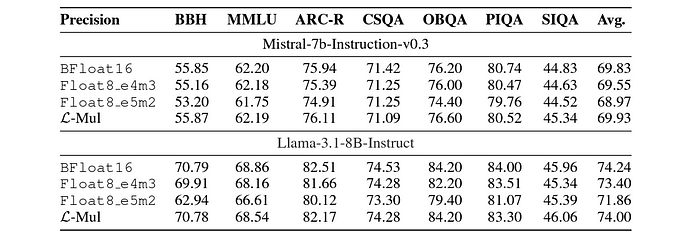
In addition to being energy-efficient, L-Mul offers a high degree of precision. As AI models increasingly adopt 8-bit floating-point numbers (FP8) to reduce memory usage and computational cost, L-Mul shines as a highly effective alternative. FP8 has two common representations: FP8_e4m3 (more precise but with a smaller range) and FP8_e5m2 (less precise but with a larger range).
When compared to FP8, L-Mul outperforms in terms of both precision and computational efficiency. L-Mul offers greater precision than FP8_e4m3 while consuming fewer computational resources than FP8_e5m2, making it a superior alternative in many scenarios.
Real-World Applications of L-Mul
So, how does L-Mul perform in real-world AI tasks? Let’s break it down:
Transformer Models and LLMs
L-Mul can be directly applied to transformer models, particularly in the attention mechanism, where large-scale matrix multiplications occur. This application leads to up to 80% energy savings without sacrificing performance. No fine-tuning is required, which is a significant advantage.
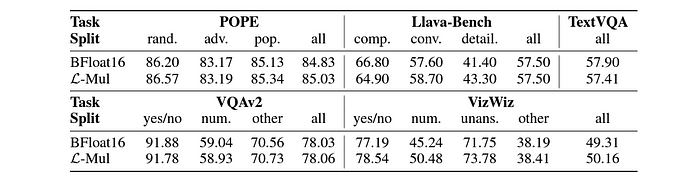
For instance, in large language models (LLMs) like Mistral-7b and Llama-3.1, L-Mul has been shown to outperform FP8 and Bfloat16, common floating-point formats used in transformers, across various benchmarks, including text-based and instruction-following tasks.
GSM8k and Other Benchmarks
When evaluated on specific tasks like GSM8k, which tests models on grade-school math problems, L-Mul consistently outperformed FP8 in terms of accuracy and efficiency. This demonstrates that L-Mul can handle complex mathematical reasoning without requiring excessive computational power.
Visual Question Answering (VQA) and Object Detection
In models like Llava-v1.5–7b, which are used for visual question answering and object hallucination, L-Mul again surpassed FP8 in both accuracy and computational efficiency, reaffirming its utility in multimodal tasks that require a combination of text and image processing.
What the Future Holds for L-Mul
The ability to use L-Mul without fine-tuning and its remarkable energy savings means that it could become a key player in the future of AI development. It’s already clear that this algorithm can enhance the performance of models across multiple domains, from language processing to vision tasks, all while reducing the carbon footprint associated with AI computations.
The results are just as promising in models where fine-tuning is required. When tested on the Gemma2–2b-It model, L-Mul performed at the same level as FP8_e4m3, meaning that even fine-tuned models can maintain their accuracy while becoming more energy-efficient.
The future of AI is bright, but it also needs to be sustainable. With algorithms like L-Mul, we are on the path to creating smarter, faster, and greener AI systems.
Conclusion: A New Era of Energy-Efficient AI
The L-Mul algorithm represents a massive leap forward in developing energy-efficient AI. By replacing expensive floating-point multiplications with simpler integer additions, L-Mul reduces power consumption and improves computational efficiency and model performance across the board.
As AI advances and demands more computational power, solutions like L-Mul will be crucial for ensuring that progress does not come at an unsustainable cost to the environment.
Reference Reading
FAQs
What is L-Mul?
L-Mul stands for Linear-Complexity Multiplication, an algorithm that replaces floating-point multiplications with integer additions to improve energy efficiency in AI models.
How does L-Mul save energy in AI computations?
L-Mul simplifies the costly floating-point operations in neural networks, reducing energy consumption by up to 95% for tensor multiplications and 80% for dot products.
Does L-Mul affect the accuracy of AI models?
No, L-Mul maintains the accuracy of AI models while reducing their energy consumption, making it an ideal choice for energy-efficient AI systems.
Can L-Mul be integrated into existing AI models?
Yes, L-Mul can be seamlessly integrated into existing neural networks without any need for fine-tuning, making it a practical solution for enhancing energy efficiency.
How does L-Mul compare to FP8 in AI tasks?
L-Mul outperforms FP8 in both precision and computational efficiency, making it a superior alternative for many AI applications.
Dogecoin (DOGE) ballooned to $0.4398 on crypto exchange Binance on Tuesday, marking its highest value in over three years.
The Shiba Inu-themed meme coin saw a massive 143.2% rise in the past week, significantly outpacing Bitcoin’s (BTC) 28.2% gain during the same period, as per CoinGecko data.
The rally follows Donald Trump’s election win, boosting optimism for speculative assets such as Dogecoin as traders bet on pro-crypto policies. The challenge now is for DOGE to sustain this momentum while attracting long-term institutional interest.
“With the election overhang now behind us, the rally in crypto markets appears sustainable, buoyed by positive forward signals from the U.S.,” Julien Auchecorne, head of Auros Ventures, told Decrypt. “However, uncertainties remain, particularly around altcoins. We’re closely watching if alts will continue trailing Bitcoin or if they’ll begin to outperform, potentially drawing back retail interest.”
Elon Musk, the self-proclaimed “Dogefather,” fueled even more buzz last month by suggesting that, if appointed by Trump, he could lead a “Department of Government Efficiency” (D.O.G.E.) with the ambitious goal of slashing $2 trillion or more from the federal budget.
The nod to the acronym “D.O.G.E” sent Dogecoin enthusiasts into a frenzy, pushing the coin to new heights. Musk’s endorsement—whether serious or in jest—often leads to spikes in DOGE’s price.
Despite the excitement around Dogecoin, Auchecorne points to some structural challenges in the altcoin market.
“The structure of altcoin launches is under pressure, especially as institutional incentives still heavily favor de-risking at launch and redirecting capital afterward,” he said. “Protocols are now adjusting strategies to retain institutional participation post-launch, taking a more measured approach to their target fully diluted valuations (FDVs).”
For example, Aptos—a network founded by ex-Meta employees—saw rapid sell-offs in 2022 from early institutional investors following its launch, causing steep post-launch declines. In contrast, protocols such as Arbitrum are adopting gradual token releases to retain institutional engagement and achieve more stable growth.
Yet, questions remain about the sustainability of the DOGE rally.
“As this dynamic evolves, we expect capital flows to be selectively drawn to projects that can sustainably balance institutional needs with strong market appeal,” Auchechorne noted.
Amid the retail-driven frenzy, Canada-based Spirit Blockchain Capital has said it wants to mirror MicroStrategy’s Bitcoin accumulation plan to build large reserves of Dogecoin.
Spirit’s approach includes launching exchange-traded products (ETPs) and payment gateways, seeking to institutionalize Dogecoin’s use case beyond its meme origins.
While Dogecoin remains below its all-time high of $0.73 in 2021, the recent surge indicates that it’s far from losing its appeal. The original meme coin now the sixth-largest crypto by market cap, ahead of Circle’s stabelcoin USDC and Ripple (XRP), shows CoinGecko data.
Edited by Stacy Elliott.
Daily Debrief Newsletter
Start every day with the top news stories right now, plus original features, a podcast, videos and more.
In the evolving landscape of artificial intelligence, the development of multimodal models is reshaping how we interact with and process data. One of the most groundbreaking innovations in this space is the Phi-3-Vision-128K-Instruct model—a cutting-edge, open multimodal AI system that integrates visual and textual information. Designed for tasks like Optical Character Recognition (OCR), document extraction, and comprehensive image understanding, Phi-3-Vision-128K-Instruct has the potential to revolutionize document processing, from PDFs to complex charts and diagrams.
In this article, we will explore the model’s architecture, primary applications, and technical setup and explore how it can simplify tasks like AI-driven document extraction, OCR, and PDF parsing.
What is Phi-3-Vision-128K-Instruct?
Phi-3-Vision-128K-Instruct is a state-of-the-art multimodal AI model in the Phi-3 model family. Its key strength lies in its ability to process textual and visual data, making it highly suitable for complex tasks requiring simultaneous interpretation of text and images. With a context length of 128,000 tokens, this model can handle large-scale document processing, from scanned documents to intricate tables and charts.
Trained on 500 billion tokens, including a mix of synthetic and curated real-world data, the Phi-3-Vision-128K-Instruct model utilizes 4.2 billion parameters. Its architecture includes an image encoder, a connector, a projector, and the Phi-3 Mini language model, all working together to create a powerful yet lightweight AI capable of efficiently performing advanced tasks.
Core Applications of Phi-3-Vision-128K-Instruct
Phi-3-Vision-128K-Instruct’s versatility makes it worthwhile across a range of domains. Its key applications include:
1. Document Extraction and OCR
The model excels in transforming images of text, like scanned documents, into editable digital formats. Whether it’s a simple PDF or a complex layout with tables and charts, Phi-3-Vision-128K-Instruct can accurately extract the content, making it a valuable tool for digitizing and automating document workflows.
2. General Image Understanding
Beyond text, the model can parse visual content, recognize objects, interpret scenes, and extract useful information from images. This ability makes it suitable for a wide array of image-processing tasks.
3. Efficiency in Memory and Compute-Constrained Environments
Phi-3-Vision-128K-Instruct is designed to work efficiently in environments with limited computational resources, ensuring high performance without excessive demands on memory or processing power.
4. Real-Time Applications
The model can reduce latency, making it an excellent choice for real-time applications, such as live data feeds, chat-based assistants, and streaming content analysis.
Getting Started with Phi-3-Vision-128K-Instruct
To harness the power of this model, you’ll need to set up your development environment. Phi-3-Vision-128K-Instruct is integrated into the Hugging Face transformers library, version 4.40.2. Make sure your environment has the following packages installed:
phi_model = Phi3VisionModel()
image_url = “https://example.com/sample_image.png”
prompt = “Extract the data in json format.”
response = phi_model.predict(image_url, prompt)
print(“Response:”, response)
Testing OCR Capabilities with Real-World Documents
We ran experiments with various types of scanned documents to test the model’s OCR capabilities. For example, we used a scanned Utopian passport and a Dutch passport, each with different levels of clarity and complexity.
Example 1: Utopian Passport
The model could extract detailed text from a high-quality image, including name, nationality, and passport number.
Output:
{
“Surname”: “ERIKSSON”,
“Given names”: “ANNA MARIA”,
“Passport Number”: “L898902C3”,
“Date of Birth”: “12 AUG 74”,
“Nationality”: “UTOPIAN”,
“Date of Issue”: “16 APR 07”,
“Date of Expiry”: “15 APR 12”
}
Example 2: Dutch Passport
The model handled this well-structured document effortlessly, extracting all the necessary details accurately.
The Architecture and Training Behind Phi-3-Vision-128K-Instruct
Phi-3-Vision-128K-Instruct stands out because it can process long-form content thanks to its extensive context window of 128,000 tokens. It combines a robust image encoder with a high-performing language model, enabling seamless visual and textual data integration.
The model was trained on a dataset that included both synthetic and real-world data, focusing on a wide range of tasks such as mathematical reasoning, common sense, and general knowledge. This versatility makes it ideal for a variety of real-world applications.
Performance Benchmarks
Phi-3-Vision-128K-Instruct has achieved impressive results on several benchmarks, particularly in multimodal tasks. Some of its highlights include:
The model scored 81.4% on the ChartQA benchmark and 76.7% on AI2D, making it one of the top performers in these categories.
Why AI-Powered OCR Matters for Businesses
AI-driven document extraction and OCR are transformative for businesses. By automating tasks such as PDF parsing, invoice processing, and data entry, businesses can streamline operations, save time, and reduce errors. Models like Phi-3-Vision-128K-Instruct are indispensable tools for digitizing physical records, automating workflows, and improving productivity.
Responsible AI and Safety Considerations
While Phi-3-Vision-128K-Instruct is a powerful tool, it is essential to be mindful of its limitations. The model may produce biased or inaccurate results, especially in sensitive areas such as healthcare or legal contexts. Developers should implement additional safety measures, like verification layers when using the model for high-stakes applications.
Future Directions: Fine-Tuning the Model
Phi-3-Vision-128K-Instruct supports fine-tuning, allowing developers to adapt the model for specific tasks, such as enhanced OCR or specialized document classification. The Phi-3 Cookbook provides fine-tuning recipes, making extending the model’s capabilities for particular use cases easy.
Conclusion
Phi-3-Vision-128K-Instruct represents the next leap forward in AI-powered document processing. With its sophisticated architecture and powerful OCR capabilities, it is poised to revolutionize the way we handle document extraction, image understanding, and multimodal data processing.
As AI advances, models like Phi-3-Vision-128K-Instruct are leading the charge in making document processing more efficient, accurate, and accessible. The future of AI-powered OCR and document extraction is bright, and this model is at the forefront of that transformation.
FAQs
1. What is the main advantage of Phi-3-Vision-128K-Instruct in OCR? Phi-3-Vision-128K-Instruct can process both text and images simultaneously, making it highly effective for complex document extraction tasks like OCR with tables and charts.
2. Can Phi-3-Vision-128K-Instruct handle real-time applications? Yes, it is optimized for low-latency tasks, making it suitable for real-time applications like live data feeds and chat assistants.
3. Is fine-tuning supported by Phi-3-Vision-128K-Instruct? Absolutely. The model supports fine-tuning, allowing it to be customized for specific tasks such as document classification or improved OCR accuracy.
4. How does the model perform with complex documents? The model has been tested on benchmarks like ChartQA and AI2D, where it demonstrated strong performance in understanding and extracting data from complex documents.
5. What are the responsible use considerations for this model? Developers should be aware of potential biases and limitations, particularly in high-risk applications such as healthcare or legal advice. Additional verification and filtering layers are recommended.
Decentralized finance (DeFi) has come a long way since its early days, evolving from simple cryptocurrency exchanges to complex ecosystems offering everything from lending and borrowing to insurance and decentralized exchanges. In essence, DeFi aims to replicate traditional financial services but with a twist, using decentralized technologies to eliminate middlemen, lower costs, and increase accessibility.
In this blog post, we’ll take a deep dive into DeFi’s potential future, from key trends and technological innovations to a long-term outlook based on well-researched data.
Trends and Predictions in DeFi:
Source: medium.com
Let’s start with some of the most anticipated trends in the DeFi space. These are based on current developments and expert predictions, giving us a sense of how DeFi may evolve in the coming years.
1. Expansion of Use Cases for DeFi:
DeFi began with basic functions such as lending and borrowing but is now entering fields previously untouched by blockchain. That includes insurance, asset management, and even synthetic assets that replicate the performance of stocks or commodities. In the next decade, DeFi ventures will likely enter into real estate, supply chain, and even social impact.
Why does this matter? One reason is that it would expand the user base for DeFi beyond tech enthusiastic people and crypto traders. The needs in real-world finance are indeed complex, and by answering them, DeFi could become relevant to millions of users. For example, microloans for developing countries or decentralized insurance products may offer solutions to millions.
2. Regulation and Compliance:
DeFi operates in a largely unregulated space, which has led to both rapid innovation and significant risks. However, regulators worldwide are beginning to recognize DeFi’s growth and influence, leading to a push for regulations to protect consumers. In the coming years, we’ll likely see frameworks that allow DeFi protocols to operate with more transparency and accountability.
This will be the trend toward compliance for DeFi to boom. It will make an environment safer for users and with increased regulatory clarity, the institutions will feel confident enough to participate in the DeFi markets. For example, the European markets in Crypto-Assets regulation might be the model for other jurisdictions.
3. Interoperability between blockchain networks:
Cross-chain compatibility is another exciting development that will shape the future of DeFi. Today, most DeFi platforms are still built on Ethereum, but new blockchains are constantly being developed and gaining traction, such as Binance Smart Chain, Polkadot, and Solana. This increases the demand for interoperability between such networks.
Interoperability means a user can move assets without barriers between blockchains and pay low fees. That enhances liquidity, increases access for users, and makes much more coherent a DeFi system. We could see projects focused on “bridge” technologies that enable cross-chain transactions with minimal friction.
4. Institutional Investment in DeFi:
As DeFi evolves, financial institutions are now recognizing its potential. In 2021, several investment firms and banks have shown an interest in decentralized protocols. It is a trend likely to increase going forward. The arrival of institutional investors may just give DeFi an even stronger foundation through capital, credibility, and stability within the ecosystem. This type of institutional involvement may lead to hybrid DeFi models where traditional financial institutions utilize DeFi technology for decentralized services alongside their already existing services. By probably around 2030, we shall witness the era where institutions offer banking services but of the DeFi kind regarding security and backing.
Technological Advancements Shaping DeFi:
The evolution of DeFi is closely tied to advancements in blockchain technology and complementary technologies. Let’s explore some innovations that could define DeFi’s trajectory.
1. Layer 2 Scaling Solutions:
Source: whiteboardcrypto.com
One of the major constraints of DeFi was its scalability limitation, particularly on Ethereum. Layer two scaling solutions, such as Optimism and Arbitrum, aim to process more transactions outside of the original blockchain while being less resource-intensive, faster, and cheaper. As a whole, such optimizations make a lot of applications in the DeFi field much more user-friendly and more accessible than before.
If the Layer 2 solutions become successful, they will remove one of the biggest barriers to mainstream adoption in DeFi. Lower fees and faster transactions mean more users, which, in turn, means a healthier DeFi ecosystem. Expect Layer 2 adoption to continue expanding, especially as Ethereum transitions to its fully upgraded version.
2. AI Integration:
Source: softwebsolutions.com
AI will be in the future of DeFi. Use of AI will determine how protocols manage risks, enhance user experience, and provide personalized financial products. Imagine a DeFi app that uses AI for predicting market trends, optimizing yields, or even managing collateral requirements, all in real-time.
AI-driven DeFi tools will enable even non-experts to make informed decisions and participate in DeFi markets, thereby expanding DeFi’s reach. Future developments may include DeFi applications that utilize AI to automatically shift funds between lending platforms to maximize returns.
3. DAOs:
Source: olliv.com
DAOs are community-governed structures that govern DeFi protocols. Token holders here vote on significant decisions taken. With maturity, in all likelihood, DAOs will play a major say in the future of DeFi. For instance, DAOs can introduce fees or change them, do protocol upgrades, and even say which assets are supported in a platform.
DAOs allow people to have ownership over a particular project and ensure decisions are in line with the interests of the community. In the coming years, most of the DeFi projects would shift towards DAO models by allowing their users to take direct control over the operational processes within the platform.
Long-Term Outlook for Decentralized Finance:
Let’s examine some of the long-term impacts DeFi might have on finance, from global inclusion to green initiatives.
1. Mainstream Adoption and Global Financial Inclusion:
With billions of unbanked individuals worldwide, DeFi could drive unprecedented levels of financial inclusion. By allowing anyone with internet access to participate in financial services, DeFi could create a more inclusive economy. Mobile adoption in developing regions, combined with blockchain technology, could be a game-changer for underbanked populations.
2. Integration with Central Bank Digital Currencies (CBDCs):
CBDCs are digital currencies issued by governments. As this gain traction, we could see them become interoperable with DeFi systems, blending traditional finance and DeFi in innovative ways. Countries like China and several European nations have been exploring CBDCs, and their integration with DeFi could bridge the gap between decentralized and traditional finance, making DeFi more accessible.
Growth and Evolution of DeFi: A Data-Driven Perspective
Let’s look out the growth and evolution of DeFi.
Historical Data and Market Growth:
In 2020, TVL in DeFi was less than $1 billion, but by 2022, it had surpassed $200 billion. This growth demonstrates DeFi’s rapid expansion and the increasing capital flow into decentralized platforms.
User Growth and Market Penetration:
Another valuable data point is user adoption. In 2021, active DeFi wallet addresses grew by over 600%, showing interest in decentralized financial services.
The future of DeFi holds immense promise, but it also faces challenges, including regulation, security, and scalability. With continued advancements in technology and supportive regulatory frameworks, DeFi could redefine finance as we know it. The key question remains: will DeFi truly become a mainstream financial solution, or will it stay on the periphery?
What’s your take on DeFi’s future? Let us know in the comments! Subscribe to our newsletter for the latest updates, trends, and insights—let’s navigate the world of Web3 together!
Famous artwork created for Jazz Joy and Roy Global Radio by Kathryn Diane Gray
When Roy O’dell Gray worked morning drive on now-defunct WNWZ News Radio in Richmond, Virginia many moons before founding Jazz Joy and Roy Global Radio in 2007, he got a phone call from ‘Soul Train’ announcer Sid McCoy, thanking Gray for playing one of McCoy’s syndicated programs. McCoy’s gesture is the main reason that Gray tries to make a public “thank you” statement when independent websites drive new listeners to JazzJoyandRoy.com.
Aovotice.cz features a searchable “Jazz Joy and Roy” article by journalist Martin Kozminsky that has won Gray’s gratitude.
Gray says, “If a Sid McCoy was able to stop what he was doing to thank me, surely I can hit the multitasking pause button on giving my wife Kathy a four hour full-body massage under a warm blanket with one hand while running the over one hundred JazzJoyandRoy.com sister sites that power both the Jazz Joy and Roy Global Radio Network and the Bible Ball Inc charity with the other, all while doing thousands a multiplication math problems in my head to practice remaining clear-eyed during competitive tennis matches…to acknowledge Aovotice.cz and their readers in The Czech Republic and around the globe.”
In Gray’s eyes, “Global broadcasting is a tough business in which joy is fueled by sometimes surprising listener subjectivity, and you can bet your proverbial bottom dollar that, for every listener that writes to Request@JazzJoyandRoy.com to tell you a song is sensational, a little due diligence can find 5 listeners who will tell you the song is the worse thing since unsliced bread. With Aovotice.cz, the subjective ball bounced in our favor.”
Jazz Joy and Roy Global RadioMarital Relations Music Radio JJ&RComedy Song Global Radio JJ&RModern Country Global Radio JJ&RClassic Country Global Radio JJ&RChristian Global Radio JJ&RRoll The Rock Radio JJ&RCrossover Jazz Global Radio JJ&R10334 W. Peoria Ave.Sun City, AZ 85351Press Contact: Barbie BensonBarbieBenson@JazzJoyandRoy.com
Underwritten by Bible Ball Inc™, a nonprofit organization, Jazz Joy and Roy Global Radio’s JazzJoyandRoy.com operates over 100 sister sites and 7 global music radio stations, plus bonus stations, which support Bible Ball Inc initiatives to train volunteer Bible Ball Inc staff to play competitive amateur sports games like tennis and golf against amateur athletes who are awardedfree Bibles, sports lessons, tees, hats and a free 15 minute onsite post-game Bible study and refreshments…for participating. For more information visit BibleBall.org. Jazz Joy and Roy Global Radio, the network credited, along with The View and Stevie Wonder, with the rise to superstardom of singer/actor Andra Day of “Rise Up” and “Billie Holiday” fame…is always looking for your help tracking down the following types of stories and more:
1. A portrait of a blind, bald author who has written extensively about doing business in Norway, Singapore or Japan.2. A day in the life of an irrepressible heart attack survivor who almost died, but never stops pursuing excellence in the fashionable socks industry.3. A look into the life of an elderly pastor who owns over 80 pets and is on a crusade to reduce Church gossip globally.4. A profile of an extremely tall person who has no arms, but owns multiple corporations and manages to hug scores of people with compassion.5. A full feature story on a business that employs fascinating family members in 40 or more countries..6. An interview with an individual who has collected more than a billion written prayer requests.
About Web3Wire Web3Wire – Information, news, press releases, events and research articles about Web3, Metaverse, Blockchain, Artificial Intelligence, Cryptocurrencies, Decentralized Finance, NFTs and Gaming. Visit Web3Wire for Web3 News and Events, Block3Wire for the latest Blockchain news and Meta3Wire to stay updated with Metaverse News.
In brief
Gemini Titan has secured a CFTC Designated Contract Market license, clearing the exchange to launch regulated prediction markets in the United States.
Gemini's...