Automation is now within everyone’s reach. From summarizing emails and generating insights to handling data and automating repetitive tasks, some tools let you run these processes directly on your PC without writing a single line of code. Leveraging local large language models (LLMs) alongside free, open-source, no-code tools, you can build powerful automation while keeping your data private and secure. This guide covers everything you need to know to get started.
The Shift Toward Local Automation
Over the past year, open-source AI models have greatly improved, allowing users to run capable models locally without relying on cloud-based solutions. Running tasks locally not only keeps your data private but also removes the need to send data to third-party servers. Previously, cloud-based automations were popular, but with privacy concerns and the evolution of local models, many are revisiting these processes to bring them in-house. While local models may not yet match the complexity of advanced models like GPT-4, they can handle most basic automation tasks, including summarization, extraction, and classification.
Key Tools for Local Automation
Setting up local automation requires just two main tools:
n8n – A free, open-source workflow automation tool similar to Zapier and Make.com.
LM Studio – A platform to run LLMs locally, allowing you to harness AI on your PC.
Using these tools together, you can build automated workflows and manage information in a streamlined way, whether it’s organizing emails, creating structured datasets, or even summarizing text.
Getting Started with n8n for Workflow Automation
n8n enables you to design workflows that automate tasks between apps and services, similar to what you might do with Zapier. However, n8n runs locally on your system, giving you control over your data. Here’s how to get started:
Install Node.js: First, download and install Node.js from its official website. This will provide the environment necessary to run n8n.
Set Up n8n: Open the terminal (or Command Prompt on Windows), and type in npx n8n to download and install n8n.
Access n8n Dashboard: Once installed, go to http://localhost:5678 in your browser. This is your n8n dashboard, where you’ll create and 1manage workflows.
Running Local LLMs Using LM Studio
LLMs enable your PC to understand and generate text based on prompts, making them incredibly useful for various tasks. LM Studio simplifies the process of running these models locally without needing extensive technical knowledge.
Choosing the Right Model
There are two recommended models for local automation:
Phi-2: This small, efficient model is ideal for older or less powerful PCs and laptops.
Mistral-7B: A more powerful model suited for gaming PCs or workstations, providing better consistency.
When choosing a model, you’ll encounter different quantization levels like Q4 and Q8. Quantization reduces model size by simplifying the data, making it easier to run on limited hardware. Here’s a general guide to help you choose:
ModelQuantizationRecommended Hardware
Phi-2Q4_K_MOld PC/Laptop
Phi-2Q8Regular PC/Laptop
Mistral-7BQ4_K_MGaming PC
Mistral-7BQ8High-End Gaming PC/Workstation
Running and Testing Models in LM Studio
After choosing your model, download it from LM Studio. The model will appear on the dashboard once loaded, and you can test it by chatting directly with it. To activate the automation capabilities, go to the Server tab in LM Studio and select Start Server.
Building Your First Automation with n8n and LM Studio
With both tools ready, you’re set to build a basic automation. In this example, let’s automate email summarization to provide a neat overview of your inbox, which can be especially helpful for prioritizing responses and managing tasks.
Creating an Email Summarization Workflow
Open n8n Dashboard: Navigate to http://localhost:5678 and create a new workflow.
Import Workflow File: If you’re using a pre-built email summarizer workflow, simply import it into n8n by selecting Import from File at the top right.
Set Email Information: Input the details of your email provider. This information can usually be found within your email client settings.
Configure CSV File Storage: Specify a location and file name for the output CSV file. This is where your summarized email data will be saved.
Once configured, the workflow will pull in emails, summarize the content, and store it in a CSV file that you can access and organize as needed.
Expanding Automation to Other Use Cases
Beyond email summarization, n8n and LM Studio allow for an impressive range of automation possibilities. Here are a few ideas:
Batch Processing CSV Data
Suppose you have a CSV file with product descriptions, pricing, or user information. You can set up n8n to process each row and prompt the language model to generate or extract information based on specific columns. For example:
Generate Product Descriptions: Use column data to create catchy product descriptions that include features or target audiences.
Extract Information: Pull specific names, dates, or details from a column and insert them into your desired format.
Batch processing enables you to perform time-intensive tasks quickly, which can be a game-changer for tasks that would otherwise require hours of manual work.
Setting Up Prompts and Outputs for Different Tasks
In n8n’s Set Prompt and Model Settings node, you can customize prompts and outputs to align with your task goals. For example, you might set up a prompt that asks the model to extract a key name or date from a text passage, format it as JSON, and store it in a way that’s easy to filter and analyze later. This customization lets you adapt workflows for countless applications.
Practical Tips for Using n8n and LM Studio Together
Start Simple: Begin with basic workflows to familiarize yourself with the n8n and LM Studio interface.
Use Quantization for Efficiency: If your PC struggles to run certain models, try using a lower quantization level to optimize performance.
Test and Adjust Models: Experiment with different model settings to find the optimal balance between quality and speed for your tasks.
Debug with ChatGPT: If you encounter setup issues, ChatGPT or other AI tools can assist with debugging and code snippets, especially since n8n uses JavaScript.
Conclusion
With the power of n8n and LM Studio, you can transform your PC into an automation powerhouse. From organizing emails to batch-processing data and generating descriptions, these tools allow you to create custom workflows while keeping your data private. While there’s a learning curve, starting with simpler tasks and expanding gradually can make automation accessible and rewarding. The best part? You can accomplish all of this without needing to be a programming expert.
FAQs
What hardware do I need to run local LLMs?
Local LLMs can run on a range of devices. Smaller models like Phi-2 work on standard PCs and even older laptops, while models like Mistral-7B require more powerful setups like gaming PCs or workstations.
Is coding required to use n8n and LM Studio?
No, both n8n and LM Studio are designed to be no-code tools. While some understanding of basic logic helps, you can automate tasks without any programming skills.
How secure is local automation compared to cloud-based options? Local automation keeps your data entirely within your system, making it much more secure than cloud-based tools that require data to be sent to external servers.
Can I use these tools to automate my business processes? Absolutely. You can automate tasks like generating reports, summarizing emails, and processing data, which can significantly enhance productivity for small businesses.
What types of tasks can I automate with n8n and LM Studio?
These tools are versatile and can automate tasks like email summarization, data extraction, classification, and even content generation—allowing you to streamline both personal and business processes efficiently.
The metaverse is no longer a sci-fi concept but a rapidly evolving digital economy that intertwines immersive experiences, decentralized platforms, and innovative technologies. For investors, it’s a dynamic world of opportunity and potential growth. In this post, we’ll dive into leading companies with major investments in the metaverse, analyze their stock performances, and help you assess potential investment strategies for navigating this exciting virtual landscape.
Top Metaverse Stock Companies Leading the Revolution:
Top metaverse stock companies are:
1. Meta Platforms (formerly Facebook):
Picture Courtesy: androidheadlines.com
Meta Platforms is the tech giant that sparked widespread interest in the metaverse when it rebranded from Facebook in 2021. Meta’s ambition is to create a metaverse that combines social interactions, gaming, work, and commerce into an immersive 3D environment.
Key Initiatives:
Horizon Worlds and Horizon Workrooms: Meta’s social VR platform where users interact using avatars in a variety of virtual settings, whether for leisure or productivity.
Hardware Focus: Meta owns Oculus, a leading virtual reality headset manufacturer, and continues to invest in AR and VR hardware, such as its Quest headsets.
Reality Labs: Meta’s division for metaverse and VR development has been heavily funded, with investments in AI, immersive experiences, and developer tools.
Investment Insights:
Opportunities: Meta’s heavy spending on developing the metaverse positions it as a leader but also as a risky investment given its enormous R&D costs. If it succeeds, Meta could set industry standards.
Risks: Meta’s challenges include scrutiny from regulators over data privacy and high operating expenses.
2. Microsoft:
Picture Courtesy: ThoughtCo
Microsoft’s metaverse ambitions focus on merging the digital and physical worlds through gaming, enterprise solutions, and productivity software.
Key Initiatives:
Acquisition of Activision Blizzard: This acquisition aims to strengthen Microsoft’s gaming presence within the metaverse. With games like “World of Warcraft” and “Call of Duty,” Microsoft can use these properties to extend virtual worlds.
Mesh for Microsoft Teams: Mesh integrates mixed-reality capabilities into the popular Microsoft Teams, allowing employees to meet in 3D spaces using avatars, making it useful for corporate collaborations in the metaverse.
Azure Cloud Infrastructure: Microsoft Azure provides critical backend services to power metaverse applications and platforms.
Investment Insights:
Opportunities: Microsoft’s dual approach to gaming and enterprise gives it diversified exposure to the metaverse. Its cloud infrastructure and productivity software provide a competitive edge.
Risks: Heavy competition in gaming and challenges in integrating new acquisitions could impact Microsoft’s success.
3. Nvidia:
Picture Courtesy: investopedia.com
Nvidia provides high-performance GPUs essential for powering immersive 3D graphics, AI-driven applications, and simulations in the metaverse.
Key Initiatives:
Omniverse Platform: Nvidia’s Omniverse is a collaboration and simulation platform that allows creators, developers, and businesses to create immersive 3D worlds. The platform supports everything from 3D content design to real-time simulations.
Graphics Processing Units (GPUs): Nvidia’s GPUs are used extensively for VR/AR applications and high-performance gaming, making them a foundational element for building metaverse environments.
Investment Insights:
Opportunities: As the need for advanced computing power grows, Nvidia stands to benefit greatly. Its technology is critical for building, rendering, and expanding virtual worlds.
Risks: High competition in the semiconductor market and reliance on hardware sales could pose challenges.
4. Apple:
Picture Courtesy: blogspot.com
Apple’s approach to the metaverse focuses on augmented reality (AR) and hardware integration rather than creating a dedicated metaverse platform.
Key Initiatives:
AR Glasses (Rumored): Apple is reportedly developing lightweight AR glasses that could transform how users interact with the digital world. The focus on blending virtual elements with the real world sets it apart.
ARKit for Developers: Apple’s ARKit allows developers to build augmented reality applications, creating a broad base for AR content on iOS devices.
Investment Insights:
Opportunities: Apple’s emphasis on premium design and user experience could create highly immersive and user-friendly metaverse experiences.
Risks: Delayed product launches or limited adoption of new AR devices may impact growth.
5. Roblox:
Picture Courtesy: roblox.com
Roblox is a platform where users create, share, and explore games and experiences built by other users. It’s often described as a proto-metaverse due to its user-generated content and virtual economy.
Key Initiatives:
User-Generated Content (UGC): Roblox enables creators to monetize their games and experiences, driving a strong creator economy.
Virtual Economy: Roblox’s in-game currency (Robux) and marketplaces allow users to buy and sell digital items, making it a functioning virtual economy.
Investment Insights:
Opportunities: Roblox’s large user base and focus on community-driven content position it for long-term growth in the metaverse.
Risks: Challenges include retaining users, keeping content fresh, and ensuring a safe environment for younger audiences.
6. Unity Technologies:
Picture Courtesy: assetstore.unity.com
Unity is a leader in providing tools to create and operate interactive, real-time 3D (RT3D) content. Its software powers a large share of the world’s 3D content, making it a crucial player in metaverse development.
Key Initiatives:
Game and App Development: Unity’s game engine is used for creating immersive experiences across industries.
Cross-Industry Expansion: Unity is diversifying into non-gaming sectors, including architecture, automotive, and film.
Investment Insights:
Opportunities: Unity’s dominance in 3D content creation positions it as a backbone of metaverse content creation.
Risks: High competition from Unreal Engine and the challenge of scaling its platform could impact growth.
7. Tencent:
Picture Courtesy: wsj.com
Tencent is a major player in gaming, social media, and digital infrastructure, with significant metaverse ambitions.
Key Initiatives:
Gaming Focus: Tencent owns stakes in companies like Epic Games (creator of Fortnite), making it influential in shaping gaming metaverses.
Social and Commerce Integration: Tencent’s WeChat platform could serve as a hub for virtual commerce and social interactions in the metaverse.
Investment Insights:
Opportunities: Tencent’s diversified portfolio and partnerships with global tech firms position it as a metaverse leader in Asia.
Risks: Regulatory scrutiny in China poses challenges to its growth and operational freedom.
8. Alphabet (Google):
Picture Courtesy: napavalleyregister.com
Google’s approach to the metaverse is centered around AR capabilities, AI integration, and immersive experiences on mobile and web platforms.
Key Initiatives:
ARCore Development: ARCore is Google’s platform for building AR experiences, making it a key player in the AR metaverse space.
Immersive Content Initiatives: Google’s focus on content, cloud computing, and AI-backed features creates a versatile base for the metaverse.
Investment Insights:
Opportunities: Alphabet’s technological resources and cloud infrastructure offer strong growth potential in AR and VR-driven experiences.
Risks: Alphabet’s metaverse growth may lag due to its more measured approach compared to competitors.
9. Amazon:
Picture Courtesy: wallsdesk.com
Amazon is working on immersive experiences through AR and VR for shopping, while its AWS cloud platform supports various metaverse services.
Key Initiatives:
Immersive Shopping: Amazon is experimenting with AR features for its e-commerce business, enhancing customer experiences.
AWS Support: As a leading provider of cloud infrastructure, AWS supports metaverse companies with scalable solutions.
Investment Insights:
Opportunities: Amazon’s e-commerce and cloud strengths position it well to capitalize on both consumer-facing and infrastructure elements of the metaverse.
Risks: Amazon’s success will depend on its ability to stay competitive in AR/VR and deliver unique experiences.
Factors Influencing Stock Prices:
Picture Courtesy: stockamj.com
Based on the analysis, the factors influencing metaverse stock prices revolve around three main areas: technology advancements, consumer adoption rates, and the competitive landscape.
1. Technology Advancements:
AR/VR Hardware Progress:
The success of the metaverse largely hinges on improvements in augmented and virtual reality hardware. Companies like Meta (Quest headsets) and Apple (AR glasses) are investing heavily in wearable technologies, aiming to create immersive experiences that appeal to consumers and businesses. As hardware becomes more affordable, lightweight, and powerful, it is expected to drive greater adoption, directly influencing stock prices.
AI Integration:
The role of AI in enhancing user experiences, such as personalized virtual interactions and intelligent content moderation, is growing. Companies like Nvidia have a head start with their AI-powered solutions for graphics and simulations in the metaverse. AI advancements not only improve product offerings but also enable scalable, adaptive ecosystems.
Content Creation and Interoperability:
Unity Technologies and other platforms enabling real-time 3D content creation have become crucial for developers and creators in the metaverse. Enabling interoperability—allowing digital assets to move across different virtual spaces seamlessly—is a key challenge and opportunity.
2. Consumer Adoption Rates:
User Base Growth and Engagement:
For many companies, the value of the metaverse lies in the size and activity of their user bases. Roblox, for example, relies heavily on a growing community of creators and users to generate revenue. Higher engagement rates with platforms lead to more data-driven insights, refined content, and more advertising opportunities.
Cultural Acceptance and Practicality:
The broader public’s willingness to adopt metaverse experiences plays a crucial role. While younger demographics may embrace platforms like Roblox and immersive games, enterprise adoption (e.g., Microsoft’s Mesh for Teams) is essential for sustainable, widespread growth.
Barriers to Adoption:
High costs, privacy concerns, and clunky user interfaces can deter potential users. Companies that can mitigate these challenges through accessibility, affordability, and seamless experiences gain a competitive advantage.
3. Competitive Landscape:
Market Competition and Innovation:
The metaverse sector is fiercely competitive, with major players like Meta, Microsoft, and emerging platforms vying for dominance. Companies are continuously innovating to differentiate themselves, offering unique virtual worlds, better graphics, or more social features. The intensity of competition can both stimulate growth and pose risks, especially for smaller players.
Partnerships and Ecosystem Growth:
Strategic alliances among tech firms, entertainment brands, and content creators help establish strong ecosystems that draw users. For instance, Microsoft’s acquisition of gaming studios and partnerships with enterprise customers are aimed at expanding its influence within the metaverse space.
Global and Regional Competition:
Regional metaverse trends and regulations (like China’s metaverse restrictions) can shape how competitive dynamics evolve. Companies like Tencent face unique regulatory challenges, impact their global strategies.
Key Considerations for Metaverse Investors:
Here are some important points that you need to keep in mind before investing:
1. Technological Innovation:
Focus on companies leading in AR/VR hardware, AI integration, and content creation. Technological breakthroughs can drive growth and boost stock prices.
2. User Adoption and Engagement:
Look for platforms with strong, growing user bases and high engagement levels. Successful adoption is key to long-term profitability.
3. Competition and Market Position:
Invest in companies with a strong competitive edge, through partnerships, unique offerings, or market leadership. The ability to stand out in a crowded market is crucial.
4. Regulatory Landscape:
Be aware of regulatory risks, especially in regions with stricter regulations, which may impact company operations and growth potential.
5. Diversification:
Since the metaverse is still evolving, diversify investments across different sectors (gaming, social platforms, enterprise solutions) to manage risk and tap into various growth opportunities.
transformative force in technology and business. With advancements in AR/VR, growing user engagement, and fierce competition, there are both significant opportunities and risks for investors.
So, what do you think? Do you believe the metaverse will be the next big investment boom, or are you concerned about its long-term sustainability? Which companies do you see emerging as leaders in the metaverse space?
We’d love to hear your thoughts! Drop a comment below and share your insights. And for the latest trends, analysis, and investment tips on the metaverse, make sure to subscribe to our newsletter. Stay updated with all the critical developments and stay ahead in this exciting new frontier!
Large Language Models (LLMs) like GPT-4, BERT, and other transformer-based models are reshaping AI applications, driving significant advancements across fields. However, running these models requires substantial computational resources, especially for inference tasks. Choosing the right GPU is crucial for optimizing performance, controlling costs, and ensuring scalability for any AI project—whether it’s a small-scale endeavor, a research-focused setup, or a full-scale production environment.
In this article, we’ll examine the best NVIDIA GPUs for LLM inference and compare them based on essential specifications such as CUDA cores, Tensor cores, VRAM, clock speed, and cost. This guide will help you select the ideal GPU for your needs, ensuring you balance performance and budget best.
Understanding Key GPU Specifications for LLM Inference
Before we analyze the top NVIDIA GPUs, let’s review the core specifications that determine a GPU’s suitability for LLM inference tasks. Here’s a breakdown of the essential factors:
CUDA Cores: The primary units responsible for parallel processing within a GPU. Higher CUDA core counts improve the GPU’s ability to handle large, complex computations in LLM inference.
Tensor Cores: Tensor cores are specially designed for matrix operations, which are crucial for neural network calculations. A higher Tensor core count generally enhances model performance, especially for large-scale deep learning tasks.
VRAM (Video RAM): VRAM, or memory, stores the model and data during inference. More VRAM allows for efficient handling of larger models and datasets.
Clock Frequency: Clock speed, measured in MHz, indicates the rate at which a GPU performs computations. Higher frequencies translate to faster processing speeds.
Price: The cost of a GPU is always a key consideration, especially for teams or individuals working within a budget. It’s essential to find a balance between performance and affordability.
Top NVIDIA GPUs for LLM Inference: An Overview
When it comes to selecting GPUs for LLM inference, NVIDIA’s offerings are extensive, from high-end, enterprise-grade models to more budget-friendly options. Below are the top GPUs categorized by performance and price, with the highest-ranked options listed first.
1. NVIDIA H100: The Premium Choice for High-Performance LLM Inference
The NVIDIA H100 is the top-tier GPU currently available for LLM inference tasks. Built on the advanced Hopper architecture, the H100 is designed for enterprises and large research labs requiring top-notch performance. Here’s why it stands out:
Tensor Cores & CUDA Cores: It features a record-breaking number of Tensor cores, maximizing its capacity for AI-related computations. The CUDA core count is also the highest in NVIDIA’s lineup.
Memory: With 80 GB of HBM3 memory, it can manage even the largest language models, such as GPT-4, in production.
Performance: The H100’s clock speed and architecture make it one of the fastest GPUs available, ensuring minimal latency in LLM inference.
Best For: Enterprise use, large-scale production deployments, and advanced research laboratories that require the highest performance without compromise.
Cons: The H100’s capabilities come at a steep cost, making it an investment best suited for entities with substantial budgets.
2. NVIDIA A100: High Performance with Cost Flexibility
The NVIDIA A100 is another top performer and is slightly more budget-friendly than the H100. Based on the Ampere architecture, it offers high processing power and memory capacity for LLM tasks.
Tensor Cores & CUDA Cores: It has an impressive Tensor core count and is optimized for AI and LLM performance.
Memory Options: The 40 GB and 80 GB HBM2e memory variants are available, allowing users to choose based on model size and requirements.
Performance: Ideal for high-throughput inference, the A100 easily handles demanding models, providing a balance between speed and cost.
Best For: Large research teams and organizations needing strong performance with a more manageable cost.
Cons: Although more affordable than the H100, the A100 still carries a premium price.
3. NVIDIA L40: The Balanced Performer
The NVIDIA L40, based on the Ada Lovelace architecture, is a versatile option for those needing robust performance without the extreme costs of the H100 or A100.
Tensor Cores & CUDA Cores: High core counts allow it to manage complex models effectively, though it’s not as fast as the H100 or A100.
Memory: With 48 GB of GDDR6 memory, it’s well-suited for substantial model sizes and multiple inference tasks simultaneously.
Best For: Teams needing high performance at a lower cost than top-tier models.
Cons: Its GDDR6 memory type is less efficient than HBM2e or HBM3, which can impact performance in highly demanding scenarios.
4. NVIDIA A40: Efficient Performance at a Moderate Price
The NVIDIA A40 offers solid LLM inference capabilities with a more modest price tag, making it suitable for high-performance tasks in budget-conscious settings.
Tensor Cores & CUDA Cores: Equipped with 4,608 Tensor cores, it delivers high performance, albeit below the A100.
Memory: With 48 GB of GDDR6 memory, it can handle mid-to-large-sized models.
Best For: Research environments and mid-sized production applications where performance is essential but budget constraints are tighter.
Cons: It lacks the cutting-edge architecture of the H100 and A100, which limits its potential for extreme high-performance demands.
5. NVIDIA V100: Legacy Power for Budget-Conscious High-Performance
The NVIDIA V100 remains a strong contender despite being based on the older Volta architecture. It’s a great option for those needing powerful performance without investing in the latest technology.
Tensor Cores & CUDA Cores: While fewer than newer models, its core counts are still robust enough for serious LLM inference tasks.
Memory: Available in 16 GB and 32 GB HBM2 memory options, sufficient for many LLM projects.
Best For: Smaller production setups, academic research, and lower-budget deployments.
Cons: It’s less power-efficient and slower than newer models, making it best suited for those prioritizing budget over cutting-edge performance.
Budget-Friendly NVIDIA GPU Options for LLM Inference
NVIDIA’s consumer-grade GPUs offer a powerful alternative for individuals or smaller teams with limited resources. These GPUs are more affordable while still delivering adequate performance for smaller-scale LLM inference.
6. NVIDIA RTX 3090 & RTX 3080: High Power for Smaller Budgets
The NVIDIA RTX 3090 and RTX 3080 are popular consumer-grade GPUs that bring solid Tensor core performance to the table.
Memory: The RTX 3090 comes with 24 GB of GDDR6X memory, while the RTX 3080 has 10-12 GB, providing a decent range for mid-sized LLM models.
Best For: Local setups, independent developers, or smaller teams working on development or moderate inference tasks.
Cons: Their consumer-grade design limits their efficiency and longevity for continuous, large-scale AI workloads.
7. NVIDIA RTX 2080 Ti & RTX 2080 Super: Reliable for Moderate-Scale Inference
These models offer a mid-tier performance level, making them ideal for less intensive LLM inference tasks.
Memory: The 2080 Ti has 11 GB of VRAM, and the 2080 Super has 8 GB. These are sufficient for moderate-sized LLM models.
Best For: Smaller development environments or individual researchers handling lightweight tasks.
Cons: Limited Tensor core counts and memory capacity make these less suitable for high-volume inference.
8. NVIDIA RTX 3060, RTX 2060 Super, & RTX 3070: Best for Entry-Level LLM Inference
These models are the most budget-friendly options in NVIDIA’s lineup for LLM inference. While they lack the Tensor cores of higher models, they’re adequate for lightweight inference tasks.
Memory: The RTX 3060 offers 12 GB of VRAM, while the RTX 2060 Super and 3070 provide around 6-8 GB.
Best For: Individuals and small teams conducting entry-level LLM inference or prototyping.
Cons: Limited memory and fewer Tensor cores make these the least powerful options for LLM inference.
Conclusion
Selecting the right NVIDIA GPU for LLM inference is about balancing performance requirements, VRAM needs, and budget. The NVIDIA H100 and A100 are unbeatable for enterprise-scale tasks, though their costs may be prohibitive. For smaller teams or solo developers, options like the RTX 3090 or even the RTX 2080 Ti offer sufficient performance at a fraction of the cost.
Whether you’re a researcher, developer, or enterprise, consider the model size, memory demands, and budget to find the best fit. You’ll be well-equipped to power efficient, scalable LLM inference with the right GPU.
FAQs
1. Can consumer GPUs like the RTX series handle large LLM inference?Yes, but they’re best suited for smaller models or lightweight tasks. High-end GPUs like the H100 or A100 are ideal for large-scale LLMs.
2. Is the A100 a good choice for academic research?Absolutely. Its performance and VRAM options make it perfect for handling complex models, even if its price might be challenging for smaller budgets.
3. How much VRAM is ideal for LLM inference?For large models,
at least 48 GB is recommended. Smaller setups may function with 12-24 GB depending on model size.
4. Are older GPUs like the V100 still relevant?Yes, the V100 remains effective for many tasks, especially for those on a budget. However, it lacks some efficiency compared to newer models.
5. Do higher clock frequencies improve LLM inference performance?Yes, higher clock speeds generally lead to faster processing, though Tensor core counts and memory are equally important factors.
Bitcoin has come a long way since its inception in 2009, but its journey for widespread adoption continues. As we move further into the digital era, there are numerous innovative projects popping up to propel Bitcoin into the mainstream. Here, we’ll explore the top 5 projects that are significantly contributing to this endeavor, pushing Bitcoin’s utility and accessibility to unprecedented levels.
1. Lightning Network
The Lightning Network has emerged as a crucial development in scaling Bitcoin transactions. Designed to enable near-instantaneous and cost-effective microtransactions, it addresses Bitcoin’s scalability issues.
The Lightning Network operates as a second-layer solution, permitting thousands of transactions per second.By offloading smaller transactions from the main Bitcoin blockchain, it reduces congestion and transaction fees.Its smart contract capabilities enhance security and trustless exchange.
This network’s ongoing development holds great promise for expanding Bitcoin’s use case as a convenient medium for payments worldwide.
2. Strike
Strike is revolutionizing how Bitcoin is integrated into everyday financial transactions. It is a payment platform that allows users to send and receive Bitcoin effortlessly, focusing on streamlining the remittance process.
With Strike, users can convert fiat to Bitcoin and vice versa, making cross-border transactions swift and inexpensive.It enables Bitcoin to be part of daily consumer spending by integrating with existing payment infrastructures.Through partnerships with major retailers, Strike is pushing Bitcoin into mainstream commerce.
Strike’s mission to democratize finance and decentralize banking with Bitcoin as a core component is reshaping the financial landscape.
3. Blockstream Satellite
Blockstream Satellite is enhancing Bitcoin’s decentralized nature by broadcasting the blockchain from space. This ensures that Bitcoin can be accessed globally, even in regions with poor internet connectivity.
By leveraging a network of satellites, Blockstream Satellite enables unrestricted access to Bitcoin.It offers increased privacy and security by reducing dependency on traditional internet service providers.Its long-term vision supports Bitcoin’s resilience in the face of terrestrial disruptions.
This bold initiative makes Bitcoin true to its roots as a borderless, unconfined financial system.
4. RSK (Rootstock)
RSK is enhancing Bitcoin’s functionality by bringing smart contracts to its ecosystem. Often viewed as Bitcoin’s response to Ethereum, RSK makes it possible to execute complex, conditional transactions on the Bitcoin blockchain.
RSK offers a two-way peg with Bitcoin, maintaining security while enhancing transactional capabilities.Its smart contracts facilitate decentralized applications (dApps), expanding Bitcoin’s utility far beyond a simple store of value.This integration creates opportunities for innovation in finance, such as decentralized finance (DeFi) platforms.
RSK’s focus on interoperability and scalability is pivotal for Bitcoin to engage in the broader blockchain industry developments.
5. Bitcoin Beach
Bitcoin Beach is a grassroots initiative that has gained worldwide attention by demonstrating Bitcoin’s potential as a community-building tool. Pioneering in a small town called El Zonte in El Salvador, it serves as a model for Bitcoin-driven economies.
Bitcoin Beach promotes the circular economy, where Bitcoin is used for daily transactions among community members.By enabling locals to embrace digital currency, it ensures financial inclusion in underserved areas.The success of Bitcoin Beach influenced El Salvador’s decision to adopt Bitcoin as legal tender, marking a historic milestone.
This project embodies Bitcoin’s ethos, illustrating its potential to transform socio-economic landscapes globally.
The Future of Bitcoin Adoption
The persistent expansion and evolution of these projects highlight the dynamic nature of Bitcoin’s adoption journey. Each innovation not only fortifies Bitcoin’s position in existing sectors but also paves the way for novel applications in global finance. As these projects mature, they collectively contribute to an ecosystem that positions Bitcoin as a robust, versatile player on the world stage.
The rise of these projects underscores a burgeoning interest and acceptance of Bitcoin, signaling its readiness for a more prominent role in the future of money. The confluence of technological advancements, visionary applications, and strategic partnerships are setting a promising trajectory for Bitcoin’s mainstream adoption, leading us closer to a decentralized, financially inclusive future. By leveraging the collective innovation these projects offer, Bitcoin enthusiasts and advocates continue to break down barriers and redefine what is economically possible.
Conclusion
Ultimately, the integration and acceptance of Bitcoin depend on such groundbreaking projects and the creative minds behind them. As they continue to tackle existing limitations and anticipate future needs, the future of Bitcoin looks brighter and more revolutionary than ever, carrying the potential to reshape financial systems and empower users worldwide. With these top 5 projects playing a critical role, Bitcoin’s adoption is destined for new heights.“`
About Web3Wire Web3Wire – Information, news, press releases, events and research articles about Web3, Metaverse, Blockchain, Artificial Intelligence, Cryptocurrencies, Decentralized Finance, NFTs and Gaming. Visit Web3Wire for Web3 News and Events, Block3Wire for the latest Blockchain news and Meta3Wire to stay updated with Metaverse News.
In his recent SmartCon 2024 keynote, Sergey Nazarov explored how TradFi and DeFi are converging into a single unified Internet of Contracts through Chainlink. This post is based on his presentation.
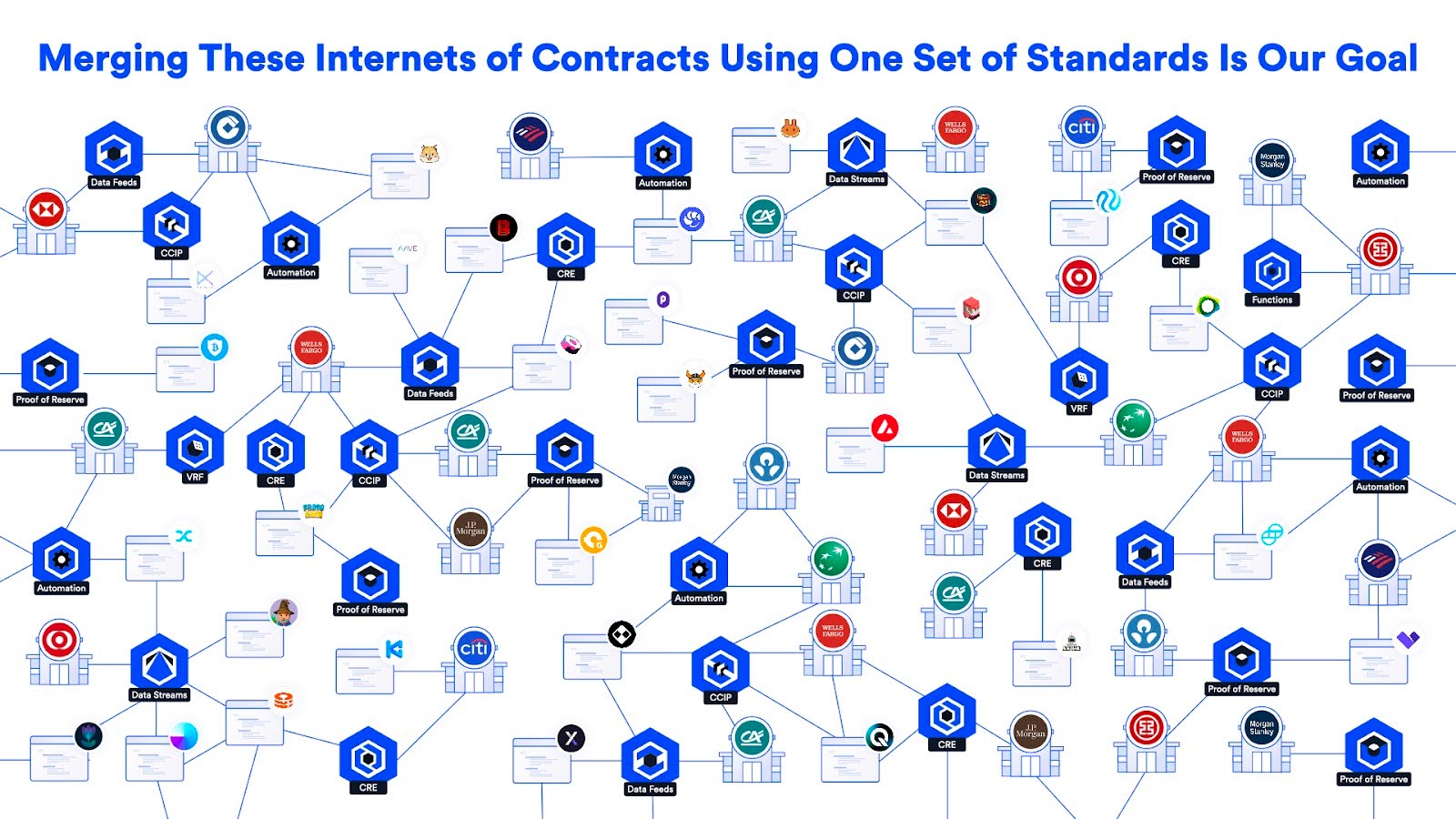
Our fundamental goal is to establish a global standard—one that works across both DeFi and traditional capital markets. These two sectors are set to converge, and when they do, we expect it will create an economic boom by combining into a single global Internet of Contracts. Chainlink’s mission is to lead this transformation by creating the standard powering this new onchain financial system.
Web3 and TradFi adoption of Chainlink standards.
Currently, these two worlds—DeFi and TradFi—are evolving in separate directions. We’ve already made significant strides in establishing Chainlink as the standard for DeFi by powering a significant portion of it, securing $75+ billion in DeFi TVL at its peak. Now, we’re also making progress in becoming the standard for TradFi capital markets.
The ultimate goal is to create applications that work seamlessly together, defining the standard for how value is transacted across the entire financial system. That’s what success looks like—building a global standard that powers the Internet of Contracts, which we expect will lead to the economic boom that will result from merging these two worlds into a single global market.
The goal is to merge Web3 and TradFi ecosystems using a unified set of Chainlink standards.
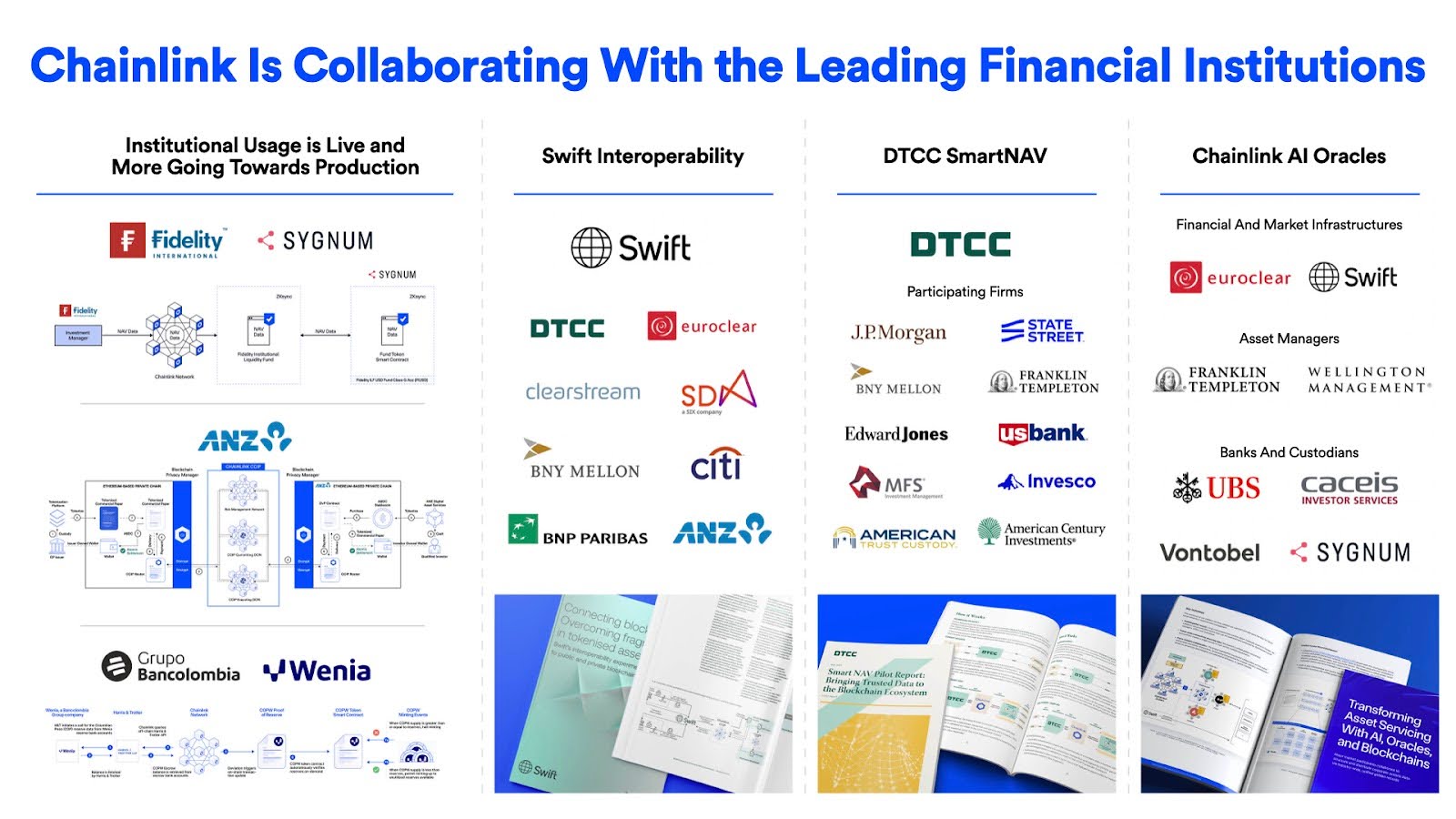
We’ve made significant progress within TradFi markets. In addition to DeFi, we have implementations in production for large asset managers, multiple collaborations with major financial market infrastructures, and we’re in various stages of implementation with some of the biggest banks and asset managers in the world. Just like we’ve successfully established Chainlink as a global standard for the DeFi community, this year we’ve made great strides toward creating the standard for capital markets.
Chainlink has been collaborating with leading financial institutions.
We’ve achieved this by providing a comprehensive set of services: data, proof of reserves, identity, cross-chain, and more—all integrated into contracts. One key lesson we’ve learned along the way is the need for a unified system to weave together these services, blockchains, smart contracts, and payment systems into a single application.
Introducing the Chainlink Runtime Environment (CRE)
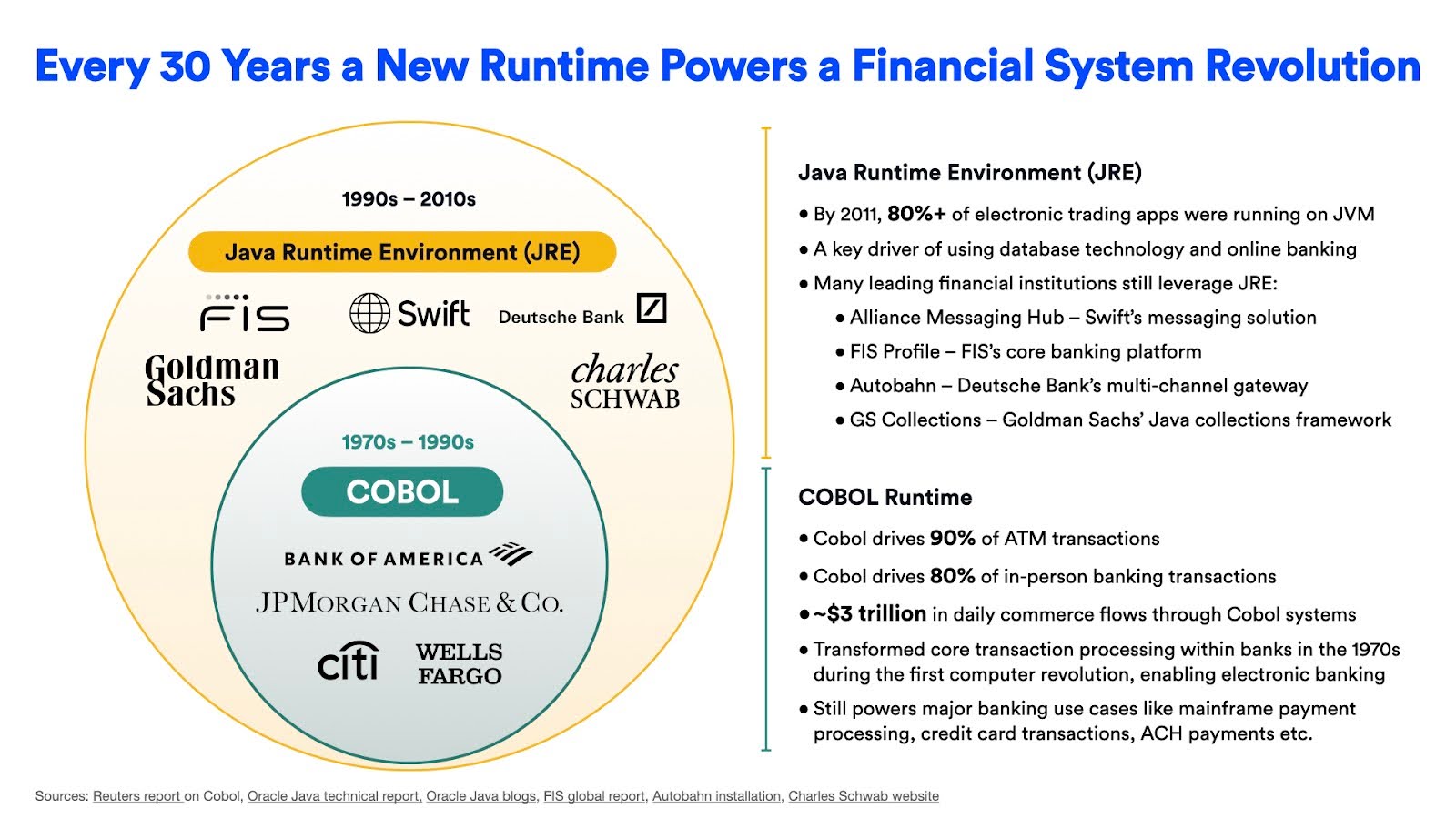
Looking back at the history of financial applications, each economic boom has been driven by the simplification of new technologies. In the 1970s, the introduction of COBOL as a runtime technology simplified interactions with databases and created the first electronic banking transactions. Similarly, in the 1990s, the Java Runtime Environment (JRE) simplified the interaction between new database technologies and the Internet, paving the way for online banking.
Every 30 years there is a new runtime powering the financial system.
Now, as the world’s value migrates across hundreds of chains and thousands of oracle networks, the opportunity to unify these systems into a single application has emerged. The goal is to allow developers to create advanced applications much more quickly than before—within days or even hours. This simplification is what has driven economic booms in the past, and it’s what we aim to do now with the Chainlink Runtime Environment.
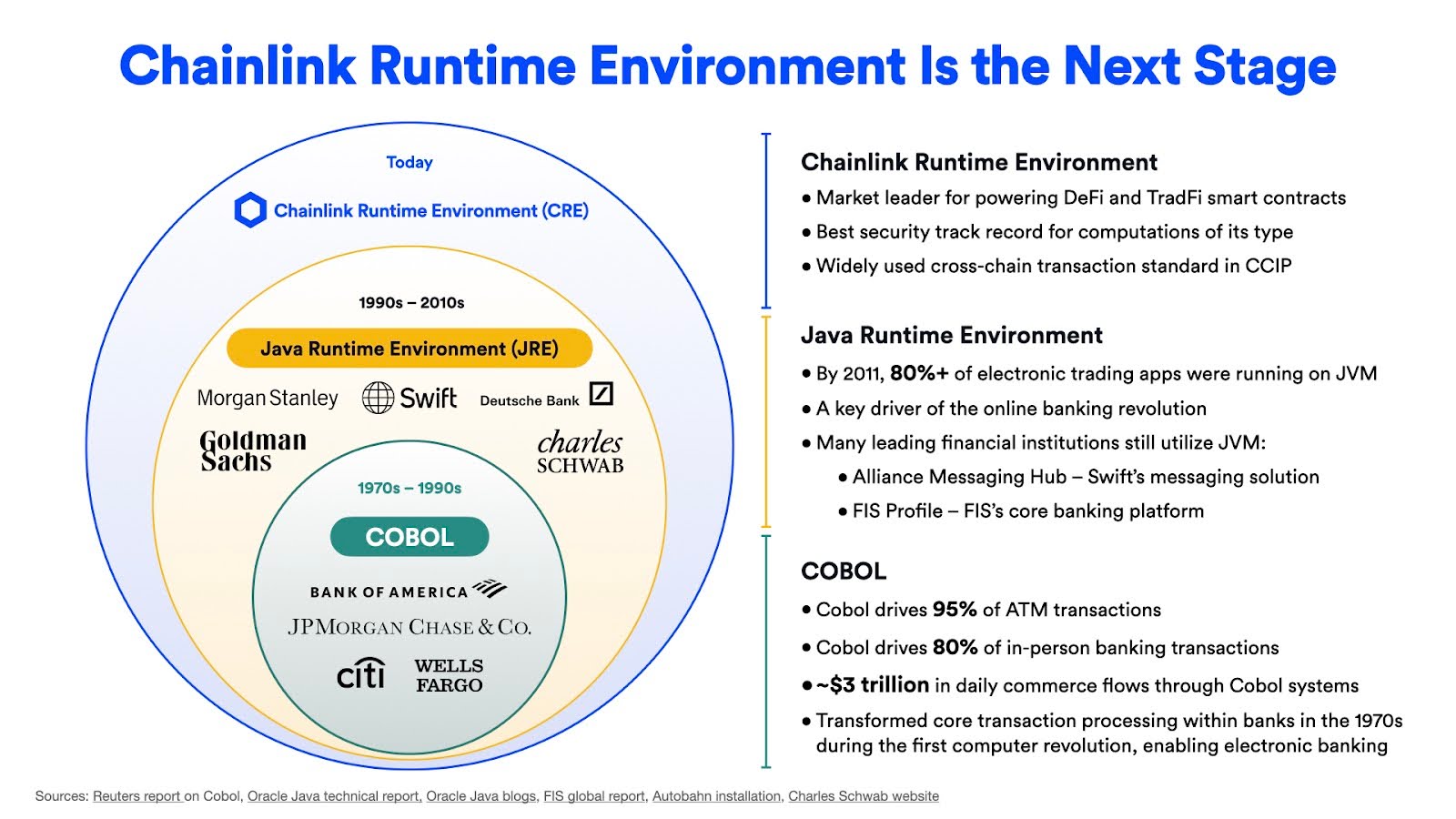
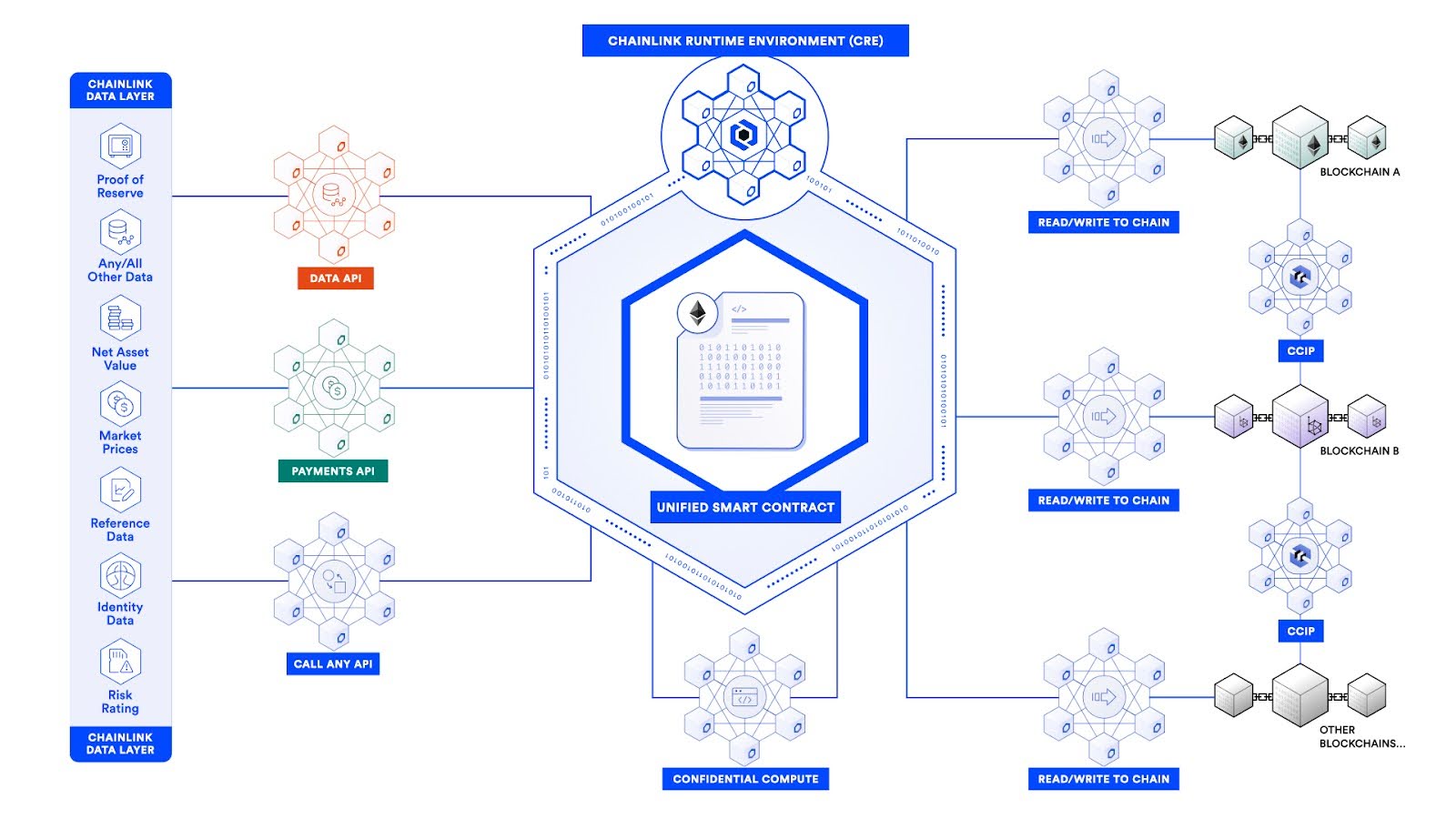
The Chainlink Runtime Environment (CRE) is designed to play the same role that COBOL and JRE played in previous economic booms in the last few decades. The CRE will coordinate blockchain technologies, oracle networks, and smart contracts into a unified application. By simplifying the complexities of interacting with multiple systems, the CRE will provide developers with an environment to easily integrate existing data, systems, and new blockchain technologies into a single application—this is the next step in simplifying blockchain application development.
The CRE will emerge as the next runtime to power the financial system.
We’ve already seen this work with the Swift network. Through the CRE, we integrated Swift messages with multiple blockchains to create a seamless transaction flow. A small amount of engineering resources was needed to achieve this, demonstrating the CRE’s power in simplifying complex systems. This solution was showcased at Swift’s Sibos conference and received a strong response. The ability to coordinate Swift messages and blockchain events securely and efficiently is just one example of how the CRE will simplify cross-chain interoperability and make complex systems more manageable.
The adoption of the Chainlink Runtime Environment is a critical piece of our vision for the future. It’s designed to unify these complex services into one cohesive application, allowing developers to write code in languages they’re already familiar with, such as Go and TypeScript, with other languages like Rust under consideration. We believe this will lead to widespread adoption and make it easier for developers to build applications that integrate smart contracts, blockchain technologies, data, and payments—ultimately leading to the creation of a global, interconnected network of contracts.
The CRE enables secure data access, cross-chain interactions, and unified smart contracts with APIs for data, payments, and more.
Privacy Is the Key to Unlocking Institutional Adoption
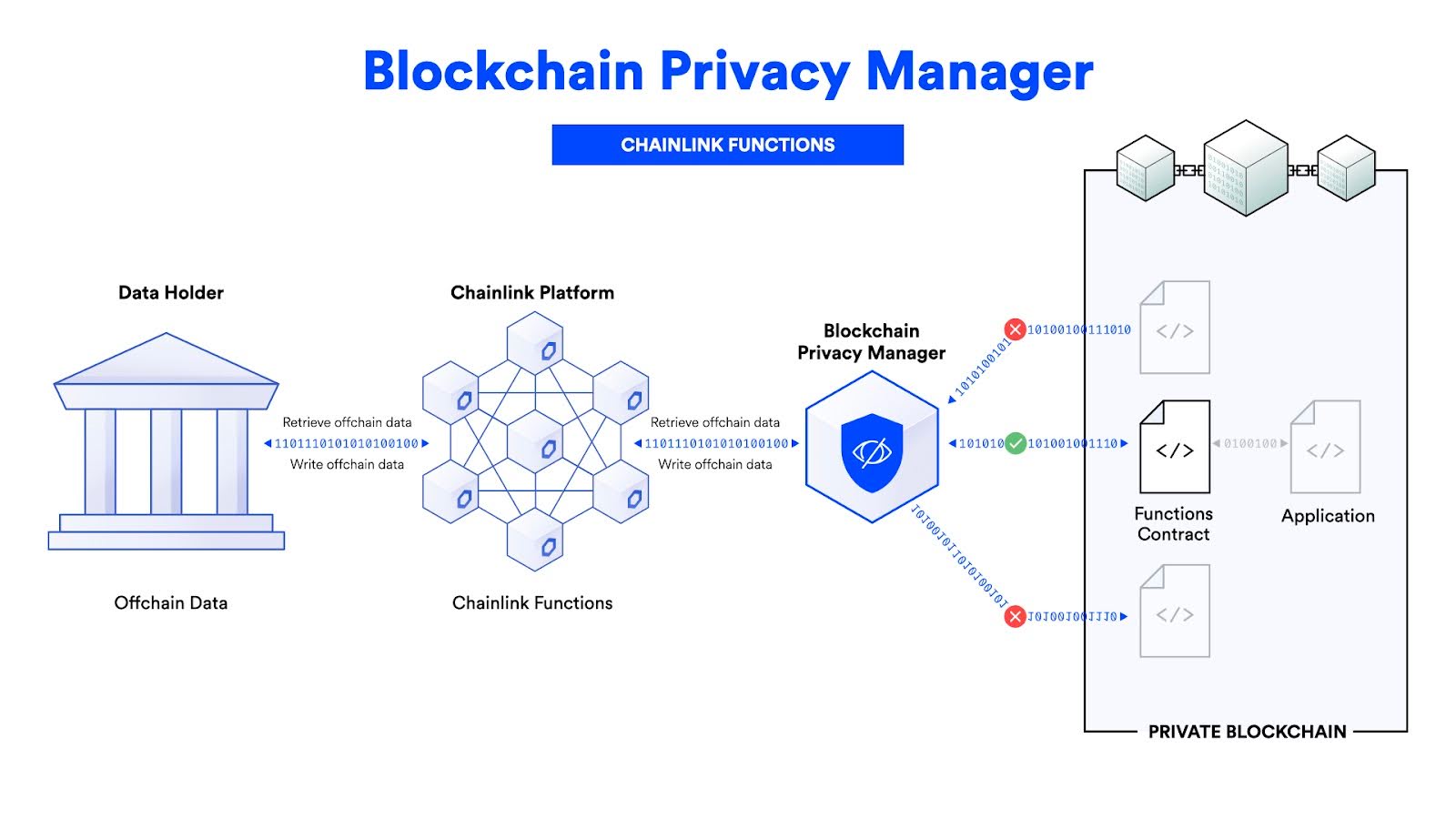
As we continue to innovate, we are also addressing privacy in blockchain transactions. For institutional transactions, privacy is essential, and that’s why we’ve introduced the Blockchain Privacy Manager. This tool helps manage privacy across various chains by defining what information can and can’t leave a chain. We’ve also applied this tool to Chainlink’s Cross-Chain Interoperability Protocol (CCIP) to create private transactions, essential for institutional users.
The Blockchain Privacy Manager enables secure offchain data retrieval and writing with privacy management for blockchain applications.
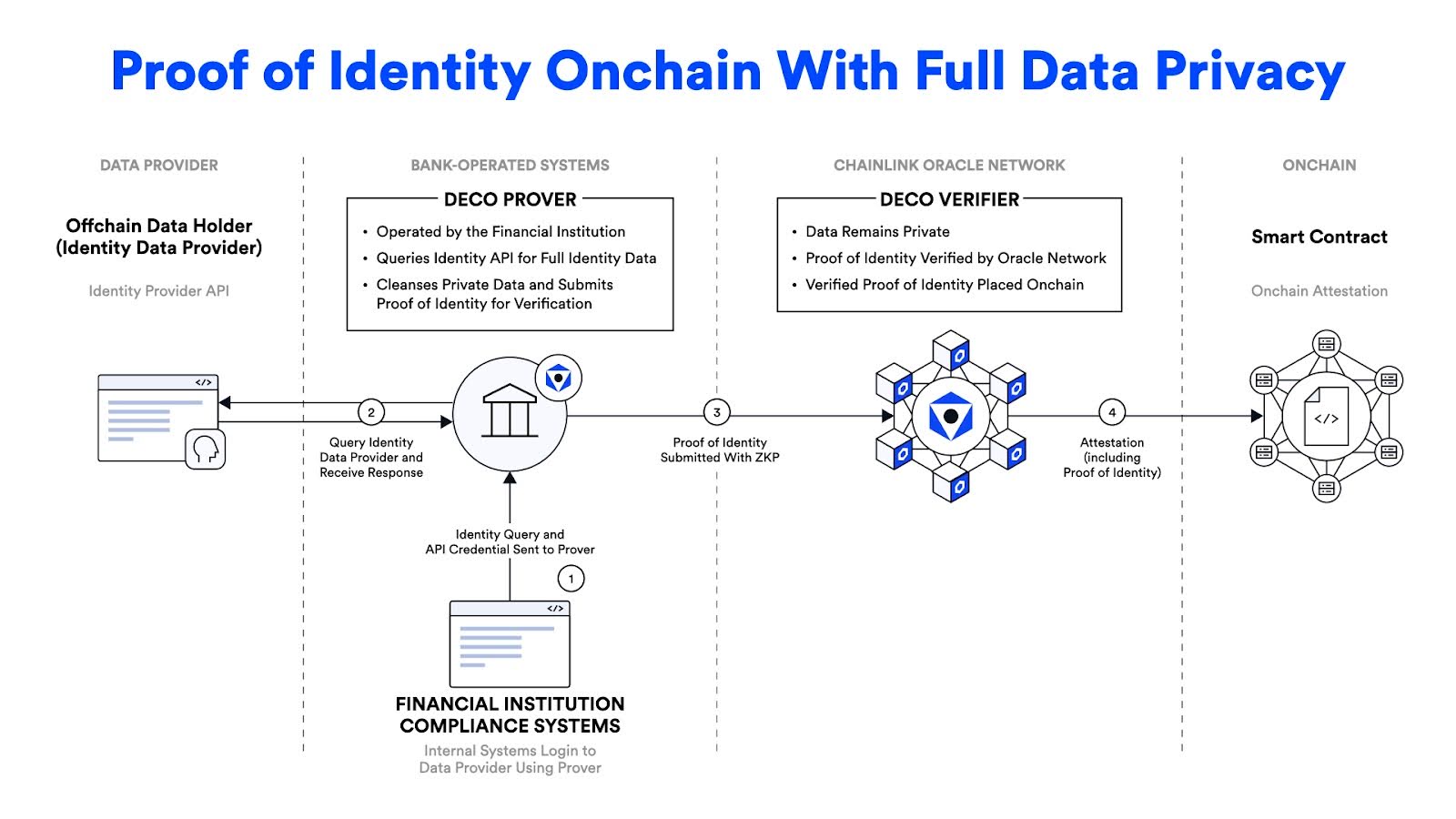
Additionally, we’re releasing tools like the DECO Sandbox, which allows developers to apply zero-knowledge proofs to any API and prove data information without revealing sensitive details. This is a significant advancement for privacy, especially in sectors like identity management and proof of funds, where confidentiality is crucial.
Proof of identity onchain with full data privacy using Chainlink’s Deco verifier and zero-knowledge proofs.
SmartData Leads to SmartAssets
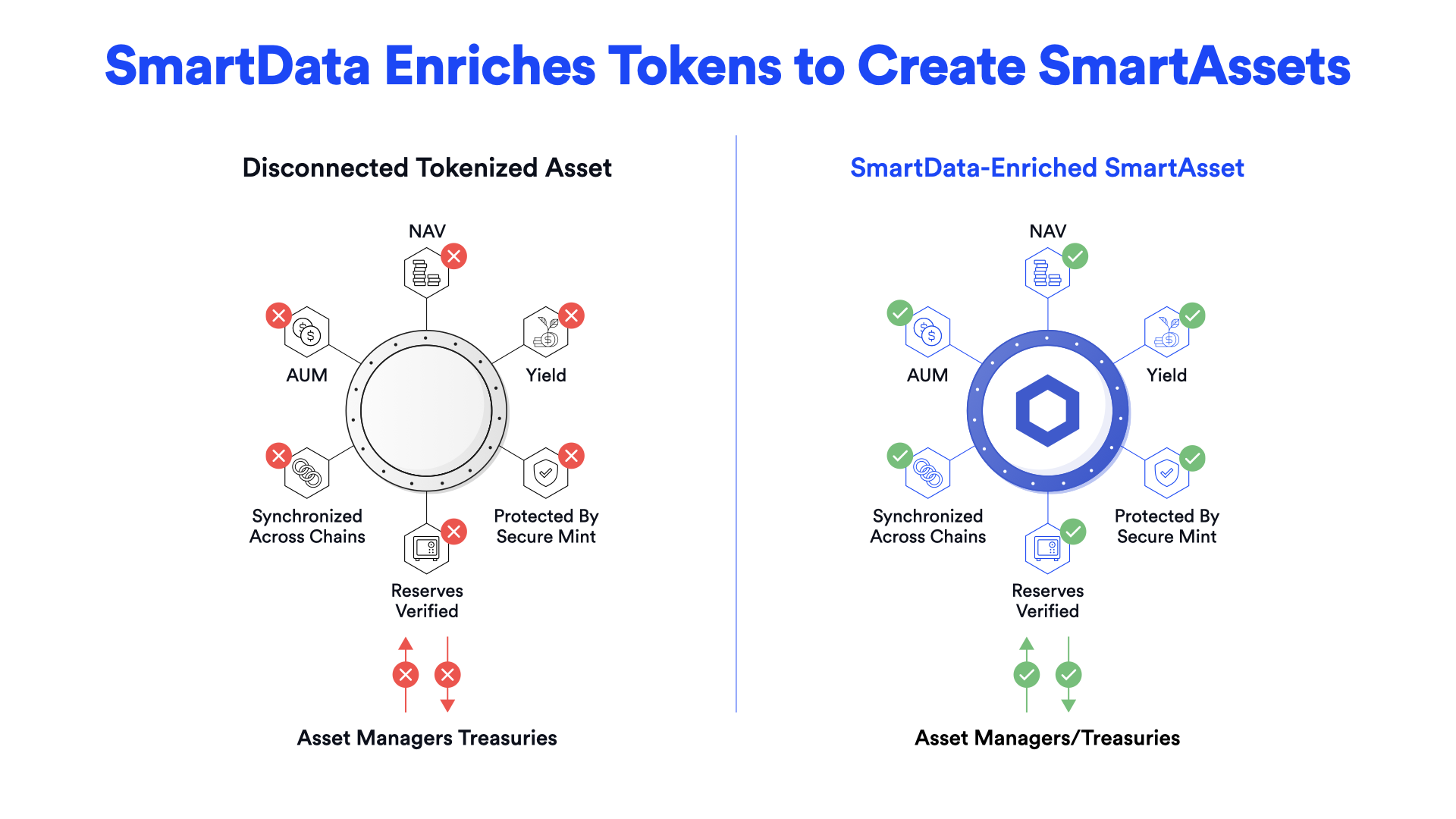
We also recognize the importance of creating data standards. Chainlink is rapidly becoming the standard for proof of reserves, a critical element in the reliability of stablecoins and commodity-backed assets. The work we’re doing with the SmartData standard will further expand the types of data that can be reliably transmitted onchain, leading to the creation of SmartAssets that are enriched and controlled by highly reliable data feeds.
SmartData enriches tokenized assets to create SmartAssets, ensuring data synchronization, yield, reserves verification, and protection across chains.
The Next Evolution of Chainlink CCIP
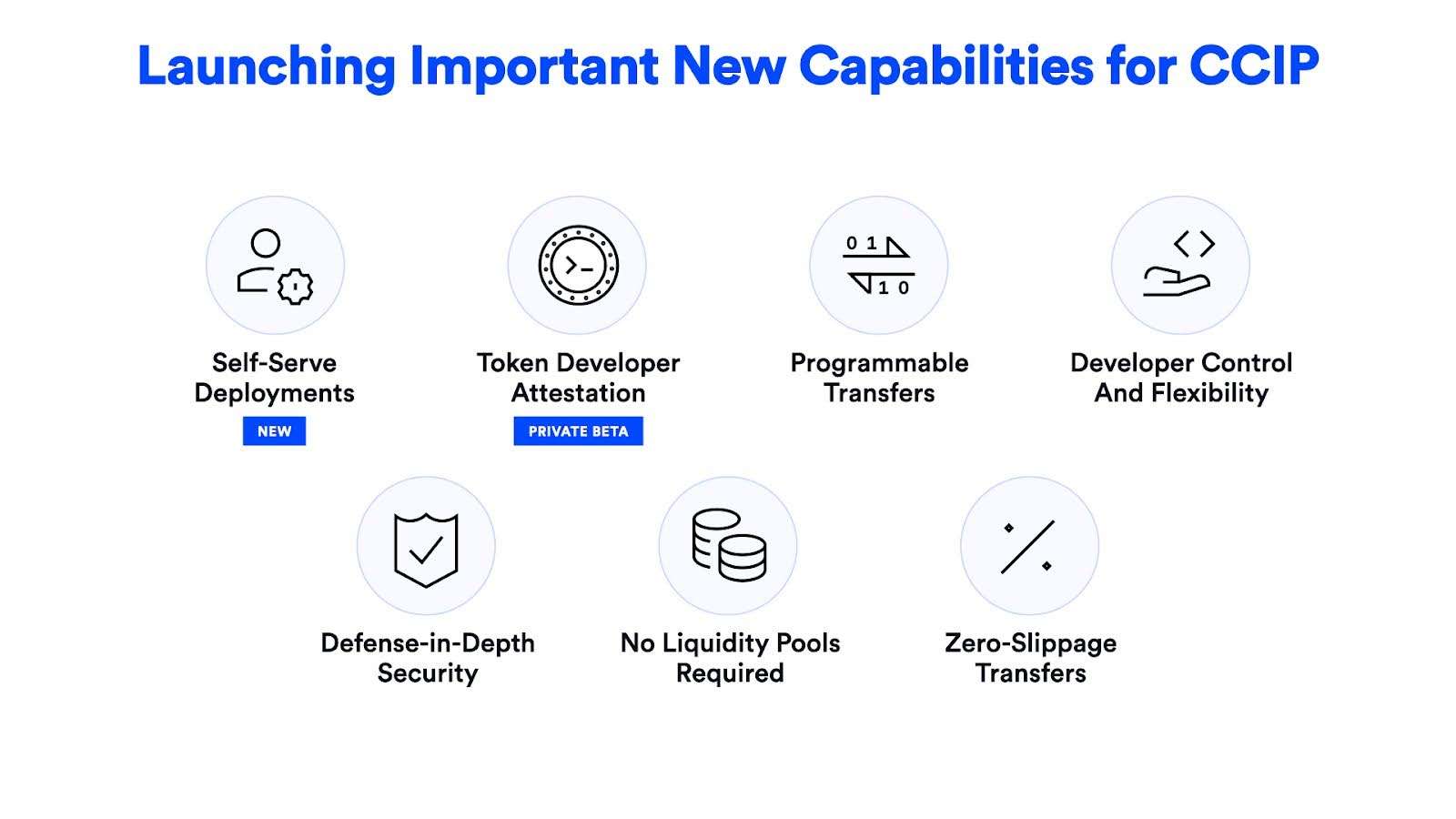
Finally, our vision extends to the continued evolution of CCIP. With features like Programmable Token Transfers, CCIP is being adopted by major blockchains as their canonical bridge solution, providing a reliable and secure way to transfer tokens across chains. The ability to conduct transactions and manage payments seamlessly across multiple blockchains will play a key role in the growth of this technology.
CCIP capabilities, including elf-serve deployments, token developer attestation, programmable transfers, and more.
The goal is to create a unified standard that spans both the DeFi and TradFi worlds. Through the Chainlink Runtime Environment, we are bringing that vision to life. We’re laying the groundwork for an interconnected global economy driven by smart contracts, and as we continue to develop these technologies, we believe Chainlink will be at the epicenter of the next economic boom.
Forget a Bitcoin reserve—what about a Dogecoin government stash?
That’s the idea of the former-joke-now-serious-cryptocurrency’s founder, Billy Markus, who floated the idea on Twitter (aka X).
“Why not national Dogecoin reserve tho [sic],” he wrote on the platform Friday.
Markus was responding to a post by prediction market Kalshi about bettors seeing an increasing chance of President-elect Donald Trump creating a strategic Bitcoin reserve.
Trump previously said that when in power, he would let the U.S. government buy up Bitcoin as a reserve asset. The U.S. already has assets like land, Treasuries, and gold in its reserves.
Republican Senator Cynthia Lummis from Wyoming exclusively spoke to Decrypt this month about how such a plan would work.
As Bitcoin gains momentum, floating such an idea isn’t as crazy as it sounds. With a market cap of $1.8 trillion, the orange coin is currently the seventh-biggest asset in the world, after this month overtaking both silver and Saudi Arabia’s petroleum and natural gas company, Saudi Aramco.
Dogecoin (DOGE), on the other hand, is the sixth-biggest cryptocurrency—and has a market cap of just $55 billion. The coin was created as a joke and is based on a popular Internet meme of a Shiba Inu dog.
Still, it gained momentum in 2020-2021 after Tesla CEO and upcoming U.S. government employee Elon Musk constantly talked about how much he liked the virtual coin. The tech entrepreneur and world’s richest man has also (seemingly) seriously spoken about how the asset could be used for payments.
And Wall Street analysts toldDecrypt that it might not be long before the asset becomes available to traditional investors via an exchange-traded fund (ETF). Meanwhile, crypto analysts also told Decrypt that DOGE could easily smash through its all-time price record from 2021, with plenty of room to run.
Things are suddenly getting very serious with the leading meme coin. But until a Bitcoin strategic reserve actually becomes reality, the notion of a Dogecoin one is likely to remain little more than a funny idea. Stranger things have happened in crypto, though.
Edited by Andrew Hayward
Daily Debrief Newsletter
Start every day with the top news stories right now, plus original features, a podcast, videos and more.
Metaverse Stock: Investment Opportunities in the Virtual World
What Does Gaming Have to Do with the Metaverse?
Imagine waking up in the morning, slipping on a lightweight headset, and instantly being transported to a bustling virtual city where you meet friends, work in a sleek digital office, or attend a concert with global superstars – all without leaving your home. Well, it is possible now. Welcome to the metaverse, where these possibilities are closer than you think. But what exactly is it? And how will it impact our lives? Let’s explore this groundbreaking digital world together.
What is the Metaverse?
Picture Courtesy: supersourcing.com
At its core, the metaverse is a collective virtual shared space, created by the convergence of virtually enhanced physical reality and physically persistent virtual space. It’s a universe where users can interact with each other and digital objects in a 3D environment. Think of it as a massively multiplayer online game (MMO), but on a much grander scale, encompassing various aspects of our lives, from work and education to entertainment and social interactions.
A Brief History of the Metaverse:
However, the concept of a virtual world isn’t entirely new. Science fiction writers have been exploring this idea for decades. However, recent advancements in technology, particularly in virtual reality (VR) and augmented reality (AR), have brought the metaverse closer to reality.
Early Days: Games like Second Life, launched in 2003, were early pioneers. They allowed users to create avatars, own virtual land, and interact with others in a 3D environment.
The Modern Era: Tech giants like Facebook (now Meta), Google, and Microsoft started investing heavily in virtual and augmented reality around the 2010s. With advances in hardware, graphics, blockchain, and connectivity, the vision of a fully-fledged metaverse became not just possible, but inevitable. Today, companies from diverse sectors are racing to lay the groundwork for this next evolution of the internet.
How does Metaverse Work?
The metaverse works by creating immersive, interconnected virtual spaces where users can interact with each other and digital environments in real-time. But how does all this come together? Here’s a breakdown of the magic behind the scenes:
1. Foundation Technologies Powering the Metaverse:
The metaverse relies on a combination of technologies that work together to create a seamless, immersive experience. Here’s how they contribute:
A. Virtual Reality (VR) and Augmented Reality (AR):
Picture Courtesy: techengage.com
VR is an experience in which the user is fully submerged in digital worlds, by using headsets that block out the physical environment. AR, on the other hand, overlays digital content on top of actuality through devices such as smartphones, AR glasses, etc. All this together gives a collection of sensory experiences that will let the metaverse become tangible and interactive.
B. Blockchain and Decentralization:
Picture Courtesy: biovustechnologies.com
Bitcoin happens to be the underpinnings of how the metaverse functions since it offers a truly safe and transparent method to manage digital ownership and assets, identities, and transactions. In that light, NFTs represent unique ownership of digital items, such as artwork, in-game items, or even land in cyberspaces. Since blockchain is offered on a decentralized system, the users get all the controls of their digital lives.
C. Artificial Intelligence:
Supports virtual assistants and chatbots while also working on creating non-player characters, which make interactions within the metaverse seem more real and dynamic. It is utilized in generating and modifying environments to ensure better experiences for the user, as well as huge data analysis, to give related personalized activities within the metaverse.
D. Networking Technologies (5G and beyond):
Picture Courtesy: Creative Market
The metaverse relies on fast low latency internet connectivity to deliver smooth real-time interactions. High-speed networks such as 5G ensure that a user can experience complex high-quality visuals and can smoothly perform his or her work without any delay.
E. 3D Rendering and Graphics Engines:
Picture Courtesy: aecmag.com
Sophisticated 3D graphics engines such as Unreal Engine and Unity are used in generating lifelike worlds and characters in the metaverse. These engines help render expansive environments, realistic avatars, and dynamic interactions, causing everything to feel more “real” within these virtual spaces.
F. Cloud Computing:
Picture Courtesy: vizteams.com
The sheer amount of data processing and storage required for the metaverse demands robust cloud computing. By offloading computational tasks to cloud servers, users can access the metaverse across various devices, ranging from high-end VR headsets to regular smartphones.
2. How Virtual Spaces and Interactions are Created:
A. World Building:
The environments you see in the metaverse-that’s an imaginary castle, but also a virtual cityscape, a virtual classroom built using 3D modeling software and game engines. Developers actually design and create digital objects rules and environments.
B. User Avatars:
An avatar is a digital representation, that forms the entry point of the user into the metaverse; it can be simple to intricate in appearance depending on the users’ preference and style, indicating the identity of the users. Advanced platforms can track the movements of the user, expressions of the face, and even the voice by technology that can mimic all of these.
C. Real-Time Interaction and Presence:
The metaverse is supposed to create an experience of as natural and authentic interactions as it can. Users meet with each other and collaborate in real-time, including experiencing eye contact with other avatars due to real-time data processing and the presence of haptic feedback devices simulating the touch feeling.
3. Digital Ownership and Economies:
A. Non-Fungible Tokens (NFTs):
Ownership of digital objects in the sense of the metaverse is possible, applied via blockchain technology to verify unique ownership. So, whether it is a plot in a virtual world like Decentraland or a rare collectible, NFTs make these assets tradable and scarce and thereby give real value to virtual items.
B. Smart Contracts:
Smart contracts involve transactions and agreements in the metaverse, but they are most often powered by smart contracts – self-executing contracts coded on the blockchain. Such activities ensure transparent and automated exchanges without the need for intermediaries and power peer-to-peer economies.
4. Interoperability and Cross-Platform Experiences:
The metaverse’s vision involves creating a cohesive network of virtual worlds where a user can transfer his avatars, possessions, and experiences from one metaverse platform to another. This requires interoperability, which is enabled by standards and protocols that facilitate data sharing and connectivity between disparate systems and environments.
For example, a virtual object or avatar created in one world can be used or resold in another because standardized protocols and blockchain-based identity and asset management would make such possible.
5. User-Centric Content Creation:
Many metaverse platforms focus on user-generated content, encouraging users to create their own experiences. As such, for example, platforms like Roblox and The Sandbox make the creators in-game and empower them to design games and build virtual spaces, even selling digital assets. This user-centric approach creates room for endless possibilities, thereby driving rapid innovation and engagement.
6. Immersion through Interaction:
Interaction in the metaverse can go beyond chatting with friends. Users can collectively build structures, attend concerts, participate in virtual meetings, play games, and even learn in a digital classroom in real time with others. Enhanced immersion frequently combines sensory feedback, such as haptic gloves that simulate touch or motion capture devices mimicking gestures.
7. Security and Identity Verification:
The metaverse introduces new complexities around security and identity management. Thus, users’ digital identities require proper protection through robust authentication systems, encryption, and DIDs (decentralized identifiers). On this score, blockchain also comes into play since it enables users to maintain ownership of their private data and assets without being reliant on intermediate central authorities.
8. Economics and Virtual Economies:
Many metaverses have their own virtual economies, with currencies, marketplaces, and monetization models. Users can earn money through play-to-earn games, selling digital creations, providing services, or participating in marketplaces. Cryptocurrencies often power these transactions, facilitating global, borderless trade.
When is a Full-Fledged Metaverse Coming?
The honest answer? It’s complicated. While many individual metaverse projects exist today, a truly unified, comprehensive metaverse, like what sci-fi films promise, maybe years away. Technical challenges, regulatory issues, and the sheer complexity of building interoperable virtual worlds on a massive scale are still being ironed out. Still, incremental steps are happening, and each year brings us closer.
How is the Metaverse Accessed?
Picture Courtesy: cryptoglobally.com
To enter the metaverse, you don’t need a magic portal, just the right tech! Here are some common ways:
1. Virtual Reality Headsets:
VR headsets like Meta Quest, HTC Vive, or PlayStation VR are totally immersive. When you put on a VR headset, you find yourself inside 3D virtual worlds that you can walk around in, interact with objects, meet other avatars, and indeed engage with the environment as if you were inside it. “Full immersion” is very often how people think of accessing the metaverse; it offers the least experience of presence and interaction that you might have ever felt.
2. Augmented Reality (AR) Glasses and Mobile Apps:
While VR completely produces virtual spaces, AR combines digital parts with the real world. Using AR glasses, such as Magic Leap or Microsoft HoloLens, allows you to overlay holographic elements onto the real space in front of you to create a mixed-reality environment. You don’t need special glasses, however, to access many metaverse experiences; by installing an AR-enabled mobile app on your smartphone, you can insert digital overlays into your everyday surroundings.
3. Desktop and Laptop Computers:
Many of the metaverse platforms do not require expensive hardware, but a stable computer is enough. For example, Decentraland, Roblox, or Fortnite can easily reach a desktop or a laptop using your keyboard and mouse to access 3D virtual worlds. This is one of the best platforms for new explorers as they will get an easy way around without investments in VR or AR equipment.
4. Smartphones and Tablets:
Ironically, tablets and smartphones may turn out to be the very keys that unlock the metaverse. Applications like Pokémon Go blur the lines between gameplay and real-life explorations, while platforms like ZEPETO allow users to build an avatar and access virtual spaces without needing a PC.
Not quite as immersive, of course, but increasingly popular and convenient: mobile access.
5. Game Consoles:
Metaverse-style experiences are delivered via gaming consoles like PlayStation and Xbox through online multi-players like Fortnite and Minecraft. These are usually considered more as metaverse “lite” experiences, providing a taste of the shared, persistent virtual spaces that are growing and evolving in time.
How do VR and the Metaverse Relate to Each Other?
Picture Courtesy: softwebsolutions.com
VR is one of the key entry points into the metaverse, but it’s not synonymous with it. Think of VR as the headset you put on to enter a virtual world, while the metaverse is the universe you enter. In other words, the metaverse could host VR spaces, but it can also be accessed in other ways, making it a broader concept.
1. VR as a Gateway to the Metaverse:
VR serves as one of the most immersive ways to experience the metaverse. When you put on a VR headset, you’re transported into a fully digital environment that can replicate the real world, create fantastical new realms, or blend elements of both. Through VR, the metaverse becomes a living space that you can “enter” and interact with, enhancing the sense of presence, movement, and connection with other users and virtual objects.
Example: Imagine attending a business meeting, exploring a concert, or playing a game with friends—all within a 3D virtual space where you can look around, move, and speak in real time. VR makes these experiences feel incredibly real and engaging.
2. Enhanced Immersion and Interaction:
While you can access the metaverse through a desktop, smartphone, or even augmented reality (AR) device, VR offers the highest level of immersion. It allows users to interact with digital objects using hand controllers or gestures and move within 3D environments. This depth of interaction transforms the metaverse from a static experience into a truly lifelike one.
Example: In a VR-powered metaverse environment, you can shake hands with another avatar, pick up and inspect digital objects, or build and manipulate virtual worlds in a tangible way. It’s like living inside the internet instead of just viewing it on a screen.
3. Social Connectivity and Presence:
The metaverse is built on the idea of a shared virtual space where people connect, socialize, and collaborate, and VR amplifies this sense of presence. When you’re in a VR metaverse setting, you see and hear other people as avatars, allowing for natural, face-to-face-style interactions. This is critical for events, gaming, social gatherings, or collaborative workspaces, making interactions feel personal and engaging.
4. Gaming and Entertainment Experiences:
The gaming industry has embraced VR and the metaverse, offering expansive worlds where players can meet, play, and explore together. VR metaverse games go beyond traditional gameplay by providing a shared, living universe that evolves with user contributions, activities, and social interactions. These experiences immerse players like never before.
5. Building the Future of the Metaverse:
While VR currently offers the most immersive way to interact with the metaverse, it’s important to note that the metaverse extends beyond just VR. The metaverse encompasses a broader digital universe that can be accessed through multiple devices and interfaces, including AR, desktops, and mobile devices. However, as VR technology advances and becomes more accessible, it will continue to play a pivotal role in defining the metaverse experience.
How Does the Metaverse Fit into Web 3.0?
Picture Courtesy: techcodey.com
Now you might wonder how metaverse going to be the game changer for Web 3.0. The metaverse and Web 3.0 are two transformative ideas reshaping the digital landscape, and their connection runs deep. Here’s how the metaverse fits into the vision of Web 3.0:
1. A Decentralized Internet:
Web 3.0 aims to create a decentralized web, where users own their data and have control over their digital experiences, quite unlike what exists today with centralized systems held by tech giants. The metaverse perfectly fits into this vision through decentralized technologies such as blockchain and smart contracts empowering the user with true ownership, be it a virtual real estate, an avatar, or just digital art. Decentralized infrastructure will also increase security, and transparency, and benefit from user-driven governance.
2. Cross-platform Interoperability:
Web 3.0 emphasizes interoperability, the ability for systems and platforms to work seamlessly together. This is reflected in how the metaverse must be an interconnected virtual universe, meaning full movement of assets, avatars, and data between different virtual worlds and experiences. Imagine a world where you move your customized avatar with your digital collectibles and virtual currencies across platforms. This is one core Web 3.0 principle firing freedom and choice in users.
3. User Empowerment and Creator Economies:
The metaverse, like Web 3.0, shifts power away from centralized authorities to users and creators. Blockchain technology, which is central to both, enables creators to tokenize assets (like art, virtual goods, or in-game items) as Non-Fungible Tokens (NFTs), allowing for direct sales, royalties, and value retention. This user-driven economy gives more control to creators over how their work is monetized, echoing Web 3.0’s ethos of decentralized empowerment.
4. Persistent, Immersive Experience:
Web 3.0 envisions a web where digital and real-world experiences blend seamlessly. The metaverse offers persistent, immersive virtual environments that users can access anytime, blurring the lines between physical and digital realities. VR and AR technologies further strengthen this integration, creating experiences that transcend traditional boundaries of digital interaction.
5. Self-Sovereign Identities:
Another major characteristic of Web 3.0 is the requirement for self-sovereign digital identities of users, allowing them to control their personal data and online personas. Such identity can be presented as an avatar within the metaverse with verifiable credentials and a history of ownership and should be secured with blockchain. This would represent a shift where identity control returns to the individuals instead of the companies.
Differences Between Metaverse, VR, and AR:
It’s easy to confuse these terms, so let’s clarify the difference between Metaverse, VR and AR:
CategoryMetaverseVirtual Reality (VR)Augmented Reality (AR)DefinitionA vast, interconnected network of virtual worlds and spaces where users can interact, socialize, create, and trade.A fully immersive digital environment experienced through VR headsets, isolating users from the physical world.A technology that overlays digital content onto the real-world environment, enhancing physical surroundings.ScopeEncompasses multiple technologies, including VR, AR, blockchain, social spaces, digital economies, and more.A component of the metaverse but can exist independently for games, simulations, and training.Often part of the metaverse but mainly focused on blending digital elements with the real world.Immersion LevelCan range from partial immersion (via mobile apps) to full immersion (via VR).Full immersion: users are completely “inside” a digital world and isolated from the physical surroundings.Partial immersion: users remain aware of and interact with the real world while seeing digital overlays.Access DevicesAccessible through VR headsets, AR glasses, desktops, smartphones, and other devices.Primarily accessed using VR headsets like Meta Quest, HTC Vive, PlayStation VR, etc.Accessed using AR glasses (Microsoft HoloLens), mobile apps (smartphones/tablets), etc.Primary Use CasesVirtual social interactions, digital asset trading (NFTs), gaming, remote collaboration, and creative content creation.Gaming, training simulations, virtual tours, and immersive learning experiences.Navigation, education, AR gaming (e.g., Pokémon Go), retail experiences, and training.InteractivityHigh interactivity involving user-driven economies, social connections, digital asset creation, and more.High interactivity within enclosed digital environments but typically focused on singular experiences.Moderate interactivity, with digital overlays responding to real-world movements and inputs.Presence of Social ElementsStrong social component, with virtual spaces for collaboration, communication, and shared experiences.Can have social interactions but often focused on individual immersive experiences.Limited social components; primarily a tool for enhancing individual experiences.Integration with BlockchainFrequently integrated with blockchain for decentralized ownership, NFTs, and digital currencies.Not inherently tied to blockchain, though some VR experiences may incorporate it.Rarely integrates with blockchain; focus is on enhancing real-world utility.User AvatarsUsers are represented by customizable avatars, often carrying digital identities across different platforms.Avatars may be used but are generally confined to specific VR apps or games.Generally not focused on avatars; digital overlays appear around the user instead.Example PlatformsDecentraland, Roblox, The Sandbox, Horizon Worlds, and more.Meta Quest experiences, Beat Saber, Half-Life: Alyx.Pokémon Go, Microsoft HoloLens apps, AR navigation apps.Relation to Physical WorldBlends virtual and physical worlds but allows users to fully immerse or partially participate.Detaches users completely from the physical world.Combines digital elements with the physical world; users remain aware of their surroundings.User IsolationVaries; some experiences are highly social, others are individual.High; users are cut off from the physical world during usage.Low; users interact with digital elements while being aware of their real-world context.Customization and Content CreationUser-generated content is a major focus; anyone can create, trade, or monetize virtual assets.Users can create or modify elements within specific VR experiences.Customization is limited to specific AR apps and overlays within real-world contexts.
Metaverse Stock: Investment Opportunities in the Virtual World
Picture Courtesy: whatarenfts.com
Investing in the metaverse represents a new frontier with promising opportunities for growth and innovation. As the metaverse continues to evolve, companies building and supporting its infrastructure have garnered significant investor interest. Metaverse-related stocks span a wide range, from tech giants developing VR/AR hardware, like Meta Platforms (formerly Facebook) and Apple, to gaming companies creating immersive virtual worlds, such as Roblox and Unity Technologies. Blockchain-based platforms, such as Decentraland and The Sandbox, have also emerged as strong contenders by enabling digital asset trading through NFTs and virtual real estate.
For investors, metaverse stocks offer exposure to a rapidly expanding digital economy that blends social interaction, gaming, commerce, and work. However, this market remains in its early stages, presenting both high-growth potential and considerable volatility. Careful research and diversification are key for those looking to seize opportunities in this virtual world while navigating its risks.
What Does Gaming Have to Do with the Metaverse?
Picture Courtesy: queppelin.com
Gaming plays a crucial role in shaping the metaverse, acting as both a foundation and a major driver of its growth. The metaverse is envisioned as an immersive, interactive space where users can engage, socialize, and create, and gaming provides a natural entry point into this virtual world. Popular games like Roblox, Fortnite, and Minecraft are already offering virtual worlds where players can socialize, build, and explore, much like the metaverse. These gaming platforms have evolved beyond just entertainment to become virtual social spaces where users can host events, buy virtual goods, and even create and sell assets.
Gaming’s impact on the metaverse is also seen in the use of NFTs (non-fungible tokens) for in-game assets and collectibles, creating new economic systems within the virtual worlds. Moreover, gaming helps refine the technologies needed for the metaverse, like virtual reality (VR) and augmented reality (AR), which enhance immersion and interactivity. As the metaverse expands, gaming will remain central to its development, with virtual economies, interactive spaces, and digital ownership continuing to grow, providing players with new ways to experience, create, and earn in these evolving digital environments.
Metaverse Challenges:
Picture Courtesy: cryptogames3d.com
The metaverse, despite its promising future, faces several significant challenges that need to be addressed for widespread adoption:
1. Technological Barriers:
Hardware Limitations: Devices like VR headsets can be expensive, bulky, and uncomfortable for long-term use. Additionally, internet infrastructure may not support seamless, high-quality metaverse experiences, particularly in areas with limited bandwidth.
Interoperability: Achieving seamless integration between various platforms and digital assets is a major hurdle, as many metaverse projects currently operate in isolation.
2. Data Privacy and Security:
Personal Data Risks: As users generate vast amounts of personal data, ensuring its protection from breaches is crucial.
Cybersecurity: The increasing complexity and interconnectedness of metaverse platforms elevate the risk of cyberattacks targeting digital assets and virtual economies.
3. Legal and Regulatory Challenges:
Lack of Regulations: Legal issues around digital ownership, intellectual property, and virtual currencies are still unclear, hindering the development of fair practices.
Content Moderation: Effective moderation of virtual spaces to prevent harmful content or behavior is challenging, requiring a balance between free expression and safety.
4. User Experience and Accessibility:
Accessibility: Not all users have access to the necessary hardware or high-speed internet, creating a digital divide.
User Comfort: VR can cause discomfort or motion sickness for some users, making it important to create more comfortable, user-friendly experiences.
5. Social and Psychological Effects:
Mental Health: Extended time in the metaverse could contribute to isolation or mental health issues like anxiety or addiction.
Identity and Privacy: Users may experience psychological effects from projecting alternate identities or facing privacy concerns related to their digital avatars.
6. Environmental Impact:
Energy Consumption: The computational power required for running virtual worlds can have a high environmental cost, raising concerns about sustainability.
Electronic Waste: The disposal of outdated VR and AR devices could contribute to e-waste.
7. Economic Risks and Volatility:
Speculation: The value of digital assets like NFTs and virtual real estate can be volatile, leading to potential financial instability for investors.
Monetization: Businesses must find sustainable ways to monetize virtual goods and services without relying on speculative investment or advertising.
The metaverse presents a fascinating glimpse into the future, redefining how we connect, create, and interact. While it holds immense promise, the journey is filled with challenges that we, as a society, will need to tackle together. From technological barriers and privacy concerns to new social dynamics, the metaverse’s growth will shape the digital frontier in ways we can barely imagine. But what do you think? Is the metaverse a utopian virtual escape, or are the hurdles too great to overcome? I’d love to hear your thoughts!
If you’re as intrigued by the metaverse’s evolution as we are and want to stay informed on all things digital, subscribe to our newsletter. We’ll keep you updated on the latest trends, insights, and debates shaping the metaverse and beyond!
The digital landscape is always evolving, taking leaps and bounds with each new innovation. Among the latest strides are Web3, the Metaverse, Artificial Intelligence (AI), and Virtual Reality (VR). While these technologies promise to reshape the future, there’s an ongoing debate about whether the overhype surrounding them is causing more harm than good.
Understanding the Hype Cycle
In the realm of technology, the hype cycle is a graphical representation of the maturity, adoption, and social application of technologies. This cycle has five phases:
Innovation Trigger: The initial phase where a breakthrough garners attention.Peak of Inflated Expectations: Early success stories generate over-enthusiasm and unrealistic expectations.Trough of Disillusionment: Technologies fail to meet expectations, leading to disappointment.Slope of Enlightenment: Some understand the benefits, leading to more pragmatic approaches.Plateau of Productivity: The true benefits and broad adoption are realized.
Web3 and emerging technologies are presently somewhere between the peak of inflated expectations and the trough of disillusionment, causing concerns about their real-world applicability and sustainability.
The Current State of Web3
Web3 represents the next generation of the internet, aiming for a decentralized web where users have more control over their data. Proponents argue that it could democratize online interactions, but critics point to the overhyped nature of the promises made. The challenges faced by Web3 include:
Complexity: New users often find decentralized platforms and technologies challenging to navigate.Security Concerns: The decentralized nature can expose systems to new vulnerabilities.Scalability Issues: Current blockchain technologies aren’t yet equipped to handle mass adoption smoothly.
The gap between vision and execution often leads to disillusionment, as the real-life implementation struggles to keep pace with ambitious ideas.
Metaverse: Beyond the Hype
The Metaverse is envisaged as a collective virtual shared space, merging physical and virtual realities. Large tech companies have invested billions, foreseeing a digital utopia. However, the hype has raised several questions:
Interoperability: Different platforms may struggle to work seamlessly together.Accessibility: High technology entry costs can limit widespread adoption.Social Implications: Concerns over addiction and mental health can’t be overlooked.
While the potential is vast, the current infrastructure and user base are still in their infancy, with many challenges to overcome before the Metaverse becomes mainstream.
The Role of AI and VR
Artificial Intelligence and Virtual Reality are integral to the advancement of Web3 and the Metaverse. They are at the very heart of enhancing user experience and providing sophisticated decision-making capabilities. Yet, the following are key factors shaped by the hype:
AI Ethics: Concerns over bias and decision-making transparency are prevalent in AI advancements.VR Realism: The promise of immersive experiences is often met with restricted sensory involvement.Integration Costs: Bringing AI and VR into mainstream use can be prohibitively expensive for many organizations.
Despite these challenges, AI and VR continue to gain traction, proving their worth in multiple industries and applications.
The Future of Hype-Driven Technologies
The excess hype has not killed Web3 and related technologies; instead, it highlights the growing pains often featured in transformative periods. For these technologies to thrive:
Realistic Expectations: Stakeholders must set achievable goals and timelines.User-Friendly Solutions: Ensuring technologies are accessible and intuitive for the average person.Collaborative Efforts: Different industries working together can lead to better integration and innovation.
Emerging technologies are in an evolutionary phase, where learning from failures and continued exploration is essential. Those who focus on delivering tangible value rather than just bold visions will likely lead the charge.
Conclusion
While the hype surrounding Web3, the Metaverse, AI, and VR may seem overwhelming, it serves as a crucial spark for innovation. By transitioning from a perspective driven by inflated expectations to one grounded in reality, we move closer to a tech-driven future that offers practical benefits.
As stakeholders adjust to this new perspective, they’ll cultivate a more sustainable and productive digital ecosystem, paving the way for technologies that will genuinely encapsulate advances for society.
“`
About Web3Wire Web3Wire – Information, news, press releases, events and research articles about Web3, Metaverse, Blockchain, Artificial Intelligence, Cryptocurrencies, Decentralized Finance, NFTs and Gaming. Visit Web3Wire for Web3 News and Events, Block3Wire for the latest Blockchain news and Meta3Wire to stay updated with Metaverse News.
OpenAI’s Whisper is a powerful and flexible speech recognition tool, and running it locally can offer control, efficiency, and cost savings by removing the need for external API calls. This guide walks you through everything from installation to transcription, providing a clear pathway for setting up Whisper on your system. Whether you’re transcribing interviews, creating captions, or automating workflows, this local setup will give you complete control over the process.
Step 1: Installing Whisper and Required Dependencies
To get started with Whisper, you’ll need to install both Whisper and some basic dependencies. Here’s how to do it:
1.1 Install Whisper
1.2 Install ffmpeg
ffmpeg is essential as it helps Whisper handle various audio formats by converting them into a readable format.
Step 2: Setting Up Your Environment
For Whisper to run smoothly, ensure that Python and pip are installed on your system.
2.1 Verify Python and pip Installation
2.2 Additional Tools for Windows
You might find it helpful to install Chocolatey, a package manager for Windows, if it’s not already installed. This can simplify the installation of other tools, such as ffmpeg.
Step 3: Transcribing Audio Files Locally
Whisper allows you to transcribe audio in multiple ways, either directly through the command line or by integrating it into Python scripts.
3.1 Transcribe Using Command Line
Navigate to the folder where your audio file is saved.
Enter the following command, replacing your_audio_file.mp3 with the actual file path:
whisper –model base –language en –task transcribe your_audio_file.mp3
The –model base option refers to the base model of Whisper. Larger models can improve accuracy but may require more resources.
3.2 Transcribe Using Python
You can also utilize Whisper directly in a Python script, which might be useful for developers building applications around Whisper.
Open your preferred Python editor and enter:
import whisper
model = whisper.load_model(“base”)
result = model.transcribe(“your_audio_file.mp3”)
print(result[“text”])
This script will load Whisper’s base model and output the transcribed text from the audio file specified.
Step 4: Important Considerations for Running Whisper Locally
Running Whisper locally is convenient, but there are some considerations for optimal performance:
4.1 System Resources
Whisper, particularly the larger models, can be resource-intensive. Ensure that your system has sufficient RAM and CPU capacity to handle the workload, especially if you plan to run multiple transcriptions or work with large audio files.
4.2 GPU Support
For faster processing, Whisper can take advantage of GPU support, which is especially useful when working with high-demand tasks or extensive transcription needs. If your system has a compatible GPU, this can reduce processing time significantly.
Conclusion
Following these steps, you can install and use OpenAI’s Whisper locally for audio transcription. This setup allows you to transcribe audio files quickly and efficiently without needing an internet connection or external API calls, providing full control over the transcription process and eliminating potential costs. Whisper’s flexibility and high-quality transcription make it a powerful tool for both personal and professional use cases.
FAQs
Is Whisper compatible with all operating systems?
Yes, Whisper can run on Windows, MacOS, and Linux. However, the installation commands for dependencies like ffmpeg may vary by system.
Can I use Whisper with non-English audio files?
Absolutely! Whisper supports multiple languages. You can specify the language in the command by modifying the –language option.
Is GPU usage mandatory for Whisper?
No, but it’s recommended for larger models or extensive transcription projects to speed up processing.
Does Whisper handle background noise well?
Whisper is robust but performs best with clear audio. Background noise may affect transcription accuracy, particularly with smaller models.
Can I transcribe live audio with Whisper?
Whisper is designed primarily for pre-recorded files, but with additional configurations, it can potentially handle live audio. However, this requires more advanced setup and a continuous data feed.
DecideAI has announced the integration of its biometric identity verification solution, DecideID, into the Solana blockchain, aiming to enhance security and trust within the ecosystem. This move introduces Proof-of-Personhood (PoP) capabilities to Solana, ensuring that users are verified as unique individuals without the need for traditional Know-Your-Customer procedures.
Raheel Govindji, founder and CEO of DecideAI, commented,
“DecideID is positioned to set a new standard in identity verification across the blockchain space. The Solana integration is just the beginning, and we anticipate a significant surge in user growth and adoption”
The integration is expected to address longstanding vulnerabilities in Solana’s airdrop ecosystem, which has previously been susceptible to Sybil attacks and botting. By verifying real users through AI-driven facial recognition and liveness detection technologies, DecideID aims to prevent fraudulent activities and ensure fair token distributions.
Solana developers will now have the opportunity to leverage DecideID’s identity verification tools to enhance the integrity of decentralized applications. This is particularly significant for DeFi projects, where ensuring that transactions are conducted by real and unique individuals adds a crucial layer of trust. The technology analyzes facial movement, depth, and micro-expressions to confirm user authenticity, utilizing Zero-Knowledge proofs to protect personal data during the verification process.
According to DecideAI, the integration will,
“Add a layer of trust in lending, staking, and yield farming by ensuring that only real and unique humans are behind transactions.
Additionally, DecideID’s AI facial recognition technology doesn’t require any Know-Your-Customer procedures or documentation, making it an easy and quick scan for users.”
The integration is currently in the testing phase and is expected to be fully launched before the end of the year. Upon release, Solana users will be able to link their wallets, participate in airdrops, and verify their personhood without extensive documentation. DecideAI is also in discussions with several Solana-based DeFi and NFT platforms that plan to adopt DecideID for enhanced security and fair governance participation.
This development is facilitated by the Internet Computer’s Chain Fusion technology, which allows for seamless protocol-level integration with other blockchains. The Internet Computer (ICP) acts as a powerful general-purpose blockchain and Web3 platform, enabling DecideID to extend its services beyond Solana with potential future integrations into networks like Ethereum.
DecideID reportedly has already verified over 14,000 unique users and aims to foster trust and accountability in decentralized applications. By preventing malicious activities and ensuring secure interactions, it contributes to a more transparent and fair blockchain environment.
Per the recent announcement, DecideAI’s mission extends beyond identity verification. It aims to reshape the landscape of large language models by prioritizing quality, collaboration, and ownership. Through its ecosystem comprising Decide Protocol, DecideID, and Decide Cortex, the company seeks to democratize access to AI resources while rewarding contributors and setting new standards for open-source collaboration.
Proof of personhood protocols on the rise
This integration places DecideID among notable Proof-of-Personhood initiatives such as World, Proof of Humanity, Idena, CorePass, and Anima Protocol.
World (formerly Worldcoin,) founded by Sam Altman, uses iris scans to generate unique identifiers for individuals, though it has faced privacy concerns over biometric data collection.
Proof of Humanity combines video verification with community endorsement to establish unique identities on the Ethereum blockchain. It aims to facilitate fair distribution in Universal Basic Income projects.
Idena employs AI-resistant tasks called “flips” to ensure each node in its network represents a unique human, enhancing decentralization and resistance to Sybil attacks.
CorePass, on the Core Blockchain network, allows users to verify and tokenize credentials such as passports, driving licenses, emails, and names. Data can then be sold to dApps, allowing users to realize the value of their data instead of giving it away for free.
Anima Protocol provides decentralized identity services on the BNB Chain, focusing on privacy while verifying user authenticity.
These projects, like DecideID, showcase how blockchain can address challenges such as fraudulent activities and fair resource distribution in digital ecosystems, but each takes a different approach to balance security, privacy, and user experience.