Web3

Home Web3 Page 206

DeFi Use Cases: Unlocking New Opportunities Across Industries – Web3oclock

0
DeFi Use Cases: Unlocking New Opportunities Across Industries – Web3oclock


Various applications of DeFi in different sectors

Success stories and innovative DeFi projects

Future potential of DeFi applications

Applications of DeFi in Different Sectors:

Success Stories and Innovative DeFi Projects:

Top 5 DeFi Projects funding in 2023 by web3oclockTop 5 DeFi Projects funding in 2023 by web3oclock
Uniswap Labs Acquires by web3 o'clockUniswap Labs Acquires by web3 o'clock
AaveAave

Picture Courtesy: coin98.net

Future Potential of DeFi Applications:


Source link

Here Is Today’s ‘Major’ Telegram Game Puzzle Durov Combo – Decrypt

0
Here Is Today’s ‘Major’ Telegram Game Puzzle Durov Combo – Decrypt


Gaming and engagement platform Major has become one of the biggest mini apps on Telegram, tasking players with racking up stars in various ways—including by playing simple games. And one of them is inspired by Telegram’s co-creator.

Puzzle Durov is a daily challenge featuring cartoonish faces based on Telegram co-founder and CEO Pavel Durov, and it’s simple enough: Just pick out the right combination of different Durov faces in the correct order, and you’ll earn 5,000 stars. Easy as that!

It’s similar in vibe to the Tomarket combo, and it’s an easy way to rack up more stars ahead of the upcoming MAJOR token launch and airdrop on The Open Network (TON), which is currently set for sometime in November.

If you’re looking for the daily Puzzle Durov solution, you’ll find it right here in our daily-updated guide. Keep reading for today’s solution.

Daily Puzzle Durov solution

Puzzle Durov is located in the Major mini app on Telegram. Simply click the Games button at the bottom of the screen, and you’ll see Puzzle Durov at the time of the resulting list.

Simply tap the faces in the correct order, as shown below, and tap the “Check” button to claim your reward. You only get one try, so tap carefully. The daily puzzle is updated at 8pm ET each night.

Here is the Puzzle Durov solution updated on Thursday, November 7:

Image: Decrypt

Editor’s note: This story was originally published on October 17, 2024 and will be updated daily.

GG Newsletter

Get the latest web3 gaming news, hear directly from gaming studios and influencers covering the space, and receive power-ups from our partners.


Source link

Multimodal AI: LLaMA 3.2 90B Vision vs. GPT-4

0
Multimodal AI: LLaMA 3.2 90B Vision vs. GPT-4


Artificial Intelligence (AI) is evolving rapidly, and one of the most exciting frontiers in this field is multimodal AI. This technology allows models to process and interpret information from different modalities, such as text, images, and audio. Two of the leading contenders in the multimodal AI space are LLaMA 3.2 90B Vision and GPT-4. Both models have shown tremendous potential in understanding and generating responses across various data formats, but how do they compare?

This article will examine both models, exploring their strengths and weaknesses and where each one excels in real-world applications.

What Is Multimodal AI?

Multimodal AI refers to systems capable of simultaneously processing and analyzing multiple types of data—like text, images, and sound. This ability is crucial for AI to understand context and provide richer, more accurate responses. For example, in a medical diagnosis, the AI might process both patient records (text) and X-rays (images) to give a comprehensive evaluation.

Multimodal AI can be found in many fields such as autonomous driving, robotics, and content creation, making it an indispensable tool in modern technology.

Overview of LLaMA 3.2 90B Vision

LLaMA 3.2 90B Vision is the latest iteration of the LLaMA series, designed specifically to handle complex multimodal tasks. With a whopping 90 billion parameters, this model is fine-tuned to specialize in both language and vision, making it highly effective in tasks that require image recognition and understanding.

One of its key features is its ability to process high-resolution images and perform tasks like object detection, scene recognition, and even image captioning with high accuracy. LLaMA 3.2 stands out due to its specialization in visual data, making it a go-to choice for AI projects that need heavy lifting in image processing.

Advantages:

Limitations:

Overview of GPT-4

GPT-4, on the other hand, is a more generalist model. Known for its robust language generation abilities, GPT-4 can now also handle visual data as part of its multimodal functionality. While not initially designed with vision as a primary focus, its integration of visual processing modules allows it to interpret images, understand charts, and perform tasks like image description.
GPT-4’s strength lies in its contextual understanding of language, paired with its newfound ability to interpret visuals, which makes it highly versatile. It may not be as specialized in vision tasks as LLaMA 3.2, but it is a powerful tool when combining text and image inputs.

Advantages:

Best-in-class text generation and understanding

Versatile across multiple domains, including multimodal tasks

Limitations:

Technological Foundations: LLaMA 3.2 vs. GPT-4

The foundation of both models lies in their neural architectures, which allow them to process data at scale.

Comparison Chart: LLaMA 3.2 90B Vision vs. GPT-4

FeatureLLaMA 3.2 90B VisionGPT-4

Model Size90 billion parametersOver 170 billion parameters (specific count varies)

Core FocusVision-centric (image analysis and understanding)Language-centric with multimodal (text + image) support

ArchitectureTransformer-based with specialization in vision tasksTransformer-based with multimodal extensions

Multimodal CapabilitiesStrong in vision + text, especially high-resolution imagesVersatile in text + image, more balanced integration

Vision Task PerformanceExcellent for tasks like object detection, image captioningGood, but not as specialized in visual analysis

Language Task PerformanceCompetent, but not as advanced as GPT-4Superior in language understanding and generation

Image RecognitionHigh accuracy in object and scene recognitionCapable, but less specialized

Image GenerationCan describe and analyze images but not generate new imagesDescribes, interprets, and can suggest visual content

Text GenerationStrong, but secondary to vision tasksBest-in-class for generating and understanding text

Training Data FocusPrimarily trained on large-scale image datasets with languageBalanced training on text and images

Real-World ApplicationsHealthcare imaging, autonomous driving, security, roboticsContent creation, customer support, education, coding

StrengthsSuperior visual understanding high accuracy in vision tasksVersatility across text, image, and multimodal tasks

WeaknessesWeaker in language tasks compared to GPT-4Less specialized in detailed image analysis

Open SourceSome versions are open-source (LLaMA 1 was open-source)Closed-source (proprietary model by OpenAI)

Use CasesBest for vision-heavy applications requiring precise image analysisIdeal for general AI, customer service, content generation, and multimodal tasks

LLaMA 3.2 90B Vision boasts an architecture optimized for large-scale vision tasks. Its neural network is designed to handle image inputs efficiently and understand complex visual structures.

GPT-4, in contrast, is built on a transformer architecture with a strong focus on text, though it now integrates modules to handle visual input. In terms of parameter count, it is larger than LLaMA 3.2 and has been tuned for more generalized tasks.

Vision Capabilities of LLaMA 3.2 90B

LLaMA 3.2 shines when it comes to vision-related tasks. Its ability to handle large images with high precision makes it ideal for industries requiring fine-tuned image recognition, such as healthcare or autonomous vehicles.

It can perform:

Thanks to its vision-centric design, LLaMA 3.2 excels in domains where precision and detailed visual understanding are paramount.

Vision Capabilities of GPT-4

Although not built primarily for vision tasks, GPT-4’s multimodal capabilities allow it to understand and interpret images. Its visual understanding is more about contextualizing images with text rather than deep technical visual analysis.

For example, it can:

Generate captions for images

Interpret basic visual data like charts

Combine text and images to provide holistic answers

While competent, GPT-4’s visual performance isn’t as advanced as LLaMA 3.2’s in highly technical fields like medical imaging or detailed object detection.

Language Processing Abilities of LLaMA 3.2

LLaMA 3.2 is not just a vision specialist; it also performs well in natural language processing. Though GPT-4 outshines it in this domain, LLaMA 3.2 can hold its own when it comes to:

However, its main strength still lies in vision-based tasks.

Language Processing Abilities of GPT-4

GPT-4 dominates when it comes to text. Its ability to generate coherent, contextually relevant responses is unparalleled. Whether it’s complex reasoning, storytelling, or answering highly technical questions, GPT-4 has proven itself a master of language.

Combined with its visual processing abilities, GPT-4 can offer a comprehensive understanding of multimodal inputs, integrating text and images in ways that LLaMA 3.2 may struggle with.

Multimodal Understanding: Key Differentiators

The key difference between the two models lies in how they handle multimodal data.

LLaMA 3.2 90B Vision specializes in integrating images with text, excelling in tasks that require deep visual analysis alongside language processing.

GPT-4, while versatile, leans more toward language but can still manage multimodal tasks effectively.

In real-world applications, LLaMA 3.2 might be better suited for industries heavily reliant on vision (e.g., autonomous driving), while GPT-4’s strengths lie in areas requiring a balance of language and visual comprehension, like content creation or customer service.

Training Data and Methodologies

LLaMA 3.2 and GPT-4 were trained on vast datasets, but their focus areas differed:

LLaMA 3.2 was trained with a significant emphasis on visual data alongside language, allowing it to excel in vision-heavy tasks.

GPT-4, conversely, was trained on a more balanced mix of text and images, prioritizing language while also learning to handle visual inputs.

Both models used advanced machine learning techniques like reinforcement learning from human feedback (RLHF) to fine-tune their responses and ensure accuracy.

Performance Metrics: LLaMA 3.2 vs. GPT-4

When it comes to performance, both models have their strengths:

LLaMA 3.2 90B Vision performs exceptionally well in vision-related tasks like object detection, segmentation, and image captioning.

GPT-4 outperforms LLaMA in text generation, creative writing, and answering complex queries that involve both text and images.

In benchmark tests for language tasks, GPT-4 has consistently higher accuracy, but LLaMA 3.2 scores better in image-related tasks.

Use Cases and Applications

LLaMA 3.2 90B Vision is ideal for fields like medical imaging, security, and autonomous systems that require advanced visual analysis.

GPT-4 finds its strength in customer support, content generation, and applications that blend both text and visuals, like educational tools.

Conclusion

In the battle of LLaMA 3.2 90B Vision vs. GPT-4, both models excel in different areas. LLaMA 3.2 is a powerhouse in vision-based tasks, while GPT-4 remains the champion in language and multimodal integration. Depending on the needs of your project—whether it’s high-precision image analysis or comprehensive text and image understanding—one model may be a better fit than the other.

FAQs

What is the main difference between LLaMA 3.2 and GPT-4? LLaMA 3.2 excels in visual tasks, while GPT-4 is stronger in text and multimodal applications.

Which AI is better for vision-based tasks? LLaMA 3.2 90B Vision is better suited for detailed image recognition and analysis.

How do these models handle multimodal inputs? Both models can process text and images, but LLaMA focuses more on vision, while GPT-4 balances both modalities.

Are LLaMA 3.2 and GPT-4 open-source? LLaMA has some open-source versions, but GPT-4 is a proprietary model.

Which model is more suitable for general AI applications? GPT-4 is more versatile and suitable for a broader range of general AI tasks.



Source link

Chainlink’s Major Banking and Capital Markets Announcements | Chainlink Blog

0
Chainlink’s Major Banking and Capital Markets Announcements | Chainlink Blog


Table of Contents

Chainlink’s Major Banking and Capital Markets Announcements

Financial Market Infrastructures

Smart NAV: Bringing Trusted Data to the Blockchain Ecosystem

Transforming Asset Servicing With AI, Oracles, and Blockchains

Swift and Chainlink Demonstrated a Secure and Scalable Way To Transfer Tokenized Assets Cross-Chain Using CCIP

Institutional Banks

Cross-Chain Settlement of Tokenized Assets Using CCIP

Chainlink Announces CCIP Private Transactions, With ANZ Bank Among the First to Use The Capability

Asset Managers

Sygnum and Fidelity International Partner With Chainlink To Provide Fund NAV Data Onchain

Monetary Authorities and Central Banks

SBI Digital Markets, UBS Asset Management, and Chainlink Are Enabling Next Generation Tokenized Funds

Swift, UBS Asset Management, and Chainlink Successfully Bridge Tokenized Assets with Existing Payment Systems

ADDX, ANZ, and Chainlink Introduce Privacy-Enabled Cross-Chain, Cross-Border Connectivity for Tokenized Commercial Paper


Source link

DeFi Risks Unveiled: How to Protect Yourself in Decentralized Finance – Web3oclock

0
DeFi Risks Unveiled: How to Protect Yourself in Decentralized Finance – Web3oclock


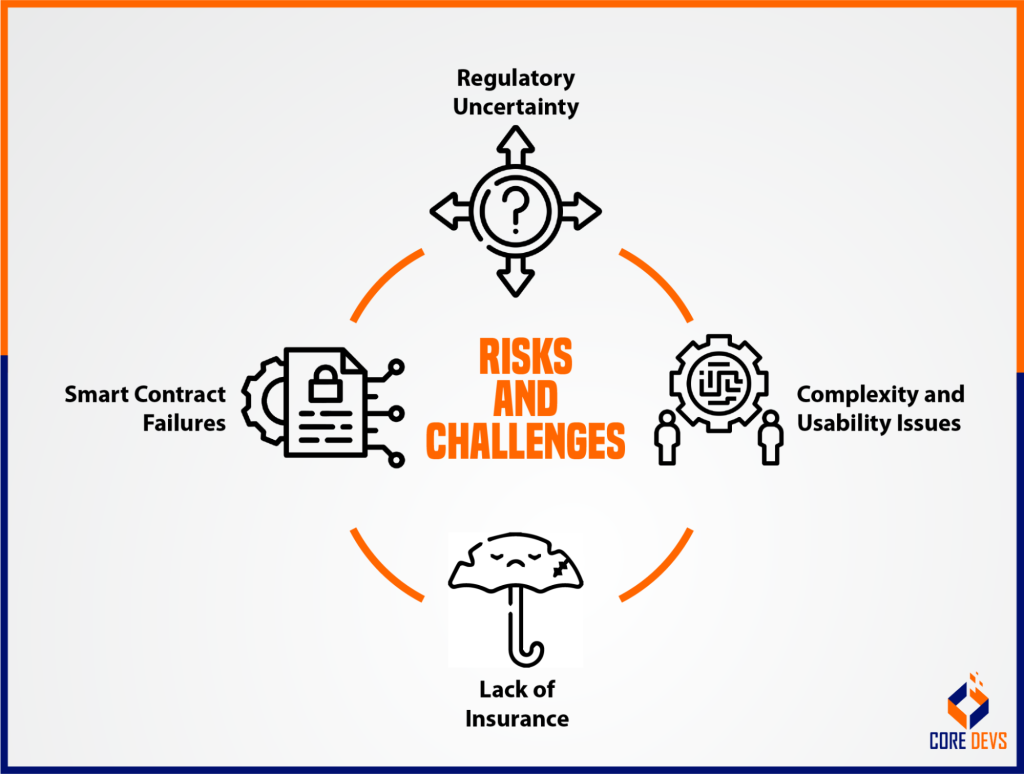
Risks and Challenges in DeFi

Common risks associated with DeFi investments 

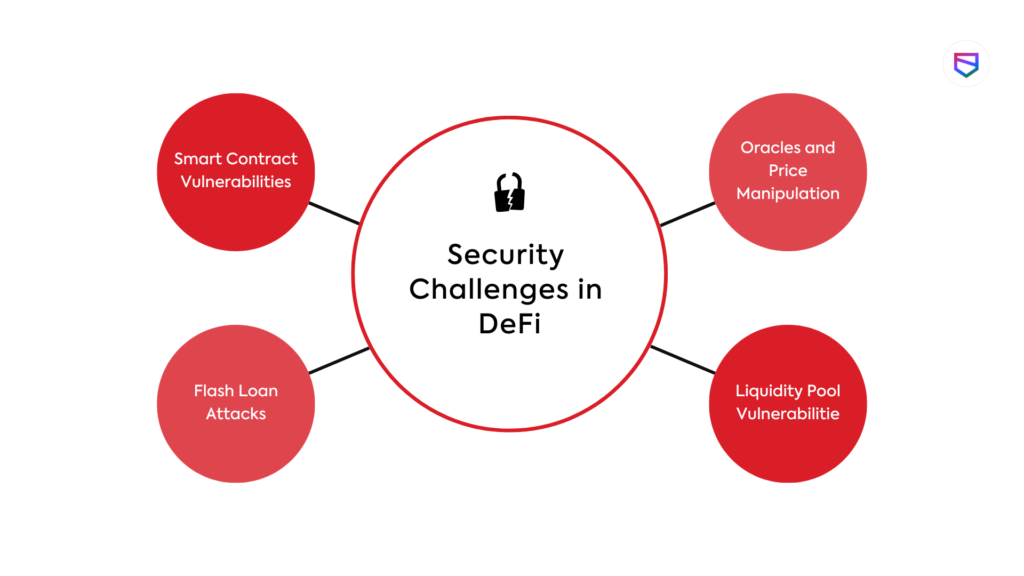
Regulatory and security challenges

Risks and Challenges in DeFi:

1. Smart Contract Vulnerabilities:

2. Liquidity Issues:

3. Market Volatility:

4. Lack of Consumer Protection:

5. Complexity and Accessibility:

Common Risks Associated with DeFi Investments:

1. Impermanent Loss:

2. Rug Pulls and Scams:

3. Flash Loan Attacks:

4. Oracle Manipulation:

5. Governance Risks:

Regulatory and Security Challenges in DeFi:

1. Lack of Regulatory Clarity:

2. Security Breaches and Hacks:

3. Cross-Border Regulations:

4. Risk of Centralization in DeFi:

5. KYC and AML Compliance:

Mitigating Risks in DeFi:

1. Do Thorough Research:

2. Diversify Investments:

3. Use Reputable Wallets and Secure Your Private Keys:

4. Start Small and Scale Up Gradually:

5. Stay Updated on Regulations:

Subscribe to our newsletter for the latest updates, trends, and insights—let’s navigate the world of Web3 together!


Source link

Ideogram 2.0: A Revolutionary AI Image Generator Compared to Flux Pro

0
Ideogram 2.0: A Revolutionary AI Image Generator Compared to Flux Pro


AI image generators have been launching at an incredible pace recently, but Ideogram 2.0 stands out as one worth trying. This new version not only excels in photorealism but also offers a seamless user experience, along with API access, which is currently in beta.

Why Ideogram 2.0 is a Game Changer

Ideogram 2.0 has a lot going for it, starting with its free-to-try model, which requires no coding skills. With its user-friendly interface, it’s an excellent choice for both beginners and experienced users. When compared to FLUX Pro, it’s clear that Ideogram 2.0 can match or even surpass other platforms in terms of photorealism.

What is the biggest selling point of Ideogram 2.0? Its ability to provide not just beautiful images but a range of “magic prompts”—suggestions generated by the AI that enhance and diversify your results. Plus, for those serious about scaling their projects, API access is now available in beta.

My First Experience with Ideogram 2.0

For my initial test, I used the following prompt:

Prompt: A still-life photo of a bowl of fruit with oranges, bananas, and grapes. This is for a Pinterest post promoting healthy eating.

The results? Ideogram 2.0 generated four 1:1 images, each beautifully rendered with detail and vibrancy. It didn’t stop there. Ideogram’s “magic prompts” feature offered enhanced suggestions based on my original input. The resulting images were impressive, showing just how well the platform can cater to specific visual needs.

Standout Features of Ideogram 2.0

1. Memes and Deep Fakes

One of the more unique features of Ideogram 2.0 is its ability to create memes and deep fakes, including images of famous personalities. I experimented with a prompt asking for an image of Kamala Harris and Donald Trump shaking hands, and the results were strikingly realistic. However, users are advised to proceed cautiously when creating such content.

2. Design Style — Accurate Fonts and Text on Images

A major issue with some AI generators, like DALL-E3, is poor-quality fonts and frequent spelling errors embedded in generated images. Ideogram 2.0 solves this issue with enhanced text accuracy, making it a fantastic tool for creating professional designs, whether you’re crafting social media posts, greeting cards, or even marketing assets.

Example Prompt:“Ideogram 2.0 is a Game Changer! Show that in bold white letters and create a stylish billboard ad. This should look enticing for a viral Medium post, with AI and robot imagery in the background.”

The result was clean and compelling, showcasing just how well Ideogram handles fonts and overall design aesthetic.

3. Color Palette Control

This feature allows users to create images that adhere to a specific color scheme, offering full control over visual tones. Whether you’re a designer working on brand consistency or an artist looking for a specific mood, this functionality is a massive advantage.

4. AI Upscaling

AI upscaling refers to enhancing an image’s resolution using AI technology. While this feature is only available in the premium version, it’s worth noting for anyone looking to improve low-resolution images or restore older photos. The potential here is huge, especially for those who work with images professionally.

Ideogram 2.0 API — Easy to Use but Requires Deposit

Ideogram 2.0’s API is simple to navigate and packed with code snippets for developers. However, a minimum deposit of $40 is required to access this feature, which might be a drawback for casual users. Still, this investment could be well worth it for businesses looking to integrate Ideogram’s powerful AI capabilities.

Example of Python Script:

import requests

response = requests.post(
“https://api.ideogram.ai/generate”,
headers={
“Api-Key”: “”,
“Content-Type”: “application/json”
},
json={
“image_request”: {
“prompt”: “A serene tropical beach scene…”,
“aspect_ratio”: “ASPECT_10_16”,
“model”: “V_2”,
“magic_prompt_option”: “AUTO”
}
},
)
print(response.json())

Premium Features and Membership Pricing

Ideogram 2.0 offers a free tier with daily credits, making it accessible to a wide range of users. However, premium features—such as image upscaling, more customization, and API usage—come with a cost. If you’re serious about using the platform for professional or commercial purposes, upgrading might be worth considering. The platform’s pricing is clear and competitive.

How to Get Started with Ideogram 2.0

Getting started is easy. Head to Ideogram.ai and sign up for a free account. With daily credits, you can test the waters and explore the platform without spending a dime. If you like what you see, upgrading to a premium plan unlocks even more features.

Final Thoughts: Ideogram 2.0 is a Must-Try for AI Image Generation

In the crowded world of AI image generators, Ideogram 2.0 truly stands out. Its combination of ease of use, rich features, and superior image quality make it a fantastic tool for creatives, marketers, and anyone interested in AI art. Whether you’re generating social media posts, professional designs, or exploring deepfakes and memes, Ideogram 2.0 has you covered.

While the API deposit may be a drawback for some, the overall capabilities of the platform make it a serious contender against other AI tools like Flux Pro and MidJourney. If you’re looking to integrate AI into your visual workflows, Ideogram 2.0 is definitely worth checking out.

FAQs

1. Is Ideogram 2.0 free to use?Yes, Ideogram 2.0 offers a free tier with daily credits that allow users to generate a limited number of images.

2. How does Ideogram 2.0 compare to Flux Pro and MidJourney?In terms of photorealism and ease of use, Ideogram 2.0 is on par with Flux Pro and MidJourney, with the added advantage of its “magic prompts” and improved text accuracy.

3. What is the “magic prompt” feature?The magic prompt feature provides AI-generated suggestions that build on your original prompt, enhancing the variety and quality of images produced.

4. Is the API easy to use?Yes, the API is developer-friendly, but a $40 minimum deposit is required to access it.

5. Can I create deep fakes and memes with Ideogram 2.0?Yes, Ideogram 2.0 allows you to create deep fakes and memes, but users should be mindful of the ethical implications of using such content.


Source link

AI is Boosting Developer Ranks Not Replacing Jobs: GitHub – Decrypt

0
AI is Boosting Developer Ranks Not Replacing Jobs: GitHub – Decrypt


You might think AI is coming for developers’ jobs—after all, AWS CEO Matt Garman predicted most developers won’t be coding within two years, and former Stability AI CEO Emad Mostaque gives programmers just five years.

But GitHub’s latest data tells a strikingly different story.

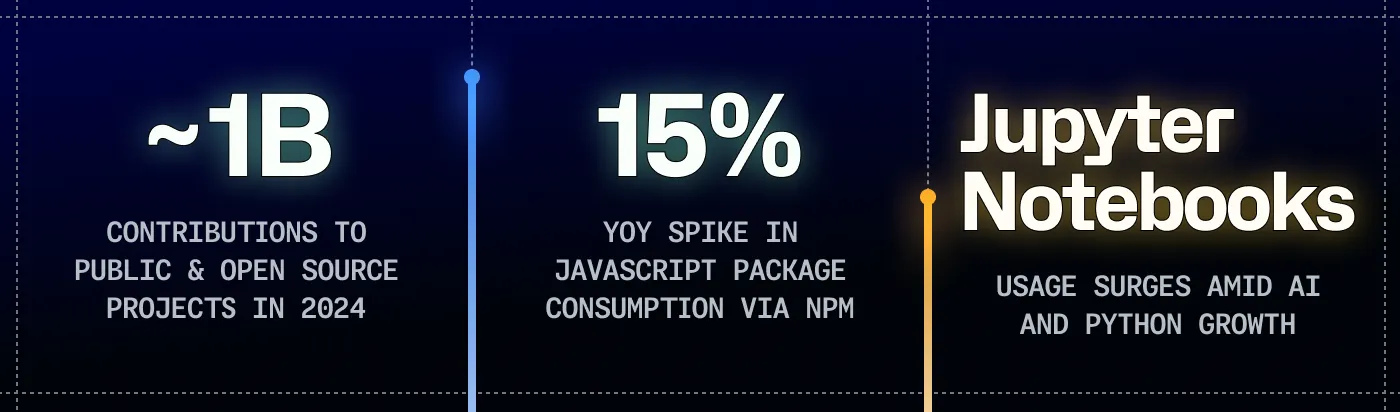
According to a recent report, developer activity hit unprecedented levels in 2024. Total projects on GitHub grew 25% year-over-year to 518 million, while contributions reached 5.2 billion.

More than one million open-source maintainers, students, and teachers now use GitHub Copilot at no cost.

“Our data also shows a lot more people are joining the global developer community,” Github’s report reads. “In the past year, more developers joined GitHub and engaged with open-source and public projects (in some cases, empowered by AI),”

The advent of AI is accelerating, not replacing, development, at least not right now.

The report shows developers created over 70,000 new generative AI projects in 2024, a 98% year-over-year increase. Public generative AI projects like home-assistant/core and Ollama (generative text) are drawing significant contributions, especially from newcomers.

This shift toward open-source AI development, rather than closed proprietary systems, is also critical to the evolution of AI technology.

The trend shows that AI development is becoming more transparent and collaborative rather than concentrated in a few large companies. This matters because open-source AI projects allow for public scrutiny of models, enable faster innovation through community contributions, and democratize access to AI technology—particularly crucial for developers in emerging markets who might otherwise be priced out of working with cutting-edge AI tools.

Python’s rise to the top spot over JavaScript marks a historic shift—the first such change since 2014.

This may not mean a lot by itself, but Python has gained significant traction, especially in fields like data science and machine learning. In contrast, Javascript is essential in areas like web development, so an increase in usage to the point of becoming the most popular language, may point to developers finding AI more profitable or attractive than working on web projects.

Notably, Jupyter Notebooks—open-source computing environments for users to run AI models and other programs—also increased in popularity this year.

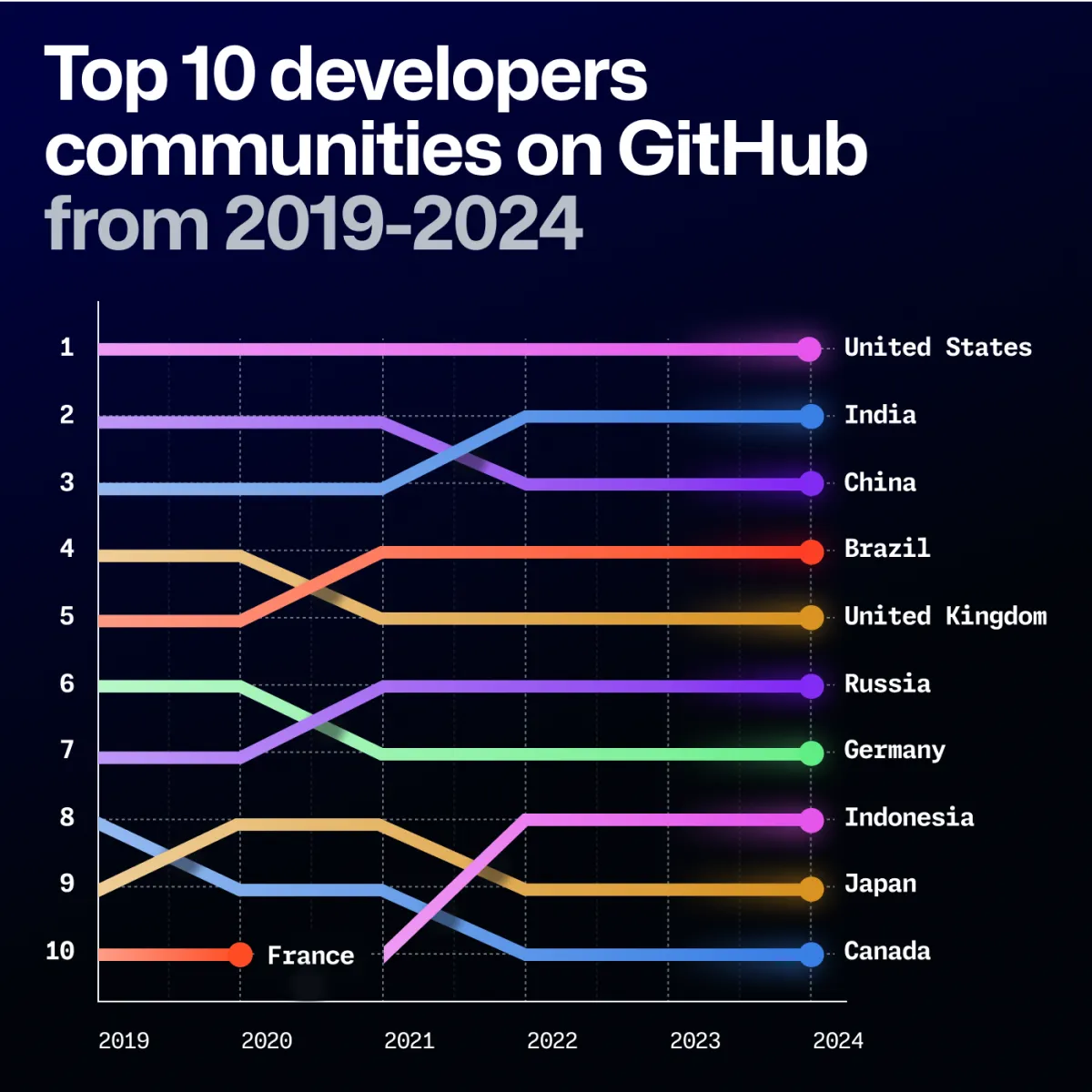
The transformation is global. India’s developer community is snowballing, and it’s projected to overtake the U.S. as the largest on GitHub by 2028. Notable growth occurred in regions outside North America and Europe, with Brazil, India, and Nigeria showing particularly strong momentum.

India saw a 95% increase in year-over-year contributions to generative AI projects, while France experienced a 70% boost. Emerging tech hubs like the Netherlands (291%), Ethiopia (242%), and Costa Rica (171%) showed major growth in AI project contributions.

But, if the report shows an exciting outlook, why are developers and other tech workers still wary about this technology?

The rapid adoption of AI, highlighted by McKinsey’s latest global study reporting a 72% AI adoption rate, may help understand the mixed feelings in the tech community.

Developers are concerned about being edged out by tools that simplify coding and automate repetitive tasks, and seeing how AI projects like those on GitHub’s platform grow; it’s easy to understand how fears of role displacement simmer beneath the excitement.

Elon Musk is also aware of these concerns, predicting an existential “crisis of meaning” as AI becomes capable of performing human jobs “better” than humans.

Speaking at the 2024 All-In Summit, Musk underscored a future where traditional roles may disappear, pushing humanity to redefine purpose in a world where tasks can be performed by AI.

Workers across industries are taking proactive steps to protect themselves as AI reshapes job roles. Many are turning to unions and collective bargaining to ensure safeguards are in place, as seen in the entertainment industry, where unions like SAG-AFTRA have pushed back against unchecked AI use in creative fields.

There’s also a surge in demand for “AI literacy” training programs, which aim to help workers across sectors understand and work alongside AI tools rather than be replaced by them.

While concerns are valid—the World Economic Forum estimates that AI will wipe 85 million jobs out of existence—GitHub’s data suggests that the dystopian AI-powered future is not upon us yet, and instead of replacing developers, AI appears to be empowering them to shape the future of tech on their own terms.

Edited by Sebastian Sinclair and Josh Quittner

Generally Intelligent Newsletter

A weekly AI journey narrated by Gen, a generative AI model.


Source link

Understanding the System 2 Model: OpenAI’s New Approach to LLM Reasoni

0
Understanding the System 2 Model: OpenAI’s New Approach to LLM Reasoni


OpenAI recently launched two new models, OpenAI o1-preview and OpenAI o1-mini, representing a significant step forward in large language models (LLMs). These models are being hailed as the first commercial implementations of “System 2” reasoning models, a concept that contrasts with the traditional “System 1” AI models we’ve been using since the release of ChatGPT in 2022. But what exactly is a System 2 model, and how does it differ from System 1? This article dives into the techniques, concepts, and innovations behind this new wave of reasoning-based AI.

What Is the System 2 Model?

The idea of System 1 and System 2 thinking originates from Daniel Kahneman’s 2011 book Thinking, Fast and Slow. System 1 refers to fast, intuitive thinking, while System 2 involves slower, more deliberate, and analytical thinking. Similarly, in AI, System 1 models respond quickly to prompts based on learned patterns, whereas System 2 models engage in more thoughtful, step-by-step reasoning.

Until now, most of the AI models we have interacted with fall into the System 1 category, offering immediate responses based on previous training. System 2 models, like the new OpenAI o1, are designed to break down complex tasks, analyze different scenarios, and deliver more reasoned responses—mimicking a more human-like reasoning process.

The Shift from System 1 to System 2 in AI

When OpenAI launched ChatGPT in November 2022, it quickly became clear that AI models could handle a wide variety of tasks but often struggled with more complex, multi-step problems. System 1 models are excellent for straightforward queries, but tasks that require deeper analysis have often been challenging.

System 2 models, by contrast, approach problems methodically. They break tasks into smaller steps, assess different approaches, and evaluate outcomes before delivering a final response. This transition from reactive to deliberate problem-solving can revolutionize how AI handles more nuanced, never-before-seen problems.

Key Concepts Behind System 2 Models

1. Chain of Thought (CoT) Reasoning

The foundation of System 2 models lies in their ability to use Chain of Thought (CoT) reasoning. This involves generating intermediate steps before arriving at a final answer, helping the model process complex problems more effectively. This approach, popularized by papers such as Chain-of-Thought Prompting Elicits Reasoning in Large Language Models (2022), allows the model to reason through a problem, much like a human would break down a difficult question.

2. Tree of Thoughts

Another technique integrated into System 2 models is the Tree of Thoughts (2023). This method expands on the CoT approach by exploring multiple paths of reasoning simultaneously. The model can evaluate different strategies in parallel, selecting the most promising path based on logical outcomes.

3. Branch-Solve-Merge (BSM)

A more recent innovation is the Branch-Solve-Merge (2023) technique. This allows the model to branch off into different potential solutions, work through each one, and then merge the best elements to form a final, optimized solution.

4. System 2 Attention

System 2 Attention is another key aspect of these models. While traditional models use attention mechanisms to focus on important words or tokens in a prompt, System 2 models pay attention to the most critical steps in a reasoning process. By weighing certain reasoning paths more heavily, these models can make more informed decisions throughout the problem-solving process.

What Are Reasoning Tokens?

One of the biggest breakthroughs in System 2 models is the introduction of reasoning tokens. These tokens serve as a guide for the AI, directing it through each step of the reasoning process. Rather than simply responding to a prompt, the model uses these tokens to think through a problem more thoroughly.

Types of Reasoning Tokens

There are several types of reasoning tokens used in System 2 models, each designed for a specific purpose:

Self-Reasoning Tokens: These tokens help the model reason about the problem by itself, almost like a self-guided brainstorming session.

Planning Tokens: These tokens help the model plan out its steps in advance, ensuring that it follows a logical path toward solving the problem.

Examples of reasoning tokens might include commands like <Analyze_Problem>, <Generate_Hypothesis>, <Evaluate_Evidence>, and <Draw_Conclusion>. These tokens are invisible to the user but are crucial in guiding the AI through a complex reasoning process.

System 2 models often generate intermediate outputs or temporary conclusions during reasoning. These outputs allow the model to assess its progress before giving a final answer. However, these intermediate steps are removed before the user sees the final output. This behind-the-scenes reasoning process makes System 2 models capable of solving more intricate problems than their System 1 predecessors.

The Role of Reinforcement Learning (RL)

OpenAI has also integrated Reinforcement Learning (RL) into its System 2 models. RL helps the model focus on the most promising reasoning paths while avoiding less fruitful ones. By continuously learning from its mistakes, the model improves over time, improving at solving complex problems with each iteration.

This learning mechanism allows the AI to excel at tasks involving uncertainty or long-term planning—areas where traditional models tend to falter. RL ensures that the model doesn’t waste resources exploring unproductive paths and instead zeroes in on the best solutions faster.

Decision Gates: Ensuring Thoughtful Responses

System 2 models also use Decision Gates, which act as checkpoints during the reasoning process. These gates determine whether the model has engaged in sufficient reasoning before responding. If the reasoning is incomplete, the model continues to process the task until a satisfactory solution is found.

How System 2 Models Excel at Complex Tasks

Thanks to their CoT reasoning, planning tokens, and reinforcement learning techniques, System 2 models are particularly well-suited for complex, never-seen-before tasks. For example, deciphering ancient texts or installing a Wi-Fi network in a large stadium can be broken down into manageable steps by using specialized reasoning tokens.

Example: Deciphering Corrupted Texts

In a scenario where a System 2 model is tasked with deciphering a corrupted text, the reasoning tokens might include:

<analyze_script>: Directs the model to analyze the text’s structure.

<identify_patterns>: Guides the model in looking for recurring themes or patterns.

<cross_reference>: Prompts the model to compare the corrupted text with known texts.

These tokens help the model approach the task step-by-step, just as a human expert would.

System 2 in Action: Complex Wi-Fi Installations

Similarly, when designing a Wi-Fi installation in a complex environment like a stadium, the model could use tokens like:

<Analyze_Environment>: To understand the stadium’s layout.

<Determine_AP_Locations>: To decide the best places to install access points.

<Simulate_Traffic>: To simulate a full stadium and assess Wi-Fi performance.

By simulating different scenarios and solutions, the model ensures that the final outcome is optimized for real-world conditions.

Conclusion: The Future of AI with System 2 Models

System 2 models represent a major leap forward in AI capabilities, offering a new level of reasoning and problem-solving that traditional models couldn’t achieve. These models can tackle more complex, multi-step tasks with greater accuracy by utilizing techniques like Chain of Thought reasoning, reinforcement learning, and planning tokens. Although System 2 AI is still evolving, its potential to reshape industries like engineering, science, and data analysis is undeniable.

FAQs

What is the difference between System 1 and System 2 models?

System 1 models provide immediate, intuitive responses, while System 2 models engage in slower, more deliberate reasoning processes.

What are reasoning tokens in System 2 AI?

Reasoning tokens guide the model through each step of solving complex problems, breaking down tasks into smaller, manageable steps.

How does reinforcement learning improve System 2 models? Reinforcement learning helps the model focus on the most promising reasoning paths, learning from mistakes to improve over time.

What are Decision Gates in System 2 models?

Decision Gates ensure that the model has completed sufficient reasoning before delivering a final response.

How does the Chain of Thought technique help System 2 models?

Chain of Thought allows the model to break down complex tasks into intermediate steps, enabling a more thorough and reasoned approach.


Source link

Hyperledger Web3j: HSM support for AWS KMS

0
Hyperledger Web3j: HSM support for AWS KMS


In the world of digital security, protecting sensitive data with robust encryption is essential. AWS Key Management Service (KMS) plays a crucial role in this space. It serves as a highly secure, fully managed service for creating and controlling cryptographic keys. What many may not realize is that AWS KMS itself operates as a Hardware Security Module (HSM), offering the same level of security you’d expect from dedicated hardware solutions.

An HSM is a physical device designed to securely generate, store, and manage encryption keys, and AWS KMS delivers this functionality in a cloud-native way. Beyond key management, AWS KMS with HSM support can also be used to sign cryptographic transactions. This provides a trusted, hardware-backed way to secure blockchain interactions, digital signatures, and more. This article will cover  how AWS KMS functions as an HSM, the benefits of using it to sign crypto transactions, and how it fits into a broader security strategy.

In Hyperledger Web3j, support for HSM was introduced two years ago, providing users with a secure method for managing cryptographic keys. For more details, you can refer to the official documentation.

However, despite this integration, many users have encountered challenges in adopting and implementing HSM interfaces, particularly when using the AWS KMS module. To address these difficulties, a ready-to-use implementation has been added specifically for AWS KMS HSM support. This simplifies the integration process, making it easier for users to leverage AWS KMS for secure transaction signing without the complexity of manual configurations.

The class, HSMAwsKMSRequestProcessor, is an implementation of the HSMRequestProcessor interface, which is responsible for facilitating interaction with an HSM. This newly implemented class contains all the essential code required to communicate with AWS KMS, enabling the retrieval of data signed with the correct cryptographic signature. It simplifies the process of using AWS KMS as an HSM by handling the intricacies of signature generation and ensuring secure transaction signing without additional development overhead.

Here is a snippet with the most important actions of the callHSM method:


@Override
public Sign.SignatureData callHSM(byte[] dataToSign, HSMPass pass) {

// Create the SignRequest for AWS KMS
var signRequest =
SignRequest.builder()
.keyId(keyID)
.message(SdkBytes.fromByteArray(dataHash))
.messageType(MessageType.DIGEST)
.signingAlgorithm(SigningAlgorithmSpec.ECDSA_SHA_256)
.build();

// Sign the data using AWS KMS
var signResult = kmsClient.sign(signRequest);
var signatureBuffer = signResult.signature().asByteBuffer();

// Convert the signature to byte array
var signBytes = new byte[signatureBuffer.remaining()];
signatureBuffer.get(signBytes);

// Verify signature osn KMS
var verifyRequest =
VerifyRequest.builder()
.keyId(keyID)
.message(SdkBytes.fromByteArray(dataHash))
.messageType(MessageType.DIGEST)
.signingAlgorithm(SigningAlgorithmSpec.ECDSA_SHA_256)
.signature(SdkBytes.fromByteArray(signBytes))
.build();

var verifyRequestResult = kmsClient.verify(verifyRequest);
if (!verifyRequestResult.signatureValid()) {
throw new RuntimeException(“KMS signature is not valid!”);
}

var signature = CryptoUtils.fromDerFormat(signBytes);
return Sign.createSignatureData(signature, pass.getPublicKey(), dataHash);
}

NOTE!

In order to use this properly, the type of key spec created in AWS KMS must be ECC_SECG_P256K1. This is specific to the crypto space, especially to EVM. Using any other key will result in a mismatch error when the  data signature is created.

Example

Here is a short example of how to call the callHSM method from the library:

public static void main(String[] args) throws Exception {
KmsClient client = KmsClient.create();

// extract the KMS key
byte[] derPublicKey = client
.getPublicKey((var builder) -> {
builder.keyId(kmsKeyId);
})
.publicKey()
.asByteArray();
byte[] rawPublicKey = SubjectPublicKeyInfo
.getInstance(derPublicKey)
.getPublicKeyData()
.getBytes();

BigInteger publicKey = new BigInteger(1, Arrays.copyOfRange(rawPublicKey, 1, rawPublicKey.length));

HSMPass pass = new HSMPass(null, publicKey);

HSMRequestProcessor signer = new HSMAwsKMSRequestProcessor(client, kmsKeyId);
signer.callHSM(data, pass);
}

Conclusion

AWS KMS, with its built-in HSM functionality, offers a powerful solution for securely managing and signing cryptographic transactions. Despite initial challenges faced by users in integrating AWS KMS with Hyperledger Web3j, the introduction of the HSMAwsKMSRequestProcessor class has made it easier to adopt and implement. This ready-to-use solution simplifies interactions with AWS KMS, allowing users to securely sign data and transactions with minimal configuration. By leveraging this tool, organizations can enhance their security posture while benefiting from the convenience of AWS’s cloud-native HSM capabilities.


Source link

Popular Posts

My Favorites

A First from Xiaomi: Publicly Available AI Model “MiMo-7B” Announced

Chinese tech giant Xiaomi has made a significant move by announcing its first open-source artificial intelligence language model, called “MiMo-7B.” The model, which...
a

Winter in Black & White Mood