Web3

Home Web3 Page 166

How Does Blockchain Work? A Beginner’s Guide – Nextrope – Your Trusted Partner for Blockchain Development and Advisory Services

0
How Does Blockchain Work? A Beginner’s Guide – Nextrope – Your Trusted Partner for Blockchain Development and Advisory Services


Introduction

Web3 backend development is essential for building scalable, efficient and decentralized applications (dApps) on EVM-compatible blockchains like Ethereum, Polygon, and Base. A robust Web3 backend enables off-chain computations, efficient data management and better security, ensuring seamless interaction between smart contracts, databases and frontend applications.

Unlike traditional Web2 applications that rely entirely on centralized servers, Web3 applications aim to minimize reliance on centralized entities. However, full decentralization isn’t always possible or practical, especially when it comes to high-performance requirements, user authentication or storing large datasets. A well-structured backend in Web3 ensures that these limitations are addressed, allowing for a seamless user experience while maintaining decentralization where it matters most.

Furthermore, dApps require efficient backend solutions to handle real-time data processing, reduce latency, and provide smooth user interactions. Without a well-integrated backend, users may experience delays in transactions, inconsistencies in data retrieval, and inefficiencies in accessing decentralized services. Consequently, Web3 backend development is a crucial component in ensuring a balance between decentralization, security, and functionality.

This article explores:

When and why Web3 dApps need a backend

Why not all applications should be fully on-chain

Architecture examples of hybrid dApps

A comparison between APIs and blockchain-based logic

This post kicks off a Web3 backend development series, where we focus on the technical aspects of implementing Web3 backend solutions for decentralized applications.

Why Do Some Web3 Projects Need a Backend?

Web3 applications seek to achieve decentralization, but real-world constraints often necessitate hybrid architectures that include both on-chain and off-chain components. While decentralized smart contracts provide trustless execution, they come with significant limitations, such as high gas fees, slow transaction finality, and the inability to store large amounts of data. A backend helps address these challenges by handling logic and data management more efficiently while still ensuring that core transactions remain secure and verifiable on-chain.

Moreover, Web3 applications must consider user experience. Fully decentralized applications often struggle with slow transaction speeds, which can negatively impact usability. A hybrid backend allows for pre-processing operations off-chain while committing final results to the blockchain. This ensures that users experience fast and responsive interactions without compromising security and transparency.

While decentralization is a core principle of blockchain technology, many dApps still rely on a Web2-style backend for practical reasons:

1. Performance & Scalability in Web3 Backend Development

Smart contracts are expensive to execute and require gas fees for every interaction.

Offloading non-essential computations to a backend reduces costs and improves performance.

Caching and load balancing mechanisms in traditional backends ensure smooth dApp performance and improve response times for dApp users.

Event-driven architectures using tools like Redis or Kafka can help manage asynchronous data processing efficiently.

2. Web3 APIs for Data Storage and Off-Chain Access

Storing large amounts of data on-chain is impractical due to high costs.

APIs allow dApps to store & fetch off-chain data (e.g. user profiles, transaction history).

Decentralized storage solutions like IPFS, Arweave and Filecoin can be used for storing immutable data (e.g. NFT metadata), but a Web2 backend helps with indexing and querying structured data efficiently.

3. Advanced Logic & Data Aggregation in Web3 Backend

Some dApps need complex business logic that is inefficient or impossible to implement in a smart contract.

Backend APIs allow for data aggregation from multiple sources, including oracles (e.g. Chainlink) and off-chain databases.

Middleware solutions like The Graph help in indexing blockchain data efficiently, reducing the need for on-chain computation.

4. User Authentication & Role Management in Web3 dApps

Many applications require user logins, permissions or KYC compliance.

Blockchain does not natively support session-based authentication, requiring a backend for handling this logic.

Tools like Firebase Auth, Auth0 or Web3Auth can be used to integrate seamless authentication for Web3 applications.

5. Cost Optimization with Web3 APIs

Every change in a smart contract requires a new audit, costing tens of thousands of dollars.

By handling logic off-chain where possible, projects can minimize expensive redeployments.

Using layer 2 solutions like Optimism, Arbitrum and zkSync can significantly reduce gas costs.

Web3 Backend Development: Tools and Technologies

A modern Web3 backend integrates multiple tools to handle smart contract interactions, data storage, and security. Understanding these tools is crucial to developing a scalable and efficient backend for dApps. Without the right stack, developers may face inefficiencies, security risks, and scaling challenges that limit the adoption of their Web3 applications.

Unlike traditional backend development, Web3 requires additional considerations, such as decentralized authentication, smart contract integration, and secure data management across both on-chain and off-chain environments.

Here’s an overview of the essential Web3 backend tech stack:

1. API Development for Web3 Backend Services

Node.js is the go-to backend runtime good for Web3 applications due to its asynchronous event-driven architecture.

NestJS is a framework built on top of Node.js, providing modular architecture and TypeScript support for structured backend development.

2. Smart Contract Interaction Libraries for Web3 Backend

Ethers.js and Web3.js are TypeScript/JavaScript libraries used for interacting with Ethereum-compatible blockchains.

3. Database Solutions for Web3 Backend

PostgreSQL: Structured database used for storing off-chain transactional data.

MongoDB: NoSQL database for flexible schema data storage.

Firebase: A set of tools used, among other things, for user authentication.

The Graph: Decentralized indexing protocol used to query blockchain data efficiently.

4. Cloud Services and Hosting for Web3 APIs

When It Doesn’t Make Sense to Go Fully On-Chain

Decentralization is valuable, but it comes at a cost. Fully on-chain applications suffer from performance limitations, high costs and slow execution speeds. For many use cases, a hybrid Web3 architecture that utilizes a mix of blockchain-based and off-chain components provides a more scalable and cost-effective solution.

In some cases, forcing full decentralization is unnecessary and inefficient. A hybrid Web3 architecture balances decentralization and practicality by allowing non-essential logic and data storage to be handled off-chain while maintaining trustless and verifiable interactions on-chain.

The key challenge when designing a hybrid Web3 backend is ensuring that off-chain computations remain auditable and transparent. This can be achieved through cryptographic proofs, hash commitments and off-chain data attestations that anchor trust into the blockchain while improving efficiency.

For example, Optimistic Rollups and ZK-Rollups allow computations to happen off-chain while only submitting finalized data to Ethereum, reducing fees and increasing throughput. Similarly, state channels enable fast, low-cost transactions that only require occasional settlement on-chain.

A well-balanced Web3 backend architecture ensures that critical dApp functionalities remain decentralized while offloading resource-intensive tasks to off-chain systems. This makes applications cheaper, faster and more user-friendly while still adhering to blockchain’s principles of transparency and security.

Example: NFT-based Game with Off-Chain Logic

Imagine a Web3 game where users buy, trade and battle NFT-based characters. While asset ownership should be on-chain, other elements like:

Game logic (e.g., matchmaking, leaderboard calculations)

User profiles & stats

Off-chain notifications

can be handled off-chain to improve speed and cost-effectiveness.

Architecture Diagram

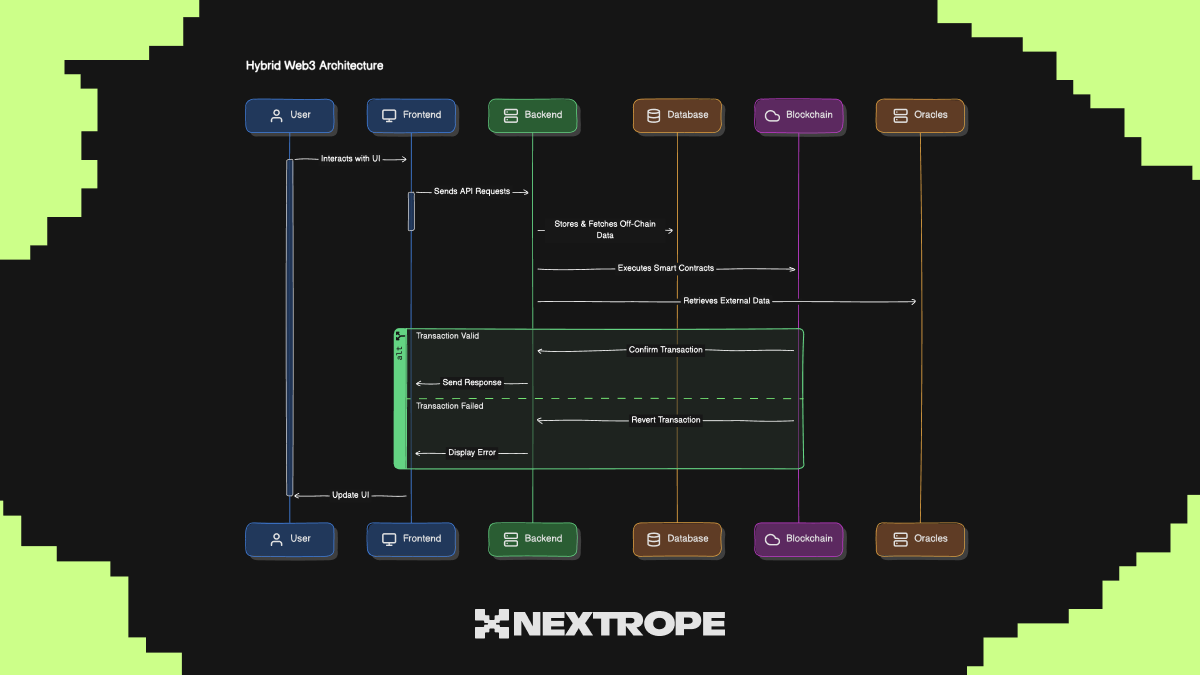
Below is an example diagram showing how a hybrid Web3 application splits responsibilities between backend and blockchain components.

Hybrid Web3 Architecture

Comparing Web3 Backend APIs vs. Blockchain-Based Logic

FeatureWeb3 Backend (API)Blockchain (Smart Contracts)Change ManagementCan be updated easilyEvery change requires a new contract deploymentCostTraditional hosting feesHigh gas fees + costly auditsData StorageCan store large datasetsLimited and expensive storageSecuritySecure but relies on centralized infrastructureFully decentralized & trustlessPerformanceFast response timesLimited by blockchain throughput

Reducing Web3 Costs with AI Smart Contract Audit

One of the biggest pain points in Web3 development is the cost of smart contract audits. Each change to the contract code requires a new audit, often costing tens of thousands of dollars.

To address this issue, Nextrope is developing an AI-powered smart contract auditing tool, which:

Reduces audit costs by automating code analysis.

Speeds up development cycles by catching vulnerabilities early.

Improves security by providing quick feedback.

This AI-powered solution will be a game-changer for the industry, making smart contract development more cost-effective and accessible.

Conclusion

Web3 backend development plays a crucial role in scalable and efficient dApps. While full decentralization is ideal in some cases, many projects benefit from a hybrid architecture, where off-chain components optimize performance, reduce costs and improve user experience.

In future posts in this Web3 backend series, we’ll explore specific implementation details, including:

How to design a Web3 API for dApps

Best practices for integrating backend services

Security challenges and solutions

Stay tuned for the next article in this series!


Source link

Stunning Aberdeen Home Listed by Love Pines Realty | Web3Wire

0
Stunning Aberdeen Home Listed by Love Pines Realty | Web3Wire


385 Shepherd Trail Property Is Now Available for SaleMarch 13, 2025 – Real Estate Agent Jennifer L Carlson is pleased to present 385 Shepherd trail for sale. The adorable modern ranch home is positioned conveniently in Aberdeen on NC 5. Very close to a popular franchise of restaurants and shopping stores. Less than 3 miles from the downtown Main Street in Aberdeen. Approximately six miles to the popular Village of Pinehurst. Close proximity to Fort Bragg Military base… Call Jennifer L Carlson to schedule an appointment to see this home for sale in Aberdeen.

Image: https://www.abnewswire.com/upload/2025/03/e64eeb43f4d0883416f9ff9ce9348494.jpg

The home for sale at 385 Shepherd Trail is situated in friendly neighborhood. Excellent curb appeal with the ideal backyard for watching your pup play, or starting your very first garden! This home is just over 1500 square feet. Feels much larger due to the vaulted ceiling in the living room. This home encompasses 3 bedrooms, 2 full baths. The owners suite bathroom offers a sizeable garden tub that could be used to sooth your achy muscles… A glass of wine? With a good book in hand? The home has updated lighting, neutral paint colors, and has been well maintained. The backyard feels incredibly private overlooking wooded green space. In the mornings enjoy a peaceful cup of coffee off the back patio. You will fall in love with this move in ready home in Moore County, North Carolina.

Open House on Sunday March 16th from 12:00pm – 3:00pm

Aberdeen, North Carolina the quaint little railroad town “Anchored by a thriving arts community with diverse musical venues, Downtown Aberdeen is now on track as a regional destination for home decor and design, and an uncommon collection of creative entrepreneurs offering specialty retail and services. Downtown Aberdeen is a place of opportunity for all ages.” (http://www.downtownaberdeen.net)

Image: https://www.abnewswire.com/upload/2025/03/596f2893779e6e2be84a6d7006ac11ee.jpg

The town of Aberdeen encourages citizens to get involved, open a business, join a board, become part of the community. Military personnel will find they’re close enough to commute to Fort Bragg, but far enough away for their local coffee shop barista to remember their name. Aberdeen is convenient to Uwharrie National Forest, or day trips to the beach or the mountains.

‘Love Pines Realty services all areas surrounding Ft Bragg North Carolina, including Southern Pines, Pinehurst, Whispering Pines, Carthage, Aberdeen, West End, Pinebluff, Vass, Cameron, Sanford, Fayetteville, & Raeford.

For more information, please visit: https://www.lovepines.com

Media ContactCompany Name: Love Pines RealtyContact Person: Jennifer L Carlson – Owner, Broker, RealtorEmail:Send Email [https://www.abnewswire.com/email_contact_us.php?pr=stunning-aberdeen-home-listed-by-love-pines-realty]City: PinehurstState: North CarolinaCountry: United StatesWebsite: https://www.lovepines.com

Legal Disclaimer: Information contained on this page is provided by an independent third-party content provider. ABNewswire makes no warranties or responsibility or liability for the accuracy, content, images, videos, licenses, completeness, legality, or reliability of the information contained in this article. If you are affiliated with this article or have any complaints or copyright issues related to this article and would like it to be removed, please contact retract@swscontact.com

This release was published on openPR.

About Web3Wire Web3Wire – Information, news, press releases, events and research articles about Web3, Metaverse, Blockchain, Artificial Intelligence, Cryptocurrencies, Decentralized Finance, NFTs and Gaming. Visit Web3Wire for Web3 News and Events, Block3Wire for the latest Blockchain news and Meta3Wire to stay updated with Metaverse News.


Source link

The Economics of Renting Cloud GPUs: A Comprehensive Breakdown

0
The Economics of Renting Cloud GPUs: A Comprehensive Breakdown


With global cloud computing spending projected to soar to $1.35 trillion by 2027, businesses and individuals increasingly rely on cloud solutions. Within this landscape, cloud GPUs have become a major area of investment, particularly for AI, machine learning, and high-performance computing (HPC).

The demand for GPU as a Service (GPUaaS) has fueled a massive market expansion. Valued at $3.23 billion in 2023, the GPUaaS market is expected to reach $49.84 billion by 2032. AI research, deep learning applications, and high-performance computational workloads drive this growth.

However, is renting cloud GPUs the most cost-effective solution for businesses? Understanding cloud GPUs’ financial implications, use cases, and cost structures is crucial for making informed decisions.

This article explores the economics of renting cloud GPUs, comparing different pricing models, discussing cost-saving strategies, and analyzing real-world scenarios to help you optimize your cloud computing budget.

When Should You Rent a Cloud GPU?

Cloud GPUs provide numerous advantages but are not always the right fit. Before committing to a cloud GPU rental, it’s essential to understand when it makes the most sense. Here are key scenarios where renting a cloud GPU is beneficial:

1. Short-Term Projects and Peak Demand

Project-Based Workloads: Renting is more practical than investing in expensive hardware if your project requires high GPU power for a limited time—such as training AI models, rendering 3D animations, or running simulations. If your GPU usage fluctuates, cloud GPUs can scale up when demand is high and down when resources are no longer needed. This eliminates the inefficiency of idle hardware.

2. Experimentation and Innovation

Testing New Technologies: Cloud GPUs allow businesses and researchers to experiment with different GPU architectures without incurring large upfront costs. This is crucial for AI research, game development, and other exploratory projects. If you are unsure whether an AI or ML model will be viable, renting cloud GPUs allows you to test your ideas before investing in expensive on-premise infrastructure.

3. Accessibility and Collaboration

Democratizing Access to High-Performance GPUs: Not all organizations can afford high-end GPUs. Cloud services provide access to powerful GPU resources for startups, researchers, and developers. With cloud-based GPU computing, team members can work on shared resources, collaborate on machine learning projects, and access data remotely from anywhere.

4. Reduced IT Overhead

No Hardware Maintenance: Cloud providers handle GPU maintenance, software updates, and security patches, allowing your team to focus on core tasks. Cloud GPUs eliminate the need for physical data centers, reducing space, cooling systems, and power consumption costs.

5. Cost-Effectiveness for Specialized Workloads

Tailored GPU Instances: Many providers offer optimized GPU instances for specific workloads, such as deep learning or scientific computing. These options provide better performance at a lower cost than general-purpose GPUs.

By analyzing these factors, businesses can determine whether cloud GPU rental is a strategic choice that aligns with their financial and operational goals.

Understanding the Cost of Renting Cloud GPUs

Renting a cloud GPU is not just about the hourly rental price—other factors influence the total cost of ownership (TCO), including workload requirements, pricing models, storage, and data transfer fees. Let’s examine the key cost components.

1. Hourly vs. Reserved Pricing (Including Bare Metal and Clusters)

On-Demand Instances: Many cloud providers offer pay-as-you-go pricing, which is ideal for short-term projects. For instance, renting an NVIDIA RTX 4090 on Spheron Network (Secure) costs $0.31 / hr. Best for: Users with unpredictable workloads who need flexibility.

Reserved Instances: Reserved instances can save you 40–60% compared to on-demand pricing, if you require GPUs for extended periods. They are best for Long-term AI model training, HPC workflows, and large-scale simulations.

Bare Metal Servers: Bare metal servers provide superior performance without virtualization overhead for applications that require dedicated resources and full control. For example, renting a bare metal server with 8 NVIDIA RTX 4090 (Secure) GPUs costs $2.48 /hr and 8 NVIDIA RTX 6000-ADA (Secure) costs $7.20 /hr on Spheron Network. They are best for Real-time AI inference, large-scale rendering, and performance-sensitive applications.

GPU Clusters: GPU clusters offer high scalability for enterprises conducting parallel processing or large-scale deep learning training. Best for: Distributed AI training and large-scale computational tasks.

2. Pricing by GPU Type

Not all GPUs are priced equally. The cost of renting a GPU depends on its capabilities. High-end models like NVIDIA H200 or H100 cost significantly more than older models like the V100 or A4000. Matching the right GPU to your workload is essential to prevent overpaying for unnecessary performance.

3. Storage and Data Transfer Costs

Beyond GPU rental, cloud providers charge for:

Storage: Storing 1TB of training data can cost $5 per month for standard storage, but SSD options cost more.

Data Transfer Fees: Transferring large datasets between cloud regions can add significant expenses.

4. Hidden Costs to Watch For

Assessing your needs and considering scenarios like the one above can help you make smarter decisions about renting cloud GPUs. Let’s look at a real-world example to understand potential costs and how to save money.

Case Study: Cost Breakdown of AI Model Training

When planning an AI model training project, the first thought that often comes to mind is: “Let’s do it on‑premise!” In this case study, we’ll walk through the cost breakdown of building an on‑premise system for training AI models. We’ll begin by looking at the more cost‑efficient NVIDIA V100 GPUs.

Suppose a company needs to train a deep learning model for computer vision. They require 8x NVIDIA V100 GPUs for 30 days. Here’s how the costs:

On‑Premise Cost Breakdown Using NVIDIA V100 GPUs

Not every training workload requires the absolute highest-end hardware. For many AI inference and moderate training workloads, an on-premise system with 8x NVIDIA V100 GPUs can be a viable choice. Here’s a breakdown of the estimated costs:

ComponentEstimated Price (USD)Notes

8 × NVIDIA V100 GPUs$24,000Approximately $3,000 per GPU (used market)

Compute (CPUs Cost)$30,000High-performance CPUs for parallel processing

1TB SSD Storage$1,200High-end NVMe drives

Motherboard$10,000+Specialized board for multi-GPU configurations

RAM$10,000 – $18,0002TB+ of high-speed DDR5 RAM (can be lower for some workloads)

NVSwitch$10,000+Required for NVLink-enabled V100 clusters (higher bandwidth)

Power Supply$5,000 – $8,000Higher power consumption (~250W per V100)

Cooling$5,000+More aggressive cooling needed compared to V100 (liquid cooling preferred)

Chassis$6,000+Specialized high-density GPU chassis

Networking$2,500+High-bandwidth networking cards (100GbE or faster)

Software & Licensing$6,000+OS, drivers, and specialized AI software

Total Cost Estimate$109,700 – $134,700+Higher than L4-based setups due to increased power and cooling needs

After this high-investment project, the Project can think it can recover the investment. One strategy to recover some of the capital investment for an on‑premise system is to resell the hardware on the aftermarket. However, for AI accelerators, the resale market often only returns a fraction of the original cost. For example, second‑hand NVIDIA GPUs might fetch only 40–60% of their new price, depending on market conditions and the hardware’s condition.

If the resale value isn’t sufficient—if you’re unable to find buyers at your target price—the hardware could end up sitting idle (or “going to dust”), locking away capital and risking obsolescence.

These challenges—high upfront costs, rapid depreciation, and idle hardware risk—drive many organizations toward cloud-based AI compute services. To understand this better, let’s compare the cloud compute platforms costs side by side.

8x NVIDIA V100 GPU Rent Cost Breakdown

ProviderPrice per Hour (1x V100)Price per Hour (8x V100s)Price per DayPrice per Month (30 Days)

Google$4.69$37.52$900.48$27,014.40

Amazon$3.76$30.08$721.92$21,657.60

CoreWeave$1.02$8.16$195.84$5,875.20

RunPod$0.23$1.84$44.16$1,324.80

Spheron$0.10$0.80$19.20$576.00

Spheron Network remains the most affordable option, being 47x cheaper than Google and 37x cheaper than Amazon for V100 compute. Let’s compare another GPU RTX 4090 rent cost.

1 x RTX 4090 GPU Rent Cost Breakdown

Cloud ProviderPrice per HourPrice per DayPrice per Month (720 hrs)

Lambda Labs~$0.85/hr~$20.40~$612.00

RunPod (Secure Cloud)~$0.69/hr~$16.56~$496.80

GPU Mart~$0.57/hr~$13.68~$410.40

Vast.ai Marketplace~$0.37/hr~$8.88~$266.40

Together.ai~$0.37/hr~$8.88~$266.40

RunPod (Community Cloud)~$0.34/hr~$8.16~$244.80

Spheron Network (Secure)~$0.31/hr~$7.44~$223.20

Spheron Network (Community)~$0.19/hr~$4.56~$136.80

Note: Except Spheron Network rates, other platform approximate rates can vary based on configuration (CPU/RAM allocation), region, and pricing model (on‑demand, spot, etc.).

Spheron Network offers the lowest rate at $0.31/hr(Secure) and $0.19/hr(Community), making it between 38.71% and 77.65% cheaper than the other providers in our list, depending on which you compare it to. Unlike traditional cloud providers, Spheron includes all utility costs (electricity, cooling, maintenance) in its hourly rate—no hidden fees.

While Big cloud providers offer more flexibility and eliminate the maintenance burden, they aren’t always the most cost-efficient solution. Cloud computing is generally cheaper than an on-premise setup, but it’s not necessarily the optimal choice for all use cases. That’s why we have built Spheron Network.

After reading the above analysis, you might wonder why Spheron is a more cost-effective option compared to other platforms.

Spheron is a Decentralized Programmable Compute Network that simplifies how developers and businesses use computing resources. Many people see it as a tool for both AI and Web3 projects, but there is more to it than that. It brings together different types of hardware in one place, so you do not have to juggle multiple accounts or pricing plans.

Spheron lets you pick from high-end machines that can train large AI models, as well as lower-tier machines that can handle everyday tasks, like testing or proof-of-concept work and deploying SLMs or AI agents. This balanced approach can save time and money, especially for smaller teams that do not need the most expensive GPU every time they run an experiment. Instead of making big claims about market sizes, Spheron focuses on the direct needs of people who want to build smart, efficient, and flexible projects.

As of this writing, the Community GPUs powered by Spheron Fizz Node are below. Unlike traditional cloud providers, Spheron includes all utility costs in its hourly rate—there are no hidden fees or unexpected charges. You see the exact cost you have to pay, ensuring complete transparency and affordability.

Spheron’s GPU marketplace is built by the community, for the community, offering a diverse selection of GPUs optimized for AI training, inference, machine learning, 3D rendering, gaming, and other high-performance workloads. From the powerhouse RTX 4090 for intensive deep learning tasks to the budget-friendly GTX 1650 for entry-level AI experiments, Spheron provides a range of compute options at competitive rates.

By leveraging a decentralized network, Spheron not only lowers costs but also enhances accessibility, allowing individuals and organizations to harness the power of high-end GPUs without the constraints of centralized cloud providers. Whether you’re training large-scale AI models, running Stable Diffusion, or optimizing workloads for inference, Spheron Fizz Node ensures you get the most value for your compute needs.

High-End / Most Powerful & In-Demand GPUs

#GPU ModelPrice per Hour ($)Best for Tasks

1RTX 40900.19AI Inference, Stable Diffusion, LLM Training

2RTX 4080 SUPER0.11AI Inference, Gaming, Video Rendering

3RTX 40800.10AI Inference, Gaming, ML Workloads

4RTX 4070 TI SUPER0.09AI Inference, Image Processing

5RTX 4070 TI0.08AI Inference, Video Editing

6RTX 4070 SUPER0.09ML Training, 3D Rendering

7RTX 40700.07Gaming, AI Inference

8RTX 4060 TI0.07Gaming, ML Experiments

9RTX 40600.07Gaming, Basic AI Tasks

10RTX 40500.06Entry-Level AI, Gaming

Workstation / AI-Focused GPUs

#GPU ModelPrice per Hour ($)Best for Tasks

11RTX 6000 ADA0.90AI Training, LLM Training, HPC

12A400.13AI Training, 3D Rendering, Deep Learning

13L40.12AI Inference, Video Encoding

14P400.09AI Training, ML Workloads

15V100S0.12Deep Learning, Large Model Training

16V1000.10AI Training, Cloud Workloads

High-End Gaming / Enthusiast GPUs

#GPU ModelPrice per Hour ($)Best for Tasks

17RTX 3090 TI0.16AI Training, High-End Gaming

18RTX 30900.15AI Training, 3D Rendering

19RTX 3080 TI0.09AI Inference, Gaming, Rendering

20RTX 30800.08AI Inference, Gaming

21RTX 3070 TI0.08Gaming, AI Inference

22RTX 30700.07Gaming, Basic AI

23RTX 3060 TI0.07Gaming, 3D Rendering

24RTX 30600.06Entry-Level AI, Gaming

25RTX 3050 TI0.06Basic AI, Gaming

26RTX 30500.06Basic AI, Entry-Level Workloads

Older High-End / Mid-Range GPUs

#GPU ModelPrice per Hour ($)Best for Tasks

27RTX 2080 TI0.08Gaming, ML, AI Inference

28RTX 2060 SUPER0.07Gaming, Basic AI Training

29RTX 20600.06Gaming, AI Experiments

30RTX 20500.05Entry-Level AI, Gaming

Entry-Level & Budget GPUs

#GPU ModelPrice per Hour ($)Best for Tasks

31GTX 1660 TI0.07Gaming, ML Workloads

32GTX 1660 SUPER0.07Gaming, ML Workloads

33GTX 1650 TI0.05Basic AI, Gaming

34GTX 16500.04Entry-Level AI, Gaming

Older GPUs with Lower Demand & Power

#GPU ModelPrice per Hour ($)Best for Tasks

35GTX 10800.06Gaming, 3D Rendering

36GTX 1070 TI0.08Gaming, AI Experiments

37GTX 10600.06Gaming, Entry-Level ML

38GTX 1050 TI0.07Entry-Level AI, Gaming

Low-End Workstation GPUs

#GPU ModelPrice per Hour ($)Best for Tasks

39RTX 4000 SFF ADA0.16AI Training, Workstation Tasks

40RTX A40000.09AI Inference, Workstation Workloads

41T10000.06Entry-Level AI, Graphics Workloads

Why Choose Spheron Over Traditional Cloud Providers?

1. Transparent Pricing

Spheron ensures complete cost transparency with all-inclusive rates. You won’t encounter hidden maintenance or utility fees, making it easier to budget your infrastructure expenses. Traditional cloud providers often impose complex billing structures that lead to unexpected costs, but Spheron eliminates that frustration.

2. Simplifying Infrastructure Management

One reason to look at Spheron is that it strips away the complexity of dealing with different providers. If you decide to host a project in the cloud, you often navigate a maze of services, billing structures, and endless documentation. That can slow development and force you to spend energy on system admin work instead of your core product. Spheron reduces that friction. It acts like a single portal where you see your available compute options at a glance. You can filter by cost, power, or any other preference. You can select top-notch hardware for certain tasks and switch to more modest machines to save money. This helps you avoid the waste when you reserve a large machine but only need a fraction of its power.

3. Optimized for AI Workloads

Spheron provides high-performance compute tailored for AI, machine learning, and blockchain applications. The platform offers:

Bare metal servers for intensive workloads.

Community GPUs for large-scale AI model training.

Flexible configurations that let users scale resources as needed.

4. Seamless Deployment

Spheron removes unnecessary barriers to cloud computing. Unlike traditional cloud services that require lengthy signups, KYC processes, and manual approvals, Spheron lets users deploy instantly. Simply configure your environment and start running workloads without delays.

5. Blending AI and Web3 Support

Spheron unifies AI and Web3 by offering a decentralized compute platform that caters to both domains. AI developers can leverage high-performance GPUs for large-scale computations, while Web3 developers benefit from blockchain-integrated infrastructure. This combined approach allows users to run AI models and smart contract-driven applications on a single platform, reducing the need to juggle multiple services.

6. Resource Flexibility

Technology evolves rapidly, and investing in hardware can be risky if it becomes outdated too soon. Spheron mitigates this risk by allowing users to switch to new machines as soon as they become available. Whether you need high-powered GPUs for deep learning or cost-effective compute for routine tasks, Spheron provides a marketplace where you can select the best resources in real-time.

7. Fizz Node: Powering Decentralized Compute at Scale

Fizz Node is a core component of Spheron’s infrastructure, enabling efficient global distribution of compute power. Fizz Node enhances scalability, redundancy, and reliability by aggregating resources from multiple providers. This decentralized model eliminates the inefficiencies of traditional cloud services and ensures uninterrupted access to compute resources.

Current Fizz Node Network Statistics:

10.3K GPUs

767.4K CPU cores

35.2K Mac chips

1.6 PB of RAM

16.92 PB of storage

175 unique regions

These numbers reflect Spheron’s ability to handle high-performance workloads for AI, Web3, and general computing applications globally.

8. Access to a Wide Range of AI Base Models

Spheron offers a curated selection of AI Base models, allowing users to choose the best project fit. Available models include:

All models use BF16 precision, ensuring efficiency and reliability for both small-scale experiments and large-scale computations. The platform presents model details in a clear, intuitive interface, making it easy to compare options and make informed decisions.

9. User-Friendly Deployment Process

Spheron prioritizes ease of use by eliminating technical barriers. The platform’s guided setup process includes:

Define your deployment in YAML: Use a standardized format to specify resources clearly.

Obtain test ETH: Secure test ETH via a faucet or bridge to the Spheron Chain for deployment costs.

Explore provider options: Browse available GPUs and regions at provider.spheron.network or fizz.spheron.network.

Launch your deployment: Click “Start Deployment” and monitor logs in real-time.

These steps ensure a smooth experience, whether you’re a beginner setting up your first AI Agent or an experienced developer configuring advanced workloads.

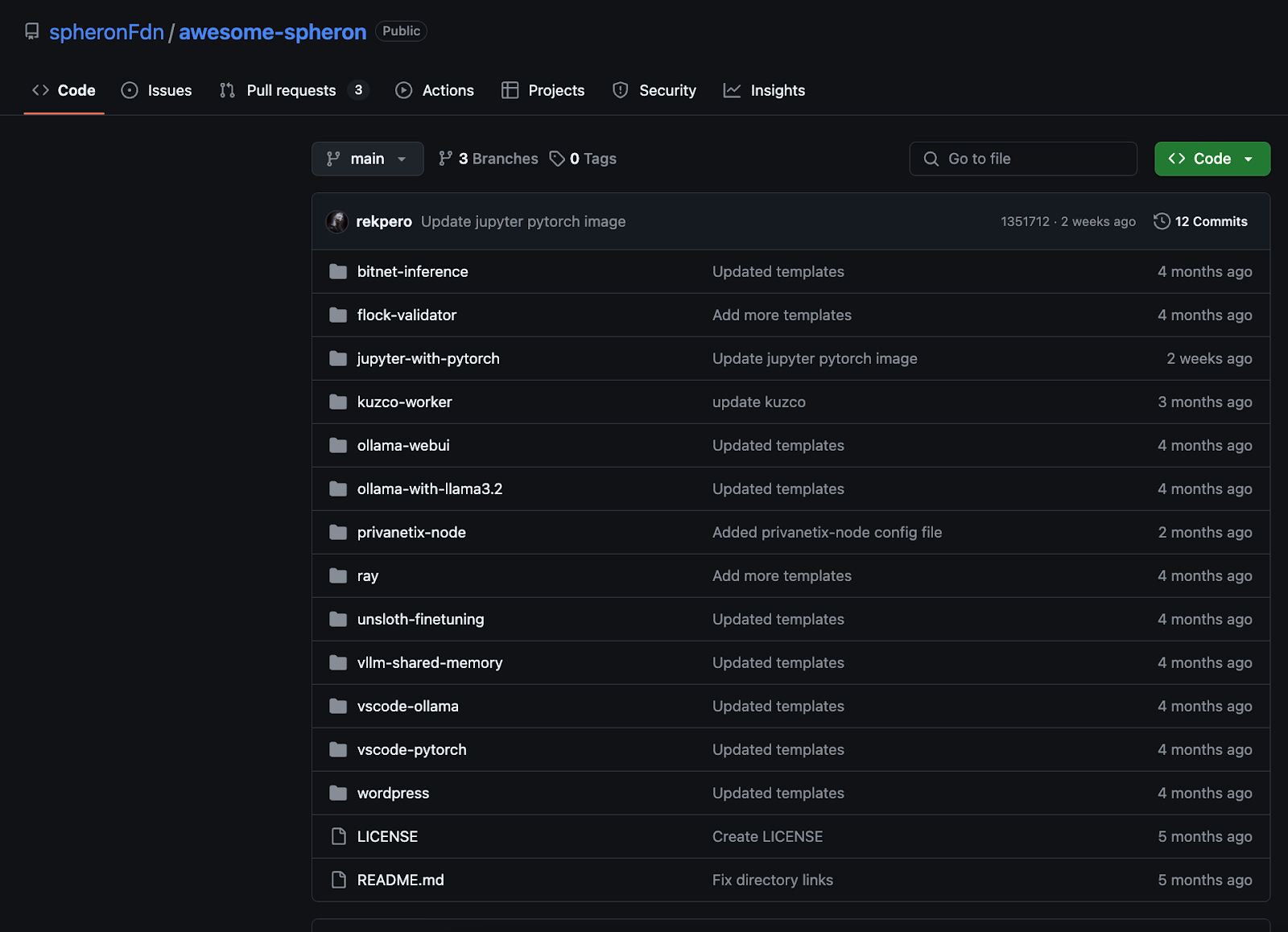
Want to test it out? Just go to the Spheron Awesome repo and https://github.com/spheronFdn/awesome-spheron, which has a collection of ready-to-deploy GPU templates for Spheron.
10. The Aggregator Advantage

Spheron operates as an aggregator, pooling resources from multiple providers. This approach enables users to:

Compare GPU types, memory sizes, and performance tiers in real time.

Choose from multiple competing providers, ensuring fair pricing.

Benefit from dynamic pricing, where providers with idle resources lower their rates to attract users.

This competitive marketplace model prevents price monopolization and provides cost-effective computing options that traditional cloud platforms lack.

Conclusion

As you can see, whether you choose on-premise infrastructure or rely on big cloud services, both options come with significant drawbacks. On-premise solutions require massive upfront investments, ongoing maintenance, and scalability challenges, while big cloud providers impose high costs, vendor lock-in, and unpredictable pricing models.

That’s why Spheron Network is the ideal solution. By leveraging decentralized compute, Spheron provides a cost-effective, scalable, and censorship-resistant alternative. With transparent pricing, high availability, and seamless deployment, Spheron empowers developers, businesses, and AI projects to operate with greater autonomy and efficiency. Choose Spheron and take control of your infrastructure today.



Source link

Senate Stablecoin Bill Passes Out of Committee With Strong Bi-Partisan Support – Decrypt

0
Senate Stablecoin Bill Passes Out of Committee With Strong Bi-Partisan Support – Decrypt


The U.S. Senate Banking Committee voted in favor of advancing the stablecoin-focused GENIUS Act to a full Senate vote Thursday, with the legislation receiving bipartisan support. 

The bill passed through committee by a vote of 18-6, with five Senate Democrats joining Republicans to push the bill over the finish line with considerable breathing room. 

Democrats who voted for the GENIUS Act’s passage include bill cosponsor Angela Alsobrooks (D-MD), as well as Senate Banking Committee members Mark Warner (D-VA), Andy Kim (D-NJ), Lisa Blunt Rochester (D-DE), and Ruben Gallego (D-AZ). 

The bill’s sponsor, Bill Hagerty (R-TN), said he intends for the bill to receive a full vote on the Senate floor by the end of April. 

“The Banking Committee’s strong bipartisan passage of the GENIUS Act out of committee brings us one step closer to providing stablecoin issuers with the choice between state and national charters and will secure our nation’s competitive edge in the rapidly evolving digital asset space,” Sen. Cynthia Lummis (R-WY), another cosponsor of the bill, said in a statement shared with Decrypt

During Thursday’s meeting of the Senate Banking Committee, longtime crypto critic Elizabeth Warren (D-MA) attempted to add multiple new provisions to the GENIUS Act, which creates a legal framework for nonbank stablecoin issuers to participate in the U.S. economy. 

Warren proposed amendments to the bill that would have blacklisted any stablecoin issuers whose tokens were found to have been used in connection with state enemies and illegal activity, including drug trafficking and the purchase of child pornography. Another would have expanded the provisions of the Act to apply to crypto exchanges and other third parties that interact with stablecoins.

All her amendments were voted down, mostly along party lines.

“Who are we trying to protect, the child pornographers and Iran and North Korea?” Warren said at one point, in apparent exasperation, after her third amendment was voted down. 

“Nobody’s looking to shut this down, no one’s looking to stop innovation,” the progressive senator said at a later point during the meeting. “But we do want to try to make this a little cleaner than it is right now.”

The bill proceeded shortly after to a vote, which it passed handily.

A new version of the GENIUS Act was released earlier this week in anticipation of today’s markup. While it has been generally supported by industry leaders, some crypto users pushed back on a new provision that would require stablecoin issuers to have the ability to “seize, freeze, burn, or prevent the transfer” of tokens if obligated to comply with legal orders.

Edited by James Rubin

Daily Debrief Newsletter

Start every day with the top news stories right now, plus original features, a podcast, videos and more.


Source link

Binance Secures Landmark $2 Billion Investment from UAE’s MGX – Web3oclock

0
Binance Secures Landmark  Billion Investment from UAE’s MGX – Web3oclock


A Landmark Investment in Digital Finance:

MGX’s Expansion into Crypto and AI:

Binance’s Growing Influence in the UAE:

The Future of Binance and MGX Partnership:


Source link

Google Unveils Gemma 3 – The Ultimate Compact AI Breakthrough – Web3oclock

0
Google Unveils Gemma 3 – The Ultimate Compact AI Breakthrough – Web3oclock


Advancing AI Accessibility:

Key Features of Gemma 3:

State-of-the-Art Performance: Gemma 3 outperforms models like Llama-405B, DeepSeek-V3, and o3-mini, making it one of the best single-accelerator models available.

Multilingual Capabilities: Supports over 35 languages out-of-the-box and 140+ languages with pretraining.

Enhanced Reasoning: Advanced capabilities for text, image, and short video analysis enable smarter, more interactive applications.

Expanded Context Window: With a 128k-token capacity, Gemma 3 can process large amounts of information efficiently.

Function Calling & Structured Output: Allows automation and agent-based experiences.

Optimized Performance with Quantization: Official quantized versions reduce computational requirements while maintaining high accuracy.

Built-In Safety Measures:

ShieldGemma 2: AI Safety for Images

Seamless Integration with Developer Tools:

Compatible with popular AI frameworks like Hugging Face, PyTorch, JAX, Keras, and Google AI Edge.

Available on Google AI Studio, Kaggle, and Hugging Face for immediate access.

Optimized for diverse hardware, including Nvidia GPUs, Google Cloud TPUs, and AMD GPUs.

Expanding the “Gemmaverse”:


Source link

Telecom Outsourcing Market Hits New High | Major Giants- Atos, IBM, Ericsson | Web3Wire

0
Telecom Outsourcing Market Hits New High | Major Giants- Atos, IBM, Ericsson | Web3Wire


Telecom Outsourcing Market

The latest study released on the Global Telecom Outsourcing Market by HTF MI evaluates market size, trend, and forecast to 2030. The Telecom Outsourcing market study covers significant research data and proofs to be a handy resource document for managers, analysts, industry experts and other key people to have ready-to-access and self-analyzed study to help understand market trends, growth drivers, opportunities and upcoming challenges and about the competitors.

Key Players in This Report Include: IBM Corporation (United States), HCL Technologies (India), Wipro Limited (India), Tata Consultancy Services (TCS) (India), Tech Mahindra (India), Ericsson (Sweden), Nokia Corporation (Finland), Huawei Technologies (China), Capgemini SE (France), Infosys Limited (India), Cognizant Technology Solutions (United States), Atos SE (France)

According to HTF Market Intelligence, the global Telecom Outsourcing market is valued at USD 110.7 Billion in 2024 and estimated to reach a revenue of USD 175.2 Billion by 2031, with a CAGR of 7.10% from 2024 to 2031.

Get inside Scoop of Telecom Outsourcing Market: https://www.htfmarketintelligence.com/sample-report/global-telecom-outsourcing-market?utm_source=Krati_OpenPR&utm_id=Krati

Definition:Telecom outsourcing refers to the practice of telecom companies delegating certain operations to third-party providers, such as IT services, network management, and customer support. It helps companies reduce costs, enhance efficiency, and focus on core services while improving customer experience.

Market Trends:●Increasing use of automation and AI in outsourced operations.

Market Drivers:●Cost reduction through offshoring and third-party services.

Market Opportunities:●Expansion of outsourcing to emerging markets for cost benefits.

Market Challenges:●Managing quality control and service consistency across regions.

Fastest-Growing Region:Asia-Pacific

Dominating Region:North America

Market Leaders & Development Strategies:●On 11th September 2024, “Ericsson has introduced Cognitive Labs, a research-focused initiative aimed at advancing AI in telecommunications. Operating virtually, the labs will explore cutting-edge AI technologies like Graph Neural Networks (GNNs), Active Learning, and Large-Scale Language Models (LLMs), driving innovation in telecom outsourcing and enhancing AI-driven solutions for the industry.”

Have Any Query? Ask Our Expert @: https://www.htfmarketintelligence.com/enquiry-before-buy/global-telecom-outsourcing-market?utm_source=Krati_OpenPR&utm_id=Krati

The Global Telecom Outsourcing Market segments and Market Data Break Down are illuminated below:Telecom Outsourcing Market is Segmented by Type (Network Management, IT Infrastructure Management, Customer Support Services, Billing and Revenue Management) by Deployment Mode (On-Premise, Cloud-Based) and by Geography (North America, LATAM, West Europe, Central & Eastern Europe, Northern Europe, Southern Europe, East Asia, Southeast Asia, South Asia, Central Asia, Oceania, MEA)Global Telecom Outsourcing market report highlights information regarding the current and future industry trends, growth patterns, as well as it offers business strategies to helps the stakeholders in making sound decisions that may help to ensure the profit trajectory over the forecast years.

Geographically, the detailed analysis of consumption, revenue, market share, and growth rate of the following regions:• The Middle East and Africa (South Africa, Saudi Arabia, UAE, Israel, Egypt, etc.)• North America (United States, Mexico & Canada)• South America (Brazil, Venezuela, Argentina, Ecuador, Peru, Colombia, etc.)• Europe (Turkey, Spain, Turkey, Netherlands Denmark, Belgium, Switzerland, Germany, Russia UK, Italy, France, etc.)• Asia-Pacific (Taiwan, Hong Kong, Singapore, Vietnam, China, Malaysia, Japan, Philippines, Korea, Thailand, India, Indonesia, and Australia).

Objectives of the Report• -To carefully analyze and forecast the size of the Telecom Outsourcing market by value and volume.• -To estimate the market shares of major segments of the Telecom Outsourcing• -To showcase the development of the Telecom Outsourcing market in different parts of the world.• -To analyze and study micro-markets in terms of their contributions to the Telecom Outsourcing market, their prospects, and individual growth trends.• -To offer precise and useful details about factors affecting the growth of the Telecom Outsourcing• -To provide a meticulous assessment of crucial business strategies used by leading companies operating in the Telecom Outsourcing market, which include research and development, collaborations, agreements, partnerships, acquisitions, mergers, new developments, and product launches.

Read Detailed Index of full Research Study: https://www.htfmarketintelligence.com/report/global-telecom-outsourcing-market

Major highlights from Table of Contents:Telecom Outsourcing Market Study Coverages:• It includes major manufacturers, emerging player’s growth story, and major business segments of Telecom Outsourcing market, years considered, and research objectives. Additionally, segmentation on the basis of the type of product, application, and technology.• Telecom Outsourcing Market Executive Summary: It gives a summary of overall studies, growth rate, available market, competitive landscape, market drivers, trends, and issues, and macroscopic indicators.• Telecom Outsourcing Market Production by Region Telecom Outsourcing Market Profile of Manufacturers-players are studied on the basis of SWOT, their products, production, value, financials, and other vital factors.

Key Points Covered in Telecom Outsourcing Market Report:• Telecom Outsourcing Overview, Definition and Classification Market drivers and barriers• Telecom Outsourcing Market Competition by Manufacturers• Impact Analysis of COVID-19 on Telecom Outsourcing Market• Telecom Outsourcing Capacity, Production, Revenue (Value) by Region (2023-2030)• Telecom Outsourcing Supply (Production), Consumption, Export, Import by Region (2023-2030)• Telecom Outsourcing Production, Revenue (Value), Price Trend by Type {Network Management, IT Infrastructure Management, Customer Support Services, Billing and Revenue Management}• Telecom Outsourcing Manufacturers Profiles/Analysis Telecom Outsourcing Manufacturing Cost Analysis, Industrial/Supply Chain Analysis, Sourcing Strategy and Downstream Buyers, Marketing• Strategy by Key Manufacturers/Players, Connected Distributors/Traders Standardization, Regulatory and collaborative initiatives, Industry road map and value chain Market Effect Factors Analysis.

Check for Best Quote: https://www.htfmarketintelligence.com/buy-now?format=1&report=14970?utm_source=Krati_OpenPR&utm_id=Krati

Key questions answered• How feasible is Telecom Outsourcing market for long-term investment?• What are influencing factors driving the demand for Telecom Outsourcing near future?• What is the impact analysis of various factors in the Global Telecom Outsourcing market growth?• What are the recent trends in the regional market and how successful they are?

Thanks for reading this article; you can also get individual chapter wise section or region wise report version like North America, Middle East, Africa, Europe or LATAM, Southeast Asia.

Nidhi Bhawsar (PR & Marketing Manager)HTF Market Intelligence Consulting Private LimitedPhone: +15075562445sales@htfmarketreport.com

About Author:HTF Market Intelligence Consulting is uniquely positioned to empower and inspire with research and consulting services to enable businesses with growth strategies, by offering services with extraordinary depth and breadth of thought leadership, research, tools, events, and experience that assist in decision-making.

This release was published on openPR.

About Web3Wire Web3Wire – Information, news, press releases, events and research articles about Web3, Metaverse, Blockchain, Artificial Intelligence, Cryptocurrencies, Decentralized Finance, NFTs and Gaming. Visit Web3Wire for Web3 News and Events, Block3Wire for the latest Blockchain news and Meta3Wire to stay updated with Metaverse News.


Source link

Bitcoin Price Rises as New Data Shows Inflation Cooled to 2.8% in February – Decrypt

0
Bitcoin Price Rises as New Data Shows Inflation Cooled to 2.8% in February – Decrypt


The Bitcoin price rose on Wednesday after a widely watched inflation gauge in the U.S. showed that consumer prices rose less than expected last month.

The Consumer Price Index (CPI) rose 2.8% in the 12 months through February, the Bureau of Labor Statistics (BLS) said. Economists expected the index, which tracks price changes across a broad range of goods and services, to rise 2.9% from a year earlier.

Stripping out volatile food and energy prices, so-called core inflation rose to 3.1% in the past 12 months. It’s a marked improvement compared to January’s 3.3% annual increase. The measure, which is used to gauge underlying inflation trends, also came in slightly below economists’ expectations.

President Donald Trump’s on-again, off-again approach to tariffs has rattled markets in recent weeks. Wednesday’s CPI print  indicated that inflation cooled amid the trade war but remained elevated from September’s 2.4% annual increase.

Bitcoin jumped to $84,000, rising 1% in 10 minutes, according to the crypto data provider CoinGecko. Ethereum and Solana also rose to $1,900 and $127, respectively.

The Federal Reserve has been monitoring how Trump’s policy maneuvers could complicate its inflation fight. Fed Chair Jerome Powell said last week that despite recent developments, “uncertainty around the changes and their likely effects remains high.”

Trump expressed optimism on Tuesday about a recent drop in egg and gasoline prices. In a Truth Social post, the president wrote, “It’s all coming down!”

The Fed is widely expected to hold interest rates steady at its policy meeting next week, when it will also release updated projections for economic growth and interest rates.

Traders on Wednesday penciled in three rate cuts by year-end, according to CME FedWatch. A month prior, futures traders foresaw just one.

Edited by Stacy Elliott.

Daily Debrief Newsletter

Start every day with the top news stories right now, plus original features, a podcast, videos and more.


Source link

Axelar Secures $30M to Unlock the Full Potential of Blockchain Networks – Web3oclock

0
Axelar Secures M to Unlock the Full Potential of Blockchain Networks – Web3oclock


What Makes Axelar’s Funding So Significant?

Breaking Down Silos: Right now, many blockchains operate in isolation. Axelar aims to bridge those gaps, creating a more unified crypto ecosystem.

Enhancing User Experience: Users won’t be confined to a single blockchain. They’ll be able to move assets and data across multiple chains with ease.

Boosting Innovation: Developers can create apps that leverage the unique strengths of different blockchains, unlocking more innovation and flexibility.

The $30 Million Boost: What’s Next for Axelar?

Expanding Stablecoin Access: Stablecoins are crucial for crypto transactions and DeFi. This funding will help them to increase the availability and usability of stablecoins across different blockchains.

Supporting Real-World Asset Tokenization: Tokenizing real-world assets, such as real estate and commodities, is a growing trend. Its interoperability protocol could connect private institutional blockchains to public networks, enabling the tokenization and trading of these assets.

Strengthening the Network: A portion of the funds will be dedicated to improving the Axelar network, enhancing its security, scalability, and overall reliability.

Axelar vs. Competitors: How It Stands Out

FeatureAxelarWormholeLayerZeroApproachUniversal, open sourceMessage-passing bridgeOmnichain protocolFocusConnecting private and public blockchainsFast cross-chain messagingLightweight, customizable securityDifferentiatorEmphasis on institutional adoption and RWA tokenizationSpeed and cost-effectivenessCustomizable security and decentralization

What’s Next for Axelar: Challenges and Opportunities

Challenges:

Competition: The interoperability space is crowded, and They will need to innovate continuously to stay ahead.

Security Risks: Cross-chain bridges are complex and vulnerable to exploits, so security must remain a priority.

Adoption: Getting institutions and developers to adopt a new interoperability protocol can take time and effort.

Opportunities:

RWA Tokenization Growth: The tokenization of real-world assets is expected to explode, and it is in a strong position to capitalize on this trend.

Institutional Interest: As more institutions enter the blockchain space, its enterprise-focused solutions could see growing demand.

Web3 Expansion: As Web3 continues to mature, the need for seamless interoperability will become more pressing, reinforcing Axelar’s mission.

What Does This Mean for You?

Watch Axelar’s Progress: Keep an eye on the developments, as they could have a major impact on the broader crypto space.

Explore RWA Tokenization: If you’re interested in how traditional finance and crypto intersect, look into how Axelar is enabling RWA tokenization.

Learn About Interoperability: Understanding interoperability and its role in the future of Web3 will be crucial as the crypto space evolves.

Conclusion: A Bold Step Toward a Unified Crypto Future


Source link

Mesh Lands a Massive $82 Million to Propel Global Crypto Payment Innovation – Web3oclock

0
Mesh Lands a Massive  Million to Propel Global Crypto Payment Innovation – Web3oclock


Expanding a Global Crypto Payments Network:

Innovative SmartFunding Technology:

Investor Confidence and Market Potential:

PayPal Ventures and the Role of PYUSD:

The Future of Crypto Payments:


Source link

Popular Posts

My Favorites

Artificial Intelligence in Epidemiology Market Strategic Growth Drivers and Outlook 2026...

0
Artificial Intelligence in Epidemiology Market Artificial Intelligence in Epidemiology Market Size is valued at 599.60 Million in 2025 and is predicted to reach...