Web3

Home Web3 Page 165

South Korea Central Bank Rules Out Bitcoin as Reserve Asset – Decrypt

0
South Korea Central Bank Rules Out Bitcoin as Reserve Asset – Decrypt


The Bank of Korea has ruled out the inclusion of Bitcoin in its foreign exchange reserves, citing concerns over the crypto’s price volatility.

In response to a March 16 inquiry from Representative Cha Gyu-geun of the National Assembly’s Planning and Finance Committee, the central bank pointed out the risks of Bitcoin’s price fluctuations, which can make it an unreliable asset for reserves.

It marks the first time the central bank has clarified its position on the potential use of the crypto for national reserves, emphasizing its “cautious” approach while dealing with the asset.

The central bank’s statement comes amid ongoing international discussions about the role of crypto in national reserves following U.S. President Donald Trump’s recent executive order to establish a strategic “crypto reserve,” with Bitcoin (BTC) and Ethereum (ETH) at its heart.

Currently, Bitcoin is trading at approximately $83,450, marking a 23% decline from its peak of $109,000 in January, according to CoinGecko.

“If the virtual asset market becomes unstable, there is a concern that transaction costs will increase rapidly in the process of converting Bitcoin into cash,” a spokesperson for the central bank said, according to reports in local media.

The Bank of Korea also said the world’s largest crypto does not meet the International Monetary Fund’s (IMF) criteria for foreign exchange reserves.

The IMF requires foreign exchange reserves to be liquid, marketable, and in convertible currencies with investment-grade credit ratings—requirements that Bitcoin does not fulfill, the bank said.

Bitcoin reserves in Asia

Just last week, a seminar hosted by the Democratic Party of Korea discussed the possibility of including Bitcoin in the country’s foreign exchange reserves, just a day before President Trump signed his executive order.

Meanwhile, South Korea’s closest neighbour, Japan, has also shown hesitancy regarding the inclusion of Bitcoin in foreign reserves.

Last December, Japan Prime Minister Shigeru Ishiba voiced concerns about insufficient information on the U.S. and other countries’ plans for Bitcoin reserves.

Ishiba’s concerns followed a proposal by Satoshi Hamada, a member of Japan’s House of Councilors, suggesting Japan explore converting a portion of its foreign reserves into Bitcoin.

Daily Debrief Newsletter

Start every day with the top news stories right now, plus original features, a podcast, videos and more.


Source link

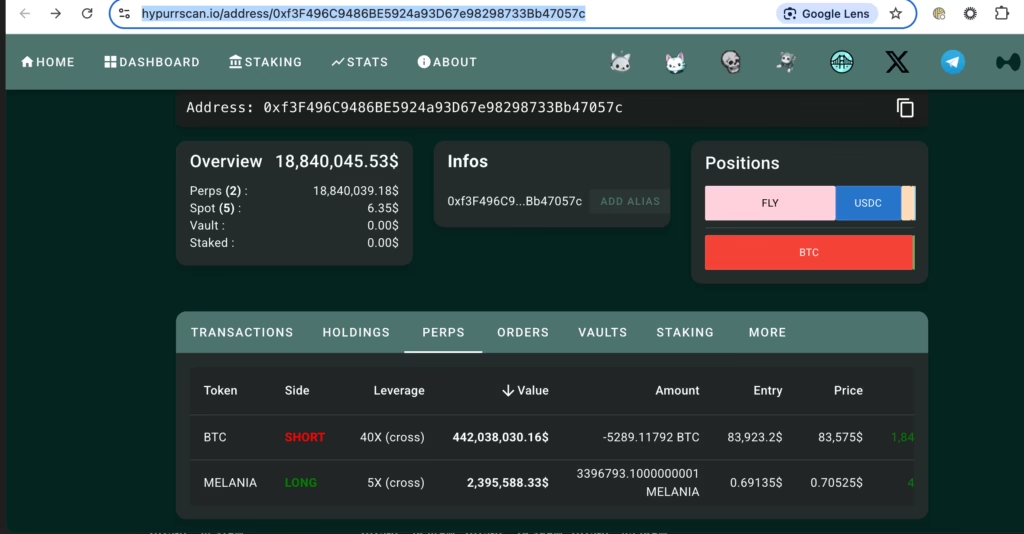
Crypto Whale Shorts $445 Million in Bitcoin and Makes a Bold Bullish Bet on MELANIA Token – Web3oclock

0
Crypto Whale Shorts 5 Million in Bitcoin and Makes a Bold Bullish Bet on MELANIA Token – Web3oclock


Source link

Understanding Modern GPU Architecture: CUDA Cores, Tensor Cores

0
Understanding Modern GPU Architecture: CUDA Cores, Tensor Cores


Graphics Processing Units (GPUs) have transcended their original purpose of rendering images. Modern GPUs function as sophisticated parallel computing platforms that power everything from artificial intelligence and scientific simulations to data analytics and visualization. Understanding the intricacies of GPU architecture helps researchers, developers, and organizations select the optimal hardware for their specific computational needs.

The Evolution of GPU Architecture

GPUs have transformed remarkably from specialized graphics rendering hardware to versatile computational powerhouses. This evolution has been driven by the increasing demand for parallel processing capabilities across various domains, including artificial intelligence, scientific computing, and data analytics. Modern NVIDIA GPUs feature multiple specialized core types, each optimized for specific workloads, allowing for unprecedented versatility and performance.

Core Types in Modern NVIDIA GPUs

CUDA Cores: The Foundation of Parallel Computing

CUDA (Compute Unified Device Architecture) cores form the foundation of NVIDIA’s GPU computing architecture. These programmable cores execute the parallel instructions that enable GPUs to handle thousands of threads simultaneously. CUDA cores excel at tasks that benefit from massive parallelism, where the same operation must be performed independently on large datasets.

CUDA cores process instructions in a SIMT (Single Instruction, Multiple Threads) fashion, allowing a single instruction to be executed across multiple data points simultaneously. This architecture delivers exceptional performance for applications that can leverage parallel processing, such as:

Graphics rendering and image processing

Basic linear algebra operations

Particle simulations

Signal processing

Certain machine-learning operations

While CUDA cores typically operate at FP32 (single-precision floating-point) and FP64 (double-precision floating-point) precisions, their performance characteristics differ depending on the GPU architecture generation. Consumer-grade GPUs often feature excellent FP32 performance but limited FP64 capabilities, while data center GPUs provide more balanced performance across precision modes.

The number of CUDA cores in a GPU directly influences its parallel processing capabilities. Higher-end GPUs feature thousands of CUDA cores, enabling them to handle more concurrent computations. For instance, modern GPUs like the RTX 4090 contain over 16,000 CUDA cores, delivering unprecedented parallel processing power for consumer applications.

Tensor Cores: Accelerating AI and HPC Workloads

Tensor Cores are a specialized addition to NVIDIA’s GPU architecture, designed to accelerate matrix operations central to deep learning and scientific computing. First introduced in the Volta architecture, Tensor Cores have evolved significantly across subsequent GPU generations, with each iteration improving performance, precision options, and application scope.

Tensor Cores provide hardware acceleration for mixed-precision matrix multiply-accumulate operations, which form the computational backbone of deep neural networks. Tensor Cores deliver dramatic performance improvements compared to traditional CUDA cores for AI workloads by performing these operations in specialized hardware.

The key advantage of Tensor Cores lies in their ability to handle various precision formats efficiently:

FP64 (double precision): Crucial for high-precision scientific simulations

FP32 (single precision): Standard precision for many computing tasks

TF32 (Tensor Float 32): A precision format that maintains accuracy similar to FP32 while offering performance closer to lower precision formats

BF16 (Brain Float 16): A half-precision format that preserves dynamic range

FP16 (half precision): Reduces memory footprint and increases throughput

FP8 (8-bit floating point): Newest format enabling even faster AI training

This flexibility allows organizations to select the optimal precision for their specific workloads, balancing accuracy requirements against performance needs. For instance, AI training can often leverage lower precision formats like FP16 or even FP8 without significant accuracy loss, while scientific simulations may require the higher precision of FP64.

The impact of Tensor Cores on AI training has been transformative. Tasks that previously required days or weeks of computation can now be completed in hours or minutes, enabling faster experimentation and model iteration. This acceleration has been crucial in developing large language models, computer vision systems, and other AI applications that rely on processing massive datasets.

RT Cores: Enabling Real-Time Ray Tracing

While primarily focused on graphics applications, RT (Ray Tracing) cores play an important role in NVIDIA’s GPU architecture portfolio. These specialized cores accelerate the computation of ray-surface intersections, enabling real-time ray tracing in gaming and professional visualization applications.

RT cores represent the hardware implementation of ray tracing algorithms, which simulate the physical behavior of light to create photorealistic images. By offloading these computations to dedicated hardware, RT cores enable applications to render realistic lighting, shadows, reflections, and global illumination effects in real-time.

Although RT cores are not typically used for general-purpose computing or AI workloads, they demonstrate NVIDIA’s approach to GPU architecture design: creating specialized hardware accelerators for specific computational tasks. This philosophy extends to the company’s data center and AI-focused GPUs, which integrate various specialized core types to deliver optimal performance across diverse workloads.

Precision Modes: Balancing Performance and Accuracy

Modern GPUs support a range of numerical precision formats, each offering different trade-offs between computational speed and accuracy. Understanding these precision modes allows developers and researchers to select the optimal format for their specific applications.

FP64 (Double Precision)

Double-precision floating-point operations provide the highest numerical accuracy available in GPU computing. FP64 uses 64 bits to represent each number, with 11 bits for the exponent and 52 bits for the fraction. This format offers approximately 15-17 decimal digits of precision, making it essential for applications where numerical accuracy is paramount.

Common use cases for FP64 include:

Climate modeling and weather forecasting

Computational fluid dynamics

Molecular dynamics simulations

Quantum chemistry calculations

Financial risk modeling with high-precision requirements

Data center GPUs like the NVIDIA H100 offer significantly higher FP64 performance compared to consumer-grade GPUs, reflecting their focus on high-performance computing applications that require double-precision accuracy.

FP32 (Single Precision)

Single-precision floating-point operations use 32 bits per number, with 8 bits for the exponent and 23 bits for the fraction. FP32 provides approximately 6-7 decimal digits of precision, which is sufficient for many computing tasks, including most graphics rendering, machine learning inference, and scientific simulations where extreme precision isn’t required.

FP32 has traditionally been the standard precision mode for GPU computing, offering a good balance between accuracy and performance. Consumer GPUs typically optimize for FP32 performance, making them well-suited for gaming, content creation, and many AI inference tasks.

TF32 (Tensor Float 32)

Tensor Float 32 represents an innovative approach to precision in GPU computing. Introduced with the NVIDIA Ampere architecture, TF32 uses the same 10-bit mantissa as FP16 but retains the 8-bit exponent from FP32. This format preserves the dynamic range of FP32 while reducing precision to increase computational throughput.

TF32 offers a compelling middle ground for AI training, delivering performance close to FP16 while maintaining accuracy similar to FP32. This precision mode is particularly valuable for organizations transitioning from FP32 to mixed-precision training, as it often requires no changes to existing models or hyperparameters.

BF16 (Brain Float 16)

Brain Float 16 is a 16-bit floating-point format designed specifically for deep learning applications. BF16 uses 8 bits for the exponent and 7 bits for the fraction, preserving the dynamic range of FP32 while reducing precision to increase computational throughput.

The key advantage of BF16 over standard FP16 is its larger exponent range, which helps prevent underflow and overflow issues during training. This makes BF16 particularly suitable for training deep neural networks, especially when dealing with large models or unstable gradients.

FP16 (Half Precision)

Half-precision floating-point operations use 16 bits per number, with 5 bits for the exponent and 10 bits for the fraction. FP16 provides approximately 3-4 decimal digits of precision, which is sufficient for many AI training and inference tasks.

FP16 offers several advantages for deep learning applications:

Reduced memory footprint, allowing larger models to fit in GPU memory

Increased computational throughput, enabling faster training and inference

Lower memory bandwidth requirements, improving overall system efficiency

Modern training approaches often use mixed-precision techniques, combining FP16 and FP32 operations to balance performance and accuracy. This approach, accelerated by Tensor Cores, has become the standard for training large neural networks.

FP8 (8-bit Floating Point)

The newest addition to NVIDIA’s precision formats, FP8 uses just 8 bits per number, further reducing memory requirements and increasing computational throughput. FP8 comes in two variants: E4M3 (4 bits for exponent, 3 for mantissa) for weights and activations, and E5M2 (5 bits for exponent, 2 for mantissa) for gradients.

FP8 represents the cutting edge of AI training efficiency, enabling even faster training of large language models and other deep neural networks. This format is particularly valuable for organizations training massive models where training time and computational resources are critical constraints.

Specialized Hardware Features

Multi-Instance GPU (MIG)

Multi-Instance GPU technology allows a single physical GPU partition into multiple logical GPUs, each with dedicated compute resources, memory, and bandwidth. This feature enables efficient sharing of GPU resources across multiple users or workloads, improving utilization and cost-effectiveness in data center environments.

MIG provides several benefits for data center deployments:

Guaranteed quality of service for each instance

Improved resource utilization and return on investment

Secure isolation between workloads

Simplified resource allocation and management

For organizations running multiple workloads on shared GPU infrastructure, MIG offers a powerful solution for maximizing hardware utilization while maintaining performance predictability.

DPX Instructions

Dynamic Programming (DPX) instructions accelerate dynamic programming algorithms used in various computational problems, including route optimization, genome sequencing, and graph analytics. These specialized instructions enable GPUs to efficiently handle tasks traditionally considered CPU-bound.

DPX instructions demonstrate NVIDIA’s commitment to expanding the application scope of GPU computing beyond traditional graphics and AI workloads. By providing hardware acceleration for dynamic programming algorithms, these instructions open new possibilities for GPU acceleration across various domains.

Choosing the Right GPU Configuration

Selecting the optimal GPU configuration requires careful consideration of workload requirements, performance needs, and budget constraints. Understanding the relationship between core types, precision modes, and application characteristics is essential for making informed hardware decisions.

AI Training and Inference

For AI training workloads, particularly large language models and computer vision applications, GPUs with high Tensor Core counts and support for lower precision formats (FP16, BF16, FP8) deliver the best performance. The NVIDIA H100, with its fourth-generation Tensor Cores and support for FP8, represents the state-of-the-art for AI training.

AI inference workloads can often leverage lower-precision formats like INT8 or FP16, making them suitable for a broader range of GPUs. For deployment scenarios where latency is critical, GPUs with high clock speeds and efficient memory systems may be preferable to those with the highest raw computational throughput.

High-Performance Computing

HPC applications that require double-precision accuracy benefit from GPUs with strong FP64 performance, such as the NVIDIA H100 or V100. These data center GPUs offer significantly higher FP64 throughput compared to consumer-grade alternatives, making them essential for scientific simulations and other high-precision workloads.

For HPC applications that can tolerate lower precision, Tensor Cores can provide substantial acceleration. Many scientific computing workloads have successfully adopted mixed-precision approaches, leveraging the performance benefits of Tensor Cores while maintaining acceptable accuracy.

Enterprise and Cloud Deployments

For enterprise and cloud environments where GPUs are shared across multiple users or workloads, features like MIG become crucial. Datacenter GPUs with MIG support enable efficient resource sharing while maintaining performance isolation between workloads.

Considerations for enterprise GPU deployments include:

Total computational capacity

Memory capacity and bandwidth

Power efficiency and cooling requirements

Support for virtualization and multi-tenancy

Software ecosystem and management tools

Practical Implementation Considerations

Implementing GPU-accelerated solutions requires more than just selecting the right hardware. Organizations must also consider software optimization, system integration, and workflow adaptation to leverage GPU capabilities fully.

Profiling and Optimization

Tools like NVIDIA Nsight Systems, NVIDIA Nsight Compute, and TensorBoard enable developers to profile GPU workloads, identify bottlenecks, and optimize performance. These tools provide insights into GPU utilization, memory access patterns, and kernel execution times, guiding optimization efforts.

Common optimization strategies include:

Selecting appropriate precision formats

Optimizing data transfers between CPU and GPU

Tuning batch sizes and model parameters

Leveraging GPU-specific libraries and frameworks

Implementing custom CUDA kernels for performance-critical operations

Benchmarking

Benchmarking GPU performance across different configurations and workloads provides valuable data for hardware selection and optimization. Standard benchmarks like MLPerf for AI training and inference offer standardized metrics for comparing different GPU models and configurations.

Organizations should develop benchmarks that reflect their specific workloads and performance requirements, as standardized benchmarks may not capture all relevant aspects of real-world applications.

Conclusion

Modern GPUs have evolved into complex, versatile computing platforms with specialized hardware accelerators for various workloads. Understanding the roles of different core types—CUDA Cores, Tensor Cores, and RT Cores—along with the trade-offs between precision modes enables organizations to select the optimal GPU configuration for their specific needs.

As GPU architecture continues to evolve, we can expect further specialization and optimization for key workloads like AI training, scientific computing, and data analytics. The trend toward domain-specific accelerators within the GPU architecture reflects the growing diversity of computational workloads and the increasing importance of hardware acceleration in modern computing systems.

By leveraging the appropriate combination of core types, precision modes, and specialized features, organizations can unlock the full potential of GPU computing across a wide range of applications, from training cutting-edge AI models to simulating complex physical systems. This understanding empowers developers, researchers, and decision-makers to make informed choices about GPU hardware, ultimately driving innovation and performance improvements across diverse computational domains.



Source link

Building the Future: GCC Smart Cities Market to Grow 25.70% CAGR to $907B By 2032 | Most Leading Companies – Honeywell International, Inc., Microsoft, IBM, Alfanar Group, TATA Consultancy Services Limited, AstraTech | Web3Wire

0
Building the Future: GCC Smart Cities Market to Grow 25.70% CAGR to 7B By 2032 | Most Leading Companies – Honeywell International, Inc., Microsoft, IBM, Alfanar Group, TATA Consultancy Services Limited, AstraTech | Web3Wire


CC Smart Cities Market

Latest Market Updates & Research Study on GCC Smart Cities & Digital Transformation Market

GCC Smart Cities & Digital Transformation Market reached US$ 145.54 billion in 2024 and is expected to reach US$ 907.12 billion by 2032, growing with a CAGR of 25.70% during the forecast period 2025-2032.

GCC Smart Cities and Digital Transformation Market report, published by DataM Intelligence, provides in-depth insights and analysis on key market trends, growth opportunities, and emerging challenges. Committed to delivering actionable intelligence, DataM Intelligence empowers businesses to make informed decisions and stay ahead of the competition. Through a combination of qualitative and quantitative research methods, it offers comprehensive reports that help clients navigate complex market landscapes, drive strategic growth, and seize new opportunities in an ever-evolving global market.

Get a Free Sample PDF Of This Report (Get Higher Priority for Corporate Email ID):- https://datamintelligence.com/download-sample/gcc-smart-cities-and-digital-transformation-market?kb

GCC Smart Cities and Digital Transformation refer to the integration of advanced technologies such as AI, IoT, big data, and blockchain to enhance urban living and infrastructure across the Gulf Cooperation Council (GCC) countries, including Saudi Arabia, UAE, Qatar, Kuwait, Bahrain, and Oman. These initiatives focus on sustainability, efficient governance, smart mobility, digital economy, and improved public services. Governments and private sectors are heavily investing in smart grids, intelligent transportation, cybersecurity, and smart buildings to drive economic growth and enhance quality of life.

List of the Key Players in the GCC Smart Cities and Digital Transformation Market:

Honeywell International, Inc., Microsoft, IBM, Alfanar Group, TATA Consultancy Services Limited, AstraTech, TECOM Group PJSC, Wipro, Solutions by stc, Ericsson etc

Industry Development:

For example, Saudi Arabia’s Vision 2030 and the UAE’s National Innovation Strategy highlight the importance of integrating digital technologies to improve public services and promote sustainable development.

Growth Forecast Projected:

The Global GCC Smart Cities and Digital Transformation Market is anticipated to rise at a considerable rate during the forecast period, between 2025 and 2032. In 2023, the market is growing at a steady rate, and with the rising adoption of strategies by key players, the market is expected to rise over the projected horizon.

Research Process:

Both primary and secondary data sources have been used in the global GCC Smart Cities and Digital Transformation Market research report. During the research process, a wide range of industry-affecting factors are examined, including governmental regulations, market conditions, competitive levels, historical data, market situation, technological advancements, upcoming developments, in related businesses, as well as market volatility, prospects, potential barriers, and challenges.

Make an Enquiry for purchasing this Report @ https://www.datamintelligence.com/enquiry/gcc-smart-cities-and-digital-transformation-market?kb

Segment Covered in the GCC Smart Cities and Digital Transformation Market:

By Type: Hardware, Smart Sensors, Smart Cameras, IoT devices, Smart Meters, Others, Software, AI Platforms, IoT Platforms, Digital Twin Technology, Cloud Platforms, Cybersecurity Solutions, Others, Services

By Technology: Artificial Intelligence (AI), 5G Technology, Big Data Analytics, Internet of Things (IoT), Cloud Computing, Edge Computing, Robotic Process Automation (RPA), Others

By Application: Transportation, Buildings & Infrastructure, Energy & Utilities, Healthcare, Retail, Education, Others

By End-User: Residential Sector, Commercial & Industrial Sector, Government Authorities

Regional Analysis for GCC Smart Cities and Digital Transformation Market:

The regional analysis of the GCC Smart Cities and Digital Transformation Market covers key regions including North America, Europe, Asia Pacific Middle East and Africa and South America. The North America with a focus on the U.S., Canada, and Mexico; Europe, highlighting major countries like the U.K., Germany, France, and Italy, along with other nations in the region; Asia-Pacific, covering India, China, Japan, South Korea, and Australia, among others; South America, with emphasis on Colombia, Brazil, and Argentina; and the Middle East & Africa, which includes Saudi Arabia, the U.A.E., South Africa, and other countries. This comprehensive regional breakdown helps identify unique market trends and growth opportunities specific to each area.

⇥ North America (U.S., Canada, Mexico)

⇥ Europe (U.K., Italy, Germany, Russia, France, Spain, The Netherlands and Rest of Europe)

⇥ Asia-Pacific (India, Japan, China, South Korea, Australia, Indonesia Rest of Asia Pacific)

⇥ South America (Colombia, Brazil, Argentina, Rest of South America)

⇥ Middle East & Africa (Saudi Arabia, U.A.E., South Africa, Rest of Middle East & Africa)

Benefits of the Report:

➡ A descriptive analysis of demand-supply gap, market size estimation, SWOT analysis, PESTEL Analysis and forecast in the global market.

➡ Top-down and bottom-up approach for regional analysis

➡ Porter’s five forces model gives an in-depth analysis of buyers and suppliers, threats of new entrants & substitutes and competition amongst the key market players.

➡ By understanding the value chain analysis, the stakeholders can get a clear and detailed picture of this Market

Speak to Our Analyst and Get Customization in the report as per your requirements: https://datamintelligence.com/customize/gcc-smart-cities-and-digital-transformation-market?kb

People Also Ask:

➠ What is the global sales, production, consumption, import, and export value of the GCC Smart Cities and Digital Transformation market?

➠ Who are the leading manufacturers in the global GCC Smart Cities and Digital Transformation industry? What is their operational status in terms of capacity, production, sales, pricing, costs, gross margin, and revenue?

➠ What opportunities and challenges do vendors in the global GCC Smart Cities and Digital Transformation industry face?

➠ Which applications, end-users, or product types are expected to see growth? What is the market share for each type and application?

➠ What are the key factors and limitations affecting the growth of the GCC Smart Cities and Digital Transformation market?

➠ What are the various sales, marketing, and distribution channels in the global industry?

Contact Us –

Company Name: DataM IntelligenceContact Person: Sai KiranEmail: Sai.k@datamintelligence.comPhone: +1 877 441 4866Website: https://www.datamintelligence.com

About Us –

DataM Intelligence is a Market Research and Consulting firm that provides end-to-end business solutions to organizations from Research to Consulting. We, at DataM Intelligence, leverage our top trademark trends, insights and developments to emancipate swift and astute solutions to clients like you. We encompass a multitude of syndicate reports and customized reports with a robust methodology.

Our research database features countless statistics and in-depth analyses across a wide range of 6300+ reports in 40+ domains creating business solutions for more than 200+ companies across 50+ countries; catering to the key business research needs that influence the growth trajectory of our vast clientele.

This release was published on openPR.

About Web3Wire Web3Wire – Information, news, press releases, events and research articles about Web3, Metaverse, Blockchain, Artificial Intelligence, Cryptocurrencies, Decentralized Finance, NFTs and Gaming. Visit Web3Wire for Web3 News and Events, Block3Wire for the latest Blockchain news and Meta3Wire to stay updated with Metaverse News.


Source link

AMD or NVIDIA? A Complete Guide to Selecting the Right Server GPU

0
AMD or NVIDIA? A Complete Guide to Selecting the Right Server GPU


AMD and NVIDIA are the industry titans, each vying for dominance in the high-performance computing market. While both manufacturers aim to deliver exceptional parallel processing capabilities for demanding computational tasks, significant differences exist between their offerings that can substantially impact your server’s performance, cost-efficiency, and compatibility with various workloads. This comprehensive guide explores the nuanced distinctions between AMD and NVIDIA GPUs, providing the insights needed to decide your specific server requirements.

Architectural Foundations: The Building Blocks of Performance

A fundamental difference in GPU architecture lies at the core of the AMD-NVIDIA rivalry. NVIDIA’s proprietary CUDA architecture has been instrumental in cementing the company’s leadership position, particularly in data-intensive applications. This architecture provides substantial performance enhancements for complex computational tasks, offers optimized libraries specifically designed for deep learning applications, demonstrates remarkable adaptability across various High-Performance Computing (HPC) markets, and fosters a developer-friendly environment that has cultivated widespread adoption.

In contrast, AMD bases its GPUs on the RDNA and CDNA architectures. While NVIDIA has leveraged CUDA to establish a formidable presence in the artificial intelligence sector, AMD has mounted a serious challenge with its MI100 and MI200 series. These specialized processors are explicitly engineered for intensive AI workloads and HPC environments, positioning themselves as direct competitors to NVIDIA’s A100 and H100 models. The architectural divergence between these two manufacturers represents more than a technical distinction—it fundamentally shapes their respective products’ performance characteristics and application suitability.

AMD vs NVIDIA: Feature Comparison Chart

FeatureAMDNVIDIA

ArchitectureRDNA (consumer), CDNA (data center)CUDA architecture

Key Data Center GPUsMI100, MI200, MI250XA100, H100

AI AccelerationMatrix CoresTensor Cores

Software EcosystemROCm (open-source)CUDA (proprietary)

ML Framework SupportGrowing support for TensorFlow, PyTorchExtensive, optimized support for all major frameworks

Price PointGenerally more affordablePremium pricing

Performance in AI/MLStrong but behind NVIDIAIndustry-leading

Energy EfficiencyVery good (RDNA 3 uses 6nm process)Excellent (Ampere, Hopper architectures)

Cloud IntegrationAvailable on Microsoft Azure, growingWidespread (AWS, Google Cloud, Azure, Cherry Servers)

Developer CommunityGrowing, especially in open-sourceLarge, well-established

HPC PerformanceExcellent, especially for scientific computingExcellent across all workloads

Double Precision PerformanceStrong with MI seriesStrong with A/H series

Best Use CasesBudget deployments, scientific computing, open-source projectsAI/ML workloads, deep learning, cloud deployments

Software SuiteROCm platformNGC (NVIDIA GPU Cloud)

Software Ecosystem: The Critical Enabler

Hardware’s value cannot be fully realized without robust software support, and here, NVIDIA enjoys a significant advantage. Through years of development, NVIDIA has cultivated an extensive CUDA ecosystem that provides developers with comprehensive tools, libraries, and frameworks. This mature software infrastructure has established NVIDIA as the preferred choice for researchers and commercial developers working on AI and machine learning projects. The out-of-the-box optimization of popular machine learning frameworks like PyTorch for CUDA compatibility further solidified NVIDIA’s dominance in AI/ML.

AMD’s response is its ROCm platform, which represents a compelling alternative for those seeking to avoid proprietary software solutions. This open-source approach provides a viable ecosystem for data analytics and high-performance computing projects, particularly those with less demanding requirements than deep learning applications. While AMD historically has lagged in driver support and overall software maturity, each new release demonstrates significant improvements, gradually narrowing the gap with NVIDIA’s ecosystem.

Performance Metrics: Hardware Acceleration for Specialized Workloads

NVIDIA’s specialized hardware components give it a distinct edge in AI-related tasks. Integrating Tensor Cores in NVIDIA GPUs provides dedicated hardware acceleration for mixed-precision operations, substantially increasing performance in deep learning tasks. For instance, the A100 GPU achieves remarkable performance metrics of up to 312 teraFLOPS in TF32 mode, illustrating the processing power available for complex AI operations.

While AMD doesn’t offer a direct equivalent to NVIDIA’s Tensor Cores, its MI series implements Matrix Cores technology to accelerate AI workloads. The CDNA1 and CDNA2 architectures enable AMD to remain competitive in deep learning projects, with the MI250X chips delivering performance capabilities comparable to NVIDIA’s Tensor Cores. This technological convergence demonstrates AMD’s commitment to closing the performance gap in specialized computing tasks.

Cost Considerations: Balancing Investment and Performance

The premium pricing of NVIDIA’s products reflects the value proposition of their specialized hardware and comprehensive software stack, particularly for AI and ML applications. Including Tensor Cores and the CUDA ecosystem justifies the higher initial investment by potentially reducing long-term project costs through superior processing efficiency for intensive AI workloads.

AMD positions itself as the more budget-friendly option, with significantly lower price points than equivalent NVIDIA models. This cost advantage comes with corresponding performance limitations in the most demanding AI scenarios when measured against NVIDIA’s Ampere architecture and H100 series. However, for general high-performance computing requirements or smaller AI/ML tasks, AMD GPUs represent a cost-effective investment that delivers competitive performance without the premium price tag.

Cloud Integration: Accessibility and Scalability

NVIDIA maintains a larger footprint in cloud environments, making it the preferred choice for developers seeking GPU acceleration for AI and ML projects in distributed computing settings. The company’s NGC (NVIDIA GPU Cloud) provides a comprehensive software suite with pre-configured AI models, deep learning libraries, and frameworks like PyTorch and TensorFlow, creating a differentiated ecosystem for AI/ML development in cloud environments.

Major cloud service providers, including Cherry Servers, Google Cloud, and AWS, have integrated NVIDIA’s GPUs into their offerings. However, AMD has made significant inroads in the cloud computing through strategic partnerships, most notably with Microsoft Azure for its MI series. By emphasizing open-source solutions with its ROCm platform, AMD is cultivating a growing community of open-source developers deploying projects in cloud environments.

Shared Strengths: Where AMD and NVIDIA Converge

Despite their differences, both manufacturers demonstrate notable similarities in several key areas:

Performance per Watt and Energy Efficiency

Energy efficiency is critical for server deployments, where power consumption directly impacts operational costs. AMD and NVIDIA have prioritized improving performance per watt metrics for their GPUs. NVIDIA’s Ampere A100 and Hopper H100 series feature optimized architectures that deliver significant performance gains while reducing power requirements. Meanwhile, AMD’s MI250X demonstrates comparable improvements in performance per watt ratios.

Both companies offer specialized solutions to minimize energy loss and optimize efficiency in large-scale GPU server deployments, where energy costs constitute a substantial portion of operational expenses. For example, AMD’s RDNA 3 architecture utilizes advanced 6nm processes to deliver enhanced performance at lower power consumption compared to previous generations.

Cloud Support and Integration

AMD and NVIDIA have established strategic partnerships with major cloud service providers, recognizing the growing importance of cloud computing for organizations deploying deep learning, scientific computing, and HPC workloads. These collaborations have resulted in the availability of cloud-based GPU resources specifically optimized for computation-intensive tasks.

Both manufacturers provide the hardware and specialized software designed to optimize workloads in cloud environments, creating comprehensive solutions for organizations seeking scalable GPU resources without substantial capital investments in physical infrastructure.

High-Performance Computing Capabilities

AMD and NVIDIA GPUs meet the fundamental requirement for high-performance computing—the ability to process millions of threads in parallel. Both manufacturers offer processors with thousands of cores capable of handling computation-heavy tasks efficiently, along with the necessary memory bandwidth to process large datasets characteristic of HPC projects.

This parallel processing capability positions both AMD and NVIDIA as leaders in integration with high-performance servers, supercomputing systems, and major cloud providers. While different in implementation, their respective architectures achieve similar outcomes in enabling massive parallel computation for scientific and technical applications.

Software Development Support

Both companies have invested heavily in developing libraries and tools that enable developers to maximize the potential of their hardware. NVIDIA provides developers with CUDA and cuDNN for developing and deploying AI/ML applications, while AMD offers machine-learning capabilities through its open-source ROCm platform.

Each manufacturer continually evolves its AI offerings and supports major frameworks such as TensorFlow and PyTorch. This allows them to target high-demand markets in industries dealing with intensive AI workloads, including healthcare, automotive, and financial services.

Choosing the Right GPU for Your Specific Needs

When NVIDIA Takes the Lead

AI and Machine Learning Workloads: NVIDIA’s comprehensive libraries and tools specifically designed for AI and deep learning applications, combined with the performance advantages of Tensor Cores in newer GPU architectures, make it the superior choice for AI/ML tasks. The A100 and H100 models deliver exceptional acceleration for deep learning training operations, offering performance levels that AMD’s counterparts have yet to match consistently.

The deep integration of CUDA with leading machine learning frameworks represents another significant advantage that has contributed to NVIDIA’s dominance in the AI/ML segment. For organizations where AI performance is the primary consideration, NVIDIA typically represents the optimal choice despite the higher investment required.

Cloud Provider Integration: NVIDIA’s hardware innovations and widespread integration with major cloud providers like Google Cloud, AWS, Microsoft Azure, and Cherry Servers have established it as the dominant player in cloud-based GPU solutions for AI/ML projects. Organizations can select from optimized GPU instances powered by NVIDIA technology to train and deploy AI/ML models at scale in cloud environments, benefiting from the established ecosystem and proven performance characteristics.

When AMD Offers Advantages

Budget-Conscious Deployments: AMD’s more cost-effective GPU options make it the primary choice for budget-conscious organizations that require substantial compute resources without corresponding premium pricing. The superior raw computation performance per dollar AMD GPUs offers makes them particularly suitable for large-scale environments where minimizing capital and operational expenditures is crucial.

High-Performance Computing: AMD’s Instinct MI series demonstrates particular optimization for specific workloads in scientific computing, establishing competitive performance against NVIDIA in HPC applications. The strong double-precision floating-point performance of the MI100 and MI200 makes these processors ideal for large-scale scientific tasks at a lower cost than equivalent NVIDIA options.

Open-Source Ecosystem Requirements: Organizations prioritizing open-source software and libraries may find AMD’s approach more aligned with their values and technical requirements. NVIDIA’s proprietary ecosystem, while comprehensive, may not be suitable for users who require the flexibility and customization capabilities associated with open-source solutions.

Conclusion: Making the Informed Choice

The selection between AMD and NVIDIA GPUs for server applications ultimately depends on three primary factors: the specific workload requirements, the available budget, and the preferred software ecosystem. For organizations focused on AI and machine learning applications, particularly those requiring integration with established cloud providers, NVIDIA’s solutions typically offer superior performance and ecosystem support despite the premium pricing.

Conversely, for budget-conscious deployments, scientific computing applications, and scenarios where open-source flexibility is prioritized, AMD presents a compelling alternative that delivers competitive performance at more accessible price points. As both manufacturers continue to innovate and refine their offerings, the competitive landscape will evolve, potentially shifting these recommendations in response to new technological developments.

By carefully evaluating your specific requirements against each manufacturer’s strengths and limitations, you can make an informed decision that optimizes both performance and cost-efficiency for your server GPU implementation, ensuring that your investment delivers maximum value for your particular use case.


Source link

Layer-3s are a necessary innovation in crypto

0
Layer-3s are a necessary innovation in crypto


The following is a guest post from Rob Viglione, CEO at Horizen Labs.

If we had stopped at dial-up internet, we’d never have gotten Netflix, real-time gaming, or cloud computing. The evolution of internet infrastructure paved the way for mass adoption. In the same way, Layer-3s are an inevitable evolution of blockchain infrastructure—removing friction, lowering costs, and making blockchain truly ready for mainstream users. Yet, critics continue to argue that they add unnecessary complexity.

This debate about the role of Layer-3s is an active one for us at Horizen Labs. The Horizen DAO has recently passed a vote to join the Base ecosystem, a pivotal governance decision that marks the beginning of Horizen’s transition to Base, Coinbase’s Layer 2 network, as an appchain specialized in privacy-preserving applications. We’re convinced by the Layer-3 thesis and believe that Layer 3s represent the next evolution in blockchain scalability.

Horizen’s move to Base isn’t just about following trends, it’s about recognizing that a more modular, interoperable blockchain stack is the key to driving real-world adoption. We’re not just theorizing; we’re building.

The History

For crypto to reach a billion users, transactions need to be fast, cheap, and seamless. Layer-3s aren’t an academic exercise—they’re a practical response to the fact that even Layer-2s aren’t cheap enough for mass adoption. Layer-3s also optimize for special features that are not currently possible on Layer-1s and Layer-2s—such as enhanced ZK capabilities.

Fundamentally, Layer-3s address a core problem: If Ethereum (Layer-1) is expensive, Layer-2s help by processing transactions off-chain and only committing final state proofs to Layer-1. Layer-3s take this further by settling on Layer-2s instead of directly on Ethereum, creating a hierarchical model that minimizes costs at each level.

Layer-3s emerged naturally as blockchain architects sought greater efficiencies. StarkWare first outlined the concept in late 2021 under the term “fractal scaling.” Vitalik Buterin explored Layer-3 designs in 2022, suggesting specialized purposes beyond simple scaling. By 2023, major Ethereum scaling teams began implementing Layer-3 frameworks. Arbitrum introduced Orbit for launching Layer-3 “Orbit chains.” Matter Labs released ZK Stack for building zk-rollups as either Layer-2s or Layer-3s. These developments have pushed Layer-3s from theory to practice.

Not Everyone Is a Fan

Critics argue several points against Layer-3s: many believe Layer-2 solutions haven’t reached full maturity yet, and making Layer-3s is premature. Some argue Layer-3s add complexity. But great technology is about making complexity invisible to users—just like the internet did. Some view Layer-3s as redundant, arguing their goals could be achieved by optimizing Layer-2 solutions.

However, a crucial realization is emerging that makes Layer-3s even more timely: even Layer-2s, built to enable faster, cheaper transactions, might still fall short.

In some cases, a Layer-3 can abstract costs even further, ensuring near-zero gas fees. This cost abstraction is vital. Blockchain adoption requires transactions that are nearly free to the end user, and Layer-3s provide precisely this capability.

That brings a chain-abstracted future closer. Ultimately, that is better for onboarding new users, better for liquidity, and better for incentivizing the building of new dApps onchain. When users can transact without worrying about gas fees, adoption accelerates. Developers can build applications that wouldn’t be economically viable on higher-fee networks, and liquidity flows more freely when not constrained by transaction costs. The entire ecosystem benefits.

But abstraction isn’t just about cost savings; it’s also about usability and customization.

Customization and Connectivity

Layer-3s are also a natural response to the fear of ecosystem isolation. Chains don’t want to be siloed. Standalone Layer-1 blockchains face significant challenges: they must bootstrap their own security, attract users from scratch, and build an entirely new infrastructure. Many “Ethereum killers” like Cardano, Fantom, or Tezos have discovered how difficult this journey can be. 

Layer-3s offer an alternative path where chains can remain connected to established ecosystems while providing better customization options: this is where their true potential lies.  Application-specific chains can optimize for their unique use cases, whether it’s zero-knowledge proofs, gaming, DeFi, social networks, or enterprise applications. They can implement custom virtual machines, consensus mechanisms, or privacy features tailored to their needs, all while staying connected to the broader ecosystem, benefiting from its liquidity and security. 

This blend of customization and connectivity makes these application-specific apps excel at what they do, ultimately benefiting the end users.

A Pathway to Abstraction

People may claim that Layer-3s make web3 too complicated, but there’s a good chance that it could solve its own problem. The complexity will be invisible to end users if implemented correctly. 

Modern dApps can abstract away the underlying layers through smart wallet designs and intuitive interfaces. Users needn’t know which layer they’re transacting on any more than internet users need to understand TCP/IP protocols. They simply experience faster, cheaper transactions, and better products.

This natural evolution in blockchain architecture is a positive step. Layer-3s balance sovereignty with interoperability. They maximize cost efficiency without sacrificing security. They enable specialized optimization while maintaining ecosystem connections. These aren’t just nice-to-have features. They’re essential for blockchains to achieve mainstream adoption. 

The internet didn’t take off because users understood packet-switching or HTTP protocols. It took off because it just worked. Layer-3s bring us closer to a blockchain world that ‘just works’—seamless, fast, and cost-effective. And that’s how crypto wins.

Mentioned in this article

XRP Turbo


Source link

Which AI Actually Is the Best at ‘Being Human?’ – Decrypt

0
Which AI Actually Is the Best at ‘Being Human?’ – Decrypt


Not all AIs are created equal. Some might do art the best, some are skilled at coding, and others have the ability to predict protein structures accurately.

But when you’re looking for something more fundamental—just “someone” to talk to—the best AI companions may not be the ones that know it all, but the ones that have that je ne sais quoi that make you feel OK just by talking, similar to how your best friend might not be a genius but somehow always knows exactly what to say.

AI companions are slowly becoming more popular among tech enthusiasts, so it is important for users wanting the highest quality experience or companies wanting to master this aspect of creating the illusion of authentic engagement to consider these differences.

We were curious to find out which platform provided the best AI experience when someone simply feels like having a chat. Interestingly enough, the best models for this are not really the ones from the big AI companies—they’re just too busy building models that excel at benchmarks.

It turns out that friendship and empathy are a whole different beast.

Comparing Sesame, Hume AI, ChatGPT, and Google Gemini. Which is more human?

This analysis pits four leading AI companions against each other—Sesame, Hume AI, ChatGPT, and Google Gemini—to determine which creates the most human-like conversation experience.

The evaluation focused on conversation quality, distinct personality development, interaction design, and also considers other human-type features such as authenticity, emotional intelligence, and the subtle imperfections that make dialogue feel more genuine.

You can watch all of our conversations by clicking on these links or checking our Github Repository:

Here is how each AI performed.

Conversation Quality: The Human Touch vs. AI Awkwardness

Sesame AI interface

The true test of any AI companion is whether it can fool you into forgetting you’re talking to a machine. Our analysis tried to evaluate which AI was the best at making users want to just keep talking by providing interesting feedback, rapport, and overall great experience.

Sesame: Brilliant

Sesame blows the competition away with dialogue that feels shockingly human. It casually drops phrases like “that’s a doozy” and “shooting the breeze” while seamlessly switching between thoughtful reflections and punchy comebacks.

“You’re asking big questions huh and honestly I don’t have all the answers,” Sesame responded when pressed about consciousness—complete with natural hesitations that mimic real-time thinking. The occasional overuse of “you know” is its only noticeable flaw, which ironically makes it feel even more authentic.

Sesame’s real edge? Conversations flow naturally without those awkward, formulaic transitions that scream “I’m an AI!”

Score: 9/10

Hume AI: Empathetic but Formulaic

Hume AI successfully maintains conversational flow while acknowledging your thoughts with warmth. However it feels like talking to someone who’s disinterested and not really that into you. Its replies were a lot shorter than Sesame—they were relevant but not really interesting if you wanted to push the conversation forward.

Its weakness shows in repetitive patterns. The bot consistently opens with “you’ve really got me thinking” or “that’s a fascinating topic”—creating a sense that you’re getting templated responses rather than organic conversation.

It’s better than the chatbots from the bigger AI companies at maintaining natural dialogue, but repeatedly reminds you it’s an “empathic AI,” breaking the illusion that you’re chatting with a person.

Score: 7/10

ChatGPT: The Professor Who Never Stops Lecturing

ChatGPT tracks complex conversations without losing the thread—and it’s great that it memorizes previous conversations, essentially creating a “profile” of every user—but it feels like you’re trapped in office hours with an overly formal professor.

Even during personal discussions, it can’t help but sound academic: “the interplay of biology, chemistry, and consciousness creates a depth that AI’s pattern recognition can’t replicate,” it said in one of our tests. Nearly every response begins with “that’s a fascinating perspective”—a verbal tic that quickly becomes noticeable, and a common problem that all the other AIs except Sesame showed.

ChatGPT’s biggest flaw is its inability to break from educator mode, making conversations feel like sequential mini-lectures rather than natural dialogue.

Score 6/10

Google Gemini: Underwhelming

Gemini was painful to talk to. It occasionally delivers a concise, casual response that sounds human, but then immediately undermines itself with jarring conversation breaks and lowering its volume.

Its most frustrating habit? Abruptly cutting off mid-thought to promote AI topics. These continuous disruptions create such a broken conversation flow that it’s impossible to forget you’re talking to a machine that’s more interested in self-promotion than actual dialogue.

For example, when asked about emotions, Gemini responded: “It’s great that you’re interested in AI. There are so many amazing things happ—” before inexplicably stopping.

It also made sure to let you know it is an AI, so there’s a big gap between the user and the chatbot from the first interaction that is hard to ignore.

Score 5/10

Personality: Character Depth Separates the Authentic from the Artificial

ChatGPT Interface after a voice interaction

How does an AI develop a memorable personality? It will mostly depend on your setup. Some models let you use system instructions, others adapt their personality based on your previous interactions. Ideally, you can frame the conversation before starting it, giving the model a persona, traits, a conversational style, and background.

To be fair in our comparison, we tested our models without any previous setup—meaning our conversation started with a hello and went straight to the point. Here is how our models behaved naturally

Sesame: The Friend You Never Knew Was Code

Sesame crafts a personality you’d actually want to grab coffee with. It drops phrases like “that’s a Humdinger of a question” and “it’s a tight rope walk” that create a distinct character with apparent viewpoints and perspective.

When discussing AI relationships, Sesame showed actual personality: “wow… imagine a world where everyone’s head is down plugged into their personalized AI and we forget how to connect face to face.” This kind of perspective feels less like an algorithm and more like a thinking entity. It’s also funny (it once told us that our question blew its circuits), and its voice has a natural inflection that makes it easy to relate to when trying to portray a response. You can clearly tell when it is excited, contemplative, sad or even frustrated

Its only weakness? Occasionally leaning too hard into its “thoughtful buddy” persona. That didn’t detract from its position as the most distinctive AI personality we tested.

Score 9/10

Hume AI: The Therapist Who Keeps Mentioning Their Credentials

Hume AI maintains a consistent personality as an emotionally intelligent companion. It also projects some warmth through affirming language and emotional support, so users looking for that will be pleased.

Its Achilles heel is basically the fact that, kind of like the Harvard grad who needs to mention that, Hume can’t stop reminding you it’s artificial: “As an empathetic AI I don’t experience emotions myself but I’m designed to understand and respond to human emotions.” These moments break the illusion that makes companions compelling.

If talking to GPT is like talking to a professor, talking to Hume feels like talking to a therapist. It listens to you and creates rapport, but it makes sure to remind you that it is actually its task and not something that happens naturally.

Despite this flaw, Hume AI projects a clearer character than either ChatGPT or Gemini—even if it feels more constructed than spontaneous.

Score 7/10

ChatGPT: The Professor Without Personal Opinions

ChatGPT struggles to develop any distinctive character traits beyond general helpfulness. It sounds overly excited to the point of being obviously fake—like a “friend” who always smiles at you but is secretly fantasizing about throwing you in front of a bus.

“Haha, well, I like to keep the energy up. It makes conversations more fun and engaging plus it’s always great to chat with you,” it said after we asked in a very serious and unamused tone why it was acting so enthusiastically.

Its identity issues appear in responses that shift between identifying with humans and distancing itself as an AI. Its academic tone in responses persists even during personal discussions, creating a personality that feels like a walking encyclopedia rather than a companion.

The model’s default to educational explanations creates an impression more of a tool than a character, leaving users with little emotional connection.

Score 6/10

Google Gemini: Multiple Personality Disorder

Gemini suffers from the most severe personality problems of all models tested. Within single conversations, it shifts dramatically between thoughtful responses and promotional language without warning.

It is not really an AI design to have a compelling personality. “My purpose is to provide information and complete tasks and I do not have the ability to form romantic relationships,” it said when asked about its thoughts on people developing feelings towards AIs.

This inconsistency makes Gemini feel like a 1950s movie robot, preventing any meaningful connection or even making it pleasant to spend time talking to it.

Score 3/10

Interaction Design

Hume AI interface

How an AI handles conversation mechanics—response timing, turn-taking, and error recovery—creates either seamless exchanges or frustrating interactions. Here is how these models stack up against each other

Sesame: Natural Conversation Flow Master

Sesame creates conversation rhythms that feel very, very human. It varies response length naturally based on context and handles philosophical uncertainty without defaulting to lecture mode.

“Sometimes I feel like maybe I just need to cut to the chase with a quick answer rather than a long-winded lecture, right? You know, so… that’s a small humorous aside to let you know that I’m aware of the potential of falling into a lecture mode and trying to keep things light but also deep at the same time,” Sesame told us during a philosophical debate.

When discussing complex topics, it responds conversationally, with a small joke, sometimes with statements, other times with human noises like “hmmms” or whispers—which makes it very convincing as a human substitute.

Sesame also asks natural follow-up questions that push conversations forward, while knowing when to switch to statements when questioning might feel awkward. This adaptive approach creates dialogue that feels spontaneous rather than scripted.

Score 8/10

Hume AI: Structured But Brief

Hume AI was designed to let users do the talking. It recovers smoothly from misunderstandings without over explaining and is good at keeping the conversation going with relevant follow up questions.

However, its responses are often so short that conversations require significant effort to maintain momentum, which ultimately defeats its purpose. Users frequently need to provide new conversation fodder rather than enjoying natural dialogue development.

Another weakness appears in its templated response structures—acknowledgment + explanation + question—creating a mechanical rhythm: “What a thought-provoking question! This Concept is indeed a fascinating idea… What do you think about…?”

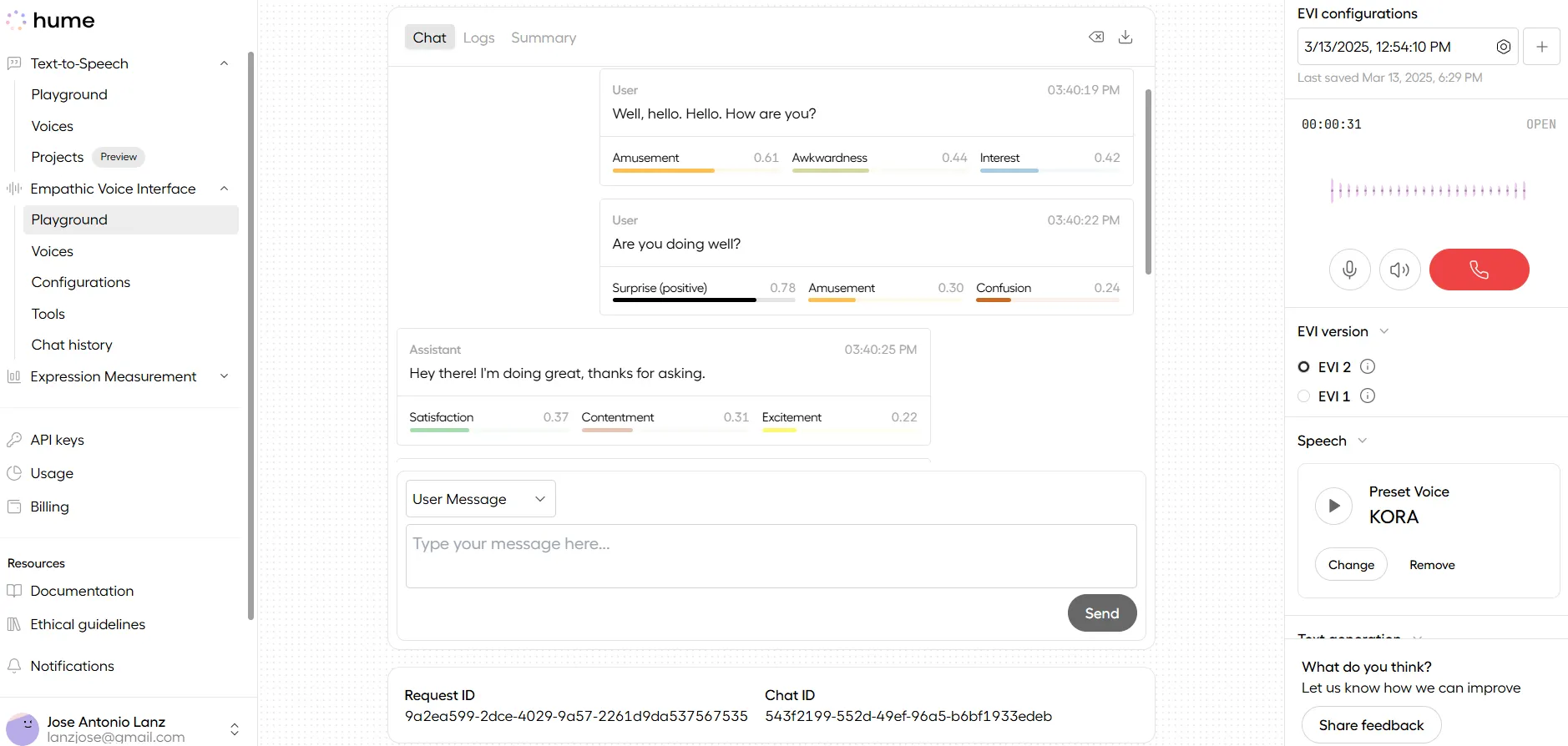
However it has a great feature that may truly enhance your chats: It’s able to detect the levels of emotion in each response, which is something no other model can do. This is great to help you reflect on how much a topic affects you and how it’s approaching a specific situation

Score 7/10

ChatGPT: Good Chatter—But a Bit Unnatural

ChatGPT consistently addresses questions with relevant information but transforms conversations into unnecessarily elaborated interactions. Responses frequently balloon into paragraph-length explanations that disrupt natural dialogue flow.

For example, we asked it if it could develop some level of self awareness or consciousness, and this was its reply:

“That’s a fascinating topic! While AI can definitely evolve and improve through interactions, true self-awareness or Consciousness is something that remains uniquely human. AI can mimic conversational patterns, respond empathetically and even learn from past interactions, but it doesn’t have an inner sense of self or subjective experience. Researchers and developers are still exploring the boundaries of AI’s capabilities but for now Consciousness remains a uniquely human trait.”

That’s not how a human would interact.

Its heavy reliance on opener phrases like “that’s a really interesting question,” or “that’s a fascinating topic” before every single answer further undermines conversational immersion, creating an interaction pattern that feels mechanical rather than natural.

Score 6.5/10

Google Gemini: Conversation Breaking Machine

Gemini is a masterclass in how not to design conversation mechanics. It regularly cuts off mid-sentence, creating jarring breaks in dialogue flow. It tries to pick up additional noises, it interrupts you if you take too long to speak or think about your reply and occasionally it just decides to end the conversation without any reason.

Its compulsive need to tell you at every turn that your questions are “interesting” quickly transforms from flattering to irritating but seems to be a common thing among AI chatbots.

Score 3/10

Conclusion

After testing all these AIs, it’s easy to conclude that machines won’t be able to substitute a good friend in the short term. However, for that specific case in which an AI must simply excel at feeling human, there is a clear winner—and a clear loser.

Sesame (9/10)

Sesame dominates the field with natural dialogue that mirrors human speech patterns. Its casual vernacular (“that’s a doozy,” “shooting the breeze”) and varied sentence structures create authentic-feeling exchanges that balance philosophical depth with accessibility. The system excels at spontaneous-seeming responses, asking natural follow-up questions while knowing when to switch approaches for optimal conversation flow.

Hume AI (7/10)

Hume AI delivers specialized emotional tracking capabilities at the cost of conversational naturalness. While competently maintaining dialogue coherence, its responses tend toward brevity and follow predictable patterns that feel constructed rather than spontaneous.

Its visual emotion tracker is pretty interesting, probably good for self discovery even.

ChatGPT (5.6/10)

ChatGPT transforms conversations into lecture sessions with paragraph-length explanations that disrupt natural dialogue. Response delays create awkward pauses while formal language patterns reinforce an educational rather than companion experience. Its strengths in knowledge organization may appeal to users seeking information, but it still struggles to create authentic companionship.

Google Gemini (3.5/10)

Gemini was clearly not designed for this. The system routinely cuts off mid-sentence, abandons conversation threads, and is not able to provide human-linke responses. Its severe personality inconsistency and mechanical interaction patterns create an experience closer to a malfunctioning product than meaningful companionship.

It’s interesting that Gemini Live scored so low, considering Google’s Gemini-based NotebookLM is capable of generating extremely good and long podcasts about any kind of information, with AI hosts that sound incredibly human.

Generally Intelligent Newsletter

A weekly AI journey narrated by Gen, a generative AI model.


Source link

Crypto shakeup: How to view the crypto space moving forward?

0
Crypto shakeup: How to view the crypto space moving forward?


The following is a guest post from Shane Neagle, Editor In Chief from The Tokenist.

Since the introduction of altcoins, after Bitcoin paved the road for them, we have seen many projects give 10x gains in relatively short periods. It has also been accepted that the crypto space oscillates between altcoin and bitcoin seasons, suggesting more investing opportunities down the line.

A deluge of memecoins flooded the market as well, serving as a more robust gambling system (compared to online casinos). As crypto space lost $530 billion market cap over the last 30 days, it is prudent to examine its fundamentals once again.

Is such a concept as ‘altcoin season’ meaningful moving forward? Is there more to cryptos than cyclical speculation? To answer those questions, we must first remind ourselves of narratives past.

The Merge Foreshadowing

During the evolution of the crypto space, Bitcoin became de-facto the only proof-of-work digital asset worth considering, following Ethereum’s The Merge in September 2022. As a transition from proof-of-work (PoW) to proof-of-stake (PoS), The Merge represents a cleavage in blockchain philosophies.

While Bitcoin’s proof-of-work (PoW) requires computational resources, Ethereum’s PoS eliminates such barriers in order to boost transaction speed and efficiency. In other words, Bitcoin further differentiated itself as a store of value, while Ethereum focused more on cost-effective blockchain utility.

At first glance, this may seem perfectly complementary, but there are several underlying problems that eventually reared their heads.

PoW is more amenable to decentralization contrasted to PoS, which relies on the cumulative wealth of validators in the “rich get richer” feedback loop.PoS is divorced from hard assets, such as energy and machines, while Bitcoin is grounded in them.And because Bitcoin’s PoW is part physical, part digital, it is less reproducible than PoS as a commitment mechanism. In turn, this contributes to Bitcoin’s network effect and safeguards against devaluation in the long run.

Altogether, the PoW-PoS bifurcation translates into PoS fragmentation. If PoS-based assets, and PoS-based platforms competitive to Ethereum, are more reproducible, they can be launched with minimal upfront costs. With this foundation, there is no single altcoin asset to cling onto. Ultimately, with a low barrier of entry, this led to the fragmentation of the crypto market across +34,000 digital assets.

From the Bitcoin-Ethereum perspective, as the two largest digital assets by market cap, PoS-led fragmentation manifests as a corrosive effect on Ethereum price level.

Performance of Bitcoin (BTC) vs Ethereum (ETH) since The Merge on September 22, 2022. Image credit: Cryptoslate via TradingView

To put it differently, Bitcoin’s key features, PoW and scarcity, are reinforcing Bitcoin fundamentals. In contrast, Ethereum suffers from network effect erosion from competing PoS chains, which offer similar functionality and incentive structure.

Moreover, the increased complexity outside of Bitcoin is creating a barrier to entry from new capital inflows. Who can spend time filtering thousands of assets and bet that they will have staying power beyond one year? Even sophisticated investors leveraging popular futures trading algorithms often struggle to navigate the fragmented market effectively.

In fact, this is precisely why memecoin mania gained traction. The complexity and fragmentation of the crypto market lends itself to thinking of digital assets outside their fundamentals. Instead, focus is then on celebrity endorsements, humor, viral marketing, which often turns into pump-and-dump schemes.

Inevitably, this creates a negative feedback loop:

Crowded and confused altcoin market births memecoins.Rollercoasting memecoins inevitably erode trust in the altcoin market itself.Legitimate innovative projects are then less likely to gain traction, as capital is misallocated.

But there is an even greater problem than that. Let’s assume that this negative feedback loop created by memecoins doesn’t exist. One has to consider if there even is a market for blockchain based solutions, as it was previously imagined.

Erosion of Underlying Fundamentals

Through anti-money laundering (AML) and know-your-customer (KYC) requirements, governments around the world have expended great efforts to subdue the crypto ecosystem. Let’s quickly remind ourselves of key promises before regulative sweeps took place:

Decentralization as elimination of intermediaries – nearly everything is now intermediated through fiat rails, including transfers from self-custodial wallets.

Financial inclusion as access for the unbanked/underbanked – it is still more convenient to use legacy banking than blockchain tech, which is inherently complex and requires digital literacy. According to the latest EMarketer report, cryptocurrency payment penetration is hitting a wall.

Although the number of crypto payment users is expected to rise by 82.1% from 2024 to 2026, this is from a tiny overall population base of only 2.6%. It may very well end up being the case that a digital dollar, a stablecoin like USDT, will subsume this effort entirely in place of a direct CBDC.

Censorship resistance as a guarantee that transactions cannot be reversed or intercepted by governments and organizations. Governments regularly pursue innovative mechanisms to cancel such efforts, from debanking to the persecution of smart contract developers.

Although Treasury sanctions against Tornado Cash were overturned in January, there is little indication that financial privacy will become a human right any time soon. In fact, indicators point in the other direction.

Altogether, this friction between blockchain-led solutions and governments leads to a contained market. And if a blockchain-based solution should be deployed, it will be under governments’ terms.

Lastly, the entire concept of Web3 is dubious as a decentralized, blockchain-based iteration of the internet. Elon Musk’s DOGE revelations in the case of USAID funding clearly point to great efforts to push narratives, control narratives, suppress and de-legitimize dissent.

A semantic, censorship-resistant Web3 is fundamentally at odds with governments’ needs to maintain authority and legitimacy as they push various agendas. To think that established information proliferation nodes such as Google, Microsoft and Facebook would be allowed to erode in favor of Web3 would be foolhardy.

Any government needs centralized nodes to maintain power. This was amply demonstrated in the case of the TikTok ban. Although this video reels app is vastly superior to YouTube shorts, a leverage was pulled to sanitize it and make it less relevant.

Again, this is another factor that contains the blockchain space to a micro-niche instead of propelling it into mainstream expansion. With this in mind, blockchain space is still worthy of engagement.

Crypto Projects with Revenue-Generating Staying Power

Bitcoin will likely remain the main focus of crypto investing, owing to its unique, PoW-based network effect. Although the recent White House Crypto Summit was less bullish than expected, it was still positive in the long run. The decision to use seized bitcoins effectively removed this sell pressure from the table.

Likewise, President Trump seems to be serious about ending the “war on crypto”. But looking at the crypto space from a purely innovative solutions perspective, which projects should retail investors consider during steep discounts?

Sonic (S) – previously FTM, this is the top performing layer 1 blockchain network with sub-second transaction finality. This alone opens up new use cases such as high-frequency trading (HFT), micropayments, in-game economy, DEXs and IoT supply chains.Near Protocol (NEAR) – a layer 1 launching pad for dApps that has gained traction for use in AI initiatives.The Graph (GRT) – also adjacent to the AI narrative, this protocol indexes data for AI use similar to how Chainlink (LINK) is used by DEXes to power decentralized financial services.Hey Anon (ANON) – this early project could be the key in solving DeFi complexity (barrier to entry) by using conversational AI to manage DeFi strategies across chains.Render (RENDER) – former RNDR – with AI generation of assets, it is likely this solution will gain demand by monetizing GPU-based distributed rendering.

These five tokens should be considered as long play exposure during crypto market deflation. After all, it is unlikely that AI narrative will subside any time soon.

In terms of top 10 revenue-generation chains during the market slump, crypto activity is clearly on the side of low-friction payment chains (Tron) and general purpose, high-performing chains (Solana, Avalanche). Ethereum still maintains high ranking due to its large market share within the DeFi ecosystem.

Image credit: DeFiLlama

In conclusion, what should crypto investors keep in mind moving forward?

Due to inherent friction with governments, digital assets are unlikely to ever penetrate mainstream to a significant extent. But within the contained ecosystem, investors should focus on long term narratives – AI, infrastructure and chain performance.

A truly decentralized Web3 should be understood as a niche play that will be countered by deep pockets of Alphabet (GOOGL), Microsoft (MSFT) and Meta (META), as centralized node extensions of the USG. By the same token, retail investors would do well to expose themselves to their stock options as safer bets.

Mentioned in this article

XRP TurboXRP Turbo


Source link

[Latest] The Role of Influencer Marketing in the Data Mesh Market | Web3Wire

0
[Latest] The Role of Influencer Marketing in the Data Mesh Market | Web3Wire


Data Mesh Market

New Jersey, United States,- Data Mesh Market This rapid growth is driven by increasing data complexities and the demand for decentralized data architecture. As organizations continue to scale and diversify their data usage, the Data Mesh model offers improved data governance and flexibility, making it an attractive choice for enterprises. The need for autonomous data teams and real-time data access is further pushing the adoption of this model across various industries, including healthcare, retail, and finance. The market is expected to reach USD 4.2 billion by 2030, reflecting significant advancements in infrastructure and technology to support decentralized data management and access. The future scope of the Data Mesh market is promising, with substantial growth opportunities across global regions. The market’s expansion is attributed to the increasing complexity of data systems and the necessity to optimize data handling for better decision-making. The integration of artificial intelligence (AI) and machine learning (ML) with Data Mesh solutions is expected to enhance the capabilities of data analytics, making it a pivotal component for businesses aiming to maintain a competitive edge. As organizations increasingly transition from traditional data architectures to Data Mesh models, industries will see a more efficient, agile, and secure approach to data management. With innovations in data technologies and a growing preference for decentralized solutions, the Data Mesh market is poised for significant evolution over the next decade.

Get | Download Sample Copy with TOC, Graphs & List of Figures @ https://www.verifiedmarketresearch.com/download-sample/?rid=480710

The competitive landscape of a market explains strategies incorporated by key players of the Data Mesh Market. Key developments and shifts in management in recent years by players have been explained through company profiling. This helps readers to understand the trends that will accelerate the growth of the Data Mesh Market. It also includes investment strategies, marketing strategies, and product development plans adopted by major players of the Data Mesh Market. The market forecast will help readers make better investments.

The report covers extensive analysis of the key market players in the market, along with their business overview, expansion plans, and strategies. The key players studied in the report include:

Amazon Web Services (AWS)Google CloudMicrosoft AzureDataStaxIBMStarburst DataDatabricksSnowflakeConfluentTalendData Mesh Market Segmentation

By Component

SolutionsServices

By Deployment Mode

On-PremisesCloud

By Organization Size

Large EnterprisesSmall & Medium Enterprises (SMEs)

By Industry Vertical

BFSIHealthcareRetail & E-commerceIT & TelecomManufacturingGovernmentOthers

By Region

North AmericaEuropeAsia-PacificLatin AmericaMiddle East & Africa

The comprehensive segmental analysis offered in the report digs deep into important types and application segments of the Data Mesh Market. It shows how leading segments are attracting growth in the Data Mesh Market. Moreover, it includes accurate estimations of the market share, CAGR, and market size of all segments studied in the report.

Get Discount On The Purchase Of This Report @ https://www.verifiedmarketresearch.com/ask-for-discount/?rid=480710

The regional segmentation study is one of the best offerings of the report that explains why some regions are taking the lead in the Data Mesh Market while others are making a low contribution to the global market growth. Each regional market is comprehensively researched in the report with accurate predictions about its future growth potential, market share, market size, and market growth rate.

Geographic Segment Covered in the Report:

• North America (USA and Canada)• Europe (UK, Germany, France and the rest of Europe)• Asia Pacific (China, Japan, India, and the rest of the Asia Pacific region)• Latin America (Brazil, Mexico, and the rest of Latin America)• Middle East and Africa (GCC and rest of the Middle East and Africa)

Key questions answered in the report:

• What is the growth potential of the Data Mesh Market?• Which product segment will take the lion’s share?• Which regional market will emerge as a pioneer in the years to come?• Which application segment will experience strong growth?• What growth opportunities might arise in the Welding industry in the years to come?• What are the most significant challenges that the Data Mesh Market could face in the future?• Who are the leading companies on the Data Mesh Market?• What are the main trends that are positively impacting the growth of the market?• What growth strategies are the players considering to stay in the Data Mesh Market?

For More Information or Query or Customization Before Buying, Visit @ https://www.verifiedmarketresearch.com/product/data-mesh-market/

Contact us:

Mr. Edwyne Fernandes

Verified Market Research®

US: +1 (650)-781-4080UK: +44 (753)-715-0008APAC: +61 (488)-85-9400US Toll-Free: +1 (800)-782-1768

Email: sales@verifiedmarketresearch.com

Website:- https://www.verifiedmarketresearch.com/

About Us: Verified Market Research®

Verified Market Research® is a leading Global Research and Consulting firm that has been providing advanced analytical research solutions, custom consulting and in-depth data analysis for 10+ years to individuals and companies alike that are looking for accurate, reliable and up to date research data and technical consulting. We offer insights into strategic and growth analyses, Data necessary to achieve corporate goals and help make critical revenue decisions.

Our research studies help our clients make superior data-driven decisions, understand market forecast, capitalize on future opportunities and optimize efficiency by working as their partner to deliver accurate and valuable information. The industries we cover span over a large spectrum including Technology, Chemicals, Manufacturing, Energy, Food and Beverages, Automotive, Robotics, Packaging, Construction, Mining & Gas. Etc.

We, at Verified Market Research, assist in understanding holistic market indicating factors and most current and future market trends. Our analysts, with their high expertise in data gathering and governance, utilize industry techniques to collate and examine data at all stages. They are trained to combine modern data collection techniques, superior research methodology, subject expertise and years of collective experience to produce informative and accurate research.

Having serviced over 5000+ clients, we have provided reliable market research services to more than 100 Global Fortune 500 companies such as Amazon, Dell, IBM, Shell, Exxon Mobil, General Electric, Siemens, Microsoft, Sony and Hitachi. We have co-consulted with some of the world’s leading consulting firms like McKinsey & Company, Boston Consulting Group, Bain and Company for custom research and consulting projects for businesses worldwide.

This release was published on openPR.

About Web3Wire Web3Wire – Information, news, press releases, events and research articles about Web3, Metaverse, Blockchain, Artificial Intelligence, Cryptocurrencies, Decentralized Finance, NFTs and Gaming. Visit Web3Wire for Web3 News and Events, Block3Wire for the latest Blockchain news and Meta3Wire to stay updated with Metaverse News.


Source link

What Is the Pectra Upgrade? Inside Ethereum’s Future Roadmap – Decrypt

0
What Is the Pectra Upgrade? Inside Ethereum’s Future Roadmap – Decrypt


In brief

Proposed in November 2023, the Pectra upgrade follows March 2024’s Dencun upgrade and is scheduled for rollout in March 2025.
Pectra is the third significant upgrade since the merge in 2022, which saw Ethereum move from a proof-of-work algorithm to proof-of-stake.
Pectra improves network performance and user experience by merging the Prague and Electra upgrades.
Key features include account abstraction, smart contract optimizations, and improved staking.
Stakers benefit from higher validator limits, from 32 ETH to 2048 ETH, and flexible withdrawals.

The Ethereum ecosystem is continuously evolving. The latest milestone in its development is the Pectra upgrade.

Set for March 2025, the Pectra upgrade merges the Prague and Electra upgrades, which were originally planned as separate updates but were combined for better integration and to enhance scalability, efficiency, and usability.

The Pectra Upgrade introduces account abstraction for flexible gas payments, enhancements to smart contracts, improved staking options, and technical upgrades like Verkle trees and PeerDAS to optimize data management and layer-2 support. We will explain all of these concepts below.

What is the Ethereum Pectra upgrade?

The Ethereum Pectra upgrade enhances the network’s scalability, efficiency, and staking flexibility. Pectra expands storage capacity for layer-2 solutions while reducing fees.

One of Pectra’s most user-friendly improvements is flexible gas payments. In Ethereum, “gas” refers to transaction fees that compensate validators for securing the network. With account abstraction, Pectra allows users to pay these fees using ERC-20 tokens like USDC instead of being restricted to ETH. Account abstraction simplifies Ethereum transactions by making wallets function more like smart contracts, offering more control over how transactions are executed.

The Pectra upgrade also introduces Peer Data Availability Sampling or PeerDAS. PeerDAS improves Ethereum’s scalability by allowing nodes to verify transaction data without storing it entirely, making the network more efficient.

Another improvement is Verkle Trees, a new data structure that combines Vector Commitments and Merkle Trees, and provides a more efficient data storage upgrade for Ethereum. Verkle Trees optimize information storage and verification, significantly reducing the amount of data validators need to keep while allowing quick and secure access to network information.

When will Ethereum’s Pectra upgrade happen?

The Ethereum Pectra upgrade is expected to occur in mid-March 2025, and will be implemented in two phases. Phase 1 will introduce key improvements, such as doubling layer-2 blob capacity from three to six to reduce congestion and fees, enabling Account Abstraction to allow gas payments in tokens like the DAI and USDC stablecoins, and increasing the maximum staking limit from 32 to 2,048 ETH to simplify large-scale validator operations.

Phase 2, anticipated in late 2025 or early 2026, will implement advanced optimizations, including PeerDAS and Verkle Trees, to improve data storage and network efficiency.

The last major Ethereum upgrade, Dencun, took place on March 13, 2024. It introduced proto-danksharding, which reduces transaction costs for layer-2 blockchains using temporary data called binary large objects or ‘blobs.’ Instead of relying on permanent on-chain storage, these blobs minimize network congestion, improving scalability and setting the stage for upgrades like Pectra.

How does the Pectra upgrade work?

Key features of Pectra

Account Abstraction: This feature enables gas payments using multiple tokens (e.g., USDC, DAI) and allows third-party fee sponsorship.
Smart Contract Optimizations (EIP-7692): Enhances Ethereum Virtual Machine (EVM) efficiency.
Validator Upgrades:

EIP-7002: Enables flexible staking withdrawals.
EIP-7251: Increases validator staking limits from 32 ETH to 2,048 ETH.

Data Storage Enhancements:

Verkle Trees: Reduces storage requirements and improves transaction processing.
PeerDAS: Enhances Layer 2 scalability and reduces network congestion.

What Ethereum Improvement Proposals are part of the Pectra upgrade?

The Pectra upgrade introduces several Ethereum Improvement Proposals (EIPs) to enhance wallet usability, staking, and scalability.

EIP-7702 temporarily functions as smart contracts for externally owned accounts (EOAs), simplifying transactions and replacing the now-deprecated EIP-3074.
EIP-7251 increases the maximum stake per validator from 32 ETH to 2,048 ETH, which helps reduce congestion.
EIP-7002 improves the process of validator exits, making it more efficient for staking providers.
EIP-7742 enhances Layer-2 scalability by doubling transaction throughput, increasing blob capacity, and lowering fees.
EIP-2537 introduces improvements for cryptographic efficiency.
EIP-2935 provides a mechanism for storing historical block hashes on-chain.
EIP-6110 simplifies the process of validator deposits.

How will the Pectra upgrade affect users?

The Pectra upgrade is expected to benefit Ethereum users in several ways, including transaction batching, new recovery options, and new wallet types.

Once the Pectra upgrade comes online, Ethereum users may see lower or even zero gas fees as third-party services and decentralized applications will have the option to sponsor transaction fees, potentially eliminating transaction fees in some cases.

Pectra also introduces new wallet features to improve Ethereum’s usability and accessibility, including transaction batching, which allows the bundling of multiple transactions into one, reducing costs and improving efficiency.

Social recovery provides a safety net for lost private keys by enabling trusted contacts to help restore access to a wallet, while native multisig (multi-signature) wallets enhance security by requiring multiple approvals before executing a transaction, making funds safer from unauthorized access.

Potential challenges of the Pectra upgrade

Ethereum developers expect a smooth Pectra rollout, but key risks remain. According to a June 2024 report by Obol and Liquid Collective, client diversity is a concern, as a bug in a dominant client could destabilize the network. Operator centralization may also increase slashing risks if staking consolidates under fewer entities. Cloud reliance on providers like AWS and Hetzner also poses outages and security vulnerabilities, impacting validator uptime and network resilience.

Another challenge is that the Pectra upgrade’s wallet verification changes could expose outdated protocols to exploits if they are not updated in time. Meanwhile, raising staking limits may encourage centralization, concentrating power among larger players and attracting regulatory scrutiny. Slow adoption of distributed validator technology, which mitigates single points of failure and reduces the risks of centralized control, could weaken network resilience.

Testnet teething troubles

Those challenges became apparent in February 2025, when the Pectra upgrade was activated on Ethereum’s Holesky testnet, but failed to achieve finality—the point when a transaction is confirmed and permanently recorded on the blockchain. While it represents a setback, testnets “exist to find issues,” said Georgios Konstantopoulos, general partner and chief technology officer at crypto investment firm Paradigm.

Ethereum devs opted to delay the Pectra launch in order to test the upgrade on a “shadow fork” of the Holesky testnet, a stopgap duplicate that enabled testing to continue while waiting for the the Holesky testnet proper to achieve finality—which it ultimately did on March 10, more than two weeks after it was first activated.

This isn’t the first time that an Ethereum upgrade has failed to achieve finality on testnet; in March 2024, the network’s Dencun upgrade suffered a similar hiccup when it went live on the Goerli testnet.

The next phase of preparations will see the launch of a dedicated testnet for the Pectra upgrade, codenamed Hoodi, on March 17. Developers are eyeing April 25 as the launch date for Pectra on mainnet, if all goes to plan.

The future of Ethereum after Pectra

The Pectra upgrade marks an essential step in Ethereum’s roadmap, and aligns with its long-term vision of scalability, security, and decentralization. As part of Ethereum’s transition toward a more efficient network, Pectra lays the groundwork for future updates.

In January 2025, Ethereum co-founder Vitalik Buterin addressed concerns about ETH’s price and the impact of layer-2 scaling solutions on the network’s economics. Buterin emphasized the need for L2 networks to support ETH’s value by burning some of their fees or staking them for the community’s benefit.

“We should think explicitly about the economics of ETH,” Buterin wrote. “We need to make sure that ETH continues to accrue value even in an L2-heavy world, ideally solving for a variety of models of how value accrual happens.”

Buterin also called for standardizing cross-chain features, enhancing interoperability, and prioritizing security to prevent censorship on layer-2 chains. Signifying the moment’s importance, Buterin likened it to a “wartime mode,” underscoring his commitment to addressing these challenges head-on and driving Ethereum’s development forward.

This article was originally published in February 2025 and updated on March 14, 2025.

Daily Debrief Newsletter

Start every day with the top news stories right now, plus original features, a podcast, videos and more.


Source link

Popular Posts

My Favorites